Couchbase CEO: There is lots of room for database competition
Oct 19, 2022
Show notes
The database is a computer technology that once seemed pretty settled terrain given the success of Oracle, IBM, Microsoft, and a few others. But it is such an important technology that there have been many attempts to redefine what the database is for an era of cloud computing.
And, so, the past decade has seen new products such as Amazon’s “RedShift” database, and new companies, including Snowflake and MongoDB, and Databricks, each with bold and intriguing new approaches.
Some would say that despite decades of development, the battle for the future of the database is just beginning.
“I do believe there will be an emergence of more database companies,” says Matt Cain, the CEO of one of those companies, Couchbase. “It’s a sixty-billion to one hundred-billion-dollar total assessable market, and the demand is significant.”
Fourteen-year-old CouchbaseofSanta Clara, California,is the latest promising database startup to come public, in July of last year, just before the IPO window shut.
The potential hundred-billion-dollar market Cain describes, what he calls a “generational market opportunity,” is the proliferation of apps by all companies as they “digitally transform,” meaning, reach more and more of their customer base via software.
“There is an insatiable demand for applications,” Cain tells me, in an interview we had recently via Zoom.
“There is not a single company that is not thinking about how to use technology to get closer to their customers,” he says. “But behind every applications is a database.”
And that database for modern applications, he says, needs to be of a certain kind.
“Why have we emerged?” he asks, rhetorically of Couchbase. “We are fulfilling a need that just can’t be fulfilled by MongoDB, or the hyper-scalers, or, certainly, legacy providers” such as Oracle.
As is often the case these days, that technology edge has its roots in open-source software.
Around 2008, a startup called CouchOne was formed by Damien Katz, who had created CouchDB, an open-source database. CouchDB had a special ability to represent information as documents, which allowed it to work with all kinds of data, not just the “relational” columns and rows of traditional databases.
A second company, MemBase, was formed around the same time to exploit another open-source project, Memcached, a technology that allows multiple server computers to share their DRAM memory circuits, thus speeding up processing by “caching” data.
The merger of the two startups in 2011 formed Couchbase, and it created a product with attributes particularly well suited to the cloud computing era. They included the ability to make a database “scale” across all kinds of computers, from servers in data centers down to smartphones, and to do so while accommodating all kinds of data, including images and video, things not handled by relational databases.
Couchbase, along with a whole field of challengers to the status quo, came to be known as “NoSQL,” or “not only SQL.” It was a statement of defiance, and also a dig at the S-Q-L query language of the status quo.
The late co-CEO of Oracle, Mark Hurd, dismissed NoSQL as much ado about nothing when I asked him about it 2015. What Hurd called a fad tuned out to have real momentum, despite some false starts.
A NoSQL startup named MarkLogic was taken private in 2020 by private equity firm Vector Capital Management. But another NoSQL name, MongoDB, came public in 2017, and, up until this year’s collapse, its stock had a great run. Established companies such as Amazon and even Oracle ultimately climbed aboard, offering their own No-SQL databases.
While Katz and many of the other co-founders of Couchbase moved on, the company in 2017 gained what you’d call adult supervision with the arrival of Cain. He had large company experience, including running worldwide field operations for data backup company Veritas, later sold to private equity.
“I was fortunate enough to know one of the early investors,” recalls Cain. “He called me and said, ‘Let me talk to you about the best company you’ve never heard of.’” As they discussed it, Cain said he realized a substantial “disruptive” market opportunity was on the horizon.
Cain is acutely aware that Couchbase has competition from MongoDB but also the dominant companies such as Amazon and Oracle that now offer their own NoSQL product.
MongoDB’s success is well-earned, he says. “MongoDB is a document-based database, and they have proven how useful that can be,” he says. “What makes Couchbase unique” from MongoDB and the other NoSQL offerings, he says, is the union of the former CouchOne and Membase in 2011, the combination of document database and caching.
“If you put those two things together, that becomes the foundation of a platform that will serve the highest-performing applications over time” by offering not just speed, he says, but also “a very flexible data schema to serve the types of applications we’re building for.”
Profitability is “an eventuality,” says Cain, “the question is what is the pace.” There are a lot of investors, he says, “who would say, Keep investing, there’s so much upside."
A “schema,” in this case, is the way that the database organizes information. The traditional relational database sold by Oracle and IBM and others is based on a columnar format, rows and columns like a spreadsheet. The NoSQL document database is more fluid, it can organize information with any number of attributes.
“They’re trying to hang on,” he says of Oracle and other database giants, but “relational [databases] don’t have the schema to support modern apps,” says Cain. “If you talk to anyone of our customers, they would say, you can’t extend Oracle to provide the same value” as Couchbase.
While cloud giants such as Amazon have their own NoSQL databases, “We have to differentiate on scale and performance, but also running in every cloud, and cloud to edge,” because enterprises want to use multiple service providers.
The most intriguing aspect that may distinguish Couchbase is one I was not aware of, which is that the company has fashioned versions of Couchbase to run in an embedded fashion. The “lite” version of the database can be installed on “Internet of Things” devices or mobile phones, places that would normally be too resource-poor to run a database of any meaningful ability.
“What Couchbase did was, we said, If we think about the future of applications, they are not only going to be running in data centers, on premise or in the cloud, but all the way out to the edge,” says Cain.
The edge, in this case, is the panoply of devices outside a data center that need their own database.
“I would be willing to bet you a cold beer,” he says, “that you have five to ten couchbase instances in the phone in front of you because Couchbase is running co-resident inside the application in the device.”
“Think about how many times you’re touching things on a mobile device, whether it’s streaming content or interacting with your banking platform, or engaging with your healthcare provider or playing an online game,” says Cain.
“All these things are happening in your mobile device, and it’s a fundamentally different challenge to support that from a database, and we have architected that from the beginning.”
All of Couchbase’s capabilities, says Cain, are in service of “trying to solve the hardest and most sophisticated computer science problems in the industry, in supporting some of the world’s largest, most mission-critical, high-performing applications.”
The mission-critical apps might surprise you.
A signature use of Couchbase is onboard the Princess Cruise Lines of Carnival Corp. The company uses Couchbase inside a pendant the size of a quarter that can be worn as a bracelet or necklace, called a “Medallion.”
Guests on the ship who wear the pendant travel in what Carnival calls “MedallionClass.” Using wireless technology, the pendant lets a guest have “contactless boarding” of the ship, keyless entry to their cabin, instantly locate friends and family onboard the boat, and get anything and everything delivered to them wherever they are with a tap on the companion smartphone app.
The medallion becomes a personal tracker with all sorts of possibilities.
“You and I could sit down at the bar for the first time, have a beer, they’ve now created a social hypothesis that you and I have befriended each other,” explains Cain. “Unbeknownst to us, two days later, there’s another sporting event, they send an ad to each of us saying, fifty percent off on beers in the next hour and a half, we both show up, and it’s, ‘Hey, Tiernan, how’s your cruise going?’ — all of that runs on a Couchbase platform in a wearable.”
The medallion, moreover, becomes a way for the cruise line to plan inventory and services. All those medallions send data to a Couchbase instance running in the cloud that can be sorted and sifted for analysis.
“This is the example of completely transforming digitally,” says Cain. “There is no platform on the planet that was architected for that use case.”
And the value of those things becomes greater than just the immediate revenue that Couchbase earns.
“Where the revenue resides based on our pricing model doesn’t fully account for how strategic the technology is,” says Cain.
I point out to Cain that for me, personally, a pendant that tracks my every move is a bit spooky. “It’s cool,” is his rebuttal, and even “mind-bending.” You can always opt out, he points out. It will come down to the application developers finding what works for their customers. But the implications for the database are signficant.
“That is the definition of digital transformation, that is what Couchbase has been built for,” he says.
So far, the strategic applications are fueling decent growth but not profitability. Couchbase told analysts last month that it expects to make around $150 million in revenue in the year ending in January, a twenty-two percent year-over-year gain.
The company’s track record is good, having notched five quarters since the IPO in which revenue beat expectations. But the company is also expected by the Street to lose $1.17 per share this year, excluding some costs. Both earnings per share and free cash flow are expected to remain negative through 2025.
In the current climate of greater fiscal probity among investors, how do his shareholders view that loss-making outlook? I ask.
“We take our fiduciary responsibility with the utmost sensitivity,” says Cain. “What is most important to investors is that they understand that we have a strategy to build a great company over time, and that we also have the operational handles and levers to flex as business conditions and macro economic environments dictate that we need to, in service of building a great company over the long term.”
Having operated through multiple economic cycles, says Cain, the company has proven it can rein in spending or expand it as need be.
But, he says, the company is “still in investment mode.” Couchbase’s cloud version of its software, called “Capella,” introduced a year ago, is going to “take us to new heights,” he says. The service, which runs in public clouds including Amazon AWS as a rentable service, is a focus of Couchbase’s spending on product development.
“There are a lot of investors who would say, Keep investing, there’s so much upside,” he observes.
Profitability is “an eventuality,” he says, “the question is what is the pace.” The company will probably host an “analyst day” meeting in the first half of 2023, he tells me, the implication being that there will be some goal-setting for profit at that time.
I point out to Cain that at a recent price around $12, the stock is fairly cheap, trading at a multiple of next year’s sales of less than three times.
Is the stock a good buy? I ask Cain.
“Look, I tell everybody with as much conviction as I can that the best days of Couchbase are in front of us,” says Cain.
“I jumped out of bed this morning knowing that today is another day I get to work with the other Couchbasers around the world,” he says. “We are very bullish about what we’re doing, and, unquestionably, we think there is tremendous upside at Couchbase.”
Couchbase stock is down fifty-one percent this year, and fifty-six percent since IPO.
Bitcoin chips, puppy Web sites among Q3’s terrible IPO returns
Oct 15, 2022
Show notes
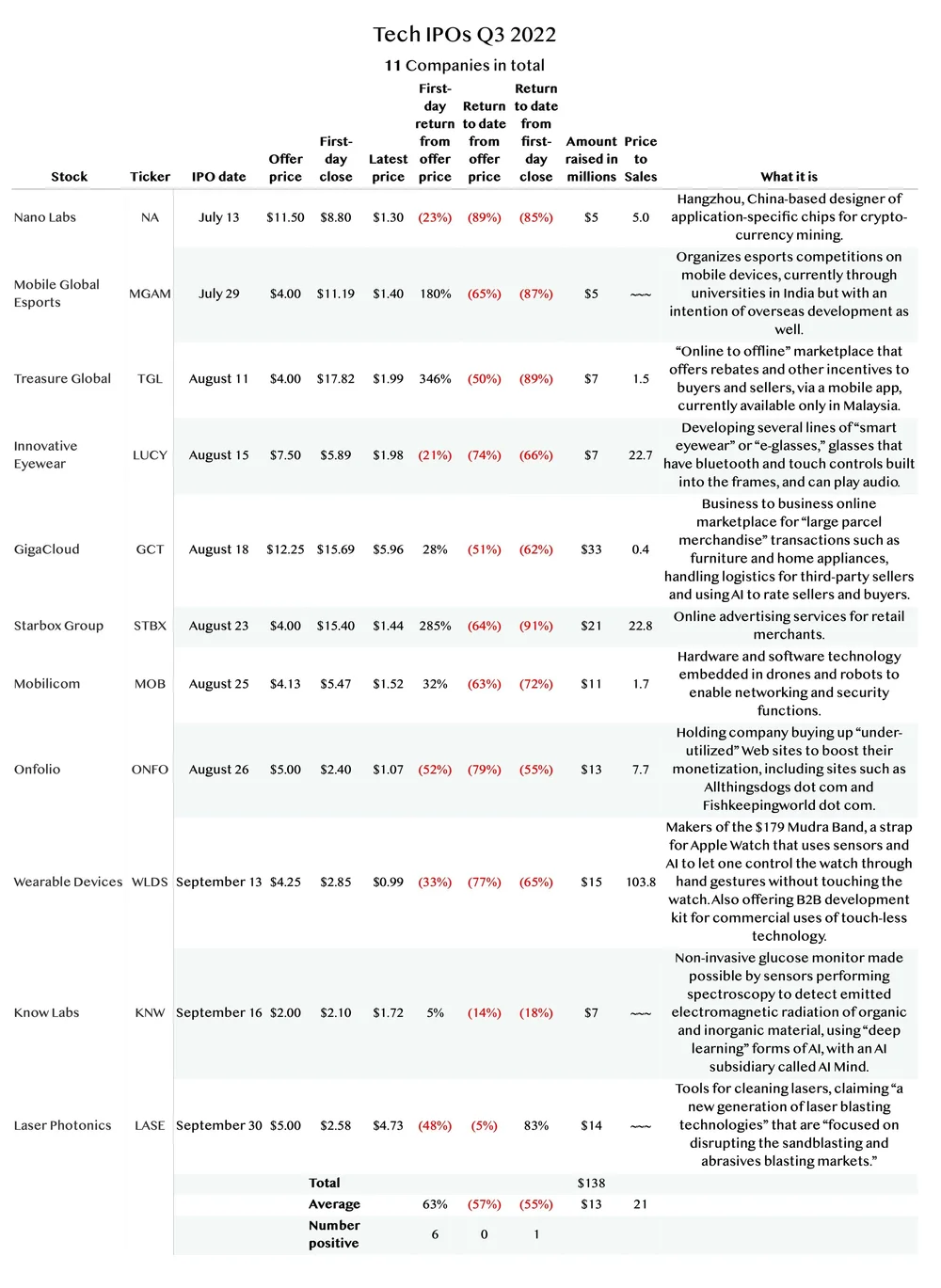
Even though the initial public offering window has slammed shut this year, that doesn’t mean that no tech companies came public. In fact, if you paid attention in the third quarter, July through September, you got to see eleven rather curious tech companies coming public, representing everything from puppy-enthusiast Web sites to touch-less gesture controls to crypto-currency mining.
The singular achievement of this cohort of eleven offerings is that it represents a huge jump from only five offerings in the second quarter and eight offerings in the first quarter.
It was, however, a pretty awful quarter to go public, with absolutely terrible price declines.
It started out just fine. The average first-day pop, meaning the rise in price from the offer price to the closing price on the first day of trading, was an average gain of sixty-three percent, which is wonderful for the selling shareholders who cashed out.
But with the broad market declines in late August and September, the average decline in price from the offer price till today, and from the first-day close till today, was fifty-seven percent and fifty-five percent, respectively. Ouch!
They are all below their offer price at this point, and only one company has notched a gain from the first-day price, Laser Photonics, mostly because it had a big nineteen percent jump on Friday.
And valuations have cooled off, the average price-to-sales multiple for these stocks being just twenty-one, down from twenty-eight last year.
Three of the eleven companies are “pre-revenue,” as they say. But I wouldn’t call these companies the dregs of IPO. Perhaps they are the brave companies willing to stick their necks out. They certainly raised money, a grand total of $138 million, and an average of $13 million.
They are an odd lot, though, I must say.
You can divide the eleven into “hard” tech, things that might take an engineering degree to get off the ground, like chips and sensors, and “soft” tech, things that are more about reinventing a fairly straightforward type of business that is not necessarily very tech-heavy.
In the first category, hard tech, an example is Nano Labs, based in the city of Hangzhou in the Zhejiang province in China. The company, founded in 2019, makes designs for chips to crunch numerous crypto-currencies, including Bitcoin and Ether.
That’s interesting because there is already pretty fierce competition in the market for crypto mining chips, including the two dominant vendors BitMain and MicroBT. Intel is also in the market with some initial chips, and, of course, Nvidia is a huge competitor even though they don’t have the market share of BitMain and MicroBT.
Nano Labs doesn’t mention those competitors by name, merely states that it faces “intense” competition.
Another hard tech firm is Mobilicom of Tel Aviv, which has been around for sixteen years. The company notes that it has patented hardware and software technology to embed a variety of functions into drones, or “small, unmanned aerial vehicles,” SUAV, as they’re termed.
The two main pieces of art the company claims are a modem technology to efficiently transmit data wirelessly, referred to as “joint beam formation and synchronization,” which is covered in a 2013 patent; and an algorithm to form “mesh” networks spontaneously, or “ad-hoc,” covered by a 2020 patent.
Unlike some other companies, the firm has revenue, a total of two and a half million last year. It’s also losing money, almost two million dollars last year. The eleven million in proceeds from the August 25th offering will help in that regard.
There was even a consumer tech company that came public, eight-year-old, Tel Aviv-based Wearable Devices, which won an award last year at the CES trade show in Las Vegas for its Mudra Band, a watch strap for your Apple Watch that lets you control the watch without touching it, just by making gestures with your fingers.
The Mudra technology — “Mudra” is a Sanskrit word for “gesture” — involves something called “Surface Nerve Conductance,” or SNC, which lets the band “track neural signals on the surface of the user’s wrist, which our algorithms decipher to predict as finger movements or hand gestures.”
The sensors “can detect multiple types of gesture,” says the company, including hand movements, finger movements, and fingertip pressure gradations. There’s also the prospect of using the bands for digital health, the company says.
Wearable Devices will also offer a “kit" for developers in corporations to build on the technology. However, the company hasn’t mass-produced anything yet. Several million dollars of the fifteen million raised will be used for mass-production of the $179 Mudra Band and for marketing and sales.
On the softer side of tech, there’s two-year-old OnfolioHoldings of Wilmington, Delaware, which received thirteen million in its August IPO to buy up odd Web properties that are “under-monetized.”
The company spells out its business plan in the prospectus: “We believe there are opportunities to acquire ‘distressed' eCommerce and content websites, or where the sellers have not optimized the website to the fullest,” and then determine the “leverage points and growth opportunities that the current website owners have not fully utilized.”
It seems a daunting task given these are somewhat oddball sites. The eighteen sites owned include allthingsdogs.com, Vital-Reaction.com, a site for sales of molecular hydrogen tablets, and onthegas.org, a site with recipes for things like “beer can chicken” and reviews of cooking equipment. And I thought Technology Letter was a niche.
Another soft-tech venture is sixteen-year-old GigaCloud, based in Hong Kong, whose business is to streamline business-to-business commerce pertaining to large “parcel” items, such as furniture and home appliances. The company acts as a kind of hub to bring together third-party sellers of such goods with resellers who would like to sell the merchandise on their own Web sites.
The company’s marketplace has been live since January of 2019. GigaCloud describes the offering as “a true comprehensive solution that transports products from the manufacturer’s warehouse to end customers, all at one fixed price.”
A big part of the plan is providing the fulfillment capabilities merchants need. The company notes that it operates “warehouses in four countries across North America, Europe and Asia,” including twenty-one “large-scale warehouses around the world totaling over four million square feet of storage space, cover 11 ports of destination with over ten thousand annual containers,” as well as “an extensive shipping and trucking network via partnerships with major shipping, trucking and freight service providers.”
Oh, and the company uses special AI software, it says, to model seller ratings and credit profiles. You have to have AI in your business plan these days.
GigaCloud has some real revenue here, totaling $414 million last year, and net income of $29 million, not bad. That’s with 382 active sellers last year, and 3,566 active buyers spending an average of almost a hundred and twenty thousand a year.
Are there any winners here? None that immediately stand out to me, but I wouldn’t count them out, either. I tend to lean toward the hard-tech companies, just because the value of patents seems to me a clear point of differentiation for those companies.
I will tell you this: at an average stock price of $2.19 for all eleven, you could certainly roll the dice on any of them without it costing you much.
In case you were wondering, this brave cohort has not thus far reignited the IPO market. In the first two weeks of October, no tech companies have gone public.
Taiwan Semi says demand for cutting-edge chips remains, plays down China risk
Oct 13, 2022
Show notes
Taiwan Semiconductor Manufacturing, the largest contract chip manufacturer in the world, overnight reported revenue and profit higher than the Street was expecting, and forecast this quarter’s revenue higher as well, and the tone was relatively upbeat considering how much worry there has been about the chip industry this year.
During the company’s conference call with analysts, CEO CC Wei said chip companies continue to “adjust their inventory,” basically the same comment that memory-chip maker Micron Technology had made during its call last week. The sudden drop-off in demand for PCs and smartphones means that chip makers have to find a way to sell off inflated inventories of chips before they contract with TSM to make any more.
Even so, TSM’s revenue rose by thirty-six percent, year over year, to $20.2 billion, topping consensus for twenty billion, and in line with TSM’s own forecast.
The company’s forecast for the current quarter is a range of $19.9 billion to $20.7 billion, which is, again, ahead of the consensus for twenty billion dollars.
Numerous analysts tried to pin down Wei, and CFO Wendell Huang, about the timing of burning off that excess inventory. The duo stuck to a broad statement that things get better in the back half of next year. “It will take a few quarters through first-half 2023 to rebalance to a healthier level,” said Wei of the inventories.
The really astounding thing is that Taiwan Semi’s most cutting-edge chips, those measuring three billionths of a meter, or three nanometer, at their critical dimensions, are in greater demand than the company can currently supply. Revenue from three-nanometer, said Wei, will be higher than was revenue from the prior cutting edge, five-nanometer, when that generation was introduced in 2020. Those “three nano” chips, as they’re called, are being used for high-performance computing, probably things such as Nvidia’s latest and greatest chips, for AI and such, and for smartphones, probably Apple’s next thing.
Hence, inventory build-up is occurring at the same time as raging demand for the latest and greatest TSM can offer.
The healthiest part of the market for Taiwan Semi, said Wei, is chips for data centers — obviously, because of AI — and for automative applications — obviously, more and more chips in cars. Wei told analysts he sees no slowing down at the moment, but also said he “wouldn’t rule out” a slowdown at some point. When he was challenged on that point, Wei clarified that he’s trying to be realistic given broad macroeconomic worries.
“The data center and automotive-related are still steady,” said Wei. “But now, the market becomes soft and we are taking a more conservative way in our planning for 2023,” he said. “And that's why we say that we don't rule out the possibility they might have some correction also, but, you know, we do not see it right now, to be frank with you.”
The one area of most tension at the moment is China, specifically new regulations imposed by the U.S. Department of Commerce on sales of chips to the country. Wei remarked that his “initial reading” after talking with TSM’s customers, is that the regulations imposed are “very high-end specification, which is primarily used for AI or supercomputing applications,” meaning that it only affects a small group of chips.
That is similar to what Nvidia’s CEO, Jensen Huang, had said when asked about the matter during a press conference I attended last month. The regulations are being characterized as “specific,” meaning, limited in their scope and effect. More a way to perhaps annoy Beijing, or keep it off balance, is the sense being conveyed.
Said Wei, “Therefore, our initial assessment is the impact to TSMC is limited and manageable.”
Taiwan Semi stock is up almost three percent this morning at $65.69. The shares are down twenty-five percent since being named in the inaugural TL20 in mid-July.
Welcome to downgrade season, look for the peak later this month
Oct 12, 2022
Show notes
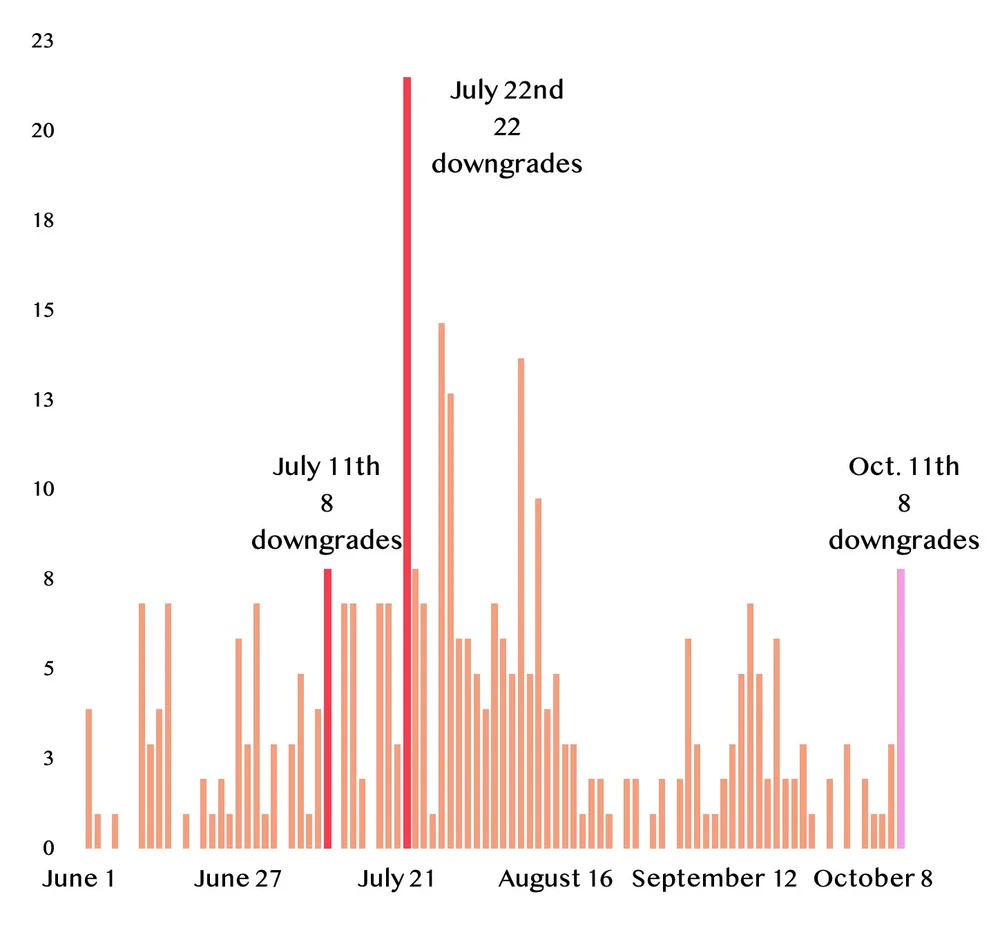
If you were watching stock ratings on Tuesday, you would have seen what seemed like a cataclysmic implosion of faith. Not only did the Nasdaq Composite have its fifth straight decline, closing down one percent, but there were a whopping eight downgrades of tech stocks, the greatest number in a while.
But, not actually that unusual, it turns out. This is about par for the start of earnings season. The chart shows you how things looked at this point in time last quarter, starting with the month of June. Oracle had been the first to report, on June 13th, the unofficial start of earnings season.
Daily downgrades of tech stocks by number of downgrades. Gaps indicate days that had no downgrades of tech stocks.
I’ve highlighted a few major milestones. In purple, the most recent bar on the chart, are the eight downgrades today, October 11th. In red, you see first the same date three months ago, July 11th. Lo and behold, there were also eight downgrades that day. Same part of the season, eleven days into the first month of the quarter, and the same number of downgrades.
The second red line, the highest line of all, was the third week of the month of July, July 22nd, when there were, in fact, twenty-two downgrades. I don’t know if there’s a numerological significance to twenty-two on twenty-two. What we do know is that the huge number was inflated by a whopping eleven downgrades of one stock, Snap, whose advertising business was in free-fall.
So, today’s downgrades are not unusual in their number. And, similar to the eight downgrades back on July 11th, the cuts today were distributed across different parts of tech. The eight names are: F5 Networks, Rackspace, Meta Platforms, Ciena, Zoom Video, Qorvo, Skyworks, SunPower.
I would note, too, that the number of downgrades daily from June 1st through July 11th, 2.6, is precisely the same number of downgrades as we’ve seen so far from September 2nd to today. So, there’s nothing unusual about the pace thus far.
Now, this is a completely unscientific exercise in fitting data to a curve, obviously, but if I were to infer anything from this small sample, it would be that the downgrades will peak in two weeks’ time, the week of October 24th, given that it corresponds to the position in the season of those twenty-two downgrades on July 22nd. The week of October 24th will be one of the heaviest weeks of earnings season, with reports from Alphabet, Amazon, Apple, ServiceNow, Meta, Twitter, Intel, and many more, so it makes sense you might see a giant cluster of ratings changes.
Of course, past performance is no guarantee of future returns, but at least it’s someplace to start.
Databricks CTO: Making our bet on the lake house
Oct 11, 2022
Show notes
The ambition of Databricks, to make the data “lake house” ubiquitous, has the audacious goal of giving everyone in a company access to all the data, not just some of it. It could be the birthing of a new era for the database industry. The vibrant innovation we’ve seen in cloud computing in the past decade resulted in many intriguing companies coming to the public markets, such as Snowflake and MongoDB — that is, before the IPO window slammed shut this year. With the cancellation of the IPO market, future stars have been kept on the sidelines. One of those still-private entities is so far along, it’s surprising they didn’t come public in the cohort with Snowflake and others. Databricks, a nine-year-old software maker based in San Francisco, is on course to make a billion dollars in annual revenue, growing at a rate of eighty percent. The company has received almost four billion dollars in venture money over eleven rounds, so it is not in need of any immediate financing. The other day, I talked with Databricks’s co-founder and chief technologist, Matei Zaharia, on Zoom. You cannot buy into a private company, but they can tell you a lot about the public markets that is worth paying attention to.“Basically, we're trying to create a uniform sort of platform that you can use to manage all the data in an enterprise,” is Zaharia’s modest mission statement. As Zaharia explains it, the database market has “two big platforms” for data. One is called a “data lake,” which is “a place you just put data in piles.” It could be spreadsheet data, it could be video files, it could be tons and tons of text documents. “That's actually where the majority of the bytes are” in the world’s aggregate data trove, says Zaharia. Usually, companies build data lakes by buying cheap storage at, say, Amazon AWS in which to dump their data. “And then there's the data warehouse, which is where you curate the data into tables, and you add access controls, and you expose them to users,” says Zaharia. The data warehouse, a term that has been around for more than twenty years, is the manicured version of data, with everything neatly organized for the data scientist. Snowflake is today’s paradigmatic example of the modern data warehouse. It uses cheap data lake storage from Amazon, yes, but then it groups data in structured ways that look familiar to an enterprise.The “uniform platform” that Zaharia is building might be a kind of “third way,” if you will, a compromise. The amusing term for it is a “lake house,” meant to suggest the best of both data lake and warehouse. “Our thesis on the market is that the best data warehouse is this lake house model where you can take all the raw data you have in Amazon S3 and you can turn that into very structured tables and get great performance out of it,” says Zaharia. (“S3” is the name for Amazon’s bulk data storage service.) Databricks is a very broad platform for distributed computing, says Zaharia. “We don't have to translate everything to Spark,” he says. “A lot of what we do is simply the launching, managing of workloads, installing all the software on them, checking if they work well — that’s useful for anything you have to run, not just Spark.” The ambition is very broad access to information, much more than what employees at a company typically got.“We're trying to make the lake good for both, and evolving it into something so that you can have everyone work with all the data” in a company. “That’s actually the model that a lot of the tech companies like Airbnb and Uber and so on use internally already — everyone who started in the modern world, and designed the data stack based on what's available” rather than working with the old stuff.“We're hoping to bring that to traditional enterprise workloads and make it usable by everyone,” says Zaharia. “Our bet is on the lake house model.”The world of data, then, is something of a pitched battle between a Snowflake approach, the data warehouse, and the Databricks approach, the lake house, though there’s considerable overlap at the end of the day. The dueling approaches are a culmination of fifty years of database development that has seen two great revolutions.A database, generally speaking, is an organized way to keep track of information, such as, for example, names and addresses of customers. Up until the 1970s, IBM was a monopoly provider of databases, given that they provided the mainframe computers that ran the database, and the disk drives on which the data resided. The process of using a database was fraught because you had to know how the IBM mainframe was constructed to do the simplest sort of retrieval of customer data. You had to be a computer systems engineer. An IBM scientist, Edward “Ted” Codd, in the 1970s came up with a novel approach to databases. Codd figured everything would be better if the database presented a logical table of information, similar to what you see in your Excel spreadsheet, columns and rows, and hid the details of the computer. Give people access to data in a logical format, and it wouldn’t matter what was under the hood. Thus was born the so-called relational model of databases, where the user manipulates relations between pieces of data. It was a profound insight, but, in true monopoly fashion, IBM dragged its feat realizing Codd’s vision. Instead, Larry Ellison ran with it and founded Oracle. Many other companies joined in the relational market, such as Microsoft, breaking IBM’s monopoly on database software. Everything was dandy for a while, and database administrators got paid six figures to fine-tune the relational approach for big banks and oil companies and other enterprises. That is, until the Web came along, prompting the second big change to databases of the past fifty years. Early in the Naughts, Google was struggling with a database problem of epic proportions: how to store and sort and sift data on all the billions of Web pages and their connections. Just as in the old IBM days, Google scientists were having to pay too much attention to the details of how data was stored across fleets of thousands of Google computers. Google came up with some home-grown software that automatically divided up the Web indexing task across those fleets of computers while hiding the details from programmers. The result was a “parallelized” database that could easily sort and sift collections of data at unprecedented scale by treating many computers as one giant computer.The Google approach was a hit, and numerous projects, both commercial and open source, built on its success. In 2009, Zaharia, then an assistant professor at UC Berkeley, got together with some colleagues to build their own enhancement to Google’s approach, called Spark. Google’s system was very good, they said, but its Achilles Heel was that it spent too much time looking for the data on all those disk drives inside all those thousands of computers. Spark made one small but significant modification: it figured out how to keep more of the most-used data in fast DRAM memory, which can be read much faster than disk. Spark also altered the division of labor of Google’s proposal by assigning tasks to each computer depending on how close a computer was to the disk storing the relevant data. The enhancements produced gigantic speed-ups, and Spark became a more-efficient way to run massive data operations on fleets of computers, perfect for the cloud era. “We made it easy for any data scientist or analyst to run things on these giant clusters of machines in a few seconds and do these interactive queries,” versus hours of waiting for results, explains Zaharia.The deeper insight that Zaharia and colleagues had in building Spark was that if the database engine was efficient enough, then nothing specific about data formats needed to be imposed on the data itself, contrary to what Codd suggested. The problem of how to be astute about the location of data, they realized, was the essential problem of all data management. Solve it, and you could make any kind of database you wanted.Zaharia and colleagues in 2013 gave Spark to the open-source world and went off to found Databricks to build a business on top of it. As Spark caught on in more and more places, the generality of its approach to handling data induced thousands of developers to write programs to run on top of Spark, to do things such as traditional database queries in the “SQL” language; massive scientific visualization projects; and machine learning forms of AI. Spark, and Databricks, became a very broad way to work with any kind of data for any kind of analysis. In the modern database world, Snowflake’s data warehouse looks like the neatly ordered world of Codd, a manicured collection that is what enteprise IT expects. Databricks, on the other hand, building upon Spark, looks a bit wild and woolly, a pile of stuff in a data lake that you can turn into a warehouse if you so choose.As Zaharia frames the competition, “The lake house, basically, gives you all the features you have in a traditional data warehouse but just on top of these massive volumes of data,” whereas, “Snowflake and traditional data warehouse is all based on the model that the first step is you've got to ingest data into it, and that converts it into an internal format, and then locks it up, and once it's in there, the only way you can access it is by writing a query to them [Snowflake].”Being built directly on top of raw data means the lake house, says Zaharia, can plug in any kind of program, such as TensorFlow, the Google program for machine learning. Conversely, “If you store the data on Snowflake, TensorFlow can't access the data directly, it has to do a SQL query and wait for the engine to send all that data back, and you pay for the SQL engine to just convert the data to something TensorFlow can understand.”By using the raw data in that way, the lake house will support more technologies, giving customers more choice. “If you're the chief data officer for some company and your job is to enable people to have the latest and greatest stuff on your data, you’ll probably choose the thing with the biggest ecosystem,” he says. “We have a very large ecosystem.”The Databricks and Snowflake approaches have different economic aspects, too. Snowflake is prized by the Street because its customers sometimes binge on data, which leads to sudden upside for Snowflake’s quarterly revenue. Databricks, on the other hand, makes the sales pitch that the lake house way of doing things is more economical for customers. “One of the things we do really well is we can run on large numbers of, kind-of, flaky cloud machines, at spot instance prices,” meaning, the cheapest offerings of compute capacity from Amazon AWS. A quick and dirty approach saves money, in other words.Because Databricks is based on open-source software, the question inevitably arises as to whether it is an open-source company, the way Red Hat was. Zaharia’s astute observation is that most everyone in the world these days makes money in one way or another off of open source. Background technical material on Spark:Apache Spark: A Unified Engine forBig Data Processing, an excellent overview of the essentials of Spark by Zaharia and colleagues, 2016An Architecture for Fast and General Data Processing on Large Clusters, Zaharia’s 2014 PhD thesisSpark: Cluster Computing with Working Sets, the original academic paper by Zaharia and colleagues, 2009 “If you think about it, Amazon Web Services is by far the most successful open-source business in the world,” says Zaharia. All of EC2, Amazon’s main cloud computing product, he notes, “everything on there runs Linux, so they monetize Linux, there’s tens of billions dollars of revenue from Linux.”Databricks, he says, is not exclusively an open-source company. Rather, “we're designing a business that is complimentary to all the great stuff happening in open source.” Open-source software is an historic movement. “We'd rather be on the right side of it,” says Zaharia.There are other vendors of Spark as a service, including Amazon’s version of it. Zaharia’s belief is that his company is the gold standard. “There's always going to be competition for things like this, but I think we definitely have the best place to run it,” he says. “For enterprises that just want to get things done, it makes a lot of sense,” he says, to go with an experienced service provider.Databricks is not limited to Spark, which is one of the surprising things I learned talking to Zaharia. The deep insight buried in the genesis of Spark, remember, was that knowing where to place computing tasks in relation to disk and network is a general principle of using data. “We don't have to translate everything to Spark,” he says. “A lot of what we do is simply the launching, managing of workloads, installing all the software on them, checking if they work well — that’s useful for anything you have to run, not just Spark.”Databricks is increasingly presenting itself as a general system for distributed computing. Distributed computing has always been challenging to engineer. Even with Spark in the public domain, there is complexity that companies would rather pay Databricks to solve. “A lot of the things you offer as a service, even if I gave you the code for them, an enterprise wouldn't be able to run it and get the same level of reliability and usability as getting it as a service from us,” says Zaharia.Part of the Databricks business model has been to foster numerous innovations that partake of the same distributed approach as Spark but for more specific tasks. For example, MLFlow, developed at Databricks and made open source, is the most widely used program for what’s known as “MLOps,” industry jargon for running machine learning forms of AI inside a business. There are large trends in data that are not limited to Spark and distributed computing, such as Kafka, the open-source software that lets companies monitor “streaming” signals from their applications in real time, millisecond by millisecond. “Streaming is one of the fastest growing areas we see in terms of computation on our platform,” says Zaharia, “and it's already a significant fraction of what the platform does.” In addition to plugging into Kafka, Databricks supports the commercial implementations, such as Confluent, and Amazon’s Kinesis product. Databricks is “doubling down on streaming” with a lot of recent hires, he notes.Examples of streaming include an online video game developer who had a fraud detection program. With Databricks’s help, the customer modified the fraud program to instead monitor real-time game play to detect abuse, cases where gamers were violating terms of play. Those are the kinds of modern millisecond apps that intrigue Zaharia.“The ones I'm most excited about are the ones that actually affect the product,” he says. “They're not just analytics, they actually affect what the person will see next, or they ban the person who’s doing something bad or or whatever.”Somewhere on the horizon is the prospect that Databricks could be a very, very broad platform to run enterprise computing across many public cloud computing services. This has been referred to in the trade press as “multi-cloud,” although I prefer my own term, “trans-cloud.” It incorporates the idea of having computing tasks that span a collection of computing resources. See also: Informatica CEO: one metadata to rule them all, Oct. 5thConfluent CEO: Kafka is essential even in tough times, August 23rdSnowflake has ‘the steepest valuation we can recall in software in decades,’ but what if it’s justified? Oct. 12th, 2020 “We believe that people will want to be able to move their workloads across platforms,” says Zaharia. “Our approach is, there are open APIs for your workload,” meaning, the programming interface, such as Spark, “and then there are thin…
Yet another shoe! AMD’s revenue warning is latest bit of chip exorcism
Oct 06, 2022
Show notes
Surely the semiconductor market must be getting to its “trough” level, from which things pick up, but there are many, many shoes that have to drop before that happens.
The most recent warning had been last week’s presentation by memory-chip maker Micron Technology about what it called “an unprecedented confluence of events” that “has affected overall demand” for chips, especially in smartphones and personal computers.
That dour outlook followed Nvidia’s warning in early August that the video game portion of its businesses sustained a much larger-than-expected drop in demand in the July quarter.
And the latest bit of bad news comes to us this evening from Nvidia competitor Advanced Micro Devices, which announced after market close that its revenue for the third quarter that ended last month will be more than a billion dollars below what the company had forecasted back on August 2nd, a total of $5.6 billion versus the original forecast of $6.7 billion, give or take $200 million. Remember, that forecast was already disappointing at the time it was offered.
AMD shares declined about four percent in late trading.
The entire shortfall, said AMD, was in its group selling into PCs. “The PC market weakened significantly in the quarter,” according to AMD’s CEO, Lisa Su, adding, “While our product portfolio remains very strong, macroeconomic conditions drove lower than expected PC demand and a significant inventory correction across the PC supply chain.”
In fact, the drop in PC chips was pretty huge, a decline of forty percent, year over year.
The other parts of the business, chips for game consoles, for the data center, and for embedded computing, appear to be doing very well. Sales in the data center, for example, were up forty-five percent from the year-earlier period, and eight percent from the prior quarter. And while Nvidia had a rough time with its gaming products in its report, AMD saw sales of gaming chips rise fourteen percent.
The company’s not yet forecasting anything for the December quarter.
The story of a very weak PC market has been going on all year. And as I noted in July, the impact had already taken center stage as one of the main themes of earnings for the entire technology industry.
So, the PC falling apart is old news, and if you wanted to be an optimist, you could say that Micron’s warning brings everyone closer to the eventual bottom in the chip market, perhaps in the second quarter of 2023, as I argued earlier this week.
But every day of concern about potential recession makes the latest dire warning about PCs have fresh relevance.
AMD plans to give analysts more details during its formal conference call on November 1st.
With the after-hours decline, AMD stock is down fifty-five percent this year, and down nineteen percent since I picked it for inclusion in the TL20 group of stocks to consider.
What’s the next shoe to drop? Well, Intel will report results Thursday, October 27th, after market close, and we will see if things have gotten better or worse since the company delivered terrible results and awful outlook in late July.
Informatica CEO: one metadata to rule them all
Oct 06, 2022
Show notes
There has been something of a renaissance in the past decade in the sleepy land of managing vast piles of information, the province of databases and related technologies. The renaissance started because of the rise of cloud computing roughly sixteen years ago, but it has taken on new and interesting forms as cloud computing has spread.
In the heart of those developments are prominent young, public firms including Snowflake and Confluent, as well as important young private companies such as Databricks and StarTree.
And then there are established companies that are transforming themselves in this riotous new age of data.
Amit Walia, the chief executive of software maker Informatica, was swinging through New York two weeks ago for a series of meetings, and was kind enough to invite me for a chat.
We had already talked in August about the company’s quarterly results, and how the company has changed since it came public a year ago after being taken private in 2015 by private equity.
This time around, I was keen to know just where Informatica fits in a constellation of rapidly expanding cloud software companies such as Confluent.
Within that renaissance of data, one of the most significant questions about how things take shape going forward is the question of what to do with what’s called the “metadata” of the cloud.
If the database is the information proper, the names of customers, the records or their product orders, and related information such as the addresses of suppliers, then metadata is like the card catalog in the library, for anyone old enough to remember those, an index that lists attributes about the data, such as where data physically resides, in what server, according to what category, etc.
All of the relevant companies such as Databricks want to have a hand in the metadata. The reason is that metadata is powerful in an era when data is increasingly stored in many, many places in cloud computing facilities. Metadata becomes a kind of essential catalog to tame the complexity.
For years, Informatica was a toolkit to help IT to clean up and prepare and migrate collections of data between different databases. Under Walia’s direction, the company has expanded from tools in the enterprise to an expanding suite of code that runs as a cloud service.
How does Informatica place itself within the efforts of all these companies eyeing metadata? I asked Walia when we met at Informatica’s satellite office in midtown Manhattan.
“It’s an apples and oranges conversation,” was Walia’s reply. “There’s metadata everywhere, data is fundamentally fragmented,” he says. There is something of a distinction, he implies, between metadata in general, and the metadata, the one true source.
“Our view is, How do I get a single view of the entire data by not putting it in one place, but by seeing the metadata?”
“Every organization has not only the old databases,” explains Walia. “They have [Amazon AWS] databases, [Microsoft] Azure databases, Oracle databases, Snowflake, Databricks, and none will ever have more than three or four percent of a company’s entire data.”
Walia’s pitch to his customers today is that his metadata software is like Google is for the Web, the index into all the disparate stuff that is being massively accumulated as “big data” grows and grows.
“There will be hundreds and hundreds and hundreds of repositories and sources of data, you will never have one place where all the data sits,” says Walia. “We want to be the system of record for metadata, bringing together all the metadata — that’s our vision for the next five to ten years.”
To that end, the Informatica software handles a heavy load. The company’s artificial intelligence capability, called Clear AI, processes eleven petabytes — a thousand trillion bytes — of metadata every day, he says.
Besides the analogy to Google, Walia uses the analogy to Switzerland in the complex world of the Web. Underlying the ambition of companies such as Confluent and Snowflake is the renaissance of software I mentioned, a fascinating soup of mostly open-source programs with playful names such as Hadoop and Spark and Kafka and Pinot.
With all these data offerings, Walia’s view is that the advantage for Informatica is precisely the difficulty of constructing a single “view” across whichever of the cloud programs his customers choose to use.
“There will be hundreds and hundreds and hundreds of repositories and sources of data, you will never have one place where all the data sits” in the cloud, says Walia. “We want to be the system of record for metadata, bringing together all the metadata — that’s our vision for the next five to ten years.”
“I’m not an open source company, but I support every open-source technology,” says Walia. That includes the widely popular program Spark, begun by founders of Databricks, but also all the derivatives of it. “I support open-source Spark, I support Databricks Spark, I support Azure Spark, I support AWS Spark,” and on and on.
“We do deep integration with Snowflake” via partnership, he adds.
“My job is to support all of them, the customer can pick and choose what they want.”
In fact, in the universe of metadata, Walia claims for Informatica a certain influential primacy over Databricks and others. After all, Informatica, now twenty-nine years old, had an extensive business as a public company years before these other companies were founded and years before Spark and Kafka and similar technologies emerged.
“We have been part and parcel of Spark,” says Walia. “Spark wouldn’t exist without Informatica,” he adds. “If we had not supported the development of Spark, it would have gone nowhere.”
When he talks about the competition, Walia draws a line between the open-source software he supports, such as Kafka and Spark, and the young companies profiting from then.
“Last I checked, there has not been a successful open-source company since since Red Hat,” he declares, the division of IBM that sells services for the open source Linux operating system.
I’m surprised by that assertion, and I point out that both Databricks and Confluent are nominally open-source software companies, and promising ones.
No, he counters, “Databricks and Confluent started as open-source resellers of Spark and Kafka” but no longer are open. Confluent, he says, is “completely proprietary, you can’t go back to open-source Kafka” once you’ve bought into Confluent’s service — a claim that I have yet to fact-check with Confluent, I should note.
From Walia’s point of view, as a catalog or index, his company surveys a vast, shifting landscape of different cloud software with a gaggle of smaller companies, some of whom compete with Informatica, some of whom, like Snowflake, are partners, mostly, for the moment.
Perhaps more meaningful than being a Google or Switzerland by analogy, the premise of Informatica is that by representing all the metadata of a company’s scattered databases, the company can help a customer gather what they need to do actual work with those far-flung resources.
“We are focused on solving mission-critical problems with mission-critical workloads,” he says, adding, with a bit of cheek, “we have never been focused on how crypto [currency] can change the world.”
As an example of mission critical, consider an inventory problem for a retailer, where product SKUs are in one of many databases or Spark collections. “I’m a Kroger, I want to figure out from all of the interfaces I have, point of sale, inventory data, what is the right amount of shelf that I need and how can I re-stock it from my warehouse,” Walia explains. “Because if I don’t stock enough, I lose sales, if I stock too much, I may have waste, and that’s cost for me.
“We are solving those mission-critical problems.”
Walia, who was the head of product development when Informatica was taken private, is inclined at times to dip into technical details more so than some other CEOs. In serving the most important applications, he tells me, Informatica’s software finds ways, automatically, to “push down,” an expression I had not heard before. It means to decide how best to tweak the code of a database request so it will run as efficiently as possible depending on which of those databases it is tapping, which can boost performance.
“What used to take Kroger a month to aggregate data, bring it all together, normalize it,” the various tasks of data cleanup, “we were able to do that in less than five days,” he boasts.
A job at a bank that takes an hour to run data, “we can cut it down to seconds.”
What happens when all his customers have moved everything to cloud computing? I ask Walia as my exit question. “That’s going to be at least another five to six years,” he says, “it’s not for the faint of heart.”
When it does, eventually, happen, “I think there’ll be a whole new generation of innovation that’ll happen after that,” he says, cryptically.
The other thing that will happen is automation, says Walia, via artificial intelligence. The scale of things is becoming enormous. That eleven petabytes of metadata his company’s software manages daily “is doubling and doubling,” he points out.
To automate things will require AI. “I mean, operational AI, not monkey-around AI,” he adds. Not programs to make statistical predictions, in other words, but, “a view of the metadata that tells IT, Hey, you’re running these ten workloads and three of them only run ten percent of the time, you could actually save a lot of cost if you make these changes.”
“The scale and the scope of the work will increase too much,” he says, “so, both intelligence and automation will be needed, and cloud will be the place where AI will play a big role.” And, by implication, Informatica will play a big role, too.
Informatica stock is down 41% this year, and eight percent since the earnings report, at a recent $21.64.
Nutanix CEO: Cloud supply and demand may be the key
Oct 04, 2022
Show notes
It has been a confusing 2022 for investors in Nutanix, the company billing itself as the Airbnb of cloud computing. Happily, it seems the worst may now be behind the company.
The company’s drama started in March, when its sales forecast for the year ended in July came in just a tad above what the Street had been expecting, a so-so outlook. There was worse to come, as the company in May cut that outlook and had its first big miss relative to expectations in three years.
Up and down, what is going on here? Nutanix sells software that runs on top of Dell, HP, Lenovo and other companies’ server hardware, as a “virtualization” layer that makes those machines more efficient to use. Dell and the others continue to contend with the supply chain mess where they can’t necessarily get enough chips to complete and ship their machines. When Dell can’t ship servers, Nutanix can’t sell software
Nutanix is a step removed from what Dell and others are dealing with, like someone hearing about a fire down the block, with no certainty, and no control.
“March was fine, we didn’t see any supply chain issues, and then at the end of Q3, people were telling me they couldn’t get servers,” says CEO, Rajiv Ramaswami in a meeting we had via Zoom a week ago. “It was a bit of a surprise for us, we had to take down our outlook; we assumed it would get worse,” meaning, the supply chain situation, he explains. “And it did get worse, but not as bad as we anticipated,” hence, the positive forecast for this year.
Welcome to global business in 2022, where it’s just really hard to know what’s going on. The upshot is, as of right now, “we’ve seen it’s pretty stable, it’s not getting worse, but not better either,” says Ramaswami of the supply chain situation. Based on what Dell and others tell him, he is cautiously optimistic that things will “get better early next year” with the supply chain.
And so, in a world of uncertainty, what does a software maker do to stay on an even keel?
One important dimension to this fiscal year, recession or not, is a certain stability in the business model for Nutanix, represented by a giant pile of what are known as “renewals.”
The Street is simply dazzled by renewals. Nutanix shifted its business three years ago from selling traditional term license contracts to selling software as a subscription. The immediate effect was to put pressure on revenue growth, because subscriptions are usually smaller commitments by customers.
But the upside to subscriptions, over time, is that customers who bought the subscription are forced to renew periodically to keep using Nutanix’s software, kind of the way you have to keep paying Adobe to keep using Photoshop.
The reason the Street loves renewals is that Ramaswami, and his newly appointed CFO, Rukmini Sivaraman, have told to the Street that renewals are highly reliable. Nutanix doesn’t give out the actual number of renewals on a regular basis, nor their dollar amount. Instead, what it says is that the company’s “gross retention rate,” a measure of how many existing customers stick with the software, continues to be ninety percent or better.
In fact, Ramaswami has told the Street that the majority of revenue growth in this new, upbeat forecast for this year is going to come from renewals, without quantifying that. During a Goldman Sachs conference last month, he told Goldman analyst James Fish that the first subscription customers, from three years ago, hadn’t yet renewed. Subscription terms are averaging a little over three years. “So, that volume is sort of ahead of us, if you will, in 2023 and beyond,” said Ramaswami, meaning, a huge wave of renewals.
“We have a base of renewals, and the base of renewals is largely independent of the macro,” Ramaswami tells me during our Zoom meeting, “in the sense that our stuff is being used for mission-critical applications that are running, so customers will likely just renew — that business is pretty solid.”
Not only solid, but extra-profitable. Renewals sales are almost like free money in that they don’t require as much sales and marketing effort to generate. The cost of goods sold can be as much as eighty percent less for those deals, a huge boost to margins.
That’s important because Nutanix achieved positive free cash flow this past year, the first time it has done so since it switched to the subscription business model. “This is a milestone for us,” says Ramaswami. His intention is to keep things that way. “We are very focused on profitable growth,” he says.
With renewals in the bag, so to speak, all the uncertainty in the outlook for this year is the new stuff, selling new subscriptions. “We haven’t seen a slowdown in demand yet,” says Ramaswami, emphasizing the tentative quality. He is mindful that signing new business can become an issue depending on recession.
“The new business is new demand, which is where I think you are going to see macro uncertainty and slowdown being reflected,” he says. “That’s where we’ve assumed modest growth.”
It’s never a great thing to wait and see what the economy will do to your business, even if you’ve got a cushion of renewals. And so, Ramaswami is banking on the mission-critical aspect of what he sells to keep new customers coming in the door.
If there is an economic argument for Nutanix in a recession, or even a modest downturn, it is that the supply and demand of the public cloud needs a middleman, a broker, that notion of Nutanix as a kind of Airbnb of cloud.
Nutanix’s software started out as a way to make companies’ private data centers more like the public cloud. But being the Airbnb of cloud means increasingly selling software as a service that will run in public cloud facilities such as Amazon’s AWS and Microsoft’s Azure.
“We have a base of renewals, and the base of renewals is largely independent of the macro,” says Ramaswami of Nutanix’s big wave of coming renewals, “in the sense that our stuff is being used for mission-critical applications that are running, so customers will likely just renew — that business is pretty solid.”
Consider the laws of supply in public cloud computing versus private data centers. Cloud computing operators such as Amazon keep building, and need to monetize that growing capacity, while enterprises in tougher times will try to hold off on their capital expense by not building more data centers.
“Their business model” says Ramaswami of AWS but also managed service providers such as Equinix, “is that they spend a lot of capital ahead of time, they have this stuff sitting there, and then they bring in tenants, they bring in people to use it. Amazon and other providers are “very motivated,” he adds. “If they see their capacity filling up, they will go do more and expand more.”
Whereas “in enterprise, they don’t do that — they will spend the capital when they need it, not spend it way ahead of time” — especially in a recession.
For Amazon and Equinix and others, “they are motivated to partner with us because this is a way for them to get more applications into their data centers,” says Ramaswami.
Nutanix, in other words, becomes a broker of demand for the hungry cloud operators.
For the enterprise customer, the consumer, it’s all about smoothing their path to using public cloud as an economic solution to avoid heavy expenses.
The Nutanix software, by abstracting away the details of different cloud environments, makes it easier to move a given computing task from the corporate data center to the cloud, or from one public cloud service to another.
“There are three use cases that people have used us for in production,” says Ramaswami, “and in each of these cases there is an economic value proposition.”
One use is disaster recovery, where a company places backup copies of data in the public cloud, and only turns on computing if disaster strikes. “So, you’re paying for compute only if you need it — this is actually quite economically viable.”
Second is companies that want to expand their operations without building new data centers. A U.K. customer was running the Nutanix software in England in their own data center and wanted to start operations in Asia.
“Typically, they would have gone out there, leased capacity for a data center, buy hardware, and it would have taken six months.” Instead, the company subscribed to the Nutanix software as an app on Amazon’s AWS service. The customer was up and running in a month.
Companies such as Land’s End have done the same thing during seasons of heavy consumer demand, using the public cloud temporarily to expand their operations.
The third economic reason is just the plain old move to the cloud of everything, which is always going on, and which brings some economic benefits such as reduced capital expense for a company by renting computing.
Of course, it is by no means guaranteed that Nutanix will get the most business by being the broker to the cloud. Lots of other companies want to broker between supply and demand, including some of Nutanix’s partners, the hardware vendors such as Dell. The mission is to keep ahead of Dell and the rest, to be the top broker, or one of them, anyway, to not only sell easy renewals but to land new customers, and new partners.
Recently, one of Nutanix’s longtime competitors, VMware, said it would accept a buyout offer by chip and software conglomerate Broadcom. Ramaswami expects that to be potential edge for Nutanix because mergers create uncertainties for customers.
As Ramaswami puts it, reflecting on the VMware deal, “That’s somewhat to our favor, because I’ve seen there’s a lot more interest by customers how to manage their risk and uncertainty when something like this happens.”
Shares of Nutanix are down thirty-three percent this year, at a recent $21.33, and roughly flat since the earnings report on September 1st.
In Barron’s Advisor: Chips are not as bad as you think
Oct 04, 2022
Show notes
Monday was an interesting day for chip stocks: they were some of the best performers, with shares of Nvidia, Intel, Advanced Micro Devices, and Applied Materials all rising four to seven percent.
That kind of bump is in defiance of constant worries about the chip market, including really bad headlines, such as Micron Technology’s forecast last week that missed by a mile.
But, the gains Monday are not so surprising, as I argue in my latest missive for Barron’s Advisor, published today. (Subscription required to read Barron’s Advisor articles.)
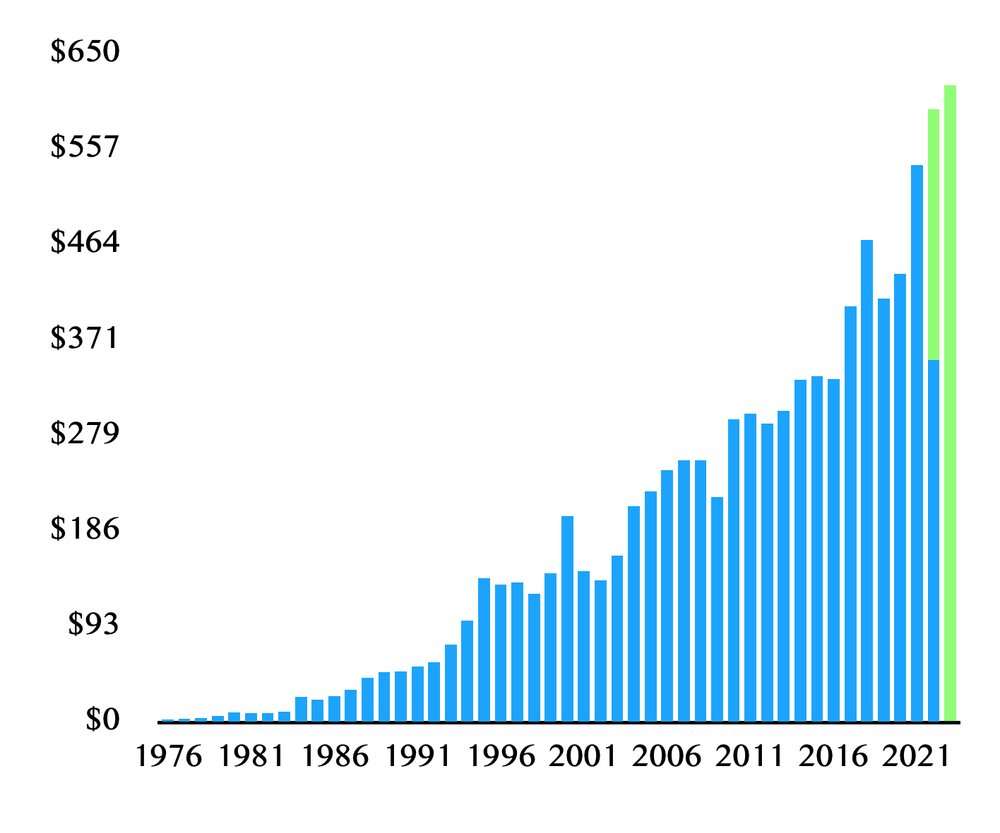
What has weighed on chip stocks most of this year is the cycle, the expectation that two healthy years will be followed by at least one, maybe two lousy years. By way of background, the chart below shows ups and downs in revenue going back all the way to 1976, curtesy of the industry consortium Semiconductor Industry Association.
The chart shows the peaks and valleys of the industry’s revenue annually, approaching what is expected to be fourteen percent revenue growth this year, a total of just under $620 billion, after a very healthy twenty-six percent growth last year. That may be followed by four percent growth next year, according to a forecast by the SIA’s collaborator, the World Semiconductor Trade Statistics organization.
Global annual semiconductor revenue from 1976 through 2023 in billions of dollars. Figures in green are forecasts for the remainder of 2022 and for 2023. Source: World Semiconductor Trade Statistics, Semiconductor Industry Association.
Now, everyone knows the numbers have to come down, because the WSTS is always late to call the downturn. However, the case I made in Barron’s is that assuming a downturn, things will be better than feared.
The main reason that will be the case is that the worst declines of past down cycles were an effect of over-supply. What is happening this time around is not a surge in supply but a decline in smartphone and PC sales, complicated by the ongoing supply chain issues.
A demand-driven decline like we’ve been seeing is not as serious as a supply-driven decline, primarily because it is easy for demand to return once an appetite for devices returns, whereas it’s really hard to get rid of a giant pile of chips that should never have been built to begin with. Demand is easier to fix than supply.
Demand will return, the product categories of PC and smartphone are not going away. We’ve seen this situation play out before. During the Great Recession, chip sales declined in 2009, but not as badly as the WSTS expected. Meantime, the stocks soared that year.
I surmise something similar is happening now as indicated in Monday’s rise. As the news gets worse, estimates get cut, and that brings chip investors closer to the bottom of things, and, consequently, closer to the turnaround.
When to focus on the numbers and when not to
Sep 30, 2022
Show notes
Probably as an occupational hazard of being a reporter, I tend to approach stock investing with two minds, one that I would call qualitative, and the other quantitative. It’s a strategy that has evolved over years for me and it’s different from how some other stock pickers approach things.
On the qualitative side, I tend to approach things first based on the story of what a company is working on. That’s a narrative, and it’s qualitative, not quantitative. What is this company’s mission? What, if anything, is there of substance in the company’s technology? How astute is management? How does the company plan to “crush the competition”?
I tend to fall back on the wise words of Jim Barksdale, formerly head of Netscape and before that, president of FedEx. Barksdale, asked about the key to success in business, said it was all about “finding a parade and getting in front of it.” I tend to think that’s pretty true. The best companies such as Amazon and Apple found ways to insert themselves into markets and extract value by seeing what was coming into formation.
On a deeper level, it goes back to my overarching theory of technology. Technology is a loom, on which a great, never-ending tapestry is being woven. It is larger than any one company, and it runs the entire history of humanity. Companies are stronger to the extent they contribute to the threads of technology, and thereby put themselves in alignment with something very profound that endures.
Because of that focus on the story of technology and companies, I tend to evaluate companies less according to numbers such as this or that income statement line, or The Metrics such as “retention rate” and the like. Don’t get me wrong, those numbers are important, but to me, they tend to be trailing indicators. Long after a company has chosen a wrong path, and run away from the parade, if you will, weak numbers are the symptom.
When Meg Whitman took over Hewlett Packard in September of 2011, the company’s R&D spending was catastrophically low as a percentage of revenue, at 2.6%. But that was after years of wandering in the wilderness as one group of executives after another failed to really have a sensible mission for the company — what I called “more than a decade of multibillion-dollar blunders,” when I wrote about Whitman’s challenge for Barron’s.
It was, in fact, the numbers-obsessed who, cheering on Whitman’s predecessor, the late Mark Hurd, in his campaign of slashing costs to the bone, lead the company to such a low level of investment.
By the time Whitman came in, looking at the numbers told you what you might have already surmised from the narrative had you been paying attention years or decades prior. Bill and Dave’s company had long since ceased, and the numbers were just a skeleton crew.
On the flip side, with very young companies, the numbers are often a way to over-think a company’s potential. A young company that has built a business of half a billion dollars in annual revenue really hasn’t accomplished that much. The world is filled with companies of half a billion in revenue. Which is not to say they won’t be future stars. But those companies are not allowed, in public markets, to grow into their potential in a sensible fashion. Once public investors get ahold of such companies, every quarter is a quarter of obsessing over the financials to try and prove the company will definitely be a future titan.
Investors with spreadsheets, in a sense, are like overly competitive parents at a New York prep school who are trying to make sure their child, at age three, is “gifted,” and therefore destined for Harvard. There may, indeed, be gifts, but you’ll crush them by constantly imposing standardized tests.
So, I don’t really use the numbers to tell me about a company, I use my qualitative sense of the mission. That approach has the advantage that there tend to be fewer people on the Street who can follow a narrative than those who can generate a spreadsheet.
I have another part of my brain, formed from covering stock trading, that does rely on numbers. I use numbers to tell me not about companies but about investors.
Markets might be rational, I don’t know, but my sense is that numbers can often tell us how irrational people seem to be acting. For example, a year ago at this time, it was possible for me to write about how stocks that were darlings of the market such as Snowflake were trading at absurd multiples of future revenue, meaning, potential revenue that was years away from being a reality. Seems hard to believe now, as Snowflake today is no longer absurd, merely very expensive.
The point is, valuations in tech-land had gotten to an insane level where people were inventing justifications to buy things. The numbers were detached from a logical analysis of profits and were about contriving excuses, similar to how medieval astronomers kept adding complications to make sure their models showed the earth at the center of the universe.
In that case, the numbers were telling me that investors were in a rather crazy place.
In July, as I was putting together the TL20, the numbers were saying something different. Basically, all the whimsical justifications had gone out the window and people were dumping things regardless of fundamental financial potential. Yes, there was suddenly inflation, and rate hikes. But what was mostly going on was the end of a regime of justifying anything and everything by whatever means. All the prep school parents had decided their darlings were idiots because they failed a test.
And what was left were companies with still tremendous capabilities and tremendous markets, which were suddenly, in many cases, cheaper than they had been five years ago, even though they probably still had years of good growth ahead of them.
My bicameral approach, then, is that I tend to rely on the story about companies and technologies, and Technology writ large, to think about companies’ potential, and I rely on the numbers to tell me just how crazy investors might or might not be at any given time.
Does that work? We’ll find out with the TL20. But years of recommending stocks at Barron’s and SmartMoney, and writing about tech at many places including Bloomberg, generally showed me that a company that gets in front of a parade can be successful, and that buying when prices are low, and selling when high, can be a generally good approach to stocks.

 Our TOPPODCAST Picks
  Stay Connected