During tonight’s conference call with analysts, following a terrible forecast, Micron’s CEO, Sanjay Mehrotra, emphasized the positives for Micron, such as a rock-solid balance sheet, but he, and CFO Mark Murphy, also used the word “unprecedented” a total of seven times to describe the challenge facing the chip industry.
Here’s the short story: the sudden drop-off in demand for PCs and smartphones, two markets making up just under half of Micron’s business for DRAM and NAND memory chips, have created a kind of V-shaped collapse in total chip demand. Customers of Micron are having to use up inflated inventories of chips before they buy any more. Demand should return in the middle of next year, marking a kind of bottom for the chip industry.
However, it’s all a bit clouded by the fact the global economic situation is volatile, noted both individuals.
“An unprecedented confluence of events has affected overall demand,” said Mehrotra, “including COVID-related lockdowns in China, the Ukraine war, the inflationary environment impacting consumer spending, and the macroeconomic environment influencing customers' buying favor in multiple segments.”
On the positive side, the company just concluded a year with record revenue, its balance sheet is stronger than ever; it is turning out more sophisticated kinds of chips than ever, speaking to its increasing technical acumen; and over half of Micron’s business is now in areas other than PCs and smartphones, namely, data center memory chips and automotive and computer networking and industrual applications.
“This portfolio transformation will increase our exposure to the most attractive and stable profit pools in the industry,” said Mehrotra of the business shift.
From an investor stand-point, the immediate bummer is that this quarter, Micron will have negative free cash flow of one and a half billion dollars, which means no buybacks, at a time when the stock is down forty-six percent and plenty of investors would love it if he could step in to support the shares.
Street response this evening focuses on grappling with the gloomy outlook.
From Robert Maire of Semiconductor Advisors: “It looks like we will be having a good old fashioned down cycle.”
This is going to spread to other chips, writes Maire. “The simple reality is that if manufacturers are buying less memory, they are buying less of other semiconductor types, its just that simple.”
I would just add that one has to keep in mind the incredible demand surge that brought us to this point.
It’s easy to forget that some of what is happening is a big cooldown from an extraordinary two years of binge-building that consumed a lot of memory chips, and all kinds of chips.
For example, in smartphones, although demand is on the wane now, as Mehrotra said, “despite the weakness in end unit sales, we achieved two consecutive years of record mobile revenue in fiscal 2021 and 2022.” Nothing lasts forever, things have to change at some point.
And while Micron is cutting its capital spending, it is also important to put that in context. Mehrotra said the conmpany still intends to spend forty billion dollars in the U.S. through the end of the decade to build manufacturing facilities, contingent on getting support from the CHIPS Act. In other words, there is still a lot of money going into building chip factories and buying equipment.
Funny enough, despite the gloom, Micron shares turned around in late trading, rising fractionally to $50.07. As I wrote on August 9th, numbers have been coming down for Micron for months now. Thursday evening’s gloomy news may finally be enough to push estimates so low for Micron that the stock can begin to appreciate again.
Earlier:
In the eye of the storm, selling a commodity product into a crumbling chip market, Micron Technology this evening reported fiscal fourth-quarter revenue that was lower than its already disappointing forecast
Revenue of $6.64 billion was below the range of $6.8 billion to $7.6 billion the company had offered back in June, which had been over twenty percent below consensus at the time.
The final number is below the much-reduced consensus for $6.7 billion.
All of this is in keeping with a warning that Micron offered on August 9th, saying that supply of chips was piling up as Micron’s customers worry about macroeconomic conditions.
On the bright side, the EPS number, $1.45, was above consensus for $1.37.
Micron shares declined one percent in late trading. The stock is already down forty-six percent this year.
The forecast for the current quarter is rather stomach-churning: revenue this quarter is expected to be $4 billion to $4.5 billion, way below the average estimate for $5.7 billion.
The forecast for profit, moreover, four cents to ten cents per share, is well below the average 69-cent estimate.
CEO Sanjay Mehrotra lead in his prepared remarks with a positive note, stating that t“In fiscal 2022, Micron generated record revenue of $30.8 billion and delivered our sixth consecutive year of positive free cash flow, allowing us to return a record $2.9 billion to our shareholders.”
Added Mehrotra, “our technology and manufacturing leadership in both DRAM and NAND, deep customer relationships, diverse product portfolio, and strong balance sheet put Micron on solid footing to navigate the weakened near-term supply-demand environment.
But, Mehrotra is also cutting capital spending, including tools to make chips, by half:
We are taking decisive steps to reduce our supply growth including a nearly 50% wafer fab equipment capex cut versus last year, and we expect to emerge from this downcycle well positioned to capitalize on the long-term demand for memory and storage.”
That will be not-so-great news to tools suppliers Applied Materials and Lam Research, both of which are down between two and three points in late trading.
In a deck of slides prepared for the report, Micron details how “Fiscal Q4 financial results were impacted by rapidly weakening consumer demand and significant customer inventory adjustments across all end markets.” No surprise there, with PCs and smartphones in free-fall for most of this year.
On the other hand, the data center market apparently continues to rage. Said Micron, “Cloud end demand remains healthy, driven by secular growth in AI and the digital economy. The market continues to face some supply constraints that are limiting server builds and macro uncertainties.”
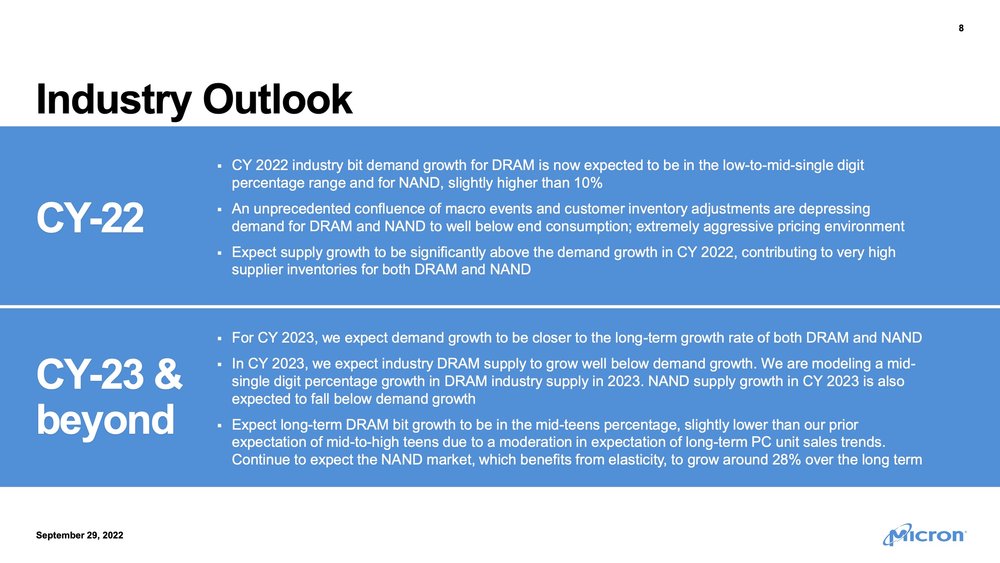
The company said it expects both DRAM and NAND to be under-supplied by the industry next year, and it expects that while there’ll be a little bit less DRAM in 2023 than previously thought, the sales NAND flash chips will expand because they respond to price cuts (that’s nice for Charlie Giancarlo of Pure Storage to know.)
My trips to the Apple Store at World Financial Center in Manhattan the last couple weeks suggested to me there is a vibrant activity on the part of consumers checking out the new iPhone 14, and also buying stuff. It was hard to get waited on as staff were coming in and out of the back with boxes of stuff people were buying.
So much for my field research, which is always the most dubious form of perspective. You, like me, might have thought Apple’s doing pretty well with this latest round of stuff, but opinions vary, and the news flow has been less upbeat.
Bloomberg’s Debby Wu and Takashi Mochizukiwrote on Tuesday that Apple has told suppliers to halt an expansion of iPhone unit production and instead go back to its original production plan, citing multiple unnamed sources. Not everybody believed the report. Several Street analysts took exception, one, Ming-Chi Kuo of TF International, an oft-cited rumor expert, calling the story “weird.”
However, it is not hard to believe that with the prospect of a recession, a fancy new phone could be causing Apple to revise some production plans, even though the thing was introduced at the same price as the previous model.
So, this is what makes a market, and today brought dueling views on Apple’s stock: a downgrade from Bank of America/Merrill Lynch’s Wamsi Mohan, and an upgrade from Rosenblatt Securities’ Barton Crockett.
On the negative side, Mohan writes that “strong outperformance [is] once again at risk” for Apple, and he expects “material” cuts to Street estimates for the current fiscal year ending in September of next year.
Mohan cut his rating to Neutral from Buy, and cut his price target to $160 from $185.
The reasons include a risk to consumer buying overall, writes Mohan, and “stronger Pro-mix won't offset decline in rev/profit if overall units decline,” meaning, people drawn to the most expensive version of the phone for its slick camera won’t be enough if overall units are under pressure.
Which brings us to unit sales estimates. Apple no longer discloses its unit sales like it used to, but the Street still compiles estimates.
The current FactSet consensus for this year’s unit sales for iPhone are 245 million units, one million more than last year. Mohan was already a little shy of consensus, at 234 million, and has cut that to 219 million. His larger point is that even if the iPhone “Pro” units end up better than expected, at 132 million units versus the consensus currently for 110 million, nevertheless, with the same blended gross profit, Apple’s gross profit dollars will plunge to $83.7 billion from $88.5 billion because lower units will dominate how many profit dollars Apple takes in.
Mohan also sees a slowing services business already at Apple, and prospects not looking great. “App Store and Licensing (Google payments), which account for over 60% of Services, have incremental risk of deceleration,” he writes.
For the defense, Barton Crockett of Rosenblatt raises his rating on the stock to Buy from Neutral, and he hikes his price target to $189 from $160, the main reason being what he sees as very positive results of a survey of a thousand Americans he conducted this month via SurveyMonkey.
“7% of respondents said they had already ordered an iPhone 14, and 22% said they expect to buy one over the next 14 months,” relates Crockett. “That sums to 29% of our census representative survey of U.S. adults via SurveyMonkey, suggesting that 75 million of the 258 million adults in the U.S. say they want one of these phones.”
The U.S., bear in mind, is historically forty percent of the volume of sales for Apple for the iPhone.
Of course, those people can change their minds, he concedes, but “we read this as a constructive demand backdrop, especially given rising macroeconomic pressures.” Basically, Crockett’s survey seems to suggest what I gleaned from my highly unscientific trip to the store.
Among the tidbits in the survey is that people seem to be drawn by the phone’s “Emergency SOS” feature. That’s where you’re out hiking and you can use a network of satellites if you need help by texting a message to a command center via the satellite service if you don’t have cellular reception or a WiFi hotspot where you happen to be.
“The Emergency SOS feature that is new to iPhone 14 seems to have broad appeal,” writes Crockett, and “38% said this feature made them more likely to buy iPhone 14.”
Crockett notes also that forty-one percent of those surveyed said they had purchased the iPhone 14 Pro “Max,” the one with the 6.7-inch screen versus 6.1-inch for the normal Pro. (The language is getting tricky with these products, ‘the normal Pro’!) Of those expressing an intention, forty percent say they intend to buy the Pro Max.
Crockett dismisses the Bloomberg story in short order:
Bloomberg's report yesterday that Apple was walking back previous guidance to suppliers for a modest bump to 2H22 production back to an original target of flat should be read in the context of consumers' clear preference for the pricier models with higher ASPs. There is also a recent history of comparable reports proving to be misleading when actuals come out.
Crockett’s estimates for iPhone don’t include unit estimates. His estimate for this year’s total iPhone revenue, however, $217.19 billion, is lower than Mohan’s estimate for $220.5 billion. It’s also higher than consensus for $208 billion.
What that tells me is that the Street is currently not expecting as many pricey Pro or Pro Max units in the total mix, leading to lower revenue estimates than either analyst.
There you have it, two different views on the matter. I will offer a third bit to this, mostly unscientific. Below is a twelve-year history of iPhone debuts in one chart. Most of them have been positive, measured from the price just before the iPhone debut to fifty-two weeks later. (The years 2015 and 2019 each had an extra week.)
In magenta, you can see the performance of Apple stock since the September 7th debut of iPhone 14, not quite four weeks. Its downward trajectory is most akin to the downward trajectory in the first four weeks of the 2012 to 2013 year, which ended up being the worst on record.
Note, by the way, that each down year was followed by a very solid up-year.
Since this is unscientific, I would in no way presume that such a move means anything material about what’s going to happen this time around.
Pure Storage CEO Giancarlo: potentially a lot of large cloud deals down the road
Sep 29, 2022
Show notes
Pure Storage is running circles around larger competitors such as Dell and Hewlett Packard, but the big prize may be sizable deals to replace the vast bulk of cheap storage inside cloud providers, says CEO Charlie Giancarlo during a meeting at the company’s satellite office in Manhattan.
Within a banner year for Pure Storage — a string of revenue beats, and really large EPS beats, and two increases so far to the year’s revenue outlook — the singular development that the Street was really taken with was the announcement this past spring that Pure won a large contract to supply technology to Meta Properties, owner of Facebook, for a major new artificial intelligence research computer, the RSC, or “Research SuperCluster.”
That announcement had caused the Street at the time to wonder, rather excitedly, if there is more of the same kind of deal in store with more cloud operators. After all, the deal had the effect of boosting Pure’s quarterly sales last October by several percentage points.
At the time that he was asked, Pure CEO Charlie Giancarlo was rather coy, but it seems there could, indeed, be more of such large deals in store.
“How many Meta-like deals are there? We think there are potentially a lot,” says Giancarlo in a meeting we had last week at Pure’s East Coast satellite office at 1 Penn Plaza in Manhattan. Giancarlo was on one of his quarterly swings through town from the company’s headquarters in Mountain View, California.
Without forecasting anything, Giancarlo took me through his thinking.
The Meta deal was for two distinct products from Pure, “FlashBlade,” and “FlashArray/C.” FlashBlade is for very high-performance kinds of applications, such as databases. FlashArray/C is for things with less-stringent demands, such as bulk file storage. The vast amount of the capacity Meta bought from Pure, ninety percent of the total one hundred and eighty-five petabytes (a thousand trillion bytes) worth, was for the more-economical FlashArray/C.
That sale for FlashArray/C had to beat out Meta’s internal teams that were using disk drives with custom software against Pure’s systems using NAND flash memory chips. Flash is generally better-performing thank disk but costs more money.
It turns out that the bake-off inside Meta is something of a model for future potential deals, says Giancarlo. He sees a prospect for many “hyper-scale” companies, the companies that run the cloud, such as Amazon and Microsoft and Google and Oracle and IBM, to replace their disk drives with better-performing flash memory chips in the form of FlashArray/C for little or no premium.
“Eighty to ninety percent of all the bits in the world are still on hard disks, and that’s true inside hyper-scalers as well,” explains Giancarlo. That vast trove of most of the world’s data constitutes what’s called secondary storage, or “near-line” storage, the stuff that is less performance-sensitive.
“What's really interesting,” says Giancarlo, “is that flash [memory chips] have been improving in price-performance, on average, fifteen to twenty percent a year for decades,” relative to disk, based on the cost-per-bit of storage in the two media.
“The intersection point, if you look at IDC data, between flash and disk, they estimate, will cross over in about four years,” meaning, flash becomes equal in price for the same capacity with disk. That is the “crossover point” that Giancarlo and I discussed back in December.
But for Giancarlo and Pure, the crossover point is sooner — it is right around the corner. “Our FlashArray/C, we feel, crossed over disk now, and with the next round of price reductions coming for flash, we feel we're going to be able to replace what's called the cheapest disk, the 7200 [RPM],” the stuff used for near-line, says Giancarlo.
The price reductions he is talking about are expected price chopping by Micron Technology and other makers of flash chips. Micron, as you may recall, has been in free-fall of late because the PC and smartphone markets have been breaking down all year, leaving excess supply of flash. The company’s forecast for revenue back on June 30th missed by a mile. Many expect that when Micron reports results tomorrow, September 29th, the results will again miss expectations.
Pure buys flash from Micron and others and combines it with Pure’s specially designed software to make highly-effective systems. If the memory market is in a sustained crisis of fall-off in demand, Micron and other vendors will have to cut prices on flash to move units, and that, says Giancarlo, will make Pure’s already economical FlashArray/C even more economical.
As a result, “We would like to believe that, maybe not every hyper-scale or every cloud company, but that many of them would choose to work with us at some level to be able to start replacing disk with flash.”
Giancarlo has another reason to think that may be the case: energy.
Pure touts not only the performance advantage of its systems but also their energy efficiency, even compared to other vendors of flash-based systems such as Dell Technologies and Hewlett Packed Enterprise, because Pure’s software and systems engineering uses the raw flash smarter than the competition.
“We have advantages on cost, we've advantages on the utilization of the asset, which lowers energy use and reduces the size of all of those things.”
Giancarlo is an enthusiastic traveling salesman — he has in past described his competition with Dell and Hewlett as “a knife-fight in a phone booth.” Not only did Giancarlo visit accounts in Australia and Japan over the summer months, he spent six weeks this past spring, he tells me, calling on customers in nine European countries, including the Bank of Ireland.
“What I learned is that, yes, power, of course, is important, but now they're afraid of power availability, and that's going to drive even more conservation than the cost by itself.” With Russia’s war in Ukraine, Europeans are concerned with a lack of fossil fuels, says Giancarlo — a sentiment that must be amplified by the report this week of the mysterious leak of the Nord Stream pipelines.
Now, the discussions Giancarlo is having with customers have shifted.
“I've been promoting at Pure lower space, power, cooling for my five years here, and for four years, nobody cared,” he says. “I’d go to customers and they say, Yeah, we don't pay for the power, that's facilities, we’ve got plenty of space, we don’t care about that, what’s your price?
“Now,” he says, “space, power, cooling — it's still an economic issue in the US, but in Europe it's, Are we even going to have the energy? So, of course we've got to reduce the amount of energy we’re using because we're afraid we might not even have it.”
When he calls on those European customers, Giancarlo has brought with him third-party analyses supporting the energy savings. “Fortunately, the facts tell the story, which is that compared to hard disk, flash is just so much more efficient, it’s literally more than ten-X,” he says, meaning, it cuts the necessary space, the power required, and the labor involved by ten times.
“We'd like to be part of the infrastructure of the largest” cloud providers, says Giancarlo. “And we think we have the opportunity to do that over the next several years.”
But compared to Dell or Hewlett or others, “we're somewhere between twenty percent to fifty percent of the power they use, so, we’re either twice as good or five times as good” from a performance-per-watt standpoint.
Pure is the only company that takes the raw flash chips and wraps special-purpose software around them rather than using commodity solid-state drives, the industry standard building block for flash-based storage. That allows Pure to have such low-level control of the use of the chips that it can wring all kinds of efficiencies out of the parts.
When does that energy advantage show up in deals?
“It already showed up in the Meta deal as a winning factor,” he says,
In the RSC, notes Giancarlo, “Meta are going to have an exabyte of storage in that data center, and they've got massive amounts of [Nvidia] GPUs.” What that means is that “they have to fit all of that in a physical footprint as well as a power footprint, and of course, they want to use most of the power for the GPUs.”
“We were the only ones that matched every one of those components,” he says, “that is, we had to get to the price right, but we were the only ones that would fit in the data center, both from a power and a space standpoint.”
Pure typically gets about a third of its revenue in any given period from cloud companies, but not necessarily the top three — Amazon, Microsoft and Google — but the top ten or twenty, says Giancarlo.
“We'd like to be part of the infrastructure of the largest,” he tells me, “and we think we have the opportunity to do that over the next several years,” mostly because the ninety percent of data still on disk needs to be rethought, and maybe because energy use is only going to become a greater and greater bugbear.
“As flash pricing comes down, they need to start doing something about their disk environment,” says Giancarlo of the cloud majors. “And we have the unique intellectual property that they don't have.”
I would add that, given the rising sense of concern in the industry about the sticker shock over the cost of cloud, it is possible that Amazon and the others could seek out Pure as a way to lower the storage cost for their millions of cloud customers, though Giancarlo is not banking explicitly on that prospect.
Pure shares, at Tuesday’s close of $27.66, are down sixteen percent this year.
The stock is also up six percent since I picked it for the TL20 group of stocks to consider in mid-July, making it one of the top performers of the TL20. When I showed Giancarlo the TL20 at our meeting, he expressed his pleasure at the company he keeps, not only Arista Networks, on whose board he sits, but also Applied Materials, a company of which he thinks very highly.
Sumo Logic CEO Sayar: The complexity of the trans-cloud is our friend
Sep 28, 2022
Show notes
The debutante ball of an initial public offering is often followed a year or two later by a more substantial affair, the very first “analyst day” meeting, when management talks to the Street about its achievements as a public company and where its sees its business going.
You could call it the cotillion, when more is revealed than could be at IPO.
Last week, a promising young company was strutting the cotillion at the Nasdaq Market Site in midtown Manhattan, Sumo Logic, the twelve-year-old developer of tools for programmers, IT staff and security specialists.
At the Nasdaq, CEO Ramin Sayar, whom I had interviewed earlier this year, was kind enough to talk with me about the big reveal, and to place it in a deeper context.
The centerpiece of these analyst events is the multi-year forecast that a company’s management offers.
“It's better to set some goalposts because sentiment has changed dramatically,” Sayar observes as we make our way to a conference room.
Indeed, the mood has change among software investors this year from exuberance to an attitude not very hospitable toward software companies not yet making profit. Sumo is not yet profitable.
When first we spoke, in March, Sayar had insisted that CEOs and CFOs cannot let investors dictate their business strategy. That’s probably true. But these days, every CEO has to reckon with the changed environment. Setting goalposts is a way to mollify nervous investors.
When it was his turn to speak during the day’s presentations, Sumo’s CFO, Stewart Grierson, set the goalposts. It is expected that Sumo’s revenue will rise by almost seventy-five percent between this fiscal year ending in January and the fiscal year ending in 2026, to half a billion dollars, and that the company will go from a negative operating margin of about twenty percent to break-even.
Beyond just goalposts, the remarks by Grierson included pledges to bring about various “efficiencies,” things such as greater marketing and sales team productivity that will reduce the total sales and marketing spend as a percentage of revenue from forty-eight percent to as low as forty percent by 2026.
Things such as automation, said Grierson, can help drive down the company’s general expenses to just ten percent of revenue from seventeen percent today.
“You want them to walk away with those goalposts, and also understand what are the knobs,” is how Sayar describes the intention. Some knobs are easy to twiddle, Sayar indicates, like sales and marketing and some general expenses. “But, you can’t necessarily dial up the innovation and engineering investment and then dial it down,” he cautions.
Some CEOs are all about the numbers, but Sayar, himself, is not overly preoccupied with the financial knobs. A veteran of enterprise software over many decades, he is more intently connected to the mission his company is supposed to be fulfilling, what the actual software is supposed to do.
What was really to be conveyed at Nasdaq, he tells me, “is for them to understand that this is a must-have, not a nice-to-have,” they being the analysts, this being his company’s software.
Being essential, if that’s what it is, appears to be good for business. At a time when some companies have been warning of “push-outs,” delays in getting a software deal signed, “we didn't see, necessarily, any slowdown in the types of deals or sales cycles or opportunities” last quarter, says Sayar.
Just what is it that makes the company’s wares indispensable? It starts with the market need, according to Sayar.
Sayar is adept at portraying the frenetic energy of what is commonly referred to as “digital transformation,” sometimes referred to as “digitization” or “digitalization,” the headlong rush of companies to churn out code as they turn everything into an app.
“You and I are inundated in our personal and professional lives every single day with this dichotomy of work versus personal stuff on every device,” he explains. All that connects back to some stuff that sits in the cloud. “The back-end of that experience are cloud applications, and companies are not slowing down on this — spending on that is not going down.”
“There are seven hundred and sixty million cloud-native apps out there, and that's a fraction of how many will be out there” in future, he notes, and that’s just counting the newer apps that have been built, never mind the stuff that is from years ago that needs to be maintained and/or overhauled.
Sumo’s programs fit into the rush of app development by helping to monitor the app development process, to check for security violations, and to see how infrastructure is performing. In those functions, Sayar’s main point is that unlike competitors such as Datadog, New Relic, Elastic and Splunk, Sumo’s software can handle the way that the infrastructure of the cloud is becoming more complicated.
“You don’t have a static model of infrastructure,” explains Sayar, meaning the server computers and network switches and data storage. “Today it's here, five minutes later, it's there, it’s in a different pod, in a different region, different deployment.
“So, you have no context to whether that’s abnormal or normal because you've collected memory, disk, CPU, response time here and now it’s running on a different pod, different cluster there, you don’t have a baseline to compare it.”
Sayar is painting a picture of chaos. The only way, he says, to get a handle on that chaos, is “if you get traces, and you get logs, and you look for diffs, and you have to get in, crack open the payload of logs, and then look for abnormal behavior by cluster, by host, by location and correlate those,” a steady stream of the jargon of IT management.
It’s bewildering if you’re not in the flow of IT management. Some of it is clarified, some of it is made murkier, by a dip into patent filings.
The patents awarded to Sumo’s CTO, Christian Beedgen, and colleagues speak to complexity, claims to things such as a cloud-computing system to tag and categorize a constant flood of data.
U.S. patent number 9,633,106, awarded in 2017, is exemplary. It describes Alice and Charlie, two IT administrators who seem to be swimming in a sea of different kinds of mismatched data. It is poor Alice and Charlie who have to “crack open the payloads” and root around to find what’s wrong.
Somehow, the Sumo Logic technology described in the patent allows them to keep their heads above the task.
But don’t his competitors, such as Datadog, do that? “No, we do that,” insists Sayar. Those other programs “tell you the what,” as in, there’s a problem. They don’t, he asserts, “tell you the where, why and how.”
As much as Sumo is being propelled by the chaos of digitalization, it is also riding the wave of new infrastructure, programs such as Kafka, the open-source software that acts as a kind of firehose to move data in real time between applications.
Kafka is just one of a series of new infrastructure software programs that have emerged in recent years, such as Spark, that seem to be adding up to something larger and more important than the traditional cloud computing of Amazon AWS and Microsoft Azure.
I first termed it, two years ago, “The Great Cloud Rush,” a wave of companies built in the wake of AWS that aim to span multiple cloud computing networks, a cohort of, sort-of, meta-cloud companies, if you will. The term that has been used in trade magazines is “multi-cloud,” but it’s a rather dull term that doesn’t really do justice to the froth of complexity that is bubbling up above the cloud services.
I throw out to Sayar the term that comes to mind: trans-cloud. “It is something that spans,” he nods his agreement, something that stretches across data centers. The Cloud Rush, or the trans-cloud, as a kind of mess, should be a good opportunity for Sumo, I venture.
“It’s fantastic!” he replies. “Because guess what? That architecture, while that delivers the promise of scale, it brings complexity, and that complexity is what we've been trying to simplify,” the overarching mission, again, of Sumo.
Snowflake and MongoDB are examples of young Cloud Rush companies, companies building a business of databases on top of multiple cloud service providers. “But operational data is different” from database data, says Sayar. Unlike the neatly organized database tables that Snowflake or MongoDB manage, the operations data generated when apps have gone down, the problem of Alice and Charlie in the patent document, is a problem of the Kafka firehose spewing torrents of totally unorganized data.
The complexity means constant uncertainty.
What was really to be conveyed at Nasdaq, says Sayar, “is for them to understand that this is a must-have, not a nice-to-have” as far as the essential nature of his company’s software.
“Before, you knew you had a dedicated server,” in the corporate data center, Sayar reflects. “Today, it’s opaque, and that makes it hard to know the what, where, why and how.”
The project of Sumo, he says, "started from the bottom” of all that, building tools that “collect, reason, aggregate the data, to be able to create samples and patterns and algorithms and statistical correlation, and add in metrics and then events and traces all the way up to the top of the iceberg, so to speak, to show the ding-dong lights!”
The ding-dong lights are the little indicator in the Sumo Logic programs that tell the developer or the IT manager or the security specialist, You’ve got a problem.
The ability to handle all that complexity is what Sayar has had his sights on since he came aboard in 2014, he says, the ability to develop generations of product as a portfolio, not a single product. He calls that the “horizon” development model, where with each horizon, the company aims to broaden its addressable market.
“How do we go into these adjacent markets more broadly around monitoring, observability, security, IoT, and edge device computing and more,” is the challenge, he says. The company is currently headed to “Horizon Four,” says Sayar, in which so-called autonomous computing is the focus, more things happening automatically.
In the patent documents, the IT people Alice and Charlie still do a lot by hand. They must be exhausted. The future, says Sayar, is one in which analyzing programs is done by other programs in an automated fashion.
To spearhead the march toward Horizon Four, Sayar in May hired Tej Redkar as chief product officer, who had been a heavy user and evangelist of Sumo software at prior software companies.
Part of Horizon Four is to bring the various functions of app development and IT operations and security closer together in one product suite. The original goal, says Sayar, of Beedgen and his cofounders had been to simplify their own responsibilities.
“Remember how we got started,” says Sayar. “Our founders were frustrated with all the crap that was happening downstream to them as developers working on security software, because a lot of the headache that was happening downstream was happening upstream.
“There's this joke that development did the partying, security got the hangover,” recalls Sayar. That just means that various constituencies inside “DevSecOps,” as the rubric is known, can never agree on how to divide responsibility. “The reality is, in this world, because of the continuous nature of how things” — meaning, apps — “are pushed to production and updated, security can't be an afterthought.”
More chaos, in other words.
The Horizon Four work won’t be complete for another three to five years from now, says Sayar. It will hopefully bring ever-greater integration of those disparate roles and responsibilities, he says, to reduce the headaches for everyone. “That pain that our founders had was built on that premise of, I want to make my job easier.”
The reception to what happened at Nasdaq seemed to be largely positive. There were no changes in stock rating or price target, that I saw, but the goalposts were well-received.
Matthew Hedberg with RBC Capital Markets described himself “feeling good” coming out of the event, deeming the financial targets put up by Grierson to be “prudent” in light of an uncertain macroeconomic outlook.
Hedberg has an Outperform rating on the shares, and a $14 price target.
Blair Abernathy with Rosenblatt Securities, another bull on the stock, wrote that he “came away from the event encouraged that Sumo has now set a clear, achievable path to profitability.”
Sumo stock, at a recent $7.20, is down forty-seven percent this year, and about that much since its IPO in September of 2020.
A message from the editor
Sep 27, 2022
Show notes
Tiernan Ray, creator and editor of The Technology Letter, takes you through his thinking about the group of twenty stocks, the TL20.
Qualcomm shows off its automotive chip chops
Sep 23, 2022
Show notes
CEO Amon, who is naturally outgoing, and who spent years in the trenches engineering Qualcomm’s technology before ascending to the top spot, went into extra innings fielding questions with vigor and acumen.
Qualcomm chief executive Cristiano Amon on Thursday gathered his team at the Classic Car Club beside the Hudson River in Manhattan for several hours of presentations to the Street and press about the company’s expanding opportunity for chips in the automotive market. It was the first time Qualcomm has done a dedicated day just to talk about cars apart from its other businesses.
The presentation was encouraging. The company increased some of its forecasts for revenue from cars for the next several years, and Amon, who is naturally outgoing, and who spent years in the trenches engineering Qualcomm’s technology before ascending to the top spot, went into extra innings fielding questions with vigor and acumen.
A ream of details on products was provided by Nakul Duggal, Qualcomm’s general manager of the automotive division, specifically the three areas that are the company’s current focus: the connectivity, such as the modem for car-to-Internet connection; the “digital cockpit,” a rubric covering all manner of things that happen with the dash, the central stack, the backset entertainment, and on and on; and “advanced driver-assistance system," or ADAS, all the technologies that will make a car, someday, drive itself, or so they say.
CFO Akash Palkhiwala rounded out the presentation with several significant financial updates that seemed to be very well received by analysts at the event.
The key stats are as follows. The company’s revenue from automative is expected to rise by thirty percent in the fiscal year ending this month, to $1.3 billion. That’s out of total company revenue of forty-four billion, so auto is still at the starting line as a part of Qualcomm’s revenue, but rising fast.
The company estimates its “addressable market” for chips in cars at one hundred billion dollars annually by 2030. That’s assuming Qualcomm makes $200 to $3,000 per car.
The company’s “primary KPI,” or “key performance indicator,” is the “design-win pipeline,” the total value of expected future contracts with manufacturers, based on the lifetime of the deal for that part in that car, assuming certain volumes of car shipments. That figure is currently thirty billion dollars, up from thirteen billion mentioned at the investor meeting Qualcomm held in November of last year.
That number doesn’t include some major manufacturers that Palkhiwala intimated will come aboard in coming years, without naming names.
And the current view into revenue has taken a meaningful jump upward from the November meeting. At that time, Qualcomm forecast three and a half billion dollars in auto revenue, annually, by 2026, and now it’s forecasting over four billion. Its estimate for fiscal 2031 has risen from eight billion to now over nine billion.
Compare that nine billion to the hundred-billion-dollar forecast, and you can see that Qualcomm is expecting to have roughly ten percent of the market by 2031.
An impressive aspect is that the new, increased revenue forecasts don’t include some parts of Qualcomm’s business that are already in development with customers. For example, RF chips, the technology for sending the signals from the cockpit wirelessly to cell towers. Qualcomm is in discussions on selling those parts, the executives said, without disclosing details. They would represent additional future revenue.
Amon, center, with CFO Akash Palkhiwala, left, and Nakul Duggal, general manager of the automotive division.
Also, 5G wireless networking, once it is turned on in cars, which will be some years yet, is expected to add five dollars per car in licensing fees for Qualcomm’s intellectual property division, Qualcomm Technology Licensing. That is very high-margin revenue because it’s almost all profit. The company has over fifty contracts in place for such licenses and expects the deployment will become material starting in 2024.
Even more impressive for investors is that Qualcomm has ninety percent of the forecast revenue for the next four years already accounted for by “design win” contracts.
Amon summed up the talks by declaring “it’s probably graduation day for the Qualcomm automotive business as we position ourselves and establish partnerships to be one of the largest automotive providers of technology for the future of automotive.”
By way of reference, Nvidia, which has for a long time sold a lot of stuff into cars, and which has big ambition for cars as well, trails Qualcomm with a projected nine hundred million in revenue this fiscal year.
I would have enjoyed more discussion of Qualcomm versus Nvidia because I find it fascinating. In particular, ADAS is the newest area for Qualcomm, and it is the area where I expect to see the greatest head-to-head competition with Nvidia in years to come.
What Amon did say was that Qualcomm is taking a much broader approach than Nvidia, trying to cover more of the aspects of Detroit’s profound changes.
“The goal is to help with the auto industry's transformation,” said Amon. “So, our approach is actually not specific to a domain or a feature or what are you going to do to deploy this specific feature, it is actually building a partnership, understanding where flexibility is needed […] and dealing with that complexity.
“So, it's a very different approach than say [Intel’s] Mobileye that is focused on ADAS, or an Nvidia that is focused on a specific technology and its application into the automotive space.”
Among the questions, I noticed a certain skepticism of the hundred-billion-dollar market size that was offered for 2030.
Analyst Gary Mobley with Wells Fargo noted that some market research firms have different estimates. Said Amon, “You can find a lot of different forecasts that give you a different set of numbers, but our framework is the following: we are negotiating regularly with these OEMs on different platforms, and we have a very good sense of two things, first, what they plan to deploy in their cars, in the short term, and then, second, how they plan to scale it differently over the long term.”
That makes sense. The company is actually working in this area, unlike a lot of market research people who are simply driving spreadsheets.
The venue for Qualcomm’s meeting, the Classic Car Club, has a hanger full of neat-looking stuff.
The most important thing about those conversations with customers, in my view, is that they appear to be at a deeper level than simply as a parts supplier. Said Amon, “You see now a senior level of engagement, in the number of CEOs that we have been engaged to in this industry, because they have to make the right choice on the platform, and then build on top of the platform. And that's very different with how the industry used to be.”
That makes sense, too. The challenge of how to make something much more gigantic than a smartphone, where there is no Apple and no Alphabet dominating the basic gestalt of the car, means that for the moment, these car companies are turning to Qualcomm for a close kind of collaboration to define what is to be built from step one.
That sounds like a good place to be.
Qualcomm shares are down fifty-seven percent this year and down fourteen percent since I picked them for the TL20.
Is Nvidia serious about software?
Sep 22, 2022
Show notes
Huang says running software to rent in the cloud will be “very long-term SaaS platforms for our company,” but does he mean it?
Nvidia has become the biggest chip vendor in the world, at three hundred and thirty-seven billion dollars in market capitalization, by dint of the fact that none of the competition have managed to come up with chips sufficiently superior to crack the company’s hold on the market for the most cutting-edge applications in data centers, especially artificial intelligence.
There is now a prospect of another interesting realm for Nvidia to exploit: software.
This week, Nvidia held another one of its “GTC” conferences, where it touts lots of new products. While the event was full of stuff about new chips, there was also the announcement of two cloud computing services that Nvidia will own and operate.
One service is a way for companies to collaborate on 3-D design via the cloud, based on Nvidia’s “Omniverse” technology, which is its take on The Metaverse, the mostly non-existent something that Meta’s Mark Zuckerberg has touted. I gave a preview of the idea of this service in a recent article.
The other service is a way to run very large AI programs in the cloud without a lot of the owned infrastructure or data science work, especially programs for handling natural language processing, which are becoming important tools for companies.
I covered the announcements for ZDNet. But, beyond the press releases, what interested me was the business question of whether Huang is really serious.
The company is planning to run Nvidia-based computers on behalf of its customers that will let them do some of what they would do with Huang’s chips by renting computingin the cloud rather than buying those computer systems outright.
It’s the kind of thing that makes me wonder, Does the chip maker want to merely juice the market for its product versus really committing to a new line of business?
And so, when I took part in a press conference Wednesday morning, I asked Huang directly, How big can this software stuff be for Nvidia over many years?
“Well, it's hard to say; that's really, kind-of, the answer,” was Huang’s initial reply.
But then, in true Huang style, he went on to ruminate at length about the importance of the two services, AI and Omniverse. Huang is not only ambitious and extremely smart, he is genuinely intellectually stimulated by large questions of where markets and technology are headed.
In my second ZDNet article, Wednesday, I printed Huang’s full response to my question. To summarize it for you, he reflected that the use of large AI programs of the kind he plans to offer in the cloud are becoming essential to every business on the planet, and so, running them as a service “is potentially one of the largest software opportunities ever.”
On the matter of Omniverse, while much of The Metaverse is just complete vaporware, in my view, Huang had an interesting technical point that opened my eyes somewhat. He emphasized that the service he plans to run is a database.
“It’s a modern database in the cloud, except this database is in 3-D, this database connects multiple people.”
Now, that is interesting. A fantasy world of people running around as avatars, having adventures, the way Zuckerberg describes, strikes me as a pipe dream. But the database market is a real market, a multiple-hundreds-of-billions-of-dollars market, if you count all the stuff sold by Oracle and IBM and Microsoft and Amazon and MongoDB and Couchbase and many others. A database in the cloud sounds like a real application and a real market.
And so, without predicting success for Huang, I would say that his technological soliloquy was thought-provoking. I have noted in past that Nvidia was moving in the direction of selling software in the cloud. Over a year ago, I wrote, “now, Nvidia is selling a cloud where people can come and rent AI capability, provided by Nvidia in conjunction with a partner, data center operator Equinix, called “LaunchPad.”
LaunchPad, however, truly seemed like a starter kit, a demo to convince people to try and then buy Nvidia chips. The remarks by Huang on Wednesday, in contrast, tilt things just a little bit in the direction of having an actual commitment to a software business.
Huang concluded by saying, “these two SaaS platforms,” meaning, software-as-a-service, the industry rubric for running programs in the cloud, “are going to be very long-term SaaS platforms for our company, and we'll make them run in multiple clouds and so on and so forth.”
I would note the Street’s reaction this week ranged from outright skepticism to mild — very mild — enthusiasm.
The most enthusiastic note I saw came from Rajvindra Gill of Needham & Co., who has a Buy rating on Nvidia shares. Gill seems to believe software can really be something over time for the company.
Writes Gill,
Longer term, NVIDIA's push into SaaS-like offerings through Omniverse can be a differentiator. Their current software run-rate is “a couple hundred million dollars.” We expect the product-market fit for recommender systems and large language models to drive increased hardware and software (“full, vertical stack”) adoption.
The jury is still out on whether software is going to be a big business for Nvidia. If it were to become such, the effect would be to give Nvidia’s shares potentially a higher valuation multiple, although that is hard to imagine given that Nvidia stock is one of the most expensive chip stocks around.
Meantime, back on planet earth, the question at the moment for Nvidia is how big a deal the latest restrictions are on Nvidia’s sales to China. On August 31st, the company said in its quarterly filing that new restrictions by the U.S. Department of Commerce on export of some Nvidia chips to China will cost the company four hundred million dollars in revenue.
Some have opined this may not be as big a deal as thought. For example, Hans Mosesmann of Rosenblatt Securities on Tuesday wrote that “We speculate that the licensing demands by the Dept of Commerce are meant to slow-down potential upcoming or ongoing programs in the target regions (which this will do but not by much), and to annoy,” rather than being a broad ban on sales.
On Wednesday, Huang was asked at the press conference about the bans. His response was that the restrictions do not shut things down so much as perhaps create extra hoops to jump through for Nvidia and its customers in the country, without being a disaster:
You can't have completely open, unfair trade, you can't have completely unfettered access to technology without concern for national security. But you can't have no trade … And so, I think it's just a matter of degrees. The limitations and the licensing restrictions that we are affected by gives us plenty of room to continue to conduct business in China with our partners, gives us plenty of room to continue to innovate and to continue to serve our customers there. And in the event that the most extreme examples and use of our technology is needed, we can go seek the license.
Nvidia stock is down fifty-five percent this year, and down sixteen percent since I picked it for the TL20.
Zuora CEO Tzuo: Media giants are learning not just to explore but also to exploit
Sep 22, 2022
Show notes
In the realm of evolutionary psychology, there is a notion of two paths to survival: explore and exploit. You’ll never know what the environment offers you if you don’t first explore your surroundings. But constantly exploring means ignoring the things you’ve found. At some point, you lean on exploiting what is already known. Survival is a balance of both.What is known as the “subscription economy,” a new form of sales in which customers buy into an ongoing relationship with a product maker, has entered a new phase in that balance between explore and exploit, according to Tien Tzuo, who is the founder and CEO of Zuora, which makes applications for companies to bundle, price and collect for those subscription-economy offerings.“The subscription economy is shifting into a new phase,” Tzuo tells me in an interview we had recently via Zoom. “It used to be all about acquire, acquire, acquire, which Netflix did” says Tzuo, referring to the massive growth of the streaming music enterprise that came to a screeching halt last year. Netflix was the classic example of explore for the past several years.However, that game has now become rather passé, says Tzuo.“Disney acquired the same number of customers as Netflix in a fifth of the time,” he observes of Disney’s own streaming video offering. “It took Netflix ten years, it took Disney two.”In other words, the first phase, acquiring customers, has become something of a dead end. There has to be something else or a company that’s just acquiring will run aground like Netflix did. Disney is an example of a company that is figuring out the second phase of subscriptions, says Tzuo, where a prospective subscriber is more ingeniously presented with increasing amounts of cross-selling and up-selling. Disney, and other companies in media and publishing, says Tzuo, are increasingly regarding their business as exploiting what they’ve got as much as simply trying to lure new perspectives. ZUO Chart by TradingView “Look at what is happening in media and publishing, it’s all about managing these subscriber journeys, how do you convert an anonymous customer to a subscriber?” explains Tzuo. The word “journey” is one of those ill-defined euphemisms that really implies what was traditionally known in the cable industry as the “lifetime value” of a subscriber. The Netflix model for lifetime was a simple straight-line calculation based on a straightforward pricing model, and that was fine for as long as new subscribers were easy to obtain. Nowadays, finding new value in that subscriber is the challenge. The New York Times, for example, which is a customer for Zuora’s software, has said that at its peak, one out of every two Americans went to the Times Web site or app to find out about the Coronavirus. And the Financial Times had a huge surge with free articles on Brexit back when that was the dominant headline, Tzuo points out. “So, the newspaper companies are realizing, look we can create a bunch of new visitors but then the game begins afoot: How do you convert the anonymous users to some subscribers, how do you cross-sell and upsell to more subscriptions?” A company such as The Times might say “you’ve been playing Wordle,” the Times’s daily free puzzle consisting of word-guessing, “then maybe you will sign up for Spelling Bee,” a Times game where you construct as many words as possible from a fixed set of letters. Spelling Bee is not free; it requires a paid subscription to either a Times Games package or to print or online Times editions. The point is, people are induced to move from free to paying. Or take Disney, he suggests. “You have Hulu, you sign up for Disney+,” the streaming service, which would bump a subscriber from $6.99 a month to $13.99, or even $19.99 if they choose to avoid commercials. What, you may wonder, does this have to do with Zuora? If his customers are willing to dig more deeply into subscribers’ passions, and pockets, Zuora also has an opportunity to sell more to the same customer base. For that reason, Tzuo is on the lookout for things he can add to his quiver. the company on its earnings call last month announced it paid $45 million in cash to buy London-based startup Zephr, which sells tools to help companies monitor and analyze that experience of which Tzuo speaks. The purchase was part of a “war chest” as Tzuo calls it, from private equity firm Silver Lake, which earlier this year agreed to purchase four hundred million dollars worth of Zuora convertible debt expiring 2029. “They were an existing partner of Zuora,” Tzuo says of Zephr, “they are focused on a key vertical [market], the fastest growing one, the media and publishing vertical,” precisely the companies such as The Times and Disney who are being most aggressive about exploiting and finding greater subscriber value.The tools of Zephr will be another product offering for Zuora alongside the tools to bundle, price and collect from subscribers. It will be a tool to mine what draws subscribers, to further draw them into additional offerings. “We welcome all customers,” says Tzuo, but, ultimately, “the subscription economy is a scale business,” the formula for “a thousand customers each building a billion-dollar subscription business — call it, a billion dollars per year — through us.” “We like the joint vision of the subscription experience — that is very much part and parcel of us,” says Tzuo of the kindred viewpoint with Zephr. “We are morphing from just a monetization platform to a monetization-plus-experience platform — going deeper — seeing our customers’ customers, what they see — the subscribers.” There is a symmetry here, to find more lifetime value in Zuora’s customers as those customers try to mine their own customers.Customers such as The Times are the vanguard to Tzuo. “Media and publishing are a little farther ahead” in mining the value of the customer journey, he says, but he expects that some day, all companies, even hard goods manufacturers, will follow suit, selling everything as a subscription to subscribers who can be more and more deeply mined.“To be fair, today it [Zephr’s technology] is focused on the media publishing industry,” he says. “We do believe that the fundamental technology for Zephr is broadly applicable.”To Tzuo, the focus on The Times and Disney and their ilk is part and parcel of what he has pledged to do. Last year, Tzuo changed the company’s approach to how it markets and sells its own programs. The new “model” he adopted, what he calls the “multi-product strategy,” meant working patiently with customers to let them add more of Zuora’s programs over time, as the customer’s needs increase.Sometimes, that means patiently building a relationship till the moment is ripe to for a sale — similar, he believes, to what his customers such as The Times and Disney are doing with their customers.The result of having more to sell can be seen to an extent in what I call The Metrics, the non-GAAP numbers that the Street obsesses over with software companies. Specifically, the metric known as “net dollar retention rate,” the percentage of money existing customers spend each year relative to the prior year, is a reflection of the ability to sell more and more to the same customers. That figure increased last quarter by a point, year over year, to 111%, closing in on a long-term goal of 112% to 115% retention rate. As important as a rising retention rate is the number of customers of a certain size. Zuora’s customers spending one hundred thousand dollars or more with Zuora, the ACV, or “annual customer value,” declined last quarter by one customer from the prior quarter but it was still up when comparing year over year. Moreover, the number of customers spending half a million dollars or more with Zuora rose by twenty-five percent. When I ask Tzuo which is more important, explore or exploit, he replies, “It’s a great question; to some extent, it’s a judgment call.”Zuora is “not a VC [venture capitalist] deciding on who’s the right company, we welcome all customers,” but, at the same time, “we believe the subscription economy, ultimately, is a scale business.”“We said eighteen months ago we would focus on the biggest-investing companies in the world that are committed to building billion-dollar subscription businesses,” he explains.“It’s not as simple as who has the most subscribers wins, there can be multiple winners,” he says, including boutique businesses much smaller than Disney. “But if you have more subscribers then you have more revenue to invest in creating what the subscribers are hungry for.“It certainly could be a startup like Zoom, it could be a large business like The New York Times saying we are committed to subscription businesses, we’re looking for the right technology, the right partner to help us get there.“We like the idea of companies that are capable of building scale businesses,” which, generally, “requires them to be an incumbent large company, or a well-backed venture startup that has passed that product-market-fit milestone,” he says. Companies that know their customers, in other words. “We are building our company to be the partner for those type of companies to be successful.” Having large customers increasingly spending more “feels good,” he says. “A thousand customers each building a billion-dollar subscription business — call it, a billion dollars per year — through us.”Churn, he notes, the rate at which Zuora’s customers go away, last quarter was the lowest it’s been since the company’s April, 2018 initial public offering. While Zuora doesn’t disclose the actual number, it’s an encouraging direction, if one assumes that finding more and more value in existing customers requires, above all, retaining customers . The Metrics reported in the August 24th fiscal second-quarter report showed what you could say is a steady glide. Not only was the dollar-based net retention up a point, but, notes Tzuo, “our ARR [annualized recurring revenue] would have been up one percent” if not for foreign exchange rates. ARR is an average of monthly sales extended out to a twelve-month period. It rose by twenty percent, equal with the previous quarter’s growth rate. Around a third of Zuora’s customers are overseas, so the rising dollar is expected to continue to reduce reported metrics such as ARR when converting from Euros and other instruments. And, subscription revenue, which is the vast majority of Zuora’s revenue, “continued to rise,” he notes, albeit more slowly, at seventeen percent growth versus twenty-one percent in the prior quarter. Without the foreign currency hit, it would have been up nineteen percent. “Overall, things feel really, really good” is how Tzuo sums up the quarter.This was the tenth quarter in a row the company beat revenue expectations, though Tzuo and CFO Todd McElhatton took down their view of the remaining two quarters’ revenue because of the dollar’s expected increase.The response was a six percent drop in the stock the next day. The bulk of that reaction may have been a little bit of confusion about what McElhatton told the Street about collections. He said some customers slipped in their payments to Zuora.“During the month of July, we observed some collection timing pushing out by a few days, on average,” said McElhatton, meaning, how promptly Zuora collects from customers. I point out to Tzuo that many companies these days have been talking about “deal push-outs,” or “extra scrutiny” in software deals. Does a slip in some collections presage something serious about a worsening macroeconomic situation? See also:Zuora CEO: You have to run a business that transcends the investment cycle, May 30th;Zuora CEO: the ‘multi-product’ strategy is starting to work, September 1st, 2020;Zuora: The end of the beginning, as the metrics start to produce, May 26th, 2021;On the path to a billion dollars: a chat with Zuora CEO Tien Tzuo, March 16th, 2021;The pragmatic streak in Zuora’s outlook is refreshing, December 4th, 2020;New sheriff in town: an interview with Zuora CFO Todd McElhatton, September 25th, 2020. “We are not seeing collections being a huge issue,” he tells me.The company, he says, “wanted to give the Street the best information.” “What we’re seeing, basically, is at the end of a quarter, if you are going to start withholding a few payments because you’re nervous, and you push it out by a few days at the end of the quarter so it runs into the next quarter,” then other parties will respond, he says, saying, “Shoot, well, maybe I need to do the same thing — you get this chain effect or herd mentality,” explains Tzuo.That sounds ominous, but, says Tzuo, “If you look at the number of collections that are over sixty days, you don’t see any rise, you see a really small percentage, so our customer base is paying. “We wanted to flag that it might be an impact at the end of our fiscal year, we might have a cash impact.”Adds Tzuo, "You know, part of me feels like it was a little too much information; if people are trying to say, Gosh, is it some kind of early signs of recession, that’s not what we were saying, we’re not seeing that.”Tzuo is a seasoned software veteran. He cut his teeth working first for Larry Ellison at Oracle, and then as head of marketing at cloud giant Salesforce. And so, I ask if there’s anything he’s seeing that looks to him like patterns from past economic downturns. “I would say that the [software] industry right now is really worried about a slowdown in IT spend,” says Tzuo. “I would say the picture is more that there isn’t any indicator of a slowdown, but there is more scrutiny of IT spend, and so you have to have something that’s valuable, and tied to the company’s strategic growth plans and we do believe we are” strategic, he says.You’ll hear “more noise” from individual companies, observes Tzuo, meaning, this or that software vendor with issues, “but the overall trend is, we you don’t see a pause in spending in what we do given the macro environment.”Zuora stock is down fifty-nine percent this year at a recent $7.66.
In Barron’s Advisor: the right price for growth
Sep 16, 2022
Show notes
One can mix various metrics of value and growth like tuning the sound of a stereo to get a more balanced portfolio.
In my latest missive this week for Barron’s Advisor, I’ve tried to provide a coherent approach to reconciling growth and value in tech stock picking. (Subscription required to read Barron’s Advisor articles.)
The crux of the piece is that one should focus on valuation multiples that incorporate projected growth for a company, which I refer to as “valuation-weighting” a portfolio. On a simpler level, you could say it’s just screening stocks to see which are both cheap and have above-average growth.
The subtler point I wished to convey, which I may or may not have succeeded in, is that one can dial the measures of value and growth as if they are the controls of a stereo mixer to find the right balance in a portfolio of growth and value.
My approach, which I began before Tuesday’s really sharp sell-off, was to look first at which stocks out of hundreds had above-average expected revenue growth, and then ask which of those high-growth names cost the least for that growth.
By way of example, one of the stocks that emerged is one of the names that I picked for the TL20, Snowflake.
Of course, Snowflake stock is a lot cheaper now, but it’s still expensive by many measures. Its multiple of enterprise value divided by the next four quarters’ projected sales was 22.3 times based on last Friday’s close, a little less after Tuesday’s sell-off.
However, Snowflake also has among the highest rates of projected revenue growth, estimated at fifty-four percent over those forward four quarters, quite a bit higher than an average growth rate for hundreds of U.S.-listed tech names of just eleven percent.
When you divide Snowflake’s revenue multiple of 22.3 by its revenue growth rate of fifty-four percent, you get a “price-to-sales-to-growth” multiple of 0.41 times. Put another way, the premium you pay for every dollar of revenue over the next twelve months is less than half the rate at which those dollars are increasing from what they have been.
That is not a meaningless measure, though its value can be debated. You always pay some premium for the future revenue to be generated by a company, and if you can get that future revenue today at a premium below the rate of growth, it’s worth considering.
I call such a measure the relative price of growth, and my point in the article is to compare that valuation measure for Snowflake to other tech names such as Coupa, Atlassian, ServiceNow and The Trade Desk. Based on the price-to-sales-growth multiple, you pay more for all of those stocks than you do for Snowflake, even if their multiple of enterprise value to sales is lower than Snowflake’s, because none of them has the projected growth of Snowflake, not even close.
What results from that exercise is that a universe of over five hundred U.S.-listed shares is boiled down to twenty-eight stocks with a nice combination of growth and valuation in their favor. To return to the analogy with a stereo mixer, you can throw in the multiple of earnings, for example, divided by earnings growth rate — the “PEG” — or the dividend yield, in order to dial up greater emphasis on certain aspects of profit and income, etc.
Based on the mix of factors, Snowflake might come out less desirable. What is important is thinking about the portfolio as balancing certain desirable aspects.
An interesting question is how this search differs from the TL20. The most important element, in my mind, and it separates stock-picking from stock screening, is that every single stock in the TL20 was chosen first and foremost because it is a stock of a company with a track record of achievement, and with what I regard as tremendous potential based on my own decades of looking at companies.
The names in the Barron’s Advisor screen emerge from what you might call a purely quantitative process, letting the “data speak,” to use an over-used phrase.
That’s not meant to be a judgement, but the two approaches are different. The TL20 involves a bit of pattern-matching that’s a little hard to capture in a screen, while the exercise in valuation weighting is more mechanical.
Like an aircraft carrier: Procore’s bet with investors on a $14 trillion opportunity
Sep 15, 2022
Show notes
Everyone knows that the investment climate this year has gotten a bit chilly for anyone not already profitable in technology. Or, at least, that’s the common conception these days.
One of the better performers in software is not profitable at the moment, but still maintains a fairly generous stock multiple of ten times next year’s projected sales, a multiple that the conventional wisdom would say should only be accorded to stocks of companies that are profitable.
“The herd mentality of Wall Street has definitely shifted to free cash flow at all costs,” says Craig “Tooey” Courtemanche, CEO of Procore Technologies, which sells software to streamline the challenges of the construction industry.
Procore, which came public in May of last year, has yet to report a profit, though it reported a small amount of free cash flow in 2020. Analysts expect Procore to lose money through 2024.
What is exciting is revenue growth, currently estimated by the Street at thirty-five percent this year, twenty-three percent next year, and twenty-two percent in 2024, at which point annual revenue will cross over a billion dollars from seven hundred million this year.
As they say, you have to spend money to make money.
“This is the bet we have with the investment community: the opportunity in a $14 trillion industry is so great we should be investing — with an eye to profitability,” says Courtemanche, in a conversation we had on Zoom following the company’s second-quarter report last month.
The fourteen trillion-dollar opportunity to which Courtemanche refers is the global construction industry, including not just McMansions but, more important, warehouses, distribution centers, data centers, bridges, hospitals — things that, Courtemanche likes to point out, tend to continue to get built even during recessions.
“I had a media person yesterday ask me about what I think of this niche industry we’re serving,” he recalls. “And I reminded them that it’s a ten to fourteen trillion-dollar industry — I don’t know why you would call it a niche!”
The company’s five-hour quarterly business review meeting, right before our chat, was upbeat, Courtemanche tells me, which is interesting at a time when lots of the software world is warning of slowing deal closings, and when companies such as Twilio are starting to lay off personnel.
Last month, with its earnings report, Procore raised its year revenue outlook for the second time this year. “We just feel very confident,” he says, “we actually saw a lot of expansion across our entire business.”
“There are lots of new contractors coming on board, our international business is growing, and existing customers are spending more with us as they increase their volume of business.”
“Customers are very optimistic.”
One thing that’s got them so optimistic is the Inflation Reduction Actsigned into law last month. “I was talking to one customer who, I asked how would they benefit,” he relates. “He said we just got ten years of guaranteed backlog for our solar and wind division — he was like, Dude, I’ve never in my career had ten years of committed business!”
Until it gets revised, the cynic will say.
“Yes, well, let’s see how this all ends,” says Courtemanche, “but if that doesn’t work, he could go build a chip fab,” an allusion to Intel’s planned twenty billion dollars of spending on new chip factories in coming years. The customer he was talking to, Courtemanche says, told him that he had, in fact, been asked to contract on a billion-dollar chip fab in Portland, Oregon, and he said no, “because he didn’t have the people to staff it.”
“We have gone from a year of abundance — people were paid not to go to work — to a new era of scarcity,” is how Courtemanche sums it up. Industry is running hot, labor is short, and the Street still doesn’t quite get it.
When we first talked, in May, Courtemanche told me the Street doesn’t get it about just how resilient construction is. Things like hospitals, and even multi-billion chip fabs, continue to get built even thorough recessionary cycles.
Has he made traction convincing investors? I ask.
“It certainly seems like it, the progressions of questions and concerns, they seem to be stabilized more than ever,” he says of investors. It is true, he says, that “the difference in perspective of what a Wall Street investor sees the world as, and what our customers see the world as, there’s just a stark difference,” he reflects. And yet, “It seems the bargain between the two,” growth and profit, “is very well understood” by investors now, Courtemanche tells me.
“We have to continue to show progress to cash flow breakeven, that’s the commitment,” he adds. And Procore has, he says, shown such a commitment by steadily improving its profit margin.
The non-GAAP operating loss this year, projected at thirteen to fourteen percent of revenue, is two percentage points better than the company expected at the start of the year. “We’re being very intentional about every dollar that we spend,” he notes.
The gross profit margin is the typical high software type, at eighty-three percent.
Because his customers have mammoth demand, Courtemanche has been making plans for the next major initiative to make money aiding subcontractors, a “fintech” initiative, if you will.
Procore is gathering data and running models to ramp up a financing and insurance service for subcontractors to relieve them of a chunk of up-front expense, and provide competitive deal insurance.
“They are little, tiny business inside of Procore that we’re incubating,” he says of the initiatives, at this stage by investing small amounts of capital.
Subcontractors are “really cash-strapped,” notes Courtemanche. “Financing things off your balance sheet is a really bad business model,” especially for smaller subcontractors.
Procore has “some milestones to hit internally,” he says, to figure out what is the right pricing, what is the right product for financing, and, of particular importance, when is the right moment to approach contractors when they are “at that right time of need” to be open to a financing proposal.
Ultimately, the company intends to find a capital provider to do the financing, he says. “We’re not going to do this off our balance sheet at that point,” he says.
“When you see us announce that we’ve formed that relationship, you’ll know we’re moving into a real thing.” The key, he says, is for Procore to be the brains providing the risk model to the financier.
“The difference in perspective of what a Wall Street investor sees the world as, and what our customers see the world as, there’s just a stark difference,” says Courtemanche. Investors still obsess over recession, but his construction industry customers “are very optimistic.”
“If we were a bank or insurance company, what you do is create risk profiles and test your loss ratios to the amount of money you put out,” he says. The perfection of those loss ratios is one of the main things being assembled now, based on the years of data gathered by the Procore software. Procore has unique scope on its industry in that respect.
“We have thirteen thousand customers, so we have a lot of data to test against,” he says, “which gives us a competitive advantage over anybody else because they don’t have that.”
Some of the risk with small subcontractors is not what you might think. If it’s an Amazon AWS data center being built, for example, “we would say Amazon is the underwriter for that, not the subcontractor.” And yet, the subcontractor can still get left holding the bag, and still could use some financial support, he argues.
How big is the market? The U.S. builds a pile of four hundred billion dollars a year in materials on the collective balance sheet, he notes. “The folks that we are talking to that would be a capital provider are very large, well-known institutions,” he says. They will be examining Procore’s track record too, he says. “I think they feel confident we’ll be able to figure this out,” given the experience and the data baked into Procore’s software.
Despite the constructive tone of everything in Procore’s customer and industry outlook, is there a Plan B, I ask, should things go really south with the economy?
“We always have an internal Plan B,” he says, although, “There’s no long-term Plan B like if all hell breaks loose,” he adds. “But I will say that with the external factors that we’re seeing like the macro [macroeconomic view], even though our customers are saying they’re cautiously optimistic about what’s happening, we take that into account.”
Rather than a sharp change, there is room, if necessary, for “adjustments to the business model,” such as delaying new hiring, he explains.
“That’s the beauty of this market,” says Courtemanche. “This market is like an aircraft carrier, it’s not like a speedboat: it goes at a particular pace, takes forever to turn.” In fact, five miles to turn an actual aircraft carrier, Courtemanche tells me.
“And, so, we have this early warning radar of what we need to do,” he says, “you get a good idea of where the market is going.”
That radar means Procore can “make these long-term investments knowing the digital transformation in construction is going to continue if not accelerate,” he says.
“We make minor adjustments around the edges, and go with the flow.”
Procore’s stock, at a recent $57.53, has been one of the better performers, down thirty-four percent this year, but up thirty-two percent in the past ninety days, versus the Nasdaq Composite’s decline of twenty-five percent and gain of eight percent in those respective periods.
Procore will hold its first analyst day meeting, the day-long series of management presentations to sell-side analysts, on November 9th.

 Our TOPPODCAST Picks
  Stay Connected