Confluent CEO: Kafka is essential even in tough times
Aug 23, 2022
Show notes
With concern about recession still prevalent, companies are being scrutinized about how well their products and services can hold the attention of customers should things really head south.“People are trying to figure out what sticks around in tough times,” says Jay Kreps, co-founder and CEO of software maker Confluent, which came public a year ago. “It’s hard for them to tell, there are lots of products in the data space.”Kreps and I were talking via Zoom last week following a highly successful second quarter report August 3rd by Confluent that sent the shares up eighteen percent after-hours.Confluent sells a commercial version of the open-source Kafka software, a rather abstruse piece of technology that is becoming increasingly important to firms of all sizes in many industries. Investors, Kreps tells me, have been mulling the deep question, “What really are the things where purchases are going to continue to happen, where customers keep expanding and renewing?”It would appear, based on the latest results, that Confluent can claim some portion of the stuff that companies are willing to continue to buy whatever their economic concerns. The second quarter report, the company’s fifth quarterly report, was also its fifth beat on sales. Although this beat on sales was smaller than the previous ones, it was still eighteen percent higher than the Street was expecting. One particular data point stood out, the company’s revenue from cloud computing. Confluent sells Kafka software as both a right to use “on premise,” in a company’s own facilities, and also as a managed service inside public cloud facilities. The cloud version, roughly one third of Confluent’s quarterly revenue, rose by a hundred and thirty-nine percent last quarter, more than double the already very high total growth rate of almost sixty percent. The durability of the company’s cloud revenue is important because Confluent sells it as a “consumption” pricing product, meaning, it bills customers not at a pre-ordained time, like the beginning of each quarter, but only as they use the software. That means revenue from cloud has an unpredictable element. Some customers have a minimum commitment, but others can use it in an open-ended way. There has been a concern about how well something would hold up that is billed on a usage basis. The disparity is clear in one of the ever-popular software metrics, the company’s “remaining performance obligation,” or RPO. That is a measure of the total value of deals done, to date, stretching years out into the future, that has yet to be recognized as revenue. Last quarter, RPO rose eighty-one percent, faster than revenue, and totaled $591 million, greater than this year’s Street consensus for revenue for Confluent of $570 million. There’s a lot that’s signed but not yet recognized, and a lot of it that has no definite time frame.So, given that disparity between what’s signed and what might be realized as revenue, there’s uncertainty for investors. If Confluent customers can hold off realizing that spend, they might do so, which would be tough for Confluent. “There was a lot of talk” among investors “about these consumption models where you pay if you use more or less,” Kreps observes. Investors, he says, have been asking, “What happens to that [consumption] if there’s a tighter economy? Doesn’t everybody, kind-of, dial down their usage and spend less?”Happily, “that really wasn’t what happened to us,” he says. Instead, “we’ve actually accelerated,” enough so to boost the revenue outlook yet again. “It wasn’t a surprise to us,” he says of the favorable trend, “but I think it was unexpected to some investors.” "If you give up on either one of those,” growth or profit, says Kreps, “you have a highly efficient small business, or you have a big mess, where you’ve built something very inefficient.” Not only were the reported results higher, Confluent raised its year revenue outlook and narrowed its forecast for its expected net loss for the year. It was the third time Confluent has raised its year outlook, and its current promise, a range of revenue of $567 million to $571 million, stands well above the original forecast for $511 million.Kreps’s observation about this is that the Kafka software is more urgently needed than some other kinds of programs. “We tend to serve these mission-critical software apps that are significant areas of investment,” he says. “I think that criticality tends to help when it comes to tighter times, which is probably what we’re entering now.”As I explained in my first interview with Kreps, in September, the Kafka software is a form of “middleware” software — basically, plumbing for data. Kafka moves data to where it is needed by a given application. Kreps calls it “data in motion,” and you can think of it as a way to “stream” corporate data from one app to another — kind-of like how a person streams Netflix shows from a server to their PC or phone.Confluent has been able to articulate to the C-suite how that data in motion will help a bank company or a manufacturing company with their respective projects. “We’ve gotten smarter at really conveying, in these different industries, what’s going to be meaningful,” he says. “They’re doing different projects around data in motion, but the high-level capabilities are very similar.” One thing that may be helping Kreps and team, he suggests, is that there just aren’t that many alternatives right now. “There aren’t that many ways to do what you do with Kafka,” he says, even though cloud operators Amazon and Microsoft have some streaming middleware products, such as “Amazon Kinesis” and “Azure Event Hubs,” respectively.Mostly, competition is companies trying to build their own, and it is that effort that Kreps has sought to replace with his company’s offerings. Assembling middleware is a little bit like building the pyramids. Having a vendor to go to such as Confluent can take some of the load off a company, observes Kreps.“I think the move to cloud services is going to continue in a more recessionary time,” he says, “just because people get much more real about what they want these teams of very expensive software engineers working on, and it tends to be the things that are unique to their business, for unique competitive advantage, versus basic infrastructure capabilities.” Even if companies wanted to just grab the open-source Kafka software and use it, Confluent is more efficient, he argues.“These cloud services are usually very TCO-positive [total cost of ownership] versus a team of Kafka experts” in-house, says Kreps.For a young company that has a novel technology, it is often the case that the person running the show is very close to the product. Kreps and colleagues built Kafka when he was at LinkedIn, almost eight years ago. This past quarter, he took over an additional role, as head of product development, on an interim basis, as Ganesh Srinivasan stepped down after four years. The search for a permanent replacement is underway.As both CEO and now product lead, one of his main goals is to refine an essential aspect of Kafka as a commercial product, ease of use. “If I think about what do we want to do as a company — there’s a paradigm shift towards streaming data in motion,” Kreps says. “Our job is to make that easy to harness and get the value out.”When Kreps and team at LinkedIn developed Kafka, as a skunk-works project, and released it to the world as free, open-source code, it caught on first among the most-tech savvy companies, namely, tech companies, such as Uber. They had the smarts to run it.“At the very early days of the company, it was powerful but hard,” recalls Kreps with a laugh. “You had these tech companies that could use Kafka at very large scale, but with a very heavy investment in engineers to operate it and build it into all their operations.”If something’s valuable, observes Kreps, “people will eventually do it,” but maybe not anytime soon if it’s too difficult. CFLT Chart by TradingView One way to make it easy is the cloud service — “doing it for them,” he says. “We’ve made remarkable steps on that.”But “the other dimension is how do we make it really easy to build applications that harness data in real time?” That’s “something new,” he says. It involves things such as having recently added the venerable SQL query language that runs most databases. “I think this is an area that’s still in the early days,” he says. “I think we want to make it something where you can take advantage of your data in motion really quickly.” In that light, Kafka, and data in motion, is the proverbial “new paradigm,” a technology that is still evolving in practice. Another way to make something easier to use is sometimes to make it free. In the June quarter, the company took down its paywall for using its cloud product. Meaning, to try out the product on an evaluation basis, you no longer have to plunk down a credit card at all, just click download. That is something of a return to the early days of software distribution, when “freeware” programs were put out in the world by startups with no up-front charge, as a way to build an audience.Something like that is necessary for the way programmers want to consume things now.“The newer generation of software engineers, their expectation is just to start with the cloud version, and have it be really easy to build with,” he explains. “If there are too many credit cards and sales conversations, if there’s too much friction in the system, you don’t get it.”I’m stunned to hear Kreps say that taking away a credit card requirement is “taking away friction.” After all, it wasn’t so long ago that Amazon’s revolutionary cloud computing proposition was, Just plunk down your credit card and get going. Apparently, even that is now too much for people. “It’s the nature of things,” says Kreps with a laugh. “It goes from blogs to YouTube to TikTok — the progress of humanity is toward shorter attention spans, whether we like it or not.”The fact is, in a larger corporation, he says, “It can be relatively hard to get something new on the company credit card.” Early in its use by a prospective, then, the goal for Confluent must be to make it very easy. Already, he says, removing friction is paying off. “We saw great growth in sign-ups” in the quarter for the trial version, he notes, rising by fifty percent from the prior quarter. “That is quite significant.”Now, he says, “it’s on us to make sure all those people have a great experience and become paying customers over time.” Lowering the paywall, and getting more people in the door, can lead to what Kreps has told the Street are the “network effects” of Kafka, where one project starts to pull in others, in a virtuous cycle. Such follow-on use can have real financial benefits.Confluent has what’s called “dollar-based net retention” of more than one hundred and thirty percent. DBNR, as it’s referred to, is a measure of how much much stuff a customer buys in a single month versus in a prior period. A rate of one hundred thirty percent is very healthy in the software world, given that anything over one hundred and twenty percent is really good. By bringing more people into the fold with free sign-ups, there’s a greater chance to convert them to the customers who will buy more and more, on average.Given that Kreps has this deep feel for the product, and how it’s used, I ask him if finding a replacement for Srinivasan as product lead will be like hiring himself.“No, I don’t think so,” he replies. “The goal is to scale what we do but not to have ten clones of the CEO.”Instead, he says, “there’s really a learning process to finding new people.”“I always come in with a bunch of opinions” in the search for someone, he says, “But then you encounter people of all sorts.”It really comes down to “what things do we want to be excellent at, and if we have thirteen things we want to be excellent at, that’s kind-of the same as having none.“So, the early process is about meeting people, understanding what they’re about, and getting really, really clear about what the organization needs.”Despite five quarters of great reports and great forecasts, and an unusual degree of strength amidst the concern over software sales generally, there is one thing that might concern investors: profit, or lack thereof. The Street expects Confluent to lose money through 2024, the average estimate being a non-GAAP loss per share of eighteen cents that year, on Ebitda of negative $32 million, and a small free cash flow loss of $6 million. What does all that mean given that the investing world is supposed to be in a somewhat changed landscape, where profit matters more than it did nine months ago?“It’s a balance,” is Kreps’s response. “We are going after a really big space, and TAM [total addressable market], and it’s important to capture that market,” he says. “At the same time, you have to build a healthy business in the process, and that’s hard to do.” He adds, with a chuckle, that "if you give up on either one of those, you have a highly efficient small business, or you have a big mess, where you’ve built something very inefficient.” See also:Confluent’s CEO explains the network effect, March 8th;Confluent, Kafka, and the nervous system of the cloud, Sept. 20th, 2021. Confluent, says Kreps, has tried to be “thoughtful” about its intended “framework” for profit. “Exiting Q4 of 2024, we expect to be operating margin-positive,” he says. “That’s the timeline we’re marching to.” Meantime, there have been a number of improvements in profit metrics he says, that “have been well-received.” Among them, the company’s non-GAAP operating profit margin improved by eight points last quarter, year over year, to 33.5%. That was a result of being “proactive” about spending in the quarter, among other things, CFO Steffan Tomlinson told the Street. The company’s gross profit margin on its cloud portion of its business, moreover, “improved substantially,” Tomlinson noted. The company doesn’t disclose the actual cloud gross profit margin, but says it is lower than overall corporate gross margin. Efforts to reduce hosting costs and to get better pricing for its product from the public cloud operators with whom Confluent partners have lead to improved economics, said Tomlinson. The Street adores those kinds of “improving unit economics,” as they’re generally called.Bottom line for Kreps, as he puts it, is that “you don’t want to stop investing in the engineering and R&D talent to build the future of the space,” meaning, the epic pyramid-building project. “Now is the time,” he says. “You want to do it in a way that’s thoughtful, but go after it.”Oh, and, “it helps we are extremely well-capitalized,” he adds. Indeed. With one of the biggest IPOs in recent memory last year, with net proceeds of over three quarters of a billion dollars, the company ended last quarter with two billion in cash on the balance sheet, he notes. “We are not in a position where we are up against a wall to raise money again,” he points out.Confluent shares are down sixty-four percent this year, and up forty-five percent in three months.
Cambium is ready to ‘ride the new growth curve’
Aug 20, 2022
Show notes
Wireless networking vendor Cambium Networks has been such a drama for the past year that it has been difficult to talk about anything other than the supply chain, and the havoc it has wreaked.
Happily, the clouds have begun to part the last two quarters, as the company got more of the parts it needed to ship product on time. That positive turn afforded me an opportunity last week to discuss with CEO Atul Bhatnagar things other than just the immediate obstacles.
“We sense there is a new S-curve for growth emerging for Cambium,” says Bhatnagar, in a meeting via Zoom.
“The last time we entered an S-curve was 2016, and every five or six years, there’s a technological change, driven by customer needs, driven by new applications.”
Cambium, in case you’re unfamiliar, is what used to be the wireless networking business of Motorola Solutions, which split off from the handset business of Motorola, which was sold to Alphabet in 2011 (and later sold to Lenovo). The company got started when private equity shop Vector Capital took the parts of Motorola that had been developed for broadband corporate networking and combined them into one company that same year.
What Bhatnagar was describing to me with his S-curve statement is the idea that companies are entering a building spree with wireless networks, to proliferate the ways that connectivity is available to their employees and to other parties. It could include high-speed Internet to the pool area of a hotel, or a way to send 5G cellular connections from the local loop back to a central office.
I’ve covered these ideas a few times with Bhatnagar in our interviews over the past two years, though a lot had been obscured by the supply-chain problems. The report the company offered this month for the June quarter saw revenue come in slightly — half a percent — above expectations, which was a big relief after a six-percent miss in the March quarter.
Although the outlook for this quarter was a couple percent below what analysts have been modeling, at least the company was able to maintain its full-year outlook. That was a big relief after the company cut its outlook in May by twenty percent.
Basically, as Bhatnagar had said to me in February, the company’s business is crawling out from under the supply-chain situation. The stock, at a recent $20.50, has anticipated this turn to the positive, rising fifty-eight percent in three months, though the shares are still down forty-two percent the past twelve months.
Now, some of the focus shifts from problems back to where the business is going in broad strokes. Bhatnagar is fond of the expression “playing a long game,” and another expression, by hockey player Wayne Gretzky, about “skating to where the puck will be, not where it’s been.”
To him, the S-curve is the culmination of several trends that he’s been discussing with me now for two years, amplified by the effect of pandemic lockdowns that have made people more dependent on bandwidth everywhere.
“Three years back, if you gave someone fifty or sixty megabits per second, people were reasonably happy,” he reflects. “But all the work-from-home, education from home, gaming going on in the homes, the need now is hundreds of megabits per second.
“To provide the new need, you need these new highways coming into your community, basically, from a single-lane highway to now a four-lane highway — that’s the way to think about it, that’s why there’s a technological shift.”
The multiple elements of Cambium’s approach to that include WiFi 6, the latest version of the WiFi networking technology standard, which has been wildly popular. Sales of WiFi 6 are expected to increase Cambium’s enterprise sales by more than forty-five percent this year, a figure the company revised upward this month from its prior outlook.
And then there’s radio systems for building out 5G networking in a “fixed” fashion — not for handsets, for building-to-building, and infrastructure — in cities, either for extending the fiber installation of a carrier’s network in the last five kilometers, the edge of a network, or for carriers who are “back-hauling” 5G networks, meaning, connecting the part that the users see back to the central office of an operator.
“The way these new growth curves work,” explains Bhatnagar, “if you’ve been innovating multiple years, and preparing the ground for the next generation technologies, you can ride the new growth curve” for years by reaping the fruits of hard work in product development.
A key element of these products is they are serving the opening up of new, very rich swaths of the electromagnetic spectrum being made available to carriers and enterprises, including what’s called the “C band,” at 4 gigahertz to 8 gigahertz, with a special sweet spot at 6 gigahertz. The new electromagnetic spectrum provides the ability to give every user multiple gigabits of wireless connectivity in a way that’s affordable for carriers.
“Anticipating what frequencies, what bands, what communications standards, is a very important aspect of predicting where the puck is going to be,” Bhatnagar tells me.
“When I say a new S-curve growth curve, that’s the next three, four, five years; the new technologies will provide the new growth curve” for Cambium.
So far, the enterprise WiFi business, lead by WiFi 6, is already on the S-curve path with that forty-five percent-plus revenue growth this year. The overall shape of the business, impacted by the supply problems, is in decline this year, with revenue expected to drop fourteen percent. If the various markets come together as Bhatnagar is suggesting, there is a prospect after this year of much higher growth.
In 2021, for example, sales rose twenty-one percent. And back in 2017, during the last S-curve to which Bhatnagar refers, sales rose twenty percent. The Street models a return to twenty-one percent revenue growth next year.
“The way these new growth curves work,” explains Bhatnagar, “if you’ve been innovating multiple years, and preparing the ground for the next-generation technologies, you can ride the new growth curve” for years by reaping the fruits of hard work in product development. As he points out, “these products are not created in one or two quarters; most of the time these products take us two years to three years to create, hardware and software.”
In other words, hopefully, the future is about the payoff that has been happening. The radios for fixed 5G service in the 28-gigahertz spectrum band, a product that has been delayed and that has been eagerly awaited by Street analysts, began shipping in March, and has steadily racked up multiple early deployments with carriers, including for things such as connectivity in stadiums.
That product had originally been designed to transmit a hundred megabits per second download speeds. After consultation with customers, Cambium increased that to four hundred megabits per second. “Now you can do honest-to-goodness, hundreds of megabits at scale, cost-effectively,” he says of the 28-gigahertz product.
The product, to Bhatnagar, serves what he believes is the company’s pledge to “focus on state-of-the-art performance while keeping the economics very attractive” for his customers to own and operate. Higher bandwidth, he says, can be a direct boost to medium-sized telco service providers who are trying to increase how much they get for wireless broadband from low rates such as $30 per user per month.
With the 28-gigahertz product, and with new products coming in the fourth quarter for the 6-gigahertz spectrum uses, “starting in Q4, we have the ammunition, and that sets the stage for the growth S-curve to start in ’23, ’24,” he says.
All of the S-curve talk points to an interesting other part of the business, one that gets little attention and is not well understood: software.
Cambium operates a cloud computing-based management service to run the boxes it sells, called “cnMaestro X.” That control panel in the cloud is a service that brings additional fees from customers, but the actual revenue amount is never disclosed by the company, it’s just lumped in with product sales.
The company last quarter for the first time disclosed one single data point, vague but promising: the amount of “annualized recurring revenue,” or ARR, that the company booked from customers for cnMaestro X rose by sixty-six percent from the first quarter to the second quarter. ARR is one of those typical software industry bullet points that companies throw around. It is the value of all the current contracts for software if they were stretched out twelve months into the future.
Without citing an absolute dollar amount, the ARR figure is of limited value. But, it’s a start. “We are beginning to now measure that,” says Bhatnagar of the software business. “By ARR you can see it is still small numbers, but it is growing now very well.”
More broadly, he says, “We have been diligently working on increasing the software revenue for the company,” adding “it’s beginning to get traction with customers.”
“We are now adding value-added content, value-added software, we are able to monetize more effectively, and that journey is just starting.”
In addition to cnMaestro, the company is soon rolling out what it calls the “network services edge,” which adds a capability for various cloud computing applications to talk to the Cambium network equipment’s software.
“That is going to bring in some very key APIs for SaaS applications,” says Bhatnagar, using the terms for “application programming interface,” the way that software communicates, and “SaaS,” the common rubric for cloud. “We are going to make it easier for SaaS applications to use network services and provide some key network services.”
The end result of such software smarts, he says, should be to simplify what his customers, the medium-sized enterprises, have to manage.
“Now, for mid-sized enterprises, instead of disparate boxes, lots of them, you have a few, tightly integrated, managed from a single pane of glass,” he says. “And as a result, the cost of ownership is far lower because you don’t need complex IT infrastructure to manage that.”
The ease of use of software, claims Bhatnagar, should start to more closely tie together all the company’s products in a kind of building-block fashion. The name Cambium has given that portfolio is “Cambium One,” a pitch meant to suggest that the various items work gather more easily.
“A lot of mid-sized enterprises, they like the simplicity, they like the fact it just works, like Lego blocks, letting things snap together without complex IT resources, it's a good value.”
Leaving aside what customers think, my years of watching small companies grow suggests the language of Cambium One is a certain maturation of the product line. A company starts with one product, then moves to several, and at some point, it makes sense to help customers buy a lot of stuff as one integrated system. The software element, and the design of the various parts as a portfolio, shows that kind of maturation.
Also part of that maturity are the lessons learned during the supply chain mess, which may make Cambium a more robust operating outfit going forward.
“We can do things now we could not do before,” says Bhatnagar when I asked how the supply chain issues affected the company. Those new things include using a larger balance sheet to buy chips from secondary sources.
It includes finding other ways to deal with challenges.
“For example, last quarter, we knew that shipping logistics would be tight after Shanghai and Shenzen opened up after lockdowns,” he says, referring to Chinese centers of production for the company’s products. “So we air-freighted products” rather than using sea freight.
“I think, those are our abilities now which five years ago were very limited,” he says. “So, absolutely, responding to the supply-chain challenges, we are in a much better position.”
Cambium was on a path to some very promising sales before the supply-chain disruption up-ended things in 2021, sending the stock down more than fifty percent at one point.
With the shares down forty-two percent in twelve months, but up fifty-seven percent in just the past three months, it seems the Street is getting comfortable with the notion the company is past the worst. If the S-curve is real, that could make things quite interesting going forward.
“Our stock does what our stock does,” says Bhatnagar, when I ask one of my favorite questions, whether it’s a good buy.
“We need to do the right things, the right innovation, have the right people, and long term, the stock will reach its potential.
“As we execute, as things come to pass, the EPS [earnings per share], the revenue, the growth — the numbers will do the talking.”
Wolfspeed soars, joining On Semiconductor in the silicon carbide winners circle
Aug 18, 2022
Show notes
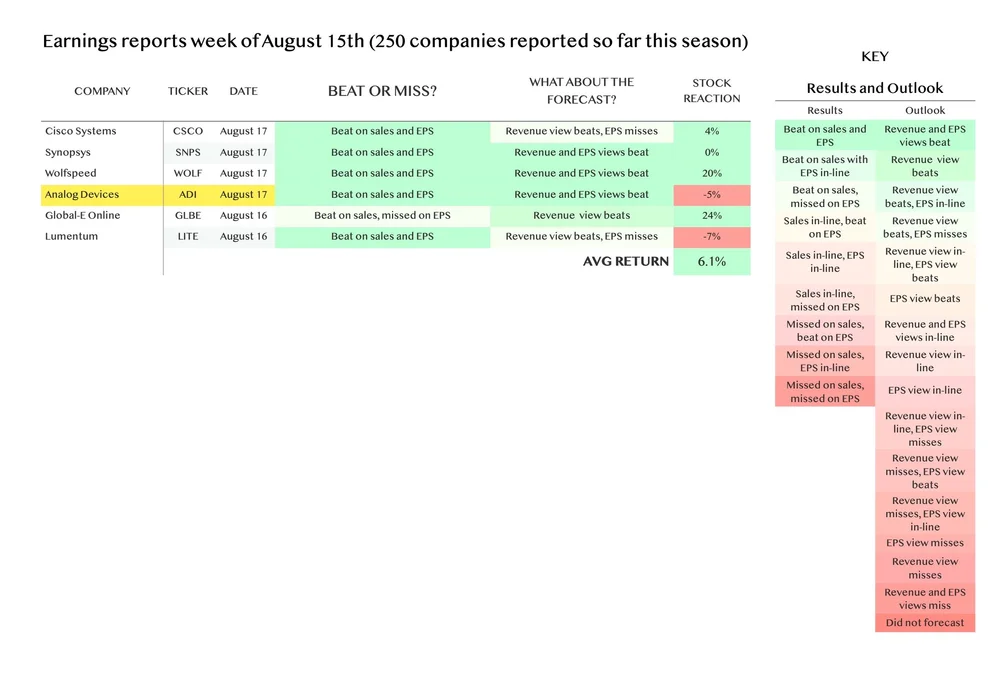
In addition to Cisco Systems, among other reports this evening, Wolfspeed, the chip maker that I profiled in May as key to the march of silicon carbidetechnology in electric vehicles, this evening reported a ten percent revenue beat for the June quarter, its biggest top-line surprise in years.
The stock soared by eighteen percent in late trading.
Silicon carbide, in case you haven’t read the lengthy opus cited above, is semiconductor technology that has remarkable properties of electrical conduction. That makes it a kind of wonder material for the traction inverter, the part in every electric vehicle that converts direct current in the battery into alternating current in the motor.
Wolfspeed’s great report follows a strong report earlier this month from a silicon carbide competitor, On Semiconductor. When I was assembling the TL20 last month, I said to myself, these are both excellent companies, and neither of them has seen a big discount to their stock valuation.
Well, I guess the joke is on me. Shares of On Semi and Wolfspeed are up thirty-one percent and forty-one percent, respectively, based on tonight’s after-hours leap in Wolfspeed.
The more important point is that the electric vehicle market continues to be a very important one, especially for these two chip suppliers. It’s quite possible the positive trends will last.
The moral of the story is that when you are plugged into an important trend in tech, as I have been with silicon carbide, don’t shy away, stick with it. Lesson learned.
Cisco, your small business barometer, is flashing green
Aug 18, 2022
Show notes
The fiscal fourth-quarter report of computer networking giant Cisco Systems Wednesday afternoon was uneventful, in a couple of interesting ways. The numbers were fine, but also not really remarkable given that they were set against a backdrop of lowered expectations.
And, more important to the average stock analyst, Cisco’s report contained no trace of weakness among small businesses, which is important given that Cisco has always been a kind of mood ring of the broader economy.
The results are a good sign for TL20 pick Arista Networks, Cisco’s main competition, and a good sign for tech and for the economy broadly speaking.
Back then, CEO Chuck Robbins told the Street that “The weakness got a little bit worse as you just sort [of] went straight down, as you would expect with small business, medium business and even smaller-size enterprises that were — didn’t perform as well as the very largest of enterprises.”
There was none of that this time. The economic details on tonight’s conference call with analysts were uneventful — happily so.
Robbins told the Street the company had a record number of product orders in the July-ending quarter, and just closed the second-strongest year in its history for revenue. “We had small business growth in Q4,” noted Robbins, “I think it was double digits [percentage revenue growth] on a global basis, which is a good sign that that's continuing to grow.”
For the revenue outlook for 2023, which was higher than expected, sales are expected to be “strong across our portfolio,” he said. “Right now, we're modeling for just the things to continue as we see them,” he said.
And it’s not just in the U.S. Robbins remarked that “I think, Asia and Europe, we had conversations with our team this week and they seem to — they continue to be reasonably optimistic as we are in the Americas.” The health of Cisco’s market is global, at the moment.
Robbins was challenged by one analyst on tonight’s call, Paul Silverstein of Cowen & Co, who has a long history covering the networking market. Said Silverstein to Robbins, “Once upon a time, networking in general, and Cisco, in particular, was the canary in the coal mine — when there was a macro downturn, you guys were the first to see it.”
Not this time. “I think you're right,” was Robbins’s reply. “And I've said this repeatedly: I think what's driven this is there are two things,
Number one, the pandemic revealed the impact of not keeping your core infrastructure technology up to speed […] the second thing is all of these mega trends that I mentioned in my opening comments, I mean, these customers are rearchitecting their entire infrastructure for the first time in years to deal with hybrid cloud and to deal with all of the mobile workers. We see IoT exploding.
So, what does one conclude from all that? Small businesses, for the time being, are buying stuff. That’s good.
And second, if Robbins is right about what’s happening in tech, networking is in a special place that is getting a lot of attention.
I would suggest all those things are good for Arista. For one thing, Cisco’s growth is nowhere near as high as Arista’s.
The Cisco numbers are the second non-event. When you look at Cisco’s reported numbers, keep in mind, they had already come down by billions of dollars.
The final total of revenue for the fiscal year ended last month, $51.6 billion, was almost four billion dollars lower than what the Street had been expecting in February. That big cut was the result of the fact that Cisco has been constrained by ongoing supply chain issues, which limit its ability to ship product and collect revenue.
So, Cisco is doing better than it would appear, but the numbers are still not anything that’s going to blow you away. The higher-than-expected revenue forecast for this year, four percent to six percent revenue growth, is partly an effect of fulfilling orders in backlog. It’s a little bit of a rear-view mirror, in other words.
Moreover, analysts tonight pointed to some weakness in the quarter in Cisco’s sales of equipment into the “campus” network, the main equipment that ties together corporate computers. You could imagine that might be the result of more companies being “virtual,” spending less time in the office or not even having an office at all.
“I mean, clearly, we have competition in the campus. We have very strong competition. We always have. And — but given the volume of the products that we're shipping right now, I don't feel like we're losing significant share.”
Well, we shall see. Arista’s still small in that campus market. Time will tell.
Among other reports this evening, Wolfspeed, the chip maker that I profiled earlier this year as key to the march of silicon carbide in electric vehicles, this evening reported a ten percent revenue beat for the June quarter. The stock soared by eighteen percent in late trading. Read more here.
Note: Names in yellow are TL20 companies.
Note: Names in yellow are TL20 companies.
Amplitude CEO: building the machine for the journey to a billion dollars
Aug 17, 2022
Show notes
Sooner or later — and better sooner than later — a successful young company needs to bring in new kinds of expertise if it is to mature past its initial success.
Such is the case for ten-year-old, San Francisco-based software maker Amplitude, whose co-founder and CEO, Spenser Skates, tells me his company has brought in the perfect individual to take the company from a quarter billion dollars in revenue annually to a billion dollars and beyond.
Thomas Hansen, the company’s president, joined last month to jump-start the company’s efforts around selling. Hansen comes with big company experience, including Dropbox, but also startup experience, including software maker UiPath.
“He’s seen the journey to a billion dollars in revenue before, that’s where we are going with Amplitude,” says Skates in a chat via Zoom not long after the company’s earnings report on August 3rd.
The view to a billion dollars is important for Skates, who has told me in each of our meetings so far — we first spoke following the company’s IPO in September — that he is focused on a “long-term” mission.
The report August 3rd was the company’s fourth quarter exceeding revenue and net loss per share estimates since the IPO. It was also the second quarter in a row in which the company raised its outlook for revenue for the year, and narrowed its net loss expectation.
“We posted some great results, which we’re really proud of, and we’ve seen a lot of traction for Amplitude in spite of the macro because we are just so critical to how people build their products,” Skates tells me.
Amplitude makes tools for software developers that help them understand how their apps are being used, and how the apps could be better if a developer made adjustments. If you use a smartphone app such as Calm for sleep and meditation instruction, Amplitude’s tool tells the Calm app’s developers how people move through the app, what features they use and don’t use, how they respond to new features, etc. — a kind of diagnosis of what is working and what is not.
Your usage is being measured, and Amplitude’s analysis is constructing the map of your habits, along with thousands, even millions of other users.
You could say the same sense of measuring and improving apps is evident in how Skates regards his own business. Having gotten this far in selling stuff, he says, "you need to set up a machine for the next level of scale.”
What does that mean?
“When you are a company of $50 million in revenue, and you have thirty account executives and sales people, that’s what we’ve been used to doing,” explains Skates. “We have set up the forecasting and pipeline generation and deal review for that scale.”
But, as things get larger and larger in an organization, new challenges emerge.
“How do you make sure everyone is really clear what they’re accountable for, for the quarter?” he asks, rhetorically. “How do you make sure that the goals for the very top level of the company cascade down through the different layers of the organization? How do you make sure all the functions from marketing to sales to customer success are coordinated?
“All those challenges are different at scale: as we get close to a thousand people at Amplitude, they are qualitatively different from when you were small.”
With Hansen’s coming aboard, Skates tells me the company now has the muscle to sell to larger and larger accounts, and to sell a broader array of product.
Hansen had taken UiPath to almost nine hundred million dollars in revenue last year, on course to over a billion this year.
In particular, Skates lauds "his ability to hire great leadership talent” at Dropbox and UiPath. “A really key part” of reaching a billion dollars in revenue, annually, “is getting the right leaders in all of go-to-market at that size and scale, he’s done that before,” says Skates, referring to the rubric for sales and marketing and customer support, “go-to-market.”
“All the talent he’s brought into his previous worlds is exceptional,” adds Skates.
The building of a machine of selling is important now not only because the company is becoming larger but also because the offering at Amplitude is becoming more extensive.
“I’m here to drive the success of the company for the long term,” says Skates, when asked about stock price performance. “If you’re focused on that, we’d love to partner with you to get you to be an owner of our stock.”
Skates is the kind of CEO who is “close to the metal,” as they say. He is captivated by the finer points of product development, as opposed to some CEOs who look at things from on high as more of a financial problem.
When we last spoke, in May, he told me his company was on a journey to expand its product line, to, as he put it, “capture lighting in a bottle twice.” The portfolio has so far consisted of three products, the “Analytics” program that started things off, and two newer offerings, called “Recommend” and “Experiment.”
This past quarter, the company added what’s called “Customer Data Platform,” or CDP, a kind of enveloping infrastructure that routs data between the analytics tools and other parts of the sales and marketing software toolkit.
For example, CDP will make it easier for a company to connect its applications to what’s called “A/B testing,” a practice of systematically changing aspects of the program for one group of users and not another, to test what works better.
“It will eventually be commoditized over time,” says Skates of CDP. There are CDP offerings from Salesforce and Adobe, but by having the program, Amplitude customers can use his company’s software without having to go to those other vendors for another thing to make it all work.
“You can get started with Amplitude much faster, and the tools integrate more deeply.”
The expansion of the product platform, the arrival of new sales talent, and the raised forecast speak to an operation that is humming along toward what is expected to be $235 million in revenue this year. The Street, of course, will still worry about the macro-economic risk.
To Skates, that matter has in a sense been dealt with. In February, Amplitude’s shares plunged by sixty percent when Amplitude cut its outlook for full-year revenue. The current forecast is now above that February forecast, and Skates tells me the cut in outlook at the time was a rather shrewd move.
“I think in a lot of ways we were ahead of the rest of the market in that we were very conscious that a lot of folks had gotten overly optimistic about SaaS markets,” he says, using the term for software-as-a-service, the rubric for cloud software. The downbeat forecast was a “reset,” and “since then we’ve been able to raise it twice, which has been fantastic — that’s a much better place to be as opposed to having to reset mid-stream.”
That doesn’t guarantee Amplitude won’t yet encounter challenges, of course. Skates insists that the results for this first half of the year convince him that even in a rough macro-economic climate, “investing in product data is the one thing that people are continuing to do now.” People are unlikely to pull the plug on Amplitude versus some other software, he believes.
The fly in the ointment for some investors will be the lack of profit. Operating margin is still negative, and though the company’s free cash flow swung from negative to positive last quarter, that was an outlier. The Street expects free cash flow will continue be negative for Amplitude for at least the next two years, and Skates reiterated in our talk that the positive number was a one-time blip.
“We are setting up, in three to five years out, we do want to be at positive ten percent free cash flow,” says Skates.
I point out to Skates that this year, we are in a regime where profit is much more important to investors, something that CEOs of other software companies, such as Dynatrace and DigitalOcean, make sure to feature in their conversations with investors.
“We’ve always had a more balanced view of that, where we want to set ourselves up for long-term growth and a sustainable business,” says Skates when I point out that attitude.
“When you are this early, you still want to make sure to make bets for the future of the business as opposed to being focused on cash generation.”
Everyone, he observes, wants to have “Rule of 60,” the Street short-hand for having a mix of, say, thirty-percent revenue growth, and thirty percent free cash flow margin. “I don’t think any SaaS business at our size is at Rule of 60,” he says.
Amplitude, moreover, “has never been a growth-at-all-costs company,” he contends, “we’ve always had a balanced approach.” The company has over three hundred million dollars in the bank, he points out, and “we’ve always been very lean,” and so, Amplitude doesn’t need to “significantly adjust our spend profile,” he says.
“Consequently, it’s a great time to build market share,” he says. “I feel great about the plan that’s in front of us.”
I ask Skates if the losses bug his audience on the Street.
His response is to turn to the long-term view he offered me in May.
“I talked about this in my founders letter” when the company went public, he notes. “I’m very much thinking about how do we set this up for the long term, because if we do that right we’ll be incredibly successful.”
Skates is something of a maverick, I’m reminded. He thumbed his nose at the IPO process last year, opting for a direct listing of shares instead of an underwriting syndicate. He is still telling investors to respect that his company in a sense marches to its own drummer.
“I specifically said, don’t buy our stock if you want us to sell the company,” he reminds me. “It’s the same thing today: In spite of what’s going on with the markets and everything on the outside, the trends driving our business are the same trends; we’re leading in our category; we have the best product out there; and if you just continue focusing on, compounding that, you’ll do really well.”
Amplitude, he says, “want investors that have that mentality, that are along for the journey with us,” he says.
I point out that Amplitude shares, despite a nice bounce following the earnings report, are down sixty-sixpercent this year. Is the stock a good buy? I ask.
Skates, as he did when we spoke at the time of the IPO, demonstrates a detached appreciation for finance and markets. “Prices are a great mechanism,” he tells me. “They contain the complete information about what people think is the fair value for the long term,” adding, “I think a lot of the fluctuation you see is the change in the price of capital, for the time-value of money.”
That’s smart, but how does that apply to Amplitude stock? Skates pushes the question of price aside.
“That’s not something I’m an expert on; I’m here to drive the success of the company for the long term; if you’re focused on that, we’d love to partner with you to get you to be an owner of our stock.”
Pressing the matter, I point out the recent stock price, $18.19, represents a drastically reduced forward sales multiple of less than seven times the next twelve months’ sales, way down from over eighteen times back at the beginning of the year. Does that make the stock more attractive?
Skates offers me a reply consistent with where he’s been coming from. “We’re good to buy if you’re a believer of the very long-term of the trends that are driving Amplitude’s business.”
TL20 jousts with the ARKK ETF, lead by Hubspot, DigitalOcean
Aug 16, 2022
Show notes
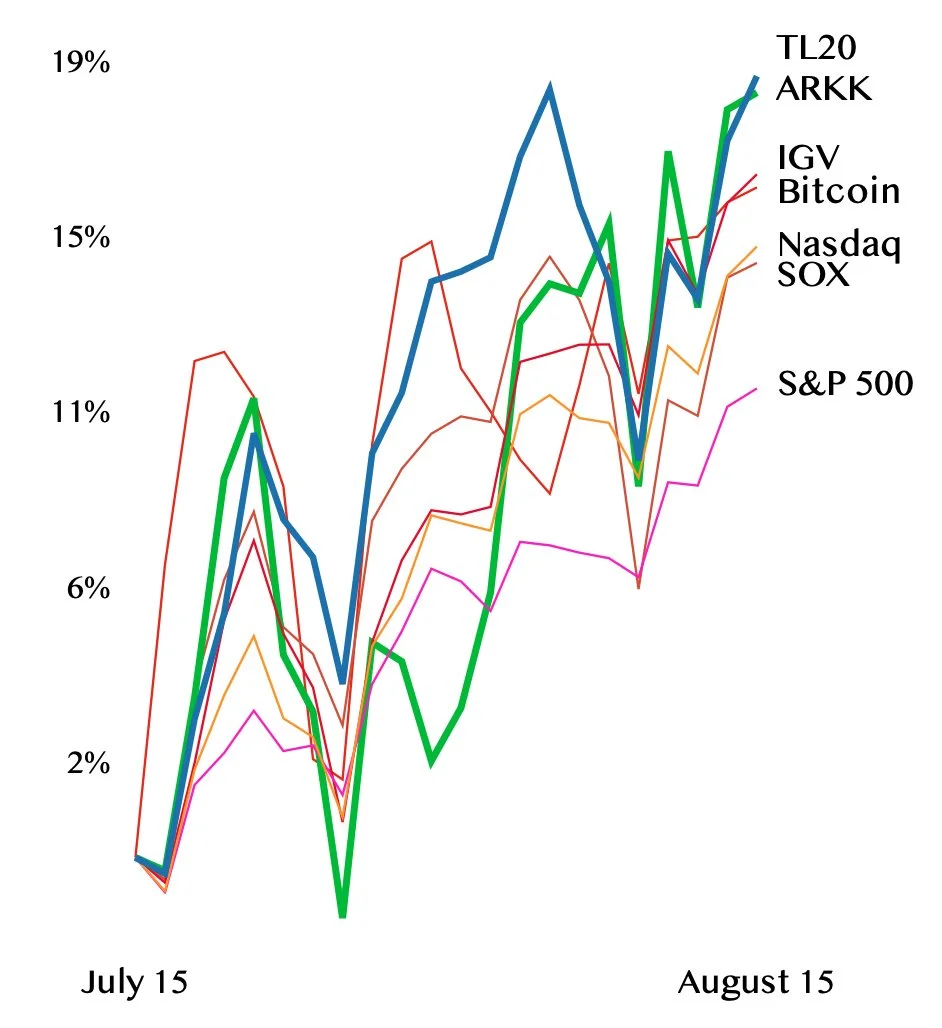
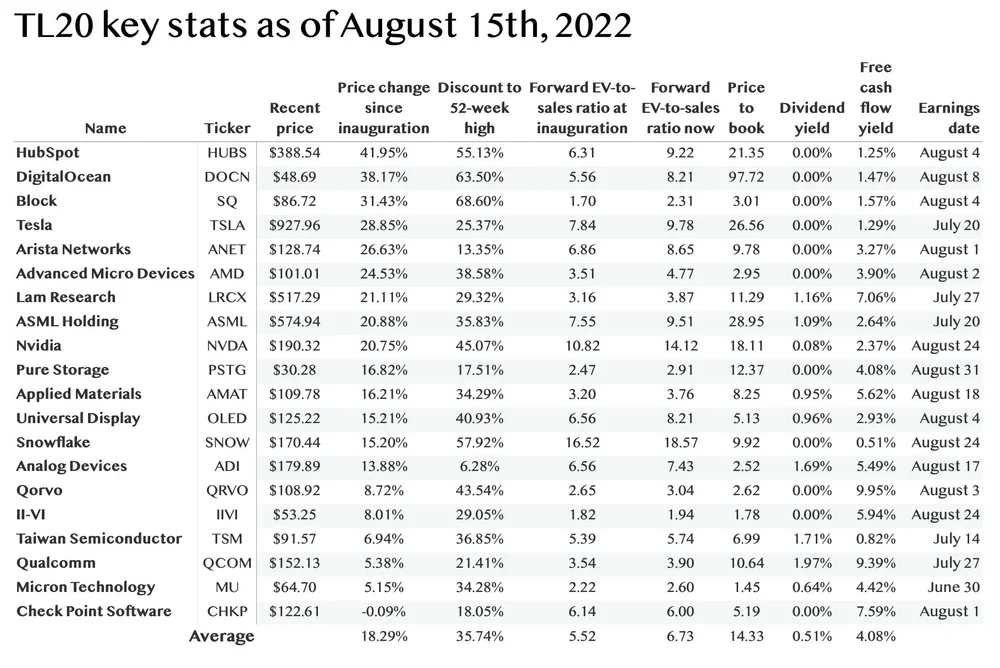
It’s been a month since the introduction of The Technology Letter 20 group of stocks, and things are going pretty well. The TL20, based on a return since inception of 18.71 percent — calculated by FactSet as a weighted average of the twenty by market capitalization — is not only head and shoulders above the Nasdaq Composite and the S&P 500, it’s also above several other relevant measures.
TL20 tops the iShares software ETF (ticker “ISV”); it tops the Philadelphia Semiconductor Index (ticker “SOX”), even though the TL20 has mostly chip names; and it’s even above the return of Bitcoin, even though Bitcoin has been lately clawing its way back from the low twenty thousand per Bitcoin to mid-twenties.
Perhaps most interesting to me, TL20 has been trading places on several days with Cathie Wood’s ARK Innovation ETF (ticker “ARKK”).
As you can see from the chart, the TL20 since inception on July 15th is a bit above the return of the ARK ETF, 18.71 percent versus 18.32 percent. ARKK has on a few days surpassed the TL20.
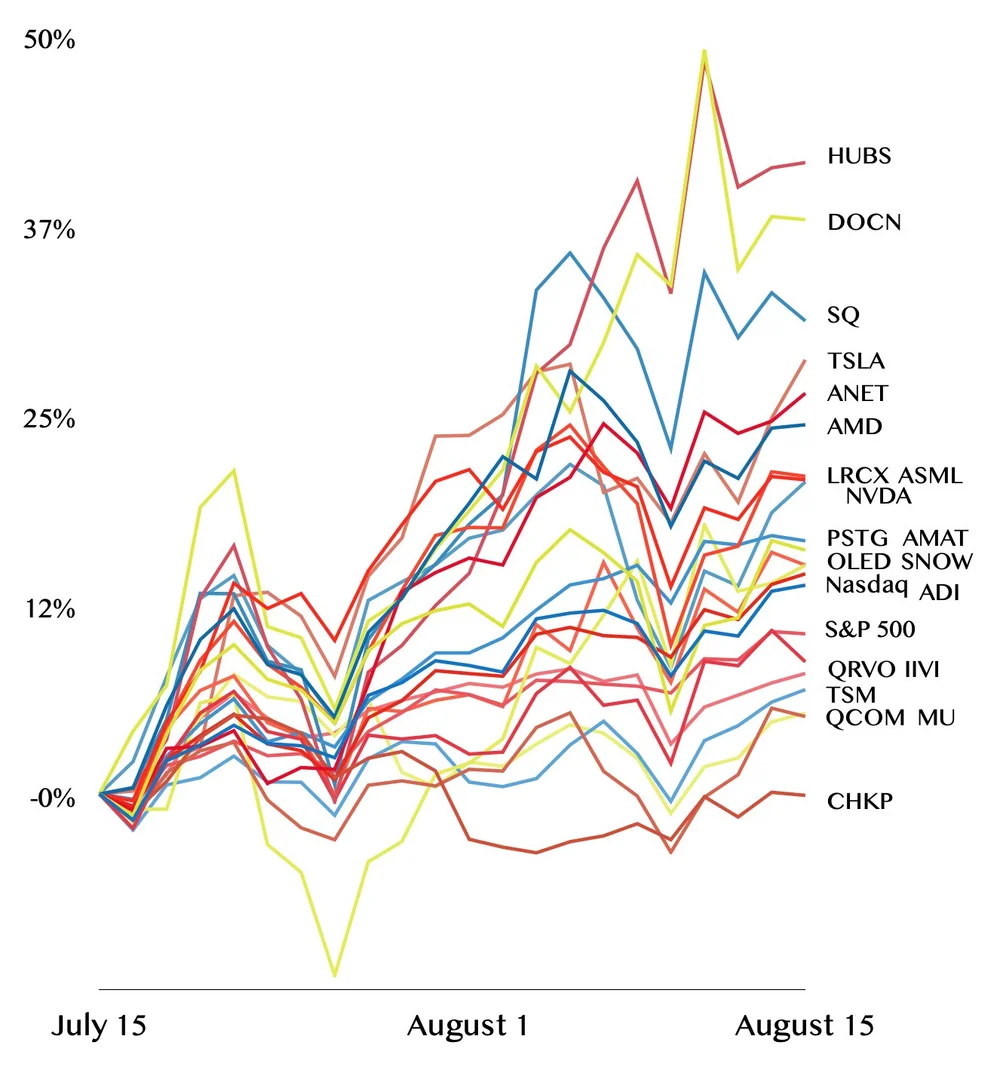
Both TL20 and Wood’s ETF have benefited from gains in some high-flying software stocks that have done well the past month. The two top performers of the TL20 are Hubspot, up almost forty-three percent, and DigitalOcean, up almost forty percent.
The ARK ETF, in that same span of time, has seen the biggest gains from Coinbase, the crypto-currency exchange, up seventy percent; DraftKings, the sports franchise, up sixty-two percent, and Unity Software, up sixty percent. Unity makes tools used by video game creators to write and deploy their games.
I would say that at this point, the primary distinguishing trait between these two vehicles’ holdings are the number of flame-outs in Wood’s ETF.
The ARK ETF has had a bumpy ride with some problem names this past earnings season, such as Roku and Twilio, both of which are fine companies but which had disappointing quarterly reports, sending their shares down by double digits.
As a consequence of big one-day drops, ARKK has had more substantial swings up and down; TL20 has not been as erratic.
ARKK is down forty-five percent since the beginning of this year.
Keep in mind, there are subtle ways the two may vary in how the weighting is computed for the prices of the two. The comparison is interesting, if not entirely an apples-to-apples comparison.
The Metaverse’s extraordinary stumbling block
Aug 13, 2022
Show notes
Jensen Huang, co-founder and CEO of Nvidia, the company that dominates 3-D graphics, used the annual SIGGRAPH 3-D conference this week to tout the impending arrival of what he and others call the next stage of the Internet, basically, a 3-D playground. A chief impediment to that vision is that the technology is incredibly resource hungry, making it unusable by the vast majority of computer users. Huang and team say that they have a plan for that.
This week saw the big annual conference for 3-D animation technology take place up in Vancouver, called SIGGRAPH. The show has been the venue for decades for breakthroughs in the art of 3-D movie-making such as the techniques made famous in Jurassic Park.
This week, Nvidia, a company founded in 1993, the year Jurassic Park debuted, told us that there was something really, really big, as big as Jurassic Park, to pay attention to at the show. I’ve covered the details at ZDNet.
That big, big thing that Nvidia is excited about is something that has so far been a whole lot of nothing, the Metaverse, the much-hyped future world that Meta’s Mark Zuckerberg has said will be the next incarnation of the Internet.
Nvidia makes GPU chips to make possible 3-D animation, both in movies and in video games, and now it is partnering with Meta and Apple and lots of other companies to make 3-D applicable to the Metaverse.
In this vision of the Metaverse, the Internet becomes a playground of interlocking 3-D worlds where everything is rendered in striking detail. Maybe you view it on your phone’s screen, maybe you view it in some future VR goggles. Your likeness might be instantiated as a 3-D character in that world, like the characters in Toy Story, called an avatar.
For Nvidia, it’s like 3-D is finally growing beyond a niche of big-budget movies and video games to invade all of the world’s connected existence. Now, that would be a great new opportunity for Nvidia.
Except, it doesn’t seem like that’s going to work. This week’s fanfare at SIGGRAPH was, for Nvidia, the perfect distraction from the company’s pre-announcement Monday morning that its sales of video game chips are weak at the moment. Part of the reason those sales are weak is because gamers, and 3-D movie studios, are niche markets. They are not small, they are worth billions to Nvidia, but they are still not mass-markets. Those markets go through cycles: customers invest in the Nvidia chips, and then they are sated for a while, and they hold off on buying.
And so, the problem of making the Metaverse in a sense boils down to the question, How do you take a niche market like 3-D and turn it into a broad consumer phenomenon? That’s the problem that Nvidia and its partners face with their Metaverse plans.
And therein lies a very difficult technical challenge.
The devices most people have in their possession today, such as the current crop of phones, don’t have the processing power nor the battery capacity to run those kinds of intense computer graphics. In many cases, they don’t have the download speeds, either, to fetch from a remote server the intense graphics data that the devices need to render those 3-D scenes.
There isn’t enough computing power on most computers, and won’t be any time soon, to handle all the graphics a Metaverse will entail.
That’s a big deal when you think about how consumer technology evolves. When the Web arrived in the early 1990s, around the time of Jurassic Park, the Web was simple enough that it was compatible with the computers of the time. It was mostly text with some low-res pictures. The hardest part was getting a dedicated “PPP” connection from the phone company. Once you had that, you could use most any computer to browse the Web.
The Web began in simplicity, and economy, and evolved. The Metaverse, in contrast, if it is ever to begin at all, proposes that everyone adopt a lavish, all-or-nothing world dependent on tremendous resources.
How can that happen without expecting the rest of the world to become video gamers or movie studios and shell out hundreds of dollars for the latest GPUs?
“That’s a really, really good question,” said Rev Lebaredian, Nvidia's head of its Metaverse effort, when I asked him that question.
Lebaredian, echoing my concern, first pointed out that “3-D, even though it’s just one more dimension than just 2-D, you might think it’s just 50% harder, it’s hundreds or thousands of times harder, and it has an insatiable appetite for computing power.”
The short answer from Lebaredian is that there’s going to have to be a way to do most of the computer processing in the cloud, in remote data centers, and have only a little bit happen on the device. And Nvidia is working on that technology, what it calls “Omniverse.”
As Lebaredian explained,
The solution to this, ultimately, is to move as much compute as possible into the cloud. We are always going to be constrained by the amount of compute you can have on a device, especially one you put on your head, or in your pocket. And it’s never going to be enough. We’ve already recognized that for virtually all other types of applications, non-3-D applications. Everything you use today, from email to search to maps, most of the compute behind that is done somewhere else, it’s not done on your device. The same needs to be true for 3-D. We’ve built Omniverse to enable this pattern, where we can break apart all of the computation necessary for 3-D worlds into components, into micro services, and move as much of it as possible to the appropriate computers in the cloud. And for the ones that need to be closer to you, you can run that compute — just that compute — near you.
All of which sounds good, except when you consider that the stuff that appears on your screen, the 2-D, and now the 3-D stuff, a bunch of polygons, is all still done locally, for the most part, on your computer, be it a desktop or a handheld. And that stuff is done either in simple fashion, if its a smartphone, or in hyped-up fashion if it’s a $2,000 gaming machine.
The user interface has always taken place locally, on the device itself. To do otherwise is extraordinarily difficult.
And so, the explanation that Lebaredian offered, while it makes sense, sounds to me like it’s right back to square one. There isn’t enough computing power on most computers, and won’t be any time soon, to handle all the graphics a Metaverse will entail. And there isn’t enough bandwidth between those computers and the cloud to crunch those polygons in the cloud and then ship them to you as a kind of description for you to render in real time, with low enough latency for it to have the illusion of reality.
I think this is a non-starter. There are all kinds of obstacles in front of the Metaverse. As I’ve written in past, it seems unlikely that Zuckerberg and the other parties involved have the kind of sensibility to create a world humans really want to inhabit. But this technical issue is the most concrete stumbling block so far.
Now, if I were to offer the contrarian view, I could put on my stock-trading hat, and suggest there is a brilliant opportunity here. Nvidia could partner with Qualcomm, the makers of cellular chips, to make sure that ever more and more of the infrastructure needed for Lebaredian’s vision is pushed closer and closer to every individual. It would demand Nvidia GPUs to sit right next to wireless 5G chips from Qualcomm. In fact, I could imagine one day both companies merging, forming a kind of powerhouse of wireless processing and transmission.
The Metaverse would finally be the perfect “killer app” for the 5G bandwidth that Verizon and others have been pitching for several years now.
That computing power would get closer and closer to you by being set up inside of Amazon cloud computing centers, what Amazon calls “local zones.” As Amazon’s CTO, Werner Vogels, recently told me, those local zones are already running more and more compute for smartphone functions of wireless carriers. Amazon’s cloud is now “getting closer and closer to every individual,” he remarked.
I would make that argument if I believed that things could come together that way. I’m skeptical, though. Especially about wireless. Every time there’s been a new “G” in cellular, such as 3G and 4G, it has mostly been used by carriers to achieve greater operating efficiency, for the purpose of saving money. It hasn’t been used to dramatically improve experiences. Sure, connections today are much faster than twenty years ago, but it’s taken that long to get reasonable Web-surfing on a smartphone.
To get the Metaverse on a smartphone, it might take another twenty years or more, long past most investors’ investment horizon.
Color me dubious on this whole thing. I’ll be interested to be proven wrong.
DigitalOcean CFO: ‘We are masters of our own destiny’
Aug 11, 2022
Show notes
“There is no need for a prima donna,” says Bill Sorenson when I ask who could replace him.
Monday, Sorenson told the Street he is retiring next year from his post as CFO of DigitalOcean. He was kind enough to talk to me by phone about the company’s second quarter report, and where the company goes from here.
Usually, I talk with the CEO of DigitalOcean, Yancey Spruill, following the company’s reports. This week, it was Sorenson.
“Yancey has been such a great leader,” he tells me. “I’m very excited about the trajectory of the company.”
I was glad to make Sorenson's acquaintance given his many years of experience in tech, and given that he’s from Sheepshead Bay in Brooklyn, New York. Being a New Yorker myself, I appreciate getting the no-nonsense picture from someone who’s from what used to be a really tough neighborhood.
Sorenson’s no-nonsense answer when I asked him who’s going to replace him (the board is actively looking for the next CFO) was that they should be a team player who doesn’t put on aires.
“Culture is important, we are one hundred percent remote,” he points out, meaning staff work from everywhere. “It’s important to have a fabric, a mission, a commonality to hold everyone together,” and whoever comes aboard “will have to fit seamlessly into that fabric.”
The ostensible subject of our talk was the report on Monday, but the stock had already in a sense eclipsed that report. The financial results were modest, with revenue for the quarter missing consensus expectations, and the outlook for this quarter merely in line with what analysts have been modeling.
The stock, however has rocketed in weeks leading up to the report, and continued to rise following it. DigitalOcean is one of the TL20 stocks to consider, and it has been the best performer since the July 15th reference date of the TL20, up almost fifty percent in that time at a recent $52.67.
“Q2 was an example of our ability to be disciplined on spending,” says Sorenson. “If we have to weather this storm, we can weather it.”
That is despite some substantial concern in the market that DigitalOcean is going to be hurt by any small business weakness in a potential recession.
In case you’re not familiar with the business, DigitalOcean sells a cloud computing service that is a more-economical alternative to Amazon and Microsoft and Google. It is David going up against the Goliaths of cloud.
What the move upward in the shares may in part reflect is a conviction among investors that, as Sorensen tells me, “We are masters of our own destiny.”
“DigitalOcean’s key verticals include Blockchain, SaaS builders, Video, Streaming, and Web Agencies,” she wrote, “and we think developer/SMB [small and medium business] activity in each of these end markets is likely to slow.”
Amidst such apprehension, it’s interesting to hear Sorensen say the company is master of its destiny. His chief point is that the company got a heck of a lot of money before the IPO window slammed shut this year.
“We have $1.2 billion of cash on the balance sheet,” he points out. No need for follow-on offerings any time soon, in other words, something he is “so glad” about, he says.
What is great about talking to a CFO who was in the room when deals were done is hearing the epic tale of getting money in a roaring market, a market that won’t be as easy again, probably, anytime soon.
“When I joined we had a bank facility that was the primary funding for the company,” recalls Sorenson. “And we determined how much cash we were going to need, and we quickly went out and we up-sized that deal.”
The company then “quickly started laying the groundwork to go public,” realizing that the company’s venture investors, including Andreessen-Horowitz, “were past their horizon,” about six to seven years, and wanted a return soon.
Following the IPO in March of last year, the company did a convertible debt offering of one and a half billion dollars. “We were just primed and ready, the convert market was just hot as a pistol,” he recalls.
“We went out thinking we might raise $850 million, and they kept calling me back, saying, You want another hundred million more?”
“So, we raised very quickly $2.5 billion” between IPO and converts, he says with a bit of a chuckle.
“Now we are in a great position to use that money to help us grow the business,” he says. “We are not dependent on third-party sources.”
The other part of the story, of course, is not just the balance sheet but what keeps getting added. DigitalOcean is one software maker that is generating positive free cash flow while many have either never reached profitability or are hoping to get back to profitability some day.
“It cracks me up about CEOs that re-affirm their commitment to being cash flow positive in 2025,” says Sorenson. “There’s a lot that can go wrong between now and then.
“We don’t have to worry about profit and free cash flow, we are there, we’ve crossed that hurdle.”
In a market that is “enormous,” perhaps over a hundred and twenty-five billion dollars in value, annually, the challenge for DigitalOcean is to preserve that profit profile while also investing in the business.
“Q2 was an example of our ability to be disciplined on spending,” says Sorenson. “As you look forward, you’re thinking about things that take a longer time to pay off, and what we’re trying to be disciplined in is the appropriate mix. What do we need to invest for the future? What do we absolutely need to invest for the near term? And within that envelope, demonstrate improving profitability.”
What happens in a tight spot, the kind that Goldman’s Borges is concerned about?
“Your question is a good one,” he replies. On the one hand, the customers are “sticky,” as they say in the software business, especially those who pay more than $50 per month to use the service, notes Sorenson. Those customers are growing the fastest, and they become somewhat embedded in the service because they come to depend on it.
“People come on, they build a business, they build an application, they’re not turning it off tomorrow,” he explains. “While their spend levels may adjust, they’re not basically picking up and moving someplace else because the product itself is still a fifty percent discount” to the larger cloud operators.
Nevertheless, “If we get in a tough environment — we’re starting to see one — we certainly have demonstrated an ability to control our costs,” says Sorenson. "And I think if we get into a situation where there’s continued pressure, we’ll continue to be disciplined to basically not go backwards in terms of our overall profitability.”
Not going backward is good, of course, but the real intention, he says, is to carry on with Spruill’s “mantra,” to “systematically improve the overall operating profile of the company.”
Spruill and Sorenson on Monday told the Street the company will produce operating profit margin this year, on a non-GAAP basis, of fifteen percent to sixteen percent. The company expects to have a free cash flow margin of nine to ten percent.
Over the coming years, the intention, says Sorenson, is to scale those margins to “mid to high twenties” for operating margin; and scale free cash flow margin to “above twenty percent,” all while maintaining thirty percent or better per annum revenue growth, on a path to a billion dollars in revenue in 2024.
“I’d say the company is incredibly fired up because they see the opportunity ahead of us.”
To steer toward those goals, says Sorenson, it will be important that his successor not only not be a prima donna, but also that the person be able to handle that growth trajectory the company aims for.
“If you take that growth trajectory to 2026, you’re doubling again to two billion [dollars],” he says.
“The thing that is going to be important is someone who has helped build organizations to several billion dollars of revenue.”
In past, CEO Spruill has been freewheeling with me in interviews when addressing stock valuation, assuring me at every turn the shares are a good buy. I point out to Sorenson the shares this year have come down a bunch in valuation, to just under nine times as a multiple of enterprise value (market capitalization less net cash) divided by projected revenue.
Is that the right multiple? I ask Sorenson.
“That’s a great question,” he says. “We are in select company where we are generating real free cash flow, and it’s growing; we are improving profitability; we are targeting sustainable revenue growth of thirty percent-plus — I think that puts us in very attractive company to be investing in for the long term.
“We have seen in markets over the past six months that there is a greater focus on cash and profitability, and we are poised to take advantage of the good market.
“If we have to weather this storm, we can weather it.”
What’s up with Invitae?
Aug 10, 2022
Show notesNVTA Chart by TradingView
Wednesday was a nice stock market session, when many companies with so-so results nevertheless turned it around and saw shares climb.
And then, there was cancer diagnostics developer Invitae (ticker “NVTA”), which, after reporting a disappointing outlook on Tuesday evening, and seeing its shares rise a modest four percent in late trading, on Wednesday soared by two hundred and seventy-seven percent.
That’s right, Invitae, which had lost eighty-five percent of its value this year amidst very mixed financial results, and massive losses, is now down only forty-three percent for the year.
The near-quadrupling in the stock Wednesday came, as I said, following mediocre results, and amidst at least one downgrade. Analyst Julia Qin with JP Morgan cut her rating on the shares Wednesday to “Underweight” from Neutral, arguing that it now seems more uncertain whether the company can reach a “long-term” growth target for revenue of fifteen percent to twenty-five percent.
San Francisco-based Invitae, which came public in 2015, and which has been selling its services since 2013, offers genetic testing for a variety of conditions, though testing a person’s DNA for hereditary cancer has been the bulk of that work.
The company’s value proposition has been to make genetic testing more accessible to the average individual, to spread the benefits of such testing. The founders, chairman Randy Scott and director Sean George, are genetics veterans, having previously worked at a number of firms in the business, including Genomic Health and Incyte.
The outlook on Tuesday, as I said, was not good. The company is expected to burn through over half a billion dollars in cash this year, and still its revenue for this year, about half a billion dollars, is expected to come in below consensus. Next year is expected to bring another couple hundred million in cash burn. Nothing to get excited about.
The news flow, moreover, has been tumultuous this year, with co-founder George replaced as CEO in July with the company’s COO, Kenneth Knight, amidst a broad restructuring.
The volume Wednesday was as remarkable as the price surge, a total of almost two hundred and thirty million shares changing hands, roughly equivalent to all the basic shares outstanding, and over two thousand percent of the thirty-day average daily volume.
All of this, moreover, transpired from about 2:15 pm, eastern time, till close, so, less than two hours. The shares were trending down slightly in late trading.
Amidst the tribulations of Invitae this year, one of the most interesting things, of course, is that the biggest single holder of the stock is Cathie Wood’s ARK Investment Management. ARK holds almost thirteen percent of the shares, according to FactSet, a position that has been increasing throughout this year, including a purchase of 813,000 shares on Monday, in advance of the earnings report.
Is it possible for Wood to have achieved something substantial on Wednesday by purchasing another very large percentage? At prices between $4 and almost $9 per share, it would, of course, cost tens of millions of dollars, which is a lot to pay in one fell swoop.
Not impossible, of course, though it’s also possible NVTA is simply the “meme stock” of the moment. If so, things could quite easily come apart in coming days. Bloomberg opinion columnist Jared Dillianon Wednesday had the interesting suggestion that the meme stock phenomenon is now in the hands of warring hedge funds. If that’s true, then it could be Wood going up against her rivals. (Dillian didn’t specifically mention Invitae.)
If you’re considering whether to dip into this, consider that aside from massive losses this year and next, the stock is currently below what is considered the book value of the shares, $12.43, according to FactSet. Decide for yourself if that means it’s a great buy.
Alteryx CFO: ‘You're beginning to see the fruits of everything that we put in place’
Aug 10, 2022
Show notes
"We took our lumps in 2020 for a variety of reasons, execution being one of them,” says Kevin Rubin, chief financial officer of software maker Alteryx, in what may be deemed a substantial understatement.
For most of the year 2020, Alteryx seemed like the gang that couldn’t shoot straight. The stock had several perilous ups and downs. Then the company brought in a new CEO in October of that year, Mark Anderson, a veteran of large, highly successful firms such as Palo Alto Networks. He had a plan to revamp the way the company sells its software, a more mature, focused approach able to support very large deals with enterprise customers.
Flash forward, Alteryx is one of the more popular names in a stock market suddenly scrutinizing software makers more heavily than it did six months ago. It seems what Anderson has been up to is finally coming together.
“I think you're beginning to see the fruits of everything that we put in place the last seven quarters, that it’s starting to really build momentum,” Rubin tells me in an interview via Zoom following Alteryx’s successful second-quarter report on August 2nd, which sent the shares soaring by nineteen percent the next day.
Alteryx makes data analytics software programs that are meant to “democratize” use of data in an organization. Rather than be stuck with a lame Excel spreadsheet, or, conversely, needing to have a PhD in data science, a person who uses the Alteryx software is supposed to be the everywoman, or man, in an organization, a citizen analyst who can derive meaningful insights with less toil.
I’ve been interviewing Rubin for three years now, and it’s nice to have his perspective. He’s been with Alteryx for over six years, so he has a sense of how things changed with Anderson. The new way of selling, he tells me, really is paying off.
“Going into Q3, we have the strongest pipeline that we've seen in many years,” says Rubin, referring to the mix of deals in process.
“I think I would be misleading you if I said that everything was done” with the company’s sales transformation, “but I think the heavy lifting is certainly behind us.”
A year ago, it was still not clear if what Anderson was bringing to Alteryx was going to work. That month, the stock dropped ten percent on a disappointing forecast, something Rubin at the time chalked up to growing pains.
“This is the third or fourth quarter in a row where we've put up some really good, strong results,” Rubin observes. Indeed, last week’s report was the fourth quarter in a row of sales beating expectations, the fourth quarter in a row of the company’s sales outlook topping consensus as well, and the fourth quarter of the stock jumping on the news.
Alteryx even managed to raise its revenue outlook for the full year, something that stands out when other software vendors such as Datadog and Dynatrace are having trouble maintaining their forecasts.
“Unlike some other commentary we've seen from software companies, we actually saw sales cycles in Q2 improve slightly,” he points out.
“If you're a CFO of a large, Global 2000, and have a list of areas that you're going to spend on in 2023, there's things above the red line, and things below the red line,” explains Rubin. “We believe data and analytics is going to be prioritized above that line.”
What has changed under Anderson, says Rubin, is a more deliberate way to go after prospects, and to build the business with each of them, which is important since most of Alteryx’s revenue in a quarter comes from follow-on sales to existing customers; new business, by contrast, starts small.
“We are landing more strategically than we were doing before,” says Rubin, using the software sales jargon for landing a new customer, part of the tactic of “land and expand,” to get a foot in the door, and spread through a customer.
“If you had asked me that question in 2018, the strategy was a little bit different, where we understood that landing a lot of logos [new customers], not all of them were going to expand with us and we, kind-of, accepted that.” The company went more for the low-hanging fruit, in other words.
Under Anderson, and chief revenue officer Paula Hansen, who came aboard in May of last year, and was promoted this past February, there has been an “operational rigor that we’ve instilled in the business” that treats customers in a more purposeful manner.
“The enterprise focus that we have today is very prescriptive about who are the prospects, and who are the largest companies in the world that we want as customers,” Rubin tells me, “and we have very strong campaigns and initiatives to go after those prospects in that regard.”
That includes having more seasoned sales talent call on enterprises than in past.
“We're not going into Acme Corporation, a large global 2000, you know, with a twenty-seven-year-old who's never sold that company before,” he says. Instead using partnerships, large operations such as PWC, has a big added emphasis for Alteryx. "We're doing a much better job leveraging what the partner network has to offer us in terms of being able to have these higher-level, more strategic, more outcome-driven conversations.” Half of the company’s “annual contract value” in the most recent quarter, meaning, the value of subscriptions it will recognize as revenue over a twelve-month period, was derived from partners, he notes.
As a result, says Rubin, unlike some other firms these days, “I'm not anticipating that we're going to have a deleterious impact of sales cycles going forward.”
As important as selling is the fact the company has “a large concentration of renewals in the back half [of the year],” notes Rubin, meaning, customers renewing their contracts, a factor of the mass of quarterly revenue coming from existing customers. That actually eases some of the constant effort of selling.
It’s good to be a CFO who’s been around, I can see from talking with Rubin, in order to grasp the dynamics and mechanics of revenue.
“We have a history and an understanding of what the renewal cycle generally tends to bring from a net expansion rate,” he tells me, referring to one of those metrics so important to the software world, the rate at which existing customers buy more.
“So, we wouldn't have that guidance out for Q3 and Q4 without having a high degree of confidence that those are levels that this business can achieve.”
The progress under Anderson is evident in the beat and raise, and the revenue growth rate, which the Street expects to rebound to forty-four percent this year from eight percent last year. One can wonder, though, what is going to happen in the fall, the time of the annual ritual of companies making out their budgets for the new year.
“We obviously don’t know what companies will decide to do,” concedes Rubin. “What we do know is data and analytics is a priority.
“So, if you're a CFO of a large, global 2000, and have a list of areas that you're going to spend on in 2023, there's things above the red line, and things below the red line,” he explains. “We believe data and analytics is going to be prioritized above that line.”
Recession is hard to predict, but it need not decimate the business, he believes. “To the extent that, you know, there is a material shift in the world, we still think, given the large opportunity that exists for us within this space, that we will be able to continue momentum and continue to to execute well.”
Despite the security of the sales pipeline, and the current outlook, the company is “watching everything like a hawk,” he says. “We have better visibility, and the ability to course correct, today, than we did in 2020.”
Another potential point in Alteryx’s favor is the possible collapse, in this new credit environment, of some startup competitors not as well funded as Alteryx. Alteryx has almost seven hundred million dollars on the balance sheet, and has demonstrated in past an ability to generate free cash flow.
“Companies in this space that are not well-funded, and their VCs, or investors, are saying, you've got to preserve cash, it’s going to make it harder for those businesses to come out and compete,” he observes, “they’re going to be a little bit on life support.”
Of course, Alteryx could be an acquirer of such stranded assets. “If there is a transaction that makes sense for the business, there's always a way to get it done,” Rubin says. He adds, "I’m not super-excited about using equity at this valuation, so I don't know that, you know, we're going to run out and do a deal that would result in us issuing equity at these levels.”
By “these levels,” he could certainly be referring to the stock’s forward price-to-sales multiple, using its enterprise value, which is just 5.6 times, even after a twenty-five percent move in the stock in the past week. That is cheaper than Alteryx was five years ago.
Do investors, I wonder, think Alteryx is profitable enough? The company is expected to lose fifty-one cents a share on an adjusted basis this year, before returning to profit in 2023. “This business has been profitable in the past, and if you just look at the long term model and the implied cash flow of this business, you know, it's pretty strong,” Rubin insists.
The company’s cash flow has been negative the first six months of this year, but that is partly an effect of the company having seasonally lower “billings,” the signing up of new business, in its first quarter. That results in the June quarter being the lowest one for collections for Alteryx. “As we typically get later in the year, billings are higher, collections are stronger, and you start to see the productivity lever relative to the performance.”
Still, there is a balance to be struck: growth, still very high, has to be a focus of spending even while leaning toward profitability. “We have been investing intentionally in areas of the business like go-to-market and product, and that has been the focus,” says Rubin. “It's not lost on us, and I hope we've demonstrated over time, that we take a very disciplined approach towards where we put money.”
As far as investor attitudes he’s observed, there is no dramatic shift away from growth in software investing, there is no focus on profit exclusively.
“If you're a company that is growing fifty, sixty percent, and showing disciplined investments, investors tend to appreciate and understand that there is investment needed to grow that business.”
So, is the stock cheap? Alteryx doesn’t have a buyback program in place, Rubin notes, as “I would rather put our cash today into growth and accretive opportunities than repurchasing the shares.”
“But, yeah, I don't disagree with you,” he adds, about the cheap valuation.
“I vote with my feet each and every day,” is his bottom line. “I come in and I feel very, very fortunate to be part of this ride.
“I think over time, we have an incredible opportunity to disrupt and transform how businesses perform.”
Voting with one’s feet, meaning, showing up, for a seasoned CFO in a hot market for CFO talent, is, certainly, an interesting proof of conviction, it occurs to me.

 Our TOPPODCAST Picks
  Stay Connected