In the TL20, as in the broader market, people sold their losing names on Tuesday
Sep 14, 2022
Show notes
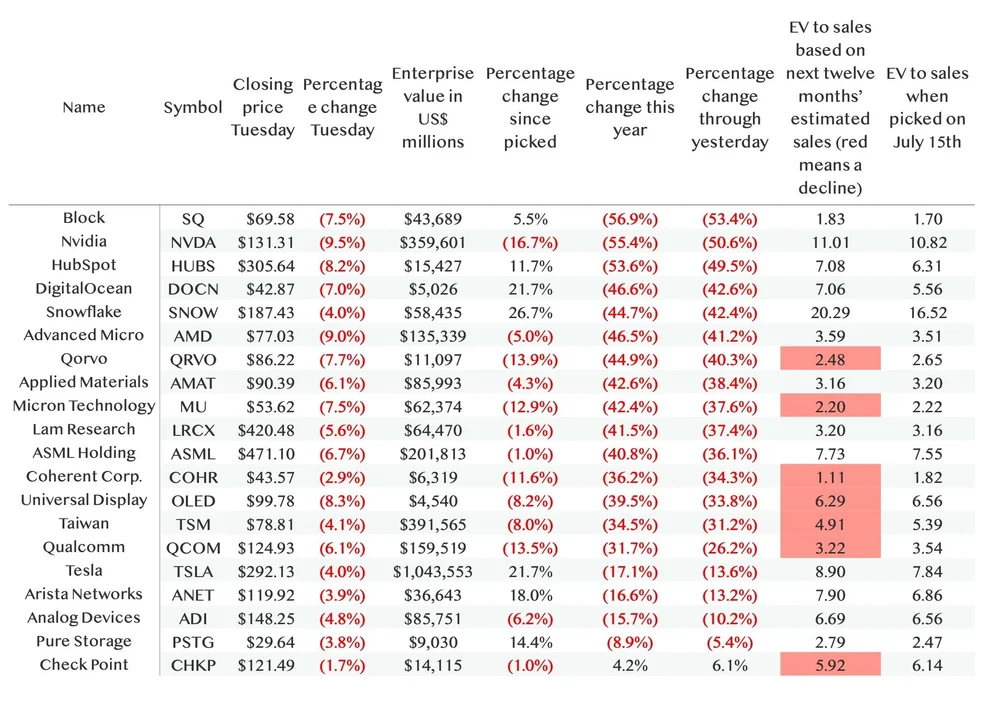
The broad selloff Tuesday certainly did not spare the twenty stocks in the Technology Letter 20. And the most interesting thing is that the declines were spread fairly evenly amongst the group. The selling did not distinguish relatively more expensive or less expensive names.
The TL20 declined by 5.9% on Tuesday, worse than the 5.16% of the Nasdaq Composite Index, although not as bad as some really pricey vehicles such as the ARK Innovation ETF (ticker “ARKK”), which collapsed by almost seven percent.
As you can see in the table below, the worse declines, lead by Nividia’s near ten-percent decline, were spread across a spectrum of valuation, based on enterprise value as a multiple of projected sales. Nvidia is still one of the most expensive chip stocks around, but Block, which is trading at a serious discount of less than two times projected sales, was also one of the biggest losers. In contrast, Tesla, one of the most expensive stocks in the group, at just under nine times projected sales, held up better than the Nasdaq, dropping only four percent.
Note: Coherent originally appeared as II-VI; the company changed its name on August 8th with the consummation of its acquisition of laser maker Coherent.
And, curiously, the decline Tuesday did not punish the most expensive stock in the group, a true outlier, Snowflake, which is now even more expensive than the already expensive multiple it had back in July, even though estimates for Snowflake have risen since then.
In fact, the most obvious pattern Tuesday is that people were selling their losing stocks more than they were selling their winners. I’ve sorted the table by the year-to-date decline. The top ten worst decliners for the year, including Block and Nvidia, down forty-eight percent, on average, had an average decline on Tuesday of 7.2%.
That is much worse than the 4.6% decline of the ten names in the TL20 that have held up the best this year, including ASML and Check Point Software.
The ranking is the same if you roll back to Monday’s close. The stocks that were down the most for the year through Monday’s close are the ones that declined the most on Tuesday, with the exception of Snowflake, which actually held up better than you would have thought.
The fact that people were selling their biggest losers Tuesday suggests we are not yet done with massive sell-offs. The notion of “capitulation” holds that the market has only really hit bottom when people sell their winners. They haven’t done that yet, by and large.
As for the TL20, I stand by the value argument. Many of these stocks were trading at multi-year lows in July when I surveyed them. Several are cheaper now, as indicated by the red boxes. Eventually, the value in those names will win out.
Oracle’s growth picks up: The Larry and Safra show wows the Street
Sep 13, 2022
Show notes
The earnings season began again this evening, with Oracle being the first company to turn in results thanks to the fact that it closes the books really quickly. The company finished the quarter August 31st and was already ready to report less than two weeks later.
In fact, Oracle’s CEO, and de-facto CFO, Safra Catz, told the Street that the ability to close the books is proof of how good the company’s software is.
“Now, today's the 12th of September,” Catz observed, during the company’s conference call with analysts Monday night.
“In fact, I signed off with our auditors on Friday,” she said, “but we don't do our earnings on Friday, so we had to wait all the way till Monday.
“Now, no other companies report on the ninth or the eighth day, in fact, most companies were reporting their July quarter last week, and here we are announcing an August quarter.”
What does that have to do with anything? Catz told analysts Oracle’s software is the same stuff that Oracle uses to run its financials. If Oracle can turn the books faster, it must be great stuff, she said.
That kind of puffery, from a CFO, is a fairly routine these days in tech-land. But even by today’s standards, Monday’s conference call was an enormously feel-good affair. Catz, and Larry Ellison, co-founder, chairman and CTO, took turns trying to outdo one another with descriptions of how great the business is doing.
The reported results slightly beat expectations, and the forecast for this quarter missed for the first time since December. But that mattered little. Oracle’s results are held back by the rising U.S. dollar, which has risen over twelve percent this year against the Euro.
Foreign exchange is something Oracle can’t control, so the Street tends to put that off to the side.
More important, Oracle, is, indeed, showing some increased growth rates, and that’s news.
The quarter’s highlight was the company’s “organic” revenue, meaning, revenue excluding the contribution of healthcare giant Cerner, the acquisition of which Oracle closed on in the quarter, rising eight percent, year over year. That was the highest rate of quarterly revenue growth in years.
Catz cited a bunch of figures for the company’s cloud computing offerings. Because they are tossed out there in somewhat haphazard fashion, it’s hard to make sense of it all. But the gist of it is that there is some momentum in Oracle’s cloud computing services, which compete with Amazon, Microsoft and Google.
As Catz summed it all up, “It's not only that our growth rates are higher than our hyperscale competitors — maybe you’d expect that because we're the newest, and thus, the smallest — but our growth rates are increasing as we get bigger.”
Fair enough. The hyperbole, however, from Ellison, while triumphal as usual, contained an odd note of contrition. Ellison usually boasts about how much better his technology is than that of his competitors.
He did a little of that Monday evening, but then, he pivoted. He talked about how Oracle software can now be used from within Amazon and Microsoft cloud computing services.
“Multi-cloud interoperability is an important step in the evolution of cloud computing,” said Ellison. It’s slightly odd for Ellison to talk about people wanting to use other companies’ products or services.
The contrition didn’t last long. Ellison noted some new customers for Oracle in cloud computing, such as Nvidia. He also remarked as how he has been “personally talking to some of Amazon's most famous brands that are running at AWS.”
“The amount of money these huge companies, these very famous companies, spend with Amazon is kind of staggering,” he observed. Said Ellision, “they can save a huge amount of money by moving to OCI,” Oracle’s competing cloud service.
Ellison teased that “next quarter, we'll be announcing some brands, some companies moving off of Amazon to OCI that will shock you. I'll stop there.” That is vintage Ellison puffery.
The analysts on the call sounded fairly impressed. The shares rose mildly in late trading.
Among the intriguing details of the evening, other than the revenue increase, is that Oracle is spending like crazy to build its cloud computing facilities. The company’s capital expenditures in the quarter rose by sixty-two percent, year over year, to $1.7 billion. That was quite a bit faster than the forty-four percent rate by which capital spending had risen in the same quarter a year earlier.
Ellison explained that Oracle has “more data centers in more countries, in more cities than Amazon or AWS,” adding, “We’re expanding, because the demand is there.”
If there was one thing that wasn’t exactly clear this evening, it was the trajectory of Cerner under Oracle’s control. As I noted back in May, the twenty-nine-billion-dollar acquisition of the health care software firm has yet to prove itself a win. There was a little bit of discussion on the call, but not much, even though the deal was finally consummated last quarter.
Catz noted, encouragingly, that Oracle’s gross profit dollars rose by fifteen percent with the contribution of Cerner in the quarter, whereas the profit would have only increased by seven percent without Cerner. “In fact, the gross profit margin increased dramatically in the quarter,” she noted, although Oracle doesn’t report its actual gross profit margin.
One quarter does not make a trend, but this was a strong quarter for Oracle. My question, going forward, is what to make of a now heavily encumbered balance sheet.
This is the first quarter in which Oracle’s working capital, the difference between current assets and current liabilities, turned negative. Oracle, for the first time since I can remember, has less in available money to cover expenses than the total amount it owes in near-term obligations.
The long-term debt balance, moreover, has swelled to seventy-five billion dollars. And the company carries an astonishing sixty-one billion dollars in goodwill on its balance sheet.
Oracle is growing as it has not in several years, but it is not a lean, mean machine, it’s a big pile of IOUs.
The only reason that fact may matter to investors in the immediate term is the that, as I mentioned back in March, the company’s stock buybacks have slowed dramatically. Buybacks totaled just over half a billion dollars last quarter, versus eight billion dollars in the same quarter a year earlier. That continues a trend of several quarters slowing down.
With the stock one of the better performers this year, down only twelve percent, and the dividend yield one of the better ones available, 1.7%, and with growth now at a faster clip, perhaps none of that will matter.
GitLab CFO: We sell essential things for no more than the price of a Netflix subscription
Sep 08, 2022
Show notes
Eight-year-old software maker GitLab is the best-prepared company to handle the quarterly earnings call with Street analysts, according to none other than the company’s chief financial officer, Brian Robins.
“We do the most work before we go into these calls,” says Robins. “I listen to all the transcripts of all the other CEOs and CFOs, I read all the analyst reports, I talk to public company CFOs, I talk to board members on public company boards.”
I was talking Wednesday with Robins via Zoom following a highly successful conference call the night before for GitLab’s fiscal second-quarter earnings report. The report, and the call with the Street, sent GitLab shares up fourteen percent Wednesday, capping a forty percent rise in the past six months.
Because Robins reads everything and talks to his peers, he knew going into last night’s affair that what was on everyone’s mind was how the macroeconomic outlook is causing a lot of companies to revise down their forecasts.
“These are uncharted markets, if you will,” Robins observes of the mood afoot. Companies of varying sizes are talking about how they are seeing deals to sell software come under greater scrutiny. The common refrain is, “We saw sales cycles lengthen.”
Not so GitLab. During the quarter, Robins and CEO Sytse “Sid” Sijbrandij told the Street Tuesday, “Buying cycles have actually sped up across the business.” GitLab’s sales rose a remarkable seventy-four percent last quarter, year over year, to $101 million, the fourth quarter in a row since the company’s IPO in October last year that results have easily topped expectations. The company added the most number of new customers of any quarter so far.
Despite beating the Street consensus for revenue by seven million dollars, Robins told analysts the outlook for this year will be higher than previously expected by about twelve million, the second time the company has raised its year outlook, cementing the sense that the company is defying gravity.
And so, I asked Robins, as had the Street, What is going to right for the company?
“I think being a mission-critical platform,” says Robins.
GitLab is a set of software capabilities that are woven together that serve application developers. On the simplest level, it is what is called a a “version control system,” a repository where coders put their pieces of code, a system that maintains the record of which is the latest version, which are stable pieces of code, which are experimental, and keeps track of who checked in or out stuff the way a library keeps track of borrowers. It’s the kind of thing that is an essential tool for programmers.
In addition, the software has taken on other capabilities, such as measuring how programs perform once they go live, and automating the process of finding bugs in masses of software too convoluted to be checked by hand.
The product has the homespun appeal of having begun life a grass-roots project. The first version of the software was created when co-founder Dmitriy Zaporozhets, “created GitLab from his house in Ukraine,” as the IPO prospectus recalls, “a house without running water.” Later, a member of the developer community, Kamil Trzciński, convinced Sijbrandij and Zaporozhets to expand the software, a pivotal, game-changing move.
Today, GitLab’s suite of tools is a “platform,” in software industry argot, an array of functions under the “DevOps” banner that not only manages code but checks for security breaches, compliance with rules. and other things that fall under a company’s software operations.
Competitors include DevOps vendors such as Datadog, but most of the competition, insists Robins, comes from companies that try, and fail, to build something in-house to manage their programming tasks.
As a result, he tells me, “Companies are saying, I can save money, I can be more productive, I can hire fewer engineers if I deploy GitLab,” and that makes the program indispensable.
Robins is fond of citing “cohorts,” the customers who have come to GitLab in waves and who end up staying and spending more. The company’s dollar-based net retention, or “DBNR,” one of The Metrics that are paramount in the software world, has consistently been over one hundred and thirty percent. That is a measure of how much more customers buy than they did a year ago. That is a very healthy rate of expansion.
“Our cohorts are still expanding with us — six, five, three, two years ago — they are all still expanding,” he says. “That doesn’t happen unless you’re fairly priced, you offer a good business outcome, and your time to value is quick.”
I offer to Robins to play devil’s advocate. Is it possible, I ask, that a company that is at half a billion in revenue annually, that sells a useful product at a modest price — the entry level for the software is $19 per developer per month — is the kind of thing that is not a big enough deal to attract the attention of the CFO when she or he, in times of trial, is looking around at things to scrutinize for extra cost savings.
“What I love about the model, from a CFO perspective, I have such great predictability into our revenue,” says Robins, referring to the subscription nature of Gitlab software, “if I see any degradation in the pipeline, I can adjust,” he says, meaning, the deal pipeline.
“I love it, because I think the same way, it’s the right way to think,” says Robins. He recalls talking with a GitLab investor Wednesday morning. “The investor said, the Premium [version of GitLab] is the price of a Netflix subscription — you offer so much more to a developer for $19 a month.”
There are only two tiers of product. The “Ultimate” version rises in price to $99 per developer per month. “For less than twelve hundred a year, you’re getting the most advanced and comprehensive security features as well,” he notes. Companies spend as much as fifteen thousand dollars a year to equip a junior sales rep with tools for sales and marketing, so in the scheme of things, GitLab seems a rounding error.
The product has a “a super-simple” pricing model, he notes. It is the same cost whether companies run GitLab in their data center, or in a public cloud facility such as Amazon AWS. The company has “removed all the friction” in buying because it knows companies will over time add more and more subscriptions for their developers as the product spreads inside teams, building that DBNR.
Add in the fact that the software makes developers more productive. T-Mobile, a GitLab customer, went from a several-month release cycle for new applications to several weeks, Robins tells me. Goldman Sachs went from weeks to hours. The market research firms such as Forrester Research estimate the GitLab software has a return on investment of over four hundred percent, on average.
But, GitLab is still very early in its mission. As Sijbrandij is fond of telling the Street, GitLab has yet to crack the vast majority of developers in its target customers.
So, I ask, when does GitLab rise to a level of a customer’s spend where it does attract the increased scrutiny of the CFO?
“It’s a great question,” says Robins. Customers have signed huge checks for GitLab at times, he observes, ten million dollars or more at a throw, even though those aren’t the norm. The biggest deal at one time was investment bank UBS signing a license for nine thousand users.
It comes down to the return on investment, says Robins.
“If someone came to me as the CFO of GitLab, and said, I need to invest $600,000, and I’m going to save you three million dollars, are you in for that,” reflects Robins, “I would say, If it’s the right thing for the business, yeah, I’ll approve that all day long.” Citibank, he notes, spends an estimated one billion dollars per year on security.
“If we’re at a ten, twelve-million-dollar clip with a bank, I don’t think they’re going to get far enough down the descending rank of expense of vendors at the CFO level to hit me.”
Because he observes his peers, and he listens to what the Street us saying, another thing that Robins has observed this year is that the market has changed from one that lauded growth at all costs to one that “demands you get profitable at all costs,” he quips.
GitLab is not yet profitable. He and Sijbrandij have told the Street that growth is the most important thing, for which they will continue to invest, but they will do so responsibly. The company hired over four hundred new employees in the first two quarters of this year.
Nevertheless, the company’s gross profit last quarter rose by a point to eighty-nine percent. And the company’s non-GAAP operating profit margin improved by fifteen points, to negative twenty-seven percent. Those numbers are testimony to increasing efficiency, what is referred to in the software world as improving “unit economics” of selling software.
“We will add $160 million of incremental revenue this year, at the mid-point of guidance, for less of a loss this year than last year,” he notes, regarding the revenue forecast. That is despite a return of some expenses that had been in abeyance such as travel.
The heavy lifting is mostly done, he insists. “We got the infrastructure built, and now almost all of what we’re adding is in sales for incremental capacity, in marketing for lead-gen, and in R&D for product feature functionality enhancements.”
Those new team members will take nine months to contribute to new sales as they come up to speed. If things go well economically in that time, the new recruits could be a big lift to capture sustained customer demand.
And if things don’t go so well economically?
“What I love about the model, from a CFO perspective, I have such great predictability into our revenue” because it is a subscription business, he tells me. “If I see any degradation in the pipeline, I can adjust,” he says, meaning, the deal pipeline.
To adjust, in this case, could mean putting a sudden hold on hiring. That “visibility” into things, and the ability to temper hiring, are “two levers” to adjust, as he sees it. “As the CFO of this company, I feel I’m in a very privileged spot, a unique situation, so I can manage the profitability of the business, if something were to go negative.”
Robins, 51, is a very seasoned executive and a very seasoned CFO. He has had tenures as a consultant to hedge funds and venture capital funds, and also multiple CFO stints with large companies, including digital authentication vendor Verisign, and consulting giant Computer Sciences Corp. He has seen the shape of companies over years that were much larger than GitLab. GitLab is more like turning a speed boat than a tanker.
“If I were a manufacturer, I would have to put all the PP&E [property, plant and equipment] in place, and then hope I can get the manufacturing ramped up, and then sell the crap out of it.”
Given the improving unit economics, given the levers of control over growth, why not, I ask, give the Street some sense of just when GitLab intends to be profitable?
“Great question,” says Robins. “We’re working internally, we are doing what we said we will do, it’s in our long-term model, we are executing against that better than what we said at the IPO” in October of last year.
The company may have an “analyst day” meeting at some point, the confab where a vision is laid out, but that hasn’t been decided yet. “It’s when you want to tell something, you can’t just regurgitate what you said on earnings, you don’t have one just to have one.”
In the meantime, Robins spends shoe leather to canvass the investor community. “I talk to well over a hundred investors a quarter, I talk to every analyst who covers us, I get out on the road.”
The stock, at Wednesday’s close of $54.16, trades for about eleven and a half times the Street’s estimate for next year’s revenue, which prompts me to ask one of my favorite questions for CFOs, Is the stock a good buy?
“I only control what I can control, and that’s the execution of the business,” says Robins. “I’m super-happy that we reported seventy-four percent year-over-year growth, and we added the most base customers in company history in really, really, really tough macroeconomic conditions.”
GitLab stock is down thirty-seven percent this year, and fifty-seven percent since the IPO.
TL20 slips below Nasdaq for the first time
Sep 02, 2022
Show notes
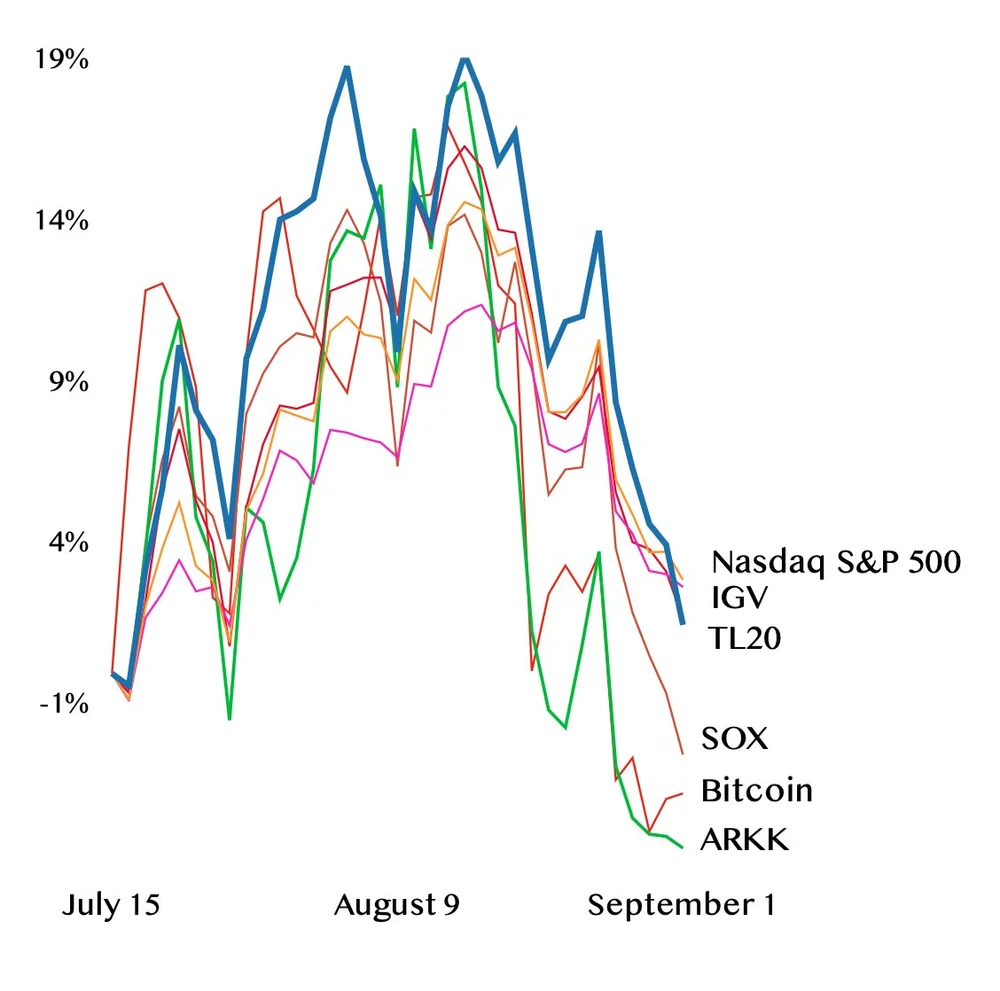
The carefree days of July are a distant memory with the decline of the TL20group of stocks to a mere one and a half percent increase since the inception date of July 15th. As you can see in the chart, Thursday was the first time the TL20 slipped below the return of the Nasdaq Composite and the S&P 500 since inception.
The proximate cause are the semiconductor companies. They are the worst performers aside from computer security vendor Check Point.
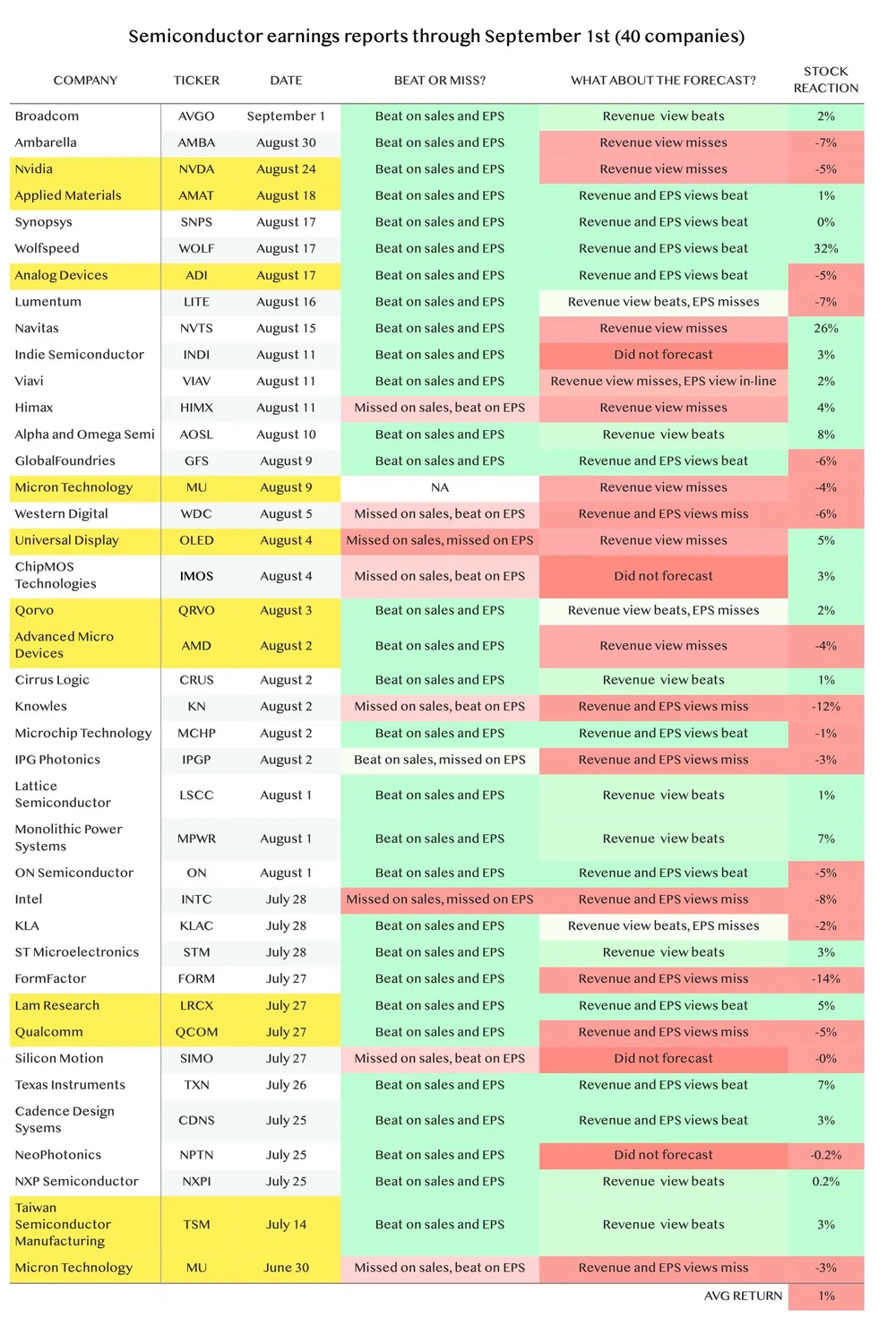
A further examination of the semiconductor names shows that most had solid earnings reports during the past month and a half, but their forecasts missed in many cases.
The signature example of what’s going on in the chip industry are the memory chips. The warning by Micron Technology, a maker of NAND and DRAM memory chips, on August 9th, was the proximate cause of weakness in the group. Micron said that it sees its customers revising their orders as they considered how they would sell off inventory of chips they already have. That lead to the conclusion that most chip companies are dealing with a sudden build-up of inventory.
This is the semiconductor cycle playing out, the bust that follows the pandemic-induced boom. All eyes are now focused on whether it will be a V-shaped recovery or something more protracted.
Robert Maire, long time semiconductor analyst, writes in his latest missive via email that “the bell ringer indicating the bottom of the cycle is the last bullish analyst capitulating (ignoring those who never change their ratings….).”
It certainly seems as if the last bullish analysts have capitulated. Revenue estimates for Micron’s fiscal year ending August of 2023 have been cut by twelve billion dollars this year. Cuts of multiple billions of dollars in estimates have also been made for many other semiconductor companies and tool makers, including Applied Materials and Lam Research.
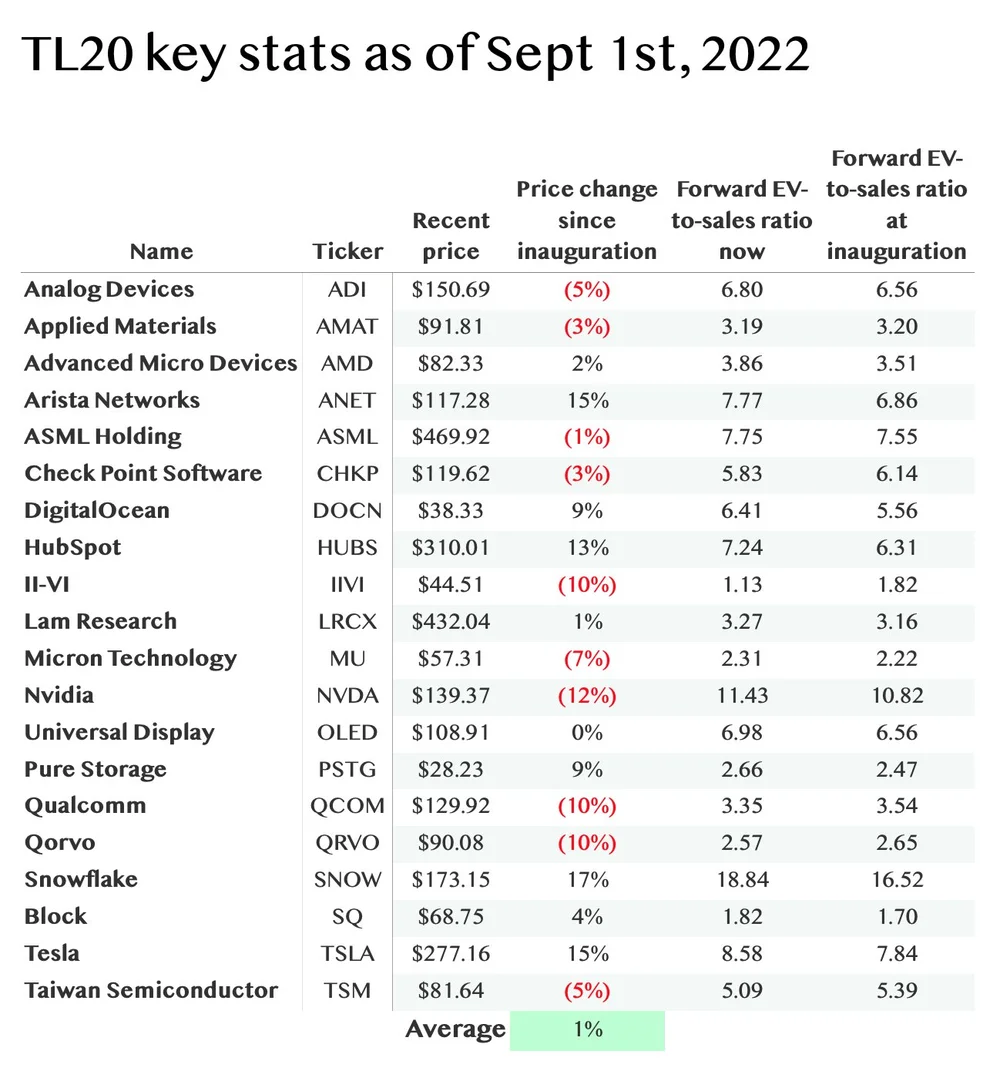
Probably, the transition from the extraordinary tightness of the lockdown period of COVID-19 to whatever is the new normal for the chip industry will be unlike any other semiconductor cycle. Regardless of the shape of that transition, the key thing that I observe is the same thing I observed in mid-July when compiling the TL20. The chip stocks are trading cheaper than they have been at earlier times. Some of them, such as Applied Materials, are cheaper now than they were in July.
For key companies such as Applied and ASML and others, their valuations, as value stocks, will win out in the end.
Pure Storage, Nutanix shine in a night of wrecks
Sep 01, 2022
Show notes
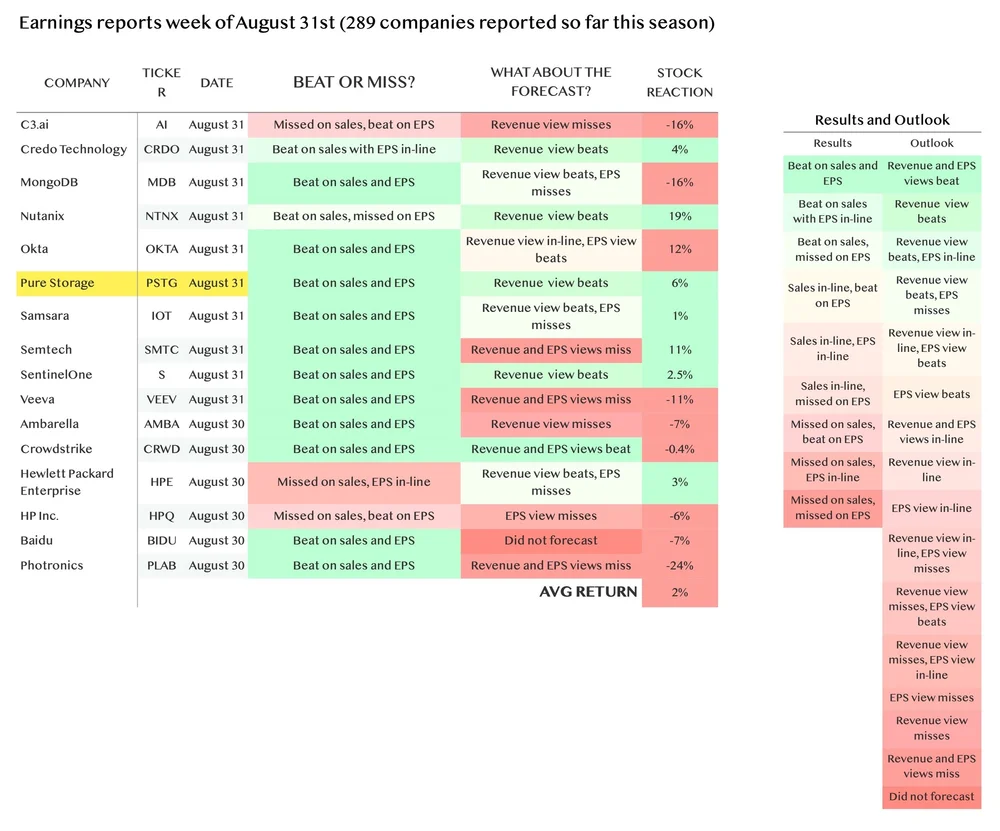
Yeeesh. It’s a brutal night for earnings reports, with multiple double-dip decliners, including some high-flying names that have been software darlings.
The good news tonight is that Pure Storage, the maker of a kind of NAND flash-based device for managing data, beat with its results and outlook and is up by six percent in late trading. Pure is one of the TL20stocks to consider, so I was glad to see that.
Another winner is Nutanix, whose shares are up nineteen percent this evening, a big rebound from the disastrous sell-off in May.
But first, let’s look at the bad news. C3.ai, Okta, MongoDB, and Veeva are all down by double digits.
Tom Siebel, founder and CEO of industrial AI company C3, said in his press release tonight, “the economic downturn is real.” He told analysts on the call, “Our customers and prospects appear to be expecting a recession,” and they are more and more scrutinizing deals for his software.
“In the course of the quarter, we saw sixty-six forecasted deals move out in the quarter, many of which we would have fully expected to close under normal market conditions,” said Siebel. He said the company is responding by making cuts to non-essential spending.
This is a continuation of Siebel’s tone back in June, when he told the Street things were becoming “quite dire.”
The side story here is that Siebel announced the company is moving from selling contracts with predictable revenue to selling on a “consumption” model. In a consumption structure, C3 doesn’t bill customers at a pre-ordained time, like the beginning of each quarter, but only as they use the software.
That is the approach that companies such as Snowflake and Confluent use, and Siebel said consumption pricing is becoming the standard in cloud software.
Said Siebel, it was necessary to move away from the company’s more traditional selling approach.
“While this elephant hunting subscription sales model has served us well in establishing C3 AI as a leader in enterprise AI, it is clear it is not well suited to the deliberate decision and approval processes inherent in the current economic environment.”
It’s an approach, however, that injects some uncertainty into C3’s model, because the rate of revenue recognition now falls into the hands of customers.
And consumption pricing won’t necessarily prevent economic effects. On tonight’s call with MongoDB, CEO Dev Ittycheria, told the Street that his company is seeing adverse effects despite still healthy demand for its database product.
Although “MongoDB is a non-discretionary spend for our customers,” Ittycheria said, “As expected, we did see the macro environment weigh on the growth of Atlas consumption.” Atlas is the name of the version of the company’s database that can be used by customers in public cloud computing facilities.
“It's important to understand that the slower-than-historical consumption growth is the result of slower usage growth of our customers' underlying applications due to macro conditions,” added Ittycheria. “In the current environment, some businesses, and, consequently, their applications, are growing more slowly.”
Over at Okta this evening, the reported revenue was better than expected, but the forecast for this quarter’s revenue was merely in line with consensus.
On the call, CEO Todd McKinnon told analysts that the company has seen “a discernible impact from the evolving macro environment.” Specifically, “We are starting to notice some tightening of IT budgets and lengthening sales cycles relative to last quarter.”
“This leads us to believe that the weakening economy is having some impact on our business,” said McKinnon.
Another company having a tough evening is Veeva, which makes cloud software for Big Pharma. The company missed with its revenue outlook for this quarter, and CFO Brent Bowman told analysts on the call that economic factors are affecting smaller customers and the drug advertising market.
“Specifically, it's impacting commercial a bit more,” said Bowman. “We've seen some impact to Crossix as advertising budgets have tightened a bit, and we also saw a little bit of lower add-on to users from SMB customers in the CRM and bulk commercial.” Crossix is the name for Veeva’s program that helps drug companies analyze their media spend.
The bright spots, again, were Pure and Nutanix. Pure’s results and revenue outlook both topped expectations, as they has for many quarters. In his prepared remarks, CEO Charlie Giancarlo spent most of his talk telling analysts how great demand is from customers. His only reference to trouble was the remark, “We do, however, see signs of increased diligence of purchases by enterprise customers, resulting in some lengthening of sales cycle.”
When pressed on the matter, Giancarlo added that the company is not losing any deals, but the CFOs at customers are weighing in more than usual:
While we are seeing you know a little bit of let's say second, second looks by companies, you know finance perhaps stepping in for a second look at a deal and that is lengthening some of the enterprise sales cycles, but it's not changed the closing of the deals later in the process. And as I said demand and pipeline looks very healthy.
In a note to clients this evening, Cowen & Co. analyst Krish Sankar writes of Pure, “A recession-resistant stock...so far!”
Finally, Nutanix, you’ll recall, had a terrible May report, falling twenty-three percent after it offered a disappointing quarterly forecast and cut its full-year outlook.
Tonight, the company’s outlook for both the fiscal first quarter, and the full fiscal year, are meaningfully higher than Street consensus.
CEO Rajiv Ramaswami told analysts he’s been traveling a lot, meeting with customers, saying he continues to see “solid demand” out there.
However, he also said the company is laying off four percent of its workforce, amounting to two hundred and seventy people. The move was presented as a way to be “diligent” about expenses in order to ensure profit going forward. Nutanix turned free-cash-flow positive in the fiscal year just ended, and intends to remain so going forward.
When Ramaswami was pressed on the issues of the economy, he remarked that a good part of the future revenue is in the bag, so to speak. That’s the portion that consists of “renewals,” contracts to use Nutanix software that are about the customer maintaining the product. There’s a tendency for customers to want to keep what they’ve already been using, so they renew.
However, he also noted, “it's in the new and expansion business that we have factored in some conservatism as it relates to the macro environment.” Meaning, Nutanix acknowledges it may be harder going forward to win new business, rather than renewals.
Despite the two bright spots, there’s something of a pattern here. It sounds like no one has a full grasp of what is going on with IT buyers. The happy possibility is that Nutanix and Pure may be selling products that are important enough that they are less likely to be cut off.
The question is whether things such as “increased deal scrutiny” at some point turns into customers heading for the exits.
HP Enterprise: holding pattern continues
Aug 31, 2022
Show notes
The two Hewletts — Hewlett Packard Enterprise and HP Inc., the concoction of Meg Whitman when she split the business a decade ago — came up short on Tuesday evening, reporting revenue below expectations, and a lackluster forecast in the case of HP.
The one Hewlett is doing quite a bit better than the other, however. Enterprise, the part that sells networking and servers and builds supercomputers, is on track to come pretty close to goals set out a year ago. It has record backlog of orders to fill, which speaks to the health of its market.
The sour result at HP Inc., on the other hand, echoes the gloomy report from competitor Dell last week with its miss on quarterly results and miss on forecast. The PC market is going through its long unraveling, which is having a major negative effect on HP’s revenue. The company doesn’t forecast revenue, but its profit per share forecast for the current quarter, seventy-nine cents to eighty-nine cents, is more than twenty percent below the consensus for a dollar and six cents. That’s in large part because revenue won’t be as high as originally expected given the weak PC market.
Hewlett Packard Enterprise shares fell three percent in late trading, while HP Inc. shares fell six percent.
Both Hewletts are struggling with not being able to get enough parts to make some shipments, a continuation of the supply chain mess. The silver lining for HP Enterprise is that those orders for networking and servers keep coming in, so its appeal to customers is intact, unlike with HP Inc. in the PC market, where demand is falling apart.
With one quarter left to go in its fiscal year, HP Enterprise’s CFO, Tarek A. Robbiati, Tuesday evening told analysts the company is on track to achieve its forecast for three to four percent revenue growth. That is despite the fact that the rising U.S. dollar is imposing a penalty of over two percentage points on the company’s revenue.
The company’s operating profit margin, moreover, last quarter was in keeping with the company’s goal of operating margin at 10.5%. And although the company lowered its outlook for the year’s free cash flow, to a range of $1.7 billion to $1.9 billion, that’s not very far from the original goal of $1.8 billion to $2 billion this year.
When HP Enterprise’s CEO, Antonio Neri, was pressed by analyst Shannon Cross of Cross Research about the poor results at Dell last week, Neri, without addressing Dell, replied by telling Cross, “I would say this quarter, Shannon, was characterized in my mind by enduring customer demand.” He noted the company’s backlog of unfilled orders is three times what it usually is during this time of the year.
As Neri pointed out, filling those orders will be a continuing payoff for HP Enterprise, especially having locked in higher prices for some of its products:
In term of clearing the backlog, this is going to still take quite a bit of time and that's good news for us because it give us momentum in Q4, into 2023, which is great because remember two things have happened in our backlog. Number one is price for a strong gross margin as Tarek just went through. So, in many ways it's protected for that gross margin, and, number two, we have not seen any meaningful cancellation at all.
The one fly in the ointment for HP Enterprise is that the company has come through a period of booming orders, and the pace of those orders are coming down. That means that once the company catches up with all the product it has yet to ship, there may be less growth to be had in future quarters.
One analyst, Toni Sacconaghi of Bernstein, asked about that. Neri responded to him by stating that some areas of the business, such as “edge” computing, are even stronger in terms of order growth and aggregate demand than for the company overall. And, anyway, he told Sacconaghi, the company sees nothing to deter it from its stated intention to increase revenue at two percent to four percent, annually, over many years.
Added Neri, “I will use the word steady because obviously you can't use the word growth in the context of the compares here but steady, steady.
“And then within that steadiness, we have growth in some unique segments that continue.”
Steadiness sounds to me rather like stasis, which sounds like what I wrote of HP Enterprise a year ago at this time: A bit of a holding pattern.
What I wrote then was that it “looks like Hewlett is just back to where it was two years ago,” in 2019, in terms of profitability, with revenue growth made easier by pandemic buying.
It still feels that way now, like HP Enterprise has some real winners in terms of product, such as its GreenLake cloud service, but the company also still struggles to “move the needle,” as they say, with such winning products.
For now, I would be more interested in two of the TL20stocks to consider that are within HP Enterprise’s field of view, Arista Networks and Pure Storage. Both of those are cleaner stories, more focused vendors.
Most holders of HP Enterprise will be in it for the 48-cent per share per year dividend. At Tuesday’s price of $13.65, that’s a 3.5% yield. Not bad.
HP Enterprise shares are down twelve percent this year, only half the twenty-four percent decline of the Nasdaq Composite, and less than the S&P 500’s sixteen percent decline.
HP Inc. shares are down sixteen percent this year.
Calculating the TL20
Aug 29, 2022
Show notes
The TL20group of stocks to consider is up over eight percent from its reference date of July 15th, besting its benchmarks by a significant margin despite recent market turmoil.
Or, perhaps, because of recent market turmoil. The TL20 were picked as being good deals, and I think that the virtue of picking good stock buys becomes readily apparent in tough markets.
I’ve cited the TL20 regularly, and the daily performance is shown at the top of the TL20 home page. Given that I’m throwing that number around a lot, it seems fit to talk about how the composite performance is computed, in the interest of being transparent about the group. That way, you can follow along, if you like, and also make your own record of gains and losses if you’re so inclined.
The TL20 performance number I cite is produced as an automatically generated composite number by FactSet, but you can easily do the math with pencil and paper if so inclined.
The TL20 is a market cap-weighted composite, which means that some of the twenty stocks count for more than others in calculating the change in price from the start date. That approach is common to very popular indices such as the Nasdaq Composite Index.
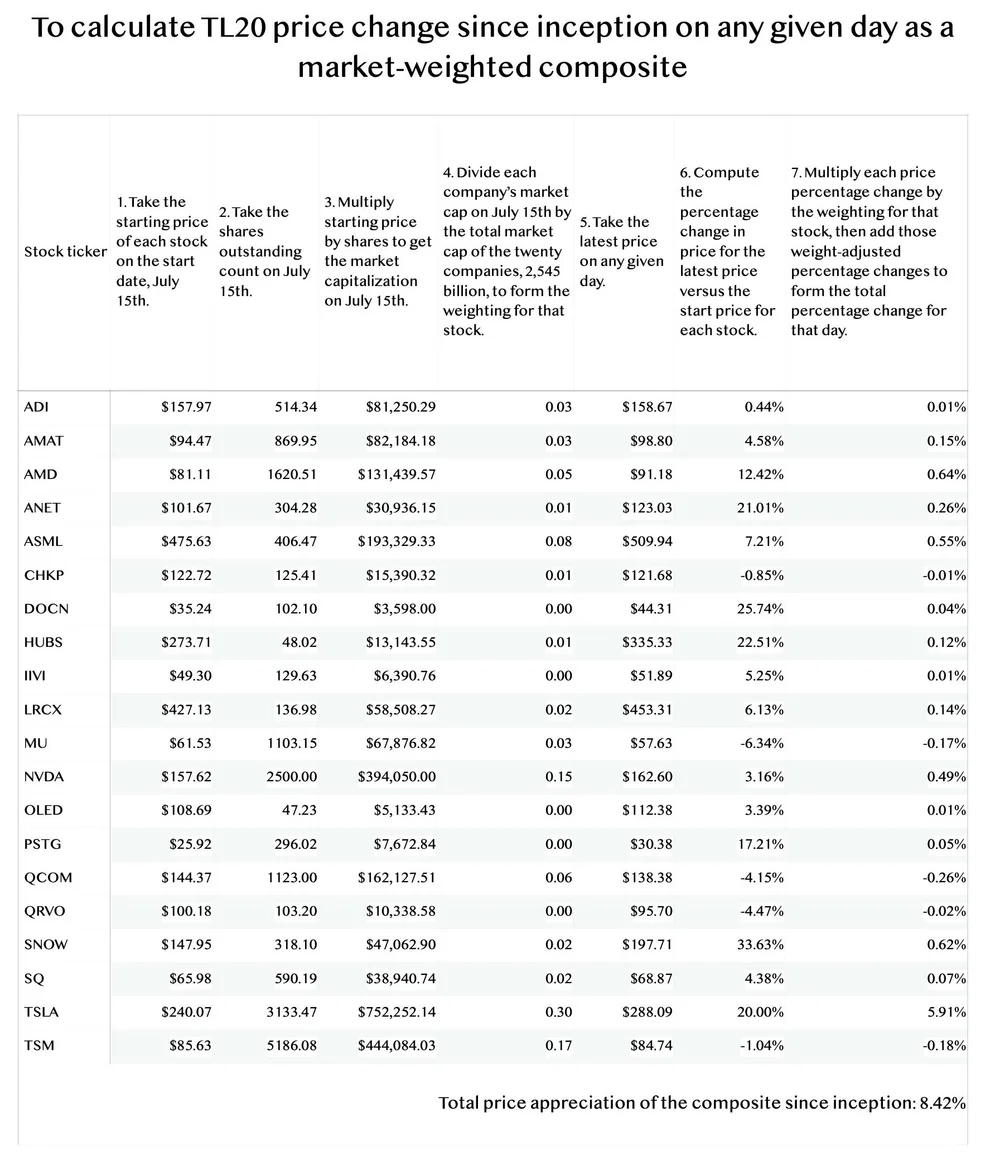
The procedure is as follows, and you can see it displayed in the columns of the table below. Every one of the twenty stocks, on the day the portfolio is started, which is July 15th, has a closing stock price as its start price. The number of shares outstanding for that stock at that time is multiplied by that starting stock price to arrive at a market capitalization for the stock. That market capitalization is then divided by the total market cap of all the stocks to arrive at what fraction of the total market cap the individual stock represents.
That fraction of total market cap constitutes each stock’s “weighting.” We then use that to “weight” the total, composite return of all twenty stocks.
First, we calculate the simple price appreciation — or depreciation! — since inception, on any given day, for each stock, by dividing the current stock price for each of the twenty by its starting price on July 15th. Then, that price percentage change is multiplied by the weighting. It’s like saying, If a stock has increased or decreased this much, we are only going to consider a fraction of that price change in the total.
The twenty individual percentage changes, thus modified by their respective weightings, are then summed to arrive at a final percentage change in aggregate. It is that final, summary change that counts as the collective performance of the TL20.
All that business means that we take only a portion of the price change of each stock into account when composing the total price change of the group, in proportion to how big that stock is compared to the total market capitalization of all twenty on the day we started. We’re saying, in effect, Changes in small stocks count for less than changes in big stocks.
You can see that in the table. Although Snowflake had a great week, jumping twenty-three percent on Friday, following a positive quarterly report Thursday night, Snowflake doesn’t count nearly as much as some others because its market cap, $47 billion, is much smaller than, say, Nvidia, worth $394 billion. The total price appreciation for Snowflake since July 15th, almost thirty-four percent, counts for only a little bit more than Nvidia’s three percent gain in that time once the two are weight-adjusted.
The market-weighting approach, while very common, can be disputed. For one thing, it gives giant companies such as Tesla and Nvidia a greater affect upon the overall performance of the group, the same thing that happens with giant companies such as Apple in the case of the Nasdaq. Over time, one can “re-weight” the group, as small companies become bigger, to make things less lopsided.
Another objection is that his form of weighting does not take into account many factors. It does not take into account the relative stock valuation, nor does it take into account dividends, which contribute to the total return of a stock over and above its mere price appreciation.
Also, as one astute reader has already pointed out, this simple market cap weighting doesn’t take into account factors such as risk adjustment, especially relative to benchmarks. It’s common to weight price appreciation by how risky a stock is on a relative basis.
On the plus side, this simple price calculation is, as I said, pretty easy to calculate without a lot of fuss. I think there’s a lot to be said for simplicity.
Keep in mind that the prices of benchmarks such as the ARK Innovation ETF, can have different forms of weighting, which may tend to make comparisons a bit less than apples to apples.
I hope you find all this as fascinating as I do, and I hope it helps to make the TL20 more transparent.
If you think there are better ways of keeping score, let me know!
Informatica CEO: The opportunity is ginormous
Aug 27, 2022
Show notes
There may be no second acts in politics, but there are lots of them in technology and, sometimes, perhaps better than the first time around. In 2015, Informatica, a software company with which I was very familiar at the time, was taken private by a private equity group that included Salesforce Ventures, Pereira Holdings, and Microsoft in a deal valued at about five billion dollars. It was one of those surprising times when a very important company simply steps aside.There was an interesting process going on as Informatica stepped out of the limelight, namely, a transition to cloud computing. “We are a startup that went from zero to a billion dollars in seven years,” says Amit Walia, who is a nine-year veteran of Informatica, and who had been the head of product before the buyout but is now the chief executive officer.Walia and I were talking recently via Zoom, following Informatica’s successful second-quarter earnings report on July 28th, in which the company’s revenue topped consensus by five percent, the third quarter in a row of outperformance since the company’s return in October in an initial public offering lead by Goldman Sachs.Informatica is not exactly a startup, it is a company worth seven billion dollars that is heading toward a billion and a half dollars in revenue this year. But Walia is fond of pointing out what is entirely new about the company, namely a billion dollars of this year’s business, two thirds, is the subscription kind, from new products developed after the buyout, for new and expanding use cases. Within that, some subscription-based software runs in a company’s “private cloud,” while a good chunk, the fastest-growing part, increasingly runs in a publicly-hosted cloud computing operation run by Informatica as a service — new lines of business that didn’t exist for Informatica in 2015.My question for Walia was the question that comes to mind immediately from having known a company and seeing it come back around: What’s different now?Informatica, which was founded almost thirty years ago, had been one of the biggest vendors of a technology called “ETL,” an acronym for “extract, transform, and load.” ETL was one of those obscure things that chief information officers spend a lot of time on but that ordinary people never hear about. When you’re constructing a database, such as, for example, the sales analysis database, to study how your different sales regions do, you have to separate out the customer records, the product records, the transaction records, and put them in a form where they can be sliced and diced by analysts.That requires dealing with all the scary details of production databases, such as incompatible formats and unreconciled time series and such. For many years, Informatica had a good business selling the ETL tools to let CIOs solve such headaches for giant data sets, for departments, for the C-suite, for the conversion from one database program to another, for the staging of copies of data in different repositories in different facilities.Informatica was synonymous with building an infrastructure for data, at a time when companies wouldn’t put stuff in the cloud but guarded it in their own data centers. INFA Chart by TradingView Nowadays, of course, people increasingly dump data in the cloud, and newer companies such as Snowflake and Confluent promise to let their customers sort and sift a lot of stuff without assembling things as much, just dump it all there. In what seemed a sign of the times, another prominent public ETL company, Talend, last year was taken private by Thoma Bravo. It was as if the M&A market was saying, the world no longer needs ETL stuff.What use would there be, I wondered, in a Snowflake world for a company that had been pre-cloud? How central can Informatica be in a new era?“Great question,” says Walia. “Because we existed before, the question becomes, That problem existed then, does it exist now?”His answer is a rhetorical question. “If a company didn’t exist in 2015, and they got VC funding, and today they have a billion dollars in revenue, what would you say?”All that matters in business, Walia observes, is whether there is a business need, and whether a given company has the products to address it. That is very much the case for Informatica, says Walia. “Our billion-dollar subscription business was created on the coat-tails of all-new products, and the new problems the world is facing,” he says. “We are not an ETL company any more,” says Walia. Where once it was a hundred percent of its business, the ETL product is only a quarter of sales today.The billion dollars to which he refers is the component of the company’s annual revenue that is now from subscription-based sales, including cloud computing programs, all of which didn’t exist in 2015 when the company sold what are called perpetual licenses for use strictly in a company’s data center. “We are neither Snowflake nor Confluent,” says Walia, given that Informatica is already profitable unlike those companies. “We know how to run a proper P&L of scale.” What Walia and team refer to as “the intelligent data management cloud,” or “IDMC,” is a suite of products that include ETL, but also newer tools to integrate multiple third-party applications; tools to run compliance, privacy and “governance” rules against a company’s data; and tools to define a master record of data amidst multiple copies, to name a few of the things the company wasn’t used for that it has spent seven years building. “We spent a billion dollars in R&D over the last five years” to make the new programs, he notes. “We are the leader in all four Magic Quadrants — not a leader, the leader,” he points out, referring to the branding that research firm Gartner uses to anoint category leaders in technology. The problems the world is facing, says Walia, are, in fact, the standard business problems of information now exacerbated by the fragmentation created by putting all kinds of data into cloud computing. Stuff is simply everywhere, and so rather than being a solution, cloud is a bit of the problem at the moment.“The world is a lot more hybrid, and a lot more fragmented,” than it was before companies started moving to the cloud, he observes. “There is no one system of record, they are using Azure for this [Microsoft’s cloud computing service], Snowflake for that, Data Bricks [a data management startup] for this, GCP [Google’s Cloud] for that — the competition for that is between Azure and Snowflake and Data Bricks and Google, not us.” In fact, Informatica partners with those various companies to advance its mission. “Snowflake is duking it out with Data Bricks every day, they partner with us.”Walia’s point is that the things that companies want to do, their problems, span these various sets of cloud technologies, at a higher level. “If I am Unilever, and I want to have a single view of a supplier, called ‘Supplier 360,’ that has nothing to do with Azure,” says Walia, “that’s a business problem.”Walia is, in fact, clearly fired up about the many gigantic customers that use his IDMC and have been using it for years for an increasing array of things. “If I’m Lufthansa, and I’m running a customer program, that has nothing to do with Snowflake, that has nothing to do with Data Bricks, that’s a business problem.”“If I’m the CDO [chief data officer] of MasterCard, and I want to have governance and compliance across my enterprise, that has nothing to do with one data warehouse, that’s a business problem.”“The cataloguing, governance, master data management —those use cases have ginormously scaled as we’ve grown the company,” he says. “I just spoke to the CEO of a top-three bank in the country,” Walia tells me. “They have a deal with Azure, they have a deal with Amazon, have a deal with Snowflake, they have a deal with Data Bricks, and they came to me and said, help me manage this complexity.”The increasingly complex problems of his customers mean that the architecture, the choice of how repositories of data fit together, has to be considered for different purposes. Information is never simply dumped in one big pile.“If I’m a bank, you use your ATM, you update your balance on your app, but you don’t dump all your data in that [data] warehouse in one instance ,” he says. “The use cases have different types.”The virtue of Informatica is to have the breadth, with its IDMC, to span those many considerations, he says. “We serve all of them, not just one.”Given the breadth, “you see how we come into play,” Walia states. “There is a reason why all of Confluent is less than my cloud business, which is half a billion today growing at forty percent,” he observes. Confluent, the real-time streaming cloud company, founded a year before Informatica’s buyout, has trailing twelve-month revenue of $488 million. Walia told the Street in July that Informatica’s cloud computing “ARR,” its annualized recurring revenue, the total value of contracts signed for cloud, out twelve months in time, will reach $438 million to $448 million by the end of this year. “Half a billion dollars growing at forty percent — that’s a pretty fast-growing startup,” he remarks. Again, though, Informatica is not exactly a startup. The company had a billion dollars in sales in 2015 when it was taken out. It is not as if Informatica was a pole vaulter who stood by the bar and jumped over from a standing start.Walia’s point, however, is that all of the subscription business, the vast majority of revenue, from all-new products, has nothing to do with the legacy sales of what is called “maintenance” in the software business, the license to continue running a given software program.How much of the new billion dollars is existing workloads moving over to the cloud? “Zero!” says Walia. “There has been zero conversion, the billion dollars of subscription is all net-new.”The traditional maintenance license was to run an Oracle data warehouse in a company’s own data center. That business is still around, about forty percent of revenue in any given quarter. But it exists at the same time that new stuff is happening that has nothing to do with the old Oracle data warehouse, says Walia. “Subscription means, I’m starting a new workload on [Amazon] Redshift,” Amazon’s data warehouse program running in AWS. “I’m starting a new workload on Snowflake — those are completely different things.” The process of moving the old stuff, the forty percent of revenue that is maintenance, is underway, and proceeding slowly, over years. “My maintenance did not go away, less than two percent of my maintenance [revenue] has migrated to the cloud,” he notes. “We started that process last year, it’s a very complex process,” a process that touches on some of the most sensitive data, he notes. “Some of our customers are running their 10-K, 10-Q reporting in an on-premise data warehouse using Informatica.” That suggests a nice prospect for Walia and team. Customers keep paying him to keep the old stuff running in their data center, while they buy the new stuff at a faster clip, and they still may replace the old stuff with even more new stuff at some point. “The beauty is, for every dollar of maintenance, I’m getting two dollars of cloud ARR,” says Walia. “Because that’s the point where we have the ability to take our cloud platform and also cross-sell and up-sell to a bigger use case.”When will all of that legacy maintenance revenue convert one hundred percent to cloud? “That is a billion dollar question,” he says. “These are mission-critical workloads, you have to go slowly, because you can’t break what works for the customer.”The smart money, says Walia, is banking on this ginormous opportunity, including a lot of returning Informatica institutional investors, “A lot of our investors, all the blue-chip mutual funds, Fidelity, Wellington, and Franklin, and T. Rowe — they obviously helped us back in the days, and they’re all back in because the opportunity is a lot bigger.”Moreover, Walia is in the unique position of having both tons of money from the October IPO — a billion-dollar capital raise — and also real cash profits. “Last year, at the IPO, I had to apologize for making money, it’s back in fashion now, as you can see.”Informatica’s free cash flow was two hundred million in the past twelve months, a thirteen percent margin, and a yield of about three percent based on a recent stock price of $22.67. Compare that with Snowflake, which is minimally profitable on a cash flow basis, and Confluent, which is expected to lose money through the next two years. “We are neither Snowflake nor Confluent — we know how to run a proper P&L of scale,” says Walia. Some of the cash will be used to pay down a remaining balance of pre-IPO debt of $1.8 billion, this year and next year, he says, with a goal to getting below six times leverage, meaning debt divided by Ebitda. (Currently, the measure is about six and a half times.)But there is still a priority on R&D spend, running about nineteen percent of sales. That percentage is below the spending rate of Snowflake and others, but it is not stingy, Walia insists. “We haven’t skimped on investing, we would not have been able to build all this stuff without investing in R&D,” he says. “We will continue to do that.”More important than the absolute rate of spend, to Walia, is the fact the company has made that transition from selling a traditional license to software to selling subscriptions, and especially cloud. That “model transition,” as it’s known on the Street, is often a time of trial for software companies, when the financials become messy and timing of revenue becomes less certain. Informatica is through the eye of the storm and in safe harbor in that respect.“We went from a hundred-percent-licensed company to a hundred-percent-subscription company, our gross margins have barely budged because we know how to run a good P&L,” he says. In fact, gross profit margin this year, projected at about eighty-one percent, is a big jump up from seventy-five percent two years ago.As we wrap up, I point out to Walia that the stock is hardly expensive in the realm of software valuations, especially for a company already profitable, trading at less than five times enterprise value as a multiple of next year’s projected revenue of $1.74 billion. That is just a little bit higher than the take-out multiple in 2015 of just under four times. Is the stock too cheap? “Absolutely, we are very cheap given the growth we have on the top line,” says Walia, adding, to cement the picture, “subscription [ARR] growing thirty percent-plus, cloud [ARR] growing forty percent-plus, eighty percent gross margins, great cash flow.“The market will correct itself,” he says of the valuation. “You never look at the day and the week and the month, you keep building, and you keep executing.”
Snowflake surges: ‘cRPO’ gives a warm good feeling
Aug 25, 2022
Show notes
Nice night for TL20 pick Snowflake, which reported fiscal second quarter revenue, for the three months ended in July, more than six percent higher than Street expectations, growing at a very smart eighty-five percent; and forecast its revenue for its products, excluding its professional services, this quarter to be in line with consensus.
The stock soared this evening almost eighteen percent in late trading, a nice reversal of the big sell-off in May.
That six percent beat was the highest since the year-ago report. More important, it was a big sigh of relief. Snowflake, you’ll recall, sells on what is called a “consumption” model, meaning, it bills customers not at a pre-ordained time, like the beginning of each quarter, but only as they use the software. That means revenue from cloud has an unpredictable element.
As I mentioned in my interview with Confluent CEO Jay Kreps the other day, there has been a concern about how well consumption would hold up amidst worries about corporate belt tightening, whether people would temper their use to slow expenses.
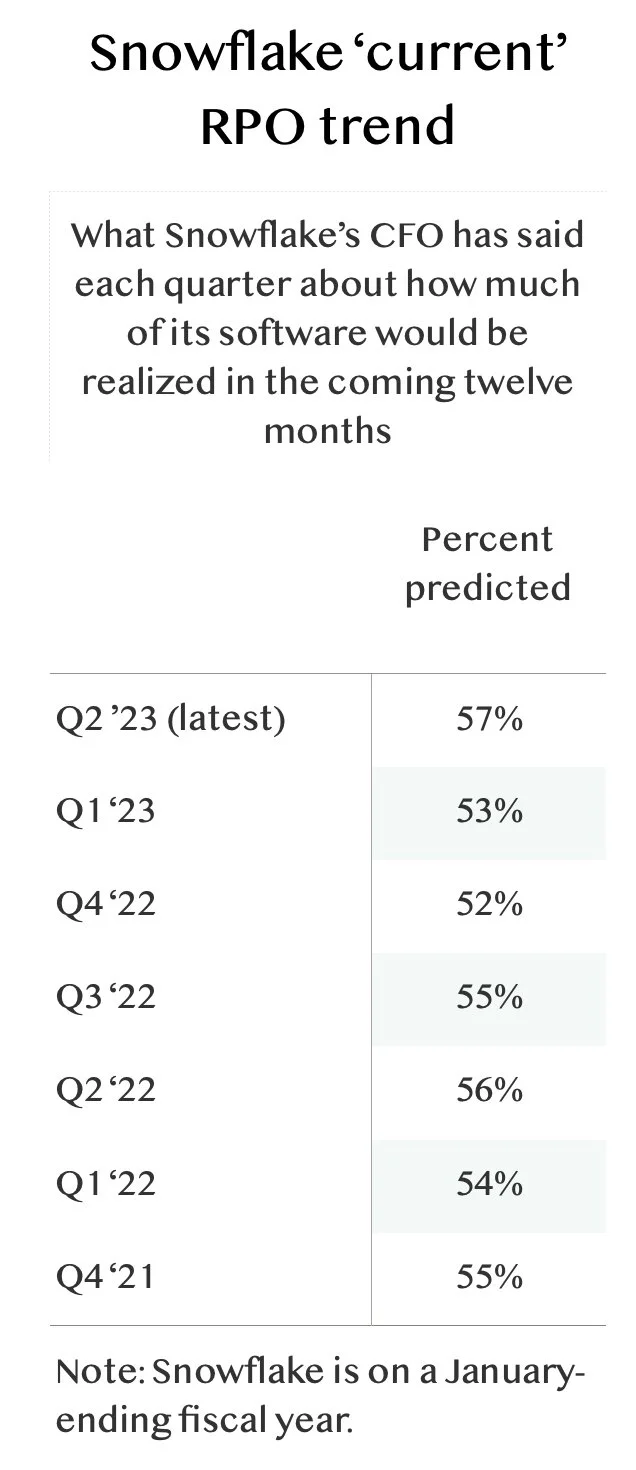
Not the case, as it turns out. In fact, Snowflake's CFO, Michael Scarpelli, told analysts that out of the total value remaining in signed contracts, what’s called “remaining performance obligation,” or RPO, the “current” portion, “cRPO,” meaning, the amount the company expects its customers to realize over the coming twelve-month period, is fifty-seven percent.
Think of Snowflake like a waiter standing at the table, hunched over the diner, predicting how fast they’re going to eat the meal.
Why is fifty-seven percent cRPO important? It’s up from fifty-three percent the prior quarter, and fifty-two percent in the quarter before that, the December quarter. In other words, the company is predicting that its customers are eating faster than they had three months ago, which is good for revenue.
In fact, back to the March report of last year, the first time the company disclosed cRPO, this was the highest rate of cRPO thus far.
Scarpelli has in past told the Street not to rely too much on RPO, nor cRPO, because they can only tell you so much. And I would agree, since it’s the obsession with such metrics that helped the Street reach a really unhealthy level of tech valuations in recent years, before this year’s plummet.
But the surge tonight suggests many can’t help looking at cRPO and getting a warm good feeling. Plus ça change…
Also likable in the report was the company’s adjusted free cash flow margin of twelve percent, in line with its pledge to steadily improve profit. Remember that during the company’s meeting with analysts back in June, Scarpelli implied Snowflake had gotten religion, promising it would try harder for profit. (The “adjusted” part means Snowflake backs out options expense.)
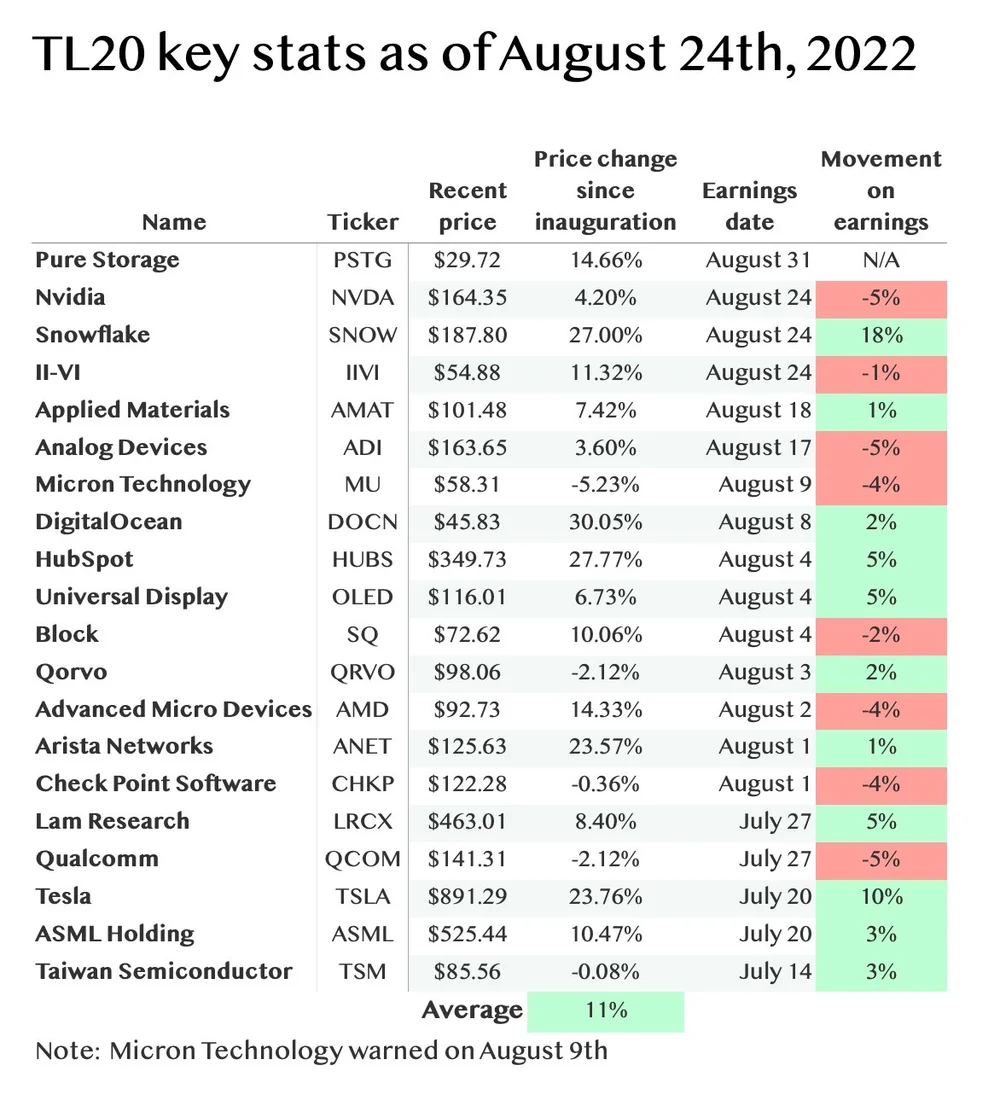
I’m delighted, of course, at the big surge in price after hours, given that it now gives Snowflake a big gain of twenty-seven percent since the inauguration of the TL20 on July 15th, just behind number two Hubspot and number one DigitalOcean.
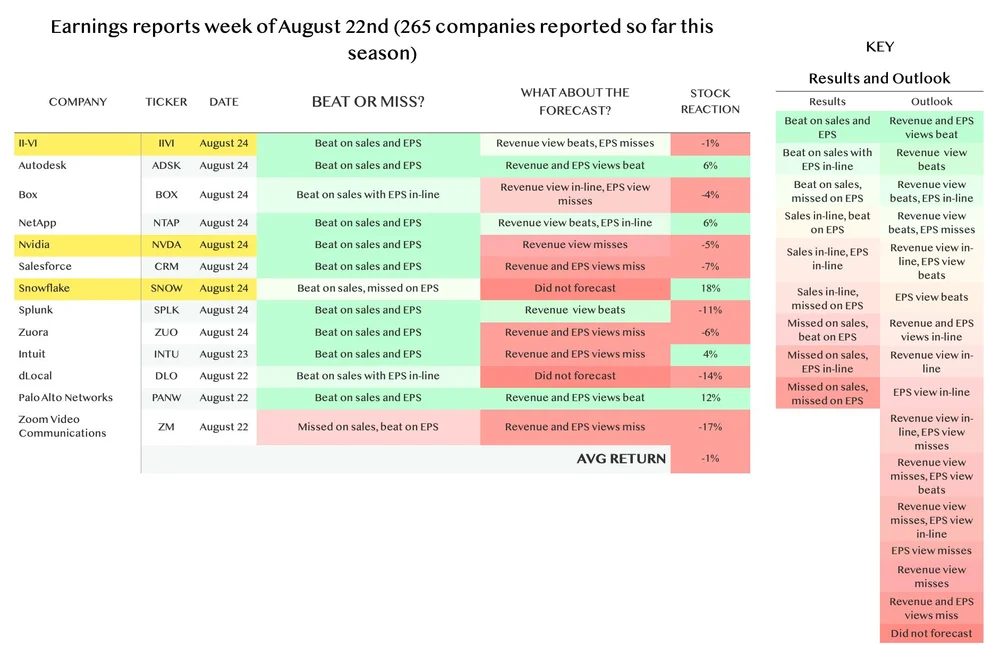
Other names reporting Wednesday from the TL20 were II-VI, which had a solid report and outlook but sold off today after reporting in the morning. The stock had been the standout gainer heading into the report, so, not totally surprising. Many traders were likely collecting some profits today.
Nvidia also reported, after having warned two weeks ago of weak results, dragged down by gaming. The company tonight offered a weak forecast for the current quarter as well, sending its shares down mildly in late trading. The analysts this evening are referring to this as the “kitchen sink” forecast, the thing that’s, hopefully, needed to relieve investor anxiety and allow them to focus on the positives.
We shall see.
The weak part of the business is not AI, which is going great guns, up sixty percent in the quarter, but rather video game chips, sales of which are under pressure.
During tonight’s conference call with analysts, the company had to address crypto-currency. Given the current crypto “winter,” the sense among all analysts is that some portion of the video game weakness is a result of people doing less Bitcoin mining, a function that consumes a lot of GPUs that also are used for video games.
CFO Colette Kress told the Street the company really doesn’t know how much to attribute to the crypto winter:
As noted last quarter, we had expected cryptocurrency mining to make a diminishing contribution to Gaming demand. We are unable to accurately quantify the extent to which reduced crypto mining contributed to the decline in gaming demand.
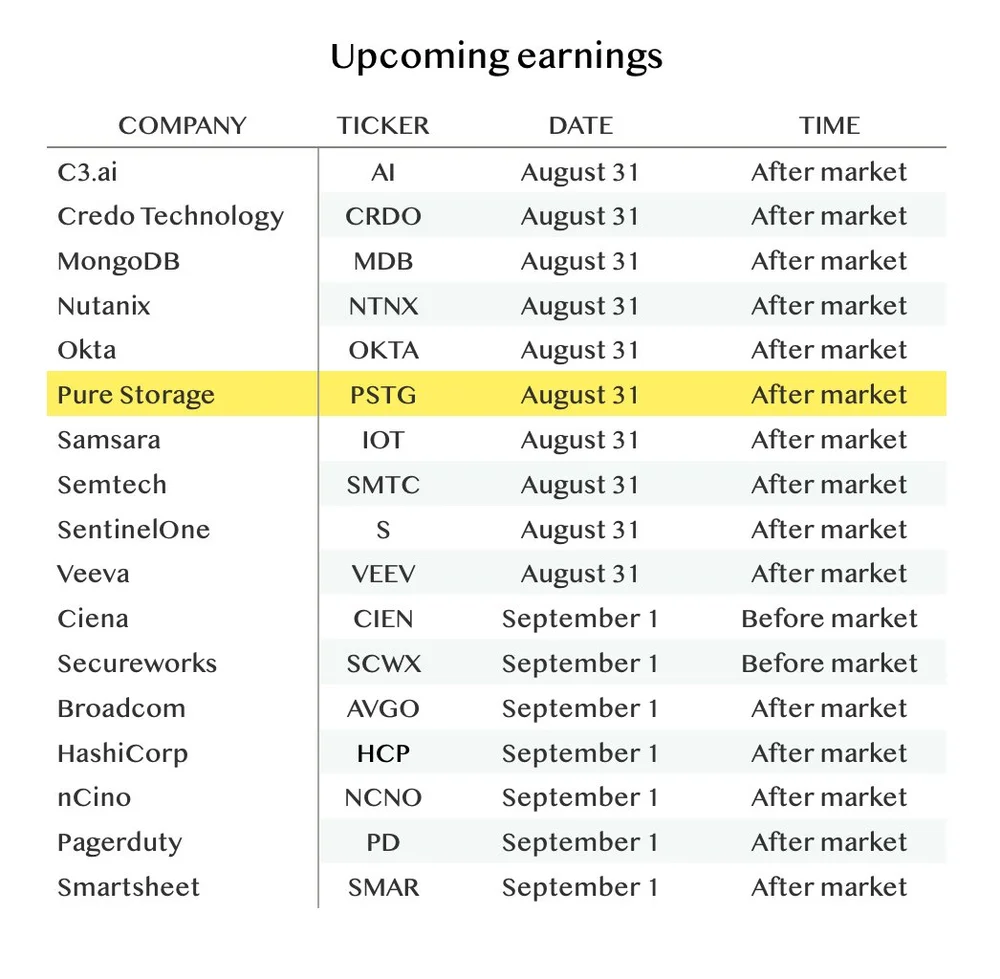
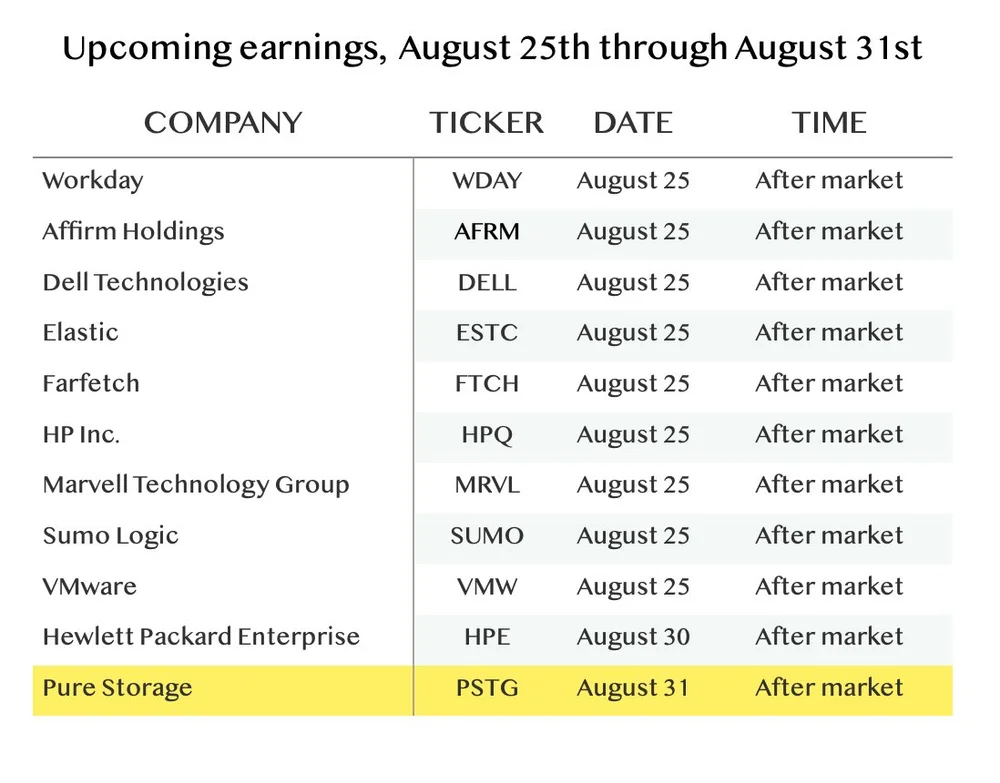
There’s one more name from the TL20 left to report: Pure Storage, coming August 31st.
TL20 holds its head above water thanks to II-VI
Aug 23, 2022
Show notes
This is why you pick a portfolio of stocks, not just one.
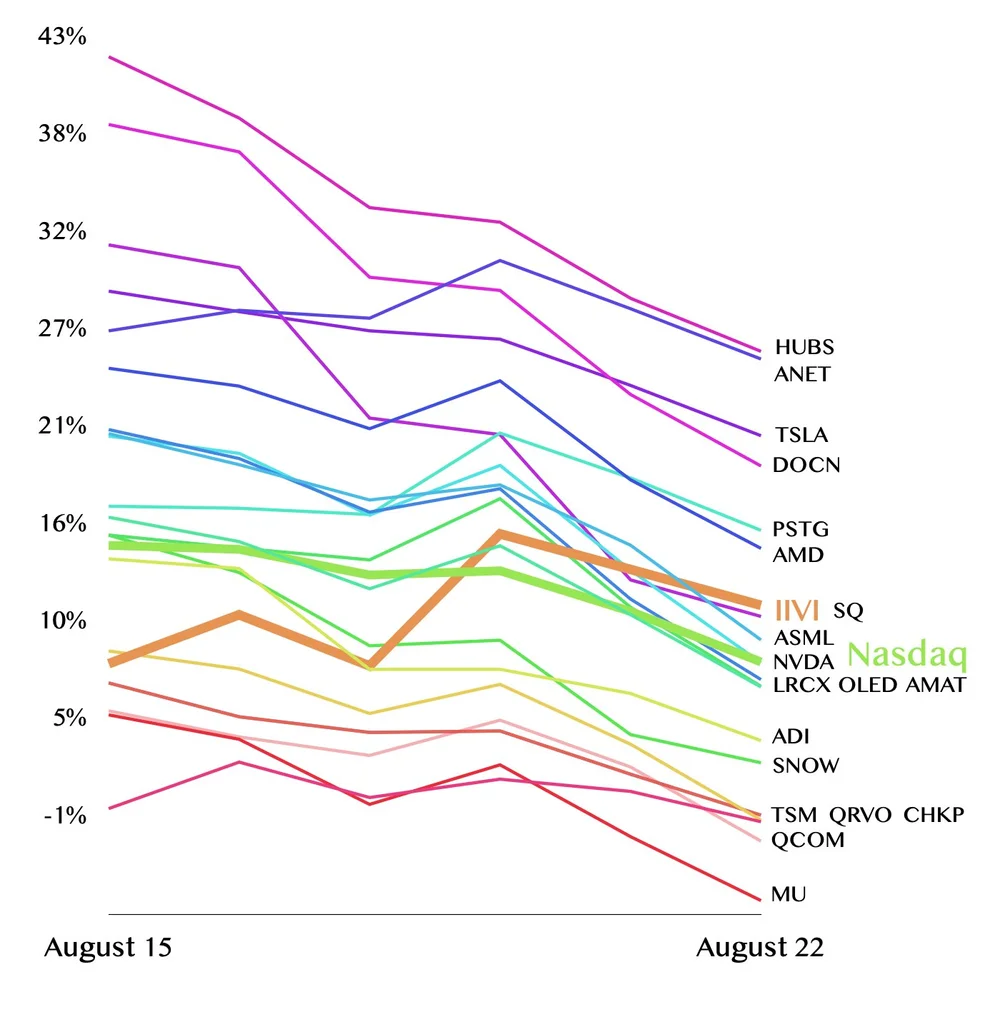
The chart above shows the five-day trend of the stocks in the TL20 group of stocks, and also their cumulative return since inception on July 15th. On the left is the total gain each stock had as of five trading days ago, since inception, and on the right is where they stand in total gains at Monday’s close.
Monday was a big day of declines for most shares, the Nasdaq Composite dropping almost three percent.
The chart for the past five days is ugly, but I’ve highlighted how one name bucked the trend. Fiber-optic component vendor II-VI, which had been initially a laggard in the group, has risen about three percent in the past five sessions, the only one of the twenty to see a net gain. It’s nice how one good stock will step to the fore when other names in the portfolio are weakening.
II-VI is up eleven percent since the TL20’s inception.
Other high-flyers such as Hubspot and Block dropped big-time these past five days, some of it from people likely taking profit on their sharp run-ups, some of it from Monday’s deep disfavor.
Hubspot had been up forty-three percent a week ago, and is still the best TL20 name. Despite double-digit declines this past week, it’s up over twenty-five percent. Block is still up about eleven percent despite its sharp fall this past week.
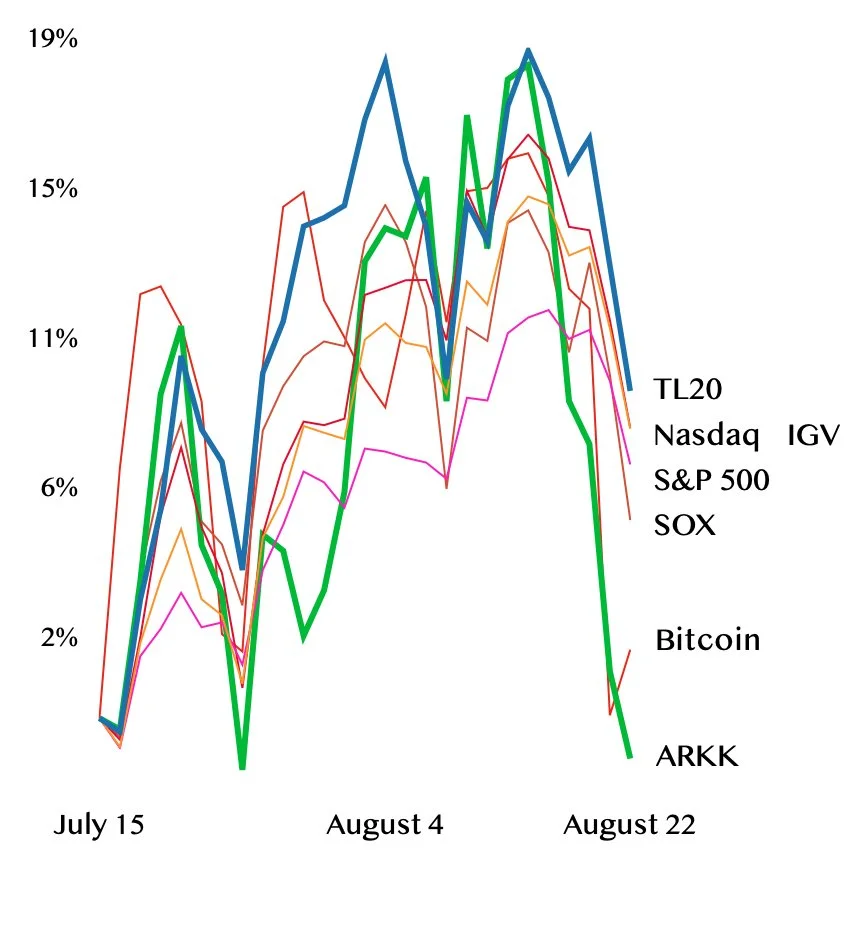
The second chart, below, displays the TL20’s collective performance relative to benchmarks since inception. The picks have managed to eek out a small gain relative to most, while the ARK Innovation ETF, and Bitcoin, are currently trailing sharply.
As mentioned in the inaugural briefing on the TL20 group of stock picks, the group is really a hypothetical portfolio, it’s not an actual trading vehicle. And so, when I make comparisons from time to time to other investments, one has to be aware of that fact because it makes most comparisons not apples-to-apples.
For example, at the top of the TL20 page, and in every update, I compare the TL20 performance as a weighted market-cap composite. That composite is created automatically by FactSet. The actual price of ETFs, in contrast, may fall below the value of their holdings.
In any event, roughly speaking, the TL20 is exceeding all its relevant benchmarks.

 Our TOPPODCAST Picks
  Stay Connected