DriveNets: A challenge to Cisco that’s intriguing
Oct 29, 2022
Show notes
“Ten years from now, this industry will not look like it does today,” says DriveNets’s Ido Susan, with the supreme conviction a Cisco challenger must maintain. “The train has already left the station.” The field of computer networking is one of the last bastions of unperturbed intellectual property. Personal computers and servers long ago became a commodity battle between Dell and HP and Lenovo. And data storage, collections of disk drives, also became something of a commodity, a resource you can rent in the cloud for pennies.Computer networking, however, has never been commoditized. Networking equipment, most of it sold by the giant, Cisco Systems, is an integrated combination of hardware and software that defies commoditization.While most of computing is like a McMansion, Cisco gear is like European cathedrals: traditional, mysterious and unassailable. No challenger has ever displaced Cisco’s richest franchise, the network “router,” the most complex and therefore the most valuable part of networking.That may be changing. For the first time in a long time, Cisco’s routing fiefdom appears vulnerable. “We have a big, big mission: to go and transform networking,” says Ido Susan, the CEO and co-founder of a startup based near Tel Aviv named DriveNets.DriveNets has received nearly six hundred million dollars in venture capital to assail the Cisco routing fiefdom. I talked recently with Susan via Zoom, he in Ra’anana, twenty minutes from Tel Aviv, and I in New York. Although this blog is about public equity, it can be worth listening to promising startups. They may be the next great IPO, and they can tell you interesting things about how technology is changing.Challenges to Cisco are always a fascinating development. Cisco’s greatest challenger, Arista Networks, emulated Cisco’s business plan, building an integrated hardware and software device, but in another product category, network switches, a simpler part of networking.Many smaller challengers have come and gone, such as Nicira, bought by VMware; BigSwitch, bought by Arista; and Cumulous Networks, bought by Mellanox (which was in turn bought by Nvidia). They all had promise, and amounted to very little.The only companies that have made a dent in the Cisco routing empire are Juniper Networks and Nokia, and they mostly play second and third fiddle. Neither has changed the fundamental nature of routing, that close integration of hardware and software.Funny enough, it’s often the case that challengers to Cisco come from Cisco itself, as is the case for Susan.“I always joke that my education came from Cisco,” says Susan. Though he grew up on a kibbutz in Israel, he didn’t finish his studies there. Instead, he became an entrepreneur, and at only twenty-six years old, sold his first startup, called IntuCell, to Cisco for half a billion dollars in 2013. He stayed on for two and a half years. "It’s the best school that you can ask for,” says Susan of Cisco, especially to learn first hand from the sales “machine,” he says. “Just amazing people.”Like all challengers, Susan’s admiration for his alma mater is mixed with a sense of the inevitable, the belief that, ultimately, progress will crack the Cisco edifice. CSCO Chart by TradingView “Ten years from now, this industry will not look like it does today,” says Susan. “The train has already left the station.”What DriveNets sells is a piece of software, a network operating system, that can run on computer hardware from any number of vendors the same way Microsoft Windows can run on Dell or HP or Lenovo PCs and servers.A router can be thought of as a computer that’s dedicated to running only one program. It continually runs an algorithm that calculates, at any moment in time, the best of several available network links to send a piece of data from one computer to another. You could say it’s a traffic control system for data.The kind of routers DriveNets is seeking to displace are the biggest, most expensive that Cisco sells, known as “core” routers. As the most powerful routers around, they’re not designed for connecting PCs. They’re built to direct the enormous rivers of billions of packets of data that flow across the backbone of the Internet. Core routers are bought by telephone companies, cable operators and other services providers whose business is running the fiber-optic lines that make up that backbone. As such, the core router is one of the most sensitive pieces of equipment in all of networking. It is the brains of it all. If a router breaks, whole swaths of the Internet can go dark and Web sites can disappear. That is, in fact, what happened to Facebook a year ago. A routine update to Facebook’s core routers’ software caused the routers to stop “advertising” the presence of Facebook on the Internet. For seven hours, nobody could find Facebook. In a bizarre example of how everything is connected, Facebook’s own employees were shut out of their physical offices as their I.D. badges stopped functioning.Given the stakes, it is no small feat that DriveNets already has won AT&T as a customer for its router software. It is working with, or in talks with, almost one hundred other service providers that Susan declined to name. It helps that Susan knows the market. The company he sold to Cisco, IntuCell, made software to help telcos manage cellular networks.The inspiration for DriveNets is the conviction that Cisco’s routers must be “opened up” the way every other part of computing has opened up.“We saw all the transformation that happened on the compute side,” says Susan. “The mainframe of IBM moved to [Intel] x86 [processors], and then it moved to VMware virtualization, and put everything in the cloud.” Likewise, data storage had at one time been exclusively “the hardware of EMC” but got opened up by “software-defined storage.” Not so for networking. “Networking is still the mainframe of the world,” says Susan.To open up networking, DriveNets has built what you could think of as a new kind of VMware for a cloud computing era.“We designed it from the beginning as cloud-native, we built everything from scratch,” he says.The DriveNets routing software lives inside what’s called a “container,” a small bundle of software code that has all the things it needs and is self-sufficient like a single-celled organism. That bundle exists with thousands of other bundles in each networking hardware box, like highly productive bacteria in a host body.All those “virtual” routers share resources to make the most of every piece of hardware. In this way, networking becomes as efficient and flexible as cloud computing and storage. A number of benefits can ensue. Networking becomes an "as-a-service model,” whereby the consumer of networking can buy it “self-service and on demand,” explains Susan.Instead of carefully planning and procuring equipment, a carrier’s network becomes a simple matter of turning on more software containers the way Amazon turns on virtual x86 servers.Disasters like the Facebook crash need never happen. Instead of upgrading a router while it’s running, a service provider can just turn on a replacement router container with the right settings and switch over.As good as all that sounds, selling the vision has been an uphill battle.“It’s a very conservative industry,” observes Susan of AT&T and other operators. When DriveNets first started, he says, the incumbents, meaning Cisco and Nokia and Juniper, exploited that conservatism. Like the days of IBM’s mainframe, “nobody ever got fired for buying Cisco,” and customers were warned to think twice about switching.“They [Cisco] would say, networking is not like compute and storage, you can’t convert it to a software base,” Susan recalls. “They would say, you can’t separate routing from the underlying physical network hardware,” the fiber-optic transceivers that Cisco sells as part of its machines.“Yes, and no,” says Susan. It is true, he says, that when DriveNets started, six years ago, x86 server hardware was too primitive. It had to be over-engineered to have the necessary horsepower for routing. “We had good product, but each server cost $20,000 because that hardware was designed for computers, not for networking,” he explains.Things began to change as efforts coalesced in the industry to find broad alternatives to Cisco’s fiefdom. Those efforts include The Open Compute Project, a consortium backed by Facebook to advance a general hardware standard.OCP fostered a new crop of hardware from “original device manufacturers,” or ODMs. Those are the little-known companies, mostly in Asia, that for decades have assembled PCs on behalf of Dell and HP and Lenovo. Companies such as Edge-Core Networks, a subsidiary of Accton Technology, and privately held UfiSpace, both Taiwan-based firms, learned to build an economical kind of network box. They benefitted from a ready supply of networking chips from Broadcom, the dominant vendor of networking silicon.As commodity network hardware emerged, the DriveNets software began to make more sense. The initial ODM hardware was designed only for the simpler network switches. DriveNets found its entry point. “We came to them [the ODMs]” with the DriveNets software, he says, “and we told them, Guys, let's complete the portfolio, let's make it available for routing as well.”Other parts of networking began to open up as things snowballed. New standards for fiber-optic transceivers emerged that let DriveNets and others offer the same connections that Cisco traditionally bundled, thereby offering carriers greater choice of physical infrastructure.As the right balance of hardware and software surfaced, the culture of caution at AT&T and other service providers began to relax.“It's a big, big change for them,” says Susan, “but once they get it, they see the benefit from cost reduction and the benefit from time to market, and new services to generate new revenue.” Those benefits include things like having networking that can be dialed up or down the same way Amazon can simply “spin up” more compute or storage. “A carrier may have a peak during the day for mobile traffic, and a peak during the evening for home broadband.” Traditionally, those shifting patterns of usage were a nightmare for carriers from a capacity planning standpoint. With the greater flexibility of numerous virtual routers, those different times of the day could be accommodated by simply expanding and contracting a dynamic network. "They can all be one peak on the same infrastructure,” as Susan puts it.Another headache for carriers, inventory, becomes streamlined by using commodity boxes. “Look, today they have Cisco 6000 and 9000, and Juniper MX, and PTX,” the various models of core routers. “And spares,” says Susan, meaning, the shelves of spare parts a carrier has to keep around for each distinct model of router. If, on the other hand, a commodity network brick dies, a service provider just swaps it out for an identical unit the same way Amazon and Google swap in and out identical servers.What can emerge are potentially significant cost savings across a phone company’s network. “You have tens or hundreds of routers in every location, and a carrier may have 4,000 locations in the U.S. alone,” observes Susan, “and they’re constantly adding capacity as the Internet grows.”The carriers, says Susan, have now gone from cautious to more demanding, he says. “They’re now coming and saying [to Cisco and Juniper and Nokia], ‘I don’t want any more of your chassis with line card,” meaning, the traditional cathedral of integrated hardware, “I want diversity and multiple options.”Cisco has changed its tune, he says. Instead of saying it can’t be done, it is now promising to unbundle and sell the way DriveNets does. Susan’s response to that is to say, “We’re already there.”“We have hundreds of petabytes running through our solution every day,” he says, “we have multiple Tier One [service providers] in the U.S. and Japan.” DriveNets has been selling now for four years. Susan declines to disclose revenue other than to say it’s doubling annually and “in the high tens of millions of dollars.” There are competing software startups, including Kaloom of Montreal, and Pluribus Networks of San Jose, which was acquired by Arista in August for undisclosed terms. DriveNets appears to have received multiples of the amount of financing as either of those two. “We don’t compete with small startups, we are fighting against incumbents,” insists Susan. The market for core routing for service providers is twelve billion dollars, annually, according to Susan. If one adds AWS and Google and Azure and other service providers that also buy routers, it’s more like twenty billion. “It’s big enough to build something big,” in his view.“You have the early adopters that are already working with us,” he says, “and then you have the second wave that are adopting more and more, and we are there right now, and the rest will follow."Again, for Susan, there is something of an inevitability in the zeitgeist, if you will.“Traffic is growing so fast and the revenue is not growing in the same percentage” for carriers, he says. “They need to find a way to monetize the network over the assets that they have, how they can utilize shared infrastructure, and all the power consumption and the rack space.”At this moment in a startup’s journey, the question naturally arises: Can a challenger, however well funded, go the distance against the incumbent if the incumbent adapts quickly?DriveNets is a big startup, at five hundred employees, in numerous time zones. Still, “our challenge now is scaling,” says Susan. That pertains especially to the challenge of creating a sales and support regime the way Cisco has for decades. However promising a startup is, that is daunting.“I asked Diane Greene,” the founder of VMware, “why did you sell the company” to EMC, he recalls. “And she told me, the technology was ready, but there was a big, big challenge to scale it up, to build a sales force, and you need an army to do that.”Hence, good startups always face the prospect of selling out. “If somebody came with a big check and it would make sense for my employees and investors, and it would make our technology more successful like VMware did, it would be hard to say no,” he concedes. For the moment, everything suggests staying the course. “I built the company to be a big company,” he says. “We are putting great talent on the ground and adding more logos every quarter, the pipeline [of business] is very impressive, and we have a lot of money in the bank." Long before toppling Cisco, Susan expects to cross paths with another challenger, Arista. “Arista is a great company,” he says, “I hope I will be as successful as Arista.” It will take a few years, but "we will see them in the cloud,” says Susan. “We will develop a switching capability, and they will develop a routing capability, it’s just a matter of time.”Though many have tried and failed, the challenge to Cisco from DriveNets seems to me different from past efforts. The rise of cloud computing feels like it could be the end of one era in networking and the beginning of a new one.Whether it’s DriveNets or another firm that cracks the code, the most compelling question is what happens if there is a massive sea-change in networking. If the routing market blows open and becomes like all of cloud computing, we could see a world of new kinds of networks and new kinds of network applications. It has happened in computing with the rise of startups such as Databricks and Snowflake. They came about precisely because computing was no longer trapped in a single box. Their arrival is leading to a vibrant new market for database software, as I’ve written. Change in one area can spark change in another area.Given the breadth and reach of networking as a category of technology, the changes this time around could be quite profound.
Amazon’s sales outlook the biggest forecast miss on record
Oct 27, 2022
Show notes
Update:
On the call this evening with analysts, Amazon’s CFO, Brian Olsavsky, confirmed that the company’s outlook for this quarter assumes consumers are going to be spending less than normal during the holidays.
“We're very optimistic about the holiday, but we're realistic that there's various factors weighing on people's wallets,” said Olsavsky, “and we're not quite sure how strong holiday spending will be versus last year.”
Olsavsky said the company was seeing sales of consumer goods slowing markedly toward the end of the quarter, especially overseas.
“It was mostly in international we saw the biggest impact,” he said. “And we think that is tied to a tougher recessionary environment there, even if you compare it to the US, it's worse in Europe right now; the Ukraine war and the energy price issues have really compounded in that geography.”
What was a big negative surprise on the call was that Olsavsky said not only are consumer sales slowing, but AWS, the Web services unit, saw its rate of growth slow at quarter’s end. Olsavsky says AWS customers are tightening their belts, and not fully spending the amounts they were committed to spend by contract as quickly as they had expected.
“There are some industries that have lower demand […] things like financial services, the mortgage business being down, cryptocurrencies has been down.”
“And I think everyone is just cautious, and they want to again watch their spend,” said Olsavsky, “and, as CFO, I appreciate that, and we're doing the same thing here at Amazon.”
Yeesh, that’s not good news for the market for enteprise software sales.
Not only is revenue at risk, but Amazon is seeing its own costs rise for energy, for labor, and everything else.
“We have seen inflation in our wages this year and particularly on our tech employees, and it's heavily concentrated in AWS.
“We're also seeing energy costs that are materially higher than they had been pre-pandemic, electricity and the impact of natural gas pricing, so those prices are up more than 2x over the last couple of years.”
Amazon shares regain a little bit of ground following the call, now down just thirteen percent.
Previously:
It’s a rough week for MegaCap tech, as I had anticipated, but tonight’s report from Amazon is one for the record books.
The forecast for this quarter’s expected revenue is not just weak, it’s a new record.
Going back sixteen and a half years, as far as FactSet will take me back, the gap between Amazon’s forecast for sales and the Street consensus, $144 billion versus $155 billion expected, is the largest on record at nine percent. It’s worse even than the company’s miss in October of 2008, the depths of the Great Recession. That was only seven percent.
Amazon went public in May of 1997, and I’m pretty sure they were forecasting back in the 1990s and early Naughts, but FactSet only goes back to 2006, so, we’ll have to just be content with that.
The forecast miss follows third quarter results that were just about in line with expectations.
Amazon shares are down sixteen percent in late trading.
The bulk of the shortfall, both for the reported revenue and for the outlook on sales, is the rising U.S. dollar. As Amazon converts sales overseas to dollars, the stronger dollar reduces what Amazon ends up with from Euros and British pounds and other currencies. That’s a problem everyone faces.
The dollar sucked five billion dollars out of last quarter’s revenue, Amazon said. And for the forecast this quarter, the dollar is expected to suck another 4.6 percentage points of growth from the revenue number.
If you add back those five percentage points of growth, you would get a currency-neutral growth rate of 9.6%. That would lead to revenue of $150.5 billion. That would still be short of consensus by three percent, but much less dramatic than the nine percent miss.
So, you can surmise that Amazon is seeing some of what it expects to be a weaker holiday season than the Street has been modeling.
Amazon’s CEO, Andy Jassy, emphasized in the press release that Amazon is prepared to take many steps to streamline costs to deal with the current economic environment.
“There is obviously a lot happening in the macroeconomic environment,” said Jassy. “And we’ll balance our investments to be more streamlined without compromising our key long-term, strategic bets.”
Meta’s expenses soar in the Metaverse as sales slump in the Actual-verse
Oct 27, 2022
Show notes
Explaining to investors why The Metaverse is worth tens of billions of dollars in expenses every year is proving a tough sell for Zuckerberg.
Shares of Meta Properties plunged by twenty percent in Wednesday’s after-hours session as founder and CEO Mark Zuckerberg told analysts how he will increase spending next year at a sharp clip even as the company is starved for growth.
Zuckerberg's comments came as Meta’s third quarter report after the closing bell delivered slightly higher-than-expected revenue, and profit per share merely in line with expectations.
The tension going on in the business could not be more obvious: Revenue is barely growing while Meta’s investment in The Metaverse in its Reality Labs division is burning almost four billion dollars per quarter while producing just a few hundred million in revenue.
The company told the Street to expect next year’s Reality Labs expenses to grow “significantly.”
In 2023, said Zuckerberg, Meta plans to spend as much as fifteen percent more on cost of goods — expensive Metaverse goggles — and on operating expenses to hire Metaverse engineers, spending that may total as much as $101 billion. And that’s without giving any indication of what revenue for the year may be. (The Street consensus is that revenue will rise by eight percent).
Moreover, capital expenses are set to soar as well, likely crimping free cash flow, as the company adds infrastructure to build more and more artificialintelligence throughout its products.
Said outgoing CFO David Warner, “There is some increased capital intensity that comes with moving more of our infrastructure to AI; it requires more expensive servers and networking equipment, and we are building new data centers specifically equipped to support next-generation AI hardware.”
One analyst on Wednesday’s call, Brent Thill, summed up the frustration on the part of investors at seeing Meta spend more and more with no clear explanation of payoff.
“I think, kind-of, summing up how investors are feeling right now is that there are just too many experimental bets versus proven bets in the core,” offered Thill, “and I'm curious if you can just add more color why you don't feel these are experimental, you feel like they pay off […] everyone would love to hear why you think this pays off.”
What came back from Zuckerberg and team was vague.
“I think a lot of the things that we're working on across the Family of Apps are, we're quite confident that they're going to work and be good,” said Zuckerberg.
“We can't tell you right now how much – how big they're going to scale to be, but I think that each of these things are, kind-of, going in the right direction.”
Not exactly a rousing summation. Meantime, those covering Meta for years are worried the company is not protecting its flank, its ability to sell ads.
Mark Mahaney of Evercore ISI, noting how Apple’s changes to tracking data have hurt Meta, remarked, “This is something that took $10 billion, maybe, out of your business, I mean, it had a material financial impact.
“And listening to the call, I just don't hear it as a major investment priority,” said Mahoney. “The question is, is it a major investment priority, or is it that goal is just elusive and it's better to focus on other things?”
Meta’s chief business officer, Marne Levine, answered Mahaney with a bunch of product descriptions that didn’t really seem to answer his question.
What you’re hearing in Wednesday evening’s back and forth is what happens when vaporware has to confront investors.
When Zuckerberg announced The Metaverse last year, I wrote that it was vaporware, meaning, a tech product that is hyped way before it event exists.
The Metaverse still doesn’t exist, but Zuckerberg has the difficult task now of selling the hype not just to consumers and developers, but also to investors as he pours more and more money into that non-existent world.
Meantime, as I’ve written before, the real investment angle here are the data center companies that stand to rake in real money off that massive increase in capital spending, namely Arista Networks and Pure Storage, two stocks in the TL20 group of stocks to consider.
Arista shares Thursday night surged by eight percent in late trading while Pure shares rose fractionally.
With tonight’s twenty percent decline, Meta stock is down sixty-nine percent for the year.
Nouriel Roubini, hyper-realist of gloom, foresees the worst
Oct 27, 2022
Show notes
Like a hyper-realist painter, Roubini crafts a vision of dystopia in which every conceivable threat seems to have equal potential.
If you are looking for a big picture with a totally dispiriting tint, Nouriel Roubini is your man.
Wednesday, Roubini, who acquired the moniker Dr. Doom during the 2009 recession, took part in an hour and a half Zoom chat hosted by the Collective[i] Forecast, a speaker series organized by Collective[i], an AI platform designed to optimize B2B sales. The attendees were a small audience of tech types and journalists, myself included.
It was a rollicking hour and a half swept along by the relentless rush of Roubini’s urgent cataloging of all the ills that make our era sound like the worst period, ever, for the planet.
“I’ve very ambitious,” Roubini told the audience. “I’m thinking about trying to predict not just the course of the global economy, but of our planet.”
I’ve not yet read the book, but Roubini assured us his writing about the ten plagues is “nuanced.” Which is interesting because his long soliloquies during the Zoom chat, delivered as a kind of verbal onslaught, came across not so much as nuanced but rather sweeping and vivid, like an Hieronymous Bosch triptych of hell.
A better analogy might be the hyper-realist school of painting of the 1960s, such as the works of Richard Estes. The delight in Estes’s paintings, which have always mesmerized me, is that every single detail of a scene, such as a candy shop window, is given equal weight. The sheer agglomeration of detail in the hyper-realist aesthetic is so massive that its totality both stuns and becalms the viewer.
Likewise, Roubini, in fifteen-minute bursts, hammered home his ten themes for the future like Homer chronicling a downfall that had already come to pass.
The big picture is a “regime change” globally, he said. Things that are emerging now are new kinds of threats on a bigger scale than in past.
“I never, never worried about nuclear war” growing up in the ‘70s, said Roubini, who is in his mid-sixties. Now, he’s been talking with people in Washington, D.C. and, “some people worry that World War III has already, effectively, started.”
Likewise, “I never heard about the term global pandemic,” he said, leaving aside HIV in the ‘80s. Nor had he heard of climate change. “There’s a link between ecological destruction and destruction of animals,” said Roubini. Not to mention, “the release of ancient bacteria” by melting ice caps that could lead to new kinds of global plagues.
“I never heard about AI, machine learning, robots, automation, destroying most jobs.”
“I never heard about debt crisis, at least in advance economies, because debt ratio to GDP, public or private, was always very low.” Nor had he heard about “implicit” debt from pension systems and social safety nets without support and an aging population.
Now, he says, he foresees multiple economic shocks that will lead to “stagflation” worst than the ‘70s, and an implosion of record levels of debt, both public and private.
“It [debt] used to be a hundred percent of GDP in 1970, two hundred percent in 2000, and today it’s three hundred and fifty percent and rising.” It’s also higher, proportionately, in the U.S. than it was during the Great Depression, he noted.
“There is a time bomb of debt,” said Roubini.
“Zombies, corporates, firms, banks, shadow banks, government, country, household, are going to go bust this time around — the mother of all debt crises.”
The forces are so great, said Roubini, that “we may be at the point where eventually, homo sapiens is going to disappear.”
It is the totality of calamity that overwhelms the listener, like having your fortune told by a tarot-card reader dealing all the worst hands possible: slipping in the shower and breaking your collar bone at the very same moment a burglar is breaking into your house while a gas leak is killing you entire family just as a car runs over your puppy on the front lawn and mere moments before a marauding horde of locust consume the neighborhood.
When it came time for audience members to venture a question, many seemed pinned to the floor, awed and desperate to know, What can I do about it all?
Roubini’s council seemed just as scary.
“You can prepare individually and you can prepare collectively,” he said. Individuals should look to “have the right skills” and to constantly be in training as some skills get killed off by AI, he said. “Retool yourself, get another degree,” he counseled. “But you have to be thinking: in what way could my job be destroyed by AI, or by an economic and financial crisis.”
On the financial side, said Roubini, look to invest in REITs in parts of the country that will survive climate change — any place but Florida.
“Prepare yourself to live where there is no WiFi” but also no drought or hurricanes, he suggested, which could include parts of Canada.
Collectively, said Roubini, we should look to the lesson of Noah’s ark. “It was a common effort,” observed Roubini. “He didn’t build a massive boat for himself and disappear; he made sure that all of human and animal and plant life was there so that after the flood you can rebuild.”
“I happen to be a Persian Jew born in Turkey who went from Turkey to Iran to Israel to Italy, and then to America,” remarked Roubini. “So, I care about the common good,” not just any one nation in particular.
As artful and passionate as are Roubini’s images, it’s important to step back and remember that in real life, reality is not hyper-reality. While Richard Estes's paintings of shop windows have a hundred things that all matter, in the real world, not all of them matter equally.
Of the ten mega-threats Roubini outlined, some of them probably have a negating effect upon others. The hard part about telling the future, as with chronicling the past, is the supple and mysterious way in which, within the totality of things, some things hang together and others blow apart.
By his own account, Roubini is simply a realist.
“I’m Dr. Realist, I’m not Dr. Doom,” Roubini told the audience. “That’s my job, recognizing some of these threats.”
“Cassandra warned about trying to avoid the thing,” as did the great prophets who tried to avert the destruction of the Kingdom of Israel, he observed.
“I want the utopian future,” said Roubini, “but to me right now, we are on the wrong track; I hope the young people who care about nuclear war, climate change, pandemic, economic, financial disaster, and AI and so on, will work with other people to resolve these problems.”
Informatica CEO: More deals being ‘pushed out’ as customers take a cautious stance
Oct 27, 2022
Show notes
The watchword of the moment for corporate earnings is uncertainty.
“Right now, the problem is, there’s no single place you can go, there’s no consistent set of information for anybody to look at” regarding the economic challenges, says Amit Walia, CEO of data analytics software maker Informatica.
“So, people are just looking at everything, and there’s an element of cautionary conservatism.”
I was talking with Walia via Zoom regarding Informatica’s third-quarter report put out Wednesday. The report was mixed, with some important metrics turning out better than expected, but also revenue and profit coming in lower than expected.
Uncertainty is what Walia’s customers are dealing with, echoing the vague remarks Tuesday night by Microsoft and Alphabet. The possible tilt toward global recession feels ominous but hard for anyone to get their hands around.
Informatica’s quarterly report, its fifth report since coming public in 2021, was the first time the company missed its own revenue forecast. The company’s forecast for this quarter’s revenue also missed Street consensus.
Informatica shares declined one percent in late trading.
Most of the miss was a consequence of the rising U.S. dollar, which depresses reported revenue. That’s the same thing that hit Microsoft and Alphabet on Tuesday.
But, some of the shortfall is also because customers are taking longer to sign off on software purchases as they grapple with uncertainty.
“We’re seeing more and more of the macro headwinds starting to come into play,” says Walia.
“We’re absolutely seeing deal cycles elongate,” he says. “What would take X amount of time now takes ten or twenty percent longer.”
Informatica is not alone. These delays are a continuation and an increase in the trend for software makers that started to crop up in the previous quarter.
Those delays are not lost sales, Walia tells me; he expects the deals will ultimately be signed. But the delays are going to run into the first quarter of next year.
“I think what we will see is that Q4 will see some of the Q3 deals, but at the same time, Q4 [deals] will move into Q1 or Q2 of next year as well.”
As a consequence of the delays and the continued rise of the U.S. dollar, the forecast for this quarter’s revenue, $398 million to $408 million, is below the average estimate of $424 million.
Does 2023 look like 2008 and 2009, a deep unraveling? I ask Walia.
“Our customers are going to need automation to do more with less” in a time of strained budgets, says Walia. Automation made possible by artificial intelligence is “an area we’re going to push very hard on.”
What’s different this time around from 2009 is that “the shocks are of a very different type,” says Walia, because trouble is not confined to one or two industries such as banking and real estate, as in 2009. “I feel it could be more uniformly challenging” as a result of the broad nature of trouble in the world.
Walia says his customers are as interested as ever in the “digital transformation” projects that the software makes possible, based on numerous visits with customers in recent months.
“The raw desire is there to be doing big data initiatives,” he says. At the same time, “everyone has an element of concern as they walk this quarter and planning for next year.”
“Things have moved so rapidly in the last couple weeks,” says Walia of the global economic situation. “I was in Europe and there’s an element of concern about what happens in winter with gas prices.”
Given all that, “the way to look at 2023 is a very conservative first half, and then a second half that will be relatively okay,” he says, contingent on interest rate drama settling down.
So, what’s the good news? The Metrics, those non-GAAP numbers that the Street uses as a proxy for future growth, all came in well ahead of consensus last quarter.
Those metrics include total “ARR,” or, annualized recurring revenue, a measure of the total value of contracts signed when extrapolating out twelve months into the future. Also better than expected were the ARR from subscription products, and from cloud computing versions of Informatica’s software.
“We are a mature company, we have robust scale, we drive profits and cash flow,” Walia points out, noting that the company’s non-GAAP operating profit came in at the high end of the company’s forecast, and better than the Street was expecting. Free cash flow of $77 million was toward the lower end of expectations, but still a nice twenty-two percent increase, year over year.
As important as profit, the use of the company’s product continues to increase, notes Walia. The company’s cloud computing service processed forty-five trillion transactions in the month of September, almost double the rate a year ago.
"Customers are using more of our platform, a lot more, which shows the stickiness it has,” says Walia. “They’re sticky use cases, they’re mission-critical, and that gives me a lot of conviction and comfort.”
He notes, too, the company’s rate of renewal by its customers is in the “mid-nineties” on a percentage basis, which is “very strong.”
“Even if the economy slows down, I would rather have adoption continue to happen because demand will always come back,” observes Walia. “But the proof of your portfolio is customers are using all of it.”
Informatica is “blessed” to have large customers such as Uber and GM Financial, he says.
To focus on just what Walia and his team can control, he says, Informatica is giving significant attention to “the use cases that help customers navigate” their world, such as using data to hold onto existing customers more than acquiring new customers. Fighting churn is the key in such an environment.
As far as Informatica’s own expenses, he’s not cutting anything now, but rather, “Stepping back and looking at our own execution and seeing what we could do differently.”
That includes things such as re-alignment of sales bonuses. There has been a two-tier compensation structure to incentive Informatica’s reps to sell more cloud services. But now that all the products being sold are cloud, the compensation can be simplified to a single rate, he says.
“Now that we are cloud-only, we don’t need to skew our compensation plan.”
Expanding the company’s partnerships with Microsoft, Snowflake, Databricks and many others will also be part of the tactics and strategy for dealing with uncertainty.
Also important moving into 2023 will be how to invest in product capabilities in the smartest way. The focus of investment, says Walia, is what the company calls “Clear AI,” its tools for automating tasks based on machine learning.
“Our customers are going to need automation to do more with less,” he says. “That’s an area we’re going to push very hard on.”
Informatica stock is down forty-eight percent this year including Wednesday’s after-hours decline.
Given the cautious trends identified by Informatica, you will probably be hearing similar talk of push-outs from many software makers in the coming weeks. You may want to take a look at my note last week about cash-rich tech stocks that may be something of a less-bad investment if you have to pick software stocks.
Alphabet and Microsoft don’t seem to read the tea leaves very well
Oct 26, 2022
Show notes
The Street always looks to the largest companies to be seers of the future. It’s a role that some captains of industry have relished in past, such as former Cisco Systems chairman John Chambers.
Others are not so apt to be prophets.
Tuesday’s earnings reports after-hours brought downbeat results from bellwethers, including Microsoft and Alphabet and chip maker Texas Instruments. All three saw their shares sell off after-hours.
The unsettling part of the reports were the vague ways in which the companies spoke about the current economic climate. There’s a broad, shapeless sense that times are tough, things are uncertain, and that there’s absolutely nothing these giant companies can really say to measure the depth of things.
Following Alphabet’s disappointing press release, with revenue missing expectations by two billion dollars, analyst Mark Mahaney of Evercore ISI asked Alphabet CEO Sundar Pichai on the conference call this evening if he could give a sense of how this current economic environment compares to economic cycles in past, given Pichai has been in the business for a while.
Pichai was rather cryptic. “You know, I think compared to the past, I think going through this, I mean there is, as we have said before, there is more uncertainty as we go through,” he said. “We definitely see indicators on both sides, so that makes it a bit more unique.”
Pichai told Mahaney that Alphabet is fortunate to be able to look forward to several years of business growth because of its mastery of artificial intelligence, as if AI would counter-balance a broad economic malaise.
In Alphabet’s lower-than-expected revenue we see that, as I suggested Monday, there was plenty of room to cut expectations still further even after analysts had already cut their estimates all year long. Part of that shortfall was the continued rise of the U.S. dollar, which makes every company that reports revenue in dollars see a hit.
If not for the rising dollar, revenue growth would have been eleven percent instead of six percent for Alphabet. But there were vague allusions to something else. Revenue was “impacted,” Pichai said, by “the challenging macro climate.”
Alphabet’s chief business officer, Phillipp Schindler, told analysts that, “There's no question we're operating in an uncertain environment, and that businesses big and small continue to get tested in new and different ways depending on where they are in the world.”
Schindler did, however, try to give some more texture. Advertising, no surprise, is a weak area at the moment.
There was, noted Schindler, a “pullback in spend by some advertisers in YouTube and Network, and these pullbacks in spend increased in the third quarter,” and, in particular, a "pullback in spend by some advertisers in certain areas in Search ads” such as financial services, insurance, loan, mortgage and crypto-currencies, he noted.
Alphabet’s CFO Ruth Porat made a point of reminding analysts that Google was up against “tough comps” in terms of revenue growth, because sales had soared in the same quarter a year ago by forty-one percent. Those tough comparisons continue this quarter.
The bright spot was Google’s cloud computing business, for which revenue was up thirty-eight percent from the prior-year period, at just under seven billion dollars in revenue.
As big as Alphabet is, the company is going to have to rein in some spending, said Pichai.
“Times like this are clarifying,” he said. Alphabet, he said, has “started our work to drive efficiency by realigning resources to invest in our biggest growth opportunities.”
That includes hiring talent more slowly than has been the case, and “making important trade-offs where needed” as well as “focusing on moderating operating expense growth.” Note that Alphabet is still losing a billion and a half dollars per quarter on its “Other Bets,” things like the Waymo driverless car effort.
It certainly brings home the current economic concern to hear gigantic companies such as Alphabet talking about tightening their belts. Analyst Mahaney tried to get Porat to discuss just how the company will do that, but she, too, offered very little in the way of specifics.
“We're trying to be smart about redeploying where we can, find efficiencies where we can while still investing for long-term growth.”
No doubt AI has the answer!
Over at Microsoft, revenue and profit for the quarter were higher than expected, but the revenue outlook for this quarter was well below expectations, $52.85 billion, at the midpoint, versus consensus of $56.1. That three-billion-dollar miss is a six percent miss, the biggest miss in forecasting in many years.
Most of that difference is the rising U.S. dollar, said CFO Amy Hood on Tuesday’s call. The Street consensus number is expecting 8.6% growth this quarter, but the forecast she gave is more like 2% growth. That still leaves a point or two of the shortfall that is not attributable to the rising dollar.
Some of that shortfall is the ongoing and well-documented slump in personal computer sales, which Hood said will continue this quarter.
But the Street has its suspicions there’s more at work here.
Analyst Keith Weiss of Morgan Stanley noted that the results in Microsoft’s Azure cloud computing division have been below expectations for two quarters in a row. “I think what investors are worrying about, or, sort-of, wondering about is, is there an inherent volatility in that business that's just harder to forecast?” asked Weiss.
Yes, said Hood, there “is some inherent volatility” to the results in Azure from quarter to quarter. But, Hood also alluded to belt-tightening by Microsoft’s own customers for cloud.
“What we did see through the quarter is a real focus, both by customers but also by our sales and customer success teams, on going proactively to customers and making sure we are helping them optimize their workloads.” Uh-oh. Optimization here sounds like people are feeling a bit pinched. Hood told Weiss this is even more the case among small and medium businesses.
It will be interesting to see how that plays out for DigitalOcean, a company banking heavily on cloud services for small and medium businesses. DigitalOcean shares were down six percent in late trading this evening, perhaps in sympathy.
When analyst Mark Moerdler of Bernstein pressed Hood on the matter of Azure growth — why is growth slowing? he asked — Hood replied that some of it was this optimization stuff, and some of it is because “there is per-user headwinds as well because we're getting and seeing some of these laws of large numbers in terms of the per-seat business.” That sounds like a clever way of not really saying anything much at all.
CEO Satya Nadella was upbeat about the cloud. He remarked that even though customers are “optimizing,” meaning, spending less, still cloud computing is a big winner in uncertain economic times because it’s a way for companies to offload some of their expense onto the service provider.
Over at Texas Instruments, where revenue and profit both beat expectations for the September quarter, but the forecast for both missed consensus, the job of forecasting is a little easier because TI doesn’t really say much of anything. Head of investor relations David Pahl and CFO Rafael Lizardi confined themselves to speaking only about the particular market trends where they sell chips.
The market for personal electronics continues to be weak, which is not surprising given the breakdown in smartphone sales and PCs this year. And they see some weakness spreading throughout the industrial equipment market for chips. The automotive market, however, is doing very well and should continue to hold up.
Part of the problem for TI as a bellwether is that its business in those chip markets is so broad, it is as if the company can’t see the trees for the forest.
“Our business model is such where we target the vast majority of our parts sell to many, many customers,” said Lizardi. “So, they're very broad in nature. The product life cycles of the parts is decades in many times.”
So much for pontificating. The most important things to know about TI may be beyond this current economic cycle. Those important things include the fact that the company has spent many years diversifying away from personal electronics, so it doesn’t suffer as much as some other chip makers from the decline in phones and PCs.
And the other important thing is that TI has its own factories, lots of them, in the U.S. The company is especially excited, said Pahl, about the CHIPS Act and what it will do to bring TI vast sums of money to expand manufacturing here in the U.S.
TI shares are down about fourteen percent this year with tonight’s after-hours decline. Microsoft is down thirty percent, and Alphabet stock is down ten percent.
Molehills out of Mountains: The week ahead for AAPL, GOOGL, AMZN, MSFT
Oct 24, 2022
Show notes
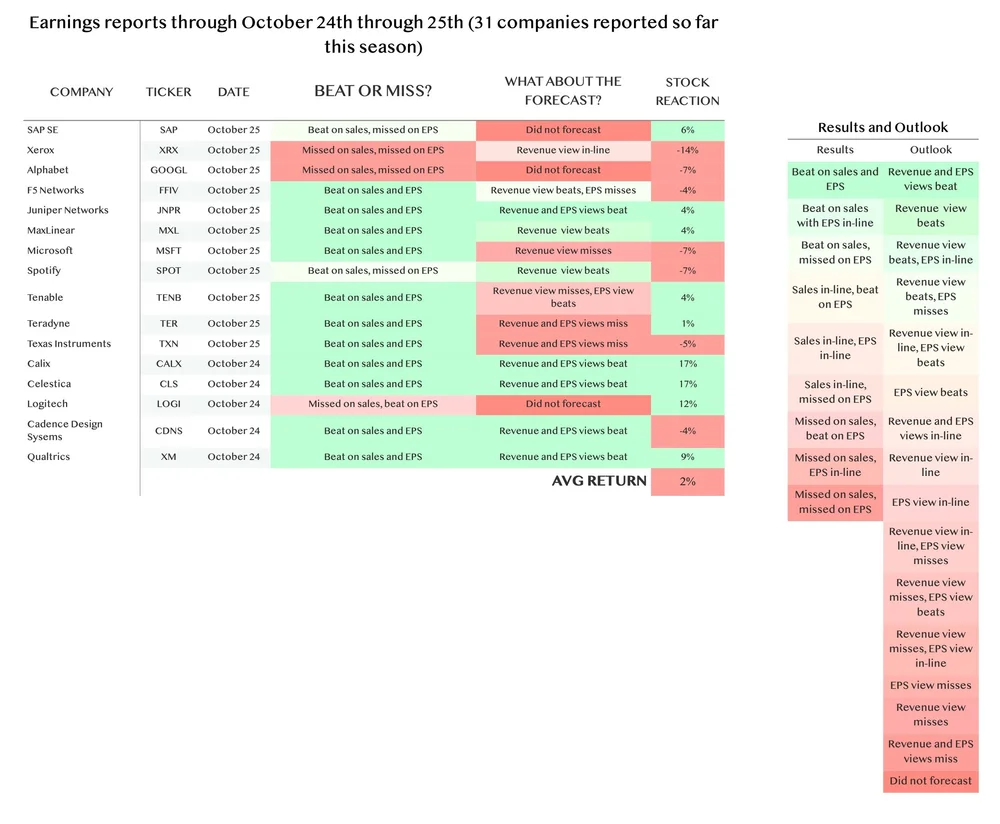
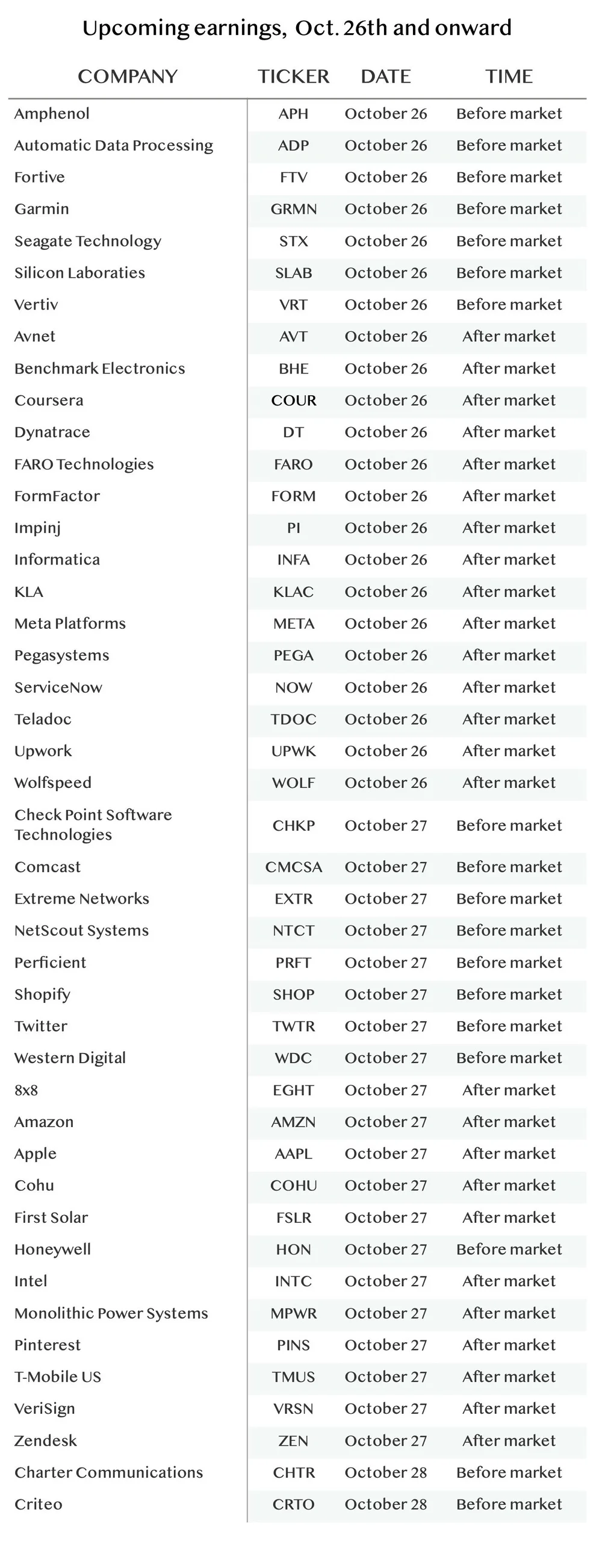
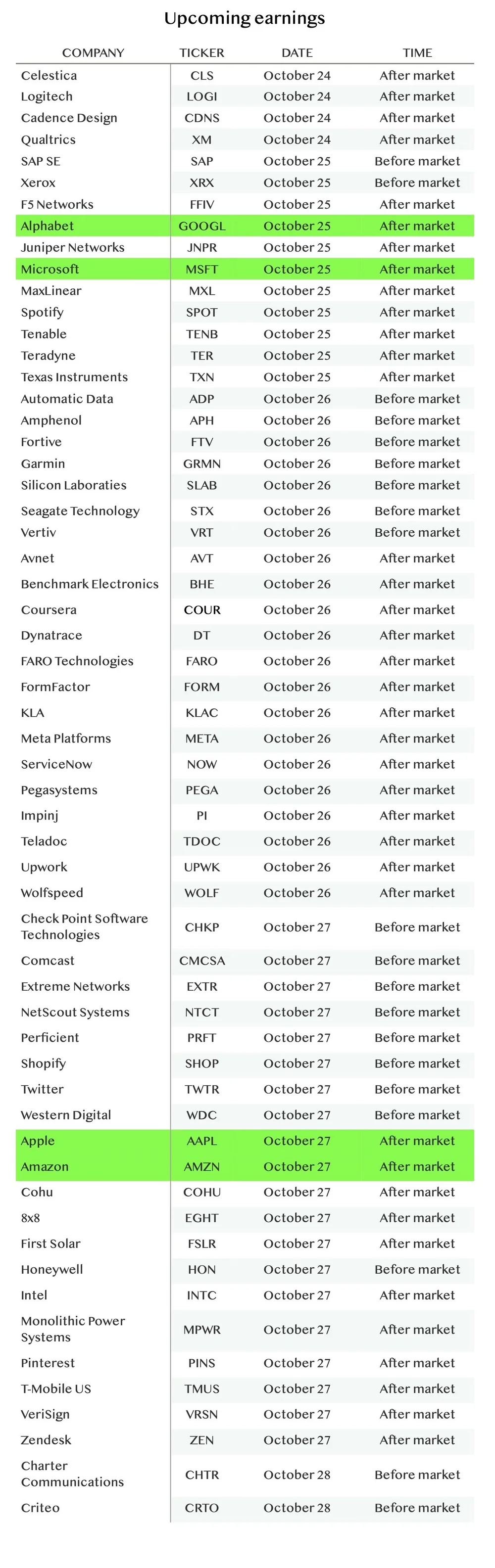
This week will be MegaWeek for earnings season, as I tend to think of it, the week the biggest firms in tech report, with Alphabet and Microsoft reporting on Tuesday after the closing bell, and Apple and Amazon on Thursday. The full lineup is in the table at the bottom of this post.
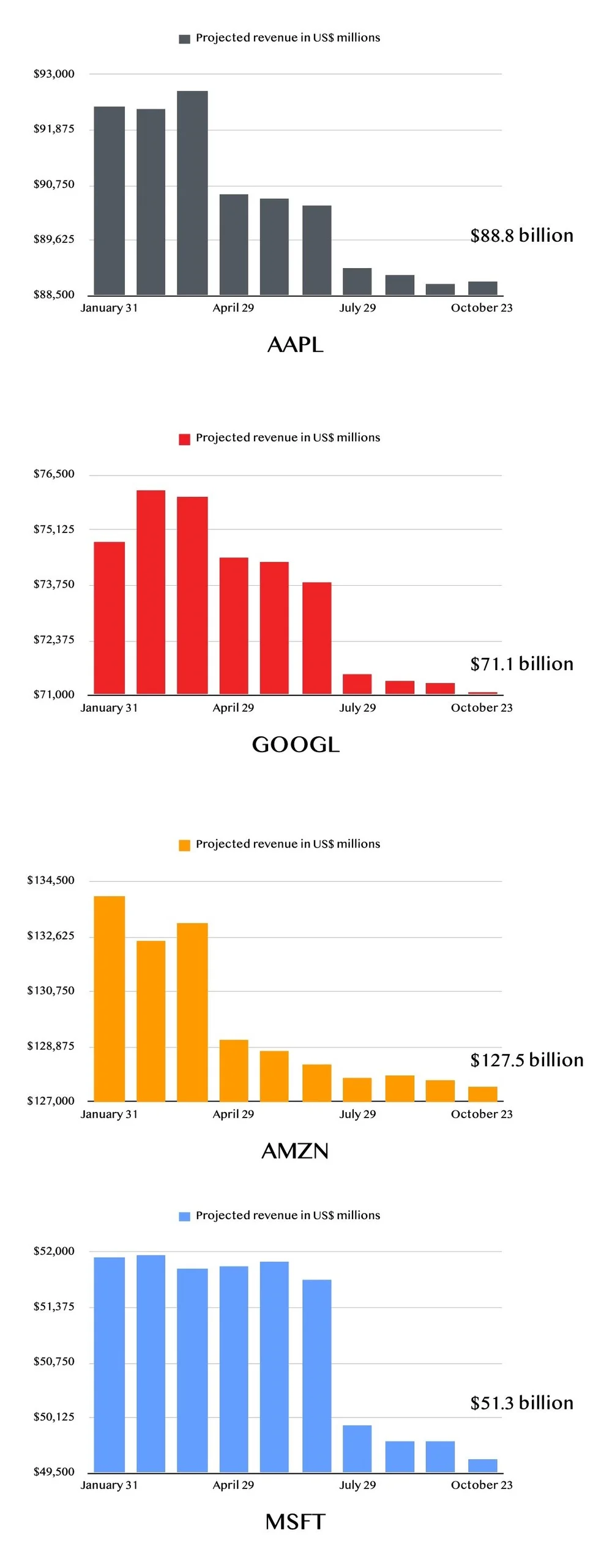
Monthly estimate change for revenue in the most recent quarter. Source: FactSet.
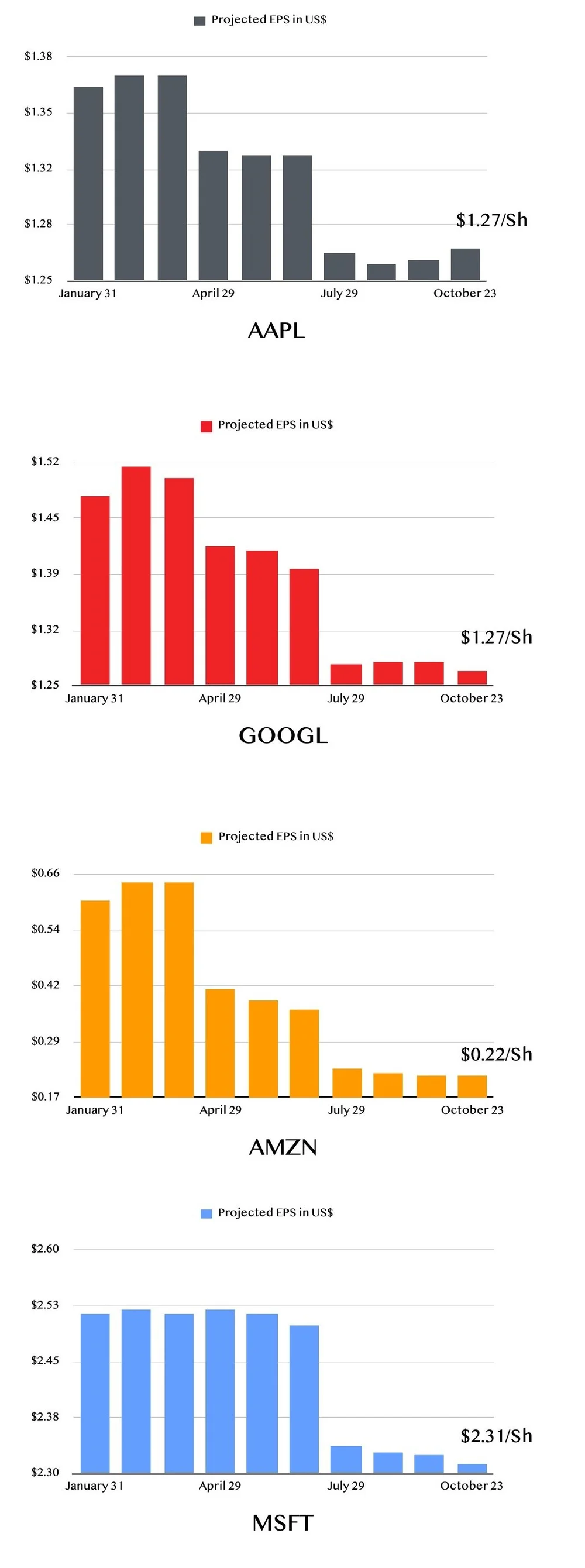
The accompanying charts show how estimates for the most recent quarter, the September-ending quarter, have changed month by month for all four companies. One chart is for the revenue number for the quarter, the second chart is for the earnings per share, or EPS, estimate.
As you can see, prospects for earnings and revenue for all four have been cut since the beginning of the year. Revenue estimates have been cut by five percent, on average, while EPS estimates have come down by twenty-three percent.
Revenue has held up relatively better than EPS, in other words, but this week could very well see the Street take an axe to those revenue estimates once again.
Part of the Street’s job between quarters is to make wild guesses without much help from the companies. Alphabet never offers a forecast. Apple hasn’t forecast anything in over two years. Amazon forecasts sales but not profit. Microsoft is the only one that forecasts both revenue and profit.
All of these businesses are susceptible to further erosion beyond the cuts so far, given that they are tied to consumer spending in no small way. Apple has so far proven the most resilient: it is the only one of the four that has beaten expectations this year for both revenue and EPS.
Monthly estimate change for EPS in the most recent quarter. Source: FactSet.
In fact, Apple is the only one that has seen a slight increase in estimates for revenue and profit in the past month. That is despite a lot of hand-wringing about whether people are buying iPhones or not. While Apple no longer discloses iPhone shipments, the company’s remarks about inventory will be a clue for analysts to parse to make up their own numbers.
Alphabet is facing an advertising market that is apparently weakening, based on Snap’s results this past week, even though midterm U.S. elections should be a boon to advertising.
Amazon is facing not only the prospect of inflation limiting purchases, and recession crimping spending, but also the continued elevated cost of logistics, which could eat into profits.
And Microsoft may or may not have more bad news to offer about the plunge in personal computer sales. More important will be what its cloud computing results say about how data center spending is holding up.
Apple, Alphabet, Amazon and Microsoft shares are down 17%, 30%, 28%, and 27% this year, respectively.
In Barron’s Advisor: Picking cash-rich software stocks
Oct 21, 2022
Show notes
The bulk of earnings season gets underway next week, when giants including Microsoft and ServiceNow will report. In anticipation of the action, my latest missive for Barron’s Advisor took a look at which software makers have ample free cash flow to go the distance. (Subscription required to read Barron’s Advisor articles.)
Last quarter, as I chronicled on a weekly basis, software makers warned of delays in deal signings, what they term “put-outs,” where more scrutiny is brought to bear on software sales by customers.
My premise for the Barron’s Advisor article is that we will see an increase in this trend during the current reporting season. October is typically a time when companies evaluate budget priorities for the coming year. I expect that such activity by software customers may start to show up in the remarks that software vendors offer about their own outlook, and perhaps even their formal forecasts.
If so, nervous software investors may look for reassurance in the profit profile of software companies. This year has seen an end to “growth-at-any-cost,” and greater scrutiny of the P&L and the cash flow statement. Investors suddenly want to know that software makers can be profitable.
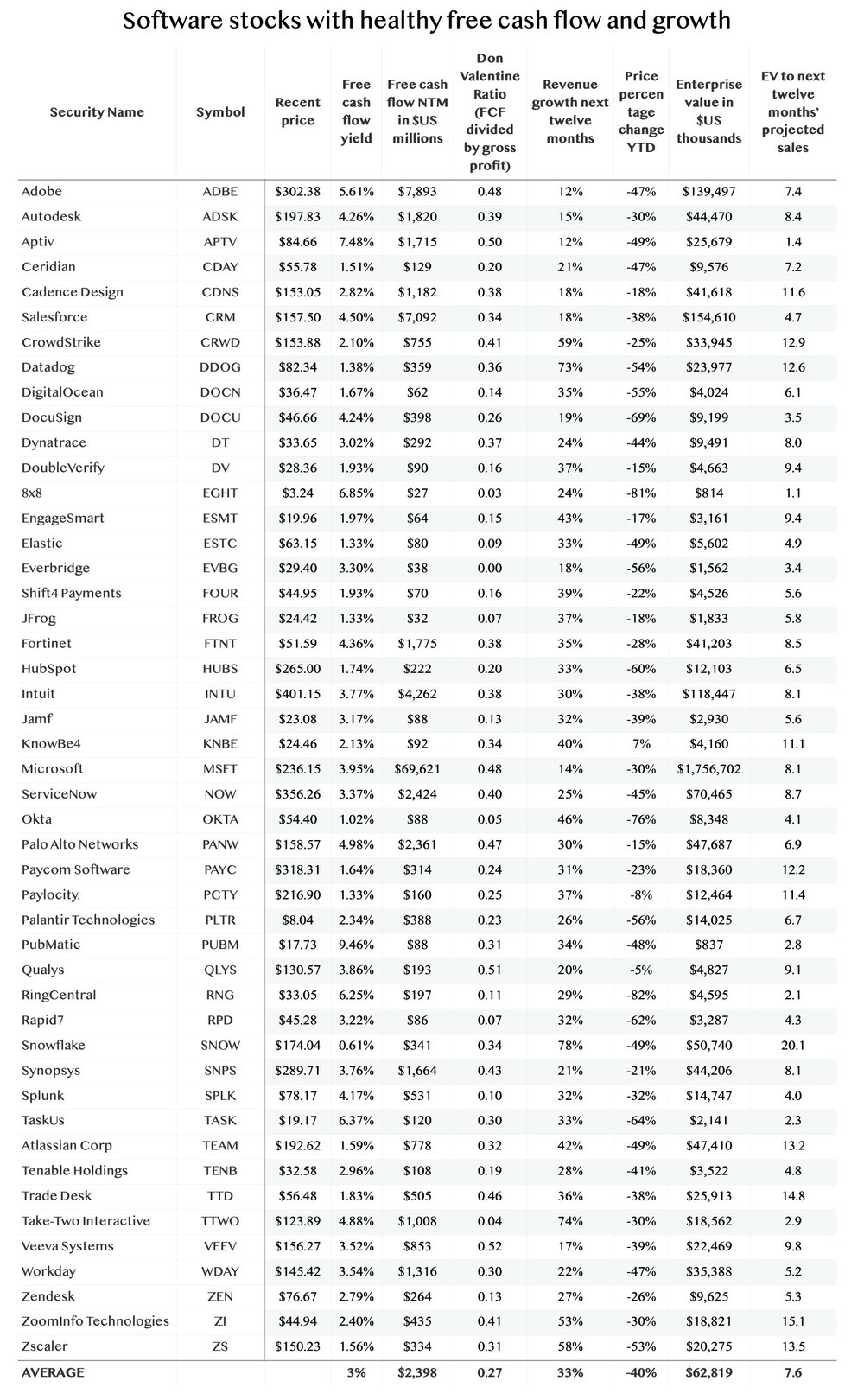
In that vein, my article looks at almost a hundred and fifty U.S.-listed software companies to see what their state of cash flow is. While I boiled down the list to ten names for Barron’s Advisor, below I provide a rather more lengthy list of forty-seven stocks that are already generating meaningful cash flow and have double-digit projected revenue growth.
Source: FactSet
The table’s central feature is the column showing expected free cash flow projected over the next twelve months on a dollar basis, with Microsoft being absolutely in a class by itself with an expected sixty-nine billion dollars in free cash flow.
You can make your own decisions about how to consider sorting these names: by their free cash flow, by their free cash flow “yield,” which is free cash flow divided by the company’s total market cap, or by their rate of revenue growth. Averages are shown at the bottom of the table in case you want to pick names that are above average by any measure.
One rather unusual measure is what I call “The Don Valentine Ratio.” The late, great Don Valentine, who pioneered venture investing in Silicon Valley, said you only need to know two things about a business, its gross profit margin, and its free cash flow. Hence, the Don Valentine Ratio is free cash flow divided by gross profit. It basically means, how much of a company’s gross profit does it manage to turn into a cash profit after spending on the essentials. I think it’s a very interesting ratio to follow. On average, the software makers convert a little over a quarter of their gross profit, 0.27, into free cash flow.
I’ve also included one valuation measure, the company’s enterprise value as a multiple of the next twelve months’ projected sales.
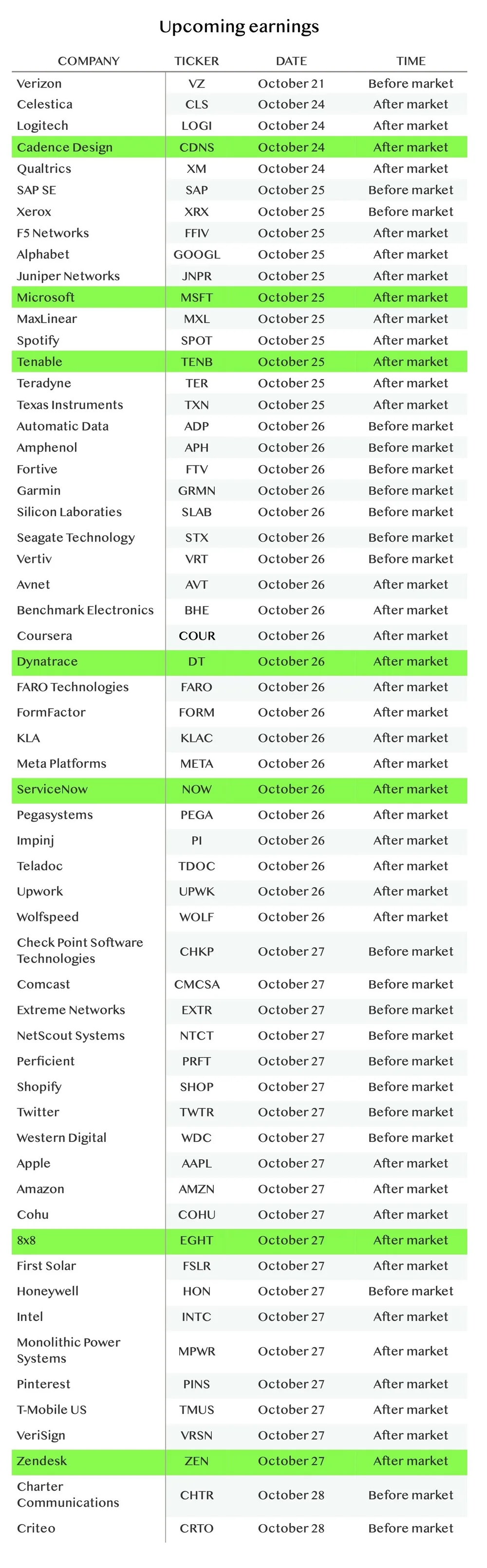
I’ve also offered below a rundown of coming earnings this month. Names among the forty-seven software stocks are highlighted in green.
ASML: We have no clue where all these chips are going
Oct 20, 2022
Show notes
Shares of chip equipment maker ASML Holding surged Wednesday by over six percent following better than expected third-quarter results, and a better-than-expected outlook.
The immediate reaction of anyone watching the chip world these days might be astonishment. There has been a steady stream of negative announcements from chip makers within a short span of time that suggest the chip market is in free-fall.
Consider that Taiwan Semi’s CEO C.C. Weilast week said chip companies continue to “adjust their inventory,”echoing Advanced Micro Devices’s CEO Lisa Su, who had said the week prior that the PC market has weakened “significantly” in the past ninety days. And memory-chip maker Micron Technologytwo weeks ago said it will cut its capital investment by forty percent and that the collapse in chip demand is “unprecedented.”
All these companies are customers of ASML, either directly or indirectly, so how is it ASML is doing just fine?
There’s a short answer and a long answer.
The short answer is that while demand is breaking down in certain markets such as PCs and smartphones, there is no broad, general oversupply of chips. As I suggested two weeks ago, a market with tight supply overall is a healthier market than one with a glut from over-building.
ASML sells tools to make chips years into the future, and on Wednesday, CEO Peter Wennink, during the company’s conference call with analysts, said ASML still faces a shortage of materials to make its tools. As has been the case all year long, his company can’t build its equipment fast enough to meet demand.
“There’s still such a big gap between the demand side and what we can make,” said Wennink.
“Looking to next year,” said Wennink, “With demand expected to remain significantly above supply, and based on discussions with our customers, we're planning to increase our system output next year.”
The company has its highest-ever backlog, thirty-eight billion dollars worth, said Wennink. Remember that ASML is the sole supplier of its kind of chip-making equipment, lithography tools. It is also a boutique supplier. It supplies tens of machines per year of each kind of machine, not millions. These machines are like small-batch whisky: you cannot crank up supply quickly enough.
Asked about Micron’s cut to its spending plans, Wennink said it doesn’t matter, everyone needs capacity beyond the moment, for years down the road. ASML is selling equipment to be put into place now for chips that won’t appear for another two years or more.
“Some of our customers … indeed look at their CapEx guidance for next year and have taken it down, but those same customers, in the same breath, tell us, Listen, we need those machines,” said Wennink.
“And these are the machines that we need for 2023, because they're strategic, they’re long-term in nature, and if you ship me 2023, it will only be 2024 output.”
Wennink was asked about statements by Micron and others that they are running their factories at a lower rate. But, said Wennink, that is a decline from a huge surge in production the past two years, when the world couldn’t get chips fast enough.
“If you look at the decrease of utilization … it comes off a peak that we've never seen before,” said Wennink. “So, it's not that you see a steep decline, you see it leveling off.”
So, the short answer is that supply of the most sophisticated equipment to make the most sophisticated chips is still tight. Supply drives things, it determines whether the market is healthy or bloated. Right now, it’s running lean and there’s no sign of that changing.
There is, however, a long answer, and it’s somewhat mysterious. Analyst Joe Quatrotchi of Wells Fargo pressed Wennink on the issue of chip demand. Could there be some kind of “air pocket” in 2024, he wondered, meaning, another collapse in demand?
“That's a reasonable question,” said Wennink, “but the answer is, we have no clue because nobody knows 2024, I mean, we are struggling to understand 2023.”
Wennink was further pressed on the matter by analyst Amit Harchandani of Citigroup. Who is putting in all these orders for equipment, and why? asked Harchandani.
“There's not one firm on the planet that actually has the full insight into where all these chips are going, and where they are being designed into,” said Wennink.
“It's consumer, it's industrial, it's automotive, it's energy transition — just the sheer application space has grown so much,” said Wennink.
Wennink said his customers don’t know, either. “The CEO of one of our largest customers said, when I asked the question, because you have a very significant market share, you should know, said, ‘Yes, I have no clue.’”
“This is exactly because nobody connected the dots,” said Wennink. “And if you ask me exactly where it goes, I have to also say, we don't have that full clarity.”
So, the long answer as to why ASML is seeing more business than it can handle is that demand has a mysterious, expanding quality, years into the future. The use of semiconductors is expanding so fast, even industry insiders don’t know what is going on.
Netflix: Not fantastic, but reasonable
Oct 19, 2022
Show notes
“Well, thank God” the company’s subscriber count is no longer decreasing, said CEO Hastings. The company will no longer forecast quarterly subscriber additions, removing one of the favorite footballs of the Street to quarterback the company’s progress.
Shares of Netflix in Tuesday evening’s after-hours trade were up fourteen percent, perhaps a short squeeze as the company delivered better-than-expected September-quarter results and a slightly better outlook, after what has been a disastrous several quarters of little to no growth.
Netflix’s “net” additions, meaning, how many paid subscribers they added after giving effect for churn, was 2.4 million, which was better than the company’s own forecast for just a million.
“Well, thank God, we’re done with shrinking quarters,” said founder and CEO Reed Hastings during the company’s conference call, which, as in past, was hosted on YouTube as a kind of TV show, with only one analyst participating, JP Morgan’s Doug Anmuth.
The outlook for this quarter’s paid subscribers, 4.5 million, is slightly higher than the Street’s average 4.3 million estimate. Said Hastings, “The results this quarter, and the guidance for Q4, are reasonable — not fantastic, but reasonable.”
The 4.5 million number is a huge comedown from past Netflix history. The average net subscriber gain in Q4, over the preceding five years, was 8.2 million. Hence, Netflix has got a lot of ground to recoup to get back to growth.
Interestingly enough, the company is now divorcing itself from the subscriber number. Going forward, Netflix said in its shareholder letter, the company will no longer forecast subscribers.
“Starting with our Q4’22 letter in January of 2023, we’ll continue to provide guidance for revenue, operating income, operating margin, net income, EPS and fully diluted shares outstanding for the following quarter, but not paid membership.”
This is akin to how some other companies have stopped talking about certain numbers. Apple, for example, some years back stopped disclosing iPhone unit sales.
Hastings and team are now increasingly focused on revenue growth as their main measure of success. That growth is currently anemic, at six percent, year over year, last quarter, versus sixteen percent a year earlier.
Some of that anemic growth is the hit from the rising U.S. dollar. Growth would have been thirteen percent otherwise.
The expectation of Hastings and team is that growth will pick up as a result of the the company’s planned roll-out of its ad-supported programming next month. For $6.99 in the U.S., the subscriber will get all the same Netflix programming but have to endure five minutes of ads per hour. Hastings and his COO, Gregory Peters, noted that the company is being very strict with “caps” on the amount of ads served, to preserve the quality of the user experience.
COO Peters told Anmuth that, even if some existing users switch to the lower-priced ad-supported plan, nevertheless, “we expect this leads to a significant and incremental revenue and profit stream.”
The other big change that’s coming is “paid sharing,” where people who’ve been mooching off of someone else’s account are given a kind of amnesty to come clean by creating their own profile of preferences. The hope is that maybe some cheapskates will be induced in that fashion to at least pay up for the ad-supported version.
Credit where due, Netflix has thought through its challenges and the introduction of an ad-backed offering and the paid sharing idea are commendable attempts to deal with those challenges.
Despite tonight’s pop in the stock price, the question will remain as to how Netflix’s success is to be measured for the seventeen billion dollars it spends annually for content.
Co-CEO Ted Sarandos offered a vigorous defense of the company’s content spending.
“We started this ten years ago, we had no IP, we had no library, we moved as quickly as we could to build a library of our own IP and to build our own library,” said Sarandos. “And in those ten years, that library now gets more viewing, more revenue and more profit than all of our competitors who have been at it for over one hundred [years].”
Hard to argue with that. Except that in those ten years, the Street always measured success by subscriber additions. Either growth will return with the addition of ads, or else investors will start to the measure the company by some other metric.
That something else might be free cash flow. The seventeen billion in cash expense for content is expected to leave about a billion dollars in free cash flow this year, a three percent free cash flow margin, and about two billion dollars next year, which would be about six percent.
That’s not a huge payoff for all the investment, but if the horizon continues to look more cash-rich, then perhaps the right-sizing of Netflix will be what investors cotton to.
The most important thing, as far as Hastings is concerned, remains the same: “Linear television is going off a cliff,” as he put it, citing the remarks of Disney’s Bob Iger. It’s going off a cliff in terms of hours viewed — streaming content is now more time spent by viewers than broadcast and cable, combined, he noted — and linear is also “collapsing as an advertising vehicle,” said Hastings.
With “connected TVs,” those sets that have Internet hook-ups, pushing more and more people to watch streaming, said Hastings, “think of it as pretty steady every year, climbing share,” meaning, streaming taking share from linear TV.
The fight going forward, said Hastings, is to “have the best content” and “the lowest prices.”
“We’re pretty excited about this next phase,” he said, “which is competitive excellence … if we can just be better than everybody else.”
With tonight’s fourteen percent pop to $275.50, Netflix shares are down fifty-four percent this year.

 Our TOPPODCAST Picks
  Stay Connected