TopPodcast.com
Menu
  • Home
  • Top Charts
  • Top Networks
  • Top Apps
  • Top Independents
  • Top Podfluencers
  • Top Picks
    • Top Business Podcasts
    • Top True Crime Podcasts
    • Top Finance Podcasts
    • Top Comedy Podcasts
    • Top Music Podcasts
    • Top Womens Podcasts
    • Top Kids Podcasts
    • Top Sports Podcasts
    • Top News Podcasts
    • Top Tech Podcasts
    • Top Crypto Podcasts
    • Top Entrepreneurial Podcasts
    • Top Fantasy Sports Podcasts
    • Top Political Podcasts
    • Top Science Podcasts
    • Top Self Help Podcasts
    • Top Sports Betting Podcasts
    • Top Stocks Podcasts
  • Podcast News
  • About Us
  • Podcast Advertising
  • Contact
Not in our directory?
Add Show Here
Podcast Equipment
Center

toppodcastlogoOur TOPPODCAST Picks

  • Comedy
  • Crypto
  • Sports
  • News
  • Politics
  • True Crime
  • Business
  • Finance

Follow Us

toppodcastlogoStay Connected

    View Top 200 Chart
    Back to Rankings Page
    Business

    Insureblocks

    blockchain & smart contracts in industries across the world

    Advertise
    • Apple Podcasts
    • Google Play
    • Spotify

    Latest Episodes:
    Ep. 99 – Introduction to the Mobility Open Blockchain Initiative (MOBI) Mar 08, 2020
    Show notes

    Chris Ballinger is the CEO and founder of MOBI – the Mobility Open Blockchain Initiative. MOBI is a non-profit smart mobility consortium working with forward thinking companies, governments, and NGOs to make mobility services more efficient, affordable, greener, safer, and less congested by promoting standards and accelerating the adoption of blockchain, distributed ledger, and related technologies in the mobility industry. About Chris Ballinger Chris started out in monetary economics and worked briefly for the Council of Economic Advisors in the United States. Chris moved into Fintech in the early days of the derivates market. More recently he joined Toyota as the CFO of their financial service organisation, the same year that Lehman Brothers went bankrupt. Whilst at Toyota he eventually went on to work at the Toyota Research Institute, which is Toyota’s arm in Silicon Valley that does the development of autonomous vehicles and robotics and AI. Whilst he was there, Chris developed his thinking on new mobility services and how blockchain and distributed ledger’s might be able to improve the new mobility service economy. Two years ago, Chris left the Toyota Research Institute ,and launched along with others MOBI. What is blockchain? Blockchain is a particular kind of distributed database that is append only where the rules for appending blocks are designed to make sure that the information is agreed on by the participants. But more generally, blockchain is common usage, it’s a broad collection of technologies, including cryptography, open databases, payments, perhaps identity, and probably quite a few other things. Blockchain’s potential for redefining the automotive industry For Chris blockchain and related technologies broadly bring four unique capabilities to the table: Digital twins: bringing digital identities to physical things. Micropayments: Today’s banking system is relatively expensive as is the variety of other trust services related to payments. By reducing the cost of those trust services and enabling peer to peer payment, the size of the payment you can do goes down. Once that goes down you can pay for more things with micropayments, thus enabling things that aren’t monetizable today to become monetizable. That may include the buying and selling of data from a car. Charging for city infrastructure in small increments for congestion pricing, pollution pricing, carbon footprint pricing and all these kinds of things might become possible with lower overhead costs for payments. Trusted shared data. When Chris was the CFO at Toyota, most of the financing was through securitization. Securitization, is the main financing mechanism for vehicles where a collection of auto loans get sold off to third parties. The overhead costs for that process, such as legal fees, accounting fees, reconciliation fees and trust are 1 to 2% of the value of the loan. Being able to have an open database that everybody can look at, share and agree as the single source of truth can potentially reduce the cost for transacting quite a bit. Data privacy and protection – the ability to control user data or third-party app data at its source, instead of it being shipped to a central database where it can be a single point of attack. These are the four basic capabilities that blockchain can bring to the mobility industry. They can be combined in various different ways to create a lot of interesting use cases. For Chris the single most interesting one is the ability for vehicles to pay as they go for things. The combination of blockchain, IoT and AI that gives anything that is connected with a modicum of sensors and intelligence, the ability to have an identity, act intelligently and autonomously in its ecosystem, and to participate in an economy autonomously. With respect to vehicles what that means is vehicles moving around and being able to interact with their environment as economic agents. How MOBI started? – the Mobility Open Blockchain Initiative MOBI grew out of a bunch of individuals doing proof of concepts (PoCs) on blockchain and distributed ledgers within their own companies. At that time Chris was at Toyota and had been running a number of small projects from 2015 to 2017 around digital twins, vehicle wallets, ride sharing on a blockchain, and car usage-based insurance and monetizing data. As all these individuals started talking they realised that they were all doing the same PoCs in their respective auto companies. The common problem they faced wasn’t one of technology but of getting to scale. How do you reach a tipping point using a new technology so that it becomes logical to adopt it? Nobody had a good answer for that. After a few meetings first under the auspices of the Digital Currency Initiative at the MIT Media Lab and then later at Silicon Valley the group grew and grew until there were 50 or 60 people in the room from a lot of different auto companies and a bunch of start-ups and tech companies. The participants agreed there was a need to formalise the meetups into an organisation to promote the use of this technology and particularly to develop standards. Chris clarifies that by standards he means simple things such as how transactions are accomplished, how payments are made, how vehicles are identified, how they identify infrastructure, how they present themselves to infrastructure. These “standards” aren’t too different to those made a hundred years ago when the first autos arrived on the road and decisions had to be made on whether a vehicle travels on the left or right hand side of a road. The participants realised there was a clear need to develop those standards, as standards are an important part for reaching scale. One of the participants had to quit their day job to run this organisation and Chris volunteered for the role. That was two years ago. Today MOBI is a non-profit consortium. It’s a group of companies that have gotten together with a shared interest in developing this technology. They realised that they can’t do it on their own and decided to launch MOBI. MOBI’s mission statement is to use these technologies to make mobility, greener, safe and more affordable. The role WAYMO and autonomous driving? Chris’s old boss at the Toyota Research Institute was Gill Pratt who was the project manager for the DARPA Grand Challenge. Gill informed Chris that autonomous driving is going to take a lot more data than people think. It’s going to take machine learning an awful lot of edge cases to understand autonomous driving and the only way to get the relevant edge cases is to collect an awful lot of miles, about half a trillion miles. That was more miles than any car company was accumulating. Even WAYMO who at that time was doing a million miles a month would have taken centuries to reach half a trillion miles. A report by the RAND Corporation states that “Autonomous vehicles would have to be driven hundreds of millions of miles and, under some scenarios, hundreds of billions of miles to create enough data to clearly demonstrate their safety” As Chris states – if you think about data and the economics of data there is some interesting points regarding it. When you share data with somebody, regardless of what the contract may say, the sharing entity probably lose control over it. Data is free to copy. Thus, if you share data to somebody else it loses value because it gets out into the wild. If that is the problem for everybody then nobody shares. Monetization of data isn’t through sharing but by keeping it protected in a silo with the incentive being to try and collect the fastest and most amount of data in order to becoming a monopolist before anybody else does. The problem of autonomous driving is, to a large extent a problem of accumulating enough data to run your machine learning algorithms. Gill Pratt asked Chris if blockchain could help car companies to share data in ways that they couldn’t. Was there a way for federated machine learning where the data can stay in its own location, where the algorithm can go to the data and still allow it to learn but in a way that avoids the data market failure. Chris found Gill’s question interesting and whilst researching that question it led Chris to Trent McConaghy and Bruce Pon (who both appeared on Insureblocks). BigChainDB, Trent’s and Bruce’s start-up ran a project for MOBI to think about data sharing for machine learning for autonomous driving. Chris also points out that every year pundits predict that this will be the year of autonomous driving with autonomous taxis taking us from A to B. Autonomous driving, because of all its edge cases is very difficult to do. The other autonomy problem is the ability for a car to participate in an economic transaction autonomously. Chris believes that long before cars can drive autonomously they will be able to pay for things, pay for roads, pay for data and perhaps sell data to create real time maps. They will have the ability to trade data with cars around them and pay for pollution charge and perhaps get credit for carpooling or picking up passengers. While the autonomy and driving is a really hard problem, the autonomous payments is basically sticking a profit function into a car, sticking a secure wallet and a secure identity into a car. It’s basically a question of agreeing on standards, not a question of massive advances in technology or in data collection. MOBI’s role is in developing standards which could lead into creating this kind of autonomy and payments ecosystem relatively quickly which is hugely important for the industry and for smart cities. Vehicles becoming autonomous economic agents At a recent conference Chris stated that there was an opportunity for autonomous cars to becoming mini weather stations through their windshield wipers. Today’s modern cars have rain sensors which automatically activate the windshields wipers. Those sensors could also be used to act as mini weather stations. This is part of a more general point, the combination of identity, sensors and connections with a vehicle wallet will allow the car to monetize itself through the buying and selling of data. Chris believes that in the not so distant future, vehicles are going to be programmed to make a living off their environment by maximising the amount of data that they can sell as a way of reducing their cost of operation. Buying and selling of data is likely to be a multi-billion dollar business over the next 10 years MOBI’s working groups MOBI operates primarily through its working groups. A working group is essentially built around a use case where a standard is needed. The very first working group was around vehicle identity because without a secure identity you can attribute anything. The second working group is around usage-based insurance. Once that vehicle is connected with an identity you can have a very different type of insurance that exists today. An insurance that is based on who the driver is, characteristics of the driver, time of the day the vehicle is driving as accidents become more or less probable depending on time of the day. Having access to the location of the vehicle is an important fact as some parts of cities are more dangerous than others. The more data you can access that is relevant to the underwriting liability the move valuable this becomes for insurance companies who have to underwrite this risk. The third working group is on electrical vehicles and grid integration. The problem about the existing electricity grid is that it’s very top down. With electric cars plugging in, it is going to become much more important to get information from the bottom to the top. Kind of a distributed information processing problem. For example, if too many electric cars plug in at the same time in a same block the have the potential to bring down a portion of the grid. On the other hand, they also provide storage capacity for the grid to help even the load. This is also known as “vehicle to grid’ technology. Auto Car reported on how the French car manufacturer, Renault ran a pilot scheme in the Dutch city of Utrecht, where they used their electrical car, Zoe to prove the feasibility of vehicle-to-grid charging systems. The fourth working group is on data marketplaces for connected vehicles, that is based on the work that the co-founders of Ocean Protocol are working on. The fifth working group recently started which is on supply chain management. The sixth working group is on finance securitization and smart contracts. Vehicle identity Vehicles today have a vehicle identification number also known as a VIN. That VIN operates in the physical world. In order to create a digital twin for the VIN and make it more useful it needs to be coupled with additional information. The more information it has the more useful that digital identity becomes. There is a lot more to identity than a number. For example, when somebody asks, who Chris or who is Walid, they don’t just want to see a copy of our birth certificate, they want to know, who you are and where do you live? They may also want to know, where do you go to school, what your capabilities are, what you’re good and whether you are a good guy and trustworthy amongst many other things. MOBI took the same approach for the vehicle identity. It has a birth certificate, information about the vehicle, who has the right to create the original record and how does the original record get rated in a way that can be trusted by others within the ecosystem. It’s a combination of useful attributes and who has the rights to specify the original record that constitutes the vehicle identity. The vehicle identity project has two more additional phases. The first phase was on the vehicle as it leaves the factory. The second phase is focused on how you incorporate all the events that happen in a vehicle’s life after it leaves the factory. For example, how many miles has it driven, how was it serviced, did it have certified parts or counterfeit parts installed? Was the vehicle involved in a serious accident or not? Essentially all the kind of information that has an impact on the vehicle’s value once it has left the factory. Chris states there’s also the opportunity to think of the supply chain to tracing the provenance of all the parts that go into the vehicle. Adding that component to the other two aforementioned phases will create a digital identity of the vehicle from the cradle to the grave. That secure identity can also act as an autonomous agent through the selling of buying of its data. You can have reputation scores and reputation values appended to it. Supply chain working group This is one of the newer working groups which is being chaired by Ford and BMW. Supply chain within the automotive industry is known as being one of the most complex there is. Car manufacturers have to keep track of about 50,000 parts or more. Through the course of assembly there will be numerous parties involved with parts coming from up to three tiers of suppliers. The capital markets that support the supply chain are themselves very inefficient with the payments that goes the reverse way forming a mirror image of the production process. On both sides of that physical supply chain and the capital supply chain there are extreme inefficiencies. The processes are paper based generating enormous amount of waste. The suppliers tend to be shared amongst the automakers so there’s an enormous potential for automakers to get together and standardise information on the blockchain. To have secure identity for car parts and have information and data that can be shared amongst the players within the ecosystem. Chris had great respect for the Daimler’s “Mobility Blockchain Platform” (MBP) hardware car wallet solution. However, he pointed out that they would have to face the great challenge of scaling and the additional problem of convincing their competitors to join their platform. Coming onto a competito…

    Full show notes at the publisher

    Ep. 98 – Google joins Hedera Hashgraph’s Governing Council Mar 01, 2020
    Show notes

    Mance Harmon, CEO of Hedera Hashgraph has returned to Insureblocks to discuss the exciting news of Google joining the Hedera Hashgraph Governing Council. We also discussed the addition of Hedera’s new service entitled, Hedera Consensus Service, which brings interesting opportunities for enterprise blockchain platforms such as Hyperledger and Corda to embrace the opportunity to create verifiable timestamps and ordering of events to a public level trust.

    What is blockchain and what is hashgraph?

    Blockchain as a term refers to two things:

    • A data structure which is a chain of blocks of transactions
    • A consensus algorithm that enables a community of participants, each of which holds a local copy of that chain of blocks to come to an agreement or consensus on which block to put next on the top of that chain in order for everyone to keep a consistent chain of blocks

    Unfortunately such a blockchain is designed to be slow for a number of reasons:

    • Proof of work, the use of a really hard cryptographic puzzle, to reach consensus is time consuming
    • From an architectural standpoint, having a single chain that everyone uses is also limiting

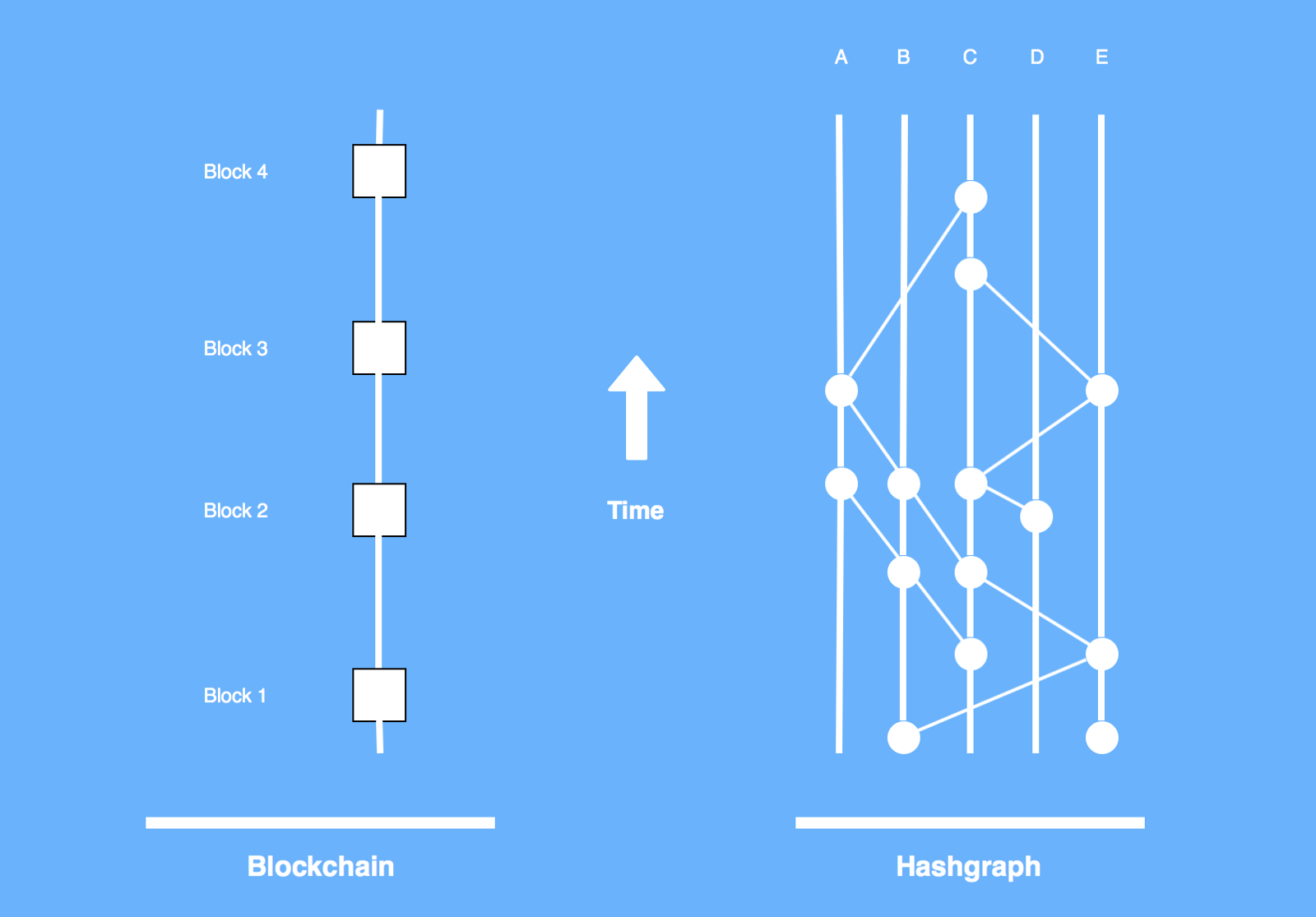
    Hashgraph, similarly is a term that refers to both a data structure and a consensus algorithm. Hashgraph’s data structure is a graph, in a mathematical sense, whose nodes or vertices are linked together with hashes cryptographically.

    Its consensus algorithm makes it possible for those that have a copy of the hashgraph to calculate how the other nodes in the network would vote in order to come to an agreement on the order of transactions.

    Because it’s a graph rather than a chain, all of the transactions are flowing into the network, can be processed simultaneously without the need for proof of work.

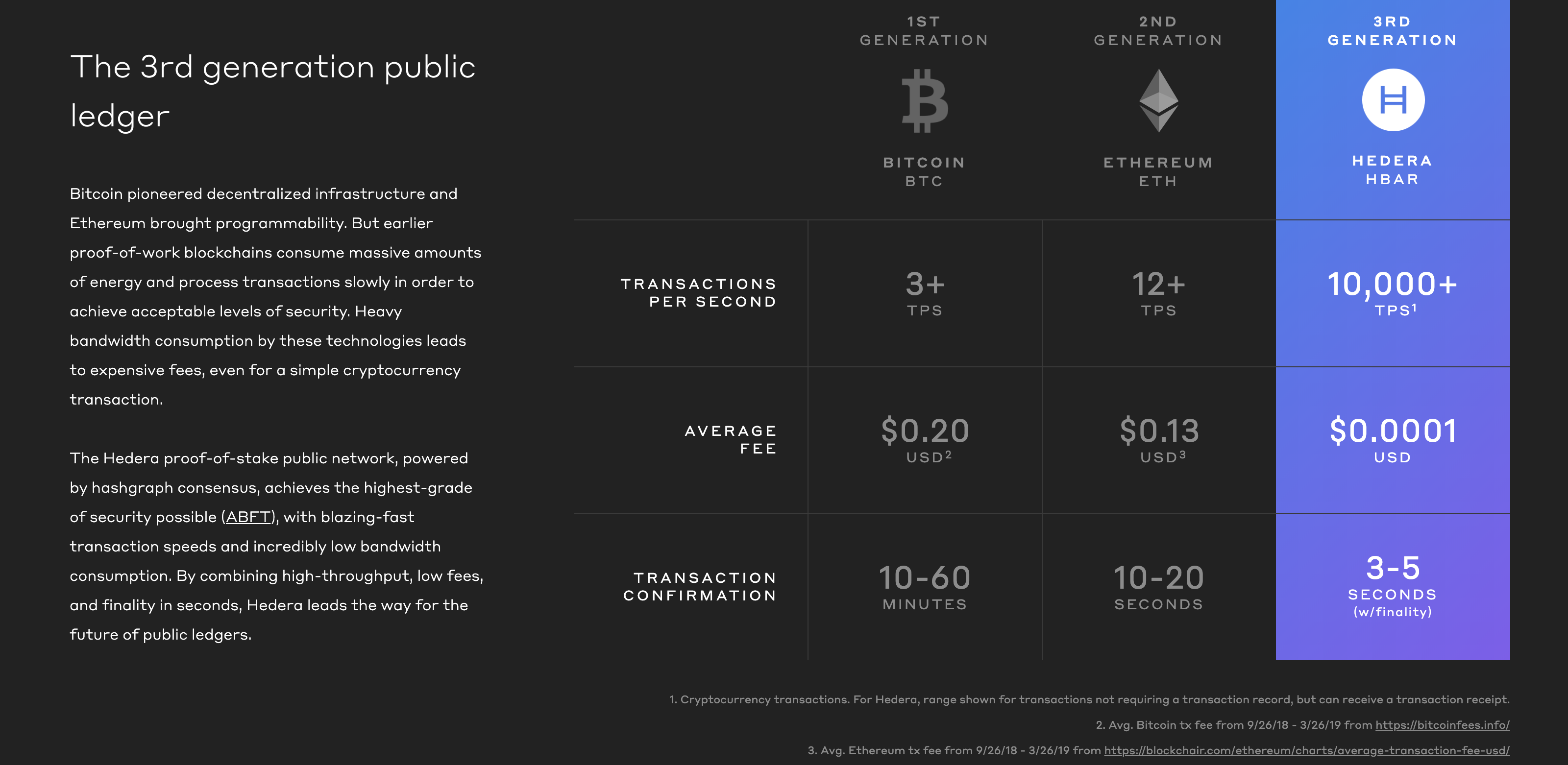
    Hashgraph thus removes the two constraining factors of blockchain: no need for proof of work and a graph instead of a single chain. The result is much higher performance and higher level of security due hashgraph using asynchronous Byzantine fault tolerance.

    What is Hedera Hashgraph?

    Google joins Hedera’s Governing Council

    The Council was designed to provide a governing body that the market would trust in doing a good job in terms of shepherding this global network to full maturity and beyond. The Council makes decisions on a wide range of topics such as product roadmap and in control of treasury management. Council members can serve up to two or three year terms. The Council will ultimately be composed of 39 members to represent the full range of use cases across industries, geographies and through time. The council members are chosen to be the largest and most respected members in their categories and geographies. Today there are 11 members: Swisscom blockchain, Tata communications, Nomura, IBM, Boeing, Google, Magalu, Deutsche Telekom, FIS, DLA Piper, and Swirlds.

    On the 11th of February, Google became the 11th member of the Hedera Governing Council.

    Hedera is a Delaware based LLC, which is a business vehicle with a legal existence separate and distinct from its owners. Council members are members of the LLC in the legal sense. What this means is that full diligence, M&A and approval by the CEO / Board of that organisation is necessary for them to becoming co-owners of Hedera Hashgraph.

    The council functions in a very similar fashion to a standards body and has oversight of the organisation itself by committee. Members sit on committees related to their level of expertise for example a tech steering committee, a legal & regulatory committee and marketing committee amongst others.

    How to avoid collusion between council members?

    As the council members have a little over two thirds of the Hedera Hashgraph tokens there is only a third of the tokens in the market in circulation. This ensures that the risk of a Sibyl attacks are removed. As you don’t have to worry about a bad actor buying up a third or more of the token supply and being able to disrupt consensus.

    The next question is to ensure that the chosen members of the council don’t collude and to do that you select members that are large enough and care far more about their individual brands and lines of businesses for them to risk their reputation on colluding over this public distributed ledger.

    Additionally a principle reason for having the council members geographical, industry wide distributed and distributed over time was to avoid collusion between members.

    Similarities between Hedera’s Governing Council and the Libra Association?

    The press has made numerous comparisons to Google joining the Hedera governing council to Libra’s loss of members from its association. The comparison isn’t fair as Libra is focused on being a payment solution and Hedera isn’t. Libra’s intention of creating a stable coin has brought it into regulatory complexities that Hedera doesn’t have.

    Hedera is focused on trying to create the trust layer of the internet in its most general sense. They are taking to market consensus as a service for the full range of use cases for public, private enterprises and small businesses.

    Why Google? Why not Amazon Web Services or Microsoft Azure?

    Mance believes that Google took notice of Hedera making use of Google Cloud Platform (GCP).

    Mance also states that Hedera’s architecture that they’re taking to market, lends itself very well to their strategy to grow GCP. Hedera’s launch of the Hedera Consensus Service also sits well with GCP’s strategy. The consensus service is Hedera’s fourth service in addition to the original three being cryptocurrency, file storage and smart contracts.

    Hedera Consensus Service

    Mance believes that the challenge of public blockchain networks such as Bitcoin, Ethereum, and EOS for example, also referred to as the “1st layer of blockchain”, is that they conflate two separate functions:

    • As transactions flow into the network they are put into consensus order
    • Secondly, these transactions then feed into another layer of business logic, often referred to as smart contracts. The smart contracts validate the transactions for some form of application

    The above two functions are very different functions but they exist on the same network. This kind of architectures creates a number of problems:

    • Privacy for smart contracts
    • Competing CPU resources

    Privacy for smart contracts: For smart contracts to operate they need data that is in plain text, not encrypted, for them to know the values within the data in order to calculate an output. In other words, privacy isn’t guaranteed as the data is going to be public.

    Competing CPU resources: As smart contracts are executing on a public network that means the developer of the smart contract is competing for CPU resources. If traction is gained that can generate issues of scalability.

    With a private network you get privacy and confidentiality however the problem is that, according to Mance, private networks aren’t particularly good with respect to consensus models. In a public network you have hundreds or thousands of nodes putting transactions in order in a distributed manner. On a private network you might have four or six that are operating in a single data centre where those consensus nodes are managed by a single entity. This is as good as a central database.

    What Hedera has done is taken the public network model and split those two layers apart. One layer, the transaction ordering is being offered as a service. The second layer, transaction validation is moved into a private network and these are called appnets or application networks.

    Enterprises will be able to create applications or have their ledger run on multiple computers in a private network or possibly on Google Cloud platform and the transactions through the Hedera Consensus Service (HCS). HCS will provide a unique opportunity to create verifiable timestamps and ordering of events for the application. This service takes full advantage of Hashgraphs’ high-throughput for speed and asynchronous Byzantine fault tolerance for security.

    Examples of how companies might utilize HCS include asset tracking across a supply chain, music stream counts to determine remittance for digital rights management, an auditable log of asset transfers, and payable events across an advertising platform

    Mance believes that Google believes in that vision which is why they have joined the Hedera Governing Council.

    Hedera enhancing private enterprise blockchain platform like Corda or Hyperledger Fabric

    Mance quickly states that Hedera isn’t competing with Corda or Hyperledger Fabric but is complementary to those enterprise blockchain platforms. On the 12th of August 2019, IBM joined the Hedera Governing Council. One of the reasons that they joined the council is because they recognised the opportunity for Hyperledger to take advantage of HCS.

    Existing Hyperledger applications can remove the RAFT or Kafka consensus engine with the HCS. This provides the Hyperledger application with the benefits of public level trust and performance that a graph can provide and security. This is equally applicable for Corda. Corda has a notary service which Hedera could replace with HCS which is in a sense a trusted, distributed public notary service.

    Growing the Hedera Governing Council

    As stated earlier Hedera is looking to grow its council from 11 to 39. Mance state that early on they were focusing on having Global 1000 companies or the equivalent of Fortune 500 across geographical regions. However, he believes there are now opportunities to have a few select universities and NGOs to join the governing council.


    Ep. 97 – Tracking Coronavirus with blockchain by Acoer Feb 23, 2020
    Show notes

    In this exciting podcast we get to hear about how blockchain is used to track the coronavirus. We had the pleasure of having Jim Nasr, CEO of Acoer, developers of the blockchain coronavirus tracker, talk to us about the challenges the healthcare industry faces and opportunities for innovating it.

    What is blockchain?

    Jim looks at blockchain in terms of three pillars:

    • Technology
    • Token economics
    • Distributed computing

    The first pillar is with technology of distributed ledgers themselves.

    The second pillar is with regards to the value creation attribution specifically to public blockchains. This is where blockchain provides a reward in a public setting in a transparent manner for the creation of value. In the Bitcoin network for example miners are rewarded with 12.5 Bitcoins for completing a mathematical challenge for which they would have used electricity and processing power.

    The third pillar is regarding distributed architecture and distributed computer. For Jim this is fundamentally a question of culture of distributing power instead of a few central figures or central servers and removing intermediaries.

    The Coronavirus Tracker

    Acoer coronavirus (COVID-19) blockchain tracker

    On the 3rd of February Acoer announced the launched of its coronavirus tracker. Acoer is a software development company narrowly focused on modern, open and interoperable healthcare software.

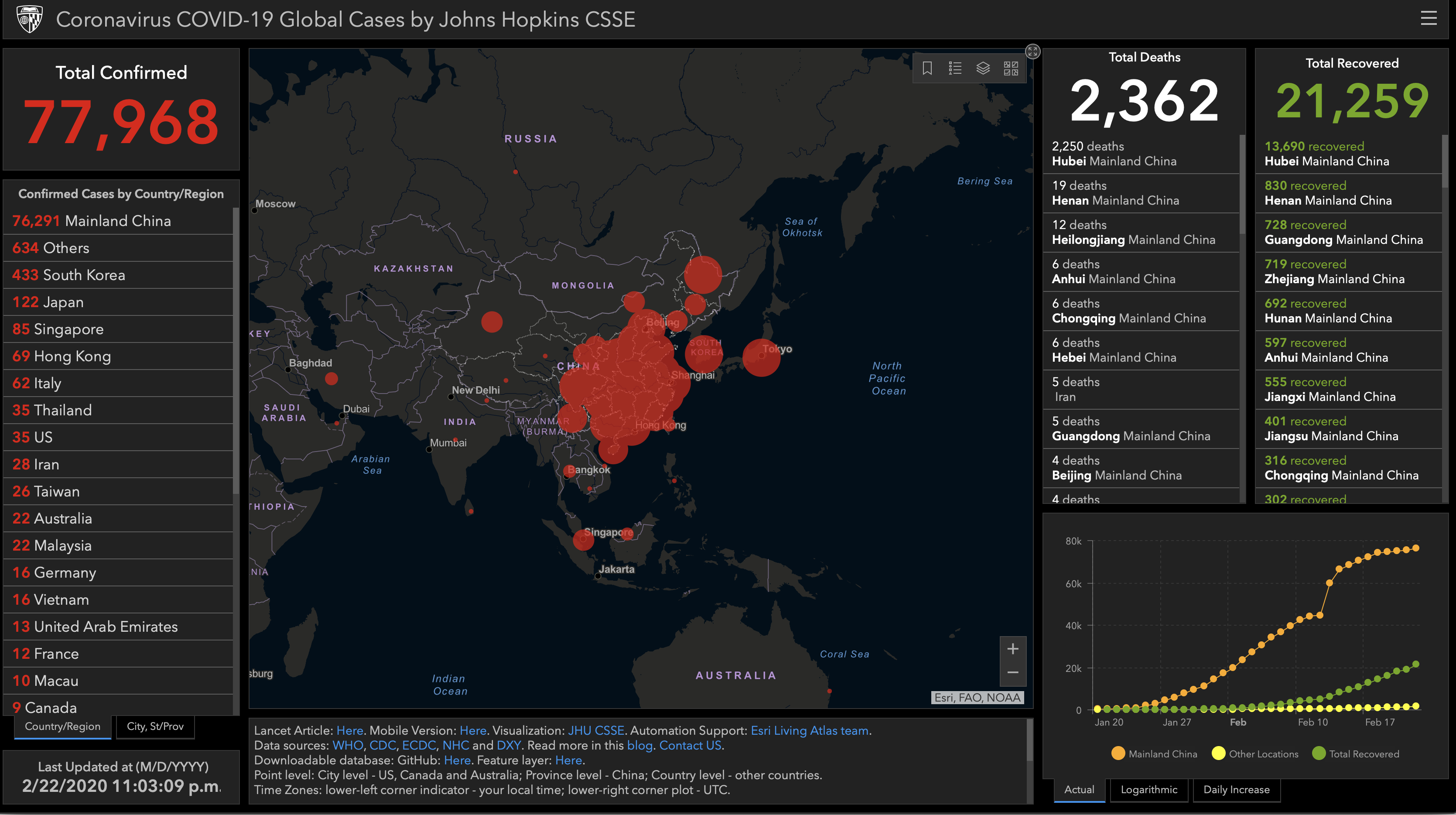
    Acoer has created a data visualization tool to track the deadly coronavirus. The tool, known as the HashLog data visualization engine, interacts in real-time with Hedera Hashgraph’s distributed ledger technology. This allows researchers, scientists and journalists to understand the spread of the coronavirus and its trends over time through visuals presented on Acoer’s HashLog dashboard.

    John Hopkins coronavirus (COVID-19) tracker

    In creating this tool Jim had looked at existing trackers, particularly the Johns Hopkins one and felt they could add a more global perspective on it, use the existing visualisation engine called HashLog to make it their tracker more usable, dynamic and filterable.

    Jim has been a huge believer that when it comes to public health data surveillance, blockchain can be a source of truth and a source of accountability. If you tuned the token economics and the game theory correctly, you can incentivize good data collection and you can disincentivize bad players from gaming the system.

    Acoer are constantly growing their data sources. Today they have clinical data from the CDC and other sources that show relevant clinical trials that are happening for treating coronavirus. Google Trends and social media provide in context data.

    Why blockchain?

    It was pointed out to Jim that as the Acoer coronavirus tracker the Johns Hopkins one is using the same data as theirs from the CDC and the WHO but it does it with APIs, Application Programming Interface, and not with a blockchain.

    Jim points out that their tracker also uses APIs. APIs are the modern way for different systems that are unaware of each other to communicate with each other with standard protocols. For example the clinical trails data, Acoer gets is through APIs from https://clinicaltrials.gov/.

    For Jim blockchain is supplementary to APIs. The blockchain ingests all this data from all kinds of sources via APIs. The blockchain can confirm whether or not the integrity of this data has been changed at any stage. Acoer can thus confirm that it hasn’t manipulated the CDC data for example as they can provide a real time audit trail of the data on a public Hedera DLT.

    The reasons for using a public blockchain is to provide clear references to the data provenance.

    Why Hedera Hashgraph?

    Having experimented with numerous public blockchain, Jim wanted a near real time responsiveness for the coronavirus tracker, and Hedera’s consensus algorithm is mathematically proven to be the most optimal. In addition Hedera’s high number of transactions per seconds and the finale of transaction within a few seconds was very important to Jim.

    Lack of innovation in the healthcare

    Like many Western countries such as the NHS in the UK, western citizens have been conditioned to mediocrity and lack of innovation in the healthcare, Life Sciences space.

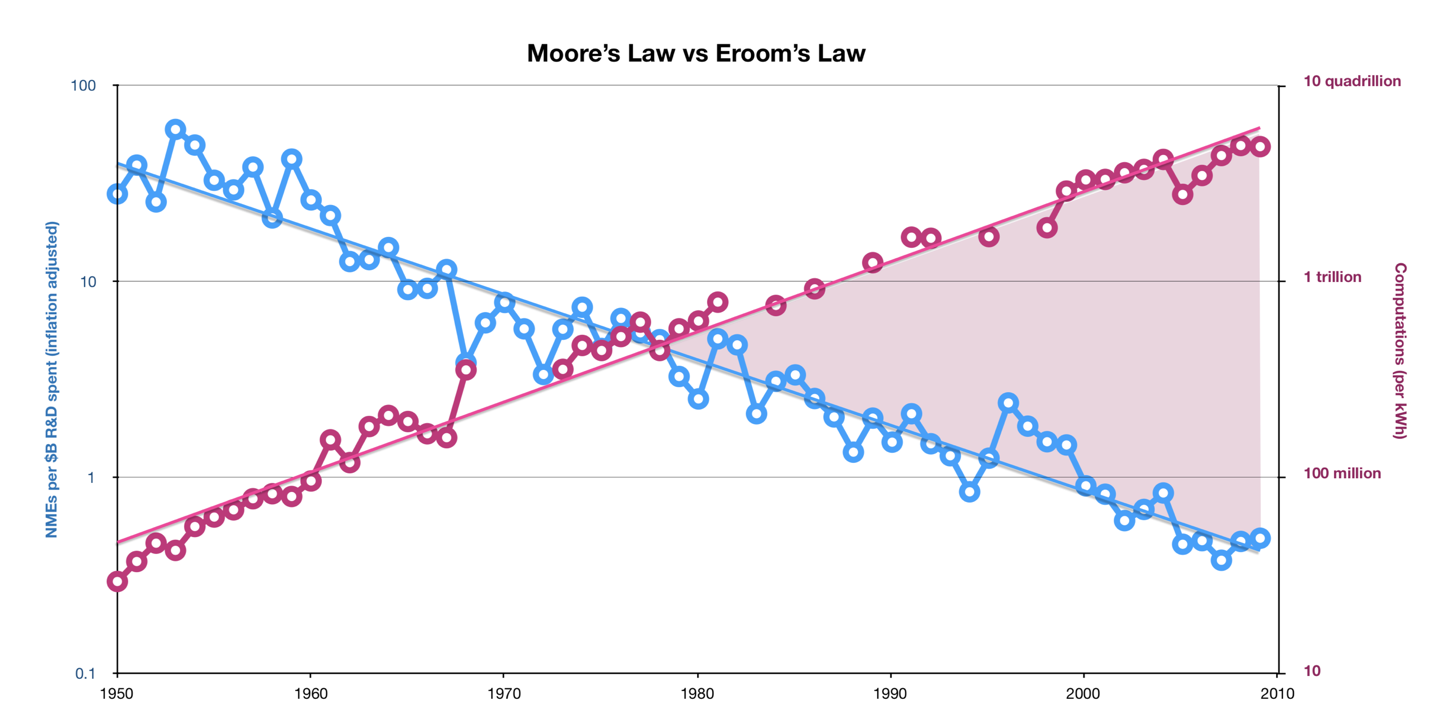
    There are many reasons for it but the empirical evidence displayed in the Moore’s Law vs Eroom’s Law diagram above categorically shows that most industries have benefited from Moore’s Law of reducing costs and improving productivity due to technology getting faster and cheaper over the last 40 – 50 years. In life sciences we have seen an exact opposite trend in return on investment.

    In Jim’s opinion there is a dearth of innovation in healthcare, largely because they are cash cow industries at play with no incentives to cooperate.

    In the US you have the most expensive and by many statistics the least effective healthcare system with an annual waster of close to a trillion dollar a year.

    Where can you start to change the status quo? In Jim’s opinion the underlying issue in healthcare, public health and life sciences is this idea of siloed data. This is one of the many reasons from a technical standpoint why things are not real time, not cost effective and why there is so much duplication of work. Once you have addressed this problem of siloed data, you can apply to the data machine learning, deep learning, predictive analytics and get real insights on the data.

    Opportunities for blockchain in the healthcare industry

    For Jim the biggest opportunity for blockchain in the healthcare industry is as a single source of truth for the data provenance. It shows the chain of custody of where data came from and where it was touched and by whom. It can show if consent was provided by the owner of the data. If they were incentivised through some kind of monetization benefit.

    Blockchain, particularly in real time can shine and become proactive. For example blockchain can provide proactive compliance, auditing and data provenance in real time. With blockchain you can trust the algorithms and cryptography that goes behind it instead of trusting a big EMR / HER vendor’s word.

    Supply chain

    Jim recognises that there is room for improving supply chain in the healthcare industry. However not just supply chain in terms of physical supply but also in terms of information supply.

    One of his ideas is for tracking public health data surveillance, particularly for infectious disease outbreaks. A public DLT that allows permissioned users or even in certain cases, permissionless users, so long as it has the token economic strength to collect information in a distributed way and have that information available to different parties, including authorities such as the CDC.

    Jim recognises that this is a long-term play that will require a public health coin for the token economy and adoption from lots of different entities.

    However, tracking the generic drug supply chain which is facing shortage issues in the US and others parts of the world is a simpler use case / implementation. It would require the FDA, pharmaceutical manufacturers, finishing shops, purchasing organisations and others to be compliant to all the rules and regulations in order to stipulate the usage of blockchain technology. The ultimate user is the FDA inspector and is something that is more practical in the near term.

    Jim, however has reservations around private blockchain supply chain solutions due to their lack of market wide adoption. This is primarily a governance issue and one around transparency.

    Bringing change in the healthcare industry

    Jim points out that it requires a mixture of leadership at the right level with real influence and a grassroot group of people from developers to doers who have a lot of interest. This isn’t just about innovation but it represents a growth opportunity at the personal level. This allows individuals and organisations to remain relevant. In an era where things change very rapidly it is important to be able to stay relevant.

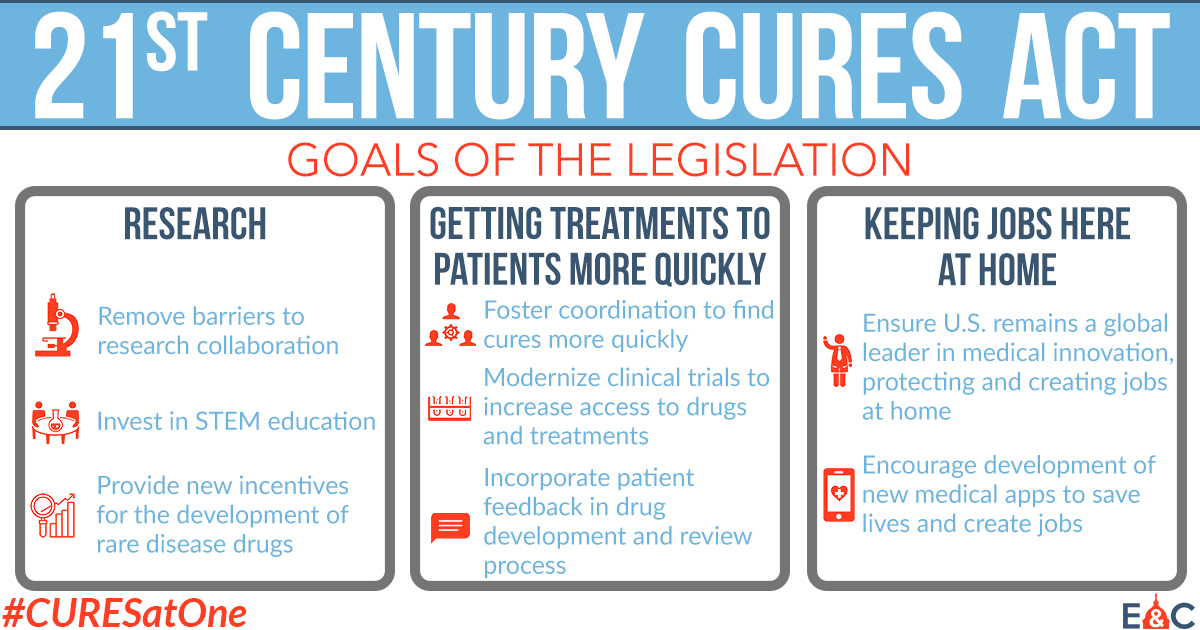
    In December 2016 the FDA passed the 21st Century Cures Act. It’s been around for four years and it allows individuals to get to their electronic health care records. It also largely mandates electronic health record provider to provide open APIs for developer to allow that access. Based off this law, CMS the centres for Medicare and Medicaid have put some real meat to the bones of this act by adding on to it this idea of personal health care record and information blocking. It really incentivises or penalises organisations that do or don’t comply in providing APIs.

    Globally Jim is encouraged by the increase in standards for data interoperability. He reminds us for example of the availability of an open API standard for the healthcare industry called FHIR (fast healthcare interoperability resource), here is a version of it with the NHS here in the; UK https://digital.nhs.uk/services/fhir-apis

    Acoer’s plan for 2020

    Acoer has two products right now, one under design and one called Hashlog which is their data visualisation engine behind the coronavirus tracker. They have multiple clients working with it for instance around substance abuse data and opioid abuse data. Acoer takes data from multiple data sources, aggregate them and present them in a visually compelling manner.

    The new product is about securing blockchain enabled file data collaboration called HashLoad.


    Ep. 96 – Vinturas – finished vehicle supply chain on the blockchain Feb 16, 2020
    Show notes

    This week we’re joined by the CEO of Vinturas, Jon Kuiper. Jon was the former head of Koopman Logistics Group and has years of experience as a senior executive and a CEO in the Finished Vehicle Logistics (FVL) industry. He joins us to talk about how Vinturas is using blockchain technology to revolutionise the FVL industry. What is blockchain? Jon Kuiper explains what blockchain technology means in the FVL industry. Blockchain technology or distributed ledger technology allows Vinturas to create an infrastructure which fosters collaboration between FVL companies and all other stakeholders in the ecosystem. This in depth collaboration allows for a single source of truth amongst all players in the FVL ecosystem, which in turn can bring huge benefits for all network participants. The finished vehicle logistics industry According to The Association of European Vehicle Logistics, Finished Vehicle Logistics (FVL) are the activities that take place after a new vehicle leaves the factory until the point when it reaches the customer. The FVL industry is a highly specialised sub-section of the transportation industry with dedicated storage warehouses and skilled drivers to ensure smooth delivery without damages to the high-value product. FVL is part of the automotive logistics market which according to a study by Global Market Insights is valued at over USD 115 billion in 2018 and is estimated to grow to USD 170 billion by 2025. The key 3 challenges in the finished vehicle supply chain industry Supply chain visibility In 2017 Supply Chain Worldwide Survey surveyed 623 supply chain professionals across 17 different countries and concluded that only 6% of firms were able to offer any type of supply chain visibility. This, more than ever presents a huge problem across supply chains which need to be addressed. ComplexityThe finished vehicle supply chain is very complex and the complexity is only increasing. Cars can be transported from the original equipment manufacturer (OEM) through potentially 4 modes of transport road, rail, maritime and river before it reaches the car dealership further increasing the complexity. FVL often spans different countries and these countries have their regulations and rules which will need to be abided to. Also, it’s not one firm which controls the whole supply chain. Products are often passed between 3 or 4 LSP’s in the supply chain before it reaches the car dealership creating multiple handover points between different logistic service providers. Customer demandsAmazon certainly leads the way in producing extremely efficient supply chains having spent billions in R&D in the last 20 years perfecting their supply chain. The ‘Amazon Effect’ has meant that expectations of supply chains in many industries have risen in recent years. Now consumers expect shorter delivery times, are less tolerant of mistakes or late deliveries. Importantly customers expect to know where their product is and how long it’ll take to reach them so like Jon Kuiper says they know ‘if he can use it to go on holiday or not.” Forecasting A problem with opaque supply chains is that it removes OEM’s ability to forecast or plan. This means that they are not able to update customers, nor are they able to execute last mile processes. The fleet owners have no information on the vehicles and the reasoning behind their vehicles being held up. If it’s because of damage it will have a large impact on their business. The overarching problem with the inability to forecast is that all stakeholders in the supply chain can’t manage the process. Inefficient operations and processes in the finished vehicle supply chain industry Before the supply chain process begins a tendering process occurs to see who can cover the supply chain service at the lowest price but there are well-known disadvantages of this process. The tendering process means that profit margins reduce. This means that not a lot of money can be spent on the research and development side of the business such as updating the IT systems. This likely explains the outdated supply chain systems which have plagued this industry for so long. As the margins reduce the leaders of the FVL industry may not make any more bids even though they may have the best capabilities to deliver the service. The smaller service providers may be overpromising on what their capabilities can deliver. What this could lead to are shortcuts which increase the possibility of mistakes in the supply chain and reduces the level of safety for workers along the supply chain. After a company has won the tendering process and the supply chain is operational the supply chain suffers from a legacy system. Information is passed along the supply chain through paper processes. This is an unsustainable practice but it also presents the problem of human-error as these vital documents can be lost or damaged along the supply chain. Then at the end of the supply chain, the information is then transferred back to the OEM’s or fleet owner and often has time delays or is scattered and incomplete. Market leader Groupe CAT transport 90% of their vehicles via lorry. The reduction of the number of lorry drivers with only 1% of drivers below the age of 25 and 50 drivers leaving daily in the UK gives the LSP’s and OEM’s several operational problems. For LSP’s they may need to raise salaries to keep and attract drivers and therefore increase costs. They will need to make use of alternative modes of transport. Meanwhile, they’re being pressured by OEM’s and fleet owners to reduce costs. LSP’s already have squeezed margins therefore they’ll likely spread this cost along the supply chain increasing costs for all participants. B2B car remarketing industry Those with large fleets of cars sell their cars more and more across borders than they did decades ago. This can be attributed to the ubiquitous data that the internet provides, now they can market their cars on the internet for other businesses to rent or purchase. The advantage of this method of acquiring cars is that instead of a Polish company purchasing a fleet of cars from Spain, through the internet they may find a company with a fleet of cars to sell in Lithuania instead. This significantly reduces cost and the time it takes to receive the cars. However, the disadvantages of purchasing through this method are that the purchasing company is more susceptible to car fraud. Mileage fraud alone is predicted to cost 5-10 billion Euros in economic damage each year. However, the opportunity cost for not having a blockchain network in place for authorities is higher. VAT and import tax evasion across European borders is rife and in Eastern Europe particularly where rules are less robust. Supply chain control towers How the industry has attempted to tackled these inefficiencies without blockchain? Structural collaboration between all stakeholders in the supply chain has historically been difficult to realise. “Supply Chain Control Towers” have been one attempt to challenge the above identified problems. These are initiatives where bigger players try to optimise networks by getting the contracts of the smaller players in the industry. It works where towers generate data from service providers and aggregate them to a level where operational supply chain processes can be managed effectively by the party collecting all the data. This is an undesirable way of collaborating for many service providers, as they are forced to release their data to third parties who then monetize their data, reducing them to service providers with even less value for their customers. Control towers are not an attractive option for OEM’s either as they create a customer lock-in, they still only cover part of the network, they are costly and they are vulnerable (one database). Why blockchain technology? Why Vinturas chose blockchain technology to solve these challenges is because they believe that blockchains characteristics are best suited to solve the challenges being faced in the FVL industry: From a holistic and philosophical stand point blockchain technology enables collaboration, and enables value creation for all stakeholders in the ecosystem Through the network members uploading the information onto the blockchain ledger it will provide all network participants with a single source of truth. Where OEM’s and LSP’s are concerned this provides real-time information on the products which allows network members to inform customers, plan and manage. Once transactions are uploaded onto the blockchain ledger it’s immutable. In an organisation which regularly competes with one another this provides a trust mechanism that no other member can tamper with their data. In terms of fraud in the European re-marketing industry once information about the cars provenance has been immutably stored on the blockchain ledger and available to all stakeholders then consumers can certify that they are getting the product that they purchased and tax authorities can be certain that the car configuration is correct. Through collaborating on the network and sharing their data everybody benefits from this. As opposed to the benefit being concentrated at the upstream or the downstream of the supply chain which is regularly the case in supply chains. Vinturas Vinturas is a consortium of different logistic service providers (LSP’s) and FVL companies in the FVL industry. Vinturas was founded in January 2019 and their blockchain platform has been operational since September 2019. Their objective in the European FVL industry is to provide a blockchain network where all participants of the network can benefit from the sharing of supply chain data safely and immutably. The participants include logistic providers, OEMs, and other stakeholders in the process like claim handlers that handle the claims of damage in the supply chain. The consortium members & key partners With 6 major consortium members covering all of the key markets in Europe Vinturas can certainly be considered the leading digital platform in FVL. In October 2019 the market leader in the Groupe CAT which shipped more than 8.9 million new vehicles in 2018 and achieved a turnover of 1.35 million in 2018 joined the consortium. This means that Vinturas are predicted to provide end to end supply chain visibility on 25% of the cars in Europe once fully operational. The Consortium Consists of: AutoLink (Baltics) Axess Logistics (Nordics) Banco Santander, Consumer Finance (Spain) Groupe CAT (France) Koopman Logistics Group (Netherlands) NVD (Ireland) The consortium is also backed by key partners. One being IBM who were integral in creating the blockchain architecture on the Hyperledger and continues to give expert advice in growing the platform. They have Grant Thornton as a partner to give legal advice, perform audits and share their blockchain expertise. Key Partners: IBM Grant Thornton Jon Kuiper: “Vinturas aims to be the leading platform in Finished Vehicle Logistics. We strongly believe in the power of collaboration. The launch of Vinturas with four well-known logistics service providers and our choice of IBM as technology partner shows our long-term commitment to delivering sustainable value”. The value proposition to key stakeholders Like many industries the FVL industry doesn’t have a strong background in collaboration. Blockchain technology provides this platform to facilitate collaboration and create additional value for all participants. This requires a mindset of identifying the value that requires the parties to collectively digitize themselves and participate on the blockchain in a safe and fair way to realizing a common vision. This is the Vinturas vision of enabling all parties to get end-to-end supply chain visibility, remove paper processes and optimise cost structures. Dealers Dealers will be able to understand when the vehicles will arrive which means that they can plan and manage the process after the arrival of the cars. If orders have already been placed on the incoming cars through being part of Vinturas you’ll be able to inform customers the location of the vehicle currently and the actual delivery time in near real time. It allows dealers to become more agile and respond to customers’ demands. For example, if the customer is not at home delivery could be postponed. OEM’s Value is provided by giving you real-time information and insight on all the logistic activities in the supply chain to your customer. This valuable information will allow an understanding of any postponement along the supply chain and corrective action can be taken quickly. Having all the data about your supply chain will allow you to optimise and re-engineer the network. In the case of a recall information about who interacted with the vehicle will be accessible on the ledger which will help understand what went wrong. Fleet owners Through using Vinturas network fleet owners transporting vehicles will be able to understand where the vehicles are located. This data can help improve lead times and supply chain processes can be improved. With Vinturas you receive a Proof of delivery (e-CMR) digital receipt which includes the identity of the recipient. Fleet owners can make use of the import functionality process reducing throughput at borders. Consumers In line with expectations, consumers finally get the opportunity to understand where their car is along the supply chain at any given moment. This makes it possible to plan when you’ll receive the car from the dealership. Authorities & governments This network provides digital proof of vehicles going across borders which is immutable. This vastly reduces the risk of VAT, mileage and tax fraud which will generate significant wealth for local municipalities. One of the key objectives of the European Commission is to achieve a digital market, Vinturas makes this possible in the FVL industry. Common data standards The industry has many costly EDI (electronic data interchange) connections which means there are no standard in transactional processes. Vinturas is focusing on two key areas: CMR is a the paper based hand over document that is used to hand over the vehicle from the transport company to the dealer. There’s an electronic version called the ECMR which has been ratified by most European countries except Germany. The ECMR is being used as the common data standard on Vinturas because it is supported by most European countries from a regulatory standpoint Damage handling for new and used vehicles. There is no standardisation at the moment except a paper based one. Vinturas see it as a huge opportunity to define that standard Cross industry blockchain ecosystems collaboration Jon sees a big opportunity in getting insurers and finance blockchain ecosystem to collaborate around setting up the standard for the damage handling of new and used vehicles. Having all the data about the vehicle and how it is being transported from A to B provides insurance companies the opportunity to create new and innovative solutions for that industry. From the financing side there are opportunities for supply chain finance opportunities for logistic service providers. Advice to aspiring consortiums Jon Kuipers advice to others considering building a consortium blockchain in their respected industry is that you have to be able to change the mindsets of the other players in the ecosystem. You must be able to convince them that through collaborating there is tremendous value to be made for all. But he advises, don’t try to convince potential participants through talking about blockchain or collaborating. Start by explaining the collective value that can be gained through working with one another and if you’re able to quantify the additional value gained by the reduction of costs you’ll be much more likely to get them onside. Future developments at Vinturas Vinturas have completed several pilots in a few different countries in 2019. The pilot prove…

    Full show notes at the publisher

    Ep. 95 – How to monetize and tokenize data – Insights from Ocean Protocol Feb 10, 2020
    Show notes

    In this exciting podcast, we are joined by Bruce Pon, co-founder of Ocean Protocol, to discuss how to monetize and tokenize data. Almost 6 years ago Bruce and Trent McConaghy, previously on Insureblocks regarding “The Data Economy”, got into the blockchain space by seeing how the concept of Bitcoin could be applied into non-financial use cases like data. What is blockchain? Bruce, refers to blockchain as a general purpose technology. He states there are only about 30 to 35 general purpose technologies that have ever been discovered on Earth, by humankind. You start off with agriculture such as the domestication of plants and animals to the steam engine of the industrial revolution to electricity and railways to the last century. In this decade we’re going to see things like AI, blockchain, bioengineering infuse themselves across the entire world. At the highest level, blockchain is one of those fancy technologies that is going to change the world over the next 30 years. At a more in-depth technical level it is a way use technology where you don’t need to trust an authority. Bruce read an interesting concept which states that it was science in the Enlightenment era which took us away from believing in authority, the Supreme kind of knowledge of authority from priests and/or kings. That Enlightenment era made us take a different methodology for understanding the world around us, which was the scientific method. Blockchain is taking us away from believing that we need a central intermediary to hold things of value for us like a bank, like a government, or any other enterprise that holds for instance our data. Blockchain allows for data to now be held in a way that there is no authority to control your own data. Just like the internet 30 plus years ago allowed the general public to get access to information in a way that was never before possible. Blockchain is going to allow us to get access to control our own assets in a way that was never before possible. Ocean Protocol In 2013 Trent McConaghy and his wife found the idea of Bitcoin as an interesting global database that allows people to have perfect knowledge about who controls what? Along with Bruce they found that this could be applied to intellectual property with copyright. Who owns the copyright? Who owns the rights to control the distribution of music or books? In 2014, they started a company called ascribe to do exactly that to try to put intellectual property copyrights, trademarks, all these types of things on the Bitcoin blockchain. 18 months later they realised that Bitcoin wasn’t the appropriate infrastructure for metadata for copyrights. They then created BigchainDB, a database that was built on blockchain technology to store metadata to solve the problem with ascribe. After running 50 to 100 industry proof of concepts they came to realise that who needs data with provenance? Who needs control of their data? It is either the people providing the data and/or trying to sell the data to the AI consumer. As it is AI that is actually absorbing all the data in order to feed its algorithms. The more sources of data, the better the AI algorithm. If provenance, ownership, and origin of data can be ensured then you have the potential to change the economic model for society when it comes to non-financial use cases such as intellectual property. Bruce recounts how in the mid 90s there was a valuation made of all the land and all the intellectual property in the world. It turns out that their respective valuations where roughly equal. The only exception was there wasn’t a proper mechanism for valuing intellectual property nor was there the infrastructure to track who owns what. Blockchain provides the infrastructure to track ownership of intellectual property globally. With the increase growth to the service economy, the knowledge economy is now going to be valued in a way that wasn’t possible. Ocean Protocol in a nutshell is trying to make that bridge between the current world where if you share something on the internet, it’s gone, there’s no value. With Ocean Protocol, you have the provenance of the data, a means of exchanging value and money for that data and intellectual property. Ocean Protocol’s goal is to make it so that every individual, just like with Bitcoin can take control of their data and their intellectual property. An Uber for data What Uber has demonstrated is that if you could get this kickstart of suppliers and consumers for unmet demand, you can make things happen. They created a liquid market of drivers, and consumers riders. Today it’s really difficult right for people to get liquidity in data. To buy data, to consume data and to make it available without making it for free. How do you get it so that somebody can start sharing data in a more free and open manner without the authority? And how do you get a consumer to discover that data in a more free and open manner without the authority? Once you crack those questions you can have liquidity. With liquidity, you have price signal, and you have a viable ecosystem. That’s what Uber has done. They have so much ride sharing data from where cars are going to how much people are willing to pay that they can price taxi rides advantageously over the incumbents who don’t have those smart systems. Uber has that information to make a liquid market viable. Bruce argues that we need that for data. Who is going to be the Uber for data who ensures that there are multiple platforms for the sharing of data that is not controlled by any authority that allows for people to start discovering the price of data. How can enterprises value their data? Bruce argues that enterprises are going to have to take a half-open and half-closed approach to sharing their data. Couple of ways to put a price on data: betting markets such as Augur that involves the crowd placing bets and essentially pricing data. Augur like others are built on top of Ethereum and provide a good indicated for open data. For close data we go back to 2000, Goldcorp – a Vancouver-based mining firm – launched the Goldcorp Challenge. At the time, the company’s mine in Red Lake, Ontario was underperforming and producing only 50,000 ounces of gold a year. In spite of this, the company’s geologists were certain that the main gold deposit lay deeper underground. Since they did not know where to begin looking and any exploration process was likely to be time-consuming and expensive, Rob McEwen – Goldcorp’s CEO – decided to do something bold. Inspired by an MIT conference he attended in 1999 – where the story of how Linus Torvalds used the Internet as a collaborative resource to build the Linux software operating system – McEwen decided to crowdsource a solution. McEwen made the company’s geological data available to the public, and offered an incentive prize of $575,000 CAD to anyone who could locate the untapped gold deposits. Within a few weeks, over 1000 submissions came in from all over the world and the winning team produced a map which Goldcorp used to identify 110 deposit sites in the Red Lake mine, 50% of which were previously unknown to the company. These unearthed deposits were worth more than $6 billion, and shaved two to three years off the company’s exploration time. But most importantly of all, the discovery turned what was a struggling mining company into the most profitable in the business. This is the power of data and when a company choses to open up its data. The building blocks to unlocking this potential are around framing, financialization, infrastructure, & protocol. Framing – data as intellectual property and providing liquidity to it In a medium article entitled “How to monetize & tokenize data”, Bruce, explains that data is intellectual property. Because data is intellectual property, copyright law applies to it. Over the last 70 years the world has harmonised copyright laws. Once you frame data as being intellectual property with applicable copyright laws it allows to put a financial value and control over it. The financialization aspect is, once you have an asset, like intellectual property, there are ways for people to make money off it. Currently this is very hard, because the infrastructure is still immature. The only people who’ve been able to financialize their data and their intellectual property are organisations like music labels or Netflix or Reuters and Bloomberg. They can do a couple things with it. They can turn that into a bond for a recurring revenue which can be securitized. There are a couple of ways where that data stream can be monetized. Now we have decentralised infrastructure that allows for monetizing of data streams built on Ethereum. Throughout 2019 there has been numerous experiments within the Ethereum ecosystem such as no lose lotteries (e.g. Pool Together) and CDPs (Collateralized Debt Position). That infrastructure can be applied to data. As soon as these proof of concepts are up and running with real money you can port that knowledge straight into intellectual property. With that data being financialised you can put insurance on top of it. You can put bonds on top of it to start financing it and getting it off their balance sheet. Financialization – pricing data and develop financial tools around it In 1982 Michael Jackson released the album “Thriller” from which he made close to a billion dollars. He talked to Paul McCartney about what to do with his money and Paul advised him to buy the classics and get royalty from them. In 1985, the king of pop, Michael Jackson bought the Beatles Music Collection of 251 songs for $47.5m once McCartney and Yoko Ono declined to buy the rights. Today, that collection is worth well over $2 Billion. That’s essentially data that has been collateralized because every time a Beatles song is played the estate of Michael Jackson gets some revenue out of it. Those songs can be bundled together to form a catalogue and sold off as a package. In the future, the package could be recomposed — with new songs or entire albums added, or songs and albums spun out separately into other catalogues. In some areas, such as music, the intellectual property can be bundled up as rights and sold off. They can also be used as assets to back a bond security, with the royalties and rights used to guarantee the payment. Data is intellectual property that is waiting for the pricing, trust and process to be simplified enough so that it can start to be traded. Once it can be traded, the tools of the financial system can be applied to create novel financial assets based on the revenue streams generated. Infrastructure – Ethereum Bruce uses the example of a hotel, where you’re checking into a hotel for a family reunion and you’re the one who has booked the entire suite of rooms on a whole floor. You have that access privilege for that entire floor which no one else can use. On Ethereum that would be an ERC721, a non fungible token. As your family is coming to that floor you need to give them access cards to each room. As you have the primary right for the entire floor you can create three key cards per room which you can distribute to your family. On Ethereum that is known as an ERC20 which is a standard for a fungible token which can be freely exchanged. For example, your aunt wants to go back home she can give it freely to another family member. As the manager of this family reunion you can create an ERC998 which is a composable token that gives you the right to whole floor and to each room. It effectively bundles the ERC721 and the ERC20. ERC721 which is like intellectual property, ERC20 which is 10 different key cards for the rooms and ERC998 which is a bundle of that you have three standards, built on the new financial infrastructure, Ethereum, you can model any type of financialization of intellectual property. You can take someone’s music rights and wrap it in an ERC721. You can say these 10 organisations are able to use it at any moment in time and are able to sell that access right with ERC20 tokens. And then what people can start doing is they can start bundling access privileges, plus the actual rights to intellectual property together and start creating bonds, collateralized debt, collateralized, loans, and other financial instruments. Protocol to implement access control on top of data Bruce recognises that this is the hardest part, which is something that Ocean Protocol is trying to solve. They are trying to make it so that anybody can publish their data for sale using decentralised infrastructure like for instance, InterPlanetary File System (IPFS), which scales globally. You need a way for people to define how they want to share their data and who can access that data. For example if you have health data you should be in control of who you want to give access to it. The ability to define and specify who you would want to share your data with is a fundamental piece. And in Ocean Protocol, this fundamental piece is called the service execution agreement. They’re also known simply Service Level Agreements for the data and rights to access the data, except machine readable. So for example for sharing your health data you can say I want my data to be shared in this manner for this amount of money or for free if it’s for charity, or for research purpose. And then on top of that you have access control which is user rights on the type of access they get once it is shared with them. The Ocean Protocol service execution agreement manifests the users’ wishes into access control over their data.

    Full show notes at the publisher

    Ep. 94 – Dublin Digital Identity Project Feb 02, 2020
    Show notes

    The City of Dublin, Ohio, USA, is a city of 50,000 residents. Under the leadership of its Chief Information Officer, Doug McCollough it has been one of the first to launch a publicly owned fibre optic networks and also a digital identity project built on the blockchain. Join us in this exciting podcast to hear how Doug is ensuring that the City of Dublin not only doesn’t get disrupted but is also at the vanguard of innovation.

    Dublin is a small city, really a suburb on the northwest corner of Columbus, Ohio. Dough really loves municipalities and is into smart cities, smart mobility, blockchain and all kinds of emerging technology and how they can help public sector organisations.

    What is blockchain?

    Blockchain is a technology, infrastructure or innovation that combines existing technologies like databases, peer to peer networks, encryption, distributed computing algorithms, to form a different way of distributing compute, data storage and data security.

    In its most basic form, it works by recording pieces of data into blocks that exist with a chain. The chain becomes more resilient every time new blocks are added to it. For Doug the most important thing to him is that as an infrastructure it is superior to other databases, networks, or distributed computing models. Especially for data transactions. It tracks what happened, when, where and with whom.

    City of Dublin, Ohio, USA

    The City of Dublin, Ohio, USA, is a small community of 50,000. In spite of it’s size the city has a Chief Information Officer, a role which is usually reserved for very large cities like Boston, New York or Los Angeles. Most cities have an IT director whose job is to keep the technology running, not necessarily to envision what’s new and what’s new.

    A few years ago, under Doug’s leadership, the City of Dublin started its path towards innovation by developing one of the first publicly owned fibre optic networks, called Dublink Broadband. Since then the city has earned a reputation of being techno centric as it embraces utilising technology to advance its economic development interests.

    The city has the Global Institute for the Study of the Intelligent Community. The institute was established to help share what the City of Dublin has learned about intelligent communities and smart city development, and share those lessons with other communities. They aim to be a kind of conduit and light in showing how communities can use technology to improve the lives of their citizens.

    Cities being disrupted

    Today cities around the world are facing an unprecedent amount of challenges:

    • There’s a declining and degrading trust in government which extends to cities
    • Cities’ residents are increasingly concerned by a dangerous data privacy environment which can have a negative impact on cities and public transactions
    • Budgetary constraints along with innovation around automation and bots have led to government bodies letting go of staff which in turn disrupts the service models that service people

    Another core challenge is that cities themselves run the risk of being disrupted by digital native companies.

    If cities do not innovate they will be disrupted like any other business.

    Google Waze and Google Maps are more often used for information on which roads to travel on instead of government. Government isn’t effectively in control anymore for telling people where to drive or in restricting roads. That’s a disruption.

    The work undertaken by smart cities is very much centred around transportation. The very nature of transportation, the roads, the traffic lights, how fast people go, a lot of that is being moved into technology vendors.

    If you look at the technology that’s going into connected vehicles it is from those same technology vendors. When these vendors get better at directing people, traffic, and at keeping them safer than governments are, then governments may stop doing it.

    What happens if that goes across a whole different sector of government services? Doug is quick to indicate that he isn’t making a judgement on whether it’s a good or bad thing. However, he does point out the question which is “who controls that? where does a citizen have some direction capability in that scenario?”. If governments are not in a position to even speak digital language, then the private sector will become the primary source of what is traditionally seen as what a government do.

    These challenges are equally opportunities for cities, local and even national governments. They can play a role in providing the security and privacy citizens yearn for. They can provide it in a manner that gives them a level of control and autonomy regarding their data.

    Doug believes everything is being disrupted and cities can be disrupted too. He sees it as his job to try and stay ahead of that by innovating. He believes there’s going to be a new distributed data environment and just as the web changed everything, blockchain and the distributed data environment is going to change everything. He wants to ensure that the City of Dublin doesn’t get caught off guard.

    Why the Digital Identity Project?

    There’s a huge amount of pressure for cities to become smart cities, to become programmable and to use data to make decisions. The corner stone of such initiatives is identity. The ability to identify people and private things is a prerequisite in order to programme around them. Automated cars for example can’t drive down a road if there isn’t a mechanism to identify them. Blockchain provides a reliable infrastructure to build upon such a digital identity. It gives citizens back control over their data and their privacy.

    Doug personally feels, as a privacy advocate not as a government representative, that individuals should have some control on how a digital identity project should be structured. He feels that people along with a democratically elected government will have more of their interest at heart than an organisation that has more of a profit motive. He wanted to get there first, to help create an identity conversation before a technology vendor becomes the primary vector for that conversation.

    Doug recounts that it really began as a thought exercise about what will government be by 2030 or 2040. What will its role be with people and what can its citizens really expect from government.

    Barriers and customer centricity

    The main barrier Doug had with the digital identity project was around perception. Often blockchain is still aligned with cryptocurrency. They started calling their project digital identity and not so much blockchain because it distracts people. Second barrier was the lack of funding as there isn’t much, if any, funding for these kinds of innovations. Public / private partnerships were set up to explore really low budget kind of experiments. A proof of concept was set up in a very limited way.

    The City of Dublin though has a strong and engaged community of residents which Doug often taps into to validate his ideas in order to get the best innovation through.

    Doug takes a very start-up approach to innovation where he applies the principles of agile and iteration which is something government isn’t used to.

    The Digital Identity solution

    Before the digital identity project was conceived, the Dublin Blockchain Group included hackers, tech guys and other interested parties. After a few meetings a few companies emerged as being very passionate about this such as Software Verde. After an RFP process Software Verde was selected to build the digital identity solution.

    Dublin’s blockchain initiative is delivered via a mobile app that has three initiatives:

    • A digital identity – a QR code enveloped in a layer of encryption which allows its users to use a public / private key to identify themselves when accessing government buildings and services thus allowing them to determine what personal information they wish to share
    • Tokens – “Dublin points” that can be used with a users’ digital identity to undertake activities which are consistent with the value of the Dublin community such as sustainability, cyber security or volunteering. These points can be redeemed for some city swag, some benefit or some arbitrary value
    • Polling – the polling facility is here to provide a secure environment for the city to ask questions and for citizens to answer it in a trusted and untampered manner. The importance of this tool is that it will enable more frequent communication and expression of views between citizens and the government in a secure and reliable manner

    Testing for the mobile app came in three iterative stances. One with internal IT staff, one with city staff and then one with volunteers who are residents of the city but aren’t city staff. The app is now live in production for the last few weeks. Up to now the feedback received from the residents is one of huge amount of positivity.

    The application itself was built on Bitcoin Cash. Part of the reason for building this project was as a learning exercise. Doug doesn’t need the infrastructure to be perfect or for it to last 100 years. He has no plans for the solution to replace the existing state-wide identity system. What he needed was stability and availability. He found that Bitcoin Cash provided him with the technology to run information transactions in a highly available and highly secure format.

    Future features of the app include:

    • A use case for a private company utilising the PII (personally identifiable information) of an individual with their permission without having to store it
    • Giving residents of the city the ability of just scanning a QR code to accessing all kinds of city services
    • Offer it to the public-school system and to non-profit initiatives

    Top tips for cities around the world

    Have a CIO, and people in your team to have a conversation about the cities long term future and discuss questions such as:

    • What happens if taxes change?
    • What happens if the entire economy were to change its structure?
    • What would you do as a city?
    • The next big question to ask is what is missing?

    For Doug what was missing was identity. Cities don’t have the means of identifying people as a lot of that data is with the state and they don’t share it.

    Doug also recommends city leaders to have conversation with other city leaders to compare notes.

    Opportunity for more diversity in the tech industry

    Doug has helped to cofound Black Tech Columbus as there isn’t enough diversity at all levels in both the tech and blockchain community. Geographic diversity is another issue where a lot of the technology in the US is centred around Silicon Valley. Doug believes that with the development of blockchain as a global technology there is a big opportunity to begin to include more diversity. It is the responsibility of the pioneers of this technology to make sure that happens.


    Ep.93 – Paths to the Risk Singularity – Insights from RiskStream Collaborative Jan 26, 2020
    Show notes

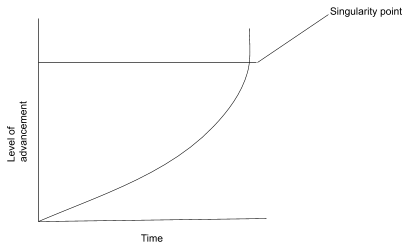
    For this week’s episode, we’re once again connecting with Christopher G. McDaniel the President of The Institute RiskStream Collaborative. In this episode, Christopher gives us an insight into the concept called risk singularity. We discuss the 3 phases that he envisions will preclude the risk singularity and what it means for insurers.

    https://youtu.be/WMqMUPkpVfM

    What is blockchain?

    Christopher defines blockchain as a mechanism where information can be shared between different parties who without this mechanism wouldn’t normally trust each other. What this gives each of these parties is a trusted mechanism. Once widespread, they’ll be no need for information to travel back and forth between different parties. Through this mechanism, everybody in the network will now have the data ubiquitously. When this data no longer needs to be transacted between different parties continually it opens up new possibilities for insurers.

    The Institute RiskStream Collaborative

    The Institute RiskStream Collaborative is a non-profit consortium. It’s a collaboration of close to 50 members, made up of some of the largest insurance carriers and reinsurers globally. The goal is to build real-world applications and use cases using emerging technology

    Risk singularity

    So what’s meant by the risk singularity? First, the term technology singularity was made prominent by Sci-Fi writer Verner Vinge who in 1993 predicted that within thirty years, we will have the technological means to create superhuman intelligence and Ray Kurzweil through his book entitled ‘The Singularity is Near’. The term refers to a hypothetical point in time where technology advances to a tipping point and past that point technological growth becomes unpredictable and irreversible. Christopher defines risk singularity means that we get to a point where data, intelligence and process transformation have become so advance that the risk management industry undergoes a dramatic and irreversible change.

    The impact of risk singularity to insurers

    Over the next 15 to 20 years Christopher believes the following

    • There’ll be a shift in that the majority of data will come to the company externally as adverse to what’s happening now where the majority of data comes from internal sources such as actuarial tables.
    • It’ll mean that insurers aren’t the ones to own individual’s data. Christopher envisions that eventually the individual will own their data on the personal lines side of insurance companies and individual’s will choose if they share it.
    • If risk singularity occurs and data comes from external sources Christopher foresees more of a blurring of insurance business lines. Today everything in the industry is very siloed. Life insurance is siloed. Car insurance is siloed as are commercial lines. When data is available from numerous different external sources, new solutions will emerge that will cut across different insurance sectors and geographies.
    • Solutions could be provided by any insurer worldwide as long as they’re in the network. According to Insurance Business UK based on the metric of net premiums written (NPW) in 2019 UnitedHealth Group based in America was the largest insurance company with $158.5 billion NPW. Second, AXA based in France with 104.5 billion NPW and third China Life Insurance Company with $97.6 billion NPW. None of these countries have a large presence outside of their areas. If consumer data is uploaded to a blockchain ledger and they’re in the network they’ll be competing directly.

    For the risk singularity to be enabled what is referred to as the Web 3.0, the combination of blockchain, AI and internet of things (IoT) needs to happen.

    Blockchain as a data sharing mechanism is the foundation. It is where the data will be uploaded onto the network and shared between the different parties. Along blockchain you will have AI and IoT. AI’s role will be analysing the data coming into the ledger to see what is valuable and can be used by the insurers. IoTwill be the external source of the data, and from 2019 to 2025 they’ll be 48 billion more IoT devices according to Statista. These ‘things’ will come many forms such as smartwatches like the Apple Watch, doorbells such as Ring and smart meters.

    It is the combination of the data shift, the blurring and the breaking down of barriers between sectors through the use of blockchain, AI and IoT will encourage the transformation of insurance processes.

    The 3 phases before the risk singularity

    The three phases are each given a 5 years time span.

    • Ubiquitous data- This refers to data sharing through an industry-wide blockchain. This explains the importance of blockchain particularly in the early years as data will need to be shared and viewed by different parties.
    • Ubiquitous information- This is the major shift of when information comes from external sources instead of within the insurance company itself. For this phase to happen IoT devices need to be widely dispersed. There needs to be a mechanism for getting information from the device to the blockchain and standards and regulations to ensure the data isn’t misused.
    • Ubiquitous intelligence- This is through the use of AI and blockchain to complete all of the processing is instantaneously. Ubiquitous intelligence will be completely frictionless and invisible to the consumer.

    Now, the data that comes to the insurance companies from outside sources needs to be turned into usable data for the underwriting process. After these three phases, Christopher argues that the data will come directly from the external sources and this will be the data that is used to make valuation decisions instantaneously. An example of how this could work. If a person has a modern car with sensors and they drive safely in a safe area then the GPS and sensor data is transferred to an AI system where the data is analysed. When it concludes that the person is a safe driver then it’s updates the blockchain ledger and their premiums are instantaneously reduced.

    Data sharing in the insurance industry

    The mentality of insurance companies at the moment is to hoard the data within the company. The companies that decide to hoard and silo data to themselves and not engage in the network will be at a disadvantage. They’ll be alternative blockchain networks where much more data is being shared and it will become a necessity for organisations to join a network and have access to this data.

    Process changes

    Assessing risk is a timely process. It can take days to assess risk through the current underwriting process. Once risk can be assessed in real-time through Web 3.0 this will open up a host of opportunities. Reinsurance is a complex and prolonged process. If reinsurance could be provided instantaneously it could mean that reinsurance could be provided to cars, boats and even people.

    Risk singularity impact on business models

    The risk singularity will completely change the business models of insurance companies. A business model describes how an organisation creates, delivers and captures value according to Alexander Osterwalder and Yves Pigneur. Now, generally, insurance companies compete to produce value through customer service and user experience. Where Christopher envisions value being provided in the future is providing a whole variety of different insurance business lines. Insurance companies will be competing to offer value on the processes more than the customer experience.

    Top tip for preparation of the risk singularity

    Get involved. Right now a lot of decisions around ubiquitous data are being made that will directly impact risk management firms. The Institute Riskstream Collaborative are very open to insurers becoming part of the conversation as to which direction they should head in.

    __________________________________________________________________________________________________

    This episode is brought to you by our friends and sponsors at R3.

    Today’s insurance industry faces a number of challenges. Data sources are disparate, the claims process is complicated, billing systems are archaic, and inefficient processes lead to high reconciliations costs, ambiguity in loss conditions and settlement delays. Let’s be honest, it’s not great!

    Here on the Insureblocks podcast, you’ve heard about numerous use cases from insurance providers and InsurTech companies implementing blockchain technology to streamline operations and lower expense ratios from back-office operations.

    R3’s enterprise blockchain platform, Corda, has been adopted as the platform of choice by many of these innovative insurance and technology companies around the world and is already helping to solve real industry issues.

    If you want to find out more, why not register for R3’s Executive Round table in London on 13 Feb – Check out r3.com/event for details.


    Ep. 92 – Blockchain for procure-to-pay – insights from Siam Commercial Bank Jan 19, 2020
    Show notes

    Procure-to-Pay, in today’s supply chains, is a complicated and lengthy process for corporations and their suppliers across the world. Listen to Orapong Thien-Ngern, CEO of Digital Ventures a subsidiary of Siam Commercial Bank (SCB) in Thailand, as he talks to us about how blockchain technology has reduced procure-to-pay process time by 50% and costs by 70%

    We had the pleasure of also being joined by Sharon Yuen, Head of ASEAN sales at R3 who manages the relationship with Digital Ventures.

    What is blockchain?

    For Sharon, blockchain is a technology that creates a decentralised records of all transactions in the network. Using blockchain technology, participants in the network can confirm transactions independently of a third party intermediary. There’s no need for a central trust authority or a central server. From payments and audits to tracking inventory and assets, blockchain technology in supply chain can deliver a new level of trust and transparency, while enabling the procure to pay process to realise huge operational benefits.

    For Orapong, whilst blockchain is a distributed ledger it is more than just technology. It’s a new way of thinking or looking at the world. What we believe is the world is going distributed. If we look at the world today things are quite centralised. You go to a bank for your money. You go to a telco if you want to use the telephone. You go to the hospital if you want to see a doctor. Each of those entity keep your record.

    Orapong believes that with distributed ledger technology (DLT), all these information records will be distributed in the near future and people own their own digital records. This will fundamentally change the business model of not just banks but all kinds of businesses. Businesses in the future will rely very heavily on data. Once the data becomes truly distributed banks won’t be functioning in the same manner as they are today. Nor will tecos. Core banking infrastructure will change as will billing systems and we’re just at the beginning of this change. Because of all these reasons, SCB is very interested in blockchain and DLT.

    Siam Commercial Bank (SCB) and Digital Ventures
    SCB was established 140 years ago. It’s the first bank in Thailand. In terms of net profit and net assets, SCB is the number one bank in Thailand. But as in the rest of the banking industry, not just in Thailand, the industry is facing some serious challenges. Return on equity five years ago in Thailand was about 22%, now it’s about 9.8%. Price to book ratio used to be 2.2, now it is 0.98. SCB isn’t alone in facing those challenges, the whole industry is facing them. European banks in Europe have a return on equity of 7.4% with a price to book ratio of 0.58, which means it is significantly discounted on book value.

    If you plot those two trends, of return on equity and of price to book ratio, Orapong believes that the banking industry is a “sunsetting industry”.

    Siam Commercial Bank is very alert of these trends. SCB believes that traditional banking has to evolve as the present market dynamics are very stagnant. For example last year, SCB created what they believed to be the leading mobile application for banking. To introduce its launch and to gain market share they announced zero banking fees. Within half an hour all the other competing banks matched their offer. Ultimately no one gained anything because everyone is willing to do whatever it takes to protect their market share.

    Within such a competitive environment SCB realised that for the bank to grow it would have to branch out from its traditional business. They started looking at the financial world through a different set of lenses. Could the adoption of new technology, creation of new product and services away from their traditional industry help them? It is within that frame of mine that they discovered and became very interested in the potential of DTL.

    SCB created Digital Ventures in February 2016 out of the banks venture builder programme. Digital Ventures aims to attract entrepreneurs with good ideas who may be short of funding or of market opportunities. The bank provides funding and customer base for these entrepreneurs to build products. If the products demonstrate promising results then the bank will spin that entity out as a start-up.

    Digital ventures is a wholly owned subsidiary of the bank. But starting this year in 2020, the bank has spun digital ventures out as a FinTech start-up. Digital Ventures will not be receiving any further funding from SCB and will have to survive by the merit of its own services and ability to raise funding from capital markets and venture capitalists.

    What is procure-to-pay?
    Source: R3

    The procure-to-pay process begins with the buyer issuing a purchase order (PO) and sending it to the supplier, which then ships the goods with relevant documentation. On receiving these, at the buyer’s warehouse, the buyer issue good receipt acknowledging that they have received the goods. The goods receipt goes back to the supplier, which issues and sends back an invoice.

    The buyer’s account payable department then compares and verifies all the documents before approving payment.

    If the supplier is seeking invoice financing from a bank to protect its working capital position, then the paper-based process adds further inefficiency and cost, since the bank must aggregate and compare several documents and price in collection risk for the repayment.

    The whole process is very complex and it is very difficult to solve because one corporate buyer for example could have tens of thousands of suppliers. To integrate all of the data and to automate it is very costly, because point to point integration is very expensive. With blockchain and distributed ledger technology this can be greatly simplified at a much lower cost.

    Could this have been done without blockchain?

    Orapong recognises that the procure-to-pay process could have been updated with existing technology, such as APIs, but it can’t be done in an economical manner. Even with APIs, how many integration points could a buyer with 10,000 suppliers manage? Once data is exchanged, how can the setup remain secure where everything is traceable and auditable? All of these are being addressed by blockchain.

    Public or private blockchain?

    Back in December 2017, Digital Ventures along with Accenture started conversations with Siam Cement Group (SCG), one of the ASEAN region’s leading conglomerates on how to transform procure-to-pay using blockchain technology. SCG is the largest company in Thailand, a 15bn US dollar company. SCG is recognised in the market as the most efficient and innovative company in Thailand.

    In choosing which blockchain platform Orapong and his team had to consider whether to go with a private or public blockchain. Public blockchains like Ethereum are very easy to use, have a lot of open source software. However, with limited number of suppliers and buyers for procure-to-pay, public blockchains aren’t the right fit. In addition in a public blockchain you can’t identify who is the one who executed the trade but you can see the information regarding the trade such as price.

    A private blockchain with strong privacy and access controls was needed, and R3’s Corda Enterprise solution was selected to underpin this project.

    Approaching SCG

    As SCG is one of the most innovative company in Thailand, Digital Ventures, approached SCG and asked them if they’d be interested in collaborative learning? To identify how DLT could be applied to SCG.

    Orapong used a picture, that tricks your eye, into seeing a bird from one angle and a rabbit from another. He told SCG that at that point that he didn’t know if he is selling to them a bird or rabbit. If a bird will fly, it is a rabbit hole and you’ll never see it again. So that’s how he approached them. And he said, this is very promising, but we don’t know what will come out of it.

    The real world is very complicated!
    Source of R3

    In March 2018, the first version of the PoC, proof of concept, was launched and it proved that the blockchain for procure-to-pay (B2P) could work. In August 2018 B2P was launched with SCG in production. From that moment it took one year to put to scale up to 100 suppliers. Even though they felt they had a good platform the real world is very complicated. Some goods got rejected because of quality, some prices got changed along the way, parts substitution, need for credit note, debit and a lot more exceptions were identified. Being in production mode was a real learning curve and it took one year to fix those issues.

    Right now, B2P can sign up 100 suppliers per week instead of doing it in one year.

    Tangible benefits of the blockchain platform

    It’s all about productivity. You have one big buyer and thousand of suppliers. The buyer has a payment bank. The supplier has a financing bank. Today a supplier would submit an invoice to the buyer which normally takes two to three weeks to get the invoice approved. That’s because the invoice needs to be matched with a purchase order with a goods receipt and with shipping document.

    The B2P platform drastically improves productivity as an invoice can be approved within the same day of its submission. For banks it is also of great benefit because in the past any financing to finance a suppliers cash flow would have to wait three weeks for the invoice to be approved. Which means for those three weeks the bank cannot provide lending. With this platform this can be greatly reduced.

    With this platform SCB is the payment bank and the financing bank. The bank can see a trade from the beginning, from the moment the POS is issued to the point when the good was shipped and when the invoice is issued. When SCB provide invoice financing they can take deduction at payment. This removes any processing fees for the invoice financing because SCB can see the trade. There is no collection risk because SCB can take collection at payment. Combined as there is no cost and no risk, SCB can provide financing at 5% instead of 18%.

    Thammasak Sethaudom, SCG Vice President for finance and investment, sums up the benefits: “The B2P platform helps shorten overall procurement processing times by 50% or from 70 minutes previously into only about 35 minutes per cycle due to the increased speed of invoice and verification processes. The solution can also contribute to a cost reduction of 70% compared to manual processes.

    R3 as a strategic partner

    In terms of the roadmap R3 works very closely with digital ventures, on what they’re planning for as new functionalities to the platform. R3 incorporates those functionality requests into the roadmap for Corda enterprise. R3 supports Digital Ventures to connect with other overseas partners in the region by inviting them to participate in a number of conferences and events.

    The future is with tokenization

    Tokenization is being able to put value on every piece of information or data. Invoices are essentially a promise to pay. At any point of time in there is about $50 trillion US dollars in supply chain trading all around the world. With a platform that can provide you with transparency of all these trades and you can tokenize it, securitize it and make value out of it. The present supply chain platform is about getting the data and creating the network effect. Once you get to that point and you have the necessary amount of volume, the real money is in token

    __________________________________________________________________________________________________

    This episode is brought to you by our friends and sponsors at R3.

    Today’s insurance industry faces a number of challenges. Data sources are disparate, the claims process is complicated, billing systems are archaic, and inefficient processes lead to high reconciliations costs, ambiguity in loss conditions and settlement delays. Let’s be honest, it’s not great!

    Here on the Insureblocks podcast, you’ve heard about numerous use cases from insurance providers and InsurTech companies implementing blockchain technology to streamline operations and lower expense ratios from back-office operations.

    R3’s enterprise blockchain platform, Corda, has been adopted as the platform of choice by many of these innovative insurance and technology companies around the world and is already helping to solve real industry issues.

    If you want to find out more, why not register for R3’s Executive Round table in London on 13 Feb – Check out r3.com/event for details.


    Ep. 91 – User experience on the blockchain – insights from RBS Jan 12, 2020
    Show notes

    Andrew Speers, Director of Product and Innovation at RBS, is passionate about user experience and developing customer centric propositions. In this podcast he discusses the important role blockchain can help as an enabler of other technologies to delivering great user experiences within the financial industry and beyond.

    What is blockchain?

    Andrew recognises that there is no standardised definition to blockchain and his definition comes from as a business user instead of a technologist, engineer or coder. Blockchain is just a distributed ledger technology (DLT). That DLT sits on top of the internet. It is a network of nodes. A node has a unique identity and it stores data.

    Applications are built on that network like apps in the app store. Nodes can participate in one or many apps, depending on the blockchain. Andrew reminds us of a few more truth regarding DLTs:

    • Not every DLT needs a blockchain
    • Not every DLT has a crypto asset or crypto currency attached to it
    • Not every DLT

    Disruption within a fragment financial industry

    Consumer Connectivity Insights 2018 reveals over 69 percent of global consumers would consider changing their bank, retailer or insurance provider due to a disconnected experience. For Andrew this has happened due capacity utilisation within financial services firms.

    The financial industry is fragmented and is being disrupted. It isn’t facing disruption it is being disrupted. The issue at hand is that the banking industry is focused on products along lines of technical expertise rather than building products along the user journey or the user experience. If an individual or a business has a multi-product need it fragments as it moves within the bank. The client first goes through an originations function, then into the credit assessment function, then into operations and/or bespoke product knowledge such FX trading finance, insurance risk and others. Complicated clients with complicated needs have to go through a number of different silos within a financial services firm which creates a hugely disconnected experience for them.

    DLT is coming to a maturity point now where it’s helping financial firms to knit some of this together to create client centric user experiences by having a distributed architecture with identifiable data from corporates. These can be seamlessly stitched together and bespoke user propositions can be created. Clients can now have a little of FX attached to a little bit of credit assessment, attached to a little bit of trade finance with the exchange of data can be automatically transacted on the distributed ledger thanks to smart contracts, thus improving the user experience.

    Challenger banks and DLT

    Andrew recognises that these type of challenger banks are doing some great work. For specific parts of their business they are seen as challengers. RBS looks to embed the existing or incumbent technologies they’re using to catch up a little bit or to stop them taking transaction and their clients off the periphery as they build scale.

    RBS is looking to DLT and how DLT allows banks to attach identity to client data and to their transactional data. It allows RBS to develop solutions with greater efficiencies as RBS does not need to constantly exchange information between the client and itself and their different departments internally, those fragmented silos that were mentioned earlier on. RBS doesn’t have to process, recheck and reprocess those same data points continuously.

    It also means that for DLT clients sitting on a shared protocol such as R3’s Corda Enterprise, who have 57 other banks on their network, then theoretically they are accessible by anybody else which creates further user experience benefits and efficiencies as well.

    Examples of blockchain initiatives in the financial sector that generate better user experience

    Identity

    Billions of people and corporations have an identity. How do you get that identity into a digital format and all of the corresponding information that allows one to prove that identity is owned by the individual or corporation? Andrew believes it to be a huge opportunity but equally a big problem to resolve. Identity needs more critical mass to be built within blockchain ecosystems.

    Crypto assets are the largest current use case that’s out there. Security tokens, crypto currencies are moving into a world of bond issuance. For example, the Commonwealth Bank in Australia worked with the World Bank in issuing a bond on the blockchain.

    Trade

    Andrew sees the most adoption and fastest adoption of blockchain technology is in global trade from a financing and logistics standpoint. In trading you have loads of different participants that need to touch a single transaction.

    A shipping agent for example creates a bill of lading that details the type, quantity, and destination of the goods being carried. A digital twin of that bill of lading can be created as a token. That token can be added onto R3’s Corda Enterprise and attach itself to an individual’s or corporation’s identity. They can claim ownership of this bill of lading. That individual can create a bill of exchange and put its digital twin onto the blockchain. A financier can then take the bill of lading and bill of exchange digital twins and provide finance against them knowing that they both exist.

    How does the financier know when to release finance against it? Finance can be released when it knows that an internet enabled shipping container goes through a geofence linked to an oracle that connects to R3’s Corda Enterprise which effectively says the goods have arrived at their destination. Payment can be released to the exporter and simultaneously deduct the transaction via direct debit using Corda Settler and complete that transaction.

    DLT enables to connect APIs, 5G, Internet of Things and other technologies.

    RBS and blockchain

    RBS identified blockchain as an opportunity very early on. Their engineering teams helped establish R3 and helped to do the original coding of Corda along with many other participants. RBS helped to develop Cordite and was involved in numerous consortium projects.

    Having seen numerous business cases around blockchain, RBS set up a Centre of Excellence around blockchain. Setting up a centre of excellence would be Andrew’s number one piece of advice for any organisation early on in their blockchain journey. That centre is responsible for looking at problems and determine whether or not a solution that is comprised of things like smart contracts, consensus, distributed structures would be useful of the user experience. Once that’s done then a conversation needs to happen around what is the right blockchain protocol.

    RBS’s understanding of DLT is now mature enough for it to be technology agnostic. It’s about using blockchain as one of many technologies, often combined together to its client’s user experience problems or for internal user experiences such as services team or regulatory reporting teams.

    Blockchain as a technology set is often helping RBS to cut costs, improve service, or finding new revenue streams. Quite often it’s mixture of all three.

    RBS is now at a point where they don’t look out for problems for blockchain to solve but instead are looking at problems and asking the question is that a blockchain problem? If it is then RBS uses a blockchain based protocol as the underlying database to get the additional benefits of things like smart contracts, consensus mechanisms and others.

    RBS blockchain initiatives

    • RBS has worked along with other participants on property conveyancing – Coadjute (Coadjute was recently on Insureblocks).
    • Marco Polo was built out by consortium of banks, TradeIX and R3
    • Global Trade Network, previously known as Voltron

    Was blockchain really necessary?

    Whilst blockchain has huge benefits as part of an overall architecture. Andrew states that anything a blockchain can do can be done with a traditional database and manpower. However if an organisation wants to focus on user experience, often it will involve multiple parties, multiple data points and multiple accessing, assessing, and manipulation of those data points. Blockchain, in Andrew’s opinion is really the only way through which it can be achieved in today’s age.

    What is important to understand is that no business case is ever built on a one-year return. You don’t have a conversation with a client around blockchain as you will lose them in 10 seconds. You talk to your clients around user experience. Blockchain is the only technology that connects the user experience to all the other enabling technologies. In this conversation blockchain sells itself. It will cost a little bit more at the start to implement compared to traditional technologies but over a five-year life cycle the costs will decrease over time as automation is introduced and new revenue will be generated by having a proper good user experience instead of a manual one.

    Are customers sufficiently engaged in designing a blockchain solution?

    Every product should involve customers in its designs.

    Andrew states “we’re sitting in 2019. If you haven’t taken your customers on a beta journey, or you know, a skunkworks journey, helping you develop and design your products, you’re just going to have something that’s not usable or workable. And there’s 1000 people out there doing that exact thing and coming up with a better solution than what you’re going to come up with on your own.”

    What is important to remember is that it’s never a blockchain conversation with the client. It’s a “what’s your problem?” conversation and how can all the available technologies at hand be used to solve that problem and create a better user experience.

    Blockchain as an enabler of other technologies for delivering better user experience

    Blockchain is a protocol that sits on top of another protocol (the web) that enables other technology to tap in and connect. It’s an enabling technology by its very nature. Global Trade Network, formerly known as Voltron, for example uses APIs and connection points in IoT to connect that trade ecosystem together to transact documentary trade in a digital environment.

    Marco Polo uses APIs to connect directly into the ERP of a customer to extract data out into the blockchain, where it is processed, transacted and shared. There’s some great examples of track and trace with IoT enabled devices going on at the moment in the gold and diamond industry.

    But the reason those three above examples were successful wasn’t because it was a discussion around blockchain. It was a discussion around what do we need to fix? And how do we make the user experience better with this technology and these technologies to solve some of the problems?

    Top tips in designing customer centric solutions with blockchain

    With anything that is being built for an enterprise you often need to consider if it’s something new, to replace something that exists at the moment you’re going to have to spend double up. Until you get to the point of commercialising, implementing and shutting down the existing system you’re going to double spend. It is important to articulate this to the business, the time frames and the cost increases.

    The second piece of advice is that in any project, hire the very best people that the budget allows and make sure they’re got a track record and experience on some of these things.

    The third piece of advice is choosing your partners and participants very well as well. Review their CVs and go through some of the references that they might give. Spend a bit of time in a project discovery phase, assessing the project and the participants and really navel gaze on the project, Is it really necessary? Or is it an intellectual pursuit?

    __________________________________________________________________________________________________

    This episode is brought to you by our friends and sponsors at R3.

    Today’s insurance industry faces a number of challenges. Data sources are disparate, the claims process is complicated, billing systems are archaic, and inefficient processes lead to high reconciliations costs, ambiguity in loss conditions and settlement delays. Let’s be honest, it’s not great!

    Here on the Insureblocks podcast, you’ve heard about numerous use cases from insurance providers and InsurTech companies implementing blockchain technology to streamline operations and lower expense ratios from back-office operations.

    R3’s enterprise blockchain platform, Corda, has been adopted as the platform of choice by many of these innovative insurance and technology companies around the world and is already helping to solve real industry issues.

    If you want to find out more, why not register for R3’s Executive Round table in London on 13 Feb – Check out r3.com/event for details.


    Ep. 90 – Securing oracles for smart contracts – insights from Chainlink Jan 06, 2020
    Show notes

    As smart contracts adoption on the blockchain continue to grow, ensuring end to end security is becoming more important. Oracles, trusted source of data, are increasingly seen as the weakest link in blockchain. In this podcast, Johann Eid, Product Manager and Developer Evangelist, at Chainlink explains to us the role decentralised oracles can have in providing this end to end security.

    What is blockchain?

    Blockchain is essentially a decentralised ledger. It is transparent and can be public in a similar manner as to Bitcoin. Decentralised, transparent and permissionless technology such as blockchain can have a tremendous impact in the way people interact between each other. Bitcoin was the first type of blockchain before it was followed up with Ethereum. With Ethereum you can develop applications on top of the blockchain thus enabling new ways for people to interact with each other.

    What is a smart contract?

    Contracts are useful when two people who don’t necessarily trust each other want to interact with each other. They give trust to a third party to enforce that the contract executes in a manner that it should. Presently, these third parties are law firms, accountants, banks, and large institutions. Smart contracts embed the logic and enforcement of those contracts on the blockchain.

    The properties of smart contracts work in a manner where you have a deterministic input which generates a predictable and consistent output. Thus, whether you have an insurance contract or a derivatives one, due to the properties of blockchain and smart contracts you can have two trust less parties, based in different parts of the world, transact together.

    Off chain connectivity for smart contracts

    Most smart contracts such as parametric insurance contract on the blockchain require real world data. Whether that is data generated by IoT devices or from legacy systems. For example weather related insurance smart contracts would need real world data provided by weather stations. Meaningful data is required to provide the deterministic input to trigger a smart contract.

    Chainlink has estimated that 80% of smart contracts require off chain connectivity. Chainlink states that smart contracts are unable to connect with external data feeds, APIs, or any other off-chain resources on their own.

    Chainlink acts as an all-purpose HTTP protocol-like equivalent (or HTTPS using a TEE) for messaging at the protocol and application level both on-chain and off-chain. Chainlink nodes are able to format messaging and data from public APIs into a readable format for smart contracts.

    Are oracles the weakest link on the blockchain?

    Oracles is often the name given for a source of data from which a smart contract connects to. Blockchains high level of cryptography makes them very secure. Smart contracts sitting on the blockchain are also secure. However, the oracles that provide real world data to smart contracts, more often than not, sit off chain and are thus sometimes considered to be the weakest link on the blockchain.

    Decentralised oracle networks, such as the one provided by Chainlink, provide a means to secure the integrity of the data that is provided to smart contracts. If for example 12 oracles are providing weather data to a smart contract and if one is compromised due to a technical error or malicious activity you still have 11 oracles providing reputable data.

    Utilising a centralised, closed source, single oracle to provide a smart contract with real world data there is the risk of compromising the end to end security of the network. That oracle represents a single point of failure which defeats the decentralised nature of building a decentralised application (DAPP).

    There are a number of risks involved with getting off chain data to a smart contract:

    • Data provider level:
      • If you have one data provider you are limited to what can be done to mitigate the risk. The best solution is to invest in additional sources of data.
      • If you have numerous data providers and one of the data provider turns out to be malicious then using the median level of the aggregate data set instead of the outlier one is the recommended approach
    • Node provider level. If the data is collected onto a single node there is the risk of it failing. Have decentralised nodes mitigates the risk

    Arriving to a consensus

    In situations where you don’t have malicious actors but the data providers are providing different data points. How is consensus achieved? Aggregation of data and finding the median of those data points is the means for achieving consensus. There are different aggregation means such as the waiting average that is dependent upon the level of trust attributed to each data providers.

    Growth in IoT devices bringing more security

    A lot of contracts, including insurance ones, revolve around IoT data. The present proliferation of IoT devices means more data providers which further secures the data provider layer. On top of it you have the node operator layer which relays the information to the blockchain thus providing an end to end security system. The growth of IoT devices brings more decentralisation and more redundancy which for Johann represents a big opportunity.


    Previous 1 7 8 9 10 11 19 Next

    Related Podcasts

    How I Built This with Guy Raz

    1

    How I Built This with Guy Raz Business
    Planet Money

    2

    Planet Money Business
    Inside Strategic Coach: Connecting Entrepreneurs With What Really Matters

    3

    Inside Strategic Coach: Connecting Entrepreneurs With What Really Matters Business
    BiggerPockets Real Estate Podcast

    4

    BiggerPockets Real Estate Podcast Business
    The Smart Passive Income Online Business and Blogging Podcast

    5

    The Smart Passive Income Online Business and Blogging Podcast Business
    A Thousand Natural Shocks With Gabe S. Dunn

    6

    A Thousand Natural Shocks With Gabe S. Dunn Business
    footer-logo

    Contact Us

    Toll Free: 844-670-7747

    Links

    • Home
    • Top Charts
    • Networks
    • Apps
    • Independents Podcasts
    • Podcast Advertising
    • Podcast News
    • Contact Us
    • About Us
    • Analytics & Insights

    Stay Connected

      Privacy, Terms of Use & Our Code of Ethics Protecting Content Creators Copyrights