TopPodcast.com
Menu
  • Home
  • Top Charts
  • Top Networks
  • Top Apps
  • Top Independents
  • Top Podfluencers
  • Top Picks
    • Top Business Podcasts
    • Top True Crime Podcasts
    • Top Finance Podcasts
    • Top Comedy Podcasts
    • Top Music Podcasts
    • Top Womens Podcasts
    • Top Kids Podcasts
    • Top Sports Podcasts
    • Top News Podcasts
    • Top Tech Podcasts
    • Top Crypto Podcasts
    • Top Entrepreneurial Podcasts
    • Top Fantasy Sports Podcasts
    • Top Political Podcasts
    • Top Science Podcasts
    • Top Self Help Podcasts
    • Top Sports Betting Podcasts
    • Top Stocks Podcasts
  • Podcast News
  • About Us
  • Podcast Advertising
  • Contact
Not in our directory?
Add Show Here
Podcast Equipment
Center

toppodcastlogoOur TOPPODCAST Picks

  • Comedy
  • Crypto
  • Sports
  • News
  • Politics
  • True Crime
  • Business
  • Finance

Follow Us

toppodcastlogoStay Connected

    View Top 200 Chart
    Back to Rankings Page
    Business

    Insureblocks

    blockchain & smart contracts in industries across the world

    Advertise
    • Apple Podcasts
    • Google Play
    • Spotify

    Latest Episodes:
    Ep. 79 – Healthcare Blockchain from a Novartis perspectives & lessons learnt Oct 13, 2019
    Show notes

    In this exciting episode we had the great pleasure of interviewing Dan Fritz and Marco Cuomo to hear about the exciting blockchain work they are doing at the pharmaceutical giant, Novartis. In this podcast you will hear about the wealth of experience they have developed by building POCs using Hyperledger, Ethereum and Corda.

    Dan Fritz role is domain architect for supply chain. His department look at technologies that support supply chain business capabilities. They also look at emerging technologies and how they could be used to leverage and address the business needs.

    Marco Cuomo is the Applied Technology Innovation Manager and his team is responsible for bringing in new technology into Novartis. He has been looking at blockchain for the last 2 – 3 years and in addition to supply chain has been looking at good use cases for using the technology.

    Novartis is a global pharmaceutical company with about 100,000 employees in over 100 countries. It has a portfolio of prescription medicines, a generic division, and is increasingly focused on biotech including cellular and gene therapies.

    What is blockchain?

    Marco Cuomo recognises that defining “what is blockchain?” is a difficult question to answer. In Novartis they have developed a “blockchain elevator pitch” to describe what is blockchain internally to their business and to their internal customers. Blockchain is a shared means centrally controlled, distributed ledger. Every partner in that blockchain network has a copy of that ledger and it enables immutable recording of transactions. These transactions track assets without the need for intermediaries.

    Dan adds that blockchain is a socio technical construct which is designed to be a win-win for all participants engaged within it. This requires a different mindset where all participants are growing the pie together instead of just slicing it up.

    Beginning of Novartis journey into blockchain in 2016

    The immutability aspect of blockchain is what attracted Dan and Marco to blockchain. Immutability is a key attribute that is desired in the pharmaceutical industry. This is an industry that is highly regulated, it operates under GxP, or good manufacturing, good distribution, good clinical practices, where the traceability of all of the processes and the accountability of all of the processes have to be proven and documented. A shared immutable distributed ledger seemed like the perfect tool in comparison to creating binders of paper that go into an archive for 10 years.

    From a supply chain perspective, it was the promise that blockchain could provide more efficient transactions, reducing the friction between data silos and organisational silos through a shared ledger.

    Additionally blockchain could provide the patient control of their own data instead of it sitting with a range of intermediaries. There is the opportunity for creating patient data marketplaces.

    The LEGO Mindstorm Truck

    In 2016, Marco purchased a set of LEGO Mindstorm Truck to create a supply chain scenario where a serialised product is delivered from a packaging line onto a truck which transports it across the supply chain from a pharmaceutical manufacturer, to a distributor, to a pharmacy and ultimately to the patient.

    At every step of the way the serial number is tracked against the serial number of the previous block to ensure that the medicine hasn’t been swapped or that it is a potential counterfeit. IoT was added to this blockchain with a set of temperature monitors to simulate a temperature excursion where the medicine is outside its standard transportation conditions. Every participant on the supply chain is informed if there is a potential quality issue.

    Why blockchain?

    If a company controls their ecosystem, all of of its suppliers and distributors then maybe a central database approach will work. However, in the case of the pharmaceutical industry, there are hundreds, if not thousands, of different players distributed across the globe. Thus, there is no way to find a centralised system that would work for everybody. Dan believes that blockchain if set up in a truly win-win scenario which can provide benefits for all the different players to participate whilst using the same standards and protocols, is a winning case.

    Single source of truth. 60% of the pharmaceutical market is governed by serialisation laws, such as the Falsified Medicines Directive for Europe or the Drug Supply Chain Security Act in the United States.

    This is where each pack has its own serial number which can be authenticated at any point on the supply chain. At the moment though the pharmaceutical industry isn’t able to cross check or correlate the data in the supply chain. For example, if different types of data such as temperature data, order data, inventory data, ship from/to data could be cross checked this would greatly increase the integrity of the supply chain and provide end to end visibility on the product at every step of the way. This unfortunately isn’t the case today.

    The other point is the illegal supply chain – the product that never comes through a normal pharmacy but sold in a street, in a developing country. The only protection that you would have there is empowering a patient to do their own check of authenticity. Dan is keen to evaluate the feasibility of leveraging blockchain to empower these patients to do such checks in the future.

    IMI – Innovative Medicine Initiative

    Last year Novartis proposed a blockchain enabled health care programme to the IMI which is the Innovative Medicine Initiative – Europe’s partnership for health. They chose to work with IMI as they had quickly realised that blockchain is a team sport and that they needed an ecosystem with players from their industry. The project they submitted to the IMI was called the Blockchain Enabled Healthcare with the aim to build the foundation for a blockchain in the healthcare industry that brings all the players from the pharmaceutical industry to the patients, hospitals and regulators.

    Six to seven companies immediately signed up to the initiative and now there are 11 companies in the consortium with more set to join.

    The aim of Blockchain Enabled Healthcare was to prove that blockchain is a solid foundation infrastructure platform. To prove it they focused on three use cases:

    1. Supply chain
    2. Clinical trials and development
    3. Health data

    A governance body was built around the platform to make clear how the different partners can work and trust each other. Existing standards are being leveraged such as GS One for the supply chain.

    With regards to governance, they are looking at different models from creating a different legal identify to creating a decentralised autonomous organisation. As blockchain is decentralised it is important that the governance body is a decentralised control structure

    The project is due to kick off in early 2020 and will run for three years.

    Criteria for developing a blockchain solution

    The key approach they use in determining whether or not to use blockchain for a use case is whether or not there is no disadvantage or advantage of using blockchain over a central database. If that’s the case then if there are external partners, auditors are involved and there is a need to exchange information in an immutable manner where there is trust that the information can be trusted.

    Dan and Marco also realised that if a project only requires an incremental improvement to an existing process in order to reduce a bit of cost or add a little bit more of quality then this probably isn’t best for blockchain. Blockchain is for totally reengineering a process that is involving multiple stakeholders which should be a step change in the way things are done. The prerequisite for that is, is there a consortium, a group of like minded partners that are willing to work together. Do they have standards defined or are there standards available that can be leveraged? These points are the starting ones when filtering potential blockchain use cases.

    Challenges for blockchain

    Awareness and education is the biggest challenge for blockchain. This isn’t just across the ecosystem but internally within Novartis’ own employees. Getting everyone aware of what’s possible cold accelerate the adoption of blockchain. With increased awareness and education Novarits employees are approaching Dan and Marco with great ideas that they couldn’t have thought off. It’s really a bottom up approach where the business identify their pain points and come up with ideas on how blockchain can help them. It is also coming from the top as they are very lucky to have a CEO whose mantra is to go big on data and digital and focusing on innovation. They’ve got a mandate to pursue blockchain, to run proof of concepts to tests out those business ideas.

    Evaluating different blockchain platforms

    When launching their POCs Dan and Marco were always keen not to always use the same technology. In 2017 there first POC was with Hyperledger, which they found a bit complicated. The second POC, the LEGO Mindstorm Truck, was with Ethereum which was a lot easier. It had a bigger community, lots of tools available to download and big cloud providers.

    Right now they’re evaluating Corda on a POC which they understand is very developer friendly. In between those POCs they’ve evaluated Hyperledger Indy and other platforms. For now they don’t believe they have seen the winner right now and are happy to continue evaluating new technologies.

    What does success look like?

    Their near-term strategy is to have a productive blockchain pilot by the end of 2019 / early 2020. This will be the first time that Novartis validates and get sign off on a productive blockchains solution that is GxP relevant.

    The long-term strategy is about the whole IMI accelerating blockchain adoption. To have a reference implementation in the three areas of supply chain, clinical trials and health data. That they can be built upon in a sustainable manner by the participants in the project and other industry members to scale it as broadly as possible.

    The convergence economy

    From the very beginning Dan and Marco thought for the need for inter blockchain connections to see how their blockchain could interact with other blockchain networks. Interoperability is one facet of it but the sharing of best practice is also important. For example Dan and Marco met up a few times with the B3i team to learn from their experience in developing consortium. They also have regular talks with other industries from the fashion to the financial industry to sharing best practice.

    They ran a POC where they tested medical devices that collected data from patients. The data was collected in a data bucket with some AI sitting on top of it. Data integrity is required from the beginning. Blockchain assures data provenance. In a situation where you may have hundreds of medical devices collecting data you need to be able to conclusively identify the data provenance. Did it come from a real patient or from some generic data?

    Additionally, Dan and Marco believe that self sovereign IDs such as the ones by Sovrin has the potential to be a killer app. Dan goes even further and states that when they were evaluating different use cases they realised that in some use cases, just identity itself is a use case. Having a blockchain anchored guarantee of identity that can associate digitally verifiable credentials solves many things in the pharmaceutical industry. This is something they see applicable not only for patients, employees, but organisations products, devices and a lot more. This is something Dan and Marco believes will be a game changer when it takes off.


    Ep. 78 – Legal & General’s blockchain pension reinsurance platform Oct 06, 2019
    Show notes

    On the 12th of June 2019, Legal & General launched its Pension Risk Transfer blockchain reinsurance platform called “Estua-re”. Thomas Olunloyo, CEO at the Legal & General Reinsurance Company, based out of Bermuda, joined us in this podcast to share “Estua-re’s background and why blockchain was the best solution to answer his pension reinsurance challenge.

    His company is the global reinsurance hub of the Legal & General Group. It writes pension risk transfer for reinsurance in multiple countries around the world. But focus primarily on the UK, the Netherlands, Ireland and Canada.

    What is blockchain?

    Thomas thinks of blockchain in terms of the context in which they’re applying it with estua-re. Blockchain is a network with a number of participants that are here to sell risk and some who are here to take on risk. It allows these participants to have a single version of the truth built on consensus that exists at all times. For a business, like the Legal & General Reinsurance Company, that trades with contracts that can last up to 50 years if not more, being able to exchange data in an immutable way, built on consensus that is self-perpetuating, is an incredibly powerful thing. Smart contracts are programmable scripts that run on the blockchain that allows for the data to be used for some purpose or another.

    Legal & General Reinsurance Company

    The company does pension risk transfer for reinsurance around the world. What is pension risk transfer? L&G provides insurance to pension schemes either directly or indirectly. Provide a guarantee for the payment of pensions to all members of that scheme. So being a reinsurer, L&G stands behind insurers who provide these guarantees. However, being a reinsurer means L&G take a part of those guarantees to pay those pensions.

    What was the problem, Estua-re was here to resolve?

    Contracts in the pension risk transfer can be up to 50 years old if not more. Every months of those 50 years data is exchanged between L&G reinsurance company and its counterpart. Most of the time that exchange is bilateral but it can also be with a larger number of counterparties. Both parties, or more, are entirely separately exchanging data every month to try and determine how much to pay the individuals within an underline population.

    For the duration of those 50 years all the parties are maintaining separate data sets, trying to calculate the same payments from those data sets and exchanging data by emails and data rooms. This is very inefficient. To add to it, any errors which are made are compounded overt time. For example, it can very difficult, if not impossible, to try pinpointing where something has changed and understand what happened 10 years ago, when managing massive data sets comprising tens of thousands of lives.

    Why blockchain?

    Thomas’ journey into solving this problem didn’t start off with blockchain. He had looked at a number of solutions and off the shelf software platforms. But none of them were really able to address the problem they had. Centralised databases with APIs worked well for bilateral business but not as well with multiple parties. Risk is shared among multiple parties. The more parties you have the less efficient it becomes to use centralised databases with APIs. Two years ago Thomas discovered DLT and blockchain which was increasingly gaining momentum and pace in the financial services industry. It then became apparent that blockchain / DLT was the only technology that was able to store data in an immutable way, all the interactions between the multiple parties for a period of time that can be over 50 years.

    What is Estua-re?

    Estua-re is world’s first pension risk transfer DLT platform. It allows to L&G to manage long term contracts on the blockchain. Estua-re’s mission is to transform the way pension risk transfer business is executed and managed by making into a more democratic system.

    The efficiency of removing the segmentation, the efficiency of having one single version of the truth between the counterparties and ensuring that transparency exists allows L&G to run its business much more efficiently.

    By removing a lot of this duplication of work, synchronisation of data, Thomas expects for there to be massive cost efficiencies for L&G and their counter parties. Looking head strategically, Thomas believes that this DLT platform will allow them to take a lot more business in more territories. The technology allows them to have a scalability that would otherwise not be possible and that scalability inherent is inherent in that cost efficiency.

    The economics of launching a blockchain solution

    Thomas states that in launching any new technological solution there will be some initial friction. However as the platform builds up speed and momentum the savings will be realised in the long terms. For the type of contracts the L&G Reinsurance Company looks, at which are 50 year annuity contracts, they look at the stream of cash flow for that period of time and then take the present value of those cash flows. So even if for the first two years you have additional costs, the savings generated over the 50 years are ultimately much higher than the initial additional costs.

    When you start looking at how the technology can provide excellent customer service in an increased significant manner and combine it with the long term cost savings it all pales in comparison to the initial friction.

    Present status of Estua-re

    Estua-re is live with one of L&G’s customer and are preparing to roll it out to other clients. They’ve also started discussions with other insurance and reinsurers about licensing the platform to them. Ultimately Estua-re’s mission is to raise awareness and interest in DLT across the industry.The real power of DLT is in the “D” in having as many participants involved.

    AWS manage blockchain

    Thomas was full of praise for AWS managed blockchain solution: “It’s the expertise and the support, the folks at Amazon are absolutely excellent.” He is now looking to migrate different elements of his platform into the Amazon managed blockchain environment. This will provide Estua-re with instant scalability, support and access to great third parties.

    The ecosystem

    Pension schemes or the pension funds, that ultimately have the risk and are looking to insure that risk. The insurance companies who write that risk directly and the reinsurers that stand behind insurance companies that take on some element of that risk from the initial reinsurers. These are the type of players within the network. For any one particular pension risk transfer transaction you can have multiple insurers and multiple reinsurers. The rational for DLT is to have that the single version of the truth amongst all those players.

    Estua-re had its first written transaction in Canada a few months ago. In Canada what typically happens is that you have a pension fund that splits its liability across multiple insurers. Each one of those insurers can have multiple reinsurers behind them.

    Every single participant in that process, every single insurer or reinsurer is ultimately working from the same data set but holds it separately and is often trying to the same thing with that data set but does it separately.

    What DLT provides these players with is the ability to all be working with a single version of the truth with a single data set that is progressively built on consensus and is stored in an immutable way.

    Accessibility of ILS (Insurance Linked Securities)

    ILS is effectively a way by which insurers transfer a risk to the capital markets. Whereas an investor would normally be able to buy a bond or a share, and ILS allows an investor to effectively buy insurance risk. The way Estua-re could change that is by broadening the market for insurance linked securities and make it more accessible to a wider range of participants. Thomas is presently looking at how to tokenise insurance risk in order to build a retail proposition that will effectively offer insurance risk as an investment to the man on the street.

    Plans for the future

    What Thomas would like to see for Estua-re and DLT more generally in the pension risk transfer space is for this to become a common currency in how this risk is traded and managed. That requires the industry to include as many participants as possible as many insurance companies, pension schemes, and reinsurance as well. That will be Estua-re’s mission in 2020 and beyond to get DLT as a concept more widely adopted as soon as possible.

    Additionally, Thomas certainly believes that insurance risk should be accessible to more people and more markets and the way to achieve that is through tokenisation within a DLT environment.


    Ep. 77 – Token Economy – insights from Shermin Voshmgir Sep 29, 2019
    Show notes

    Shermin Voshmgir is Director of Cryptoeconomics Research Lab @ Vienna University of Economics and Founder of BlockchainHub which she started nearly 5 years ago. She recently published a book called the “Token Economy”.

    In this podcast Shermin is going to take us through what are tokens and the token economy.

    When researching blockchain, Shermin quickly realised that blockchain information was spread out on Reddit, Twitter, Ted Talks and numerous other places but there didn’t seem to be this one central repository of information. Shermin launched BlockchainHub to provide a comprenhsive source of information on blockchain.

    To find out more about Shermin you can check out her site Shermin.net.

    What is blockchain?

    Blockchain is the driving force of the next generation internet, often referred to as Web 3.0. It’s not a front-end revolution it’s a change around the data structures in the back end of the internet. Blockchain allows us to have a universal state layer of who did what and who owned what in terms of values or tokens. This is a completely new way of storing and collectively validating data via ledgers which are collective managed by a public or a federate network.

    Blockchain is not a financial technology it’s a governance technology.

    The Book – Token Economy

    Shermin recently published her book the “Token Economy”. For her, tokens are the killer application of blockchain and smart contracts.

    With the launch of the internet in the late 80s we had the information revolution. However most people couldn’t access the internet because even if they had a computer they did not have the notion of command line to operate the internet to connect to another computer.

    However, when Sir Tim Berners-Lee invented hypertext it allowed everyone with even limited computer knowledge to create a visually appealing website, which anyone could now use to navigate the internet with clicking on links.

    Tokens are to the Web 3.0 what HTML was to the web. Smart contracts have made it really easy to create a token with a few lines of code. At the beginning of the web a lot of the initial web sets had a “hello world” message and a bunch of links. One of the earliest use case was the search engine. Tokens are at a very similar stage. Whilst it is now very easy to create tokens most people don’t know what to do with tokens.

    What is a token?

    Tokens have been out for a quite a while. Prior to blockchain tokens have had many use cases from their usage at amusement parks, airmiles, gift certificate, a paper note for a fiat currency is a token, a metro / tube ticket is a token, a casino jetton is a token that can be exchanged for cash. Probably the earliest tokens in human history were shells or seeds that were used as a kind of standardised medium of exchange.

    A QR code is a kind of computerised token. Cognitive psychology have used tokens. For example in the 50s there were experiments to use incentive mechanism as kind of positive reinforcement tool to change patient behaviour. Good behaviour at the hospital would be rewarded with tokens which could be exchanged for special access rights to the TV room or a special kind of food at the canteen.

    Tokens have three components related to them:

    • They have to be issued
    • They have to be managed
    • They need some kind of copyright protection to enable they’re not copied

    Why are blockchain tokens a game changer? Blockchain networks provide the infrastructure upon which tokens can be created and managed with a few lines code with a smart contract. What needs to be determined is how many tokens are to be issued? What is the purpose of your token? What is the function of the token?

    Shermin argues that it is important not to use the regulators terminology of tokens as either being security tokens or utility tokens for example. The regulatory perspective is only one perspective what is more important is to think what do they represent? Do they represent an asset or an access right to a service? A token is like a rights management tool that provides access to something you own or someone else owns. That access might be temporary, or it might be permanent until it is transferred to another identity.

    Examples of interesting tokens

    For example Bitcoin, is an access token for the Bitcoin network. If you want to send transactions through Bitcoin, you have to pay in Bitcoin tokens for transfer in the network, right.

    Steem is a social blockchain that grows communities and makes immediate revenue streams possible for users by rewarding them for sharing content. It has over 1 million registered users and has been operational for over three years. Both contributors and curators of content on Steem ger rewarded with Steem tokens which can be exchanged for fiat currency.

    Basic Attention Token (BAT) is an Ethereum-based digital advertising token. The mission of the BAT team is to fix the broken state of the current digital advertising space in which users are unknowingly tracked, publishers are having trouble monetizing content, and advertisers are constant victims to fraud.

    At the end of 2018 Shermin worked with the City of Vienna to develop a blockchain based token as part of an incentive program to reduce CO2 emissions. If you can prove that you walked, cycled or took the train instead of a car you can be rewarded with a token which can be redeem in exchange for cultural activities in the city.

    Token design

    When thinking of the design of the token you have to answer two fundamental question:

    • What is the propose of the token?
    • What kind of functionalities should the token have?

    The individuals who are issuing the token have to answer the question what is the purpose of the token. Derived from that purpose the functionalities of the token can be designed.

    When looking at a token’s functionalities the following functions need to be addressed:

    • Fungibility of the token
    • Token supply
    • Durability of the token

    Fungibility and transfer ability of a token is a design aspect. Is the token fungible or not fungible? Is it transferable of not transferable. If the token is fungible then every token is identical in value. Non fungible tokens are unique single tokens that are not identical to each other. A token that represents a Picasso painting for example isn’t fungible as it cannot be easily tradable for another painting.

    Token supply is another design aspect of a token. How many tokens get issued. Are all tokens issue up front or are they issued on a timed basis? Are tokens issued upon certain behaviour or by proof of work like in Bitcoin. You could have tokens that are tied to an identity which makes them less tradeable and less liquid.

    Another question would be the durability of the token. Will it expire after a while? Or will it have an indefinite use?

    Once these design functions have been agreed then a regulator can evaluate the tokens and determine whether the token has properties of money or properties of a security.

    Identity tokens

    Identity tokens are a very good use case for non fungible tokens. Identity tokens can hold information about your personal ID and some personal information such as age to give you access rights to bars. It can hold information regarding your drivers licence via a driver’s licence token. It could be a school certificate or a university certificate.

    Today there are 2904 tokens, according to CoinMarket Cap. These are fungible and transferable tokens that can be easily traded. On the Ethereum mainnet there are over 216,000 token contracts according to Etherscan. Only some of these tokens are fungible tokens that can be traded.

    The more interesting use case for tokens is around identity tokens. Tokens that represent assets, like real estate or art. For example very few people an afford to buy outright a Picasso. However with tokens we can now tokenize the Picasso, we fractionalize it and create cryptographic derivatives of it. In other words you could become a fractional owner of a Picasso painting without needing to buy the whole painting.

    New business models

    Real estate can be tokenised and fractionalised. An apartment for example can be fractionalised between two people and a token contract can be issue via a smart contract to handle the monthly rental payments.

    Purpose driven tokens that enable complex networks. For example the CO2 token with the City of Vienna. Token curated registries where you can create lists of the best universities for example. Shermin recognises that we are still in the very early stages of what this token economy can bring us.

    Bitcoin itself is a purpose driven token to enable a peer to peer financial network. Bitcoin is a peer to peer payment network which without the absence of intermediaries all peers who don’t know each other nor trust each other to transact. The protocol rules of Bitcoin incentivizes the network actors to valid transactions with tokens. If you bring productive activities to the network, you get rewarded with Bitcoin tokens. Proof of work makes it unfeasible to cheat the network as it is extremely expensive to do so.

    For Shermin, Bitcoin represents the first time in history were we found a mechanism to incentivize an individual towards achievement of a collective goal. The Bitcoin network is a public payment network for a public good. In the past public goods were provided by centralised authorities, like a city or state. They were subsidised through taxpayers money. And for the first time, we found an economic mechanism to incentivize the individual to provide to a public good in the absence of intermediaries.

    Facebook Libra

    In Shermin’s opinion, the Libra Association was in a way Facebook announcing that the Web 2.0 is over and that the Web 3.0 is coming and we want to be at the forefront of it. What they have announce is a stable token.

    Facebook essentially said – well, we have 2.4 billion users, many of which are underbanked, that we have worldwide, the numbers are roughly 2 billion people that are underbanked or at least a considerable fraction of them.

    Facebook is could become a payment provider to these unbanked, a kind of shadow bank through offering the Libra token. Facebook is working with a number of private companies and some NGOs in building the public infrastructure which will be managed by the Libra Association registered in Zurich, Switzerland.

    Shermin believes that they’re most likely planning to launch a reputation token and an attention token.


    Ep. 76 – Insurance & DLT – a risk manager’s perspective Sep 22, 2019
    Show notes

    In June 2019, the CRO (Chief Risk Officers) Forum, published the “Insurance and distributed ledger technology – a risk manager’s perspective” white paper as a practical tool for risk managers to accelerate the accomplishment of the productive phase of DLT.

    For this podcast we are joined by Dr. Sebastian Rath, Principal Risk Officer at NN Group, and with Gian Luca de Marchi, CRO at Unipol Group. Sebastian and Gian Luca aren’t here on behalf of the CRO Forum but are pleased to discuss their views on DLT while sharing some of the CRO Forum DLT paper content.

    What is blockchain?

    A distributed ledger can be considered as a database that is distributed across several independent computing devices where changes to data are protected and manged by cryptography and consensus. This in turn provides guarantees that the data cannot be tampered with and that all parties have identical copies that can be considered as a reliable single source of truth.

    The functionality of a distributed ledger system can be enhanced by the use of smart contracts (i.e. computer programs deployed and executed on the ledger’s network) and oracles (i.e. data feeds that trigger specific conditions defined within smart contracts).

    What is the CRO Forum?

    The CRO Forum was formed in 2004 to advance risk management practice in the insurance industry. CRO Forum member companies are large multi-national insurance companies whose members are headquartered across the world with a concentration in Europe.

    The CRO Forum has three core aims:

    1. Championing best practice in risk management to advance business,
    2. Aligning regulatory requirements with best practice in risk management, and
    3. Providing insights on emerging and long-term risks.

    The CRO Forum aims to share its views on topics related to these aims through publications and papers. In this context, the DLT paper was created by a working group of hands-on risk and technology experts from multiple member companies, including NN Group and Unipol Group.

    What is a Chief Risk Officer and what are their responsibilities?

    Basically a Chief Risk Officer, the CRO, is an executive responsible for identifying, measuring and addressing any material risks that could have an impact on company objectives. Adverse events should be mitigated, while opportunities should be enhanced. According to the Solvency II regulation, when insurance companies calculate their own solvency position through internal models approved by supervisors, CROs are also responsible for the design, implementation and management of these models.

    The CRO Forum’s white paper on DLT

    Hype has surrounded Distributed Ledger Technology and especially blockchain over the last few years since the birth of the Bitcoin cryptocurrency.

    Hype, and criticism too, have been fuelled by fervent visions as well as misconceptions. These technologies have not yet delivered on promises, but several experts believe that DLT has the potential to transform the financial services sector. CROs are well positioned to play a critical role and strengthen innovation initiatives; the CRO Forum paper is thus meant as a practical tool for risk managers to accelerate the accomplishment of the productive phase of DLT. Although traditional risk management frameworks remain valid, there are specific issues to consider when assessing the risk of a DLT-based application.

    Sebastian believes that the paper captures today’s status-quo for the insurance market’s use of larger DLT applications. More importantly, in his view this paper was an opportunity to formulate key considerations, key questions and advocacy opportunities where the insurance industry of the future may wish to dedicate time and resource to shape future DLT solutions.

    Eventually, the paper’s recommendations are designed such that they can inform DLT solutions, future standards for technology and IT aspects, or strengthen strategy and governance for DLT partners. Its guidance is both practical and specific in addressing DLT applicability, feasibility, governance, security and profitability.

    Through this paper, the Forum is also sharing some core tools for risk managers to proactively participate and shape the future of DLT in insurance as soon as innovation moves from the exploratory into the deployment phase. Examples of such tools are a risk catalogue and good practices that are explicitly shared with the risk community through the Appendix of the CRO Forum paper.

    One of the aims was to establish a sound, jointly shared language for DLT risks and share good practice approaches to mitigate such risks. With the paper’s tool kit, the hope is to engage risk managers addressing strategy, governance, compliance, IT, operations and DLT-specific aspects.

    The paper can be downloaded from the CRO Forum’s website.

    CROs’ roles in DLT applications

    The decentralized nature of DLT and its applications leads necessarily to a risk profile that is different from the one that arises from centralized solutions. The traditional roles of Risk Management become therefore highly valuable also with regards to DLT and DLT based projects.

    Risk Management must play a key role to permanently challenge DLT related projects throughout the full project lifecycle. This requires involvement of CROs in such initiatives and potentially some knowledge built up within Risk Management itself. CROs will start considering key questions regarding, for example, DLT strategy, DLT governance, the integration of DLT and non-DLT architectures, and data and algorithm sharing criteria. The first crucial assessment to be done regarding DLT and DLT based initiatives, however, is evaluating the necessity and applicability of a DLT approach.

    Key considerations insurers should look at when determining that applicability of a DLT solution

    In the paper it explores applicability, feasibility, profitability, governance and security of DLT solutions. The CRO Forum’s working group was clear not to endorse DLT as the only solution for future insurance efficiency improvements. It shares a workflow to determine where there may be genuine advantaged for DLT implementations.

    They extended this with critical questions that any business case should be answering, covering profitability, comparisons to non-DLT solutions and the role of non-existent regulation or standards. The paper also facilitates the regular risk identification and monitoring. It urged risk managers to start understanding business contexts and the specific role of DLT. Those can be relevant and very different, depending on the insurance sector, the line of business, products and required operations. They critically inform the technical characteristics of a DLT platform choice.

    Two use cases are analysed in the paper to explain this process:

    • Risk in using a private DLT – use case Catastrophe Excess of Loss (CAT XL) re-insurance
    • Risks in using blockchain – use case Parametric flight delay insurance

    What are the events that should trigger a new risk assessment?

    As Sebastian puts it “DLT technology is such a fast moving development. Our challenge here is the pace, the lack of standardisation and the role of governance that any solution needs to find to operate with stability. Any major events, such as new developments or changes in the code base, could trigger re-assessments for risks. As emerging technology, the regulatory framework imposes possibly future constraints that need to be managed, monitored and may need to be adhered to”

    How can CROs engage blockchain technology now and in the future in the insurance industry and beyond?

    The CRO forum believes that individual CRO functions may increase collaboration while engaging on DLT topics. The paper has identified the following:

    • Internal policies informing DLT adoption as well as negotiations for the governance and implementation of decentralized insurance networks;
    • Developing smart legal contracts and securing the usage of oracles;
    • Managing digital identities;
    • Safeguarding contract certainty and confidentiality, cryptographic safety and sound decentral governance; the regulatory approval and avoiding regulatory arbitrage; or
    • Automating audit trails and verifications;

    Now, to achieve such collaborations effectively, the paper identifies distinct insurance market enablers. These can be seen as the ability to:

    • Deliver well-defined industry DLT issues and narratives;
    • Propose feasible DLT solutions;
    • Build strong, trusted DLT and advocacy capability;
    • Encourage DLT leadership and champions;
    • Inform and mobilize public and customers;

    Together these help to establish clear path and resource for implementation, influence, support, shape and inform DLT coalitions. An in-house capability to strengthen DLT enablers becomes valuable as soon as DLT adopters start engaging and using DLT.


    Ep. 75 – Commercializing Blockchain Sep 15, 2019
    Show notes

    Antony Welfare is the Managing Director of Luxoft, which is part of DXC Technology and has accumulated a wealth of experience on blockchain across industries. He recently published the book Commercializing Blockchain whose content we will be discussing in this podcast. Antony is interested in real blockchain applications and is all about commercializing blockchain – using blockchain in a commercial business or a government to add value efficiency, trust, and a lot more which is discussed in this podcast.

    What is blockchain?

    Blockchain itself is just a technology. It’s just a set of rules and principles that you can put into code. It is an enabler for trust and transparency in any network or business or community, in government, where data and information that’s transferred can be more trusted and transparent. Blockchain circumvents all the modern issues we presently have around the reconciliation of data, auditing it and verifying it. Blockchain is fundamentally about trust and transparency.

    How does blockchain compare to two companies who have a decade worth of trust in working together and have an API to sharing and exchanging information. Antony would really challenge if two companies, organisations or networks would really trust each other. Each party always reconcile the information they have as they don’t have the exact same copy of the data. At the end of the day the transparency and the trust isn’t there in a technical format. Blockchain is about making the trust and transparency there in a very clear black and white coded manner.

    Commercializing Blockchain – The Book

    Back in 2017, Antony was working with Oracle Corporation and was doing some deep research on blockchain. During his research he realised he wanted to write about real blockchain applications and how the technology could impact individuals, businesses, and government communities. His initial thought was to write a blog to help him in creating material for the keynote speeches. It is at this moment that it dawned on him that there was an opportunity to write a book. Through his contacts from meetups and the feedback he was getting on his book idea he realised that not a single person in the world knows it all on blockchain. He invited 13 contributors to write different sections of the book from how contracts are formulated to global trade issues to consensus mechanism and what the future looks like.

    The common and most interesting question he asked all of his contributors is what does blockchain look like in five years time. They all agreed that blockchain is going to be an enabler for us to build solutions to be more efficient to more trusted as a community and that no one will be talking about blockchain just like no one talks about TCP/IP for the web.

    Killer app of blockchain?

    Email is one of the killer apps for the internet. We asked Antony what he thought would be the killer app for blockchain. Antony believes that the killer app is around identity. He believes that there will be an app that will sit on your device (mobile, laptop, etc..) that will hold the identity keys where you share what you want to share with whom you want to share it, what portion of the data and for how long. Essentially, self sovereign identity. Which means that similarly to how you use Google or Facebook but with the difference that you know what’s happened with your data, where is has gone, who has used it and crucially you determine that instead of Google or Facebook. Then tokenization of this data can also all you to get paid for how you wish your data to be accessed and used.

    For Antony, identity and tokenisation are the two killer apps for blockchain.

    Luxoft works with Sovrin’s self sovereign identity to launch their own personalised medicine track and trace which is around self sovereign ID for a person and personalised medicine. It allows the patient to only share the information they wish to share with the treatment centre.

    Is blockchain a fad?

    For Antony, it’s great, because people said the same thing about Amazon and about the internet.

    Over the last couple of years people have been saying the blockchain is a fad. But it isn’t a fad, as it will soon become as normal as the internet is, and yet we didn’t think that back in the 80s and early 90s. Blockchain is an enable for all of us to build better businesses, better communications and it’s just going to disappear into normal business.

    But over the last couple of years, people have said, it’s just a fad. It’s not going to happen. But what happens is not it’s not a fad, it just becomes normal. As we’ve said, you know, we all use the internet every day all day with our mobile devices, especially. And yet, we didn’t think that back in the 80s.

    CEOs of a company have a duty of care for their companies. Part of that duty of care is a fiduciary duty that they have to assess the risks of new technology and of new entrants to the market. Blockchain isn’t a fad, it’s a technology that enables your business to be more efficient and more trusted. This is backed up by plenty of evidence as supported in his book and also on Insureblocks. For Antony ignoring this point means that your company has a high risk to disappear in a similar manner to Nokia or BlackBerry.

    Antony invites CEOs and directors to investigate blockchain technology as it will make things more efficient, smarter and cheaper. It will enable you to use the data and information properly, rather than spending a significant amount of time reconciling and adding things together for auditing. If CEOs and directors continue to listen to the naysayers, saying blockchain is a fad, your business will suffer either from competition embracing the technology or from lack of innovation internally.

    Antony wants to make it clear that we’re not talking about cryptocurrency but about enterprise blockchain solutions which as any enterprise solution adds value and makes things more efficient.

    Antony talks about a case of a global bank that has a large number of entities across the global. 80% of their transactions are between their own company subsidiaries. Their bank reconciliation department has 300 people reconciling the bank accounts between the subsidiaries. This can be resolved with a blockchain solution which in turn could reduce the banks reconciliation department from 300 people down to 10 – 30 staff.

    Minimum viable ecosystem and parts of blockchain?

    Luxoft works on a minimum viable ecosystem philosophy. The question then becomes what is the minimum viable ecosystem you need achieve your objectives, be it save money, be more efficient, etc, etc. It really depends on the exact use case and what’s needed. For some it could be five, 10 or maybe even 100 participants.

    With regards to blockchain, Antony makes the point that there are solutions out there which take blockchain technology, but only certain parts of it. For example Amazon’s QLDB is a quantum ledger database that has some blockchain features. What is important is that real practical businesses don’t necessarily need the whole blockchain solutions, they may need only parts of it and it is important to work with clients in understanding their requirements and what parts of blockchain they may need.

    New actors and new business models

    It wasn’t so long ago that there was this belief that blockchain would get rid of all middlemen. This has clearly not happened. Antony believes that middlemen of all shape and form have an opportunity to embrace blockchain and new develop new business models. Tokenisation of assets from art works to buildings to land is going to open new business models.

    Blockchain technologies is equalising the world in a way. So normally big corporates are powerful and own everything and run everything because smaller entities and normal people can’t compete due to the lack of resources. Blockchain technology can enable those smaller entities to be a node and be part of a much larger network because of the share network and its decentralised nature. This will allow the gig economy, entrepreneurs and small companies more access to do different things, tokenise assets and be part of something much bigger.


    Ep. 74 – Self Sovereign Identity – insights from Sovrin Sep 08, 2019
    Show notes

    Heather Dahl is the CEO of Sovrin, one of the leading self-sovereign identity solutions. In this podcast we discuss how identity has evolved from the offline world, to the limitations of it being online in the internet and finally to the opportunities it brings in a blockchain world. What is blockchain? Heather Dahl looks at blockchain as one of the technologies tools that we have today. From her perspective we should ask ourselves – are you seeking a solution that provides a decentralised network, meaning that you’re running a large number of diverse validators or nodes around the world that are run by different organisations that are censorship resistant, that helped build redundancy? Is that something you want that provides governance where no one organisation or company or government runs that network? If that’s something you want, blockchain technology brings that decentralised, diverse set of nodes to run a blockchain solution. From an identity standpoint is do you need interoperability with your identity? If you only need an identity for your sole company’s purposes then you don’t need a blockchain. However, if you’re building an identity, that needs to be interoperable with other systems then you need a blockchain based identity system like Sovrin. This allows issuers to write schemas and credential definitions and revocation on publicly available decentralised global network that everyone can access. Heather likes to think of blockchain as an immutable ledger where her customers, users or clients are in control of their data and information. What is Sovrin? Heather Dahl is the CEO and Executive Director of the Sovrin Foundation. ‘Sovrin’ most commonly refers to the Sovrin Network, a public service utility enabling self-sovereign identity on the Internet. The Sovrin Network is decentralized, meaning individuals can collect, hold, and choose which identity credentials —such as a driver’s license or employment credential—without relying on individual siloed databases that manage the access to those credentials. Sovrin is an open source project that offers the tools and libraries to create private and secure data management solutions that then run on Sovrin’s identity network. Sovrin is now a global network for decentralised identity in six continents. In the past year they have launched the Sovrin Alliance to provide education and training programme for their community and those interested in decentralised identity. In partnership with Hard Yaka, Sovrin has launched a self sovereign identity incubator out of San Francisco. Sovrin also recently won the award for “Greatest Social Impact” by One World Identity. You can find out more about Sovrin on their website and join the Sovrin Alliance. The internet has failed in providing an identify solution The web is abound with news regarding breaches of privacy, personal data being sold, cybercrimes and much more. The common factor around all these issues is identity. Heather believes that we don’t have a data management problem, we have an identity problem as all pieces of data are connected to some form of identity. These issues stem from when the internet was created as a network of machines. The identity protocols weren’t designed for people they were designed to identify machines. Heather gives the example of how email addresses are structured, where you’re at a workplace (name@workplace.com) or at a university or at a technology provider (eg. name@gmail.com) which provides you with a free email so that they can take your information. Identify was thus created in a very fractured manner that isn’t fully interoperable. As the internet grew websites and services who provided us with identities didn’t do in a manner with the users’ best interest but in a manner where they could profit, exploit and share. It is this internet lack of identity infrastructure that’s resulted in a fractured experience that’s insecure, fails to protect its users privacy and prone to criminals hacking into it. This lack of identity structure leads to people being deprived of their rights that they enjoy in the physical world. It has failed because identity doesn’t scale in a cost effective way. It has failed, because the identity solutions out there created privacy problems with serious correlation issues. And lastly, a lot of these identities don’t provide consent, we’re just given the identity and we have just have to accept it, because we need an identity to operate in the digital world. Or once we get it, we don’t have the ability to consent to further agreements as we use that identity along the way. Offline identify vs internet identity Heather explains the differences between offline identity vs internet identity in confirming ones right to access a service. She gives the example of when an individual goes to a bar to buy an alcoholic beverage. The bar will not contact the State of Maryland to confirm the individual whether or not they are over 21. Nor will they call the State of Maryland every time the individual goes to buy a beer at the bar. It’s because there’s trust that when the individual pulls out their driver’s license the bar doesn’t have to confirm whether or not the state did issue that driver’s license to the individual. With the internet you have what’s called the “phone home problem”. When we try to share identities on the internet they don’t trust it and thus there is an online verification with the providers of that identity to confirm its authenticity. That phone home problem leaves a trail. Whilst in the offline world the state of Maryland has no clue how often one goes into a bar to order drinks, there’s a sense of privacy that allows the user to prove themselves for a trustworthy interaction without having someone or an organisation following every single step of their day. That’s what self-sovereign identity offers people in their digital lives is a way to replicate that offline identity that we use every day. Difference between self-sovereign ID and blockchain based identity? A blockchain based identity is an identity that is written in a private ledger that is decentralised for your organisation and where that identity is only used going to be used within that private ecosystem. Self-sovereign identity is when you want to use that identity outside of that walled garden. It allows organisations who are issuing an identity, it allows them to connect that identity to a public lookup credential. This allows the holder of that identity to be able to present that identity elsewhere without the phone home problem. This allows other organisations to verify that the credential that has been issued is both accurate and it hasn’t been revoked on a ledger. That means they don’t have to go back to the database that issued the identity as it is on the public ledger which they can look up the schema, the credential definition and whether it’s on a revocation registration and that’s all done in a privacy preserving way. Self-sovereignty, allows organisations to issue credentials that can be used elsewhere in a privacy preserving way. It allows a holder of that credential to present their identity for services, or other relationships that they want to engage in, in the digital world without having to disclose it to the organisation who issued the identity. It also allows verifiers, those who are accepting the identity, to be able to ensure that the identities valid based on whether they trust organisations, they can verify it all in a privacy preserving way and not to have to connect back to the original issuer. It allows a completely interoperable global system where any organisation person or thing can use that credential to gather services, to engage in digital relationships with organisations, entities or other things, and do that in a privacy preserving way. Zero knowledge proof and self-sovereign ID Zero knowledge proof (ZKP) are a cryptographic technique that allows users to share information without relinquishing their security and/or privacy. So, what they do is they use cryptography to provide a proof statement from the holder to the verify without revealing any additional information that’s not required. Heather gives the example that if she wants to buy an adult beverage from a bar, they don’t need to know where she lives. They don’t need to know her height or weight or her eye colour. They don’t even know need to know her exact age. All they need to know is that she is 21 years or older. ZKP is a technology that allows Heather to share that she is 21 years old or older without revealing anything else of her identity. For ZKPs to be usable the verifier has to believe the statements are true and that the results of the proof is accurate. The verifier has to know that the holder hasn’t altered the information. Because sometimes in the real world, for example, college kids may alter their driver’s licence in order to buy adult beverages. What Sovrin removes is the ability to make that alteration because it is on the blockchain, on the immutable ledger. If allow organisations to accept credentials to verify information knowing that they are absolutely accurate because of the blockchain ledger. Different types of identities When we talk about identity we are not talking just about individuals. Identity can be applied to organisations, machines, IoT devices and data sets can have identities. Files, jpegs, stocks, anything can have identities. A chair can have an identity and the components of a chair can have an identity. Everything in the digital world has an identity at some point in it. Each of those identities, whether it is the leg of that chair or a piece of data can be self-sovereign. And where it becomes important is that a laptop has an identity and within it, it can have an identity of what it contains. And why is that important? A company goes to recycle that laptop, they can scan the identity of it, and they know exactly what it contains and how to recycle the particular pieces. Self-sovereign ID’s impact on enterprises ability to store and mine data Enterprises collect and hoard personal data. In a self-sovereign world those organisations ability to hold on to the data will be determined by the user. What does this mean to organisation’s ability to build their business models if their ability to interrogate data sets is potentially hampered? Heather’s response to that question is do enterprises and organisations really need to store old data that may not be accurate. They need to assess the data that they need and what shelf life it has. Self-sovereign identity provides enterprises with accurate information at the time of the transaction. Self-sovereign identity and ZKPs allows enterprises to uses blockchain to make sure that the data they collect is accurate at the time of a transaction or when it is need. Any extra information not relevant to that transaction that isn’t necessary doesn’t need to be hoarded as it can create a security issue for that company. And that’s where something like sovereigns, you are knowledge proofs. Self sovereign identity allows you to use the blockchain to make sure it is accurate at the time that you need it in any extra information. You don’t need to afford it, because that just creates a security issue for you. How can enterprises engage with self-sovereign identities? Some of the earliest adopters of Sovrin are from the financial industry. CULedger is a credit union service organisation that focuses on delivering innovative applications to credit unions through its DLT platform. Their flagship product, MyCUID is a DLT built platform that enables credit unions to detect and prevent call centre fraud, enables self-sovereign identity for members, and will run on the Sovrin Network. You can download a wallet with your MYCUID. What it does is it allows the user to prove who they are, their address that they have an accountant, a credit union, and the credit union has gone through that KYC. Where this becomes important is within an ecosystem. If that user was to move to another location and open up an account with another credit union, it saves the whole KYC to be done all over again simply by sharing their MYCUID with the new credit union. So for KYC, as long as there’s trust between the financial institutions, it is a very cost effective way of reducing KYC costs. GDPR & self-sovereign IDs The challenge is that when GDPR was initially conceived, blockchain and self-sovereign IDs where still pie in the sky kind of ideas without any real traction. However, Heather believes that what Sovrin has created is what the original authors of GDPR had in mind. Her goal, along with the entire blockchain community is working with the European Union, the European Commission, the parliament, the regulatory bodies, in figuring out how GDPR applies to blockchain technology. Heather doesn’t think that anyone has the exact answer on how GDPR applies to blockchain. But she thinks that many in the blockchain community are highly new motivated to work with those regulators and figuring out how to apply the intention of GDPR, to the blockchain technology that exists today. Self-sovereign IDs, AIs and Web 3.0 Self-sovereign IDs exist in agents and agents are applications, software managers, and digital wallets. We can set the controls, so that we can decide, every time something happens, then you can share my identity, or every time I go to purchase something on this website you can share my shipping address. There is going to be ways where we will engage our digital lives, and we’ve preset how we want our information to be shared. And we never have to look back because it just happens. And that is the web 3.0 world today. So, if I tell my refrigerator, every time I run out of milk, order it and have it shipped here, it just doesn’t. And I no longer have to be involved in that transaction chain anymore. Importance of diversity for innovation at Sovrin At a recent conference, Heather talked about the important of diversity for innovation at Sovrin. When Heather talks about diversity, she talks about including people who don’t have the backgrounds, skill set, experiences, views that you have. Diversity means bringing in ideas that you never expected. And ideas and perspectives you never expected never come in perfect packages the way you want them. Heather advises everyone to take a look at who’s on the outside, who is not in your inner circle, who was not included? What experiences do you lack, take a chance on someone who doesn’t come from the traditional world of technology, and bring those people in because they’re going to bring ideas that are representative of the populations of the people that you want to include to have use of your technology.

    Full show notes at the publisher

    Ep. 73 – TradeLens – Supply Chain on the Blockchain Sep 01, 2019
    Show notes

    TradeLens is a digital platform that empowers businesses and authorities along the supply chain with a single, secure source of shipping data, enabling more efficient global trade. Join us and Daniel Wilson, director of business development at TradeLens / Maersk and Juan-Jose Ruiz, Head of Strategy & Business Development at TradeLens / IBM to find out more about the exiciting TradeLens platform.

    Daniel and Juan are jointly responsible for building out the investment case, as well as overseeing and implementing TradeLens mid to long term strategy, and managing third party engagements.

    What is blockchain?

    Today’s traditional ways of storing data, whether cloud native or locally are great if you’re able to trust with absolute surety, that the people and the organisations and the systems managing those data will do so essentially, with impunity. You have no risk that the data stored there and the systems will have any way of being challenged or corrupted.

    However, we all know that these systems aren’t perfect, and they have limiting features on them. Even systems as secure as banks have billions of dollars stolen from them each year. Because something as simple as hacking in and changing numbers in accounts is something that is feasible, given today’s technology.

    So basically, what blockchain is, is a way of moving away from the centralization of control and authority. It’s moving away trust from a single body and towards a distributed way of managing that information, and a distributed way of managing trust. Essentially what this means it that everybody within a blockchain network has a stake in the management of the system. Everybody has a way of checking the actions and activities of everybody else.

    In an environment like supply chains this is very important as the idea of trusts and systems does not exist today as lots of paper and manual process are still being used in managing trade. What blockchain can enable, amongst other technologies, is a way of distributing digitization across the network, without centralising that control in any one party or body.

    What is TradeLens?

    Daniel used an analogy of the airport and planes to describe what is TradeLens. For example when Daniel books a flight to Europe from Newark airport in NY with United Airlines, he might find out that his plane is actually operated by Swiss Air on a different type of airplane leaving from a different terminal. However he can still choose his seat and check in using his United mobile app.

    Basically, air travel for passengers is great because you have these all in one solutions in front of you on your phone. Containerized shipping isn’t like that. A typical container will have an end to end journey that involves as many as 30 organisations such as the port loading the container on the ship, the shipping line who has the ship, the banks providing financing, government’s providing certification and clearance and much more.

    In those 30 organisations you’re dealing with at least 100 individuals and more than 200 information exchanges in the process of that container journey.

    And today, the best case scenario for most of those information exchanges, is an EDI communication protocol, which is 1970s technology, it’s batch processing, it’s not particularly resilient. Outside of EDI you’re dealing with emails, phone calls, WhatsApp and texting. But in the majority of cases those information exchanges are being done with a lot of paper and faxing.

    TradeLens is trying to address this lack of connectivity in three steps:

    1. Integrating within the systems of those 30 organisations to convert their data into the data standards that TradeLens has adopted
    2. Store the data into the TradeLens technology platform:
      • Shipment milestones for 121 unique event types on the container’s end to end journey
      • Documentation for TradeLens to receive, store and share documents in a structured or unstructured data format
    3. Underpinning this data is the blockchain capability that adds immutability and their data sharing specification, which is the TradeLens permission framework, for ensuring that only the right people get access to the right data at the right time

    The whole platform acts like an open and neutral operating system that exposes the network and its capabilities through a set of open APIs to the TradeLens marketplace on which both TradeLens and third parties can build and deploy capabilities to address specific use cases.

    TradeLens brings together a supply chain ecosystem on a single shared and open platform that can be delivered by different parties to create value. The vision is to connect the ecosystem and to drive innovation.

    Digitising documents onto the blockchain

    The blockchain technology helps us in validating the documents related to a shipment. We can authenticate and identify the source of the organisations and the user who created those documents. We can manage the access to the documents and the information contained in those documents through the rules defined in the blockchain.

    We can store the document in a secure way with the signature of the user who created that document. Blockchain provides that trusted paperless set of data registered onto the blockchain, that can replace the actual physical copies that are being used today.

    Only a fingerprint of the document is put onto the blockchain, not the entire document. It certifies the origin of the document and that it hasn’t been tampered with. The data within the document comes in a structured format which enables automation of business flows through the use of smart contracts. This for example can replace some of the existing manual processes to check the contents of the document.

    Integrating with the ecosystem

    The main challenge in the shipping industry isn’t just that they have different degrees of being digital it’s that they have no ability to use the digital tools they presently have in a collaborative setting.

    What these players presently do today is that they export CSV files or PDFs from their existing digital systems and share them with everybody else. TradeLens give them the opportunity to share their files in a structured data format through the TradeLens platform by integrating to it.

    By integrating to the TradeLens platform they get 90% of the heavy lifting done by the platform. The platform ensures that all the players within the ecosystem that are connected to it have the latest technology with all of the necessary integration points. It provides them with the backbone on which to build applications on top of.

    Standardisation of cargo containers and Malcolm McLean

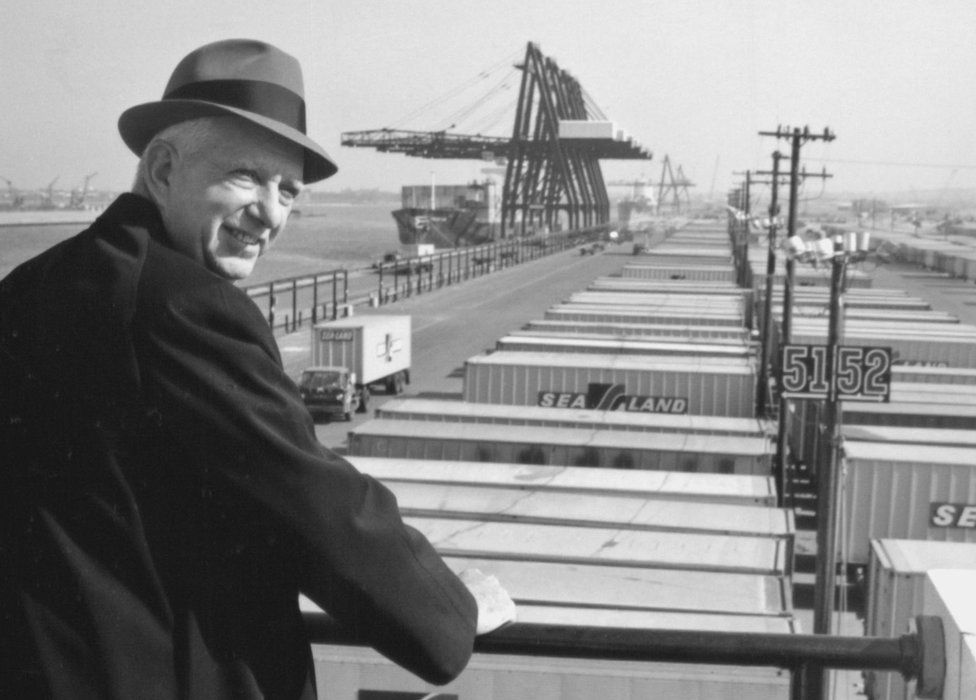
    Malcom McLean

    In the 1950s a man called Malcom McLean initiated a process of standardization of cargo containers between shipping companies, harbours, trucks and trains, leading to massive productivity gains where in 1956, cargo cost $5.86 per ton to load whilst now it only costs $0.16 per ton to load. Whilst Malcom McLean was the catalyst for this change in 1956 it took a few decades for that cost to come down thanks to globalisation in the 90s and early 200s to bring it down to $0.16.

    Similarly to the standardisation of cargo containers, TradeLens want to drive standardisation of data and communication.

    Players within the TradeLens ecosystem

    TradeLens interacts with the 30 organisations that are part of the containers end to end journey with the vision to move away from a series of point to point integration that exists in the present digital landscape to a fully open ecosystem.

    70 ports and terminals around the world are connected to the TradeLens platform. With a dozen customer authorities around the world including Australia, Netherlands and Saudi Arabia.

    TradeLens is working the banks and insurers to help them improve their existing business practices and reduce the costs of servicing their customers. Giving tools to shippers to improve their business propositions and empower them with access to data they couldn’t have in a timely manner.

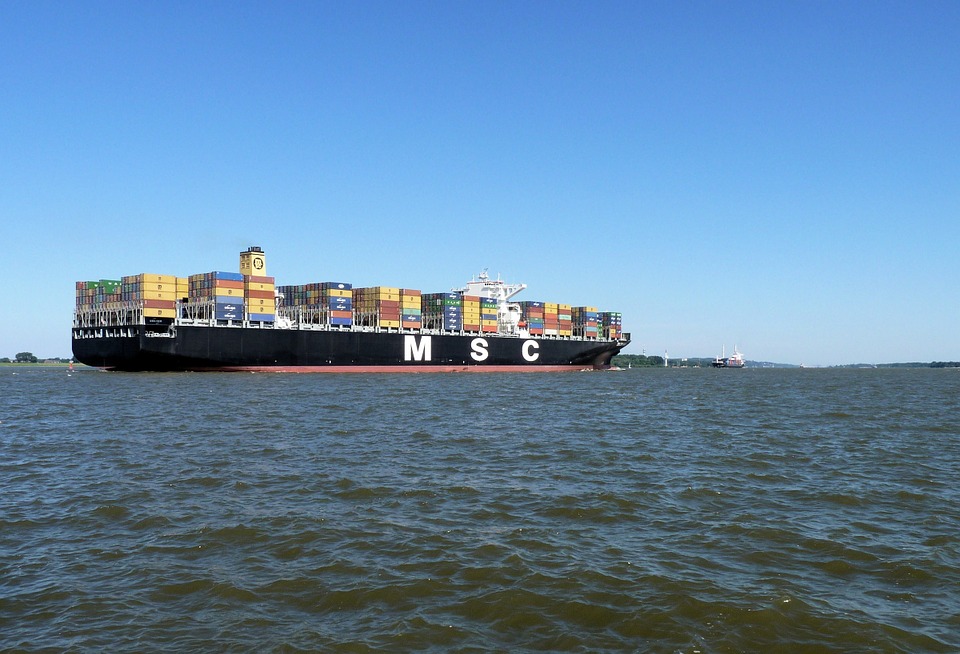
    CMA CGM and Mediterranean Shipping Company (MSC) join TradeLens

    CMA CGM and Mediterranean Shipping Company (MSC), two of the world’s largest ocean carriers joined TradeLens in March 2019. This announcement helped to dispel some of the earlier sentiments that TradeLens would struggle signing up major marine cargo carriers. However they join a number of other carriers like Hapag-Lloyd from Germany), Ocean Network Express from Japan, and a number of regional carriers, logistic companies, exporters and many more. All of these different players play an important role in enriching the TradeLens ecosystem and validating the proposition.

    Consortium approach or not?

    The team at TradeLens debated whether or not to take a consortium approach into launching TradeLens. The challenge of the consortium approach is that you are as fast as the slowest member of the consortium.

    Having the leading shipping line in the world, Maersk and one of the leading global IT company for business processes, IBM, the TradeLens team felt they could move faster whilst always engaging with the ecosystem. It wasn’t a consortium approach but a network first approach. It meant constantly engaging and talking to all the players within the ecosystem to ensure that the solution they built was for the market whilst moving very rapidly in a true start-up style.

    TradeLens governance

    The TradeLens platform is developed by a collaboration model. It isn’t a registered company, it’s an LLC or partnership it is two organisations, IBM & Maerks coming together with a shared purpose. Both Maersk and IBM each have separate business units fully devoted to working together on the TradeLens platform.

    In terms of governance this comes in two facets:

    • Technology governance
    • Data governance

    The first one is regarding the technology which is delivered in an open source manner to ensure that all participants have access to the source code and have a full understanding of the technology they are using. Whatever is built on the TradeLens platform is opened up as open standards to the entire ecosystem. This helps build trust.

    The second facet is how TradeLens manages permissions. TradeLens has its data sharing specification which defines the access that people in organisations have by default to data. This is publicly available. The team regularly solicit input on the specification to ensure participants to the network know exactly where the data go when they publish it to the platform and who has access to it.

    With regards to the commercial governance, as TradeLens is a collaboration between IBM & Maersk, they both need to have a consensus view on what decisions are made for the platform.

    In addition to this consensus view is the imminent launch of the TradeLens advisory board. The purpose of that board is to act as the voice for the TradeLens ecosystem to ensure what is being developed in terms of standards, technologies and ecosystem capabilities reflect what the TradeLens ecosystem actually wants.

    Canada Border Services Agency pilot

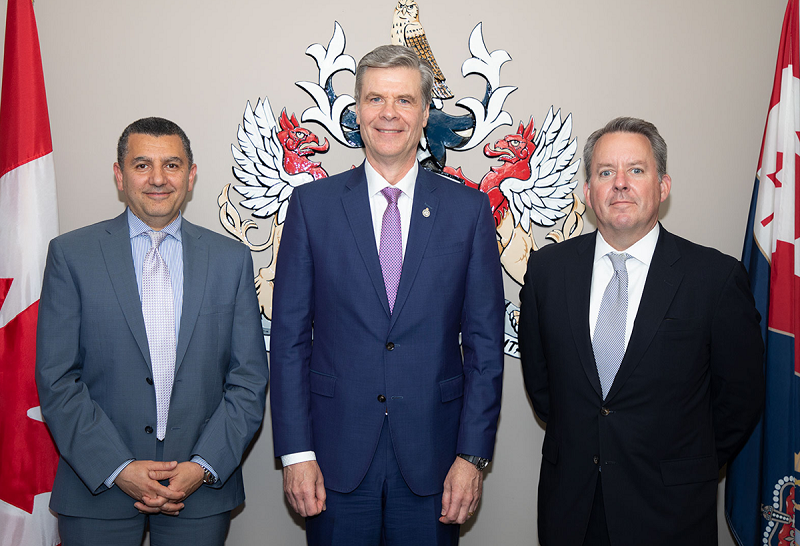
    From left to right: Ayman Antoun, President, IBM Canada; John Ossowski, President, CBSA and Jack Mahoney, President, Maersk Canada.

    For the pilot, TradeLens had the Canadian border service agency, a leading exporter and importer, a port authority and a leading logistic provider participating. The objective was for them to use the TradeLens platform for them to more efficiently and effectively share information between themselves and access to data they couldn’t efficiently collect today.

    Several shipments ran through the platform over several weeks. Data that wasn’t previously digitised was digitised, reduced the number of information changes and specifically the Canadian customs it was about improving risk management and targeting. For example, they had better data to help them identify the containers they wanted to have a closer look at. In turn the other partners within the pilot would get better data from the Canadian customs to ensure that their containers would clear more rapidly than before.

    Insurwave and Tradelens

    Maersk is presently involved in two blockchain initiatives, TradeLens and Insurwave. Insurwave at the moment it is focused on the insurance market on hull (insuring the ship), insurance and reinsurance.

    As Daniel puts it, Insurwave is ensuring the ship instead of the stuff inside the ship, whilst TradeLens is focused on managing the data of the stuff that’s on the ship rather than the ship itself. At the moment there isn’t any overlap between the two organisations.

    However, in the future if Insurwave like other blockchain initiatives are interested in looking at how they can optimise information sharing to reduce risk, and to increase the accessibility of products in the insurance market. There’s scope for TradeLens to collaborate with Insurwave or any other platform out there.


    Ep. 72 – Hybrid Blockchain – Insights from Kadena Aug 27, 2019
    Show notes

    Are hybrid blockchains the silver bullet for enterprises wanting to operate in the blockchain world? Join us and Ben Jessel, Head of Growth at Kadena, as we discuss the merits of hybrid blockchains that take on the best of both permissioned and public blockchains.

    What is blockchain?

    A blockchain is a mechanism to have an immutable record. That record can be a record of ownership record or a record of data that can be shared by everyone. It is distributed, which means there’s no single owner. Anyone can write to that blockchain and it iss crypto graphically secured, which means that it is tamper proof.

    There are two forms of blockchains. Public and private blockchains, which really is a determinant on how the users of a blockchain are permitted to collaborate on that blockchain itself.

    About Kadena

    Kadena is a blockchain organisation whose mission is to be the first blockchain there’s actually ready for business.

    Will Martino and Stuart Popejoy are the co-founders of Kadena. Will Martino played a pivotal role in the setup of the securities exchange commissionthat started to oversee aspects of blockchain and then he went to work at JP Morgan Labs. Within that role Will and Stuart interviewed a whole range of stakeholders in 2014 and came to the conclusion that blockchain technology wasn’t ready for prime time utilisation by JP Morgan or any tier one financial institution in terms of speed, security, and scalability.

    Will and Stuart used the results of their investigation to build a reference blockchain which ultimately laid the foundations for Quorumand for the launch of the JP Morgan Coina few years later. Will and Stuart left JP Morgan with the open source reference permissioned based blockchain to start Kadena. Now they’re getting ready to launch the public version of this blockchain on the 30thof October thus giving them these two platforms, a public blockchain and a private blockchain, which speak the same language around their smart contract language.

    Differences between public and private blockchain

    What fundamentally differentiates a public and a private blockchain is around who has access to the blockchain and the actions they are allowed to perform. A public blockchain, like Bitcoin, is available to everyone and a new user is able participate in the consensus purely by downloading a wallet and submitting a transaction. As the users are anonymous there are very low levels of trust. The way public blockchains enable transactions to complete without any of that trust, is through mathematics. Its consensus capability is a an incentive model, that de-incentivizes unruly actors by making it very expensive to subvert the blockchain.

    In the case of Bitcoin you have proof of work which requires the need to solve a computationally intense mathematical problem, that would cost a lot of money to complete.

    Now, as each block is added in compounds the difficulty. So while it may be a little difficult to subvert the most recent block, to subvert one that is 10 blocks behind, you not only have to subvert that block, you have to rewrite history for all the corresponding blocks that come afterwards, which means that they are linked together using this mathematical equation, which is very time and resource intensive. And that becomes incrementally harder over time.

    Proof of stake, has a slightly different incentive model, which is about staking money that you could lose if you’re found to be subverting the network. So there’s an incentive model, which inherently stops the subversion of the network. And that’s the trade off.

    The challenge with that, in particular, for tier one financial services clients, is they have some concerns that number one, this is computationally very intense, and therefore expensive. And then secondly, because it is a fully anonymous network, they cannot guarantee that those participating in the network are doing so for nefarious purposes, you can’t guarantee that you’re not transacting with North Korea or a sanctioned country because there is a level of anonymity, you cannot confirm nor deny that, you have added transactions of a chain, which may be to ransomware.

    Private blockchain / permission blockchain is born out of the idea that you have greatest sense of trust in the network. As you have that greater amount of trust, you don’t necessarily need this very intensive computation mechanism that incentivizes good behaviour over bad. You still have a consensus mechanism. Depending on the model, you can have an organisation that is leading that consensus for a period of time, and then gets re-elected. But effectively, it uses a kind of a system called Byzantine fault tolerance. What that allows is the network to achieve consensus, but in a way that’s very fault tolerant, that ensures that everyone remains in consensus, and has exactly the same information.

    One of the challenges you get with these permissions networks, is that you tend to need to have a whole consortium built around a permission network. This creates challenging questions around consortium dynamics, particularly in financial services, where there are aspects of anti-trust which need to be answered.

    In a permissioned network you have a degree of centralisation for allowing people in and out of the network and a mechanism for forcing good and bad behaviours in terms of whether these participants are providing the services that they are meant to be providing.

    In addition, you need to agree on data standards, smart contracts and all kind of other standards. The point to be made here is that there are a number of governance issues that need to be resolved before actually stepping forward.

    Hybrid blockchains

    Hybrid blockchains are here to resolve the two design constraints and benefits of a public and permissioned blockchain.

    A public blockchain provides the following benefits:

    • full transparency, anyone can look at a blockchain and confirm a transaction has happened
    • distribution capability, which means that anyone can use it, which takes out a lot of friction that tends to be associated with a permissioned blockchain
    • capitalise on the development of the community that are building open source technologies to improve these blockchains

    A permissioned blockchain provides the following benefits:

    • security, because you have more of a closed network
    • increased speed
    • more control

    What the hybrid blockchain does is take parts of those advantages and puts them together. Data can be added either onta a permissioned blockchain or a public blockchain and then use

    each of those aspects to advantage. So, for example, you could store very confidential information that you want to transact across a few entities with an NDA in place. But then you may actually want to represent that a trade has been taken place for the purposes of transparency on a public blockchain, where you’ve stripped out a lot of that data in itself.

    Kadena has developed a smart contract language that enables its users to seamlessly move between public and permissioned blockchains instantaneously without understanding the underlying technology.

    Use of hybrid blockchains

    There has been a number of hybrid blockchain implementations. Some organisations use the permissioned side of the blockchain for internal use cases and the public side of the blockchain as a kind of sandbox area for them to experiment with the technology with a number of entities using non critical data.

    Kadena has recently been working with a very large health insurer in the United States. The challenge that health insurer, has along with others in the industry, is around provider directory information.

    This is data, which all insurance companies that are client facing need to provide about the providers in their network, and even out of their network. These are doctors, surgeons, physicians, hospitals, specialists, etc. This information about who they are, where their practice is, their contact details, where they take insurance, and things of that kind of nature.

    That is a lot of data that needs to be updated very regularly. A recent review by CMS, Centers for Medicare and Medical Services, found that a quarter of all healthcare databases had errors in them. That led the CMS to start imposing a fine on insurance providers that did not keep their data up to date.

    About $2 billion is spent just updating and managing provider data in the industry in the US alone. 75% of that effort and costs, is duplicative, in other words can be removed from the sector as a whole.

    What the industry’s been struggling with some time is to find a solution that can allow these organisations to collaborate on these records, without the need to create a central entity to manage all of this data. Blockchain here provides a perfect opportunity, because you can have effectively what is a data market of data where you can share providers data.

    A blockchain with a public and a private element does provides, an interesting way of solving this problem, because you can have, the existence of purchase of data records, through some public chain, but then keep some of that representation, in a more permissioned and private way.

    Parametric insurance & hybrid blockchains

    Parametric insurance seem to be the ideal candidate for hybrid blockchain implementations. Parametric insurance is an insurance product that pays out when a certain parameter is reached.

    In a hybrid blockchain you use the public side of the blockchain to provide transparency on both what is the oracle that provides the data on the deterministic event (Eg. rainfall, hurricane, delayed flight) and on the mechanism (smart contract) for making a payout once the deterministic event has happened.

    Whilst the permissions side of the blockchain is for underwriters to share underwriting data between themselves such as historic losses, fraud and other sensitive information. You can then start layering this further with capital markets.

    Parametric insurance product is effectively a bond as a payout based on certain conditions which can be modelled. You can draw models of how the environment has been affected over a number of years, then forecast back out and hedge etc. So suddenly, you now have a market place in the back end, where you can actually aggregate and distribute the securitized product, around a range of buyers are sell side etc. Now, that is a market that you absolutely need to have on a permission blockchain because it is highly commercially sensitive.

    Is Facebook’s Lybra a hybrid blockchain?

    Libra is a Facebook backed initiative, which is a collection of institutions, predominately payment institutions, as well as social media institutions that are providing a rail, which will enable payments to flow between different parties with certain service. According to Ben, if you really study the Libra white papers, they actually have an ambition that’s far wider than a permission blockchain, they actually see that the rail will be to be used across many different systems all over the world to be tradable on an exchange and a cryptocurrency exchange, use as a mechanism for exchange, but beyond their ecosystem.

    The key question that Libra will have is, how do we both have the benefits of this permissions, closed network, and still have this distribution network, where we can actually distribute our product across the world. Libra will have to have this twin track capability where you can move between public and private, in a seamless kind of way.


    Ep. 71 – DLT Conceptual Framework Aug 19, 2019
    Show notes

    Defining and understanding what is blockchain is a difficult task in itself. Michel Rauchs published a white paper entitled “Distributed Ledger Technology Systems – A Conceptual Framework” whilst he was at the Cambridge Centre for Alternative Finance. to help clarify all the concepts in DLT systems and to provide a framework in understanding those systems.

    About Michel Rauchs

    Michel got interested in Bitcoin, cryptocurrencies, blockchain technologies about 5 years ago and then decided to write a master thesis about the evolution of the Bitcoin business ecosystem. For his thesis he monitored the evolution of this ecosystem by taking a data set of 500 different companies, projects and organisations over a 5 year period.

    Joined the Cambridge Centre for Alternative Finance to work full time as a researcher of the blockchain and cryptocurrency ecosystem. He has now recently left the Cambridge Centre to set himself up as an independent consultant at Paradigma.

    What is blockchain?

    Michel concedes that answering this question could take a whole day. But for him a blockchain, or a DLT system as he prefers to call it, is essentially just a shared record keeping system that is collectively maintained and updated by multiple participants that may not necessarily trust each other. Participants are able to reach an agreement over shared set of data and its validity without the need for a central coordinator or central administrator.

    With regards to differentiating the differences between DLT and blockchain it is very difficult as the terminology is very unclear, messy and fuzzy. At the moment they’re both used as umbrella terms for a wide array of different concepts and technologies.

    Publishing the white paper “Distributed Ledger Technology Systems – A Conceptual Framework”

    Michel had two objectives in publishing the white paper: “Distributed Ledger Technology Systems – A Conceptual Framework”:

    • Clarify all the concepts that have been conflated together
    • Provide a framework to divide the system into different parts, components and processes. To compare different systems together by analysing how different design configurations and decisions essentially impact the characteristics and properties of the systems

    Public vs private blockchains and distributed systems.

    The difference between DLT systems and other distributed systems, are that in traditional distributed systems you have distributed storage, processing power across multiple connected devices but connected by one entity to achieve fault tolerance. So, if one of these components or devices goes down, that the system as a whole still continues to function.

    In DLT systems, it’s really about what is called Byzantine fault tolerance. So not only being able to cope with hardware failures but also with tolerating with the presence of potentially malicious actors that want to actively try to undermine or disrupt the network.

    In public blockchains you have dynamic membership systems where anyone can join a network and leave the network at any point of time. It essentially means that we do not know at any point in time, how many actors on the system, and actually who they are.

    Now, in private blockchains, it’s a bit different, because we have restricted access to a limited number of participants. A fixed membership system. It’s closed and restricted to certain type of participants. And as such the number of adversities you can have is a lot more limited.

    Public blockchains are really complex socio-economic systems. Because anyone can join, anyone can leave, you don’t actually know how many people there are. So, the only way to essentially regulate that system, is via self-regulation through a combination of economic incentives and Game Theory.

    Whereas in private blockchains, you have a more traditional business environment as all participants are known and vetted. In comparison to public blockchains, the security of private blockchains relies primarily on the legal system. The threat of taking legal actions in case an actor misbehaves

    Key characteristics a DLT system needs to be capable of ensuring

    In his report, Michel distilled five key characteristics an “ideal” DLT system:

    1. Shared recordkeeping: enable multiple parties to collectively create, maintain, and update a shared set of authoritative records or data.
    2. Multi-party consensus: enable all parties to write data to the system and to participate in the consensus process. To come to agreement on a shared set of records rather than relying on one single record producer.
    3. Independent validation: enable each participant to independently verify the state of their transactions and integrity of the system. Thus, there isn’t the need to rely on some trusted third party to actually tell you that what you see is, is correct.
    4. Tamper evidence: allow each participant to detect non-consensual changes applied to records, in a very trivial manner, to make it very easy for anyone to immediately notice if somebody has tampered with the data.
    5. Tamper resistance: make it hard for a single party to unilaterally change past records (i.e. transaction history).

    Rise of the blockchain meme

    In an upcoming study, due to be published in September 2019, that looks in detail at 70 live enterprise blockchain networks, that have been deployed in production, over 80% of them in their current form are actually very centralised. This invalidates 2 to 3 of the above key characteristics a DLT system needs to be capable of ensuring.

    For some of these systems, there’s good reasons that they want to start initially centralised and then gradually distribute control over time. However, 77% of these systems do not have much in common with multi-party consensus. They just use some of the technology components such as cryptographic techniques, P2P or even simply the blockchain nomenclature. These kind of systems falls under what Michel’s report calls, blockchain meme category. These systems often leverage blockchain as a concept to act as a catalyst to drive organisational change. Change between two processes between enterprises regarding the underlying infrastructure that these different enterprises use to essentially exchange and share data with themselves.

    Whilst these systems don’t quite fit into what Michel’s report would consider to be true DLT systems, that’s fine as most business environments don’t require them all. However, as the same terminology continues to be used across all of these systems it creates confusion on what is blockchain and DLT and it sets unrealistic expectations on what it can actually deliver.

    In a blockchain meme, it gives companies the excuse to reconsider the way things have been done. It’s about starting to really disentangle everything and just integrate everything into different pieces and if there’s a way of doing things differently. This blockchain meme thus becomes a way to help solve political roadblocks that are there.

    What is a ledger?

    “Ledger” is a word we often hear in the blockchain space, however not much time is actually spent explaining what it is. Michel, defines it as the way that the data is essentially structured, so the way that people actually look at what is being recorded in the system.

    “From Transaction to Records” by Michel Rauch

    Four actors in a DLT system

    To simplify DLT systems there are four types of actors:

    • Developers: provide the code base and the updates to the system.
    • Administrators / operators: especially in private blockchains they are essentially actors that either operate the network or hold the IP of the networks and intellectual property rights.
    • Gateways: in a public blockchain they can be exchanges, custodians or oracles. Gateways bridge the DLT system with the external world so that data can flow between the two.
    • Network participants:the network consists of interconnected participants that communicate by passing messages among each other. Full nodes, auditors, those are the ones that validate transactions and actually share them with their peers.

    Introducing the framework – three core layers

    A DLT system can be divided into three interdependent core layers:

    1. Protocol: set of software-defined rules that determine how the system operates
    2. Network: interconnected actors and processes that implement the protocol
    3. Data: information flowing through the system that carries a specific meaning in relationship to the design and functions the system is intended to play for users

    The protocol layer

    The protocol layer is the foundation of the entire DLT system: it defines the set of formal rules that governs the system and codifies its architectural design. The protocol can be considered a set of ‘constitutional’ arrangements agreed upon by all system participants. The protocol contains two components:

    • Genesis component: is before the system is actually started, this entire process is about who is involved in actually deciding the rules, what are the limitations, defining what are the rules and the boundaries.
    • Alteration component: Sets out how the protocol evolves over time. It includes a governance aspect (i.e. how collective decisions are made) as well as an implementation consideration (i.e. how the result of those decisions are incorporated).

    The network layer

    Is the practical implementation of the protocol rules. The network layer is comprised of interconnected actors that collectively store, share, and process data. The network layer is the practical implementation of the protocol rules, describing how participants access the system, how data is shared within the network, how the ledger is updated, and how participants verify the validity of transactions and records. It contains three core components:

    • Communications component – is all about how data is shared and who has the authorisation to initiate transactions
    • Transaction processing (also known as transaction ordering): This is what’s called mining in public blockchains. Determines who is allowed to participate in the network consensus process. It’s about adding blocks and ordering them in the system.
    • Validation component: Sets out the actions undertaken by each auditor to verify whether transactions and records conform to protocol rules, i.e. are valid and non-conflicting. This is a crucial aspect of a DLT system that provides nodes with the ability to verify independently what occurs within the system.

    The data layer

    The data layer is the information that’s processed and stored by the system in the form of records. It answers the fundamental question of what is stored in the blocks.

    Michel highlights what’s important is the reference of what he calls the value linking of the data. So, whether it’s endogenous, meaning if the data we refers to things that are confined within the boundaries of the system itself.

    For example, BTC only exists within the boundaries of the Bitcoin blockchain. It doesn’t exist outside. So, its very existence is defined by the ledger or the public Bitcoin blockchain. So that’s what is called endogenous data

    Now you have the opposite of that, what is called exogenous data, or exogenous references. for example, a private blockchain that records events in and supply chain rights is essentially just to share record keeping system here that essentially needs to connect to the external world in order to get external data to essentially work with that.


    Ep. 70 – Risk Transfer 2.0 – insights from Ryskex Aug 11, 2019
    Show notes

    Dr. Marcus Schmalbach is the CEO and co-founder of Ryskex, a provider of a blockchain-based ecosystem for alternative risk transfers and innovative insurance solutions. In this podcast we discuss Risk Transfer 2.0 from a perspective of how to use blockchain and AI solutions for new and emerging risks.

    What is blockchain?

    Candidly, Marcus, Googled what is blockchain to get the following definition: “a decentralised distributed and public digital ledger that is use to record transactions across many computers”. However from his personal point of view, blockchain is an upcoming and interesting technology for the insurance market that will have a great impact on that industry.

    What is Ryskex and what is its vision?

    Ryskex stands for risk exchange. It offers a hedging platform focusing on emergent and non-insurable risk in a b2b ecosystem.

    They bring together risk managers of traditional insurance companies or captive owning companies and institutional investors who have a risk appetite. Ryskex uses both blockchain, a private version of Ethereum, and AI technology in running its platform.

    What is Risk Transfer 2.0?

    Risk Transfer 2.0 is fundamentally two points:

    • Covering risks in innovative ways such as the use of parametric based solutions
    • Covering new upcoming risks like globalisation and ones engendered by digitisations such as cyber risks

    Cyber insurance for example is very difficult to price and to understand the real risks associated to cyber. As it’s a relatively new risk there isn’t sufficient data on the kind of exposures that could happen that weren’t conceived of. New solutions have to be designed based on this limited set of data. However Cyber risk is only one example of such new risks, we have reputational risk and especially climate change risk that can have a large impact on the corporate risk landscape. All of these new emerging risks cannot be tackled using traditional approaches and thus require new solutions.

    What role does data play?

    The question thus comes to mind is that does the data exist or are insurance companies simply not capturing the right kind of data? Marcus agrees that the data is existing but isn’t necessarily being captured by insurance companies.

    Parametric insurance has a trigger that initiates a claim process. Having the right data to act as the trigger is critical. Ryskex works with insurance companies to help determine what is the right trigger for a parametric insurance. In the case of cyber insurance a trigger can be agreed between the policy owner and the risk taker. For example a double trigger model can be used when there is a data breach (1st trigger), which when reported by the press will ultimately lead to a fall in their share price (2nd trigger).

    Ryskex is working with some syndicates in the London market to design these kinds of solutions over the next few months and offer them in a parametric solution.

    New risks require new infrastructures

    Marcus recognises that there is a lot of scepticism in the insurance industry with regards to both AI and blockchain technology. However, in addition to the recognised benefits that blockchain can bring, Marcus believes that blockchain helps to make claim adjustments and parametric payments a lot more cost effective. The AI component will have a large impact on the underwriting or the risk and its pricing.

    PRICE (political sanctions, reputation damage, innovation failure, cyber-attacks and equity) model

    At the moment there are risk which are hard to cover or who are insurable on the market.

    Reputational risk in an era of social media is increasingly difficult to manage when CEOs or politicians can turn to Twitter to express their views whether personal or not. This is an example of an emerging risk that is in great demand but in low supply on the market.

    Ryskex was in the 2ndcohort at Lloyd’s Lab over the last 4 months working on covering cyber in a parametric way (parametric cyber cover). They worked very closely with Akash Bharadia and his team from AXIS Capital, on designing parametric cyber cover.

    The captive insurance opportunity

    Earlier this year Marcus received a call from the Governor in Vermont as they were planning to set up the DLGA in order to remain the number one captive domiciled in the world. He recognised the need to look for new technologies and new opportunities for their clients and he believed that blockchain is an integral part of that opportunity. Ryskex isnowa member of the Distributed Ledger Governance Association (DLGA) and the Vermont Captive Insurance Association (VCIA) there.

    60% of Lloyd’s business comes from the US and most of it is from captive related one. Vermont being the number one captive domiciled in the world and Ryskex being in the Lloyd’s Lab puts them in a prime position to develop parametric insurance solutions for captives for those two markets.

    New business models?

    via GIPHY

    Marcus responded to the question that the data being used to develop new parametric solutions could be used to develop new business models that moves from risk transfer to risk mitigation. He believes this is a fantastic opportunity that kind of reminds him on the movie: Minority Report.

    Marcus believes that in some areas we could use the power of AI to predict forthcoming risks in order to develop mitigation strategies to avoid it.


    Previous 1 9 10 11 12 13 19 Next

    Related Podcasts

    How I Built This with Guy Raz

    1

    How I Built This with Guy Raz Business
    Planet Money

    2

    Planet Money Business
    Inside Strategic Coach: Connecting Entrepreneurs With What Really Matters

    3

    Inside Strategic Coach: Connecting Entrepreneurs With What Really Matters Business
    BiggerPockets Real Estate Podcast

    4

    BiggerPockets Real Estate Podcast Business
    The Smart Passive Income Online Business and Blogging Podcast

    5

    The Smart Passive Income Online Business and Blogging Podcast Business
    A Thousand Natural Shocks With Gabe S. Dunn

    6

    A Thousand Natural Shocks With Gabe S. Dunn Business
    footer-logo

    Contact Us

    Toll Free: 844-670-7747

    Links

    • Home
    • Top Charts
    • Networks
    • Apps
    • Independents Podcasts
    • Podcast Advertising
    • Podcast News
    • Contact Us
    • About Us
    • Analytics & Insights

    Stay Connected

      Privacy, Terms of Use & Our Code of Ethics Protecting Content Creators Copyrights