TopPodcast.com
Menu
  • Home
  • Top Charts
  • Top Networks
  • Top Apps
  • Top Independents
  • Top Podfluencers
  • Top Picks
    • Top Business Podcasts
    • Top True Crime Podcasts
    • Top Finance Podcasts
    • Top Comedy Podcasts
    • Top Music Podcasts
    • Top Womens Podcasts
    • Top Kids Podcasts
    • Top Sports Podcasts
    • Top News Podcasts
    • Top Tech Podcasts
    • Top Crypto Podcasts
    • Top Entrepreneurial Podcasts
    • Top Fantasy Sports Podcasts
    • Top Political Podcasts
    • Top Science Podcasts
    • Top Self Help Podcasts
    • Top Sports Betting Podcasts
    • Top Stocks Podcasts
  • Podcast News
  • About Us
  • Podcast Advertising
  • Contact
Not in our directory?
Add Show Here
Podcast Equipment
Center

toppodcastlogoOur TOPPODCAST Picks

  • Comedy
  • Crypto
  • Sports
  • News
  • Politics
  • True Crime
  • Business
  • Finance

Follow Us

toppodcastlogoStay Connected

    View Top 200 Chart
    Back to Rankings Page
    Business

    Insureblocks

    blockchain & smart contracts in industries across the world

    Advertise
    • Apple Podcasts
    • Google Play
    • Spotify

    Latest Episodes:
    Ep.59 – USA roadtrip – blockchain & insurance May 27, 2019
    Show notes

    On the 12th of May 2019, Insureblocks went on a 2 week road trip across the United States of America. This trip took us from the International Finance Corporation in Washington D.C. to the North American Contingency Associaiton in Myrtle Beach, South Carolina. From there we headed to New York City to run a blockchain cross industry workshop at R3’s offices before heading to Connecticut to run a blockchain presentation to the Connecticut Captive Insurance Association.

    Throughout this trip we interviewed a number of individuals from insurance professionals to regulators and to professionals from the pharmaceutical industry:

    • Nicholas Hanes, Senior Vice President, Underwriting and MGA Operations at Spotted Inc. and Vice President of NACA.
    • Philip Mershon, Senior Account Manager – Entertainment at OneBeacon Insurance Group
    • Dempsey Lulley, Risk Insurance Administrator at WeWork
    • Philippe Heilberg, co-Founder & COO/CFO at Arbol Inc.
    • Flora Nanda, Senior Manager, Blockchain at Pfizer
    • Michael Fulton, Associate Vice President, Technology Innovation at Nationwide
    • Tomer Saar, Partner, managing director at DBI Construction Consultants and Construction Consultant
    • Stephen DiCenso, Consulting Actuary at Milliman, Inc. and President of CCIA.
    • Christopher Gallo, Insurance Accredited Financial Examiner, CFE at State of Connecticut Insurance Department
    • Janeanne Lubin-Szafranski, Of Counsel at Neubert, Pepe & Monteith, P.C.
    • Christopher Day, North America-Business Development and Sales at RapidQube Digital Solutions
    • Dawn Ware, CEO, Ware Consulting LLC and Independent Director

    Ep. 58 – Convergence of AI, machine learning and blockchain – Inisghts from BlockClaim May 13, 2019
    Show notes

    Blockchain is one of many new emerging technologies alongside AI, machine learning, robotics and much more. Most insurance companies unfortunately look at these technologies in silos and thus get a limited return on their investment. BlockClaim is an exciting insurtech that had the foresight to design an offering that combines both AI, machine learning and blockchain. In this exciting podcast we had the pleasure of interviewing Niels Thoné, CEO of BlockClaim, who passionately shared his insights on the convergence of AI, machine learning and blockchain.

    What is blockchain?

    On a high level blockchain is all about storing and processing sensitive information, like financial transactions, on a lot of different computers rather than with a single central authority. What this means is that the need for trust in a central authority is removed because if it fails the network doesn’t fail. For BlockClaim, a private blockchain is a great way to connect various actors with different systems, software or legacy IT in a super light touch way. It allows BlockClaim to gather information from all these different systems in real time without interfering any kind of workflows.

    Blockchain creates a unified data format that allows you to feed that into any AI or machine learning and increase its efficiency through the use of smart contracts for automation of workflows or processes of claims for example.

    The new stack

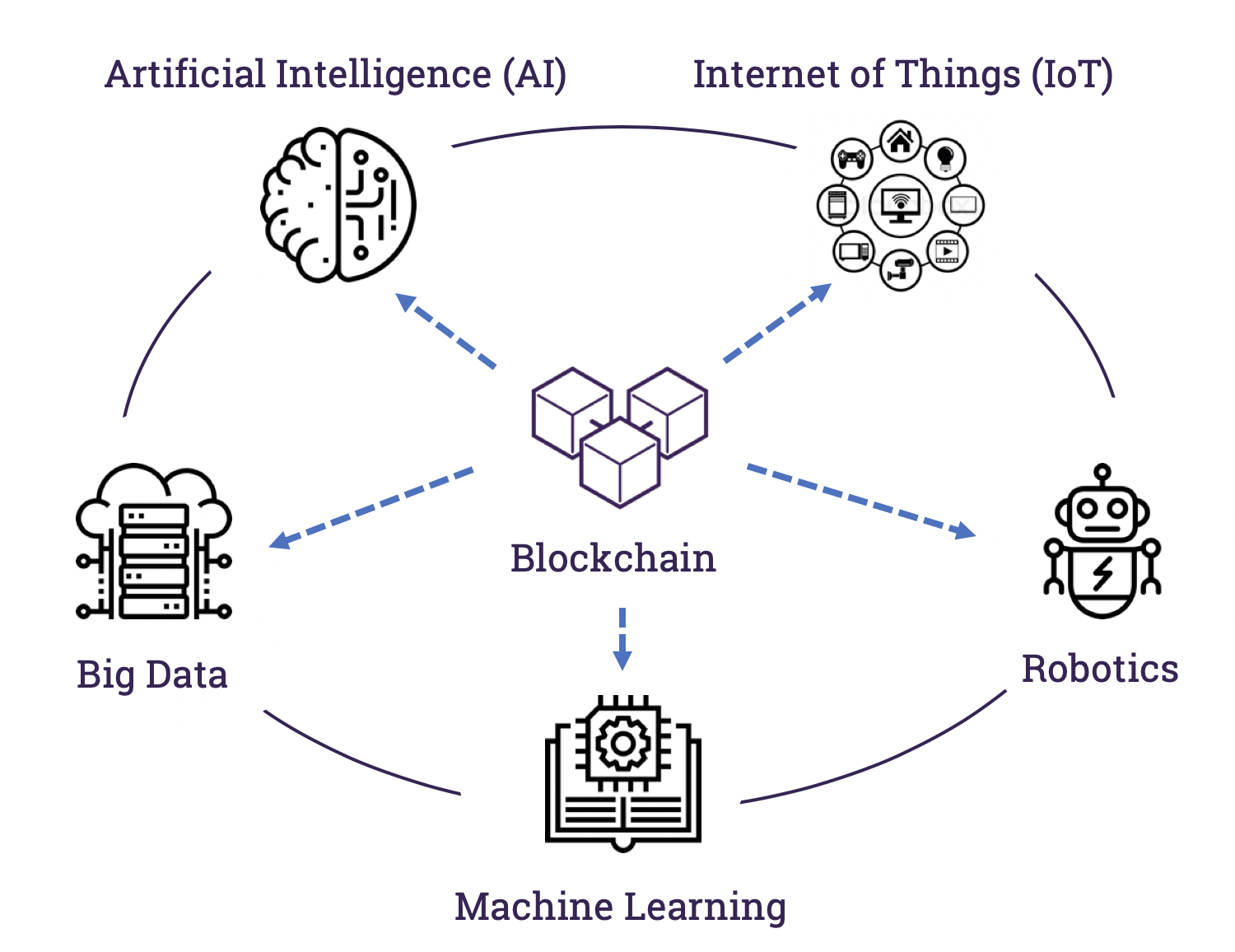
    Here at Insureblocks we are great believers that the future resides in looking at emerging technologies such as blockchain, AI, machine learning, IoT, big data, and robotics as the “new stack”. Because it is only by combining them that we can really get the most ROI out of them. We asked Niels his thoughts on how the insurance industry was embracing these new technologies.

    Insurers have a tendency of looking at these new technologies in a “trendy way”. Five, six years ago it was RPA, then it became AI and machine leaning and last year it was blockchain. A lot of insurers have a tendency of just following the latest technology trends which complicates things.

    However Niels is quick to point out that sometimes you meet a C Level director that gets it and sees the value of combining these new technologies to help them achieve their vision. He gave the example of a CEO of a bank insurer who stated her vision of settling claims in one day and wanted to find out what set of technologies would help her achieve that vision.

    Innovation department at insurance companies are also a great way for start-ups to have that first conversation. However these innovation departments are more like gatekeepers who do put you in touch with different sections of the business but they don’t have any budget or any kind of decisive authority.

    Data – the new natural resource

    In episode 40, IBM’s 2019 Insurance Predictions, we interviewed Sandip Patel, global managing director for insurance across IBM. In podcast he stated that there is a fundamental shift in how we think of data. Where data is becoming the next natural resource, particularly in Insurance from a few perspective:

    • Volume of data: The rate and pace at which data sets are evolving is growing exponentially.
    • Type of data: the nature of data is changing. 60 – 70% of the data sets such as from wearables, sensors, and drones, often referred as unstructured data sets
    • Temporal factor of data

    Data basically enables BlockClaim to make informed decisions in an automated way

    Blockcliam is both an aggregator of data and an enricher of it. Data basically enables BlockClaim to make informed decisions in an automated way. Claims for example can be very subjective. Recognising that claimants may lie, a claims handler has to try and reconstitute an objective reality of what happened. What BlockClaim aims to do is to automate that. They leverage external and internal data such as “dark data” to enrich the whole claim process. Dark data is any data such as PDFs, emails, images (eg. of a car accident) that aren’t in the right systems which makes it difficult to mine. However it is data, usually stored in an email inbox, that a claims handler evaluates in an intuitive way.

    One of BlockClaim’s USP is in creating new data sources. Looking for better APIs, building their own spiders to aggregate data, plugging into IOT such as wearables and combining all of that with an insurers own internal data gives BlockClaim the opportunity to build the ultimate contextual engine.

    BlockClaim’s Vision

    BlockClaim’s aim is to help insurers to settle claims in 24 hours. On average claims in the UK, depending on the verticals, takes about 25 days. This is often due to sequential processing, outdated systems and an ecosystem that involves numerous players. BlockClaim wants to offer lemonade style claims for everyone.

    Delivering on BlockClaim’s’ Vision

    BlockClaim offers three different ways to integrate with an insurer:

    • Batch – insurers send them claims on a daily basis and BlockClaim enriches the data and states which claims can be settled or not
    • Real time – BlockClaim can integrate within a few hours into an insurers workflow or claim systems
    • Proper integration – BlockClaim sits within the insurers core systems

    The New Stack – BlockClaim style

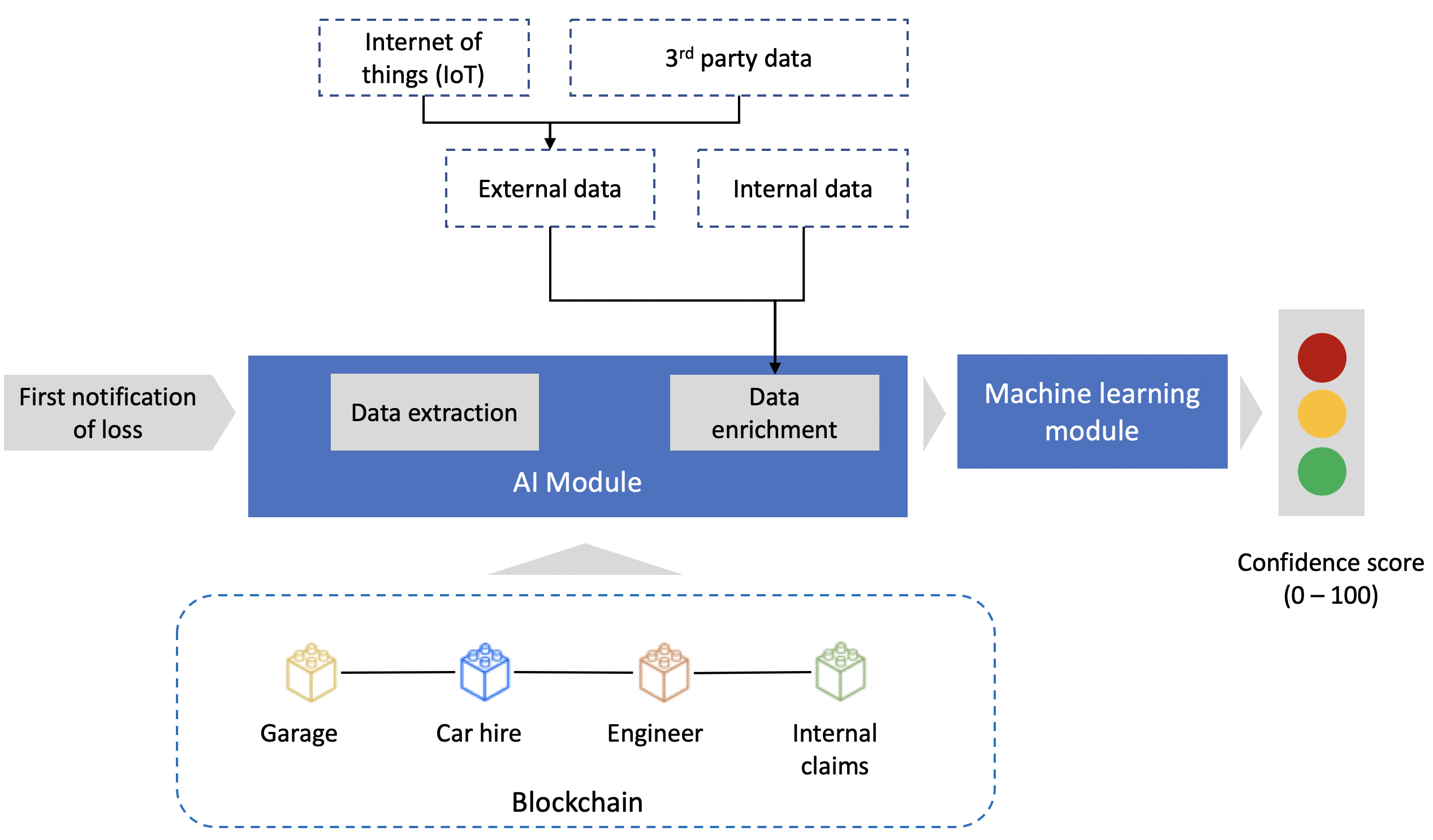
    BlockClaim uses a mixture of AI, machine learning and deep learning on a blockchain to deliver their 24-hour claims vision. The AI and the blockchain section of their proposition comes in two modules.

    The AI module. When a claim comes into the system the AI extracts the data and enriches it with external data such as IoT and internal insurers data that includes dark data. With machine learning it generates a confidence score between 0 – 100 in a kind of traffic light system.

    However, there are other players within this claim ecosystem that sit on the blockchain module. In motor claims for example you have garages, car hire companies, engineers and internal claims teams. As they all sit on the blockchain you can audit wherever the claim is.

    Insurers work with a number of TPA who provide every month an excel file with claims data. A key frustration insurers get is that they don’t get to control the data. They don’t have visibility of the data now can they audit it. With this blockchain related solution of the ecosystem, insurers can now have clear visibility of their data.

    Each ecosystem player’s data is fed into the AI and you can start getting a real time confidence score every step of the way in the claims process along the blockchain.

    Depending on the level of the confidence score you have a triage system, that can determine to which next step the claims process should take and that includes skipping several steps in the process thus reducing the settlement time.

    This process is also very effective in capturing fraud that can be operated by criminal gangs that may involve the participation of service providers (e.g. a garage).

    Did you really need a blockchain?

    Niels recognises that the insurance industry is very polarised around the question of blockchain and on whether it’s a yes or no question. For him it varies like 50 shades of grey. You can use a distributed database, but if you have more than five or six participants it becomes incredibly difficult to manage a permission system. Blockchain has a built-in permission system. It is the best and cheapest way to effectively work with various partners or actors in a system with over three or five players.

    Niels is excited by how blockchain technology can help reduce fraud. For example if a large number of insurance companies were to join a blockchain ecosystem then fraudulent activity on an insured with an insurer can be automatically detected and all the other insurance companies within the ecosystem will be informed of it.

    BlockClaim’s road map

    BlockClaim started at Imperial College, about 2 years ago out of a POC (proof of concept) that was about blockchain telematics and insurance. The company then evolved towards working with motor insurance first and now recently moving into health claims. BlockClaim analyses five million claims. Their next step is to move into lines of business such as fleets, home, pets and kind of PNC lines and some kind of commercial lines.

    Insurers who work with Blockchain have been looking at expanding their collaboration with to cover the underwriting side. There is a real opportunity in using BlockClaim’s ability to aggregate and process large amounts of data (external and internal) for not just managing claim but also in helping underwriters’ better price themselves.

    Top tips for Insurtechs in working with incumbents

    Niel’s main tip to Insurtechs is to raise funding from a mix of sources. Make sure that your investors have a great black book of contacts that can offer you introductions and warm leads that allows you to bypass a lot of the steps that you normally have to do. Sales cycles for example can be very long up to 9 and 12 months long. Getting access to the right C-level people, product owners and budget holders can make a significant difference.

    Business angels with an insurance background or former C-level individuals are great to providing those kind of introductions and thus play an important part in getting the right mix of funding sources.

    Niel’s second tip is try to get a soft landing. Always offer insurance companies with an easy way for them to sign up to try your product.

    Your turn!

    Niels have shared some great insights with us on the convergence of AI, machine learning, and blockchain.

    If you liked this episode, please do review it on iTunes – your reviews make a huge difference. If you have any comments or suggestions on how we could improve, please don’t hesitate to add a comment below. If you’d like to ask Michael or Tim a question, feel free to add a comment below and we’ll get him over to our site to answer your questions.


    Ep. 57 – AI & Blockchain – insights from Dessa May 06, 2019
    Show notes

    For this week’s podcast we continue into our theme at looking at new technologies that constitute the “New Stack”. Dessa is a company that specialises in offering artificial intelligence solutions to enterprises. We had the pleasure of having Paul Brikis, insurance lead at Dessa shares his thoughts on AI & Blockchain.

    What is blockchain?

    To define what is blockchain, or even just to conceptualist it, Paul played a little game with Walid.

    Paul: Let’s pretend that we’re going to assign my phone a store value and possession determines ownership. Let’s imagine there are no other phones in the room and I’m holding the phone. If I ask you, Walid, who owns the phone, what would you say.

    Walid: I would say you own it.

    Paul: Exactly there’s none other ones in the room. You know it’s very easy to see that ownership is mine. So, let’s pretend I pass the phone over to you and let’s ask the same question who owns the phone.

    Walid: Well technically I would say it’s still you as you just passed it over.

    Paul:Sure, but it’s in your hands like you know you feel confident that you’re holding that phone. So, we can see that the transfer of physical goods is very easy to transfer ownership. But let’s play the same game, but this time let’s change the rules where I’m going to take a photo of my phone and say that photo is redeemable for the phone in the picture and now let’s assume that I email you that photo. Do you still believe you own that phone?

    Walid:I may own the phone, but you may have sent the phone to somebody else.

    Paul:Exactly, digitally things are easily reproducible. When we are transacting digitally it’s hard to create trust of ownership. This has been called by economists as the double spend problem. In that in physical goods there’s no way to know it’s been spent twice, but in a digital world that’s really hard. The way to combat this is to establish all forms of intermediaries, so we trust that when we own these things that people say we own. You need a third party to validate that. Where blockchain is this revolutionary idea where suddenly we can transact with parties we don’t necessarily need to trust, but have confidence that we’re getting what the other party says we’re supposed to be getting.

    What is Dessa?

    Dessa’s mission is to help large enterprises scale AI. They strongly believe that AI is a transformative technology that companies are going to need a lot more of in the future. The company is made of two parts:

    1. A truly world-class AI team
    2. A team of former MBB (McKinsey, BCG, Bain) consultants who specialise in helping large enterprises identify business problems and opportunities that AI can address

    Dessa works in a highly regulated industries such as Telco’s, banks, investment firms, credit cards and insurance.

    What is artificial intelligence (AI)?

    For Paul, the reason why blockchain got on the map was thanks to Bitcoin. AI got onto the map thanks to a contest in 2012 called ImageNet. ImageNet is like the Olympics of computer science challenges. In this particular challenge, computers were tasked to classify five million images.

    The team from the University of Toronto combined very powerful computers with a technique called deep learning and they won the competition. This event is seen as a sort of the advent of when AI became topical. All three of those team members were recruited by Google and that when they became an AI first company.

    Dessa has recruited Alex Krizhevsky, who developed the technology from that team, called AlexNet.

    AI is a broad umbrella that is composed of machine learning and deep learning.

    Machine learning

    Machine learning is technology that essentially is improving itself and it can be used for things like predictions based on a set of data. It works in a very linear manner.

    Deep learning

    What’s interesting about deep learning is that in comparison to machine learning, where we can see all the moving pieces and we know why it derives at a certain answer, in deep learning we don’t know why it’s coming out with outcomes. Deep learning ingests a massive amount of data, it figures out the weightings of which data is important and which one isn’t over hundreds of thousands of simulations to figure out the outcome.

    Deep leaning is being used extensively amongst the high-tech companies such as Google, Facebook and Amazon. The most immediate touch point people would have with deep learning is with self-driving cars.

    AI first strategy

    Google, Amazon and Facebook are companies that are very successful at adopting an AI first strategy. What makes them successful is a capability to ingest a large amount of data and create insights from that data and replicate these models at scale. What this means is that everything they’re doing is getting better and far greater than humans can do.

    AI first strategy means setting up the capability to produce more and more of those models at scale. For non-tech companies who want to adopt an AI first strategy they are going to need to become builders of models. They possess an equally large amounts of data assets and they need to start thinking about how to unlock those data assets and one way they can do that is to start building models internally to generate those insights.

    How do non-digital companies adopt an AI first strategy?

    Paul mentioned a large investment company that Dessa works with that still get a bunch of submission documents for new policy account or investment by fax machine. These fax documents were reviewed by people on a regular basis. What Dessa did is that they were able to create a very powerful tool that would review the fax documents and make sure they were accurate.

    Enterprises own a tremendous amount of data and what they have to determine is which data is valuable and then how can they best leverage it to get some lift by deploying models.

    As in blockchain, what are the common misconceptions in AI?

    Both technologies are revolutionary over evolutionary and both can transform industries in the years to come. When it comes to blockchain, most people won’t know whether a service is powered by blockchain or not, because it is an infrastructure technology.

    With AI however people will see an impact almost immediately. When using YouTube or even product recommendations from an insurance company, there is a deep learning algorithm which is suggesting which other videos or insurance products that are relevant to you. AI also has the capability to “super charge” employees effectiveness. An outbound call centre were able to take the efficient effectiveness of outbound calls from throwing a dart to a dartboard to about a 90% effectiveness rate with the use of AI.

    With regards to jobs these new technologies have an interesting impact. Blockchain has the capacity to significantly reduce back end admin related jobs that are both very tedious and very repetitive. Jobs that humans usually don’t get a high degree of job satisfaction and aren’t quite necessarily good at that task.

    AI is very interesting because it can outperform humans on a variety of tasks. Where it won’t compete is on things like empathy, understanding, relationship building or even humour for that matter, as these things are very hard for computers to do.

    Example of an AI good business case

    Dessa has done a lot of transformative work with credit cards generating aggregates of hundreds of millions of dollars of benefits. However for Paul, the coolest thing that resonates with people is the work that Dessa has done in space!
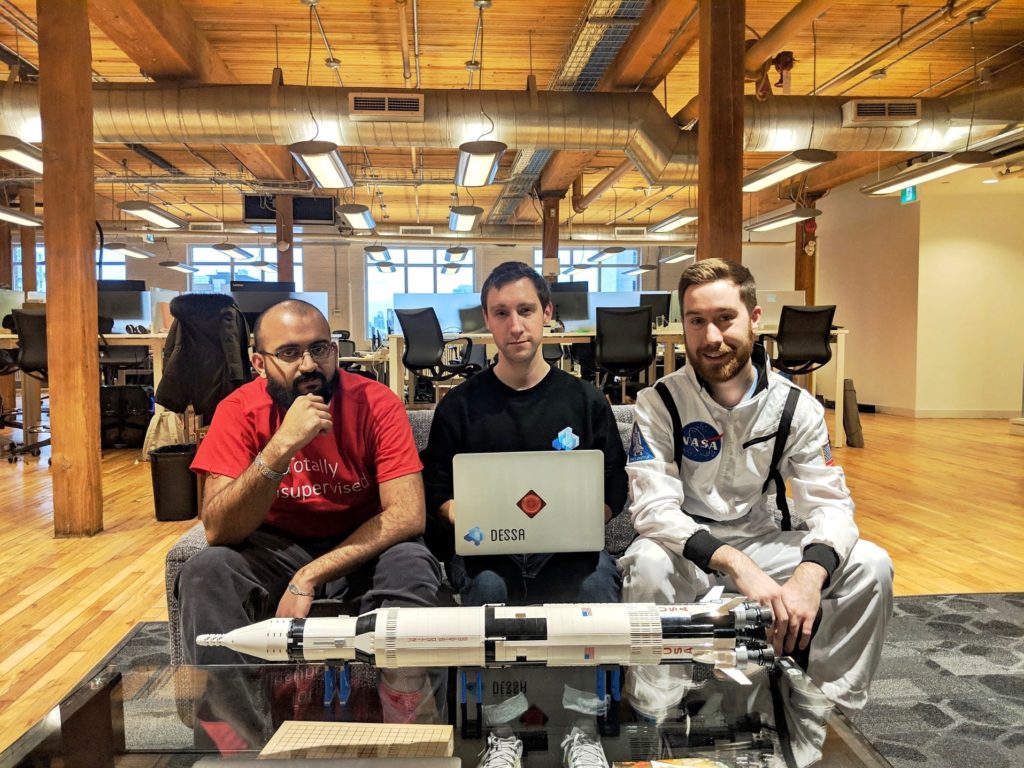
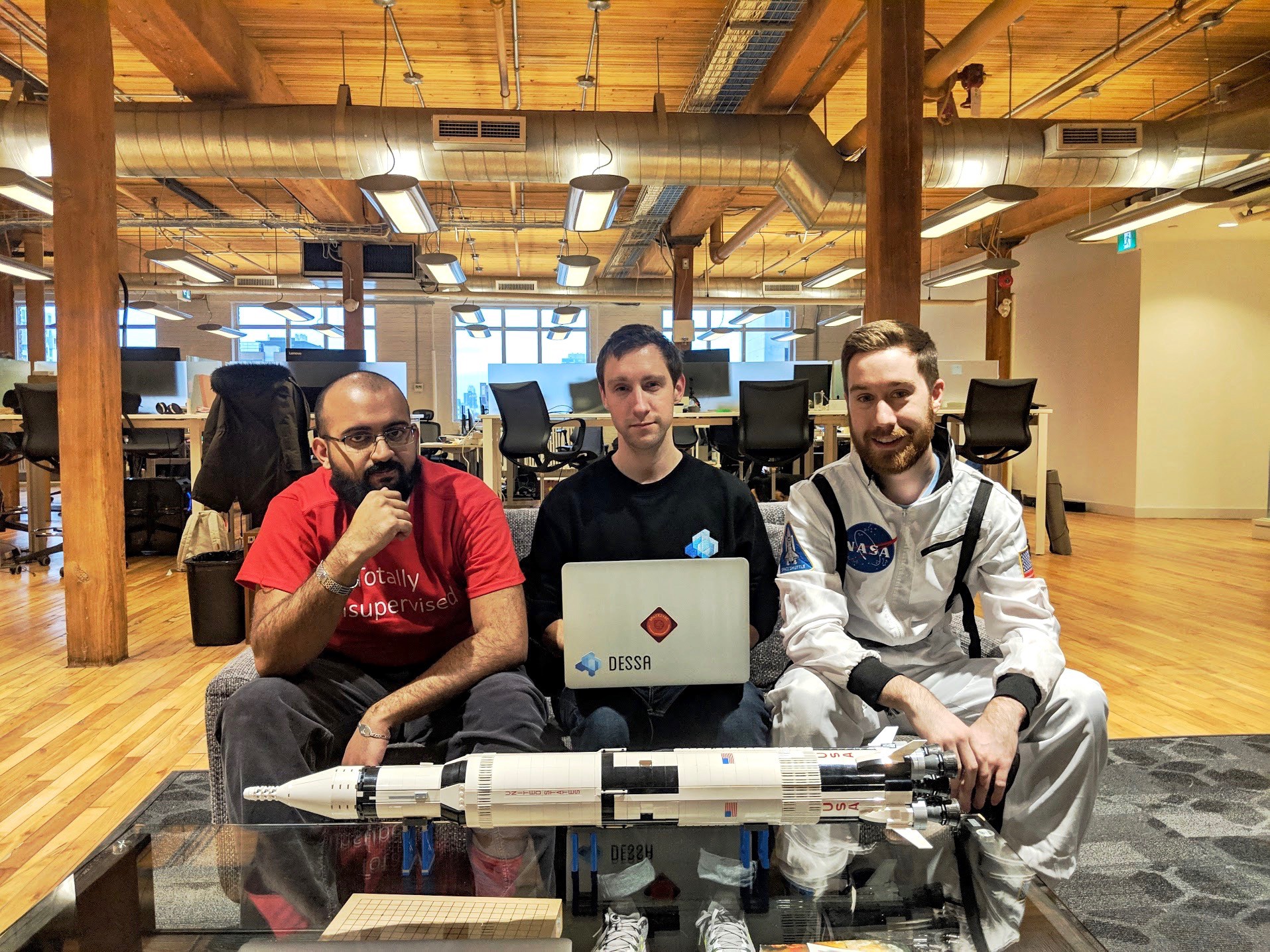
    The space2vec team has transformed our company’s enthusiasm for space into a serious side-hustle. Pictured left to right: Jinnah Ali-Clarke, Pippin Lee & Cole Clifford.

    Dessa’s team has recently broken a world record for supernova detection. The team at Dessa thought of how they could apply their techniques to something they thought is very meaningful and could have a really big impact. After conversations with the astronomy communities the realised that their telescopes capture about 30 terabytes of data an eveing and the next day astronomers review hundreds and thousands of photos.

    There was a 400 million photo data set of supernovas, and supernovas are important because they’re dying stars that make up 60% of the energy in the universe. The more we understand them the more we can evolve our understanding of space. However, the problem was that there is too much data and it’s like searching for a needle in the universe haystack. The Dessa team were able to create a model which essentially predicts what’s a supernova and what isn’t, and this cut the time it takes astronomers to review these photos but almost half.

    Dessa is now in conversations with NASA about putting this technology on a 2021 launch into space!

    AI in the insurance industry

    Munich Re identified email as consuming a lot of labour hours. They were getting about hundreds of thousands of emails a year and they applied AI technology by creating a triage system for incoming emails. The system would make predictions to whom the email should go to. They claim that the system has delivered tangible benefits for them.

    Another good example is how come companies are experimenting with IoT and AI to help predict who is driving a car based on driving behaviour.

    Where and how will AI and blockchain converge?

    For Paul, blockchain is very good at transactions and at structuring data. Which are two very important components to AI. However, in his opinion they’ll address different parts of the insurance value chain. Blockchain will have a tremendous impact on risk capital and that’s the idea of how does risk origination to a broker to a carrier to a reinsurance broker to a reinsure to a retrocession broker to the ILS markets, how does that get bundled a little bit more.

    Where AI will be very good at is in predicting what the cost of that risk is and then administering that risk. The closest analogy Paul would make or prediction would be our ability to predict hurricane severity against a portfolio of houses. Thsi was really revolutionary to unlock the insurance link securities market and that when we could say this class of hurricane hitting Miami, we know it’ll cost X number of billions of dollars and instead of doing ground-up claims payments from the reinsurer to the carrier, we can now say if this event hits here’s a very large check, you’re on your own to deal with the claims.

    Paul thinks the analogy would be can we create predictions at a more microscale in personal lines, in commercial lines, in casualty or is there a way we can tie that risk capital closer to that underlying risk and, so he thinks those are two overlapping ideas that will require both blockchain and AI.

    Your Turn

    Thank you Paul for sharing your thoughts on AI and blockchain. If you liked this episode, please do review it on iTunes. If you have any comments or suggestions on how we could improve, please don’t hesitate to add a comment below. If you’d like to ask Patrick a question, feel free to add a comment below and we’ll get him over to our site to answer your questions.


    Ep. 56 – Innovation & diversity in the Insurance Industry Apr 28, 2019
    Show notes

    Susan Joseph has been working in the blockchain area for the past 4 – 5 years. As a lawyer she has consulted with the insurance industry and most recently was the North American representative for B3i, the blockchain for insurance consortium.

    In this podcast we discuss two of Susan’s passion: “Innovation and diversity in the insurance industry”.

    What is blockchain?

    Blockchain is a foundational technology that provides a highly flexible set of tools allowing businesses, governments and others to re-examine their commercial relationships. It brings opportunities for greatly enhanced efficiency and development of new products. Inherent in the technology is the ability for diverse parties to cooperate in a way where trust is brought about through cryptography or promoting diversity through the development of the technology in the belief that the widest spectrum of perspectives will foster the most valuable innovations.

    On a more technical side it is an additional communication layer on the internet / web 3.0. It’s based on advanced cryptography, computing and game theory. Susan likes to refer to it as a distributed value technology and for her it presents the next step in the digitization of data – both communications and assets, while the data is created transferred and stored. It has wide-ranging implications for commerce, society and behaviour.

    Is the insurance industry good at embracing innovation and diversity?

    In Susan’s point of view, no the insurance industry isn’t particularly good at embracing innovation and diversity but that isn’t too different to a lot of industries though. Innovation, in the insurance industry, is highly regulated and particularly in the United States where you have 50 state regulations in addition to some federal ones.

    Systemically it’s hard to set up innovation in this space and yet you see a demand for digital projects and easier access to products and different kinds of products. Innovation has to happen, or the industry just isn’t offering what the market wants.

    With regard to diversity that’s a problem with every industry – services, technology and insurance. When you look at cutting-edge technology, Susan believes it’s even worse. The amount of diversity in a cutting-edge area that just isn’t there. Susan think it is really interesting in that in this technology, such as blockchain, which is intended to democratise, that we need to have this diversity of thought and diversity of voices.

    it’s not, there’s not a full-throated diversity effort let’s just put it that way and I think it’s really interesting in this technology which is intended to democratize, the more diverse thought and diverse voices in there that needs to happen. Because that’s a population that we want to serve.

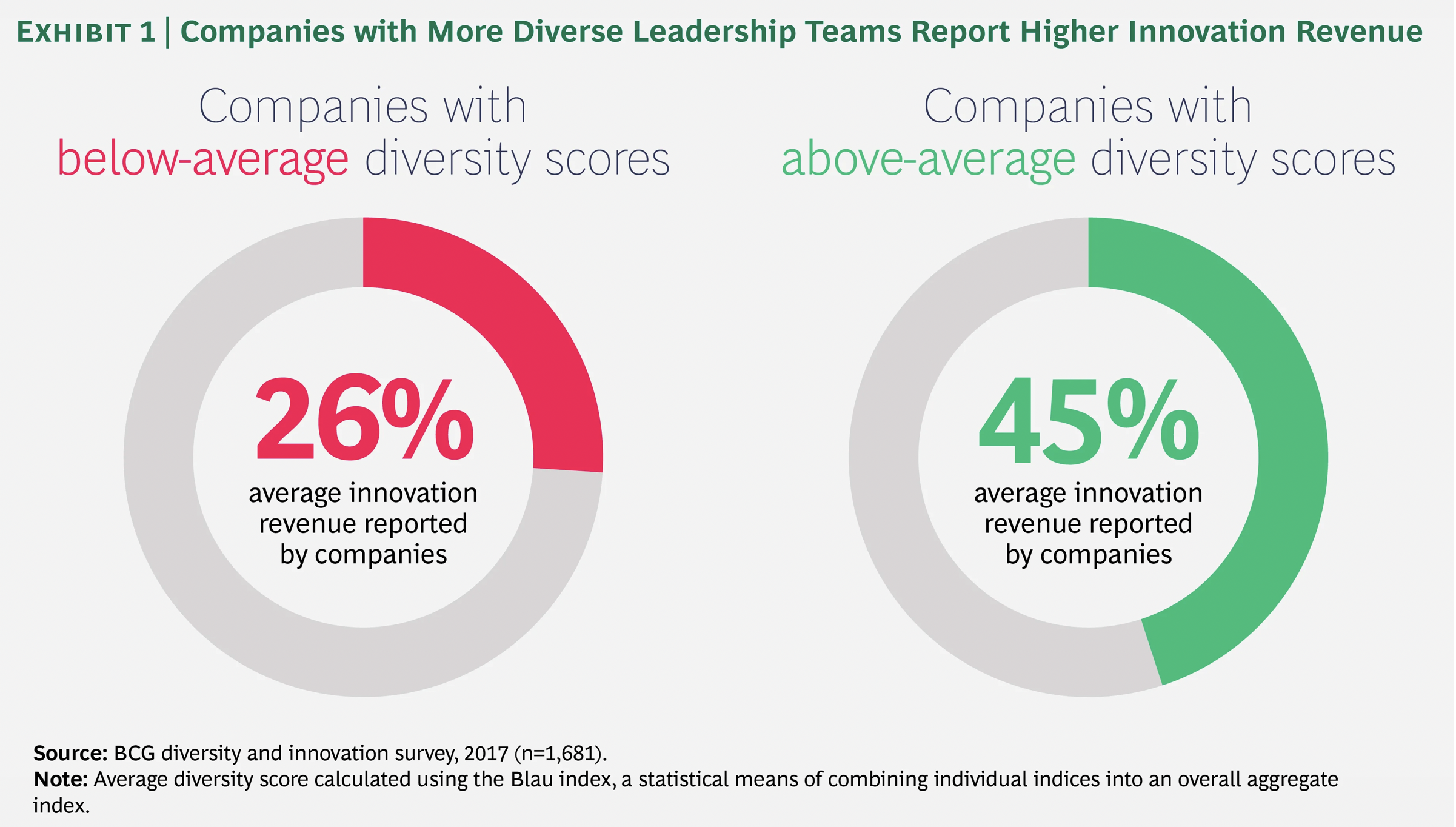
    Diversity is diversity in terms of gender, types of voices, cultural and a lot more. It is an inclusion play. Plenty of studies have shown boars with three or more women really start to affect the culture and change and increased profitability. A set of diverse voices and thoughts will improve the innovation side of any company. It’s really hard to innovate in an echo chamber.

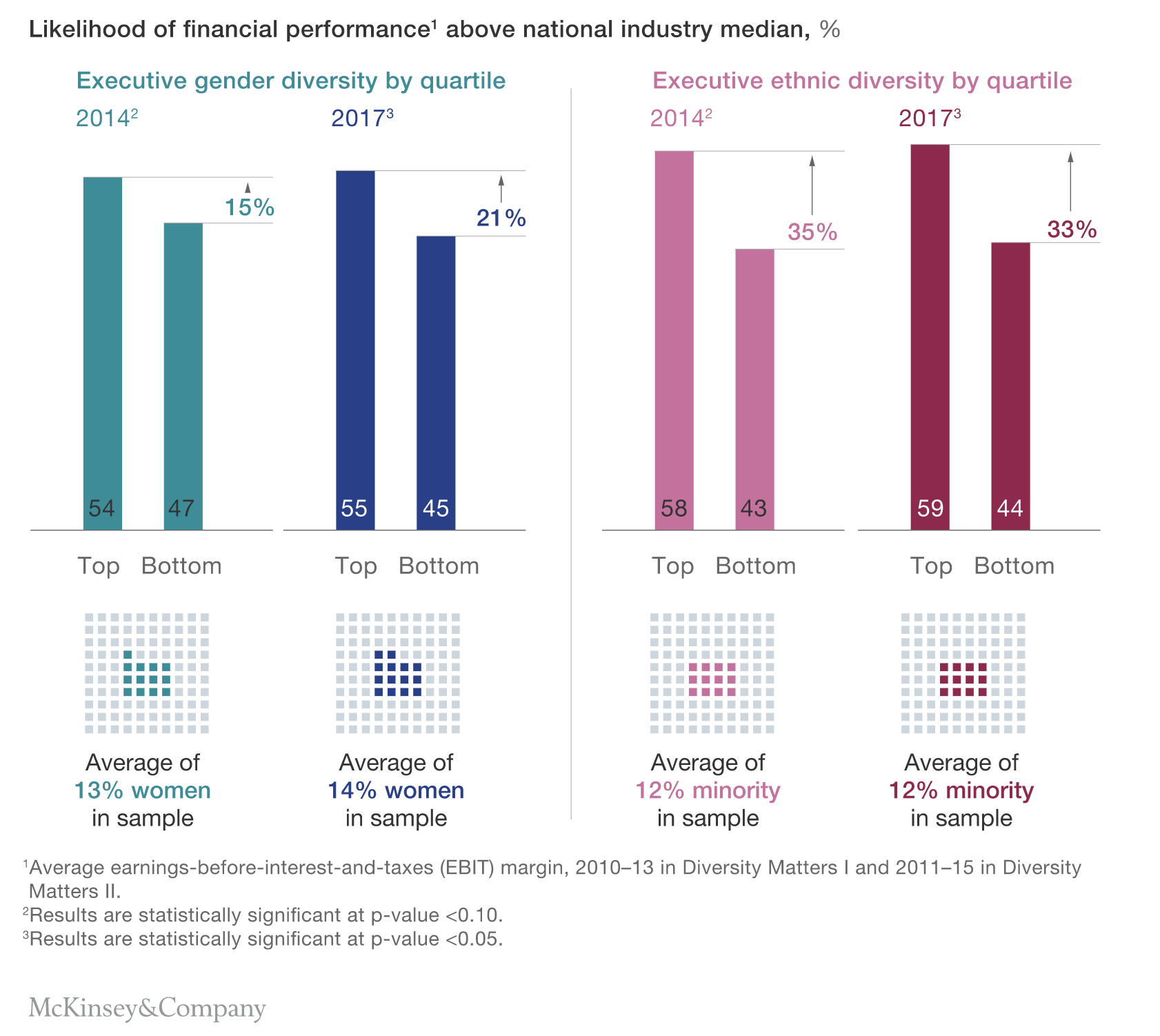
    In a study by McKinsey in 2017– “Companies with more culturally and ethnically diverse executive teams were 33% more likely to see better-than-average profits.“

    AM Best – Scoring and assessing innovation

    AM Best is a global rating agency and information provider with a unique focus on the insurance industry. On the 14th of March 2019, AM Best published a report requesting comments from market participants in the insurance industry and other interested parties on the draft of a new criteria procedure, “Scoring and Assessing Innovation.”

    AM Best defines innovation as a multistage process whereby an organization transforms ideas into new or significantly improved products, processes, services or business models that have a measurable positive impact over time and enable the organization to remain relevant and successful. These products, processes, services or business models can be created organically or adopted from external sources.

    For Susan this is a really interesting move. As AM Best is a trading agency this exercise helps to move the conversation perhaps all the way up to the level. However what concerns her is when you start to tie a number to innovation. A large part of what goes on in innovation is a lot of learning, research and development, especially in a new technology such as blockchain, which is a long-term proposition. In such innovations there isn’t necessarily immediate ROI on it. So, quantifying something can lead to one wanting to sort of “teach to the task” meaning getting to the result that one is “an innovator” and one may actually lose the pure learning piece involved with that innovation. Susan thinks that needs to be calculated within that score to encourage that, as it is part of the benefits of what some innovation units do in large corporations.

    Susan has experience insurers who both approach to innovation one from a dedicated innovation unit and one from a “grassroots” manner. Both of these approaches have their pluses and minuses. However, Susan believes there is a need for a marrying of both approaches. You need an explorer’s culture that permeates from top down and bottom up.

    For an insurance carrier to get the best possible innovation score with AM Best, Susan would tell them that they should examine how they are putting their current innovation in. That they should assess culturally across their company how innovation is perceived and who can participate and that they should set up some incentives for everybody innovating for the company and outlets for that.

    Having a digital mind set

    It is widely accepted that most of the large insurance incumbents have developed digital channels but not a digital mindset. Additionally, insurance is an industry that has a tendency of pricing itself on historical data, i.e. paper, instead of via utilising real time data.

    With the arrival of tokenisation, crypto currencies and all sorts of digital assets most insurers are quite confused on the type of data points they should be accessing for underwriting those new risks. Part of the reason is because they don’t have a digital mindset.

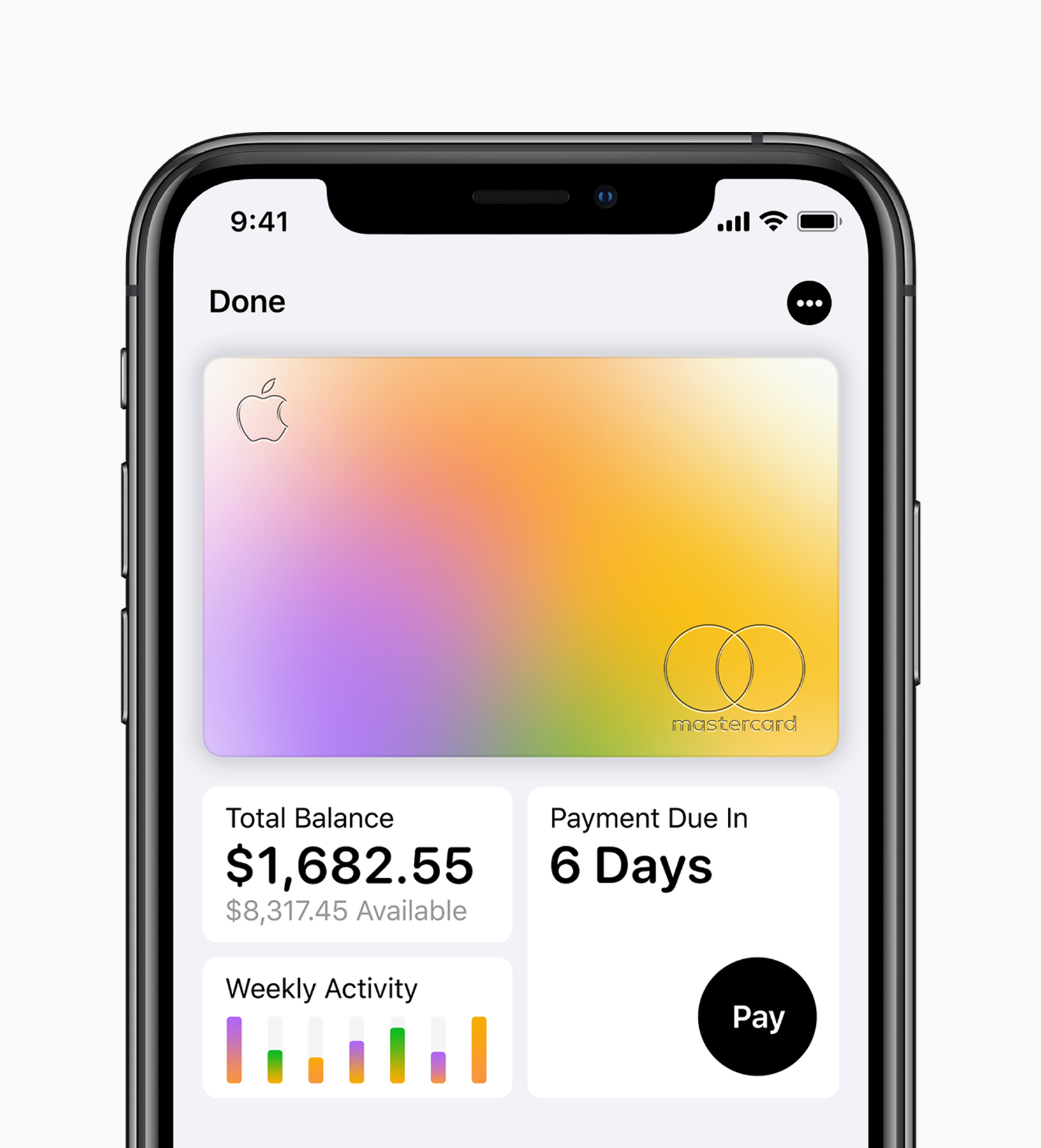
    Susan believes there is a need for the industry to be really shaken up through the entrance of a new player to the market. Similarly to what the Apple Card has done to the finance industry.

    Susan believes there is a need for the industry to be really shaken up through the entrance of a new player to the market. Similarly to what the Apple Card has done to the finance industry.

    Diversity in fostering greater innovation

    Whether it is blockchain, AI, virtual reality or any of those types of technologies that are being looked as they largely have homogenous people providing the solutions. Without a diverse workforce in those innovation labs you will not be able to get the best of results. For example when the Apple Watch was first launched it didn’t include a woman’s cycle. That’s 50% of the population whose needs are being effectively ignored. A diverse workforce would have brought a diverse thought around the table and such mishaps wouldn’t have happened.

    Is insurance the right industry for taking a lead in blockchain development?

    Susan believes that insurance is the right industry for taking the lead in blockchain development. Because in general insurance is a social good that is provided through some sort of mutual mechanism. This ensures that those which are the least risky and the most risky can get covered by a policy. Insurance has a wealth of data which fundamentally has been built on trust. All these things conspire to creating a good solution on blockchain.

    The insurance industry also has two consortiums looking at blockchain – B3i and RiskBlock Alliance. These consortia’s whether it is B3i, RiskBlock Alliance, a health consortium or Trade Lens or whatever consortia, the legal entity itself is a start-up. Susan believes that blockchain technology will best be served through consortiums. She has written a piece entitled: “Do blockchains and consortia go together like PB & J?”

    Diversity and Blockchain

    Diversity and blockchain is a not-for-profit that started out of a panel at MIT on blockchain and AI. At the end of the panel the director leading the panel encouraged Susan and its participants to launch the not-for-profit Diversity Blockchain Group (DiB).

    DiB is dedicated to promoting inclusion and education. They’re trying to set best practices for the industry by publishing out statistics about diversity, training advisory boards, mentorships and sponsorship to help promote diversity. Susan encourages everyone whether it is at conferences, events, summits and even podcasts to help promote diversity. This needs to be a coordinated diverse effort.

    Insureblocks supports this message as we had produced our very own podcast on Diversity in Blockchain.


    Ep.55 – The Digital Chamber of Commerce – Insights on Blockchain Apr 22, 2019
    Show notes

    Trade associations play a leading role in educating the business community on the opportunities of blockchain. In this podcast we had the pleasure of interviewing Patrick South, Vice President of Development at the Digital Chamber of Commerce in Washington D.C. The Chamber of Digital Commerce is the world’s leading trade association representing the digital asset and blockchain industry.

    What is blockchain?

    Blockchain is a combinatorial innovation. Think of it like a Lego bucket in which people are pulling existing Lego pieces and piecing them together in new innovative ways. Blockchain is leveraging existing proven technologies such as linked lists, asymmetric key parenting and hash functions in new and innovative ways.

    Blockchain is a distributed ledger is a distributed ledger that records and maintains data in a manner that allows multiple stakeholders to securely share access to the same information in digital aspects.

    In today’s environment we have all these disparate databases that require constant reconciliation and messaging. A lot of existing technology is simply applying digital overlays to analog processes. What blockchain offers is the true business transformation. Instead of having to reconcile siloed databases, blockchain creates a single source of truth that enables all parties to operate from of that mutualised data store.

    What is the Digital Chamber of Commerce?

    The Digital Chamber of Commerce is a 501(c)(6) trade association whose mission is to promote the acceptance and use of digital assets and blockchain based technologies. Through education, advocacy and working closely with policymakers, regulatory agencies and industry, their goal is to develop an environment that fosters innovation, jobs and investment.

    They are made up of over 200 members:

    • 60% are startups varying from blockchain platforms to cryptocurrency exchanges to ones operating in the security token space
    • 40% are composed of large financial institutions, consultancies, service providers, law firms, accounting and advisory firms

    The Chamber has five working groups to promote the acceptance and use of digital assets and blockchain based technologies:

    • Token alliance:which is co-chaired by the former SEC commissioner Paul Atkins and former CFTC chairman James Newsome. Last year this working group wrote a white a paper on what constitutes a non-security or utility token entitled – “Introducing: Understanding Digital Tokens: Market Overviews and Proposed Guidelines for Policymakers and Practitioners”
    • Smart contracts alliance: which focuses on the existing legal framework and how smart contracts can be used to enforce that. This working group has a white paper entitled: “Legislator’s Toolkit for Blockchain Technology” and “Smart Contracts: Is the Law Ready?”
    • Digital asset accounting consortium: as there are no accounting standings in the digital asset space. Developing accounting and reporting standards for digital assets and blockchain-based technologies.
    • Blockchain intellectual property council: Balances the protection of proprietary information with the openness necessary for innovation.
    • State working group: Engages with state and local governments on the regulation and implementation of blockchain technology.

    US Congress engagement with blockchain

    The Digital Chamber of Commerce regularly engages with the Congressional Blockchain Caucus which is co-chaired by Congressman David Schweikert, Congressman Bill Foster, Congressman Tom Emmer and Congressman Darren Soto. It represents a good mix of Democrats and Republicans.

    This caucus is composed of men and women who dedicate their time and energy to learning more about blockchain. In addition numerous congressmen and congresswomen attend blockchain events both run by the Digital Chamber of Commerce and by other leading industry players.

    Smart contracts alliance

    In their white paper “Smart Contracts: Is the Law Ready?”the Smart contracts alliancewas looking at the broad questions around is there existing laws in place that enables both the use of smart contracts and more importantly the enforcement of smart contracts from a legale perspective. The conclusion of that white paper was that between the ESIGN Actand the uniform electronic transactions act, UETA, they believe that the current legal framework enables the use and the enforcement of smart contracts. In other words, smart contracts can be created, executed and enforced in the same manner as existing contracts are today.

    Today’s contracts are rather probabilistic in the sense that you aren’t always guaranteed the results of the outcome. With smart contracts you have deterministic digital agreements that guarantee that code is going to execute the deterministic outcome. The smart contracts alliance focus was on bridging the gap between what they think the technology enables and what they believe the current legal framework enables in the United States.

    National Action Plan for Blockchain

    The National Action Plan for Blockchain is part of the Chamber’s ongoing mission to promote the acceptance and use of digital assets and blockchain technologies. The Chamber is encouraging U.S. leaders to recognize and incentivize the development of blockchain solutions.

    The Chamber is calling on the US government to publicly support the development of blockchain technology in the United States and for the Chamber to provide the US government with a set of guiding principles on how best to support blockchain technology.

    At the moment in the US there is a fair amount of regulatory uncertainty which has led firms to go to other jurisdictions such as in Asia, UK, Malta and Gibraltar that are providing friendlier treatment and guidance.

    The Chamber would love to encourage a top-down narrative for blockchain in which the government publicly recognises the innovation and investment that this technology can bring.

    Key regulatory challenges with blockchain

    There are a number of conversations that happen within the chamber around regulation:

    • Financial institutions look at the broader question around the application of the custody rule in the blockchain and crypto space
    • Tax treatment
    • Accounting treatment of digital assets
    • Digital securities and their tokenisation. Possible implications this may have regarding dis-intermediating transfer agents

    The new stack – convergence of blockchain, AI, IoT, big data and other new technologies

    Patrick reminds us that TCP/IP was the underlaying protocol that enabled the internet. Blockchain is seen as the underlaying technology that enables Web 3.0. It is this underlaying layer of trust on which new applications will be built upon.

    Patrick brings the analogy with how the Nokia phone helped to democratize commercial phones in making them accessible to everyone. It was a game changer at that time until the iPhone arrived and offered a whole range of new applications not accessible to Nokia phones. Blockchain is similar in that sense to the change the iPhone brought.

    Data is the new oil and blockchain offers everyone the opportunity to control, own and capatalise their data in a manner they couldn’t before. With blockchain we will see the creation of data market places in which individuals will have more control over their own data and be able to selectively disclose information to the relevant parties and monetize it too. This can involve the use of zero knowledge proof. The simplest way of explaining what it is, is through an example. In the US you have to be over 21 to drink at a bar. To prove that you are over 21 you share your identification card that carries a lot of information in addition to your age. It carries you full address, weight, height and other personal information you may not wish to share with a bouncer at a bar. Zero knowledge proof is to be able to prove that you are over 21 without sharing your ID with an attestation against the ID from a valid entity such as a state or federal one.

    What’s next for the Chamber?

    In the short term the Chamber is going to continue pushing forward their national action plan for blockchain. Patrick would love to see the Chamber take a more global perspective in working with jurisdictions globally to help foster an environment for innovation and investment in blockchain technology.

    Your Turn

    Thank you Patrick for telling us about the Digital Chamber of Commerce and the exciting work you do. If you liked this episode, please do review it on iTunes. If you have any comments or suggestions on how we could improve, please don’t hesitate to add a comment below. If you’d like to ask Patrick a question, feel free to add a comment below and we’ll get him over to our site to answer your questions.


    Ep.54 – Building effective governance in a blockchain ecosystem – Insights from Hedera Hashgraph Network Apr 14, 2019
    Show notes

    For this week podcast we continue our theme on how to build effective governance solutions in a blockchain ecosystem. This time we had the pleasure of having Mance Harmon, CEO of Hedera join us to share his insights on how to build effective governance.

    What is blockchain?

    At a very high level, blockchain is an evolution of database technology. In traditional database technology you can have a multi master database solution, which is essentially like having multiple copies of a same master database. It’s a replicated database with identical information in every instance. As users connect to these master databases to make updates to them you sometimes have what is called a write conflict. Meaning that the collection of all these databases need to come to an agreement on which one of those master databases was modified first. The assumption has always been that one organisation would manage all of those master databases. Whilst that may be fine in some scenario it doesn’t quite work in one where for example you’d ask Amazon to take one of its masters from its multi master database solution and give it to Google to run and administer.

    What blockchain initially provided was for the first time the ability to take this multi master database solution and give away the masters to different legal entities, different organizations and do so securely. The 1st generation of blockchains, Bitcoin being an example of them, uses a very linear process. Each node in the network has a local copy of this chain and as new blocks get published the community decides which blocks to put on top of the chain and what order and everyone does that in this sort of linear fashion. For Mance this isn’t very efficient.

    Difference between Hashgraph and Blockchain?

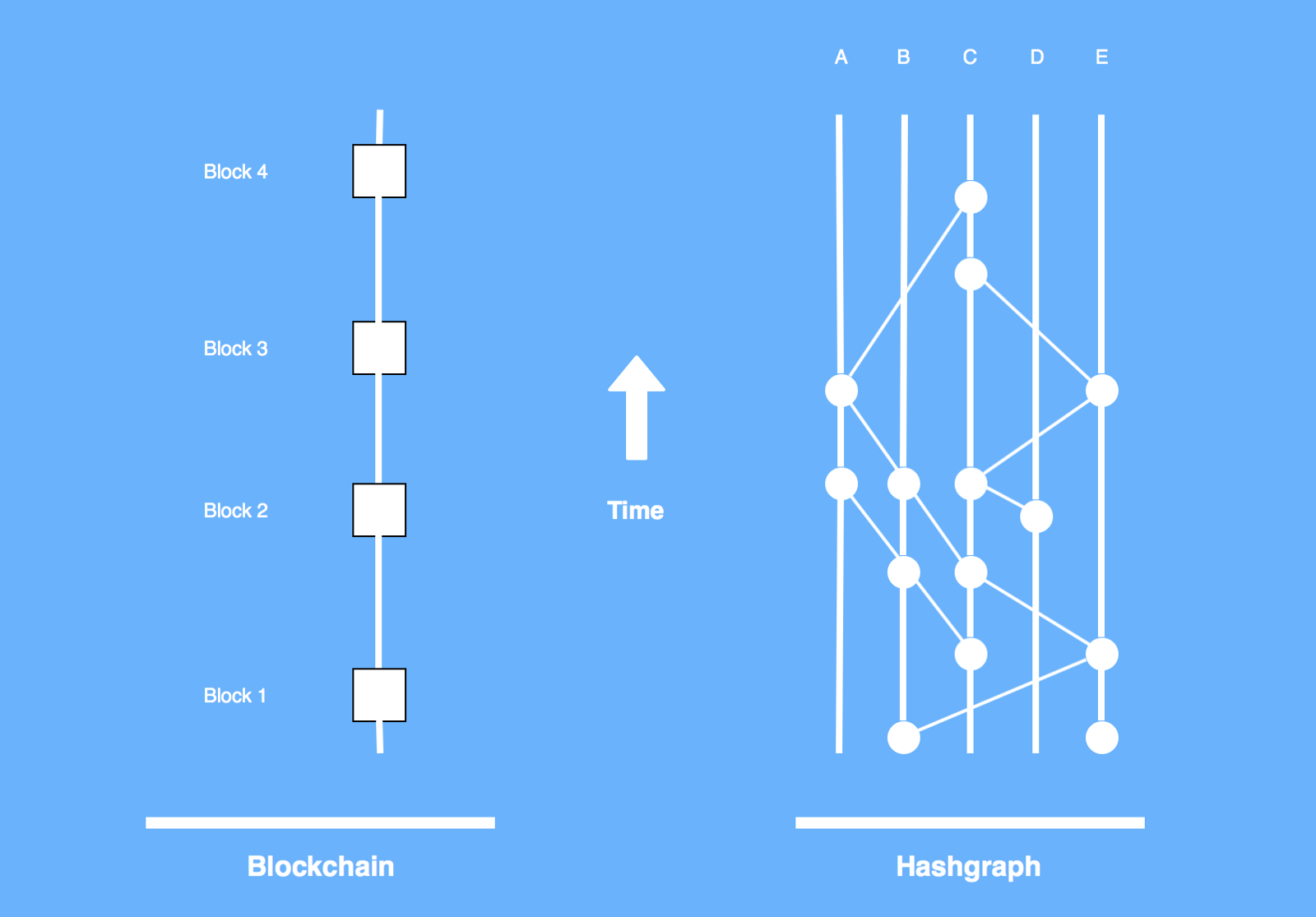
    Hashgraph like blockchain is a form of distributed ledger technology (DLT). However unlike blockchain it doesn’t have a chain of blocks. Hashgraph is a graph that represents the flow of transactions, changes to the database across the network as well as an algorithm for determining which of these transactions to apply in a given order.

    A hashgraph is a patented algorithm that promises the benefits of the blockchain, distribution, decentralisation and security through the use of hashing, without the drawback of low transaction speed.

    While Bitcoin allows for approximately 5 transactions per second and Ethereum allows for approximately 15 transactions per second, a hashgraph can process thousands of transactions per second.

    Hashgraph can achieve such speed and security because it adds a tiny amount of information on top of any transaction between databases. That tiny amount of information, or metadata, essentially keeps. A record of the last received transaction and the last one created. By taking those metadata one can build a picture of the flow of information within a network.

    What is governance?

    Governance refers to the process that a governing body goes through to determine what the product roadmap will be? What features are going to be added to the product? When those features will go to market? What rates are paid to the nodes in the network for their participation? What the fees are for the use of the network?

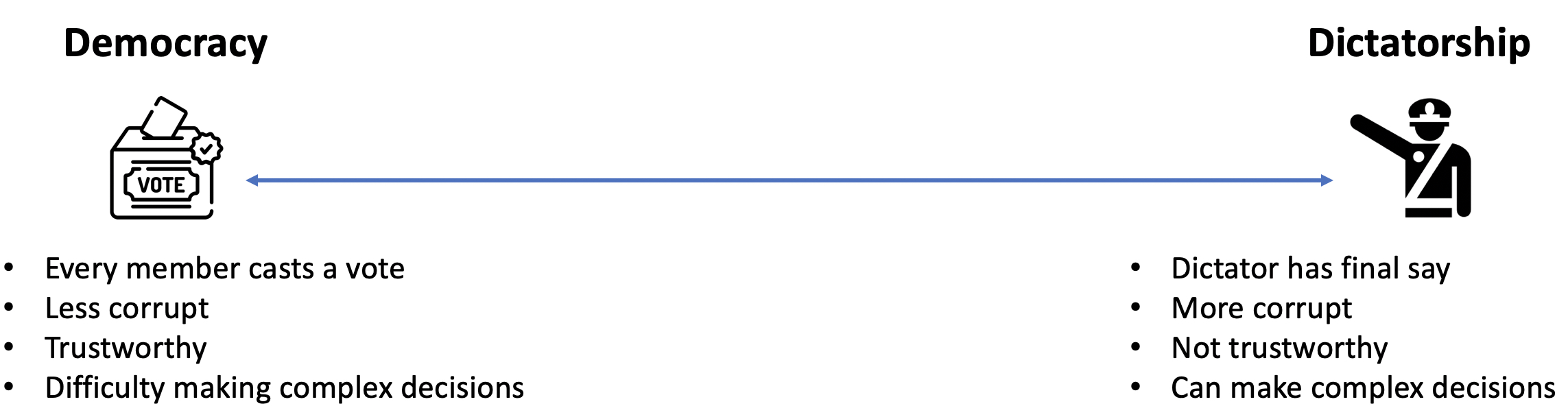
    Governance can be thought of by using different model points as reference points. On one end you’ve got a dictatorship model where one person is calling the shots whilst on the other you have a full democracy.

    Governance council type of model

    A council type model is an alternative approach. Just like you wouldn’t have every person that holds a US dollar to be voting on monetary policy. However, a council of experts on monetary policy to be governing the money supply can work.

    A governance council type of model is one where you have a large population that votes and a subset of the population that acts as experts of the council to making complex decisions. That is the model used by Bitcoin for example where you have 11 or 12 core developers deciding what goes into Bitcoin.

    Differences in governance between open source blockchain and private blockchain

    The problem in the public blockchain market is that everything is open-source, and what that means practically, is that the governing council whatever form that takes doesn’t have any teeth. They can’t actually compel the nodes in the network to actually adopt the changes that they’re proposing. If there is disagreement around the nature of those changes then a portion of that public blockchain may choose to split or hard fork of the network and go create their own.

    Hard Fork. By: Coin Telegraph

    A good example of this is when Bitcoin Cash decided to hard fork out of Bitcoin. See Coin Telegraphs article about this fork.

    Whilst forks have fostered innovation they also represent a certain level of risk for business manager considering building enterprise applications on top of a platform that may fork.

    In a private blockchain network the governing body grants permission to players to enter the network and issues them with the relevant rights to participate in. In such a network the governing body has the necessary teeth to govern.

    Hashgraph’s governance approach

    Hashgraph as an algorithm is patented. Whilst it has similarities to open source it is not open sourced. As open source project is open to review, it is transparent, accessible and has no licensing requirements to use.

    However, due to its patent it has a governing body that has the authority to compel the nodes within the market to adopt the changes that the governing body decides upon. The governing body has legal controls and technical controls to compel the nodes in the network to adopt the upgrades and to prevent the network from hard forking or splitting into competing networks. These controls ensure for the first-time stability in a public distributed ledger network that hasn’t previously existed.

    When building the governing body Mance took inspiration from Dee Hock, founder of the Visa Network back in the 1960s and author of the book “One from Many: VISA and the Rise of Chaordic Organization”.

    39 global blue chip organisations with the largest market capitalisation chosen across 18 sectors of the global market to ensure broad distribution across all sectors and geographically distributed. Each of them are term limited to ensure they aren’t council members for life. They are members of a corporation with real teeth. Hedera Hashgraph is an LLC, a Delaware based LLC and these council members are formal members of the LLC. So, there is a board of managers for example that has five representatives selected from the 39 and the board of managers have the authority to hire and fire the CEO, Mance Harmon.

    The 39 blue chip organisations select 5 members of a board of managers who are responsible for day to day matters in order to ensure quick responses. In addition to the board of managers, there are committees such as a technical steering committee, a legal and regulatory committee and a marketing committee for example. Each committee have oversight over the relevant operations of the company but they are not operational. They do however help decide product roadmap and policy for example.

    Once a blue chip organisation term is ended a membership committee that is made up of some of the 39 members will look at potential replacements and make recommendations to the 39 at large and then vote on who they want to invite into the committee.

    In the future Mance predicts they will have participating organisations that will be able to make contributions but won’t be able to vote. Those participating organisations will also form a clear pool of possible replacements for the governing members when their terms ends.

    Governance learnings from running both a public and private blockchain

    Hedera Hashgraph initially started off as Swirlds a blockchain platform for permissioned networks for enterprises. Mance and Leemon then also created Hedera Hashgraph as a public ledger.

    Private blockchains are a lot easier than public ones. Public blockchains have cryptocurrency which means there are legal and regulatory issues that need to be addressed. A global governing body is required to look at legal and regulatory issues in every jurisdiction. A private network doesn’t have a cryptocurrency associated with it and in general it’s a smaller group with a set of bylaws to govern themselves.

    However, Mance points out that the way Hedera Hashgraph is set up it more closely resembles private blockchain networks in the manner that they are governed.

    In general, public blockchains have governing challenges due to their lack of teeth to enforce changes to the code with open source. Mance doesn’t believe that long term public networks will succeed if they’re always trying to persuade the members of the community to adopt the latest set of changes. It’s governance through crisis, where progress is made forward only through crisis.

    Top tips for creating a blockchain ecosystem

    In creating a private network the top tip is to get as many of the potential members of the ecosystem involved as early as possible because there are lots of subtleties in the governance bylaws that have to be worked out. It helps in getting the members buy into the eventual governance set of bylaws.

    Your Turn

    Thank you Mance for sharing some great insights on how to build effective governance solutions within a blockchain ecosystem. If you liked this episode, please do review it on iTunes. If you have any comments or suggestions on how we could improve, please don’t hesitate to add a comment below. If you’d like to ask Mance a question, feel free to add a comment below and we’ll get him over to our site to answer your questions.


    Ep.53 – Debate – Public vs Private blockchains for enterprises with R3 and Consensys Apr 07, 2019
    Show notes

    This is a very special podcast for us as it is our first debate format on Insureblocks. We were extremely privileged to have two titans/Jedi Masters from the blockchain community join us for this podcast. On one side we have Richard Brown, Chief Technology Officer from R3, builders of Corda, advocating for enterprises to use private blockchain systems. Whilst on the other side we’ve got John Wolpert, Team Lead at Web 3 Studio at Consensys, builders of Ethereum based blockchains, advocating for enterprises to use public blockchain systems. Have a listen to this fascinating podcast and if you’d like for Insureblocks to organise more debates on our show, do let us know. About Richard and R3 Richard is the Chief Technology Officer at R3 an enterprise software firm that are the founders of Corda. Corda is an open source blockchain platform designed for the enterprise world. R3 initially began as a consortium of large financial firms trying to figure out what opportunity does blockchain represent for their firms and the implication blockchain may bring to their businesses. As part of this learning exercise and exploration they reviewed a number of blockchain platforms before deciding to build their own blockchain platform called Corda. Corda is available in an open source format and it is being used by a large number of firms to solve some interesting business processes. About John and Consensys John is the leader of a team at Consensys called Web 3 Studio. Consensys is a company that is dedicated to building a platform to enable people to build on the Ethereum blockchain. John’s Web 3 team focuses, as he puts it, “on novel unexpected and exciting use cases that can help developers really get behind blockchain and Web 3.0” Previously John used to be the Global Head of Products at IBM’s blockchain and one of the cofounders of Hyperledger. However, John, doesn’t define himself as a Hyperledger guy or an Ethereum guy but more as a “stateful internet” guy. He is a big fan for pushing the managing of states in a decentralized manner. What is Blockchain? – John According to John, blockchain is just one part of an evolution of the internet towards a stateful internet. In other words an upgrade to the present internet that is essentially led by companies soloing servers sitting around controlling state, memory and business logic. “There won’t be one chain to rule them all.” But now, I believe that in order for the Stateful Internet to avoid descending into a fight at the gates of Mordor, we do in fact need a trustless, permissionless, decentralized root chain playing umpire. This can be done today in a decentralized manner similar to how we experience passing messages right now with packets of information going back and forth between different routers. However, managing state is a lot harder than managing passing messages. As messages go through a router, a router doesn’t have to remember what state it was before, what state it is now and coordinate that state with billions of other routers. Ethereum offers the ability to manage state between routers in a decentralized manner. What is Blockchain? – Richard For Richard, blockchain is a technology that enables us to do something we couldn’t have done before. It enables multiple different computers, controlled by different organisations that don’t necessary fully trust each other, to be in sync and to be in consensus about some facts their owners care about. Whether that’s a crypto, an insurance policy or anything else. To be able to know that what you see on your computer your counterpart sees the same thing. This works without any one party having undue influence or power over the other and without everybody having to cede control to some central entity or some cloud operator. Background to this debate On the 3r of January 2019, Consensys published an article entitled “Busting the myths of private blockchains”. On the 14th of January Richard Brown posted a counter argument entitled “Busting the myths of public blockchains for business” and Insureblocks produced a podcast, “Are public blockchains suitable for the enterprise world? Insights from R3” with Richard regarding that blog post. On the 23rd of January John Wolpert wrote back an article called “These aren’t the enterprise blockchains you’re looking for”. The case for private blockchain – Richard Richard makes the case that when you have a system that’s under your control that ensures that what you see is exactly what your counterpart or competitor sees simultaneously. With that ability you can dramatically reduce costs, complexity, risk, and duplication. All reconciliation that is presently done to confirm all parties have the same information will be removed. Such a system would speed up the process for decision making as resources wouldn’t need to be allocated to ensure that decisions were built on the right information. It is with that objective in mind that you start identifying what are the requirements such a platform would need. An identify module is required to ensure that if information and assets are sent to individuals, that it is to the right identity. Additionally, there is the need for privacy, to ensure that only the two parties to a deal, have access to the information and not all parties within a blockchain ecosystem. These are the two principles upon which Corda has been built. The ability to ensure that the information is shared with the right person and only the ones with the need to know are made aware of it. Information is shared with the two parties and those who need to check the validity of the transaction. Those who are not parties to the transaction and who don’t need to know shouldn’t get to see the transaction. The private blockchain platform has to be built on a language that most developers can understand such as Java, Scala or any kind of modern language. The platform has to be scalable and be able to provide finality to transactions. This is the private blockchain platform that Richard and his team have been building with Corda. Richard admits that when they set out to build Corda for the finance industry they hadn’t quite realise that what they had built was more general purpose that what they had expected, as Corda started being adopted by other industries such as insurance, heath and trade finance supply chain for example. When Richard announced the launch of the Corda Network at CordaCon in Tokyo he announced it as an internet of Corda nodes. However most if not all of blockchain deployments in business have been standalone ones. They’re all different networks with different governance, different identity, different consensus schemes, it was like if they were on different planets. Getting those different networks to talk is a quite a complex task with significant interoperability challenges. For Richard the real opportunity is that private blockchain ecosystems built on an IBM Hyperledger fabric network or on a Corda Network they should be willing to be able to accept a certain level of loss of control to ensure interoperability of their network with other blockchain networks. Similarly, to what the Ethereum network has achieved, multiple applications on the same network. If you’re going to deploy an Ethereum Enterprise blockchain, or an IBM Hyperledger Fabric or Corda blockchain for one purpose such as supply chain logistics, if you can agree as a group almost as a community up front to some common identify standards, common governance, common protocol rules in a similar way as what the public Bitcoin and public Ethereum network does, the opportunities for interoperability within that shared network are so much greater. Through this approach you are effectively deliberately relinquishing up front your rights to deviate from certain things in order to maximise the chances of interoperability. This is what the public Ethereum network has achieved, multiple applications on the same network and that is something Richard believes that enterprise blockchains should strive and aspire to. Whether it is Corda or Fabric blockchain networks shouldn’t be deployed as standalone entities. The case for public blockchain, a different approach and a new way of thinking – John John considers himself to be Gundalian. The Gundalian architecture is basically the assertion that parties that are not counterparts to an agreement should neither execute the code of that agreement nor even know about it nor store the state transitions of that agreement. John believes that neither public or private blockchain are up to the task for evolving the internet and what is needed is to move from this divergence of blockchains towards a convergence that establishes not an Ethereum protocol, or a Hyperledger fabric protocol, or a Corda protocol but a seamless protocol. The case for blending Corda’s security and Ethereum’s state machines – John When discussing about security there are two elements to it: Tamper resistance Surveillance resistance for avoidance of data breaches. What are the requirements. A public permanent registrar that isn’t controlled by any group of companies. That enables two parties to be able to transact and make up rules for transacting in a private and secure manner known only by the two parties. The challenge of such a system, under traditional techniques (non blockchain), is that the state machines are very mutable. Either party could tamper with the code or the cloud administrator, whether it’s Azure or AWS, could camper with it. However if you want a system that is immutable, that can’t be tampered with and is military grade tamper resistance you can’t do this with a private blockchain, the closest thing to a military grade resistance is a large globally distributed public main net (ie. Bitcoin or Ethereum) . The problem with that is that the public main net has no surveillance resistance. Everything is done by everybody without necessarily knowing the identities of those parties. John believes that there is an opportunity to use Corda’s point-to-point communication between two parties that secure the business rules so that only those two parties have visibility of those rules. Then have the outcome of that logic returned to the main net with the shared state result. That way you achieve privacy and more importantly confidentiality along with global military-grade tamper resistance, Ethereum. Thus Corda and Ethereum can work seamlessly together in a stateful internet way. Differences around tamper resistance – Richard Richard agrees with John’s definition around surveillance resistance – if I’m transacting with you, the only people who should know about it are the people who have a right to know. However where Richard and John disagree is with regards to the definition of tamper resistance. Richard believes that none of the blockchain platforms are actually tamper resistance. Data resides on people’s computers and nothing can stop these individuals from changing pieces of data. If that is the case then the requirement is one of tamper evidence. If a party tries to convince another party of another version of the truth it can verify the inputs upon which the argument is based if that has been changed or not. By Critical Thinker Academy All blockchain systems whether it is Corda, Fabric, or Ethereum are logic engines that are based on inductive logic . If Party A wants to convince Party B in an irrefutable manner it will do it by stating this was the last agreement that was agreed. This is proven either because it was signed by lots of miners or signed by a notary pool. Then as per the rules both Party A and Party B have previously agreed upon, here is some new evidence or some new data as per those rules and here is the proof that I can change the previous fact or the previous deal into something else. Essentially changing the previous state of the state machine as both parties had pre agreed on the rule, pre agreed the evidence to be provided and both parties had a shared understanding of what the previous state was. If it was just a database in the cloud, that database can be hacked or its operator persuaded to change something Party A would have no way of evidencing that. With blockchain, previous state is provided by either proof-of-work blockchains or notarised blockchains. In a proof-of-work blockchains the largest number of miners have effectively voted on that previous state. However Richard states that you need to believe that the mining pool either in a Bitcoin or in an Ethereum blockchain is mostly honest and highly diverse, it is unlikely that they would be feeing a false history to either Party A or Party B. However this means that there is a probabilistic element that history could be reversed and what was initially agreed could be made to show as un-agreed as neither Party A or Party B know who is signing or mining those transactions. Probabilistic nature of finality – John John states that today it isn’t possible to provide instant finality to scale to massive numbers. In John’s opinion, Corda is good for point-to-point but struggles with shared states. Ethereum is really good at shared states so it can effectively become the notary of notaries by pinning the Corda contracts onto it. John believes that if we are moving towards an internet of transactions you cannot leave it in the hands of a group of companies or governments. You need it to be in a decentralised system that sits outside of the realm of politics as much as possible. Differences on governance visibility – Richard Richard agreed in principle with John’s point but commented on how Bitcoin, the largest blockchain network is effectively in the hands of 3, 4, or five huge firms in China. So how can you prove that the previous step was confirmed? This can be done in fundamentally two ways: (1) Using the proof of work and proof of stake in Bitcoin and Ethereum. It has the potential to provide the kind of decentralisation that John was referring and avoid being beholden to any small number of firms. However, Richard points out that the practical reality of the last ten years is that it hasn’t worked out that way and it is controlled by a very small number of parties who nobody has any governance control over and the possibility of reversal through probabilistic finality. Instead Richard suggests, instead of having no transparency on not knowing who these players are, lets surface them to the front by making them explicit. Let’s have five, seven, nine organisations who are providing this consensus service, identified and selected by the members of a private blockchain. Let’s agree on how they are governed and how they are overseen. One ledger to co-ordinate the other ledgers – John John doesn’t believe there exists a blockchain as a service network that doesn’t have a hegemon calling the shots. He hasn’t seen a blockchain as a service network that has given their administrative keys over to the participants except CLS which in his opinion was a really good example of using private blockchains. One ledger is big enough to coordinate the other ledgers. For John all the different blockchains/protocols have different benefits for different use cases but they need to be able to pass parameters to each other with you getting into deadlocks and race conditions. Then they need a coordinating route chain, one that’s running pinning contracts and John’s opinion that is what the Ethereum main net is here to do. Richard however doesn’t believe that the Ethereum network as it currently exists can do that. Markus Tradt question – Room for more than one protocol? “Considering the origins of both of your blockchains and where they are heading is it possible to assume that the differences between public and private blockchains may shrink. If that’s the case is there room for more than one protocol?” – Markus Tradt, the CTO of B3i, John’s answer You can do fast finality within a Corda Network and put a slip transmission…

    Full show notes at the publisher

    Ep.52 – Governance 101 in a blockchain ecosystem Mar 31, 2019
    Show notes

    For the uninitiated, governance may seem like a side note. But in this exciting podcast, Thomas Cox, Chief Governance Officer at StrongBlock, is here to talk to us about “Governance 101 in a blockchain ecosystem”. Prior to StrongBlock, Thomas worked at Block.one which raised $4 billion in an ICO and launched the crypto currency EOS. He helped them set up their governance infrastructure. It was the first blockchain technology that allowed for governance to be done on chain in a variety of different ways.

    What is blockchain?

    A blockchain is just a ledger that has very serious promises around safety and security. When something is recorded on that ledger you can’t deny that it was there, you can’t change it and if you try to you will leave fingerprints of your attempt. This now creates a shared source of trust with players within your ecosystem. So instead of having insurance carriers and brokers disputing each versions of their respective truth you now have a shared system that all parties can be working from with a single shared version of the truth. This means as enterprises we can stop struggling over whose data to believe and now our struggle shifts into how do we make the data we all work from better.

    What is governance?

    Governance is essentially composed of three core statements:

    1. It’s making collective decisions
    2. Carrying those decisions out
    3. Tweaking the process for making the decisions

    Thomas Cox, recommends anyone interested in governance to read James M. Buchanan, The Calculus of Consent: Logical Foundations of Constitutional Democracy.

    What is a consortium?

    A collective or a consortium is any group that gives up some of their individual power to the collective, to the entity that they’re joining. Such that they can if they lose the vote, they’re still bound by the majority decision and they can’t opt out.

    For example, in a consortium you have to figure out the following:

    • Who is in and who is out?
    • What are the criteria’s for joining?
    • How to record proof that someone has joined and if there’s a free to joining how do you record proof of payment?
    • What are the rules members of the consortium have to abide by? How is that proved?
    • How to normalise the data definitions by establishing common data standards?
    • How to harmonise the data flows and processes? So that for example rekeying of information isn’t necessary anymore.

    If you’re going to play in the blockchain space, you’re most likely going to be doing it within a consortium and you’ll find that all of the work that you do to set up a consortium is about 90% the same work you have to do to set up a blockchain between your organisations.

    You can download his presentation on: Politics and Governance of Consortium Blockchains as delivered 23-Jan-2019 Seoul

    If the above represent 90% of setting up a blockchain system then why not do the extra 10% of effort to create a shared ledger where you can have that shared truth between all the parties?

    Consortias aren’t something new. When people have very risky endeavours, they build consortia’s to find wants tackle the endeavour together. All blockchain is doing is helping us automate and smooth something that we’ve been doing as human beings for thousands of years. We have a new tool to solve an old problem

    Thomas cannot imagine a future in which a consortium forms and they don’t set up a blockchain to formalize the operation of that consortium. Thomas cannot imagine going to all that work of really setting it up a consortium properly and having it work well and not taking the extra ten percent of effort to implement it in an automated distributed ledger that just dramatically reduces the friction of day-to-day business operations.

    The three phases of governance?

    Pre-constitution phase

    In the pre-constitution phase decisions are made to determine how is the consortium going to be structured. For example it could be in a unicameral, bicameral or in a multi-cameral manner.

    How is the power going to be divided in order to avoid having a hegemon imposing its power on the rest of the members. For example, you could have a set up with a house of brokers and a house of carriers and any major changes has to pass both houses. So even if one house is significantly more powerful than the other house they still have to both say yes to agree to any changes. Putting into a place a shared ledger, with the appropriate governance, that won’t let its members cheat or use unfair force you create huge opportunities for cooperation for synergy and for trust.

    Legislative Phase

    The legislative phase is the legislative set of decisions you make on defining the kind of data and how we represent a claim for example in the insurance industry. What’s the window of time in which claims can be disputed before they’re finalized. What do you do with a claim that’s challenged after the finalization period.

    This is where blockchain shines. Because once you encode certain behaviours in software, software that nobody can change without leaving fingerprints, the software that we all share a copy of and no one can change it unilaterally.

    Now those guarantees of behaviour have teeth. You move from a trust situation that is dependent upon lawyers enforcing it to one where the software doesn’t enable you to act outside of the encoded behaviours. This means players can now compete in areas where they have a natural competitive advantage such as customer service, product design, etc.

    Daily Phase

    The daily phase is the one regarding daily operations such as filing a claim, market payments, reconcile someone’s version of events with somebody else’s version of events and so on and so forth. Knowing that you’re passing through these stages of governance evolution helps you set up the chain properly and ensures that your consortium or your business will actually get the benefit that you were hoping to get rather than just recreating the power struggles of the past in a new environment.

    Additionally the advantage of having automated decision making on chain is that it becomes quicker, easier, lower friction, higher reliability and higher verifiability.

    Curve ball – Blockchain ecosystem between broker and carriers

    We threw Thomas a curve ball with a last minute question on how do you build a blockchain ecosystem between brokers and carriers. The challenge being that brokers want to have as much commission as possible whilst the carriers want to get as much data as possible on the customer from the broker. This has traditionally been a problem as the broker is afraid the insurance carrier may try to disintermediate them if they share too much customer data with them.

    Thomas: “Well let’s suppose I’m the carrier and I promise you I will never sell direct to this customer. I can now stipulate that on chain and we’ve got a on chain identifier for who that customer is and if I ever in the future even inadvertently through some other arm or some subdivision of mine that wasn’t paying attention goes off and sell something direct using the data that you submitted, we’ve go t an audit trail to prove that and I can say oh my gosh we just broke our word to you, I’m so sorry here I’m going to take their commission away from them and give it to you because that was wrong of us and being able to identify, having a shared truth of you know who the customer is and who’s selling to them and whose customer are they. See if I can protect your interests and I can prove that I can protect your interests, I’m now the carrier that all the brokers want to work with. Now how is that not a competitive advantage?”

    Your Turn

    Thank you Thomas for sharing your insights in Governance 101 in a blockchain ecosystem. If you liked this episode, please do review it on iTunes. If you have any comments or suggestions on how we could improve, please don’t hesitate to add a comment below. If you’d like to ask Thomas a question, feel free to add a comment below and we’ll get him over to our site to answer your questions.


    Ep.51 – Blockchain delivering inclusive insurance to Sri Lanka by Etherisc & AON Mar 24, 2019
    Show notes

    For this week’s episode, we spoke to Kshitij Nangia, Director – COO Strategy at Aon, and Michiel Berende, Inclusive Insurance Lead at Etherisc. Our guests provide us with an introduction to the notion of inclusive insurance along with insights as to how blockchain can help increase insurance penetration in emerging markets such as Sri Lanka.

    Etherisc has teamed up with Aon and Oxfam in Sri Lanka to offer small hold farmers weather-based crop insurance.

    About our guests

    Michiel started out as an underwriter at Interpolis, a Dutch insurance company. He moved on to work closely with the DHAN foundation to explore micro-finance and microinsurance solutions within India. As with most blockchain enthusiasts, he discovered Bitcoin in 2013 and was intrigued by how Bitcoin could facilitate small transaction values at a relatively low cost.

    Kshitij has a background in strategy consulting. Prior to joining Aon in 2014, he worked in India and Chile as a strategy consultant in financial services. He is currently part of the COO strategy team at Aon.

    About Etherisc and Aon

    Etherisc is an InsurTech firm that focusses on blockchain applications within the insurance industry. The firm aims to offer “Insurance as a service” by becoming the Linux for insurance. The first phase of this goal went live recently through the launch of the General Insurance Framework (GIF) – an open-source codebase for Ethereum based insurance applications (dApps), which may be accessed via GitHub here.

    Aon is a diversified professional services firm which provides risk, retirement and health consulting. Aon is one of the “Top 3” insurance brokers.

    What is blockchain and how does it work?

    According to Kshitij, blockchain is digital ledger shared across parties. It has in-built audit trail that provides an immutable record which induces trust between parties. He believes the real power of blockchain can be harnessed when combined with AI and smart contracts.

    Michiel adds on that blockchain permits P2P transfer of digital assets without any intermediary. The decentralized network is held together by nodes who process transactions in return for some incentive.

    Inclusive insurance

    According to Michiel, inclusive insurance (or microinsurance) refers to any insurance product offered to low income clients. Roughly 1.6 billion people do not have access to microinsurance products. He provides some alarming statistics – insurance coverage ratios for some regions are rather low – Latin America stands at 8.5%, Africa at 5.4% and Asia – 6.9%.

    Michiel estimates that there are 500 million small hold farmers globally without access to any insurance and index-based agriculture insurance, which is a good fit for blockchain, may be a solution to increase insurance penetration.

    Project origins and background

    Oxfam has been working on-ground in Sri Lanka with local insurer SANASA Insurance Co providing farmers with crop insurance. In March 2018, Michiel attended a conference where he spoke about agricultural insurance using blockchain and the impact that blockchain can have on the insurance value chain. It was at this conference where Oxfam and Etherisc expressed an interest to jointly explore blockchain for crop insurance.

    Later in 2018, Michiel met Hugo Wegbrans, Chief Broking Officer – EMEA at Aon. Following this discussion, Aon expressed an interest in pursuing the concept of a low-cost agricultural insurance product which uses blockchain to distribute insurance risk.

    Michiel highlights that the project will begin by covering 3000 farmers. Out of a total of 800,000 small hold farmers in Sri Lanka, roughly 65,000 have access to agricultural insurance. The ultimate goal of this project is to provide every small hold farmer in Sri Lanka with weather-based parametric crop insurance.

    Why blockchain?

    The argument in favour of using blockchain for providing crop insurance in Sri Lanka is as follows:

    1. Weather index product
    • Michiel highlights that the current crop insurance offerings are paper based. Though blockchain is not required to digitalize it, smart contracts can help streamline manual processes, reduce costs and minimize errors.
    • The farmers will be provided with a parametric insurance product. As demonstrated by other parametric insurance products such as Etherisc’s flight delay product and Fizzy by AXA, blockchain and parametric insurance work well together. Part of this reason is the self-executing nature of smart contracts and the objectivity of the chosen index (which can be easily verified when linked to a blockchain).
    • Additionally, blockchain serves as an enabler (data transmission and handling layer) for IoT which collects the data and for AI which is used to analyze the collected data.
    1. Numerous stakeholders
    • Crop insurance involves multiple stakeholders including buyers (MNCs, for example), enablers (the local/national/international welfare programmes), distributors and farmers. Blockchain can introduce trust and transparency in the data sharing mechanism between these parties.
    • Blockchain can help in last mile distribution; money disbursed for farmers relief may not reach the ultimate beneficiary. To avoid such scenarios, multi-signature wallets may be used (access to funds requires more than one key).

    Another problem is the lack of access to accurate weather data – roughly 30 years’ worth of data is required to build actuarial models. The hope is that by leveraging new technology such as blockchain, not only can this data be collected accurately but also cooperation amongst parties can be encouraged.

    The partnership

    “(We) look at the vision, the people, the solution and the level of understanding of business.”– Kshitij commenting on some evaluation criteria for an incumbent-InsurTech partnership.

    The Aon-Etherisc-Oxfam project is an excellent example to add to the growing list of incumbent-InsurTech partnerships. According to Kshitij, Aon views Etherisc as a progressive and innovative InsurTech which understands the challenges that a legacy insurer faces.

    Kshitij points out that this partnership, as with most within the insurance industry, stems from executive buy-in; Hugo and Tobias Noack together were a driving force behind Aon’s involvement. Aon’s projects focus on at least one of the 3C’s – client, community and colleagues; for this partnership, the focus is on communities (who have a lack of insurance coverage).

    Advice from Kshitij and Michiel

    Kshitij suggests that insurance incumbents must keep an open mind regarding innovation and emerging technologies such as blockchain. Whereas, for InsurTech firms, he urges them to understand the current business model of incumbents and the challenges faced by incumbents.

    Michiel warns InsurTech start-ups that they must be prepared for rejection and must keep on going. He also recommends insurance incumbents to examine the General Insurance Framework code-base for an introduction to blockchain and insurance applications on blockchain.

    The road ahead

    In addition to completion of the initial stage of the crop insurance project in Sri Lanka, Etherisc will be working towards Beacon project (an R&D initiative funded by the EU) which forms part of the Horizon 2020 programme. This project aims to combine earth observation data with meteorological data. Etherisc will be leveraging its existing blockchain capabilities during this 3-year project together with a large consortium which includes Aon.

    Your Turn

    Many thanks to Kshitij and Michiel for providing an insight into inclusive insurance and the role blockchain can play in providing insurance products to the last mile customers. If you liked this episode, please do review it on iTunes. If you have any comments or suggestions on how we could improve, please don’t hesitate to add a comment below. If you’d like to ask Kshitij or Michiel a question, feel free to add a comment below and we’ll get him over to our site to answer your questions.


    Bonus Episode – UK’s All Party Parliamentary Group on Blockchain Mar 21, 2019
    Show notes

    This is a bonus podcast as Insureblocks was invited to attend the All Party Parliamentary Group on Blockchain at the House of Parliament on Monday the 18th of March. It was a fascinating session hosted by MP Damien Moore with opening remarks from MP and Minister for the Digital and Creative Industries Margot James and blockchain advocate MEP Emma McClarkin.

    Presentations were made by IOTA on Global Trade, by Oracle on the food supply chain, Everledger on the diamond supply chain and finally Lloyd’s of London, on behalf of the London Market Target Operating Model (LMTOM) program – Insurance, Claims and transaction settlement.

    We interviewed a number of the delegates by asking them what they were hoping to achieve at this event and in their opinion how the UK government could support blockchain.

    We would like to thank the following participants for participating to this “Pulse” episode, in order of appearance:

    Daniel McCoy Andrade, head of business development at Photocert

    Emma McClarkin, Member of the European Parliament, East Midlands

    Jens Munch Lund-Nielsen, Head of Global Trade & Supply Chains at IOTA Foundation

    Vikram Kimyani, Cloud solution architect at Oracle

    Najib Rehman, Data Strategy Lead at FarmaTrust

    Areiel Wolanow– Managing Director of Finserv Experts

    Manreet Nijjar, Co- founder & CEO, Truu

    That’s it, this concludes this episode. What kind of support do you think the UK government could give to blockchain? Feel free to add your comments on Insureblocks, Twitter or Linkedin.

    Note: We would like to thank both Areiel Wolanow and the Big Innovation Centre for the kind invitation.


    Previous 1 11 12 13 14 15 19 Next

    Related Podcasts

    How I Built This with Guy Raz

    1

    How I Built This with Guy Raz Business
    Planet Money

    2

    Planet Money Business
    Inside Strategic Coach: Connecting Entrepreneurs With What Really Matters

    3

    Inside Strategic Coach: Connecting Entrepreneurs With What Really Matters Business
    BiggerPockets Real Estate Podcast

    4

    BiggerPockets Real Estate Podcast Business
    The Smart Passive Income Online Business and Blogging Podcast

    5

    The Smart Passive Income Online Business and Blogging Podcast Business
    A Thousand Natural Shocks With Gabe S. Dunn

    6

    A Thousand Natural Shocks With Gabe S. Dunn Business
    footer-logo

    Contact Us

    Toll Free: 844-670-7747

    Links

    • Home
    • Top Charts
    • Networks
    • Apps
    • Independents Podcasts
    • Podcast Advertising
    • Podcast News
    • Contact Us
    • About Us
    • Analytics & Insights

    Stay Connected

      Privacy, Terms of Use & Our Code of Ethics Protecting Content Creators Copyrights