TopPodcast.com
Menu
  • Home
  • Top Charts
  • Top Networks
  • Top Apps
  • Top Independents
  • Top Podfluencers
  • Top Picks
    • Top Business Podcasts
    • Top True Crime Podcasts
    • Top Finance Podcasts
    • Top Comedy Podcasts
    • Top Music Podcasts
    • Top Womens Podcasts
    • Top Kids Podcasts
    • Top Sports Podcasts
    • Top News Podcasts
    • Top Tech Podcasts
    • Top Crypto Podcasts
    • Top Entrepreneurial Podcasts
    • Top Fantasy Sports Podcasts
    • Top Political Podcasts
    • Top Science Podcasts
    • Top Self Help Podcasts
    • Top Sports Betting Podcasts
    • Top Stocks Podcasts
  • Podcast News
  • About Us
  • Podcast Advertising
  • Contact
Not in our directory?
Add Show Here
Podcast Equipment
Center

toppodcastlogoOur TOPPODCAST Picks

  • Comedy
  • Crypto
  • Sports
  • News
  • Politics
  • True Crime
  • Business
  • Finance

Follow Us

toppodcastlogoStay Connected

    View Top 200 Chart
    Back to Rankings Page
    Business

    Insureblocks

    blockchain & smart contracts in industries across the world

    Advertise
    • Apple Podcasts
    • Google Play
    • Spotify

    Latest Episodes:
    Ep.41 – Key barriers to blockchain adoption – insights from Cygnetise Jan 07, 2019
    Show notes

    For this week’s episode, we spoke to Steve Pomfret, CEO at Cygnetise. Steve describes himself as a “process guy” with over 18 years of experience in bringing about operational change (efficiency and de-risking) at reputed banks and brokerage firms.

    After learning about blockchain, Steve spotted an opportunity to apply his skills and learnings together with blockchain to streamline processes within the financial ecosystem. Presently, Cygnetise has one blockchain application used for management and distribution of authorized signatory lists such as delegated authorities, bank mandates etc.

    What is blockchain?

    According to Steve, blockchain has 4 pillars –

    1. Decentralised database
    • A centralized database allows users with requisite permissions to add, remove, edit and view data (think of a spreadsheet on your computer!)
    • A decentralised database is not owned by a single party. Hence, each party, with requisite permissions, can add and view data. There is a record (time-stamped audit trail to document modifications.)
    1. Distributed Ledger
    • The key feature of blockchain for commercial applications – under traditional centralized systems of record, for a transaction between two parties to take place, there would have to be a debit and credit effect recorded. However, with a single shared database (as in the case of blockchain), data doesn’t need to move around.
    1. Immutability
    • Numerous blockchain applications in insurance today exploit the immutability of blockchain (such as FlureeDB, which uses DLT-enabled databases.) Blockchain has an in-built audit trail that is timestamped.
    1. Smart Contracts
    • Smart contracts are pieces of code that allow execution of certain actions conditional on certain pre-specified conditions being met.
    • With appropriate (legal) documentation, smart contracts may also serve as (trigger based self-executing) legal contracts – this is the notion of Ricardian contracts.

    Lack of universal terminology as a barrier

    Steve makes an excellent point – since blockchain is a nascent technology, there are no universally accepted definitions for key concepts. To begin with, blockchain purists and business practitioners disagree on whether industry deployments of “blockchain” are “blockchain” or “DLT” projects.

    As Steve points out, so long as the terminology used is clarified by the concern parties, the terminology itself doesn’t hold much significance.

    Barriers to adoption of blockchain across industries

    “Part of the adoption (of a new technology) is to break it down into something that is useful at a process level and then you can build and evolve as opposed to revolutionize.”

    Blockchain as a nascent technology

    Steve recalls the first time he read about blockchain in a newspaper – the article spoke about how blockchain would “revolutionize” trade, clearing and settlement process within the banking ecosystem. His initial reaction was that of surprise – as he rightly points out, how could you realistically expect hundreds of ecosystem participants spread across the world to each adopt a new technology almost overnight? In his opinion, such claims are equivalent to stating that it would be possible to build Facebook overnight.

    The message is clear – change doesn’t take place overnight; more so at financial institutions since they are subject to strict internal and external scrutiny – new technology needs to pass through checks before reaching commercial deployment.

    Integration with legacy technology

    According to Steve, the more complex a blockchain based solution is, the harder it becomes to integrate the solution with the existing technology stack through API’s. Furthermore, he highlighted that another approach would involve identifying manual processes within an organization or an ecosystem that can be replaced by technology (perhaps, blockchain.)

    How to build a business case for blockchain deployment?

    “Companies that we’ve been talking to are nervous about holding their customers data .”

    During the discussion, several interesting points were raised that could be used to support a case to deploy blockchain within a business –

    1. Key characteristics of blockchain

    • Immutability, smart contracts, distributed ledger and decentralised database.
    • It should be noted that more than one of the above characteristics should be critical for the success of the project at hand.

    2. More efficient use of (customer) data

    • Blockchain provides an organization with greater visibility of data – thus, permitting data analytics to be used to provide better (personalized) services to customers.

    As Steve mentions, the introduction of regulation such as GDPR has made businesses wary of storing more customer data than is necessary – the quantum of fines for data breaches under GDPR are enough to put SME’s out of business!

    During the conversation, Steve makes an indirect reference to the growing commercial interest in “self-sovereign data identities.” Reputed high-street banks such as Barclays have tied up with Everynm to explore self-sovereign data identity through Sovrin (a public permissioned blockchain protocol.) The idea behind doing so is to give customers ownership of their own data. Thus, under GDPR, businesses would no longer liable for data breaches.

    Bank mandates – a business case for blockchain

    Steve provides an interesting blockchain use-case that has been explored by Cygnetise – bank mandates. Organisations have designated individuals who are permitted to initiate bank transactions from the company bank account on behalf of the company.

    The traditional (pre-blockchain) process

    If one of the signatories were to leave the organisation, the process of revoking authority to make payments is long-drawn, manual and paper- based i.e. prone to errors, delays and potential fraud.

    After a form is filled out, it is posted to the bank which converts it to a PDF format to send to another department where records are manually updated – a process which takes at least a few days!

    With blockchain, this process can become instantaneous.

    Why blockchain?

    Steve points out that it is possible for a centralized database to eliminate this paper-based process, but, blockchain offers two additional benefits –

    1. Reduced risk to organisations

    • Going back to the earlier point about Self-sovereign data identities (SSI), blockchain protocols such as Sovrin may be used to provide customers with ownership of their data – thus, reducing the risk exposure that banks and other financial institutions face with data breaches. (Alternatively, any permissioned blockchain protocol could be used to give customers control over their own data.)

    2. Better customer journey

    • Steve makes a valid point that medium and large-scale enterprises will have accounts with multiple banks and would therefore, need to carry out the above-mentioned process multiple times (once for each bank.)
    • Using blockchain would mean a customer would just need to update the information once in its ledger on the blockchain for the change to be reflected in each of its bank accounts (feature of decentralised database.)

    Concerns – user security and business implications

    Steve highlights that using a blockchain based solution for changing bank mandates poses the same risk that would be faced in the original process – at the end of the day, in both cases, there would be a human that removes the entry (or decides to remove the entry.)

    Companies maintain central databases to mine data and use the insight generated to offer better products to customers. To continue with a similar model would require a hybrid solution where cryptographic hashes of data are stored on chain and the data itself in stored in secure off-chain databases. If a customer provides consent, then the company can mine the data (in accordance with GDPR.)

    How to overcome the legacy mindset?

    “Everyone wants to see somebody else go first which is the biggest issue.”

    Steve points out that a good starting point for blockchain is “utility applications” where blockchain comes in to replace a manual process – the business use-case should be strong enough for the focus to be on the benefit to the end-customer (or to the business) rather than on the underlying technology (blockchain.) Steve goes on to state that Cygnetise pitches the bank mandate product as a solution to a problem rather than as a blockchain product.

    Improvement in customer journey and reduction in costs will spark blockchain adoption – Cygnetise clients have provided them with excellent feedback on their product and as adoption rates increase, it creates the ecosystem needed to fully unlock the potential of blockchain.

    An example from the insurance industry – Fizzy by AXA

    Fizzy is an Ethereum-powered flight delay insurance offered by AXA. In an earlier episode, Laurent Benichouspoke to us about the product launch and it’s value proposition.

    For this product, blockchain replaces the traditional process of making a flight delay insurance claim which involves getting a note from the carrier about the flight arrival time, filling in a form and then filing for a claim. With Fizzy, a delay of at least two hours, automatically triggers a pay-out to the customer (enabled by smart contracts.)

    Fizzy isn’t marketed as a “blockchain based” insurance product rather it is marketed as “smart insurance, automatic compensation” – precisely it’s value proposition.

    Time – the solution to mainstream blockchain adoption

    Rather unsurprisingly, Steve stresses that people need to get over the “blockchain thing” … parallels may be drawn between the “dot com bubble” and the “blockchain hype.”

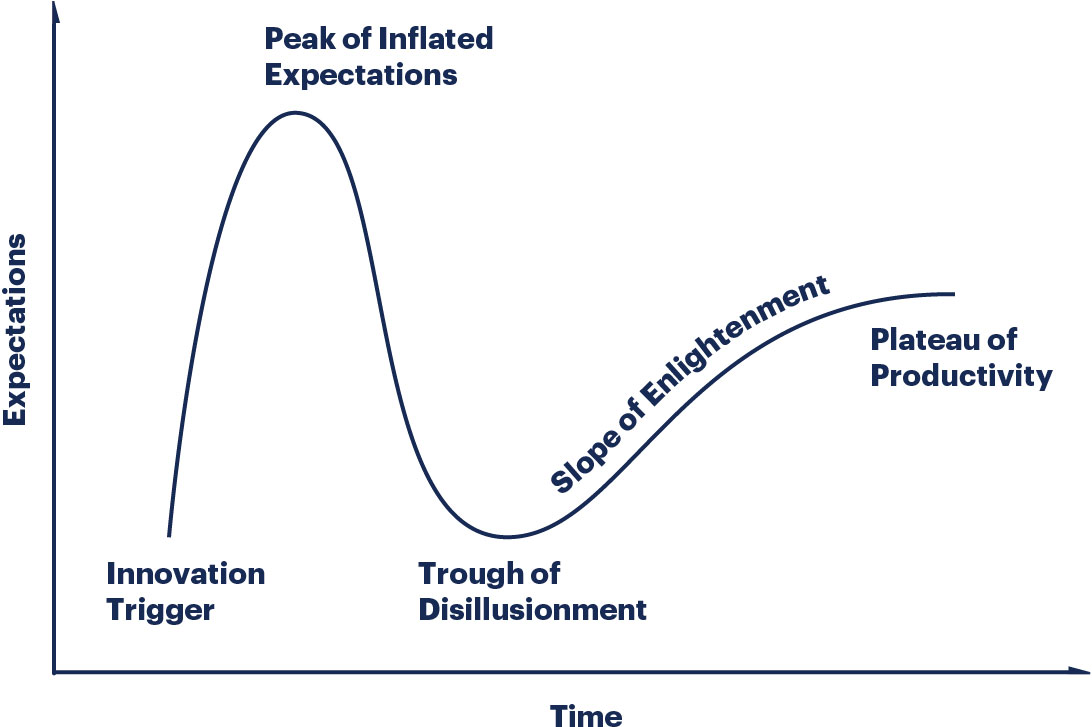
    According to Steve, not enough companies are working on process level applications – there is a lot of emphasis on carrying out Proof-of-Concepts (POCs) by large enterprises – but these projects appear as press releases and then nothing else is heard about them later. We are currently in the “trough of disillusionment” phase of the Gartner Hype Cycle for Emerging Technology – it will be a few years until blockchain will go mainstream.

    However, this will only happen if firms focus on ‘utility applications’like the bank mandate project by Cygnetise (where a ‘utility application’ would mean replacing a manual process with blockchain.)

    Blockchain is becoming increasingly important – governments and corporates across the world are beginning to take an active interest in blockchain. For example, recently Amazon Web Services (AWS)has started to provide a managed blockchain service. There is a lot of interest in the legal profession regarding the legal status of smart contracts – a topic frequently debated in the community.

    Concluding thoughts

    Steve summarizes his recommendations – start small, build incrementally, aim for profitability and remain customer centric.

    Your Turn!

    Steve has provided some excellent insight into the key barriers to blockchain adoption.

    If you liked this episode, please do review it on iTunes. If you have any comments or suggestions on how we could improve, please don’t hesitate to add a comment below. If you’d like to ask Steve a question, feel free to add a comment below and we’ll get him over to our site to answer your questions.

    Thank you, Steve!


    Ep.40 – IBM’s 2019 Insurance Predictions Dec 16, 2018
    Show notes

    For this week’s episode, we spoke to Sandip Patel, Global Managing Director for insurance across IBM. Sandip refers to himself as a lifetime practitioner in the insurance industry having worked for PWC and Aetna and IBM within the insurance industry. In this special episode Sandip shares with us what are IBM’s 2019 insurance predictions.

    What is blockchain in under 2 minutes?

    Sandip reminds us that practitioners in the insurance industry are painfully aware of the friction and the manual cycles that are involved in different insurance processes.

    Blockchain is an operating system for establishing trust in the insurance trust. A shared replicated and permissioned ledger technology which allows any participant in the business network and the business process, that they are engaged in across different parties, to see these systems of records. It’s a single system of records, ledger of transactions, with consensus, prominence, immutability and finality.

    Blockchain carries the following three characteristics:

    • A level of transparency where transactions can be inspected by the relevant parties who have been granted explicit permission to view them.
    • A distributed ledger where there is a single immutable prominence regarding where the data came from and where they were actioned. This provides a level trust through every transaction flow through the blockchain.
    • A level of audit trail that exists where previous transactions can be confirmed as having happened providing a level of trust in the entirety of the transaction.

    IBM’s 2019 Predictions

    Sandip detailed out IBM’s 2019 insurance predictions around three key points:

    • Data
    • New Digital Ecosystems
    • Customer and ecosystem interactions to create a differentiated brand

    Data

    Digital transformation in insurance: Data is the new natural resource

    There is a fundamental shift in how we think of data. Where data is becoming the new natural resource, particularly in insurance from a few perspective:

    • Volume of data: The nature of data is changing. The rate and pace at which data sets are evolving is growing exponentially. Data sets are going to keep growing to petabytes level and more with which the insurance industry is going to have to deal with.
    • Type of data: The nature of data both structured and unstructured is fundamentally changing. 60 – 70% of the data sets such as from wearables, sensors, and drones, often referred to as unstructured data sets since most computers haven’t yet been exposed to such type of data sets.
    • Temporal factor of data (relevance). There are data sets which are being created which loose relevance within a few nanoseconds of being created.

    The shift requires insurers to fundamentally rethink how to think about data. Traditionally insurers have thrived and excelled in capturing, storing and owning large volumes of data about their customers, products, risk factors, historical events…etc. In the future there are going to be very relevant data sets such as sensor data which informs certain risk factors at the point of time they are created where the paradigm of data is going to be how quickly are you able to capture the data set at the point of creation and enable some decision making based on certain risk factors.

    Competitive advantage in the insurance industry today is defined by an insurer’s ability to leverage all this data – structured, unstructured, owned, bought, rented, accessed on demand – and drive insights at scale to proactively find new customer segments, gain early insights into customer needs, and quickly innovate products that blend traditional risk products with insightful risk advice and preventive services.

    New digital ecosystems

    The second paradigm shift that is happening in the insurance industry is around the new ecosystems that are being created. These ecosystems require the players within them to operate in a fundamentally different manner with their customers and partners to identify revenue and profit goals within those ecosystems.

    Customer and ecosystem interactions to create a differentiated brand

    In a digital world customers expect insurers to interact with them directly. This of course can be challenging to the insurance industry which is traditionally accustomed to having intermediaries. However, this digital world requires a fundamentally different mindset on how you structure those points of interaction. These points of interaction represent an opportunity for insurers to create a brand about themselves that is different to the one they traditionally played where their only point of interaction was around paying claims when something bad happened.

    The ability for insurers to rethink their brand through hyper personalisation, demonstrating an element of service that is at par with other digital interactions a customer has with other companies. Create a level of perception that an insurance company isn’t here to simply pay out claims but is here to proactively pre-empt those claims and help to protect a level of trust with them.

    In a data-rich environment, a segment of the insurance business will shift from pricing and managing the risk of loss to pricing and managing the risk of prevention, including monitoring and preventative services that will define competitive parity.

    You now have the ability through data sets and through ecosystem partnerships to actually offer new products advice, and services where you start to change your brand to customers. Someone that is able to partner with customers to help them prevent losses before they actually happen.

    Challenges of the insurance industry in realising those predictions

    Whilst data has been booming in the last few years producing more data that has ever been produced, the manner in which the insurance industry uses data to price and analyse risk is based on historical data. The insurance industry doesn’t seem to have embraced real time data for real time pricing and even less for predictive analytics for anticipating future risks.

    Traditionally the insurance industry has been about capturing data, storing it and analysing historical data. That approach though is going to be too costly for a single insurer to capture, store, and analyse all those data sets, even for historical purposes. Insurers are looking for partners, such as IBM, that can curate large volumes of data and make it available in a consolidated form at the point of decision making to take advantage of driving predictable models to prevent risks or to create a whole new breed of products.

    In a world that is increasingly connected with autonomous cars, connected homes, and individuals with wearables we will start to look at insurance models where the technology and capability will exist to both create predictive models for how you price and manage risk. Additionally we will see new insurance products that can be both dynamically priced and managed based on how you can predict certain risks and proactively prevent them and monitor them.

    German Insurance Association

    To provide more detail to the above, Sandip provided us with an example regarding the importance of coopetition and the creation of non-traditional ecosystems through partnerships within the industry. IBM is doing some work with the German Insurance Association and Bosch that produces sensor devices that can be plugged into the cars. Working with Bosch and the German Insurance Association they have created a service called Ecall4all. The German Insurance Association requires its participating insurance companies to offer this device to their car insurance customers. If there is an impact to the car that the sensor detects it sends out an alert that is monitored and analysed by IBM. IBM will then send an alert, based on the GPS location of the car, for roadside assistance.

    Blockchain

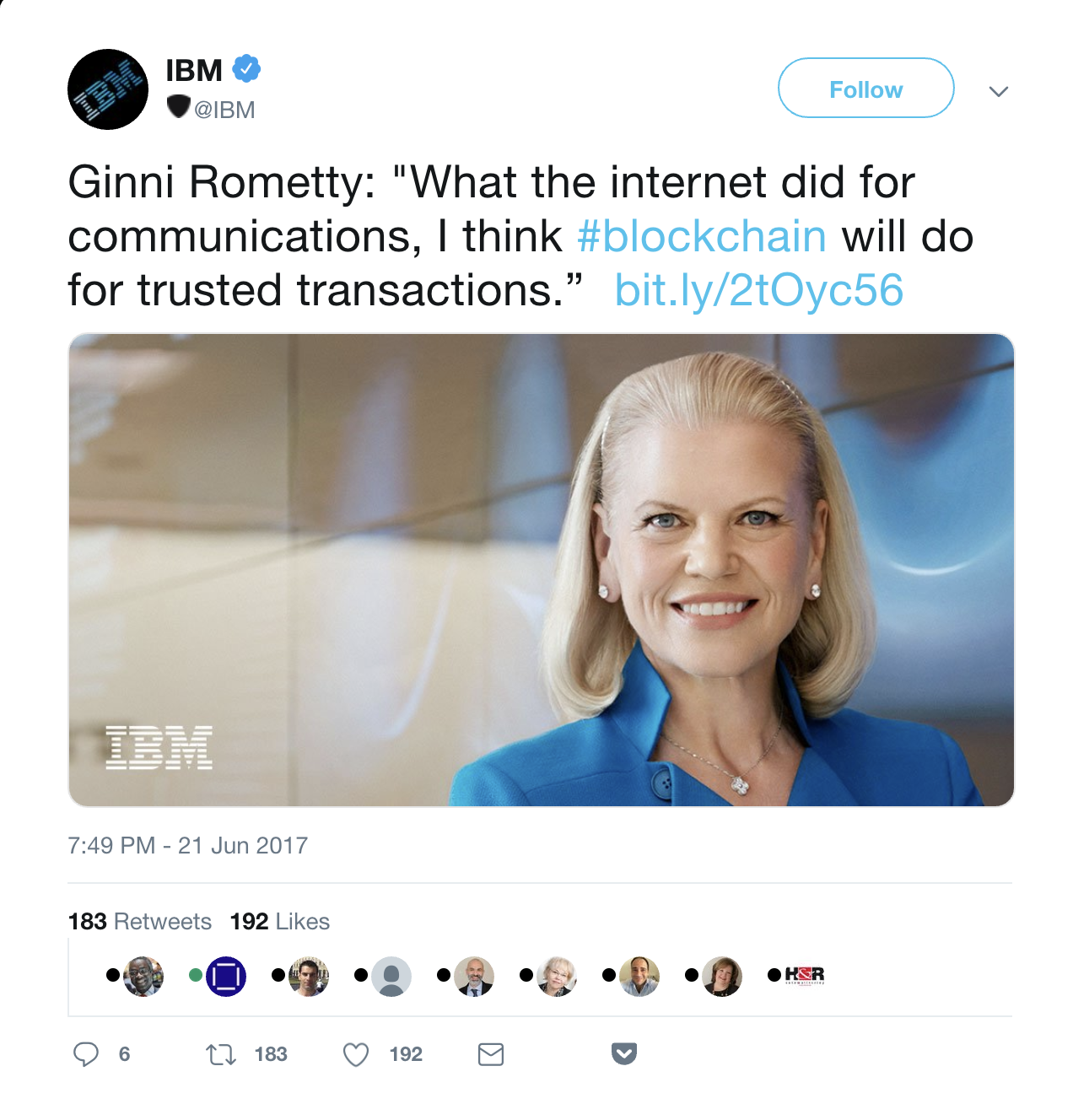
    Blockchain will become a fundamental part of the core operating processes. IBM’s chairman, Ginni Rometty “What the internet did for communications, I think blockchain will do for trusted transactions” (read more about her view on Business insider)

    The initial uptake of blockchain in the insurance industry has been around processes with high level of complexity and manual intervention that need to be automated. Additionally blockchain is useful where you have multiple parties across multiple geographies where it is impossible to know something happened with a level of trust and of provenance. That is where we have seen blockchain begin to become relevant because there is an immediate ROI benefit by simply taking the manual friction, compliance and regulatory issues out of the equation.

    However as insurers start to increasingly invest into blockchain they start to realise that it can help them re-establish the provenance, transparency and trust that is needed within the industry and our ecosystem partners.

    Your Turn

    Sandip has provided some excellent predictions on the challenges and opportunities the insurance industry will face in 2019.

    If you liked this episode, please do review it on iTunes – your reviews make a huge difference. If you have any comments or suggestions on how we could improve, please don’t hesitate to add a comment below. If you’d like to ask Sandip a question, feel free to add a comment below and we’ll get him over to our site to answer your questions.


    Ep.39 – Blockchain from a Nationwide perspective & lessons learnt Dec 09, 2018
    Show notes

    This week’s episode is slightly different from the norm – it was recorded off the fly and in the moment as a fireside style discussion. Walid had the opportunity to speak to Timothy Dwyer and Michael Fulton from Nationwide. During this podcast, we get an overview of Nationwide, discussed their perspective and lessons learnt on blockchain and its recent Proof of Insurance POC.

    First a little about our guests:

    Timothy Dwyer, Vice President & Assistant Treasurer to Nationwide, returns to our podcast to provide some further insight into blockchain from Nationwide’s perspective. Tim’s role at Nationwide covers banking, credit and debt finance.

    Michael Futon, Associate VP Technology Innovation, makes his debut appearance. Michael is the representative for Nationwide at the RiskBlock Alliance.

    What is blockchain?

    Michael answers this question from an innovator’s perspective –

    Blockchain allows participants to do things differently – its key properties are its decentralised nature and immutability.

    How important is immutability?

    Michael points out that it is difficult to find perfect use cases for blockchain. Walid posed an interesting question – wouldn’t tamper evidence in a system/solution be enough? Michael and Tim both agreed that in many use cases, it would be more practical to have a system that permits (but records) changes as mistakes are bound to happen!

    Although many use cases do not warrant the need for immutability, some specific cases such as asset transfer do require immutability (to prevent fraud and other forms of charge-back scams.) In some cases, reversibility may in fact be a desirable property – as referenced to during the discussion, in 2016, we saw the hack of the (first) DAO (‘DAO’ is an acronym for a ‘Decentralised Autonomous Organization’, recall that recently Hugh Karp from Nexus Mutual made an appearance on Insureblocks with a guest post– the Nexus Mutual is an example of a DAO.)

    Following the subsequent collapse of the DAO due to this hack, there was a hard fork on the Ethereum network – this split the network into ETH (Ethereum) and ETC (Ethereum Classic) – the hard fork represented a split in consensus – some parties wanted the DAO attack victims to be returned their money, but others did not. The DAO attack is an excellent example of the case where parties agree to “reverse” transactions on an otherwise immutable network.

    As our speakers point out, immutability and irreversibility need not be mutually exclusive – take the example of storing your books of accounts on the blockchain. The standard practice in the accounting profession is to never delete an incorrect transaction but to make a rectifying entry – the same idea may be applied to a blockchain – errors made may be corrected in subsequent blocks with a reference to the block containing incorrect/inaccurate information.

    An introduction to Nationwide

    Nationwide is a leading P&C and Life insurance company based out of the USA, it prides itself on writing a highly diversified line of business.

    Blockchain at Nationwide

    Timothy points out that the interest in blockchain stemmed from the lunch-time discussions surrounding cryptocurrencies in 2015. These discussions matured and lead to the formation of a monthly blockchain forum (which still runs today.)

    Michael and Timothy insist that Nationwide is still in the exploration/educational part of their journey with blockchain and they are actively observing how networks are developing.

    DLT beyond blockchain

    The CEO of Hedera – the company behind the much-hyped hash-graph technology has delivered talks at Nationwide – the company is demonstrating willingness to explore DLT solutions beyond blockchain.

    Nationwide has observed that hash-graphs are able to handle a larger volume of transaction flow than blockchain currently and a potential POC using hash-graphs is in the pipeline! It is important to note that it is still early days for Distributed Ledger Technology. Hash-graph may perform better than Corda currently, but there is no guarantee this will be the case even in the short term.

    Some advice

    Our guests point out that it is extremely important for an organization to balance technology and product innovation. Furthermore, the management must be able to prioritize areas of the business that are lagging behind competition or falling short of market expectations.

    Proof of Insurance POC with the RiskBlock Alliance

    The Proof of Insurance POCis Nationwide’s first blockchain project – as pointed out earlier, since the firm is in the educational phase of its journey with blockchain, the focus on this project was to validate the hypothesis that blockchain has the potential to revolutionize the way business is conducted currently.

    Nationwide already has a proof of insurance solution available to existing customers on their mobile phone – the focus of this project was not on the value add to customers but was to gain experience in working with the RiskBlock Alliance. The next step will be to use blockchain in a case which offers greater value add for both the customer and Nationwide.

    Discussion about blockchain projects outside of Nationwide

    Fizzy by AXA

    Fizzy is a parametric flight delay insurance product offered by AXA powered by the Ethereum blockchain network. Policies may be purchased online via the Fizzy website and claims payout is automatically triggered if a flight is delayed by two hours or more.

    In episode 22, Laurent Benichou, spoke about Fizzy at length and sent across an extremely powerful message that it is no longer AXA who decides whether the customer will be compensated rather it is the code which makes these decisions. At the recent FinTech Connect 2018 event in London, Alexandre Clement, Product Owner – Fizzy at AXA, presented some latest updates on Fizzy.

    The discussion brought up some interest points such as the notion that AXA may be able to charge a premium (over regular flight delay insurance prices) to customers due to the guaranteed payout in case of a delay (an element of trust induced by blockchain.) Furthermore, blockchain will reduce policy administration and claims handling costs which may allow insurers to offer previously financially unviable products (such as micro-insurance, which is presently being piloted by Aon, Etherisc and Oxfam in Sri Lanka!)

    Corda-based blockchain projects

    There are several insurance related projects being built on the R3 Corda platform. The most well-known include the B3i products (property CAT XoL and commercial insurance), Insurwave (commercial marine insurance product led by EY) and the Canopy 2.0 platform offered by the RiskBlock Alliance.

    The engineers are R3 have been hard at work to develop “Business Networks” with the goal of allowing Corda DApps to interact with each other within a “compatibility zone” – this prospect of cross-project interoperability may unlock huge value. An example would be the embedding the B3i offering with that of Marco Polo (a trade finance initiative built on Corda.)

    The transformational impact of blockchain

    Blockchain is bringing to insurance the same transformation that standardization of containers brought to the marine shipping industry in the 1950s – blockchain may be thought of as the catalyst driving various market participants to work together and develop ecosystem solutions.

    In the insurance industry, the adoption of the ACORD data standards is being championed by both B3i and the RiskBlock Alliance – having a common data standards across platforms and across the industry will pave the way for interoperability between different blockchain projects.

    Your turn!

    Michael and Tim have shared some great insights with us on their learnings on blockchain.

    If you liked this episode, please do review it on iTunes – your reviews make a huge difference. If you have any comments or suggestions on how we could improve, please don’t hesitate to add a comment below. If you’d like to ask Michael or Tim a question, feel free to add a comment below and we’ll get him over to our site to answer your questions.

    Thank you, Tim & Michael


    Ep.38 – ‘Mutualisation’ of insurance through blockchain – insights from VouchForMe Dec 03, 2018
    Show notes

    In this week’s episode we get an insight into how blockchain can enable ‘mutualisation’ and learn about social insurance from VouchForMe. Our guest is Matt Peterman, Founder, VouchForMe and InsurePal. Matt’s experience spans private equity and fraud detection in the insurance industry. It was roughly 3 years ago that Matt realized that ‘mutualisation’ in insurance was gone – this realization led to Matt co-founding InsurePal.

    Breaking down the jargon

    What is blockchain?

    “Blockchain is a mechanism where we can send information and money at the same time through non-centralized institutions.”

    Matt provides the example of Ethereum by highlighting that instead of sending money through Swift, people can now send money through a network for 25,000 miners (who form the Ethereum network) in a P2P (peer-to-peer) manner.

    What is Ethereum?

    “Ethereum is a software of the future (economy.)”

    Matt makes a profound statement that Ethereum is ‘a software’ and not ‘the software’ i.e. it is still early days in the blockchain/crypto world and only time will tell which software (public blockchain) prevails and reaches mass adoption.

    In this light, a recent article published on CoinDesk sheds some light onto why public blockchains are yet not suitable for enterprise needs. There are indications that the technology needs time to mature to become enterprise grade.

    Permissioned blockchain v/s Ethereum (public blockchain)

    Matt highlights that the Ethereum network is secured by over 25,000 nodes whereas a permissioned blockchain network implemented by a consortium might have as few as 4 or 5 nodes securing the network.

    A node may be thought of as a point where information is confirmed, stored and validated.

    The notion of ‘mutualisation’

    From an underwriter’s perspective

    From his experience in fraud detection, Matt recalls that there is a lot of opportunistic fraud and premium leakage in the insurance industry today. The Association of British Insurers concluded that there is one insurance scam roughly each minute!

    At the point of underwriting, there are numerous scams such as prospective policyholders claiming they have a garage for their car, when, in-fact they do not. Insurance companies today are trying to fight fraud by using big data or by trying to link customer provided data with other data-points including social media (Facebook, Google etc.)

    A mindset problem

    Matt points out that people think of insurance as a necessary evil. In some cases, insurance companies are thought of as government-sponsored entities which can be ‘used’ to obtain money from time to time!

    As Matt suggests, most people forget that these malicious activities increase the cost of claims which in-turn increases the premium charged to the end customers. In the UK alone (for FY 2016), insurance fraud cost the industry $1.3 billion and the industry spent $200 million trying to combat fraud. The origins of insurance can be traced back to Edward Lloyd’s coffeehouse where parties agreed to share risk (which reduces fraud) and it is this notion that VouchForMe is trying to bring back using blockchain.

    ‘VouchForMe’

    The notion of 3rdparty underwriting

    Traditional underwriting involves pricing using data made available by the customer and augmented data (with permission) from Facebook, Google etc. At ‘VouchForMe’, prospective policyholders are asked if they have many friends or family who would guarantee or vouch for them. ‘Vouching’ for a prospective policyholder means pre-authorizing a credit card to pay out a maximum of pre-agreed sum in the event of a claim by the prospective policyholder.

    There are two advantages that this scheme has:

    1. Reduction in adverse selection – Prospective policyholders are much more likely to be good drivers or good home-owners since they have a counter-party willing to vouch for them. This means that ‘VouchForMe’ has overall a better than average risk pool.
    2. Countering moral hazard – Since a policyholder has a counterparty (usually close friend/family) vouching for them, they are less likely to make a fraudulent claim.

    The notion of ‘mutual’ endorsements

    Matt was asked a question about why counter-parties would be willing to dedicate a portion of their credit card limit to vouch for an insurance policy for their friend/family.

    Matt responded by highlighting that endorsements are usually mutual– which turns out to be an excellent sales tool. Mutual endorsements also foster stronger relationships.

    As Matt points out, when a close friend or family member meets with a motor accident, your first response is not how do you plan to replace your car (hopefully) but it is more along the lines of expressing concern regarding their physical and mental wellbeing. Quite often, you may even lend your friend some money to help them! ‘VouchForMe’ is trying to translate the sympathetic nature of human beings into insurance contracts (smart contracts) on the blockchain.

    Why does ‘VouchForMe’ need blockchain?

    Matt believes that blockchain provides a neutral tool to allow customers to decide their destiny and decide who will support them along the way.

    Matt explains further that the ‘VouchForMe’ proposition could have easily been built without blockchain but that lead to a loss of the ‘neutral’ position. Many clients are scared today of handing over their data to companies and without blockchain, this consumer data would have to be stored on centralized servers.

    Why didn’t ‘VouchForMe’ use Facebook as the medium?

    Matt points out that this is a question he is often asked by insurers and the reason for not using Facebook as a medium is due to GDPR. If an insurer wishes to obtain additional underwriting information, they must go to Facebook, Google or other centralized data stores.

    Matt highlights that GDPR aims to put customers in control of their own data and insurers are extremely well placed to facilitate the return of ownership of private data back to customers. In fact, insurers would stand to gain a lot from notion of ‘self-sovereign data identity’ as the insurer would not have to go through an intermediary (Facebook or Google) to obtain accurate (and verifiable) customer data to carry out underwriting.

    It is also well-known that centralized institutions such as Facebook are large targets for cyber-attacks whereas public blockchains (Ethereum, in particular) have yet to be compromised as a whole (hacking a single node is possible but hacking the entire network is a feat as yet unaccomplished.)

    Responsibility for KYC and identity verification

    Matt mentions that the KYC process is carried out at the insurance companies end to ensure that there is no money laundering taking place. He goes on to mention that money laundering is a problem in life insurance but no so much in P&C insurance which is the current focus of ‘VouchForMe’.

    The process

    Matt provides an example to illustrate the sales process – at the point of sale, the insurer informs a prospective policyholder that there is a special offer which reduces the premium by a certain amount if the policyholder can bring three people to vouch for him/her up to some pre-specified amount each.

    As described earlier, not only does this sales process reduce risk but also it serves as an excellent marketing tool – people who vouch for others may wish to try the product offering for themselves!

    If a claim is triggered, the first notification of loss (FNOL) goes to the carrier and this automatically triggers communication to the guarantors informing them about the amount that is due from them due to the claim.

    As a result of this process, the insured usually bears the cost of small claims and is discouraged from making fraudulent claims or inflating claims amounts.

    Where is information stored?

    The policy sits on a centralized system whereas information regarding the relation(s) guaranteeing the policyholder sits on the Ethereum blockchain. ‘VouchForMe’ currently works on a hybrid data storage model – this would allow partner insurance companies to expand their existing customer-base to include individuals who are skeptical of storing too much personal information with companies.

    How does blockchain enable the ‘VouchForMe’ model?

    As Matt pointed out earlier, the ‘VouchForMe’ model does not require blockchain but blockchain enables privacy of data through Zero Knowledge Proofs(ZKP). Zero Knowledge Proofs allow verification of some information held by the customer without requiring the customer to release the information.

    It is important to note that ZKP provides probabilistic certainty about the information held by the customer i.e. a carrier may know with 99.99…. % probability that the customer has $100 in his account (but, the carrier doesn’t know exactly how much money the customer has).

    Why Ethereum and not a permissioned blockchain?

    Matt highlights that ‘VouchForMe’ aims to be a sustainable offering and hence, long term viability of the product is key. Since ‘VouchForMe’ is blockchain enabled, the life-span of the product is limited by the life-span of the blockchain protocol it is built on (Ethereum in this case.)

    According to Matt, since we are in the early days of blockchain, we could potentially see some large (permissioned and public) blockchain protocols become redundant within the next few years. However, he believes the Ethereum community has a large pool of developers who are active and engage in constant development of the network. Thus, he feels that Ethereum may be in better position to survive in the longer term as compared to some private blockchain protocols.

    In addition, Matt indicates that public blockchain protocols such as Ethereum may be safer for data storage and transmission since they are truly decentralised(Ethereum has over 25,000 nodes) as compared to permissioned blockchain protocols which may have fewer than 10 nodes securing the network. The number of nodes determines how difficult it is to hack the network.

    The journey ahead

    Matt points out that it is not necessary for insurance carriers to understand blockchain completely – he takes the example of the internet which is widely used today by almost everyone but very few understand how the internet works.

    ‘VouchForMe’ is currently running three pilots spanning motor and home insurancein the Netherlands and Switzerland. Since these pilots are still in their early stages, Matt does not have any datapoints to share. However, he anticipates that by January or February 2019, there will be enough traction to extract meaningful statistics.

    Your turn!

    Matt has provided some excellent how blockchain can enable ‘mutualisation’ in the insurance industry and explained the notion of ‘social insurance.’

    If you liked this episode, please do review it on iTunes – your reviews make a huge difference. If you have any comments or suggestions on how we could improve, please don’t hesitate to add a comment below. If you’d like to ask Matt a question, feel free to add a comment below and we’ll get him over to our site to answer your questions.

    Thank you, Matt!


    Ep. 37 – Blockchain in the specialty insurance market – insights from Ed, a Lloyd’s broker Nov 25, 2018
    Show notes

    For this week’s episode, we spoke to Arun Narayanan, Head of Data and Analytics at Ed. This episode provides an excellent insight into the specialty insurance market at Lloyd’s and how blockchain based solutions can streamline processes, generate savings and promote product innovation.

    Ed Broking is a global wholesale insurance broker which is headquartered in London with offices in China, Dubai, Germany, and the USA. Ed Broking provides clients with broking facilities for a wide-range of specialty business lines such as aerospace, marine cargo, construction and energy.

    What is blockchain?

    “Blockchain is a distributed ledger that sits on a peer-to-peer network where transactions are validated by every other member in the network.”

    After providing a technical definition of blockchain, Arun proceeds to explain the benefits and features of blockchain:

    1. Blockchain can improve data sharing – Each transaction stored on the distributed ledger must be validated and these transactions are visible to all parties with requisite permissions. Thus, blockchain can enable data sharing between parties that may potentially have conflict of interests (for example, insurers and reinsurers.)
    2. Blockchains are secure – Cryptography (cryptographic hashes) ensure that transactions once stored on chain cannot be tampered with – this makes the information in the blockchain secure and verifiable.
    3. Blockchain can generate savings – There is a large amount of manual work done in the Lloyd’s market today (especially in the specialty business lines). Smart contractscan help automate some of these tasks to save time and money. At the same time, immutability and time-stamping in a blockchain provides a verifiable audit trail for regulatory or internal compliance processes, thereby generating even more savings.

    Will blockchain disintermediate brokers?

    At the start of this calendar year, there was a lot of discussion around the possibility that blockchain will disintermediate brokers entirely. However, over the past few months, this idea has been replaced by a notion that blockchain will enable brokers to focus on their core competencies – translating complex risks their clients face and bringing appropriate risks to the correct sources of capital (underwriters).

    It goes without saying that automation may eat into some of the existing revenues of broker, but it is important to remember that blockchain, which may cause this revenue loss, will also reduce costs and create significant new product opportunities.

    Brokers leading the charge in blockchain – is this counterintuitive?

    Some examples of brokers playing an instrumental role in blockchain are:

    1. Marsh: In collaboration with IBM, ACORD and ISN, Marsh has launched a commercial Proof of Insurance solution on the IBM Hyperledger protocol. Extending this idea of proof of insurance, in October this year, Marsh collaborated with Evident to launch a blockchain based insurance verification solution for gig-economy workers.
    2. Willis Towers Watson (WTW): In May this year, WTW was part of the pilot for Insurwave – a commercial marine insurance blockchain solution which has report cost savings between 30% to 40%. Insurwave has been covered in detail in Episodes 12, 18 and 19.

    Arun steps in to help us understand why all is not lost for brokers and attempts to explain the growing interest in blockchain amongst brokers.

    “This (the emergence of blockchain) is a huge opportunity to improve the insurance value chain.”

    Arun believes that the combination of IoT, Blockchain and AI has the potential to enhance the insurance value chain and potentially re-define the roles of some of the incumbents. He believes that brokers will not be disintermediated since brokers are trusted advisors for clients. Since Ed Broking focuses on specialty lines of insurance, there is even less chance of disintermediation.

    How is business transacted today by brokers like Ed?

    Specialty lines of insurance have contracts that are bespoke. Arun believes that before commenting on how blockchain can improve existing processes, it is important to shed light on what the current processes are:

    Phase 1 – Client on-boarding / Analysis phase

    This phase is about figuring out what the risk exposure is i.e. what kind of coverage would the client require. This phase involves a lot of manual work since there is little structured data to work with – there is still a lot of work that needs to be done with regards to data standards.

    Phase 2 – Trading phase

    This phase may be thought of as the risk placement phase – sort of market negotiation. The broker goes out to find parties willing to underwrite the risk – this could take place across multiple markets. A lead underwriter sets the price and follow-on underwriters subscribe to (sometimes fixed) percentages of the contracts.

    The London Market Target Operating Model (LM TOM) is currently focusing on this phase of the process with the Placement Platform Limited (PPL) – this project is currently exceeding expectations; 29.6% of scope risks for Q3 2018 were placed through PPL!

    Phase 3 – Accounting and settlement phase

    This stage is concerned with the processing of transactions and settlement of claims which involve manual work – this is where smart contracts can generate savings through automation and the distributed ledger reduces cost by preventing duplication of effort and reconciliation.

    According to Arun, it is essential to streamline the data flow issues in the client onboarding phase.

    Opportunities presented by blockchain

    According to Arun, Ed Broking follows a technology agnostic approach.

    Blockchain offers some interesting opportunities for brokers such as Ed:

    1. Improve trade efficiency – A large portion of manual work done in the Lloyd’s market today could be automated and digitalized – this is precisely the focus of the PPL initiative. Reducing the possibility of human error and eliminating the need for data reconciliation are some of the ways blockchain can reduce friction in the insurance value chain.
    2. Improve customer satisfaction and customer service – cost and other benefits arising out of blockchain based solutions will translate to lower premiums for end customers and shorter periods for claim settlements.
    3. Product innovation – Blockchain could allow previously financially non-viable products (micro-insurance, on-demand insurance etc.) to be sold to customers by insurance intermediaries due to low overheads.

    What approach has been taken by Ed Broking?

    Ed Broking is currently not a part of B3i or the RiskBlock Alliance but is open to the idea of joining industry initiatives. Ed Broking is currently in the “educational stage” of their blockchain journey – the focus is on validating the business-use case and potential of blockchain. The aim is to determine the outcomes of such technology.

    As Arun puts is, there is internal support from the senior management to explore blockchain. The key is to be able to facilitate integration – a company cannot let go of its legacy infrastructure overnight and the new technology must fully integrate into existing systems.

    Arun believes that interoperability is key and that there will be multiple ecosystems in the future just as there are today. Interoperability between different protocols will ensure that in the future we don’t face the same problems arising due to data silos.

    Role of IoT devices

    IoT (Internet of Things) is beginning to play a major role in the insurance industry – in the Insurwave project, IoT devices are used to track containers, ships and other factors to provide accurate and real-time risk rating.

    Arun elaborates that underwriting today is primarily based on static data sets and pricing is experienced based. As we move into a world where we can get real-time data from IoT devices, incumbents and InsurTechs can begin to offer on-demand insurance or micro-policies (think of Metromile which has launched on-demand motor insurance recently in the UK). Going back to an earlier point, Arun highlights that being able to price risks more accurately and provide new (personalized) products lets brokers serve existing (and new) customers better.

    Another point briefly touched upon by Arun was the idea of parametric (or trigger-based) insurance products; these policies mark a move away from the traditional indemnity products offered by incumbents. Some incumbents such as Swiss Re already offer parametric insurance products for Nat Cat (natural catastrophe) events.

    Closing remarks

    Arun believes that blockchain will allow brokerage firms such as Ed Broking to improve customer satisfaction. In his opinion, the future of insurance lies in the combination of blockchain, AI and IoT. He re-iterates a sentiment that is shared by many – blockchain is a network solution and no single party can drive change; it must be an industry-wide effort.

    Your turn!

    Arun has provided some excellent insight into the specialty insurance marketplace and given us the broker’s perspective on blockchain.

    If you liked this episode, please do review it on iTunes – your reviews make a huge difference. If you have any comments or suggestions on how we could improve, please don’t hesitate to add a comment below. If you’d like to ask Arun a question, feel free to add a comment below and we’ll get him over to our site to answer your questions.

    Thank you, Arun!


    Ep.36 – Blockchain in the Indian insurance market – insights from Policybazaar Nov 18, 2018
    Show notes

    For this week’s episode, we spoke to Ashish Gupta, CEO of docprime.com and CTO of Policybazaar. This is our first time focusing on the Indian insurance ecosystem and Ashish provides an excellent insight into the $95 billion insurance market along with Policybazaar’s latest blockchain implementation. Indeed, an episode you cannot miss!

    Policybazaar is India’s leading insurance aggregator which provides a platform for retail customers to purchase health, life and motor insurance. Currently, Policybazaar has control over roughly 80-85% of the insurance aggregator market in India and the platform transacts roughly 30-40% of all personal line’s insurance cover sold in India.

    What is blockchain?

    “Blockchain is a more secure and dispersed way of saving data.”

    Ashish explains that in the Indian insurance market, data has been traditionally stored in servers – data is disjointed, there is a lack of transparency and a lack of trust during data exchange. Blockchain is resistant to change i.e. data is verified and parties can trust the data. Furthermore, data can be allowed to communicate to unlock value.

    Policybazaar and Blockchain

    Recently, Policybazaar announced its partnership with Accrivis network– a data integration platform provider to implement blockchain solutions.

    What problems can blockchain solve for Policybazaar?

    Ashish begins by providing a quick overview of how Policybazaar enables insurance purchases – by virtue of being an aggregator, Policybazaar interacts extensively with its customers and typically makes the transaction on behalf of the customer. Traditionally, API’s together with databases would enable this transaction to flow from customers to Policybazaar’s payment and insurance partners.

    “Data doesn’t need to necessarily reside in two places; one of the big problems is data sanctity across data storage mechanisms.”

    Ashish explains further by stating that Policybazaar has validations in place to check the customer’s name, age, email, phone number and other details. Similarly, its partners might have the same or a similar set of validations at their end too! This potentially leads to issues during data exchange and transfer.

    Blockchain is an attractive proposition for Policybazaar since a platform can be set up jointly with its partners – ownership is shared by Policybazaar and its partners – thus, everyone in the network shares, sees and trust the same version of the truth. This reduces operational cost and speeds up response time to customer queries.

    Merits of blockchain

    “The duplication and maintenance of data becomes extremely expensive, painful and time-consuming. (Introduction of blockchain) makes these issues goes away.”

    Ashish answered the difficult question of why blockchain v/s a centralized database by highlighting the key utility of blockchain in the insurance industry – Immutability. Since cryptographic hashes change if data is modified, blockchain prevents modification of data (a problem that often arises from Policybazaar’s experience.)

    The current blockchain implementation

    Presently, Policybazaar is exploring the application of blockchain for its payment mechanism and the reason for doing so is that Policybazaar is currently experimenting with offline payment mechanisms such as cash collection. Developing and deploying blockchain into the insurance ledger will be the next step.

    Policybazaar has chosen IBM Hyperledger for its blockchain deployment – Ashish elaborates that there is a sense of trust in the stability and performance of this blockchain protocol. Furthermore, the permissioned nature of the protocol suits the business requirements of Policybazaar.

    Policybazaar is currently not using smart contracts in its blockchain platform. However, once the platform is tested for stability and performance, smart contracts will be incorporated when the platform begins to address Policybazaar’s insurance partners.

    The business benefits of deploying blockchain

    Ashish clarifies that although a rigorous mathematical analysis of the cost benefits from blockchain deployment have not been carried out, he estimates that the cost of data handling and transmission through blockchain would be roughly 2x to 3x cheaper than traditional means of doing so.

    Blockchain creates value for insurance customers

    A major competitive edge that Policybazaar possess over its legacy insurance partners is that it is relatively new – it was founded 10 years ago! In some sense, legacy IT issues and scalability are not the kind of issues Policybazaar faces.

    “Policy Bazaar interacts with (via digital channels) about twenty to thirty times more customers than any other (core) insurance player in the country.”

    Thus, the cost of not being able to respond to customers in real time is extremely high for Policybazaar. As Ashish points out, for other players, digital is just one channel of revenue, for Policybazaar, it is the only channel of revenue.

    Blockchain prevents issues such as mismatches in data held by Policybazaar and its insurance partners which lead to slower response times to customer requests for quotes, claims and other reasons. Furthermore, Ashish stresses that some of the cost savings (that blockchain will deliver, in his opinion) will get passed on to the end customers.

    Policybazaar – a digital first business

    Ashish provides an excellent example which illustrates the digital first approach adopted by Policybazaar in the Indian insurance market. For a traditional Indian insurance firm, the first step in any transformation project is digitizing the data which is then followed by analyzing the data to extract insight. At Policybazaar, the data is already digitized, therefore, the first step is extracting insight from the data – this, according to Ashish, provides Policybazaar with a huge head start over other firms.

    Value add to insurance partners

    “There are distinct advantages of being an aggregator. 60% to 70% of people buying (insurance) digitally to visit our site – we have the unique ability to link different data points.”

    Ashish elaborates by sharing an interesting insight Policybazaar has been able to generate from its data – people who buy insurance at night are less likely to make a claim than people who buy during the day!

    Roughly a year and a half ago, Policybazaar started getting its insurance partners to share their claims data and merged this external (partner-provided) data with their claims data. This has allowed Policybazaar to provide a value-add service of giving insurance partners feedback on their pricing.

    According to Ashish, insurance partners are willing to explore blockchain with Policybazaar and share data since they have seen the value-add that Policybazaar has provided. He believes the blockchain discussion would have been a non-starter two or three years ago!

    Barriers to blockchain adoption in India

    “Everybody is interested in this field (blockchain) and everybody wants to explore this further. Risk mitigation is a big barrier to adoption.”

    Ashish believes that the biggest challenge is convincing its partners to move from the traditional data set-up (centralized and private servers) to a semi-private state (blockchain platform jointly owned and managed by Policybazaar and its partners.) Some of the concerns that have been raised by partners are related to scalability and performance – can blockchain handle capacity during peak-season? Partners are also interested in understanding the cost benefits that blockchain adoption will provide – will the gain from operational efficiency offset the additional computational and data storage requirements?

    Ashish has observed that partners are extremely interested in blockchain adoption – but a major challenge that lies ahead is there is lack of clarity as to where to start from with blockchain and when to scale blockchain enabled operations?

    Can Indian insurers work together on blockchain without Policybazaar?

    Ashish highlights that this question is open to debate. He states that there are some cases where insurers collaborate and others where they can be quite defensive.

    For no claim’s bonuses, there is full collaboration between insurance incumbents – moving service provider allows a customer to carry forward the no claims bonus from previous years with another service provider. However, there is a lot of gray area – some older insurance companies believe any change will benefit newer insurance companies more, hence, they are more resistant to change. But there is a growing realisation that resistance to change will lead them to become outdated!

    Ashish points out that the idea of making a mobile app to purchase insurance in India would have been considered ridiculous – the argument would have been insurance is an annual purchase. And, this idea has rapidly changed – the mindset is evolving…. Ashish believes that the biggest barrier to blockchain adoption is that is doesn’t require evolution of a single firm but requires evolution of an entire ecosystem to create value.

    The current state of blockchain in the Indian insurance ecosystem

    Blockchain is still in its infancy in the Indian insurance ecosystem. However, as Ashish highlights – there is growing interest in blockchain applications in insurance in India.

    In this light, the IRDA (Insurance Regulatory and Development Authority of India) published a working party report on InsurTech (dated 31/07/2018) which recommended that Indian insurance companies should look to create a consortium to explore blockchain adoption! In mid-April this year, there was a lot of buzz around a consortium of Indian Life insurance companies led by Cognizant to explore blockchain enabled data sharing.

    What changes in insurance can blockchain enable?

    A shift from macro-policies to micro-policies

    Ashish believes that blockchain may potentially lead to another benefit for customers – a move from macro policies (annual policies) to micro policies (shorter duration policies.) As Ashish describes, the current macro-policies put stress on customer finances for the month such policies are purchased in.

    Blockchain allows parties to share data and trust the data that is visible to them. You could imagine an annual motor insurance policy getting broken down into monthly pieces – this will only be possible if data is co-owned.

    Ashish provides the example of no-claims bonus for motor insurance – consider two people – the first has had three no claim years but met with an accident last year and the second has met with an accident each year for the past four years. Under the present system, both parties would receive the same no-claims discount of 0%. Thus, the present scheme is unfair and does not reward/punish customers for their behavior. This scheme results from the fact that insurers do not trust the information provided to them – both by customers and by the previous insurers.

    Personalization of policies

    “At least from a technical or digital or data sanity point of view it (personalization of policies) is feasible.”

    Ashish was asked regarding his views concerning policy segmentation at an atomic level. To this he responded that this is possible but will be difficult to achieve. Ashish points out that there is scope for value-add by combining a core health insurance offering from one company with certain service levels offered by another companies.

    “Now whether it (personalization of policies) makes sense or not or whether the customers want is another battle.”

    However, Ashish highlights that there is a strong sense of brand loyalty towards insurers in India – customers may not want to mix and match their products!

    Blockchain at Policybazaar – the lessons and journey ahead

    The lessons

    Ashish was interviewed in July this year on Policybazaar’s view on blockchain. Ashish states that his optimistic views regarding blockchain still remain, but this exercise has given the team at the Policybazaar a deep insight into blockchain. The theoretical knowledge is now augmented with awareness and practical insight.

    The journey ahead

    As Ashish mentioned earlier, the current blockchain project is aimed at streamlining payments. Once this project has been successful, Ashish hopes to deploy blockchain on the insurance side – bringing Policybazaar’s insurance partners onto the blockchain platform. Ashish stresses that the end goal is to provide a transparent, quick and seamless experience for Policybazaar customers.

    Tips for insurance professionals looking to explore blockchain

    1. Don’t explore blockchain on your own

    • Ashish believes successful blockchain implementation requires a firm’s partners to believe in the platform and adopt it.
    • He recommends exploring blockchain with at least two parties – this is the idea that blockchain is an ecosystem solution. In previous episodes, Jags Rao from Swiss Re and Antonio Di Marzo from B3i made similar statements.

    2. Be clear about the goals of the project

    • According to Ashish, blockchain should be used where there is a need for data transparency and data sanctity.

    Your turn!

    Ashish has provided some excellent insight into the Indian insurance market along with information about Policybazaar and its latest blockchain implementation.

    If you liked this episode, please do review it on iTunes – your reviews make a huge difference. If you have any comments or suggestions on how we could improve, please don’t hesitate to add a comment below. If you’d like to ask Ashish a question, feel free to add a comment below and we’ll get him over to our site to answer your questions.


    Ep.35 – B3i:An insight into commercial insurance on the blockchain Nov 11, 2018
    Show notes

    For this week’s episode, we had the opportunity to speak to Antonio Di Marzo, Product Owner – Commercial Insurance at B3i, at the B3i headquarters in Zurich. Antonio provides an excellent insight into B3i’s upcoming project – commercial insurance on the blockchain which was announced in September this year at the ‘Rendez-Vous de Septembre’. If you haven’t listened to the earlier News Flash episode regarding this announcement, now is a good time to do so!

    Prior to his current role at B3i, Antonio spent over ten years at Generali Global Corporate and Commercial. During his time at Generali, he was involved in building a global platform and he feels deploying this platform across various countries was the biggest challenge he faced. Antonio brings this experience of leading digital transformation and dealing with different cultures to B3i.

    What is blockchain?

    “Blockchain is a catalyst (for industry); this technology is bringing people together, empowering people and enabling transformation.”

    Antonio believes there is no set definition for blockchain because the technology is evolving rapidly. He compares blockchain today to the internet in the 1990’s – there is lack of clarity regarding a definition but there is a clear indication that the technology has the potential to increase customer satisfaction, increase industry profitability and increase insurance penetration.

    “Blockchain has the potential to empower people to challenge the status quo. Insurance is an enabler for human beings.”

    Antonio recognizes that insurance provides peace of mind, encourages constructive risk-taking and provides a cushion for the bad times. Furthermore, he believes blockchain can help increase insurance penetration. This sentiment is shared by many others at B3i – Philipp Tölle, Co-Architect at B3i, was recently interviewed and he spoke along similar lines.

    “Blockchain is bringing trust, integration and automation.”

    Antonio stresses that prior to the advent of blockchain, participants in the insurance industry were working in silos.The breakthrough that blockchain has provided is a shift in the industry mindset towards working in ecosystems.

    Foundations of B3i

    The Lloyd’s – B3i connect

    “Lloyds is an example of success. However, it is not technology enabled, it is human being enabled.”

    Following a question about Lloyds offering a (physical) insurance ecosystem, Antonio clarified his earlier statement about blockchain enabling ecosystems in the insurance industry.

    Although he acknowledges that Lloyds has spread to various countries and it serves as an excellent model since all competitors behave in a similar way, he asserts that B3i wishes to build several ecosystems that are interconnected and allow easy integration of new ecosystems.

    “What if we copy the Lloyds mindset and spread (the model) using a technology that can support such activity?”

    Enter B3i

    “(B3i was formed due to) the willingness to check if this technology (blockchain) was an enabler for the insurance industry.”

    Antonio explains that that the founding members of B3i recognized that they all wanted to seriously explore what blockchain was capable of – hence, it was natural to join forces. Even though each founding member was capable of exploring blockchain individually, there was an understanding that an optimal outcome would only be achieved through cooperation – this notion is shared by Jags Rao, Blockchain Workstream Lead at Swiss Re, who was interviewed in the previous episode.

    B3i began as a consortium and built its proof of concept (POC) on IBM Hyperledger Fabric. The POC involved over 100 nodes and thousands of insurance contracts. This POC convinced the initial members to look at blockchain seriously as evidence suggested that blockchain will be an enabler.

    The analogy between B3i and a child

    Antonio explains that parents recognize the importance of coaching, education and support to enable their child to achieve their potential. Similarly, the initial members of B3i were convinced that to unlock the true potential of blockchain, B3i would have to be incorporated as a separate legal entity with proper funding. Competitors would have to set aside differences and work together to ensure the best outcome.

    “B3i is a community where cooperation drives activity and it consists of a team of developers who are looking to bring blockchain to the insurance industry.”

    The next steps for B3i

    Antonio explains that reinsurance was an excellent starting point for B3i while exploring blockchain. The reinsurance market is characterized by large premiums and few transactions – once again, using an analogue to a child, he explains parents first coach children to walk and only then train them for a marathon!

    On 1stJanuary 2019, ‘Codex 1’ (the B3i Property CAT XoL product) will go live along with the B3i platform. The platform is a business network to connect cedants, brokers and reinsurers. As Antonio explains, this project will lay down the general infrastructure (analogous to roads, railways etc. in the physical world) needed to let participants communicate in a common language and interact with the (property CAT XoL) product.

    According to Antonio, B3i is now able to explore a new product (commercial insurance) since it can duplicate the code and underlying infrastructure i.e. a significant portion of the work has already been done in the past.

    Why commercial insurance?

    “There is a strong connection between the problems in CAT XoL placement and the problems in commercial insurance.”

    Antonio explains that there is contract uncertainty in the commercial insurance industry which arises due to high latency and friction resulting from manual processes. B3i aims to provide an environment for all market participants to be integrated. The first step in integration is to allow all parties to speak a common language. Antonio clarifies that although the problems may be similar, the same solution cannot be applied. However, a solution can be modified according to specific requirements.

    The 3 pillars of transformation

    “The three pillars – standardization, integration and automation are together like TNT.”

    Antonio compares the work B3i is doing today to the work that was done in the shipping industry in the 1950’s – promotion of integration, standardization and automation. Antonio points out that the insurance industry already has excellent standards; B3i follows the ACORD standards.

    Furthermore, B3i wants to make sure the infrastructure it develops is available to everyone. B3i has already expressed willingness to allow 3rdparties to develop solutions on top of their platform. The recent launch of the B3i membership community opens the door for non-shareholders to work alongside B3i and its members.

    Community led approach

    “Our (B3i) platform needs to be able to create the wow factor from brokers to cedants to reinsurers.”

    When asked about how B3i intends to test its market hypothesis, Antonio replied by drawing attention to a series of workshops that B3i will be organizing – the pilot workshop took place in Zurich and Insureblocks was a part of the same!

    These workshops have a dual purpose – to permit discussions regarding the common issues faced by market participants and to arrive at a consensus regarding which issues are to be prioritized. Antonio stresses that the goal of B3i is to create Minimum Loveable Products to drive adoption across the board in the industry.

    Global reach

    “Commercial insurance is a global market, but transactions are locally executed.”

    Antonio states that the perception that B3i is a European organization is incorrect – he supports this statement by pointing out that the participants at the B3i workshop – Zurich Insurance Group, Allianz, Liberty Mutual are global organisations.

    However, Antonio recognizes that commercial insurance, though global in nature, is strongly influenced by local factors. Some excellent examples of local initiatives are the Italian commercial insurance initiative (which we covered in a previous episode) and the Spanish co-insurance initiative. Antonio believes that B3i will be an enabler for local initiatives.

    A reality check: standardisation and integration in an industry that hasn’t embraced digitalisation?

    Antonio was asked an extremely difficult and topical question – how can B3i achieve its goals of standardization and integration in the insurance industry when the industry is yet to embrace digitalization?

    “It is a massive challenge; B3i is here to embrace massive challenges. You need two things – time and willingness”

    The PDF analogue to describe the human factor

    Antonio takes the example of PDF documents – he explains that the reason why the PDF format is so popular today is that it provides a medium for tamper-proof exchange of documents. Antonio now asks an interesting question – “What if there is another technology that guarantees what you see is what is received?” He adds that feedback regarding the message would be received via the same infrastructure (a hint at what DLT is capable of.)

    Antonio now connects all the dots together – he explains that the popularity of PDF is because of the comfort we (as humans) have with its format. Furthermore, he highlights that the major limitation PDF faces as a format for data exchange is its inability to facilitate interactions between value chain participants.

    Antonio stresses that blockchain has one key feature which makes it ideal for information exchange – trust. Blockchain guarantees that there is a single version of the truth that is visible to parties. Blockchain eliminates the duplication of manual work.

    “There is the human factor and at B3i, our aim is to enable humans to transact a business.”

    Antonio believes that the first step to integration is to provide the infrastructure to facilitate communication and value exchange. Once such infrastructure is in place, a common language can be introduced (standardization) and the adoption will follow naturally.

    The roadmap for the commercial insurance offering by B3i

    “The vision for us (B3i) is to release the infrastructure that will enable the commercial insurance ecosystem to be affordable and relevant.”

    According to Antonio, B3i will approach the commercial insurance project using an agile plan. The project kick-off around the end of January 2019 and the plan is to release the Minimum Loveable Product by the end of 2019. The product launch will be on a global scale and B3i is in the process of shortlisting two geographies for the initial product launch.

    Your turn!

    Antonio has provided some excellent insight into the motivations behind the commercial insurance project planned by B3i.

    If you liked this episode, please do review it on iTunes – your reviews make a huge difference. If you have any comments or suggestions on how we could improve, please don’t hesitate to add a comment below. If you’d like to ask Antonio a question, feel free to add a comment below and we’ll get him over to our site to answer your questions.

    Thank you, Antonio!


    Ep. 34 – Blockchain from Swiss Re’s perspective and the lessons learnt Nov 05, 2018
    Show notes

    In this week’s episode we get an insight into blockchain from the perspective of Swiss Re and hear about the lessons learnt from their projects. Our guest is Jags Rao, Blockchain Workstream Lead, Finance Reinsurance at Swiss Re. Having started out his career over 22 years ago as a software engineer working on a COBOL system, Jags has seen tremendous changes in technology – today he is a strong proponent of distributed computing and he is betting big on blockchain!

    What is blockchain?

    “(Blockchain is) a platform in which you can validate transactions, and this makes blockchain fascinating!”

    According to Jags, blockchain consists of several components – a network, a protocol, and a distributed ledger. From the business perspective, blockchain permits virtual recording of economic transactions i.e. an exchange involving something of value – which could be a will, a deed or even a title license. From the technology perspective, it is an open-ended database which records transactions in an immutable fashion.

    How did the blockchain journey begin?

    Jags introduced blockchain to Swiss Re. However, his personal journey in exploring blockchain began by looking at Bitcoin. Jags realized that the technology underlying Bitcoin could be relevant to the enterprise world as it could solve some of the fundamental problems in the insurance industry.

    “The insurance industry has been financially healthy, but operationally less efficient. This is partly due to multiple layers of counterparties in the insurance value chain.”

    According to Jags, blockchain brings the promise of creating a common network to allow counterparties to track data driven interactions without needing to maintain their own systems. Blockchain will not help just one company but help the industry as a whole.

    Blockchain in the insurance industry

    Is blockchain a challenge, an opportunity or a threat?

    “This (referring to the change driven by blockchain adoption) is a clear business model innovation opportunity for us (Swiss Re.)”

    Jags acknowledges that innovation in the insurance industry today is being driven by the end customers of insurance – the change in customer demand makes it easy to bring about change in the industry.

    Jags describes Swiss Re as a “risk knowledge company.” The key factors driving profit in insurance today are –

    1. Risk management
    2. Global diversification
    3. Informational asymmetry

    Informational asymmetry in the value chain generates profits for participants. However, blockchain provides a common network where participants come together – thus reducing informational asymmetries.

    This raises an interesting question – in an environment where blockchain is eliminating informational asymmetry, how should an incumbent react to maintain its leadership position?

    Jags views this impact of blockchain as an opportunity to innovate with business models and not as a threat to the existence of (re)insures.

    The network effect

    “Collaboration is key; blockchain is an ecosystem solution.”

    Jags asserts that Swiss Re does not consider blockchain as an internal process improvement tool but rather as a mechanism to engage with the ecosystem where a critical mass of players can be achieved. Highlighting that over 60 cooperatives have been formed that are relevant to the insurance business, Jags stresses that there is a need for team spirit and the ecosystem way is the only way forward.

    Jags was asked about blockchain solutions in other industries – such as TradeLens (IBM and Maersk) in the international trade industry and Food Trust (IBM and Walllmart) in the grocery value chain.

    Jags responded by stating that such projects present a massive opportunity to open new risk pools for insurance companies. He highlights that the emergence of such digital ecosystems pioneered by trusted brands to solve real business problems makes it extremely important for companies such as Swiss Re to continue exploring blockchain.

    Permissioned blockchain protocols and informational asymmetry

    Jags clarifies that informational asymmetry is not eliminated by blockchain. He elaborates that permissioned blockchain protocols allow information sharing on a need-to-know basis i.e. such protocols provide privacy preserving transparency.

    Jags has co-authored a paper titled “Privacy preserving transparency in blockchain networks.” The idea of blockchain networks providing privacy preserving transparency is best illustrated through permissioned blockchain protocols – enterprises can retain their secrets but still engage with the ecosystem.

    Are insurers playing a catch-up game in blockchain?

    Jags answers this question from the perspective of Swiss Re – he highlights that the company has a strong position and a good understanding of the implications of emerging technology. Some technology projects are directly supervised by the CEO and there is a consensus that emerging technology will be an enabler for the business.

    When asked about the risk that is posed by alternative capital pools entering the insurance industry due to digitalization, Jags asserts that this doesn’t pose a huge risk but does stress that the current market changes are transformative in nature.

    Swiss Re, B3i and blockchain – the journey and the learnings

    The first blockchain project at Swiss Re

    Jags stated that the first blockchain project at Swiss Re was focused on intergroup retrocession – an internal business process. This project helped validate the technology hypothesis of blockchain. Swiss Re was able to identify that counterparties could come together, set up a contract and validate contracts which would result in entries being recorded on the distributed ledger. Jags recalls this project was undertaken in the summer of 2016 in the south of France at a lab of one of their technology vendors – he was truly fascinated by the visibility that blockchain provided – it was this project that gave the cross disciplinary team exploring blockchain at Swiss Re the confidence that blockchain has a strong use case.

    “More often than not blockchain need not be applied.”

    As Jags points out, the team at Swiss Re has gained tremendous insight into blockchain – both from the business and technical perspective – their viewpoint has matured, and the focus is now on those projects that demonstrate a real need for blockchain to solve a business problem.

    How do you convince the management to sponsor blockchain exploration?

    “You have to get your hands dirty and see it for yourself.”

    About two and a half years ago, Jags was the first full-time resource working on blockchain at Swiss Re. At that time, his prime focus was to display the benefits of blockchain – emphasizing that the technology can be applied to the business.

    Jags gave some interesting advice on how to secure senior management buy-in:

    1. Develop a roadmap
    2. Demonstrate focus – there are numerous projects that may be undertaken but most won’t go beyond the POC (Proof of Concept) stage.
    3. Stress on the commercial viability

    Lastly, Jags highlights that nothing will be possible unless there are people on the ground who are prepared to experiment, possibly fail, learn and move forward.

    Jags once again iterates his earlier point that blockchain is an ecosystem solution – therefore, it is important to build a consortium, and this is where B3i comes in.

    The Swiss Re Distributed Ledger Technology Strategy

    Jags admits that work on the development of a framework for exploration of blockchain has only begun this year. Swiss Re has conducted an exercise to identify which digital ecosystems should be partnered with and which projects are worth exploring with blockchain. A by-product of this exercise is the development of a use-case assessment framework that identifies key criteria to decided whether blockchain should be implemented or not.

    Although such a decision tree is in place, Jags states that Swiss Re will share the same at an “appropriate time.” The justification provided by him is that this framework has been created based on the experience of the DLT team at Swiss Re but would like to see how input from business teams will modify the framework.

    Top tips for insurance professionals wishing to explore blockchain

    “My first tip would be don’t initiate any blockchain project. Initiate projects which can solve a business problem that is important to your company.”

    Jags explains that blockchain is a means to solve business problems – the number of blockchain projects that don’t proceed beyond POCs indicate that many decision makers overlook this aspect of blockchain. Jags suggests that projects involving blockchain are change management projects – blockchain should be deployed to solve business problems and to bring stakeholders together.

    There will be resistance to change because blockchain requires engagement of cross-functional stakeholders – resistance will come from people who have been in the business for a long period of time – change must be delivered step-by-step from the ground up all the way to the executive level.

    Closing words – blockchain outside the insurance industry

    “At Swiss Re we strongly believe that our goal is to make this world more resilient.”

    Jags highlights that blockchain isn’t just confined to the insurance industry. He takes the example of ‘Helperbit’ which is an Italian start-up using blockchain to offer a digital disaster management platform – it allows people to donate to others in areas affected by natural disasters. It offers security – donators are in full control of their funds and donations can be made via both fiat money and crypto currencies.

    Your turn!

    Jags has provided some excellent insight into blockchain in the insurance industry and Swiss Re’s learnings about blockchain. You can discover more about his insights in a recent post on the ICISA Insider.

    If you liked this episode, please do review it on iTunes – your reviews make a huge difference. If you have any comments or suggestions on how we could improve, please don’t hesitate to add a comment below. If you’d like to ask Jags a question, feel free to add a comment below and we’ll get him over to our site to answer your questions.

    Jags Rao on Insureblocks

    Thank you, Jags!


    Ep. 33 – Healthcare and Insurance on the Blockchain – Digipharm Oct 29, 2018
    Show notes

    In this week’s episode we will investigate how blockchain is being deployed in the healthcare and the health insurance industry. Our guest is Ahmed Abdulla, CEO & Founder of Digipharm. Prior to founding Digipharm, Ahmed was a Global Health Economist at Rosche and Research Associate at the University of Liverpool. In addition to his present role as CEO, Ahmed is a Blockchain expert in healthcare for the United Nations Economic Commission for Europe.

    Blockchain in two minutes

    According to Ahmed, blockchain is a collection of records – referred to as ‘blocks.’ Through cryptographic hashes, a block is linked to the previous block. This creates an open and distributed ledger, which is cryptographically secure, timestamped and immutable.

    Digipharm and value-based healthcare

    Digipharm began as a project a year and a half ago with a goal of becoming an independent third-party platform to implement value based healthcare which is the notion of paying for healthcare on the basis of the performance of the treatment or drug.

    Ahmed explains that there are two major factors that prevent patients from accessing the best healthcare facilities.

    1. Cost

    Speaking from experience, Ahmed highlights that pharmaceutical companies spend millions in R&D activities for new drug development. Once a patent for a drug has been obtained, the pharmaceutical company must undergo the process of securing FDA or EMA approval. Hence, there is a short period of time between receipt of approval and expiry of the patent i.e. the company must recover its expenses and generate profit in a relatively short period of time.

    As a result, the prices of new drugs are usually quite high – customers are unable to handle the ever-increasing cost of medical treatment and parties (such as the Government, insurance companies etc) struggle to meet these rising costs.

    2. Uncertain medical outcomes

    Approval for new drugs or treatments are given based on evidence collected during clinical studies. Thus, there is uncertainty of the performance of such drugs and treatments – this creates the need for a mechanism where performance data is tracked, and outcomes data is used to pay for healthcare.

    As described by Ahmed, there is a misalignment of incentives of various stakeholders within the health economy. Customers and other payers (Governments and insurance companies) wish to reduce the rising cost of medical treatment and counter the uncertainty of the outcomes of medical treatments, pharmaceutical companies are forced to charge high prices to recover their investments into R&D and regulators are unable to lower standards to maintain safety.

    Implementation of value-based healthcare

    Does such a model exist?

    “Value-based Health Care is a mature concept. It is not something that Digipharm has developed. The issue lies within its implementation.”

    When asked if such a model can be implemented, he explained that the ‘outcomes’ of a treatment or drug which form the basis for determining payments under a value-based healthcare system can be quantified. In this regard, he gave some examples –

    • For cancer related treatments, it would be progression (worsening/spread of cancer) or survival.
    • For diabetes and cholesterol drugs, it could be blood glucose levels and cholesterol levels respectively.

    Thus, there are measurable outcomes that can be used to determine performance and hence, determine payments under a value-based healthcare system.

    How does Digipharm help in the implementation of this model?

    Ahmed clarified that Digipharm does not replace the initial (face-to-face) negotiations between manufacturers (drug or treatment providers) and payers (such as insurance companies.)

    Digipharm helps by providing a platform to automatically reconcile pricing agreements – patients start treatments at different times and reach the various stages of illness or recovery at different times – there is a need for a system that can track all patient events. Presently, such reconciliation is done manually – which is exposed to human error, data mismatches and potential fraud.

    The challenge – getting the data right

    Ahmed suggests that a solution should be able to integrate to health information systems or clinical data registries, for example, using an API link to access NHS information. Digipharm facilitates integration with health data in full compliance with the health industry standards for electronic health records.

    Why is blockchain used?

    At Insureblocks, we feel it is important to ask our guests why blockchain was chosen as the technology to help them solve their business problem.

    1. Ahmed explains that the distributed ledger allows all parties to see a single version of data – this reduces operational costs of data verification and reconciliation by each party.
    2. Ledger entries are timestamped, verified, cryptographically secured and immutable – these features facilitate trust among the concerned parties.
    3. Furthermore, smart contracts can be used to automate reconciliation as per contract agreements.

    How does blockchain fit into the value-based healthcare model?

    Digipharm has built its platform on the Hyperledger Fabric protocol.

    1. Agreement between parties– Agreements are made off-chain but Digipharm is able to used Chaincode (the ‘smart contracts’ on Hyperledger Fabric) to automate processing of agreements between parties.
    2. Post-agreement data integration– APIs allow Digipharm to extract relevant data needed to compute price under the pre-decided pricing agreements – for example, such data may include the drug or treatment being administered and the outcome of the same.

    Ahmed highlights that pricing agreements in the healthcare sector are extremely confidential given the hyper-competitive nature of the industry and large sums of money involved in deals. Hyperledger Fabric delivers a high level of security to participants due to its permissioned nature and the active involvement of IBM.

    Is blockchain the only technological solution to the problem?

    Ahmed states that a solution could have been developed without blockchain. However, blockchain is an ideal solution due to its decentralised nature and the fact that it provides real-time visibility of data and events to all parties (who have the requisite permission.) Value-based healthcare is driven by collaboration and the decentralised nature of blockchain fosters such collaboration.

    Furthermore, taking a long-term view, Ahmed mentions that there are digital ID solutions being built on blockchains – this could allow platforms such as Digipharm to track patients and deliver personalization and thus, improve patient outcomes.

    In a recent episode, we covered Digital IDs on blockchain. Currently, Nodalblock offers a DigitalID solution that can be embedded into Ethereum or a private blockchain developed by Nodalblock for a client. Furthermore, Accenture recently announced it is testing an interoperability node between Ethereum and Hyperledger fabric. Thus, incorporation of digital IDs in the Digipharm platform is not a far-fetched idea.

    The role of health insurance companies

    Ahmed states that “health insurance companies are one of the key stakeholders within our minimum viable network.”

    For Digipharm, a minimum viable network includes manufacturers (pharmaceutical companies), payers (insurance companies, government agencies or individual customers) and providers(hospitals.) Digipharm will have health insurance companies participate in the pilots it plans to set up soon. However, as Ahmed points out, health insurance companies are spread over the globe and firms vary in size from multinational giants to small firms focusing on social health insurance.

    What are the challenges?

    In the words of Ahmed, “If we went in there (referring to meetings with healthcare ecosystem participants) and said it (the Digipharm solution) was a software and we didn’t mention blockchain, I think it would be a lot easier for us.”

    1. There is a lack of understanding and apprehensionabout blockchain.
    2. It is difficult to explain to participants that they must host their own nodes to maintain the decentralised and distributed nature of the system.
    3. Problem of embedding automation in a moving train – Ahmed describes the industry as a moving train and states that Digipharm does not possess the expertise to facilitate on-going digital transformation within the healthcare sector. Hence, it has partnered with a Big Four consulting firm which brings relevant expertise to the table.

    Ahmed highlights that Digipharm has also partnered with Swisscom Blockchain to assist the IT teams of participants to understand and implement blockchain.

    What’s next for Digipharm?

    Digipharm is currently planning various pilots with parties including leading pharmaceutical companies and international health authorities. Ahmed expects that each pilot will be different – covering areas such as digital IDs, bespoke integrations with custom electronic medical records, integration with medical devices etc. Digipharm aims to run these pilots around Q1 and Q2 of 2019 and take the learnings to develop a production level software.

    Ahmed mentions that there is a special partnership to build blockchain based e-hospitals in the cloud and that there will be a token sale (initial coin offering) to raise funds.

    Your turn!

    Ahmed has provided some excellent insight into how blockchain can be deployed in the healthcare sector to implement a value-based healthcare model.

    If you liked this episode, please do review it on iTunes– your reviews make a huge difference. If you have any comments or suggestions on how we could improve, please don’t hesitate to add a comment below. If you’d like to ask Stan or Karl a question, feel free to add a comment below and we’ll get them over to our site to answer your questions.

    Thank you, Ahmed!


    Ep. 32 – IBM’s Blockchain in the Insurance Industry Oct 21, 2018
    Show notes

    For this week’s episode we had the pleasure to hear about the exciting blockchain work IBM does in the insurance industry and beyond. We very pleased to have Craig Bedell, Global Insurance Industry Executive, and Annap Derebail, Executive Architect Financial Services Sector from IBM, take us through IBM’s journey with Hyperledger Fabric and some interesting blockchain case studies.

    Blockchain in 2 minutes

    Annap

    Annap chose to explain what is blockchain from an insurance perspective. The insurance industry operates within a network that involves brokers, service providers, regulators, advisory services, other insurance carries and reinsurers. They transact business across this network by exchanging assets that typically historically have been recorded in ledgers or systems of record by each party involved in these transactions.

    As they compete with each other they don’t necessarily trust each other. The effect of this lack of trust is that when ledger’s mismatch for whatever reason, either due to error or incomplete updates, businesses would spend considerable time and resources to resolving these disputes or reconciling records.

    Blockchain fundamentally brings a shared replicable ledger that records who owns what within a business network so that there are no disputes and records don’t have to be reconciled.

    Craig

    For Craig, blockchain is a technical platform for conducting transactions on a shared permanent ledger that records every aspect of every transaction between all associated parties. Don Tapscott, author of the blockchain revolution, refers to blockchain as being the second coming of the internet, the first internet being the internet of information and this second internet, blockchain, being the internet of value.

    Hyperledger

    Hyperledger was founded back in 2015 when a number of companies that were working on blockchain realised that they could achieve more by working together rather than separately. They came together with the aim of pooling resources in order to create open-source blockchain technology for anyone to use. The members put the governance under the foundation or guardianship of the Linux Foundation. The organisation now has over 230 member organisations from a wide variety of industries.

    Three key principles, why insurers should consider Hyperledger

    According to IBM, there are three key principles, why insurance companies should consider Hyperledger:

    1. Open source: the code is written in a reliable manner, has no vendor lock-in, resulting in high quality solutions
    2. Open governance: all technical decisions carried out within Hyperledger are made by a group of community elected developers.
    3. Open community: An open community concept which establishes enterprise friendly consistent handling of IP and this is done by adopting the Apache 2.0 license and the Creative Commons attribution 4.0 license for content.

    Beyond these three key principles there are a set of design principles for enterprises: modularity, security, interoperability, availability of open APIs that enable ease of dealing with these sorts of Hyperledger blockchain frameworks.

    IBM’s involvement in Hyperledger – Fabric

    Hyperledger Fabric has a modular based platform for building distributed ledger solutions. This is being developed as open source. IBM has contributed about 40,000 lines of code to initially bootstrap the Fabric project. The code is owned and operated by the community. It supports a large number of privacy and confidentiality features that fit all manners of insurance business use case:

    • Channels which allow groups of participants to carry out separate transaction in private
    • Private data which enables parties to transact data with each other without revealing its content
    • Un-linkable transactions which brings confidentiality to transactions

    IBM’s involvement in Hyperledger – Indy

    Hyperledger Indy is a distributed ledger, purpose-built for decentralized identity. It provides tools, libraries, and reusable components for creating and using independent digital identities rooted on blockchains or other distributed ledgers so that they are interoperable across administrative domains, applications, and any other “silo.”

    Fundamentally it aims to answer questions such as:

    • “who am I dealing with”
    • “how can I verify their data about another party within this transaction

    Biggest opportunities for blockchain in the insurance industry?

    1. Bringing efficiency and new ways of transacting within the insurance industries network
    2. Plugging the insurance industry as a key component into existing networks. For example being able to handle the aspects of risk that are important for these networks to function.
    3. Providing regulatory and statutory reporting. A good example is the one Insureblocks recorded with Joan Zerkovich from the AAIS – “26 – Insurance Regulatory Reporting using Blockchain – AAIS introduce openIDL”

    Craig see areas for services such as certificates of insurance, claims, subrogation; it’ll be across all of those dimensions as well as the aspects of risk assessment and reinsurance. We’ll see more and more examples of these coming together and connected blockchains as well he believes.

    Blockchain for Asset Registration – Netherlands Vehicle Licencing Agency (RDW)

    The Netherland Vehicle Licencing Agency (RDW) and IBM have developed an electric bike registration proof of concept, based on blockchain technology, which they call BikeBlockchain. Bike owners can prove their ownership and report the bike stolen through a blockchain enabled application. The smart lock on the bike registers the position of the bike, which is recorded onto the blockchain when the lock is activated. When a bike is stolen the police are able to see the latest position to respond instantly. Insurance companies can use smart contracts to automate their claim handling processing making this much more reliable and efficient. This represents an example of the second biggest opportunity for blockchain in the insurance industry; ability to plug itself into existing blockchain and business networks.


    Blockchain for digitising the global supply chain – TradeLens

    TradeLens is an open and neutral industry platform underpinned by blockchain technology, supported by major industry players. The platform promotes a more efficient, predictable and secure exchange of information in order to foster greater collaboration and trust across the global supply chain.

    It is eliminating the significant expense close to 30% of transportation of goods which goes to paperwork and eliminating that paperwork has been a critical component. Adding in open ocean cargo insurance, excess credit insurance and even looking at the custom bond by having those capabilities into a trade blockchain brings substantial efficiency.

    Blockchain for the food industry supply chain – Food Trust

    IBM’s Food Trust brings together companies like Walmart and Tyson, Nestlé and over 300 other companies to create visibility and accountability in the food supply chain. These companies can now use the blockchain to do product recalls much more efficiently and effectively. A risk manager can address the product recall insurance exposure by immediately seeing the benefits of having the capacity to effectively execute product recalls. They can mitigate their product liability exposure and to some degree even positively improve their directors and officers liability expires.

    Blockchain for proof of insurance – Marsh

    Earlier this year, Marsh announced a proof of insurance on the blockchain alongside IBM, ACORD, and ISN.

    Quite often when a contractor is hired, one of the prerequisites that has to take place is verifying the validity of their insurance that they are carrying and given that this process was highly manual and time-consuming, it would often cause delays in construction. Projects resulting in loss of revenue across the network for the various players, for example Marsh processes around 15 million certificates annually just within the US.

    By putting the proof of insurance onto a blockchain network that enable the sharing of the proof of insurance certificate across the network, they jointly expect 25% – 40% improvement in operational efficiency for the verification problem.

    Is R3’s Corda taking the lead in the insurance space?

    Last year, IBM ran a successful proof of concept and a market test with over 38 insurers with B3i. Recently B3i has made the decision to switch technology platforms to Corda. In IBM’s view these are early days for the technology and as it evolves customers are experimenting with multiple technologies.

    As new insurance scenarios arise, new challenges will continue to arise that will provide challenges to every single platform and the advantage that IBM believes it has or with its notion that an open community entered approach within Hyperledger, where there is transparency to the issues that are faced and how those issues get resolved are in an efficient manner becomes very important. Just to prove that point, AAIS, who is working with IBM around regulatory reporting and program development have in fact joined Hyperledger.

    Hyperledger Alliance with the Ethereum Enterprise Alliance (EEA)

    There are three points when considering this alliance:

    1. Hyperledger developers who join the Enterprise Ethereum Alliance can now participate in EEA certification programs and EEA members who work on specifications and standards can work on Hyperledger to help implement those standards.
    2. Learn from each other from the permission and permission less worlds. As enterprise networks get larger and larger, the behaviour in networks can change. New forms of consensus, new types of smart contracts, the notion of permission and permissionless less can shift over time.
    3. Companies who have been sitting on the sidelines overly hesitant to commit because of concerns over interopaerablity will be reassured

    Asked the question if Corda could join, Annap stated that nothing is impossible.

    Your Turn

    Craig and Annap provided a great overview on the role IBM is playing in developing interesting blockchain solutions for the insurance industry. It was clear IBM has a lot to offer within and outside of insurance. If you liked this episode please do review it on iTunes – your reviews make a huge difference. If you have any comments or suggestions on how we could improve, please don’t hesitate to add a comment below. If you’d like to ask Craig or Annap a question, feel free to add a comment below and we’ll get them over to our site to answer your questions.


    Previous 1 13 14 15 16 17 19 Next

    Related Podcasts

    How I Built This with Guy Raz

    1

    How I Built This with Guy Raz Business
    Planet Money

    2

    Planet Money Business
    Inside Strategic Coach: Connecting Entrepreneurs With What Really Matters

    3

    Inside Strategic Coach: Connecting Entrepreneurs With What Really Matters Business
    BiggerPockets Real Estate Podcast

    4

    BiggerPockets Real Estate Podcast Business
    The Smart Passive Income Online Business and Blogging Podcast

    5

    The Smart Passive Income Online Business and Blogging Podcast Business
    A Thousand Natural Shocks With Gabe S. Dunn

    6

    A Thousand Natural Shocks With Gabe S. Dunn Business
    footer-logo

    Contact Us

    Toll Free: 844-670-7747

    Links

    • Home
    • Top Charts
    • Networks
    • Apps
    • Independents Podcasts
    • Podcast Advertising
    • Podcast News
    • Contact Us
    • About Us
    • Analytics & Insights

    Stay Connected

      Privacy, Terms of Use & Our Code of Ethics Protecting Content Creators Copyrights