TopPodcast.com
Menu
  • Home
  • Top Charts
  • Top Networks
  • Top Apps
  • Top Independents
  • Top Podfluencers
  • Top Picks
    • Top Business Podcasts
    • Top True Crime Podcasts
    • Top Finance Podcasts
    • Top Comedy Podcasts
    • Top Music Podcasts
    • Top Womens Podcasts
    • Top Kids Podcasts
    • Top Sports Podcasts
    • Top News Podcasts
    • Top Tech Podcasts
    • Top Crypto Podcasts
    • Top Entrepreneurial Podcasts
    • Top Fantasy Sports Podcasts
    • Top Political Podcasts
    • Top Science Podcasts
    • Top Self Help Podcasts
    • Top Sports Betting Podcasts
    • Top Stocks Podcasts
  • Podcast News
  • About Us
  • Podcast Advertising
  • Contact
Not in our directory?
Add Show Here
Podcast Equipment
Center

toppodcastlogoOur TOPPODCAST Picks

  • Comedy
  • Crypto
  • Sports
  • News
  • Politics
  • True Crime
  • Business
  • Finance

Follow Us

toppodcastlogoStay Connected

    View Top 200 Chart
    Back to Rankings Page
    Business

    Insureblocks

    blockchain & smart contracts in industries across the world

    Advertise
    • Apple Podcasts
    • Google Play
    • Spotify

    Latest Episodes:
    Ep. 24 – Britain poised to be global leader in blockchain Aug 28, 2018
    Show notes

    This week we focus on a recently published report claiming that the UK is poised to become a global leader in blockchain. To help us discuss this we are joined by Sean Kiernan– one of the reports key authors and CEO at DAG Global.

    Sean is a banker, with previous experience in both Switzerland and London, as CEO of Falcon Private Bank’s London office, who at the time were the first regulated crypto-bank. He has recently been involved in setting up DAG Global, a London-based company aiming to become the UK’s first regulated crypto-bank where he is its CEO.

    Blockchain in two minutes

    The easiest way of describing blockchain is to imagine a spreadsheet, which everyone across the world can see, in both its current format but also every previous edition. This analogy reflects the decentralization of the ledger and also the immutability of the blockchain technology and can be extended further as formulas can be added to spreadsheets. The addition of formulas reflects automation offered by smart contracts, allowing ecosystems to be built and enabling the restructuring of processes for the benefit of all parties.

    Is the UK placed to become a leader in blockchain?

    To build a successful blockchain ecosystem, both IT and Financial sectors are required. Unlike the US, where San Francisco and New York are independently recognised as the technology and finance hubs respectively, London is rare in that it has a huge IT sector alongside a financial services sector which are both globally recognised. Many of the big American IT houses have acknowledged this, with Google, Apple and Facebook increasing their UK staffing despite Brexit lying just around the corner. In addition to the right industry components, the UK’s regulatory framework is also beneficial to widespread blockchain development and adoption, but more on this will be mentioned later.

    Whilst places like the Zug Valley in Switzerland are also competing for the title of ‘blockchain capital’, with an intent in the Swiss Banking sector redefining itself through marketing and cryptocurrency. However, the Swiss finance sector cannot compete with the depth of financial services offered in London, with a multitude of hedge funds, insurance, private equity and asset management firms alongside a healthy range of private banking firms also, leading to wider demands on the blockchain ecosystem and more potential for progress. The presence of blockchain consortium R3 in London represent the developmental opportunities in London, not only in finance but also within both healthcare and real-state industries also.

    How has the UK Government engaged with blockchain?

    The involvement of the All Party Parliamentary Group on Blockchain (APPG Blockchain) and Deep Knowledge Analytics in authoring this report has outlined the discussions between governmental groups and different sectors of the UK economy as to how blockchain can be used to optimal effect. Additionally, the FCA has provided public statements of support for the emerging sector and a regulatory sandbox for product development. Businesses can test innovative products, services, operating models and delivery mechanisms within the regulations imposed by the FCA, ensuring that consumer benefits can be delivered whilst also managing the associated risks.

    The successes of this scheme have led to a ‘global sandbox’ being proposed, with the FCA leading a collaboration of 11 other financial regulators, forming the Global Financial Innovation Network (GFIN) and demonstrating future promise for the move towards regulated global blockchain adoption with the FCA at the helm. By recognising and working with blockchain developers, the GFIN can help educate individuals on the safety of blockchain. This helps to bridge gaps between traditional financial services and blockchain based technologies such as cryptocurrencies, with potential for a token economy in the future.

    How was the report initiated?

    The report was the brainchild of a group of people. Dmitry Kaminiskiy, a colleague of Sean’s at DAG Global, is also the founder of Deep Knowledge Ventures and has issued numerous reports in various sectors including technological longevity and artificial intelligence. He discovered that no such report on the UK blockchain space had been conducted and set out to create an encyclopaedia of UK blockchain in collaboration with Big Innovation Centre. The Big Innovation Centre is a UK-based thought-leader, helping to bridge the gap between the government and the private sector, opening dialogue and ensuring all parties are working together. The report was designed to be a snapshot doing just that – raising awareness and opening discourse between the various parties. Hopefully, the report has been completed at an opportune time, giving the industry an extra little push at a time where some serious investment is being made and many professional people looking into how they can utilise the blockchain technology for maximal effect.

    Examples where blockchain is being applied

    Blockchain technology can become a universal language allowing immediate trust between parties with potential to be instrumental to the running of numerous processes across business. The transparency offered through immutable records and smart contracts is essential in allowing secure transfer of value, allowing blockchain to transform processes, reflecting the disruptive nature of the internet in the 2000s.

    A primary example is within property. The country of Georgia worked alongside a company called Bitfury to solve issues associated with land-ownership rights. They started by placing the national land registry onto a blockchain, immediately solving a whole host of problems ranging from data quality issues to records accuracy and providing a public-access database allowing data to be efficiently accessed and transferred when required. Additional benefits were also observed. The insurance industry benefitted, with more frictionless access of records and acknowledgement of risks, and transactions within real-estate instantly became more secure, increasing trust and allowing time-stamped verification of previous transactions to be accessible to all.

    The benefits extend to medical records too, though there is more contention surrounding this due to data protection issues. Theoretically, an individual could store their medical records on a blockchain, where they would own the data and then consent to disclose various parts of the record as and when required. By empowering the consumer in this way, the logic is shifted from current systems where databases and records are maintained by a specific company. Companies targeting these issues include disruptive pilot services such as Medichain and Mediledger which are both aiming to place sensitive patient data onto blockchain, providing both security and accessibility benefits in a hope to revolutionise healthcare.

    The idea of blockchain allowing technology to meet trust is exemplified through Fizzy, the flight delay insurance policy released by AXA (see Ep. 22 – Fizzy, AXA’s Blockchain Case Study for more details). Where Laurent Benichou (Head of R&D at AXA) brilliantly says “it’s not anymore AXA that decides if you’re indemnified or not, it’s the smart contract”, perfectly summarising the level of trust in the blockchain code.

    Common elements shared by companies embracing blockchain

    Companies at the forefront of blockchain adoption are split into two categories, the bigger companies which have specific R&D subsidiaries or departments who are able to take a chance on something new, or the smaller nimbler companies who are happy and comfortable disrupting the markets and blazing a trail and leading the way in the industries. However, within 3 to 5 years, it is expected that the larger companies will develop their own divisions or acquire start-ups in order to bring the technology in house and reap the benefits themselves.

    Criticisms of blockchain and future directions

    One of the major hurdles blockchain technology approaches in the future, revolves around governance and data standards, with many saying that ensuring this interoperability between blockchains may take some time. This view was reflected in an article by Forrester Research, entitled ‘Prediction 2018: The Blockchain Revolution Will Have To Wait A Little Longer’ which predicted the winding down of numerous blockchain projects and pilots with others scaling back ambitions and timelines. Whilst there may be an element of truth in these predictions, that is not unusual with the onset of new technology and people should not be discouraged. The natural life cycle of these projects sometimes involves two steps being made forward with one step back, due to the experimental nature of the technology. However, much of the institutional funding is around for the long term, despite vociferous reports from places such as the Bank of International Settlements who disproved of the energy consumption surrounding cryptocurrency mining and the ‘fragility’ of the code. It is important to remember for each setback or cynic, there are plenty of alternative viewpoints held by those optimistic of blockchain’s future (as this blog has gone some way to prove).

    The Banking sector reflects this, with recent reports of up to $1.7 billion invested into optimising the backend operations of banks with blockchain potentially transforming the transfer of value. Creating an ecosystem that can be shared across the sector is crucial, with the work of consortiums like R3 and B3i essential in the widespread adoption of the technology ensuring that compatibility between ecosystems is optimised. With many members of the Insurance Sector moving towards the Corda platform in order to streamline their backroom operations.

    Other future directions to be explored could take advantage of the ability to follow events in real time on a blockchain. The benefits have been explored in previous episodes on Marine Insurance and Insurwave (See Ep.12 – Insurwave – A Maersk pilot for marine blockchain insurance, Ep.18 – Insurwave: the complete story with EY and Ep.19 – Insurwave: the insurer’s perspective with MS Amlin and XL Catlin) and have similar potential in the line of motor insurance with the utilisation of trackers and peer-to-peer (P2P) sharing of information improving the amount and quality of data available to insurers, and allowing them to reflect this in premium prices.

    What blockchain initiatives have caught your personal attention?

    Sean identifies a number of initiatives focussing social benefits of blockchain, specifically on increasing transparency with foreign aid delivery, and ensuring that those who are most in need of aid receive it, without a middleman taking a cut. One such example of this is AID:Tech, which is an Irish FinTech start-up aiming to bring social and financial inclusion to those currently underserved and ensuring the traceable flow of aid into disaster hit regions such as Syria.

    Your turn!

    Sean gave us a great insight into the report outlining the state of blockchain in the UK. If you liked this episode please do review it on iTunes – these reviews do make a huge difference. If you have any comments or suggestions on how we could improve, please don’t hesitate to add a comment below. If you’d like to ask Sean a question, feel free to add a comment below and we’ll get him over to our site to answer your questions.

    Thanks Sean!


    Ep. 23 – Blockchain from an Allianz perspective & lessons learnt Aug 20, 2018
    Show notes

    For today’s episode we are going to Munich with Bob Crozier, Head of Global Blockchain Centre of Competence at Allianz.

    Bob shares his views on blockchain’s effect on the insurance industry and sheds some light on the Allianz approach to blockchain.

    Blockchain in two minutes

    A blockchain is a shared ledger record of transactions. When everyone in a network agrees a piece of information is correct, it is added to the ledger and the blockchain’s technology links each successive transaction to the previous one. The end result is an unbroken history of transactions that all parties can trust is correct.

    Blockchain’s impact on the insurance industry

    In August 2017 Bob wrote a blog post titled “how blockchain will impact insurance in 2017 and beyond”, where he examines how blockchain is changing how insurance companies operate on a fundamental level and the way insurers and customers relate in a shared economy.

    This refers to the gradual change in which insurers realise that working together to solve common customer pain points requires rewriting the rules of business. Blockchain is the first time competitors have to work together to improve the industry and insurers have to learn to coexist in a world where the means of developing and delivering products or services, i.e. blockchain, require shared development and maintenance.

    By working together Bob does not simply mean creating policies and exchanging risk, for which Lloyd’s of London already does a good job. Bob refers to solving more fundamental issues in the low value adding tasks that are a prerequisite for doing business. It is about solving common pain points and creating a customer-centric experience.

    Bob’s post also introduces the concept of self-sovereign identity. Data privacy rules are increasingly granting more protection to consumers. Self-sovereign identity, therefore, refers to the way in which people can take control of their data and only give companies the data which is necessary for a product or service. This means that insurers will have to better calibrate the level of information required to provide a service, which will naturally lead to more customer-centric products and services. It is an opportunity for insurers to listen to customers and provide the services they want, in the right volume and in the right way.

    If you are interested in Bob’s article, you can find it here.

    Allianz and blockchain

    Allianz is keen on experimenting with blockchain and Bob walks us through two recent projects.

    1. Captive insurance blockchain

    Captive insurance programmes, one of the most complicated aspects of commercial insurance, are established by multinational organisations which self-insure instead of purchasing insurance. This entails creating their own self-insurance program which pools together selected assets and insurance exposures from their global operations. They collect premiums from each operating company and pay out claims internationally as they arise. Due to the complexity of self-insuring, captive insurance companies use an insurer to effectively administer the program. Allianz is one of those insurers, having partnered with captive insurance companies to provide administration and compliance services utilising its international network.

    Blockchain is integral in making this task simpler. The blockchain network automatically connects all the parties in the programme, including the captive management, the local subsidiaries and the fronting insurer. Any updates or changes to the data are shared in real time across the network, creating a much faster, transparent, secure and efficient means of distributing information, conducting business processing and recording transactions.

    But why use blockchain? Since all parties are trusted in a captive insurance model, one could argue that a set of connected databases or APIs will do.

    While all parties are trusted, which is often the case with private blockchains, blockchain’s value over existing technologies lies in how Allianz can now eliminate non-value-adding tasks by introducing automated processes to replace thousands of emails and massive data files. For example, smart contracts make the process simpler by automatically ensuring the appropriate pay-out goes out to the appropriate subsidiary.

    2. Allianz and Monuma

    Allianz partnered with Monuma to create Blockchain Patrimonia, a product that certifies and values customers’ valuable assets. This greatly reduces the cost of valuing specialty items. Instead of having a valuation expert visit customers’ homes, Monuma’s product uses photographs, metadata and blockchain.

    The added value of blockchain in this scenario is that the photos can be used concurrently with their metadata. This includes GPS coordinates, image properties and time-stamping. Adding this information on an immutable ledger makes the assessment and claims processes easier. It essentially develops a proof of provenance, which is difficult to accomplish using other technologies.

    3. Learning points

    A major learning point has been the importance of using blockchain to create a more customer-centric service. As Bob puts it, “when you focus on the customer and solving pain points for them then you have a valid business case for any blockchain related deployment anywhere in the value chain.”

    Part of this reasoning means that developing a full end-to-end blockchain insurance system is not a top priority for Allianz. The focus is on the parts of the value chain that can add immediate value by removing low value adding tasks and solving customer pain points. This will increase confidence and credibility in blockchain, making an end-to-end blockchain system feasible in the future.

    Allianz and B3i

    Another way Allianz is leading the blockchain revolution is B3i, which features in a previous episode and of which Allianz is a founding member. B3i came to be after a group of insurers decided to work together to address common pain points across the industry.

    As B3i evolved from a consortium to a startup, so did Allianz’s involvement. It now uses its knowledge to help members get the best start in experimenting with blockchain. Bob points out B3i is not about getting a competitive advantage. It is for the industry and by the industry and its goal is to use blockchain to address industry pain points, help members reduce their cost base and make customers’ lives easier.

    Different blockchain networks

    Due to all these initiatives Allianz has gathered experience across different blockchain technologies. Its captive insurance program runs on IBM’s Hyperledger Fabric. Monuma utilises the Bitcoin blockchain and B3i uses Corda.

    Bob informs us Allianz has no particular preference. It is important for companies to keep an open mind on blockchain and adopt a technology agnostic viewpoint. Different protocols are better-suited to different use cases and the technologies are all relatively new. It is therefore in a company’s best interest to experiment with as many blockchains as possible to better educate itself in blockchain.

    Challenges in launching a blockchain product

    Despite the rewards of experimenting with blockchain, developing a blockchain product or service comes with its own set of challenges.

    1. Funding your project

    One of the most important aspects of launching a blockchain project is getting the right C-level sponsor. The most successful implementations of any technology are those where there is investment from the company itself, especially if the company has ensured alignment of the correct resources such as customer service, operations, IT, legal and marketing.

    A solid business case is necessary for a project to receive this treatment. The project must solve a problem or improve customer experience. The challenge therein is that the insurance industry does not have a good history of capturing data, such as data on how hard it is to build a policy or how expensive it is to make a claim. This means it can be difficult to compare blockchain’s potential with existing technology.

    This is why getting a company to invest in blockchain involves a leap of faith and it is important to sell the vision well enough to get the sponsors onboard. The way to do so is to build confidence in the business case. Bob achieves this using a parallel comparison between the current and the new blockchain inspired processes. By critically evaluating the two processes it is possible to distil a pragmatic view of the benefits of blockchain despite the lack of markers to compare the two.

    2. Persuading stakeholders

    Another challenge is persuading stakeholders to utilise blockchain. The way to overcome this challenge is education. It is vital for the various domain specialists to understand how to apply blockchain in their own business processes. In Bob’s experience, once companies obtain that understanding they can use it to apply blockchain to their own business.

    Advice on starting out

    Launching a blockchain project can be tough so Bob shares some advice to get the best possible start.

    1. Identify the problem you seek to solve

    It is vital to have correctly identified the cause of the problem the project seeks to solve, instead of just its symptoms. Only then can you decide if blockchain is the right tool.

    In making that decision, it is important to be intellectually honest and understand blockchain is not a cure-all. The primary objective should be improving customer experience, with operating efficiencies being an almost secondary KPI.

    2. Work in your ecosystem

    Blockchain is a shared space. A successful blockchain project requires bringing together all the key people that are attached to the idea. This extends to people outside your organisation and includes all the people within their realm of the project’s ecosystem. This means bringing together customers, startups, regulators, universities and more.

    Understanding the technology is a minimum requirement. People need to be open to working with startups or universities that have great ideas and partnering with them to bring these ideas to market. It is necessary to leave your ego at the door, work together with others and share the learning experience.

    Allianz, for example, partnered with fortiss and the Technical University of Munich. This involved giving postgraduate students real problems Allianz encountered and providing the help and expertise they needed to work on their own prototypes and PoCs and create their own solutions.

    3. Get started!

    It all begins with taking the first step. Get involved, reach out to your ecosystem, remember blockchain is a shared economy and just get the ball rolling.

    Beyond insurance

    Looking at blockchain’s potential beyond insurance, Bob pointed out how the UN’s World Food Program is using blockchain to deliver food to a Syrian refugee camp in Jordan. It is an Ethereum implementation that ensures people in need get the resources they need to survive.

    Blockchain makes this possible by significantly reducing the cost of the programme. It’s a great example of blockchain removing complexity from process-based systems and linking to existing technologies, in this case the UN identity database, to make life better.

    You can read more about this initiative here.

    Your turn!

    Bob shares some great insights on blockchain’s effect in the insurance industry and how Allianz is leading the blockchain space.

    If you liked this episode please do review it on iTunes. If you have any comments or suggestions on how we could improve, don’t hesitate to add a comment below. If you’d like to ask Bob a question, feel free to add a comment below and we’ll get him over to our site to answer your questions.

    Thank you Bob!


    Ep. 22 – Fizzy, AXA’s Blockchain Case Study Aug 13, 2018
    Show notes

    For today’s episode we are going to Paris with Laurent Benichou, director of R&D at AXA. Laurent will introduce a famous blockchain case study called Fizzy, AXA’s blockchain flight delay insurance policy.

    Blockchain in two minutes

    A blockchain is a fully distributed database. This means it has no single point of failure and no central managing authority.

    Blockchain’s technical characteristics, such as its immutability and cryptographic verification, create numerous convenient features including fast and easy payments, smart contracts and the ability to indefinitely store information.

    Fizzy

    Fizzy is a fully automated flight delay insurance policy that runs on the Ethereum blockchain and allows customers to get indemnified as soon as they arrive to their destination. The process is fully automated, with a smart contract deciding whether customers are eligible for indemnification. This means no action is required by eligible customers to claim their indemnity.

    AXA fully supported Laurent’s idea. Deploying Fizzy, which began development in late 2015, was easy from an internal point of view. This is because AXA is aware of customer pain points regarding flight delay insurance:

    • Coverage exclusions reduce customer satisfaction as they can lead to cases where the policyholder is unaware whether they are covered or not.
    • Customers do not know when they will be compensated.
    • Customers have to provide proof of delay. This is a cumbersome process involving contacting the airline to provide proof and sending it over to the insurer.

    AXA was excited to create a product that efficiently deals with these challenges. Fizzy is very transparent with no claim forms, proof of delay or other paperwork involved. These issues are all automatically dealt by Fizzy, which notifies the customer that the policy has been purchased successfully, that it is stored on the blockchain and that compensation has been completed. In that way, AXA tries to create trust between itself and its policyholders.

    If you would like to find out more about the process behind launching Fizzy, Laurent has written a blog post which you can find here.

    Fizzy’s value proposition

    Fizzy’s value proposition for AXA revolves around rebuilding trust in the insurance system.

    1. Customer-centricity

    Despite AXA being a party to the transaction, Fizzy will reinforce trust by ensuring total transparency in making policy payouts. As Laurent puts it, “it’s not the insurer, it’s the smart contract on the blockchain” that will decide whether the policyholder is eligible for indemnification.

    This means that unlike traditional flight delay policies, where not every eligible policyholder asks for their indemnity due to the cumbersome process, Fizzy guarantees that every eligible policyholder will be compensated. Laurent is confident that customers will be willing to pay more for that guarantee, a necessary condition as paying every eligible customer means the price will need to be adjusted to retain margins.

    Having said that, Laurent is keeping the same margin for Fizzy as for other products (and perhaps even a lower margin for the first years). Fizzy is more about increasing customer-centricity than directly improving AXA’s profit line. In that way, AXA can build trust between themselves and their customers.

    We cannot but notice how both Laurent and Stefan from Etherisc (which we covered in a previous episode and provides its own flight delay blockchain product) stress the importance of customer-centricity and using blockchain to rebuild trust in the insurance industry.

    If you want to find out more about blockchain’s potential to create trust, you should check out our episode (Blockchain vs. the Insurance Trust Deficit) on blockchain and the insurance trust deficit.

    2. Learning exercise

    Another benefit of Fizzy is that it helped AXA better understand blockchain. Laurent tells us launching Fizzy helped the team develop a better understanding of how mature the technology is and how to successfully use it for other products.

    3. Cost reduction?

    Unlike other blockchain products, cost reduction is not a priority for Fizzy. Fizzy is all about creating trust and putting the customer in the driving seat. However, we can see how the lack of paperwork makes life easier for every party involved.

    Challenges

    As with any new technology, developing Fizzy came with its own set of challenges:

    1. Risk

    One of the challenges in launching a blockchain product is building a business case. A lot of important aspects, such as projected revenue and cost efficiencies involve educated guessing.

    Using the Force to estimate a blockchain product’s projected revenue

    Using the Force to estimate a blockchain product’s projected revenue

    While it was clear that Fizzy could help resolve customer pain points, it also involved a leap of faith. Fizzy’s revenue potential was less clear and Laurent had to do a precise business plan to convince his managers. AXA management understood Fizzy is a completely new product that involves educating customers and distributors and revenue will not be immediate.

    2. Regulations

    Regulations add another layer of complexity. Unlike other R&D projects, in which the development team completes the project and then passes it to another team so that it gets industrialized, finding the correct regulatory framework was a challenge for Fizzy.

    The Fizzy team had to connect with numerous entities within AXA to get Fizzy up and running. For example, it had to find out which entity within AXA had the proper licence to sell Fizzy and which entity can get Fizzy reinsured.

    The regulatory complexity might come as a surprise as it is easy to see why regulators would love Fizzy: it provides great customer value in the form of clarity and certainty. While French regulators are supportive of Fizzy, what they also want is to ensure it functions in a way that does not endanger the airline and insurance industries. For example, the policyholder should not be indemnified more than the loss suffered. An excessive payout would incentivise people to delay flights.

    3. The technology

    Another challenge Fizzy faced was the technology. While in theory it is easy to work out the system architecture, providing the full automation of Fizzy was quite complex. Automation, from purchasing the policy to payout, is a continuous linear process that should not stop at any point. However, existing legacy technology means this was not always the case. For example, a server might turn off at night because that worked for previous products.

    Laurent informs us that with a good technical team, this is a challenge anyone can manage.

    Why blockchain?

    It is arguable that Fizzy could have launched using existing technologies, such as a central database working in combination with a series of APIs. Such an implementation would work with most aspects of Fizzy’s customer-centric layout, such as automatic claims and payouts. However, it would miss the opportunity to add further trust in the relationship between insurer and policyholder by having the smart contract, instead of the insurer, decide whether the customer gets indemnified.

    Additionally, while Fizzy is currently limited to euros, Laurent is hopeful that in the future people will be able to pay in Bitcoin and Ether. When customers pay in Ether the smart contract will not only decide that a customer gets indemnified, it will also make the payment to the customer’s Ether wallet. This will make Fizzy even faster and add further trust to the transaction.

    Learnings

    Fizzy launched on September 2017, starting out with just a few routes from Paris Charles de Gaulle airport to the US before expanding to Italy. This was not enough to make Fizzy immediately profitable and Laurent is currently looking at creating partnerships.

    Potential partners include online travel agencies, airports and travel apps. Fizzy made the first test with a partner this summer. This helped scale the product, which has already sold around 11,000 policies, making Fizzy the top user of the Ethereum network. We’re glad to see Fizzy giving the CryptoKitties a good run for their money!

    Fizzy in the Ethereum community

    With Ethereum being a public blockchain, Fizzy is in constant interaction with the Ethereum community. Due to AXA’s size, it was impossible for Laurent to fulfil all community standards right from the outset, such as publishing Fizzy’s smart contract. Despite that, the Ethereum community welcomed Fizzy and has provided Laurent with invaluable feedback on improving Fizzy. The positive relationship between Fizzy and the community stems from the fact Fizzy has the right objectives. It works on a public blockchain, published its smart contract in June and made known its data provider, FlightStats.

    Next steps

    Laurent has an ambitious schedule set for Fizzy:

    • Add more routes. Fizzy currently covers 16% of worldwide routes. Laurent aims to reach 70% to 80% by the end of the year.
    • Expand to more countries. Laurent plans to expand Fizzy beyond France and Italy, aiming to open throughout Europe and in Asian countries.
    • Opening a partner portal. Selling B2B is a key aspect of Fizzy so an efficient partner portal is necessary. At the moment Fizzy has an API which allows people with technical expertise to access Fizzy but Laurent aims to make accessing Fizzy easier.
    • Allowing people to pay in Ether and Bitcoin.
    • Improve Fizzy’s oracle.
    • Interact more with the Ethereum community. The community has numerous valuable proposals for Fizzy and Laurent wants to use this feedback to improve his product.
    • After establishing a strong presence in the flight delay sector, Laurent sees the potential to expand in other areas, such as weather and agriculture.

    Your turn!

    Laurent gave us a great overview of Fizzy and how blockchain can rebuild trust in the insurance industry.

    If you liked this episode please do review it on iTunes. If you have any comments or suggestions on how we could improve, please don’t hesitate to add a comment below. If you’d like to ask Laurent a question, feel free to add a comment below and we’ll get him over to our site to answer your questions.

    Merci beaucoup Laurent!


    Ep.21 – ACORD: data standards for blockchain in insurance Aug 06, 2018
    Show notes

    Today’s episode takes us to New York with Bill Pieroni, President and CEO of ACORD, the global data standard setting body for blockchain in the insurance and related financial services industry.

    Bill shares his perspective about the importance of the uniform data standard provided by ACORD and the value of investing in blockchain and new technologies.

    Blockchain in two minutes

    A blockchain is a digitized, decentralized ledger of transactions.

    The first step is a transaction request, such as a claim, contract or endorsement. This request goes over a peer-to-peer network and, after its validity is verified through cryptographic algorithms, it is combined into a new data block which is added to an existing blockchain, thereby completing the transaction.

    In insurance, the peer-to-peer network can be comprised of insurers, reinsurers, brokers, independent agents, regulators or anyone with a vested interest in the insurance industry.

    ACORD

    ACORD is the global standard setting body in the insurance industry. It aims to bring together various stakeholders for whom collaborating would otherwise be difficult, either because they are competitors or because they lack the necessary infrastructure. For over forty years ACORD has been providing the infrastructure, facilitation and expertise to enable fast and accurate data interchange by creating electronic standards, standardised forms, taxonomies and tools. It boasts over 8,000 global members, with one third of all global premiums leveraging ACORD standards covering brokers, agents, carriers, reinsurers and solution providers.

    With new technologies such as blockchain, IoT and usage-based insurance, data standards have become more important than ever. Investing in innovation runs a risk of becoming a one-off investment due to an inability to effectively leverage the technology. By setting a common data standard across the industry, ACORD helps lower the cost, risk and time associated with investing in innovation.

    ACORD and blockchain

    A great aspect of blockchain is that it requires a level of cooperation which brings together the stakeholders in the insurance industry. Operational efficiency is blockchain’s most popular feature. However, Bill reminds us of blockchain’s potential to enable the development of superior value propositions. Talented individuals across the insurance industry can work together to focus on meaningful differentiation rather than just thinking how to compete on price based on a specific set of data.

    Following a proprietary approach to data standards would be a mistake. It would create barriers in the industry by limiting a product’s uptake and the the availability of vendors to develop innovative solutions.

    Having a common data standard is therefore critical. It reduces risk and makes it easier for existing legacy platforms to adapt to blockchain. A common data standard does not only create a tactical advantage, ie cost reduction, it creates a strategic advantage as well. ACORD standards leverage much of the work done in the insurance industry in the past decades and share that with ACORD’s global network.

    ACORD is involved in most, if not all, blockchain initiatives globally, either by helping develop their data standards or by directly leveraging ACORD standards as part of the initiative. Here at Insureblocks we have seen quite a few of these initiatives. Insurwave, B3i and R3’s Corda blockchain all utilise ACORD standards. ACORD is also working with different digital network operators, including B3i and the RiskBlock Alliance, to create a smart contract standard on how data is processed, a key step in allowing interoperability between different networks. Finally, ACORD is working with Ethereum and IBM’s Hyperledger Fabric as it seeks to set a uniform data standard across blockchains.

    Data in the insurance industry

    Data is the lifeblood of the insurance industry, which fundamentally works by examining data to quantify risk. While insurance companies have been doing this for hundreds of years, digital data requires a different approach. ACORD has created a digital maturity model as part of its white paper on the insurance industry’s digital maturity, which is freely available for ACORD members here. You can also read more about the study here.

    The model ranks digital data maturity in five stages:

    1. Analytically impaired: companies at this stage are dominated by standard reporting and maybe some ad hoc reporting. They use data to ask backwards facing questions, such as why did a loss occur or why did growth not match expectations.
    2. Localised analytics: these companies have some ad hoc reporting and queries and tend to focus on how they can use the data to improve.
    3. Analytically aspiring: they might have passive alerts and some statistical modelling. These companies use data to predict how the industry will develop and move forward.
    4. Analytical carriers: they use forecasting and predictive tools to innovate and differentiate themselves.
    5. True digital competitors: these companies ask what is the best possible outcome and seek how to best utilise data and highly leverage predictive analytics across the insurance value chain.

    Bill stresses the importance of leveraging data to create a competitive advantage. Using data to look backwards and ask what happened is not a strategic use of data. Companies should ask how data usage can be optimised to lead to the best possible outcomes.

    ACORD’s study found that only 10% of insurance companies are in the top category, with another 10% falling in the second. The good news is that only five to ten percent are in the bottom category. What Bill is most concerned about is the middle grouping, which includes over a third of all insurance carriers. While these companies are investing in optimising their digital data, this can be a costly and difficult journey.

    Blockchain in the insurance industry

    Analytical carriers and digital competitors, the two top categories of the digital maturity model, are two to three times more likely to be using blockchain. As a whole, however, the insurance industry has been hesitant towards blockchain. Bill gives us two reasons for this:

    1. Legacy technology

    Perhaps surprisingly, the insurance industry was one of the first adopters of technology in the late 1960s to early 1970s. This has led to a great deal of legacy technology which makes it more difficult to leverage new technologies.

    2. Risk aversion

    The insurance industry avoids risk. Despite the fact insurance companies quantify and cover risk, they seek stability and consistency by managing, codifying and transferring that risk. Part of this involves examining past performance to calculate premiums. This practice has made insurers more conservative and has created a negative feedback loop which does not incentivise risk-taking behaviour. Coupled with the fact that insurance is a very compliance and regulatory driven industry, insures have both real and perceived barriers in utilising new technologies like blockchain.

    This hesitancy, however, comes with a very real risk itself. Many companies will be unable to catch up with blockchain once it takes off.

    This hesitancy, however, comes with a very real risk itself. Many companies will be unable to catch up with blockchain once it takes off. Last generation technologies, such as the microwave or television, had a latency period of anywhere between ten to thirty years and once the uptake occurred the CAGR (Compound Annual Growth Rate) was 4%.

    Things are different now as there is no latency period. A new technology is introduced, examined and then quickly adopted or discarded. If companies don’t embrace these technologies, experiment with them and become part of the learning curve, they risk missing out. Adopting new technologies, including blockchain, is about informational scale economies, instead of operational. Some blockchain initiatives will be unsuccessful but will still constitute a learning experience. Late adopters, on the other hand, will be at a disadvantage as they will miss out on the knowledge on how to optimally utilise blockchain.

    Why companies can’t play catch up

    A common response is that many companies cannot afford to invest in unproven technology. They would rather wait to see how blockchain develops and then spend extra money to hire experts to help them catch up.

    The problem with that argument is that it misunderstands the nature of blockchain. Large teams are not well-suited to new technologies and spending a lot of money and resources to catch up with blockchain is neither necessary nor effective. What is necessary is to have a small and highly skilled team of three to five people thoughtfully examine blockchain to understand the issues, opportunities, and strategic and tactical implications. This is a long term objective and not investing in new technologies may dissuade this talent from ever joining a company, which is one of the reasons insurance commonly appears in the bottom quartile of attractive industries for young people.

    To draw an example from the finance industry, Commerzbank is currently experimenting with five different types of blockchain. While this is taking things to the next level, it illustrates how adopting blockchain is a long term effort seeking to enhance a company’s knowledge.

    Technology investment and shareholder returns

    In the blockchain for insurance summit Bill gave a persuasive explanation on the correlation between IT investment and total shareholder returns. The study examined a few thousand carriers over a twenty year period and tried to identify whether the level of IT spending correlated to total shareholder returns.

    At face value there is no correlation between IT spending and shareholder returns. However, the team confirmed that if IT spending is aligned with strategic intent, business processes and organisational attributes and capabilities, a strong correlation with shareholder returns is clear.

    IT spending needs to be done thoughtfully as part of an overarching strategy. This includes focusing on the product, focusing on customer-relationship management, innovation, operational efficiency and price based competition. Companies that successfully align these objectives with IT investment have some of the highest customer satisfaction and retention levels and achieve superior loss cost, which averages over 70% of premium dollars for property and casualty and non-life insurance. The correlation coefficient between level of IT spending and the ultimate impact on shareholder returns becomes well over 0.9.

    ACORD and blockchain investment

    One of the objectives of ACORD is to help members invest in blockchain and other new technologies.

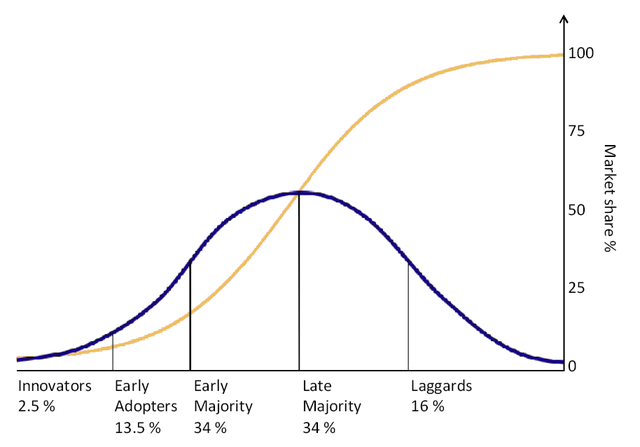
    Looking at the diffusion of innovation curve, we can see a trigger, a peak of over-inflated expectations and some depression. Expectations and results vary greatly when investing in new technologies.

    ACORD examined over 600 successful and unsuccessful technologies in the insurance industry over a 20 year period to create a framework for examining whether new technologies like blockchain will be successful:

    1. At the core of this framework is the anticipated and actual captured value, ie how much value the technology was expected to create and how much value it ended up creating.
    2. Can the technology be tested? Technologies that do not allow for experimentation and testing because they require users to discard much of their legacy technology tend to fail regardless of whether they would have created value.
    3. Do the decision-makers believe it was the technology in question that led to the improved result? The insurance industry depends on numerous factors, such as weather and the economy. It needs to be clear that it was the technology that added value.
    4. Is the technology compatible with legacy technology? Technologies and innovations that require replacing a lot of infrastructure tend to be unsuccessful.
    5. What is the level of homogeneity between users? Users of successful technologies use it in a consistent way.
    6. Is there coopetition? Competitors coming together to make the technology useful is a good sign.
    7. Are there authoritative adopters? Successful technologies tend to be adopted by firms within the industry which are respected in their given areas.

    Bill stresses that these criteria are necessary but not sufficient. The laserdisc fulfilled all the criteria and had superior image to the VHS but that didn’t take it very far. Nevertheless, we are happy to see blockchain fits all the criteria.

    Your turn!

    Bill gave us some great perspective on the importance of common data standards and how to best approach blockchain and other new technologies.

    If you liked this episode please do review it on iTunes. If you have any comments or suggestions on how we could improve, please don’t hesitate to add a comment below. If you’d like to ask Bill a question, feel free to add a comment below and we’ll get him over to our site to answer your questions.

    Thank you Bill!


    News flash episode – Blocksure OS Goes Live with Commercial & General and Covéa Insurance – 03.08.18 Aug 02, 2018
    Show notes

    Welcome to another episode in ours News Flash series, where we share the latest developments in the blockchain space, straight off the press. Today we are joined again by Ranvir Saggu, who previously featured in Ep.8 – Building a Blockchain PoC/Pilot, and we welcome Bradley Brandon-Cross to Insureblocks for the first time.

    Ranvir is CEO at Blocksure – a blockchain business specifically focussing on implementing blockchain in the insurance space, and is currently focussing on Blocksure OS, which is a platform set to revolutionise the insurance industry. He is a seasoned insurance executive with over 25 years in-depth experience across various composite insurers, with hands-on experience in delivering large transformational programmes at the highest level.

    Bradley is Managing Director at Commercial & General– a small independent insurance broker which focuses on both commercial and consumer insurance lines. Bradley also has a wealth of experience in insurance, leading GE Capital’s primary insurance business in Europe and responsible for innovative products such as the first Shariah compliant insurance product authorised by the FSA.

    Ranvir and his team at Blocksure have been developing Blocksure OS for 4 years, with 2 years in concept and 2 years spent on PoC and validation. Throughout the final year they were looking for pioneering brokers to partner with in designing an innovative concept product on their new platform. Bradley and his team at Commercial & General were instantly excited by the technology and the prospect of reducing costs and improving customer flow and beginning product development on their Blocksure OS platform.

    The Product

    Together with Covéa Insurance, Blocksure and Commercial & General are releasing Insure Now. Insure Now is a tenant’s policy targeted at millennials, where blockchain facilitates policy administration and premium collection with the entire insurance methodology built around the technology. It is the first insurance product in Europe which utilises blockchain and the first product to be built on the Blocksure OS platform, which uses a microservice architecture with R3’s corda platform at its core. The product is smartphone based, with an app controlling the interactions of the customer, catering for their every need through a simple user interface on their phone, a revolution in the paperwork heavy insurance world.

    The blockchain engine allows secure and validated contracts in each part of the database which can be viewed in real-time by all parties, behind a web-enabled front end. Previous platforms utilised for tenant’s insurance have been plagued by issues with database integrity and data transferral between brokers and insurers, and third-party administrators. However, blockchain should alleviate some of the back-office costs by removing these issues and a huge amount of the administrative mess, ensuring that companies can focus on the customer experience. Real-time updates and automated functionality allow changes to policies to be administered with minimal fuss and within seconds, reducing cost and time and providing obvious benefits to the customer.

    What challenges have been faced in blockchain adoption?

    At Commercial & General, one of the main hurdles to overcome was understanding blockchain and how it would work in practice. Ranvir and his team at Blocksure were excellent at explaining the basics of the concept and helped the team overcome these initial challenges. However, there are always some who do not fully understand the benefits, and it is important that these people recognize the innovative and experimental nature of the product and look at all the positive feedback garnered from users and testers.

    Challenges have been further minimised by Ranvir’s team building the platform from an insurance-first perspective, enabling them to explain the benefits of the platform in ‘insurance-speak’. Not only does this allow insurance brokers to better comprehend the technology and reduce the associated challenges with that, but it also helps attract other insurers to Blocksure OS and inspire executives to use Blockchain in the future.

    The journey to the product

    Production started with Blocksure creating a PoC, demonstrating how the blockchain platform could deliver an insurance product and the benefits associated with this. Next, it was essential to find like-minded executives who were looked for innovative ways to disrupt the market. Bradley, and his team at Commercial and General, were perfectly suited, as they immediately saw the benefits and changes which could be made to the customer experience.

    After a programme of stringent testing, the product was made live, as of Monday. However, promotional efforts have been minimal, as whilst both Ranvir and Bradley are confident in the functionality of the product, they maintain that they should not ‘run before they can walk’ and avoid overloading the product in its first weeks.

    Future uses of Blocksure OS

    If successful, Bradley openly discusses expanding Blocksure OS to other Commercial & General products, with the potential of a new brand for blockchain based business and the possibility of end-to-end claims processing. Increasing the ease of service and reducing paper records are beneficial to customer experience, as is reducing the administration fee for an MTA. Most companies charge between £15 and £25 for these, but Bradley claims that this could be reduced to £1 – reflecting a potential reduction in backroom time and expenditure for the insurer of up to 90%.

    Reducing administration costs also has benefits for those at the lower end of the socio-economic spectrum as it allows insurers to offer products which are currently uneconomic to underwrite. The benefits are huge for the gig-economy, with other products offering Airbnb and Deliveroo-type covers in the pipeline, allowing these emerging sectors to be covered where it previously was uneconomic to do so. (For more info stay tuned for upcoming episode on Blockchain in emerging markets).

    Real-time updates can help rebuild trust between insurers and insured parties, previously damaged by fear of fraud or non-payment of claims. Blockchain facilitates more expansive data capture in real-time, allowing users to take smartphone photos immediately if an item is lost or damaged, providing a first notification of loss and allowing the relationship between insurer and insured to begin to improve.

    From the Blocksure perspective, they have a small number of products they are aiming to deliver within the year, and by keeping that number they are looking to build confidence in the technology rather than rushing to meet deadlines. However, Blocksure are currently in numerous conversations with companies, outlining where Blocksure OS can increase value propositions, enabling them to broaden their product suites and surpass limits imposed by their current legacy platforms.

    Bradley’s views on the future of his organisation reflect this, with discussions with Ranvir and his team on eventually implementing Blocksure OS platform within all their consumer products, and looking into more complex personalised products, commercial products and healthcare products also. For commercial lines, Commercial & General act as more of a traditional broker and are integrated into traditional systems, potentially proving a more challenging journey for blockchain integration. However, blockchain allows insurers to move away from traditional insurance design and move into the future, providing more product flexibility for customers.

    Your turn!

    Between Blocksure, Commercial & General and Covéa Insurance, they have created Insure Now – a first-in-class product with the potential to demonstrate the practical applications of blockchain to the rest of the sector.

    We hope you have enjoyed this news flash, if you liked this episode please do review it on iTunes. Your comments and suggestions are always appreciated so please don’t hesitate to add a comment below.

    If your organisation has any news you’d like to share regarding blockchain, feel free to get in touch with us and we’ll help you spread the word. If you’d like to ask Ranvir or Bradley a question, you can add a comment below and we’ll try to get them over to our site to answer your questions.


    Ep.20 – The Journey from Bitcoin to Enterprise Blockchain Jul 30, 2018
    Show notes

    This week we look at the exciting journey from Bitcoin to enterprise Blockchain with Burak Yetiskin, a director at Deloitte in Switzerland.

    Burak, a former cryptologist turned strategy consultant, has been working in consultancy for nine years now. His last three years have been spent working exclusively on DLT and blockchain technology within the financial services and insurance sectors at Deloitte.

    Blockchain in two minutes

    Simply put, blockchain is the underlying technology of Bitcoin, where Bitcoin was the first application of distributed ledger technology (DLT) used for transactions, in the form of the first decentralized cryptocurrency.

    Following from the first deployment of blockchain technology and the success of the first Bitcoin transactions, the technology is being scaled into something much greater than previously imagined. What was originally created to underlie an online currency is becoming a complete distributed solution, revolutionising global business and trade. This revolution is paired with a change in perception, as blockchain developed from ‘the technology behind bitcoin’ into a distributed ledger solution allowing the immutable agreement of facts, statements or contracts in the business world.

    What is Blockchain? CNBC explains the break-though technology from CNBC.

    How did the banks and governments react to Bitcoin initially?

    Due to Bitcoin’s lack of central authority, it was and partially still is perceived to represent a shadow finance world, where the participants are unbound by regulations such AML, CTF and KYC, meaning governments had reason to be fearful. China’s move to ban access to cryptocurrency exchanges in addition to ICOs until clear regulatory requirements are introduced exemplifies this scepticism, with hopes that the volatility of the market can be regulated and protection measurements can be put in place.

    The small-scale adoption of cryptocurrency worldwide does not threaten established institutions and governments; however, they’re increasingly realising the potential of bitcoin and also the underlying technology. A recent speech from Chinese President Xi Jingping outlined the value of blockchain to modern technological advancement, with Chinese Central Television stating that “the value of blockchain is 10 times that of the internet” in a recent show. This represents a significant U-turn in their standpoint on the technology. They are not alone in embracing blockchain, with numerous Proof of Concepts and pilots built using blockchain or DLT inspired technologies (see Ep.8 – Building a Blockchain PoC/Pilot), with cases of usable money transfer and trade finance platforms emerging recently from huge institutions such as Santander and HSBC.

    The Bitcoin ‘hype’ of Q3 2017 – what triggered it?

    The hype was fuelled by extreme market volatility, which brought media attention and subsequent market entrants fuelled by large short-term gains. This led to a surge in the market value from 18 billion in 2017 to almost 800 billion by the start of 2018, only to decrease again to around 200 billion by June 2018. The rise and fall was due to increased publicity influencing a rapid influx of money into the market, causing accelerated market growth without the underlying development of the firms which issued the traded coins – leading to an unsustainable hike in price.

    However, a benefit of the increased publicity surrounding the Bitcoin bubble is the massive spike in public awareness and education regarding blockchain technologies, which could prove beneficial for the long-term adoption of blockchain technologies in general.

    Blockchain’s love/hate relationship with Bitcoin

    For those in the blockchain industry, there is often a love/hate relationship between Blockchain and cryptocurrencies such as Bitcoin. The love stems from the continued awareness and publicity that Bitcoin provides to other blockchain based technologies, whereas the hatred is due to the constant misunderstandings surrounding the difference between the two. Banks still often misconstrue blockchain technology as belonging on the dark web and being shady or involved in illegal transactions. This is far from the truth and the distinction between the two needs to be made clear. Bitcoin is simply a currency based on blockchain technology, whilst blockchain is a technology which has the potential to reorganise and streamline current business processes. Once this distinction is clear, the hype can be transferred into a reality, and serious investigations and investments into the technology can begin.

    How blockchain technology is being adopted by business:

    1. First Steps

    Once enterprises realised the true potential of DLT they started implementing it for internal purposes, looking into what the technology can do for them through PoCs, with parallels to Amazon’s release of their marketplace in the 00s, with later adoption by third parties.

    2. Birth of the Consortiums

    However, soon everybody realised that ‘nobody wants to own the world’s first fax machine’ and shifted their focus to working in collaboration in order to amplify the business impact of the new blockchain technology, with consortiums arising. The pooling of resources ensured that enterprise-grade platforms were created from the likes of B3I and R3, allowing the full value of blockchain to be exploited through a network of participants in either the insurance or finance sector respectively.

    These consortiums permit both the technology to be tested, and also the notion of cooperation between competitors, allowing common issues to be resolved whilst maintaining a competitive edge.

    3. Utilising the blockchain

    JP Morgan has made a number of serious investments to bring the technology into place, in order to have a disruptive and transformative impact on the sector. Their focus has been to bring blockchain ‘under the hood’ – meaning the infrastructure is being moved to DLT or DLT inspired models in order to support the same front-end operations but more efficiently with no significant difference to the customer experience.

    The benefits of inadvertently keeping blockchain out of focus are that it allows the company to focus on the final business outcomes and increase efficiency without receiving scrutiny on the technical details of the technology’s design. By keeping the technology ‘under the hood’, sceptics who view blockchain as a publicity stunt, simply attempting to increase share prices though positive press, are disproved. Instead, companies are focussing on utilising the technology to provide different, more efficient ways of operating, to the benefit of the customer rather than simply allowing them to say “Well, we looked into it”.

    Main advantages of blockchain over legacy system?

    CEOs in the industry are being faced with the dilemma: do I choose a tried and tested system of central databases utilising a series of APIs and cloud technologies, or do I side with a new and relatively unproven technology, with a way to go in terms of maturity but heaps of promise? When focussing only on benefits term, it is important to understand which ‘pain points’ you aim to improve in the short, mid and long term, and whether the decentralized way of working brings value to your business.

    A number of trade finance consortia have recently exemplified these benefits. HSBC and ING recently announced that the first trade finance payment had been made using R3’s Corda platform, allowing letters of credit to be viewed in real-time on a shared platform, providing increased visibility for the financing of trade and reducing the time-costs associated with this. When compared to ‘legacy systems’ involving passing physical records from party to party the benefits are obvious in this case, however each and every use case should be analysed in detail, with businesses ensuring that blockchain adds value to business outcomes before spending money and time implementing the technology.

    Uses of DLT and challenges facing blockchain start-ups?

    Start-ups which have been successful in demonstrating the success of blockchain to their relevant sectors have often have strong connections to their industries, ensuring that they comply with the regulatory framework necessary. In the UK, the FCA curates a sandbox area where they support start-ups and ensure that they have an informed view on the regulatory environment, with the recent cohort containing numerous DLT inspired start-ups, such as BlockEx and Etherisc amongst others (see Ep.17 – Creating a decentralized insurance model with blockchain & smart contracts – Etherisc). GDPR exemplifies the current regulatory climate in which start-ups must survive, with the immutable and shared elements of DLT coming under specific scrutiny and posing specific challenges.

    Numerous NGOs have utilised DLT in attempts to transform the world for good. One such example is a company attempting to help Syrian refugees regain their identities after they have been lost in fleeing their war-torn homes. The distributed nature of blockchain technology allows their identities to be verified at multiple check points, having a massive impact on those individuals and illustrating one of the numerous social impacts of blockchain technology.

    How can blockchain be used in the insurance space?

    Historically, the insurance industry has been slow to embrace new technology. Focusing on cost reduction and removing friction between entities in the insurance ecosystem is paramount to streamlining the sector, and blockchain answers many of these questions. However, the true potential of blockchain in the insurance space is not only limited to streamlining collaboration of individual parties. The internet of things also has potential when combined with blockchain, as do smart contracts, both helping the true potential of blockchain within insurance to be reached.

    Whilst this is an exciting prospect for the majority of industry partners, it is possible that blockchain technology could disintermediate certain parties unless they rejuvenate and reassess their positions in the sector. Whilst this may not be such an issue as the industry enters a transitionary phase where both DLT and legacy models are utilised side-by-side, when the industry has fully evolved, they would need to find a new industry position in order to survive within the new blockchain environment.

    Which blockchain initiative has caught your personal attention?

    Burak identifies blockchain initiatives in the commodity sector – a sector plagued with inertia for the last three to six months, as being extremely exciting. By streamlining the data from commodity traders, customs officials and government departments and locating it all in one place on a secure and verified network, the transactions could take minutes instead of days, thereby transforming daily operations and exponentially improving the operations of businesses within commodities trading.

    The benefits of streamlining data here are not dissimilar to those outlined by Marilyn Blattner-Hoyle of AIG in Ep.13 – Blockchain & Trade Finance, illustrating how ripe the financial services sector is for blockchain innovation.

    Your Turn!

    Burak shares an interesting insight into the rise of blockchain technology and its uses across the industry. If you liked the podcast, feel free to review it on iTunes and if you have any questions or comments do not hesitate to ask them in the comments section below. Any specific questions for Burak please also leave in the comment section and we will endeavour to get him over to our site to answer them.

    Thank you Burak!


    Ep.19 – Insurwave: the insurer’s perspective with MS Amlin and XL Catlin Jul 22, 2018
    Show notes

    Insurwave, the new marine insurance blockchain platform launched by EY, Guardtime, Microsoft, Willis Tower Watson, XL Catlin, MS Amlin and ACORD and piloted by Maersk has been a recurring theme here at Insureblocks.

    In a previous episode, Insurwave – a Maersk pilot for marine blockchain insurance, we examined the client’s perspective. In a more recent episode, Insurwave: the complete story with EY, we discussed the process of creating Insurwave. To complete the circle, today we will look at Insurwave from an insurer’s perspective.

    For today’s episode we were lucky enough to have two speakers, Madeline Bailey, Head of Strategic Initiatives at MS Amlin, and Hélène Stanway, Digital Leader at XL Catlin.

    Blockchain in two minutes

    Blockchain is a distributed ledger that allows users to share data in real time in a secure and immutable way. This data can be related to assets, for example the location of a vessel, or it can be a smart contract, a piece of code set to execute when a set of specified parameters is fulfilled.

    Blockchain has the potential to create trust between parties in the insurance industry and improve risk intelligence, lowering costs and benefiting parties across the insurance value chain.

    Why Insurwave?

    In the past four years the marine insurance industry has experienced declining performance and increasing combined operating ratios. It has become necessary, therefore, to take a strategic look at the industry and consider how new technologies can improve efficiency. In building Insurwave, both MS Amlin and XL Catlin were willing to take a leadership position in the insurance industry and commit to a vision of how the industry is going to develop.

    In an industry not known for embracing change, developing Insurwave came with challenges. Working alongside competitors and completely re-inventing the underwriting process is not something insurance companies have done before. However, every participant was keen to grasp an opportunity to cooperate with representatives across the value chain and consider what each needs out of an insurance transaction to re-imagine the underwriting process.

    The low margins plaguing the insurance industry posed an additional challenge. Unlike usual, well defined projects, it is harder to quantify the costs and benefits of investing in innovation. For that reason it was important to have a clear set of goals with Insurwave. One of the main factors Insurwave has been successful is its focus on providing hull and war cover for its pilot with Maersk.

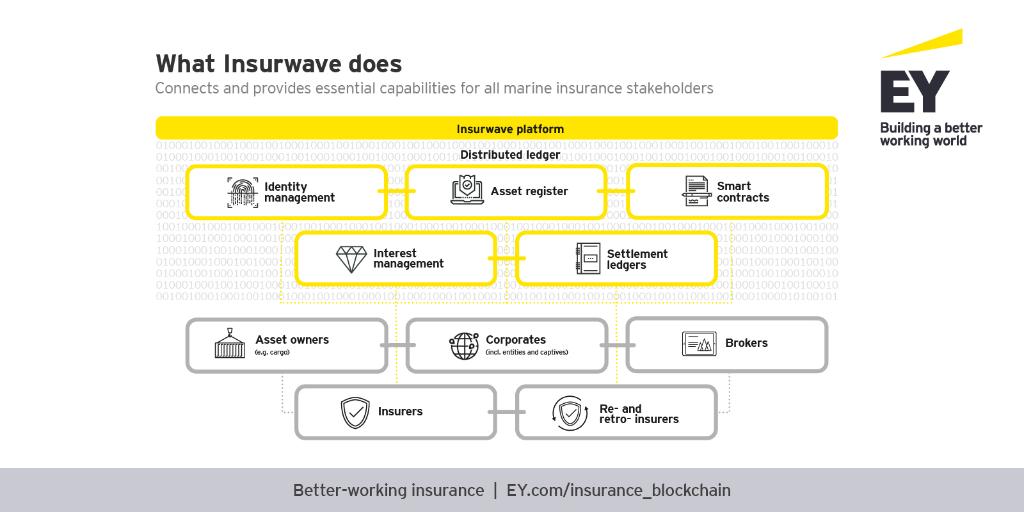
    What insurwave does?

    What insurwave does?

    Insurwave’s effect

    Insurwave allows parties to seamlessly share data between them. By combining blockchain with IoT data, parties have access to real time information. At the moment Insurwave provides over thirty data points per vessel. The aim is to get to fifty. Insurers get more data, get data of different types and get it in real time.

    Up until now, insurers traditionally looked backwards to quantify risk. This means the insurance industry has yet to come up with a definitive answer on how to use all this new data but Insurwave opens up a range of new possibilities.

    1. Real time decision making

    Real time data updates have the potential to shift traditional business models in favour of real time decision making. Consider war zones, for example, which are geofenced in a smart contract on the blockchain. A vessel captain will be able to decide between navigating through a war zone, knowing it will lead to an added premium, or avoid it in favour of a longer journey which will also require more fuel but at a lower premium.

    Additionally, connecting the IoT data points to risk and contract data opens up the possibility for different types of products and services for clients, creating a better tailored and more efficient service.

    2. Cost reduction

    Another advantage of effortlessly sharing information is cost reduction. Traditionally, each party in the value chain has to scour through their own set of data, wasting time and resources often just to reconcile their data with that of another party. Insurwave provides a full audit trail for every transaction, ensuring every party accesses the same, accurate data.

    This means that Insurwave also provides fundamentally embedded compliance as the blockchain includes regulatory data as well. Sanctions checks, money laundering checks, identity and trust checks will all be done at once and on the same platform, lowering costs significantly.

    3. Effect on premiums

    Combining blockchain integration with IoT devices leads to an abundance of data points which can be used to build more sophisticated, near real time risk models. Some underwriters, however, argue that existing marine insurance policies are already unsustainably low and the ability to utilise new data might actually raise premiums.

    This is unlikely. At the moment, fifty cents in every dollar of premium cover costs and tackling this can increase profitability while keeping premiums low. Additionally, in the current model clients have to pay for uncertainty as insurers err on the side of caution when averaging and aggregating data and price using historical information. However, thanks to the additional data Insurwave provides, insurers will be able to quantify the risk with more certainty and provide personalised pricing that reflects a fair value for the client.

    4. Capital requirements

    With access to this new range of data, insurers will be able to better understand and measure risk. With that knowledge it is possible to convince regulators on lowering capital requirements under Solvency II.

    Regulators seek assurance from insurers on how they manage and control risk. Having an immutable and easily accessible risk profile will therefore be a huge asset to regulators and help establish a relationship between data and risk, leading to lower capital requirements. While it is still early and the relationship between data, risk and capital will have to be better delineated first, this is a goal the team behind Insurwave is definitely considering.

    Learnings and advice

    Having been through the process of creating Insurwave, Hélène and Madeline are happy to share their advice on developing an insurance blockchain platform.

    1. Listen to your ecosystem

    Listening and truly understanding what participants across the whole value chain need is integral in launching a successful blockchain platform. By bringing together the client, the broker and the insurers it was possible for the team behind Insurwave to re-imagine how marine insurance worksand create a platform that benefits the whole industry.

    2. Focus on the client

    A lot of the value chain benefit starts from solving the client’s problem first. Working in a customer-focused environment is key in providing a clear outline of what a customer actually needs. Having Maersk in the Insurwave group contributed to the project’s success as it ensured Insurwave is designed with improving client service in mind.

    This is particularly important because as new technologies are introduced, risks are no longer just physical. They are both physical and digital and new products and services must be designed in order to provide the right coverage, at the right price, using the right underlying data.

    3. Get involved

    The best way to learn about blockchain is to get involved and start your project. However, it is important to remember that building a new platform is not the only option. Existing platforms, like Insurwave or B3i, are designed to be open and can improve as their network expands. The more companies on a platform, the more data will be available to share between parties who wish to transact.

    Your Turn!

    Hélène and Madeline give us a fresh perspective on how blockchain and Insurwave can help insurers increase efficiency and profitability.

    If you liked this episode please do review it on iTunes. If you have any comments or suggestions on how we could improve, please don’t hesitate to add a comment below. If you’d like to ask Hélène or Madeline a question, feel free to add a comment below and we’ll get them over to our site to answer your questions.

    Big thanks to Madeline and Hélène!


    Ep.18 – Insurwave: the complete story with EY Jul 15, 2018
    Show notes

    In one of our previous episode, Insurwave – a Maersk pilot for marine blockchain insurance, we introduced Insurwave, a new marine blockchain insurance platform launched by EY, Guardtime, Microsoft, Willis Tower Watson, XL Catlin, MS Amlin and ACORD and piloted by Maersk.

    This week we are joined by Shaun Crawford, Global Insurance Sector Leader at EY and one of the founders of Insurwave. We will be discussing the complete story of Insurwave, from Proof of Concept to launch.

    Blockchain in two minutes

    A blockchain is a series of blocks of continuous records, where a previous block is effectively a cryptographic copy of the information from the preceding block. The blockchain is managed autonomously using a peer to peer network, meaning that the whole network will know if a peer makes a change to the blockchain. Therefore, everything has to be authenticated. This leads to a live, immutable audit trail.

    Insurwave

    Insurwave is the first product of Insurwave Ltd, a joint venture between EY and Guardtime, a blockchain company whose experience ranges from the NHS to the US Air Force. It is a blockchain platform linking the shipping industry with the brokers, the insurers and reinsurers. At the moment it is focused on providing hull and war cover.

    Insurwave is built on the open source version of Corda (See Corda’s latest announcement). The reason for this choice is that Corda is a very mature and privacy-focused blockchain. In other blockchains every peer has access to all the data on the blockchain. Insurwave, however, deals with sensitive company information and requires certain data to only be accessible by certain peers, making Corda the best choice.

    Building Insurwave

    Building Insurwave required looking beyond the insurance industry. Guardtime was chosen both for its expertise in blockchain and its range of experience. Gathering a group including shipping, insurance and technology leaders created a team capable of critically examining existing processes to build a new product from the ground up.

    The first step in building Insurwave was to create a PoC. This revolved around ten use cases and considered how blockchain can improve efficiency and reduce costs. In doing that, it was always important for Insurwave to be a new proposition, a completely new business model, rather that a digitisation of existing processes. Insurwave has been an opportunity to re-imagine how the underwriting process would be in the future and how claims handling could become more efficient. The end result is that Insurwave can improve cost efficiency by at least 40 per cent.

    As the insurance industry isn’t particularly known for embracing change, building a completely new platform can be challenging. What made Insurwave feasible was having a small team. Having just one shipping company, one broker, an insurer and a reinsurer ensured that the team could examine all facets of the insurance industry while also remaining flexible.

    Insurwave’s potential

    Creating an immutable audit trail and seamlessly sharing data between parties has the potential to improve existing practices in numerous ways.

    1. Bring risk closer to capital

    For shipping companies like Maersk, a major benefit of Insurwave is that it allows them to bring risk closer to capital. In the traditional model, shipping companies have an enormous amount of data that is not being used when the insurer prices a journey. Insurwave can provide the insurer with this data in a structured manner, allowing them to have more certainty, better quantify the risk and provide a better price. The data will also be helpful to brokers, who can use it to look for the right type of insurer and provide a more compelling service.

    2. Improve the title process and claims handling

    Having an immutable audit trail means the title process will become easier and more efficient. All the relevant data will be found at one place, speeding up the process significantly.

    3. Solvency II

    Insurwave also has the potential to help insurers by bringing down Solvency II capital requirements. Presently, because of how the market operates, there is no link between risk and capital and a high level of capital is required under Solvency II.

    However, if insurers have access to a lot more data points, such as IoT devices on ships, to help them quantify the risk, capital requirements can be reduced. As insurers can better quantify the risk, less capital would be required by the insurance company on the balance sheet to support that leverage. While that is a long-term goal of Insurwave, and regulators will require at least a few years to understand the link between risk and capital requirements, it is a goal Shaun is confident Insurwave can achieve.

    Critics could argue that if premiums and capital requirements are reduced while ships and cargo are getting more expensive, the reduced premiums and capital requirements will not suffice to cover for a disaster. Insurwave’s answer is that all the new data available on the blockchain can lead to better decision-making. More information about the ship will become available, such as when it was last serviced or its cargo levels. Information about routes, such as weather and congestion, will also be available to help underwriters cover risks more accurately.

    Insurwave’s next steps

    The current Insurwave model is ready to be adopted by more clients. The pilot with Maersk has been very encouraging and other shipping companies have shown interest in joining. Insurers have also expressed their interest and many are joining Insurwave at the moment.

    In terms of functionalities, Insurwave is currently focused on hull and war cover. Its top priority is making Maersk’s pilot a success. Following that, extra functionalities are planned for sometime around October, with cargo insurance being a potential area.

    In the long term, Insurwave is also looking beyond marine insurance. Aviation is a potential field as the airline industry has shown an interest in blockchain but Shaun stresses that Insurwave’s current focus is Maersk’s pilot and building on that experience.

    It is also worth noting that Insurwave is open to working with other platforms, whether they are on the Corda blockchain or not. For example, Maersk is also working with IBM’s Hyperledger Fabric on a logistics supply chain project, which could be a suitable partner for Insurwave. At the moment, however, it is too early to speak of interoperability and data exchanges between different blockchains.

    Insurwave’s advice

    Shaun has been working on Insurwave since day one, making him well-suited to give anyone interested in blockchain some advice on how to embark on their blockchain journey and evaluate the stability of their business processes.

    1. Work on your PoC

    The PoC stage proved to be a challenging aspect of building Insurwave. The team had to reconstruct their concept numerous times to get it to work. For that reason, it is important to start small and build up from that.

    Once a PoC is ready, it is important not to announce too fast. Insurwave was actually initially considering a different solution. In hindsight, Shaun is thankful they waited until they had a working pilot as Insurwave is now in a better direction.

    2. Work with your ecosystem

    Having Maersk on Insurwave’s team was an invaluable asset. It ensured Insurwave was built tailored to client needs and ready to provide a value adding service. Additionally, having a broker, an insurer and a reinsurer on the team means Insurwave has been built using feedback and input from the whole industry. This has made Insurwave a well integrated platform to be used by the whole industry, proven by its popularity with shipping companies and insurers alike.

    3. Be business driven

    When working with blockchain it is easy to become too focused on the technology and miss the practical side of things. While it is necessary to understand the technology behind the solution, Shaun stresses the importance of first designing a business solution and then using the technology to implement it.

    4. Structure your data

    There is a lot of data in the insurance industry and blockchain is well placed to take advantage of this. Before this is possible, however, the data must be constructed in a format that can be used by the blockchain. One of the first steps, therefore, is to digitise the data and ensure it is structured correctly so it can be used effectively in the blockchain.

    Your Turn!

    Shaun shares some insider perspective on how Insurwave came to be, the challenges it faced along the way and its goals for the future.

    If you liked this episode please do review it on iTunes. If you have any comments or suggestions on how we could improve, please don’t hesitate to add a comment below. If you’d like to ask Shaun a question, feel free to add a comment below and we’ll get him over to our site to answer your questions.

    Thank you Shaun!


    News Flash – R3 – Announcing Corda Enterprise – 10.07.18 Jul 10, 2018
    Show notes

    Welcome to the first episode of our new News Flash series, where we share the latest developments in the blockchain space, straight off the press. In today’s episode we have Ryan Rugg, Global Head of Insurance at R3 and a regular speaker at Insureblocks.

    R3, which featured in one of our previous episodes (R3 – The blockchain banking consortium) started in 2015 as a consortium of financial institutions that joined forces to test blockchain solutions. Three years later, their hard work has culminated in an exciting new project and we are proud to announce the release of Corda Enterprise to the insurance industry.

    Corda Enterprise is R3’s commercial offering that brings greater enterprise capabilities to the Corda platform. It builds upon Corda’s functionality, enhancing availability, security and performance.

    Corda

    Corda, the blockchain created by R3, is the only blockchain that has been designed and built specifically for business. Corda’s focus on privacy, security and scalability distinguish it from other blockchains. Unlike Ethereum and Hyperledger Fabric, where all the information is shared between every node on the network, Corda shares information on a bilateral and multilateral level only with parties that need to see it.

    This choice has certainly paid off as there are currently over 200 financial institutions, regulators, insurers, trade associations, professional services firms and ISVs that are working on Corda. Many of these have featured on Insureblocks, such as B3i, which replaced the IBM Hyperledger Fabric with Corda, Insurwave and RiskBlock.

    Corda also appeals to industries beyond insurance. Fusion LenderComm, a syndicated lending platform and GuildOne’s Royalty Ledger, a blockchain solution for the oil and gas sector, both utilise Corda.

    This wide participation across industries is the reason Corda is an open source project. R3 wanted Corda to be a decentralised and open environment where every company can work with others or create and share their own innovative solutions. Continuing in this spirit, Corda and Corda Enterprise are fully interoperable. Anyone can remain on Corda without procuring the Enterprise licence. Anyone can upgrade to Corda Enterprise and still work with applications on the Corda blockchain.

    Why Corda Enterprise?

    The whole idea of Corda is to enable businesses to transact directly and privately, reducing transaction costs and streamlining operations. However, many large users faced technical, regulatory and compliance issues that prevented them from using blockchain internally at scale. After listening to Corda members’ requests, R3 is launching Corda Enterprise and has implemented additional functionalities so that every business can benefit.

    These extra features enhance security and make Corda Enterprise easier to scale:

    • Blockchain Application Firewall – enables Corda Enterprise to be deployed inside corporate data centres while retaining the ability to securely communicate with other nodes on the network. This is a unique feature that is not present in any other blockchain
    • 24/7 support
    • Predictable release schedules
    • Governance, performance and availability monitoring
    • Enhanced security
    • Disaster recovery
    • Support for Oracle and SQL databases
    • Corda network

    The Corda Network

    People often talk about ledger interoperability but forget about interoperability within ledgers themselves. Within differently designed networks, such as Ethereum and Hyperledger Fabric, users cannot seamlessly operate from one application to another, leading to trapped assets in different channels.

    In reality businesses want to operate with more than one application at a time. With Corda Network, members have a unique ID. This means they have a single identity on the platform and can seamlessly operate within all applications, whether on Corda Enterprise or Corda open source.

    Starting out: Corda or Corda Enterprise?

    Choosing between Corda and Corda Enterprise wholly depends on business needs. Corda is free and well-suited to many businesses. It contains numerous templates and clear documentation to accelerate members’ learning and help them make the most out of Corda.

    If a company wants to use Corda on a larger scale and requires the advanced functionalities of Corda Enterprise, they can easily migrate. As the platforms are interoperable, members of Corda Enterprise can always work with members of Corda, and vice versa.

    What’s next for Corda?

    In addition to Corda Enterprise, R3 is launching two new features to help members make the most of the Corda environment.

    1. Corda Marketplace

    As Corda has increased in popularity and applications are developing in insurance and beyond, R3 is looking to migrate them to a Corda marketplace. Essentially, this will be a Corda app store where users can easily try applications Corda partners have built. Members will be able to easily find and use tested apps or showcase their own applications. To promote this vision and help members display their applications, R3 is holding CordaCon. It is coming to London on September 12th – 13th.

    Anyone interested in Corda and blockchain should register to attend. CordaCon covers areas including insurance, financial services, energy and asset management.

    *Update: Corda has now launched the Corda Marketplace at CordaCon. For more information go to: https://marketplace.r3.com/dashboard

    2. Corda Insure

    Corda Insure will launch between mid-August and September and is part of a series of global trials run by R3 to ensure members are fully prepared for using Corda. It is a learning tool aimed at insurers on a global scale.

    The first week focuses on education. It includes 25 to 30 modules, to be deployed at scale at participating organisations, covering topics such as oracles and reaching consensus. Members have access to an optional test to ensure their knowledge is up-to-date.

    The second and third weeks focus on the business side. Tech teams are trained on how to use the Corda platform and can receive a Corda certificate. During the third week, members participate in a learning exercise on an Industry Loss Warranty. Participants are assigned different roles (insurer, reinsurer, broker and trustee) and go through the process of deploying a live node and reaching consensus.

    Corda Insured has been inspired from Corda KYC, a global project in which 33 banks participated on a KYC project on the Corda platform. Corda Insure is the ideal tool for any Corda organisation that wants to ensure they are both educating and upscaling their workforce.

    Your Turn!

    Between Corda Enterprise, Corda Marketplace and Corda Insure, R3 have developed a great strategy to solidify and expand Corda’s popularity.

    We hope you enjoyed our first News Flash episode. If you liked this episode please do review it on iTunes. Your comments and suggestions are always appreciated so please don’t hesitate to add a comment below.

    If your organisation has any news you’d like to share regarding blockchain, feel free to get in touch with us and we’ll help you spread the word. If you’d like to ask Ryan a question, you can add a comment below and we’ll get her over to our site to answer your questions.


    Ep.17 – Creating a decentralised insurance model with blockchain & smart contracts – Etherisc Jul 09, 2018
    Show notes

    Creating a decentralised insurance model with blockchain & smart contracts – Etherisc

    This week we are taking a broader look on how blockchain can transform the insurance sector. Specifically, we will consider how blockchain and smart contracts can be used to create a decentralised insurance model.

    With us we have Stephan Karpischek, co-founder of Etherisc. Etherisc is building decentralised insurance applications on the Ethereum blockchain. They began in 2016, pioneering a flight delay application utilising a public blockchain. Currently they are developing over 20 products and will soon release a product covering hurricane insurance for Puerto Rico.

    Etherisc’s vision is much larger than simply developing its own applications. It is building an open and free protocol for decentralised insurance so that companies can develop their own insurance products using smart contracts.

    Blockchain (and Ethereum) in two minutes

    On a first level, a blockchain is a data structure. On a larger scale, blockchain is an experimental field where we can try and build new incentive schemes. It is an opportunity to re-evaluate how economic actors cooperate and make decisions. We can use blockchain to develop new financial instruments, and more generally a new financial system, that works better than the current financial industry and economic structure.

    The Ethereum blockchain adds another infrastructure layer. At its core, Ethereum is meant to be an open space. Everyone can join the Ethereum network and develop their own applications and financial products. This means that Ethereum is supported by a large and diverse community of developers who make sure the blockchain rises up to any challenges it faces, such as cost of transactions. This makes Ethereum one of the most mature blockchains to tackle the decentralisation of the insurance industry.

    The decentralised insurance model

    1. The goal of decentralised insurance

    So why should we decentralise insurance in the first place? In the current insurance model there is an asymmetrical relationship between the insured and the insurer. The insurance company manages both the risk pool and the pay-out. They are therefore incentivised against paying out claims, at the expense of the insured.

    A decentralised model using blockchain offers a solution to this problem. Blockchain can be used to build automated systems that manage the risk pool just like an insurance company, minus the commercial incentive to withhold pay-out.

    2. Smart contracts as a public utility

    A decentralised insurance model assumes that any company can provide their own insurance product. To achieve this, it is necessary to make the means of providing insurance easily accessible. Etherisc’s solution to that is a smart contract that is freely available to copy and use. Anyone would be able to use this technology without requiring a licence.

    As often happens with free software, funding can be an issue. Etherisc is using a token sale to fund this idea and has already raised enough money for a few developers to start work on this protocol. In the end, however, making smart contracts a public utility is a community project requiring the feedback and engagement of the developer community. This makes the open Ethereum blockchain an ideal environment.

    Centralised versus decentralised insurance models, both utilising blockchain

    Centralised versus decentralised insurance models, both utilising blockchain

    3. Traditional insurance actors in the decentralised model

    Smart contracts can automatically examine a balance sheet, collect premiums and make pay-outs under certain conditions. This technology becoming freely available would mean that traditional insurance companies would have to fundamentally adapt their business model.

    The first step to do that successfully is educating themselves. Stephan firmly believes that insurance companies need to use a decentralised system in order to understand it. His advice for insurance companies is to start using blockchain applications. It is important to look beyond private and consortium blockchains and consider the fully transparent option of a public blockchain.

    The second step would be embracing change. This is more challenging. What often happens is that when insurance companies believe they have understood what blockchain is all about, they decide on starting their own experiments rather than consider Etherisc’s decentralised vision.

    While traditional insurance companies are known to be risk-averse, regulators have proven to be a strong ally of Etherisc. Numerous regulators across different jurisdictions are interested in working with Etherisc and using the transparent nature of blockchain to protect customers worldwide.

    4. Etherisc in the decentralised model

    Etherisc aims to become an enabler. It wants to help others develop their own insurance products and incentivise them to work together on a wide range of applications. Currently, Etherisc is focused on parametric insurance. They provide a data source or an API that can act as an oracle. An oracle is essentially a third-party service that can push external data onto the blockchain, from where it is accessible by the smart contract.

    Etherisc’s flight delay product offers a good example. The customer pays a small premium into a smart contract. The smart contract, which, through Etherisc’s oracle has access to the relevant data, gets informed about the flight being delayed and pays the customer in accordance with the insurance policy.

    This paradigm can be applied to many different scenarios. Weather is another data source and Etherisc’s HurricaneGuard is a first instance of weather-based parametric insurance. Other areas include train delays and traffic jams. This model can also tackle more sophisticated forms of insurance, such property and casualty, life, health and social insurance. There is no area of insurance that cannot be improved in accordance with Etherisc’s vision.

    5. Stable coins

    Cryptocurrencies provide a lot of flexibility to the decentralised insurance model. One reason, however, people are reluctant to use cryptocurrencies in insurance is volatility. An insurance policy can last for years and the volatile nature of cryptocurrencies can diminish a customer’s returns. Resolving this issue would help Etherisc’s decentralised insurance model gain popularity.

    A possible solution is using stable coins, which are tied to a fiat currency and therefore hold their value. The technology is still in early stages but Stephan believes it is possible and Etherisc is using a stable coin called Dai that is tied to the US dollar.

    Etherisc and diversity

    Etherisc has clearly set some ground-breaking goals but their visionary nature is not limited to commercial aspirations. From the beginning, Etherisc has had a strong commitment to gender diversity and nearly half of their core team are women.

    Here at Insureblocks we also celebrate diversity and hope more companies in the InsureTech will appreciate the benefits of a diverse workforce and follow Etherisc’s example.

    Your Turn!

    Stephan shares some very innovative ideas on how blockchain and smart contracts can become freely available and ultimately decentralise the insurance industry.

    If you liked this episode please do review it on iTunes. If you have any comments or suggestions on how we could improve, please don’t hesitate to add a comment below. If you’d like to ask Stephan a question, feel free to add a comment below and we’ll get him over to our site to answer your questions.

    Thank you Stephan!


    Previous 1 15 16 17 18 19 Next

    Related Podcasts

    How I Built This with Guy Raz

    1

    How I Built This with Guy Raz Business
    Planet Money

    2

    Planet Money Business
    Inside Strategic Coach: Connecting Entrepreneurs With What Really Matters

    3

    Inside Strategic Coach: Connecting Entrepreneurs With What Really Matters Business
    BiggerPockets Real Estate Podcast

    4

    BiggerPockets Real Estate Podcast Business
    The Smart Passive Income Online Business and Blogging Podcast

    5

    The Smart Passive Income Online Business and Blogging Podcast Business
    A Thousand Natural Shocks With Gabe S. Dunn

    6

    A Thousand Natural Shocks With Gabe S. Dunn Business
    footer-logo

    Contact Us

    Toll Free: 844-670-7747

    Links

    • Home
    • Top Charts
    • Networks
    • Apps
    • Independents Podcasts
    • Podcast Advertising
    • Podcast News
    • Contact Us
    • About Us
    • Analytics & Insights

    Stay Connected

      Privacy, Terms of Use & Our Code of Ethics Protecting Content Creators Copyrights