TopPodcast.com
Menu
  • Home
  • Top Charts
  • Top Networks
  • Top Apps
  • Top Independents
  • Top Podfluencers
  • Top Picks
    • Top Business Podcasts
    • Top True Crime Podcasts
    • Top Finance Podcasts
    • Top Comedy Podcasts
    • Top Music Podcasts
    • Top Womens Podcasts
    • Top Kids Podcasts
    • Top Sports Podcasts
    • Top News Podcasts
    • Top Tech Podcasts
    • Top Crypto Podcasts
    • Top Entrepreneurial Podcasts
    • Top Fantasy Sports Podcasts
    • Top Political Podcasts
    • Top Science Podcasts
    • Top Self Help Podcasts
    • Top Sports Betting Podcasts
    • Top Stocks Podcasts
  • Podcast News
  • About Us
  • Podcast Advertising
  • Contact
Not in our directory?
Add Show Here
Podcast Equipment
Center

toppodcastlogoOur TOPPODCAST Picks

  • Comedy
  • Crypto
  • Sports
  • News
  • Politics
  • True Crime
  • Business
  • Finance

Follow Us

toppodcastlogoStay Connected

    View Top 200 Chart
    Back to Rankings Page
    Business

    Insureblocks

    blockchain & smart contracts in industries across the world

    Advertise
    • Apple Podcasts
    • Google Play
    • Spotify

    Latest Episodes:
    Ep. 31 – Piprate launches a blockchain enabled Data Transfer POC with Renaissance Re Oct 15, 2018
    Show notes

    Welcome to another exciting episode of Insureblocks! Today we are joined by Stan Nazarenko and Karl Stanley who discuss how blockchain can enable seamless data transfer in the insurance industry.

    Stan Nazarenko is the CEO of Piprate which is an InsurTech data sharing platform. Piprate aims to provide companies in the insurance and reinsurance space with a way to share data that creates trust, accountability and transparency.

    Karl Stanley is an AVP at Technology Ventures for Renaissance Re. Renaissance Re is a global reinsurer specializing in writing P&C business which has been in existence for 25 years. Technology Ventures at Renaissance Re is a combination of a Corporate VC arm and an innovation department – the objective of this function is to keep an eye on emerging technology, provide advice to the VC arm on technology investment and develop internal technology strategy for both the short and long term.

    Blockchain in two minutes

    Our guests were asked the customary Insureblocks question to share their perspective on what blockchain is and perhaps, what it means for the insurance industry.

    According to Karl, from a non-technical perspective, blockchain is a shared and tamper-proof data store. From a technical perspective, it is a decentralised shared ledger which relies on distributed computing and asymmetric cryptography (public-private key pairing.) Distributed computing is important since the ledger is shared by all parties and replicated across all nodes in the network and cryptography maintains the security of the system. Explaining further how cryptography secures the system, Karl stated that since blocks are hashed, a change in data stored in a block results in a change in the hash which indicates that tampering of data has taken place!

    Stan chose to provide a less technical and more business-oriented definition of blockchain. He stated that blockchain is a technology that allows a network of participants to agree on a single, shared and consistent state of the world. It also allows participants to update the state.

    Some insight into Piprate

    Insurance professionals are always looking for the most attractive risk. Precise and trusted data is required to understand risk. Today’s data sharing involves a combination of excel spreadsheets, emails, file shares etc. These methods of data sharing are not secure, not compliance friendly and pose the grave threat of cyber risk.

    Piprate permits seamless data sharing by using data wallets – a list of all data possessed by a member of the network. The goal is to help everyone along insurance value chain to get most comprehensive risk representation – thereby bringing risk closer to capital, permitting better pricing and facilitating precision underwriting.

    Why did Piprate choose blockchain?

    Stan was posed the question on do they really need a blockchain based system for the effective exchange of data between the parties along the value chain. In his view the challenge of using APIs either to connect insurance players along the value chain or via centralized institutions is three fold:

    • Who will hold the data? Will data be held by the firms’ respective authors? Will it be via a centralized party? If these firms get hacked, acquired, or go out of business will the data become inaccessible?
    • API relevant information is great for immediate access of data? However, they aren’t always great for the long tail accessibility of historical data (e.g. 10 – 30 years old)
    • Insurance carriers may at any point of time wish to change the availability of historical information and/or change the structure of the API, the availability of the API, the availability of historical data that may have been available in the past. A blockchain based system, due to it’s immutability means that previously made information available information will always be available.

    Given that blockchain is a nascent technology and is rapidly evolving, it was natural to ask Stan why he felt that blockchain would be able to stand the test of time i.e. couldn’t the problem with APIs described by Stan occur with blockchain too?

    Stan explained that Piprate has adopted a blockchain agnostic approach by building an abstraction layer on top of the blockchain which allows seamless switching between providers.

    Why does blockchain interest Renaissance Re?

    Karl believes that the distributed ledger technology has a strong use case for insurance. Initiatives such as the RiskBlock Alliance (the Canopy 2.0 framework was discussed in a recent episode) and B3i (an announcement by B3i was made in a recent episode) indicate that blockchain has been getting a lot of attention from the industry.

    Since different members of insurance value chain need to access the same underlying data in a trusted manner, blockchain is likely to play big part in the future of the insurance industry.

    Over the past 25 years, since Renaissance Re has come into existence, technology has developed rapidly. According to Karl, Technology Ventures aims to observe the emerging technology trends and make recommendations for transforming the current framework.

    He takes the example of underwriting systems at reinsurance firms – not too long ago such systems were built from scratch up. Today, there is no need to do so when you have so many third party services, such as Office 365, that you can plug into using APIs.

    Karl echoed the growing sentiment in the industry that there is a need for incumbent-insurtech partnership. Incumbents are beginning to acknowledge that not all capabilities can be built internally, and it is a race to find which 3rdparty tools can be leveraged to get a competitive edge in the soft market conditions today.

    Why is blockchain important in insurance?

    Karl emphasized that 3 key features of blockchain – the presence of the distributed tamper-proof ledger, existence of smart contracts and possibility of tokenization are extremely important.

    1. The ledger

    Since the distributed ledger is tamper-proof, shared data store, it serves as a provenance solution. Recent blockchain solutions to address Proof of Insurance – POI (a Marsh and IBM collaboration) and First Notification of Loss – FNOL can streamline the process of technical accounting in the industry.

    There exists tremendous scope outside of insurance, the ledger can be used in the housing industry by moving a title deed on public asset blockchain i.e. if a bank needs to take possession of a house due to mortgage default, it involves a paperless and quick transfer of digital title.

    1. Smart contracts

    Smart contracts are useful for warranty based insurance or parametric insurance (Fizzy byAXA is an example of a flight delay parametric insurance – Fizzy was discussed in an earlier episode.)

    The ability to automate (to a limited extent) processes such claims handling and payouts through smart contracts can provide huge cost savings soon.

    1. Tokenization

    Tokenization is an alternative way to capitalize risk takers. Black Insurance, which we covered in a recent episode, is a decentralised insurance marketplace built on a tokenization model.

    Though tokenization has less immediate use due to lack of regulatory clarity on ICOs, distrust in ICOs due to fraud and lack of customer education, it has the potential to have immense impact in the long term.

    At this point, Stan added that the Adoption of blockchain in insurance is a big leap in terms of data management.Preservation of data has always been a problem – people in the industry (until very recently) have just accepted this problem. However, the emergence of blockchain, which offers a potential resolution to such problems, has brought such issues back into the spotlight.

    The recent announcement

    Roughly a month ago, Piprate, Renaissance Re and TigerRisk Partners, announced the successful completion of a commercial POC for the transfer of exposure data.

    The goal was to explore how the platform and blockchain can be used for one specific problem – exposure management in reinsurance industry. Piprate wanted to prove that blockchain technology and the platform provided a seamless experience by facilitating near real-time conversation between brokers and reinsurers (like the real world) and data exchange which was immutable.

    How is the Piprate platform different?

    Stan highlighted although Piprate shares the same underlying technology as the products offered by others (such as B3i),Piprate models and treats data differentlt – the focus is on how different data sets can be combined to a single coherent data set – the implementation of this idea is in the form of a Global knowledge graph.

    Piprate complies with the FAIR data principles and the JSON universal data format for exposure and other structured data so that it is easy to process on both sides to achieve longevity.

    Why did Renaissance Re chose to work with Piprate?

    The origins of the idea for a solution to facilitate exposure data transfer was a white paper written roughly a year ago by Blythe Walker, CTO at Renaissance Re and Ian Branagan, CRO at Renaissance Re.

    Speaking from his own experience, Karl stated that the workload is seasonal and removal of mechanical work from the workflow would ease pressure on the analysts to let them focus on pricing deals. He also added that at the time of writing the white paper, blockchain was not mentioned.

    Karl and Stan have worked together in the past at Renaissance Re hence both parties felt there was an element of familiarity and reduced execution risk.

    He further added that this POC has confirmed two things – the exposure exchange concept does work and blockchain can be used as the underlying data transport layer.

    The next steps for Piprate

    Stan stated that Piprate plans for a test network launch in early January 2019 and will be interested in gathering feedback from all participants.

    As an InsurTech, Piprate believes that other InsurTech firms can provide interesting insight into risk through exposure data – Stan hopes offerings from other firms can be made available via their platform. The focus is on building a pipeline to process data as it enters the system.

    Stan shared some ideas such as being able to derive individual property-level insight from data or the use of machine learning tools to check authenticity of claims images provided!

    Closing remarks

    Stan clarified that the blockchain agnostic approach doesn’t equate to interoperability as connections between blockchain protocols still needs some work but in terms of data representation there is 100% portability.

    Karl asserts that there is a window of opportunity today with blockchain – it is cutting edge today, it will transform the industry but tomorrow it will be something that everyone will use.

    Your turn!

    Stan and Karl provided have some excellent insight into how blockchain can transform the insurance industry by bringing trust, accountability and transparency to the process of data transfer.

    If you liked this episode, please do review it on iTunes– your reviews make a huge difference. If you have any comments or suggestions on how we could improve, please don’t hesitate to add a comment below. If you’d like to ask Stan or Karl a question, feel free to add a comment below and we’ll get them over to our site to answer your questions.

    Thank you, Stan and Karl!


    Ep. 30 – Digital IDs on the Blockchain Oct 08, 2018
    Show notes

    In this week’s podcast we will be discussing digital IDs onto the blockchain. We had the pleasure of having 2 guests in this episode. Daniel Faria, CEO of Nodalblock and Timothy Dwyer, VP and Assistant Treasurer at Nationwide Insurance. Daniel has had a career in cyber security and entrepreneurship. Timothy has spent a majority of his career in treasury and navigated into blockchain about 3 years ago by looking at the disruption it could bring to banking.

    Blockchain in two minutes

    To explain blockchain in a non-technical manner, think about a traditional accounting firm that has one hundred book keepers. What if each of one of those one hundred book keepers had at the same time had to maintain a ledger saying exactly the same thing. Out of those hundred if more than 51 would say that a certain record is wrong, then all of the other ones would have to fix the book to maintain the record exactly the same way.

    About Nodalblock

    Nodalblock is a blockchain cyber security company.

    The fastest FBI has stated that the fastest growing crime in the US is identity theft with one identity being stolen every 3 seconds! That’s 35,000 every day and more than 15 million every year.

    Nodalblock include digital IDs with multi factor authentication with a certification API that can be used to prove the authenticity of any digital file. A legal binding digital signature and and then an encrypted file transfer tool made available for a client’s IT systems via a regular API.

    Nodalblock essentially brings security to the blockchain.

    About Nationwide

    Nationwide is a diversified insurance company offering life insurance, mutual funds, property and casualty.

    Nationwide has had a keen interest in blockchain, ever since it launched a proof of concept for “Proof of Insurance” with the RiskBlock Alliance (featured in this episode – An Introduction to the RiskBlock Alliance) at the end of 2017.

    Nationwide has been trying to determine if there was an opportunity for business disruption with blockchain technology on a stand-alone basis. They’re still trying to determine that and they still haven’t found a blockchain use case that will fundamentally change their business.

    They’re still continuing to look for that and consider themselves to be in education mode regarding blockchian.

    They have recognised the barriers to entry to blockchain, in the form of the network effect and in speed of transactions that can be pushed throught the network. Two points which they felt will be resolved in due course.

    Digital ID

    As we all know we all leave comprehensive digital footprints wherever we transact on the internet. Whether it is on social media sites like Facebook or Twitter, financial transactions with Paypal and Apple Pay amongst others. We all must disclose personal and financial data to uses these services. This leads to our personal data being stored in various databases which we have little control over. How can digital IDs on the blockchain help to address this, especially in a world where our IDs get hacked with Equifax last year and Facebook last week?

    To answer that question businesses have to really ask themselves the question of the value they place in running KYCs and in keeping that information secure. Do they have the necessary processes in place, especially when considering that the biggest security problem is humans; employees in firms that get hacked due to a phishing attack.

    As public and private blockchains can interact between each other it gives large organisations such as insurance companies the strategic opportunity to open up part of their stored internal information (such as their customers digital IDs) to talk to a larger network (public blockchains) whilst maintaining the private sections secure, whilst leveraging the power of public blockchains.

    Nodalblock had an example of a recent piece of work they did for a large European insurance company whose GDPR, onboarding and KYC would cost them $175 per client. The insurance customer implemented the Nodalblock ID blockchain solution which lead to reducing their KYC costs and a reduction in their manual labour costs attached to that process. They could now create an automatic process to onboard customers by signing a legally binding policy through their mobile phone.

    Nationwide didn’t look at digital IDs for their proof of insurance blockchain project as an assumption was made that it was existing customers. Customers were validated outside the chain whilst the proof of insurance sat on the chance. For Daniel, this is very complementary because once you’ve validated the ID you can validate the policy onto the blockchain.

    Addressing digital IDs on the blockchain

    For Timothy, every time we need to transact, we have an identify process that isn’t seamless. A global solution, whilst a significant undertaking, to develop a blockchain where digital IDs can be created will provide immense value to insurance companies. It will facilitate the process of validating the process of payments.

    The way Daniel looks at digital ID with an insurer is that the network of where that client is registered sits on a semi private blockchain with the insurer. There is a smart contract that connects the private ID to a public blockchain where the validators can give you an extra level of security. It is up to the client if they want or not to engage with external parties. Daniel believes that contrary to Timothy you don’t need a global solution for digital IDs. Because Nodalblock supports facial recognition, thumb identification and one time passwords. They have all these tools within their stack including the ability to recognise a drivers license and immediately authenticate it. With those tools they are able to authenticate a client without the need for a global network.

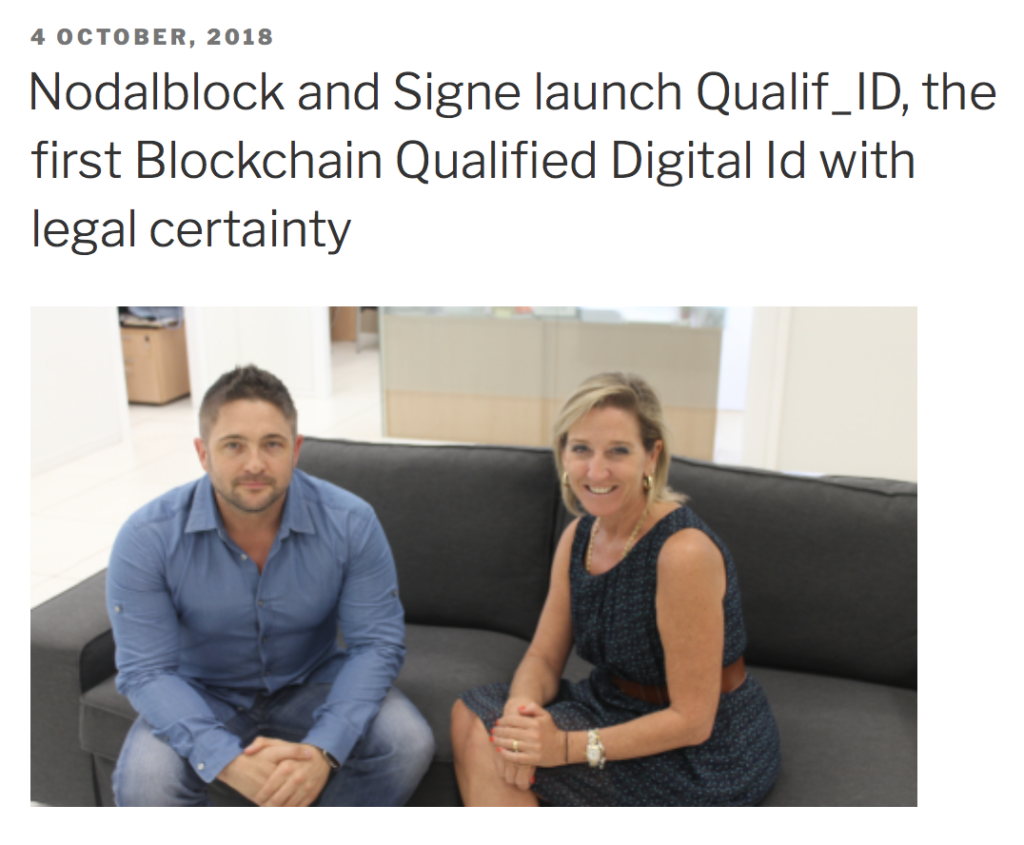
    This week, Nodalblock has launched the first digital ID on the blockchain with a qualified electronic signature – Qualif_ID. It brings together the traceability and immutability of blockchain with the legal certainty of the electronic signature.It is legal binding and fully traceable. It helps companies identify users in online transactions for example.

    GDPR

    Companies regulated by GDPR will be legally obliged to delete user data when the information is no longer required for the reason it was collected. Biometric information will be treated as sensitive data. This means that digital IDs have a key role to play in helping companies trace their customer’s data across different IT systems and different business lines. It is quite common that companies to have several different identities for a single customer in their systems.

    Digital IDs can be generated from personal data but the data cannot be derived from the ID. Only the encrypted hash of the ID is stored onto the blockchain. The personal data is stored off chain.

    Self sovereign ID

    Self sovereign ID will mean a better user experience for the end user. It means the user will have a decentralised ID that will be able to operate across multiple blockchains across the world without the user having to repeat their ID in multiple places.

    In the past problems of IDs were key based, where we now have a key problem where you have to secure it. Bio markers are a possibility for allowing an identity, combined with a blockchain, to allow a secure way to do KYC prior to a transaction. However there still needs more steps around maturing of the technology and ubiquity in a network where it is common place.

    For Daniel the key is interoperability. How will companies and governments get their head around it and how it will operate is a challenging question that could take up to 10 years to answer.

    Concluding statements

    Timothy: What we have moved away from is using blockchain for process improvement. It turns out you don’t get the pay back for the capital investment or the benefit in improving processes that whilst aren’t that efficient have improved over the years. Once the blockchain technology speeds up Nationwide is interested in using the technology in micro transactions. Does that enable them to do time based insurance in a more efficient way? Will consumers start adopting micro transactions which at the moment aren’t in the marketplace because of costs associated with it? Does that change the network effect of payments and allow a watershed moment where things change? Figuring out the answer to these questions and trying to determine what will be the next big transformational event is what keeps Nationwide interested in exploring the potential of blockchain.

    Your turn!

    Daniel & Timothy provided some interesting insights on both digital IDs and how to evaluated the potential of blockchain technology.

    If you liked this episode please do review it on iTunes – your reviews make a huge difference. If you have any comments or suggestions on how we could improve, please don’t hesitate to add a comment below. If you’d like to ask Daniel to Timothy a question, feel free to add a comment below and we’ll get them over to our site to answer your questions.


    Ep. 29 – Re-inventing the Insurance Value Chain with Blockchain Oct 01, 2018
    Show notes

    In this week’s episode we will look into how blockchain can reinvent the insurance value chain. Our guest is Risto Rossar, founder of Black Insurance. Risto has over 20 years experience in the insurance industry, having worked in insurance before launchingfive insurtech startups. Now he is focusing on Black, a blockchain-enabled, decentralised insurance marketplace.

    Blockchain in two minutes

    Risto focuses on blockchain’s value proposition, which he believes lies in replacing central authority bodies. Potential candidates include central and traditional banks, government branches, courts and (of course) insurance companies.

    Blockchain does have a broader range of uses. However, Risto supports that other technologies can achieve these just as well and it is important to ensure the positive aspects of blockchain outweighthe challenges it entails.

    Discovering blockchain

    Risto had been exploring how technology can improve the insurance industry long beforeblockchain. In 2001 he created one of the first online insurance brokers, IIZI, which became the biggest insurance broker in the baltic states. Through this he realised insurance brokers are not particularly scalable, so Risto launched Insly to help them become digital. Inslyadapted IIZI’s successful technology, sellingit as a software solution to over 300 insurance companies and intermediaries in 40 different countries.

    Launching his owninsurance brokering business and providing IT solutions to over 300 other brokers around the worldled Risto to blockchain and ultimately founding Black Insurance.

    The insurance value chain

    Risto’s multifaceted experience covers the consumer and brokering perspectives, as well as providing software solutions to brokers worldwide. He is happy to share what he has learned through his journey about the state of the insurance value chain.

    1. The industry’s strengths and weaknesses

    The main strength of the insurance industry is that it is dominated by big insurance companies, offering certainty and stability in the insurance market. This is reinforcedby a strong regulatory regime, aimed at protecting consumers.

    These qualities, however,also contribute to theindustry’s weaknesses. The strict regulations create high barriers to entry, maintaining an oligopoly and working to the advantage of the biggest and bettercapitalised insurers. This not only leads to higher premiumsbutitis also a source of systemic risk, meaning that the problems of the biggerinsurance companies can quickly spread across the market.

    Another problem facing the insurance industry is the lack of innovation, withbig insurance companies beingvery slow to innovate. This is exacerbated by the fact smaller startups, whether they are brokers, agents or MGAs, do not control the product. It is the large insurance companies that control the product, limiting the opportunities smaller companies have to innovate.

    2. What can blockchain bring

    Risto believes that, from a technical perspective, today’s insurance industry does not need blockchain. Blockchain’s real strengthis its abilityto get rid of the trusted third party. Everything else can be done with existing technologies. It is important, therefore, for companies to consider if blockchain is the best way to implement futureprojects or if existing technologies are better suited.

    From a broader perspective, blockchain is still adding value to theinsurance industry. Blockchain has been a catalyst for innovation, with the whole insurance value chain exploring different blockchain applications. While many of these projects could have been implemented without it, it is blockchain that spurred action and made them a reality.

    AXA’s blockchain-based flight delay insurance, Fizzy, (which features in a previous episode) offers a good example. While it is a great product, Risto believes blockchain was not necessary. While the smart contract ensures customers do not need to trust AXA, they still need to trust the implementing code. Additionally, with the maximum payout being 500 euros, there is arguably no trust issue to begin with. Consumers would have trusted AXA even if it used a traditional database to pay claims automatically. Nevertheless, sincenobody tried to implement automatic flight delay compensation before, the blockchain implementation is still an important step forward.

    3.Embracing blockchain: incumbents

    The insurance industry is approaching blockchain in two different ways. On the one hand we haveinsurtechs, which are fullyembracingblockchain to provide innovative solutions and services.Incumbents, on the other hand,are taking more timid steps. Their focus inon figuring blockchain out, aiming formore incremental benefits. Risto believes that this is the right approach.There is no point for large insurance companies to heavily use blockchain within their IT systems.

    To illustrate his argument, Risto draws our attention to Paul Krugman’s column, in which he criticises cryptocurrencies and says “fiat currencies have underlying value because men with guns say they do”. Traditional insurance companies already add value in a tangible and pragmatic way.Risto argues that a traditional insurance company on a blockchain is an oxymoron, since the they are two fundamentally different things.

    Despite that, blockchain technology keeps getting better. Blockchain platforms, such as R3’s Corda, are constantly improving. Thenegative aspects of blockchain, such as transaction costs and a lack of scalability, are also quickly vanishing. This means it is reasonable to use blockchain even if there are no underlying trust issues.

    The question then becomeswhich technologyis better overall. While a traditionalinsurer’s central business model should not be based on blockchain,many projects and servicescan be implemented on blockchain as well. This will also benefit the industry as a whole by promoting innovation.

    4. Embracing blockchain: insurtechs

    Risto recalls atime when insurance companies had a strong no cloud policy. It used to bevery difficult to sell cloud-based policy administration software to the insuranceindustry. However, the industry has now moved forward.

    The same line of reasoning applies to blockchain. The insurance industry is gradually becoming more favourable towards blockchain, with insurers developing an open mind about examining how blockchain can improve their business. This makes life easier for many blockchain-focusedstartups as well, creating business and promoting innovation. Risto points out it is important for startups towork together with traditional insurers. It is not a zerosum game andtraditional insurance companies continue to play an instrumental role in the market.

    Even the hype surrounding blockchain has something of value to add to the industry. Widespread adoption and experimentation helps solidify new technologies.Even ifmany startups are utilising blockchain merely because it is a buzzword, they do help further develop blockchain and figure out potential use cases.

    Black Insurance

    Black Insurance is in the process of establishing a blockchain platform aiming to decentralise and democratise the insurance industry.

    1. New value chain

    Both through his experience with IIZI and by supporting over 300 other brokers, Risto noticed the current system is unnecessarily difficult towards brokers. It is very challengingfor brokers and MGAs to create new products and to find capacity for existing ones.

    This stems from the difficulty in working with traditional insurance companies, which is what Black’s platform tries to solve. The Black platform draws inspiration from the Lloyd’s of London model, enhanced by blockchain.

    One the one side of the platform are the brokers. When a broker lists their product, the platform provides a complete description of their business plan including elements such as the product, market strategy, sales volume and profitability.

    On the otherside of the platform are syndicates of insurance professionals. The syndicates manage funds on behalf of investors. They also raise money in the form of ICOs. This involves selling Black security tokens, with each token representing one syndicate. The money raised by the ICO forms the insurance solvency capital. Then, the syndicate managers pick the products they want to invest that money in. Black then provides them the necessary licence and the marketplace to operate in.

    With all the building blocks in place, brokers can sell their insurance products or even create their own virtual insurance company. When the products are profitable the whole value chain profits, including brokers, syndicates and investors.

    The Black Insurance model

    2. The role of blockchain

    Looking at Risto’s views on blockchain, we askedif blockchain was necessary to implement Black’s platform. After pointing our attention to another immutable technology implementing Lloyd’s (paper), Risto explained that blockchain offers the perfect toolkit to adapt the Lloyd’s model.

    There are many marketplaces, such as Uberor AirBnb, that offer automaticpayments withoutblockchain. However, blockchain allows the use of tokens, the main reason Black is on blockchain. The tokens, which are sold to investors to fund the risk pool, are very easy to trade and do not require high levels of investment. They actlike perpetual bonds whose interest rate is connected to the profitability of their respective insurance portfolios.

    This is what is known as the tokenisation of insurance capital. Stakeholders canconnect capital markets in a very trustworthy manner without the need of any trusted third parties involved in the insurance portfolios and the Black platform in general. As Risto points out,Black is creating a completely new asset class, offering the option to invest into financial instruments whose reward is determined by the insurance portfolio’s profitability. All the pieces fit together perfectly and blockchain is the glue that holds it alltogether.

    3. Democratising the insurance industry

    Black’s platform also works to democratise the way insurance works. It workssimilar to a crowd cube, as investors can fund products that would otherwise be difficult for brokers and MGAs to find access to capacity.

    The addition of insurance syndicates also takes care of the issue of asymmetricinformation between brokers and investors. The syndicates’ expertise ensures the risk pool is deployed efficiently, acting as investment managers and engendering trust in the platform. Risto points out that, in a way, Lloyd’s is also a crowd funding platform, albeit occupied mostly by institutional investors. Historically, though, names were private individuals.

    4. Black’s journey

    Black has made significant progress in the ten months since the first seed idea. Brokers have shown a huge interest, with over $300 million of gross written premiums signed up to the platform.

    On the technical side, Black is in talks with several strategic partners in the insurance industry to go to market more quickly. Black is also working with the Italian Technical University and several crypto experts to ensurethe platform works perfectly. Presently, Black’s most important goal is to start the next funding round and move on to execution. If you want to find out more about Black Insurance, check out their whitepaper or lightpaper.

    Your turn!

    Risto provided some fresh perspective on blockchain, both on the value it brings to the insurance industry and about how Black is using blockchain to revolutionise the insurance value chain.

    If you liked this episode please do review it on iTunes – your reviews make a huge difference. If you have any comments or suggestions on how we could improve, please don’t hesitate to add a comment below. If you’d like to ask Risto a question, feel free to add a comment below and we’ll get him over to our site to answer your questions.

    Thank you Risto!


    Bonus episode – Hurricanes vs Blockchain Sep 25, 2018
    Show notes

    With the US battling Hurricane Florence and typhoons battering China and the Philippines, the insurance industry is preparing for potential record claims. Handling those claims and, more importantly, helping those affected rebuild their lives is a challenge facing people across the insurance industry.

    For today’s “Bonus Episode” we will be exploring how blockchain can provide insurance to hurricane afflicted areas. With us we have Renat Khasanshyn, co-founder of Etherisc. Renat is responsible for products at Etherisc, helping people join the Etherisc ecosystem to build their own insurance offering.

    Blockchain in two minutes

    A blockchain is a distributed ledger. By combining security and immutability through the use of cryptographic algorithms, the whole network can be absolutely certain they are accessing the same information. This enhanced trust and security creates numerous potential applications:

    • Implementing checks and balances regarding funds or tokens in an account.
    • Issuing and tracking an insurance policy.
    • Using a smart contract to pay out claims automatically.

    Etherisc

    Etherisc, which also featured in a previous episode, (creating a decentralised insurance model with blockchain & smart contracts – Etherisc) is a decentralised insurance protocol promoting the collective creation of insurance products.

    A protocol is a collection of rules. While these rules do serve as a guideline, what distinguishes a protocol from an industry paper is that the protocol creates a system of incentives and deterrents. Blockchain’s functionality enables it to promote collaboration by rewarding complying parties. For example, a member will be rewarded if it follows the protocol when valuing a claim.

    Renat tells us Etherisc’s protocol consists of a theoretical and a practical aspect. On the theoretical level, the protocol outlines the responsibilities of each party in the Etherisc ecosystem, such as designating which party should be recording premiums.

    On a more practical level, Etherisc provides common tools and infrastructure. This includes product templates or even an insurance license and is part of what makes the Etherisc ecosystem special. The protocol creates an added value that would not be possible if each member worked separately, even if they used the same technology and underlying code.

    Etherisc’s vision

    Etherisc is not simply a decentralised insurance company. It is an ecosystem aiming to democratise the insurance industry and people can join the Etherisc ecosystem to build their own insurance offering. How members structure their company is completely up to them. It can be a peer-to-peer pool, a mutual fund or a for-profit company.

    What matters to Etherisc is that people on the ecosystem are fairly compensated. Its protocol enables members to be compensated in accordance with the value they create regardless of their age, race, gender or personal connections. Imagine, for example, a 20 year old Etherisc member from China. They could be a developer, data scientist or software engineer. Etherisc’s protocol could allow them to earn 3% of an EU or US insurance company’s revenue, creating a both fair and valuable opportunity.

    Hurricane Guard

    In April 2018 Etherisc launched HurricaneGuard, the first blockchain based insurance product to combat catastrophic weather events.

    You can try out their demo concept.

    1. How it started

    It all started when Renat visited San Juan, Puerto Rico to examine the devastation caused by Hurricane Maria. What disappointed him the most was the business practices of traditional insurance companies. Approximately 80% of commercial policies did not pay out, and those that did took months or even years. This left people in a very vulnerable situation, forcing many to gather what money they had left and leave their homes. While factors such as a shortage of claims assessors did play a part in this, Renat informs us it all comes down to the structural problem of insurance companies balancing payouts against their own profit.

    After talking to local Ethereum developers, Etherisc’s team realised it was possible to adapt the concepts and templates used in Etherisc’s flight delay parametric insurance to wind risk. This led to a working group forming on Telegram, with local developers joining the discussion to brainstorm and come up with a better way of dealing with the aftermath of a hurricane.

    Within a few months the HurricaneGuard team was formed. Renat points out HurricaneGuard is the project of local developers and entrepreneurs. What Etherisc did was build and provide the protocol that made it possible. How the HurricaneGuard team will move the product forward and whether they create a company or not is totally up to the local people that put in the effort.

    2. How it works

    When Renat asked those affected by Hurricane Maria what help they could use the most, he found out a rapid payout would make an immense difference. If the affected had $5,000 they would be able to repair their roof and buy fuel, a generator and some provisions until electricity was restored.

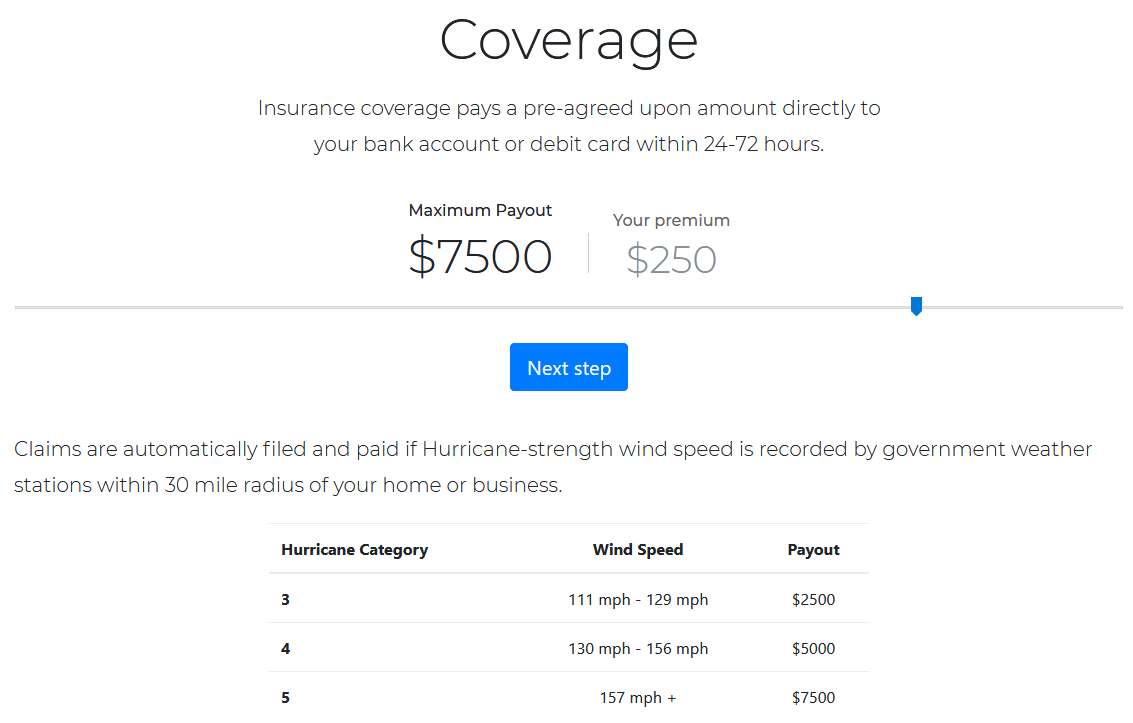
    Hurricane Guard does exactly that. It provides parametric micro-insurance that is paid upon occurrence of the event, independently of an assessment of damage. HurricaneGuard achieves this using a smart contract to track wind speeds. If local wind speed exceeds a predetermined level where it is clear that houses are damaged and lives are disrupted, the smart contract pays out claims automatically within 24 to 72 hours.

    Renat pointed out HurricaneGuard does not intend to replace traditional insurance companies. The payout is smaller and does not aim to help people completely rebuild their house. That would require an assessment of damage, taking too long to help. HurricaneGuard provides a rapid, short-term relief to those affected.

    Hurricane Guard User Interface

    3. Why blockchain?

    Blockchain is a necessary element of HurricaneGuard and Etherisc’s underlying protocol.

    Renat took us through the life cycle of a HurricaneGuard policy to illustrate why blockchain is the optimal implementation method:

    • The smart contract on the blockchain automatically inspects a data feed, examining data such as the probability of loss to price the policy.
    • The smart contract issues the policy automatically upon payment of the premium.
    • While HurricaneGuard does not accept payments in crypto, other Etherisc products do and the blockchain is used to keep the custody of the funds.
    • The blockchain also stores policy information, such as the level of premiums and potential payouts. This makes life easier for customers and regulators alike.
    • Blockchain also helps manage the risk pool’s exposure. As regulators want to ensure the risk pool contains enough capital to pay out claims, the blockchain tracks the amount of capital stored in the risk pool and its exposure to risk. This is a major distinguishing factor, as previous technology did not allow regulators to see an insurer’s exposure in real time.
    • The smart contract automatically issues payouts when wind speed exceeds a certain threshold.

    On a higher level, blockchain is also what enables Etherisc’s protocol in the first place. It creates an incentive scheme to minimise what Renat calls “the trust premium”, ie the cost to obtain the promise that an insurer will issue the payout. Lloyd’s of London, for example, paid out only $0.49 per $1.00 in 2016.

    Etherisc’s protocol optimises the amount of funds that go to insurers while also helping consumers get a bigger share of their contribution to the risk pool. The protocol’s incentives and deterrents, made possible by blockchain, increase competition and reward the insurers who pay out more claims, instead of focusing on increasing shareholder returns.

    4. The future of HurricaneGuard

    HurricaneGuard’s innovative offering has attracted a lot of interest from areas facing hurricanes. The team’s current focus is on establishing HurricaneGuard in Puerto Rico before expanding to the US, specifically to North and South Carolina.

    One of the challenges in expanding HurricaneGuard are the high barriers to entry of the insurance industry. However, Renat is confident Etherisc is more than capable to help developers and entrepreneurs overcome these barriers. Not a single member of HurricaneGuard worked in an insurance company before creating a product providing affordable insurance to those who need it most. Renat hopes the team behind HurricaneGuard will form a separate, independent company comprised of people who got in insurance because they care about helping their community.

    On a higher level, Etherisc is excited to share open-source templates or even products that others can bring to their own companies and countries. Their product licences are very permissive and Etherisc is happy to contribute to the cross-pollination of skills, people, products and intellectual property around the world. As Renat says, in the end it is all about helping the customer.

    Your turn!

    Renat gave us a great demonstration of how blockchain and innovation can empower people and improve the lives of those affected by natural disasters.

    If you liked this episode please do review it on iTunes – your reviews make a huge difference. If you have any comments or suggestions on how we could improve, please don’t hesitate to add a comment below. If you’d like to ask Renat a question, feel free to add a comment below and we’ll get him over to our site to answer your questions.

    Thanks Renat!


    Ep. 28 – Challenges and opportunities in brokering crypto assets Sep 24, 2018
    Show notes

    For this week’s episode will be shifting our focus from blockchain itself to one of blockchain’s most popular applications, cryptocurrencies. Specifically, we will be discussing the challenges and opportunities of brokering crypto assets.

    To help us we have a panel of experts including Rachel Turk, Head of Directors and Officers insurance at Beazley, Rhys James, Head of Management Liability and Financial Institutions at Paragon Brokers and Ed Ventham, Client Executive at Paragon Brokers.

    Blockchain in two minutes

    A blockchain is a distributed ledger that is maintained by a network of users. It is powered by its users, who keep it secure through cryptographic algorithms. This is a distinguishing feature of blockchain that ensures the ledger is safe and trustworthy.

    Cryptocurrencies

    Cryptocurrencies are the tokens of value that exist on specific blockchains. The Bitcoin blockchain, for example, uses Bitcoin. The US Securities and Exchange Commission designated cryptocurrencies as a currency, saying they work as a “replacement for sovereign currencies”. This distinguishes them from a safe security and has great implications on how insurers perceive cryptocurrencies.

    1. Mined vs premined

    A mined cryptocurrency, such as Bitcoin or Ether, is what people generally understand cryptocurrencies to be. Multiple users on the network solve the complex algorithms that keep it secure and are rewarded with the currency.

    A premined currency involves creating a number of coins before the currency is launched to the public. The currency is then distributed over time onto the blockchain for its specific use case. Premined cryptocurrencies have a negative connotation in the crypto community as some argue gathering all the coins upfront allows companies to easily manipulate the market.

    2. ICOs: utility and security tokens

    Initial Coin Offerings (ICOs) are used to raise capital and involve the distribution of utility or security tokens. Utility tokens represent future access to a company’s services and are not designed as investments. This created difficulties for companies and insurers alike. When insurers were discussing ICOs and SAFT agreements, what they were really trying to cover was the legal risk inherent in the agreement.

    Rhys informs us that, in the last few months, there has been a shift towards security token offerings. A security token offering is essentially an equity or dividend offering, with security tokens having an inherent security designation by the SEC. From a risk point view that means clients are preparing private placement memorandums and adhering to SEC rules around security offerings. This changes the risk of the ICO race and moves the market forward, making a great difference to insurers who can now know they are dealing with well-established securities laws.

    3. The crypto industry

    When examining the crypto industry it is important to distinguish between its different sectors. These include pure blockchain companies, cryptocurrency exchanges and cryptocurrency custodians. Each sector has different regulatory responsibilities and can benefit from different insurance products. While there are some more general services such as regulatory indemnities, cryptocurrencies have also led to the creation of specialist products. For example, custodians require crypto wallet insurance to protect the private key for their wallets’ public addresses.

    Thankfully, Rhys is here to explain what that means. The public address (also known as public key) is similar to an individual’s sort code and account number while the private key is the credentials needed to access the account. With cryptocurrencies, the best way to secure the key is to take it offline. This leads to a high value password and a custodian usually holds several of these private keys.

    4. Regulating the crypto industry

    Cryptocurrencies are borderless by design. This has created a novel challenge for regulators around the world, who have adopted a piecemeal approach to regulating them. Rachel points out insurers must therefore adopt a global perspective when examining cryptocurrency regulation. The US SEC takes a different approach than Malta or Gibraltar and it is too early to discern the dominant regulatory regime. However, Rachel believes regulation will not be based on where the company that founded the currency is incorporated. It will more likely depend on where the owners of the tokens or the company’s shareholders are based.

    Insurance and the crypto industry

    While the insurance industry had been very hesitant to insure crypto assets, insurers are gradually waking up to the opportunity.

    1. Type of client requests

    Ed and Rhys inform us Paragon has been receiving numerous requests for crypto asset insurance. These come from companies of all sizes. It can be a small startup ready for an ICO who need D&O and cybercrime cover. It is often difficult to help these companies. Even if they have an amazing idea and investors are lining up, the risk is very difficult to place. With no background or history, insurers are reluctant to take on the risk and brokers cannot do much to help.

    Larger companies have also entered the cryptocurrencies market. These companies are more after the traditional insurance packages, such as D&O, PI, and cybercrime cover. It is generally easier to provide insurance to these companies as they have an established board and business background.

    Pointing out Kodak’s ICO (yes, the camera one), we asked Ed if it is easier to work with an established company doing an ICO or a startup raising money through the traditional means. Ed informed us it is more important to focus on the different client needs instead.

    Insurance brokers are client advocates. This means that the role and responsibility of the broker depends on the stage the client is at. With a startup, a broker will discuss when it’s the right time to come to market, evaluating the costs and benefits of insurance. The larger companies, on the other hand, have budgets commensurate to the insurance market. While this makes it easier to bring these clients to market, they also tend to be riskier.

    The difference ultimately rests on the broker’s role at each stage. The technology is there and a good broker will be able to craft an appropriate solution for a client regardless of whether they are a startup or an established business.

    2. Finding the right policy

    Cryptocurrency has created a paradigm shift which will lead to new utilities and added customer value. However, Rhys informs us it does not require a complete overhaul of insurance products. It is possible to cover the needs of the crypto market by tailoring traditional insurance policies.

    The first step is to discern in which sector the client is in. For example, a client could be an exchange, a cryptocurrency custodian or a startup doing an ICO. Then, the broker can understand the needs of the client in terms of risk and prioritise them according to the client’s budget. Finally, the broker creates the solution, which will be implemented using traditional insurance contracts that are tailored to be fit for purpose.

    Designing bespoke solutions means the learning curve is steep for brokers and insurers alike. Rachel draws an analogy with the first wave of internet companies. There was a day when Google and Amazon were just starting out and insurers had to understand what they do and how the internet works. However, they were still buying the same insurance products as traditional retailers. The same can be said for the crypto market.

    3. Working together to understand the risk

    The difference with traditional insurance sectors is that, in order to cover the risk, insurers need a strong knowledge of the cryptocurrency market. Our panel unequivocally agrees cooperation is necessary to achieve this. Underwriters and brokers need to work together with clients to understand the client’s risks, create the right products and price them accordingly.

    Fitting in with our recurring theme of customer-centricity, this perhaps involves a change in mindset from the traditional culture of the insurance industry. Rachel points out it is important for insurers to try new things and get involved. The learning curve is steep and some insurers may decide crypto assets are not for them. However, deciding whether to provide crypto insurance should be the result of gathering and analysing information, rather than rejecting an opportunity due to a lack of understanding.

    4. Underwriting crypto risks

    Before an underwriter gets to assess the risks, the client has already been through the lawyers, regulators and brokers, in a sense creating a bona fide of business. When it is the underwriter’s turn to examine the submissions, it is important for them to understand what business need the company fulfills. Rachel recalls the dot-com bubble, where companies would just add “.com” after their name and get a huge valuation. It is therefore important to distinguish between the people who are passionate about a great idea and the ones who try to cash in on the ICO trend.

    Underwriting is both a science and an art and the underwriter will also have to rely on their gut feeling. “The part of underwriting you can never explain”, as Rachel puts it. This means underwriters must accept they might make mistakes. Paying claims is an opportunity for underwriters to reevaluate their offering and better understand the market when the next opportunity comes up.

    5. Educating the insurance industry

    Our panel firmly believes education is integral to tackling the crypto insurance market, helping insurers understand customer needs and deciding whether to cover a risk or not.

    Ed believes the market is through the top of the hype curve and more mature businesses are coming to market. Insurers should grasp this opportunity and not be afraid to make a mistake or two. The end goal, however, should always be to close the knowledge gap. While underwriters have some appetite for the market, they will choose the best clients to partner with. Brokers, on the other hand, are trying to increase the depth of the market for offering these solutions. That happens in different verticals, such as D&O and physical private key storage. Each sector moves at a different pace but the market will only grow if individuals across each sector move to market.

    Rachel points out clients also play a part in educating the industry. She recalls meeting with a US custodian company and leaving with a clear understanding of the company’s product, ethos and management team. Some clients, however, take little time to explain their product and just pay lip service to the requirements. A company with the ability to simply explain its offering to regulators and investors will have a much better start and is more likely get insured. Rhys adds that it is the positive client experiences, along with specialised external consultants, that educate the industry and drive the market forward.

    It is also up to the individuals within the insurance industry to educate their companies. People with the willingness and desire to understand cryptocurrencies need to act as advocates within their own organisations to help the market grow.

    The future of crypto insurance

    Blockchain and cryptocurrencies are still very new and the market needs time to mature. Ed recalls a loss adjuster telling him a big claim is necessary for that. It would help insurers quantify their exposure and better understand the challenges and opportunities behind crypto assets.

    It is also important to remember the insurance industry does not operate in a vacuum. It is part of a global, fast-moving environment where investment acts as the catalyst driving business forward. As investors become confident and capital flows in the blockchain and cryptocurrency space, companies need insurance to protect their new capital. Similarly, as regulators work to make new industries safer, insurers can more confidently underwrite new risks. This cyclical process can close the knowledge gap and help the crypto insurance market grow.

    This may take some time but our speakers ensure us the crypto insurance market is gathering momentum. The technology is solid and stakeholders believe in it, making crypto assets an area worthy of attention.

    Your turn!

    Rachel, Rhys and Ed gave us a great overview of how crypto assets work and the challenges they create for the insurance market.

    If you liked this episode please do review it on iTunes – your reviews make a huge difference. If you have any comments or suggestions on how we could improve, please don’t hesitate to add a comment below. If you’d like to ask our panel a question, feel free to add a comment below and we’ll get them over to our site to answer your questions.

    Big thanks to Rachel, Rhys and Ed!


    Ep.27 – Lloyd’s and Blockchain with Inga Beale – CEO of Lloyd’s Sep 17, 2018
    Show notes

    This week we bring you a very special episode, straight from the heart of London’s insurance industry. Our guest has provided leadership, inspiration, innovation and the embracing of all communities irrespective of gender, race or religious affiliation. We are proud to have with us Inga Beale, CEO of Lloyd’s of London. We will be discussing blockchain and the future of Lloyd’s. As Insureblocks is based on community, Inga will also be answering the questions you submitted over the past weeks. Blockchain in two minutes A blockchain is a shared, immutable record of transactions. Blockchain’s traceability and cryptographic verification make it an exciting prospect for the insurance industry. Transactions can become particularly complex and involve numerous parties. A claim, for example, usually involves the claimant, the policyholder and the customer. However, it can also involve a third-party loss adjuster, a lawyer, an underwriter, a company claims adjuster, brokers and so on. The beauty of blockchain is that it creates a single, shared, transparent record that every party in the transaction can rely on. Lloyd’s of London Lloyd’s is an insurance market comprised of over 80 insurance syndicates. Lloyd’s is unique as these syndicates are competitors but also collaborate in sharing the bigger risks. In its 330 year history Lloyd’s has always been there to ensure risk never came in the way of human ingenuity and support human progress through the good and the bad, whether that was launching a satellite into space or the Titanic’s fateful voyage. Lloyd’s in the changing landscape The insurance industry has found itself at a point of unprecedented change. On the technology front blockchain, IoT, AI and robotics are ready to drastically update the industry. Incumbents also face a huge number of new entrants including insuretechs and their innovative, customer-centric propositions, Amazon and possibly even Chinese firms like Zhong An and Ping An. As Inga mentioned at the Dubai World Insurance Congress, the insurance sector risks “sleepwalking” in this new world if it remains complacent. Inga has therefore taken active steps to ensure Lloyd’s remains a leader through this changing environment. While Lloyd’s has been known to be very traditional in some ways, such as being very paper-based, Inga informs us Lloyd’s has turned a corner and is on its way to being a leader in the new world. Unlike startups, whether insuretechs or fintechs, which usually focus on a single solution, Lloyd’s is focusing on the whole industry. It is working together with new entrants to make sure it is getting the best of these new ideas and piece them together to complete the bigger picture. Driving change within Lloyd’s Inga Beale and Shirine Khoury-Haq, Lloyd’s COO, have shown a keen interest in blockchain since 2015. This resulted to the London Market Target Operating Model (TOM) initiative launching in 2016, which now runs a major consultation to see how blockchain can improve the industry. Here is a copy of their whitepaper. However, bringing change in an organisation as large and unique as Lloyd’s can be challenging. Change disrupts people’s lives, who can often feel threatened by it and worry about how it will affect their jobs. It is not easy, therefore, to convince all 34,000 people engaged in Lloyd’s that change is a good thing. Inga tells us the secret lies in getting other people excited and open to seeing the benefits blockchain and other innovative technologies can bring. Blockchain investment in the insurance industry The multiple blockchain PoCs and pilots multiple blockchain PoCs and pilots in the insurance industry are valuable but timid steps compared to the $1.7billion annually invested by the financial industry in blockchain technology. Will the insurance industry have to wait until faced with a crisis before moving forward? Inga informs us embracing change when the industry is doing well can be more difficult due to a fear of the unknown. She recalls how in the ‘90s people were resisting outsourcing the processing of catastrophic modelling to India. The industry’s appetite for change has not changed much since. Even the reinsurance industry, whose finite group of participants make it well suited to testing blockchain, has been hesitant in its adoption. Inga believes the best way to combat the complacency is to focus on improving the customer experience. Lloyd’s TOM is now focusing on claims and how to make claim payments in a quicker, easier and more transparent way. Improving the customer experience is a common theme with our previous episodes, such as our episode with AXA’s Laurent Benichou. However, the definition of who the customer is can vary. It can include the broker, the underwriter or the policyholder. For Inga, the defining feature of a customer is having the willingness to buy a service and the money to do so, ruling out intermediaries. Placing Platform Limited (PPL) In an effort to promote innovation in the insurance industry, Lloyd’s has launched a major initiative called PPL. PPL is an electronic platform that aims to replace paper with fully auditable electronic records, providing features such as real-time confirmation of cover. While PPL has not been implemented using blockchain, Inga informs us Lloyd’s is open to utilising new technologies to improve PPL. Blockchain’s shared ledger can fit perfectly in an environment where many underwriters share the same risk. It is therefore particularly well suited to tracking the placement of risk in Lloyd’s, a subscription market involving numerous stakeholders. Inclusion@Lloyd’s We at Insureblocks strongly believe in promoting diversity and inclusion, with one of our previous episodes exploring the issue of diversity in blockchain. Inga is a champion of diversity and Lloyd’s has made great progress under her leadership thanks to the Inclusion@Lloyd’s initiative. While the business case of having a diverse team is well established in terms of innovation and penetrating new markets, Inclusion@Lloyd’s has higher aspirations. Its aim is to create an inclusive workplace where everyone is embraced and respected regardless of their background. Lloyd’s Dive In festival, part of Inclusion@Lloyd’s, is a celebration of diversity and inclusion. This is the festival’s fourth year and this year’s theme is about taking action. This can take many forms: Including somebody in a conversation. Addressing or calling out inappropriate behaviour. Challenging existing policies, processes or procedures at work. Empathising with people from a different background. A distinguishing feature of Inclusion@Lloyd’s is that it is led from the top of the hierarchy, making sure CEOs and senior management understand the importance of diversity and are open to sharing their real-life experiences about diversity and inclusion. Inga admits there is still a long way to go but Lloyd’s is well on its way to leading the way in diversity and inclusion. Insureblock’s community questions – YOUR questions! Here at Insureblocks we believe blockchain is all about community. This is why we gave you the chance to join us in this episode by asking Inga your questions. 1. “What has your experience as CEO of Lloyd’s taught you about transforming an industry and how will this guide you in the future?” Tom Davies, Marsh Transforming Lloyd’s is particularly challenging because Lloyd’s is a market with a large number of independent stakeholders. However, Inga notes there are two particular qualities that help transform an industry: While people are now getting more receptive to blockchain and innovation, it has been important to be patient and understanding of people’s issues when bringing them onboard with new ideas. Influencing such a large market is incredibly challenging but being excited and showing people how innovation will improve their companies will get them excited too. 2. “The US and European carriers seem to be coming to terms with the commercial need for financial and crypto insurance products. Are Lloyd’s ready to support this growth market? Can we expect to see increased levels of enthusiasm towards Lloyd’s insurers considering this space?” Georgia Gough, Paragon Brokers When cryptocurrency was newer, Inga admits Lloyd’s was having reservations about how reputable, safe and useful it was going to be. Now, however, Lloyd’s has become more open to providing crypto insurance products. The global leaders of banking and finance have been experimenting with cryptocurrency and Lloyd’s is ready to follow the market and play a bigger part in the crypto insurance space. 3. “According to Insurance Business UK, PPL is now used on 16% of policies written ever since February. A significant surge in the last couple years since the platform has been introduced. What do you feel is the reason for the sudden surge and do you feel there is room for PPL in a possible future blockchain world?” Natalia Zurowsky, PremFina PPL was launched in phases, focusing on a single area at a time. It started with terrorism because it involves a smaller community of brokers and underwriters. Gradually, it launched new products every few months and now PPL covers nearly all the policies underwriters cover in Lloyd’s and the broader London market. This is why it was not possible to get a high level of adoption to begin with. The second step has been to set market adoption targets for PPL. The target for the second quarter of 2018 was a 10% adoption rate, which Lloyd’s exceeded. The target for the next quarter is 20% and Inga is hoping the PPL adoption rate will reach 30% by the end of the year. As far as blockchain is concerned, the support is definitely there. Inga informs us PPL is a live platform Lloyd’s will keep modernising, so perhaps blockchain will become part of PPL in the coming years. 4. “Given that human is centric to the Lloyd’s value proposition. Do you feel PPL is taking away from what differentiates Lloyd’s from other providers of risk capital and do you see a future where Lloyd’s becomes a fully electronic platform?” Rahul Mathur, Willis Tower Watson Lloyd’s is focused on becoming digital and will soon provide a host of products that can be traded, placed and accepted electronically. However, the essence of Lloyd’s will always be its people and the relationships of trust they form. Lloyd’s brokers and underwriters have always been there to listen and help people with their innovative endeavours. These conversations will continue to happen face to face. In this sense, the physical aspect will remain. Inga draws an example from the Netherlands. When an insurance market decided to go fully digital, they decided to close the market and send everybody to their offices. However, in the following years the need for a physical space and meeting people in person became apparent. In the end they reopened the market but in a different format. Lloyd’s is also keen on modernising and the underwriting room will definitely look different in five years. However, people will still be its defining element. The relationships, discussions and negotiations are at the heart of Lloyd’s success and the cluster effect all around Lloyd’s in the City of London is part of what makes it unique. 5. “As a champion for diversity and inclusion efforts in the risk and insurance industry. With you stepping down at Lloyd’s what work can we carry forward to keep your legacy alive?” Dante Disparte, Risk Cooperative Diversity and inclusion are here to stay. Thousands of people from the insurance industry have come together to fight for diversity and Lloyd’s Dive In festival has engaged people across the entire insurance sector including life assurers, brokers, consulting firms, lawyers and more. Thanks to all these people Dive In has gained a lot of momentum, with a presence in 27 countries and over 50 cities, including a gender-focused event in Saudi Arabia. Inga tells us this all became possible because the industry is full of wonderful people who are willing to fight for change. Embracing diversity is necessary for insurance to become a more modern, dynamic environment that people want to join regardless of their background. We know that here at Insureblocks, all of us will do our best to keep Inga’s legacy alive. Your turn! This has been a truly special episode for us. We got to discuss the future of the insurance industry and Lloyd’s of London, focusing not only on innovation but also on diversity and inclusion. We hope you enjoyed this episode as much as we did. If you liked this episode please do review it on iTunes – your reviews make a huge difference. If you have any comments or suggestions on how we could improve, please don’t hesitate to add a comment below. We are sad to hear Inga will soon be leaving Lloyd’s but wish her best of luck with her next endeavour. Thank you Inga!

    Full show notes at the publisher

    News Flash – The Institutes RiskBlock Alliance selects R3’s Corda Blockchain for Canopy 2.0 Sep 12, 2018
    Show notes

    Welcome to the second episode of our News Flash series, where we share the latest developments in the blockchain space. For today’s episode we are excited to present returning speaker Christopher McDaniel, president of the RiskBlock Alliance.

    Chris will guide us through the release of Canopy 2.0, the new version of the RiskBlock Alliance’s blockchain framework, which will run on R3’s Corda Blockchain.

    RiskBlock Alliance

    The RiskBlock Alliance, which featured in one of our previous episodes (An Introduction to The RiskBlock Alliance), is an industry-led consortium comprised of insurance carriers, brokers and reinsurers focused on delivering blockchain solutions to the insurance industry. What sets it apart from other insurance consortiums is the fact it’s a not-for-profit organisation sponsored by The Institutes, an educational organisation focusing on the property and casualty space that has been around for over a century.

    Since its founding last September, the RiskBlock Alliance has expanded significantly. It developed a relationship with LIMRA in the life annuity and retirement space and expects to expand in areas including group benefits and workers’ compensation.

    The RiskBlock Alliance is built around three aspects.

    • The consortium itself and its members, who are integral in ensuring the RiskBlock Alliance is for the industry and by the industry.
    • Its blockchain framework, Canopy, a standardized set of blockchains that are reusable for many applications.
    • Blockchain applications. The RiskBlock Alliance builds fifteen to twenty application on an annual basis on its Canopy framework.

    Canopy

    Before Canopy each company had to create its own blockchain for its applications. If a company decided to build a blockchain application utilising policy information, they created a policy blockchain. Then, if a different company built another application requiring policy information, they had to build a similar blockchain from scratch.

    The RiskBlock Alliance’s solution to this is Canopy, a framework that makes it easier for companies to experiment with blockchain and create their own solutions. It provides a set of reusable blockchains, such as a policy or a claims blockchain, along with numerous applications that work on these standardized blockchains.

    Canopy 2.0

    Canopy 2.0 will be released in early September, along with a blockchain application for proof of insurance and one for first notice of loss in claims. It aims to become the framework that connects all blockchain applications together.

    1. Universal framework

    Canopy 2.0 will be the first universal version of Canopy. While the RiskBlock Alliance will continue building its own applications, Canopy 2.0 will be an open framework others can build upon. It will have the tools and components to allow others to cooperate with the RiskBlock Alliance and improve the framework by creating applications and expanding the framework itself. In that way Canopy 2.0 can grow beyond the areas it is currently focused on, making it the first true end-to-end blockchain insurance platform.

    2. Back office connectivity

    At the moment a lot of blockchain solutions ignore the problem of connecting back office systems with the blockchain, leading to a gap between blockchain applications and back office data. Canopy 2.0 solves that with its ability to create APIs to connect back office systems with the blockchain.

    This connectivity does not just make loading data onto the blockchain easier, it also allows members of the consortium to create more flexible use cases. Chris points out that blockchain is not meant to be used as a data warehouse and it is neither easy nor sensible to put every piece of data onto the blockchain. Through these APIs, members will be able to selectively combine data from the blockchain with data from their back office systems in their applications, thereby creating more flexible use cases for all blockchain applications on Canopy.

    3. Canopy in the Corda environment

    While the first version of Canopy was built on Ethereum, Canopy 2.0 is build on R3’s Corda platform. Similarly to Insurwave, the RiskBlock Alliance chose Corda because it is focused on enterprise and has built-in the necessary privacy capabilities.

    The RiskBlock Alliance has opted for the Corda Enterprise version, which we discuss in our previous news flash. At the moment the main reason is that it makes managing the nodes in the blockchain easier but Chris is also excited about the future of Corda Enterprise, which has the potential to interface different blockchain platforms together.

    Working on Corda also gives Canopy the ability to communicate with other Corda based apps. The Corda platform has attracted multiple promising initiatives such as Insurwave or Generali’s quotation process. The RiskBlock Alliance does not expect, or want, its applications to be the only insurance solutions. It aims to work together with other innovators to create a framework where all these applications can communicate and cooperate. Canopy 2.0 is exactly that.

    Under the Corda Marketplace, which is set to launch by the end of the year, applications will operate under different governance rules. For example, B3I applications can sit under different governance rules than Insurwave. The RiskBlock Alliance, however, is working on making apps on Canopy available on any business network and is also in talks about creating a branded version of the Corda Marketplace where all Canopy applications will be available. Chris even hopes Canopy will be able to communicate with applications built on Ethereum or Hyperledger Fabric, although this is much more challenging than communicating with Corda apps.

    Developing Canopy 2.0

    Canopy’s APIs might have solved the issue of legacy back office systems but the legacy state of mind of some insurance companies is an additional challenge in developing Canopy 2.0

    This was one of the major issues the RiskBlock Alliance discussed in its advisory board meeting, which is comprised of executives from its member companies. While the board is eager to explore the benefits of blockchain, the whole of a company needs to embrace the technology for it to be efficiently deployed at scale. This means convincing the compliance, technology and operations departments on the benefits of blockchain and the Canopy 2.0 framework.

    The RiskBlock Alliance plans to achieve this through educating its members. It created a robust test platform so that members can experiment and become comfortable with the framework before going live. In a similar spirit, the RiskBlock Alliance has been working with The Institutes to create a blockchain certification programme. This will be followed by a choice of two capstone programmes. The technology capstone will go into the technical details of implementing the blockchain, while the business capstone will focus on how blockchain can be used in an insurance ecosystem.

    By educating members on the benefits of blockchain and letting them experiment with the Canopy 2.0 framework, the RiskBlock Alliance is hoping to win over the hearts and minds of its members.

    What’s next for the RiskBlock Alliance?

    Launching Canopy 2.0 is just part of the RiskBlock Alliance’s strategy, which includes expanding in new areas, new territories and providing new products.

    1. P&C and beyond

    The property and casualty space is currently ahead of other sectors in terms of blockchain integration, with Chris hoping the majority of the RiskBlock Alliance will have embraced its blockchain applications by the end of the year.

    The RiskBlock Alliance also plans on bringing other sectors up to speed. On the life and annuity in retirement front, it is currently in the process of onboarding members before developing use cases, which will roll out by early next year. Other areas such as workers’ compensation and group benefits are still in early stages, set for development in 2019.

    2. Going global

    For this episode Chris joined us from Toronto, where he is in the process of establishing RiskBlock Canada. Europe and Asia Pacific are the next targets for expansion for later this year, with the RiskBlock Alliance hoping to start developing applications for these areas in early 2019.

    3. Canopy 3.0

    The RiskBlock Alliance is planning to enhance it’s blockchain framework, enabling its members to use it for analytics, integration to IoT and other technologies such as AI and machine learning. It is currently in talks with R3’s Corda team about achieving these functionalities on Canopy 3.0 but hopes they can be achieved across the whole Corda platform rather than being limited to the Canopy 3.0 framework.

    4. New products

    The blockchain space is currently focused on making the insurance industry more efficient. Chris points out there is an 80/20 split between improving efficiency and creating new products. Canopy’s latest applications, which focus on proof of insurance, first notice of loss and subrogation all aim to make insurers more efficient and reduce costs.

    As Canopy gets better developed and enhanced with more information, Chris predicts the 80/20 split will be reversed as the RiskBlock Alliance will be able to create new products utilising all the newly available data. These products will be completely novel, with many focusing on connecting insurance with other industries. For example, the RiskBlock Alliance is currently talking with a company in the supply chain space who want to create real time insurance policy applications at every step of the supply chain.

    Your Turn!

    We are excited for Canopy 2.0 and it seems there is a lot more in the future for the RiskBlock Alliance. With its expansion in new areas and territories, it seems the RiskBlock Alliance is hungry to shake things up in the insurance space.

    If you liked this episode please do review it on iTunes. Your comments and suggestions are always appreciated so please don’t hesitate to add a comment below.

    If your organisation has any news you’d like to share regarding blockchain, feel free to get in touch with us and we’ll help you spread the word. If you’d like to ask Chris a question, you can add a comment below and we’ll get him over to our site to answer your questions.

    Thank you Chris!


    News Flash – B3i’s announcement at Monte Carlo 2018 Sep 10, 2018
    Show notes

    Welcome to another episode of our News Flash series, where share the latest developments in the blockchain space, straight off the press. For today’s episode we are excited to present Ken Marke, CMO at B3i, the blockchain insurance industry initiative.

    Ken is joining us to reveal some exciting news about B3i’s new product and plans for the future.

    B3i

    B3i, which we have introduced in a previous episode, began life in October 2016 when five insurers and reinsurers came together to see how blockchain can benefit the insurance industry. This led to a consortium which ten other members joined to test the viability of blockchain in solving problems for the insurance industry. Its first project was a prototype for a catastrophe excess of loss programme, which has been very successful. The next step was to establish B3i as a legal entity, domiciled in Zurich.

    Now, B3i is focused on expanding its product line and enabling partners to cooperate with them to offer more products and services on B3i’s platform, thereby creating a network ecosystem. Today B3i will reveal how it plans to achieve this goal and Ken is here to guide us through B3i’s announcements.

    1. Commercial insurance development programme

    B3i is launching its commercial insurance development programme, for which it recruited Antonio di Marzo from Generali. You listen to Antonio’s interview below to find out more about B3i’s development programme.

    https://www.youtube.com/watch?v=r1tTRoY5BYk

    B3i’s development strategy also involves expanding its global network. It will launch an office in New York in a few weeks and is planning to open several new offices in key regions around the globe. Additionally, B3i has been forming alliances with industry groups around the world, including the Association of British Insurers in the UK and the Chamber of Digital Commerce in the US.

    The purpose of B3i’s new alliances, and of its development programme in general, is to expand its network and its ability to educate the insurance industry. Ken points out it is very important for the insurance industry to better understand blockchain’s potential. While experimenting with blockchain is welcome, Ken believes the time has come to move beyond experimentation and start identifying real problems blockchain can solve in the insurance industry. As Ken says, “let’s get blockchain out of the lab and into the business”.

    2. Cat XoL product

    Staying true to Ken’s word, B3i unveiled a demo of their Cat XoL prototype in September 2017, inviting companies to join its testing platform. We are excited to announce the Cat XoL product will become available on the market at the end of this year, taking live contracts on the platform through an early movers programme.

    B3i chose Cat XoL as its first product as it is important to start simple when developing a prototype. A Property Cat XoL contract was the perfect choice as there is usually a smaller network in a reinsurance contract including a seed, a broker and a few reinsurers. Additionally, there are less transactions in a reinsurance contract, ensuring the new concept wouldn’t face too much pressure in the early stages of development. In that way, B3i could work on a simple project, making sure the prototype, its functionalities and peripheral needs are all in order before moving on to more complex products.

    But isn’t trust already guaranteed in such a small network?

    While engendering trust is one of blockchain’s strongest assets, it’s not the only one. The Cat XoL product helps ensure contract certainty and simplify communication, allowing parties to better deal with any unexpected challenges that might arise. Blockchain’s immutability ensures every party has the same version of truth, which removes friction from the value chain and the need for reconciliations in the network.

    The results

    Testing a blockchain product’s performance against existing processes to measure the exact improvement in efficiency is not something B3i is expecting to do as the data on the blockchain is confidential to the reinsurance network. Having said that, the feedback from the product’s 38 market testers looks promising. B3i has been keen to learn how much of the manual work on reconciliation the Cat XoL product would save if it was adopted for the market testers’ insurance contracts.

    The calculation across the value chain of the seasonal broker or insurer amounted to savings of around thirty percent of their administrative costs, proving B3i’s Cat XoL product can significantly improve efficiency.

    The early movers programme

    B3i’s early movers programme will launch at the end of this year and it is the first step in using its Cat XoL product with live contracts.

    Ken tells us the programme essentially involves a trusted group of interested members who will select a real contract, due to renew in 2019, and place it on the platform. The purpose of this is to help B3i test the product’s resilience and functionality on a live scenario and refine the product as needed.

    3. B3i and the Corda network

    In our introductory episode on B3i we announced it was planning to switch from IBM’s Hyperledger Fabric to R3’s Corda network. This switch has led to a great working relationship between B3i and R3, which has helped B3i improve its development efficiency, reaching its objectives quicker while ensuring high-quality products.

    Additionally, Corda’s business network is well-aligned with B3i’s ecosystem strategy. Corda’s technology makes cooperation easy between different supply chains and industries, such as insurance and banking. This means B3i has access to the necessary fluidity and efficiencies to create an open ecosystem that promotes cooperation.

    4. B3i membership community

    Our final announcement is B3i’s membership community. Up until now, the way to join B3i has been to become a shareholder, customer or partner. However, after its successful market testing programme B3i noticed that the interconnectivity, networking and educational aspects helped all parties in the group. It therefore decided to offer these benefits to a wider audience and B3i’s membership community will also be available to companies who do not wish or are not able to become a customer or shareholder yet.

    The most important benefit of B3i’s membership programme is education. B3i has come up with numerous ways to enhance education and knowledge sharing among its membership community.

    • Conferences: B3i will hold three annual conferences around the world. Member companies will participate by sending candidates, with the first three candidates being free of charge. These conferences will discuss market developments in blockchain within the insurance sphere, hold workshops, provide feedback and even share ideas for B3i’s new products and services.
    • Think tank: members will participate in think tanks and working groups focused on specific issues, such as regulation. This will allow members access to thought leadership from B3i’s experts and the opportunity to develop concept papers.
    • Feedback group: this will be more customer-focused than B3i’s think tank. Members will be able to share their latest blockchain-based insurance applications and get feedback from other members and user groups.
    • Technical library: B3i will develop a repository of papers and other resources which will grow over time to help its members understand and employ blockchain.
    • Networking: interconnectivity was a particularly popular aspect of B3i’s market testing. B3i will therefore develop a Slack channel where everyone in the community will be able to engage with each other, share ideas, answer questions and more.

    Is there an opportunity for cooperation with other industries?

    Here at Insureblocks we’ve recently launched our own community on Slack to facilitate the exchange of ideas and we are eager to see how this can help the cross-realization of blockchain initiatives and pilots from other industries. Companies from areas such as logistics or finance can join into this community to share their thoughts and begin the cross-realization of ideas early.

    Ken and B3i share this vision. Blockchain can have huge benefits to areas such as supply chains and cooperating with the insurance industry will be beneficial for both markets. The oil & gas industry, for example, would benefit from the visibility and traceability of oil in the supply chain. From an insurance perspective, it would make insuring all the asset liabilities and handling claims much easier. B3i therefore welcomes other industries to participate in its new community.

    Your Turn!

    Between B3i’s plans for international expansion, its new Cat XoL product and its membership community, we’re not sure over which announcement to get most excited. What we are sure of is that B3i is ready to take the lead in blockchain in the insurance industry.

    If you liked this episode please do review it on iTunes. Your comments and suggestions are always appreciated so please don’t hesitate to add a comment below.

    If your organisation has any news you’d like to share regarding blockchain, feel free to get in touch with us and we’ll help you spread the word. If you’d like to ask Ken a question, you can add a comment below and we’ll get him over to our site to answer your questions.

    Thank you Ken!


    Ep.26 – Insurance Regulatory Reporting using Blockchain – AAIS introduce openIDL Sep 10, 2018
    Show notes

    In today’s episode we focus on insurance regulatory reporting with the American Association of Insurance Services (AAIS). With us we have Joan Zerkovich, Senior Vice President of Operations at AAIS. Prior to the AAIS, Joan worked in information technology, with over twenty years as a CIO specialising in building large infrastructure systems.

    Joan will talk to us about openIDL (open Insurance Data Link), the blockchain-based solution aiming to improve data sharing between insurance carriers, the AAIS and US state regulators.

    Blockchain in two minutes

    Blockchain is a technology that provides increased trust and security in data sharing systems. It enables users to upload records, data or transactions to a system, which are stored in a chronological order and cannot be modified or deleted. The records are encrypted and stored in blocks, with copies of those blocks then stored in the same away across the network. The immutability of the records and the secure storage across numerous computers on the network provides a level of trust and security never before seen in data systems.

    Smart contracts are blockchain’s other distinguishing feature. A smart contract is essentially software that checks for specified transactions in the network and automatically executes queries without exposing any more underlying data than necessary. Combined with blockchain’s immutability, this ensures the trust of all parties on the system.

    American Association of Insurance Services (AAIS)

    The AAIS is the only non-profit, member-owned advisory organisation in the US. As the US insurance industry is regulated on a state (instead of federal) level, the AAIS was formed to provide a common platform across all the state-regulated markets. Joan is here to guide us through the US regulatory framework and how the AAIS helps insurance carriers navigate it.

    To begin with, insurance carriers need to request state insurance departments permission to create and rate a new product. After a long approval process, the insurer needs to report to the department once they start writing business. This can be a very time-consuming and expensive process and it can delay a product getting to market by numerous years.

    The AAIS employs a countrywide programme to make this simpler across all fifty states. This includes creating common forms and contracts, whose language is set primarily on a national level but is adapted to conform to state-level regulations. Once the programme is approved by the regulator, any member of the AAIS can go through it to write business much quicker, significantly reducing the time and cost involved.

    Another feature of the US insurance regulation is that antitrust laws do not allow insurance companies to share pricing and rating data between them. However, the AAIS, as an advisory organisation, can collect policy and claims data from insurance carriers across all states. It then uses that data to to create new products, update loss cost and rating factors and share them back with insurance carriers.

    Finally, insurance carriers have to report to state regulators. This is done by providing the data to the AAIS, which aggregates and anonymises it before passing it on to regulators. Overall, the AAIS makes it easier for state-based regulators to serve their communities while also ensuring consistency across all states and improving operational efficiency.

    Data collection before openIDL

    While data collection, reporting and filing of new products is now digital, data is nevertheless coming from multiple different systems across thousands of insurance carriers. AAIS has to normalise the data, do quality assurance checks and create a coherent data set that can be used for product development and industry reporting.

    Traditionally this is done by members submitting their data to the AAIS statistical data management application. This is a web-based tool where members upload the data required for the application to perform quality assurance checks. After going through the checks successfully, the data is transferred to AAIS systems. In that way, the AAIS knows it has clean, aligned data it can use for statistical analysis and industry reporting.

    Data sharing and granular data

    Insurance carriers are generally not comfortable sharing their granular data, which means collected data is usually limited to the bare minimum carriers have agreed to provide to regulators. State legislatures and emergency response personnel, however, often request state regulators to quickly assess some activity, such as a flood, within their state bounds. This leads to regulators asking for ad hoc reports. As carriers are hesitant to transfer the required data to regulators’ systems due to security concerns, a slow and expensive negotiation process begins.

    The results do not meet the needs of any participant. The data does not make it back to the advisory organisation to improve its products and the regulators do not use the data to provide any industry reporting, meaning carriers get nothing in return for their sensitive data. With the current system being unable to meet the needs of today’s complex and sophisticated data environments, Joan informs us it was time for change.

    OpenIDL

    OpenIDL is the first blockchain platform that enables the efficient, secure and permissioned-based collection and sharing of statistical data.

    1. Creating openIDL

    OpenIDL started out from AAIS asking what is the meaning of being an advisory organisation. It approached the dissatisfaction with the status quo as a business problem, instead of immediately focusing on technology. The AAIS brought together its key stakeholders, along with data providers and the academic community in a design thinking session to discuss how the current process can be improved to solve existing problems. The result was openIDL.

    2. How openIDL works

    OpenIDL uses blockchain to improve communication between carriers and regulators while also enhancing trust and security. AAIS created a new environment in which the statistical data is stored, along with any additional data requested by carriers and regulators. Additionally, openIDL contains a web-based interface to communicate the need for and the willingness to share ad hoc data.

    This was all done within AAIS’ existing framework. While the technology was updated, AAIS did not have to change anything about the way it operates on principle.

    3. Enhancing trust and security

    Blockchain was fundamental in solving the security issues and lack of trust between carriers and regulators. The data carriers provide is stored on the blockchain network. The way data is stored on the blockchain, ie using encryption and storing multiple immutable copies on the nodes in the network, allows carriers to share the data in a secure manner while retaining ownership of it.

    From the perspective of regulators, they can request data on the openIDL web-based interface and offer to provide an industry report in return. This creates an incentive for carriers to provide the requested data. The fact carriers don’t have to transfer the data directly to the regulator makes the process even simpler. Once carriers have agreed to be part of the report, they authorise the AAIS to use smart contracts on the blockchain to access and aggregate the relevant data and provide it to the state regulators.

    In that way, only the necessary data has been provided to regulators, and it has been done so in an aggregated and anonymised form. The regulators then get the report they need and share it to the market. This resolves the security issues, enhances trust and incentivises carriers to share data.

    4. The importance of blockchain

    Critics might argue that, since members trust the AAIS, the same functionality could have been achieved using a large database managed by the AAIS. This is neither a possible nor the best solution.

    It is not possible due to the security and trust issues in sharing data. Not using blockchain would mean carriers would have to transfer data to the AAIS environment. The complex cybersecurity and data protection regime carriers operate in leads to carriers being legitimately hesitant to transfer data outside their control.

    Using blockchain for openIDL is also a better option as it enables the AAIS to shift the value it provides its members. It is an opportunity to change the role of advisory organisations and move away from being a statistical reporting agency. Traditionally, if a carrier sends data to an advisory organisation, they may later pay to gain access to statistical reporting.

    Blockchain provides a better way. The data will be stored on the blockchain and ownership will remain with members. Instead of members paying to access aggregated data, they will receive market insights and improved information to enter new markets and develop new products in return for their data. As Joan says, the AAIS’s core function had always been to create new products and keep them up to date for the benefit of the insurance industry.

    5. The challenges in adopting openIDL

    Unlike what we often hear in the context of private organisations adopting blockchain, AAIS members were eager to adopt openIDL.

    The AAIS board of directors, which is comprised of CEOs of insurance companies, were excited about using blockchain to improve efficiencies and decrease costs in data sharing. Members were easy to convince as the AAIS made the transition very easy. OpenIDL’s first pilot project did not require members to do anything, using 2.5 million records already on the system. The AAIS then provided members the tools required for a smooth transition to the platform. The end result is that all AAIS members are participating in openIDL without incurring any expenses.

    6. Goals for the future

    Success for openIDL entails a technical and a cultural aspect. From a technical perspective, the goal is for all members to have a key data sharing infrastructure in place in the future. That blockchain-based infrastructure will provide value to its members and also enable them to connect with other industry networks.

    The AAIS also aspires to bring a cultural change with openIDL. Joan hopes the ease, security and transparency of openIDL will make members excited about sharing data. Seeing how openIDL can lead to new products quicker, help regulators and provide carriers with industry insights, we believe this is definitely possible.

    Hyperledger Fabric

    OpenIDL is built on IBM’s Hyperledger Fabric. Joan believes blockchain interoperability is achievable and Hyperledger Fabric will make this possible. While every blockchain network will have its challenges, advantages and disadvantages, Hyperledger Fabric is run by the Linux Foundation, the most successful open-source, open-platform software organisation, making interoperability more likely.

    Additionally, the Linux Foundation has been excellent in providing support and IBM’s expertise has been invaluable. A global network of developers has been quick to support the AAIS with any problems it encountered, helping openIDL reach 2.5 million records on the blockchain and a fully operational web-based system in just seven weeks.


    Your turn!

    Joan provided a great overview of openIDL’s development and explained how blockchain can become the catalyst behind a cultural change in data sharing.

    If you liked this episode please do review it on iTunes – your reviews make a huge difference. If you have any comments or suggestions on how we could improve, please don’t hesitate to add a comment below. If you’d like to ask Joan a question, feel free to add a comment below and we’ll get her over to our site to answer your questions.

    Thank you Joan!


    Ep.25 – Unlocking the future of blockchain in emerging markets Sep 03, 2018
    Show notes

    Today with us we have Susan Holliday, Principal Insurance Specialist at the International Finance Corporation (IFC), all the way from Washington DC. Susan has over thirty years of experience in the insurance industry and specializes in insurance and insuretechs. We will be discussing how to unlock the future of blockchain and the opportunities for insurers in emerging markets.

    Blockchain in two minutes

    While there are different blockchains with slightly different features, blockchain is centered around two key features:

    • It is a distributed ledger. This means it has numerous nodes and, if one part of the blockchain experiences an error, the rest of the blockchain remains operational.
    • The transactions are processed in blocks. Each block is linked by a hash (a cryptographic function) and is immutable. This means it is completely transparent and users can trace every transaction.

    The International Finance Corporation

    The IFC is the World Bank’s private sector arm. It is government-funded, with nearly all governments of the world being shareholders of the IFC. Its goal is to invest in emerging markets to alleviate poverty and increase shared prosperity. It achieves this by considering both the financial returns and the developmental potential of a prospective investment. The IFC helps companies grow and brings in private sector investment. Following a project’s completion, it exits its current investment and uses the profits to continue its work in other areas.

    Insurance plays a fundamental role in achieving the IFC’s goal by helping companies and individuals become more resilient. People can then establish businesses more easily, take on risks and better cope with the financial difficulties of a natural catastrophe or a death in the family.

    The IFC works within all classes of insurance. It has invested in commercial line companies, reinsurers and personal line companies including non-life, life and health. Insuretechs are also becoming an increasingly important part of the IFC’s portfolio.

    Insurance penetration in emerging markets

    One of the challenges of emerging markets are the very low insurance penetration rates. While there are protection gaps everywhere, insurance penetration, which is measured by premiums versus GDP, is typically lower in emerging markets.

    There are three main reasons emerging markets have low insurance penetration rates.

    1. Natural catastrophes

    Some emerging markets are exposed to various natural catastrophes for which they are largely uninsured. This is an increasingly big problem and the IFC is actively looking to provide solutions to climate risks. However, this is not the root cause as countries with a higher insurance penetration can also have a high catastrophe exposure.

    2. The insurance trust deficit

    In many emerging markets people are either unaware or distrustful of the insurance industry. Some of this distrust stems from historical examples of companies writing business with no intention to pay out valid claims or intermediaries who defrauded clients. Part of the blame, however, rests with the current state of the insurance industry. Products developed over fifty years ago are not well-suited to the needs and day-to-day problems of people in emerging markets.

    The solution to this is customer-centricity. Companies need to pay more attention to the needs of clients to develop new and better-suited solutions.

    3. Profitability

    Disposable income is, on average, lower in emerging markets. This means coverage and premiums would be small, which doesn’t sit well with insurers’ high operating costs. Even where claim ratios are low, high operating costs and too many middlemen lead to disheartening results for insurance companies.

    The IFC is trying to change that by investing in fintech and insuretechs to create new products that can be delivered in a cheaper, more efficient way. By investing in new technologies such as blockchain, artificial intelligence and machine learning the IFC hopes to automate parts of the insurance process so that insurers will be able to handle high-volume, low-margin business.

    Opportunities in emerging markets

    Emerging markets are ripe with opportunity for insurance companies. Unlike other markets, it is about growing the industry rather than fighting for market share.

    1. Underserved population

    Most insurance in emerging markets consists of larger companies that provide insurance for themselves and their employees. This leaves a large gap of underserved potential customers. Emerging markets have a lot of SMEs, which are often too small to have group policies. There is also a large informal sector where people are, in essence, self-employed. Both these groups have traditionally been hard to reach and provide the right product for.

    There are also some particularly underserved markets. Susan is involved in a project aiming to provide better insurance offerings for women, and in particular women-led SMEs, demonstrating the financial inclusion aspect of the IFC.

    2. Leapfrog potential

    While there are great examples of emerging markets efficiently using technology, such as Kenya’s M-PESA, emerging markets are still behind in adopting technology.

    The advantage of this is that emerging markets can more easily adopt the technology best-suited to their needs. In a previous episode, Bill Pieroni, President and CEO of ACORD, talked about how legacy technology can be a challenge in adopting new technologies. In emerging markets, however, insurers, don’t have to go through all the old business models. In many cases, the people in these markets have never had a landline or a personal computer. This isn’t stopping them from innovating and cheaper smartphones are making innovative services accessible to a wider portion of the population. For example, consumers in India can transfer money using WhatsApp.

    This potential has created the opportunity of building the insurance companies of the future. Insurers can skip some of the evolution US and European industries have gone through and cater specifically to the needs of emerging markets.

    How can blockchain help unlock emerging markets for insurers?

    Blockchain is well-suited to simplifying aspects of insurance involving multiple parties and can help insurers access emerging markets.

    1. Bancassurance

    Due to the large number of parties involved, including a bank, the client and other intermediaries, bancassurance can be complicated and unnecessarily costly. Blockchain can simplify this process and make bancassurance more cost-efficient.

    2. Health insurance

    To create health insurance policies which are affordable and cater for emerging markets, the whole value chain needs to be readjusted. This includes patients, customers, doctors, hospitals, pharmacies, insurers, clinics and more. Susan believes blockchain is the right tool for the job and that it will have the biggest impact in health insurance.

    3. Parametric insurance

    Blockchain and smart contracts are great for handling real-time information and automatic payouts. Examples of parametric insurance include weather events and flight delay compensation.

    4. Traceability

    Blockchain’s traceability could be a way of reducing fraud and making public records more accessible. Many emerging markets have no public records databases. Putting public records data on a blockchain would make it easily accessible and reduce transaction costs. For example, the details of cars, their license and insurance policies could be easily accessible to all insurance companies in a market.

    Another important application of blockchain’s traceability is healthcare, where it can improve the supply chain management by tracing the origins of pharmaceutical products. There have been scandals in numerous emerging markets in which expired medication had been provided to consumers. Without blockchain it is often very difficult to trace its origin and find the party at fault.

    5. Trust?

    It is easy to assume people will automatically trust blockchain. Insurers must be careful, however, especially in the beginning. In markets where insurance is already met with distrust, blockchain can be seen as an added complication. Susan believes companies shouldn’t make blockchain a big selling point to the consumer. It is the better service and customer-centricity blockchain provides, not the blockchain itself, that can increase trust in the industry.

    Micro-insurance

    “Micro-insurance”, which is becoming increasingly popular in emerging markets, can actually refer to two different types of insurance.

    • The original use of the term refers to low-value insurance for people with lower incomes, similar to how microfinance refers to low-value loans for people with lower incomes.
    • It can also refer to very short-term, on-demand insurance. However, it is important to remember that the distinction can be sometimes hard to draw. For example, a customer might require low-value, short-term insurance to travel to a different city.

    Blockchain can help facilitate both types of micro-insurance. Smart contracts (about which you can learn more here) can make low-value insurance more efficient and reduce costs, making it a more attractive offering for insurers. Blockchain can also improve on-demand micro-insurance by utilising real-time information in combination with smart contracts to create a more efficient service.

    Blockchain use cases in emerging markets

    Susan was happy to share some of the blockchain use cases she has encountered working in emerging markets:

    • Bluzelle is a company working with insurers to create real-time claims processing.

    • Galileo is creating a blockchain ecosystem which includes banks, insurers, reinsurers and service providers.

    • StaTwig is focusing on supply-chain management, integrating blockchain with IoT.

    • Inmediate, which features in one of our previous episodes, is the first digital broker in Singapore. They operate a b2C platform for retail insurance and a b2b insurance technology distribution business.

    Blockchain: the way forward

    Blockchain is here to stay and has lot to offer to the insurance industry. However, some issues need to be resolved before unlocking blockchain’s full potential.

    1. Education

    Blockchain is still a buzzword. While people are learning more about blockchain every day, “blockchain” is still thrown around too much without people fully knowing what it means. The insurance industry must experiment with blockchain and educate itself to use it in the most efficient manner.

    2. Narrowing down the options

    Blockchain is still a rapidly evolving space. Insurance companies are experimenting with different implementations and there is still a debate about whether blockchains should be open, closed, permissioned etc. This is necessary so that blockchain can improve and insurers can learn what works best for them.

    However, the industry has to narrow down its blockchain options to a smaller number of models and market winners before blockchain’s wider adoption. Smartphones, for example, primarily use Android and iOS. It is not realistic or efficient for insurance companies and their clients to be working with a vast number of different blockchains. Groups like B3i and the RiskBlock Alliance, which both feature in previous episodes, are working on this by consolidating the market and making cooperation easier.

    Which blockchain initiative has caught your personal attention?

    Susan is still yet to see her ideal initiative focussing on health insurance, stating the complexity behind incorporating multiple parties as the reason for its delay in development. However, as discussed in Ep.14 – Blockchain use cases outside of insurance with Lee Brenner, initiatives such as MediLedger are showing progress in this space, bringing medical records into the 21stcentury.


    Your turn!

    Susan provided a great analysis of blockchain’s potential and the opportunities for insurers in emerging markets.

    If you liked this episode please do review it on iTunes – your reviews make a huge difference. If you have any comments or suggestions on how we could improve, please don’t hesitate to add a comment below.

    Thank you Susan!


    Previous 1 14 15 16 17 18 19 Next

    Related Podcasts

    How I Built This with Guy Raz

    1

    How I Built This with Guy Raz Business
    Planet Money

    2

    Planet Money Business
    Inside Strategic Coach: Connecting Entrepreneurs With What Really Matters

    3

    Inside Strategic Coach: Connecting Entrepreneurs With What Really Matters Business
    BiggerPockets Real Estate Podcast

    4

    BiggerPockets Real Estate Podcast Business
    The Smart Passive Income Online Business and Blogging Podcast

    5

    The Smart Passive Income Online Business and Blogging Podcast Business
    A Thousand Natural Shocks With Gabe S. Dunn

    6

    A Thousand Natural Shocks With Gabe S. Dunn Business
    footer-logo

    Contact Us

    Toll Free: 844-670-7747

    Links

    • Home
    • Top Charts
    • Networks
    • Apps
    • Independents Podcasts
    • Podcast Advertising
    • Podcast News
    • Contact Us
    • About Us
    • Analytics & Insights

    Stay Connected

      Privacy, Terms of Use & Our Code of Ethics Protecting Content Creators Copyrights