TopPodcast.com
Menu
  • Home
  • Top Charts
  • Top Networks
  • Top Apps
  • Top Independents
  • Top Podfluencers
  • Top Picks
    • Top Business Podcasts
    • Top True Crime Podcasts
    • Top Finance Podcasts
    • Top Comedy Podcasts
    • Top Music Podcasts
    • Top Womens Podcasts
    • Top Kids Podcasts
    • Top Sports Podcasts
    • Top News Podcasts
    • Top Tech Podcasts
    • Top Crypto Podcasts
    • Top Entrepreneurial Podcasts
    • Top Fantasy Sports Podcasts
    • Top Political Podcasts
    • Top Science Podcasts
    • Top Self Help Podcasts
    • Top Sports Betting Podcasts
    • Top Stocks Podcasts
  • Podcast News
  • About Us
  • Podcast Advertising
  • Contact
Not in our directory?
Add Show Here
Podcast Equipment
Center

toppodcastlogoOur TOPPODCAST Picks

  • Comedy
  • Crypto
  • Sports
  • News
  • Politics
  • True Crime
  • Business
  • Finance

Follow Us

toppodcastlogoStay Connected

    View Top 200 Chart
    Back to Rankings Page
    Business

    Insureblocks

    blockchain & smart contracts in industries across the world

    Advertise
    • Apple Podcasts
    • Google Play
    • Spotify

    Latest Episodes:
    Ep.50 – The New Stack – Convergence of blockchain, AI, IoT, big data and a lot more Mar 17, 2019
    Show notes

    In this exciting podcast, our 50th, we had the great pleasure of having Magda Ramada Sarasola, EMEA Insurtech Innovation Leader, at Willis Towers Watson return to Insureblocks. In this fireside chat we discussed the emergence of a new stack – the convergence of blockchain, AI, IoT, big data, machine learning and robotics. This podcast sits at the epicentre of a pivot we’re doing at Insureblocks for 2019. In addition to reporting stories on blockchain within the insurance industry, Insureblocks is going to embrace three new themes: Cover new industries: finance, supply chain logistics, food and agriculture, automobile and transportation, and healthcare. The aim is to investigate their blockchain learnings and facilitate the sharing of best practice across industries Investigate how blockchain sits with this new technology stack that includes AI, IoT, machine learning, big data, and robotics. We believe that while they’re noteworthy the potential these technologies have individually is limited but once combined as a stack there is the “multiplier” effect to their potential Deep dive into the legal and regulatory blockchain environment and of course best practices for establishing effective governance within blockchain networks What is Blockchain? In the initial days blockchain was often referred to as a shared excel database. Of course, now we know that blockchain is a lot more than that. Today blockchain can be looked as this ledger that participants who don’t know each other and don’t necessarily trust each other can transact without the need for an overseeing central actor. Transactions of value can be: Exchanged without being corrupted or changed Validating their authenticity and confirm that whoever is sending the value actually owns it Consequently for Magda, blockchain is a sociological innovation. It enables peer-to-peer markets to work without centralised authorities. This has impact not just onto the peer-to-peer world but also onto the enterprise and business world whose ecosystems are highly dysfunctional. It gives enterprises peer-to-peer enablement which makes blockchain so interesting. It’s a new governance paradigm that changes the way we organise markets and transactions of value in the broadest sense of the word (i.e. digital and physical assets). Data the lifeblood of insurance August last year, Insureblocks interviewed Bill Pieroni, CEO of ACORD– (Ep. 21 ACORD: data standards for blockchain in insurance) where he stated “Data is the lifeblood of the insurance industry, which fundamentally works by examining data to quantify risk”. Over the last few years the nature, type and amount of data that is becoming available to the insurance industry has radically changed. Sandip Patel, Global Managing Director for insurance from IBM, stated that on Insureblocks that “Data is the new natural resource” and he mentioned three important points: Volume of data is changing – 2.5 quintillion (a thousand raised to the power of six {1018}) bytes of data is produced on a daily basis (as reported by Forbes in May 2018) Type of data from both structured and unstructured Temporal factor of data Source: Domo – Data Never Sleeps 6.0 Magda recognises the “mind-blowing” amount of data that is being produced on a regular basis that it is very difficult to define what the actuarial value of that data is. Insurance industry was quite late to embracing big data. One of the reasons was that they didn’t have enough transactional data at a high frequency like ecommerce does for example. That has changed, over the last few years, as the insurance industry recognises that there is a lot of data that it doesn’t own that is being generated by other players that has been proven to actually add value in assessing the riskiness of an individual or of a certain asset / situation. However due to the large amount of data that is produced it is important to have a clear data strategy that understands: Type of data you have / don’t have Type of data you need and where to get it Knowing how to structure that data How to make best use of that data What that data adds in value as opposed to what you already have The necessary infrastructure to deal with the data and secure the data The Netflix paradigm For Magda, the insurance industry may be facing what she calls the “Netflix paradigm”. What’s driving all of the insurance industry’s pillars of innovation is data and how we use that data. The problem is that most of the data is not owned by the insurance industry. Partnerships are made to access data from Fitbit, Under Armour, Apple Watch, and many others. It’s really difficult to price that data today, because data is not distributed and it’s sitting in centralized repositories that are owned by different actors. Not so long ago, Netflix was able to stream a lot of movies that it didn’t own. However, when the market increasingly used streaming and binge watching on Netflix, that became the prevailing business model that cannibalised the channels that traditional content owners had. This forced the traditional content owners to raise their price for their content in order to eat into Netflix’s margins. However, Netflix had anticipated that move and had already started producing its own content and has now become one of the main content generators globally. Why? Because they were sitting on lots of data about behaviour about what people watched and when and they were able to use that to generate very targeted content. Today the insurance industry is able to access data it doesn’t own from third parties like Fitbit. However, at some point the value of the data will be clear and insurance players may not be able to access that data anymore. The new stack Next year there is an estimated 20-25 billion IoT devices coming online. All these devices will produce raw data which we aren’t able to process into intelligence. Not only that but they’re being communicated on the internet which is insecure and open to cyber criminal activity. Some innovative insurance companies have been looking at emerging technologies like AI, IoT, machine learning, big data, robotics, drones, telematics and a whole range of other technologies. However these have been looked at individually instead as a new stack and thus the ROI is limited. Data vaults At the present moment we are producing a large amount of data which is only going to increase on a yearly basis. Numerous questions arise on how we can keep the data secure, communicate it in a secure way, keep it free from tampering or nefarious actions, and ensure that it can be monetized and used by its rightful owner. Today, whilst you own your data and are in charge of it in some extent, it is being copied and used by companies. There is a need for identity solutions and data self-sovereignty. Unfortunately does solutions are not mature enough today and a new infrastructure is required to enable them. This coupled with the fact that it will take a long time for people to realise the value of their data and how their data is being used. Blockchain can help in bringing a solution by providing its users with the ability to be custodians of their own data. The way this would work is that people will have a data vault which can contain their digital identity, their FitBit data, their driving behaviour and medical data for example. For example, today to get a drink in a bar in the US you have to prove you are over 21 years old and have to show your driver’s license. However, that driver’s license contains your address which you may not wish to share with the bartender. With a secure data vault, that contains your driver’s license, it can essentially automatically validate that you are over 21 without sharing your address. If people have those vaults and objects have their vaults, data becomes an inherent part of every actor in an economy and its individual historical data that cannot be corrupted. A car is an example of an object data vault who streams data. The car can validate its data such as how it is being driven and maintained. The day the car is sold it can be sold with its data vault. Alongside user vaults and object vaults we can also have vaults of behavioural data and many other vaults in the future. For Magda, that is the future where data is being distributed as opposed to centralised and it is secured in a cryptographic manner. Need for a new infrastructure – blockchain coalition, cross industry and government initiatives We need to focus on the things that blockchain enables that we cannot do with other technologies. Magda illustrates two key points: Data stored within a data vault cannot be corrupted even by the owners of the data. So for the first time users can be true custodians of their own data Blockchain frontier – i.e. how the data gets into the vault, that it comes from trustworthy sources such as a bank or a government institution. This will require a new infrastructure that can connect all these validators to an immutable and distributed ledger. For example if you go into a bank that bank will have systems where they can look at your credit worthiness, they look at your behaviour, they look at Equifax and then they will validate the data. If they put that into your vault whenever you go to another bank, they don’t have to repeat it, as the KYC would already have been done from a trusted source. As it is stored into your data vault they will also know that the data hasn’t been tampered with. For this to happen it will require blockchain coalitions and cross industry and government initiatives to build the necessary infrastructure. Oracles and IoT the weakest link? When looking at innovation in general and specifically at the new stack we realise that it isn’t just about blockchain. Blockchain is dependent upon getting reliable validated data into it. These comes from oracles which can take the form of IoT devices. Securing real-time data streams from IoT is not easy. As you cannot corrupt the smart contracts on the blockchain there is a clear case for trying to corrupt the oracles. There is a need to secure the oracles. Maximising ROI by moving from individual technologies to the new Stack There is a clear business case for merging these emerging technologies into a new stack. These technologies are doing very different things and if you really want to have a quantum leap in terms of how you develop a new business model or enable a new way of doing things, you need the combination, you need the new stack. IoT are a great source of instant access to data. Machine learning and computer vision can extract data from numerous sources such as what is your sentiment from micro facial expressions to the distress in your voice. Machine learnings and certain algorithms are critical for data ingestion and for the analytics of that data. Big data implies that we are sitting on a very large amount of data ready for us to use. The reality though isn’t quite that. The data isn’t ready. It needs to be structured, it needs to be cleaned from what is noise and what is valuable. For that you need advanced analytic tools, machine learning, AI, computer vision augmented related to be able to incorporate things like a human behaviour with the data and the physical reality around them. All these technologies really work well in combination. Blockchain enables a way of having distributed markets and distributed value and interactions with people without them being centralised. For that to happen you need to know who the people are, how they behave and you need to understand them. This requires a smart contract to be truly smart. It can only achieve this by having a layer of machine learning that has access to data for it to learn from. Thus, to maximise ROI we need to ensure that we look at the business case and then determine what set of technologies is appropriate for that business case. It may be a small set of technologies, it may be the entire stack or it may be legacy technology. The key is to always start from the business case and not to look for a problem that this technology can answer. Future of risk and its pricing Having the technologies from the new stack and hyper granular data sitting on those data vaults we have what Magda calls fourth generation solutions that can react in time to events and to behaviour. This means in the future we should be able to have products that adapt in their structure as in clauses what they cover, what they don’t and price themselves in an almost real-time fashion. Another future possibility is one where for certain types of risks and products we may not need an underwriter to actually underwrite. For example, future car insurance will be on a smart contract that can read exactly how the car is being driven, used, and maintained. The smart contract will also understand the driver’s driving patterns and automatically price the risk. You can neutralise the risk through a coded mutual for certain type of risks, where you have smart contracts dealing with pricing the risk, assessing the risk, pricing risk, pulling it, generating a vehicle like an insurance security and placing it in a distributed capital market. Part of the risk for that car insurance can be accepted by individuals around the world such as one in China or in Australia that have a certain risk appetite that has been assessed by their respective smart contracts. In such a future you are bridging the risk to capital journey in a decentralised and automated way. Parametric insurance Parametric insurance is the low hanging fruit as it is straightforward to process if you have the right data input you can automate it very quickly. The question is does parametric insurance require a blockchain? In most cases probably not, but there are some where it does. In those cases where it makes sense from a consumer perspective to buy a product where they want to make sure the insurer could not stop the policy from being executed. Your Turn Thank you, Magda, for this fireside chat and for sharing your views on the new stack. If you’d like to meet Magda, make sure to attend the upcoming Blockchain for Insurance Conference here in London on the 18thto 19thof June 2019.

    Full show notes at the publisher

    Ep.49 – The Psychology of Blockchain Mar 10, 2019
    Show notes

    The word blockchain can create a whole range of emotions ranging from excitement to fear. In this podcast we had the pleasure to have Mark Simpson, Head of Consultancy at Armour Risk, take us through the Psychology of Blockchain. What is blockchain? Mark prefer to lift it to describe what Distributed Ledger Technology is (of which blockchain is a type of DLT) Simply – Digital and decentralised books of record A bit more complex – DLT is a database held and updated independently by each participant (or node) in a network – the distributed bit. Updates to the ledger are independently constructed and recorded by each node. The nodes then vote on these updates (different methods) to ensure that the majority agrees with the conclusion reached. This voting and agreement on one copy of the ledger is called consensus, and is conducted automatically by a consensus algorithm. Once consensus has been reached, the distributed ledger updates itself and the latest, agreed-upon version of the ledger is saved on each node separately. The immutable bit. The DLT attributes are Distributed Transparent & change evident Consensus driven Immutable record Tamper proof Cryptographically secure In three words – Digitally Lifting Trust Fear and DLT as a catalyst for change In many ways DLT is like other forms of technology in that it is a catalyst for change, but as it challenges from more than a tech point of view it brings other challenges. DLT challenges paradigms; values, identity and this can be tough. According to Mark our view of the world and decision making is in fact distributed and doesn’t just occur in our head. As a coach one of the methods Mark has trained in was multiple intelligences (or mbraining for short). Mbraining developed by Grant Soosalu & Marvin Oka used findings in Neuroscience that show we have three functioning brains in our head, heart and gut respectively. Using these findings as the basis for further behavioural modelling research, they unpacked some of the unconscious processes we use with our head, heart and gut. It is a body of knowledge that has really helped from a change perspective and is being used in a framework Mark has developed called Resilient Changing. Mark wrote an article on the topic of change a couple of years ago: https://www.linkedin.com/pulse/meeting-challenges-change-part-1-mark-simpson/ In summary we have The head brain – highest expression – creativity Cognitive Perception- cognition, perception, pattern recognition, etc. Thinking – reasoning, abstraction, analysis, synthesis, meta-cognition etc. Making Meaning – semantic processing, language, narrative, metaphor, etc.s The heart brain – highest expression is compassion Emoting– emotional processing (e.g. anger, grief, hatred, joy, happiness etc.) Values – processing what’s important to you and your priorities (and its relationship to the emotional strength of your aspirations, dreams, desires, etc.) Relational affect – your felt connection with others (e.g. feelings of love, hate, indifference, compassion, uncaring, like, dislike, etc.) The gut brain – highest expression – Courage Core Identity– a deep and visceral sense of core self, and determining at the deepest levels what is ‘self’ versus ‘not-self’ Self-preservation – protection of self, safety, boundaries, hungers and aversions Mobilisation – motility, impulse for action, gutsy courage and the will to act Fear and blockchain What is fear – An unpleasant emotion caused by the real or perceived threat of danger, pain, or harm? What could this mean from a blockchain perspective? Head brain All this new terminology – I don’t understand it, or I don’t want to admit I don’t understand it – examples – DLT = Blockchain = Bitcoin = environmental damage, money laundering, There is a lot of evidence that many people in organisation do not understand blockchain and its potential. It does take time to understand and as it is a nascent technology. Examples of misunderstanding: DLT cannot not scale – performance is an issue. DLT will not work with GDPR to name a few. Heart brain Values: Trust and relationship are key – uberrimae fideis (utmost good faith) to act honestly and not mislead or withhold critical information from one another. The doctrine of utmost good faith applies to many everyday financial transactions and is one of the most fundamental doctrines in insurance law. Now this isn’t suggesting people act dishonestly – but representations/interpretations of the world can differ. Beliefs: Order – distributed technology and blockchain = disorder and chaos – we are regulated after all. Example: It’s not safe, it can be hacked: we have seen all these bitcoin scams, people losing their money. Gut Brain “Identity and safety” Blockchain will disintermediate me, when digitisation was brought into team X then y% were made redundant Example: Change is risky, this is new technology and it has a high chance of failure – why be associated with failure In a practical and business sense, particularly where change is involved we often hear the term “people are change resistant”, before assuming the problem lies with the resistor it may be an issue of communicating at the wrong level. Letting go of control When it comes to letting go, organisations and the individuals and that make up the organisation may find some challenges in letting go of control. We have had for some time a fragmentation of control in respect of a number of areas – e.g. relationships– direct business, broker, business, and aggregation sites – now this can be further fragmented when we develop ecosystems which I’ll explain later. Fear of what is being lost This is an industry that rewards knowledge, people progress through knowledge and technical expertise – new ways of working can erode that information power and that body of tacit knowledge Fear of failure – despite being in the risk industry – this is an industry that as “risk experts”, fears failure and does not deal with failure particularly well – failure is often punished. Fear of what could be lost, rather than seeing things as what could be gained – we see this as organisations across any industry wrestle with dilemmas such as if, when to cannibalise their own business – SaaS vs on premise models for the enterprise software companies Coupled with short-term thinking – average CEO tenure is 5 years, in UK Insurers it is on average 4.2 years. https://www.spencerstuart.com/research-and-insight/uk-insurance-ceo-route-to-the-top This sets a tone, couple this with increased budgetary pressure and a need to execute and generate a return in even less time that before puts lots of pressure on the project portfolio. DLT is competing with many other initiatives – RPA, IoT, AI, chatbots, etc., in Mark’s view its value comes when it is seen as an AND rather than OR choice, but the reality is lots of cost pressure. When we add in short-term MBOs and linked remuneration the desire to be at the forefront of change can be really tested. The challenge with DLT is that is a new paradigm, a disruptor or “Breakthrough innovations” to use other terms, – these typically require new and different business models to succeed. For example: Coopetition, greater sharing of information, smart contracts, new forms of underwriting – dynamic underwriting. Some things that help Aware of the past, taking the strengths and explaining the differences For example if you have punished risk taking or “failure” in the past, you will need to explain and reinforce why will this time be different? Language can be key in setting a tone, it influences; even the term “fail-fast” has connotations – use terms like “experiment”, “scouting mission” rather than fail-fast or unsuccessful project. For example the Amazon CEO Jeff Bezosencourages an “explorer mentality” rather than a “conqueror mentality” in his teams. Start small– define risk, problems, and budget – there are a few firms betting the house on blockchain, but they are not customers, they are software firms. Team structure and size –smaller teams, with greater autonomy and critically support can move quicker, but again be mindful of team members past; it can take more than telling them. A bit like when an animal is first released back into the wild, it may run back to its cage and ways of operating, we humans can be the same Focus on the learning-mindset– seeing and critically using it as learning – sharing the knowledge inside and even outside the organisation. Think about the team– with this type of innovation and to borrow from design thinking there is a need to be comfortable with the chaos – but also with focus and an eye on the goal and a certain degree of discipline, not to be confused with being rigid or lacking innovative spirit. Embracing trust Now trust has many connotations, the trust in the new paradigm/technology, trust in the ability to make change, Lets start with the basis of trust. Insurance is founded on the bedrock of trust. A nice article from the CII in Jan 2018. Public Trust in Insurance (https://www.cii.co.uk/media/9224251/academic-brief-public-trust-in-insurance.pdf) When we trust, we expect both competence and basic good will, since neither alone will get the job done. A claims comparison study of British consumers back in 2017 showed that only half trust insurance companies to pay claims Source Insurance Times: https://www.insurancetimes.co.uk/only-half-of-british-consumers-trust-insurance-companies-to-pay-claims/1425151.article#commentsJump Only half of British consumers trust insurance companies to pay claims We see a root cause of the trust issue being around information asymmetry, this usually takes two forms: Adverse or advantageous selection – when somebody has asymmetric information before a transaction and uses it to their advantage. Moral hazard – when one party in a transaction has asymmetric information after the transaction has been completed e.g. the insured gives a lower standard of care to their phone when it is insured vs when it is not. Whilst companies espouse that they work in a trust business and way, there is strong evidence that this trust is qualified – look at the spend on lawyers and processes to handle the level of information asymmetry and let’s face it distrust – do my records agree with their records. Blockchain in narrowing the information asymmetry, and if coupled with some other technologies such as AI, IoT can really start to lower the cost of verification, this again isn’t to necessarily disintermediate certain parties, and indeed the shape of verifiers may change (See https://ccl.yale.edu/sites/default/files/files/SSRN%20–%20Some%20Simple%20Economics%20About%20Blockchain.pdf) A lot of change in the insurance industry is being driven by the customers: The increased demands,sophistication and action – insurance is one facet of what companies do, other industries are innovating using blockchain in areas such as oil and gas, supply chain, pharma, health – they will expect insurers to at least keep up. The great untapped market– aka protection gap – The Geneva association describe the levels of unprotected and its staggering– Munich Re and Nat Cat Cover – only 30 per cent of catastrophe losses insured. Swiss Re projects the future protection gap at more than USD 150 billion p.a. or about 0.25 per cent of global GDP – so huge growth potential There are also financial pressures– the lack of strong investment returns, strong pressure on costs but a shareholder demand to maintain earnings – so there is a need for smarter underwriting and more efficient business generating better returns Strong investment signs – What we are seeing is a new wave of technological opportunity and investment in what Insureblocks refers as the new stack – e.g. DLT, AI, Chatbots, IoT, RPA, 3D printing, etc. Now it would be easy to pitch this as a choice, DLT vs X, vs Y but for Mark the real gain comes when we combine the technologies, but that can bring a greater perceived risk, and we still have the budgetary pressures and need to demonstrate results – so starting with something specific, starting small, showing progress and gaining trust works. Also regulation We are also likely to see Open Banking paving the way for open insurance. A world where customers demand more control over their data and information, if I can share my financial transaction history, why shouldn’t I be able to share my driver behaviour data collected in my car’s black box with other insurers? If new laws were introduced requiring data held by insurers to be available via open APIs, how would the market respond? A move of this nature would most certainly make the market a more competitive environment than ever before, but where threats arise, as do opportunities. This is certainly an area where blockchain can digitally lift trust and the sharing of information. Working within an ecosystem Ecosystems can have a range of meanings, for Mark an ecosystem is in the vein of coopetition, or at least an environment that supports a network with collaboration and competition. McKinsey defines anecosystem as an interconnected set of services that allows users to fulfil a variety of needs in one integrated experience. McKinsey estimate ecosystems will account for 30 percent of global revenues by 2025. Ecosystem presents great opportunities and is a definite advantage over the pure product, platform play. Gateways, reducing frictionallowing as customers navigate related services. Network effectsand maximise the information value for all parties. Data integrationacross a series of services to complement and enhance customers Networks depend on participants so really can be a race for scale and scope – i.e. all the value chain actors are present from client to capital and there are enough of them to make transactions worthwhile. The London Market for example has a rich history of market initiatives and there have been successes, but there have been many that have ground to a halt. Governance So if we assume the purpose being to facilitate effective, entrepreneurial and prudent management that can deliver the long-term success of the ecosystem then it is about structure, beliefs and behaviour. It’s hard to argue against the importance of governance. We’ve seen in the last months that many platform, network operators are really taking this seriously. R3 made a statement on the governance model back in October 18 with the foundation, and the desire to be transparent and governed by the network users. They have a clear mission, values and structure, conditions of board participation, promoting diversity and representation of the network – all good stuff. See the Insureblocks podcast on governance on the Corda Network. In ChainThat’s Bermudian insurance and reinsurance risk and capital exchange, David Edwards talks of various governance models and the desire for the network to decide on the model – again all good stuff. On top of this it is the importance of how things are governed as much as what. How people behave on the network – ideally united under a common cause, with some shared beliefs and minimum behaviours – so flexibility with responsibility. People, process and tech So we’ve covered a lot of the challenges already, but a few more thoughts on what it means for change. People One the key aspects to this change is the way we approach change, – taking an outside in and inside out view, what works well currently in our industry or outside it. Mark find it is critical to support the team in their journey to innovation – in his change experience he often find the HR team, change management teams are the ones that need support first before they go and help the rest of the company, they also need support throughout the process, it’s not a one-off and it’s draining. If they are not equipped; it’s almost akin to putting a drunk behind the wheel of change. Process We are starting to see the emergence of design strategy and design thinking being u…

    Full show notes at the publisher

    News Flash – ChainThat launches blockchain powered insurance and reinsurance risk & capital exchange in Bermuda Mar 05, 2019
    Show notes

    Welcome to another episode in ours News Flash series, where we share the latest developments in the blockchain space, straight off the press. Today we are joined again by David Edwards, CEO of ChainThat, who previously featured in Ep.8 – Building a Blockchain PoC/Pilot, and we welcome Rebecca Oliver, business development director at ChainThat, to Insureblocks for the first time.

    About ChainThat

    David Edwards formed ChaintThat in 2015 with the sole focus to see how blockchain distributed ledger technology can impact commercial speciality insurance and reinsurance. Since there early start ChainThat cover the entire value chain from the placement process to technical and financial accounting, settlement, claims administration and facilities, tax and regulatory reporting. ChainThat has received investment from Xceedance and has now grown to about 30 staff.

    Launching the world’s first technology-driven insurance and reinsurance risk and capital exchange

    ChainThat’s new initiative is to launch in Bermuda the most efficient reinsurance risk and capital exchange in the world called the Bermuda Risk Exchange.

    Why Bermuda? Bermuda, is home to the ILS and a lot of captives, it has a very proactive government that wants to drive innovation in Fintech and Insurtech. The regulars are one of the leaders with their digital asset regulations and the tokenization of assets. Bermuda has a great community spirit that is keen to innovate and bring a blockchain based solution of the ground.

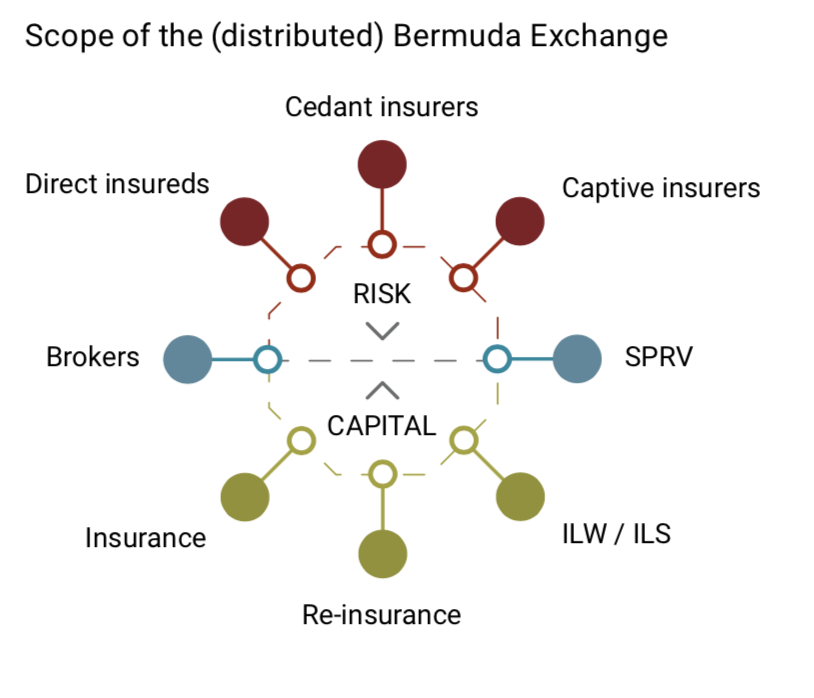
    Scope of the Bermuda Exchange - Source: ChainThat

    Scope of the Bermuda Exchange – Source: ChainThat

    From a marketplace platform to a risk exchange

    ChainThat is offering a marketplace platform that will morph into a risk exchange. Initially the platform will be supporting existing back-office processes such as the placement of risk to supporting the technical and financial account and then moving into the settlement process and claim’s agreement process. The aim is to remove frictional costs to drive down costs to make insurance more efficient that it is today. The platform is built on Corda and uses the ACORD data model for all transactions.

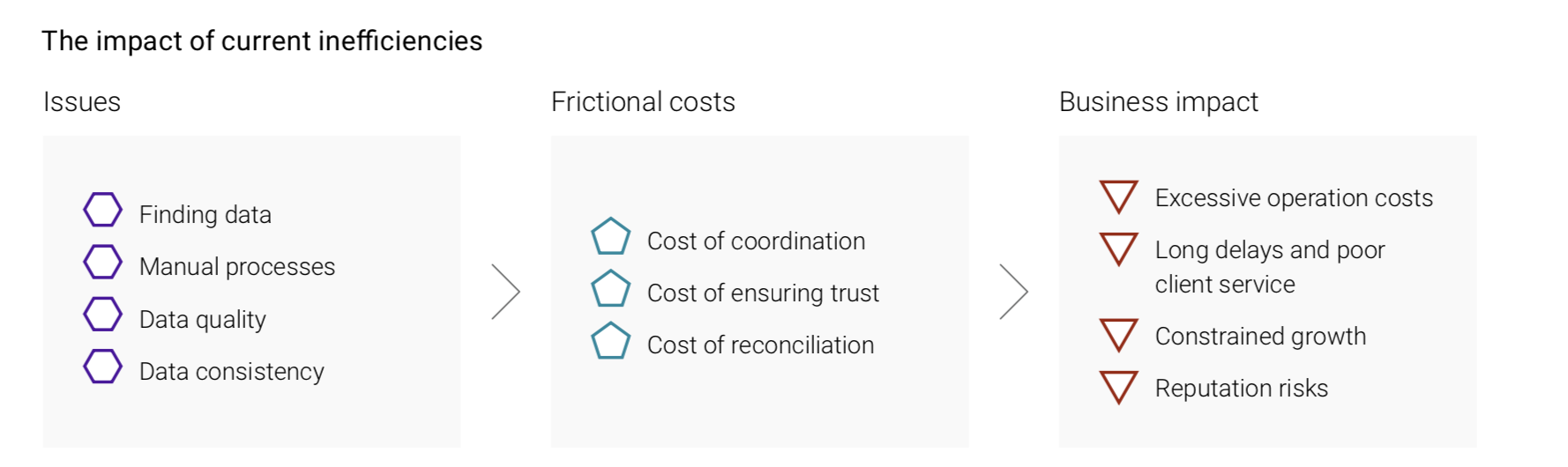
    Impact of current inefficiencies - Source: ChainThat

    Impact of current inefficiencies – Source: ChainThat

    David hopes to offer this risk exchange to other insurance marketplaces by finding one regulatory area that has high trading volumes and lots of participants such as Singapore, Dubai, Zurich and New York.

    Why blockchain?

    The challenge centralised systems have to running a marketplace for insurance companies is that the centralised entity has to store the data and manage the system on behalf of the marketplace participants. However, the insurance business model is a peer-to-peer one, just like they used to in the Lloyd’s coffee shop. That’s what blockchain technology enables, it gives participants back the control of their data and their process. It provides the guarantee that you’re looking at the same version at the exact same point of time.

    Education & Customer Centricity

    At the beginning David concedes that there was a lot of misinformation about blockchain and distributed ledger technologies. So they had to spend a considerable of time educating all the main parties (brokers, reinsures and regulators) and engage with them on a one-to-one basis. This meant that ChainThat had a customer centric approach to defining the exchange and ensured that the participants within the exchange helped to shape and finalise the final outcome.

    Brokers and disintermediation?

    David believes that individuals who believe that brokers will be disintermediated by blockchain lack the understanding of what the broker really does. For David the brokers are the market makers, they provide the risk management services to the customers and they provide back office services. It’s the back-office services that blockchain is looking to streamline. Not just for the brokers but for all insurance entities. By improving efficiencies in back-office services then brokers can deploy their resources more effectively at making those markets and providing better value to their customers around their risk management services.

    Products on the risk exchange

    Initially the exchange will start off with property, and facultative and treaty contracts. Looking at doing the accounting, settling and claims related to those. ChainThat will be adding further lines of business onto that and alternative risk transfer, ILS and ILW.

    Top tips for aspiring marketplace

    So, the first thing is don’t be afraid to fail. You’ve got to fail fast on these things and you know try it as quickly as you can. Try things quickly, if they don’t work try something else quickly.

    David’s top tip is don’t be afraid to fail fast and to keep trying out new things. Take an iterative approach from starting on a small project that take can be started on a credit card and then rapidly scaled up.

    The big bad word of “integration”

    ChainThat has thought about integration from day one. In a marketplace the market moves as slow as the slowest participant which usually is around integration. ChainThat has built a layer on top of its platform that acts as an accelerator for integration which can also integrate with ACORD messaging. ChainThat has data pipelines for performing data mapping exercises which enables them to talk to their firm’s internal systems.

    What does success look like?

    After the launch event of the 5thof March, ChainThat is going to be looking for participants to sign up to the live production trail to use the platform. During the duration of the trail there will be key milestones to define the efficiencies and demonstrate the KPIs against the trail. They want to be able to see how the participants will be able to sell the trial internally to their boards to demonstrate the true value from concept to live production and to demonstrate the potential of what this platform can provide and the new products they could thing to bringing to the market.

    From a ChainThat perspective they want to see that they have defined an exchange that has the longevity to go into live production with multiple participants in Bermuda.

    Your turn!

    ChainThat has launched a truly innovative and modern risk and capital exchange in the market. We are very excited to have been given the chance to report on this exciting news.

    We hope you have enjoyed this news flash, if you liked this episode please do review it on iTunes. Your comments and suggestions are always appreciated so please don’t hesitate to add a comment below.

    If your organisation has any news you’d like to share regarding blockchain, feel free to get in touch with us and we’ll help you spread the word. If you’d like to ask David and Rebecca a question, you can add a comment below and we’ll try to get them over to our site to answer your questions.


    Ep.48 – Are public blockchains suitable for the enterprise world? – Insights from R3 Mar 04, 2019
    Show notes

    For most firms getting a good understanding of what is blockchain and its possible use is a challenging exercise. Once that has been established a further decision has to be made regarding whether or not to build their blockchain solution on a public or private blockchain system.

    Within the first two weeks of January 2019, both the public and private blockchain proponents expressed their views on the merits of their systems. For this podcast we had the pleasure of having Richard Brown, Chief Technology Officer at R3, the builders of Corda, a private blockchain system, express his views.

    Who is R3?

    R3 is an enterprise software company that produces an open-source blockchain called Corda. Corda was first launched in 2016, initially for financial services sectors, mainly banks. However, it was the insurance industry that helped broaden Corda’s view and utility as a blockchain for other industries. Now in 2019, Corda has launched the 4thversion of Corda which has already been adopted by finance, insurance, healthcare, government, and the oil and gas industry.

    What is blockchain?

    What is interesting to know is that in the early days of R3 they didn’t begin with the ambition or the intention of building a blockchain platform. R3 began as a collaborative exercise between a large number of large firms to try and figure out what is blockchain and what the opportunities and implications it might have.

    The conclusion they came out with regarding “What is blockchain?” is that blockchain is a technology or an approach to building systems that allows multiple parties who want to transact, but who don’t fully trust each other to do so in a way that allows each and every one of them to know what they see on their computer is exactly the same as what their counterparts sees on theirs. This massively drives down duplication costs, errors, inconsistencies and the need for reconciliation which allows firms to focus on solving business problems and transacting with their counterparts. Essentially, once you know what you see is accurate, that you know the information you’re working on is correct, you can make decisions more quickly and with more confidence.

    Busting the myth of private blockchains – Consensys

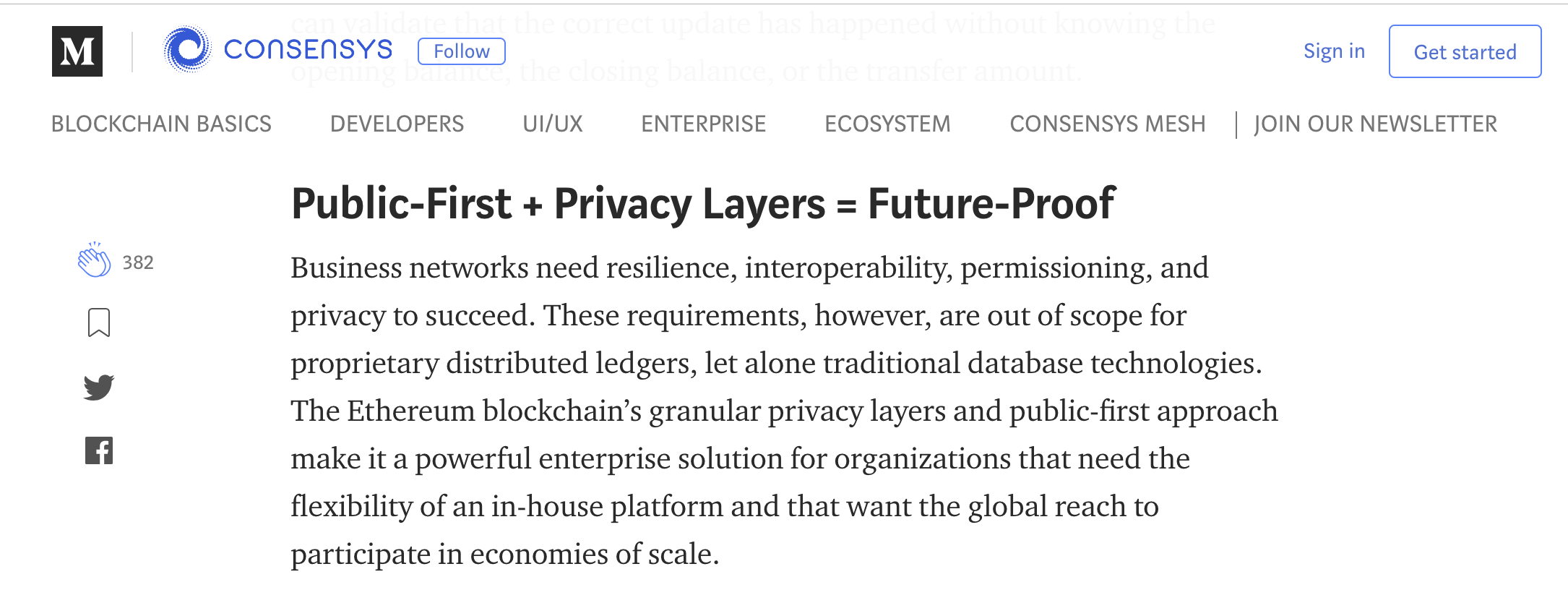
    On the 3rdof January an author at Consensys, an Ethereum based blockchain technology company, published a blog post entitled “Busting the Myth of Private Blockchains”, whose main point was to explain why enterprises shouldn’t use private blockchains in business:

    Business networks need resilience, interoperability, permissioning, and privacy to succeed. These requirements, however, are out of scope for proprietary distributed ledgers, let alone traditional database technologies. The Ethereum blockchain’s granular privacy layers and public-first approach make it a powerful enterprise solution for organizations that need the flexibility of an in-house platform and that want the global reach to participate in economies of scale.

    The Rebutal – Busting the myth of public blockchains for business

    On the 14th of January, Richard wrote a blog post “Busting the myth of public blockchains for business”. In this blog post he debunks three of the main arguments the Ethereum community makes on why business should build on Ethereum:

    1. Ethereum has the largest community of developers. For any firm new to blockchain deciding which platform to use can be complicated. A common argument used by the Ethereum blockchain community was to go to the platform with the most developers.
    2. Ethereum has the most advanced tools and the best technology. This argument essentially builds on the first since Ethereum has the largest community of developers.
    3. Anchoring your private transactions onto a public chain is more secure. Public chains are more immutable than ‘insecure’ private networks and so you should ‘anchor’ your private transactions to prevent malicious parties rolling back your transactions behind your back.”

    What is meant by “anchoring” isn’t quite clear, Richard’s interpretation of it is that you take a fingerprint of a snapshot of the private network and then embed that fingerprint into the public chain. The idea being that as long as that fingerprint is in the public chain it will remain secure no matter what happens to the private chain.

    Debunking – Ethereum has the largest community of developers

    The Ethereum development community claims there are about 250,000 Ethereum developers. Presumably this is the number of people who can code using Solidity, the language in which almost all Ethereum apps are coded. Richard estimates that the number of downloads of the Solidity tool is around 500,000.

    Corda runs on the java virtual machine. There are as of today about 12 million java programmers in the world from a base of 250 million downloads of the java development tool set. That’s a factor of 1/20 between actual java programmers to individuals who have downloaded the tool set. If we take that same factor and apply it to the number of solidity downloads of 500,000 you end up with 25,000 solidity developers instead of 250,000.

    Richard is quick to point out that he doesn’t want to dismiss the efforts. Java has been around for a very long time whilst the Etherium community is far newer and have achieved some phenomenal things such as getting a production network online.

    Debunking – Ethereum has the most advanced tools and the best technology

    By building onto the Ethereum blockchain you will inherit and benefit from all the innovation that happen within Ethereum. Richard’s debunk mainly focused on the Ethereum Virtual Machine (EVM). A team from Kadena documented, the EVM is “fundamentally unsafe” And the team at Aion also independently reached a similar conclusion and have written eloquently why they didn’t use the EVM and chosen the Java ecosystem instead.

    To top it off Ethereum is due to move away from EVM to something called eWASM or if you want an EVM 2.0

    EWASM is just ethereum’s version of the WASM (which stands for WebAssembly) code, created by the World Wide Web Consortium (W3C), the team of developers responsible for maintaining and standardizing the web. – Coindesk.

    Richard’s point was that whilst companies who may be developing on the existing EVM run the risk of finding themselves left behind when eWASM launches, and having to deal with potential compatibility issues. Richard would recommend any firms looking to develop on blockchain should pay attention to that platform’s roadmap and the compatibility promises of that platform.

    Corda uses the java virtual machine which is used by million of developers and has developed an extensive collection of libraries. Equally the Hyperledger Fabric, which is written in Go, has a million developers.

    Debunking – Anchoring your private transactions onto a public chain is more secure

    The way public blockchains, like Bitcoin and Ether, work is through proof of work. Miners are people who spend significant amount of computational power and energy to solving difficult problems. The reward for solving that problem is that they get the chance to propose the next block in a blockchain and in so doing get a reward of some bitcoin or some ether. This however is an inherently probabilistic process. This is because, two miners may find the same solution at the same time and only the longest chain will win out. During that period of time when the longest chain is identified there is a period of uncertainty as there is a nonzero probability the transactions that look as though they have been confirmed may get unconfirmed if they were built on the smaller chain.

    The trap many people have fallen into was that there’s some number that’s for all intents and purposes is safe. Whether that is six, twelve or fifty levels of confirmations (ie. new blocks added to a chain) that the chance of a reversal is effectively zero and of course that’s not true.

    On the 7thof January,Ethereum Classic, got a “51% attack”, were up to 100 blocks were reversed – Coin Telegraph. What this means was that all transactions that happened within those 100 blocks, that may have been safe and confirmed, became unconfirmed. To make matters worse the attacker was able to execute a double spend.

    What is important to remember is that Ethereum main net (ie. Ethereum proper and not Ethereum classic) is much larger than Ethereum Classic and is thus less prone to a 51% attack.

    Richard’s point though is that this can happen and if the probability is nonzero firms need to make sure that their business process and the way they design their application take that point into account. Additionally, the public blockchain sphere is one of anonymity whilst in business blockchains you need to know the identity of the entities who are forming the consensus such as the notaries in Corda. You want to know who is providing your firm’s transaction finality.

    How to avoid collusion in private blockchains?

    Public blockchain communities point out to the risk that key players within a private blockchain may choose to collude between each other and rewrite a block and impose it on the rest of the participants.

    On the Corda blockchain, they have set up the Corda Network Foundation (this was discussed in Ep.47 – Building effective governance in a blockchain ecosystem – insights from Corda Network). The key about the Corda Network Foundation is that it is responsible for the governance of that network and it is not controlled by R3 and it can’t be taken over by any one entity or any two colluding entities. In a subsequent release version of Corda and of the Corda Network there will be segregated sub zones where firms can run mini private networks within the main network.

    Richard emphasize the need for a clear governance framework, a verting framework, a way to check that the right algorithm is being run. There is the need to deal with dispute resolution, the need to know who to serve legal notices. It is important to accept upfront that these are problems that have to be solved and plan for them rather than just making that claim that miners will resolve those problems.

    Your Turn

    Thank you Richard for sharing your views on why public blockchains aren’t suitable for the enterprise world. If you liked this episode, please do review it on iTunes. If you have any comments or suggestions on how we could improve, please don’t hesitate to add a comment below. If you’d like to ask Richard a question, feel free to add a comment below and we’ll get him over to our site to answer your questions.


    Ep.47 – Building effective governance in a blockchain ecosystem – insights from Corda Network Feb 25, 2019
    Show notes

    Often not considered as “sexy” in the blockchain world, but building effective governance is probably one of the most important tasks in building a resilient blockchain ecosystem. For this podcast we were very privileged to have James Carlyle, Head of Network and Operations at R3.

    What is blockchain?

    Blockchain is a distributed ledger system that makes a fundamental promise which is “what I see, is what you see”. The idea being that although people share a common view, they actually have their own copies of data and that matter for numerous reasons such as the one of control. . It means with a copy of their own data and the promise that what they see is what the other side sees, that they don’t need to rely on intermediaries.

    What is governance?

    I always say if you haven’t figured out who is in control, it’s because you haven’t been looking hard enough; there is someone there

    Governance is about control first and foremost. What had initially attracted James to Ethereum was the idea of an unstoppable world computer where no one was in control. The initial bitcoin and Ethereum community were people who believed in small government or not government and perhaps they thought that these systems came without control. However James view is “I always say if you haven’t figured out who is in control, it’s because you haven’t been looking hard enough; there is someone there”.

    R3’s initial governance for running a consortium

    In R3’s early days it was solely focused on running a consortium and the consortium was there to explore how blockchain technology could be used in finance. Right from the start R3 set out to encourage participation and collaboration, which is absolutely fundamental for blockchain, and thus governance became important from the very start.

    In its early days R3 had a steering committee that decided what it should focus on. A steering committee had representation from every one of the 42 initial bank members of R3. One of the first things the steering committee decided to do was for example to set up an architecture working group and the architecture working group had its own governance.

    The architecture working group’s governance was comprised of leading and chief architects from banks thinking about the right technology choice for distributed ledger’s in banking. But governance has always mattered with these collaborative and heterogenous groups.

    The Corda Network

    When Corda was first designed its founder imagined a platform in which people could use Corda to manage agreements with each other for any business between any businesses and at any time… ie. the corda network. This can be thought of as an internet of Corda nodes. Corda nodes that are connected together and across which business transactions can take place.

    In the initial days of Corda most groups of banks and other companies wanted to deploy their blockchain software together in the form of many consortiums who weren’t necessarily connected. Corda’s original vision of a corda network couldn’t be achieved in this manner. The reason is because each network per application has its own boundary of trust and that means that what happens in that network is trusted within the network itself, but it isn’t trusted by anyone else. Each network has a “trust route” where all of the digital signatures and so on can be traced back and it’s not possible easily at least to bring the advantages of blockchain across the boundary of one network to another.

    That’s because the provenance for example which is supported by things like the digital signatures and the hash chains and everything else, that provenance doesn’t move across boundaries very easily.

    If we take the analogy of two villages who want to trade with each other. In the real world what they need is a common trust boundary and that trust boundary is provided by things like language, a set of laws and currency. For example, they can trade together, two villages can trade together if they know a common legal process and a common set of laws that bind them.

    The Corda Network is here to create a larger trust boundary that surrounds multiple business networks. Where it defines a number of things that they have in common, such as common rules. Example of common rules are technical aspects. They’re technical parameters of Corda and one example is the maximum message size. It is defined as a standard for the whole of the Corda network and business networks that operate within that accept that common definition, that common standard and it means that when they transact with each other one of them is not going to get surprised when it receives a message that’s much larger than it normally is used to working with. So that’s an example of a technical parameter which the Corda network defines as.

    Governance models’ inspiration

    James recognises that governance has been around for a long time and there exists a lot of examples on which to draw up and learn from. He draws a clear distinction for Corda that is different form the world of permissionless blockchain systems like Bitcoin and Ethereum.

    Corda operates within a legal framework. Corda smart contracts would have a legal prose equivalent and there would be a jurisdiction that governed those existing agreements in the existing legal prose.

    Bitcoin and Ethereum

    In Corda, its members were expected to understand the identities of their trading partners. There was no sense of a sort of anonymous trading between parties as you’d expect from permissionless blockchain systems.

    James and his team did look at Ethereum and Bitcoin in guiding their technical designs for Corda. They also looked at the governance of those systems. However, a lot of their governance seems to have an implicit governance model where decisions are influenced by politics and influence.

    For the Corda network they wanted an explicit governance model. One where decisions were made according to a defined process. Decision-making was transparent, the principles and goals of the governance model were explicit that everyone could see and reason with.

    ICANN

    ICANN became a source of influence both by its simplicity and by how concise its governance model was. The initial set of Corda Network governance guidelines were initially modelled toICANN’s governance guidelines.

    Additionally the Corda Network looked at the Hyperledger project, Linux Foundation, SWIFT and OPEX to name a few.

    Corda Network’s governance – independent or part of R3?

    As blockchain systems are deployed in the very heart of enterprise organisations. They’re often used in order to avoid things like reconciliation and in order to make the sort of cost savings real, organizations themselves need to redesign their business processes when deploying blockchain systems. That takes time. It means the deployments become long-term deployments and that means that organizations that are going to use a network have to trust the long-term nature of that network. So, stability is really important. Stability around things like access and pricing. The participants will want to know that they’re not going to be adversely affected by a pricing change in five years’ time.

    James and his team felt that the only way really to provide that assurance and given that R3 itself is a commercial entity, profit-seeking entity is to set up a separate entity to govern the network, to ensure that governance is transparent, its democratic. The participants on the network have a say in how the network is run and have a say over things like pricing.

    That separate legal entity would have a board of directors and participants would vote for the board of directors. So, they have a say in who represents them, and the board directors are then free to make decisions about the nature of and the running of the network

    This of course imposes certain requirements on R3. It requires that R3 doesn’t seek to control the new legal entity. It requires that R3 understands and believes that the success of the network benefits R3 as well. Even if R3 doesn’t profit from the network. Participation costs to the Corda Network have been brought right down. The entity that governs the Corda Network is a not-for-profit entity so that the fees that are charged to participants exactly mirror the costs of running a few technical services.

    Corda Network’s governance model

    So, we want it to be transparent, we wanted to be cost effective, we want it to be stable.

    Prior to launching the Corda Network, there was a lot of consultations done with business networks, application vendors and consortium that want to use Corda and the Corda Network. The feedback received from these consultations was used in fine tuning the policies and proposed rules.

    The Corda Network aims to be transparent, cost effective, and stable. But yet flexible to change. Because they recognises that they won’t necessarily get it right first time and they want it to be fair and open.

    The board of directors has control. It votes on things through a series of what are called – governance events, and these can either be mandatory or advisory or in extreme cases constitutional governor incidents where the nature of the foundation itself can change. The participants on corda network hold an identity. They are issued with certificate that represents their identity and that’s what they use when they transact with each other and the model was set up is as simple as possible. That is that one legal entity, where an identity corresponds to a vote of one vote. So that means that voting for directors for example, which shall happen on an annual basis, is very straightforward and the directors that receive the most votes receive take the open seats that are available to them.

    Continuity is managed by a set of measures. In the steady state there is a rotating board where three seats are up for election every year with each seat lasting for three years. This means that the board doesn’t get replaced in its entirety every year and people are able to work over a three-year period to implement change and ensure continuity.

    There are some protections in place around control around making sure that it’s fair. For example the board for example cannot be populated solely by people who work in banking or in any one industry or in any one continent. They didn’t want the board to be populated solely with people from Europe.

    The controls state that there should not be more than three directors from any industry, not more than three directors from any continent, not more than three directors from large or very large organizations. This ensures diversity in terms of the organization size that is represented.

    An additional point that is very important is that the Corda Network wants directors who are passionate about blockchain technologies and whom understand the political and governance issues. They want people to vote for individuals. Because it’s individuals that have passion and skill and so directors are invited to come forward, to be nominated or nominate themselves and describe why they think they would make a good director. Participants with a vote can then vote for individuals instead of organisations.

    Transparency, clarity of rule and determinacy is incredibly important, which is why they set up a separate entity, the foundation.

    The Foundation

    The foundation is the independent entity. The foundation is a not-for-profit, it has a board of director structure, that it had the concept of participation and could accept a sort of voting arrangement. The UK law firm Clifford Chance, proposed a Dutch Stichting. The stitching is interesting, because it has no owners. As there are no owners and therefore there is no profit and there is no profit distribution or dividend.

    The Stichting has a board that make the decisions and with the majority vote things get changes. It is based in Holland and is a Dutch legal entity.

    A set of safeguards have been put in place that benefit all of the participants of the network.

    One of them is that the foundation can’t be sold. Another is that the foundation cannot change its role to manage something other than corda network. These safeguards are baked into the articles of association.

    Top tips in setting up a governance structure

    For James, tip zero is to be completely clear about you know what the objectives are for the thing that one is applying governance to. The first tip would be not to ignore it really matters and it’s not as sexy perhaps as writing software. But it’s probably or possibly more important ultimately. It’s important for the adoption of things. So that’s tip number one is to take it seriously and to recognize that it takes time and it needs communication. It needs lots and lots of feedback and discussion to get it right. Because it can’t be too opinionated. That’s perhaps the second tip. The third tip is actually to be bold. Being opinionated helps. Because it helps to get a straw man out there that people can debate and that sometimes takes the work of this very small group of people to put a straw man together. It helps tip number four is to look around and look at what other people have done and try to figure out what can be reused and not try and ignore everything else and start from scratch. Because probably that will just take more time. Governance models have evolved with parliament and democracies and other political systems over thousands of years and human nature doesn’t change that fast.

    Your Turn

    Thank you James for sharing some great insights on how to build effective governance solutions within a blockchain ecosystem. If you liked this episode, please do review it on iTunes. If you have any comments or suggestions on how we could improve, please don’t hesitate to add a comment below. If you’d like to ask James a question, feel free to add a comment below and we’ll get him over to our site to answer your questions.


    Ep.46 – A retrospective look on blockchain for 2018 Feb 17, 2019
    Show notes

    For this episode we were fortuitous to reconnect with Dante Disparte Founder and CEO of Risk Cooperative to look back on how blockchain has evolved in the insurance industry in 2018 and what we can expect for 2019.

    What is blockchain?

    For the insurance industry, Dante describes blockchain as a bordereau or a ledger that exists simultaneously in an exact form across multiple distributed computer systems. From the outset this creates a level of resilience, a level of tamper proofing that you don’t get from existing technologies today.

    Retrospective of blockchain in the insurance industry in 2018

    “Still the beginning”

    “Still the beginning” is how Dante would characterise blockchain in the insurance industry. In spite of Bitcoin recently celebrating its 10thanniversary, it’s really only been in 2018 that we started seeing large scale enterprise tinkering with blockchain technology.

    In January 2018, Dante penned an article “One Thing Is Clear From Davos, Blockchain Is Out Of Beta” in Forbes, where he stated that at least 50% of the Fortune 500 were embarking in deep experimentation with blockchain. 2018 was the year of orientation, and Dante believes that 2019 will be the year of experimentation at scale. 2020 would see the much broader adoption of the technology across asset classes and across industries.

    Consortiums and competitive advantage

    The most mature and evolved model in the insurance industry are the consortia at B3i and the RiskBlock Alliance. This model allows a risk averse industry, such as insurance, to understand the technology and follow their peers in getting basic POCs and use cases.

    Dante’s personal view of the world is that the consortia approach amounts to co-opetition which is tantamount to having Amazon partner with Walmart and JC Penny’s (For the UK: Tesco partner with Sainsbury, Asda and Lidl) in building ecommerce platforms. For Dante there is a genuine opportunity for insurers, brokers and others in this industry to leverage emerging technologies like blockchain and others to get a competitive advantage. Firms that really embrace those technologies, instead of limiting it to back end efficiency plays, will really take a lead over their competitors.

    In episode 23 “Blockchain from an Allianz perspective and lessons learnt” Bob Crozier, Head of Global Blockchain Centre of Competence at Allianz. Pointed out that “B3i is not about getting a competitive advantage. It is for the industry and by the industry and its goal is to use blockchain to address industry pain points, help members reduce their cost base and make customers’ lives easier.”

    Whilst Dante agrees that there is value in such consortia his issue is that the strategic challenges the insurance industry faces require competitive dynamics than the consortia model doesn’t allow for. The average expense ratio is between $0.30 and $0.50 on every dollar of risk capital.

    If a firm tries to become more efficient to risk allocation and risk pricing but yet everybody in the insurance industry is following the same model in leveraging technology in exactly the same way, that firm’s potential net gain has been washed away.

    Opportunities for Innovation – Insurwave Style

    Insurwave is a great example of opportunities for innovation that is triggered by the buy side of the market, especially when you are a Maersk with enough buying power and clout to force the insurance industry to innovate.

    You can hear more about Insureblocks from a Maersk perspective, EY perspective and insurance perspective.

    Need for Digital Transformation

    “Where the internet was a disruptive technology in every sense of the word, blockchain is an augmenting technology”

    Blockchain isn’t meant to disrupt or displace the core function of the insurance industry, after all what is an insurance industry but a promise to pay. Blockchain is a technology that is here to amplify the trust.

    Maersk has a fortuitous balance sheet which in some ways means it can opt out from the insurance market all together. We are seeing an increasing wave of large firms self-insuring themselves and even opting out of the insurance market. Dante uses the example of VW emissions scandal, who in spite of this scandal still managed to become the largest automaker the year after. The role insurance can play in those large enterprises becomes less and less relevant when insurance operating model is still stuck in the year 1730.

    See Insureblock’s “This is us” video for a playful put at the insurance industry being stuck in the past.

    Big Megatrends

    Dante points out to the new operating realities in the marketplace that can’t be ignored by the insurance industry. There is a new generation of consumers born with a smart phone in their hand used to instant gratification. There is nothing instant or gratifying about the process of getting a class of insurance underwritten under traditional norms and through traditional value chains.

    Even the developments done by Etherisc and by Fizzy in providing some form of instantaneity in terms of protection and claims outcome and remediation. Insurance at the core is an instrument of utmost good faith and technology enables insurers to show that. That’s a very powerful model of transformation that doesn’t come at the expense of traditional distribution model but it does tap new model opportunities.

    The new megatrend is with regards to the asset light economy we live in. New generations are urban dwellers who opt out from owning a car and who share an apartment with friends longer than previous generations. This represents both as an opportunity and a challenge for insurers if they are willing to decouple their traditional distribution models. Nothing but technology can enable insurers to reduce their 30-50% expense ratio to price their solutions sufficiently to attach to those new buying habits.

    Last new megatrend is with regards to a world being etched by complex big catastrophic events, which Dante calls “non-conforming risks”. Risks that don’t care about actuarial models that can level entire cities or communities. Think climate change related ones. These risks are happening at an increased frequency. The insurance industry has a unique double jeopardy – the assets that they once thought were safe to offset liabilities on the balance sheet are now proven to be very risky. Insurance industry have to look at bringing new talent, new technology and new strategies to face those challenges.

    Predictions for 2019

    Like any big wave of technology, Dante believes, we have now crested the peak cycle of the hype cycle and are now entering a more mature phase. Blockchain will now fade into the background as a callout technology. What customers want is trust, transparency and a technology like blockchain that can defuse the asymmetries of information that don’t work in the markets favour. Firms will be able to do achieve that by using blockchain technology but without putting the label on it. As a technology, blockchain doesn’t sit in isolation from other new modern technologies such as AI, IoT, Big Data, Machine Learning and Robotics.

    Blockchain for Insurance – June 18-19th2019 in London

    Dante and Walid will be co-chairing the 3rdinstalment of the Blockchain for Insurance conference in London. Insureblocks and Dante are both looking forward to catching up with the real blockchain practitioners outlining their progress. We aim to provide the delegates with the ability on how to sell digital transformation internally. To provide them with real proof points from insurers who have developed blockchain solutions for them to benchmark to and learn from. To find out more about this conference click here: https://blockchain-insurance-europe.com/

    Your Turn!

    Many thanks Dante for participating with us in this fireside chat and we look forward to greeting you in London on the 18th of June. If you liked the podcast please do review it on iTunes. If you have any comments, suggestions on how we could make it better please don’t hesitate to add a comment below. If you’d like to ask a question to Dante, feel free to add a comment below and will get him over to our site to answer your questions.


    Ep.45 – Automating the Claims Process with Blockchain – insights from Benekiva Feb 10, 2019
    Show notes

    In this week’s episode we explore how can we automate the claims process with blockchain. Our guest for this topic is Bobbie Shrivastav, Co-founder and Chief Product Officer at Benekiva. Bobbie has 15 years experience in the technology field. In 2015, in addition to becoming a parent Bobbie started working on Benekiva after realising all the inefficiencies in the insurance industry.

    What is Blockchain?

    Blockchain is magic? That magic pill that we have all been waiting for? Bobbie describes blockchain as a ledger of transactional records that is permanent and immutable, i.e. it can’t be changed. In addition it is distributed across a permission based or permissionless based blockchain and is append only.

    What is Benekiva?

    Benekiva is a technology platform that is here to bridge the gap between carriers, policy holders and beneficiaries via claims automation, asset retention and data management. Benekiva claims to be the only stand alone claims platform for life and annuity that focuses on the customer.

    Challenges of the existing claims process?

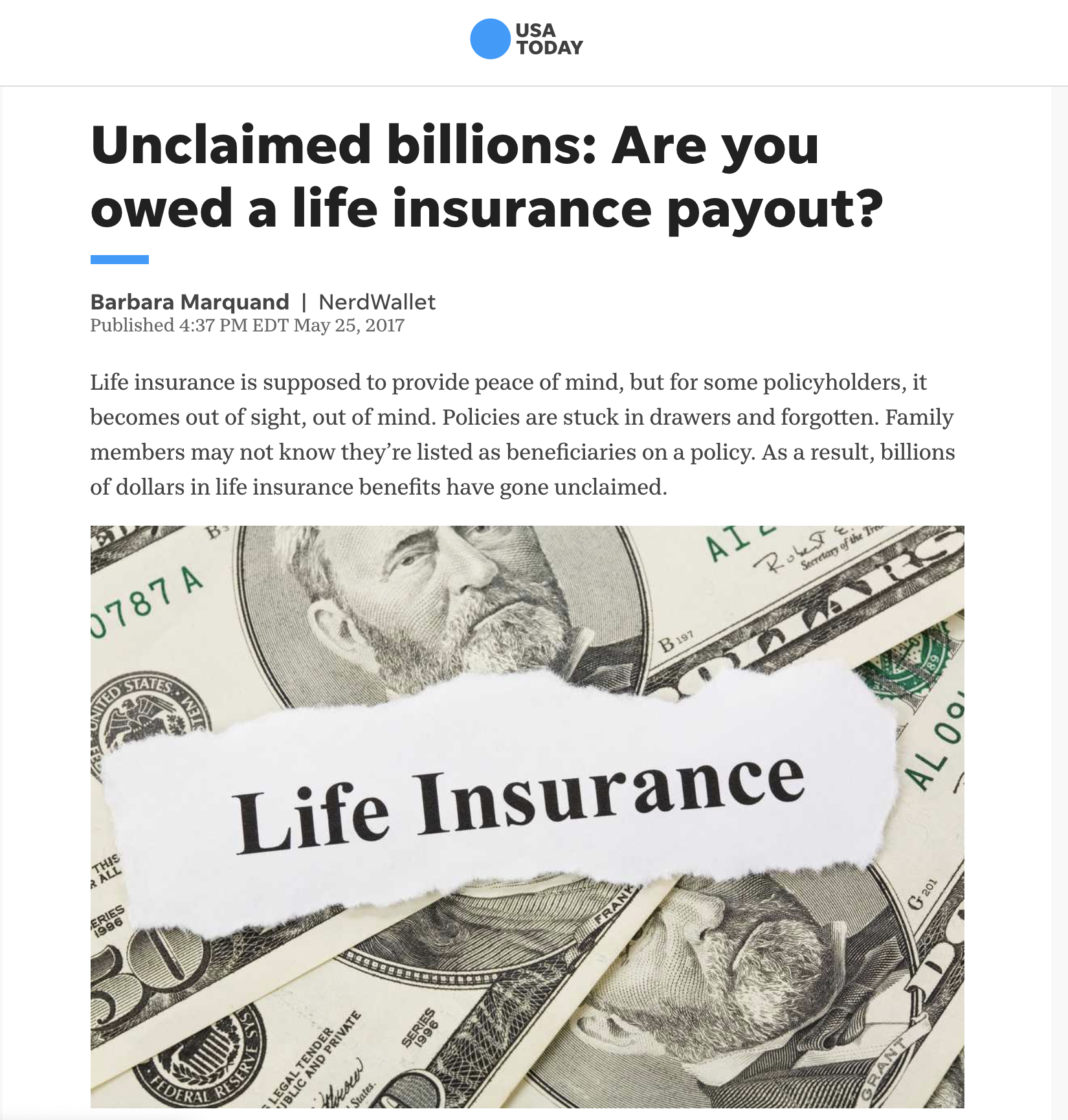
    In 2016, Bobbie heard a stat that 68% of life insurance goes unclaimed in the United States. According to NerdWallet and USA Today, there is $7.4 billion of unclaimed life insurance in the US alone.

    This staggering number is due to the fact that what is wrong with the existing claims process is that it is still in paper and file mode. For the most part the work flow is passing paper and files. It is a process full of friction that generates many barriers for beneficiaries to successfully receive a payout.

    Bobbie highlighted the four main problems:

    1. Inefficient process
    2. Legacy systems
    3. As most life insurance policies are filed in paper format it doesn’t enable for a digital kind of communication with the policy holder for updating their details such as their beneficiaries.
    4. Unclaimed laws prevent insurance companies to keep the money so they have to engage in costly investigative exercises to find the beneficiaries of the life insurance policy.

    How have carriers tackled this problem to date?

    Up to now most carriers’ strategy for addressing those issues has been through back end admin system upgrades. Whilst there is no issues with updating an insurance company’s core systems, it isn’t an update that has a fundamental impact on claims processes. As it also takes on average 2 – 5 years to do those updates, claims improvements haven’t happened. Additionally as some carriers look at claims as an expense centre, they don’t always invest sufficiently into it to update them.

    Benekiva can integrate with insurance companies current systems and also into the updated admin systems once the update is complete. In the meantime Benekiva can start pulling data from legacy systems and provide immediate customer experience improvement. Even if the data is stored in a paper format, Benekiva is able to digitise its content.

    Blockchain

    Benekiva started looking at using blockchain in two use cases within a private blockchain:

    1. Immutable ledger – provide an audit trail of the claim process from the moment the policy is generated to when the payout is made
    2. “Time travel capability” – enables querying at any point in time instantly

    Bobbie recognises that this could have been done without blockchain. However, Benekiva understands the importance of being at the cutting edge of technology and to start experimenting with blockchain in order for the future to explore building a consortium.

    From a customer experience side blockchain can help guarantee integrity and once the consortium model is enabled it will be able to service the beneficiary very efficiently with the potential to significantly reducing this stat of 68% unclaimed life insurance.

    Benekiva’s blockchain has been developed by Fluree.

    What does the future look like?

    Making the claim process as seamless as possible is Benekiva’s focus for the next few years. Integrating chat bots, smarter “smart form technology”, fraud detection, blockchain and a lot more to make the claim process for the beneficiaries as smooth as possible. Additionally, Benekiva believes there is an opportunity to make the claims staff easier by providing an efficient workplace that isn’t paper base but digital.

    Your Turn

    Thank you Bobbie for sharing some interesting insights on automating the claims process with blockchain. If you liked this episode, please do review it on iTunes. If you have any comments or suggestions on how we could improve, please don’t hesitate to add a comment below. If you’d like to ask Bobbie a question, feel free to add a comment below and we’ll get him over to our site to answer your questions.


    Ep.44 – Blockchain & GDPR Feb 03, 2019
    Show notes

    Last week we had the pleasure of talking to Dr. Markus Kaulartz, lawyer at CMS Germany, discuss with us the very hot topic of Blockchain & GDPR. We will try to answer the question of how does GDPR, drafted in a world in which centralised and identifiable actors control personal data, sit within a decentralised world like blockchain? Markus is the co-author of “The tension between GDPR and the rise of blockchain technologies“.

    Markus works in the IT law department of CMS Germany with a focus on innovative topics such as blockchain, AI, cyber security and all the data protection issues. Previously to becoming a lawyer, Markus used to work as a software developer.

    What is Blockchain?

    From a pure legal point of view there are two aspects:

    1. Blockchain is a database which is distributed and synchronised, whose data cannot be deleted. This definition however is controversial within some quarters as blockchain isn’t considered as a database but it is used to simplify defining it for a non-IT audience.
    2. Blockchain enables us to move digital assets. This is very important because a receiver of a digital token for example will always know that the sender of the token doesn’t own it anymore. In other words the tokens transfer of ownership emulates the transfer of ownership of real life offline assets. If we look at the transfer of ownership of paper share certificates they presently use a bank as a central intermediary to help identify who is the present owner of a share. In a blockchain world we can theoretically eliminate the need of the bank.

    What is GDPR?

    General Data Protection Regulation (GDPR) is a regulation in EU law on data protection and privacy for all individuals within the European Union and the European Economic Area. It was enacted in May 2016 but only applied from May 2018. It replaced the former EU Data Protection Directive with a big difference that it applied directly to the member states of the EU without the need for it to be transformed into national laws. The other big difference of GDPR with the former EU Data Protection Directive is the amount of the fines. Under GDPR the fines are up to 4% of the global turnover of a company.

    What is key is that GDPR also applies to companies outside of the EU that works with the EU. For example if you’re an Indian or American company who offers services to EU citizen you will have to comply with GDPR regulation.

    Personal Data & Application of GDPR

    GDPR only applies where personal data is being processed. Personal data is defined as any information relating, directly or indirectly, to a natural living person, whether the data identifies the person or makes him or her identifiable.

    Article 4 of GDPR defines Personal Data – “as any information relating to an identified or identifiable natural person (‘data subject’); an identifiable natural person is one who can be identified, directly or indirectly, in particular by reference to an identifier such as a name, an identification number, location data, an online identifier or to one or more factors specific to the physical, physiological, genetic, mental, economic, cultural or social identity of that natural person.”

    The key implication is that a person, not a company, can be identified or identifiable. Being identifiable means you don’t necessarily need to have their name, or address of the person, it suffices to have their unique ID and even their IP address. In a blockchain world the public key is considered as personal data as it is related to an identifiable person. Having any of these identifiable data points means that GDRP applies.

    If GDPR applies an assessment needs to be carried out to identify which obligations are applicable:

    • Inform data subjects with what to do with the data
    • Maintain records of processing activities
    • Implement technical and organisational measures
    • Review in which country the data is stored (i.e. EU or non EU)
    • Need a legal basis for the data processing. In general processing of personal data is forbidden unless there is a legal basis. A legal basis might be consent or whether the processing is necessary for processing a legal obligation

    Consent

    A consent needs to be very specific. Getting an informed consent in a public blockchain such as bitcoin is very difficult, if not impossible, as it’s very hard to say on which node the data is stored in which country.

    A private blockchain is easier to implement GDPR, than a public blockchain, as you can control the data flows.

    CNIL, the French Data Protection Authority, stated that although the public key, in a public blockchain such as bitcoin, is considered personal data, GDPR doesn’t apply because people use it in a purely private context. This is known as the household exemption.

    Controller and Processor

    In a GDPR context we distinguish between a Data Controller and a Data Processor.

    GDPR applies to data controllers and data processors whether or not there are established within the EU. If outside the EU, if such controllers and processors process personal data in connection with offering services or goods to EU data subjects, or in respect of the monitoring of data subject behaviour within the EU, then they have to abide to GDRP.

    The Controller determines the process and means of the data processing. The data processor processes personal data on behalf of the data controller. A typical example of a data processor is a hosting service provider which does not determines the purpose of the processing but only stores and processes the data on behalf of its customers (ie. the controller of the data).

    In a Bitcoin world the nodes essentially are processors that store the data. However as users of the Bitcoin blockchain we should have data processing agreements with the nodes which is challenging as most nodes are unanimous. Another potential legal framework is to look at the nodes as data controllers which also has the challenge of what happens when the data is transferred outside of the EU.

    Markus believes that these legal challenges can lead to the creation of a future EU public blockchain.

    Suggestions for Public Blockchain builders

    Markus highlights a set of solutions for blockchain builders on how to deal with GDPR:

    • Store personal data off chain
    • Identify the nodes outside of the EU and prepare legal agreements with each of them
    • Set up a blockchain that only uses nodes within the EU

    Private Blockchains

    Private blockchains in comparison to public blockchains are much easier to reaching GDPR compliance. Markus proposes two solutions:

    1. Deleting Decryption Key

    Some companies have business models that require them to store personal data on-chain. As blockchains are meant to be immutable (ie. the data cannot be deleted), this can provide a challenge with GDPR’s “right to be forgotten” clause. To overcome this challenge Markus recommends that personal data should be stored in an encrypted way. If the customer wishes to have their data removed under the “right to be forgotten” clause, then deleting the decryption key related to that personal data will make it inaccessible. CNIL, the French Data Protection Authority, supports this solution as a means to becoming GDPR compliant.

    2. Lookup Tables

    An alternative solution that Markus usually recommends is to store the personal data off-chain and linking that data to a blockchain via a lookup table.

    In his document, “The tension between GDPR and the rise of blockchain technologies“, Markus provides a detailed example of how this could work in a GDPR compliant manner:

    “Let’s say you have built a platform that allows people to rent out their cars to those in need of cars. In this case, the blockchain is used strictly as a payment channel and, after payment, a customer receives a unique car token with which to enter the car. For the platform to work, however, there has to be a link between the users’ identities and their public keys. The details of their identities and the links can be kept in an environment where they can be modified and deleted (off-chain). To be extra safe you may even want to oblige parties to create unique public keys using your platform for each relationship. If you destroy the link that has been used as an identifier, all that is left on that blockchain is a public key and its transaction history. The public key is just a string of characters that, in itself, may or may not amount to personal data. Following deletion of the link, whether the data qualifies as either personal or anonymous depends on what is left on that blockchain and the likelihood of link-ability. If all that is left is three simple transactions between two anonymous public keys, the ability to link that to an identifiable natural person may become practically impossible. Therefore, the data that was once considered personal in the GDPR sense, may have morphed into anonymous data.”

    You have a lookup table which is the link between the data off-chain and the data on-chain. You have a key on-chain which is associated with another key in the lookup table. That other key refers to the data set stored off-chain. If someone requests their data to be deleted then you can delete the data off-chain and you can delete the entry in the lookup table. Thus the remaining key on-chain will have lost its association with the lookup table key (related to the off-chain data) as that would have been destroyed. The remaining ID on-chain is unanimous and which is thus GDPR compliant.

    DPIA – Data Protection Impact Assessment

    DPIA is essentially a deep dive into a company’s data processing activities. If a company is required to perform a DPIA, it has to assess the entire process of how data is being handled at a very sophisticated level. A DPIA is usually required to be done if the data processing is likely to be a high risk for the rights and freedoms of a natural person. In the case of blockchain a DPIA is required because of the following reasons:

    • When new technology is being used with other data processing circumstances which can lead to a high risk for data subjects
    • When data subjects are prevented from exercising their rights

    How can data protection principles be fulfilled in blockchain?

    The most important point is to apply the principle of privacy by design. That means from the very first line of code that is written a company has to apply appropriate technical and organisational measures to being GDPR compliant. For example:

    • ensuring that personal data is correctly encrypted
    • data subjects can delete their data
    • where is the data stored? Is it stored in other countries or not?
    • Is there the appropriate legal basis for the processing of data?

    If privacy by design isn’t applied from the beginning then the company runs the risk of having to significantly update their software to being GDPR compliant.

    Your Turn

    Markus has provided us with some great insights on the challenges of GDPR and Blockchain. If you liked this episode, please do review it on iTunes – your reviews make a huge difference. If you have any comments or suggestions on how we could improve, please don’t hesitate to add a comment below. If you’d like to ask Markus a question, feel free to add a comment below and we’ll get him over to our site to answer your questions.


    Ep.43 – ‘Mutualisation’ of insurance through blockchain – insights from Nexus Mutual Jan 27, 2019
    Show notes

    Last week we had the pleasure to talk to Hugh Karp, founder of Nexus Mutual, about their insights on how blockchain and smart contracts can be used for building effective insurance mutual. This is Hugh’s second appearance on Insureblocks as he was a guest blogger last September where he penned a post on “Public Blockchains in Insurance: Do incumbents need to worry?”

    What is Blockchain?

    Hugh believes it is more interesting to focus on what the technology enables instead on focusing on the technical description of it. Blockchain gives a shared view on some sort of information, so that everyone can agree on the information and that it can only be changed by playing by the rules.

    Examples of such information are account balances and the rules could be a combination of smart contract logic and consensus process to add new information to the blockchain. In Bitcoin that consensus process is mining for example.

    Once we have shared information that all parties can agree on, and self enforcing rules, we can coordinate human activity in ways we couldn’t do before. What is key is that this can now be done more efficiently than ever before and without a central regulator.

    Why Mutualisation?

    Mutuals are the original insurance structure. They arose because communities recognised that they had a shared common risk and that they would be more resilient if they spread this risk out within the group. These communities would pool resources together and decide as a group when a claim will be paid. If no claims were made then all the members benefited.

    This is a stark difference to traditional insurance companies whose interests aren’t aligned to those of its customers. Shareholders driven by profit by not paying out claims. Mutuals are member led and have a shared goal thus reducing the risks for conflicts of interest.

    So what about regulators? Aren’t they meant to reduce those conflicts of interest? Hugh believes that in well developed countries that is the case but it comes at an administrative costs. In developing countries though many people don’t always have a reliable legal and regulatory system on which they can rely on.

    What is Nexus Mutual?

    Nexus Mutual uses the power of Ethereum so people can share risk together without the need for an insurance company… ie bring back the true form of mutuals where individuals contribute to an insurance like entity and group together to protect themselves. Nexus Mutual uses blockchain to reengineer the business model.

    The role blockchain and smart contracts play in building a mutual?

    How does it help to scale trust and capital? Mutuals have traditionally struggled to compete with shareholder insurance companies. Expanding outside of their original community group is challenging for a mutual. Hugh exemplifies this problem with an example of where one village may not trust the elders from another village to pay out their claims. Thus blockchain can be helped to scale out trust because instead of having to trust that other group of people you simply have to trust that the code works as it is intended.

    The other, less well-known issue, that mutuals face is the scaling of capital. Due to how they are structured, mutuals can only raise money from their membership base, and have limited access to capital markets. As insurance is capital intensive it does put limit a mutuals growth.

    Hugh believes that due to their decentralised characteristics mutuals can only be built on a public blockchain (e.g. Ethereum) instead of a private one (e.g. Hyperledger and Corda). This ensures that the funds are collectively held on a smart contract instead of in a central location. Member driven and member owned.

    Tokenisation

    As Nexus Mutual is using smart contracts on the Ethereum public blockchain they can tokenise membership rights of the mutual which allows an increased level of flexibility on how they can raise capital. In other words the rights of the members (e.g. voting power) of the mutual are represented as tokens on the Ethereum blockchain. The more tokens you have the more you can transact within the mutual.

    Governance

    Nexus Mutual is building the initial set of governance, the rules, by which the members of the mutual agree to abide by. Examples of such rules are how many tokens they need to acquire to do claims assessment and how many they need to destroy to purchase cover. Additionally if members participate in the system fairly they get rewarded with tokens if they participate unfairly they get punished. This creates the aligned incentives to make the mutual work.

    Members can join that mutual based on those initial set of rules. Members can then vote to change the rules if they wish.

    How do you avoid members of the community behaving like a traditional shareholder-based insurance company? How do you avoid them keeping the profits instead of paying out claims?

    Nexus Mutual ensures that the rules and incentive structure are set up in a manner that is at least as good as those of a regular insurance company. For members to participate in claims assessment they have to place a bond before they vote. If they vote with the majority they earn rewards. If they vote fraudulently their bond can be destroyed. This system was rigorously tested via a third party utilising AI agents that have undergone a machine learning process.

    Smart Contract Cover

    Smart Contract Cover is the initial product Nexus Mutual will be launching with. This covers smart contracts, written on Ethereum, from the risk of having bugs or hacks that can lead to financial loss. This is recognised as the biggest risk within the Ethereum community as evidenced by two previous hacks:

    • On the 26thof June an unknown hacker spotted a flaw in the smart contract code of the DAO (a digital decentralised autonomous organisation) resulting in 3.6 million Ether (a value of $50m at the time of the attack) being stolen
    • Two Parity multi signature wallet attack. Multi signature wallets are smart-contracts designed to manage crypto assets by the consent of multiple wallet owners. The attacks led to the freezing of over $150m of ether with its owners unable to access their funds.

    It’s a very niche product for the Ethereum blockchain only as Nexus Mutual is a crypto only platform. Cover can be purchased in Ether and/or in DAI. DAI is a stable coinlinked to the US dollar that doesn’t experience the volatility typically seen in crypto.

    You can have a play around with their Smart Contract Cover on their Alpha Demo.

    Warranting Nexus Mutual’s own Smart Contract

    Nexus Mutual applies the highest level of security practices to its smart contracts and run audits and testing. For their launch they will have a small relative amount of funds to start with to minimize losses if something was to occur. Their smart contract code also has an emergency pause functionality should something go wrong so that they can stop the contracts. All smart contracts have timing windows and delays to control the amount of money that can come out.

    Pricing of Risk

    Due to the limited availability of data, Nexus Mutual has created a market based mechanism where the crowd sources the price of the risk.

    This works on a two tier pricing approach: The first tier is quite common. It’s an algorithm that determines how battle tested the code is, how long it has been on mainnet, and how often has been it hacked. This works for quite a few smart contracts but not for all. The second tier, is where Nexus Mutual allows any members of the mutual to stake value or place a bond against specific smart contracts that they think are secure. In return the members can earn a sales commission when someone buys cover on that contract. Thus the more the members stake the lower the price of cover.

    Becoming an Alternative Risk Carrier.

    Hugh recognises that his first focus is to prove Nexus Mutual’s business model and get some initial scale. Once they have reached those goals they plan to open up their product offering and include ones such as natural catastrophe covers as have a massive global under insured problem. Nexus Mutual’s cost efficiencies will enable people to get cover with small limits.

    Your Turn!

    Hugh has provided some excellent insight into how blockchain and smart contracts be used to build insurance mutuals.

    If you liked this episode, please do review it on iTunes. If you have any comments or suggestions on how we could improve, please don’t hesitate to add a comment below. If you’d like to ask Hugh a question, feel free to add a comment below and we’ll get him over to our site to answer your questions. To find out more about more about Nexus Mutual and their aim to becoming an alternative risk sharing platform you can read their whitepaper.


    Ep. 42 – Legal aspects of blockchain Jan 14, 2019
    Show notes

    For this week’s episode, we are joined by Olivier Rikken, Director of blockchain and smart contracts at Axveco– a consultancy firm based out of the Netherlands focusing on sustainable innovation. Olivier last spoke to us in April regarding smart contracts – this episode focuses on the legal aspects of blockchain and smart contracts.

    Since April last year, Olivier has been involved in a wide range of blockchain related projects which include being part of the ISO World Standards working group on smart contracts. In addition to his role as a start-up coach for blockchain-enabled start-ups within and outside the Netherlands, Olivier is part of the governance group for the Dutch Blockchain Coalition and is a guest lecturer at three universities in the Netherlands.

    Blockchain in two minutes

    According to Olivier, blockchain is a decentralised database – a shared administration system where everyone who wishes to join may do so and participate (reading, writing and validating content.) There is no need for a trusted 3rdparty to monitor the database.

    Publication of the “Legal Aspects of Blockchain”

    Olivier has recently co-authored a book titled ‘Legal Aspects of Blockchain’ – this book was a product of a collaboration between the Dutch government and the UNOPS (United Nations Office for Project Services.)

    Olivier was involved in a working group that published a report on the legality of smart contracts in December 2017. This report drew the attention of the UN and Olivier was subsequently approached with a proposition to co-author a book on smart contracts together with experts from institutions such as MAS (Monetary Authority of Singapore), MIT amongst others.

    A powerful opening

    “The fourth Industrial Revolution is underway and organizations in the public domain on both national and international front are being confronted with numerous new technologies” – Minister for Foreign Trade and Development Cooperation, Netherlands.

    Olivier explains that in the past few years, we have witnessed several technological developments that could potentially disrupt industries as we know them today. An industrial revolution is characterized by a change in the way things are organized and work is carried out.

    For example, decentralisation (through blockchain and DLT) can allow us to design new ecosystems and processes – advances in blockchain combined with developments in big data analytics, artificial intelligence and IoT indicate that we may be on the brink of major changes.

    Looking at blockchain from a regulatory angle

    Olivier believes that prior to forming regulations on a new technology, it is extremely important for law-makers, politicians and lawyers to understand the technology and its implications. Using the example of GDPR and blockchain – he highlights that there is a lot of concern regarding GDPR compliance issues with blockchain. However, as he points out, there isn’t a single version of blockchain (public v/s private, permissioned v/s permission-less etc.)

    Formulating regulations concerning blockchains is particularly challenging– though regulations tend to be as general as possible – it is extremely important for regulators to address different types of blockchain to promote enterprise adoption and increase confidence. Thus, Olivier feels regulations (today) cannot be general since there are very specific questions that need answering.

    Olivier raises some questions (that are still being discussed) from a regulatory perspective such as who is accountable for blockchain, how is privacy guaranteed and where/how can traditional jurisdictions apply (if at all)?

    How will legal jurisdictions apply?

    During the discussion, Olivier points out that there is still a lack of consensus regarding which legal jurisdiction applies in cases where transactions take place between parties in different legal jurisdictions.

    Olivier provides the example of Swarm City, a P2P lending platform built on the Ethereum network. He explains that P2P deals can take place between multiple parties in different countries and the infrastructure (Ethereum in this case) is hosted by multiple parties in different countries (recall nodes run the Ethereum network.) This presents a legal nightmare and a solution is yet to be proposed.

    There is one case for which the answer seems clearer – private permissioned blockchain networks (for example – B3i.) According to Olivier, if something goes wrong, the owners of B3i (the incorporated entity and its representatives) could be held accountable – however, it is difficult to pinpoint the party/parties responsible for a public permissionless protocol (such as Ethereum.)

    Decentralisation – beyond business and into dispute resolution

    Olivier brings up an excellent point – the blockchain community has been working on various initiatives – an extremely popular model for blockchain projects is that of a DAO – decentralised autonomous organisation. A DAO can be thought of as a company built using code (smart contracts.)

    A DAO is not managed by a (small) group of individuals (C-suite, employees etc) rather it is managed through a decentralised voting mechanism which entitles token-holders to be owners and managers of the DAO.

    With the arrival of DAO’s, we may even see traditional dispute resolution process (through a court with a judge and jury) be replaced by a blockchain forum-based dispute resolution system where a simple/special majority of voters (token-holders, validators etc) decide on the outcome of disputes.

    An illustrative example of this dispute resolution mechanism is provided in the white paper published by Nexus Mutual, a decentralised mutual built on the Ethereum network – Hugh Karp, CEO of Nexus Mutual, wrote a blog-post on our website recently.

    As Olivier mentions, emergence of new governance structures for blockchain projects will pose an interesting challenge to lawmakers.

    Blockchain may not provide a complete solution

    Olivier states that in the foreseeable future it may be possible for smart contracts to automatically trigger a dispute resolution mechanism (in case of a disagreement between parties) which could be AI based. However, as he points out, there are ethical concerns – would we be willing to let a business rule-based and self-learning algorithm make decisions on our behalf?

    Voting with accountability

    Olivier was asked for his opinion regarding the idea that parties holding voting rights (token-holders, full node operators etc) could be held legally responsible for errors or faults. Olivier responded by suggesting this idea has a problem – think of a case where software downloaded on a (hardware) device malfunctions – it would be incorrect to blame the hardware provider once the cause has been fully established. Similarly, in most protocols, voters are analogous to hardware providers and the applications which run on the protocol are analogous to software.

    Legally binding smart contracts

    During our previous conversation with Olivier, he reminded us that ‘smart contracts’ are not equivalent to legal contracts – they are merely pieces of computer code. Since April, there has been a lot of work (upwards of 50 initiatives) in the blockchain space with regards to building legally binding smart contracts.

    Self-sovereign identity

    Smart contracts could be attached to an individual through Self-sovereign identities which allow an individual to identify themselves digitally and retain ownership of personal data (something that hasn’t been possible until the arrival of blockchain.) A popular project in this space is Sovrin– a public permissioned ledger being built to support self-sovereign identities. A key challenge here is to understand what really constitutes an identity – is it a name, a date of birth or biometric information or a combination of all the above?

    Physical registry

    A viable alternative (for the short to medium term) is the use of in-person (physical) verification of a wallet address – though this method would work well it goes against the principle of decentralisation since it would require some existing entity to carry out authentication.

    The future of regulation concerning blockchain

    “With any technology we overestimate the short-term effect and we underestimated long-term effect.”

    Olivier points out that regulators are moving fast and there is a lot of collaboration within the industry to speed up formulation of regulations. According to him, many questions that have been raised don’t require new regulations to answer – he gives the example of ICO’s (Initial Coin Offerings) and STO’s (Security Token Offerings.) Several countries have indicated that they will treat (presently) these offerings as being equivalent to traditional security offerings.

    Furthermore, as Olivier suggested earlier, regulation for permissioned blockchain will not be particularly challenging since such protocols represent the kind of systems law-makers have seen in the past. He sends across a ‘practicse over theory’ message and encourages companies and individuals to continue innovating and run into (regulatory) walls – this will allow regulators to take note of scenarios that may potentially be overlooked during discussions.

    Olivier believes that the blockchain protocol of the future will be a hybrid between permissioned and permissionless – he believes regulatory aspects will be much easier to address on a protocol that is (to some extent) permissioned. Interoperability will be key in the next five years for blockchain.

    Your turn!

    Olivier shared some great insight into the progress that has been made with regards to regulations concerning blockchain and smart contracts.

    If you liked this episode, please do review it on iTunes – your reviews make a huge difference. If you have any comments or suggestions on how we could improve, please don’t hesitate to add a comment below. If you’d like to ask Olivier a question, feel free to add a comment below and we’ll get him over to our site to answer your questions.


    Previous 1 12 13 14 15 16 19 Next

    Related Podcasts

    How I Built This with Guy Raz

    1

    How I Built This with Guy Raz Business
    Planet Money

    2

    Planet Money Business
    Inside Strategic Coach: Connecting Entrepreneurs With What Really Matters

    3

    Inside Strategic Coach: Connecting Entrepreneurs With What Really Matters Business
    BiggerPockets Real Estate Podcast

    4

    BiggerPockets Real Estate Podcast Business
    The Smart Passive Income Online Business and Blogging Podcast

    5

    The Smart Passive Income Online Business and Blogging Podcast Business
    A Thousand Natural Shocks With Gabe S. Dunn

    6

    A Thousand Natural Shocks With Gabe S. Dunn Business
    footer-logo

    Contact Us

    Toll Free: 844-670-7747

    Links

    • Home
    • Top Charts
    • Networks
    • Apps
    • Independents Podcasts
    • Podcast Advertising
    • Podcast News
    • Contact Us
    • About Us
    • Analytics & Insights

    Stay Connected

      Privacy, Terms of Use & Our Code of Ethics Protecting Content Creators Copyrights