TopPodcast.com
Menu
  • Home
  • Top Charts
  • Top Networks
  • Top Apps
  • Top Independents
  • Top Podfluencers
  • Top Picks
    • Top Business Podcasts
    • Top True Crime Podcasts
    • Top Finance Podcasts
    • Top Comedy Podcasts
    • Top Music Podcasts
    • Top Womens Podcasts
    • Top Kids Podcasts
    • Top Sports Podcasts
    • Top News Podcasts
    • Top Tech Podcasts
    • Top Crypto Podcasts
    • Top Entrepreneurial Podcasts
    • Top Fantasy Sports Podcasts
    • Top Political Podcasts
    • Top Science Podcasts
    • Top Self Help Podcasts
    • Top Sports Betting Podcasts
    • Top Stocks Podcasts
  • Podcast News
  • About Us
  • Podcast Advertising
  • Contact
Not in our directory?
Add Show Here
Podcast Equipment
Center

toppodcastlogoOur TOPPODCAST Picks

  • Comedy
  • Crypto
  • Sports
  • News
  • Politics
  • True Crime
  • Business
  • Finance

Follow Us

toppodcastlogoStay Connected

    View Top 200 Chart
    Back to Rankings Page
    Business

    Insureblocks

    blockchain & smart contracts in industries across the world

    Advertise
    • Apple Podcasts
    • Google Play
    • Spotify

    Latest Episodes:
    Ep. 69 – State Farm’s blockchain – Auto Claims Subrogation Aug 04, 2019
    Show notes

    Dustin Helland is blockchain product strategy and implementation manager at State Farm. In this exciting episode he talks to us about the auto claims subrogation implementation on blockchain by State Farm and USAA. What is interesting about this implementation is that it was done on a Quorum blockchain, which is a first on Insureblocks.

    What is blockchain?

    Blockchain is a distributed ledger, which enables members of a business network to execute transactions in a peer to peer fashion.

    Distributed ledger technology (DLT) essentially means that each of the network participants has a copy of the shared information. And by leveraging some complicated mathematical algorithms, the blockchain technology ensures that each of the participants can trust that the copy they have, or have access to, is the same as all the others.

    What this means is that when each of the participants can trust the information that they have, it allows them to perform business transactions in a peer to peer fashion. Rather than depending upon a third party or intermediary for validating that the information is actually correct.

    Who is State Farm?

    State Farm was founded in 1922 by retired farmer and insurance salesman George Jacob “G.J.” Mecherle. State Farm now insures more cars and homes than any other insurer in the United States while also providing a few other products such as life insurance, ifnanical services and a litany of others. As a mutual company, State Farms is focused on their policyholders and is currently ranked number 36 on the Fortune 500 list of largest companies.

    State Farm’s blockchain journey

    State Farm’s blockchain journey started in late 2016 when Bitcoin started to get on the attention radar of financial institutions and other large enterprises.

    State Farm established a group in their labs department to explore and priorities blockchain opportunities. The team initially focused on working across the multiple business lines such as the claims department, underwriting and financial services. The objective was to educate them on the capabilities of the technology and identify and evaluate possible blockchain use cases that State Farm thought could be of value. In the spirit of learning by doing, they aligned a few of the identified business opportunities with some development teams to create early prototypes.

    Since then their work has evolved towards a focus on product delivery and realisation of business value. The current flagship project is the net subrogation product that they have built in collaboration with USAA (United Services Automobile Association).

    Large consortium approach or co-founder one for blockchain?

    State Farm rapidly realised that blockchain is a team sport. For many of the blockchain use cases, to realise the potential of that use case requires a certain level of market adoption. The value is typically in the network.

    There are a couple of emerging patterns for driving blockchain solutions from concept through development and industry adoption. State Farm has invested and participated in each to really understand them. One of those models is the co-founder based approach that typically involves a small number of firms or companies that focus on developing a single product or use case. They build it out, prove it out and invite others to join in.

    The other model is the consortium approach such as RiskStream Collaborative (previously known as the RiskBlock Alliance) where you start off with a larger number of network participants, utilising this neutral third party to facilitate the collaboration, drive out product ideation, assist with product development, and then eventual implementation and support.

    The benefits of this type of approach is that it is mainly viewed by most as a more neutral environment for competitors to start working together. The neutral third party can facilitate conversations and the initial cost can be spread across multiple parties. The main challenge is one you typically get when a large number of decision makers need to collaborate and reach consensus when they have different opinions and points of view.

    Deciding on which approach to be taken is really down to the identified use case. Some use cases can achieve value very rapidly with a small number of participants whilst others may require a large buy in from the market’s participants.

    Why auto subrogation use case?

    Leveraging blockchain for netting of subrogation payments between insurers has been one of State Farm’s top use cases from the very beginning for the following reasons:

    • The solution will benefit from leveraging the strengths of blockchain technology
    • What kind of data is going to be involved in processing the risk. Net subrogation includes data that organisations are primarily already sharing and it doesn’t include highly sensitive customer information.
    • Business value. The US auto insurance industry today exchanges, thousands and thousands of individual claims, subrogation payments each day, in the form of paper checks, snail mail, through highly manual processes. Using blockchain they were able to digitise this process by tracking transactions electronically, proof of agreement, and calculate a net for the organisation’s existing electronic payment system to enable an electronic payment exchange.

    Dustin recognises that for most use cases, such as this one, it could be done by a centralised third party managing a shared database, instead of a blockchain. That is the old traditional way of handling these things. However, Dustin believes that giving direct insights into the transactions, accessing auditability, being tamper proof on a distributed ledger that is on site and managed by the participating organisations, instead of a centralise neutral third party, has business value.

    Getting buy-in for the solution

    The auto claims subrogation blockchain project required a very different type of thinking as you’re working directly with competitors. It involved team from legal, security, risk, compliance, public affairs, the business and the IT departments that are supporting the existing processes.

    Getting that support and buy-in required education, collaboration and consistent transparency.

    Iterative approach to development and business case in ROI

    The project was broken down in phases. The phases were aligned with ROI and business value projections. Each phase provided additional insights on the realisation of their initial projections and assumptions.

    First phase was prototype phase which was completed in 2018 and both State Farm and USAA agreed that they were on track to achieving the business value to proceed to the next phase. Phase two, which they are now completing, is their shadow network phase. The blockchain solutions is implemented in production in parallel to the existing processes, but without the exchanging of payments.

    This phase is proving out the business processes, confirming the expected efficiency gains, and understanding the integration points needed to existing systems to better understand the costs. At the end of this phase both State Farm and USAA will have a clear understanding of the ROI and value of the blockchain solution, and decide on whether or not to move to the next phase which will include develop the proper integrations and turning on the exchange of payments.

    It is important to note that any aspiring blockchain project have to appreciate that in the short term there will be extra costs involved in running a blockchain system concurrently to the existing one to be able to compare and contrast the benefits of the blockchain solution.

    State Farm’s blockchain projects in the pipeline

    State Farm has two blockchain projects in the pipeline. One involves the exchange of information between insurers and state motor vehicle department, for the purpose of insurance tracking. The opportunity here is to provide efficiency gains and quicker validation of data with the promise of making the policy experience a better one.

    The second project is around improving efficiency and reducing the cost associated with insures sharing information during the claims process. Improvements there could shorten timelines and improve the customer claims.

    Building on a Quorum blockchain
    State Farm’s blockchain solution is built on a Quorum blockchain that is governed by JP Morgan.

    Based on Ethereum, Quorum is an open source blockchain platform that combines the innovation of the public Ethereum community with enhancements to support enterprise needs.

    It has permission implementation and supports transactions, privacy and smart contracts.

    Early 2018 was the time when State Farm had to make a decision on the blockchain platform it would develop its auto claims subrogation solution. They needed a permission based blockchain with transaction privacy.

    At that time Quorum, Corda and Hyperledger Fabric were all in their early days. However they felt that as Quorum is Ethereum based and the public Ethereum had been put through its spaces that it would be a more robust platform. The other interest factor was when they talked to their developers the developers had analysed the level of documentation and number of contributors.

    Dustin does recognise that either Quorum, Corda or Hyperledger Fabric could easily have been used for building out their solution.

    But the one slight difference in the overall architecture approach that Dustin sees is that high level blockchain processing sits in three phases:

    • Validation of the transaction or execution of the smart contract
    • Consensus portion
    • Block creation and storing of the final block

    In Corda you have the concept of the notary node where one of the network participants has a node, have a certain higher level of responsibility and potentially even data insights.

    Hyperledger Fabric, on the other hand has a modular architecture where different nodes are involved in different parts of the blockchain process. That architecture also includes an order node, which similarly has a greater responsibility and potential authority in the network itself.

    Quorum, which is Ethereum based, for the most part, a node is a node is a node.

    So, in early 2018, State Farm felt that a Quorum type of architecture would be a best fit as it helps to avoid any perceptions that one network participant is trying to gain some sort of advantage over the other one.

    However, Dustin confirmed that at State Farm his teams maintain a constant level of expertise and experience in both Hyperledger Fabric and Corda so that when other use cases come up and they need to pivot to another blockchain platform that they wouldn’t be starting from ground zero.

    Expanding the adoption of net subrogation on the blockchain

    State Farm and USAA are having numerous initial conversations with a number of large US insurance organisations. To facilitate those conversations, they’ve enabled other insurers to get involved easily and at a low entry investment through a beta test. This involves providing them with access to a node where they can they can exercise the application and run through some test scenarios with State Farm and USAA.

    They also provide them with a full copy of the code if they’d like to set up their own node and run the same test scenarios.

    Your turn

    Thank you, Dustin, for talking to us about your auto subrogation blockchain implementation at State Farm. If you liked this episode, please do review it on iTunes. If you have any comments or suggestions on how we could improve, please don’t hesitate to add a comment below. If you’d like to ask Dustin a question, feel free to add a comment below and we’ll get him over to our site to answer your questions


    Ep. 68 – Successful scaling of blockchain consortia through governance Jul 28, 2019
    Show notes

    In this podcast we are joined by Kevin Leuthardt who wrote an interesting article on this subject earlier this year where he analyses the use of governance from a business network layer, protocol layer and data layer for scaling blockchain consortia.

    Kevin Leuthardt is the cofounder of KSquared which works with start-ups across industries and technologies. He is a tax lawyer and is involved in the European Blockchain Association within the Governance Working Group.

    What is blockchain?

    Kevin sees blockchain as a foundational technology. From a technical standpoint it’s a shared synchronised data ledger which is encrypted and comes with the potential of disintermediation, automation and providing a single source of truth. Automation comes through the use of smart contracts.

    What Kevin finds the most exciting about blockchain is that it brings about the so called competition paradox where competitors can work together to unlock new opportunities.

    The article – Successful scaling of blockchain consortia through governance

    On the 16thof January, Kevin wrote an article entitled “Successful scaling of blockchain consortia through governance”.

    Whilst working on a project around withholding tax refund on a DLT project, Kevin realised the importance governance had in the successful deployment of a blockchain consortium or an enterprise blockchain project.

    What is governance?

    Governance is a term which encompasses organisational, legal and economic reflections or considerations. Governance within a business network like enterprise blockchain is a set of rules, values and a set of incentives by which participants agree to operate within an ecosystem. If is a rulebook which is here to manage key situations or events:

    • Such as what to do in certain key situations such as the need to tweak a protocol.
    • How to avoid a hard fork?
    • Who owns the IP?

    The ultimate goal of governance, within the competition paradox, is to enable and facilitate transparency and continuity of the network.

    How to assess the governance of a blockchain consortia?

    If you think about what’s actually a blockchain consortia, it’s essentially a set of companies which agree to collaborate in order to advance the state of blockchain. Within an industry it’s about establishing industry standards, use cases or build real commercial applications as is the case with B3i.

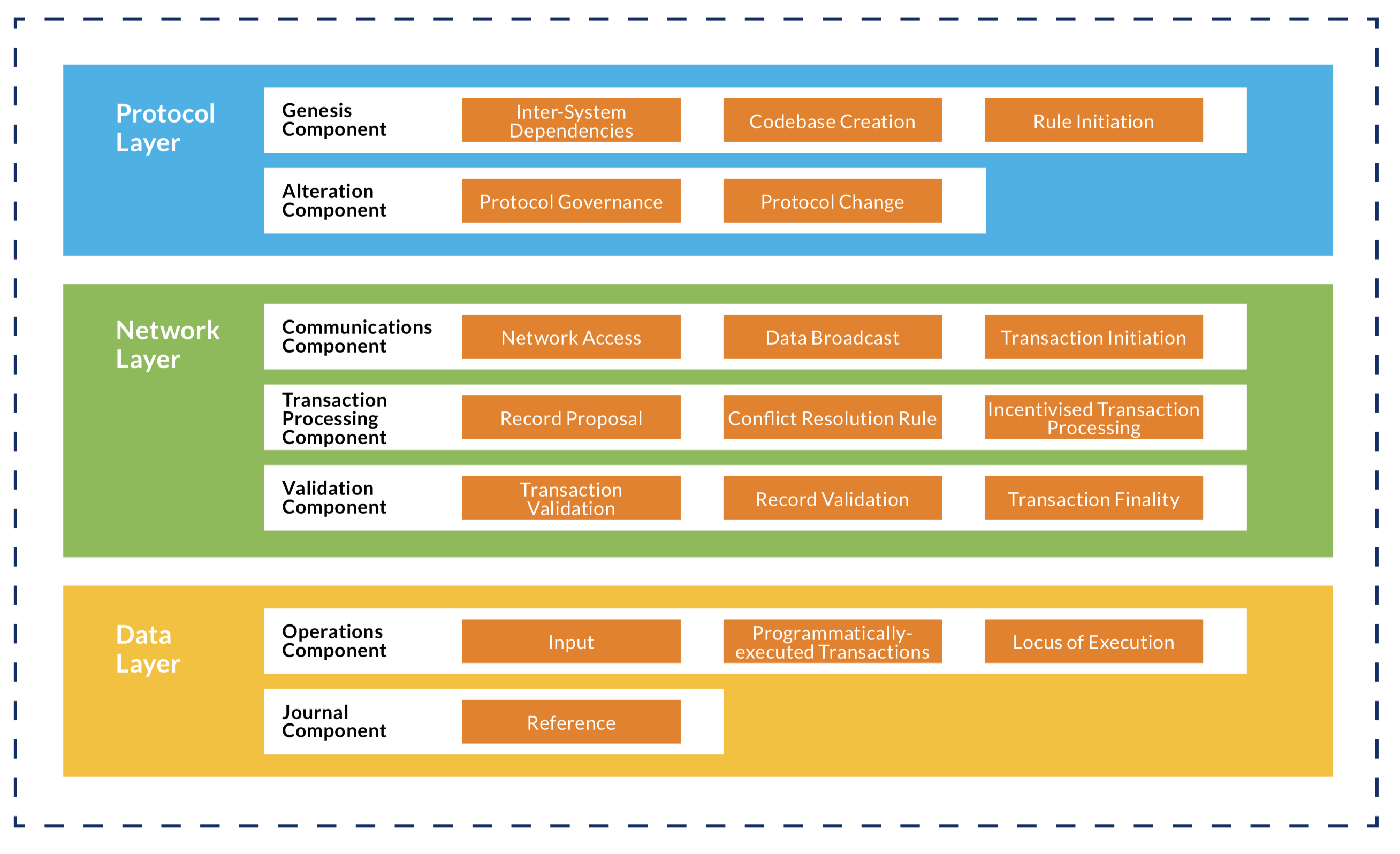
    In order to analyse the governance of a blockchain consortia it requires to run an assessment of the anatomy of the distributed ledger application. Michel Rauchs, at the Cambridge Centre for Alternative Finance at Cambridge University, has published a conceptual framework on distributed ledger technology systems. It splits the anatomy of blockchain applications into three layers:

    • Protocol layer – everything about the blockchain stack
    • Network layer – details of the business network such as who can access the network, who can submit transactions and who validates the transactions
    • Data layer – what happens on chain and what happens off chain, where does the application take data from, what Oracles to sue and also aspects of cybersecurity

    Rauchs et al.’s conceptual framework for distributed ledger technology systems

    Minimum viable ecosystem (MVE)

    A minimum viable ecosystem (MVE) is the smallest configuration of participants which needs to be brought together to create a unique commercial value to validate a certain assumption. This isn’t about achieving big scale. It’s about having the minimum number of participants to really test out the coopetition paradox and the proof of concept of a blockchain education. In general in an MVE you don’t have strict legal structures more of a memorandum of understanding in terms of who brings what to the table, agreed costs and the vendor involved for running the MVE.

    A good example of this is how B3i started off in the early days as a loose coalition of reinsurers before it became a registered company in Switzerland in 2018. Another one is how Maersk initially started off working with IBM on Tradelens before launching it as a formal joint venture.

    It is understood that some MVEs for the sake of speed do sometimes create fake partners. This happens because getting the necessary minimum partners can sometimes be quite time consuming so some MVEs have resorted to create fake partners and mimic their transactions onto the network.

    Kevin advises against using fake partners as a true partner to an MVE brings credibility to the network, insights into the industry from their perspective, and provide both people and financial resources to the network.

    Multi-layered governance framework for blockchain consortia

    Kevin takes a multi-layered governance framework for blockchain consortia by remixing Michel Rauchs “conceptual framework on distributed ledger technology systems” into three layers:

    • Business network – membership admission, organisational roles and permissions, intellectual property, sweat equity and profit sharing
    • Protocol – selection of protocol base and protocol amendments
    • Data – on and off chain data, storage, privacy and cyber security

    Business network layer

    One of the key challenges that is faced in this layer is how to balance the interest of the consortia initiators to the ones of the later joiners? This is particularly important as it is recognised that the consortia initiators are the ones who carry the vast majority of the risk.

    Kevin agrees that consortia initiators have to be rewarded for the sweat equity, human and capital resources that they provide to the a blockchain consortia. However on the other hand the amount of “compensation” of sweat equity consortia initiators receive has to be correctly determine. Too much compensation, such as giving too much power to the consortia initiators or too much of a say in the future evolution of the consortia, can deter future potential joiners of the network from actually joining as it is simply not attractive. This may have been the reason why Tradelensinitially had a hard time attracting new partners to their blockchain consortia. There was this perception that any new joiners to the Tradelens network had to disclose a lot of data and information to both IBM and Maersk.

    In an ideal world you would have a system where every single participant, either a consortia initiator or a late joiner should have a positive ROI from the participation in the blockchain consortia or business network. By ROI you have access to profit sharing from the profits of the network and benefiting in the efficiencies of being in the network.

    Legal structure

    For Kevin, a centralized legal entity governed by open governance principles is the preferred standard, particularly given the administration and compliance management considerations. However if you look at the Mobi initiative they do not operate as a legal identity in its own right but more as an initiative for the mobility industry.

    In terms of having a central legal entity approach, registered either as a profit or not for profit legal entity, it acts as a networking operating company. Alternatively, you can have a a basic general partnership which looks at compliance.

    The network operating company would be in charge for the development (incl. community building), administration and commercialisation of the blockchain application. Any intellectual property accruing from the activities of the business networks would be assigned to the network operating company. However, the software package required to access the platform should be offered as a free, restrictive, open-source license to enable its adoption within the ecosystem.

    Organisational structure

    The organisational governance must account for the interests of both the equity holders and the community. Whether the network operating company is set up as a profit or not for profit identity it needs to have a board which really steers the business network.

    In a for profit organisation, like a commercial legal entity, where not all the participants in the network are shareholders you need to have a Community Council. This Council gives a voice to the participants who may not be shareholders of the network operating company.

    Protocol layer

    The initial protocol layer is defined by the initiators of the business network during the assessment undertaken in the proof-of-concept.

    In the early days of B3i, they started of the MVE by building their prototype on top of a Hyperledger Fabric blockchain, before switching to Corda when moving to a more production type environment.

    It is important from a governance perspective to understand who has a say in determining what are the technical and legal reasons / implications for moving from one blockchain protocol to another one.

    Data layer

    What is important is to have privacy by design from moment you start drafting the data layer and how comprehensive it can become. The need to ensure that the blockchain network is in compliance with the data protection laws in the jurisdictions in which it operates in. That’s where there is an advantage of having a centralised approach to a blockchain consortium because you have a central legal entity which can take up some responsibility. For example a central legal entity can ensure that the network is GDRP compliant.

    The network operating company should act as the data controller and data processor in line with the applicable data protection laws. The entity can assign a data protection officer and ensure that the data stays within the European Union and not send to a node outside of the EU.

    Any data should only belong to its original owner, its users, and can only be transacted in agreement with the data owner. The network operating company is never expected to assume any data ownership other than its own.

    Enabling Web 3.0

    Here at Insureblocks we encourage blockchain participants to think about the Web3.0, a world where industry specific blockchains can interconnect with one another. Kevin believes there are three aspects to consider for such an eventuality:

    • Network interoperability – adopting an open source blockchain protocol should facilitate interoperability
    • Governance – having membership access rights as open as possible should enable other networks to connect
    • Crypto economics – facilitates the exchange of digital assets across networks

    Your turn

    Thank you, Kevin, for sharing your insights on Successful scaling of blockchain consortia through governance. If you liked this episode, please do review it on iTunes. If you have any comments or suggestions on how we could improve, please don’t hesitate to add a comment below. If you’d like to ask Kevin a question, feel free to add a comment below and we’ll get him over to our site to answer your questions


    Ep. 67 – The Data Economy – Insights from Ocean Protocol Jul 22, 2019
    Show notes

    Trent McConaghy grew up on a farm in rural Canada. He did AI research for 20 years including running 2 startups and a PhD. For the last 5 years he has been focused on blockchain and in particular on Ocean Protocol which he has co-founded.. Ocean Protocol is a protocol whose mission is to unlock data for the broad benefit of society. Data is becoming increasingly important and influential throughout the world, ensuring that the opportunities to access data are equalised is the aim of Ocean Protocol.

    What is blockchain?

    Blockchain at its heart is a technology, just as the internal combustion engine or a computer. The internal combustion engine combined with oil unlocked mobile transport in a big way. Similarly blockchain unloads a whole new set of possibilities that we haven’t seen before. At the very heart, it is simply a database. However its a database with very specific characteristics:

    • Decentralised: no single entity owns or controls it
    • Immutable
    • Concept of ownership if you have the private key to it such as tokens for money like with Bitcoin
    • Unlocks incentives – blockchain can be used to shape incentives for human behaviour

    What is the data economy?

    Trent looks at the token economy as the open version of the money economy. With the money economy we have tokens, currencies, etc. Traditionally these were distributed solely by national governments in opaque ways through the Fed and Central Banks. Whilst this has been beneficial in many ways there were still challenges. Bitcoin opened up the money economy by being permission less, friction free and fully open.

    Today there is a data economy, but like the money economy it is very opaque where credit card companies are selling your data, Facebook buying data from 150 organisations to add it to its own data in order to sell you more adds. There already is a data economy where it’s a flow of value and participants in the economy are buying and selling data in a closed and opaque manner. Just as Bitcoin opened up the money economy, ocean is designed to open up the data economy.

    AI, the last mile of data

    Just like the internal combustion isn’t useful on its own nor is oil useful for its sake, both of them are useful towards machines that are then used for mobility. AI, is the last mile to unlock the value of data. Modern AI really loves data. The more data it receives the more accurate its models become which in turn can create business value. For example AI models used to predict cancer usually use data gathered from 100 individuals. These models can predict cancer from 6 months in or even from stage three. If those AI models were based on orders of magnitude of more data such as over millions of individuals then you could theoretically predict the existence of cancer 6 days into it from very early weak signals. Feeding large amounts of data into AI can help to unlock value and build new applications.

    Components of the data economy

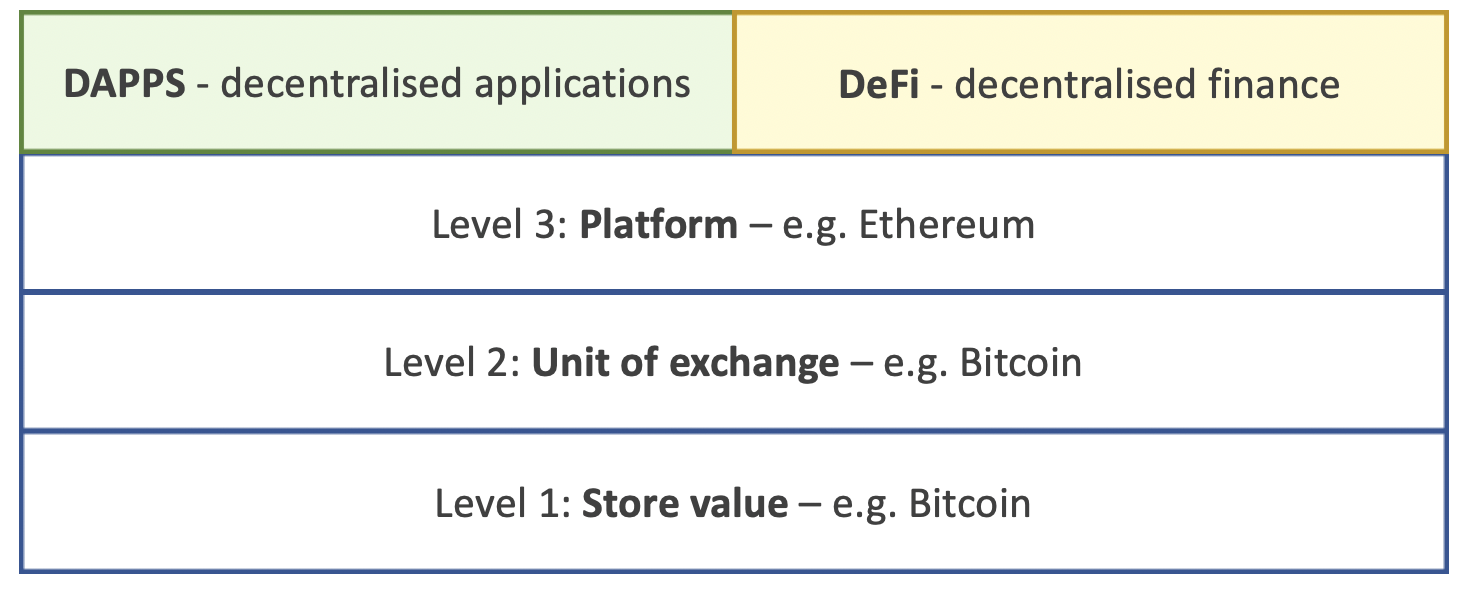
    Three levels to both the open money economy and to the token economy:

    • Base infrastructure (i.e. a store of value)
    • Unit of exchange
    • Platform to launch and to exchange things

    The last mile on top of the platform are the applications.

    In the token economy the de factor standard, the unit of exchange, that has emerged is Bitcoin. The platform is Ethereum. On top of the platform you have a set of decentralised applications, DAPPS, running on Ethereum, which represent the kind of last mile in terms of applications. In terms of financial side the last mile are Decentralised finance or DeFi, some use cases of DeFi are for payments, lending, stablecoins, tokenization and decentralised exchange.

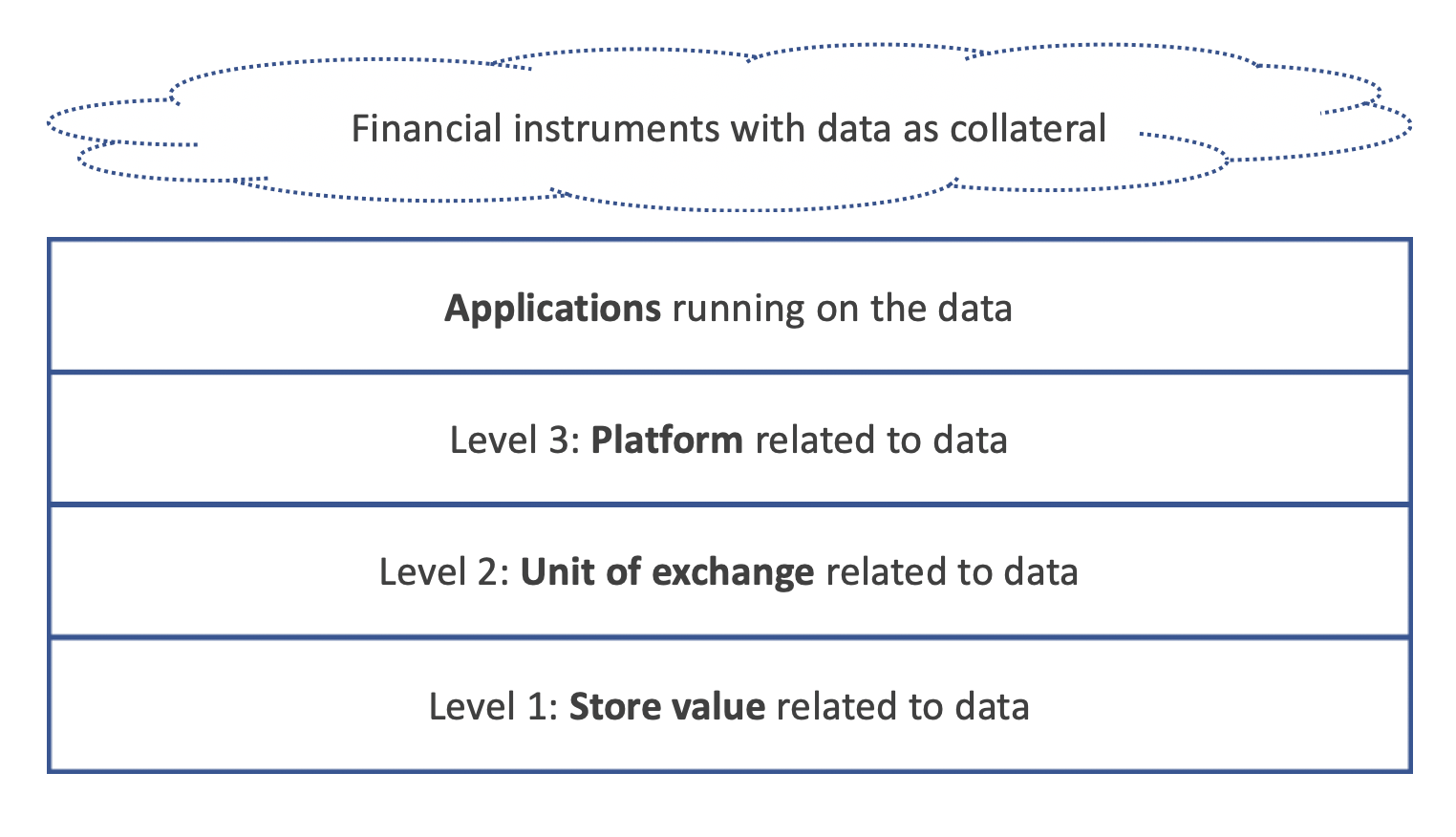
    The components of the data economy are very similar in structure to the ones of the open money economy and the token economy. At the bottom level you have a store of value in terms of data, you have a unit of exchange related to data and you have an application platform related to data. One level up you have the last mile were you have the financial instruments that sit on top of this base, where data itself is the collateral. If you can collateralise data then you can get loans against data itself, insurance on data and many more applications.

    Example: Connected Life and Parkinson

    Connected Life is an organisation based out of Munich and Singapore that is building data models to predict Parkinson. They’ve been working with TUM, the Technical University of Munich to get data from their patients to build those data models. They’ve also been working with NUS, the National University of Singapore to get data from their patients. Because of data privacy laws, GDPR, in Germany, the data can’t leave European soil. Similar laws exist in Singapore. Ideally Connected Life wants to be able to build data models that uses both data sets without breaking those countries respective privacy laws.

    With the help of Ocean Protocol they built a data model that update itself form the Singapore data set as well as from the Munich data set, thus ensuring you have a model that has twice as much data. Connected Life is working to extend this test to more hospitals for not only for Parkinson diagnosis, but also for treating and for prevention.

    In America a lot of healthcare data is sold to insurance companies and to other providers. So, there’s already value being transferred there. If each piece of data was tokenised and collateralised then you can have financial instruments on top. In due course what this means is that consumers could be incentivised to making their data available. Insurance companies for example could request such data to improve their data training models, for better predication of insurance whilst at the same time consumers are not giving up their privacy.

    Ocean Protocol – helping companies embracing the data paradigm shift

    connecting the data and the AI expertise

    Most large enterprises have big data enterprises. Whether it’s in their infrastructure with Oracle databases, MongoDB and Hadoop to people like Chief Information Officers and emerging Chief Data Officers.

    Ocean can simply help those large enterprises solve their data management problems better. For example those that are multinational with offices in various countries they might not be able to share data from one office to the next because of data regulation. Additionally, it is important to recognise that data sometimes needs to stay at company’s premises, it needs to stay private. How do these organisations benefit of these data sets merging as in the above case of Connected Life? The big trick is to bring computational power to the data where it is vetted computational algorithms that are running against the data by applying simple business intelligence and eventually building AI models.

    The competitive advantage is data and not AI. Most Fortune 500 companies have a tons of data and they’re wondering what do to with it as they’re concerned about sharing it due to privacy issues and because of the fear of losing control. These companies have been trying to recruit the necessary AI expertise but the vast majority of available AI experts have gone off to work for Google, Facebook and Amazon. It is the combination of data and AI that has led to massive value creation for the Google, Facebook and Amazon’s of this world.

    Waymo, is Google’s off shoot autonomous vehicle. Recently it has been valued above $175 billion, which is superior to BMW’s valuation of $42 billion, Volkswagen, $76 billion and Daimler $48 billion combined! The market recognises that the future is in the data.

    The question then is how can incumbents unlock the benefits of data? How to spread the benefits of data and spread the benefits of AI? That’s what Ocean Protocol was designed for. Ocean makes it possible for these Fortune 500 companies to access the benefits of AI without compromising their privacy and control.

    Ocean makes it easy for AI experts to build models for the benefit of Fortune 500 companies without those companies losing control of the data. So it’s connecting the data and the AI expertise.

    Lessons to take from Toyota?

    Google’s ambitions in autonomous vehicles goes back to the DARPA Grand Challenge of 2005. This has given them over a decade competitive advantage over the incumbents. The response from the incumbents in the auto industry is maybe instructive for insurance.

    Toyota realised that to do autonomous driving they would need 500 billion miles of driving data onto roads which would have taken them 20 years to acquire. Toyota reached out to Ocean Protocol to pool their data alongside GM, Ford, Daimler and others to compete against Waymo and win. Ocean built an autonomous vehicle data exchange and a prototype two years ago. On the back of that Toyota realised that they couldn’t pursue this on their own so Chris Ballinger, who was running the project left Toyota to create a consortium called Mobithat now has over 100 organisations signed up to it including 80% of the world’s auto production. What these organisations have realised is that not a single one of them can win the data game on their own. But collectively they can create massive value by pooling their data in a way that reconcile privacy. That is a lesson insurance amongst other incumbents industries can take note off.

    Your turn

    Thank you, Trent, for sharing your insights on the data economy. If you liked this episode, please do review it on iTunes. If you have any comments or suggestions on how we could improve, please don’t hesitate to add a comment below. If you’d like to ask Trent a question, feel free to add a comment below and we’ll get him over to our site to answer your questions.


    Ep. 66 – Blockchain & AI in Pharmaceutical & Healthcare – insights from FarmaTrust Jul 14, 2019
    Show notes

    Najib Rehman, Data Strategy Lead, at FarmaTrust and Raja Sharif, CEO and Founder of FarmaTrust join us in this exciting podcast on how they use AI and blockchain technology in the pharmaceutical and healthcare industry to help resolve some of its problems.

    What is blockchain?

    Blockchain is essentially a database that is distributed for all relevant parties to have access and visibility. Where it differs from traditional databases is that it doesn’t have a sole controller. With blockchain if all the parties have an agreement, a consensus around what the distributed dataset looks liken, then it’s very difficult to game the system. Blockchain makes it easier to identify the bad actors.

    Fraud & challenges in the pharmaceutical and healthcare industry

    The World Health Organisation estimates that up to 700,000 people die every year due to complications caused by counterfeit Tuberculosis and Malaria vaccines. PWC estimates that counterfeit pharmaceutical is a $200bn annual business. This is quite a significant percentage of the $1.2 trillion pharmaceuticals global trade.

    In the UK alone, the NHS is dealing with large amounts of waste within various hospital institutions such as how inventory is managed, how it’s being leveraged and used within each hospital by healthcare professionals or not being used. Due to the very nature of healthcare, hospitals can’t afford not to have something on the shelf to treat a patient, as the consequences could be catastrophic for the patient. So, there is a large amount of excess stock that’s often floating and often sadly not used to ensure that patient safety and patient lives are the priority.

    The World Health Organisation estimates that more than 50% of drugs sold online in the West is fake. In Europe the Falsified Medicines Directive and in the US the Drugs Supply Chain Security Act are both trying to address this challenge by stipulating that pharmaceutical companies need to have individual serialisation and digitisation of the packs of medicine. So, all packs in developed markets now have to have an individual identity that therefore makes the use of distributed ledger technology quite suitable for this challenge

    Combination of AI and machine learning can help identify patterns to help healthcare professionals ensure that patients are treated but without the waste that we’re seeing today.

    Data standards in healthcare

    GS1 is a global data standard that is used across industries including in healthcare. It is a standard that is used for products for tracking and identification. These standards aren’t always adhered to. Companies and entities will create their own identifiers for a product which then conflicts. How to address this problem is an important question that needs to be addressed by companies, governments and agencies. Blockchain and its associated technologies can help to address this problem.

    FarmaTrust and its vision

    FarmaTrust is essentially a blockchain and AI solution for the pharmaceutical and healthcare industry. FarmaTurst works in three verticals:

    • Pharmaceutical tracking and data services– tracking a product or a medical device from the point of manufacture to the point of consumption. Clients of FarmaTrust for this vertical are the US FDA (Food & Drug Administration) and McKesson here in Europe.
    • Cell and gene therapy (personalised medicine) – providing technical solutions behind the production of treatments, such as carti type treatments for late stage cancer of blood cancers, stem cell therapies and pharmaceutical personalised medicine.
    • Clinical trials – providing clarity and transparency around global clinical trails using blockchain solutions

    Why blockchain?

    The most interesting quality of blockchain is the immutability and incorruptibility of the data. Once you can ensure you have good data and ensure data integrity that has lots of knock on effects in terms of data analytics and artificial intelligence.

    Smart contract also plays an important role. You can automate many of the processes and with FarmaTrust it allows to automate functions like automatic purchase ordering, automated regulatory reporting and automated payments. Thus, ensuring that FarmaTrust can digitize every part of the process in the healthcare and pharmaceutical sector. For the incumbents FarmaTrust bring a lot of cost savings, efficiencies and visibility or transparency

    For the end user it means they can trust the medicines they are taking and if done properly can help reduce the costs and future proof of operations.

    FarmaTrust uses Quorum as its blockchain technology.

    From an AI perspective, its utility is about optimization of inventory and ensuring that the right product is in the right place at the right time.

    FarmaTrust ongoing project – inventory tracking

    FarmaTrust is working with a major pharmaceutical wholesaler in helping them optimise inventory tracking. They had a legacy system infrastructure that wasn’t providing them with the transparency to their staff in their warehousing facility nor to the drug manufacturers.

    FarmaTrust system sits alongside the wholesaler’s legacy technology by optimising the value chain from production to wholesaler to the ultimate point of dispensation, be it a hospital or pharmacy. The blockchain provides the audit trail, the immutability of the data and alongside machine learning it can help optimise what is the optimal stock level at every point along the value chain.

    FarmaTrust is also running a pilot with the FDA and Systech to provide compliance, traceability, anti-counterfeit and product safety solutions, enabling clients to ensure product authenticity from the manufacturing floor to a patient’s hands. Najib believes that they’re the only pilot on the drug supply chain security at to pilot this using blockchain technology.

    Your Turn

    Thank you, Najib and Raja, for sharing your insights on blockchain & AI in pharmaceutical and healthcare. If you liked this episode, please do review it on iTunes. If you have any comments or suggestions on how we could improve, please don’t hesitate to add a comment below. If you’d like to ask Antony a question, feel free to add a comment below and we’ll get him over to our site to answer your questions.


    Ep. 65 – Unlocking investment in blockchain projects Jul 07, 2019
    Show notes

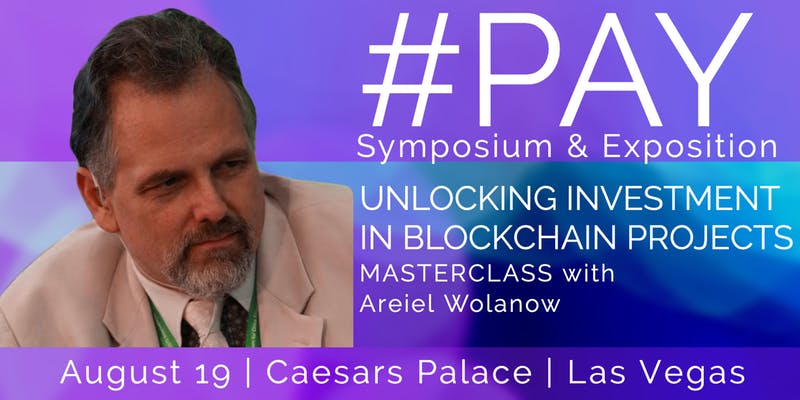
    Managers in enterprises or start-up founders all have to go through a framework in order to unlock the necessary investment for their blockchain projects. Understanding that process and what it entails is key. Areiel Wolanow is managing director of Finserv Experts, expert advisor to the All-Party Parliamentary Group on Blockchain amongst many other blockchain advisory and non-exec positions. In this podcast he takes us through the commonalities between successful and failed blockchain projects before building a framework for requesting investment for a blockchain project.

    What is blockchain?

    Blockchain is an enabling technology. It allows multiple separate legal parties to share a single version of data and keep that data in synch between themselves. Thus, removing the need to reconcile different versions of data between themselves.

    Journey to blockchain

    In early 2014, Areiel was running IBM’s financial services practice for East Africa based out of Nairobi. 90% of the Ethiopian commodity exchange is with coffee. The challenge that they faced was that the Fair Trade Association was threatening to remove accreditation across the country, because of the level of corruption. Virtually all coffee farmers in Ethiopia were calling themselves Fair Trade with only a tiny minority having actually gone through the process.

    The Ethiopian commodity exchange had asked IBM if they could do an IOT based provenance solution. The idea was to give where farmers, who had gone through the Fair Trade process, the ability to purchase Fair Trade RFID tags to put in their coffee bags. Whilst this solution would help solve the problem from the farm side, the problem remerged when the coffee reached the roaster and ultimately the market floor. The Fair Trade coffee would get mixed with other coffees thus making the ability to trace provenance very difficult and easily gamed.

    It became clear that considering these challenges that blockchain could be an excellent solution for nailing down the provenance, tracking the coffee throughout the various transactions all the way to the consumer scanning a QR code on their coffee bag and seeing their coffees journey.

    Blockchain – addressing the “world’s oldest business requirement”

    The above coffee example, or Everledger with diamonds, demonstrate how provenance is a powerful use case for blockchain.

    Blockchain is an innovation that addresses what Areiel refers to as the “World’s oldest business requirement”. This is a requirement that goes back to 4,000 BC when humans were designing the very first contracts.

    A bulla (or clay envelope) and its contents on display at the Louvre. Uruk period (4000 BC–3100 BC).

    At that time Sumerians would record future commitments (eg. use of an Ox for bushels of grains) on a “bulla” a hollow ball-like clay that contained tokens that identified the quantity and types of goods being recorded. This ball would provide an independent verifiable tokenised representation of a contract. A bulla was at that time as transformative as the internet is today.

    However, as the bulla becoming increasingly adopted it became difficult for individuals to remember how many tokens where inside each balls. This set an upper limit on scale of the bulla system. The next invention was creating indentations on the outside of the bulla to represent the number of tokens on the inside. These indentations eventually took the form of symbols to represent not just the number of tokens but the different type of tokens.

    Finally, it was realised that the symbols had supplanted the tokens themselves. As long as both parties where present when the symbols were being drawn and that they were accurate, there wasn’t any more a need for tokens.

    Ultimately the move came from this clay ball to the use of cuneiform script, the oldest form of writing, which developed out of the need to model future commitments. Cuneiform writing become an independently verifiable record of that commitment, now known as a ledger. A thousand years later cuneiform script would eventually be used not just for writing contracts but also for law, politics, religion, philosophy, music and literature.

    Blockchain is just the latest step in this journey of maintaining ledger.

    Blockchain in numbers

    There has been up to now about 80,000 blockchain projects around the world. This includes start-ups, enterprise POCs and pilots, and crypto related projects. 92% of them have already failed which is broadly in line with the 90% failure rate of most start-ups.

    A McKinsey report called “Blockchain’s Ocam problem” stated “The bottom line is that despite billions of dollars of investment, and nearly as many headlines, evidence for a practical scalable use for blockchain is thin on the ground.”

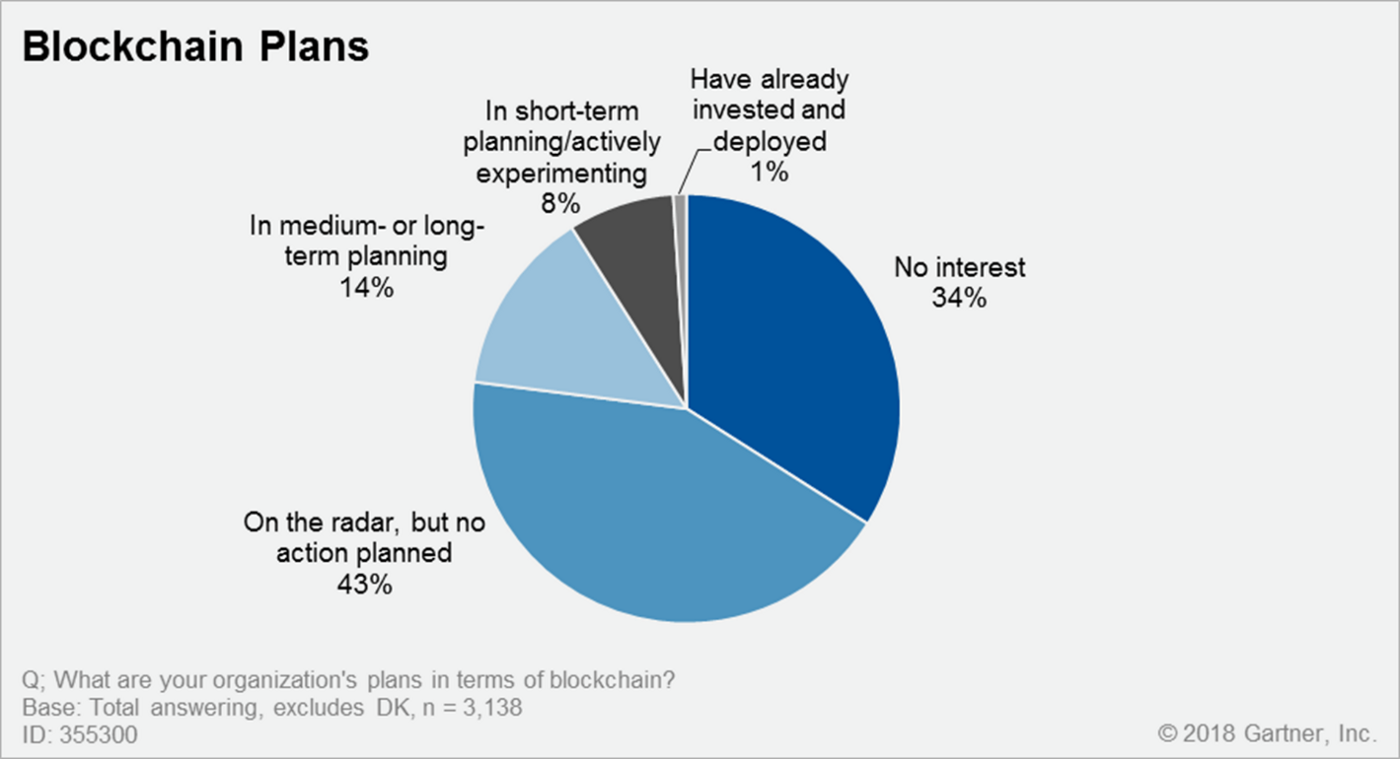
    Gartner 77% of CIOs no interest in blockchain

    77% of CIO’s surveyed by Gartner at the “Gartner 2018 CIO Agenda at Gartner Symposium/ITxpo 2017” stated the blockchain didn’t even feature on their radar. A PWC 2018 survey of 600 executives from 15 territories, state that 84% say their organisations have at least some involvement with blockchain technology.

    For Areiel, what this indicates is that the push to adopt blockchain isn’t coming in from IT but from the business. Most blockchain developments are being sponsored by the business and not by IT. It is being delivered by external development centres. They’re not being done at the enterprise level but at a line of business level. So, if a head of a line of business is developing a blockchain project it won’t show up on the CIOs radar or even on the enterprise architecture level. The stats from CIOs survey and the McKinsey report aren’t inconsistent with where the money is being spent and at what level within the organisation.

    It’s the line of business leaders who are spending on blockchain which are benefiting from it.

    What are the characteristics of a successful or failed blockchain project?

    A lot of blockchain project are sold under the promise that it will deliver numerous benefits for a consortium. However, it assumes that the network reaches critical mass and thus all participants will automatically sign up to the network in the hope of reaching that shared benefit.

    Areiel states that one of the first due diligence rules he has in place is to say that “if your business model doesn’t produce a substantial ROI of at least 20% or more for the very first user of the network, stop!” Adoption is critical to get a network going.

    So you need great value for the first adopter. Additionally, you need a solution for people to be sharing the ownership of their data.

    Big food retailers like Tesco have become the de facto regulators. Their regulations are more strict and more enforced than government regulations around food safety. For example if you run a chicken farm and one of your chickens has salmonella then you will be fined about £30k by the government. If Tesco finds out you’re out of businesses. Tesco has more clout in enforcing food safety. Tesco has a complete lock on the supply chain, thus it doesn’t need a blockchain. It can force its suppliers to give it their data onto their database which they own. There is no benefit for them to have decentralised database model as they can mandate a centralised one which they have full control over.

    Cost of measuring existing process vs blockchain process

    Areiel, alongside Charles Ayorinde from AXA and Richard Boreham from ChainThat where tasked to work on a feasibility study for a DLT based trade settlement and claims agreement for Lloyd’s as part of the LM TOM programme. They had to answer two questions:

    1. Is it possible to conceive a business model for running both Lloyds and company market business without the need for a bureau?
    2. If so what is the economic case for doing that, be?

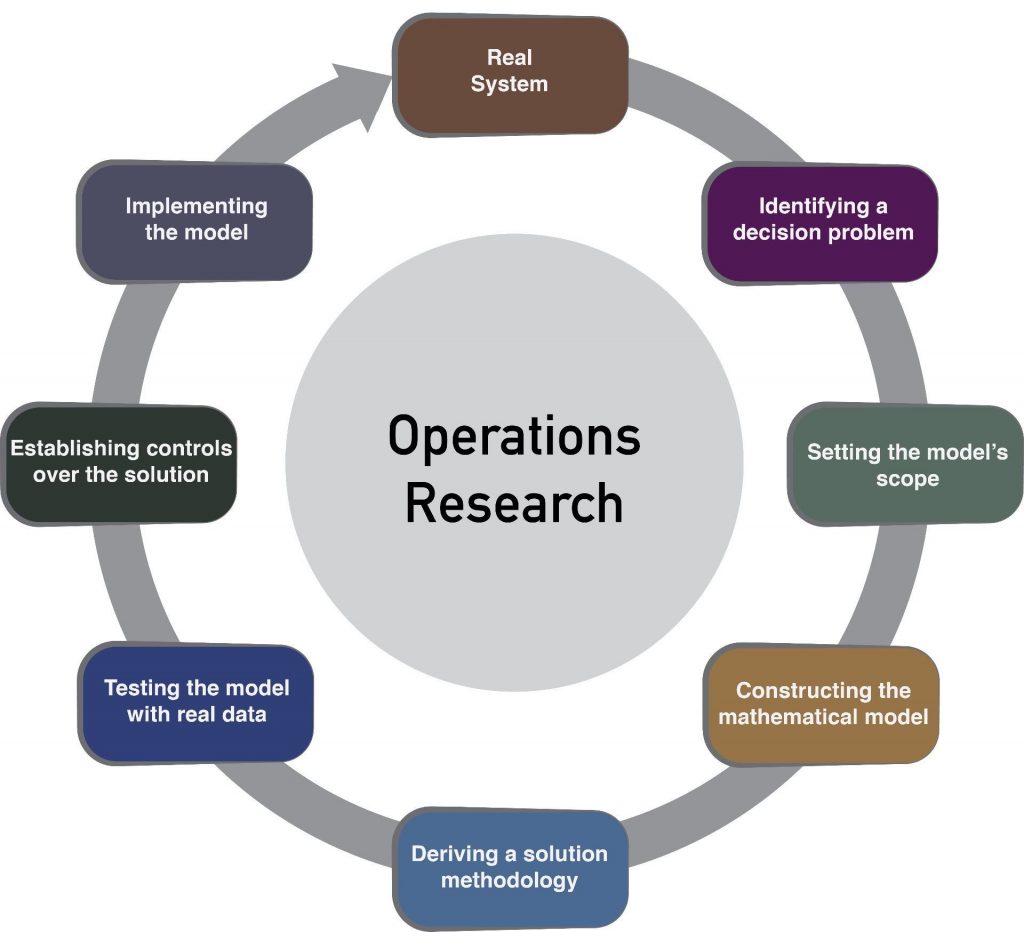
    Operations Research

    “Operations research” in 1960s and 1970s were the hot topic of business schools. It is a discipline used to measure the cost of doing business within a certain business process. They used that process to develop the business case for Lloyds, the result of which demonstrated that the business case was very strong.

    In Areiel’s view the strength of the business case was centred around the core value proposition of blockchain, a ledger. Lloyd’s and the company’s market spend a significant amount of money, time and effort keeping insurance contracts in synch between all the different partners instead of primary value creation. Lloyd’s expense ratio is one of the highest in the world. The existing business processes for settling and claims agreement where first codified in 1810 and haven’t changed much since then.

    The idea of a solution that removes the need for a centralised transaction processing capability is huge. But even outside of Lloyd’s or placement of syndicated risks, you are seeing tremendous benefits. Blocksure, a blockchain development company, is working with insurance companies providing them with significant cost reduction opportunities for new line of business compared to what it would cost to launch with traditional processes. See Insureblock’s podcast of Blocksure with Commercial General.

    Blockchain with new lines of business

    Start your blockchain journey with a new line of business, new products or new customer segments. This is where you should see the first changes. The reason is because neither you nor other members of your trading network have to worry about transformation costs. Starting with a new line of business removes the need for transformation costs.

    Delivering micro insurance for natural disasters in Indonesia. Only 6% of Indonesians have insurance because the cost of placing it makes it unaffordable and regressive.

    In parts of Indonesia the only way to pay a claim is to send someone out on a helicopter with a suit case of cash which if it is a small amount of money the cost of the helicopter trip is higher than the claim.

    With blockchain you can pay claims into a mobile wallet in addition to managing the operational costs of doing the placement.

    Framework of thinking for requesting investment in a blockchain project

    Present the benefits in a manner that someone understands and be able to quantify them. For example how long does it take to produce a D&O policy, how long does it take to send all the emails, and to reconcile our version of documents for example.

    At Lloyd’s, one of the biggest drivers of additional costs in processing an insurance contract or in agreeing a claim is the cost of a query. A question somebody has to ask before making a decision. That brings the entire process to a halt. Queries happen because data isn’t kept in synch. In the feasibility study, Areiel and his team measured how much time is spent handling queries, what percentage of transactions have queries, how many full time employees spend their time processing queries. This provides a basis on which to extrapolate. In addition they ran a simulation based on the answers they were given and used that to estimate the cost of reduction.

    Workshop

    The workshop is called “Unlocking investment in blockchain projects”, it’s a 3-hour course in introducing this framework of thinking on how to present the business benefits of a blockchain project in a way that investors can consume. If you’d like to find out more about this workshop you can click here.

    Your Turn

    Thank you, Areiel, for sharing your insights on unlocking investment in blockchain projects. If you liked this episode, please do review it on iTunes. If you have any comments or suggestions on how we could improve, please don’t hesitate to add a comment below. If you’d like to ask Antony a question, feel free to add a comment below and we’ll get him over to our site to answer your questions.


    Ep. 64 – The Convergence Ecosystem – insights by Outlier Ventures Jun 30, 2019
    Show notes

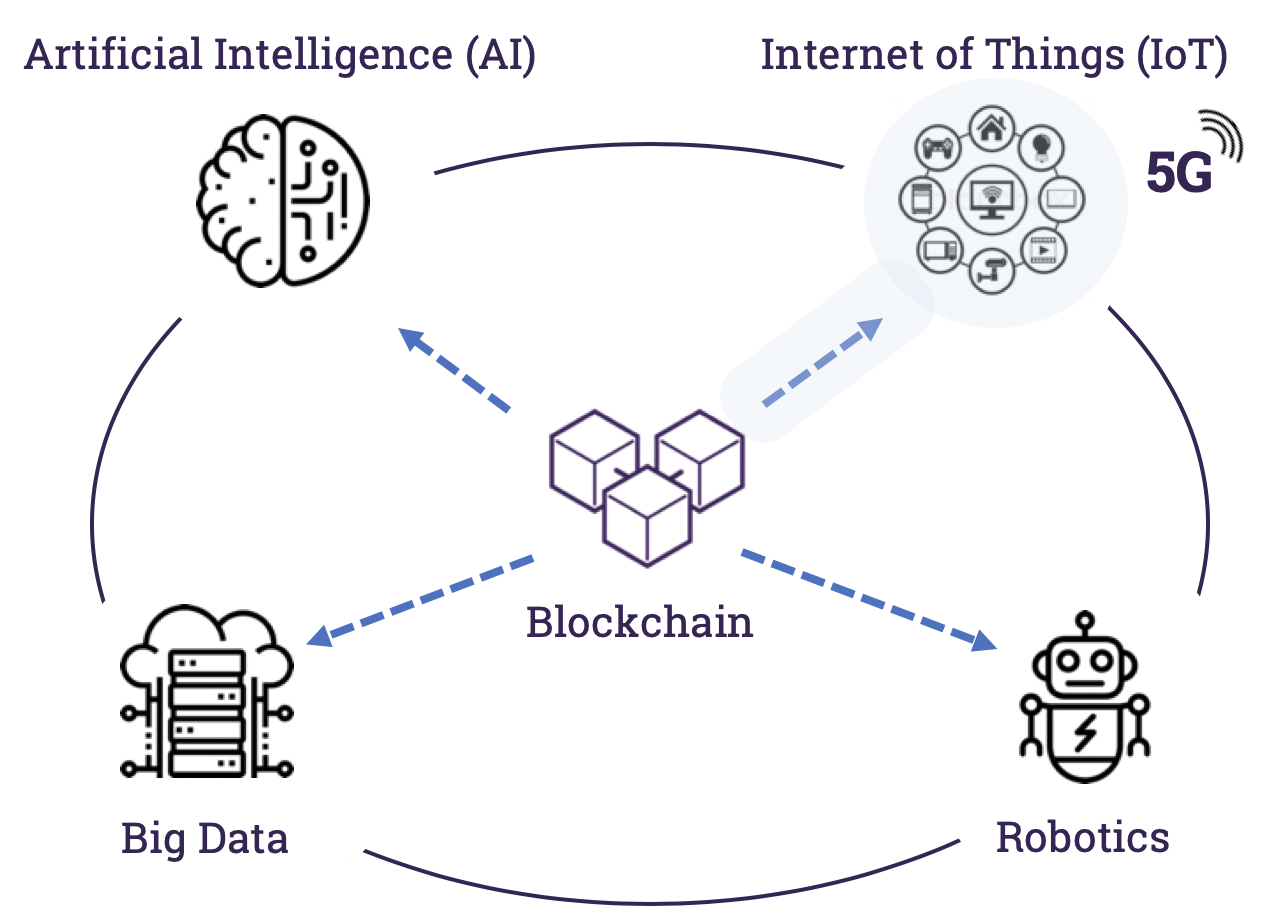
    Jamie Burke is the founder & CEO of Outlier Ventures. He also is a pioneer of the “Convergence Thesis”, where blockchain is foundational to Web 3.0 a more decentralised and automated future. In this podcast we discuss how we are starting to see the emergence of a “convergence ecosystem” that involves blockchain, AI, IOT, big data and robotics that will help to build new markets that are open-source, distributed, decentralised, automated and tokenised. About Jamie Burke & Outlier Ventures Jamie has a background in digital innovation and change management within large corporations. Prior to founding Outlier Ventures, Europe’s first blockchain venture platform he was an angel investor. Founded in 2014, Outlier Ventures is a venture platform focused on building the infrastructure for the next phase of the Internet. Their investment philosophy is based around the idea of the Convergence Ecosystem. They view blockchains and other decentralised tools like tokens as a new data layer enabling other technologies like AI and IoT to combine and converge. Outlier Ventures are the authors of – The Convergence Ecosystem Source: Outlier Ventures What is blockchain? Blockchain is a catchall word which broadly represents distributed ledger technology (DLT). A blockchain is a very specific form of DLT. Jamie prefers defining what is DLT instead of blockchain as he finds the broader application of DLT in all of it different configurations more interesting. DLT can be broken down into three components: The ledger which is about ownership and the transfer of ownership in an auditable way, where the state of the ledger is governed by the network instead of a central party Digital scarcity: today a jpeg, a movie, a sound file can be replicated a number of times. The notion that something can be both digital and scarce is a new one and one that can be enabled by blockchain Smart contract gives you the ability to program rules into the ledger to carry our rudimentary “if then statements”. Whilst at the moment they are pretty dumb they have the potential for increased intelligence What Jamie expects is that both at the ledger and at the smart contract layer, is an increase level of intelligence, which is why they’ve invested in a start-up called Fetch.ai. What is the convergence ecosystem? A little over 3 years ago, Outlier Ventures had spoken to over 1,500 blockchain start-ups, most of which would fail. Many of the challenges these start-ups faced was the lack of blockchain infrastructure (Eg. on Ethereum or on Bitcoin) thus making their use cases not quite possible. It increasingly became apparent that DLT shouldn’t be looked at on its own, but how it can be used to look at IoT (Internet of Things) or AI (Artificial Intelligence) problems, preliminary predicated around data. It was at this moment that the Outlier Ventures team decided to look at DLT’s ability to not only solve IoT problems, especially industrial IoT, and AI problems but actually all of these things combined and accelerated one another. For example the minute you solve for one problem such as securing an IoT and supply chain of IoT devices you can have provenance of devices and data all the way up to incentivizing the ability to unlock data marketplaces to train AI algorithms. Looking at these problems from a convergence perspective is the only way to make sense of it all: Source: Outlier Ventures Insureblocks shares a similar view to Jamie’s regarding the convergence ecosystem. We look at it from a technology standpoint in terms of the new stack: Source: Insureblocks There’s also an industrial standpoint, the Web 3.0 for the ecosystem of ecosystem: Source: Insureblocks A new web paradigm – Web 3.0 The current web paradigm is predicated around the platform model, one built around mediated marketplaces, and the cloud. This has brought numerous conveniences but also huge concentration of data, wealth and power to a handful of platform monopolies. Google, Facebook and even Amazon have become competitors to a large number of industries around the world. The emergence of the new stack that is built upon being decentralised and distributed is one that will naturally unbundle those monopolistic platforms. Data is at the centre of this paradigm shift. Data is the commodity. It’s collection, curation, transportation and ultimate conversion in a digital asset is key. Digital asset not just in terms of representation of value but as programmable assets which can be trade, measured and quantified according to a set of incentives and disincentives. They can be fed into smart contracts and machine learning algorithms to enable autonomous systems. This leads to coordination mechanisms in distributed systems. In the present web paradigm there are more bots (digital agents) than people interacting on the web. People are either not fully participating on the web or they are devolving work to digital agents. These digital agents serve the platform needs over the person’s needs. Whilst they may deliver value to the person it is always the platform’s interest first. In a Web 3.0 that is distributed and decentralised, that is centred around the person and the sovereignty of their data, you can trust devolving an increasing amount of economic work to digital agents that serve the individual rather than the platform. This bottom up paradigm will break up those monopolistic platforms which is something both governments and regulators have been taking an active interest in from an up-bottom approach. Clashing views regarding the future of the web Sir Tim Berners-Lee was part of a very small group of scientists, researchers from a few academic institutions who made some deliberate design choices when designing the internet. These choices were motivated by a certain political philosophical belief as reflected by the Declaration of Independence of Cyberspace for example, they said they wanted to do away with many of the instruments of the state. They wanted to do away with identify, property, rule of law and other concepts that society was based upon to create an environment where that wasn’t required. Whilst that was true when they all knew and trust each other but it didn’t scale to a planetary level. This created the web today, an environment without identity, which led to the platform monopolies acting as trust brokers because people can’t trust one another on the internet. The platform monopolies have effectively become non-state actors. Facebook is one of the biggest countries on the planet without the degree of accountability that any politician or government would have. Data centres are like the new offshore bank account for these platform monopolies. It allows them, to do certain economic activity which they couldn’t do onshore. According to Jamie there exists three alternative vision to the internet: Surveillance capitalism which is predicated on largely US corporations which to a degree have become extensions of the state. After September 11ththere was a large collaboration between corporations with the data regarding data collection China digital stateism where the corporations serve a single state. For example the CIA recently accused the Chinese telecom giant, Huawei of being funded by the state, according to The Times. EU commission with GDPR is trying to constrain, restrict and breakup the monopolistic platforms, because it doesn’t benefit in the way that China or the US government does from those monopolies. This European third way is one which is where we are most likely to see this decentralised web take root both in terms of the bottom up innovation and the innovation of crypto assets. Corporations leveraging data in Web 3.0 According to Gartner there will be 20 billion IOT devices online by 2020. All these connected devices will produce a lot of data. The cost of processing and storing large amounts of data, which largely becomes as data rapidly loses its value if it isn’t rapidly consumed, is ever increasing. Yet in spite of that it is still being stored and secured at great costs. “In 2015, data centres consumed about 3 per cent of the global electricity supply and accounting for about 2 per cent of total greenhouse gas emissions. That gives it the same carbon footprint as the airline industry.” Source: The Independent. Because the new data is central to Outlier Ventures thesis, the Convergence Thesis, Outlier Ventures invests in protocols and markets, marketplaces that solve this problem such as Ocean Protocol. It’s an open source protocol that is a non-profit foundation based in Berlin, that has designed a token economy which enables a data marketplace. Data is often referred to as the new oil, they refer to it as a commodity. Yet it can’t be traded like a commodity. It’s very difficult to quantify the value of data generally and then specific to a certain context. Because market forces just don’t apply. There’s no incentive. At a World Bank level,UK national level and at a local government level there are numerous open data initiatives with an obligation to create a data feed or an API. But it’s just raw data, it’s almost unusable and comes in lots of different formats. Ocean protocol has designed a marketplace which looks to incentivize all the key participants in a data economy that can enable for looking at data provenance, data curation, data availability. This allows for participants in that data ecosystem to stake money on the value of data. The real value of the data comes when it is being fed into an algorithm, into an AI that can transform the data into insights or actionable outcomes to give to machines or some form of automated systems. Ideally you want these machines to be able to act upon insights as quickly as possible from as fresh a dataset as possible and then potentially find correlations between data sets that just aren’t possible top down. If you speak to most enterprises in any industry, they don’t have a blockchain problem nor a decentralisation problem. They almost definitely have a data problem and the data problem is they don’t know what to do with their data. They know it has some value to somebody, but they have no idea how to extract it, enrich it, acquire insights from it or automate it into actionable outcomes for their own purposes or the purposes of others. Have a decentralised data marketplace and incentives for a data economy to form around data in a way that is usable for enterprises can address this problem. This opens up interesting consortia’s around particular sets of data or a particular automation where barriers of trust or friction points can be removed. Corporatism in a decentralised web What excited Jamie the most about the decentralised web in the context of AI and how the value realised by an AI can be owned is the idea of an AI co-operative. The closest business model or organisational structure to the decentralised web is the co-operative. Groups of people at any level can contribute primarily by producing data to an AI. The question that arises is who owns the AI or the value generated by the AI. Giving AI personhood in a similar way to a corporation is fraught with risks, as the driving factor for those AIs would be shareholder value. These AIs run the risk of being offshores and thus won’t pay any tax on the value they accrued. The opportunity is to create an infrastructure whereby at a click of a button a co-operative can be created that can own their data and if anybody wants to use that data to train an AI has to somehow negotiate with that co-operative or the co-operative itself is an AI. How can incumbents, like insurance, prepare themselves for this convergence ecosystem? Jamie answers this question by where in his opinion lays the most opportunity. He sees the most opportunity in the machine to machine economy. How can insurance insure machines, whether that’s in autonomous systems (eg. dark factories or supply chains where there aren’t so many people). There needs to be a flow of data, a flow of value and therefore flow of risk management. Thinking about the legalities of smart contracts between machines in the context of insurance can be very powerful. Nexus Mutual for example offers smart contract cover. The second opportunity for insurers is how can they contribute data as an asset to a wider ecosystem and not do so in a way where they think that in of itself has proprietary value. Instead to look at it from the value it unlocks when combined with other data sets and the new business models that could be innovative on top of that. Your Turn Thank you, Jamie, for sharing your insights on the convergence ecosystem. If you liked this episode, please do review it on iTunes. If you have any comments or suggestions on how we could improve, please don’t hesitate to add a comment below. If you’d like to ask Antony a question, feel free to add a comment below and we’ll get him over to our site to answer your questions.

    Full show notes at the publisher

    Ep. 63 – Fireside chat with Antony Elliott – Chairman of B3i Jun 23, 2019
    Show notes

    Antony Elliott, is Chairman at B3i and Group Head of Business Transformation at Zurich Insurance. In this podcast we discussed innovation in the insurance industry, blockchain as part of the new stack, but also what he feels were the lessons learnt at B3i and what his aspirations are for it.

    At Zurich Insurance, Antony is focused on making the organization more effective, efficient and customer centric. As he suggests, his role at B3i has a similar focus except at an industry-level. Thus, his dual roles allow him the ability to drive transformation at a group and industry-level; an opportunity few have!

    What is blockchain?

    According to Antony, blockchain is a tamper proof protocol that allows information to be shared across a distributed platform. From an insurance perspective, blockchain permits better allocation of capital to risks by allowing mutually distrusting parties to be part of the same network and extract benefits from referring to a single source of truth.

    B3i from Antony’s perspective

    B3i began as an industry roundtable to discuss blockchain and was eventually incorporated as a company in 2018 which is owned by seventeen insurance companies. The wider B3i community consists of 40 insurance entities including primary insurers, brokers and reinsurers. It’s mantra is for the market by the market. The aim at B3i is to build protocols, standards and infrastructure to remove friction in risk transfer in order to better allocate capital to risks.

    Antony’s journey

    Passionate about transforming the insurance industry inside and outside of Zurich insurance.

    Antony was introduced to the insurance industry during his early days on the graduate scheme at PwC back in 1999. His initial experience with insurance was in PwC’s assurance practices which involved audits and consultancy work.

    He believed then (and does till date) that insurance is a social good. However, he continues to believe that there are ways to make insurance better for customers. Antony’s LinkedIn handle summarizes his vision as “passionate about transforming the insurance industry inside and outside of Zurich insurance.”

    Innovation in insurance

    Antony points out that the insurance industry has made substantial progress with regards to innovation over the past 5 years. The focus on innovation is gradually shifting from the product side to becoming centered around the customer. Antony makes an interesting remark that “line of business” (a phrase widely used in insurance companies) bears no relevance to the customer!

    As of June 2019, Zurich has created the role of Chief Customer Officer – Conny Kalcher was recently appointed to this position. This role may be viewed as that of a customer advocate within the organization. Another area that the insurance industry is improving is with a focus on innovation and engagement with startups. In general insurance is pretty good at developing proof of concepts but have a harder time at scaling innovation. Zurich is attempting to do it differently and Antony proceeds to highlight some examples of incumbent engagement with technology recently. In particular, he mentions Zurich’s acquisition of Bright Box in December 2017. Bright Box focused on telematics for OEMs which augmented Zurich’s effort in the telematics-based motor insurance category. In March 2019, Zurich partnered with start-up riskmethods within the supply chain space. In addition to these partnerships, Zurich conducted its Global Innovation World Championship in 2018.

    Blockchain as part of a new stack

    Antony shares Insureblocks’ view that emerging technologies such as blockchain are part of a new stack. He takes the example of a connected home insurance service where a blockchain based ecosystem together with IoT devices (in homes) and AI (to analyze data) will be required.

    Blockchain will provide a single source of truth to various participants in a connected home insurance service – this ecosystem would involve home owners, facility managers, service providers (electrician, plumber etc), emergency services (fire brigade, ambulance) and insurance value chain participants.

    He is quick to point out that data ownership is an excellent question. Since data will be generated by on-site IoT devices, it remains unanswered as to whether data ownership resides with the OEM (original equipment manufacturer), end customer, insurance company or other service providers. What he is certain about is that it is important for insurance companies to be able to extract the signal from noise (given the large volume of data produced) and determine risks accordingly.

    Journey leading to B3i

    Antony was not present at the first B3i roundtable discussion in 2017 but was, as he puts it, a “fast follower”. Blockchain presented Antony with an opportunity to approach insurance differently.

    He further points out that DLT will, like the internet, become an infrastructure level technology upon which applications can be built. He highlights that during his childhood, he was fascinating when his father brought home a video recorder and notes that his children don’t understand the concept of live television (he believes DLT is still a maturing technology and is in the “video recorder” stage of where live television was).

    B3i is focused on providing a platform upon which the insurance industry can transact. One of Antony’s key learnings is that it is important for all insurance value chain participants to be involved in activities concerning an ecosystem. Although brokers and reinsurers were not present at B3i’s initial talks, they are now part of the B3i network. He points out that there is a need to further diversify the board to include representatives from brokers.

    B3i & brokers

    If there’s any brokers listening and they’d like to have a conversation about becoming part of a family, we’d love to hear from you.

    In answering the question “What do you believe the B3i team has gotten right up to now and what can they improve on?”, Antony highlights some of the great achievements the B3i team have done to date. The one area he felt B3i didn’t quite get right is that in the original roundtable conversation it only included insurers and reinsurers. Brokers weren’t around the table at the beginning and as a result they’re not quite present at the board table at the present stage. Antony would love to have the brokers engaged at the board table to discuss B3i’s strategy, development of the reinsurance and commercial insurance products.

    Recent SBI investment

    In May 2019, Japanese firm SBI Group invested $1.9M into B3i. Antony states that conversations with SBI regarding the Japanese market have been useful and new investors brings new ideas to the table. The CEO of SBI shares B3i’s view that DLT will change how financial services works

    Your Turn

    Thank you, Antony, for speaking with us regarding B3i, Zurich Insurance Group and how DLT will become a driver for innovation in the insurance industry centered around the customer. If you liked this episode, please do review it on iTunes. If you have any comments or suggestions on how we could improve, please don’t hesitate to add a comment below. If you’d like to ask Antony a question, feel free to add a comment below and we’ll get him over to our site to answer your questions.


    Ep. 62 – Parametric insurance on Smart Contracts – Insights from Clyde & Co Jun 16, 2019
    Show notes

    On the 15th of May of this year, law firm Clyde & Co launched an off-the-shelf connected parametric insurance contract for use by insurers. In this episode, Walid catches up with Lee Bacon, partner at Clyde & Co and co-founder of Clyde Code.

    Lee makes a repeat appearance to discuss connected contracts and Clyde Code, which is a consultancy unit focused on blockchain and smart contracts within Clyde & Co. Lee highlights that insurance is a core focus of Clyde & Co and together with other partners at the firm, he began exploring blockchain in late 2015.

    What is blockchain?

    From a non-technical perspective, blockchain is a form of distributed ledger technology (DLT) which depending on its guises can be either a public permission-based system or for enterprises as a private kind of ring-fence system. It’s an enabling technology which enables parties to have access to the same data at the same time with an element of trust that the data is of the type and format that all parties can take comfort that they have the same information at the same time.

    What is a connected contract?

    “A smart contract is neither smart nor is it a contract, but it can be both.”

    Lee highlights that the phrase “connected contracts” has been borrowed from Clause.io. A connected contract consists of a smart contract linked to a legal contract. A smart contract requires a trigger to execute a set of actions. In the case of connected contracts, the smart contract executes depending on trigger values defined in the legal contract.

    Can smart contracts become law?

    Lee points out that legal contracts and law are not the same – legal contracts are subject to the law. Just as legal contracts are subject to law, smart contracts are subject to the same law. He believes that smart contracts are capable of being legally binding.

    Partnership with clause.io

    Lee explains that connected contracts fall under the umbrella of smart contracts. Specifically, connected contracts offered by Clyde & Co are built on the clause.io platform since these contracts appear as a human readable contract instead of code.

    Clause.io permits user input in words and transcribes these words into code for a machine to execute. Further, clause.io allows smart contracts to be connected to legal contracts.

    Use case

    The use-case explored was parametric insurance for a solar plant. This plant was under contractual obligation to supply a certain amount of energy per quarter – failure to do so would invite financial penalty. Thus, this solar plant purchased (parametric) insurance cover to insure against adverse weather.

    The claims trigger was more than 10 days of “adverse” weather conditions (per quarter) to generate electricity i.e. more than 10 such days per quarter would trigger a payment. A precise definition of “adverse” was provided in the supporting legal contract. This example illustrates how a connected contract (smart contract + legal contract) operates.

    Further information regarding this use-case may be found here.

    A note regarding parametric insurance in the UK

    Lee points out that there is a fine line between parametric insurance and derivative contracts – the differentiator is that in the UK, the former requires an insurable interest in the asset/event of interest. Under English laws, a contract of parametric insurance does not require the insured or insurer to demonstrate the actual loss. Instead, a “valued loss” (i.e. predetermined sum assured) can be decided upon at the contract outset and this mutually agreed value is paid out as a claim.

    In other geographies, parametric insurance is not recognized as an insurance contract. It should be noted that in the UK, the insurer must only establish that a loss has occurred for the claim to be paid out under a parametric insurance contract. You can read more on the subject here.

    The importance of connected contracts for Clyde & Co

    According to Lee, law firms such as Clyde & Co have traditionally provided legal consulting services. However, the connected contracts offering marks a shift into the “product” domain. This project has been funded entirely by the firm (hence, represents a product with IP owned by Clyde & Co). Special emphasis has been placed on the legal framework and contract terms; matters such as risk pricing have been left to client firms who avail of the connected contract product.

    Is blockchain required?

    As with many projects, blockchain is not required to facilitate the connected contract product. However, blockchain is useful since it provides a single source of truth along with transparency and audit trail.

    Initially the use of blockchain will provide efficiency and cost savings through replacement of paper-based process and reduction of reconciliation activities. In the medium to long term, dynamic pricing agreements and contingent events could be built into connected contracts to add value.

    The next steps

    Parties want to enter into a transaction and not a contract.

    Lee emphasizes that connected contracts will provide a digital environment with several features of legal contract at a lower cost which may be an attractive proposition for several clients. He points out that common standards are required for industry-wide implementation, hence, Clyde & Co has adopted the Accord project. Although this project has involved Clause Co, the offering is platform agnostic.

    Clyde & Co will explore the application of connected contracts within the marine supply chain; specifically, around financing activities associated with loading and unloading marine freight.

    Furthermore, as suggest by Lee, another area of interest is industry loss warranties (ILW’s) – these contracts are a form of (re)insurance derivatives which pay-out the insured party a specified sum of money in the event of the entire industry suffering a specified loss. ILWs are similar to treaty insurance cover and could potentially see a parametric-style implementation in the future.

    Your Turn

    Thank you, Lee, for speaking with us regarding connected contracts and how technology is linking the changing worlds of legal consulting and insurance. If you liked this episode, please do review it on iTunes. If you have any comments or suggestions on how we could improve, please don’t hesitate to add a comment below. If you’d like to ask Lee a question, feel free to add a comment below and we’ll get him over to our site to answer your questions.


    Ep. 61 – Insurwave, one year on since launch Jun 09, 2019
    Show notes

    Shaun Crawford is the Global Vice Chair of Industry at EY and the chairman of Insurwave. It has been nearly a year since Insurwave has launched and since then it has won 8 industry awards. In this episode we discuss some of their exciting learnings from last year’s Insureblock’s podcast and their plans for the future.

    What is blockchain?

    In last year’s episode, Shaun gave us a technical definition of blockchain, this time he defines blockchain in a business optic. In the next few years we are going to see a 10x growth in volume of data produced due to 5G and IoT (internet of things) devices. To help manage all of this data from various sources, blockchain is the best technology to accomplish that. Blockchain can:

    • Confirm the relevance, accuracy, accountability and authenticity of the data
    • Ensure the data provenance of the data
    • Provide reliability and security to the data

    On the 25thof March, Shaun wrote a blog entitled, “Is 5G the missing piece in the corporate jigsaw” in which he discusses the enormous opportunity that 5G will bring in unlocking the potential for IoT

    What is Insurwave?

    Insurwave is effectively a pipe, that takes data from a shipping company, accessing that ton of data, finding relevance of that data, feeding it through to a broker, which then feeds into a reinsurer and a retro insurer in marine insurance. Basically, it brings capital closer to risk.

    Insurers today are miles aware from where the actual risk is taken. Insurwave provides the relevant data to enable the insurer, the broker, and the reinsurer to come up with a better and effective product. This ultimately results in a much more effective business process.

    Awards and more awards!

    Since last summer Insurwave has won eight awards including the The Insurance Day Maritime Insurance Award. Shaun recognises that there are a lot of blockchain ideas, proof of concepts and promises for the future out in the market, in which a number of them will success. What Insurwave has achieved is that it has been live for 12 months now with Maersk. They have proven the worth of their core functionality and have built a lot more on top of it.

    Evolution of the Insurwave team

    When Insurwave first launched it had a small team – Maersk, one insurer, one reinsurer and one broker. Shaun stresses that their number one client has always been Maersk. Insurwave launched with basic functionality in July 2018 with Maersk but is now rolling out the full functionality for the whole hull and machinery by June 2019 for the next panel.

    Insurance broker Miller’s has joined the Insurwave panel with a new reinsurer Gard and their retro panel. They are building out new nodes to accommodate for other shippers and brokers which they will be announcing in the near future.

    Corda and technology platforms

    Insurwave has used Corda open source to build its back-office platform and has built a lot of functionality in front end system technology as well. Shaun describes his experience of using Corda as being very good but for him the key is not so much about technology. The toughest challenge is about defining the right business process. The toughest challenges isn’t about digitising existing processes but in creating new business models and then developing the technology to support them.

    Insurwave has recently run a POC (proof of concept) with EY and a large insurer to prove interoperability with Ethereum and Corda. Shaun expects there to be more interoperability in the future.

    Insuwave’s partner is Guardtime. Guardtime have the KSI software which they will be using a lot more of the KSI core for complex blockchain solutions for data provenance. This will be very important as Insurwave moves to their next phase with cargo which will involve the use of thousands of sources of data from IOT devices. This will see the use of Corda with KSI and some front-end technologies to deliver on all of their objectives.

    Improving cost efficiencies by at least 40%

    Last year’s Insureblocks episode, Shaun mentioned that they expect Insurwave to improve cost efficiencies by at least 40%. Since 2018 Insurwave has validated this cost efficiency. It isn’t just about business process efficiencies, it’s around documentation, it’s around roles, profiles, it’s about how they’re going to be creating new business models for the future.

    Marine hull has been quite a difficult area for making money in the last few years for all parties whether it is insurers and brokers. Consequently Insurwave’s cost efficiencies and new business models in marine hull has generated a lot of interest in that industry.

    Shaun expects greater benefits to come out with new functionalities and with cargo in the future.

    Solvency II

    Like last year, Shaun still believes that the real big price for insurers with Insurwave is with adjusting capital requirements to real time risk under Solvency II. The thinking is that with real time understanding of risk then the capital requirements for that risk should also be flexible.

    The Insurwave team has had conversations with regulators. However as Insurwave has only been running live for a year, the regulators would want to see it running for a bit longer to get more evidence of how it would all work.

    In a year or so Insurwave will have the evidence to support the fact if they can work with regulators to change some of the Solvency II assumptions, to enable less capital to go on the balance sheet because they’re recognising this data as much more valid and leveragable for taking risks.

    Progress on “Next Steps” in 2018

    In 2018, Shaun had shared with us a set of next steps he was hoping to achieve for Insurwave:

    • Signing up additional shipping companies
    • Developing cargo insurance
    • Evaluating the aviation industry as an opportunity

    Shaun stresses that his number one priority is getting Maersk fully operational this summer with the full functionality. Insurwave has been running a few proof of concepts with regards to cargo and they hope to go straight into it this summer with a proper design and build.

    With regards to aviation, the work that Insurwave has done for the hull of ships is very similar to the hulls of planes. Leveraging Insurwave into the aviation industry is something they’re keen to do.

    At the present moment Insurwave is talking to other shipping companies overseas and in Europe and aim to sign them up once Maersk is fully live.

    Insurwave partners with Zhuhai Port Holdings Group Co.

    On the 8th of May 2019, Insurwave announced a new agreement with Zhuhai Port Holdings Group Co., Ltd. to explore and collaborate on shipping logistics and marine insurance to promote frictionless trade across the Greater Bay Area and beyond.

    Zhuhai is one of the biggest ports in China and in the world. They’ve been also talking to Ningbo, Shenzen, Quanzhou and Hong Kong Port as well. The Chinese see a great opportunity for this technology to be operative within their ports. They’re looking at this opportunity not so much for the hull and water side but much more as a logistic play. There is a lot more potential with cargo and logistics from green water sea, to blue water river, to the grey water (the canals) which feeds the great belt road initiative.

    Source: HSBC & BBC

    Thanks to the help of the British Foreign and Commonwealth Office there’s a lot of potential trade relationships being pulled forward with the UK and China. Insurwave is looking to do a kick-off and a trail with them very shortly along with other shipper, brokers and the ports to prove it can be done in Chinese language, with Chinese data rules and Chine IP rules

    In support of their Chinese counter parties and local financing they’re working on a different model and creating a Chinese technology data that will connect with Insurwave.

    Common data standard or a Chinese and an English data standard?

    The Zhuhai Port Holdings agreement is an exciting opportunity for Insurwave. However it does bring up the challenge of how to set up a common data standard, when you have an English one and a Chinese one.

    Shaun recognises that these are all new standards and they’re aiming to help evolved those standards for China. They’re very strict rules on how data can leave the country, but from a standards point of view this is a all up for grabs. As long as the technology resides and the data resides in China, Shaun believes they can make this work. The interoperability will be easier between the various systems so the ships can move around the world between different ports and Insurwave can facilitate that.

    Ports of the future

    There are a lot of moving parts in ports. Cargo goes onto ships, which goes into port. Cargo stays in the port and there is all sort of risks associated with that. Whether the cargo is perishable or non-perishable goods there is a lot of loading and unloading of goods. Technology plays an important part in managing all of this, from IoT (Internet of things) to the work going on in China in making their ports autonomous. 5G will play an important part in ensuring all these IoT devices remain connected. A whole new technology infrastructure is rising to the challenge in supporting a wider ecosystem of portable structures working in ports for managing goods, security, dealing with people trafficking and other issues. Blockchain can measure, connect and bring traceability to all of these data points.

    Skills sets for the future

    As in last year’s episode business architects are still the top skills that Shaun looks for in enterprises like Insurwave. Complexity in terms of the ports, cargo, and data will require individuals who can understand these new business models and how they can be joined up together.

    Data scientists will be needed to leverage the data even from data sources that no one has ever imagined as IoT will keep providing an abundance amount of it.

    Insurwave’s next steps (Insureblocks Insurwave podcast in 2020)

    For our next podcast with Insurwave in 2020 on Insureblocks, Shaun hopes to be able to update us on:

    • Where they are with regards to cargo
    • Linking to Chinese ports and other ports around the world
    • International global trade – US/Chinese trade wars and Brexit issues represent opportunities for Insurwave

    Your Turn

    Thank you Shaun for giving us this great update on Insurwave and your lessons learnt over the last year. If you liked this episode, please do review it on iTunes. If you have any comments or suggestions on how we could improve, please don’t hesitate to add a comment below. If you’d like to ask Shaun a question, feel free to add a comment below and we’ll get him over to our site to answer your questions.


    Ep.60 – Calculating ROI on blockchain – Insights from RiskStream Collaborative Jun 02, 2019
    Show notes

    Patrick Schmid has a Phd in Economics and is the Vice President of RiskStream Collaborative (previously known as the RiskBlock Alliance). In this fascinating episode he provides an expert opinion and process for calculating ROI for blockchain applications. This is a must listen episode for anyone looking to develop blockchain solutions and need a functioning model to be able to calculate expected ROI. What is blockchain? Patrick proposed two definitions: Formal definitionBlockchain is a distributed ledger that maintains a constantly growing list of chronologically added records in the form of blocks. Within each block the data (e.g. transactional data or smart contracts) is confirmed and verified through this decentralised consensus process. This process removes the need for an intermediary to be involved in verifying and confirming transactions. Therefore, it establishes trust without the usage of a centralised authority. This is why, blockchain is often referenced at the trust machine. It is the decentralisation of trust where the data was once stored in one location and the trust was provided by one party. With blockchain the data is broadcast to all parties within network and the entire community is providing the consensus through the protocol itself. Informal definitionBlockchain basically meshes the network with database/distributed database/ledger through encryption to provide advancements in ecommerce or transactions, or computing via smart contracts. What is the Institute & how did its blockchain initiative start? The Institute is a 501c3 not-for-profit that was set up over a hundred years ago out of the Wharton School at the University of Pennsylvania. The Institute provides knowledge-based solutions with the goal to make the risk management, in the insurance industry, more efficient for industry participants and consumers. The Institute came across blockchain through their existing research when Patrick was leading their enterprise research whose goal was to provide some market insights and trends. Some of the early trends coming out of this research was that the insurance industry was going to continue to undergo employment changes. For example, careers in analytics were going to continue growing whilst traditional careers were expected to either remain stagnant or shrink. Patrick had developed an early personal interest in bitcoin, cryptocurrency and blockchain. In 2015 Patrick discovered smart contracts and R3’s emerging banking consortium. It became apparent that there was a need to develop a thought on blockchain for the insurance space. After some extensive research and discussions with numerous players in the space, Patrick made some recommendations to the senior management team to consider starting a blockchain insurance consortium in 2016. He felt that a not for profit would be perfectly suited to provide the network for the insurance industry. The Institute’s Board, which represents 40 – 50 CEOs that represent 60-70% of domestic insurance premium volume, reviewed the recommendations and supported them. Now RiskStream is not only doing this in the P&C industry but also expanding to Canada by working with LIMRAto start working on the life and annuities as well. What is RiskStream Collaborative? RiskStream’s perspective is that DLT (distributed ledger technology) is network driven, whilst the technology is here to answer pain points that the insurance industry faces, they feel that a non-partisan arbiter is needed to bring the industry together to design, test, implement and ultimately adopt the technology. The RiskStream Collaborative was brought forth through the Institute and is designed to be that connector. RiskStream is a 501c6 not-for-profit. Its members lead every area of what they do. They have over 40 members from carriers, distributors, reinsurers and brokers. For example, members work with RiskStream staff to design use cases on behalf of the industry. Then work with staff and service providers (e.g. Accenture and EY) to build out the canopy framework and the associated applications. RiskStream is looking to leverage the Canopy Framework, which is built out of Corda, to connect to new and emerging technologies like IoT and AI. This is something that both RiskStream’s members demand and the industry at large. Due to these reasons they decided to rebrand the RiskBlock Alliance to RiskStream Collaborative in order not to be pigeonholed into solely blockchain but as a provider of industry wide solutions. Blog – Examining the benefits of RBA Alliance’s proof of insurance and first notice of loss applications On the 5thof February, Patrick Schmid published an article entitled “Examining the benefits of RBA Alliance’s proof of insurance and first notice of loss applications”.For the last few years RiskStream has been doing a considerable amount of work on the proof of insurance and first notice of loss applications. Originally the applications where developed on Ethereum but as RiskStream’s members weren’t too comfortable to utilising a public/private Ethereum blockchain a transition was made to Corda. Requirements, use cases, and user journeys were developed for each application with the members at a very granular level over the years. As the use cases where gearing up to launch into production the RiskStream advisory board asked what is the ROI and benefits associated with those use cases? However, it is challenging building out the ROI without the use cases being into production so a set of assumptions had to be developed in order to build the business models. The blog post was written to provide a starting point that would help the industry build use cases and ROI models associated to them. A clear need for ROI on blockchain Too often up to now we get statements similar to the one from Patrick’s post “From an insured’s perspective, industry use of blockchain may enhance the customer experience, improve affordability, provide a means for greater product innovation and allow for faster entry into emerging markets. From an insurer’s perspective, use of blockchain may lower costs, ease data retrieval, simplify processes, offer new products, combat fraud and lower regulatory burdens.” This is something that is often mentioned by blockchain advocates but measurable evidence of that has been limited. We asked Patrick why he felt that was the case? He had a number of answers to that question: Blockchain is still a nascent technology. It is challenging to quantify because whilst there is a lot of news about the subject there is much actual use of it up to now. Much of the savings that blockchain can provide is around operational efficiency and/or customer experience related which are areas that are tough to measure. Blockchain is a network-based technology. As it isn’t a technology that can be used on your own you have to make assumptions about the network size Patrick is optimistic that this will change as canopy’s two use cases are coming into production within June 2019 and have RiskStream’s members using it by late summer 2019 for proof of insurance and first notice of loss. In his blog he makes it clear that in calculating ROI he only looked at known measurable impacts. He didn’t look at unknown measurable impacts, known unmeasurable impacts, and unknown unmeasurable impacts. ROI on proof of insurance Proof of insurance is required in a number of circumstances and often leads to costs for insurers as they field calls, exchange information, verify coverage and provide record-keeping. In the United States alone, approximately 26.4 million people are involved in an auto traffic stop annually, and police report over 6.3 million auto crashes in a given year. Each of these instances, which total 32.7 million occurrences, involves auto proof of insurance validation — and likely represents a small portion of total auto-related proof of insurance verifications in the US. Distributed ledger technology, like blockchain, canreallyhelp ease this process on consumers, agents/brokers, carriers and other interested parties by providing a single source of truth and a permissioned means to transferor verifyinsurance informationcoverageacross various parties. If a company is involved in a network, like RiskStream, a DLT-based application could help the companies involved in the consortium to share data, cutting down on paper-related costs or data storage and the costs incurred by complying with state-based insurance verification systems as many of these systems mandate submission of complex data feeds. The hope is that longer term, if adopted by a large network, the proof of insurance use case could cut down on uninsured motorists, which represent about 13% of driversin the United States.This is a costs are passed down to insureds through their own coverage. The proof of insurance application may also have impacts on the customer experience by streamlining activities and easing the data sharing for the consumer. Three cost reductions were identified with proof of insurance for calculating ROI: Costs reductions associated with the need to store image files for use within existing mobile apps Reducing costs of providing paper Insurance cards Reduced costs of complying with state run insurance verification systems Costs reductions associated with the need to store image files for use within existing mobile apps Today many insurers have digital images of their insurance provided paper card which they share via a mobile application. There is a cost to store that image file. There is a cost to insurers to store these photographs within their systems. An important note is we assume the images are stored on premises due the security aspects associated with the proprietary data including in an insurance card. According to StorgeCraft (using a report by Gartner), the average cost of storing one TB of data in-house is $3,351. This number is supported in other research. It includes items like base cost, redundancy and backup, facilities and power, maintenance, migration and management. Total estimated storage costs comes up to $2,835,827 Proof of insurance – storage costs for image files Source: https://medium.com/@schmidpat/examining-the-benefits-of-riskblocks-proof-of-insurance-and-first-notice-of-loss-applications-6a9e545fb734 If Proof of Insurance data was standardized and exchanged through distributed ledger technology (DLT), it will transform the Proof of Insurance process (exchange of information between policyholders or presentation to a third party) by introducing a unique way to validate and securely provide proof of insurance electronically in real time. Total estimated savings of using DLT over three years are of $2,268,662 Proof of insurance – image storage costs savings Source: https://medium.com/@schmidpat/examining-the-benefits-of-riskblocks-proof-of-insurance-and-first-notice-of-loss-applications-6a9e545fb734 Reducing costs of providing paper Insurance cards Auto insurance ID paper cards are issued with the policy, whether it’s a new or renewal policy. Since many auto policies are issued every six months, it’s possible that a ID card is shipped to each policyholder twice a year, and possibly more if changes are made to the auto insurance policy that trigger the issuance of new ID cards. Proof of insurance – paper insurance cards costs Source: https://medium.com/@schmidpat/examining-the-benefits-of-riskblocks-proof-of-insurance-and-first-notice-of-loss-applications-6a9e545fb734 It’s assumed that the total cost of sending an insurance card is $0.02. If there are 225,670,179 insureds nationally and assume that the count of send outs is neither higher, nor lower than the insureds count, then one could simply multiply the two numbers to get the industry wide cost, which comes to $4,513,403. This implies if every company in the private passenger auto market were to do away with proof of insurance cards, there would be a $4.5 million savings. Proof of insurance – paper insurance cards costs savings Source: https://medium.com/@schmidpat/examining-the-benefits-of-riskblocks-proof-of-insurance-and-first-notice-of-loss-applications-6a9e545fb734 Reduced costs of complying with state run insurance verification systems Uninsured motors problem is a big concern for various states. Certain states have uninsured motors rates as close as 25%. In order to limit those issues various states have set up insurance verification systems and have implemented insurance reporting requirements that leverage insurance information from carriers to spot uninsured motorists. The challenge is that not each various state-run system is the same. Some don’t even have a state-run system. Each of which may have a different style or different data standards, present a significant burden and cost to insurance companies who have to comply with up to 50 different system. It is important to note that when insurance data verification systems do not significantly reduce the number of uninsured drivers, insured consumers may also be negatively affected because the compliance costs to the insurers may be passed on to consumers RiskStream’s POI blockchain application could ease the burden on the insurers to supply the data to those insurance verification systems but also for the regulators to correctly take in that information. Total estimated savings over three years is $64m Finally there is a thought that uninsured motors could be reduced by implementing that technology which could in turn lead $9.8m savings in total over three years. Total estimated savings for the RiskStream proof of insurance application Source: https://medium.com/@schmidpat/examining-the-benefits-of-riskblocks-proof-of-insurance-and-first-notice-of-loss-applications-6a9e545fb734 Whilst RiskStream’s POI application has been running in prototype mode for a little while there isn’t at this stage sufficient data to collaborate the savings made in the above assumptions, however that is coming. ROI on first notice of loss For first notice of loss (FNOL), RiskStream was looking at the exchange of information between a broker and a carrier and a carrier to a carrier. According to recent auto claims statistics in the U.S., the number of auto bodily injury claims in a given year is 1.7 million, and the number of auto property damage claims is roughly 6.8 million, if you assumed they weren’t part of the same claim, the total is 8.5 million auto claims. This number is much, much larger if aggregating claims across lines of business and totalling them globally. Regardless of the line of business, the first notice of loss experience doesn’t meet expectations for consumers: it should be more streamlined, personalized, seamless, and fast. For businesses (insurers, brokers, etc.), the current inefficient, manual process involves a large amount of iterative information exchange, wasted time/resources, irreconcilable recording keeping, and redundant completion of various forms. A decentralized ledger provides the means to share data from insureds and insurers to the various involved parties (such as other insurers and collision centres) in a trusted manner without an intermediary while maintaining security through permissions. This can greatly improve the process, cutting costs for insurance-related businesses, which could be passed on to consumers. Perhaps, the greatest benefit, however, is the insurer to insurer exchange that can occur. According to RiskStream members, each insurer to insurer call related to a first notice of loss claims takes 15 minutes of time and there are several of these calls. With blockchain or distributed ledger technology, a single source of truth could be referenced, cutting down from a time perspective or potentially eliminating these calls all together. In calculating savings on FNOL, Patrick’s team looked at estimated savings on average time spent on fielding calls. The average minutes saved on claim intake and data sharing are created i…

    Full show notes at the publisher

    Previous 1 10 11 12 13 14 19 Next

    Related Podcasts

    How I Built This with Guy Raz

    1

    How I Built This with Guy Raz Business
    Planet Money

    2

    Planet Money Business
    Inside Strategic Coach: Connecting Entrepreneurs With What Really Matters

    3

    Inside Strategic Coach: Connecting Entrepreneurs With What Really Matters Business
    BiggerPockets Real Estate Podcast

    4

    BiggerPockets Real Estate Podcast Business
    The Smart Passive Income Online Business and Blogging Podcast

    5

    The Smart Passive Income Online Business and Blogging Podcast Business
    A Thousand Natural Shocks With Gabe S. Dunn

    6

    A Thousand Natural Shocks With Gabe S. Dunn Business
    footer-logo

    Contact Us

    Toll Free: 844-670-7747

    Links

    • Home
    • Top Charts
    • Networks
    • Apps
    • Independents Podcasts
    • Podcast Advertising
    • Podcast News
    • Contact Us
    • About Us
    • Analytics & Insights

    Stay Connected

      Privacy, Terms of Use & Our Code of Ethics Protecting Content Creators Copyrights