TopPodcast.com
Menu
  • Home
  • Top Charts
  • Top Networks
  • Top Apps
  • Top Independents
  • Top Podfluencers
  • Top Picks
    • Top Business Podcasts
    • Top True Crime Podcasts
    • Top Finance Podcasts
    • Top Comedy Podcasts
    • Top Music Podcasts
    • Top Womens Podcasts
    • Top Kids Podcasts
    • Top Sports Podcasts
    • Top News Podcasts
    • Top Tech Podcasts
    • Top Crypto Podcasts
    • Top Entrepreneurial Podcasts
    • Top Fantasy Sports Podcasts
    • Top Political Podcasts
    • Top Science Podcasts
    • Top Self Help Podcasts
    • Top Sports Betting Podcasts
    • Top Stocks Podcasts
  • Podcast News
  • About Us
  • Podcast Advertising
  • Contact
Not in our directory?
Add Show Here
Podcast Equipment
Center

toppodcastlogoOur TOPPODCAST Picks

  • Comedy
  • Crypto
  • Sports
  • News
  • Politics
  • True Crime
  • Business
  • Finance

Follow Us

toppodcastlogoStay Connected

    View Top 200 Chart
    Back to Rankings Page
    Business

    Insureblocks

    blockchain & smart contracts in industries across the world

    Advertise
    • Apple Podcasts
    • Google Play
    • Spotify

    Latest Episodes:
    Ep. 118 – UAE blockchain deployment case studies and learnings Jul 19, 2020
    Show notes

    Mariam Al Muhairi is the Head of the UAE’s Centre for the 4th Industrial Revolution and Project Manager at the Dubai Future Foundation. She joins us to discuss the UAE’s blockchain deployment case studies and learnings. She also shares some fascinating results of a survey conducted with over 100 stakeholders from more than 60 various governmental and non-governmental entities across the UAE regarding top blockchain implementation challenges and success factors. What is blockchain? Mariam likes to see things in the form of physical blocks. For her blockchain are blocks, identifiable by a unique code, that stores information, and stores who is transacting with the information. Each transaction is verified through a process that involves miners on a public blockchain which creates great security. This ultimately also helps to avoid blocks being tampered and used in a fraudulent manner. Dubai Future Foundation The UAE’s Centre for the 4th Industrial Revolution is an initiative under the Dubai Future Foundation. The Future Foundation was established in 2016 with a main mandate across five departments to look into the future of Dubai and identify trends that will benefit both the economy but also the society and other areas within the Emirates. The five departments include: Foresight and imagination – development of trends Content dissemination – the aim is to fill the gap in the dissemination of scientific and technological content in Arabic to the UAE and MENA region Capacity building – an academy where people can take courses but also a platform where experts present to the public A platform to facilitate the partnering up of startups with government entities Museum of the future is due to open next year as both a touristic attraction but also as a policymaking tool to see how people react to different ideas or different scenarios of the future UAE’s Centre for the 4th Industrial Revolution, which Mariam leads is a collaboration between the World Economic Forum and the Dubai Future Foundation. The Centre focuses on policy development for emerging technologies such as blockchain, artificial intelligence and precision medicine. Dubai Blockchain Strategy & The Emirates Blockchain Strategy The Dubai Blockchain Strategy, launched in October 2016 by His Highness Sheikh Hamdan bin Mohammed bin Rashid Al Maktoum, Crown Prince of Dubai and Chairman of the Executive Council, was the result of a collaboration between the Smart Dubai Office and the Dubai Future Foundation to continuously explore and evaluate the latest technology innovations that demonstrate an opportunity to deliver more seamless, safe, efficient and impactful city experiences. Additionally, it was about creating an industry and a market around this emerging technology as well as figure out how it could be used. The strategy establishes a roadmap for the introduction of blockchain technology for Dubai and the creation of an open platform to share the technology with cities across the globe. The Dubai Blockchain Strategy is built on three pillars of government efficiency, industry creation and international leadership. Government efficiency: under this pillar, the strategy will contribute to increased government efficiency by implementing blockchain and enabling a paperless digital layer for all applicable government services. Industry creation: this will support the creation of a blockchain industry by providing an enabling environment that encourages start-ups and businesses. Leadership: Dubai aims to lead the global thinking on blockchain technology and become the hub for blockchain intellectual capital and skill development. Since then the Dubai Blockchain Strategy was used for authoring the Emirates blockchain strategy which has more of a federal strategy. Each time the strategy is reviewed it is scaled, from Dubai to the UAE and hopefully the next time it will be outside the country and into the MENA region. The Emirates Blockchain Strategy focuses on four main themes: happiness of citizens and residents; elevating government efficiency; advanced legislation; and international leadership. The UAE government, as a part of its digital transformation efforts, decided to capitalize on blockchain technology to transform government transactions on the federal level, 50% of which will be conducted using blockchain by 2021. Learnings of the Dubai Blockchain Strategy & the Emirates Blockchain Strategy The UAE has a very active blockchain ecosystem within both the public and private sectors with more than 40 government entities and 120 blockchain companies covering 200 plus initiatives. The Dubai Blockchain Strategy was put in place in 2016. At that time there was a rush to utilise the technology and to have it underpin a number of public structures or infrastructures. What was realised quite soon afterwards was that blockchain wasn’t always the solution to every challenge. Last year the Centre for the Fourth Industrial Revolution UAE surveyed over 100 stakeholders from more than 60 various governmental and non-governmental entities across the country actively exploring or implementing blockchain. The primary purpose of the survey was to understand the maturity of the ecosystem and the relevant challenges and key success factors at hand. Two key findings came out of this survey: Having the right business case was absolutely critical. Having an understanding of why blockchain is to be used and why you would invest in it. Stakeholder management. Having the right people on board is key. It isn’t about having just the IT team but it’s about having management, compliance, and the people dealing with data privacy on boad. A great way to identify the initial business case is through workshops. Design thinking workshops work great for the initial ideation session in discussing whether or not blockchain is a right use case. Mariam doesn’t recommend using a template or set questions because there isn’t a one size fits all. However, with the work collaboratively done with the World Economic Forum blockchain toolkit there are some foundational questions that need to be answered such as who are the stakeholders, what are the incentives for them to be here, what they want to achieve using blockchain, what was the reason for choosing blockchain, who owns the data, who heads the blockchain, what’s the value added and many other questions. UAE’s embrace of technology Mariam explains to us that since the formation of the country in 1971 the UAE has had an outward outlook and was always rapid to adapt itself. The country has been blessed with oil revenues that along with good leadership has helped it to deal with challenges from the region and an ability to support countries around them. Mariam also pointed out that people at the top not just at the governmental level but also within organisations are constantly looking at what’s the next thing and how it can be used? This could have something to do with the country being quite young and its leaders being quite young. They have an innate drive to always be moving towards investigating what the future looks like and identifying new trends. The Dubai Future Foundation is constantly monitoring those new trends, to follow through and test them out. There is a big drive within the government for Agile Government, for the government to be like the private sector. In the early 2000s, Dubai was nicknamed, Dubai Inc, because of its approach to running the government sector like a corporation. There is another expression which Dubai uses to measure return on investment (ROI), called “Return on Dubai” – which means is this something that Dubai sees value in as a government, as a country and as a society? Does it bring value in the long term? As Dubai has a strong traditional economic structure in place and a low risk aversity this helps its leaders to not focus on getting an immediate return on their investment but more to focus on providing a “return on Dubai”. Report: Inclusive Deployment of Blockchain: Case Studies and Learnings from the United Arab Emirates In January 2020, the UAE Centre for the Fourth Industrial Revolution contributed to the World Economic Forum’s blockchain development toolkit in April and published a white paper entitled “Inclusive Deployment of Blockchain: Case Studies and Learnings from the United Arab Emirates”. A number of key findings were illustrated in the report which by adopting blockchain technology, the UAE government expects to save: AED 11 billion (US$3 billion) in transactions and documents processed routinely 398 million printed documents annually 77 million work hours annually The use of blockchain technology will not only allow operational cost reduction but will support the digital security of national documents and transactions, as well as accelerating decision-making processes. The report identified that whilst heads of blockchain initiatives were aware of how to utilise the technology, service providers and corporates weren’t aware of the regulatory implications. Is there a specific regulatory policy around blockchain? A certain data privacy law in place? These kinds of questions kept coming up at a time when there wasn’t the necessary regulation in place. The government’s approach to blockchain was very much a try and trail, implement and then identify the areas that needed to be covered from a regulatory standpoint. The report also included a survey of over 100 stakeholders from more than 60 various governmental and non-governmental entities across the country actively exploring or implementing blockchain. Within the private sector there were the corporates and the solution providers. What Mariam found interesting was that there were very similar identified challenges but everyone was approaching it from their own perspective. Some of the report’s key findings regarding top challenges to blockchain implementation were: Survey participants were unified on the opinion that the core challenges in blockchain implementation remain in the operational and regulatory sphere rather than on the technical side. Bringing stakeholders to the table, alignment of interests, and communication between parties were ranked as top challenges for blockchain projects. The public sector saw education and alignment with stakeholders as the most pressing challenge, whereas the private sector’s key concern resonated around regulatory uncertainty Source: UAE’s Centre for the 4th Industrial Revolution Some of the report’s key findings regarding top success factors to blockchain implementation were: Key Findings Key success factors lie in the early stages of planning and defining blockchain engagement, as well as continuous communication and alignment between stakeholders. 80% of government entities stated that the most important factor was planning and identification of the most applicable applications of blockchain early on.For large organizations and some of the government departments, the key success factors were primarily related to definition of project scope, roles, and responsibilities, as well as managing expectations. Service providers were unified in their opinion that a well-structured engagement strategy and use case definition enabled them to effectively structure implementation and deliver value for clients. Source: UAE’s Centre for the 4th Industrial Revolution Use case: DP World DP World is a world leader in global supply chain solutions, specializing in cargo logistics, port terminal operations, maritime services, free zones and more. It is a leading enabler of global trade and an integral part of the supply chain. The trade enabler has a portfolio of more than 150 operations in 46 countries across six continents. DP World works in an ever increasing complex global supply chain with a large number of suppliers, custom officials and many other parties within their trade system. Blockchain was brought in as a solution to both generate revenue and to cut costs by paperless strategies, cutting down the time spent with custom officials (verifying packages and cargo) as well as trying to get more suppliers on board and limit time spent with the banks. The blockchain trade platform helped DP World to manage their large group of stakeholders and orchestrate them in a more time efficient manner. Use case: Dubai Land Department The Dubai Land Department was actually one of the first use case that was implemented in the UAE. The main reason for using blockchain was around some confusion regarding land deeds. Land deeds entered in the previous system would sometimes have been altered for different reasons partially due to version control between different officials. It was recognised that the system wasn’t operating as hoped. Blockchain was brought in as a solution primarily for its verification process as well for its security and traceability capabilities. Blockchain and COVID-19 Mariam was recently quoted as saying: “The role blockchain technologies can play in the economic recovery post the COVID-19 disruption will be critical. The upheaval has dislocated economies and ecosystems, and has hindered supply chains because of a lack of transparency, visibility and traceability on goods being moved around the world.” She added “Moving forward, there must be an emphasis on rebuilding global trade networks by learning and putting into practice the lessons emerging from this pandemic. The solutions that blockchain technology provides, outlined in the Redesigning Trust toolkit, can go a long way to future-proofing and safeguarding businesses in the recovery and adaptation to the new normal.” Prior to COVID-19 Mariam recognised that there was a small decline in the discussion around technology. With COVID-19 there’s been a resurgence in blockchain interest particularly in supply chain, in food traceability, in health records, in immunity passports and medical supplies. ___________________________________________________________________________________________ This episode is brought to you by our friends and sponsors at R3. In this digital-first world, now more than ever, businesses need to modernize existing processes, systems and models – and enterprise blockchain provides the ideal solution for transacting directly and streamlining business operation. Developed by R3, Corda is light years ahead of other blockchain platforms in terms of privacy, security, scalability and interoperability. And–because Corda was built to meet the stringent requirements of highly-regulated industries, it can be used by firms of any type or size and in any industry. Blockchain applications built on Corda can reimagine and increase the potential of existing business networks, enabling direct and trusted transactions that eliminate friction and accelerate growth. Check out r3.com to find out more.

    Full show notes at the publisher

    Ep. 117 – Monetizing Data in a Data Privacy Manner – Ocean Protocol’s Compute-to-Data Jul 12, 2020
    Show notes

    AI loves data, the more data it has the more accurate the models are which leads to better business outcomes and better research outcomes. A lot of the data today is locked behind closed walls. To unlock the digital economy and to train AI models, you need to unlock private data, that is exactly what Ocean’s Compute-to-Data is doing. It’s unlocking private data while preserving privacy. Join us and Trent McConaghy, Co-Founder of Ocean Protocol, as we discuss how to unlock data in privacy manner in order to monetize it. Trent has a background in AI and has been working in the real of blockchains for the last several years with a focus on data. His initial work was around IP and data, and then on big data with a blockchain database. What is blockchain? A mundane definition of blockchain is that it is a database with three special characteristics: decentralised immutable assets: Decentralised as in, no single entity owns or controls it. If for example you have tens of thousands of people running it then it starts to act and look like a public utility just as a gas company or the internet itself. This public utility records “state”. Immutable means once you’ve written onto it, it’s there for good. This is very useful characteristic for tracking provenance whether of financial instruments or of a fruit flowing from a farm in one country to a supermarket shelf in another. The idea of assets is if you have the private key, or password, to something then you own it. For example, if you have a Bitcoin private key then you own approximately $10,000. Since that initial inception of blockchain a few new characteristics have been added: Smart contracts which are essentially unstoppable scripts that run on top of a blockchain automatically when they have received the appropriate inputs. Blockchains are seen as incentive machines to get people to perform certain actions. Bitcoin for example gets people to add to the security the Bitcoin network through hashing, known as Bitcoin mining. People are willing to expend computational power to do this hashing, add security to the network, in the hope of getting paid in Bitcoins by the Bitcoin network. About Ocean Ocean Protocol is a decentralized data exchange protocol to unlock data for AI, launched in 2017. Leveraging blockchain technology, Ocean Protocol connects data providers and consumers, allowing data to be shared while guaranteeing traceability, transparency, and trust for all stakeholders involved. It allows data owners to give value to and have control over their data assets without being locked-into any single marketplace. The data economy In July 2019, Trent recorded his first podcast with Insureblocks entitled “The Data Economy – Insights from OceanProtocol”. He sees that the data economy is already a true economy in that there is buying and selling of data but the key is that it’s really hard to see it. You could nearly characterise it as a sort of shadow data economy, where there’s buying and selling data, but it’s mostly behind closed doors. On the one hand it’s visible if you’re buying data feeds from Bloomberg regarding stock prices. On the other a lot of data is bought and sold behind closed doors that you don’t hear about. For example, we don’t hear about the 150 plus organisations that Facebook is buying data from in order to mine people better to sell ads to. “The more data you sell, the less valuable it becomes. Instead, if you work with privacy-preserving tools and you allow other people to develop applications and derivative products, using your data, without ever giving you a copy of your data to anyone else — you get all the revenue without the increase in supply. This means, whenever someone wants to do anything with this kind of data, you still have billing power. And secondarily, you also have better pricing power,” concludes Andrew Trask Compute-to-data and extracting value out of private data Source: Ocean Protocol There’s actually no issue in extracting value out of private data. The problem is that people that have private data are very reluctant to share the data because of privacy concern, regulation concerns such as the European data protection regulation under GDPR. There’s always a difficult choice to be made as on one hand yu want access to large data sets including private data in order to train an AI to improve the AI’s models, improve the business outcomes or the research outcomes in science. However, doing that will hurt privacy and control. For example, large enterprises are worried that their millions of users’ data leaving their premises might fall in the wrong hands and expose them to massive liability risks as well as having a PR disaster. A good example of that is when Equifax was hacked and 147.7 million of American’s credit records was exposed. Of course, on the other hand you do nothing and therefore no extra value but no privacy concerns. Ocean Protocol’s “Compute-to-data” enables you to get access to data in a way that it extracts value for your models but at the same time doesn’t have any privacy or control concerns. Privacy is about information flows, it’s about ensuring that information doesn’t flow everywhere. To extract value out of data in privacy conserving manner can be achieve by having computation running right next to the data for AI eyes only not for humans. Humans never see this data. The data never leaves the premises. From that an AI model is built that can do predictions or maybe simple statistics are done, such as building an average. The resulting derivative information doesn’t have any privacy or control issues. The data remains secure, it never leaves the owner’s premises. The AI model runs on top of the data and extract insights that don’t impact the data’s privacy or control issues. That’s the heart of the idea of compute-to-data. This is radically different to the present manner we exchange data as it usually involves a middleman mediating between the person who wants to extract the value from data and the person who has the data. That middleman could steal the data or have their data stolen as was the case with Equifax. The opportunity is that, what if that mediator is a public blockchain that acts as the middleman to orchestrate those events. A public blockchain would bring in transparency and there wouldn’t be a single centralised entity that owns or controls the data. The public blockchain would help connect the people who are consuming the data with the people with the data. Ocean is leveraging its access technology so that an entity wanting to run an AI training algorithm can run it next to the data and the blockchain technology is orchestrating it. Ocean compute-to-data is Ocean’s response to solving the current trade-off between benefits of using the private data and the risks of exposing it. Compute-to-data lets data stay on-premise, while allowing 3rd parties to run specific compute jobs on it, like building AI models. There are multitudes of applications in science, technology, and business contexts because the compute is sufficiently aggregating or anonymizing that the privacy risk is minimized. Could this have been done with a public blockchain? Trent recognises that this can be achieved. Sophisticated players can of course talk to each other directly. However, it becomes complicated if they wish to talk to more than one player at the same time. They could of course create numerous relationships one by one but this can rapidly become complicated with significant overheads. The opportunity is to share the data on a data marketplace. With blockchain you can have a trust platform that enables the exchange of value and manage the access rights to the data. Using and trusting Compute-to-Data Compute-to-date is a general technology for varying levels of comfortability with AI and other technologies. It can be as simple as computing an average. For example, getting an average of cash flows of offices in different countries for a multinational can be tricky if data can’t leave the offices due to difference privacy rules for certain countries. With compute-to-data an average can be built for each country and summed up locally at head office. For slightly more sophisticated users a linear regression model can be built using data with a number of variables. Linear regression models, according to Trent, suffices 50-80% of the time when doing AI modelling. The next step in sophistication are Gaussian process modelling or neural networks. What is key to understand is that the entity suppling the data knows that the AI training algorithm has been vetted and that it’s not going to basically copy all the data back to the person consuming it. Building an average calculation for example requires only three lines of code. Builders of AI models will be using trusted libraries which would have been vetted by some experts. That’s a very small ask for suppliers of data who don’t need to be AI experts. Monetization – how is price determined for data? Ocean has a flexibly approach to pricing of data. Ocean focuses on providing tools for data providers to make a data asset sellable, so that a data consumer can purchase access to the data. In between Ocean provides technology to build data marketplaces. Price of data in a data marketplace is determined by the people running the marketplace. At the moment data marketplaces comes with a fixed price for data. Ultimately though it will be done in an automated manner where price is determined by supply and demand. Ocean’s next version of data marketplaces will also include price discovery of datasets. Compute-to-date Example – MOBI Ocean Protocol is part of the MOBI consortium – the Mobility Open Blockchain Initiative. MOBI is a non-profit smart mobility consortium working with forward thinking companies, governments, and NGOs to make mobility services more efficient, affordable, greener, safer, and less congested by promoting standards and accelerating the adoption of blockchain, distributed ledger, and related technologies in the mobility industry. Chris Ballinger, CEO of MOBI was featured on Insureblocks to talk to us about an “Introduction to the Mobility Open Blockchain Initiative (MOBI)”. Ocean started collaborating with Chris Ballinger in early 2017, when he was still at Toyota research, for autonomous vehicles, electric cars and car sharing. The problem that exists for autonomous vehicles is that the AI algorithms don’t have enough data to reach the required level of accuracy. A report by the RAND Corporation states that “Autonomous vehicles would have to be driven hundreds of millions of miles and, under some scenarios, hundreds of billions of miles to create enough data to clearly demonstrate their safety”. This would take Toyota 20 years to reach. Recognising that some of their way competitors were moving faster in accumulating the data, Toyota asked themselves the question “what if we pooled our data with not just ourselves but with the other big automakers such as BMW, Daimler, Volkswagen, GM, and Ford?” That was the initial idea that Ocean started working on with Chris at Toyota in early 2017 by building a decentralised data exchange for autonomous vehicle data exchange around miles driven. That data exchange was decentralised with no single owner or controller that enabled the buying and selling of datasets. What Ocean identified is that the automakers weren’t keen around their data leaving their premises. For example, Toyota wasn’t so keen on all of its miles driven leaving their premises for being trained by BMW. This concern was partly privacy and partly control. There was also uncertainty on whether the data had identifiable information, or whether it was monetizable and if you shared it would you lose the ability to monetize it. Because of that uncertainty automakers were reluctant to share the data. This is where compute-to-data comes in. It enables the automakers to pool their data to build accurate enough autonomous vehicles where privacy can be preserved and controlled. What this means is that Toyota can still build an AI algorithm for their autonomous vehicle that uses data from all of its competitors without their data ever leaving their premises. BMW, Daimler, VW and all the others can do the same. The way this could work is that Toyota might train its model initially on its data to build a baseline model. To update the weights from its model it could bring in BWM data or VW data. Toyota would build a mini training algorithm that goes into the BMW data to run computations for the mini neural network and send updates to its overall neural network at Toyota. Toyota can then use the same mini training algorithm to reproduce the same computations overs at Daimler, GM and Ford to update the weights on its datasets. In the end, Toyota gets neural network AI model for driving cars that’s been trained across all the automakers that are part of MOBI while at the same time it has preserved privacy of each of those automakers as the data never left their premises. Compute-to-data and COVID-19 There are a lot of opportunities for AI models and predictions to help to tackle COVID-19. In China everyone is being tracked and are given a colour code of green, yellow or red. Green meaning you’re clear, yellow means you’ve been in contact with someone who had it and Red means you have coronavirus. This kind of surveillance is one which most people in the West are uncomfortable with. The question is can we do something similar to China but in a data preserving way? Today we are using AI technology to try and measure COVI-19 but it involves looking into a lot of PII (personally identifiable information). With compute to data you can achieve that. Trent challenges us to imagine a world where you have access to all of the data across the whole life cycle from sensing and contacting coronavirus all the way through to treatment every step of the way, to ty and prevent things from getting worse. Imagine you have access to all of this data but without seeing any PII, where you can run compute-to-data on all of these data sets in order to get a very holistic view for the whole world with AI trying to prevent each step from getting worse. All this data of course can also be very useful for health insurers who can use the data to build better actuary models. Plans for 2020 Ocean had an alpha version of compute-to-data late last year and a beta version earlier this year. The platform is now live with several customers using it in beta. Compute-to-data is now in v2 and Ocean is working on v3 which will have two new main components: data tokens and incentives. Data tokens With tokens you can tokenize insurance contracts or tokenize real estate. There are many applications for which you can tokenize. Once you tokenize something you can think of it like removing friction for building financial assets on top of it. For example, once you have a tokenized insurance contract it can flow through the Ethereum ecosystem, and be traded. In v1 and v2, Ocean had built a blockchain based technology for access control but it was not tokenized. Part of v3 is to tokenize the access control. For example, today to read the Wall Street Journal you need to have a subscription to access the data. Instead of a subscription you could have a data token that grants you access to the Wall Street Journal’s data. However, you can also have an access token for accessing data from BMW or Toyota or to your own medical records. Ocean is providing the technology for entities to create their own data tokens and to be able to consume them. Once the tokens are created they can flow through the Ethereum ecosystem. Similar to the Apple Wallet that can hold your boarding passes for an airplane or your cinema tickets. People also have crypto wallets to store their bitcoins and ethers. Eventually inside the Apple wallet or the crypto wallet you could have data tokens that give you access to products a…

    Full show notes at the publisher

    Ep. 116 – INATBA – International Association for Trusted Blockchain Applications Jul 05, 2020
    Show notes

    Marc Taverner is the executive director of the International Association for Trusted Blockchain Applications (INATBA) since the middle of January 2020. He has been active in the global blockchain ecosystem for more than five years, working across 20 countries, engaging with organisations from core crypto currency companies to governments and financial institutions, through to large corporates and industry associations.

    As executive director of INATBA, Marc is committed to positioning INATBA as the only international organization truly equipped to convene public and private industry partners with the credible support of powerful allies like the European Commission and key advisory bodies

    What is blockchain?

    For Marc, blockchain is a type of distributed ledger technology (DLT) where transactions are recorded with an immutable cryptographic signature called a hash. These are added into a chain of blocks, with each block, validating the prior block and creating an immutable audit trail that in turn creates trust.

    Distributed ledger technology is a decentralised database managed by multiple participants across multiple nodes.

    The reason why blockchain and distributed ledger technology is important is because it finally helps us solve the issue of trust by applying technologies such as cryptography and governance models such as consensus mechanisms.

    What is INATBA?

    To answer the question of what is INATBA, Marc took us on his journey that ultimately took him to INATBA. In the 2014, Marc was introduced to the world of blockchain and bitcoin when he met Valery Vavlivo, CEO and co-founder of Bitfury, who made him Global Ambassador & Markets Development at Bitfury.

    Whilst at Bitfury, Marc learned that trying to get large blockchain applications to scale, such as the Land Registry one for the Republic of Georgia or the one the Ukraine’s Government plans to auction seized assets on a blockchain, would come up against a number of friction points. These frictions points weren’t only technology ones but also one of policy and of interoperability both between nations and between technology stacks.

    All these applications were interesting for those governments and created a great deal of interest with other governments around the world who wanted to leverage those applications and others. But the friction points were preventing the adoption of blockchain based technologies at a massive scale.

    Some of these issues are rooted around the lack of standards and interoperability between technology stacks which would cause governments and large potential customers of this technology to recoil a little from making early decisions for the fear of either putting themselves into a vendor locking position, or a situation where they’ve made the wrong strategic technological decision.

    INATBA exists to address some of those friction points. They bring a number of parties together from governments and supranational bodies in the public sector to startups, SMEs and enterprises in the private sector, to try and achieve commonality across standards, good governance and interoperability. By reducing those friction points they hope for blockchain to be massively adopted.

    Interoperability

    Establishing standards and interoperability from a technology perspective is absolutely needed and very critical for the industry to be able to develop further. But equally important is the focus on governance structures and legal structures.

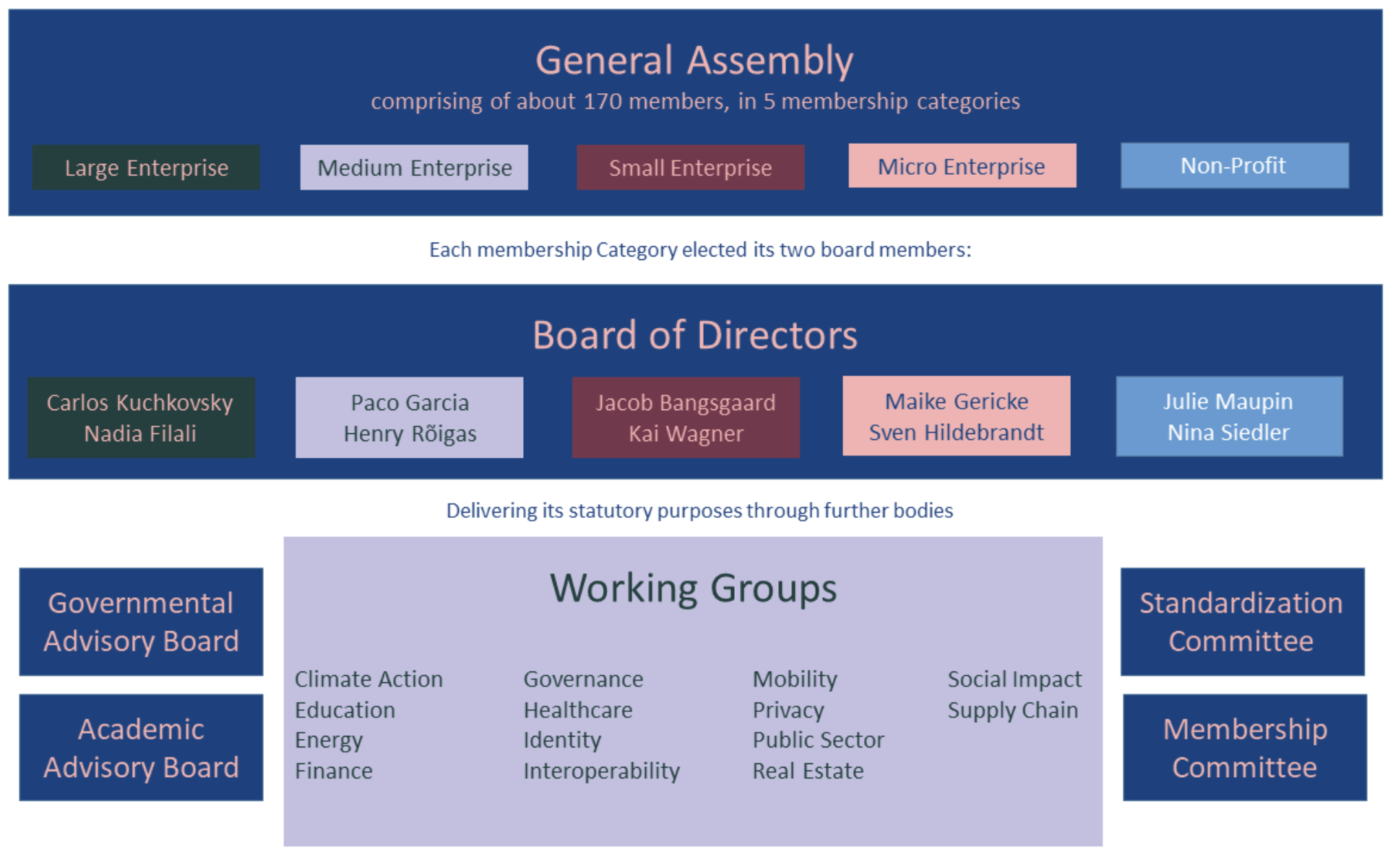
    INATBA established the Standardisation Committee, to work across all working groups with the aim to convene discussions with parties from different standard setting bodies, policy makers and all the elements of public sector and the private sector to reach an agreement on standards and levels of interoperability across technology, across legal structures, and across country boundaries.

    From a governance standpoint, INATBA promotes an open, transparent and inclusive global model of governance for blockchain that reflects the shared interests of stakeholders from industry, start-ups and SMEs, civil society organisations, governments and international organisations.

    INATBA’s working groups

    INATBA has 14 working group and three committees:

    1. Standardisation committee looks at governance and interoperability
    2. Legal committee looks at legal issues and is presently looking at the topic of smart contracts and the setting of standards with them
    3. Membership committee reviews membership applications

    One of the INATBA working groups is the healthcare Working Group who has been very busy working on the COVID-19 pandemic. They are working closely with the World Economic Forum’s COVID Task Force to address the challenges that the pandemic has caused

    The Energy Working Group, has been working with UCL, University College of London, looking at the topic of energy in particular peer to peer energy, and very soon they’re going to be producing the output of a series of roundtable discussions they’ve been holding over the last few months.

    The privacy working group have been working on mapping the global approaches to privacy around the world, so that INATBA can engage policymakers to support their policy enhancements decisions and help them reach a level of commonality between themselves.

    Converge of blockchain, AI and IoT

    The convergence of blockchain, AI and IoT is naturally built into the work plans developed by each of the 14 working groups.

    Convergence is also the name of an INATBA event which assembled 1500 participants from all over the world within the public and private sector for a series of high-level discussions. It is called convergence to recognise that INATBA isn’t just focusing on blockchain and DLT but on the convergence of everything that is required to establish the massive adoption at scale of blockchain and DLT, andincluding how it needs to interface with other emerging technologies.

    Convergence was last held in November in Malaga in 2019. The recording of the events can be viewed here:

    Why members join INATBA?

    INATBA is open, inclusive, democratic and transparent organisation within its governance model. It is funded through its membership fees and all of its members share an equal voice independent of its size or financial means.

    Governments who engage with INATBA gain access to a valuable pool of knowledge in a public or private forum fo their policy creation, development of legislation or their overarching technology strategies that include blockchain and DLT.

    The INATBA academic advisory body brings a level of academic rigour for the presentation of evidence from their research and compiled data. The academic advisory body brings academic impartiality which is free from undue commercial influence or political influence.

    INATBA, presently has almost 170 members, 20 government and supranational organisations and some 43 individuals representing academic institutions from 18 countries.

    COVID-19

    INATBA, together with the European Commission and University College London – Centre for Blockchain Technologies, launched a global initiative that convenes public and private entities committed to quickly activate blockchain solutions that address challenges caused by the COVID pandemic.

    The INATVA COVID Task Force will convene key players in the global blockchain ecosystem to identify deployable technology solutions that address governmental, social and commercial challenges caused by COVID. Working on an expedited timetable, the Task Force will analyse, sort, package and present solutions to governments and organizations to deliver real value quickly.

    So far 25 solutions have been presented to INATBA. Six were around helping to bring the business community together for collective action against COVID. Seven were around how to protect people’s livelihood and facilitate business continuity during the crisis. And 12 were aimed at mobilizing cooperation and business support for the COVID-19 response.

    Success in 12 months time

    Marc states that when you put to the side the unprecedented conditions caused by COVID-19, in an ideal world, INATBA would have had a real impact on the growth of technology and see real uptake of some applications at a significant scale. INATBA would have influenced regulators and policymakers in getting governing bodies around the world to help them enhance or create policies and pieces of legislation and regulation that would facilitate the adoption of blockchain and distributed ledger technologies in their countries.

    ___________________________________________________________________________________________

    This episode is brought to you by our friends and sponsors at R3. In this digital-first world, now more than ever, businesses need to modernize existing processes, systems and models – and enterprise blockchain provides the ideal solution for transacting directly and streamlining business operation.

    Developed by R3, Corda is light years ahead of other blockchain platforms in terms of privacy, security, scalability and interoperability. And–because Corda was built to meet the stringent requirements of highly-regulated industries, it can be used by firms of any type or size and in any industry.

    Blockchain applications built on Corda can reimagine and increase the potential of existing business networks, enabling direct and trusted transactions that eliminate friction and accelerate growth.

    Check out r3.com to find out more.


    Ep. 115 – OECD Global Blockchain Policy Centre Jun 28, 2020
    Show notes

    Caroline Malcolm heads the Global Blockchain Policy Centre at the OECD, assessing its policy implications & building solutions to ensure governments across the world can access and respond to the opportunities and challenges it raises. In this podcast she discusses with us the interesting work the OECD is doing around understanding the potential blockchain can bring to the its members, how they collaborate with other international institutions and she also invites you all to participate in the upcoming OECD Global Blockchain Policy Forum 2020 . What is blockchain? Caroline agrees that there is a wide range of views regarding defining what is blockchain. For the OECD, blockchain is just one type of distributed ledger technology (DLT) and refers itself to a combination of technologies. These technologies create a digital, shared and self-updating ledger of verified transactions or information amongst parties on a network. These blockchains and DLTs more broadly use various types of consensus mechanisms to validate and record those transactions or transfer of information. They have various governance systems with various degrees of control for the different parties on the network. Blockchain applications have been developed across lots of different sectors, and is often described as the Internet of value. What is the OECD? The Organisation for Economic Co-operation and Development (OECD) is an international organisation that works to build better policies for better lives. Their goal is to shape policies that foster prosperity, equality, opportunity and well-being for all. The OECD is an international organisation with at the present moment 37 members, including Colombia who recently joined. Together with governments, policy makers and citizens, the OECD works on establishing evidence-based international standards and finding solutions to a range of social, economic and environmental challenges. From improving economic performance and creating jobs, to fostering strong education, informing the impact of emerging technologies such as AI and blockchain, to fighting international tax evasion, they provide a unique forum and knowledge hub for data and analysis, exchange of experiences, best-practice sharing, and advice on public policies and international standard-setting. The OECD Global Blockchain Policy Centre For the last 6 years the OECD has been looking at cryptocurrencies and their impacts and potential for financial markets. In 2017, the OECD launched a project called Going Digital which broadly looked at digitalization across the policy spectrum. Within 18 months of that project being underway the OECD members decided that going forward they would put their focus on artificial intelligence and on blockchain. In 2018 the OECD Global Blockchain Policy Centre was created and in 2019 the OECD AI Policy Observatory was created. The OECD Global Blockchain Policy Centre was created to support governments to address the challenges raised by DLT and their applications as well as to seize the opportunities it offers for achieving policy objectives. The Centre focuses a significant amount of effort on education – capacity building and focusing on what that means for policy makers. Caroline and her team recognised that there was a huge lack of understanding about why this technology was not just like any other emerging technology. The decentralised aspect of the technology was what policymakers and regulators need to be paying special attention to. The Centre created their own course for policymakers to help them get a better understanding of what is the technology, what it’s useful for, what it’s not useful for and help them understand how it is changing the policy implementation environment. Caroline recognises that striking the balance between a healthy scepticism about blockchain technology and the hype associated with it to recognising with a certain humility that we have seen in the past emerging technologies that have developed and grown into something that we may not have been able to envision. Since 2018 the Centre runs the Global Blockchain Policy Forum on an annual basis to show the potential of blockchain technology without it being overhyped but concrete and realistic. In 2019 the forum and even more for the 2020 forum is focused on demonstrating that blockchain isn’t something for the future but a technology that is happening now. The OECD Global Blockchain Policy Centre’s work The OECD Global Blockchain Policy Centre’s work sits in four categories: Finance Supply chains Government and public goods Governing blockchain Finance The finance category involves work on financial consumer protection in the crypto asset space and asset tokenization. It also involves taxation work, sustainable infrastructure, and within the work of the Financial Action Task Force (FATF) they are looking at both virtual assets and digital identity. Supply chain This category is looked at from two aspects: track & trace of goods and a more qualitative aspect. The track and trace of goods has come to the fore in a kind of post COVID world as society looks at preparing its systems to become more resilient in the future. COVID-19 has demonstrated that perhaps we don’t have a good understanding of our supply chains, and as much control and information and transparency as we thought we had. With regards to the more qualitative aspect of supply chain and on the due diligence of supply chain. How to use technologies such as Internet of Things (IoT) to get a better understanding of what is happening in supply chain? It’s being able to see beyond just how a good is moved from point A to point B but to be able to see whether child labour or slave labour is being used within supply chains. Government and public goods This is about the delivery of public services for things like migration, development aid and sustainable development goals. It’s about using the technology for greater transparency to address corruption risks in aid delivery and ensure that when aid is given it is arriving to the intended recipient. This category also looks at transport and how blockchain is being used for urban mobility. Governing blockchain It’s about digital identity, governance of decentralised systems and understanding the new business models that can arise from it. It’s understanding and working out what are the incentives in those decentralised models and how they are governed. Cross institution collaboration In 2019 the OECD crated this informal network along with the European Commission, the WTO, UNICEF, World Food Programme, The World Bank, IFC and the IMF to informally share information about the different projects that they are all working on and identify points of collaboration. One that really emerged quite quickly was around the issue of education for policymakers and for public sector officials for them to understand what does blockchain mean to them as a government official or as a policymaker. The OECD is developing an online course for these government officials and policymakers to help them understand what is blockchain. The aforementioned international organisations are contributing mini modules to those courses along their areas of expertise. Different approaches to blockchain The OECD is composed of 37 member states from across the world. They recognise that there isn’t one size fits all with regards to the approach to be taken on blockchain. This reflects the various different sort of economic and government structures in different parts of the world. The OECD tries to understand what are the different policy options if there’s been no policy steps already taken by a member state. When governments have started to make moves, the OECD analyses what they’ve done and why it fits in a particular circumstance and try to tease out lessons for other countries about what could actually be useful for them to apply in their own circumstances. Public private partnerships Within the private space one of the key challenges that often arises is around consortia. There can be challenges in terms of willingness to share information and how to reach a consortium agreement. Experts have shared with the OECD that when you have government involved it can actually sort of smooth the path to a more effective consortium. In Singapore, a collaborative project was undertaken with the Monetary Authority of Singapore and a number of the regional banks looking at how to improve KYC processes. Through this public private collaboration it was realised that by sharing information amongst the participants you can get better outcomes for both the banks and the regulators to help them meet their obligations. Startup community and the OECD Caroline recognises that they need to be more involved with the startup communities. To help address this they held a startup showcase as part of their Global Blockchain Policy Forum in 2019. It was designed to not just to expose startups to a policy audience but also for policymakers to better understand the specific issues startups face. The OECD is doing work on individual country studies such as one in Italy focused on the sort of small to medium enterprise sectors in those countries and their blockchain community. This is to gain an understanding of what stage of development and areas of focus does the startup community have and what government policies are in place to align with overall policy objectives. For this year’s Global Blockchain Policy Forum they would like to showcase additional startups in a virtual way. OECD’s approach to digital identity, AI and the Web 3.0 The OECD has a comprehensive approach to digital identity solutions that involve DLT based ones and none DLT ones. They take a technology neutral approach when considering the full spectrum of digital identities. The OECD collaborates with a number of organisations including the Financial Action Task Force on digital identity. The OECD is also involved in the ISO’s Technical Committee on DLT in developing technical standards. Caroline admits that up to now the OECD has looked at emerging Web 3.0 technologies in isolation. However, they are working on updating their 2017 Digital Economy Outlook this year which will look at how these technologies come together. For example, it will look at where blockchain might go if you get greater adoption of the Internet of Things. How blockchain can help in the COVID pandemic? The COVID-19 pandemic has presented a series of new and pressing challenges across sectors, from the unprecedented policies required to slow infection and support the economy by governments, to the impacts on business operations right through the supply chain. As institutions have raced to adapt, questions of privacy, data security, and veracity of information have come to the fore. Governments and corporations have already turned to decentralised systems to address some of these concerns, while distributed ledger technologies like blockchain have attracted attention as a useful means of addressing specific fragilities and building future resilience. On the 27th of May, the OECD ran a COVID-19 Blockchain Webinar with a number of delegates: Jessica Douglas, Blockchain Services Leader, UK and Ireland, IBM Riho Laast-Laas, Lead, Estonian Track-and-Trace Consortium Frank Ricotta, CEO and Co-Founder, BurstIQ The delegates discussed the following topics: Supply chain management – a key area where DLT can play a role in improving it Track and trace – the example of the Estonia consortium demonstrated the value of having existing digital systems in place. For the last years, Estonia has made significant digital investments in the delivery of government services and management of information using emerging technologies such as blockchain. They were able to leverage that investment in building a track and trace application that addresses the concerns around data privacy Data sharing – the research foundry project has been working on how data can be collected by academics and research institutions by allowing them to retain ownership of that data and understanding where it ultimately ended up OECD Global Blockchain Policy Forum 2020 Source: OECD In 2019 the OECD successful ran the OECD Global Blockchain Forum 2019 with a summary report that can be downloaded: “2019 OECD Global Blockchain Policy Forum Summary Report”. For this year the OECD is going to launch their annual OECD Global Blockchain Policy Forum 2020 . The event will run virtually from the 16th of November to the 20th of November 2020 and will convene government ministers and senior policy makers, industry leaders, academics and other stakeholders to: Discuss the leading applications and significant policy issues confronting the blockchain ecosystem in 2020, including asset tokenisation, central bank digital currencies, and self-sovereign identity Review the emerging policy responses including through the recent work of the OECD, and share best practices identified across the world Look ahead to emerging trends in the blockchain industry, and hear from stakeholders on how policy can best support viable and fit-for-purpose innovation and adoption of distributed ledger technologies Startups will be able to showcase what they’ve been doing to policy makers As the event is being run virtually, Caroline wants to take the opportunity to enlarge the audience to the forum by including not just policy makers but also industry experts, general public and academics. ___________________________________________________________________________________________ This episode is brought to you by our friends and sponsors at R3. In this digital-first world, now more than ever, businesses need to modernize existing processes, systems and models – and enterprise blockchain provides the ideal solution for transacting directly and streamlining business operation. Developed by R3, Corda is light years ahead of other blockchain platforms in terms of privacy, security, scalability and interoperability. And–because Corda was built to meet the stringent requirements of highly-regulated industries, it can be used by firms of any type or size and in any industry. Blockchain applications built on Corda can reimagine and increase the potential of existing business networks, enabling direct and trusted transactions that eliminate friction and accelerate growth. Check out r3.com to find out more.

    Full show notes at the publisher

    Ep. 114 – Utilising blockchain at UNICEF Jun 21, 2020
    Show notes

    For this week’s podcast we had Christina Lomazzo, Blockchain Lead within the Office of Innovation at UNICEF. and Ariana Fowler, Blockchain Strategy within the Office of Innovation at UNICEF, join us to discuss how UNICEF and other UN agencies are using blockchain for social good. What is blockchain? Christina and Ariana produced a report entitled “A Practical Guide to Using Blockchain within the United Nations”. As per its guide blockchain is a type of software made up of records of digital transactions that are grouped together into “blocks” of information and shared securely across computers on a shared network. When a new block is added, it is connected or “chained” to the previous block, making it difficult to change past information. All computers on the shared network retain a complete record of transactions as they occur, representing the entire blockchain. These computers are called nodes. Transactions submitted to a blockchain can only be added and previous data cannot be removed or modified. This is sometimes referenced as an immutable proof of record. What is UNICEF? UNICEF, the United Nation’s Children’s Fund, is a 70 years old entity that is part of the United Nations. UNICEF works in over 190 countries and territories to save children’s lives, to defend their rights, and to help them fulfil their potential, from early childhood through adolescence. UNICEF works to serve children and women around the world, in the areas of education, child protection, child survival such as vaccination, health, and water sanitation. Last year UNICEF responded to over 300 emergencies around the world, on gender issues, and supply chain. The Office of Innovation at UNICEF is a team that looks at emerging technologies and how this will have an impact on UNICEF and the work it performs. A data science team that looks at artificial intelligence and machine learning. A team that looks at drones and how those can be used in a variety of scenarios. Most recently a blockchain team was put together that focuses on a number of areas: A venture fund that makes early stage investments into start-ups in UNICEF programme countries. The blockchain team acts as technical mentors to those start-ups working on a variety of use cases Support internal UNICEF countries office teams who might be interested in building blockchain applications or exploring where blockchain may play a role in their process Running UN courses on what is blockchain and with young people around the world, teaching them about blockchain and Web 3.0 “A Practical Guide to Using Blockchain within the United Nations’ The UN innovation network is an informal, collaborative community of UN innovators interested in sharing their expertise and experience with others to promote and advance innovation within the UN System. Under the UN Innovation Network, Christina and Ariana produced a report entitled “A Practical Guide to Using Blockchain within the United Nations”. The purpose of producing this guide was to give an introductory resource in what blockchain is. It helps to identify if blockchain is the right technology for a use case. The guide has a number of sections: A high-level introduction to what is blockchain Tools, flowcharts and discussion points to determine whether blockchain is the right fit and if so what type of blockchain Examples of where blockchain can be used with some examples of how it is being used across the UN Resources within the UN to approach blockchain in a systematic way. Fungi & Mycelium In the report, fungi and mycelium were used as a metaphor to explain what is blockchain. There were two reasons for using this analogy. First reasons, the practical guide is accompanied by a tool called atrium a glass space that has some greenery growing in a sheltered environment. Second reason, as they started developing the paper and thought about using the atrium, as a greenery, they started to think of systems like fungi and mycelium which are vast underground networks that are critical to plants’ survival but are often never seen but yet are so integral to forest and green vegetation. This is very similar to a blockchain network that people don’t really ever see but provide so much benefit to an ecosystem. General uses of blockchain having at the UN Blockchain has three key categories of use cases within the UN: Single source of truth – what is the truth for both public records and supply chain tracking for example Tracking the exchange of value within digital finance and cryptocurrency – seeing how assets become digital and being able to track their movement. Increasing organisational efficiency using smart contracts and digital engagement Single source of truth Within the public records and supply chain tracking, there is a project in Afghanistan looking at land record management. It’s a collaborative project between two different UN agencies, to digitise land records and having a single version of the truth by putting them onto a blockchain so that everyone knows who owns what land and when the registry had been updated or transferred. The World Food Programme has a project, looking at how to digitise the supply chain of food in one of their largest food corridors between Djibouti and Ethiopia. Taking an analogue and paper process to making it digital and putting in blockchain features to improve its efficiency. Tracking the exchange of value For tracking the exchange of value within digital finance also known as DeFi (decentralised finance) in cryptocurrency world. Building Blocks is the World Food Programme is a blockchain project used in several refugee camps that uses biometrics instead of paper vouchers for getting goods at stores. It’s digital accounting for some of those beneficiary vouchers. In the fall of 2019, UNICEF launched its crypto fund for UNICEF to be able to receive, hold and disburse donations of cryptocurrencies ether and bitcoin. This will allow for transparent donations and investment tracking within the United Nations. This is a project that Insureblocks supported in Christmas 2018 in its video “This is us” Smarts contracts and digital engagement Digicus is a smart contracts platform that allows for the streamlined processing of the disbursement of funds within the vendor procurement process. When a contractual commitment with a monetary value is made between organisations, this relationship can be codified on a blockchain and when a predetermined milestone is met, payment can automatically be sent. Digital impact tokens are being used as an incentivizing behaviour mechanism for staff at the UN. The tokens create verifiable proof of participation and can be redeemed to provide nutritional bars to children in need, creating double the impact The Atrium The Atrium is a blockchain-based collaboration tool where the UN community can plant and grow ideas around blockchain. It’s an inter-agency collaboration tool where anyone within the UN network can sign up and participate in three key sections: A section to learn about blockchain Sharing of blockchain projects and prototypes Community forum for the exchange of information, identifying of collaboration opportunities and questions and answers The Atrium is built on top of blockchain and as participants interact with it they can earn blockchain based badges. When asked if Atrium really needed a blockchain to be built instead of a centralised database. Ariana, completely agreed that Atrium could have been built without a blockchain but in their next iteration there will be the possibility where UN staff will be able to learn how to programme smart contracts, write smart contracts, and then actually deploy them on this network that atrium is built on. This will give them the ability to know what it feels like to build a blockchain application and see it interact within a blockchain. Cash transfers in refugee camps in Jordan This is a project supported both UN Women and by the Building Blocks of the World Food Programme where blockchain technology is being used in refugee camps to track cash entitlements that are disbursed to the people World Foord Programme (WFP) serves. Cash value from WFP or other partners is stored in an ‘account’ for individual recipients and is maintained on the blockchain. The cash that people receive or spend on goods and services is paid to retailers through a commercial financial service provider that is built on a private, permissioned blockchain, and integrated with UNHCR’s existing biometric authentication technology—WFP has a record of every transaction. This not only saves on financial transaction fees in the camp setting but ensures greater security and privacy for Syrian refugees. The project currently coordinates the delivery of food assistance for over 100,000 Syrian refugees. Source: “A Practical Guide to using blockchain within the United Nations”. Digital impact tokens for chocolate produced in Ecuador The United Nations Development Program (UNDP) in Ecuador has developed digital impact tokens on the blockchain. For every chocolate bar sold, there are impact tokens associated with that chocolate bar. When a chocolate bar is purchased the consumer has two options with their impact tokens. They can either take those tokens and send them back to the farmer. When four tokens are sent back to a farmer, a new cocoa tree is planted, with the intent that this allows the farmer to increase their production and therefore their income. Alternatively, the consumer can choose to get a discount on future chocolate purchases. Because the token is issued using a blockchain, the tokens transfer can be tracked by anyone, creating an immutable and transparent proof of impact. Vendor payment leveraging smart contracts Christina and her team are working with the Kazakhstan office on a project called Digicus which is looking to digitise some of the financial processes in Kazakhstan mainly around vendor payments. UNICEF works with many partners to deliver its mandate and is innovating in managing those relationships. UNICEF recently leveraged blockchain to digitise and consolidate UNICEF’s agreements with its implementing partners on the ground in Kazakhstan (governments, NGOs, academic institutions) by using smart contracts. The goal of the prototype was to develop a platform to streamline processes related to cash transfers to improve the transparency and accountability of partnerships and related transfers of resources. Ultimately, the platform allowed for streamlined verification of the results achieved by partners and allowed the blockchain-based smart contract to automatically release the payment, after verification and authorisation. This platform, called “Digicus”, allows all parties to have a common understanding of what stage a project is at, what goals have been achieved, and showcases how smart contracts can be used to expedite processing of paperwork and payment. Source: “A Practical Guide to using blockchain within the United Nations”. Linking youth to the future of work This is a collaborative project between UNICEF South Africa and UNDP South Africa. The project is called Zlto “zlah-toh” which is really around matching young people with small jobs or micro tasks. Allan (left) at a Zlto workshop with Cape Town based App Developers in March 2020 Zlto is an innovative digital rewards system that is aimed at reducing employment barriers youth face such as work experience, the cost of work seeking, and access to credible networks by rewarding them for “doing good”. The micro jobs performed by the youth are stored as a “work asset” on the blockchain which are validated on the platform by recognized reviewers and serve as credible, verified work experience which can assist them in their search for employment. With the rewards earned through Zlto, young people can access quality opportunities including education, formal jobs, and small business finance. An added advantage of Zlto is that young people earn credits for the micro jobs they perform which can then be exchanged for products and services ranging from basic food supplies such as bread and milk to transport, airtime and electricity. Source: “A Practical Guide to using blockchain within the United Nations”. Collaboration in terms of technology stack In 2019 the Office of Innovation at UNICEF drones team launched a corridor in Kazakhstan. This was the first drone corridor to test out how to coordinate drones in an emergency response scenario. The Kazakhstan country office team asked the blockchain team if they could provide certificates that were validated on a blockchain for the companies flying in the drone corridor. As UNICEF has numerous drone corridors around the world, the companies would be able to provide recognised certificates to each of the drone corridoes. This was one of the first collaborations the blockchain team had with the drones team. UNICEF Venture Fund The UNICEF Venture Fund is a $29M pooled Fund investing in early stage, open-source, emerging technology with the potential to impact children on a global scale. It also provides product and technical assistance, support with business growth, and access to a network of experts and partners. The UNICEF Venture Fund is the first financial vehicle of its kind in the United Nations and enables UNICEF to learn from and to shape markets of emerging technology such as AI, drones, machine learning, AR, VR and blockchain, that exist at the intersection of $100 billion business markets and 1 billion persons’ needs for international development such as refugees to children and other vulnerable populations. The funds invests in frontier technologies that will have an impact in UNICEF capabilities to reach its mandate. They look for projects that are open source or willing to become open source. The blockchain team within the office of innovation passionately believe in open source technologies and digital public goods impact as being exponential. They are presently look for start-ups who have an idea for a use case that is relevant to UNICEF’s mandate to improve the lives of women and children around the world.

    Full show notes at the publisher

    Ep. 113 – World Trade Organisation – Can blockchain revolutionise international trade? Jun 14, 2020
    Show notes

    Emmanuelle Ganne is the Senior Analyst at the World Trade Organisations’ Economic Research Department. She is an international trade expert with over 15 years of experience in international trade, trade policy, global governance, and diplomacy. In this podcast we discuss whether or not blockchain can revolutionize international trade. via GIPHY Her blockchain adventure started at the WTO in 2017 and it was ‘love at first sight”. Because her direct colleagues at the WTO didn’t quite understand the technology and its transformational opportunities for international trade, she decided to author the book “Can blockchain revolutionise international trade?“. The book tried to build a bridge between the private sector and the IT community on the one hand and trade officials on the other. Emmanuelle’s journey over the last two or three years has been to help people understand this unique technology and to create an enabling environment that allows it to be deployed on a large scale to make a difference for international trade. What is blockchain? Emmanuelle took the interesting approach of defining blockchain from the perspective of how she explained it to her teenage niece. At that time her niece’s school had a Pokémon craze going on. Every day, she would bring to school a big box of Pokémon cards that she would trade with her friends. To explain blockchain Emmanuelle, asked her niece to try and imagine if she had an app on her mobile that would store digital twins of all of her Pokémon cards. Having such an app meant she wouldn’t need to bring her big box of Pokémon cards to school. She could digitally trade them as each card has its own unique digital twin like a fingerprint of that paper card. Normally you can make copies of digital documents very easily but with blockchain you cannot. The mobile app can thus also allow her niece to trace the history of the card including which one of her friends previously owned that card. Blockchain is like this mobile app. It’s like a giant repository of digital records stored in a specific order that ensures transparency and is highly secure as it also provides the guarantee that the information hasn’t been tampered with. This is achieved because everyone has a copy of the transactions. What you see is what everyone sees. These factors combined provides an environment of trust which means Emmanuelle’s niece can trade with not just her friends but with other individuals knowing that the digital twins of the cards aren’t fake and that all transactions are real and recorded. Emmanuelle’s explanation of blockchain has some similarities to how Bettina Warburg explains what is blockchain to a 5 year old, a teen, a college student, a graduate student and an expert. Can blockchain revolutionise international trade? In November 2018, Emmanuelle published a comprehensive report entitled “Can Blockchain revolutionize international trade?” and then a year later in November 2019 she published the report “Blockchain & DLT in Trade – A Reality Check”. Whilst both of these reports are WTO publications, Emmanuelle clarifies that the opinions expressed in these publications are hers and are not meant to represent the opinions of the WTO and its members. Blockchain is a technology that presents a unique set of features that make it truly interesting to facilitate trade in terms of: Traceability of transactions Removing the need for trusted third parties Preventing double spending Recorded data on the ledger is virtually immutable and its timestamps enhances the transparency of supply chain and traceability of transactions. For example supermarket shoppers can scan the QR code of fresh tuna to trace if it was sustainably sourced and slave labour free. It can be used to check if the small farmer that grew the cocoa beans of chocolate bars was paid a fair price or if the luxury bag being purchased wasn’t a counterfeit. In addition to providing traceability of products, blockchain can also remove frictions from international trade by facilitating trade transactions. Blockchain allows participants who don’t necessarily trust each other to collaborate without the need to rely on a trusted third party, this is why The Economist, call it the trust machine. This is particularly important in international trade as it involves hundreds of actors who don’t necessarily know or trust each other but have to work together to process transactions. Another important characteristic of blockchain is that it prevents double spending. As previously mentioned a problem of digitalisation is that it enables the creation of numerous copies of the same document. With blockchain that isn’t possible. This is particularly important in the case of documents of titles that are used in international trade such as the bill of lading which proves ownership of products. This isn’t a document that should be copied several times. Blockchain technology removes the risk of that double spending and when combined with the above other features it can make true digitalization of trade transactions possible. Blockchain however is only a tool which for it to work to its full potential needs an enabling regulatory environment that recognises e-signatures and e-documents. It needs to address the interoperability issues to avoid the digital island problem of numerous platforms that don’t talk to each other. Challenges in international trade – labour and paper intensive “In 2014, Maersk followed a refrigerated container filled with roses and avocados from Kenya to the Netherlands. The company found that almost 30 people and organizations were involved in processing the box on its journey to Europe. The shipment took about 34 days to get from the farm to the retailers, including 10 days waiting for documents to be processed. One of the critical documents missing, only to be found later amid a pile of paper.” Source: Bloomberg – Kyunghee Park International trade remains very labour and paper intensive. Four billion paper documents are generated each year as a result of international trade. The industry is trying to address that by looking at a number of technologies such as blockchain. There have been a number of PoCs (proofs of concepts) and some like Komgo which are already in production is digitising commodity trade finance. Source: “Blockchain & DLT in Trade – A Reality Check”. Most projects are still in their early stages. In her report “Blockchain & DLT in Trade – A Reality Check” co-authored with Trade Finance Global, she tried to map the different projects out there in trade and trade finance by producing a “Periodic Table of DLT Projects”. On a scale of 0 to 5, the average level of maturity was 2.3 showing that most projects are in between the pilot phase and entering production. Interestingly the current COVID-19 pandemic has shown that it is possible to go digital with millions of people forced to work from home. A recent ICC study has shown that many banks were taking their own measures to relax internal rules on original trade documentation to help combat the hurdles introduced by the pandemic. They have expanded the use of e-documents, e-signatures and they have put in place new business processes and controls. For Emmanuelle the pandemic has shown that players within international trade can go digital and it has in her view accelerated the move to digitalisation. A recent Trade Finance Global survey demonstrated that 89% of practitioners surveyed within the receivables and factoring industries see an increase in the usefulness of blockchain because of the current outbreak. Additionally, two thirds of them shared that the legal validity of documents and common standard are a must have. Co-ordinating blockchain efforts amongst institutions Insureblocks has had the pleasure of interviewing Nadia Hewett from the World Economic Forum and Peteris Zilgalvis from the European Commission. It is becoming increasingly clear that there is a certain amount of overlap between the work being done between the WEF, European Commission, WTO and the OECD. Emmanuelle recognises that and whilst there are exchanges of ideas and work being done on joint projects there isn’t a goverance structure that brings them all together for inter-agency cooperation. There is a need for a multi stakeholder dialogue to address the current challenges and allow this technology to work to its full potential and to be deployed on a large scale. The ICC has launched the ICC Digital Trade Standards Initiative (DSI) which will build on the work done by numerous other likeminded initiatives which aim to digitise trade, notably through the development of open trade and technology standards to promote interoperability. Four process of international trade where blockchain can help Source: “Can Blockchain revolutionize international trade?” There are four processes in international trade where blockchain can help: Commercial transactions Trade financing Transport Official control measures Trade finance, transport and official control measures are the key ones that impact the WTO. International trade transactions involves various roles: Transportation logistics – physical flow of goods from point A to point B Trade finance – financial flow of money from the buyer to the seller Documents – flow of documents between parties to complete a transaction such as certificates of origin, phytosanitary certificate and bill of lading to name a few In all of these process you have a large number of actors involved – importer, exporter, banks for trade finance, freight forwarder, ocean carriers, air transportation services, custom authorities and a number of other authorities for the issuance of certificates for example. The reason blockchain is interesting is because it allows multiple players within and across different process to interact in near real time in a highly secure and trusted environment. It facilitates collaboration and the automation of processes. You can automate the transfer of documents and with the use of smart contracts you can automate payments under a trade finance transaction. An example on how blockchain can be used is with the issuance and storage of import and export permits on the blockchain. This helps reduce the risk of fraud, avoid the permits being lost and with the use of smart contracts expired import and export permits can be automatically be rendered as invalid. Letters of credit vs open accounts Boston Consulting Group found that more than 20 players are part of a single trade finance transaction creating 5,000 data field interactions with only 1% of these creating real value. The rest of the data is either ignored or transmitted to the next party. Letters of credit and open accounts are the two main tools for financing trade. A letter of credit, also known as a documentary credit or letter of undertaking is a payment mechanism that is very often used in international trade. It’s a letter from a bank, guaranteeing that a buyer’s payment to a seller would be received on time and for the correct amount if the buyer is unable to make payment on the purchase then the bank would be required to cover the full amount or remaining amount of the purchase price. It’s often used in Asia but it’s a very paper and labour-intensive process with burdensome procedures. Blockchain can facilitate interaction between the different actors and reduce paperwork. There have been an interesting number of pilots such as Contour, previously known as Voltron, which have tackled those issues with blockchain technology. What these pilots have demonstrated is that you can reduce the process related to letters of credit from typically five to ten days to less than 24 hours. An open account transaction is a sale where the goods are shipped and delivered before payment is due. This transaction is advantageous for the importer in terms of cash flow and costs but it carries a high risk for the exporter. Blockchain can help to mitigate the risk that the exporter faces. we-trade-introduction from we.trade on Vimeo. There are a number of blockchain platforms that offer open accounts transactions such as We.Trade. We.trade uses smart contracts to provide a guarantee of payment and automatic settlement when the pre-determined conditions, agreed in a contract between the parties, are met. So here blockchain is used more in terms of mitigation of the risk involved in addition to facilitating the entire process. Blockchain is also increasingly being used in supply chain finance. It’s a financing solution that is initiated by the ordering party, usually a large international party in order to help its suppliers to finance its receivables more easily and at a lower interest rate that they would normally be offered. Blockchain provides greater transparency into the supply chain because all transactions can be monitored for all parties on the chain. Can blockchain play in a role in reducing the $1.5 trillion gap in trade finance? The WTO estimates between 80% and 90% of global trade relies on trade finance, yet there is a $1.5 trillion gap between the market demand and supply for trade finance. KYC and AML requirements remain the most cited barrier, with high transaction fees, and low credit ratings rounding out the top three. Small and Medium-sized Enterprises (SMEs) remain disproportionately affected by these and other barriers, experiencing a 45% rejection rate on proposals, much larger than the 17% seen by multinational organisations. Emmanuelle reminds us that there are many reasons for this $1.5 trillion gap in trade finance. One of them is the difficulty for SMEs to get finance. Blockchain is interesting because it allows for companies to have an identity and to have an immutable evidence of time stamped transactions of how much business they’ve done. It allows for these digital records to be easily accessed and checked. From that respect it can facilitate trade finance. Blockchain can ease some of the constraints faced by SMEs but it won’t be the panacea to address the $1.5 trillion gap in trade finance on its own. It is one element amongst many others. The Periodic Table of DLT Source – Trade Finance Global As mentioned earlier on in this post Emmanuelle also produced, in November 2019, a report entitled “Blockchain & DLT in Trade – A Reality Check”, co-authored with Trade Finance Global, in this report she published a “Periodic Table of DLT Projects” where on a scale of 0 to 5, the average level of maturity was 2.3 showing that most projects are in between the pilot phase and entering production. She is hoping to update the periodic table in Q3 of 2020 and she believes that by then the average level of maturity will be above 2.3. We.trade was already mentioned as was Geneva based, Komgo, that was launched in December 2018 which focuses on international commodities trading like oil and gas. DLT Ledgers which wasn’t actually mentioned in the period table is a Singapore start-up that has already processed $3.3 billion in trade finance. Many other initiative such as Marco Polo and Contour have successfully launched numerous Proof of Concepts and are now entering production. You have many different speeds of developments of blockchain initiatives in trade finance. What explains this difference is that start-ups are more agile and can move faster than consortiums. Contour for example was previously known as Voltron which was a consortium of banks which was run by committee that made decision making difficult and time consuming. In January 2020, Voltron was re-invented as a separate legal entity called Contour. It had a change in governance structure, a CEO and is now able to provide a full commercial service. This governance structure explains to a large extent the differences in maturity that you see with these different projects. Emmanuelle believes that in the coming 6 – 12 months the landscape will change quite significantly. Regulators & regulatory sandbox…

    Full show notes at the publisher

    Ep. 112 – Power Ledger – powering energy with blockchain Jun 07, 2020
    Show notes

    Dr. Jemma Green is the co-founder and chairman of Power Ledger. Power Ledger is a four year old technology company, with 20 power projects in over nine countries, that facilitate two things – the trading of electricity and the trading of environmental commodities using blockchain technology. In this podcast we discuss with Jemma how their platform is revolutionising the power industry and how it is being used to democratise power.

    What is blockchain?

    Blockchain is a like a database that can be used in many different ways. It is a common record keeping system which creates more efficiencies in the transaction process between counterparties who in the past would have had their own record keeping system. Using a blockchain enables an entry in a ledger to contain both the payment and the physical statement of a digital asset. This reduces the settlement risk or the need to reconcile and settle payments which can be very costly for the transacting parties.

    With smart contracts, which sit on the blockchain, you can also perform complex commerce transactions.

    The Energy Industry

    For the last century or so electricity markets have remained relatively unchanged. It is characterised by large power stations, typically, coal and gas fired power, bringing electricity to people’s homes brought by transmission and distribution networks, the grid.

    In the past 15 years, a new paradigm has begun to emerge as citizens and business have installed rooftop solar panels on their homes and office buildings. More recently, battery storage is being installed inside homes and businesses, as well as large scale solar and wind farms.

    Technology can help facilitate the dispatch of electricity via virtual power plants to stabilise the grid which historically has suffered from volatile prices creating significant problems in the market. Surplus rooftop solar power can be stored in batteries, and that market mechanism, facilitated by Power Ledger’s technology, can help the grid deliver low cost, clean and resilient power.

    These power technologies, along with the connectivity of blockchain to bring communities together, serves as a kind of citizen utility which provides a certain level of empowerment that has the potential to drive the next wave of innovation to democratise power.

    There are numerous drivers towards the democratisation of power. For some it is about getting a better price for electricity whilst for others it is their concern regarding air quality and the potential to electrify transportation in their city.

    Jemma believes that overall people are very engaged in the topic of electricity and becoming much more sophisticated in what they understand of the markets and what they expect of them.

    Power Ledger introduction

    Power Ledger is a technology company that uses blockchain to facilitate trading of electricity and environmental commodities. Their vision is leading the global democratisation of energy movement. To give people access to energy and to participate directly in energy markets and improve their lives and the lives of others. Power Ledger would like to be recognised as a major contributor to transforming energy markets and sustainability globally and positively impacting the lives of 1 billion people. That’s Power Ledger’s big ambition that makes the, want to get out of bed every morning and do what they do.

    Power Ledger the Uber / AirBnB of electricity

    Blockchain enables buyers and sellers to transact with each other directly without the need for an intermediary. In the case of electricity, households with rooftop solar panels could sell its surplus electricity to its neighbours in much the same way as Uber and AirBnb allow people to monetize their cars and spare rooms.

    Power Ledger works with electricity retailers in providing them with its trading platform to facilitate the retailer’s customers to trade electricity between themselves. Blockchain provides all parties with the source of truth to underpin the buying and selling of electricity and the payment of it.

    Did you really need a blockchain?

    Jemma recognises that there are many things that could be done without a blockchain. For example, peer to peer trading with one retailer can be done without a blockchain. This however limits what’s possible beyond that. With blockchain you can facilitate cross retailer trading and create a much bigger distributed electricity market.

    For example, two retailers on the blockchain can trade with each others customers. Customers with stored electricity in batteries can sell it to their own retailer or to other retailers in the network.

    Blockchain technology enables the tracing and verification of used energy sources to audit it in terms of environmental commodity trading like renewable energy and certificate trading. Additionally, blockchain can set all the trades both physically and financially in one block thus reducing counterparty settlement risk and removing the need for brokers which can drive cost efficiencies.

    Smart contracts can facilitate more complex transactions between multiple parties within an energy ecosystem like a virtual power plant. And it can also optimise the market for maximum value capture from all available income streams in a virtual power plant.

    Virtual power plant

    A virtual power plan is where businesses or households install a battery to store their surplus electricity from solar energy and wish to dispatch that electricity from the battery into the market at times of peak demand.

    They might also provide what is called ancillary services to the market such as providing frequency and other control services. They might sell into the spot market to add more supply at peak times and provide grid support services to grid operators.

    Essentially a customer with a battery can sign up to one of Power Ledger’s partner retailers and use the platform to access the batter for that purpose. Collectively all of the batteries in the network are what’s called a virtual power plant. Together they can add up to the same size as a normal power plant.

    The Power Ledger Platform
    Source: Power Ledger Whitepaper

    When a utility company and customers want to gain access to the Power Ledger Platform a bond must be paid in the form of power tokens (POWR). These tokens can also be independently traded outside the platform as a digital asset on eligible exchanges. Sparkz is an exchangeable energy trading stable token, that can be used when units of electricity like kilowatt hours are bought and sold on Power Ledger’s platform. These tokens are automatically converted into sparks from the local fiat currency to enable energy trading. When energy transactions are settled, sparks are automatically converted back into the customer’s chosen currency. For example, one spark in Australia is one cent, or one spark in Thailand is one Thai baht.

    Sparkz are issued against escrowed power tokens via a blockchain enabled smart contract. The Sparkz are sold by the retailer to consumers who use the token to pay for energy. Utility companies need POWR and consumers need Sparkz.

    Incentive mechanisms for delivering sustainable outcomes

    Jemma points out that in the past being sustainable didn’t always make economic sense. She believes that now making money and delivering sustainable outcomes can be intimately linked. This however depends on how the markets are set up and the incentives created through products and services can support that.

    Power Ledger’s platform provides a market mechanism that encourages people to install battery systems that can stabilise the grid and stay connected to the grid. In the past batteries were installed by consumers to self-supply and to be less reliant on the grid. The drop in price of solar panels and batteries makes sense to use them without government subsidies. Connecting them to the Power Ledger platform enables consumers to trade and generate new revenue streams out of them.

    Electricity markets for a century had the market built on top of the physical system used to service it. Now there is an inversion where market mechanisms can create the right kind of behaviours that deliver distributed electric market that is stable, clean and low cost.

    COVID-19, a wakeup call for the energy sector

    Jemma recently wrote an article on Forbes “COVID-19: The Wake-up call the energy sector needed”. COVID-19 has heightened people’s desires about how to become more self-sufficient. In Australia there has been a strong demand for solar battery systems since COVID-19.

    Large retail outlets are thinking about how they can incentivise customers back into stores by purchasing their customers’ electricity in store vouchers thus creating a green barter system.

    Energy networks, retailers and operators have delivered services in much the same way for a century – driven by fossil-fuels.

    New technology is making it easier, more effective and affordable to use renewable energy, and the costs associated with installing those technologies, such as solar and batteries are decreasing.

    And most industry players recognise the need to change and evolve in order to remain relevant, or are at least are starting to, with a little nudge from COVID-19.

    Self-generating renewable energy infrastructure gives people the power to become self-sufficient for their electricity needs, with some even going ‘off-grid’ altogether. There is more of a sense of urgency to innovate right now and to make decisions.

    Global catastrophe’s like COVID-19 are also a catalyst for many things that are ripe for changes in a similar manner as how World War One saw more women get into paid work.

    Global partnerships

    Power Ledger is working with a number of companies all across the world from Europe, to Asia and North America. Power Ledger doesn’t see itself as just selling a piece of tech. They want to help their clients achieve what’s of fundamental importance to them and to help them reach those ambitions.

    In France, for example, they are working with the green energy retailer, ekWateur. ekWateur recognises that their customers want to be able to choose their energy mix, they want to be able to say I want solar from this farm, wind from that farm, and, and solar from my neighbours. Power Ledger’s platform enables their customer base to achieve that.

    In the US they have partnered with Clearway Energy Group to roll out a digital commodity trading software in the United States to develop a platform to trade Renewable Energy Certificates (RECs) in the US. Clearway Energy recognises that blockchain can significantly improve the efficiency for the trading of RECs by linking transaction functions within a common platform.


    Blockchain Bistro – COVID19 and the economic downturn’s effect on P&C insurance Jun 05, 2020
    Show notes

    Welcome to the Insureblocks first Blockchain Bistro. Blockchain Bistro is a new show that we are adding to our range of podcasts. It’s a live webinar on Linkedin Live where we aim to discuss interesting subjects with a panel of experts. For this first show we had the pleasure of having Patrick Schmid, Vice President of RiskStream Collaborative.

    Patrick was recently on the podcast to discuss “COVID19 and the economic downturn’s effect on P&C insurance: An opportunity for technology?“. For this first Blockchain Bistro, Patrick was joined with two Insureblocks partners: Mark Simpson and Rory Unsworth.

    Together we discussed whether or not if COVID19 and the economic downturn’s effect on P&C insurance is an opportunity for technology? We also took a number of questions from the community live in the webinar.

    We hope you’ll enjoy this new format and feel free to reach out to us on Linkedin or on Twitter or just add a comment below to give us some feedback or suggest some themes you’d like for us to discuss.


    Ep. 111 – COVID19 and the economic downturn’s effect on P&C insurance: An opportunity for technology? May 31, 2020
    Show notes

    Patrick Schmid is the Vice President of The Institute’s RiskStream Collaborative a risk management insurance blockchain consortium. In this podcast Patrick discusses with us the impact of COVID19 and the economic downturn’s effect on P&C insurance and whether or not this represents an opportunity for technology. What is blockchain? Blockchain is a distributed ledger that maintains a constantly growing list of chronologically added records in the form of blocks. Blocks contain data such as transactions or smart contracts. They’re verified and confirmed through a decentralised consensus process. This process is why blockchain is often seen as providing the decentralisation of trust without the need for an intermediary or a centralised party. In this period of economic downturn, due to COVID19, Patrick believes that blockchain can provide the much-needed operational efficiency at a time when privacy and security are of high concern. Medium article: COVID-19 and the economic downturn’s effect on P&C insurance: An opportunity for technology? A board member of The Institute challenged Patrick and his team to think about the impact COVID19 would have on insurance and how to think about RiskStream’s strategy for the remainder of the year. This prompted, along with Patrick’s concern about the economy to write the article: “COVID-19 and the economic downturn’s effect on P&C insurance: An opportunity for technology?” The article analyses the economic impact of the outbreak of COVID19 and the lockdown is having on the US economy and the fallout it will have on the P&C insurance industry. It looks at how it will strain underwriting profits and the impact a decline in interest rates and financial markets will have on net investment yields. 40% estimated fall in US GDP In the first quarter of 2020 GPD was estimated to have declined by 4.8% with JP Morgan predicting an estimated 40% fall in GDP in Q2. According to the US Department of Labour US unemployment rate rose to 14.7%, an increase of 20m in April, representing the highest unemployment rate increase since the Great Depression. Some economists are predicting that the unemployment rate could increase to 30% before this pandemic peaks. This has led to an unprecedented rise in unemployment claims with an additional 3m claims on the 14th of May bringing the total to 36m. Source: US Bureau of Labor Statistics A perfect storm? Whilst the P&C industry as a whole has taken these events in its strides it isn’t insulated from the economic fallout. The impact on business activity is expected to be felt in commercial lines and the effects from declines in residential activity and consumer activity in general, are expected to show up in personal lines. The effects are expected to impact the P&C combined ratio through changes to premiums, losses and expenses. A combined ratio above 100 indicates the industry is paying out more money in claims then it is making from policies. Due to effects on policies and losses the industry should expect an increase in the combined ratio. Adding to industry stress, net investment yields are likely to decline as well. The industry typically invests very conservatively, so interest rates are a good measure to track as a proxy. On the 15th of March the US Federal Reserve in its most dramatic move since the 2008 financial crisis announced it is cutting its benchmark interest rate to near zero and said it would buy $700bn in Treasury and mortgage-backed securities as it attempts to head off a severe slowdown. The decline in P&C investment yields related to lower interest rates will constrain P&C insurance profitability further. The duration of zero-interest rate policy will specifically impact areas of insurance with longer time horizons. Some are even saying there’s the potential for negative interest rate policy which would further stress P&C insurance profitability. Source: Patrick Schmid COVID19 & economic downturn’s potential impact on P&C insurance lines Patrick has seen a distinction between different areas of P&C lines due to the crisis. He believes there will undoubtedly be changes in the demand for insurance and the new environment will lead to alterations in insurance claims and losses. Down the road, this may also lead to changes in regulation and could even generate new business models. Source: RiskStream Collaborative Auto insurance Premiums are likely to contract across a variety of lines of insurance as the economy weighs on new exposures and causes early policy cancellations. General auto and air traffic will decline as more people stay home. The increase in unemployment will likely show up in reduced premiums for personal auto, aircraft and commercial auto. In the UK and in the US a number of auto insurance carriers are providing refunds to policy holders due to the reduced amount of driving. Workers compensation policies The rise in unemployment claims along with new work-from-home environment may result in businesses cutting workers compensation policies. Credit & mortgage guarantees Patrick believes that due to some of the policies being enacted in the US homeowners and mortgage guarantees will have some short run stability. But unfortunately, long term, there’s definitely the risk for foreclosures spiking leading to credit, mortgage guarantee and surety losses expected to increase. Home insurance Homeowners may see a slight uptick in losses as more residential activity takes place at home, due to school cancellations and work-from-home policies, thereby increasing risk. Patrick mentioned his own personal risk of his son trying to light a candle one evening! Business interruption coverage Like in the UK there has been a number of captured headlines in the US regarding insurers trying to wiggle their way out of honouring their business interruption policies. Here in the UK, Hiscox, has come under particular scrutiny around its business interruption. Business interruption coverage, which can be included in property coverage, is an area of question. This coverage indemnifies companies for lost profits for non-excluded risks, yet outbreaks of disease are generally excluded. Certain policies include coverage for “interruption by communicable disease.” Even with this language included, some policies still exclude contamination due to a pathogenic organism, bacteria, virus or disease. There are a lot of elements to consider with this issue. Therefore, it is likely there will be challenges and litigation related to business interruption. Is the pandemic a catalyst for tech-adoption in insurance? The P&C insurance industry, like many others, was thrust into a new business environment due to the global pandemic. Within a week a relatively manual and conservative industry, which relies heavily on face-to-face interaction, showed an impressive ability to adjust and leverage technology to continue to provide products and services. While some firms within the insurance industry had already made good headway in tech-related innovation and automation prior to the pandemic, the industry as a whole has continued to be somewhat reluctant to adopt emerging technologies. The pandemic and the associated economic fallout may wind up being the key catalyst for widespread tech-adoption within insurance. Prior to the pandemic the stage for large-scale technological adoption within insurance was already set. While the economic downturn will lower the quantity of available start-ups and InsurTechs, the quality and adoption of technology whether it’s from a start-up or from an incumbent leveraging technology may actually increase. In addition, the count of internal projects for brokers, carriers and reinsurers leveraging new technologies has been rising over the past few years. Overall Patrick believes that the insurance industry will most likely see an increase in tech adoption when this pandemic plays itself out. Importance of innovation A lot of the carriers (brokers and reinsurers) representatives at the RiskStream Collaborative work within innovation departments have been leveraging new technologies over the last few years. However, in spite of having understood the importance of innovation few had moved their projects to production usage. On the 5th of March 2020, the credit agency, AM Best released its Scoring and Assessing Innovation methodology. It explains that these company-specific innovation efforts are likely to have a long-term impact on an insurer’s financial strength. Put differently, in order to profit maximize, insurers need to innovate and they need to do it now. Will the pandemic herald an increase in usage-based insurance (UBI)? One of the constraints to technological adoption within insurance has been lack of customer adoption. Telematics has been around for a long period of time, but never experienced robust demand. It’s possible the pandemic could change this. Due to the pandemic related lockdown, miles driven has collapsed and more customers are now unemployed, leading to auto insurers around the world issuing refunds to their customers. Telematics and Usage-Based-Insurance (UBI) may provide angles for auto insurers to maximize retention of policyholders. Whilst there are still some concerns regarding the data security risk the cost-benefit for consumers to exchange private information for a reduced rate is likely to be changing as well. The opportunity to leverage blockchain type applications may help in this endeavour to reducing the data security risk and thus increase the adoption of UBIs. Risk singularity Earlier this year, Christopher McDaniel, spoke on Insureblocks about the Paths to the Risk Singularity, the point where data, intelligence and process transformation have become so advanced that the risk management industry undergoes a dramatic and irreversible change. Patrick believes that Christopher’s vision is 15 years in the making but one of the key themes that will need to be addressed is around security. One major challenge with consumer and business-adoption of internet connected devices, like those proposed with UBIs, has been the security risk. There are still some concerns, but security is slowly improving and the risk is becoming more manageable. It’s likely that there’s a methodical upturn in IoT usage over the next few years, but any increase in insurance usage will deliberately focuse on areas where security is tight. Increasingly, the large scale public adoption of IoT-oriented devices and the data streams associated may also present new insurable opportunities, while simultaneously providing insurers with an ability to further improve operational efficiency through automation. Certain insurance lines are expected to see an increase in losses, as mentioned earlier, as the economy continues its downward trend. Some of the increase may wind up being attributed to fraud. AI and machine learning systems could potentially help reduce the cost of reviewing potentially fraudulent transactions identified by traditional rule-based systems. An additional benefit of cognitive fraud detection systems is that they can detect fraud patterns that humans may overlook. This can help save insurers money in a challenging economic environment. Additionally, in an era where insurers are aiming to maximize policies while reducing expenses due to the economic downturn and remain profitable, AI could potentially help. Artificially intelligent systems have been developed to read contracts, assess which areas of potential risk, and even offer suggestions on how to improve the terms of the contract. The thought being that, as carriers try to move towards increased operational efficiency within the insurance industry, AI and machine learning might be additional tools in the toolbox to help that process. The Institute RiskStream Collaborative The Institute RiskStream Collaborative is a 501c6 non-profit consortium that was formed out of The Institute. The Institute itself is a 501c3 not-for-profit that was set up over a hundred years ago out of the Wharton School at the University of Pennsylvania. The Institute provides knowledge-based solutions with the goal to make the risk management, in the insurance industry, more efficient for industry participants and consumers. RiskStream Collaborative is a collaboration of over 40 members, made up of some of the largest insurance carriers and reinsurers globally. The goal is to build real-world applications and use cases using emerging technology such as blockchain and distributed ledger applications. Increased interest in blockchain? The Institutes RiskStream Collaborative has been working with roughly 40 P&C and L&A insurance-related organizations to design use cases for life and annuities, personal lines, commercial lines and reinsurance over the past few years. RiskStream had expected a downturn in industry participation in our working groups and committees due to COVID, yet they have been surprised to witness more participation and robust growth within their working groups. This may be another signal that the pandemic and economic downturn is causing industry participants to re-evaluate the need for cost savings through technology. RiskStream offers a number blockchain applications to choose from: Personal lines auto – proof of insurance application that helps with verification of insurance and a first notice of loss application as well Reinsurance placement application Subrogation net settlement application Commercial lines – certificate on insurance Life & annuity space – mortality monitor; sharing information on policyholders across difference carries on the life and annuity side Life & annuity space – a licensing and appointments application The timing of involvement in industry-wide initiatives may be also be ideal. RiskStream’s Proof of Insurance and First Notice of Loss solutions, have moved through multiple path to adoption steps with members. Therefore, the associated ROI is within reach as mentioned in a podcast we did with Patrick last year entitled: Calculating ROI on blockchain. Once adopted, it’s likely the path forged within these personal lines will allow for easier adoption of use cases being designed/built in other areas, such as commercial lines, reinsurance and life & annuities.

    Full show notes at the publisher

    Ep. 110 – The European Commission’s approach to blockchain May 24, 2020
    Show notes

    Peteris Zilgalvis is the Head of Unit, Digital Innovation and Blockchain, Digital Single Market Directorate at the European Commission. In this podcast he walks us through the European Commission’s approach to blockchain by listing out a number of the key bodies and initiatives that are furthering the development of blockchain across the EU.

    Peteris is a lawyer by background having a JD degree from the University of Southern California. Since Latvia, Peteris’ home country, joined the European Union in 2005, he has been the Head of Unit at the European Commission working on blockchain and digital innovation.

    Peteris has a strong passion for blockchain since 2012. He is the original co-chair of the Fintech Task Force. From both the financial services side and the digital single market, Peteris has been working in legislation, policy, funding infrastructure, research as well as working with stakeholders and international cooperation.

    What is blockchain?

    From a technical standpoint blockchain is ledger composed of a growing list of records of blocks that are cryptographically linked and managed by a peer to peer network whilst adhering to a protocol for communication between the nodes to validate new blocks.

    Essentially it’s a way for validating transactions of data in an immutable and permanent way to ensure that the transaction:

    • Hasn’t been tampered with
    • Avoid double spending
    • Can transfer value

    From an EU perspective the EU sees blockchain as a set of distributed ledger technologies which also include Hashgraphand Tangle for example.

    Peteris also makes the very permanent remark that decentralisation isn’t black and white. It is a gradient between something that is fully centralised to something that is nearly fully decentralised. This is what makes it so exciting, for Peteris, as it allows for a diverse group of actors to work together whilst preserving their autonomy.

    EU Institutions furthering blockchain

    Digital Innovation and Blockchain Unit

    Peteri’s unit is the policy leader on blockchain as a technology. His unit isn’t composed of programmers but instead of engineers, economists and lawyers looking at digital policy.

    Within the unit they have the EU Blockchain Observatory and Forum whose mission is to promote blockchain in Europe by mapping existing blockchain initiatives, analysing and reporting on important blockchain themes, promoting blockchain education and knowledge sharing and holding events to promote debate and discussion.

    The European Blockchain Partnership is composed of 29 countries, 27 EU member states along with Norway and Liechtenstein, who are building a European Blockchain Services Infrastructure (EBSI). The European Blockchain Services Infrastructure (EBSI) is a joint initiative from the European Commission and the European Blockchain Partnership to deliver EU-wide cross-border public services using blockchain technology.

    EBSI also acts as a regulatory sandbox where EU and national legislation is reviewed to facilitate the adoption of blockchain. For example, they are working to ensure that there aren’t different requirements for smart contracts across the digital single market.

    The Digital Innovation and Blockchain Unit collaborates with the International Association of Trusted Blockchain Applications (INATBA) and with the Fintech Task Force to look at possible legislation on digital assets.

    EU Blockchain Strategy

    By the end of June, the Digital Innovation and Blockchain Unit will be presenting its blockchain strategy to the European Commission commissioners to review and possibly adopt.

    The strategy document will talk about the European Blockchain Partnership initiatives to building blockchain services infrastructure between the member states and the European Commission along with the European Court of Auditors. It will talk about utilising a regulatory sandbox approach to ensure that the EU has a pro innovation regulatory framework in place. It will be addressing applications which can benefit from a pro innovation clear framework, whilst at the same time ensuring that consumer protection and investor protection is properly addressed.

    The strategy document will recognise that blockchain isn’t the solution for everything but that it can provide unique solutions for European Union public services where there are multi-level governance that respects the autonomy of having national public sector databases whilst sharing information on common policies. It will bring in private actors, in a public private collaboration framework, to facilitate the sharing of data between competitors in a manner that respects competition laws.

    EU Blockchain Observatory and Forum

    The EU Blockchain Observatory and Forum is a semi-autonomous think tank, financed by the European Commission, that works for the Digital Innovation and Blockchain Unit. This body looks at the landscape to provide an independent point of view on a set of topics such as blockchain and GDPR, e-identity, blockchain and governance, and blockchain and digital assets such as smart contracts. The EU Blockchain Observatory and Forum’s website lists all their workshops and workshop reports in order to inform the Digital Innovation and Blockchain Unit but also the wider public.

    The first two year mandate of the EU Blockchain Observatory and Forum ended on the 6th of May and a new one started on the 13th of May. The European Commission selected a consortium consisting of INTRASOFT, the University of Nicosia, the Centre for Research and Technology Hellas (CERTH), and subcontractors (including Bitfury Group, OpenForum Europe AISBL, White Research, PLANET S.A.) as the new partner to operate the EU Blockchain Observatory and Forum, taking over the role from the consortium led by ConsenSys A.G.

    European Blockchain Partnership

    The European Blockchain Partnership is looking at implementing a number of use cases later this year such as: regulatory reporting, tax and customs excise area, diploma certification, certification of audit documents, and self-sovereign identity.

    A recently announced new use case in March 2020 is here to explore how small and medium enterprise bonds could be issued on the blockchain across the entire digital single market across the 27 countries. The aim is to speed up this initiative in order to facilitate the access of capital to SMEs during this time of coronavirus.

    European regulatory sandbox

    The European Commission is looking to adopt a regulatory sandbox to help answer the question – is it necessary to look at legislation to evaluate whether or not blockchain is a more efficient way of doing things? For example, the notarization of land sales required all documentation to be done on paper in some European jurisdictions which required changes to the law for it to be done in a digital manner.

    This regulatory sandbox is also looking at regulation to identify possible impediments for the usage of digital assets and smart contracts. This means looking at different laws and their interpretation across the member states via a number of actual digital assets and smart contract implementation and possible implementations in the future. Such work by the regulatory sandbox is here to provide legal certainty which helps de-risk further investment by investors in this technology.

    How does the EU differentiate itself from China and the US with regards to blockchain?

    Peteris recognises that there is a lot of investment and energy in blockchain from both the US and China. In China, for example, you have a lot of blockchain investment and actions looking at a central bank digital currency.

    The EU has a blockchain vision that is looking at the convergence of AI, Artificial Intelligence and IoT, Internet of Things. The EU believes there is a third way for looking at those technologies that is based on a human centric internet also called Web 3.0.

    The US has a platform economy approach to blockchain as exemplified by Facebook’s Libra initiative or Twitter and Reddit looking at tokenization. In China you have a more centralised approach to blockchain that doesn’t emphasises the decentralisation element.

    The EU has a more decentralisation approach to blockchain as demonstrated by its multi-level governance for the public sector. In the near future we will see the implementation of nodes across the 29 EU countries which eventually will be scaled up to the hundreds and thousands of nodes to regions and cities across the EU. This will ensure that the EU has a decentralised and multi-level approach to blockchain as it reflects the EU’s own governance model with each citizen having access to it.

    Blockchain and GDPR

    Peteris recognises that one of the main challenges of GDPR is with its implementation. He equally feels that whilst blockchain can help EU citizens control their data, ensuring data portability, it is a technical challenge. However, it is one which can be surmounted.

    Utilising tools such as zero knowledge proof, chameleon hashes and others, Peteris believes that blockchain can be a state of the art, data protection and data sharing technology that preserves and even heightens self-determination and individual control. Recognising the challenges on issues such as the right to be forgotten, the European Blockchain Observatory and Forum has looked at a proportional application on the right to be forgotten.

    Could blockchain have helped Europe deal more effectively with COVID-19?

    From a personal perspective Peteris believes that blockchain could have helped Europe deal more effectively with COVID-19. At the same time, he cautions at the idea of thinking of blockchain as the panacea for everything. He believes that if there had been more investment in health, in AI for managing data on a blockchain along with other technologies to ensure citizens’ privacy and reassurance of how their data was being shared, this could have led to a better outcome.

    For example, Estonia’s usage of time stamping from Guardtime for the verification of access to healthcare records is something that has greatly ensured and increased the confidence of citizens in the digital health records. For Peteris this is a signal for the EU to invest in public health and in technologies to help doctors and systems work more efficiently and more rapidly.

    Building a more resilient world post COVID-19 with blockchain and the European Green Deal

    Peteris is convinced of a “#EU Green Deal” equals a “#Digital EU”. The EU very much sees the European Green Dealand a green transformation going hand in hand with digital technology. For example, it is important that within a democratic society, an important decentralisation element, is that the individual citizen can see how their activity can reduce their carbon footprint. The digital technology will be able to demonstrate in a quantified manner how citizens can reduce their carbon footprint by adopting alternative approaches to running their lives for having a positive environmental impact.

    The aim is to twofold:

    • Ability to quantify and design EU policies and laws for reducing carbon footprint
    • Motivate individuals to reduce their carbon footprint themselves and see the impact they’re having

    This can take the form of encouraging citizens to insulating their homes or installing solar panels instead of continue carbon consuming behaviour. It’s about managing citizen’s expectations and giving them real data to inform them of the impact of their choices.


    Previous 1 5 6 7 8 9 19 Next

    Related Podcasts

    How I Built This with Guy Raz

    1

    How I Built This with Guy Raz Business
    Planet Money

    2

    Planet Money Business
    Inside Strategic Coach: Connecting Entrepreneurs With What Really Matters

    3

    Inside Strategic Coach: Connecting Entrepreneurs With What Really Matters Business
    BiggerPockets Real Estate Podcast

    4

    BiggerPockets Real Estate Podcast Business
    The Smart Passive Income Online Business and Blogging Podcast

    5

    The Smart Passive Income Online Business and Blogging Podcast Business
    A Thousand Natural Shocks With Gabe S. Dunn

    6

    A Thousand Natural Shocks With Gabe S. Dunn Business
    footer-logo

    Contact Us

    Toll Free: 844-670-7747

    Links

    • Home
    • Top Charts
    • Networks
    • Apps
    • Independents Podcasts
    • Podcast Advertising
    • Podcast News
    • Contact Us
    • About Us
    • Analytics & Insights

    Stay Connected

      Privacy, Terms of Use & Our Code of Ethics Protecting Content Creators Copyrights