TopPodcast.com
Menu
  • Home
  • Top Charts
  • Top Networks
  • Top Apps
  • Top Independents
  • Top Podfluencers
  • Top Picks
    • Top Business Podcasts
    • Top True Crime Podcasts
    • Top Finance Podcasts
    • Top Comedy Podcasts
    • Top Music Podcasts
    • Top Womens Podcasts
    • Top Kids Podcasts
    • Top Sports Podcasts
    • Top News Podcasts
    • Top Tech Podcasts
    • Top Crypto Podcasts
    • Top Entrepreneurial Podcasts
    • Top Fantasy Sports Podcasts
    • Top Political Podcasts
    • Top Science Podcasts
    • Top Self Help Podcasts
    • Top Sports Betting Podcasts
    • Top Stocks Podcasts
  • Podcast News
  • About Us
  • Podcast Advertising
  • Contact
Not in our directory?
Add Show Here
Podcast Equipment
Center

toppodcastlogoOur TOPPODCAST Picks

  • Comedy
  • Crypto
  • Sports
  • News
  • Politics
  • True Crime
  • Business
  • Finance

Follow Us

toppodcastlogoStay Connected

    View Top 200 Chart
    Back to Rankings Page
    Education

    Anthony Metivier’s Magnetic Memory Method Podcast

    Learn, Memorize And Recall Anything Using Memory Techniques, Mnemonics And A Memory Palace Fast

    Advertise
    • Apple Podcasts
    • Google Play
    • Spotify

    Latest Episodes:
    How to Remember Numbers: 3 Powerful Techniques Aug 13, 2024
    Show notes

    Rowan Atkinson dressed as a nun to illustrate using the Major Sysem to memorize numbers and create a Person Action Object systemIf you want to know how to memorize numbers, you might be getting frustrated…

    After all, there is a ton of confusing information about the main remembering numbers technique known as the Major System.

    I found it frustrating too when I first learned it as a PhD student at York University in Toronto… but I pushed through and it ultimately helped launch my career as a Mercator Scholar in Germany.

    And that was interesting because the Mercator is named after a person very skilled in mathematics.

    So to help you out, we’re going to address the question of just how many numbers a person can remember when using number mnemonics.

    And you’ll learn how to use a Memory Palace to memorize numbers. As many digits as you want.

    To do so, in this post, I will show you:

    1. The Major System that allows you to memorize numbers with letters and words.
    2. How to connect the Major System with a Memory Palace.
    3. How to expand the Major System into a PAO or 00-99 system.

    Or you can just watch the video version of this lesson:

    https://youtu.be/Nlm4FKwoogU

    No matter how you choose to learn these techniques, this is important:

    Your goal is to shift the burden of memorizing numbers to recalling fun and straightforward images that are already in your memory.

    This simple shift from trying so hard to using mnemonic images instead will reduce the cognitive load on your brain and make learning and remembering any number exciting and fun. Using these techniques will also expand your mind as they provide substantial mental stimulation over the years to come.

    How to Remember Numbers: Simple Mnemonic Examples

    Have a look at this image:

    Magnetic Memory Method Image of a Nun for the Major System (or Major Method)

    This is a nun.

    She represents the number 22 in the 00-99 Major System I use.

    Every time I see 22, I bring this nun to mind (I actually imagine Mr. Bean dressed as a nun. More on why later…)

    I do this because if I next see the number 235, I can see an animal, it’s easy for me to use the Major System to add another image.

    Nun fighting and animal to express how to use the Major System on a how to memorize numbers post

    When the nun interacts with the animal in an unusual way, I’m able to remember a longer digit with ease: 22357.

    The Major System That Underlies The Technique That Helps You Remember Numbers

    To get to the stage where you can use nuns and animals, you need to understand why 22 is a nun and 235 is an animal.

    The Major System has different terms, including:

    • The Phonetic Number System
    • Phonetic Mnemonic System
    • Number Consonant System
    • Herigone’s Mnemonic System
    • … and more.

    The exact history of it is not known, but in Mind Map Mastery, Tony Buzan attributes it to Johann Just Winckelmann.

    Others cite Aimé Paris and Major Beniowski, from whom we most likely take the name, Mnemonic Major System.

    And that’s just in the west. The Katapayadi system goes back at least to 869 BCE.

    Although there are many variations and you can make up your own, a large number of people use an arrangement like this:

    0 = soft c, s or zMajor System on the Magnetic Memory Method
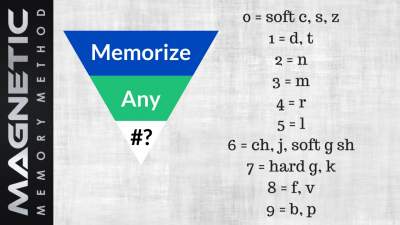
    1 = d, t

    2 = n

    3 = m

    4 = r

    5 = l

    6 = ch, j or sh

    7 = k

    8 = f or v

    9 = b or p

    In this way, I came up with Nun for 22, but perhaps you would prefer a piece of naan bread. Try to make sure that you have a vowel between the two consonants, but if that doesn’t work for you, a word like “onion” is also acceptable.

    It’s really up to you, but I suggest that you avoid abstract concepts like “noon.” If you want to use “noon,” make sure it is a clock with its hands pointed at noon, and maybe include Gary Cooper who starred in High Noon to make it even more concrete.

    Likewise with a word like “anon.” This word could make an excellent Magnetic Image for 22, but only if you make it concrete, such as by having James Woods with a particular book.

    Why James woods? Because he starred in My Name is Bill W. about the origins of Alcoholics Anonymous.

    I realize this specificity requires you to stretch your imagination, but its excellent brain exercise (better than any app) and is the secret of how to get a solid 00-99 working from the beginning. (Instead of having to fuss with it for years and potentially give up, as others sadly do.)

    How To Expand Your Major System Into A Full 00-99 List to Memorize Numbers

    To expand the rules that underly the phonetic Major System is easy. I suggest you take it 5-10 sets at a time.

    But first, get a Memory Journal so you have a place to chart down your ideas on paper.

    Overall, the best way to learn how to memorize numbers using this approach would go like this:

    1. Get a Memory Journal for completing the creative task

    2. On a new page, copy the start with 00 and write all the numbers up until 10.

    3. Starting with 00, think of words that begin and end with ‘S.’ I personally use Thomas Szasz, but many use Dr. Suess.

    Sissy Spacek would also work. Or a pair of eyeglasses built by Zeiss.

    Many other options are equally concrete. If you choose Zeus, use the character from Planet of the Apes or a clear painting or cartoon of Zeus so you’re not relying on a vague concept.

    4. Proceed to 01. For me, this is “sad,” and I see the tragedy mask worn by William Shatner in his performance of Oedipus Rex.

    5. Keep going for about 5-10 minutes and take a break. It’s important to relax and revive your creative muscles.

    How To Memorize Formulas For Physics & Chemistry That Involve Numbers

    If you want to expand your skills and start memorizing formulas, you’ll want to expand your systems.

    https://www.youtube.com/watch?v=uAkiuGEs0CU

    The five systems are:

    • Memory Palace
    • Alphabet list (you can use the pegword method)
    • Major System or Dominic System
    • Symbol system
    • Recall Rehearsal

    It might feel like a lot to cover, but most people can develop all of these systems over the course of a weekend.

    How To Memorize Numbers Encoded With Images In A Memory Palace

    First things first, you’ll need to know how to create a Magnetic Memory Palace. Here’s your ticket for that:
    Magnetic Memory Method Free Memory Improvement Course

    Next, start with your first Magnetic Station in the Memory Palace. If you used Dr. Suess, place him on the first Magnetic Station. If you used the sad tragedy mask for 01, place it on the next station.

    You can do this in small sets or get more ambitious and work on larger sets. The critical point is that you use Recall Rehearsal to get the images into long-term memory.

    For many people, this step will not be necessary because they can deduce like Sherlock Holmes what their images are by relying on the Major System.

    For example, I didn’t learn my 00-99 using a Memory Palace. I only needed to think about the Major for each digit and track back to the image I chose.

    The Major Mistake I Made When Creating My
    First Phonetic Mnemonic System

    When I created my first list for math based on the science of mnemonics, many of the images were not concrete enough.

    To this day, I keep strengthening them and find many opportunities to do so. For example, I use to have a very generic idea of “fire” for 84.

    But I later evolved this image to Chuck Norris in Missing in Action 2 with a flamethrower. I did not have to invent this image because there is a classic scene in the movie where he burns down a bridge with a flamethrower.

    And that is the beauty of using the Major System to memorize numbers. By letting its rules set you free, your imagination will come up with many powerful associations. It is also a great way to strengthen your ability to make associations if you need the developmental exercise. (Many people do.)

    Another mistake a made was that I didn’t quiz myself enough. But I now know a lot more about number memory tests and how to use them to stimulate my growth.

    Although straight up tests of raw digits is important, I also memorize historical dates for testing purposes. That way the information has meaning, which helps with giving context to numbers, a factor studies have shown stimulate better retention.

    How To Extend Your 00-99 to A Person Action Object System

    So far we’ve talked about giving each digit an image from 00-99.

    Many people like to have a triple-whammy effect by having at least three different elements going on for each digit.

    To be honest, I have never found this necessary or entirely useful in everyday life. However, in the world of memory competition, it is a must.

    That said, my own method of working often includes most of Person Action Object criteria.

    For example, the 01 tragedy mask is both a person and an object: It is the tragedy mask (the object) worn by William Shatner (the person). To add an action would be easy: he could be soaping it up with suds.

    Although I would be making a leap of the imagination by turning “suds” into a verb, this could work very well.

    To take another example, I have Jim Carrey with a lyre (stringed instrument) for 54. I could have him using it to “lure” something or someone to add an action, but I don’t need this specificity for my personal memory practice.

    The reason I don’t have a full PAO (sometimes falsely lumped in as a Mnemonic Peg System) for each digit is that I prefer flexibility. In real life, you do not have to beat the clock the same way you do in a memory competition.

    You are also using numbers you want to memorize for the long term, like banking info, phone numbers and passwords. These are not random digits heard or read at an event that you’re going to forget minutes after submitting your results.

    To that end, I prefer to choose how my Magnetic Images interact with each other on the fly.

    Obviously, this approach is different than the Dominic System (or Hotel Dominic) or the system Ben Pridmore uses, etc.

    And at the end of the day, that’s the incredible and mind-blowing truth:

    Tony Buzan was right:

    The rules will set you free. Especially if you follow his approach to mind mapping.

    Each person always uses these techniques individually. And although ultimately you must find your own path, you are free to do so by leaning on the classic techniques and paying attention to the Magnetic Memory Method principles of being specific and concrete. And of course there’s more to learn in How to Memorize Math, Numbers, Simple Arithmetic and Equations.

    And now that you know the options available to you, you can easily learn how to remember numbers quickly. Because…

    Using Mnemonics to Remember Numbers Is Easy And Fun!

    Now that you have these strategies, I suggest you listen to my interview with Brad Zupp. He explains his story and perspective from the realm of competition and practical use of these techniques as a mental passwords manager.

    How do these approaches to remembering numbers strike you?

    If you have any experiences you’d care to share or have any questions, post them below.

    You got this!


    How to Become Fluent in a Language: Everything You Need to Know Aug 13, 2024
    Show notes

    If you want to become conversationally fluent, you might wonder how many words and phrases you need to learn. You probably also want to know how long it’s going to take to tie enough threads of the language together to speak without hesitation. You also want the certainty that the language will in fact wind up deep down inside you and become part of your being. On this page, you’ll discover the best way to become fluent in a language — and how to define fluency in the first place. It’s not exactly what a lot of people think. In fact, when you define “fluency” in the best possible way, you can achieve goals in the languages you want to learn with incredible speed and efficiency. Why am I saying that becoming fluent is different than you might think? Well, I used to believe that learning a language would be impossible for a busy person like me. Especially since I was easily distracted and stressed at the time. But when I started my PhD at York University in Humanities, not having skills in at least one other language wasn’t an option. Later, when I taught at the University of Saarland in Germany, not knowing German wasn’t an option either. Then there was the time I needed to pick up Mandarin in a pinch in order to maximize a career opportunity. It’s on the basis of these successful experiences that I can tell you that fluency isn’t exactly what many people think it is. And I’m going to share with you each and every career-making tip and tactic I know on this page. https://www.youtube.com/watch?v=I2TOary2yQQ Here’s what this post will cover: What Does It Mean To Be Fluent? The 5 Stages of Language Fluency How To Become Fluent In A Language Fast: 8 Powerful Tips Becoming Conversationally Fluent Is Easy And Fun Let’s begin. What Does It Mean To Be Fluent? Let’s start our definition by ruling out what fluency isn’t. Fluency is not: Being 100% accurate every time you speak Knowing every single word in a language Mastering grammar Think about your own mother tongue. Do you say things 100% perfectly every time you speak? Of course not. We all stutter sometimes or forget simple words we’ve known our entire lives. Likewise, any honest person who looks through a dictionary will find hundreds of words they do not know in their mother tongue. As for grammar, I remember showing off in German to my friend Olly Richards in Berlin several years ago. When I asked someone I was speaking to if my grammar was correct, the native German speaker shrugged and looked at me as if I was insane for asking such a question. The point of this story about asking a native German speaker if my grammar was correct? Very few native speakers actually know much about their mother tongue. And that means in order to become proficient in a language, you don’t have to either. The 5 Stages of Language Fluency As you start learning a language, you’re going to go through phases or stages. These can be broken down into: 1. Zero knowledge of the language. You literally don’t know a thing. You might not even know what the language is called in the language you’re learning. (For example, German is called Deutsch.) 2. Basics of the language, like the alphabet. In different languages, you’ll face different demands depending on the character set and any symbols you need to learn. Obviously, Asian languages have bigger demands than Russian with Cyrillic, or you might lose a few letters when learning a language like Italian. 3. Starting to speak. In this stage, you will perhaps have a few words and phrases you can use. You may be practicing entirely on your own or with a teacher. 4. Reading, writing, speaking, and listening. In this stage, you’ll ramp up your efforts by using what is called The Levels Of Processing. You need to combine multiple forms of input and output in order to consolidate what you’re learning. 5. Flying solo. This is when you are able to hold conversations that flow — or at least accomplish goals. You’ll usually find this incredibly pleasurable, but all that matters is that you can understand and be understood pretty much on demand. You can start understanding interesting aspects of a language at all of these levels. You really don’t have to wait for the fifth stage to understand innuendo, for example. Even just knowing a bit about how certain letters are sounded can give you access to the psychological experience of the language. You can also work on your accuracy at each stage. In fact, you’ll want to keep coming back to hone the accuracy of each stage over time. For example, I’ve been studying Sanskrit for three years, and I still learn new things just about the alphabet. How To Become Fluent In A Language Fast: 8 Powerful Tips You came here to understand how to learn a language fluently, so let’s get into 8 things you can do to reach fluency fast. 1. Create a Vision Statement and a Learning Plan Realize that there are good rules of thumb but no one path that suits everyone. It’s important to accept this simple fact. Your journey will share some common characteristics with other learners, but ultimately it’s your path to follow. To ensure you have a path to follow, I suggest you write out a Vision Statement and craft a learning plan. https://www.youtube.com/watch?v=MFz31HpVkj0&t=2s For example, you can get a journal to document your journey and start on page one with a statement like this: I will be fluent enough in German in 90 days from now to hold my first conversation about my interests and future plans. Can you see how powerful this simple statement is? Instead of saying, “I want to learn German,” (or whatever language you’re learning) you now have a clear and crisp goal. It is concrete and specific. You can also develop a plan based on this goal thanks to its specificity. You know that you need to learn words and phrases around interests and plans. And specificity allows you to create highly targeted learning missions. To make yourself even more focused, I suggest writing out the exact times of day and locations you will study your language. For example, you can create a calendar in your journal and set mornings from 9 a.m. to 10 a.m. for learning. For more on strategy, see my list of language learning hacks. 2. Gather the Best Possible Learning Materials Using Limits A lot of language learners overwhelm themselves with too many study materials. In today’s world, it’s easy to make this mistake — it seems like every minute there’s a new book or course you can take. Instead, follow the advice my friend Olly Richards gave me years ago. Pick just: One language textbook (here are some of the best) One language course One language teacher In the beginning, you might not know which are the best for you, so be willing to experiment. Generally, your research will be worth every minute and there are lots of reviews you can read. Personally, I think Pimsleur audio programs are decent in the beginning for the course you choose. Audio courses allow you to learn while walking around. That said, there are benefits to watching video lessons and taking notes. A book should have a nice vocabulary list and sample conversations with full phrases. And a teacher should be responsive to your vision statement and your learning plan. Simple, right? It is, just so long as you don’t fall for “shiny new language resource” syndrome and abandon the resources you’ve already invested in. Be a completionist, limit your resources, focus your time and energy and you’ll be well rewarded. 3. Pick a Memorization Strategy When you’re just getting started, remembering new words is one of the most difficult challenges. You have to remember sound, meaning, spelling, and in some cases characters or new alphabets. Mnemonics are your best bet for moving quickly. These include: The Memory Palace technique Story and linking methods Pegword method To learn each of these in one swift course, please consider completing Memory Palace Mastery: That’s what Amanda Markham did. Then, in just 10 days, she memorized 200 words in her target language. You’ll also want to consider combining the Memory Palace technique with self-created flash cards. For example, these cards have linking associations and are themselves linked to a Memory Palace: 4. Book Sessions With Your Teacher In Advance As part of planning your personal learning sessions, it’s important to spend time with a native speaker. There are at least two ways to do this: With a paid teacher With a tandem partner Personally, I recommend you get a paid teacher. Sometimes you can find good tandem partners, but they always want at least half the time for their language. Plus, language enthusiasts are rarely trained teachers. That said, paid teachers are not without their pitfalls. This is why having your vision statement and specific goals laid out for them is a must. Otherwise, they will often take you in directions that will not get you to fluency under any definition. And the reason to book your sessions in advance is so you have them scheduled. When you have already paid and just need to show up, you’re much more likely to put in the time. For finding teachers, I recommend Languatalk. 5. Use This Tip With Native Speakers One of the best things you can do is book many sessions with a native speaker and sit with a magazine. Flip through the pages and simply ask, “What is that?” Repeat this question and record everything. I share a really fun and easy tool for doing this in this best language learning software article. When you get home or after you end the session, go through the recording and capture the words and phrases you want to commit to memory. Then use your favorite memory strategy to learn them permanently. When you next speak with your partner, make sure to repeat the new words you’ve learned. Don’t expect your teachers or speaking partners to always monitor this perfectly. Take charge to make sure that you are in alignment with your vision and goals. 6. Read Stories I first read Kafka and Brecht in German while in university, in 2001. I quickly learned the power of stories for picking up new vocabulary and phrases. Of course, Kafka was too complex. But Brecht plays can be watched on video with English subtitles, and this made audio exposure to the language a delight. You can also buy DVDs that have subtitles in the language you’re learning. Watching Hamlet with the German words on the screen was hugely beneficial for me. But don’t ignore old fashioned books. I suggest this Teach Yourself collection of stories for multiple languages as a wonderful source of graded reading material. Beelingua is an interesting app with multiple stories that you should consider as well. 7. Translate Articles Based On Your Interests My friend Luca Lampariello got me into the idea of translation for language learning — specifically based around topics you’re interested in and want to be able to talk about. I’ve done this quite a bit, and picking a book of interviews with my favorite German band was a great way to develop speaking powers with the kinds of Germans I hung around with most: musicians. Again, if you’re clear about your vision, it’s easier to think up missions like these and plan them out. To get started, try using Google translate to find some keywords. If you’re into classical music, for example, figure out how that is said in the language you’re learning. Then search Google for articles about that topic using the term you discovered. To translate, I suggest going word for word with a dictionary. Write out your translation by hand, which is known to help memory much more than typing. Pro tip: I recommend that you don’t spend too long on any translation effort in one sitting. 10-15 minutes will do. Always take note of especially interesting words and phrases so you can memorize them. 8. Reevaluate Your Vision Statement And Craft New Missions Thanks to the focus you’ve brought to the task of developing your fluency, you’ll have come a long way much faster than most who dabble in language learning. As you set new vision statements over the years, think about the kinds of missions and goals you can set that will give you a useful boost immediately. This part of the process is important because the further into the future you set the achievements, the more you invite delay and frustration. Be willing to break things down into smaller achievements. Even if the rewards are much smaller as a result, you’ll get more of them, more often. And always be realistic about how native speakers actually use the language you’re learning. Think more about the kinds of people you want to speak with and think about working on missions that reflect goals like: Improving accuracy in a regional dialect you live in or want to visit. Developing more vocabulary inside of a specific interest area (like art, science, or philosophy). Develop personal ways to develop your proficiency. Consider having your accuracy and proficiency tested by external tests (if relevant to your goals). Use these to craft your missions accordingly. In sum, we always want to create “Quick Victories” for ourselves. It’s not really about creating motivation. Rather, it’s about laying the neurochemical basis for learning consistently so we always keep going – almost on autopilot – even when we don’t feel like studying. (Which can and will happen to everyone.) Finally, add a bit of “Zen” to the process. By this suggestion, I mean let go of the outcome. A lot of learners chase away success because they cling to unrealistic goals or otherwise make a poorly conceived outcome a must. When you can relax and focus on having fun, learning a language is not only more fun and much easier, it also feels like it’s just happening naturally. As some people say, no one “learns” languages. They are only acquired. For that to happen, you just have to rig the game so you can. Mnemonics and other visualization strategies related to goal completion aren’t the only tools, but they certainly help. Becoming Conversationally Fluent Is Easy And Fun As you can tell, the exact definition of “fluency” is flexible. I suggest you mix things up by crafting your own personal standard and working towards at least one external evaluation. Whatever you do, please don’t confuse using apps as actual language learning practice. I haven’t included anything about them in this article because they’re not really how successful language learners operate. At most, they might use Anki or some related SRS program, but I have found in my many years of speaking with polyglots that it’s not the tool. Instead, it’s the strategic use of the tool in a context that gets you plenty of speaking practice with real humans that matters. When it comes to making sure you can speak with natives, one of the most powerful tools is the Memory Palace technique. It lets you rapidly pile up your arsenal of words and phrases. If you’re interested in learning more about how to use it for language learning, register for this free training series now. It will take you through the most effective and efficient way you can learn any language much faster. In fact, it will help you learn anything new. And all simply by playing a kind of game in your mind as you use a focused set of resources. It’s also the best tool I know of for rigging the game neurologically in your favor because of how it gives you those “quick victories” practically on demand. Plus, we have studies that show how powerful these techniques are for experiencing the brain-preserving benefits of bilingualism. And let me know: Which of these tips helped you the most? What language or languages are you learning at the moment?

    Full show notes at the publisher

    Aphantasia: How to Remember More Without Mental Pictures Aug 12, 2024
    Show notes

    Aphantasia. Sounds like a magic word a magician would say before conjuring a rabbit from his hat, doesn’t it? But let me ask you this: Can you visualize the magician pulling out the rabbit by his ears? For most of us, it will be easy to recall images inside our heads, using our mind’s eye. However, if you could NOT see any image in your mind’s eye – no colors, no sounds, no smells, no textures, no flavors, nothing at all – you may have a condition called aphantasia or a blind mental eye. Don’t freak out, though. Many people have aphantasia, even magicians. Familiar with Penn Jillette (of Penn and Teller fame)? He is a famous magician and entertainer, and, he is an aphantasic(!). This was according to his own words on his Sunday School podcast, Episode 174. By his own admission, Penn says he cannot conjure a mental image of a person or a place to save his life. Back when I was in university, both as a student and later as a professor at 3 different universities, I also couldn’t “see” images in my mind. But after learning what you’re about to discover on this page, everything changed for me. What Is Aphantasia? A Detailed Definition The term ‘aphantasia’ comes from the Greek words a, meaning “without”, and phantasia, meaning “a capacity to form mental images”. The phenomenon was first described by the controversial psychologist Francis Galton – one of the pioneers of eugenics – in 1880. The interest in the phenomenon was renewed after the publication of a study conducted by a team led by Dr. Adam Zeman, a professor of cognitive and behavioral neurology, at the University of Exeter. Zeman’s team published a paper in 2015 on what they termed “congenital aphantasia”, now known simply as aphantasia. For Firefox co-creator Blake Ross it was a surprise revelation that other people could visualize things in the mind’s eye while he couldn’t. “I can’t ‘see’ my father’s face or a bouncing blue ball, my childhood bedroom or the run I went on ten minutes ago,” he wrote in a Facebook post. According to Craig Venter, the biologist who created the first synthetic organism: “It’s like having a computer store the information, but you don’t have a screen attached to the computer.” One of the main scientists researching aphantasia is Adam Zeman. He simply calls it living without imagery. When I was a kid, they told me I had something quite similar. But back then my teachers called it “Imagination Deficit Disorder.” But are these really the best possible terms and definitions for aphantasia? And what about the mental imagery you experience when you dream? Can You Dream With Aphantasia? It depends on what you mean by “dreaming”. For example, I just told you about Gerrard. He’s never seen Mt. Everest, and yet he’s climbed it. He had to have a dream to do it. Some people with this condition do report that they dream. Others say they don’t. But even people without this condition also report they don’t recall their dreams. The only way to really know is take it case by case and visit a dream lab. Personally, I dream very vividly, but not particularly visually. I never see faces when I dream, for example. Strangely, I tend not to see technology either, such as cellphones or computers. I know this because I have journaled my dreams for many years. I made them more “visual” over time by placing them in writing so I could cross-index the dreams, chart patterns and observe the workings of this mind at rest. What About Lucid Dreaming with Aphantasia? Some people with aphantasia also report that they can lucid dream. I’ve had similar experiences, and the sensations all culminate as physical, rarely visual. For example, when I go lucid, I often find myself piloting a spacecraft, balancing on a tight wire or even levitating as I write in my dream journal. And my regular experience of finding myself journaling when I go lucid suggests a trick you can use: By keeping a journal consistently, you’re likely to start dreaming about it. When it appears in your dreams, you may become aware that you’re dreaming. It’s quite wild! Also, you can think verbally throughout the day about your dreams. You don’t have to approach them from a visual angle at all in order to explore the wonderful world of dreaming as an aphantasic. The Role of Daydreaming Then there’s the question of daydreaming. I often think conceptually when daydreaming, and have also wondered about my ability to read fast and retain what I’m reading. Could it be that the kind of reading-assisted “daydreams” I experience while going through novels without visualizing saves mental energy? One point to consider is raised by Stephen King in On Writing: A Memoir of the Craft. He basically says that he stopped putting much time into visually describing characters because his readers weren’t following his instructions anyway. I think this point provides a major clue. Because I couldn’t visualize the characters at all, my brain just skips over those parts of the story. Possibly to save energy, but the larger point is that all kinds of readers engage books on their own terms. When King learned that about his audience, he himself started focusing differently on the construction of the daydreams he shares through the creation of fiction. How Common Is Aphantasia? How many people have aphantasia? While research on the subject is still in its nascent stages, neurologists believe approximately one in 50 people or 2-5% of the population are non-visual-imagers. Sounds like a big number? Don’t be surprised. Being an aphantasic is nearly as common as having a food allergy. Neuroimaging has shown something surprising. Mental imagery, although strongly associated with the left temporal lobe, requires the use of large networks of brain pathways. This finding suggests that aphantasia could potentially occur in different ways in different individuals. It also suggests that there is likely an aphantasia cure, or at least a path to developing partial imagery. The Three Likely Causes Of Aphantasia However, the exact cause of aphantasia is still unknown. Even an exact definition remains elusive. Nonetheless, according to Dr. Zeman, heredity and environment both are likely to be relevant causes. Zeman has also speculated that aphantasia could result from brain lesions as well. Tther suggestions that have been floated around include: Congenital causes Environmental influences Brain lesions (especially in the hippocampus) Neurological differences Traumatic brain injury Stroke Psychological trauma Neurodegenerative disease Medication side-effects Different types of thinking Interestingly, an aphantasic may have strong visual memory. They may be able to describe in detail about how things looked – the cat had blue eyes, the umbrella was pink and matched the skirt – even though they cannot see these visual images in their mind’s eye. Moreover, many people who cannot form mental images can think in sounds, while others can remember physical sensations. Penn says, when he dreams, he’s not sure if he sees visual images but has the sensation of knowing that “ideas wash over me”. How Aphantasia Affects Memory Our brain stores information in at least two different ways: verbally and visually. Both these types of storage are independent of one another, and each can be used alone. Therefore, even people with aphantasia can complete the “tests of visual imagery” without too much difficulty. They can also often (but not always) complete these non-visual sensory memory exercises. Here’s a quick test: Count the number of windows in your house. [clickToTweet tweet=”Quick #memory improvement exercise: Mentally count all the windows in your home.” quote=”Quick #memory improvement exercise: Mentally count all the windows in your home.” theme=”style6″] Even if you can’t see a “mental” image of your house and locate each window in that image, you would have an awareness of being there and recall from factual information the number of windows in your house. While aphantasics can remember things from their past, they experience these memories in a different way than someone with strong imagery. They often describe memories as a conceptual list of things that occurred rather than a video playing in their mind. As Ross says, he can ruminate on the “concept” of a beach, but cannot flash to beaches he has visited. “I know there’s sand. I know there’s water. I know there’s a sun, maybe a lifeguard. I know facts about beaches. I know a beach when I see it, and I can do verbal gymnastics with the word itself…But I have no visual, audio, emotional or otherwise sensory experience.” The brain has many unique ways of storing visual information than just as a picture. Here’s your key takeaway: Even without mental imagery, you can remember and reason just as effectively by using verbal, spatial, and conceptual cues. Multiple Ways To Create Visual Imagery In Your Mind Neuroscientists believe that the brain constructs visual imagery in more than one way. There are separate circuits for things like shape, size, color and spatial relationships, and when these are accessed together, we form an image of a memory. As AphantasiaMeow and I suggest in these videos, it might have to do with how the brains of some people develop: https://www.youtube.com/watch?v=LA0ZUj7Wtmc&lc https://www.youtube.com/watch?v=k0F9gOgGOqc There are still a lot of unknowns, that’s for sure. But it’s great that someone is doing such good work to help people create a mind’s eye. Back to the source of the problem: Experts think that aphantasics piggyback on neurons involved in controlling physical movements rather than using the visual brain circuitry to “visualize” or recall information. For instance, you can trace the letter B of the alphabet in your brain to know it has curves or you can use your mind’s eye to see its image. Does Aphantasia Hamper “Visualization” Memory Techniques? Not in the least. Tansel Ali and I talked about your multiple options in a recent interview. And I have written at length about how easy it is to use the Memory Palace technique without visualization. In sum: Memory techniques involve more tools than just visualization. You have many options, including not visualizing at all. [clickToTweet tweet=”Memory techniques involve more tools than just visualization. You have many #mnemonic options.” quote=”Memory techniques involve more tools than just visualization. You have many #mnemonic options.” theme=”style6″] When you use a memory technique like the Memory Palace use all the Magnetic Modes, you can memorize a very large amount of information relatively quickly without necessarily seeing the Memory Palace in your mind. Here’s an infographic that tells you all about the different ways that your brain perceives information: Personally, I don’t have aphantasia. However, I am low on the visual threshold. As a result, it took me a long time to understand techniques like mind mapping, let alone developing mind map mastery (which is still a work in progress, to be honest). Most of what I do in the world of memory techniques involves thinking about strange combinations of images in words and sounds, not high-definition imagery. I would call this being audio-conceptual. So, if you are worried that the inability to see visual images in your mind will stop you from using the Memory Palace technique… Don’t be. Just follow the steps I teach in this complete guide to using the Memory Palace technique. Over the years, I’ve invested in myself so that I can “see” something like visuals in my mind. But even to this day, the best results I get from memory techniques don’t require constant streaming of high-definition images in my head. I’m not trying to develop eidetic memory, after all. I just want to remember more. Here’s my discussion on this issue: https://youtu.be/2l1DJXZyHmM In any case, if you want to visualize bright, vivid pictures in your mind’s eye, you can try image streaming. Image Streaming Vs. Aphantasia? Image streaming is a simple process that enables you to open up your mind’s eye to visuals. Here’s how it works: Close your eyes and describe what you see. If you don’t see anything (which would exactly be the case if you have aphantasia) help your brain start seeing visual images. Start by gently rubbing your closed eyes like a sleepy child. Then describe the bright sparkly light that you see behind your closed retina. Or look at a bright light like a candle for a half minute, or a window which has strong light/dark contrast. Then when you close your eyes, you should be able to see after-images, like a blob of light or color, at back of the eye. Describe that blob of light. You can also describe a memory that you cannot “see” but remember from the past. The important thing is to use all senses to describe your blob of light or memory: sight (vision), hearing (audition), taste (gustation), smell (olfaction), and touch (somatosensation). While you are examining and describing your after-images or visual memory events, keep a look out for experiencing some other kinds of image. It could be a momentary face, landscape, or whatever. Notice when this happens, and switch to describing that new image. Remember to describe all images to an external focus – quickly and loudly. The external focus can be a friend or a dictaphone (voice recorder), anything or anyone you can talk to. Practice image streaming for only 10-20 minutes a day to enable your mind’s eye to see pictures. Then move on and try these multi-sensory brain exercises. Frequently Asked Questions About Aphantasia and Memory I’ve received hundreds of questions about aphantasia over the fifteen years I’ve been publishing books and courses about memory improvement. This livestream about aphantasia and and memory I held on YouTube has hundreds of comments as well. For your convenience, let me condense the most common questions and answers for you to read at a glance. Can people with aphantasia visualize anything at all? Some people report that they experience faint outlines, colors or concepts of images without seeing them vividly. I’ve sometimes experienced what I describe as “ghostly outlines.” But mostly, when I close my eyes, I only see darkness. Does aphantasia affect memory or intelligence? No. In fact, many people who report this condition can reason and remember even better than those with exceptionally strong visual imagination skills. The point to understand is that some kind of mental representation is taking place. Learn to use how your mind already works well and soon you’ll find ways to expand your intelligence almost naturally. And if you want to improve your recall specifically, make a complete study of mnemonics. Check out my guide on mnemonic images for the full rundown. Can you cure or reverse aphantasia? I believe the first step is to stop approaching aphantasia as either a “condition” or a “problem.” Focus instead on expanding your awareness of how mental imagery is defined. Most people don’t practice thinking enough, and for that journaling is key. Can people with aphantasia still use the Memory Palace technique? Absolutely. Memory competitor Lynne Kelly identifies as someone with aphantasia and has established impressive records for herself. But you should also know that power-users of Memory Palaces like the USA memory champions Nelson Dellis and John Graham have both remarked that they simply don’t have time to visualize during competition. Yet, they still use Memory Palaces? The takeaway? If some of the most accomplished memory champions use Memory Palaces without visualizing them, so can you. How do artists or writers with aphantasia create visual work? I love this question because for years I believed I could not draw. Then I took a Riven Phoenix course where he talks about memorizing the formulas used by Da Vinci. Although I didn’t take my drawing skills very far, I did improve simply by memorizing the words of the formulas in Phoenix’s course. I recently did the same b…

    Full show notes at the publisher

    Reflective Thinking: 5 Powerful Strategies For Improving Your Life Aug 12, 2024
    Show notes

    Reflective thinking provides one of the fastest paths to living a better life. I saw the power of it year after year while serving as a professor at three universities around the world. No kidding: The students who were reflective thinkers constantly came up with resources that helped them navigate life’s challenges – not just the assignments they faced in school. People who aren’t reflective thinkers? They remain blind to the resources right in front of their eyes. Even better, the substantial improvements you can expect when you practice reflective thinking often include: Improved memory Optimized decision making Reduced stress Better relationships Superior reasoning skills So if you’d like a reflective thinking model you can add to your life, stick around. I’ve been practicing reflective thinking since I was a teenager and this post is for you. What is Reflective Thinking? I first came across this form of mental exercise when I read Albert Camus’ The Stranger in high school. It was the first time I realized it was possible to lead an interesting life, one much more exciting than the dreadful future I felt I was facing at the time. Camus was an existentialist, which essentially boils down to using “radical honesty” and accepting the limits imposed upon our lives. To achieve radical honesty, you start by reflecting on the human condition for what it is, not what you want it to be. As challenging as this form of reflection can be, shortly after I discovered this way of looking at the world, I realized that reflective thinking is a tradition. It goes back much further than the Ancient Greeks, for example. But Socrates remains a famous figure when it comes to this type of thinking. He said three highly memorable things that demonstrate reflective thinking in action: “The unexamined life is not worth living.” “I know that I know nothing.” “Look at how many things there are which I don’t want.” In each of these examples, Socrates is turning the lens upon his experience of consciousness. He is looking at both the bigger picture of life and demonstrating something even more critical: He is showing that self-examination by being a reflective thinker gives life more value He recognizes the limits of his knowledge (like an existentialist) He divides his quality of mind from external, material objects in the world By examining these statements and what they mean, we can develop a working definition of reflective thinking. It is a form of self analysis that creates a more valuable experience of consciousness by revealing what is truly important in life. Its main requirement is radical honesty so that you avoid self deception. Major Philosophers And Psychologists Who Used Critical Thinking And Reflection The psychologist Albert Ellis remarked that he never would have discovered the processes that ultimately led to cognitive behavioral therapy (CBT) if “I had not been strongly influenced by philosophers rather than psychotherapists.” (You can find this quote in the Albert Ellis Reader.) Ellis’ reflection is an important observation (and example of self-reflection) because philosophers were doing the work of psychologists long before Sigmund Freud arrived on the scene. Albert Ellis was influenced more by philosophers than his fellow psychologists when working on a form of reflective thinking to help people lead better lives. In fact, in the Minutes of the Vienna Psychoanalytic Society (the session of 28 October 1908), Freud remarked that he found reading Nietzsche challenging to his sense of self-importance. He observed that Nietzsche had already covered the core ideas of psychoanalysis and could barely get through half a page without encountering insights Freud thought he’d discovered on his own. There are many examples in Nietzsche to consider, but one of the strongest takes place at the end of Beyond Good and Evil. In the closing passage, he demonstrates reflective thinking by directing radically honest questions at this own career: Did I seek where the wind bites keenest, learn to live where no one lives, in the desert where only the polar bear lives, unlearn to pray and curse, unlearn man and god, become a ghost flitting across the glaciers? This passage is highly poetic, but read in context, Nietzsche is essentially asking: Did I try hard enough? Both Sigmund Freud and Friedrich Nietzsche were hugely influential on the development of reflective thinking. When applied to both our personal lives and our careers, this is one of the hardest questions we can ask ourselves. Yet, the benefits of taking on the rigors of this form of thinking are clear: Only by asking such hard questions can we identify our weaknesses and find the path to personal growth. Other philosophers and psychologists with a particular focus on thinking reflectively include: Voltaire Spinoza Leibniz (especially viewpoint dependency) Giordano Bruno Carl Jung Robert Langs How to Think Reflectively In 5 Simple Steps Albert Ellis gives one of the finest reflective thinking models around: A.B.C. A = Adversity B = Beliefs C = Consequences Of course, not everything comes down to problems like adversity. You can think reflectively about positive things too, such as when you enjoy a painting or film. But usually we find ourselves reflecting when we need to solve problems and gain mental strength. So let’s focus on how we can reduce adversity in our lives by analysing our beliefs and the consequences we create. One: Identify Specific Thinking Goals For Your Reflective Thinking Sessions As I just mentioned, reflective thinking doesn’t necessarily entail problem solving. When you want to improve your ability to reflect, start with the end. For example, you might want to: Improve your objective reasoning skills Practice positive visualization using aspects of your personal history Learn to think more logically Develop the ability to think faster When you know what you want out of thinking reflectively, you’ll get more out of the process. This was essentially John Dewey’s message in his book, How We Think (1910). In it, Dewey points out that, “Each phase [of reflective thinking] is a step from something to something,” and describes the process as a chain of consequences. Like Ellis, Dewey stresses the role of belief. But it can be abstract trying to figure out in both Ellis and Dewy how to find out where your beliefs are holding you back. That’s why a program like Self Authoring can be tremendously helpful. I describe an even more robust model you can try in The Victorious Mind: How to Master Memory, Meditation and Mental Well-Being. Once you have a specific goal in mind, you can “stress-test” it using mind mapping. This activity can help make your thought process more visual and actionable. Of course, a subset of setting goals for your thinking sessions is to also set aside the time for them. After all, a goal without a schedule is not really a goal at all. Two: Practice Self Inquiry We know that Socrates favored the examined life. But how exactly do you exam life? The answer is delightfully simple: Ask yourself questions. What kind of questions? Well, it turns out that there is a process known as “self inquiry.” It is thousands of years old and part of philosophical traditions like Advaita Vedanta and Zen. My two favorite questions are: How do my thoughts behave? Are they useful? Why do these two questions work? https://www.youtube.com/watch?v=kvtYjdriSpM Such self inquiry questions essentially cause you to pay attention to your experience of consciousness itself. In other words, you start to reflect on the experience of having a mind. Other reflective thinking examples you can experience come from related questions in Gary Weber’s Evolving Beyond Thought: How real are my thoughts? Do my thoughts have value? Where does the sense of “real” and “unreal” come from? Where do my biases come from? What is my nature? Some of these self inquiry questions are very challenging. I have found taking on the challenge incredibly valuable as I become a better thinker. The best part? These questions are portable. No matter what situation you’re in, you can ask them and find your way back to a neutral state, often within seconds. As a person given to mental turbulence, I’ve come to call this neutral state, cruising altitude. This process is not merely a spiritual or psychological pursuit. As Mekada Julia Graham shows in her book, Reflective Thinking in Social Work, “we are always composing and revising our autobiographies as we go along.” Without inquiry, we miss the changes as they are taking place, and because many people do not use self-inquiry practices, they wind up wondering how on earth they wound up in their present position in life. Self-inquiry helps you see the broader picture both as it unfolds and as you are experiencing change in the present moment. These self-inquiry techniques also help you resolve issues like free will and the current revelations in science that there is no such substantial thing as having a “self.” Although that idea sounds crazy, rest assured, As neuroscientists like Sam Harris have often pointed out, no research has yet discovered where the “self” exists in the brain. Self-inquiry can help confirm that any self you do have is constantly changing, just one more reason why reflective thinking is so powerful. Three: Focus On The Right Problems Albert Ellis pointed out that people often focus on their “primary disturbances.” He suggested focusing on the “secondary disturbances” instead. For example, many people with PTSD will focus on a scene of trauma. But since they cannot change the past, the real problem is the “secondary disturbance” caused by experiencing the memory. To solve the problem, they need to focus on “the disturbance of being disturbed.” This way of thinking about it can feel counterintuitive, but once you start practicing thinking in this way, you’ll find great mental relief a lot faster. Four: Be A Realist Psychologist William James pointed out in Radical Empiricism that we often experience humiliation in the pursuit of goals, but not from failure. Instead, we experience disappointment of how the journey for success played out. This point brings us back to existentialism and radical honesty. A lot of people can use their minds to visualize success clearly. But because they are not realistic about either their goals or the journey they’ll have to take to get there, they suffer. A realist, on the other hand, reflects deeply about what success really is and what it really takes to get it. And because hard work is always involved in achieving anything worth having, a realist can let go of the outcome and enjoy the journey. Thinking well leads to many wins in life. Working this way creates a win-win because when you reflect back on the time you spend in moving toward your goals, your memories of the pursuit will not be disappointing at all. So how do you become a realist? Practice observational learning. You can do this by learning to understand the difference between descriptive thoughts and judgmental thoughts. For example, in the book, Promoting Reflective Thinking in Teachers : 50 Action Strategies, Germaine Taggart and Alfred Wilson explain that we can better express our views when we separate description from judgment. One of their powerful suggested exercises involves finding a memory about a dramatic event. Write about the event two times. The first time, talk about how you felt and the second time, describe the event in neutral terms. Focus literally just on the facts. They give this short example: Judgmental: The child responded well to questioning. Descriptive: The child responded correctly to five out of six questions. As you can see, the descriptive version gives a much more accurate picture of what actually happened in the situation. Five: Focus Your Reflections On Others So far, we’ve talked a lot about focusing on yourself as an individual. There’s nothing wrong with that. However, we’ve also noted William James’ warning that dissatisfaction comes more from the journey toward goals than failing to reach them. Another key strategy for getting more out of the journey is to make sure that you are focused on others in your thinking. By doing so, you can potentially experience Abraham Maslow’s concept of self-transcendence. As you may know, Maslow talked about the suffering we experience when we are not able to actualize ourselves. As Maslow says about the experience of someone capable of self-actualization: “He is more able to fuse with the world, with what was formerly not-self, for example, the lovers come closer to forming a unit rather than two people, the I-Thou monism becomes more possible, the creator becomes one with his work being created, the mother feels one with her child.” It is possible to establish and maintain a state of flow, like waves in the ocean. Essentially, Maslow is talking about the state of flow, or the feeling of oneness, rather than separation. But to really feel fulfilled, we need to transcend the notion that there is a “self” at all. Self inquiry is essentially designed to help you experience that, and it can be tough. But rest assured, As neuroscientists like Sam Harris have often pointed out, no research has yet discovered where the “self” exists in the brain. So how do we get into a state of flow that helps us transcend? A Powerful Reflection Exercise For Creating Flow Seating on the floor or a chair, close your eyes. Starting with the first letter of the alphabet, bring a person you know to mind. For A, you might think of Amy. (If you can’t arrive at someone for any individual letter, just skip ahead. Do the best you can.) Reflecting on what you can do for others is very freeing. Think about something you could do for that person. It doesn’t have to be monumental. The point of the exercise is to start reflecting on your ability to give. By the time you’ve gone through the entire alphabet, you should be able to create a quick plan and then execute on it. Soon, you’ll start to feel amazing as you transcend your notion of the self. Other Reflective Thinking Examples To Boost Your Progress As you experience deeper reflective thoughts through the steps outlined above, here are some more activities you can explore. Take everything one step at a time. Learning better thinking processes is a marathon, not a race. Study Word Meanings One problem we see in the world today is a lack of linguistic skills. People understand their own language with less dexterity than ever before. As a result, they fail to benefit from critical thinking that would otherwise benefit their lives. But when you know what words mean and a little about their history, your thinking power goes way up. Learning word origins can reduce your suffering by contextualizing it. We’ve talked a lot about suffering on this page. And it’s a perfect example of how to reflect differently by looking at words. “Suffer” has the Latin word “ferre” in it, for example. This is the English word for “ferry.” This suggests to us that our ancestors thought that pain had two aspects to it. The pain itself, and having to carry, or “ferry” that pain from one place to another. (If you haven’t already, please think back to Ellis and the primary and secondary causes of suffering he identified.) To give you another example, notice that the word “accept” has the Latin “capere” in it. This means “to take.” Using our reflective thinking abilities, we can notice that suffering might be part of the world. But our ancestors did not include tolerance or resignation in the word “accept.” When you see that the word “ferry” is literally in the word “suffer,” you can think differently about it – without necessarily accepting that you have to suffer. In other words, although we might have to “accept” suffering, we don’t have to be resigned to “ferrying” it everywhere we go. We can seek relief even as we take on the pain. We can respond actively instead…

    Full show notes at the publisher

    Memory Recall and Retrieval: The Definitive Guide Aug 12, 2024
    Show notes

    memory recall and retrieval feature imageMemory recall, sometimes incorrectly called retrieval, is the experience of remembering information.


    Here’s the catch I’ve noticed after more than a decade serving the public as a memory expert with one of the most watched TEDx Talks on memory issues:

    Proper recall can only happen after at least these other levels of memory have succeeded first:

    • Noticing and recognizing the importance of information (like someone’s name)
    • Encoding (making an effort to remember)
    • Decoding (making an effort to recall)

    Only after these stages have succeeded do you have memory recall.

    And now you know one of the major reasons we forget: Something has interrupted the retrieval and recall process.

    The good news?

    We can improve.

    We just need to know more about how our memory works, so let’s dive in.

    Recall Vs. Retrieval: What’s the Difference?

    In brief, “retrieval” refers to the general process of how your brain interacts with your mind to access information you’ve stored in memory.

    Recall, on the other hand, refers to a specific type of retrieval. It often involves:

    • A conscious request to remember something, such as in a conversation or when completing a test.
    • The use of cues, such as when something in the environment “triggers” a memory.
    • Effort, like when you deliberately try to remember an important detail.

    Understanding the difference between retrieval as a whole and recall is useful in memory science because it helps with making accurate cognitive assessments.

    I find the distinction helpful in my teaching as well because it helps me figure out what kinds of memory problems various people are actually facing. Often people looking for help simply say that they’re having issues in a general way. Thanks to these distinctions, it’s easier and faster to give memory training recommendations that are likely to work.

    The distinction has also been useful in court. As this research paper demonstrates, how and when people involved in accidents or criminal cases recall case details can create distortions. Elizabeth Loftus is one of the most important researchers in this area and papers like this provide a great way to learn more about recall and retrieval in real world situations.

    The 3 Forms of Memory Retrieval

    The challenge of learning about recall is that it’s not just one thing. Memory retrieval happens in several different ways that are related to other stages of memory, but are ultimately different.

    These forms are:

    • Free recall
    • Cued recall
    • Serial recall

    Free recall allows you to retrieve information in any order. For example, if you watch a movie, you can tell your friend about the middle first, then the end before talking about the beginning. You’ve remembered enough to narrow in on different elements without getting confused or forgetting.

    Cued recall, on the other hand, involves triggers. Here’s an easy way to think of this kind of retrieval:

    a metal chain
    Certain forms or recall can be compared to a chain or set of linking structures.

    When memory athletes memorize lists of words, they use their memory skills to combine elaborated associations so that one mnemonic triggers the target information in a chain.

    When I did my memory drills this morning, for example, three of the words were blizzard, tea and piano. Tea and piano were easy to recall because I saw Ozzy Osbourne in a blizzard pouring warm tea on his piano. One image “cued” the recall of the others.

    Note: Cued recall itself helped me associate Ozzy with the word “blizzard” because he recorded a 1981 album called Blizzard of Oz. When you create all your associations based on links that already exist in your memory, you can remember things a lot faster.

    This kind of recall happens in everyday life too, even if you’re not a memory athlete.

    For example, if you’re trying to remember the name of an actor, thinking about movies he’s been in can help trigger the name.

    Serial recall involves recalling information in temporal order. It relates to episodic memory in some circumstances. Think of it as when you’re relating a series of events and talking in a “and then this happened” kind of pattern.

    Does your mind really use just one of these kinds of recall at a time? Sometimes yes, sometimes no.

    video camera
    Recall is definitely not like replaying a movie. It’s more like assembling actors on a stage.

    For example, you might have started giving details from the beginning of a story using free recall but realize your friend isn’t following the plot.

    Your serial recall kicks in and that’s when you say, “let me start at the beginning.”

    As you relate the plot of the movie, cued recall will likely help you add in nuance and detail that you would have forgotten otherwise.

    What Is Recall Memory?

    One thing that defines memory above all is that it is always dealing with the past. Think about it:

    Let’s say that you imagine a future scenario, like taking a trip.

    Later, when you want to plan the trip, you are recalling that vision of the future up from the past.

    So whether you’re speaking a language to become fluent or sitting for an exam, improving memory recall involves improving how you access the past.

    Recall vs Recognition

    Of course, you will have differences depending on the circumstances. For example, you might struggle in an exam because you cannot recognize several key terms.

    a woman is struggling in an exam

    Or, you could have an advantage because your recognition of some terms help trigger cued recall.

    Complex stuff, isn’t it? Well, the devil is always in the details, which is why it pays to learn how to study effectively. You don’t have to memorize everything in order for recognition to help you recall the information you need.

    The 4 Types of Memory Recall

    The plot thickens!

    The four kinds of memory recall are useful to know about because the brain encodes information in very specific ways.

    Did you know that your emotional state dictates how you encode memories? This is just one reason why certain types of memory training can help relieve conditions like PTSD.

    Let’s dig a little deeper into:

    • Recall
    • Recognition
    • Recollection
    • Relearning
    friends are hanging out together
    It’s possible to suddenly recall things without a trigger. For example, a memory of hanging out with your friends can arise for no reason.

    Recall happens when you remember something without a cue or trigger.

    For example, sometimes you just think about a friend out of the blue. The friend isn’t there, and yet somehow the brain has pulled out memories about her.

    The Role of Questions In Remembering

    Answering questions relates here as well. If you’re at an interview, you can only prepare so much. You’ll get questions you aren’t expecting, and yet you’ll find that you can remember certain facts without needing a trigger.

    Recognition is when you know you’ve seen something before. You might not even remember that you’ve seen it before, but you still recognize it. Take the word “tiger,” for example. You probably don’t remember the first time you learned it, but you recognize it for what it is (a word) and the animal it refers to.

    The opposite of recognition is sometimes called Jamais vu and can be deeply disturbing. Normally, however, recognition is positive and useful.

    Recollection usually involves piecing things together using logic or objective reasoning. When you’re trying to recall information, you can deliberately follow a trail of information by leaping from one association to another.

    Relearning is required when we forget things we’ve spent time learning. For example, you might have gone through great efforts to memorize vocabulary, but still can’t remember it.

    To establish this form of recall and make learning much more fun, repetition might not be the answer. You might need to try a different approach, such as the Memory Palace technique.

    How These Memory Processes Work Together

    If your brain is reasonably healthy, I have very good news for you:

    Most of what you need for long term memory recall happens in the background.

    Not for all information, of course. But improving memory recall, especially for long-term retention, is why memory training was invented by our clever ancestors. When you want to be sure you can recall something, mnemonic devices and mnemonic strategies are a must.

    But there are aspects of life that can interfere even with the best memory training efforts. These include:

    • Alzheimer’s Disease and Dementia
    • Lack of exercise
    • Poor nutrition
    • Dehydration
    • Lack of sleep

    If you have concerns, it’s always a best practice to consult a qualified medical professional.

    How to Improve Long Term Memory Recall

    I’m glad you asked, because helping you improve your memory is my passion.

    First, I would suggest that you pick a technique and practice it for at least 90 days. You can choose:

    • The Memory Palace technique
    • The Roman Room technique
    • The link and story methods
    • Major System
    • Pegword Method
    a man climbs a wall
    Like any skill, consistent practice is needed to develop the foundations and improve over time.

    As you practice, have a goal.

    Generic memory improvement is possible, but you can really accelerate the process by picking specific information to memorize. Here are some suggestions with training tips:

    • Memorize vocabulary
    • Memorize scripture
    • Memorize a speech
    • Memorize a song
    • Memorize a textbook

    For best results, I suggest that you add daily meditation. I teach a simple process in my book available through Amazon called The Victorious Mind: How to Master Memory, Meditation and Mental Well-Being.

    How Do We Recall Memories On Demand?

    In a phrase:

    Study your memory and practice the best techniques.

    the science of memory

    The more you learn about the science of memory, the more it will inform your practice.

    And simply accept this simple fact:

    Apart from certain situations with disease or brain trauma, retrieval failure is almost always a choice.

    But now you are informed and know how to retrieve memory on demand. And if you need more help, just sign up for this free course now:

    Free Memory Improvement Course

    Which of the practices I suggested on this page are you going to try first?


    How To Strengthen Memory In 7 Unusual But Effective Steps Aug 12, 2024
    Show notes

    a brain exuding memory power for strengthen memory feature imageThe classic way to strengthen memory involves cleaning up your act in ways you’ve heard a thousand times before.

    Most articles talk about nutrition and memory, sleep and fitness.

    Maybe they’ve even got ads for some dodgy memory supplements alongside a few tips they never completely explain.

    That’s not what you’re going to find here.

    As the author of multiple bestselling books on using memory techniques, I can tell you that diet, sleep and fitness are important.

    But that’s not the message that helped me memorize the TEDx Talk that reached millions of people.

    No, the truth is that strengthening memory requires actually using it, the same way building muscles involves lifting heavy things.

    As in weight training, however, there are optimal ways to put in your reps.

    So on this page, I’m going to show you the best ways to give your memory a workout that will actually improve its strength in measurable ways.

    Ready?

    Let’s dive in!

    Strengthen Your Memory By Following These 7 Unusual Steps

    I’m calling the training on this page “unusual” for a few reasons.

    First, I’m going to connect you with a lot of free training from across this blog. You’ll literally need nothing else, unless you want to gather up some of the best Memory Palace books and memory improvement courses I might mention.

    Getting into those kinds of advanced memory techniques is well worth the investment.

    But in reality, you need to commit first.

    And as we all know, commitment is quite rare in our world. In fact, even decision making itself has been shown in this study to already require good memory.

    With that in mind, take this list of suggestions as a whole. There’s no particular order of importance. Each and every step matters, especially if you struggle with making commitments and sticking with them.

    One: Start Using Mnemonics

    No matter how strong your memory is right now, it can be stronger.

    And one of the best things you can do is understand that memory science completely validates the effectiveness of using both ancient memory techniques and modern variations.

    The exact techniques to start with require a bit of personal exploration. After decades of teaching memory, I suggest you start learning and using them in this order:

    • The Memory Palace Technique
    • The Pegword Method
    • The Major System for memorizing numbers
    • Spaced Repetition

    Although that might seem like a lot of ground to cover, many of my students in the Magnetic Memory Method Masterclass pick all of these skills up in a weekend or two.

    The reason why these mnemonic strategies work so well in combination is that they’re mentally stimulating and give your brain a great workout. You also get great visualization exercise.Woman holding phone. In a crisis, it's good to memorize important phone numbers.

    Two: Reduce Any Apps That Might Be Causing Deskilling

    When I first started this blog, people weren’t sure that smart phone addiction was really damaging memory.

    These days, the problem is known and has a name: Digital Amnesia.

    Not only that, but researchers have found that social media use is leading many of us into poor health.

    Sure, it’s still a good idea to eat foods that improve memory. But you still need to stop deskilling your brain.

    I’m not saying that anyone should stop using computers. Rather, choose to use your natural memory at least half the time.

    Use journaling to actually dig up some of your autobiographical and episodic memories so these types of memory get a little exercise on a daily basis.

    That way, you can get the best of both worlds: our amazing digital technologies and some memory fitness simply by writing for a few minutes each day. And manually using your mind to recall information instead of always looking things up.

    Common sense, right? Using your memory is a clear and obvious way to strengthen it, so please start today.Anthony Metivier with books

    Three: Read Daily

    Confession time:

    I love video. I even recently received a Silver Play Button from YouTube for earning over 100,000 subscribers.

    But I try to limit how much video I consume in favor of reading.

    That’s partly because I honestly just love reading. But I’m ageing and completely aware of longitudinal studies like this which demonstrate that reading prevents cognitive decline.

    A subset of reading daily is to take on reading challenges.

    To do that, I switch between reading purely for pleasure and going through dense material that takes me time to understand.

    I know that a lot of people try to avoid challenges, but such evasion is a surefire way to weaken your memory. It also can ruin your mental dexterity, which is why I created this training for you called How to Think On Your Feet.

    In some ways, reading requires a bit of spontaneity in your thinking.

    For example, when I come across difficult materials, I don’t toss the book aside in frustration.

    Rather, I start to read the challenging passages aloud. As it turns out, this study shows that reading aloud can help you remember more of your reading.

    But more than that, reading aloud lets you experience the text in a completely different way. You consider the meaning of the words from a different perspective and can usually unpack more nuance as a result.

    Exactly how much should you read in a day? In this post, I answer the question, and ultimately suggest that it’s a goal-oriented amount of time. I personally try to get in at least 2-3 hours, but if I have a research project on-the-go, I’ll often do up to 5 hours or more.

    Four: Play Authentic Memory Games

    There’s no end to the brain exercises out there.

    The trick is to find ones that are not only fun and challenging. But also brain games that actually deliver a sufficient amount of workout that leads to stronger memory.

    Frankly, it’s difficult to find them, but even just simple games like Solitaire can help improve your retention. Some scientists even use simple games like this to help test for memory issues.

    If you want to see some of my favorite memory games, check out this video for a visual example:

    https://youtu.be/-7Feazpc_ho

    Five: Study At Least One Language

    Scientists have known for a long time that there are many cognitive benefits to being bilingual.

    One possible explanation is that bilingualism requires more attention to detail.

    It definitely involves memorizing vocabulary, and that keeps your memory strong in a big way.

    Remember when we discussed journaling above? Turns out that research shows you’ll learn new words by writing them out by hand faster too.

    It’s for this reason that I often combine Memory Palaces with self-created flashcards.

    Six: Don’t Take On So Much At Once

    When people hear the suggestion that they should learn a new language, they imagine a massive project. Although it is a lot of work, there’s no need to feel overwhelmed.

    Many of my best friends are polyglots and they all have one secret memory technique in common: chunking.

    That’s the scientific world for breaking things down to their smallest possible component. Rather than trying to learn an entire word, just break it down into individual syllables.

    Your rational mind might protest that this will make everything take longer. But in reality, it will strengthen your memory because you’re actually following through.

    You can also use the Memory Palace technique for language learning which works best when you use chunking.

    The most important point here is that you don’t have to take on more than you can handle. In fact, proper deliberate practice requires the opposite. So break things down.

    Seven: Think And Walk Backwards

    When Joshua Foer named his famous memory book, Moonwalking with Einstein, there was more to the title than just an example of mnemonic imagery.

    There’s scientific research showing that thinking of time as a kind of space and thinking “backwards” improves your memory.

    Not only that, Dr. Aleks Aksentijevic’s work shows that both walking backwards and merely imagining yourself walking backwards can improve your short-term memory. Here’s a video of him discussing the research:

    https://www.youtube.com/watch?v=zZkPPBlysao

    I personally do this a few times a week along with other movement practices. It is powerful.

    In fact, you can follow the exact same training I follow by watching this video, which has a nice story to it as well:

    https://www.youtube.com/watch?v=CcC8WtK1u64

    The Golden Rule Of Memory Strengthening Activities

    Now that you’ve seen one of the most unusual memory improvement strategies, just make sure that you only walk backwards in a place that’s safe to do so.

    And take action. Often.

    That’s because the golden rule of strengthening your memory is that you need to explore and experiment.

    There are countless memory techniques to use and activities to try. But that’s the point: they have to be tried.

    If you’d like more help along the way, get my free memory improvement course here:

    Free Memory Improvement Course

    It will take you deeper into the Memory Palace technique and related mnemonics. To do that, you’ll get free video lessons and worksheets.

    From there, all you have to do is follow the golden rule.

    Your memory is such a precious asset so I wish you great success on your journey.

    And if you do wind up buying memory courses, make sure to consider my Consumer Awareness Guide. It will help make sure that any investment you make is the best.

    But as I hope to have made clear today, you already have more than enough resources to strengthen your memory starting today.

    Make it happen!


    Digital Amnesia: 5 Ways To Stop The Internet From Ruining Your Memory Aug 11, 2024
    Show notes

    Annoying, isn’t it? You say to yourself, “I’ll just search for it.” Then you fire up your favorite search engine. Get the goods. Move on. Only problem is … Next time you need the info … Thanks to Digital Amnesia … It’s Gone! Honestly, this condition called “Digital Amnesia” or what some researchers call “Digital Dementia” … stinks. Not only do you have a fine brain humming along in your skull … There are also a gazillion good reasons why you should be using it properly. Yes, properly. Even if you really can just look stuff up online. Because here’s the VERY good news: This year is the best year ever to use your memory at the highest possible level. And this is the year you’re going to make it happen, even if battles with net neutrality are starting to make the Internet we’ve come to love look like an endangered species. Here’s how: You Can’t Annihilate A Problem You Haven’t Defined It’s fun to throw around cool terms like “The Google Effect” and “Digital Dependence.” But until you’ve spent some time defining the monster, you’ll have a hard time setting it on fire. Or at least using your Magnetic torches to herd it out of the village. That said … what exactly is “Digital Amnesia”? Back in 2015, the Internet security company Kaspersky Lab put out an interesting report on the matter. You really should read it. Much of it is in response to the research of Manfred Spitzer who has studied the side effects created by adding technology to traditional education. You can watch Dr. Spitzer discuss his years of research into what he prefers to call Digital Dementia in this video: https://www.youtube.com/watch?v=4ZG1bPD-otE To condense the Kaspersky report for you, Digital Amnesia occurs whenever your mind draws a blank on information you’ve stored on a device you trust. And as the report suggests, this outcome isn’t always a bad thing. For example, do you really need to remember the thousands of website addresses you’ve bookmarked (and never visited again)? Heavens No! But that doesn’t mean you’re off the hook. Also included is information like the phone numbers of family members and friends. And the reality is that by not remembering them anymore, we’re endangering lives as we weaken our brains. Seriously. Without knowing the numbers of your loved ones, what would you do in an emergency if your phone wasn’t working? Ask a good Samaritan if he remembers your spouse’s number? No way, Jose. That’s your job. And you’ve got all the tools you need to get all kinds of simple number strings done when you use the Major Method. How To Suck The Life Out Of Half Your Brain Ever heard of “deskilling”? It basically means that you become less capable over time because you’re no longer using certain skills. And that can only lead to bad outcomes: * A destroyed brain* Crappy employment* No employment* … and much, much worse, including linguistic deskilling. But you’re probably asking: How exactly does having Google and your devices remember everything for you destroy your brain? Simple. When you develop dependence on technology, the areas of your brain responsible for memory start to decay. Just like the muscles in your body would do if you stopped walking. The Truth About Deskilling Your Brain No, deskilling the muscles of your memory won’t necessarily happen to you overnight. But one day you’ll wake up and … Bam! You Can Barely Remember A Thing! And it gets worse. Because memory has a sibling. Concentration. And as long as you have the Internet at your fingertips, you don’t even bother using your concentration to try and access things you might actually have in your memory. How To Put A Barrier Between Need And Action Instead of instantly searching for information you already know, pause for a second. Give your memory a bit of space. Ask and you might just receive. But when you push it away and go straight to the search engines, you’re deskilling your memory every time. And that means you’re also damaging your concentration. The good news is that you can improve focus fast with these tips, but there will be more work to be done. Starve The Brain To Rebuild The Brain Yes, I’m talking about destroying digital amnesia by going on an information diet. But wait! you protest. I don’t want to miss out on – Miss out on what? More fake news of the impending apocalypse? Come close, my friend. I’ll show you exactly how to take a powerful, memory-boosting digital detox so you can seriously improve your entire life in the process. Stop Letting The Internet Push You Around Here’s a little secret for you: I have never once “allowed push notifications.” So far, I don’t think I’ve missed out on anything of any interest. I could be horribly wrong about that, but I recommend you never accept notifications of any kind in your life that you don’t control. By being in control of when you’re disrupted, you automatically improve your ability to concentrate. Fight Digital Amnesia Like A Magnetic Jedi For a real Jedi Mind Trick memory exercise, try setting a notification with a positive message for 12:03 p.m. every day. Then work on remembering and reminding yourself that the notification comes at that time. It’s tough, but doable. Your mind really can track time and remind itself to remember. (For more cool Mind Tricks like these, check out my post on brain exercises.) Put Your Devices In The Dog House Virginia Woolf famously wrote that writers need their own rooms to create in without disruption. Well, all humans need their own place to sleep without their machines. Problem is, so many people use their devices as alarm clocks. This sad fact means that they’re checking their notifications and messages before even stepping out of bed. That’s no way to build a better brain. Instead, put your laptops and smartphones out in a hallway closet, kitchen or completely other room. If you need something to wake you up, use an old fashioned analog clock or one of those fancy lamps that slowly turns on over time. That gives you the effect of waking up with the sun and gives you a great dose of light that will contribute great things to your health. And if you’re worried about not being able to find where you put your device, don’t be. It provides good practice in learning how to remember where you placed things. Use Airplane Mode Without Fear It’s no secret that I write almost every episode of the Magnetic Memory Method Podcast on my iPhone. But people ask me all the time, How on earth do you do it? There’s actually a long answer coming out in a new training I’m putting out, but the fast and dirty response is: Airplane mode. I concentrate like there’s no tomorrow when writing because Airplane Mode prevents anything and everything from contacting my iPhone. And since all Push Notifications have been disabled, it’s just me, my words and the music. Same things go for when I’m using The Big Five Of Language Learning in combination with my Pimsleur Memory Technique: https://youtu.be/ulEmB1lDjoA There’s nothing to interrupt me as I exercise my memory. And that means that my concentration muscles grow at the same time. Remember this simple equation: Exercising Your Memory =Improving Your Concentration However, don’t make the mistake in thinking that it works the other way around. Concentration is a tool that helps you remember more based on paying better attention. But it’s not a sure-fire guarantee. That’s why it pays to learn how to use the best possible memorization technique. (You are subscribed to this blog and have taken my free video course, right? If not, just scroll up and tell me where to send it.) Cut The Umbilical Cord At Least Once A Week Don’t worry, it’ll grow back. I’m serious: The ultimate way to help your brain is simple: Take entire blocks of time away from the digital onslaughts to which we subject ourselves. When you start, start small. Vow to not check your device and stay off all computers for an hour. Just one hour. Doable, right? You bet it is. Then see if you can’t extend it to an entire 24 hours. And listen, you’re not getting this advice from a wanker who doesn’t walk his talk. Hard as it sometimes, week after week, I perform at least one digital fast. And that’s because science shows clearly that there’s a link between smart phone addiction and depression. I don’t want that, and that’s why I’m quite dogmatic about digital fasting as often as I can. What To Do During Your Digital Fast Personally, I like to have options. But if I were to boil things down to one portrait, here’s one of my fave “digital detox walkabouts.” First, I pop a blank page notebook into my backpack along with a bunch of colored pens. Then I pack in my Chinese character book and a deck of playing cards. Next comes a bottle of water, usually my Soul Bottle. Maybe something to read, like a print newsletter. All that done, I head out the door. No podcasts, no music, no communications technology. And when you do this, it’ll be great because it’ll be … Nothing But You And Your Memory! If you’re still with me, let’s play do-as-I-do. Picture yourself walking from your home to your favorite park or cafe. Depending on the weather, you go outside some place where you can soak in the sun. Heck, you might even do some of these exercises just standing on the side of the street: https://youtu.be/d2E5RlvpmlI Or, if you’re doing a coffee and memory experiment or it’s unpleasant outside, you head for your favorite cafe. While walking, you think about all the buildings you’re passing. You enter the odd shop you’ve never been in and consume it into your memory for use as a Memory Palace. You notice a street you’ve never walked down before and take it. Then, when you’ve reached your destination, you get out your supplies. Since you’re the author of the Magnetic Memory Method Podcast, you’ll start with a … MMBD (Mind Map Brain Dump) Or you’ll use your blank notebook to do something else memory-related you’re not telling anyone about … yet. 😉 Next, you’ll pull out some cards, shuffle and memorize them. You’ll set the cards aside, let a few minutes pass and write out all the cards you remember on a piece of paper. Optional method: Carry two decks. Once you’ve memorized the randomized cards in the first deck, you can reconstruct the order using the second deck. Then you can flip each of the cards over one by one, comparing them. The reason I don’t use this method personally is because I feel that the writing process helps strengthen recall in many ways. I’ll be looking into the claims that “the hand builds the mind” in a more scientific way throughout 2017. In the meantime, just test different options for yourself as you fend off digital amnesia. Memorize Something Related To YourComputer-Free Memory Project Finally, I crack open my Chinese Character book and draw a Memory Palace. Following the Magnetic Memory Method, I correspond everything with The Principle of Alphabetization and get busy. All of this is done without computers of any kind, including the walk home. Except this time instead of thinking about and gathering new Memory Palaces, you’re practicing Recall Rehearsal (this is a flexible memory method, not a memory system). And the last thing you do before you switch the computers back on is test what you’ve memorized at the cafe. Either just the cards or Chinese or both (both is best). And for bonus points, you never do turn the machines back on. You just hop into bed with a good book and your honey-bunny for some oxytocin-inducing love memories. (Yes, sex helps your memory too while you’re healing from digital amnesia!) Recognize The Privilege Of HavingMemory Abilities You Can Improve Okay, I’ll admit it. This is a mindset thing. But the reason I focus on mindset so much is the same reason it applies to dealing with digital amnesia. You’ve got to understand this one thing: Not everyone is so lucky to have memory. It’s true. Dementia … Alzheimer’s … Brain damage from trauma of all kinds … Heck, some people are born without ever having had the ability to use their memory at all. But Not You! If you’re reading this post or listening to the podcast version, you can completely skip the rise and impact of digital amnesia on brains around the world. Why? Because you have the opportunity to save your brain. And you have clues and tools for exercising your memory and concentration. The only thing you have to worry about next is what you’re going to do with all your super powers. With Great Memory Power ComesGreat Memory Responsibility Yes, it’s time to dust off that old comic book line once again. (In case you don’t recognize the heading above, I’m trying to tap into your episodic memory of Spider-Man and a few other levels to remind you that you’re a superhero.) But don’t worry. I’m not talking about responsibility for the entire world. It’s the responsibility to keep using your mind and memory. Your head isn’t just for hanging hair on. It yearns for brain exercise. Something you can get at any time just by using a few mnemonic devices. And your head demands that you take action. https://www.youtube.com/playlist?list=PLkZ2FGJhR5R9ai_zHhAqJpimTx2MpoJmC&disable_polymer=true Trust me. If you don’t use it, digital amnesia will take over. You will lose your memory and the overall health of your mind. So step up to the plate and stop Google from ruining your memory. You’re the only one who can.

    Full show notes at the publisher

    How to Remember Names: Your Quick Start Guide Aug 10, 2024
    Show notes

    Wish you knew how to remember names? Back before I learned to use mnemonics for memorizing them, I struggled. Within seconds, names would completely disappear from my short-term memory. Now, with over 12 years of experience as a memory coach and author of over a dozen bestselling memory improvement books, I specialize in helping people enhance their memory skills through scientifically supported techniques – including rapidly remembering names. Not only have my methods for remember names been featured in Forbes, multiple seminars and workshops, I’ve successfully trained professionals in various industries to improve their name recall abilities. Like Lee Escobar, whose major name memory demonstration we’ll discuss below. It’s really important to learn how to remember all the names that come up in your daily interactions because… Forgetting names sucks, especially at events where you’re meeting important new contacts. Glancing down at business cards is fine and dandy, but it doesn’t exactly scream professionalism. No. You want to be looking that new person in the eyes and connecting, not constantly peeking at the sweaty lump of cardboard stuck to your palm. Instead, you want to hold each person’s name with the certainty that can only come from mastering your memory. https://www.youtube.com/watch?v=71DYmsKGf7Y 3 Key Reasons We All Forget Other Peoples’ Names The first way you can help yourself stop forgetting names is simple: Understand why it happens. First, names are abstract. Unless you’re a philologist, most names will hold zero meaning for you. Though there are some ways that the meaning of names can be manufactured to help your memory, most names disappear from working memory within seconds. Memory expert Harry Lorayne used to say change starts when you pay attention, but that’s only partly true. As Lynne Kelly demonstrates in The Memory Code, memorizing even the most abstract names is a skill that has helped the human species survive for thousands of years. We’re here not merely because our ancestors paid attention and used memory techniques. No, our ancestors kept the use of mnemonics for names in rotation with deliberate practice. Please make sure you use the steps below with some level of practice as well to ensure that you master this skill. Now we can talk about attention. When we meet people, we might hear names, possibly even registering them in our auditory memory. But we’re either dazzled by their good looks or horrified by the food dangling off their faces. Worse, we’re thinking about what we’re going to say next in the conversation. In other words, our concentration is directed inward instead of outward. Finally, we forget things like names because we’re bombarded by stimuli. The room is filled with noises, we may be drinking alcohol, suffering jet-lag. or moving around the meeting space. All of these elements distract us and make it very difficult to remember a wide variety of things. We also distract ourselves. For example, you hear the name. But before you’ve taken a second to digest it, you ask where they’re from and what they do. In combination with all the activity in the room, you’ve just pushed the name away instead of drawing it closer. Anthony Metivier memorizing and recalling names at a memory demonstration in Brisbane I never push names away. When I give live demonstrations at business meetings, I follow the steps we’re about to cover, so please read on. How To Remember Names Quickly:The Super-Simple Mechanics Let me teaching you the techniques in the form of a story, the same techniques my student Lee Escobar used to remember nearly 200 names. He discusses his triumph in this video testimonial for my Magnetic Memory Method Masterclass: https://www.youtube.com/watch?v=dWgx5W5p0VM A few years ago, my friend Max Breckbill held one of his great entrepreneur dinners in Berlin. A bunch of people get together to network and just chill out in a relaxed restaurant. His dinners are amazing. Max always begins the evening with a round of introductions. As each person said their name, I created a crazy image to help me with remembering names. For example, there was a guy named Lars, so I saw Lars from Metallica playing drums on his head. The principle here is simple: Lars brings to mind a famous person named Lars that I already know. The mechanism here is a direct association. Let me give you another example: Someone at this event was named Lukas. For this name, I saw Luke Skywalker using his Light Sabre to carve an S onto Lukas’s chest so I would remember it was Lukas with an S instead of Luke as in Skywalker. In this case, I’m using a familiar name but using an exaggerated image to highlight an important variation. A bit later, I imagined one other person named Jeremy in a fistfight with Eddie Vedder with the Pearl Jam song of the same name playing on the soundtrack. Now, rather than using a Jeremy I know, I’m referring to a song. This is a useful technique when you’re able to use it. The same principle of making the association large and vibrant in your mind applies. There were 20 other names I memorized at that event. I created a wildly explosive image for each. This did not take long. It was literally just seconds. I did not connect the names in any particular way with a story, either. That’s an unnecessary step many other memory teachers offer, and I’m not sure why. The most important part is that your associations must be INSANE. The good news is that it takes only a bit of practice to assign these images that really pop in your memory. And I really do mean that these images “pop” because I always have endless images at the tip of my tongue using the pegword method. In brief, you’re able to give an image to each letter of the alphabet and always, instantly, have some kind of association to work with. The only catch is that you need to do this with all of your images. How To Practice This Method So You can Remember A Person’s Name The steps I’m about to share assume that you’ve learned the methods of association I’ve just described. Step One: Practice in a stress free environment There are many places on the Internet where you can find lists of names. I like the Internet Movie Database. You can also use the Internet Memory Association’s software to generate names for you. Start with simple names and first names only. Later, work with the more complex names and eventually add last names. Step Two: Practice privately Before you start proving yourself as a memory master, start at restaurants or any place where the staff wear name tags. Then, memorize the names and test yourself. I suggest using a notebook to write down the names and then confirm your accuracy the next time you see them. As you practice, consider treating the process like a game. As this study demonstrates, when people use active recall principles in a game-like manner, they remember names better. Step Three: Ramp It Up When you feel that you’ve got the hang of it, apply the technique in real time. It’s okay to start with one person at a time, but set yourself a goal. For example, at the next meeting, aim for five people. Then ten. Build up until you can memorize an entire room. Additional Tips 1. Always Be Cool Relaxation is essential when memorizing any kind of information, especially in real time. Daily habits like meditation and fitness help a great deal. You can also deliberately manufacture comfort using invisible techniques at the event such as Pendulum Breathing and Progressive Muscle Relaxation. No one will know you’re doing anything and you’ll be as relaxed as a sleeping YouTube kitten. Nothing will rattle your cage. Please take this tip seriously and invest in learning to relax. Stress has been shown to induce memory loss, after all. But when you’re able to remove stress and maintain a calm and cool state, you have a chance of substantially reducing forgetting from your life. 2. Don’t Drink Or Smoke If you want to have a strong memory that works on command, cut out alcohol and stop smoking. I used to get away with it when doing memory demonstrations, but alcohol seriously messes with your working memory and nicotine withdrawal makes concentration difficult if not impossible. Better never to have smoked at all. 3. Let Go Of The Outcome Wanting to succeed trips a lot of beginners up. But when you put all thoughts of success out of your mind, your memory is free to percolate the images you feed it. Plus, you can play with the names in high spirits. Since you’ll want to go through the names a few times throughout the evening to massage them from working memory into long-term memory, you want the entire process to be fun. But if you’re racing through the list motivated by the fear of making a mistake, you’ll only damage the results. Speaking of mistakes … 4. Don’t Get Stressed When You Flub I struggled with a few names at Max’s event. Hopefully sharing these near-misses with you will help you avoid similar problems. First, I had my fat lips motoring away at some points. I was talking with other people instead of recalling the names in my mind. In other words, I was not working against the forgetting curve. I predicted that I would lose 40-60% of my potential for total recall every ten minutes that passed without making a quick pass over the names. It turns out my numbers were off, though. That’s thanks to these 4 easy ways to learn faster and remember more. I only struggled with 2 of the names later, but didn’t entirely forget them as I’d predicted I might. With a bit of a push, the images popped up and I was able to retrieve them. Annoying, but passable. However, there was one name I got completely wrong, but that’s only because I misheard it. The key thing is that I didn’t react to the mistake. That would have only encouraged a memory block. I simply explained that I had misheard the name and discussed the mnemonics I would use for the name once I had heard to properly. Something similar happened to me at an important business meeting in Sydney. I called someone named Graham by the name William. As soon as I realized I made this mistake in a noisy restaurant, I explained that I would have my mnemonic image of William Shakespeare now eating a Graham cracker. I never forget his name again. 5. Avoid Abstract Mnemonic Associations “Pascal” was one of the names I struggled with at the event. Because things were going fast, I picked an ineffective image for him. The philosopher Pascal had famously turned from atheism to religion, so I saw an image of God halfway putting a noose over this person’s face. Although I did get Pascal’s name back eventually, I had to keep my cool. The reason for my bad memory in this instance? First, I don’t know how Pascal the philosopher looked and I’ve never seen God. In retrospect, I could have used Michaelangelo’s God from the Sistine Chapel. But even an association like that doesn’t exactly help get back to “Pascal” at speed either. The best bet is to learn how a real Pascal looks. Here’s the second problem: I tried to see two actions instead of just one. I created so many vague elements that I could barely remember the hurdles I’d placed between myself and the target information. But I didn’t let myself get stressed out about it. I simply noticed the outcome and knew I would use it as a talking point and teaching tool if called upon to give a memory demonstration. I have given demonstrations, I have made errors and I have won respect simply by keeping my cool and sharing what went wrong. You can too, so I recommend you follow the Always Be Cool principle while taking time to analyze your mistakes. This will help you improve your skills with remembering names. You Don’t Have To Remember Names In Order Every Time Let’s say that you’re called upon to give a demonstration and you had trouble remembering names. Instead of giving up or getting frustrated, just move on, the same way you would in practice. As you’re finishing the other names, you’ll often be pleasantly surprised at how the ones you forgot suddenly spring back. And if not, you wind up with an opportunity to explain what went wrong and demonstrate troubleshooting on the fly. Whatever you do, don’t let yourself get frustrated. You don’t want to blow your momentum over what amounts to nothing in the long run. Always be cool and your memory will serve you well. When you master remembering names, you will always be surrounded by friends. And when you also have some great verbatim passages memorized to entertain or teach them, all the better.

    Full show notes at the publisher

    What Is Active Recall and Does It Help You Remember? Aug 10, 2024
    Show notes

    Have you heard the hype about active recall, but still feel skeptical? Or maybe you’ve heard the latest “learning guru” say that this recall method is better than the Memory Palace technique. If that statement has gotten your hackles up, I can’t blame you. As a memory expert with over a decade of publishing, teaching and experience writing about memory, it raises my hackles too. After all, the Memory Palace, when used correctly, is active recall and self testing all rolled into one. At least, that’s what I needed to realize in order to have the techniques truly help me finish my complex PhD at York University. Unfortunately, there’s a lot of confusion out there about this approach to learning, including people saying that using Anki is all you really need. Well, if that was true, everyone with a smart phone would have a Nobel Prize by now. So if you want information to “stick” in your memory permanently, you’re in the right spot. On this page, you’re getting an in-depth understanding of active recall, drawing upon everything I’ve learned in my years of studying memory science in-depth and putting proper active recall principles into action. Of course, I’ve also made mistakes with this important memory technique. So I’ll take extra care to help make sure you avoid them. The biggest mistake of all? Not getting into proper active recall principles sooner. So let’s dive in. What Is Active Recall? Here’s the best scientific definition I’ve found so far: Active recall is a personalized recall strategy that involves variety. https://www.youtube.com/watch?v=Um9S6TDVP0Y In other words, spaced repetition software might help you use active recall. But it can only help you and pales in comparison to what personalization with variety can do for you. And that’s where the memory techniques taught on this blog come in. Here’s what I mean with an example: This morning I learned 态度 (tàidu). It’s Mandarin for “attitude” or “manner.” To use active recall and spaced repetition to rapidly place the sound and meaning of this word into my long term memory, I followed these steps: Memory Palace Elaborative encoding Revisiting the Memory Palace Elaborative decoding Speaking practice in a sentence Writing Reading Listening Technically, the “active recall” part happens only during the attempt to recall the information. However, we know from memory athletes like Boris Konrad, that active recall is a lot easier when you use personal associations to “encode” information. He’s a neuroscientist too, so his views are very valuable. If you have difficulties with coming up with associations, consider learning how to image stream the Magnetic Memory Method way. Retrieval Practice Another way of looking at the recall part is to use the term “retrieval practice.” When I recall the association I made in the Memory Palace for this word, I’m practicing one level of retrieval. Speaking and writing the word are other levels. Pulling up the meaning when hearing the word through listening is yet another level. The reason retrieval practice at multiple levels helps your brain form memories faster is simple. The more levels of recall you engage, the faster your brain makes multiple connections. This has been called the “levels of processing model” and works for just about everyone. People with schizophrenia may struggle, however, no matter how much active recall they perform. Does Active Recall Really Work? In a word: Yes. The real question is: Are you doing it? And if you’re doing it, are you doing it in a deep or shallow way? If you’re using Anki or some other flashcard app and not using elaborative encoding, then that is a passive and shallow way to engage with what you’re learning. But if you at least make personalized associations for each and every piece of information, your recall rates will soar. In order for active recall to work, your associations need to be personalized and varied. You are a living being, not a programmable computer, so if you use software, always personalize how you use it. (Side note: There is a place for passive memory training, and it is shared by Dr. Gary Small. It’s very powerful for its intended purpose.) Why Active Recall Works In Any Language One of the key researchers to know about is Dr. Richard Atkinson. He has shown 88% retention rates for those who use elaborative encoding. That’s compared to 28% recall for those who don’t. Here’s more on retaining information efficiently. You can also learn more about why features of human language make this process work, and see it reproduced for students with different mother tongues. For example, Dr. Horst Sperber has reproduced these research findings for German speakers with ease. In other words, the language you speak doesn’t matter. It’s your strategy with this recall method that makes all the difference. So the question isn’t really whether or not these techniques work. The question is: How do you make sure you are always using active recall in a deep way? 7 Passive Study Techniques for Active Recall The trick is to learn how to encode quickly, place the associations you make into Memory Palaces and then remember to decode using active recall. Luckily, all of this can be “automated” through habit formation. Step One: Have Your “Palette” Prepared The first habit to develop is having enough Memory Palaces and then thinking of them as you learn. To get started with this, make sure you have enough of them. My free course will help you: When I’m encoding, it takes just a second to think of the Memory Palace for a word like 态度 (tàidu). Since its core meaning is “attitude,” I thought about a lecture hall where I’d seen Margaret Atwood give a lecture. Attitude and Atwood share a core sound. And if you’ve ever seen her speak, you know that she’s definitely a woman with an interesting attitude about many topics. Step Two: Have Your Encoding Materials Prepared A word like 态度 (tàidu) can be broken down into pieces: tài and du. If you use the Magnetic Memory Method, you’ll have associations ready to go based on the alphabet. I just thought about Attwood wearing a tie made of doodoo. Here’s more on using a “Magnetic Alphabet” to rapidly encode information: https://www.youtube.com/watch?v=caCUFPy7j0I Step Three: Elaborate All Of Your Associations Fast associations generally aren’t enough. You need to elaborate on them in a multi-sensory way. We do this through a process called KAVE COGS. Each of the letters stand for one of the “Magnetic Modes.” Let me take you through the process with 态度 (tàidu) as an example. Kinesthetic: Physically feeling the weight of this tie on Atwood’s neck. Auditory: Hearing the sound of her voice having a bad attitude about the situation. Visual: Thinking about what the scene looks like. Emotional: Experiencing her disgust at having a tie made of doodoo. Conceptual: The fact that Atwood is an author is a concept itself, but I add on the idea that her next book is called “Attitude” and is about someone forced to wear a tie made out of doodoo. Olfactory: The smell of the tie is all too easy to imagine. Gustatory: So is the taste – yuck! Spatial: This is where you spend a second thinking about the sizes of things involved in the association. In my imagination, this tie is rather tiny. With practice, using KAVE COGS should take only seconds. For a simple exercise, try to remember that a sound like tai (as in Thai food) and du mean attitude in Mandarin Chinese. Encoding with highly personal experiences like eating particular kinds of foods makes active recall much easier. Come up with your own multi sensory associations and then after five minutes, see if you can bring each association back to your mind. Step Four: Purposefully Bring Back The Association There’s no cookie cutter answer for how to do this. Memory expert Dominic O’Brien suggests the Rule of Five, but I’ve never found a specific description of how he does it. Myself, I make sure to just start recalling the information. When I’m learning Chinese, I use new words and phrases in conversations with my wife. When I’m learning history, I pepper the facts into my writing and conversations. I recall in the shower. I practice active recall while walking. I apply the recall method in a journal I use for testing. I keep using active reading to instil the source material of the information. I continue listening to relevant audio and visual programs. Etc. The important point is that recall happens in multiple formats and locations. It really helps that some of the active recall takes place out on walks, for example. Step Five: Use Recall Rehearsal The absolute best way to use active recall is by following patterns that maximize the primacy and recency effects. These are the laws of memory that help us build mental connections faster and ensure that they last. This process also harnesses the serial position effect and the Von Restorff Effect. There are 5 key patterns for using active recall with a Memory Palace. Please make sure you use them all. To use it, you mentally travel in your Memory Palace using different patterns. On each station of the Memory Palace, you use active recall to decode your associations and bring back the target information. Here are the patterns: Beginning to end End to beginning Middle to end Middle to beginning Skip the stations If you keep your Memory Palaces small, or at least segment them, you’ll find this process easy and fun to do. And it’s incredibly effective too. Step Six: Use Questions When revisiting the Memory Palaces, exactly how to trigger recall can be a silent process. You can simply bring the location to mind and let the association you created replay. But sometimes things don’t start up so smoothly. And that’s where I suggest you learn to use a simple “decoding” question. What was happening there? If this question doesn’t help you start recalling the information, then you can start self testing using KAVE COGS. What was the kinesthetic association I made? What was the auditory association? What was the visual association? Etc. Usually, you won’t have to ask many of these questions. And the questions are a great “cheat detector” that expose when you’ve tried to take shortcuts by not using all of the Magnetic Modes built into KAVE COGS. When that happens, just add them in. This will probably fix the problem and improve your rate of recall quickly. Step Seven: Develop More Advanced Approaches As you develop with these skills, you’ll want to be able to encode while reading. Usually, I extract the information from books I’m studying onto cards. I taught this process in How to Memorize a Textbook. But if you want to practice a skill that releases you from this, you can turn each page into a mini-Memory Palace on its own. You can do this by developing a 00-99 PAO, which is a variation on the pegword method. Let’s say that you encounter a fact. For example, I’m currently reading Adam Zamoyski’s Napoleon: The Man Behind the Myth. To remember that Napoleon was born in Corsica, I use 09 because it’s on page 9 that I encounter this fact. My image for 09 is Brad Zupp driving a Saab. To elaborate this image to recall “Corsica” I imagine him throwing an apple core about the window. I place this image not in a traditional Memory Palace, but at the top of the page. Later, when I want to remember that Napoleon was born in 1769 and died in Longwood in 1821, I can add these facts to the middle and the bottom of the page. Using mnemonic devices to help with active recall is great for facts like historical dates, people and locations. Then, when performing active recall, I have page 9 to easily refer back to as the “palette” where I “painted” the associations. Although this technique is a bit more advanced, it does not mean you can skip Recall Rehearsal. You just wind up using it a different way as you mentally revisit the pages of the books and your associations in them. Why Mastering Active Recall Is A Must As we’ve seen, the Memory Palace technique is a great way to use Active Recall. To call it an alternative to flash cards and spaced repetition software would be a mistake. Or better said, it’s the other way around. Leitner boxes, Anki, Quizlet and other programs are the modern alternatives to this ancient technique. But do they work as well? They certainly can, provided you engage deeply with the elaborative encoding steps I’ve shared with you today. However, I’m confident you’ll find they work even better if you strengthen your spatial memory using the Memory Palace technique. In sum, here’s the takeaway to remember: Active recall studying throughout the day is totally possible. You just need to set up your memory systems. But it’s technically not to be called “active recall” if you’re not making highly personal associations that help you recall. And you need to be reading, writing, speaking and listening in ample doses to make sure you’re actively recalling through multiple channels of your mind. So what do you say? Are you ready to approach active recall and spaced repetition in a new way?

    Full show notes at the publisher

    What is Mind Mapping? The Ultimate Guide To This Powerful Tool Aug 10, 2024
    Show notes

    Do you ever wonder, “what is mind mapping” exactly? Well, imagine you’re listening to a history lecture. Instead of taking notes, your fingers itch to make a mindmap of World War I events as you hear them. But how do you draw mind maps? And, can mind maps alone boost your memory, learning power, and creativity? In this article, you’ll explore a complete guide to mind mapping, how to draw one, including multiple examples of mind maps. We’ll also examine whether mind mapping alone can improve your brainpower and creativity, and what else you can do. Why am I someone worth listening to when it comes to this visual note-taking and learning activity? Well, I learned it directly from Tony Buzan, for one thing. And he and I mind mapped the vision statement behind the blog you’re reading right now, giving me a plan I’ve stuck with ever since. Plus, I’m a PhD with over two decades of experience in teaching, instructional design and course creation. I’ve used mind mapping to help me craft and deliver courses at some of the world’s top educational institutions, such as York University, Rutgers University and the University of Saarland. Even my TEDx Talk with its millions of views started with a mind map. With all of these experiences to guide us, here’s what I’ll cover on this page: What is Mind Mapping? Benefits of Mind Mapping Who, When, and How to Make a Mind Map Tools You Can Use for Mind Mapping Can Mind Mapping Alone Improve Your Memory? How to Combine a Mind Map with the Major System What is Mind Mapping? Mind mapping is a simple, visual way to organize your ideas for better clarity and recall. Mind maps focus on only one central concept or idea and are based on radial hierarchies and tree structures. What does all that mean? Let’s get into the details. A Brief History and Definition of Mind Mapping Methods The practice of drawing radial maps to map information goes back several centuries. Some people credit the first mind maps to the 3rd-century philosopher Porphyry of Tyros. Ramon Llull, Leonardo Da Vinci, and Isaac Newton also used mind mapping techniques. Much later, in the 1960s, scientists Allan Collins and Ross Quillian developed the semantic network into mind maps. However, it was psychology consultant Tony Buzan who first popularized the term “mind map.” As a master of the technique, Buzan drew colorful, tree-like structures called radial trees where a central topic branched out to several sub-topics. https://www.youtube.com/watch?v=EgG8GuQHHIs The Tony Buzan Learning Center defines their Mind Map as “a powerful graphic technique which provides a universal key to unlock the potential of the brain. It harnesses the full range of cortical skills – word, image, number, logic, rhythm, color, and spatial awareness – in a single, uniquely powerful manner.” These pictorial representations introduced by Buzan are now being used by students, teachers, engineers, psychologists, and others in many ways. His Mind Map Mastery is probably the best book he produced on the topic. Then there’s the work of Phil Chambers on mind mapping, which we discuss on this episode of the Magnetic Memory Method Podcast. So, what does a mind map look like? Mind Map Examples To get the most benefit out of mind mapping or any kind of mind-mapping exercise, make sure your mind maps are colorful and engaging. Don’t worry: the results can look analytical and artistic at the same time. To help you see what I mean, here are some great examples of how fun and engaging mind maps can be. Some of them look messy — but look deeper and you’ll see they are examples of detailed trains of thought. Source: Tony Buzan Learning Center Source: MindMapArt Source: MindMapArt Source: BiggerPlate These fascinating examples are colorful, though in some cases, also quite visually overwhelming. That’s why I’ve pared down my own style, and am glad I got Tony Buzan’s seal of approval after doing so: Anthony Metivier with a Buzan-style Mind Map But you might be asking: aren’t these the same as spider maps, concept maps, and other such visualizations? No. There are some key differences. For example, this mind map Tony helped me create for business outcomes has a central image and flows based almost purely on images. Part of the effectiveness comes from what is called mental imagery and how it is personal to me and my goals. And there are further reasons why this particular approach works so well, which we’ll cover in the next section. Why are Mind Maps Effective? Nobel prize winner Dr. Roger Sperry’s research helped establish that visual forms of note making are more effective than written methods. He showed that the brain is divided into two hemispheres that perform cortical skills like logic, imagination, color recognition, and others. These functions work in sync when you mindmap your thoughts, creating a lasting impression in your brain. Mind maps are effective because: They nudge you to ditch the usual, bullet-point style of thinking, which pushes you to use your creativity. They are presented in a brain-friendly format — and people can grasp the linkages quickly. They let you see the bigger picture. They keep you focused on key issues. They give you time for “diffuse thinking” as you pause to change colors and reflect on keywords and images. And, they help you retain and recall more information through patterns and associations. Next, let’s look at why mind mapping can be beneficial. Benefits of Using a Mind Map Years of research have gone into testing the effectiveness of mind mapping. In a 2005 study by G. Cunningham, 80% of the students agreed that mind mapping helped them understand science concepts better. Paul Farrand proved the efficacy of mind mapping as a study technique and encouraged its use in medical curricula. Mind maps are known to help you to improve your productivity at work, academic success, and even to manage your life. Here’s how you could apply it in your day-to-day life: Note Taking: You can map out notes from a podcast, a project discussion, or a seminar. Brainstorming: Helps in real-time collaboration with your team members to make informed business decisions. Studying: You can summarize books. Presenting information to an audience: Use it to get your team’s buy-in for anything through clear narratives. Problem-solving: Sometimes, it helps if you map out your current situation and your desired situation separately. This will help you come up with solutions easily. Increasing creativity: The words, images, and colors you use let you see the information from a very different perspective. Planning: Plan your holiday or your next sales strategy using mind maps. Language learning: Use a simple, 12-point mind map to combine 12 vocabulary words with the Major System. Here’s how: https://www.youtube.com/watch?v=3I7h98IKaho Although mind mapping is not a magic bullet when it comes to learning a new language, it has been tremendously helpful in my journey towards developing fluency in several languages. Who, When, and How to Make a Mind Map Now that you have a fair idea of mind maps, let’s understand who should use it, as well as when and how. Who Should Use Mind Maps? Mind maps are particularly helpful for those who: Remember a visual image or a diagram better than written pieces. (Or need practice becoming more visual. Deal with lots of information or a project that needs more clarity. Need to brainstorm for ideas from others to build a bigger project or solution. Mind mapping has also proven useful for dyslexic students and those with ADHD. When Should You Use Mind Maps? Create mind maps when you need to achieve some goal — to understand your course material or project better, or to assess the ideas from brainstorming sessions. Remember — mind mapping isn’t the end goal by itself. And don’t spend too much time perfecting it. If it takes too long, it may hamper your creative thinking. Rather, make many mind maps and explore the principles discussed on this page. Doing so is called deliberate practice and will help you get into flow thanks to how consistent exploration of the technique helps you develop procedural memory and reflective insight. How to Make a Mind Map Drawing a mind map is pretty straightforward. For example, if you want to prepare a meeting agenda take a blank page and follow these basic steps: Draw a bubble in the middle of the page with the title of your meeting. Branch out with new bubbles from the central theme, with each branch representing the topics you want to address. Draw lines to connect each of them to the middle bubble. Add new ideas starting from the general to the specific. Repeat this for each subtopic branching out from the topics. What are the Rules for Mind Mapping? Mind maps are meant to be hierarchical and show relationships among pieces of the whole. What are the guidelines you can use? Tips for Drawing a Mind Map Here are some mind mapping rules to make your mind map project expressive and compelling. Use colors, illustrations, and pictures: Some of the most effective mind maps have more doodles and symbols than words. Keep the topics and sub-topics brief: Stick to a single word each, or just a picture instead of long phrases or sentences. Keyword for branches: Name your branches or lines using a keyword each. Use different text sizes and alignment: Provide as many visual cues as you can to emphasize important points. Use symbols: Draw symbols like arrows and shapes to classify your thoughts. Space it out: Leave enough negative space between your idea bubbles. Highlight important stuff: Highlight important branches or bubbles with borders or colors. Create linear lists: You can create linear hierarchies using bullet points and numbered lists. Mix up word sizes and fonts: Add in hierarchies of words using different font sizes to highlight their importance. Use varying cases: Use lower and upper cases to highlight the importance of ideas. Every little effort you put into your mind map project will engage your brain. And, all these visual aids will make your mind map more memorable and easier to recall. Now, do you draw mind maps on paper, or is there a diagramming tool to do it? The answer is: both. Additional Tools To Explore You can draw mind maps by hand, just like note-taking during a lecture. Or you can use websites or mobile phone apps to do it. Traditional Mind Maps Nothing is as comforting as putting pen to paper when an idea strikes you. This is, in fact, the simplest way to map your ideas. It is your personal project — your thoughts, handwriting, and your doodles. You can create it yourself or in groups on a whiteboard during a brainstorming session. The pen-and-paper method works perfectly most of the time, but it does have limitations: You may not have enough space on the paper to expand your thoughts. You can’t make too many corrections. And, it may not always be presentable enough to share in a formal meeting. The other option is to use mind mapping software — websites and apps. Mind Mapping Software Mind mapping apps and websites help you organize your ideas and store large amounts of data in a single location. What makes for great mind mapping software? The best mind mapping tools… Allow you to create a wide network of ideas, facts, and connections. Let you make quick changes through automatic spatial organization and hierarchical structuring (particularly useful while brainstorming). Let you play with fonts and colors, and even drag and drop files into the mind mapping program. Which are the Best Mind Mapping Software Tools? Here are three of the best online mind mapping tools available today: 1. MindManager by MindJet: This tool is for business users — a professional mind map maker with MS Office integration. You could even pick a mind map template in the tool to get started. Source: MindManager 2. XMind: This mind mapping tool has a simple interface and is mainly for enterprise-level users. It lets you convert your mind maps to a Gantt chart that shows the start and end dates and progress of each task. You can even use a countdown timer to time your sessions on this mind mapping software (this will keep you focused and will stop you from spending too much time mind mapping and brainstorming). Source: XMind 3. Scapple: This mind mapping tool was built for writers by a writers group called “Literature and Latte.” It is easy to use and comes with great features (minus embedding audio and video). With this mind mapping application, you’re not limited to starting with a central theme. You can begin with a small idea, then work backward to reach the main idea. Source: Scapple You could also experiment with an open-source free mind mapping tool like FreeMind or Coggle. The point is this: there are a lot of options. For an example of one teacher who uses software and teaches with a specific focus on personal develop is Joseph Rodrigues. Here’s one of his best: https://www.youtube.com/watch?v=NvDcP-ZrJhQ Mind Map + Memory Palace = Magnetic Memory A mind map is an excellent non-linear visual representation of your ideas that mimics the way your brain thinks. You can also use mind mapping for business to help you determine how the market thinks too. Once you master it (whether you use a notebook or a mind mapping software), you’ll never go back to linear note-taking ever again. But, mind mapping alone may not boost your brainpower as much as when combined with the Magnetic Memory Method. If you need more mind map examples, I have plenty for you. And there are alternatives for exploring various aspects of your mind, such as using adult coloring books and brain games. At the end of the day, I suggest combining mind maps with all kinds of activities, including the Memory Palace technique. So when you’re reading to use this combination to fire up your memory, creativity, and learning, sign up for my free memory improvement kit:

    Full show notes at the publisher

    Previous 1 7 8 9 10 11 45 Next

    Related Podcasts

    Making Sense with Sam Harris

    1

    Making Sense with Sam Harris Education
    Grammar Girl

    2

    Grammar Girl Education
    Good Life Project

    3

    Good Life Project Education
    Explain It to Me

    4

    Explain It to Me Education
    Team Never Quit

    5

    Team Never Quit Comedy
    Optimal Living Daily – Personal Development and Self-Improvement

    6

    Optimal Living Daily – Personal Development and Self-Improvement Alternative Health
    footer-logo

    Contact Us

    Toll Free: 844-670-7747

    Links

    • Home
    • Top Charts
    • Networks
    • Apps
    • Independents Podcasts
    • Podcast Advertising
    • Podcast News
    • Contact Us
    • About Us
    • Analytics & Insights

    Stay Connected

      Privacy, Terms of Use & Our Code of Ethics Protecting Content Creators Copyrights