TopPodcast.com
Menu
  • Home
  • Top Charts
  • Top Networks
  • Top Apps
  • Top Independents
  • Top Podfluencers
  • Top Picks
    • Top Business Podcasts
    • Top True Crime Podcasts
    • Top Finance Podcasts
    • Top Comedy Podcasts
    • Top Music Podcasts
    • Top Womens Podcasts
    • Top Kids Podcasts
    • Top Sports Podcasts
    • Top News Podcasts
    • Top Tech Podcasts
    • Top Crypto Podcasts
    • Top Entrepreneurial Podcasts
    • Top Fantasy Sports Podcasts
    • Top Political Podcasts
    • Top Science Podcasts
    • Top Self Help Podcasts
    • Top Sports Betting Podcasts
    • Top Stocks Podcasts
  • Podcast News
  • About Us
  • Podcast Advertising
  • Contact
Not in our directory?
Add Show Here
Podcast Equipment
Center

toppodcastlogoOur TOPPODCAST Picks

  • Comedy
  • Crypto
  • Sports
  • News
  • Politics
  • True Crime
  • Business
  • Finance

Follow Us

toppodcastlogoStay Connected

    View Top 200 Chart
    Back to Rankings Page
    Education

    Anthony Metivier’s Magnetic Memory Method Podcast

    Learn, Memorize And Recall Anything Using Memory Techniques, Mnemonics And A Memory Palace Fast

    Advertise
    • Apple Podcasts
    • Google Play
    • Spotify

    Latest Episodes:
    MMMP 006: How To Master Your Highly Targeted Memorization Goals Feb 09, 2014
    Show notes

    TheMagneticMemoryMethodPodcast2150x150Are you learning a language and struggling to pick which words and phrases to learn?

    In Episode Six of The Magnetic Memory Method Podcast, you’ll learn the number one way to discover the words you’ll need to experience boosts in fluency quickly.

    That way you can enjoy targeted conversations in your dream language when using mnemonics.

    Not just any mnemonics, mind you.

    There is a specific way to use the Memory Palace technique for language learning.

    Plus, you need to know how to pick the right vocabulary to memorize. This is such a critical skill because so many people overwhelm themselves by focusing on words they don’t actually need to know.

    Or they overwhelm themselves by turning language learning into some kind of numbers game.

    Neither strategy works, and the reason they can’t work is simple:

    • If you memorize vocabulary you don’t need to use, you’re sure to forget it
    • If you constantly tell yourself about how many thousands of words you need to learn, you’ll frustrate yourself

    But if you really want to become fluent in a language, you have to change how you think.

    You need to create targeted learning “missions” and focus on the vocabulary you’re actually going to use immediately.

    You need to use numbers in your favor, and not against yourself.

    For example, you can use the power of small numbers to create a simple Memory Palace. Focus just on filling one Memory Palace and before you know it, you’ll have ten new words, then twenty, thirty, etc.

    Rest assured, frequency lists can be helpful along the way.

    But they are not the holy grail when it comes to learning new languages fast. Just ask my friend, the world famous polyglot, Olly Richards.

    The real magic happens when you get deeply involved in the planning and consistent execution.

    I hope this episode of the show helps you out and I look forward to hearing from you with questions for future episodes of the show!


    Car Crash Survivor Michael Gusman Talks About Mnemonics And Brain Trauma Jan 27, 2014
    Show notes

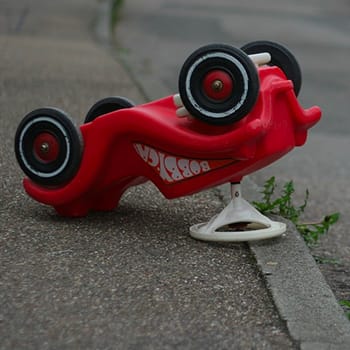
    Michael Gusman traumatic brain injury feature image of a toy card upside downCan memory techniques help people recover from traumatic brain injury?

    Obviously, you need to consult with a doctor first, but you might find the Michael Gusman’s brain trauma experience inspiring – and something you want to share with your medical professional.

    In this episode of the Magnetic Memory Method Podcast, you’ll hear directly from him.

    Why should you care?

    Because Michael’s a memory enthusiast who was t-boned by an SUV at 55 miles per hour.

    As a result, Michael suffered multiple injuries and a brain hemorrhage that left him with short term memory loss.

    In this interview you’ll learn Michael’s personalized Memory Palace methods and wound up healing his memory.

    He’s not the only one to experience memory improvement following brain injury. Matt Barclay not only recovered his memory, but gone on to give an incredible memory demonstration.

    That means if you’re having memory issues from an accident, you stand a chance at great recovery too.

    Plus, when you listen to this episode of the Magnetic Memory Method Podcast:

    • You’ll learn what the journey method is and how it can help you recall information without any effort.
    • You’ll learn how having a dedicated memory strategy helped him deal with the fear and confusion of memory loss following his accident.
    • You’ll hear about exactly how much of his recovery he attributes to the use of memory techniques.
    • You’ll learn how to directly place information into your long term memory so that when you want to recall it, it’s just like turning on a faucet.
    • You’ll learn about number rhymes and wax tablets, key techniques that anyone can get started using right away.
    • You’ll learn why memory techniques are a lot easier than they seem and how to use exotic action, images and even smells to help you memorize information.
    • You’ll learn Michael’s biggest mistakes as he was first learning memory techniques and building Memory Palaces so that you don’t have to make them yourself.
    • … and much, much more.

    Enjoy this interview and let both Michael and I know if you have any questions.

    And before you go, it’s not just car-crash induced brain trauma that mnemonics can help you recover from.

    Check out this TEDTalk for some very interesting research into the use of Memory Palaces to help Alzheimer’s patients remember the names of their loved ones:

    https://www.youtube.com/watch?v=BMcduh1HEHA

    I’ve also run across an interesting report about people using Memory Palaces to stave off the effects of so-called “chemo brain.” That will be fantastic news if it really helps people cope with the terrible suffering of the cancer itself and the side effects of the medicines used to treat it.

    So as you can see, even if you’ve experienced memory loss from brain trauma, there’s hope. If you can see in your mind or even just think about where your kitchen is in relation to your bedroom, you’re halfway there. (And if you can’t, look up my video on aphantasia. Believe me, you can still use a Memory Palace and memory techniques.) And if you can get an image or thought about your favorite actor or cartoon character in your mind, then chances are, you can learn to memorize just about anything. You just need to work at it a little bit every day and have something you want to memorize. Make it something that will make a meaningful difference in your life, like Michael did. He skipped memorizing shopping lists and went straight for scripture with great personal meaning for him. And if you’re worried that you don’t have any locations you can use to base a Memory Palace on, just have a listen to this episode of the Magnetic Memory Method Podcast. It will help you out a great deal. 🙂

    Further Resources

    St. Aquinas’ Summa Theologica

    Rhetorica Ad Herennium

    Jim Samuels on how to use mnemonics to reduce stress.

    Traumatic Brain Injury article in Wikipedia.

    If you’ve experienced memory loss from brain trauma or illness, let me know in the comments below. I’m always searching for ways to help! 🙂


    MMMPodcast Episode 003: Memorizing Mathematical Formulas Jan 16, 2014
    Show notes

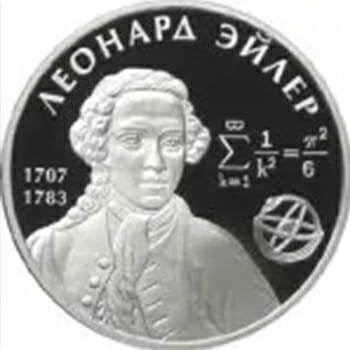
    memorize formulas podcast feature imageIn this episode of the Magnetic Memory Method Podcast, you’ll discover how to use a Memory Palace to store mnemonic associative imagery for numbers and formulas.

    Why?

    Because that will enable you to recall any mathematical term of formula you could possible desire.

    You’ll also hear some fun and interesting mnemonic examples featuring nuns, pyramids and Pythagoras’s abs!

    Why would you want to use such weird associations?

    It has to do with the power of elaborative rehearsal and spaced repetition paired with the Major System.

    The Skills You Need To Memorize Any Formula

    Once you’ve mastered those memory techniques, it’s important to make sure that you are memorizing the right formula.

    For example, in how to memorize a textbook, I gave a perfectly good mnemonic example, but the formula I was given was incorrect.

    I’m mentioning this because paying attention is the number one skill, a point memory expert Harry Lorayne has drilled his readers on for decades.

    Assuming you’re memorizing the correct formulas in the right configuration, you can also explore techniques that will help you deal with symbols and letters. These include:

    • Dominic System
    • PAO System
    • Pegword System
    • Number Rhymes

    Then, if you’re interested in learning more, check out my full course on how to memorize everything related to math.

    So what do you say?

    Has this episode of the Magnetic Memory Method Podcast helped inspire and educate you about memorizing formulas?


    A Powerful Memory Improvement Drill Using Plain, Old-Fashioned Dice Jan 10, 2014
    Show notes

    Magnetic Memory Method Podcast LogoIn this episode of the Magnetic Memory Method Podcast, I talk about a cool dice game you can use to put a little variety into you language learning efforts.

    If you’d like to learn more about applying these techniques to your personal learning goals, here’s what I suggest.

    Check out either How to Learn and Memorize the Vocabulary of Any Language or How to Memorize Names and Faces.

    Why Use Dice In Your Memory Palace Networks?

    As I discussed in the episode on memorizing backwards, all proper memory techniques involve spaced repetition and elaborative rehearsal.

    You’ll also want an element of what is called active recall. You use personalization and variety along with a bit of stretching to help form memories faster with these approaches.

    Throwing dice allows you to add a random element that optimizes the primacy and recency effect that make the Memory Palace technique tick.

    How To Perform This Memory Improvement Drill Using Dice

    The steps are simple:

    • Have a Memory Palace
    • Have a list of items you want to memorize
    • Memorize the items
    • Use Recall Rehearsal to start forming long term memories
    • Get some dice
    • Roll the dice
    • Pop into that exact station in your Memory Palace and recall the information encoded there
    • Repeat

    More Ways To Use Dice Drills To Experience Rapid Memory Improvement

    If you’re willing to get a 100-sided die (fun fact: it’s called a Zocchihedron), you can use it to help you master your PAO System.

    What’s that?

    It’s a means of memorizing numbers quickly. It’s a web of mnemonic images typically based on either the Major Method or the Dominic System.

    Here are the steps involved in using dice for practice drills to practice your number systems:

    • Develop your first PAO System
    • Roll your Zocchihedron
    • Rapidly recall your image for the number you see
    • Repeat as often as desired

    Can you use an online number generator to achieve the exact same effect?

    Maybe yes. Maybe no.

    Once reason many of us love to use physical dice is that it helps us avoid digital amnesia.

    I even use poker dice to help me practice my memdeck work after memorizing a pack of cards.

    I’m sure there are more ways to involve dice in your memory improvement drills. Please post any you think of in the comments below.

    And thank you for listening to this episode of the Magnetic Memory Method Podcast!


    The Greek Alphabet Is Easy To Memorize (Audio and Video) Jan 06, 2014
    Show notes

    Memorizing the Greek alphabet is not that difficult.

    In fact, one of my students, Kevin Wax, wrote to me that:

    With your incredible help, I’ve been able to memorize the Greek alphabet (words and symbols) front words and backwards in about 3 or 4 total hours of work.

    I was very worried as I tackled this project, but your techniques were so very helpful.

    That’s right. He did it in just 3-4 hours.

    Personally, I wouldn’t call the process “work,” but I’m just glad that Kevin got it done.

    If memory serves, he was memorizing scripture at the time, something many of my students want to do.

    And the Magnetic Memory Method is proven to help with that.

    Just check out what Jeannie Koh had to say in her testimonial after taking my course:
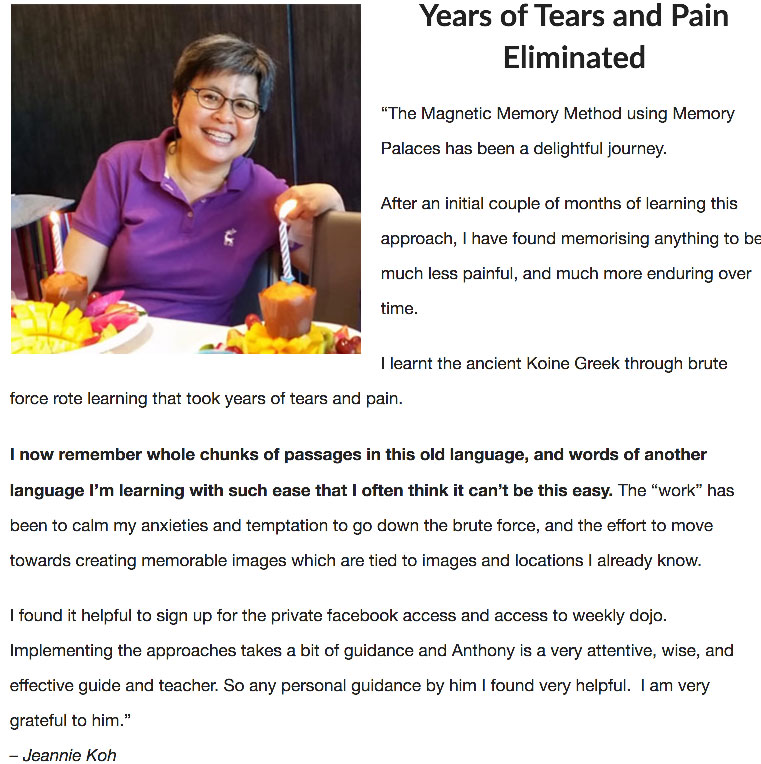
    Jeannie Koh Magnetic Memory Method Review for Bible Memorization

    So that you can experience similar results, here’s what’s very new:

    I went a little hog wild this time, creating both an audio and video version of the same suggestions I gave both Kevin and Jeannie.

    You can download the Mp3 above or watch as we wind our way through my Memory Palace and the mnemonic imagery I used to memorize each letter of the Greek alphabet. Here’s the video:

    https://youtu.be/-V4tc-5Kuh4

    Want more on how to master the alphabet in any language? This online memory improvement course will show you how.

    The key is to develop your mnemonic systems and use a bit of abstract thinking along with the best possible memory techniques.

    For example, for the letter aleph, consider using a famous person named Al, such as Weird Al Yankovich or Al Gore.

    You’ll also want to read Greek as often as possible. As you do, memorize interesting vocabulary. Spell the words out after you’ve memorized them and mentally rotate each Greek letter in your mind. This process is as useful with Greek as it is with Hindi.

    To take things to the next level, consider learning the pegword method. This mnemonic technique will give you an image for each letter of the alphabet, making memorizing new words in Greek easier yet.

    If you ever have questions, feel free to post them below, or get in touch using the contact page.


    MMMPodcast Episode 001: 5 Ways To Ruin A Perfectly Good Memory Palace Dec 31, 2013
    Show notes

    TheMagneticMemoryMethodPodcast2150x150In this first session of the Magnetic Memory Method Podcast, I talk about the 5 ways we ruin our Memory Palace efforts when working with mnemonics.

    You will learn:

    • How to create solid Memory Palace locations
    • How to create vivid imagery
    • How to include zany action
    • How to “rehearse the information you’ve memorized
    • How to use relaxation throughout the process for maximum success

    https://youtu.be/ZhjaNuzBhOE

    The mistakes talked about in this episode of the podcast simply aren’t necessary. Please take this information about using a Memory Palace in the most sophisticated manner possible and put it to use.

    Of the many mistakes, not picking a place for the information you want to memorize is amongst the deadliest you can make. You simply must use some kind of location-based memorization strategy if you want true success.

    The only problem is that so many people struggle with identifying Memory Palaces.

    That’s why I created the podcast episode How to Find Memory Palaces. It will help you find more Memory Palaces than you can shake a Magnetic stick at.

    And then there are people who want to make changes to existing Palaces they’ve built. That’s not entirely recommended, but you can give renovating a Memory Palace a try and see how it works for you.

    At the end of the day, a solid, unchanging Memory Palace will serve you best because it allows you to “magnetize” your properly created associative-imagery to the “roller coaster rails” of the MP journey. Without that certainty, you’ll wind up constantly second-guessing your Memory Palaces.

    And doubt is a recipe for disaster.

    Why?

    Because you want all of your focus to land squarely on quickly finding and decoding the target information – the information you need. The information you used all of this beautiful mental architecture and imagery to help you remember in the first place.

    Then you need to make sure that imagery is big, bright, bold and bursting with vibrant color. You really want the images to pop into your awareness as you journey through your mind.

    If you struggle with mental imagery that grabs your attention, give these visualization exercises a try.

    Never forget: they call it the art of memory for a reason (ars memorativa). You’re literally “crafting” memories when you use mnemonics.

    And you get to create the rules of play, meaning that you can memorize as much information as you want for as long as you want to hold it in accessible memory. You just need to know – not just what to do – but what mistakes to avoid.

    I hope this episode of the podcast helps! 🙂


    Previous 1 43 44 45

    Related Podcasts

    Making Sense with Sam Harris

    1

    Making Sense with Sam Harris Education
    Grammar Girl

    2

    Grammar Girl Education
    Good Life Project

    3

    Good Life Project Education
    Explain It to Me

    4

    Explain It to Me Education
    Team Never Quit

    5

    Team Never Quit Comedy
    Optimal Living Daily – Personal Development and Self-Improvement

    6

    Optimal Living Daily – Personal Development and Self-Improvement Alternative Health
    footer-logo

    Contact Us

    Toll Free: 844-670-7747

    Links

    • Home
    • Top Charts
    • Networks
    • Apps
    • Independents Podcasts
    • Podcast Advertising
    • Podcast News
    • Contact Us
    • About Us
    • Analytics & Insights

    Stay Connected

      Privacy, Terms of Use & Our Code of Ethics Protecting Content Creators Copyrights