TopPodcast.com
Menu
  • Home
  • Top Charts
  • Top Networks
  • Top Apps
  • Top Independents
  • Top Podfluencers
  • Top Picks
    • Top Business Podcasts
    • Top True Crime Podcasts
    • Top Finance Podcasts
    • Top Comedy Podcasts
    • Top Music Podcasts
    • Top Womens Podcasts
    • Top Kids Podcasts
    • Top Sports Podcasts
    • Top News Podcasts
    • Top Tech Podcasts
    • Top Crypto Podcasts
    • Top Entrepreneurial Podcasts
    • Top Fantasy Sports Podcasts
    • Top Political Podcasts
    • Top Science Podcasts
    • Top Self Help Podcasts
    • Top Sports Betting Podcasts
    • Top Stocks Podcasts
  • Podcast News
  • About Us
  • Podcast Advertising
  • Contact
Not in our directory?
Add Show Here
Podcast Equipment
Center

toppodcastlogoOur TOPPODCAST Picks

  • Comedy
  • Crypto
  • Sports
  • News
  • Politics
  • True Crime
  • Business
  • Finance

Follow Us

toppodcastlogoStay Connected

    View Top 200 Chart
    Back to Rankings Page
    Education

    Anthony Metivier’s Magnetic Memory Method Podcast

    Learn, Memorize And Recall Anything Using Memory Techniques, Mnemonics And A Memory Palace Fast

    Advertise
    • Apple Podcasts
    • Google Play
    • Spotify

    Latest Episodes:
    The Story Of How To Learn And Memorize German Vocabulary Jan 01, 2016
    Show notes

    I’ll never forget the day I made the most important discovery of my life. A discovery that would also prove important for thousands of language learners and students of various topics around the world. Here’s what happened: I was on my porch down in Zehlendorf. (It’s really too bad about Zehlendorf …) I really miss that part of Berlin. I used to walk to the nearby lake Krumme Lanke and through a wooded area leading to the stores and the M48 bus I often took to Potsdamer Platz. I went there so I could watch movies for my work. Yes, watch movies. I was a Film Studies professor back then. Greatest job in the world – if you can get it. And If You Can Keep It! Anyhow, I was on the porch studying German and nearly tearing out my hair with frustration. No matter what I did, the German vocabulary wouldn’t stick in my mind. Worse, the flashcard software I’d been using bored me to tears. I’ve never found anything more painful than banging foreign language vocabulary repetitively against my eyes in the vain hope that I would somehow magically remember the abstract and mysterious words. In all fairness, some people can tolerate rote learning. In fact, there’s research suggesting that polyglots get great value from hard repetition. This happens primarily because they’ve trained themselves to be really good at it. But Let’s Be Real Most people do not want to be polyglots. Most people would be happy just to get halfway decent in one language, not several. In fact, most people would be overjoyed just to get a couple of hundred words in their long term memory. And most people would be ecstatic if they could turn those words into basic conversational fluency. All you need is about 800-1200 for that, plus a touch of understanding the grammar. Still my favorite German dictionary after all these years. So there I was with a fat dictionary pumping words into the spaced-repetition software I loathed like the plague. I sure loved that dictionary, though. What a glorious thing, all thick and yellow. Heavy too, almost as heavy as a brick. But that didn’t stop me from carrying this German-only (or monolingual) dictionary everywhere. And That’s When It Hit Me! With a bit of summer wind on my face, I asked myself a fundamental question: Why on earth wasn’t I using memory techniques to help me learn German? Seriously. They sometimes say that Ph.D. stands for “piled higher and deeper,” but Mann O Mann (as the Germans say), was I ever mystified. You see, following a terrible and nearly suicidal depression that almost forced me out of grad school, I discovered memory techniques almost by accident. I was avoiding the looming field exams and dissertation defense by learning magic tricks. Of course, procrastinating on my studies only made my depression worse … But it’s at least a good thing that I was doing something constructive. I thought of my magic practice as developing a kind of “emergency paycheck,” because I was certain at that time I was going to wind up on the streets with nothing more to do than entertain people and pass around my hat. And I suppose that would have been fun for awhile. Studying card magic was certainly better than jumping off a bridge, which the mounting pressure and the teeth of my depression were forcing me to consider. Worse, if you’ve ever experienced the horrors of manic-depression in full swing, you know the impulses involved. They are sick and sweet and jump out at you from nowhere. It’s terrible too because once the urges pounce, they can keep trouncing on you for days and days on end. The most sinister part of the situation was that I couldn’t concentrate or read. It always felt like my eyes were slipping off the page. And when I could read for brief periods of time, I always wound up forgetting everything. And that made me frustrated and even angry. Magic was my only relief. And it was easy to study too because you can buy a lot of training in card and coin magic on DVD. I didn’t have a whole lot of money at the time, but it sure was worth it. Especially when I came across the process that would save my life. I’m talking about the “Holy Grail” of all card tricks: The Memorized Deck. There’s a ton of effects you can create with a memorized deck. The only difference is … They Aren’t Effects! They’re Based On Real Magic … … Or at least, the closest thing to real magic that exists. The ability to go through 52 cards, looking at each only once and being able to recall the entire order backward and forward … This ability is a complete miracle. So I bought a book on the topic and an audio program that included a section on card memorization. It would be years before I read the book, but my hungry ears gobbled up the audio like peasants on bread during a famine. And what I heard nearly made my brain explode. It’s true. I understood the procedures immediately. It’s shocking how simple it is, and yet … … I was skeptical. How on earth was I going to put these techniques into action when I could barely concentrate on a book? Not only that, but playing cards are essentially a kind of book, only they are made up of totally abstract and fragmented sentences and chapters. And the pages can be endlessly recombined. But even so, I gave the technique a try. What happened totally blew me away. Why? Because 15 minutes after learning the technique, I had memorized my first deck of shuffled cards. I couldn’t believe it. In fact, to this day I’m still in awe. And the reason I work so hard to promote memory techniques to people around the world is precisely because that awe remains. And it grows and grows the more I hear from people who have read one of my books or taken one of my video courses. They All Have One Special Characteristic In Common … They, like me, learned the methods and took action. They experimented. They memorized vocabulary using the tools of the Magnetic Memory Method and they got results. And then they repeated what they learned and got even more results. And those results led to even higher payoffs because things just keep getting better and better the more you use mnemonics as part of your learning. Anyhow, as soon as I realized what I had done with the playing cards, I instantly saw how I could apply these techniques to learning and memorizing the 250+ books I needed to cover for my field exams. (500 when you add on dissertation research…) These exams are mean and nasty affairs. Seven professors sit around a table and drill you with questions for nearly two hours. They’re very protective of the university Ivory Tower, so they do everything they can to keep you out. The hostility makes the process of sitting for those exams frightening an stressful in every possible way. And frankly, most people never make it. I don’t know what the figures are now, but back then, the graduation rate from Ph.D. programs in Canada was a mere 13%. In other words, out of every 100 people who enter grad school, 87 walk away without a degree. But I wasn’t one of those who left the hallowed halls empty-handed. And it’s all because I took action and used the memory techniques I’d learned on that magical day during the depths of my nearly suicidal depression. Of course, it’s not as if my studies were suddenly free from challenges. Far From It The memory techniques boosted my confidence and this gave me increased clarity. But I still struggled to read with the amount of focus needed to even discover and isolate the information I wanted to memorize. I also didn’t have Atomic Habits like the kind I’ve since learned from James Clear. So what I wound up doing was to read the books out loud. Unlike the memory audio program I had no problem following, the philosophy and history books I was reading had no audio editions. Worse, they were so dense and so obscure … It was often like pulling teeth just to get through them. But by reading out loud to maintain my concentration and then listening to my narrations, I could finally concentrate. And then I would write down the key points and facts from the books on index cards. Next, I would order the index cards in particular ways to aid the memorization of them into the Memory Palaces I’d created. (Here are 5 Memory Palace examples if you need them.) Following that, I memorized the information on the cards. Kind of like memorizing a deck of playing cards, only in this case you’re not entertaining audiences but rather earning a degree. But there was another level of difficulty. The memory techniques and especially the Memory Palaces I was using at the time were far from foolproof. And I Made A Lot Of Mistakes You see, the techniques I had learned were actually kind of pedestrian. They weren’t made for higher levels of learning. And they certainly weren’t designed for language study. So what I did was to develop completely new approaches to the memory techniques. I was still learning and memorizing information very well, but I knew I could do better. Above all, I knew that my Memory Palaces could be much more precise. So I found better ways to begin the journeys through them. I discovered principles that reduced the errors many people make with mnemonics and massively reduced the cognitive load extensive learning places on the mind. And the more I worked at it, the more streamlined the techniques became. Before I knew it, I had zoomed through most of the books and was ready to sit for my exams. (These days, I also use mind mapping based on this Tony Buzan methodology.) I had also finally landed on a feasible dissertation topic. And even though I still felt physically terrible and the mental illness remains to this day … I Was Sitting On Top Of The World I marched into those exams brimming with confidence and aced them. In fact, when my final dissertation defense concluded and I was called “Dr. Metivier” for the very first time, the top examiner who had come up to Canada from the United States told me something I’ll never forget. “Most people freeze up,” he said. “Some of them even break into tears. But you … … the only person cooler than you is Miles Davis.” I guess what he meant is that I was calm, collected and cool in the sense of being unshakable. And trust me, each and every one of the professors surrounding me at that table on the second floor of the Vanier building on the campus of York University in Toronto did all they could to shake me up. But none of them could, not even the one hellbent on failing me. Why? Because I knew my stuff and could remember it. All Of It And when they awarded my degree, they even added a special comment on the form that I had presented my knowledge with originality and audacity. I take that to mean that I did it all with nerves of steel, total confidence and the ability to create new knowledge, not just parrot what I’d memorized. And that’s what the Magnetic Memory Method is all about: Creating knowledge while also being able to repeat information verbatim. Or in the case of memorizing vocabulary, being able to create unique and meaningful sentences. But don’t get me wrong. In some cases, being a parrot isn’t a bad thing. Not A Bad Thing At All But let’s flash forward a couple of years. There I was on the porch. Stupidly I’d sat through six months of a German language course after landing a research and teaching grant at a university there. Looking back, I still can’t believe it. But in all fairness, I had already used my memory to get my Ph.D. But researching and teaching didn’t require them in quite the same way. I used mnemonics only to memorize the names of my students and the basic architecture of my lectures. But on that porch, I realized that I could have been using memory techniques all along to memorize German vocabulary. The only question now was … How? When I thought back to what I’d done during my graduate years, it all fell into place. You see, when organizing the knowledge I needed to know in order to memorize the works of philosophers and literary or film theorists great and small, I had created at least one Memory Palace for each, sometimes up to five. In many cases, the Memory Palaces weren’t so much centered on the career of a philosopher, but on a single book. For example, for Aristotle I concentrated only on memorizing the major details of The Nicomachean Ethics. But as for the rest of his cannon, I’m a sitting duck in water. Michel Foucault, on the other hand, had five Memory Palaces, four for individual books he’d written and one for facts about his life and how it intersected with important moments in his Zeitgeist. Regardless of having one Memory Palace or five per philosopher, in each I got some kind of picture in my mind of what that person looks like. In the case of Aristotle, I had only paintings to work with. With Foucault, I could look at oodles of photographs. Then, using a well-formed Memory Palace that obeys the principles of what would eventually become the Magnetic Memory Method, I followed these philosophers along carefully constructed journeys. At one point, for example, Aristotle fistfights with the notorious serial killer John Wayne Gacy. Foucault, known for his sexual escapades, got into some situations rather X-rated to at present mention. I would eventually come to call these Magnetic little puppets of mine, “Bridging Figures.” Why? Because by following them around in my imagination, they “bridged the gap” between Memory Palace stations and engaged in behaviors that quickly and efficiently reminded me of the key points I needed to know. After that, it was just a matter of rehearsing the show a few times and writing out what I’d learned in summary format to ease the information into long-term memory. As one commentator on a Magnetic Memory Method YouTube video puts it regarding my approach to memory techniques and mnemonics overall, it’s all … Easy Peasy Lemon Squeezy Lemon squeezy, indeed. It also works for heavier material, like memorizing concepts too: https://youtu.be/PUC5N9QORhM Thinking about that practice and its tremendous power, I clearly saw that the same approach readily applied to German vocabulary. Abraham Lincoln helped me connect “ab” words in an “A” Memory Palace. To give another example, Einstein took over the show in an imaginary reconstruction of my brother’s home. Even more interesting, real people proved useful too. For example, my ex-wife’s good friend Vera war sehr verantwortlich when it came to stuffing “ver” words into a very special Memory Palace that happened to be her home in Brooklyn. I had only visited the place once, but due to the mind’s uncanny ability to absorb the details of a building on autopilot, I used its rooms and hallways to great effect before moving to my old girlfriend Vicki’s home and on and on and on. Nifty, Isn’t It? You bet it is. And before I knew it, the fruitless hours spent on index cards and writing words out by hand became a thing if the past. I deleted every trace of the spaced-repetition software clogging my laptop and honored instead the unparalleled abilities of a well-trained memory. Thousands of books and over a dozen video courses and public appearances later, the ancient art of memory finally had an innovation for one of its toughest opponents: language learning. There had been other attempts. Harry Lorayne and Jerry Lucas devote three pages to memorizing vocabulary in The Memory Book. In Memo, Oddbjorn By talks about organizing a city into three parts to help organize gendered nouns, an idea he may have found in Host Von Romberch, who was a contemporary of the great mnemonist Matteo Ricci. But none of these approaches had the rigor needed to memorize vocabulary en masse. Harry Lorayne is no fan of Memory Palaces and mnemonists like Dave Farrow use them sparingly. Nothing Wrong With That But for so many people like myself, pegs and linking do little or nothing. Without a track upon which to lay the associative-imagery, the choo-choo train of the mind has to grasp after ghostly images popped willy-nilly into the void, connected only by abstract r…

    Full show notes at the publisher

    Foods That Improve Memory You CAN Pig Out On Dec 24, 2015
    Show notes

    If you’re lucky enough, eating foods that improve memory is something you do every day. If you’re like most of us lucky ones, it might be something you do too often every day. But for something you do so often, are you getting the most out of your eating, for both your body and mind? Doctors, nutritionists, fitness instructors, and your mom are constantly preaching: “You are what you eat.” “An apple a day keeps the doctor away.” “Eat your fruits and veggies.” As a memory expert with a PhD who has faced lifelong struggles with food sensitivities, I can tell that these statements aren’t always true for all people. Certainly not when it comes to memory. For example, when I have an outbreak after eating something to which I’m allergic, it can diminish my health and negatively impact my focus and memory. Sometimes for days on end. So what to do? On this page, I’ll share the science of foods that positively boost memory. While also explaining how to make sure that you’re getting the best possible results without any negative side effects. Foods That Improve Memory & How To Test That They Work For You As we know, diet is consistently cited as one of the more important aspect to weight loss, mood and overall good health. What you eat can make you healthy, happy, and well-functioning, or throw you into a death-spiral of obesity, disease, and disability. It should come as no surprise that diet also affects mental health. In fact, there is mounting evidence that specific types and classes of food can have beneficial (or detrimental) effects on memory. Recently, for example, coconut oil has come into question, but that doesn’t mean it works for me. As I share in this video, there are many very healthy foods I simply cannot eat without a negative reaction, including brain fog: https://www.youtube.com/watch?v=bobKqgCXge0 I shared my story in the video above because science is a process of questioning, especially when so many healthy foods can lead you to lack focus and concentration. So the question is… Is it possible to change your diet to maintain, and even achieve new and better levels of memory and information retention? We are all salivating for a definitive answer, but for the most part, the jury is still out. Much of the research surrounding food and memory are in preliminary stages and tested on animal subjects. Not to dismiss the abilities of a lab rat, but making the connection between a rat and a human is dubious. However, we aren’t entirely left in the dark. In fact, there is exciting new research pointing to real and impressive associations between food and memory. This post (don’t forget to listen to the podcast version too) will dive into this salad bowl of findings and scoop out foods to help with memory conservation and retention. All you’re left with is the easy – and delicious – part of figuring out how to incorporate these foods into your meals. So, let’s dig in. One: The Ugly Nut That Should Get More Attention They look like brains, are hard to crack, and have a slight bitter flavor. Walnuts taste as unique as they look, and cracking them open has been a strength test for bodybuilders everywhere. Beyond their use as a party trick, these funny-looking nuts have some evidence pointing to their ability to improve memory. It’s not due to their pretty appearance. Walnuts contain the highest source of antioxidants among their nut brothers and sisters (Vinson and Cai 134). Perhaps due to their impressive antioxidant profile, walnuts have garnered research specifically on their abilities to improve memory. A recently published, cross-sectional American study was conducted analyzing the association of walnuts to several forms of cognitive function (Arab and Ang 284). The study included participants from a variety of ethnicities, age groups, and genders. It surveyed over 20,000 people about their dietary habits and had them take various cognitive tests. These tests included reaction time, numerical processing, and recall. This is perhaps the largest walnut to cognitive function study ever done on the US population, and boasts impressive results. The study showed strong associations between higher walnut consumption and progressively better scores on each cognitive test, including the memory recall test (Arab and Ang 284). In other words, the more walnuts they ate per day, the better their memory became. These results applied to all of the age groups studied, ranging between the ages of 25-59. The study concludes with an (albeit serious and scientific) ode to walnuts. “These significant, positive associations between walnut consumption and cognitive functions among all adults [. . .] suggest that daily walnut intake may be a simple beneficial dietary behavior.”(Arab and Ang 284) This study does not stand alone when it comes to nuts and seeds for cognitive health. Another study focusing on elderly subjects found positive effects of walnut consumption on memory recall (Valls-Pedret et al. 773). What all these studies are really trying to say is, “Walnuts. Get on that”. Raw or roasted, add them to salads, to your oatmeal or even to the your green smoothies in the morning. If the statistics are correct, you should be getting smarter and remembering more details than ever. Two: How Green Tea Can Super-Charge Your Memory Green tea is a favourite around the world – I drink it myself almost every day. It’s found in a variety of drinks outside of its standard tea form, including lattes, soft drinks, and even ice cream. Green tea has been in the limelight for a while compared to other memory boosting teas for its purported ability to aid in treating nearly any ailment. Every other week there seem to be stories about green tea’s heroism in fighting cancer and diabetes. Hype aside, can green tea help your memory and mind as well? In a study conducted on Japanese residents over age 60, higher green tea consumption was associated with lower incidence of dementia (Noguchi-Shinohara et al). Dementia is a common cognitive and memory decline associated with growing older. The study suggests that green tea consumption could be beneficial for reducing our risk of memory decline. But what about improving our memory here and now? A very interesting, albeit small, study on college students, sought an answer to this question (Schimdt et al 3888). The study examined the effects of green tea extracts on brain activity in the prefrontal cortex of the brain. 12 healthy volunteers were given green tea infused drinks and asked to perform a working memory task while in an MRI. During the task, the prefrontal cortex showed increased activity and the volunteers performance was heightened (Schimdt et al 3888). A larger study looked at the effects of tea consumption on the cognitive abilities of middle-aged adults in community living in Singapore. This study didn’t test green tea exclusively, but it found protective and enhancing affects of green tea on cognition, including memory (Feng et al 438). The evidence suggests that drinking green tea daily will protect from future memory decline and may even provide a memory boost. This result as certainly been my experience, and it certainly feels great having it in my system while playing my favorite memory games. Keep in mind that there’s another reason why drinking green tea is so good. Hydration and brain function go together. That’s why I drink green tea every day, but also follow up with plenty of water. Three: The Small Berry That Packs A Punch You’ll Remember Blueberries aren’t just for toddlers and vanilla ice cream anymore. Blueberries are showing some promise in the protection of your memory. In fact, they’re probably amongst the best fruits for brain health that you can eat. In a study of nine older adults with memory decline, consuming blueberry juice over 12 weeks resulted in improved memory function. Each day this group of five men and four women drank blueberry juice. After 12 weeks of drinking blueberry juice, these nine test subjects showed improvements in recall and general cognitive functioning (Krikorian et al 4000). Although small and preliminary, the research offers an interesting benefit to an already very health food. If you aren’t already eating blueberries, these findings should be the kick you needed to start adding them to your smoothies. Personally, I used to eat blueberries frequently, but had to stop due to my food issues. But I remember how effective they were when I could eat them. Luckily, I can still eat the next food we’re going to discuss, and do so at least two times a week. Four: There’s Nothing Fishy About This Brain Food If you’ve been on the internet at any point in the last ten years, you’ve probably heard about “Omega-3s”. You may not know exactly what they do or what they are, but you know you need more of them. The purported benefits of Omega-3s is the reason fatty fish have been promoted as a necessary addition to your weekly meals. Fatty fish, such as salmon, contain some of the highest levels of Omega-3s. Similar to green tea, Omega-3s have been touted as having a wide variety of health benefits. These include things like reducing pain associated with rheumatoid arthritis, ensuring the healthy development of babies, and aiding against dementia. Setting the former two claims aside, it does seem that Omega-3s, as consumed through fish, have a protective effect against memory deterioration. A large study followed 889 older adult men and women over nine years. It was hoping to understand whether differences in fatty fish intake impacted the prevalence of dementia by the ninth year (Schaefer et al 1545). Researchers found that subjects with the highest intake of Omega-3 fatty acids had a lower risk of developing dementia and Alzheimer’s. Their subjects consumed a mean of three servings of fatty fish per week and the risk reduction was impressive. Subjects that consumed the most fish saw their risk of memory impairment decline by 47% (Schaefer et al 1545). Another study followed a group of 281 people aged 65 to investigate the correlation between fish intake and brain deterioration. This study found that higher levels of Omega-3 fatty acids in the blood, predicted reduced deterioration for its test subjects (Samieri et al 642). In another very large study of over 1,200 people, Omega-3 fatty acid, along with various other micronutrient levels, were analyzed. The results were compared to the prevalence of an important biomarker for dementia, a compound in the blood that predicts Alzheimer’s. Sure enough, those with high levels of Omega-3 fatty acids had a lower amount of the threatening biomarker (Gu et al 1832). What’s really interesting is that these results were not replicated through supplementation. In a huge study, supplementation Omega-3 fatty acids were given to 4,203 subjects to determine whether memory function improved. The study followed subjects for five years, during which they tested various cognitive functions, including memory. The results showed that supplementation did not have a significant effect on cognitive function (Chew et al 791). Moral of the story? There seems to be real memory benefits and protective effects to eating foods high in Omega-3 acids, such as in fish. Moreover, supplements have not proven effective. You’re much better off saving your money for a nice salmon filet once a week. The Simple Diet That Brings It All Together It might get tiring eating walnuts, berries, green tea, and fish all the time. But you’re in luck! As it turns out, there is an entire diet which has been shown to be protective against memory degeneration. The diet, called the MIND diet, reduces the risk of cognitive decline and memory by 35%. And that’s just for people who followed the diet moderately well (Morris et al 1022). For those who stuck to the diet closely, the study measured an impressive reduction of 53%. This diet has not, as of yet, been shown to enhance memory for healthy adults. There are no super-memory foods in the MIND diet. Nonetheless, the MIND diet and study has shown impressive results in its potential to protect you from memory deterioration. The MIND diet is a combination of two very well-studied diets: Mediterranean and DASH. Unlike these two diet, it places a special emphasis on the consumption of berries, strawberries, and blueberries in particular (remember them?). The diet involves the following: At least three servings of whole grains a day A salad and one other vegetable a day A glass of wine a day A serving of nuts a day Beans every other day Poultry and berries at least twice a week Fish at least once a week Fermented foods like the ones this study shows improve memory and mental clarity In addition to choose whole grains for better cognition and foods like leafy greens for brainpower, the MIND diet also calls for limiting or eliminating unhealthy foods, especially butter, cheese, and fast or fried food. In a time when many countries are facing ageing populations and increasing rates of Alzheimer’s, the MIND diet offers hope. As of yet, there is no effective cure for Alzheimer’s. Every step to a more definitive prevention of Alzheimer’s is a step in the right direction. Of course, you can’t rely on the MIND diet on its own. Make sure you also get ample exercise, memory-friendly sleep and lots of socialization. Don’t Be Tricked By Ginkgo Apart from being a lovely decorative tree across North America, Ginkgo Biloba is an ancient species of trees. In fact, they are known to be the oldest tree species in the world, remaining unchanged for over 200 million years. That’s right, this tree has been around since the dinosaurs. Unlike the dinosaurs, they did not go extinct. Not just a pretty tree, Ginkgo Biloba has also been used in east asian culinary. For example, Ginkgo seeds are added to a traditional vegetarian dish called “Buddha’s Delight”. Otherwise, Ginkgo Biloba has earned a shining memory-boosting reputation in both alternative medicine circles and the mainstream population. According to the New York Times, it is widely marketed as a preventative treatment to Alzheimer’s disease. What’s more, it is America’s best-selling herbal cognitive enhancement. But is there substance behind these claims? Unlike many food claims, definitive answers are possible because Ginkgo is one of the most commonly studied herbs in the world. Ginkgo has not shown evidence for preventing memory-loss diseases in later life, including dementia. In 2015, a study reviewing many previous studies available on Ginkgo showed no effect on memory loss prevention (Charemboon and Jaisin 508). But can it help enhance memory for healthy adults? Again, the evidence is lacking. A similarly large review conducted in 2012 found nothing to prove that Ginkgo Biloba enhances memory, despite the marketing (Laws et al.). All that glitters is not gold, especially when it comes to claims made by herbal supplement manufacturers. Save your money on Ginkgo supplements and move on to other, better evidenced memory-supporting foods. Antioxidants And Cognitive Function It’s difficult to isolate specific components in foods that make them effective. It’s been found that blueberries, walnuts, and green tea have amongst the highest levels of antioxidants among their respective food groups. Antioxidants are thought to protect against cell damage from free radicals, which occur naturally in the body due to normal metabolism. However, many studies analyzing the effects of antioxidant supplements have failed to show significant effects. It seems that you must take the food with the antioxidant, possibly with other vitamins too. Start On Your Memory-Boosting Journey(Without Supplements) Although there may be a time and place for supplementation, uprooting memory supporting foods you can tolerate from their place in your diet is a poor strategy. In any case, the variety and availability of these delicious foods leaves no reason not to incorporate them into your d…

    Full show notes at the publisher

    Dave Farrow Talks About Focus, Fatigue And Memory Expertise Dec 17, 2015
    Show notes

    Optimized-Screen Shot 2015-12-17 at 13.05.34In this episode of the Magnetic Memory Method Podcast, Guinness World Record Holder Dave Farrow talks about developing focus, overcoming study fatigue and how advanced memory abilities can make you an expert in anything.

    As a long term researcher into many aspects of memory science, it was an honor to move from using the techniques personally while studying them to trying my hand in a competition with one of the best.

    Farrow was incredibly generous to record this episode, something in his character I noticed at the competition itself.

    Putting together memory competitions is not easy, after all.

    And on top of that, he’s put in the practice to establish his legendary status as a memory champion.

    Press play above and in this episode, you’ll learn:

    * Why the Ancient Greeks are not the only source of powerful memory techniques.

    * An amazing focus method for people with A.D.D. that’ll also work for anyone!

    * How to beat any world memory record and maintain the information over long periods of time.

    * The important of accuracy in memory and how to develop it fast.

    * How Dave memorized 59 decks of cards, totally 3068 cards.

    * The important difference between a memory championship and memory competition.

    * The nearly magical power of pegs as a powerful alternative to using a Memory Palace.

    * The secrets of bring longevity to memory without having to cram or spend tons of time reviewing.

    * A stunning and colorful alternative to the Major Method, especially for people with dementia using an arrangement like this (you can create your own version):

    1 = red
    2 = orange
    3 = yellow
    4 = green
    5 = blue
    6 = purple
    7 = brown
    8 = silver
    9 = gold
    0 = black

    * Exactly how to memorize the Major Method (sometimes called the Major System) using “mnemonics for mnemonics.”

    * How to use memory techniques to “fill in the gaps” of anything you missed from a lecture.

    * How to deal with being accused of cheating when you use memory techniques to ace every test.

    * How to rebalance your brain after intense periods of learning so that you can maximize every minute you invest in your studies.

    * How to study with zero fatigue, no matter what field you’re in (medical, legal, etc.)

    * The relationship between the focus created by athleticism and what you need to maximize your scholastic studies.

    * Why having a short attention span has little to do with the Internet Age and everything to do with our primal ancestors.

    * The best places to study so that you have the space and the freedom of mind to get the most out of your memory.

    * How to combine focus bursts and mnemonics to blaze through learning a language – even supposedly difficult languages like Chinese.

    * Why you need to avoid memory techniques taught by people unqualified to explain them.

    * How to find out your primary way of making imaginative connections so that mnemonics work for you at the highest possible level.

    * The power of irony, oddity and personification as alternatives to action and imagery in your approach to memorizing information.

    * How Dave used memory techniques to become expert in everything needed to build the animatronic “FarrowBOT” with fully articulated hands. It truly is the robot that memory built.

    * The secret keys to developing motivation and passion so that you can make maximum gains with your memory over the long haul.

    * … and much, much more!

    Photos From Dave Farrow’s 2015 Canadian Memory Seminar And Tournament

    Optimized-3_farrow

    The 2015 Seminar and Memory Tournament took place on October 17th in Toronto, Canada at the Ontario Science Center.

    Please feel free to read the full Tournament Rules. You can also grab the World Memory Tournament Manual Dave put together with Chester Santos for more information about being a memory competitor or putting together your own competition.

    Optimized-1_farrow

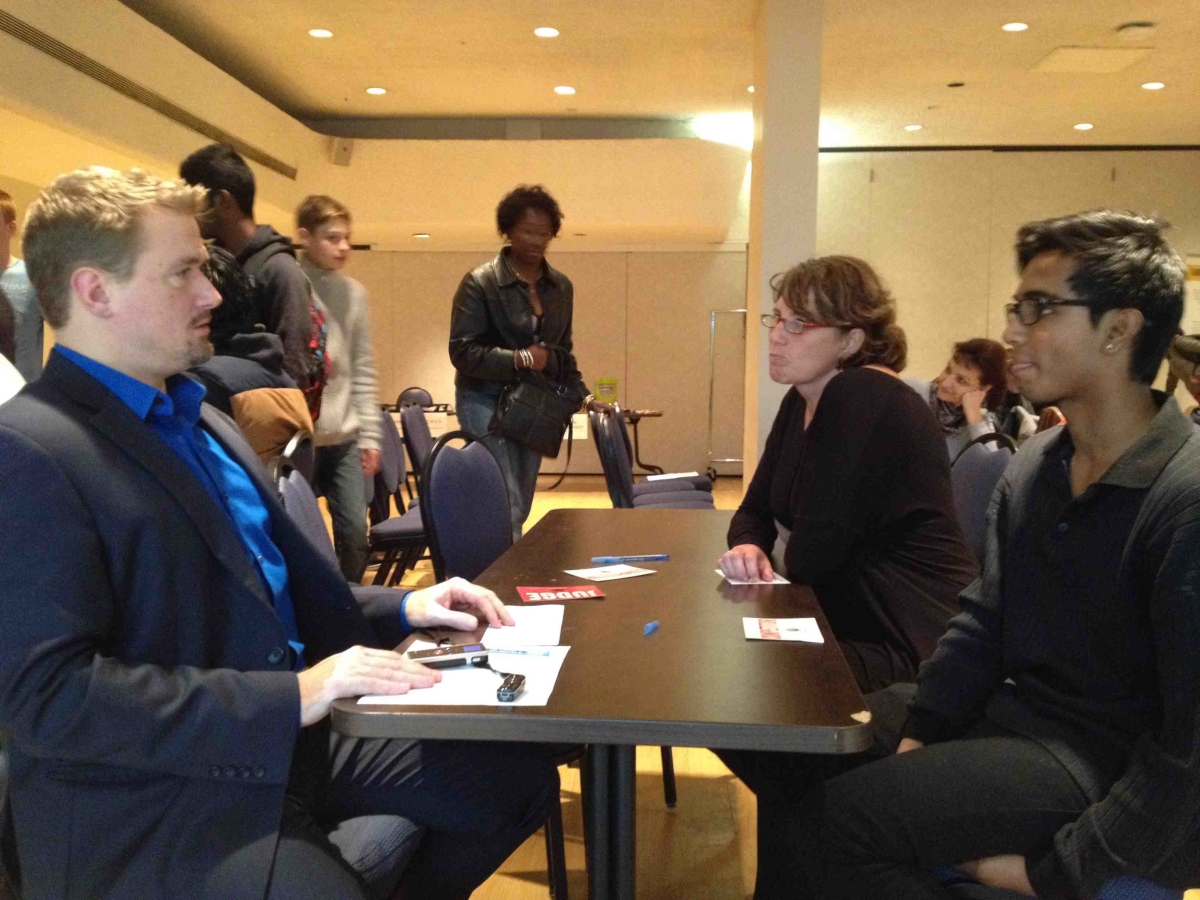
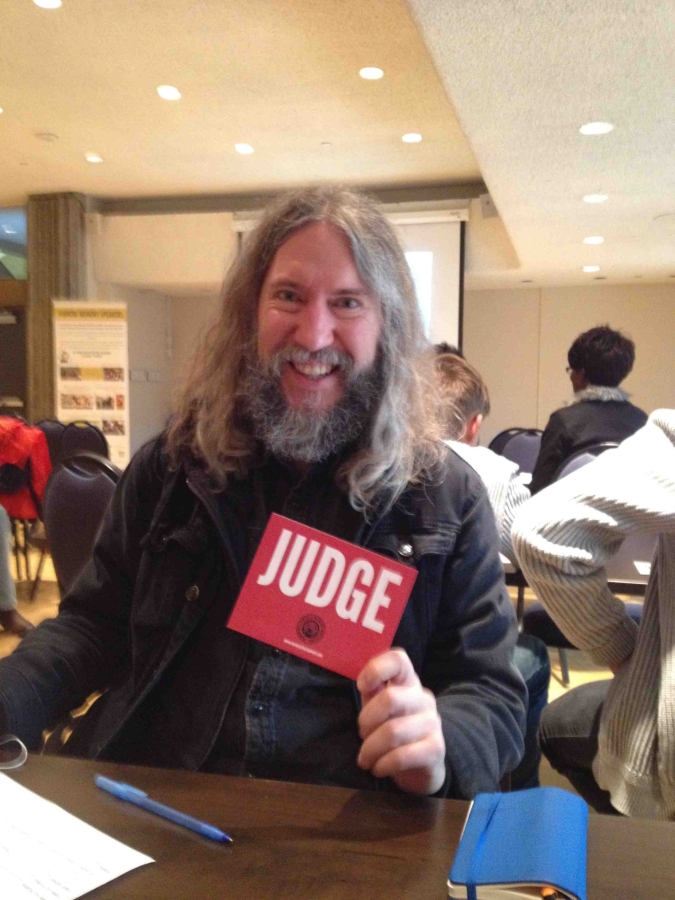
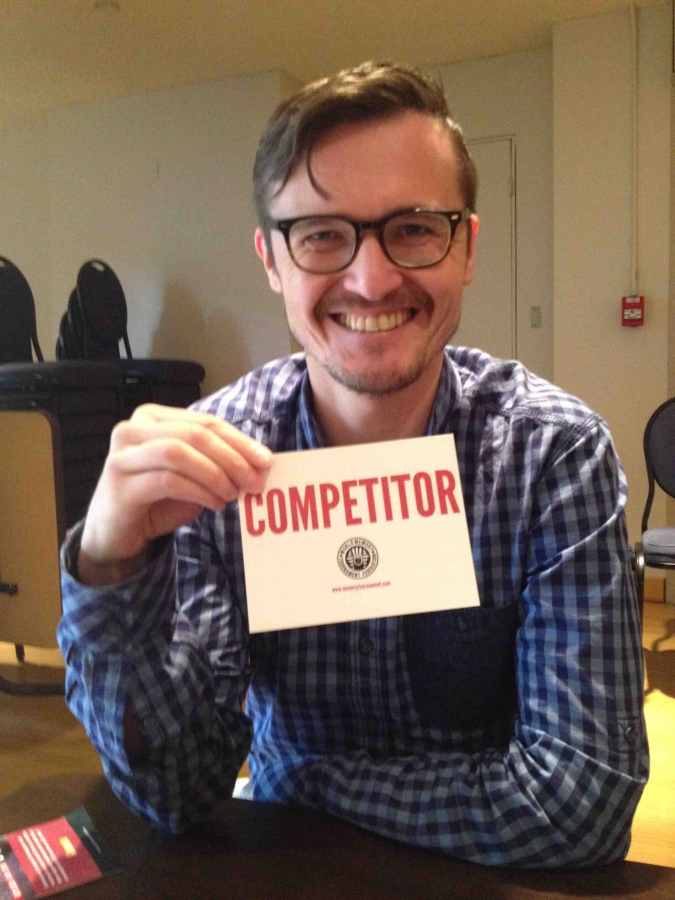
    At the competition, anyone can take turns being either a competitor or a judge. It’s amazing how quickly complete beginners pick up the mnemonics and get stunning results just minutes after receiving instructions in how to memorize vocabulary, numbers and playing cards. Even the most skeptical utterly surprised themselves!

    Optimized-2_farrow

    As you can see, I was having the time of my life overseeing some of the matches. It was actually a challenging experience because judges have to make some tough close calls. If one competitor makes a mistake, the other competitor can claim the point and then go on to rack up even more until they’ve exhausted the amount of vocabulary, numbers or playing cards they were able to memorize.

    Optimized-5_farrow

    Optimized-6_farrow

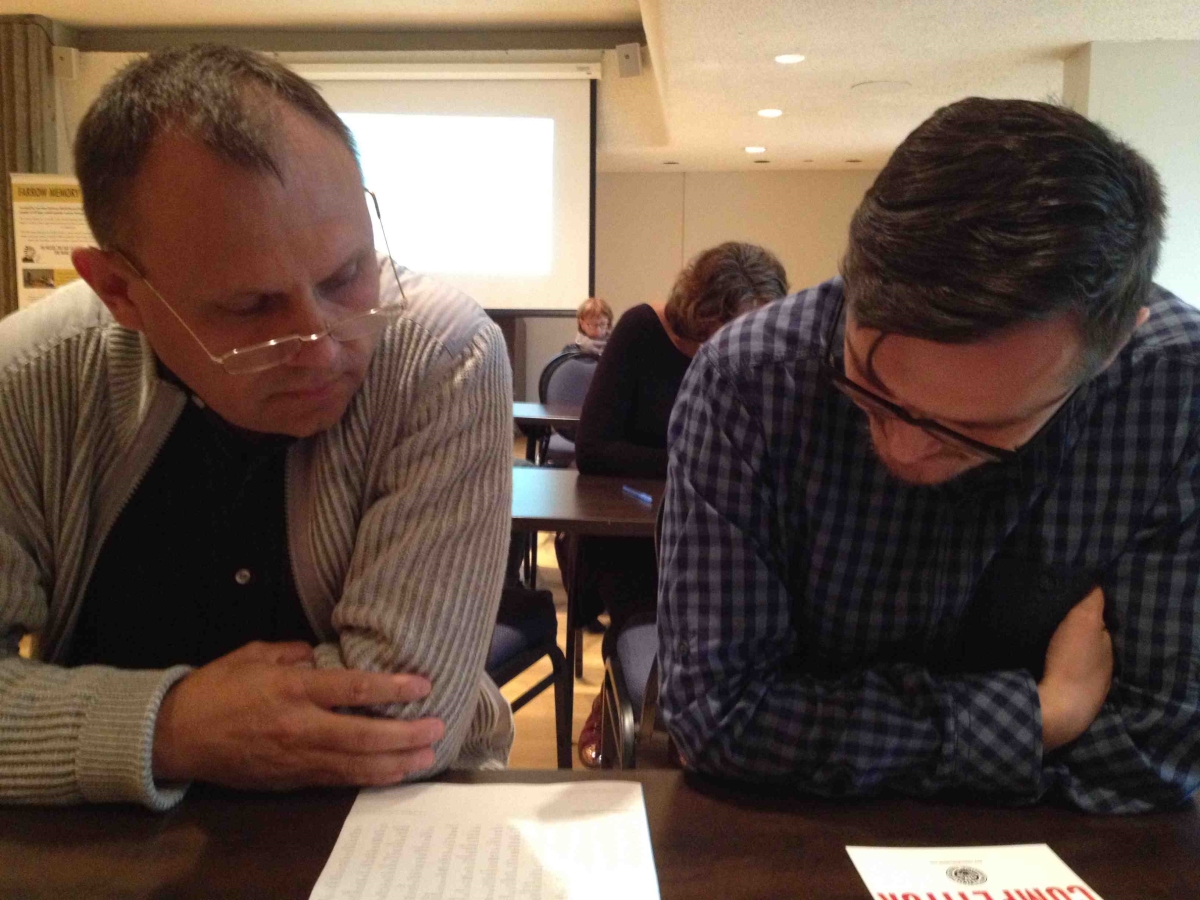
    These competitors are memorizing lists of vocabulary that they are seeing for the first time. A camera captures everything and detailed records of the results are recorded by the judge.

    Optimized-4_farrow

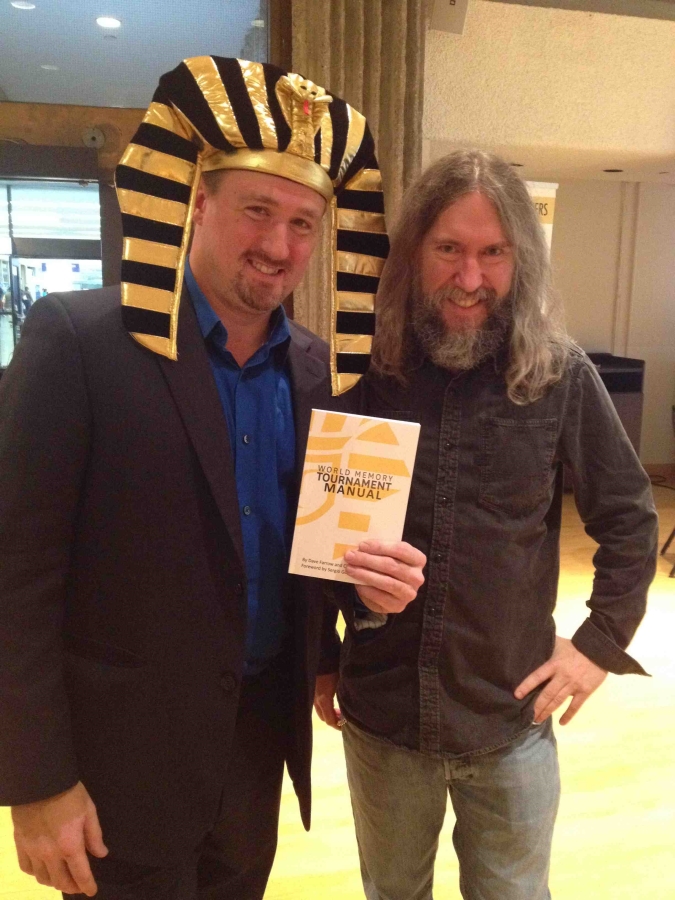
    At the end, everyone walks away as a winner just for taking up the challenge of exercising their imagination and memory abilities and it is a thrill to get a photo with the “Farrow” of Memory himself, Dave Farrow.

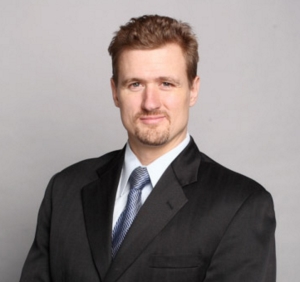
    Dave Farrow and Anthony Metivier in Toronto

    Further Resources And Information Mentioned During The Interview

    Dave’s TEDTalk On Why Forgetting May Save Humanity:

    https://youtu.be/7M5rFiVLeR0?list=PLsRNoUx8w3rMe8eTdzEJa5_7gIUVxW1JX

    Excellent article about a Dave Farrow event by Tatiana Sanchez

    Dave Farrow article on Wikipedia

    Pushbutton Memory

    Eric Dinnerstein’s World Memory Statistics

    Make A Wish Foundation

    Ben Pridmore

    PAO notes on the Magnetic Memory Method Podcast

    Harry Loryane

    How to Win the USA Memory Championship with Nelson Dellis


    The Memory Palace of Matteo Ricci Dec 03, 2015
    Show notes

    Let me ask you something: If you had the cure for cancer, to what lengths would you go to get it into the hands of the people? I’m guessing you would not rest until you could see the world freed from the disease in all its manifestations. Matteo Ricci did not have the cure for cancer, but as we learn in The Memory Palace of Matteo Ricci by Jonathan D. Spence he did have the next best thing: A simple recipe for eliminating forgetfulness. Not only that, but Ricci’s recipe helps with memorizing entire books and large volumes of vocabulary. Most impressively, Ricci developed a means for memorizing how to write in Chinese. Yes, you really can memorize how to understand and sound those crazy characters, and even memorize the stroke order. The Freakish Willpower Of A Memory Wizard As an Italian Jesuit priest and missionary, Ricci’s memory techniques were so powerful that some of the people in China who heard him recite their books forward and backward thought he was a wizard. In some cases, people saw him as a religious threat because Ricci also believed he had the ultimate salve for the human condition: Christianity. Indeed, as Jonathan D. Spence suggests in The Memory Palace of Matteo Ricci, “by impressing the Chinese with his memory skills, Ricci hoped to interest them in his culture; through interesting them in his culture he hoped to draw them to an interest in God.” Talk About Ambition! Although Ricci’s proselytization had only middling results in China, he was a friend of memory techniques, and we can learn a lot from him about how to use mnemonics at a much higher level. He wrote about his approach to memory and quoted the scholars from whom he learned the Memory Palace technique in a book called Xiguo Jifa. It took me forever and a day to find a copy of it, but finally I did and made sure to pack it up and take it with me during a recent move: https://youtu.be/4F0DL0vLkaY Speaking of books, Ricci was said to have the ability to memorize them cover to cover – and recite them forward and backwards. But is this a useful skill? You be the judge. https://youtu.be/X-zB_mGT0Zc But memorizing entire books aside, as with all interesting lives, Ricci’s was filled with drama. Along with his many thrills, chills and spills, this “wizard” of the dark mnemonic arts we can learn … The Many Dangers Of Using Memory Techniques The first danger with using memory techniques is that as your memory grows stronger, so do your powers. You may even find that special new powers grow, abilities that you did not anticipate. And, as all fans of Spider-Man know … With Great Power Comes Great Responsibility This is certainly true, but those of us living today can probably ignore the idea that using mnemonics fuses your brain with the cosmos. But it was a common concern in the sixteenth century, the flames of which Giordano Bruno had no problem fanning. But for Ricci’s contemporaries, the threat was real. Being accused of magical powers regularly led to imprisonment, disfiguring torture and public execution. Often all three. We can also probably dismiss the idea that rosemary helps with memory improvement, something promised by Ophelia in Shakespeare’s Hamlet: “There’s rosemary, that’s for remembrance, pray you, love, remember.” Other than that, the rest is golden. Drawing on Spence’s book about Ricci, we can now turn to … Matteo Ricci’s 5 Memory Palace Tips For Total Memory Mastery 1. Cultivate eloquence by using familiar buildings. Ricci grew up during a time when fortresses were taking on more prestige than cathedrals in European cities. This historical circumstance meant that Ricci could use the best of both worlds. And you can too by visiting the most modern architecture where you live and the oldest remaining buildings. You can transform these buildings into well-formed Memory Palaces simply by following a few simple principles. This free Memory Improvement Kit teaches you each of these, so grab it now. The great thing about many civic buildings is that they’re well-planned. You can also usually find a floor plan on one of the walls. If not, a guard or other official will probably know where it is and let you take a photograph for later reference. Get Freakishly Insane Results With This DIY Memory Palace Strategy Or, for very good practice, you can sketch out a floor plan of the building yourself. This activity translates your immediate impressions through your muscles and other representation systems directly into your memory, and if you can start memorizing information before you leave the site, all the better. For more ideas about the kinds of buildings that make great Memory Palaces, check out the How To Find Memory Palaces episode of the Magnetic Memory Method podcast. The most important point Ricci draws out is that familiarity breeds eloquence when it comes to creating top-notch Memory Palaces. As he noted in his letters, even the biggest and most chaotic cities he visited during his travels became small and manageable in his mind through familiarity. For us, this means spending more time visiting the homes of our friends and maximizing the value of all the Real Estate surrounding us. Even the most sprawling metropolis can provide you a tightly organized system of Memory Palaces if you take it just one corner cafe at a time. This “Best Friend” Secret May Be The Best Way To Get Ahead With Memory Techniques Ever 2. You Don’t Have To Use Memory Palaces On Your Own Memory improvement takes places in your mind and your mind alone … Or does it? Not for Ricci. As Spence unearths, Ricci and his friend Lelio Passionei created Memory Palace systems together while studying in Rome. Twenty years later, Ricci still reflected on these Memory Palaces. No doubt they were even more memorable to him than others because he did not create them alone. If you’re creating Memory Palaces all alone, you could be limiting your success. Check out this post on how to play memory games using your childhood with a friend to maximize the potential of your memory and the Memory Palaces you want to use. 3. Flexibility is king All memory techniques involve encoding information, storing it, consolidating it and then decoding it when you want access to it later. But many people think that using a Memory Palace and visual memory techniques requires creating perfect images. They sweat and labor and fight with their minds to come up with 100% accuracy. The Best Way To Prevent Failure Is To StabPerfection In The Heart And Leave It For Dead Not only is 100% accuracy not necessary. It also rarely works. There is rarely a one-to-one correspondence between what you want to memorize and the images you use to memorize that info. What you need instead of verisimilitude is flexibility and trust. Don’t let yourself get caught up in the rabbit hole of perfectionism. Ricci, as Spence tells us in The Memory Palace of Matteo Ricci, often made adjustments, getting things just right enough to trigger the right memories at the right time. It’s almost like getting a car engine running just well enough to get it on the road until it can either repair itself or coast based on that initial momentum. When it comes to mnemonics, that’s usually all you need. Do The Right Work Ricci did this not only in his mind but in his religious teachings as well. Indeed, to communicate the larger ideas of Christianity, Ricci often adjusted the Gospels so that the visual pictures he had fashioned could do, as Spence puts it, “the right work.” Our takeaway as memory enthusiasts is that it really all comes down to flexibility and letting your mind fill in the blanks once you’ve got mnemonic imagery that is good enough to do the right work. 4. Information Can Be Broken And Put Together Again Ricci had the mind of a strategist. Instead of trying to memorize Chinese ideographs as a whole, he would allow them to be as complex as he found them, but cut them into pieces so he could better create images for them. By doing this, he had an easier time compounding multiple meanings onto the same ideograph. Spence gives the example of “yao,” which may mean to want, to need, shall and fundamental. To fit all of these possible meanings into the single mnemonic image he placed in his Memory Palace, Ricci saw a Muslim tribeswoman from the Xixia territories. She has fundamental beliefs that oblige her to do certain things. In other words, her fundamental beliefs require that she wants, that she needs and that she shall. Once created, Ricci places this image of the woman in his Memory Palace so “she will stay there, in the quiet light that suffuses the Memory Palace, calm and unmoving, for as long as he chooses to leave her.” How Do You Stack Up When It Comes To Breaking Things Down? The point being that most, if not all pieces of information can be broken down into multiple components. Even the smallest words, in a language like Chinese Mandarin, can be separated to learn better and memorize tone structures. The Magnetic Memory Method for language learning takes this approach a step further by using Bridging Figures that we can apply to numerous similar word pieces and the various combinations they make with other sounds to form complete words. Using the MMM, you can also trigger both the sound and the meaning of the word using the actions and interactions of the Bridging Figure in your Memory Palace. Cool Stuff Or What? 5. Study As Many Memory Masters As You Can It was common during Ricci’s time to quote from a number of different sources. We still do this in many books today, but in the world of memory, you’d be hard-pressed to find too many references to books written by other memory trainers. Many want you to think that they’ve got the best “system” and no one else exists. That’s fine and dandy for branding and marketing purposes (though it’s ultimately destructive in the age of the Internet). Luckily, Ricci had no such concerns, nor did Spence. Here are just a few of the many names who come up: Hear Be The Root Of All Eloquence Cypriano Soarez. De Arte Rhetorica. Spence thinks Ricci first learned about Memory Palaces in this book. Cypriano connects the structured placement of images to help recall information to the eloquence of the thesaurus (thesaurus eloquentae), which he calls the “root of all eloquence.” Pliny’s Natural History. In this book, Pliny apparently cites a number of memory experts, passages that Ricci translated and placed in his own book. Frances Panigarola. Ars Reminiscendi. War. What Is It Good For? Absolutely …Mnemonics? Ricci may have met Panigarola personally, a man said to have used one hundred thousand stations in a very large number of Memory Palaces. He apparently used a lot of puns to make his images memorable. These images tended to reference current political disputes and wars between nations. Tip: Since wars involve a lot of historical figures and over-the-top activities, the history of war is a ripe source for exaggerated imagery and intensely memorable personalities. We can also see that many of the mnemonists of Ricci’s era tended to use mnemonic imagery appropriate to their times. We, on the other hand, can use the Internet to examine swaths of history and come up with images as old as cave drawings and as new as Banksy. We’re in the finest moment of all times to be fully and completely visual. We are rich. Guglielmo Gratarolo (sometimes spelled Gratoroli). De Memoria Reparanda. The Weirdest Way To Use Emotions To Make Information Memorable Gratarolo’s key tip is that the images we create should be so powerful that they “move one to laughter, compassion or admiration.” We could add to this disgust, fear and even anger. As people who need to remember, we need all the help from our emotions we can get. Gratarolo also appears to have been the first to use something akin to what we now call the Person Action Object technique (PAO). “After designing a memory location on conventional lines, he then positioned in each an object – a chamber pot, a box of salve, a bowl of plaster were his first three examples – and then had separate figures, each based on individuals he knew well and each carefully named, jolt the scene into mnemonic action. Thus in rapid sequence Grataroli presented his friend Peter as picking up the chamber pot full of urine and pouring it over James, Martin putting his finger in the ointment box and wiping it over Henry’s anus, and Andrew taking some plaster from the bowl and smearing it over Francis’s face. If one could link these vignettes by pun, analogy, or association of ideas to given concepts, one could be guaranteed never to forget them.” That Truly Is Disgustingly Unforgettable! Ignatius Loyola. Spiritual Exercises. Loyala stressed that Jesuits be mentally present at Christ’s death. “No violent detail is to be avoided,” he wrote, quoting Ludolfus of Saxony. By focusing on the extremities, the priests would not only better remember the Gospels. They would strengthen their overall abilities with memory techniques. Host von Romberch. Longestorium Artificiose Memorie. Romberch described entire memory cities to be divided by categories such as shops, libraries, slaughter yards and schools. How specifically this kind of division should work is not clear. Nor is his suggestion to use “memory alphabets.” These were to be based on the logical combination of humans, plants, animals and objects. Of all Ricci’s contemporaries, Romberch seems to have been most closely aligned with the Magnetic Memory Method. The ability to use general methods to create specific systems for specific memory purposes is perhaps the most profound approach we have. Hater’s Gonna Hate … Not everyone in Ricci’s time held memory techniques and mnemonics in high esteem. In Of the Vanitie and Uncertainties of Arts and Sciences, Cornelius Agrippe said that the “monstrous images” required by mnemonics dulled the mind. He even went so far as to suggest that mnemonics “caused madness and frenzy instead of profound and sure memory.” Erasmus and Melancthon agreed and Rabelais went out of his way to mock memory techniques. In Gargantua, the title character learns to memorize bizarre books of grammar and the commentaries written on them by Bangbreeze, Scallywag and Claptrap. The Worst Thing You’ll Smell All Day Although Gargantua can recite these books backward and forwards, Rabelais does not present the skill in a virtuous light. Instead, Gargantua “became as wise as any man baked in an oven” and when speaking to him about his memorized knowledge, “it was no more possible to draw a word from him than a fart from a dead donkey.” Those who mocked memory techniques and the ability to use a Memory Palace really missed out. But Their Loss Is Our Gain … … and their mockery contributed to the preservation of these extraordinary techniques for learning, memorizing and recalling anything. The Enduring Tragedy OfThe Memory Palace Of Matteo Ricci Sadly, Ricci spent so much time in China, but apparently wasn’t aware of the countless Chinese mnemonists capable of memory feats that made his abilities pale in comparison. So although we get a wealth of information in his writing about the Western mnemonic tradition, Ricci could not expose us to the untold treasures of the Chinese memory wizards as part of his extraordinary career. For this reason, I’ve been inspired to start learning Mandarin Chinese. Two weeks deep into the language, my results using several Memory Palaces to memorize Pimsleur dialogs has been even more successful than anticipated. I’ll be talking more about exactly what I’m doing, so stay tuned and be sure that you’ve got my free Magnetic Memory Method Memory Improvement Kit so that you’re subscribed for notifications and can learn the techniques to use along with me. And like Ricci … Use Knowledge To Change The Entire World For The Better Until next time, keep busy learning and practicing the art of memory. And as always, keep yourself Magnetic! 🙂 Further Resources Mandarin Chinese Mne…

    Full show notes at the publisher

    Jonathan Levi On ADD, Education And His TEDTalk Memory Palace Nov 26, 2015
    Show notes

    Optimized-11856260_10104505646784533_4608229342249143478_oJonathan Levi is an insanely smart guy.

    Long before he founded SuperLearner, he had started and sold busineses.

    He had also learned multiple languages and traveled the world.

    Since Jonathan and I recorded this episode, he’s sold SuperLearner and moved on to other interests.

    But the information he shares in this episode of the Magnetic Memory Method podcast remain valuable.

    Plus, if have a personal reason for keeping this episode available.

    Even though Jonathan knows a ton about memory techniques, he still came to me for help when preparing to memorize his TEDx Talk.

    Of course, that chuffs my ego.

    But it also helps you know that when it comes to memorizing speeches, the Magnetic Memory Method is where even my fellow memory experts and mnemonists turn.

    Here’s Jonathan’s TEDx Talk, which is well worth watching:

    https://youtu.be/vtQzuwnyW6E

    Next, click play on the interview using the player above so you can learn:

    * The importance of developing your visual memory.

    * How the process of using a Memory Palace can change over time – and become even more powerful when you have the best practices under your belt.

    * How to create a powerful Memory Palace – even if it’s just minutes before giving a major presentation.

    * How to use the most shocking locations in your personal history to memorize anything fast (graphic content).

    * Why it’s never acceptable – and also never necessary – to have crappy grades in school.

    * How Jonathan deals with ADD, both with and without medication.

    * How to cope with listening to boring lectures.

    * Why traditional education needs to change and what the future of education will look like.

    * How to speed up the slow pace of learning as an independent learner on the road to autodidacticism.

    * How to use stories in order to memorize and make what you have to say memorable.

    * The magical power of tension and distress when learning, memorizing and recalling information.

    * How to deal with feeling uneasy about things you don’t want to do and why this kind of action creates such powerful results.

    * Why people don’t use memory techniques, even if they’ve mastered them.

    * The connection between slouching and bad memory habits.

    * How to build confidence in your memory for better conversations and social performance in practical situations.

    * How to shape the muscle of your mind in order to increase raw memory ability.

    * How to make using mnemonics second-nature.

    * How to safely do N=1 experiments on yourself (and why self-experimentation may be the most important activity you ever engage in).

    * The danger of doing exercises that aren’t optimized for endocrine.

    * The rampant evils of estrogen in everything from your food to your cologne.

    * Why there is no such thing as being in the “normal range” and why you need to go much deeper when exploring your own health.

    * How to be more attractive to the opposite sex – even if you’re a weird and introverted memory enthusiast.

    * Why you have a moral obligation to share what you know with the world.

    * Jonathan’s core values and why you shouldn’t waste your memory on appointments and other small details.

    * How to create deep knowledge in ways that create dense connections between the neurons in your brain.

    * How to harness the power of dual-coding in your use of memory techniques.

    * How to share your knowledge ethically as you navigate the changing educational landscape in the 21st century.

    * … and much, much more!

    Further Resources, People And Items Mentioned In the Podcast

    USA Memory Champion Nelson Dellis On Memory, Tenacity, & Conquering Anything

    Extreme Memory Improvement: How Nelson Dellis Pushes The Limits Of Recall For The Good Of Humanity

    Ben Greenfield Fitness

    Rob Wolf of Eat Real Food

    Loren Cordaine of The Paleo Diet

    Kombucha

    N=1

    Branding You: How to Make $1000 A Day Selling YOUR Knowledge


    7 Minimalist Ways To Boost Success In The Face Of Soul-Crushing Overwhelm Nov 19, 2015
    Show notes

    image of a chair in a minimalist roomLet’s face it – you’re burned out.

    Work is killing you. Your Kindle app is bursting with unread books. Your credit card is melting from the heat of buying stuff you want but do not need.

    Worse, you’re constantly aware of how it all circles back to the job or entrepreneurial pursuits you need to keep the devil’s plates spinning.

    Here’s the good news:

    There are specific habits that can get you off of this endless wheel of unhappiness. They are all easy and mostly inexpensive to do. They give you insight into your situation and can spring you from the prison of burnout faster than you can imagine.

    The best part is that these seven techniques are also minimalistic. There’s almost nothing to them. And the “zen of almost nothing” is a great way to get started dealing with overwhelm.

    1. The Shocking Truth About Meditation

    Daily meditation feels good and creates many benefits ranging from stress relief to increased creativity and improved critical thinking.

    The only catch is that taking time for this simple practice can be difficult to remember. And that’s somewhat strange, given how good it can make you feel, even after only five minutes of practice.

    One way to make meditation a regular practice you won’t forget is to place a mat beside your bed. When you wake up, sit for even just a moment to connect with your surroundings.

    https://www.youtube.com/watch?v=mBRZZEbX4w8

    You don’t have a spend a penny on your mat either. Just fold up a blanket, and for extra comfort, place a pillow on top of that. In this way, you can keep your ankles off of the hard floor and give some balance to your spine.

    Many people think meditation is difficult. But it’s easy to do and gets even easier when you approach it without a lofty goal, like enlightenment. As Alan Watts said, the best way to approach meditation is “sitting just to sit.”

    If you can make this simple approach to meditation a regular practice, even with thunder and lightning jolting through your soul, you have a chance at developing better balance in your life within a week or less.

    2. How Taking A Simple Walk Can Protect Your From Harm

    Many hold walking as a form of meditation. But walking also releases regulatory chemicals in the brain, such as dopamine and norepinephrine. These chemicals not only create pleasure, but can also help reduce any physical pain you might be suffering.

    And you can make walking even more soothing for yourself. Take some MP3s of calming music that you resonate with and focus on immersing yourself in the sound and rhythm as you walk.

    Walking Meditation works for improving focus and concentration

    Match your movements to the music and pay attention to the feeling of the world around you. It’s only important that the music you choose reduces overwhelm – not increase it.

    And if you are interested in meditation, take a break and sit on a bench in a park. Just to sit.

    3. How To Practice Vegging Out (In A Positive Way)

    Well, not exactly “vegging out” in the traditional sense.

    Practicing Shavasana has a funny catch to it. You will always lose the game. No matter how good you get at the stillness, your body will eventually force you to move.

    But in this game, losing is a good thing. As you experience the relaxing feelings of stillness, you’re also studying your impulses and your need to react to the same thoughts and desires that lead to overwhelm in other areas of your life.

    As you practice Shavasana over the coming weeks and months, try extending the periods of stillness longer each time. You’ll find that by extending your reactions in Shavasana, you’ll also be able to slow how you react to overwhelming elements of life too.

    4. Do This With A Pen And Paper Every Day

    When life hands you a car crash, we tend to react to the overwhelm by piling on worry, concern and more stress.

    The way around this is to buttress yourself in good thoughts before tough things happen. That way, you’ll have a reference guide to which you can refer.

    To complete this simple exercise, get a notebook or dedicated journal and focus on writing down things you genuinely appreciate. Be specific. If you’re grateful to have a computer, list it. If you enjoyed the smile of a stranger on your walk, make a note of it.

    And commit to doing this every single day for at least three months. Add these 5 Brain Exercises for bonus points, if you like.

    Please don’t think this daily writing habit is silly or will itself contribute to your overwhelm. In 59 Seconds, a book by Richard Wiseman, the author gives scientific studies that demonstrate the validity of journaling gratitude.

    But you don’t take the word of science for it.

    Give it a try and you’ll find out on your own. Within as short a period as one or two days, you may find that you’re already feeling happier about your life and this new recognition of how things are for you will buttress you against future troubles that really can be overwhelming without a daily defense practice in place.

    5. Have Two-Tiered Positive Goals You Can Achieve Now And Later

    You’ve probably heard of SMART goals. They are goals that are:

    * Specific
    * Measurable
    * Achievable
    * Realistic
    * Time-related

    These are all great guidelines to keep in mind when making your goals, and they are designed to reduce overwhelm.

    As a bonus to the SMART concept, my friend Daniel Welsch in Spain adds on two other components that work well. He notes two kinds of things he wants to achieve:

    * Goals that cost nothing (like spending more time with a loved one)
    * Goals that cost $1000

    The former can be scheduled immediately. The latter can be worked towards and earned. It doesn’t have to be $1000, but the benefits of having a monetary goal in mind are huge.

    After all, you’re going to work one way or another and saving up for a specific goal that costs money not only engages you in your work in a more meaningful way. It also lets you give yourself a gift for all that you do.

    The trick is to make sure that your goals in and of themselves reduce overwhelm while leading to even greater states of calm and freedom in the future.

    6. How To Make Your Favorite Poison A Cure

    It was often said in Ancient Greece that the cure is always a poison, and the poison is always a cure. In fact, the word “pharmacy” partially descends from this concept (Pharmakia).

    Computers are like that too. At the same time you can use them to achieve miracles, you can also let them run you into the ground.

    Set specific limits. For example, no matter what, hit the off-switch at 10 p.m. and stick to it. Then go for a walk, sit on that bench and practice positive visualization based on your journaling or other ideas.

    Of course, everybody knows that setting limits is tough, but the benefits of doing so reduce overwhelm and open you up to receiving so many good things in life that cannot be achieved when you and your brain are chained to a machine designed to bombard all your senses.

    7. How To Reduce Overwhelm While Chilling Out With Friends

    Social media has many positive aspects. But it’s not a substitute for real life contact. It doesn’t cause your brain to create any of the healthy and helpful chemicals that social interactions bring. And in fact, keeping up with all those posts and liking all those likeable links can bake your brain.

    You also don’t get the challenges your brain needs while using social media. These include being asked questions and asking questions in return, complete with the body language and innuendo that only real life contact can offer.

    That said, like meditation, social contact needn’t have a lofty self-improvement goal. It can be valuable in and of itself just as something to do.

    But if you do want something specific to do with your friends, tell them about your minimalist plans to bring more balance into your life. After all, they’re helpful for everyone else too.

    And teaching something helps you organize information in your brain, leading to streamlined thoughts and crystal clarity that also help reduce overwhelm in your mind.

    So what do you say? Are you ready to get out of the soul-crushing loop that you’re in and bring in some new habits that will help you reduce overwhelm and boost your success? I hope so, because the truth is that you can free yourself from the suffering of burnout, one small positive habit at a time.


    How Motivation Affects Your Memory When Learning A Language Nov 11, 2015
    Show notes

    Check out this guest post by Camilla Hallstrom. She teaches you how to use powerful psychological tools to make finally crossing that language off your bucket list simple and fun. Take it away, Camilla! Have you ever started learning a language only to find yourself still no better than a beginner years later? If so, you’re certainly not alone. Learning a language is often considered extremely daunting and takes a long time. After all, you’ll have to cram all this information into your brain. For example, you’ll have to memorize new vocabulary, including regional variations, slang, cultural concepts, grammar rules, and numbers. If you’re not some sort of a memory prodigy, you’re in it for the long term – and who has time and energy for that? But here’s the thing: The conventional wisdom that learning a language is a long and arduous path is… Just Plain Silly As a native speaker of two languages, Swedish and Finnish, and fluent speaker of three more languages, English, French, and German, I can communicate in two other languages, Norwegian and Danish, and I’m a beginner in an eighth language, Italian. Am I a language prodigy? No way. Do I have superhuman memory skills? Not really. Is it in my genes? Nope. No one in my family speaks as many languages with the same fluency. The key to every language that I’ve learned is that I have learned how to motivate myself to keep on learning and memorizing. Being motivated to learn a language might sound intuitive, but still, this is one of the most basic things language learners struggle with. Motivation also applies to learning in general and learning memorization methods that can be applied to other things. For example, you know from Anthony’s Magnetic Memory Method that there are structured frameworks that can be applied to language memorization. And if you’ve used the Magnetic Memory Method, you know it works. Yet, it’s easy to fall back on the same old excuses – you don’t have time to create those Memory Palaces right now, you don’t have time to learn the techniques, etcetera. So how do you continue to motivate yourself to keep on learning? How do you master those Memory Palaces and learn a new language? Read on to learn exactly how you do this – once you’ve mastered motivation, there are no limitations to your learning. (Note: I’ve put together an eBook at the end of this post that will give you 19 actionable ways get motivated and achieve your goal.) What Does Motivation Do to Your Memory? Years ago, back in high school, I wasn’t very diligent. German was one of my least favorite subjects. Yet, I had to undertake a rigorous and important exam at the end of my senior year. Everything that I had ever learned in my German classes throughout school was going to be tested. I didn’t have very much time to revise. Also, I had to take three other exams at the same time. I pretty much gave up at the starting line. Instead of trying to frenetically revise grammar books and dictionaries a month before my test, I decided to do something unconventional. Quite simply, I watched my favorite movies, read my favorite books, and watched the news – all in German. I did this for a month and I enjoyed doing it. At the end of that month, the result for my exam took me by surprise – I scored nationally in the top 20% and was one of the best in my class. This success happened despite the fact that I had been one of the poorest performing students just a few months earlier. How come? Don’t Overlook This Little Known Secret:It Supports All Successful Language Learning The fact that I enjoyed the way in which I was revising for my test meant that I was motivated to do the tasks I did. And as it turns out, motivation can affect cognition. In fact, many of those who achieve success in learning a language are highly motivated. Of course other things play in as well. When learning a language, your success is – beside motivation – determined by your aptitude skills: Working memory. Your working memory is what enables you to both temporarily store and process information. Working memory is crucial for our language learning because it enables us to understand and communicate in our target language. Associative memory. Your associative memory helps you remember associations between unrelated items, such as the name of someone you just met and it helps you connect old and new information. For example, when learning a language, your associative memory can help you build links between words in your native language and your target language. How strong your mechanisms are for implicit learning. Implicit learning is what you learn without realizing that you’re learning. For language learning, implicit learning means that you unintentionally learn complex and subtle regularities in a language. Implicit learning is common for children, but for adults it can be more challenging. However, you’d think that my classmates were also motivated. Some of them had been much more successful language learners throughout school – why, then, did I perform better? What was it that set me apart from other students – those who were diligently reading the textbooks set out in our curriculum? To answer this, we need first to understand how motivation works. Here’s Exactly What Motivation Is And How It Works There are different forms of motivation, intrinsic and extrinsic motivation. Intrinsic motivation is our internal motivation. For example, hobbies are often driven by intrinsic motivation. Intrinsic motivation builds on: The natural motivation to direct our lives. Being able to continuously improve something. Being part of something that is bigger than us. Beside these motivational factors, intrinsic motivation can build on different factors, such as having a clear goal. Clear goals should be defined goals that: Have personal meaning to you. Intrinsic motivation builds on our internal motivation. Subsequently, your goal should build on something that’s important to you and not caused by external motivators. In other words, know your why. Are attainable. Self-esteem is tightly linked with motivation. If you don’t believe that you have the capacity to do something, it’s hard to muster the motivation for it. Subsequently, if you don’t gain momentum, you lose self-esteem for that particular task or goal and as a result, you lose interest in your goal. You need to find the sweet-spot between attainable goals and too easy or unachievable goals. Extrinsic motivation, on the other hand, is external. It refers to incentives that come from outside of the individual. Such incentives could be a good grade or monetary compensation. What Motivates You To Learn A Language? Intrinsic motivation is key both to mnemonic processes and specifically, language learning. Consequently, intrinsic motivation has a huge impact on how you use the Magnetic Memory Method or any set of memory techniques. Extrinsic motivation, again, has shown not to be as effective as intrinsic motivation when it comes to learning a language. Some people are naturally intrinsically motivated to learn a language. For example, intrinsic motivators for learning a language are: Learning a language for a trip to a country. Learning a language to communicate with friends and family. Learning a language to be able to read a certain book in its original language, watch a certain movie, and so forth. Learning a language when moving to a country. Learning a language as a hobby. Learning a language to better understand a culture. Learning a language because it appeals to you, e.g., because it sounds beautiful. Now that we know what motivation is, we can return to why I performed better than my classmates in my exam despite not having performed as well in the past. I was intrinsically motivated to watch movies and read books as these things are things that I would have done even if I hadn’t had to prepare for my exam. I was preparing for the exam because of an extrinsic reason, but I was able to turn it into something that I liked doing. This gave me intrinsic motivation. My classmates, on the other hand, were – at least for the most part – extrinsically motivated. They took the tests to get good grades. This, again, isn’t as effective as intrinsic motivation. What Can You Do When Your Motivation Fizzles? It’s worth noticing that motivation is not static. It changes according to circumstances, like your mood and your goals. For example, if you have a particular task – like I had in my example – you might experience a sudden burst of motivation. The risk is that you lose that motivation once you’ve completed your task. This, again, can lead to a serious problem – procrastination. What Is Procrastination Anyway And … What Makes It So Bad? Motivation fluctuates. As we’ve discussed, intrinsic motivation has a big impact on your mnemonic processes. The risk is that once you become unmotivated, you don’t take the actions you should. However, while there are times when you’re not motivated to do something, there are ways in which you can ensure that you continue to work towards your goal. In this case, it’s learning a language and therefore, continuing to create Memory Palaces. So how do you keep up working on memorizing your target language even when you don’t feel like doing so? First, it’s key to understand why you procrastinate when you lose your motivation. You procrastinate because your decisions are processed in two different parts of your brain. Take the limbic system. It’s a primitive part of the brain. It assesses the instant rewards of any decision. It’s also the part of your brain that makes you procrastinate. For example, you might decide not to build a Memory Palace, which has long-term rewards, and instead log in on Facebook, which has instant, but useless rewards. By swapping Facebook for memory methods, you immediately do what you want to and not what you should for long-term gain, which is learning a language. The prefrontal cortex, on the other hand, evaluates long-term gain and processes decisions accordingly. To keep from procrastinating, you should always consider what consequences your action holds for you in the long run. Of course, isolating these consequences is much easier said than done. However, there are ways in which you can optimize that you’ll make a decision based on these consequences. Never Settle For Multitasking For example, you should focus on few goals at the same time, and never settle for multitasking. This way, it’s easier to keep your goal on the top of your mind at all times and consequently, make decisions based on it. You should also make a plan for how you will achieve your goal. This way, you always keep up with what your next step is. Also, when you’re tired or hungry, your decisions are processed in your limbic system. Sleeping enough hours and eating regularly helps you identify what consequences your actions have in the long run. Now that you know why you lose motivation and procrastinate, we’ll look at what remedies there are for this in relation to language learning and memorization. How Habits Help You Achieve Your Goals … Even When You Lack Motivation #1. Seinfeld’s productivity secret as a habit-building method First, by establishing habits, you ensure that you continue to build your memory palaces and learn your target language. Habits are behavior patterns that are constantly repeated and ultimately become almost inevitable. For example, you brush your teeth and shower almost by automation. Even if you feel like not brushing your teeth, you do it – it’s more difficult not to do it than to do it. In this case, you don’t even make a decision, and therefore, you don’t need to worry about the limbic part of your brain interfering with your action. Consequently, you don’t have to determine the long-term reward of your action, which means that it’s hard to procrastinate on your task. Habits can naturally be applied to your memory goals. By building Memory Palaces and using them as part of your language learning activities every day and making the process a habit, you keep up the practice. To hold yourself accountable and make the habit-keeping process easier, I suggest that you make use of Seinfeld’s productivity secret. Seinfeld’s productivity secret is a habit-building system. It’s quite simple: get a wall calendar and a red marker. Now, decide the habit you want to build – right now, that habit is building and using Memory Palaces. For each day that you complete the task (more like a game, really), mark that day with a big, red X. Soon, you’ll have a chain that grows longer and longer. Your task is not to break the chain. That’s the only task – keep the chain growing. After a while, you have a habit that sticks. #2. Tiny habits as a habit-building method Another habit-building technique is building tiny habits. According to Mark Channon, tiny habits are easy, digestible habits that take you closer to your goal – small steps you take to approach your goal. For example, if brushing your teeth isn’t already a habit, the smallest step you could take is to place your toothbrush so that it’s right in front of you when you wake up. The next step would be to brush one tooth, then another, and so forth. In this case, you want to learn a language. (And if you’re reading this, but for some reason don’t, here are 15 Reasons Why Learning A Foreign Language Is Good For Your Brain.) Take the smallest step you can and program your mind to repeat it at a set time. Let’s say you want learn vocabulary in your target language every day. Your tiny habit might be to put paper and a pen on the table. By making the habit small and specific, you significantly lower the threshold to getting started and in the end, your habit becomes automatic. If you memorize just one word a day using just one Memory Palace and make this a habit you can build upon, your language learning will skyrocket. And once you’ve done just one, it will be hard for you not to do another. To Skyrocket Your Language Learning – Find Your Intrinsic Motivation As already discussed, I used movies and books to learn a language, because I like doing these activities. Even if I was learning German for an extrinsic reason (getting a good grade in my exam), I was intrinsically motivated to read books and watch movies. Subsequently, I used methods for my language learning that I was intrinsically motivated to do. In the same sense, when you feel unmotivated to use memory methods and learn a language, you can do activities that you’re intrinsically motivated to do, and that help you reach your goal. The action itself is already an immediate reward and therefore, you don’t procrastinate on it. And how do you decide whether the activity in question is worth acting on? In her celebrated TEDx talk, relationship and career expert Mel Robbins gives a good rule of thumb for these situations. https://youtu.be/Lp7E973zozc If you come to think of something and don’t act on it within five seconds – kill the idea. To take action on an idea or activity, you could make a note of the first step you should take, Google if you can find a certain book, check if the movie you’re looking for is available on Netflix, or check if you can find a language partner online. As to specific activities you can undertake to learn a language, you could watch a relevant travel program in your target language, read a book on fishing if you’re interested in fishing, keep a journal in your target language if you like writing or play a memory game in that language. However, to properly use this method, there are a few things to note. First, you don’t want to overwhelm yourself with a difficult movie that’s impossible to follow in the language you try to learn. This kind of choice will only lead to procrastination. Instead, you should choose movies and books that: Are easy to understand. A movie or book you’ve already seen or read in your native language (or any other language you fully comprehend). Don’t have subtitl…

    Full show notes at the publisher

    Kevin Rogers And The Truth About Comedy, Memory And Marketing Nov 05, 2015
    Show notes

    Have you ever thought about getting into marketing? Or perhaps you’ve just wondered … what on earth makes the people who write all those ads tick? If so, then today’s your lucky day, because on this episode of the Magnetic Memory Method Podcast, the remarkable comic turned copywriter, Kevin Rogers of Copy Chief, holds the truth about … How To Be Memorable On The Stage And On The Page So go ahead click on the play button above, download the transcript for this interview or read Kevin’s many words of wisdom right here below. Anthony: Kevin, I’m really excited to have you on the podcast today. There are a number of reasons why I wanted to speak with you in particular. Maybe you could tell everybody listening to this a little bit about who you are and what you do. Kevin: Sure, thanks Anthony for having me. I’m really glad to be here. An interesting, I guess, resume, I am now a freelance direct response copywriter, which means I write the ads that force people to make a decision. Essentially, direct response compared to more sort or traditional advertising means that there’s always a call to action at the end of it. An extreme version would be an infomercial – buy now, buy now and you’ll get an extra set of knives and all that good stuff. We certainly have much more subtle ways to do all that, but that would be the one big distinction between what we do and other types of marketing. My story is that I was a stand-up comedian. I actually left high school a little early because I was restless and after doing some labor jobs that I didn’t feel were a perfect fit, I was dared by friends to do an open mic night at local comedy club. It turned out that was a better fit for me. I was fortunate to excel pretty quickly at that and actually won a contest to take over as the house MC at this club here in Clearwater, Florida. It was a really great opportunity because it meant that I was doing eight shows a week and stage time is everything to a comic. For instance, in New York City, there are so many comics there, and they will club hop. They might be taking cabs from club to club from 5:00 in the afternoon to 2:00 in the morning just trying to get on everywhere. It was a big deal to get that much stage time at a popular club here in town. Then I went on the road at about 19 and stayed on the road for almost 7 years as a comic. That was an incredible adventure. How To Turn Your Hair Into A Calling Card I knew at some point that I didn’t have any control over whether I succeeded or not in that business. Show business is one of those things where it takes a little bit of luck and some knowing the right people. For me, I had no business sense whatsoever. I do know a few comics who had marketing backgrounds and certainly used that to their advantage, Carrot Top being one really good example. Carrot Top was having stickers made of his image when he was still just a road comic. He really understood that his shock of orange hair was his calling card. I had none of that. I had no business sense. https://youtu.be/UQKpF_8hdN8 I just kind of knew that at some point I would need to make a decision that if I wasn’t getting signs from the business that this was going to pay off for me, somewhere around the age of 30 maybe, I did not want to risk becoming some of the older very bitter comics that I worked with. Because they were amazingly funny and talented, and, they were also really tortured. It was clear to me, and to them, that they had no alternatives. When you spend most of your life as an entertainer and that does not manifest into a big win, then what do you do? It’s a really sad state of affairs for a lot of people I have a lot of respect for. Anthony: We know the image of the tortured comic, or many of us do anyway because we see it again and again. What do you think it is that tortures them? Is it something that links to memories that they’re trying to deal with? What would it be maybe from your own experience? Kevin: Yeah, it’s absolutely that. I think there is an incredibly thin line between pleasure and pain when it comes to how we express ourselves. You know funny comes from pain, period. We laugh as a healing device. Comics – I can’t tell you about a stable person I’ve ever met who is like gut-busting funny. It just doesn’t equate. Not everybody grew up in some terrible condition, although that’s often the case. A very true statement is comedy is therapy for the comic. Very often, these people would be in dire straits mentally without that outlet. It’s funny because hanging out with them or being around them offstage is very often not what you would expect. People just assume a comedian is funny all the time and loving life and it’s nothing but laughter. There are parts of that which are true. For the most part, it’s a bit of – I don’t want to call it miserable – but…. How To Hold The Most Depressing Dinner Party In The World I’ll never forget a story a screenwriting teacher told about his wife wanting to liven up a dinner party so she invited comedy writers. It turned out to be the most morose dinner party she had ever thrown. It made perfect sense to me. Anthony: I’m curious, how do you remember sets and when you’re doing eight sets like that back to back, are you doing the same thing? Are you embedding it into memory as you go along? What is the artistry there in terms of your own delivery and the role of how you prepared and how you performed? Kevin: That’s a great question. I think what I did, and what I saw, is very typical among comics. There wasn’t a lot of strategy to it other than you always wanted to be coming up with new material. We would start with what we call a premise. A comic would say to another comic, “Do me a favor and watch my set because I’m trying out a new premise.” They wouldn’t really say I’m trying out a joke. Sometimes jokes come to you just done out of the aether. The first thing you do when that happens is you call four other comics, and you go have you heard this before? Because you are afraid that your memory is playing tricks on you and telling you it’s got something new when it’s actually something you heard somewhere else. The worst think you can encounter as a comic is being labeled a thief. We are all very careful that we’re not accidentally repeating someone else’s bit. You bring up the premise, you have some idea of what the punchline will be and you work it into a place in your set where it feels safe because you’ve got momentum and then you know that you’ve got some great jokes after that. You slide it into sort of a safe place in your set and you just work it out. I think most comics prefer to have the magic happen live. It’s almost more about how you introduce the premise than how you execute the punchline when you’re developing a joke. Because at its best, the process is letting the audience sort of dictate live which way the joke should go. Very often things happen in the moment that you couldn’t sit with a pad and pencil and create. Notebooks … The 51st Shade Of Grey? As far as memory, people would say all the time, “How do you memorize all that?” I guess it just starts with five minutes. You memorize it enough to – The first time I went on stage that was my biggest challenge. I got on stage. And it felt nothing like I could have imagined. I was very nervous. I couldn’t see. I didn’t expect that. I’ve got these lights in my face. I was just trying to remember the jokes and listen for something that sounded like good news coming back from the crowd. Then you just remember that and then you add on bit after bit, and guys could have hours of material. George Carlin famously would do a new HBO special every year. He would build up new material for that year, and then he would throw it away after the special was recorded. That was done. That was part of the magic of George Carlin. He was dedicated to the craft and to developing and evolving new material. He would take about the best 10 percent of the previous special, use that as the foundation, sort of the safety net to give audiences their money’s worth. Other than that, he’d bring up a notebook and basically just be working out new material in front of a crowd of hundreds or thousands sometimes. Anthony: I was going to ask you about that. Because there are some comics that have trademarks like Carrot Head. There are very few comics that have actually made a bit of a trademark of actually having lines written on a notepad or whatever that they bring up. I wonder if you ever did that too, or had any sort of visible triggers, notes written on your hand or anything like that to prompt yourself? Kevin: It’s a good question. There was like a phase – a thing in the 1990s all of a sudden called alternative comedy. It was the early days of Patton Oswalt and Marc Maron and these San Francisco comics. Janeane Garofalo was a big alternative comic. They would all bring their notebooks up. That was their thing. It was like we are so cool we are not pretending to perform. We don’t care. There is no formality here. Honestly, it was a bit like torture a lot of times. It was just very self-indulgent. It’s not that there should be some hard rule that you can’t bring up a notebook and refer to it if you’re working out new stuff. No problem with that, but it almost became a cliche. You know, like this is all so fresh that I have to look at my notebook to even remember it. With some people, it was BS. They knew the bits. They were just using the notebook as a prop. For me personally, I did later start recording my sets. To be honest, I don’t know how often I actually listened back to them. If I was trying to work out a new joke, I would record and at least listen to that part. Then I might go I forgot the funniest line I had or whatever. It would have benefited me to formalize that a little bit more. For the most part, again like I said, for me and a lot of comics it was about creating a moment. Believe me, when you do create a moment with a new premise and it hits, you will not forget what made it work. It just becomes a part of you because that’s your lifeblood. It wasn’t too formal. How To Build An Empire Without Wearing Any Pants Anthony: As a way of seguing from comedy into copywriting and Copy Chief, there is a real funny and compelling marketing video that you put out at one point recently for the Copy Chief community. You were apparently wearing no pants. Maybe by way of saying a little bit about how you went from comedy into marketing you could also talk about, “What is it about comedy that helps persuade people to buy?” and, “Have you ever really left comedy?” Kevin: Great question. So I’ll try to really give the condensed version of this. I did leave comedy and that was a painful exit for a couple of reasons. One, I was really done with touring clubs. That part wasn’t hard. My heart I knew would always be in it and there would be potential jealousy to see friends make it when I had kind of thrown in the towel. I had convictions about it, and I knew it was the thing to do. The other part that was difficult was logistically trying to go get work. That same problem I talked about wanting to avoid. The good news was I was only about 30 so I had plenty of energy and some time. I knew I liked to write and so I would take classes at the local university, University of South Florida here in St. Pete after moved to Florida from Chicago, my wife and I. I would just take all the writing courses I could before I had to actually choose a major and go to real college. Writing was always there for me, and I just had no idea there was this thing called copywriting. I always said I wanted to be a writer. I had no idea outside of comedy writing, which I had decided probably wasn’t for me just because of what I had seen of it in Hollywood and how it worked. It really turned me off. I was doing like these no resume jobs. I bellman, I was a bartender and then I just got really lucky and got into a situation where I met a guy who was a direct response marketing junkie and he introduced me to copywriting. He knew I liked to write and he said I think you’d be a good copywriter. You should check it out. Here’s Why Comedians Might One Day Rule The World I slowly became indoctrinated and learned and was able to make a career of it. What is interesting is in trying to sort of transition and “go legit” from an entertainer to a guy who you should hire to push people’s luggage around at your hotel, I realized that bringing up comedy was bad news. People don’t want to hire somebody who wants to talk about how great it was to be a comic. They assume that’s still what you want to do. I was finding other things to put on my resume and really kind of burying that story. When I got into copywriting, I still had that mindset. It just wasn’t on my radar anymore at that point. It was my friend and mentor John Carlton, the legendary copywriter, who, when we began in the early moments of our friendship, said to me – that was sort of what bonded us. He was really fascinated by the idea of standup comedy and that I had actually made a career of this. He had a lot of questions about it. Then he said to me at one point, “Why aren’t you talking about this?” He said right now you are just another copywriter but if you were the standup comic turned copywriter, that’s a much more interesting conversation. He said, “Do you realize how few people in the world have had the experience you’ve had and how many would love to?” I didn’t. I just knew most of the people I knew were comics. It was normal to me. That was a huge revelation to me. It still took years. Then what I began doing was teaching copywriting through the lens of comedy. Then I wrote the book The 60 Second Sales Hook where I took a joke formula and I showed people how to just change the last part of it and it becomes a perfect condensed marketing story. That was very popular. To Be Memorable, You Gotta Make A Commitment It wasn’t until recently, Anthony, where I realized it was kind of my duty to strive to be funny again with marketing. Part of it was me just getting comfortable enough in the market to feel like it wouldn’t hurt me to do that. Then it became about, “Well how do I do it? What approach do I take?” I started to just post up videos on Facebook and sometimes they would just be tactical giving copy tips and other times it would just be me doing something stupid like lip sinking to Sympathy For The Devil in my car. It’s funny because I never stop. I commit to the entire song, right. I realize that it’s not funny if I show 20 seconds of it, but the fact that I did the entire song and never broke character for a second. That resonated with people. I slowly started learning what’s funny. How do I merge into now this new technology, this new ability to reach people? That’s when I started having fun with video. It’s interesting that you bring up the no pants video, because that is the result of me spending two days in this very office that I’m talking to you from right now with a camera set up, the lights just right and trying to do a straight pitch for my copywriting course. I was feeling incredibly frustrated and it just not feeling right. I finally got just annoyed enough to go, “You know what dude, just like relax. Go sit at the desk and just look into the camera even if it is babble for a minute.” You know what it was? It was like just going right back to that idea of just take the premise and go with it and see what happens. I literally sat down, turned on the camera, and for whatever reason, I guess because I was sitting at a desk, that’s the line that came out of my mouth. I said, “Hi, I’m Kevin Rogers, the founder of Copy Chief, and I may or may not be wearing pants right now.” Then I kind of ran through some stuff. I literally wrote that video which is about four minutes long in a minute. I jotted down. I came up with the premise of I want to teach something. To me that is the most important thing w…

    Full show notes at the publisher

    How To Win The USA Memory Championship Oct 21, 2015
    Show notes

    Memory ChampionshipIn this episode of the Magnetic Memory Method Podcast, USA Memory Champ Nelson Dellis teaches you how to win the USA Memory Championship.

    As a 5-time USA Memory Champion, it’s a delight to have Nelson’s take on excelling at your next national or international memory match.

    And he’s a great writer too. Since since he’s the author of several books, including the fantastic Remember It! and Memory Superpowers, I asked Nelson to share a written version of the lessons he shared on the podcast for those of you who want to win memory competitions.

    You can read each and every word below.

    Take it away, Nelson!

    So you’ve read a bunch of books on memory skills. You may have even listened to all the podcasts on this site.

    But although many of them have helped your memory tremendously, there might be some of you out there who want to use your techniques to compete in (and possibly win) the USA Memory Championship.

    As a 4x USA memory champ (and before you think I’m cocky, also a 3x USA Memory Championship loser), I know the ins and out to winning this competition.

    Surprisingly, becoming a memory champion is not necessarily all about memory. There are a lot of other subtle things that go into making it to the end and winning the USA Memory Championship.

    And I’m going to explain to you exactly how.

    Here we go.

    Step 1 – Sign Up


    This first point is dumb and obvious, but I’ve met a lot of people who talk about the competition as if it’s this Holy Grail that awaits them …

    … once they are truly prepared.

    To them I say, f*ck it.

    Just sign up and compete. There is nothing better than getting the experience of a full competition under your belt than actually competing.

    I hate to say this but, no one (well except for the very first winner, Tatiana Cooley) has won this thing on the first try. You could argue that Joshua Foer won on his first go, but technically he was there the year before as a journalist.

    Sure, he didn’t compete that first time, but he dug himself deep into the competition for his article. Scott Hagwood, Ram Kolli, Ron White, Chester Santos and myself, we all lost before we won.

    Even this year when I took first place, I honestly believe I won based on competition experience. There were some competitors with better-trained memories than me, but less competition knowledge and experience.

    So, bottom line, it’s about getting competitive experience. If you want that edge, just sign up and compete. It’s worth gold. Go for it!

    Step 2 – Make It To The Second Round

    The USAMC is split into two parts. The morning events:

    • Names & Faces
    • Speed Numbers
    • Speed Cards
    • Poetry

    The afternoon playoff events:

    • Spoken Words
    • Tea Party
    • Double Deck O’ Cards

    Making it to this afternoon second round has a lot of parts, because you need to score well in each event to make it into the advancing top 8. Not as well as you might think, but decent enough.

    The scoring works like this: With each discipline you get a score based on how much you memorize correctly according to the rules.

    Then, that score is turned into a championship score, which is a weighted score based on a curve. The best score is 100 pts and then everyone scores comparatively.

    Statistically over the years, you need about 200-250 out of 400 pts to make the cut. But standards change over time and it is harder to get a score that high than ever before.

    But the nice thing is that even if there are a couple people hitting some awesome scores, there are a lot of people with mediocre scores. Until everyone in the USA is amazing at memorizing (which they’re not … yet), this fact will be your savior.

    The mediocre scores are there because it often ends up that there are one or two, at most three front runners who are in another league compared to everyone else in the top 8. The rest are good, and still better than the remainder, but not that impressive comparatively to the top.

    So the bottom line is that you need to score consistently mediocre (or better) across the board to make the top 8. You used to be able to pass to the second round by being amazing at just 2 of the events. But agian, that’s getting harder to do. And if you are great at only one event but none of the others, you’re chances are nearly zilch.

    In other words, sorry to say, but there is no real shortcut here. You gotta be “good” at all four disciplines: names, numbers, cards, and poetry. But the good news is, you don’t have to be that good.

    Step 3 – Play Strategically Through The Playoff Rounds

    Okay, you’ve made into the top-8. Maybe not top ranked, but you’re in there. The nice thing about the afternoon playoffs is that it is all strategy. The chances for anyone to win at this point are all pretty much even. You could be the worst of the 8 (i.e. Ram Kolli in 2013) and still end up beating 1st place (me) and become the champ.

    SPOKEN WORDS

    They take you backstage to memorize 200 words (or as many as you can of those 200) in 15 minutes. Then, recall takes place back on stage, in order of the list, alternating between competitors.

    One slip-up and …

    … you’re out.

    The round ends when three people have made a mistake. To me, this is the most difficult and nerve-wracking event. What you want to be able to do is memorize just enough not to run out of words before those three competitors get eliminated.

    This means that the real trick is in figuring out how many words to memorize. It makes for a delicate balance between what you are capable of and what you think others can achieve.

    Mind Explosion!

    There have been years that the word count went up to 88, and others where it only went up to 35.

    Everything depends on circumstance. People trip up on the most unpredictable things.

    For example, favorite Johnny Briones recited “architecture” instead of “architect” in 2014. Top 5 finalist, Brad Zupp swapped the very two first words “aorta” and “office” in 2012. And many others have just blanked when they new up to 100 or so words. You just don’t know who’s going to trip up, so make sure you know YOUR words.

    Typically I go for what I think is a safe minimum, around 100 words. Make sure you can do those 100 words, and do them perfectly. What’s tricky in recall is that you aren’t by yourself reciting. You have to be mentally prepared to say every 7th word or even less if someone gets knocked out before you. This can be a bit tricky and throw you off if you haven’t practiced.

    TEA PARTY

    Next up, six audience members come on stage and state eight factoids about themselves.

    My advice:

    Don’t bother listening to the people. Just listen for the name, memorize it, then put your head down, ignore them, and just study the sheet (the same information they speak is given to you in print). They talk way too fast to memorize it on the fly, so just read it instead.

    Plus, you get an extra 7-9 minutes to review the packet info after the audience members are done speaking. On top of that, you get three strikes (not single elimination like SPOKEN WORDS).

    I find this event the easiest because it’s so lenient. Typically it goes until two people are eliminated, but in recent years, no one has made three mistakes, so all five competitors qualify for the next round. Look for them to add a few more bits of info next year to make it harder.

    DOUBLE DECK

    So now you’ve made it to the finals! All you have to do is memorize two decks of cards in five minutes.

    At this point, it’s most likely there are three competitors left (but it could be up to five). The goal is to memorize more than your opponents.

    There was a time when memorizing around a deck and a half was championship winning, but not anymore. Last year four out of the five finalists memorized (or claimed to) both decks in their entirety. So then it comes down to accuracy.

    How reliably can you recite those two decks perfectly? You won’t have to say all the cards, since you’ll be alternating between competitors, but as with the words, you need to be flexible and say any card when it comes to you. A few competitors have failed to do this over the years (me included) despite being clear favorites to win the title. It’s tricky, but can be overcome with practice.

    Step 4 – Fly Under The Radar

    Here’s an “inner game” tip to take with you for the whole competition:

    Don’t talk hype. Just show up to the competition and kick some quiet ass.

    For one, you’ll be no one’s focus. You can freely chill out in the back of the room hitting the scores that you practiced with zero attention coming your way.

    But if people know about you or you’ve been around a few competitions and done well, you’ll get more attention. More attention means more stress and possibly more cameras in your face.

    What I wouldn’t give to do my 2010 competition again. No one knew me, and I came out of the gates shocking everyone, quietly and confidently. The top guys didn’t know anything about me, and it made them nervous while I was in there just cruising.

    Obviously there is still a lot of work you’ll have to do if you want to do well in all the events. But there is an endless amount of literature on just how to train your memory for competition. You can start at Art of Memory where you’ll find loads of resources created by other memory competitors.

    Put all those things together and with enough luck and skill, you might just find yourself standing up on stage as the 2016 USA Memory Champ.

    BOOM!

    Further Resources

    Extreme Memory Improvement interview with Nelson Dellis

    Nelson’s Kickstarter campaign for a children’s picture book called I Forgot Something (But I Can’t Remember What It Was)

    Climb for Memory

    Canada’s 2019 Memory Champion Shares His Secrets

    How To Help Middle School Students Remember More

    Beyond Mnemonics with John Graham

    Simon Luisi’s Expansion of the Major System


    Why Goal­-Setting For Memory Improvement Should Be Your Number One Priority Oct 08, 2015
    Show notes

    This is Andrew Barr and today I’m sitting in for Anthony in this guest post. I’m from realfastspanish.com and over there I help Spanish students get a conversational level of Spanish using specific tactics and strategies to improve their effectiveness as language students. And in this post I’m going to teach you how you can apply some of these strategies to significantly improve your effectiveness when it comes to your memorisation challenges using the principles of the Magnetic Memory Method. Whether you are just starting out with memory palaces or you are a seasoned professional, today you will learn three ways you can improve your effectiveness with memory palaces in order to achieve your goals with less effort and in less time. If you are already using Memory Palaces and mnemonics you are well ahead of the curve. You already know that using memory techniques improves the efficiency of learning. But, it is still possible to get even more out of your approach to memorisation. It doesn’t matter whether you are using the Magnetic Memory Method for language learning, acing exams in school, vying for a memory championship title or trying to impress friends at a party. There are three steps you need to consider if you want to have even more success with your memory challenges. Memory Palaces Are a Means, But … What is the Goal? “If I had an hour to solve a problem and my life depended on the solution, I would spend the first 55 minutes determining the proper question to ask, for once I know the proper question; I could solve the problem in less than five minutes.” — Albert Einstein. “Begin with the end in mind” — Stephen Covey. Before you can start to maximise the potential of your memory palace training you need a clear vision of what you are a trying to achieve. A memory palace is a tool that you can use to achieve any number of outcomes with incredible efficiency. But the real power comes when your outcome is sharply defined. The problem is that, often, we don’t clearly define where we want to end up, which makes the path to get there a lot harder than it needs to be. Recently, I met a guy who works for an oil company and was telling me about his vision to become rich. He said he had his whole plan mapped out. His plan was to buy property after property and then subdivide and develop. He told me he wanted to have a few million in property, a few million in stocks and a few million in cash for those “just in case” moments. After mapping the whole plan out, I looked at him and said “Why? What is all this money for? If money is a means to an end, what is your end goal?” He said “I want to work with children”. I Couldn’t Believe It I said “why don’t you become a teacher?” He said “I want to work with disadvantaged children”. He then told me that he didn’t need the money to pay for programs for the children, he needed it so he could live without needing to work to free up his time. I told him he didn’t need millions of dollars to do that. I told him about a good friend of mine—a high school teacher who quit her job to work with disadvantaged children. She left her job here in Australia and moved to the Solomon Islands where she is working and living on a small allowance to cover her board and her food. She is working with the local teachers to develop a new curriculum in the school. As well as helping and teaching the children that live in the local area. She didn’t need millions of dollars, she was clear about what she wanted to do and she went and did it. After telling him the story, he just stared at me blankly. He offered a few excuses but it was obvious there was a disconnect between the goal and the means for getting there. Without a clear vision in mind, it is possible he will spend years trying to achieve a poorly defined goal. What if it takes him 30 years to meet his goal? Will it be worth it if he gets there in his 60s? Or worse, if he doesn’t get there at all? Don’t Get Caught With A Poorly Defined Goal He is not the only one, though, who got caught with a poorly defined goal. I too have found myself without a clear vision at times. Seven years ago I decided I wanted to be fluent in Spanish. I did some online research and found some resources for beginners. I printed everything off and got to work. I practiced for quite some time learning whatever I could about the Spanish language. Within two years, I organised my first trip to Spain. Before I got there I was so excited for the fun and adventure I was going to have with my new language skills. I was going to make local friends, I was going to go to interesting places only the locals knew about and I was going to experience Spain the way a typical tourist couldn’t. Does Language Learning Overwhelm, Confuse And Frustrate You? When I got there, the reality was a completely different thing. I was overwhelmed, confused and frustrated. My Spanish was hopeless. It was miles from what I thought it was. I couldn’t understand what the locals were saying. I couldn’t remember what I had learnt. And when I did remember how to say something, I translated literally from English and got a lot of strange looks. When I returned to Australia I was deflated. I thought my abilities in language learning were worthless and I should move on to other pursuits. Shortly after my return, I met up with a few friends in bar. They brought along a friend from France. Her English was good but not amazing—it was good enough to communicate, better than my Spanish at least. I told her about my experience in Spain and for the next few hours we shared language learning war stories. She told me about her struggles with English. I asked her “despite what you are saying, I understand you perfectly, you can communicate. How did you get to this level?” She then told me something about language learning that changed everything for me. She said “you can just keep learning forever, and that’s it!” I asked her what she meant. She told me that, if I wanted to, I could spend every day for the rest of my life learning something about the Spanish language. But, if I wasn’t clear about what I actually wanted to do with the language I would be lost learning for learning’s sake. What do I mean? In the English language there are over 250,000 words yet only 20,000 are used in regular day-to-day communication. Sure, You Can Memorize A Gazillion Spanish Words … But Why? For Spanish, these numbers are even better—there are a total of 100,000 words in the language yet the top 1000 most frequent words make up 87% of spoken communication. It is really quite amazing, you only 1% of the total number of Spanish words in existence for almost 90% of the conversation language. What I discovered after talking to the French girl in the bar was that I could spend the rest of my life learning about 99,000 words in Spanish, but if I couldn’t use the most common 1000 words properly I would never have a chance to meet the locals and experience parts of the culture I had always wanted to experience. So the question is — how well have you defined your goals? How well do you know and understand the outcome you truly want from the use of your memory palaces? And is there actually a disconnect between the information you are placing into your memory palace and what you actually need to know? Anthony has mentioned that one of his most popular podcasts was How To Memorize A Textbook. It is possible to memorise a whole textbook using memory palaces. But as Anthony mentioned, and I reiterate here, before you start filling your memory palaces, you should start by eliminating components of the textbook that you aren’t actually going to need. If you are preparing for an upcoming exam, are there components of the course that you won’t be tested for? For example, imagine you have an upcoming chemistry test. The teacher tells you that the test will be on the periodic table. The question is—do you have to memorise all 118 elements? Maybe some quick research uncovers from the previous exam tests or maybe the teacher tells you that they will only test your memory for the first 50 elements. Now you only need 50 memory stations instead 118. Through defining a clearer goal you have made the path easier. If you are studying a language, are there low frequency words that you are unlikely to ever use? Or are there words that you can eliminate because you can easily say them in another way? The 3 Person Test If we use language learning as an example, one word that I don’t particularly like is the word fluency. I encourage all of my students at Real Fast Spanish to stop using this particular word when trying to set goals in language learning. For example, I mentioned that there are 100,000 words in the Spanish language. If you wanted to be “fluent” in Spanish (or Spanish and French, for that matter), how many of those 100,000 words should you put in a memory palace? It is unclear, right? But … What Does Fluency Mean? Instead see if you can define a better goal for yourself. How? By using the 3 person test. Start by coming up with an appropriate goal to help you move you from where you are now to where you want to be. Then ask 3 people if they clearly understand your goal. If they do, it is a good goal, if they don’t, you need to go back to the drawing board. What you ultimately want from the 3 person test is a consensus from your panel of 3 when you have achieved your goal. Let’s look at a few examples. Imagine your goal is to count to 10 in Chinese. If you could do it, then the panel would all agree. Yes you have achieved your goal. Now imagine your goal is to be fluent in German. When you ask three people if they think you are fluent then it is very possible you could get three different answers, when you think you are. One person might say ”yes”, one might say “maybe” and one might answer the question with another question. In this case your goal would fail the 3 person test. Knowing and having a sharply defined outcome is the first step to maximising your effectiveness with your memory challenges. A clear end game allows you to carefully select the right information to place into your memory palace which will save you time and effort later. Let’s look at the second step. How to Overcome Resistance “Resistance will tell you anything to keep you from doing your work” — Steven Pressfield. Once you are clear about what you actually need to put into your network of memory palaces and you have eliminated all unnecessary memorisation, you simply need to create the associated images and locate them where you know you can to find them later. But, this is easier said than done right? In order to fill your memory palace, you need to actually do the work. You need to overcome resistance. Resistance, unfortunately, is a part of nature. It’s everywhere. In the physical world, resistance is called inertia. Have you ever tried to move a large boulder? Or have you ever tried to push a car when the engine isn’t running? If you want to move large objects in the physical world you need to apply a lot of energy. You need to find a few friends or get the help of a large machine to apply enough force to start moving the object. In the biological world, resistance is called homeostasis. In the human body there are hundreds of processes all working to maintain the status quo. There are buffers in the blood to maintain pH. Insulin is used to maintain sugar levels. Our bodies also use metabolic and perspiration processes to maintain a constant internal body temperature. If you want to change your internal body temperature—which is not recommended—you need to go into a freezing cold place or an extremely hot place and stay there for enough time to break down the body’s internal regulation systems. In other words, a lot of thermal energy is required to overcome biological resistance. In the psychological world resistance is called procrastination. Let me ask you this question—have you ever procrastinated? Why Do We Procrastinate? It’s because procrastination is similar to inertia and homeostasis. And here’s the thing—it’s not your fault! If you have ever procrastinated it’s because resistance is everywhere in nature. Nature loves to resist change. So if you want to overcome procrastination, like the large boulder or the internal body temperature, you need to apply enough energy to overcome the resistance. If you want to successfully populate your memory palace with all of the carefully selected data you have chosen in step 1, you need to overcome your psychological resistance to change. How? If you want to overcome resistance you need to apply enough energy. For psychological resistance … You Need To Apply Emotional Energy What does that mean? Have you ever had a big exam, assignment or report due for work that you left to the very last minute? Maybe you left it until the night before or the morning of. Let me ask you this question—in the end, were you able to pull an all nighter or some other feat of poor health in order to get the assignment done? If so, what changed? In the lead up to the assignment, you were resisting it—naturally. Then when the deadline came close, you started to worry about failing or getting in trouble at work. At a certain point the resistance to doing the work was overcome by the emotional energy that came out of the fear of failure or getting into trouble. Knowing this, if you want to successfully fill your memory palace, you need to develop enough emotional energy to overcome the naturally occurring psychological resistance. The Test of the Five Whys One idea that you can use to build emotional energy is the test of the “the five whys”. This idea originally came from industrial manufacturing as a strategy to pinpoint the cause of potential breakdowns in the production chain. They needed the test because human beings aren’t particularly good at getting to the heart of an issue. If you want to truly understand why you should do something you need to ask “why?” five times. The true answer is rarely obvious from the first why. If you want to unearth a limitless source of emotional energy for overcoming resistance, you need to get to the heart of your motivation. Let’s see an example. I will give an example for learning Spanish because it’s what I’m used to. But you can apply the test to whatever memory outcome you are striving for. Imagine you have a well defined small task to place 10 new Spanish words into a memory palace. The five “whys” test would go as follows: Why do I have to learn these Spanish words? Because they are important for Spanish.Why is knowing Spanish important? Because I want to be able to speak another language.Why do I want to speak another language? Because I want to experience a new culture.Why do I want to experience a new culture? Because it will enrich my life.Why do I want to enrich my life? Because it is the best way to live! As you can see, by using the five ”whys” test I have connected the trivial task of placing 10 words in a memory palace with a higher life purpose. By asking the question “why” five times you can access a deep well of emotional energy and use that energy to overcome procrastination and resistance. Once you have a sharply defined goal and you have overcome resistance at a task level, the final step is to create a routine that will allow maximum effectiveness with the Magnetic Memory Method. Creating a Routine Allows You to Create “Discipline allows magic. To be a writer is to be the very best of assassins. You do not sit down and write every day to force the Muse to show up. You get into the habit of writing every day so that when she shows up, you have the maximum chance of catching her.” ― Lili St. Crow. “You try to sit down at approximately the same time every day. This is how you train your unconscious to kick in for you creatively.” ― Anne Lamott. One important aspect of memory palaces is the creation of associated imagery. If you want to fill a memory palace you need to create an…

    Full show notes at the publisher

    Previous 1 38 39 40 41 42 45 Next

    Related Podcasts

    Making Sense with Sam Harris

    1

    Making Sense with Sam Harris Education
    Grammar Girl

    2

    Grammar Girl Education
    Good Life Project

    3

    Good Life Project Education
    Explain It to Me

    4

    Explain It to Me Education
    Team Never Quit

    5

    Team Never Quit Comedy
    Optimal Living Daily – Personal Development and Self-Improvement

    6

    Optimal Living Daily – Personal Development and Self-Improvement Alternative Health
    footer-logo

    Contact Us

    Toll Free: 844-670-7747

    Links

    • Home
    • Top Charts
    • Networks
    • Apps
    • Independents Podcasts
    • Podcast Advertising
    • Podcast News
    • Contact Us
    • About Us
    • Analytics & Insights

    Stay Connected

      Privacy, Terms of Use & Our Code of Ethics Protecting Content Creators Copyrights