TopPodcast.com
Menu
  • Home
  • Top Charts
  • Top Networks
  • Top Apps
  • Top Independents
  • Top Podfluencers
  • Top Picks
    • Top Business Podcasts
    • Top True Crime Podcasts
    • Top Finance Podcasts
    • Top Comedy Podcasts
    • Top Music Podcasts
    • Top Womens Podcasts
    • Top Kids Podcasts
    • Top Sports Podcasts
    • Top News Podcasts
    • Top Tech Podcasts
    • Top Crypto Podcasts
    • Top Entrepreneurial Podcasts
    • Top Fantasy Sports Podcasts
    • Top Political Podcasts
    • Top Science Podcasts
    • Top Self Help Podcasts
    • Top Sports Betting Podcasts
    • Top Stocks Podcasts
  • Podcast News
  • About Us
  • Podcast Advertising
  • Contact
Not in our directory?
Add Show Here
Podcast Equipment
Center

toppodcastlogoOur TOPPODCAST Picks

  • Comedy
  • Crypto
  • Sports
  • News
  • Politics
  • True Crime
  • Business
  • Finance

Follow Us

toppodcastlogoStay Connected

    View Top 200 Chart
    Back to Rankings Page
    Education

    Anthony Metivier’s Magnetic Memory Method Podcast

    Learn, Memorize And Recall Anything Using Memory Techniques, Mnemonics And A Memory Palace Fast

    Advertise
    • Apple Podcasts
    • Google Play
    • Spotify

    Latest Episodes:
    Optimizing Evernote And Other Productivity Software For Better Memory Oct 09, 2018
    Show notes

    Evernote for better memory Magnetic Memory Method Blog Feature ImageEvernote for better memory?

    I was skeptical too.

    Until I met Charles Byrd.

    As a 15 year Silicon Valley veteran with an extensive background in technology and software, Charles needed Evernote to work better. His success demanded it.

    But although Charles has some great things to teach us about optimizing Evernote for better memory, he’s also part of the larger memory improvement community. Just wait until you hear how he still uses lesson from Dominic O’Brien he learned a long time ago.

    As a public speaker, trainer, and life long learner, Charles has combined his understanding of mnemonics with technology and productivity and become a recognized expert in the field.

    He is also the founder of the company Byrd Word, LLC – specializing in productivity training, marketing, and technology to expand his reach. He specializes in the tools and workflows that will organize your team, reduce your anxiety, and x2 your business, school progress and personal improvement journey.

    Charles Byrd Evernote Expert on Magnetic Memory Method Podcast to discuss software for productivity and better memory Magnetic Memory Method Podcast

    To learn more about how Charles can help you use Evernote in ways that improve your memory and productivity, I recommend his Kill the Chaos presentation.

    Evernote For Memory Vs. Mind Mapping

    After recording the interview with Charles, one of the first questions I had was how technologies like Evernote compare with Mind Mapping.

    As you know, Mind Map Mastery is a worthy skill every lifelong learner should develop.

    After you listen to this interview, I think you’ll have ideas on exactly how you can apply Charles’ core process to your mind map strategy.

    Although how you would apply these techniques differ in time, what I love about the information Charles shares in this interview is that you can apply the “decision parameters” to all kinds of media.

    Indeed, I am thinking about ways to combine mind maps with Memory Palaces and Evernote in one fell swoop as we speak.

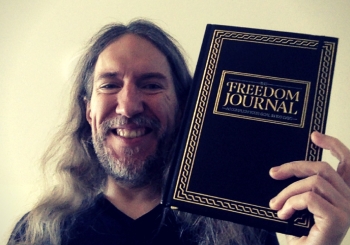
    Anthony Metivier with The Freedom Journal for memory improvement and language learning

    This also includes how you use The Freedom Journal and other note-taking devices and approaches for organizing life in our current ocean of information overwhelm.

    The simple process even applies to your memory training practice with Memory Palaces.

    In many ways, I’ve been applying a similar process for years, but Charles has streamlined everything into a kind of ars combinatoria that any mnemonist can quickly link to their hand for use with any information you encounter in life.

    Wouldn’t Evernote Cause More Digital Amnesia?

    It’s a great question.

    Illustration of man with brain on fire to illustrate digital amnesiaThe answer is…

    It depends.

    Digital Amnesia is a real issue, one that all mature learners in the 21st century face.

    But as Charles demonstrates beyond all doubt, it’s more about our habits around technology than anything else.

    In other words, we need to avoid the traps of technological determinism. We cannot blame the technology for how we behave. But we can use the technology to help ensure we operate in better ways.

    Can Evernote Provide Brain Exercise?

    Although we didn’t talk about this question on the interview, I’ve been thinking about it ever since.

    When thinking about brain exercise apps, memory experts are divided.

    As a question of application, I think this software certainly can be used for brain exercise.

    As a quick example, imagine using Evernote to capture all of the 00-99 images you create based on the Major Method for your PAO.

    Likewise, you could enter a number of mnemonic examples of Magnetic Imagery you’ve drawn and placed in a Magnetic Memory Palace for review in Evernote:

    Drawing of Magnetic Imagery mnemonic example for helping to memorize information

    Then, simply schedule in a review period that exposes you to your drawings without revealing the answers. This is a fantastic way to keep learning and give your brain an extra workout throughout the day.

    This process also provides a simple and direct way for you to challenge your brain without feeding it the information, all within a simple app.

    The trick is in making sure you have some “desirable difficulty” as part of the process so that you’re challenged. Sans Forgetica has been working in this area recently around reading, and using obstacles to move your memory forward is what personally applied Memory Palace science is ultimately all about.

    But if you’re looking for the best memory improvement exercises, just make sure that you match the desired outcome with the processes and the information that will get you there.

    Further Memory Improvement Software Discussion & Resources

    There are many other learning opportunities related to technology and memory on the Magnetic Memory Method site.

    For language learning:

    The Fluent Forever App

    How to Consistently Get Quick Victories With Language Learning Courses

    For General Technology and Human Memory Discussion:

    7 Reasons Having A Memory Implant Would Really Suck

    MyQuest For Your Memory Improvement

    Why I Only Read Physical Books Instead of Digital Ebooks

    In all cases, the danger I see above all in discussions like these is the human element. Whether its “organic” memory techniques like the Memory Palace or a software, we always risk too much self-involvement with the information.

    So after listening to this podcast with Charles Byrd, I encourage you to think about how all of these strategies apply to you getting more out of your human relationships.

    To that end:

    I’d love to hear your thoughts and more about your memory improvement journey in the comments below.


    How To Train Your Memory By Phil Chambers [Memory Improvement Book Review] Oct 04, 2018
    Show notes

    If you want to know how to train your memory, the journey to greatness begins with recognizing something odd about that brain between your ears: You sometimes forget enormous things! That’s how Phil Chambers begins his fantastic book, How to Train Your Memory. When you start your memory improvement journey by acknowledging just how easy it is to forget where you parked your car, you start from practical realities we all face. After all, vehicles are the biggest things we own apart from our homes. Yet, the location of a car can still easily disappear from memory! Acknowledging this fact gives us a sense of just how strange and mysterious an entity you’re dealing with. Of course, there’s something even bigger than cars and houses we forget that How To Train Your Memory helped me recognize, but we’ll get to that in just a bit. First, let’s talk about: Why You Should Learn How To ImproveMemory Recall From Memory Expert Phil Chambers It’s a good question, and a delight to answer. First off, Phil’s a great writer. When learning how to improve memory and concentration, clarity matters. Second, Phil’s got street cred. More than being a leading memory expert, he’s the Chief Arbiter of the World Memory Championships. We talked a few years ago about what this role involves in the interview called Phil Chambers and the Outer Limits of Memory. Phil is also one of the few memory trainers who has thought deeply about combining Memory Palaces with Mind Maps. He is a World Mind Mapping Champion, after all, and author of the incredible guide, 101 Top Tips For Better Mind Maps. https://youtu.be/VW6O2okqmO4 And if that wasn’t enough, get this: Phil has taught memory improvement and mind mapping alongside Tony Buzan himself for many years. In fact, I made it a point to attend a live Thinkbuzan training and learned more than I ever would have dreamed possible. Having them both in the same room is a blessing you won’t want to miss! Why Memory Training Is The Best Way To Improve Memory And Concentration I remember taking courses with the filmmakers Atom Egoyan and Peter Greenaway while studying at the European Graduate School. Both of them have encyclopedia knowledge of Film History. But because I know how to convert semantic memory into episodic memory, I listened to those lectures differently than my fellow students. Sure, I took notes using my approach to note taking. But using the same tools Phil talks about in How to Train Your Memory, I remembered tons of names and details simply because I was actively connecting imagery with the information as the professors spoke. And I was able to do so even though I was star struck to be in the same seminar rooms with these legends of cinema. Kind of like how I was star struck to be in a room with Phill and Tony! In other words, using memory techniques help you zone in on details by using association that pushes away distractions. Phil explains why and how association works. He also gives additional tips and examples that will help you. One skill in particular that you’ll get better at after reading this book is the one that matters the most: The ability to convert abstract information into concrete images better and faster. How does Phil’s book help you develop this skill? Each chapter gives you exercises to complete. And you really should complete them. In fact, getting a physical copy of How To Train Your Memory will help make sure you complete the exercises. I talk about why I’ve been reading only from physical books for memory training here: https://youtu.be/er-k8Ecgdfo (Oh, and physical books make it easier to use the Major System to memorize page numbers so you can easily find good passages you want read again.) When Acronyms For Learning Help Your Memory Excel &When They Lead To Failure One of my favorite parts of How to Train Your Memory is when Phil Chambers lays out the pros and cons on using acronyms for memory training. Basically, it comes down to calculating the margin for error. The same thing goes for using rhyming as a memory technique. Sure, it can work, but when using mnemonic devices, too many things can go wrong. Why? It comes back to the science of memory: If you don’t convert semantic information into episodic memory through the use of mental imagery, you will find it harder to reproduce. But there is one acronym that Phil gives us that demonstrates when this technique is super powerful, and I’d like to demonstrate how and why. The acronym is SEAHORSE. You’ll need to read the book to learn the memory training lessons packed into that single word, but when you get it right, you’ll have the keys to the memory improvement kingdom permanently locked into your mind. The reason why this acronym works so well is that: 1. The mnemonic acronym SEAHORSE creates an image. You can picture the creature in your mind. 2. SEAHORSE creates an image that looks like a part of the brain that plays a huge role in memory. This is the hippocampus, which is names in Greek after its resemblance to the animal. (Hippo = horse and kampos = sea monster). 3. You can connect the SEAHORSE acronym to the author himself when you realize that the name Phillip (i.e. Phil Chambers) relates to the word hippocampus. How To Use A Mnemonic Acronym In A Memory Palace As I’ve already shared, I’ve met Phil Chambers in a room. In fact, Phil and our group turned that room and its surrounding area into a Memory Palace. Now I can use it again and see where Phil sat in the room. I can place the image of a Seahorse over his head to remember the acronym. I can also place as a hippopotamus with a horse’s mane over his left shoulder and a camping tent over his right shoulder. These images remind me of the Greek word origin of hippocampus. I am encoding both the sound and meanings of these words by converting facts into images. These images automatically receive episodic memory characteristics. This “transfer” happens because: There is a story behind why I was in that room. The stories I know about Phil The “image-story” of why a hippo would have a horse’s mane in the first place (it’s because the seahorse in his brain is driving him insane…) This image-story takes just a few seconds to generate. And yes, my brain is aided by the fact that I’ve met Phil and I’m drawing upon neurochemical changes. This is why you should focus on drawing from your own experiences too. It’s related to the multi-sensory memory experiences fellow memory expert Nelson Dellis talks about in Remember It! Then, by charting out 8 Magnetic Stations throughout the room, I can then layer on some Magnetic Imagery for the parts of the acronym itself. For example, the first word of SEAHORSE is “Senses.” In the corner of the seminar room, I can see Superman. He is tasting his hearing aid while blind and suffering from a belly ache. Why? Because a blind Superman tasting a hearing aid while in pain reminds me of most of the senses. I can even change his name to Super-Sense-Man to tap into the cognitive mode of the mind and memory and seal the deal. All that needs to happen next is to move to the next station and create a memorable image for the acronym word that starts with “E.” The Fullest History Of The Major System In The World I’m a huge fan of the Major System and use it every day in the memory training I use based on memory training techniques from around the world. Even if it feels invisible, the Major (or Major Method) is actually behind the 00-99 I use for phone numbers, playing cards, birthdates and everything based on digits. I learned a lot from reading Phil’s take on both the history of the Major and how he mixes it with the number-shape technique. Why is the history of our tradition so important? Easy: Knowing the story of the memory tools you use gives you even more mental connections and imagery! In terms of the actual technique, Phil points out something that I try to make sure everyone understands: The techniques you use for competition are not necessarily the same as the ones you would use in every day life or for large learning projects. Before I continue, let’s review the Major Method. There are some variations and different approaches to the Major System, but this arrangement is quite common: Now, for many people learning how to memorize numbers, this approach will be more than enough for daily life. Except… How do you deal with 3 digit numbers without creating a 000-999? Phil demonstrates exactly how to do it in ways that I do all the time. For example, 358 would be the mail man based on the Major and a snowman based on the number-shape technique. For me, 35 is the mail man Mr. McFeely from Mr. Rogers Neighborhood. So I just see him shoving envelopes into Frosty the Snowman. However, here’s the problem: In a competition setting, the context might tempt you to mix and match the Major with the number-shape technique and impoverish your results. And that’s exactly what happened to me when Phil gave us a number memory test. I was half-using the Major and half-using the number-shape approach. In real life, when you have time to review your images and re-shape them when needed, no big deal. But when the heat is on during a competition, there simply isn’t time. You are working at the level of practical strategy. Both involve what Phil describes as “creative innovation.” But in the case of competition, you need your mnemonic systems set up and well-practiced in advance for competition purposes. Learning life is usually – though not always – more forgiving. Mind Maps For Memory Training & Memory Improvement? One of my favorite parts of How to Train Your Memory involves the limitations mind mapping has for memory improvement. Phil explains the ins-and-outs clearly and continues giving incredible tips. And the best part is this: The book includes a number of his own mind maps that explain the memory techniques taught in the book. It’s also a great supplement to Tony Buzan’s Mind Map Mastery. In sum, Phil gives you a decision matrix for knowing when to use mind maps for memory and when to go to more dedicated techniques and strategies. More and more, I’ve been thinking about what I’ve learned from him about mind mapping and often impose a “mnemonic clock” on the page built from the Major so that each position has a ready made image. For example, 12 is Tin Tin, 13 (one-o-clock) is J. Edgar Hoover vacuuming the Hoover Damn with a Hoover vacuum, etc. Although this approach is a bit rigid, as Tony Buzan said while I trained with this Dynamic Duo of memory improvement, “The Rules Will Set You Free.” And as Phil makes clear, the context in which you choose the rules you will follow matters the most above all. Why You Need To Read How To Train Your Memory Memory training is a bit of an odd world. On the one hand, there are many books you can read and be set for life. You just need to keep using the techniques you’ve learned. On the other hand, there’s always more to learn and top performers in every field constantly revisit old ideas and scour the world for new angles. Plus, we simply don’t know what we don’t know. That’s why I’ve was delighted to re-experience some familiar concepts through a new lens in How To Train Your Memory and learn things I didn’t know before. I highly recommend you do the same. Oh, and about that issue with people forgetting things bigger than their car or their house. It’s this: People forget to pursue their passions. That’s even stranger than forgetting where you parked. And if your passion involves the need for better memory (how could it not?), make sure you read How To Train Your Memory by Phil Chambers.

    Full show notes at the publisher

    Nelson Dellis On Remember It! And Visual Memory Techniques Sep 27, 2018
    Show notes

    Nelson Dellis Featured Image For Remember It Interview Magnetic Memory MethodWondering if Remember It! is the memory improvement book you should read?

    Take it from me, the answer is yes.

    For one thing, the book excels at making what memory techniques are and how they work truly visual.

    No kidding:

    Remember It! is the most visual memory improvement book I have ever seen.

    Even better, Nelson shares his unique way of using the Memory Palace technique to get the best results for both competition and learning.

    You’ll also appreciate the visual memory techniques in Nelson’s new book for the way it will help you avoid getting lost in the technical details involved in memory techniques.

    That doesn’t mean the book skimps on details, however. In many ways, Remember It! is like an illustrated mnemonics dictionary.

    Remember It! Book Review At a Glance

    Author: Nelson Dellis

    Primary Goal: Teach you the best memory techniques for learning anything.

    Best For: Students, adult learners, anyone seeking memory improvement.

    My Verdict: ⭐⭐⭐⭐⭐ (5/5). This is a powerful memory improvement guide everyone should read.

    Pros: The illustrations make even the most robust memory techniques simple to understand.

    Cons: It might not include examples for how to apply the techniques to what you want to learn.

    Now that you know the book is great, you might be asking yourself…


    Who is This Nelson Dellis Anyway?
    Some Kind Of Memory Champion?

    As a matter of fact, yes.

    And he’s got some of the best memory improvement tips in town. Here’s a quick summary of some of the best:
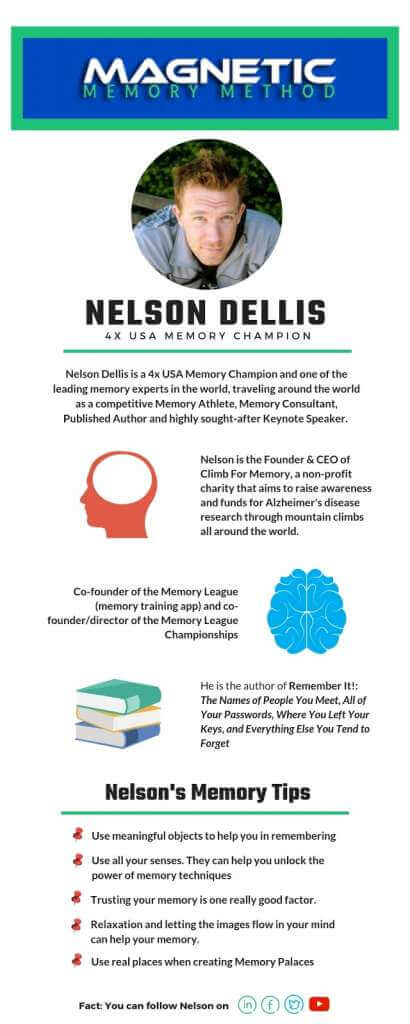
    Nelson Dellis Magnetic Memory Method Infographic


    You see? Nelson’s even inspired me to up my game and get more visual too. Hence this infographic summary. Thanks Nelson!

    More Reasons I Find Nelson Dellis Inspiring And Influential
    For The Life-Long Study Of Mnemonics


    Nelson Dellis is a 6x USA Memory Champion, memory athlete, memory consultant, published author and highly sought-after keynote speaker.

    Nelson is also the Founder & CEO of Climb For Memory, a non-profit charity that aims to raise awareness and funds for Alzheimer’s disease research. He does this through mountain climbs all around the world.

    Nelson approaches memory techniques scientifically and as part of living a good and healthy life.

    Additionally, he’s written Everyday Genius, Memory Superpowers and regularly runs the Everest Memory Masterclass.

    If you’d like to learn more of the memory techniques Nelson has crafted for himself and how imagination can play a big role in your memory improvement, download this podcast now.

    No. Wait. First do this:

    Order a copy of Nelson’s new book, Remember It!

    Oh okay… still not convinced?

    Press play now and you’ll discover:

    • Exactly what inspired Nelson to write down his approach to championship-level memory techniques
    • How the visual memory techniques illustrated in Remember It can help you better understand memory techniques
    • How to make use of all your senses for memory improvement
    • The importance of establishing and keeping trust in your memory
    • How physical objects can help your memory
    • Different ways of managing Memory Palaces and making sure they are truly visual
    • The true meaning of “Multiple Memory Palaces” and why you must create a number of them (never rely on just one)
    • How to use the “Body Peg List” in an interesting way
    • How the alphabet can help in remembering
    • Tips on quick memorization for when you just have to Remember It!

    If you want to see inside Remember It and just how visual it is, check out this video:

    https://youtu.be/B1pyM4r1Ev0

    3 Reasons Nelson’s Visual Memory Techniques Are The Best You’ll Encounter

    Let’s face it:

    1. There are thousands of books and programs on memory improvement.

    But never before has anyone gone to any great length to make their mnemonic examples leap from the page.

    Nelson does.

    And this is very powerful because you sense through your eyes what needs to be happening in your mind.

    2. Even if you have aphantasia, Nelson’s book will help.

    This is because Nelson makes it clear that memory techniques are always visual for all people, and all people are visual. Yes, no matter what.

    But he also makes it clear that you need to make your approach multi-sensory.

    And he gives you great ways to dive in and experience memory techniques. The visual prompts make it difficult not to want to give them a try.

    3. Nelson is aware of the real value of memorization techniques.

    It’s not just about winning prizes, learning languages or conquering your exams at school.

    It’s about conquering life itself.

    And to do that, you’ve got to bring the body and the mind together.

    Should You Buy Remember It?

    In a word, “yes!”

    Remember It will become your go-to book for ideas, inspiration, guidance and strategic know-how.

    You’ll discover the best mix of scientifically proven visual memory techniques with practical application in both memory competition and in life.

    Grab it from your favorite local or online bookseller now and then reach out and let Nelson know loud and clear that you appreciate with a review on Amazon and a follow across his presence on the web.

    Well… What are you waiting for!?!

    Get started with these resources now! 🙂

    For More On Nelson Dellis:

    Nelson Dellis’s website

    Remember It on Amazon

    Climb for Memory

    Nelson Dellis on Twitter

    Nelson Dellis on Facebook

    Nelson Dellis on YouTube

    Related Episodes on the Magnetic Memory Method Podcast:

    The 3 Most Powerful Memory Techniques For Memorizing Numbers

    5 Memory Palace Examples To Improve Your Memory Training Practice

    System For Remembering Cards? 13 Reasons You Should Have One

    Remember Names At Events: Quick Start Guide To Memorizing Names

    Extreme Memory Improvement With Memory Champion Nelson Dellis

    Did this Memory Champion Just Use “Remote Viewing” to Read My Mind?


    Teach Yourself Using The Best Language Learning Books By Olly Richards Sep 20, 2018
    Show notes

    Olly Richards Teach Yourself Author Portrait Best Language Learning BooksLooking to teach yourself a foreign language and need the best language learning books? Let me introduce you to my friend Olly Richards.



    Well, they’re aren’t necessarily.

    Unless they’re built by someone who deeply understands the needs of language learners.

    Enter Olly:

    He’s the man behind the new Teach Yourself Short Stories For Beginners series.

    He’s also the man behind the hit blog and podcast, I Will Teach You A Language.

    But still I hear you asking…

    Why are his short story books the best language learning books?

    Well, here’s just one reason that Olly mentions in this episode of the Magnetic Memory Method Podcast:

    “A book that is on your lap, and is exciting and contains lots of stories that make you want to read, is a an unbeatable source of continuous learning in the language.”

    How does a book make you want to read?

    That is exactly what you’re about to find out.

    Even better:

    In this episode, Olly Richards gives us interesting tips and techniques about language learning through his great new Short Stories for Beginners language learning books.

    Discover The Best Language Learning Books
    From A Master Polyglot And Learning Expert

    Olly Richards is the founder of I Will Teach You A Language and speaks 8 languages. He started learning his first foreign language at age 19 when he bought a one-way ticket to Paris.

    Olly Richards Teach Yourself Best Language Learning Books
    And now you can discover the keys to quickly and easily learn any language with Olly by selecting the most effective language learning books.

    Press play now and you’ll discover:

    • Simple techniques to learn new languages quickly
    • The power of story in language learning and how to choose the best language learning books
    • The important skills your need for learning any language fast
    • How to develop reading skills in the language
      Short Stories Teach Yourself Best Language Learning Books By Olly Richards
    • How to get confidence in speaking a language
    • How to learn a foreign language by growing your vocabulary in a simple way
    • Techniques for improving your comprehension (remember, bilingualism is good for brain exercise and brain health)
    • Simple short stories for beginner level learners
    • How to find fun resources for learning new languages
    • Tips to keep you motivated in learning the language
    • Great for those studying to conference interpreters

    It was also a great honor to be invited to read from Short Stories in German during Olly’s Festival of Reading:

    https://youtu.be/y50t1Fu_SQc

    It’s been awhile since I’ve had a chance to speak in German, but it seems like my memory for this beautiful language is holding up. So grateful to have some cool stories to read auf Deutsch – thanks Olly!

    To be one of the first to get Olly’s new series of books, claim up to $777 in language learning courses now.

    Further Resources For Language Learners:

    About Olly Richards

    Olly Richards on Amazon

    Olly Richards on YouTube

    Follow Olly on Twitter

    Related Language Learning Episodes:

    Olly Richards Talks About Language Tech And Real Communication

    Stoic Memory Improvement Secrets For Language Learners

    The Freedom Journal For Language Learning


    Mind Map Mastery: 10 Tony Buzan Mind Mapping Laws You Should Follow Sep 13, 2018
    Show notes

    A lot of people search the Internet for Mind Map software. And that’s great… provided they’re getting it from Tony Buzan. Most especially when you’ve read his book, Mind Map Mastery. Why read this book? First of all: No one else alive has thought so thoroughly through this incredible technique for externalizing the brain and interacting with it quite like Tony Buzan. Even better, no one else has shown so thoroughly how: A proper Mind Map boosts creativity. How Mind Mapping as a practice improves memory. How the process of mind mapping sets you mentally free (more on that in a bit). It gets better too because… No one has given more Mind Mapping examples than Tony Buzan. And in Mind Map Mastery, Tony Buzan provides exactly what the subtitle of this book promises: Mind Map Mastery is Your Complete Guide to Learning And UsingThe Most Powerful Approach to Mind Mapping in The Universe! I know that sounds exaggerated, but here me out because in this extensive book review, you’re about to discover: * Why Tony Buzan’s Mind Map Mastery delivers on this promise * Why making your thoughts visible eliminates mental exhaustion * Why colors create mental focus and energy * How simple limits create an infinity of ideas * How a proper Mind Map can serve as a Memory Palace * Bonus: How to fuse a Tony Buzan Mind Map with the Major System! If all that sounds good to you, please read every word on this page. I promise I will earn your agreement that Mind Map Mastery by Tony Buzan is the most important book in the world! The Future Of Mind Mapping Begins With The Past Tony Buzan begins Mind Map Mastery with a short history. And in case you’re wondering, yes, “history” is the right word. Buzan taught the skills and benefits of mind mapping for a very long time before writing Mind Map Mastery. Just check out this video from 1974: https://youtu.be/LnYVJKxyRPM This video is from the same year Use Your Head appeared. This is what one of its many book covers looked like: As he explains in Mind Map Mastery (released 44 years after Use Your Head!), the Mind Map emerged from an understanding of the brain as a spatial arrangement of neurons. But That Realization Didn’t Happen Overnight! And Buzan drew upon other influences to arrive at this powerful conclusion. For example: Buzan’s understanding of the method of loci was integrated into mind mapping. Buzan also encountered the Major System from day one of university. (The Major is also spatial in many ways. More on that with these 3 Powerful Memory Techniques For Memorizing Numbers.) With the method of loci that underlies the Memory Palace technique and the Major, Tony Buzan brought the first Mind Map to life. Yet… there was a problem! How Tony Buzan Solved Problems With The Early Mind Map As Buzan reflects, his first Mind Maps had problems. In his words, they were “monochromatic, monotone and monotonous.” Worse… he struggled to answer this question: Is Mind Mapping Note-Taking? In short, no. Far from it. In essence, Buzan had revolutionized note-taking. But for Buzan, this was not good enough. So Tony Buzan did what all great innovators do: He showed the technique to others, particularly learners left behind by the system. Next, Buzan observed how these learned used his early mind maps to improve their lives. Finally, Buzan took his observations back to the Mind Mapping process so he could improve the technique. How Tony Buzan Mind Maps Mimic The OrganicBrain Better Than Any Software As we know from many great geniuses, solvitur ambulando. That phrase means, “it is solved by walking.” And solve the problems with mind mapping by walking is exactly what Tony Buzan did: To help himself understand more about why his early Mind Maps were helping people, he walked in nature. As a result, thoughts about how to better “mirror” the cellular nature of the brain on paper emerged. Radiant Thinking Observing the Mind Maps combined with walking and reflecting led to revelations about “Radiant Thinking.” By giving people a means of connecting thoughts on paper like the brain connects ideas through cells, Mind Mapping broke free from note-taking. Like the brain when it is operating at its full power, “Radiant Thinking” through Mind Mapping is: Multi-faceted Colorful Associative Multidimensional Verbal and Pictorial Imaginative and Analytical Isn’t that exciting! Imagine being able to think in these ways all at the same time without the costs of multi-tasking! The good news is this: You can! Tony Buzan Use Your Head Secrets Mixed With The Laws Of Mind Mapping For all of these accomplishments, there was still a problem… No matter how clear the instructions… Some people are teaching Mind Mapping without understanding the method. Instead of following the Laws of Mind Mapping, they are calling other techniques like these mind maps: Spider Diagrams Pyramid Diagrams Concept Maps Fishbone Diagrams Sunburst Charts To be clear: None Of These Techniques Count As Mind Maps! Look, there’s nothing wrong with using such visualizations, but to call them Mind Maps can never mirror the human brain cell. Think about it: What does a spider have to do with mind mapping? With human thought? With human memory? Spiders are fantastic, but if we know one thing about human memory and learning going back to Ad Herrenium, it’s that metaphors matter. For that, I’m glad Tony Buzan wrote Mind Map Mastery to help correct the record. He reminds us of the Laws of Mind Mapping. He refocuses our attention on why they mirror the neuron, the central location of thought. The Natural Reason Why Mind Maps Must Have A Central Image Like a brain cell, a Mind Map must have a center. Without a central image, your Mind Map has no focus. Without color, the Mind Map lacks power. Imagine going on a walk through nature in black and white. A Fishbone Diagram built from straight-lines has nothing to do with the curves of human thought. Concept Maps are usually overloaded with words (I am often guilty of this). As a result, they quickly become unwieldy, awkward and collapse. Without care for balance and distribution, a Pyramid Diagram places your focus on concentrated areas. These do not help your brain create new solutions or remember more. Would You Like An Abundance Of Mind Mapping Examples? Tony Buzan demonstrates the validity of his claims with nearly two dozen examples. The images in Mind Map Mastery are just as they should be: Clear Balanced Colorful Keyword focused Evocative Understandable at a glance Compelling Easy to emulate as you create your own How Mind Map Mastery Helped Me Improve My Practice To be honest, I’m like a lot of learners. I get a few tips and put them haphazardly into play. This is NOT a problem. If anything, it is a blessing. But no serious, mature learner can stop there. You’ve got to return to the well of knowledge and refine your practice. Here’s a Mind Map example from 2015 shortly after I met Tony Buzan at a ThinkBuzan training. Then I recorded a chat with Phil Chambers about how to combine Mind Maps with Memory Palaces. So, what’s the problem here? After all, I used this Mind Map to: * Write a book * Turn the book into a video course * Launch the course successfully with Jonathan Levi. (This Mind Map is the first brainstorm of what became a course called Conquering Content that we placed in our online program, Branding You Academy.) Yet, for all that success, there are quite a few problems with my mind map. The Whole Mind Map Is Overloaded (For One Thing) Yes, there are colors, but… I had attended the ThinkBuzan training to learn about memory. We did a bit of Mind Mapping, but I was so focused on the memory aspect (and not embarrassing myself) that not all the lessons got through. And I’m just one of those learners who need to go back to the well and refine my practice through repeat exposure. For this reason, I still reread one book per month. But… I had yet to go back to THE ultimate book on mind mapping I’d read as a kid. This lapse happened mainly because I was revisiting Buzan’s books on memory. And I hadn’t quite learned enough Chinese to read him in Mandarin, even if he was suddenly following me everywhere! My lack of attention to the Laws of Mind Mapping was tragic. It meant that I wasn’t getting nearly the results that I could have been. So even though my mind mapping was successful, it was still dampened. Then came the incredible announcement of Mind Map Mastery. I ordered it immediately. The wait inspired me to revisit Mind Mapping in earnest. Perhaps pretentiously, I released this video: https://www.youtube.com/watch?v=7DjtAAZcw6k But what I’m talking about wasn’t advanced at all! Though there is one virtue evident in every word I speak in the video. Here’s why: I was advancing my skills and practice by taking it one S.I.P. at a time (study, implement, practice). Then, when Mind Map Mastery finally arrived, I started reading it. I applied what it said, and before you know it, my Mind Maps improved! Here’s a Mind Map example from one of the best YouTube Livestreams I’ve ever held: (If you want to watch this replay and join future live streams, here’s the memory improvement books ultimate list hangout replay for you. Click subscribe and choose to be notified so you can join us next time we go live.) What made this mind map better than any I’d created before? The answer is simple. I just followed… How to Mind Map Using The 10 Laws Of Mind Mapping One: Blank paper in the landscape orientation. Why is blank paper so important? I believe it’s because the chemical makeup of the brain is more closely related to paper than, say, computer. Also, the inner landscape of the mind is unlined. If you use lined paper, you are placing a barrier between your thoughts and the laws of mind mapping. Landscape orientation is critical as well because we see the world horizontally more than vertically. Peripheral vision is freer left-right than it is up and down. I also believe landscape orientation allows for greater mirroring of another essential structure: The clock. It is the clock formation that lets us instantly turn any Mind Map into a Memory Palace at a glance. Two: Draw a central image in the center. Tony Buzan says that the central image should feature at least three colors. It’s a subtle point and one that I’ve missed many times. I look forward to putting it into practice many times in the future and observing the improvements. The image should express your core concern with the Mind Map. Three: Different images should appear throughout the Mind Map. You should also use dimensions, such as drawing some of your keywords in 3D. Four: Keywords should be capitalized. For some reason, this is one of the toughest laws for me to follow. Maybe I read too much e..e. cummings when I was in high school. 😉 I’m not sure why Buzan thinks this should be the case, but certainly capitalization communicates importance to the brain. And of course, we have to consider that not all mind maps have words at all. For example, I mind mapped my business with Tony and there no words on it whatsoever, yet it’s been incredibly effective: For that reason, I suggest you take this rule under consideration, but not necessarily to the point of following it blindly. Five: Each Keyword should have its own “branch.” This Law helped me squeeze far more from my Mind Maps. It’s counterintuitive for a wordy sound-conceptual person like myself. But the constraint works because it creates pressure on the keyword and your mind. Think of it this way: When you look at a clump of sentences and start reading, you’re assisting your memory in a way that turns it off. Why should you remember what your Mind Map encoded when you can just read what you said? But when you have a keyword, you give your brain a creative memory workout. This minimally assisted response to keywords is brain exercise par excellence. Six: Your Branches Should Flow And Taper If you look at an image of your brain’s neural networks, you’ll see precisely the tapering Buzan wants you to benefit from when creating your Mind Maps. This law isn’t dogma. This correspondence to nature isn’t the totalitarianism of a control freak. It’s the firm insistence that Mind Mapping mirrors your brain on the page. The closer you bring your mind and the Mind Map together in structure and flow, the more your creativity and memory perform. Seven: Balance The Length Of Your Branches The point about balance is another recommendation that needs more of my attention. But I think by following the other suggestions, adherence to this one happens naturally. Eight: Use A Ton Of Colors When I got back into Mind Mapping, I struggled with this as well. After all, choosing colors can create a bit of decision anxiety. Questions like these might arise: Which color should I use? Is green really appropriate for this idea? What if I make a mistake? Sure, there’s a reason the brain pumps out these concerns. Barbara Oakley explains it well in Mindshift. But if you dive in and start to practice the Mind Map technique, you’ll find you automatically make the right decisions. Nine: Emphasize Points With Arrows And Lines Connecting the different branches with arrows is one of my favorite parts. For me, it’s like a “meta” Mind Map and corresponds with the Rhizomatic nature of the Magnetic Memory Method. These measures, when combined, kick De Bono’s lateral thinking up a serious notch. Ten: Maximize The Clarity Of Blank Space/White Space Perhaps the most compelling Law involves the use of blank space for clarity. In other words, you need to let your Mind Maps breathe. I never used to do this, which slowed me down. Now, when mind mapping my YouTube videos and blog posts, like this one, you can see that I’ve made much more use of white space. It lead me to much better results thanks to doing so. How To Continually Improve Your Mind Mapping Practice To improve, I just started creating more Mind Maps. As with the Magnetic Memory Palace Network, you benefit more (and faster) by working with multiples. This approach gives Mind Maps and Memory Palaces more space for your brain to fill-in-the-gaps. This pointer also circles back to Buzan’s point that the Mind Map should be useful at a glance. If there is no breathing room and no blank space, you stifle your success. But when you leave enough space between your branches: “Your brain negotiates these gaps to understand where you are and where you are going. “ How To Bring The Mind Map, Major System and Memory Palace Together First of all, don’t even get started unless you are on the path with well-formed Mind Maps. Yes, I have some discoveries to share. And yes, they will work without precision. But if I could turn back the hands of time and start all over again, I would have my Mind Mapping strategy in order first. Especially in the context of these sensory memory exercises. That cautionary note aside, here’s what you can do if you know the Major Method: Once you have that committed to memory and are fluent in using the Major: Imagine that your blank page is a clock. Limit yourself to twelve branches or less. Create your central image and radiate your twelve branches from the center starting at 12 o’clock. Since the Major System tells most of us that 1 is D or T and 2 is N, mentally impose or draw that symbol at the 12 o’clock. Do this after you’ve created the branch. Not: Personally, I never draw my Tin Tin image. That’s where the Keyword goes. After you complete the branch, think about how your Keyword can interact with your Major System image. For example, if my keyword is “Ancient Greece” and my sub-branches involve Thales and Simonides, I will think of them all in a fistfight with Tin Tin. But more than think of them, I will use all the Magnetic Modes to “Magnetize” them into my memory. To make the relationship between the Mind Map and the Memory Palace “Magnetic,” I will touch upon the Magnetic Memory Method Principle of CAV KOG(S) and the Magnetic Modes: Conceptual Magnetic Mode Audit…

    Full show notes at the publisher

    Can You Really Improve Memory Like Sherlock Holmes? [Actionable 11 Point Checklist] Sep 06, 2018
    Show notes

    Imagine receiving thousands of emails from people asking you, “Can you really improve memory like Sherlock Holmes?” What would you tell them? Would you say… “Oh yes, of course. Just use the best memorization technique all the hip kids are using these days.” Or would you say… “Sorry. Too busy. I must go to my Mind Palace!” Well, as the man with all the memory exercises and memory improvement know-how… I have to take a third path. And I always give people an answer that breaks my heart! But here’s the truth of the matter… You Can’t Improve Memory LikeSherlock Holmes Because…The Dude Isn’t Real! Seriously. How can any honest and ethical person tell you that such a thing is possible? How can you create a Memory Palace (or Mind Palace) like Sherlock Holmes and experience substantial memory improvement when that person doesn’t exist? And yet other memory trainers use this metaphor all the time. They use it as their “marketing hook.” That’s right. And even if it’s false advertising, it works. But what those marketers are really saying is something more like this: “Hey, how would you like to memorize information like a fictional coke addict who walks with a cane?” Worse: “How about becoming like someone who treats his sidekick Watson like a dim-witted moron?” No thanks. I don’t know about you, but… I Want Real Memory Improvement! And as much as I’d like to stop the misrepresentation of the real glory of memory techniques, the world of marketing is what it is. Unless you know how to memorize these classical copywriting headlines. So… I suggest you remember Caveat Emptor in the wild world of online memory training. But here’s the very good news: If you want to know about a memory method that really will help you improve memory, you’re in the right place. After all, memory isn’t really at the core of Sherlock Holmes. Here’s the real deal: It was medical deduction for the diagnosis of disease that influenced Arthur Conan Doyle, not detective work. And it’s this kind of medical detective the books and movies really base themselves on. All that aside, here’s what we’ll be doing in this Sherlock Holmes continuation post: I’m going to provide you with an 11-Point checklist that will make sure you’re on the right track. Are you ready to get started? You are? Great! Let’s go! The Ultimate 11 Point Improve Memory Checklist So with all that ground covered, let’s get started with the ultimate checklist for improving your memory. Do all these things and you’re guaranteed to have a memory sharper than you ever dreamed possible! 1. Learn the Memory Palace technique first. Why? A few reasons. First, there are a lot of terms out there for the different memorization techniques you can learn. But the Memory Palace is the only one that taps into the most significant memory power: Spatial memory. Second, the Memory Palace enables you to use the other memory techniques you’ll learn about inside them. I’m talking about the link method, the Major System, the mnemonic peg system and so on. There are lots of terms and we’ve clarified them in this post with 5 Memory Palace Examples To Improve Your Memory Training Practice. Why seek so much clarity? So we can master the fundamentals first. That’s how the Magnetic Memory Method ensures you can actually use the skills for life. Without struggle. Without constant questions about what to do and how to do it. Without fear of making mistakes at every corner. The Major Path To Fast Success With Memory Improvement 2. Learn the Major System. “The Major” as the memory technique veterans refer to it involves associating numbers with letters of the alphabet. The Major has also been called the phonetic mnemonic system and the digit-consonant system. Whatever you call it, here’s what it looks like: Why learn to memorize numbers? First, even in the age of smartphones and online calculators, they’re still super-important. You still need to know the phone numbers of your loved ones in case you lose your device. Not only that, but when you create a Magnetic Memory Palace, you can give each Magnetic Station within a number. That way, when you’re using the Memory Palace to encode and decode the information, it’s easy to move directly to the information you placed inside. Once you have the Major System working, you’ll also be able to: Remember passwordsBank account numbersHistorical dates and birthdaysAppointmentsAddresses… and anything else involving numbers! To make this happen, you’ll want to create what some people call a P.A.O or a 00-99 list. If you’d like more information, I’ve included my own mnemonic examples in How to Memorize Math, Numbers, Simple Arithmetic and Equations. How To Memorize History:Mnemonic Example Of How Having A “Magnetic” 00-99 P.A.O. When you have a proper 00-99, any time you see a number, you instantly have a Person, and action and on object pop into your mind. This simple mnemonic tool is better than any vitamins for memory improvement on the market. For example, I wanted to memorize some dates about George Washington not too long ago while reading Richard Brookhiser’s book on Washington’s leadership skills. According to Brookhiser, Congress made Washington Commander in Chief of the military in 1775. This post lasted until 1783. I instantly memorized these dates by placing some Magnetic Imagery in a Memory Palace. The mnemonic examples I used? First, I used my image of George Washington himself. I’ve seen paintings and stone carvings of the dude, so I have a relatively decent idea of how he looks. How To Mix Major System P.A.O. Mnemonics For Historical Dates Second, I needed to remember that 17 is involved because these dates took place in the 1700s. To do that, I have George Washington equipped with some very sharp tacks. In the Major Method, 1 = d or t and 7 = k. Put those two together to form a word like “tack.” Next, to this image of George Washington with tacks, I have him shoving these into John Cale. Yeah, that hurts, and that’s why it’s memorable (Sorry John Cale!) Now, you might not know John Cale or his loose relationship to the history of binaural beats via Lou Reed, which is why you need to get into real memory training. It will help you instantly create these associations when you need them. The point is that Cale (pronounced “kale”) starts with a hard “k” sound and ends with an “l.” That’s perfect because all I need to do is think of George Washington putting tacks into Cale in my Memory Palace and then I can recall 1775 in a snap. Just Get Started And The Rules of The Major System Will Set You Free You can do this too if you dive into these techniques and start creating your associations from 00-99. Don’t overthink it. As my mentor, Tony Buzan says, “the rules will set you free.” Briefly, I know this period for Washington ended in 1783 (according to Brookheiser) because, in the same Memory Palace, I can sense George Washington interacting strangely with George Orwell. George Orwell wrote “Animal Farm” and he is spraying “foam” at the cast of “fame” in this image. Why? Because F = 8 in the Major System and 3 = M. “Farm,” “foam” and “Fame” all compound together to make the association bulletproof. Brookheiser tells us that the actual Washington presidency took place between 1789 and 1797, two numbers I now know by heart. Why? Well, as strange as it is: I see Cobra Commander with his viper symbol bashing Peter Parker with a puck. Viper = 89Parker/puck = 97 It’s that simple. Every 2-digit number has an image like this. All that needs to happen in your mind is this: Get them interacting in weird and unusual ways in a Memory Palace. With a small amount of practice, you’ll learn to remember vast amounts of information. Ever hear Sherlock Holmes talk about doing stuff like this in his “Mind Palace?” No way, hombre. Sherlock Holmes isn’t real. 3. Learn Recall Rehearsal (a.k.a. Spaced Repetition) You know why we call it “Recall Rehearsal” in the Magnetic Memory Method universe. A few reasons: First, it doesn’t count as spaced repetition. That sounds hard, annoying and… lame. Second, a well-formed Magnetic Memory Palace Network is like a series of theaters. In these theaters, you call your players for “rehearsal.” So when I ask my mind about the dates for George Washington’s terms as a military commander and the first President of the United States… I’m NOT replaying a movie. No, I’m a theatre director. I know which theatre the play takes place in and I call my actors to the stage. Then I ask: What were they doing there? Why? How? And other questions to trigger back the associations. And I do it only as many times as needed to get the information into long-term memory for as long as I need the info. But spaced-repetition… I find it’s a waste of time without Magnetic Imagery involved. Plus, Recall Rehearsal puts the Magnetic in the Magnetic Memory Method by making it easy, fun and effective. And it’s the only way to develop a mnemonics dictionary in your mind for instant and rapid use of memory techniques. Dominic O’Brien And The Rule Of Five With practice, you can reduce the number of repetitions needed to a shockingly low level, though of course, Dominic O’Brien’s Rule of Five is worth your attention, but… Don’t go wishing and praying for a magic number. Learn these skills for yourself and the principles that make them work. That’s the fast and easy path to real memory magic. And it’s better than even the best improve memory games on the market. But some other guy’s “memory system” or spaced-repetition number will never be as robust as your own. Earn the success you want through experience. It’s a beautiful thing. More on How To Improve Memory Recall Better Than Sherlock Holmes Now that you know the truth about using a Memory Palace and use it to place information into long-term memory, here are some additional tips that will help. Pay attention to each of these because they are essential to your success. These tips are critical to the long-term health of your brain and memory. 4. Eat a memory-friendly diet. It’s true: Foods that improve memory – and foods you should avoid – can make or break your memory. Walnuts, blueberries, green tea – these have all been shown to give your memory a boost better than any improve memory supplements on the market. 5. Exercise. I go to the gym three days a week. It keeps my body fit, as well as my brain. The best part? I’m able to perform Recall Rehearsal while pumping iron and hitting the treadmill. I also walk frequently and do pushups and yoga at home. Every bit of fitness helps protect your brain and memory. 6. Reduce Multitasking (Except when using the particular form of multitasking in a Memory Place we’ve been talking about today.) Seriously. People who want to learn faster are damaging their chances of success by holding multiple open tabs and reading from devices enabled with notification options. Speaking of which… 7. Sleep Without Devices In Your Room If you want to improve your memory, improve your sleep. It seems unrealistic these days, but it’s getting more important every day: We need to unplug from the Internet. We need time away from the machines that use algorithms to shape what we see and how we think. Personally, every time I stray from my computer curfew… I regret it. Not only does my memory suffer… I make bad decisions. I get a bit paranoid. I feel less well. By protecting the bedroom and using my re-reading strategy with real books, I create a buffer zone around my sleep that works very well. https://www.youtube.com/watch?v=er-k8Ecgdfo Oh, and I use a sleeping mask too. Highly recommended. 8. Use app-free brain exercises Brain exercises are important. And the best evidence shows that when you use apps to get it… You’re getting horrible results. The only ones ever shown to work in any impressive way set you up with one-on-one coaching on the other end. In other words, it’s not the app alone getting you the mental fitness results. But if you’re willing to learn some of these brain exercises, you’ll quickly find boosts in focus, attention and memory. I’ve shared many exercises to improve memory and concentration, so please be sure to listen to the Magnetic Memory Method Podcast frequently so you don’t miss any of them. 9. Learn new mental and motor skills. The obvious suggestion here is music. Pick up the guitar, piano and French Horn. But it could also be painting where you learn about shapes, lighting and the color wheel. Or you could learn to juggle, code a website or learn a language. There are many things you can do. The important thing is to take action and get results. 10. Know the difference between mild forgetfulness and full-blown memory loss Every person must take full responsibility for the state of their memory. Just as we monitor our heart rate and respiration, we need to put thought into the functioning of the mind. To understand this critical difference, I’d start with listening to this memory loss with Jennie Gorman. She was able to recover her memory quickly with just one simple tweak. It’s the kind of solution many people would never think to investigate. Then there’s brain trauma. Listen to Michael Gusman talk about how he used memory techniques to overcome these issues following a nearly fatal car accident. Continuing to educate yourself about the role of memory in your life and the health of your brain is indeed your best weapon. 11. Learn to use a variety of mnemonic devices (and never stop) If there’s one thing we can find legitimately inspiring in the Sherlock Holmes stories, it’s that the dude seems to keep learning. And more than learning, he keeps thinking about the things he knows. So although no one can improve their memory to be like an unrealistic fictional character, you can be you. Better: You can be the best possible version of yourself. All you need to do is keep learning how to use your mind. That’s what the Magnetic Memory Method website is here to help you accomplish. Are You Ready To Take Your Skills To The Next Level? If so, pick something you want to learn that will improve your life. Now you have the tools to learn it quickly and easily. And when you need more information on how to improve memory for any learning goal, remember to come back to the well. The Magnetic Memory Method Family will be here for you.

    Full show notes at the publisher

    The Real Data You Should Know About Cogmed For Brain Exercise Jul 12, 2018
    Show notes

    Portrait of Christine Till a memory expert on the Magnetic Memory Method PodcastHave you ever wondered about apps like Cogmed for brain exercise and memory improvement really work?
    So have I.

    And here’s the reality:

    It is really difficult coming up with a clear answer when you read the research about general brain fitness and memory in the scientific literature.

    Here’s the great news:

    On this episode of Magnetic Memory Method Podcast, you’ll hear from Dr. Christina Till.

    Dr. Till is an Associate Professor in the Clinical Developmental Area in the Faculty of Health at York University.

    As she shared her scientific research on memory, multiple sclerosis (MS), Huntington’s disease and other areas of mental cognition, this point leapt out at me:

    “My dream study [would] combine the benefits of physical activity with cognitive training. To maximize brain growth, we should be doing both.”

    If you’d like to peer behind the scenes of how memory research is conducted with softwares like Cogmed in the mix and what the conclusions really mean when it comes to improving memory , download this podcast episode now.

    And get ready to dive deep because there’s a ton of substantial information you will learn from Dr. Till’s research and work and how scientists develop their studies and draw their conclusions.

    Press play now and you’ll discover:

    • How Christine came to be interested in memory.
    • What “environmental enrichment” means and how it can help you improve your memory.
    • What Huntington’s disease is and how it degenerates the brain over time.
    • The early manifestations of the Huntington’s disease.
    • The conditions or immune triggers that have been implicated in increasing the risk of Multiple Sclerosis (MS).
    • The metaphor goal suggestion with “machinery” when it comes to the brain and memory.
    • How the cognitive network of the brain gets injured. (This may or may not relate to memory issues from other forms of brain trauma.)
    • Why some people’s cognitive performance can remain stable at early stages of disease.
    • What the term “memory reserve” means and how it can be measured.
    • How cognitive training and certain cognitive activities can help your memory.
    • How the software called “Cogmed” helps people with cognition training.
    • The reasons for choosing “Cogmed” out of the number of programs for Christine’s study.
    • The conclusion of Christine’s research study and what it really means for memory.
    • The power of meditation and linking physical activity with cognitive training.
    • What’s coming up next for Christine and where can people learn more about her research and work.
    • And a special video interview with Christine:

    https://youtu.be/f95sFa53aIo

    Alternatives To Cogmed For Brain Exercise

    On this episode, I mentioned to Christine that I was learning to juggle and recite the alphabet backwards.

    Here’s a demonstration of this simple brain exercise and how you can learn it without any frustration by following a few simple principles:

    https://youtu.be/lGEuP-ls5hA

    Part Two:

    Christian decides to share his juggling chops while reciting a poem in a video response:

    https://youtu.be/_yx3goqUJYQ

    And then another follow-up with coins!

    https://youtu.be/JCD_GU1zV4o

    Enjoy (and send us your video too if you’ve got one so we can feature your authentic brain exercise techniques)!

    And if you’re supporting a loved on with cognitive decline, see my specialized Guide to Memory Games for Dementia.

    Further Resources on the Web, This Podcast and the MMM Blog:

    Christine Till Profile profile on York University’s website

    Memory training points to new directions for treatment of Huntington’s disease

    Why Bilingualism Makes For a Healthier Brain

    The 3 Best Teas for Memory, Focus, Concentration & Brain Health

    Binaural Beats And Memory: Can This Crazy Music Make You Smarter

    The Wise Advocate: Become a Better Leader of Your Memory


    8 Reasons You Need A Flexible Memory Method Not A Memory System Jul 05, 2018
    Show notes

    Have you been looking for a memory method you can use to learn and remember difficult information? I’m talking about foreign language vocabulary. Programming codes. Charts and diagrams. Passwords. Names of people from around the world. And do you keep running into promises about how someone’s “memory system” will help you achieve your learning goals? Maybe they offer you some brain exercises. Or maybe they promise the keys to the memory improvement kingdom with a mnemonic peg system or some other list of mnemonic devices. The BIG Problem With The Memory SystemsOf The Memory Improvement Gurus There’s nothing wrong about checking out mnemonic examples from memory experts you admire. Except this: Anytime anyone tells you that their “memory system” will work for you… Run away screaming! Why? Because memory systems don’t work! Instead, you work the systems. And you’ll do that a lot better if you create the systems yourself (with a little authentic help from your Magnetic Memory Method friends). It’s kind of like singing and playing the guitar. Bringing the two together is a lot easier when you wrote the song. And the results are much more powerful. Why A “Magnetic” Memory Method Always OutperformsThe Other Guy’s Memory System So here’s what’s up: On this page, I’m going to explain exactly why what you really need is a memory method (not some other dude’s system). And not just any old method with memory exercises and memorization techniques. What you need is a “Magnetic” Memory Method that lets you combine all of the memory techniques available into a streamlined approach. You don’t need all kinds of confusing terms and mnemonic examples. You need to execute your moves in one swift blow each and every time you encounter information. When you have this approach, I think you’ll be pleasantly surprised by how much your memory skills can grow. Which means that the pain and frustration of forgetting information within seconds disappears. If you’re ready, let’s dive into the 8 reasons having a memory method is the only approach that makes sense. Reason #1:Each Person’s Memory Is Unique And Needs A Unique Memory Method Flexibility is what makes the teaching on this memory improvement blog unique. Anyone can use the memory techniques I teach because you learn about yourself as you discover the methods so that everything fits into place quickly. Why is figuring out how you stand so important? A few reasons. First, memory techniques rely upon association. You’re taking information you don’t know and Magnetically weaving it together with things you already know. For example, when learning some Chinese poetry, I wove the corner of a building together with some weird imagery that made it easy to recall the sound and the meaning of the phrase. The images involved Lee jeans, a kite, E.T. (The Extraterrestrial), a burning cup of yen, Emil Zola, Che Guevara and sheep. I Know That Sounds Like A Mouthful Of Mnemonic Examples! But here’s the thing: All of these images came to me freely and quickly because I have a memory method. It’s trained to be flexible, and that’s why it works so fast. What exactly have I trained? Speedy access to the same kinds of information each person has available to them now: A Proper Memory Method Digs Deep Into Your Personal history By using a flexible memory method, you can easily access a host of friends, family members, teachers, preachers and other members of your community. I suggest listing them all out frequently. It’s a kind of memory improvement game you can play with your childhood anytime. A Proper Memory Method Exploits Your Personal Culture You also have your culture. I often draw upon Canadian politicians. These are names that an international audience might not recognize, but that are deeply impressed upon in my memory. But I’m Canadian and so memorizing the Canadian Prime Ministers makes a lot of sense (maybe, lol). Even if you’re not into politics, I’ll bet you have at least a couple local and regional figures you can bring to mind and use to make simple associations. Having them ready will help you improve your memory for studying a great deal. Why Everything You Already Know Is Dying To Become A Memory Tool Then there are musicians, actors and artists. These are all part of your culture. Only a flexible memory method will help you unpack them all. Some other guy’s system? That’s probably the same guy who encourages you to memorize with a “Mind Palace” like Sherlock Holmes. (Yawn…) Sorry, but the very suggestion that your memory can be like a fictional character’s is fraud. How about you be you and use Sherlock Holmes as a Magnetic Bridging Figure in a well-formed Memory Palace instead? Reality is far better than fantasy when you have a substantial memory method, that’s for sure. You can go even deeper into your toy collection, video game collection and personal library if you wish. And I recommend that you do. You are unique and the more you unpack all of the wealth of material already in your mind, the more you will succeed with memory improvement. Reason #2:A Proper Memory Method Helps You Avoid Learned Helplessness Perpetually on the hunt for shortcuts and memory hacks? Totally normal. The only problem with the perfectly understandable human desire to put the cart before the horse and succeed is that memory involves learning. Learning takes place in time. There is almost always a curve towards mastery that begins with initial exposure and leads to – not mastery – but the maintenance of mastery. I don’t care if you’re Da Vinci or Jimmy Hendrix: If you don’t maintain your skills in any area of talent, you’re going to lose them. Why “Mastery” Is Just The Beginning Of The Memory Journey In many ways, mastery is just the beginning of the journey. You only truly start to understand your craft after you get good at it. After the doors of perception open wide because you’re getting results using the memory techniques. Because you’re creating your own mnemonic examples. Using the real deal. Not memory techniques anyone else handed you. Techniques you crafted on your own using a method. The Truth About Greedy Learners Hunting For “Hotel Dominic” Take Dominic O’Brien, for example. He’s known for a lot of things. Hotel Dominic, the Dominic System, and winning multiple World Memory Championships and other competitions. He may not agree with this assessment, but as I interpret what I’ve learned from him, he had a goal. He learned the techniques. He sat down and created all the figures he needed to remember numbers and cards with a highly personalized P.A.O. How The Internet Creates Damaging Learned Helplessness He shared some examples to get people started and serious students of memory improvement worked out the rest on their own. Enter the Internet. Next thing you know you’ve got thousands of people begging for his list, Ben Pridmore’s list, my lists, etc. They want the fish, instead of learning how to fish for themselves. Maybe I’m just jaded, but here’s the problem with giving too many mnemonic examples: You can never create enough to solve the fundamental question of understanding the why and how we use these images based on our unique qualities and experiences. Understanding how to tap into that rich pool of references in each person’s life (see point one above) is the ONLY thing that’s ever going to authentically help. Use A Memory Method To Create Your Own Memory System Or Go H.O.M.E. Otherwise, as longtime supporter Alex of this site (J.A. on YouTube) says, “Go H.O.M.E.” It’s funny pun and paradox that mixes the acronym technique with an important message: Huge Outcomes Means Exercising. And to get the outcomes memory training can create for you, please exercise your mind with a proper memory method. I know, I sound hardcore. Perhaps even dogmatic. But I’m sharing just one of several stoic secrets for using memory techniques that I know will help you faster. How To Create Your Own 00-99 P.A.O In A Flash Speaking of having a bunch of images for the digits 00-99, here’s all you have to do: Learn the Major Method to create your own system. Create a Magnetic Bridging Figure for each two digit number from 00-99. Start small at first. Work from 01-10. Then 11-20 and so on. You don’t have to create them all in a single day. Use pen and paper. As Sharon did: Notice that Sharon didn’t try to get it perfect the first time. Sharon just took action after taking my card memorization course in the Magnetic Memory Method Masterclass. (Like you should too if you want to experience incredible memory improvement fast). Taking action is essential because: Reason #3:A Proper Memory Method Goes Beyond Method of Loci TrainingBy Creating Connection, Comprehension & Understanding As Tony Buzan told us on this episode of the Magnetic Memory Method Podcast, there are multiple intelligences. A proper memory method helps you bring them together. Magnetic Stations replace the Method of Loci and you can add a Major System 00-99 character to each if you wish. And as you develop one aspect of the memory method you choose, you’ll quickly discover other levels you want to learn. Music mnemonics may come to mind. Or languages. Or philosophy. Nothing will be out of reach as you continue to grow your skills. Tony Buzan’s Incredible Memory Improvement Formula And growth can be constant. In Buzan’s classic, The Memory Book, he gives this formula: E + M = C ∞ It breaks to the idea that Energy + Memory = Creativity Eternally. And although each of us will eventually pass on, I think he’s right about the eternal part to a degree. After all, as long as good people like us keep the mnemonic tradition alive, it will be passed down through the generations. And that means you and your influence truly can be eternal. Speaking of which: Reason #4:A Method Based On Multiple Memory Improvement Books Involves You In A Powerful Tradition Not everyone knows this about Aristotle, but he wrote a book about memory. I wrote a commentary on it which is available with the original text in English and my commentary. In this commentary, I connect Aristotle with Plato’s thoughts on memory before him. And then I connect the Magnetic Memory Method to more and then more and then more. Why did I do this? Because there’s so much untapped knowledge about creating the best memory method on earth to be found in writings about memory from the past. In fact, the more I read the tradition, the more my memory improves. And that’s important because it translates directly into the help I can give students of the Magnetic Memory Method. And it’s not just Aristotle. Here are some other figures from history whom you may not have known used memory methods: Simonides of Ceos The unknown author of Ad Herrenium St. Augustine Matteo Ricci Giordano Bruno And that’s to mention some interesting contemporary figures. I’ve already mentioned Dominic O’Brien and Tony Buzan, but there’s also: Doctor Yip Florian Delle Nelson Dellis Jonathan Levi Alex Mullen … plus, all the exciting things going on with technology with people like Gabriel Wyner for memory and language learning through the Fluent Forever app. The list goes on and on, and the direct benefit is that this tradition provides an endless wealth of inspiration and new ideas. Reason #5:Memorization Techniques Based On Methods Create Learning Flexibility “Be water, my friend.” Wise words from Bruce Lee. This principle matters for your memory improvement journey with memory techniques because information is like the wind. And your brain is often like a brick wall. Ever seen how the wind can pick up a tree and toss it against a building? Suddenly that big and tough brick wall doesn’t look so tough anymore, does it? But if it had been water, it could move out of the way and possibly even used both the tree and the wind as a tool for its own purposes. So when you’re looking for the right memory method to help you learn and remember the information that will pass the exam or scratch that language off your bucket list, make sure it’s flexible. No difficult information ever has to break your mind again. Reason #6:Brain Health Starts As An Idea You Need To Remember A lot of people are worried about Alzheimer’s and Dementia. For good reason: Memory loss is a severe and life-destroying pain in the butt. It doesn’t have to be a serious disease or brain trauma that drags you life down either. Lack of focus and concentration sucks too. And when you’re worried about these problems and the memory loss from stress they cause at work, your sleep suffers. How To Avoid The Punishing Hell Of Poor Memory You probably don’t focus nearly as much attention to your diet, and physical fitness as you should. As a result, things spiral further down into the hell of poor memory. Luckily, having the right memory method can help. Not only will you perform better in your studies and at work. You’ll also remember your to-do lists. You’ll remember which foods that improve memory you should be eating. You’ll remember the exercises you should be doing at the gym. When you can keep your focus on all of these matters and consistently follow through, your memory will naturally experience a boost. Reason #7:The Right Memory Method Creates Belonging Did you know there are entire communities of people who use memory techniques? They have a special lingo. You’ve read some of the terms on this page already. But there’s more to discuss: The Roman Room The Link Method The Pillar Technique “Ghosting” The Ugly Sister Effect The Telesynoptic Memory Palace Yeah, okay, it can get a bit nerdy from time to time. But that’s what makes it fun! You don’t have to know all the terms. Certainly, no one is going to exclude you from the club if you don’t understand. Far from it! Everyone who takes their memory methods seriously will help you understand everything from The Wardrobe to the Millennial P.A.O. Once you’re in the club, you’ll find a host of friends who share your interest in learning and remembering without the hassle of forgetting. Why Friendships With Mnemonists Improves Your Memory These friendships will help you find inspiration and accountability. They’ll help you experience a sense of belonging. They even challenge you from time to time. They’ll help you accomplish the ultimate benefit of having a reliable memory method of all. Reason #8:A Life Devoted To Learning How To Memorize Reveals The Truth The main reasons I use memory techniques and teach them so passionately come down to this: Mnemonics saved my life. I was depressed, about to drop out of university and intensely suicidal. Being able to remember complex philosophical terms and make progress on learning a language gave me hope, confidence and courage. It also enabled me to live the life of my dreams and travel the world. It allowed me to visit the statue of Bruno in Rome many times pictured above. He was a man who died for the truth and you can hear all about in this interview with Scott Gosnell about Bruno’s powerful memory improvement book. And as I learned about how meditation helps improve memory, I added this tool to my daily practice of mental improvement. You Can Easily Memorize The Truthful Information That Genuinely Improves Your Life Later, I applied my ability to learn and remember my goals of optimizing my health (big thanks to Jonathan Levi for mentoring me on the specifics. Also on bitcoin and generally what I need to learn and remember about finances.) And eventually, I started to use the memory techniques I’ve been honing for my personal practice and teaching to memorize Sanksrit. There still exist ancient tomes of philosophy that contain special formulas for scrubbing the mind clean of fear, worry, doubt, and stress. Sure, I still fall prey to these things once in awhile. But thanks to memorizing lines from the Ribhu Gita provided by Gary Weber in Evolving Beyond Thought, I feel more aligned with reality than ever before. The tradition is sometimes called Vedanta, or Advai…

    Full show notes at the publisher

    How Jessie Villalobos Got A Promotion – Magnetic Memory Method Review Jun 21, 2018
    Show notes

    Portrait of Jesse Villalobos Magnetic Memory Method Review and Testimonial

    This is perhaps the best Magnetic Memory Method Review online so far:

    “The more you try it, the better you do. Every attempt is incrementally better than the last time.”

    -Jesse Villalobos

    Since constant improvement is what the memory method taught on this website is all about, I was delighted to hear these words from one of our course participants.

    Even better:


    In this episode of the Magnetic Memory Method Podcast, you can hear them directly from Jesse Villalobos too.

    Scroll up and click play. Listen in we talk about:

    • How Jesse based his PAO system on the Major Method for remembering numbers…
    • Jesse’s Magnetic Journey using the PAO system (Person Action Object)…
    • How Jesse used this approach to get a raise and a promotion at his job!

    Of the many tips you’ll discover, here’s one of the most important points:

    Jesse keeps listening to the Magnetic Memory Method Podcast for motivation week after week. Yes, even though he completed the Magnetic Memory Method Masterclass.

    This point is important. Jesse’s approach combines a solid study ethic and continually feeding himself with ideas and inspiration.

    And when Jesse started, he was serious about getting results. He wanted to get really good at memorizing numbers.

    His success secret?

    Taking action!

    It’s not just about learning about memory techniques. It’s about applying them in meaningful ways one S.I.P. at a time:

    S.I.P.

    Study memory techniques

    Implement memory techniques

    Practice memory techniques with information that improves your life

    It’s this approach that helped Jesse get the mastery over the Person Action Object (P.A.O.) and Major Method that he wanted. These are the techniques that lead to total success with memorizing any number.

    Aside from remembering numbers, Jesse also learned how to remember names and faces. This skill provided other unexpected benefits from memory training that Jesse hadn’t even anticipated!

    If you’ve been looking for an extra bit of insight about how the Magnetic Memory Method can help you, try Jessie’s advice:

    Just dive into learning and using memory techniques.

    Download this episode and learn from Jesse’s experiences and insights. You’ll learn exactly how improving his memory has helped his personal confidence and well-being.

    Press play now and you’ll discover:

    • How memory techniques help Jesse in his work. It involves remembering a lot of numbers.
    • Why using memory techniques is an “out of body experience.”
    • Jesse’s feeling about how he gains more energy than he burns using memory strategies.
    • Mnemonic examples of a well-functioning Person-Action-Object system to memorize numbers based on the Major Method.
    • The process of how Jesse created his Magnetic Memory Palace Network and how it all works in detail.
    • The importance of drawing your Memory Palaces for total success.
    • How Jesse handles problems with ghosting or the Ugly Sister Effect.
    • How Jesse discovered the Magnetic Memory Method and what it has brought to him both personally and professionally.
    • How Jesse got a raise and promotion. By demonstrating competence, his co-workers started perceiving him as an expert thanks to Magnetic Memory Palaces and memory techniques.
    • A family-related memory issue that encourages Jessie to keep his mind active.
    • The positive influence of listening to Magnetic Memory Method Podcast over time.
    • Jesse’s perspective on avoiding perfectionism and still getting the most out of his sensory memory.
    • Other memory improvement books and courses that really impacted Jesse.

    Do you have questions about how the Magnetic Memory Method can help you perform better at your work?

    Do you want more answers to your questions about mnemonics?

    If so, please dive into the episode and learn more about how you can get on a call with me. If you want me to help you transform into a walking, talking mnemonics dictionary, I’d like to help.

    Further Memory Improvement Resources:

    Harry Lorayne

    Get Good At Remembering Numbers

    How to Memorize Numbers With A PAO System [Person Action Object]

    Major System Secrets And The Future Of Your Memory With Florian Dellé

    Want More Magnetic Memory Method
    Reviews, Testimonials and Student Interviews?

    Lee Escobar’s Magnetic Memory Method Review and Testimonial

    Paul Deery’s Memory Improvement Demonstration and Magnetic Memory Method Review

    The Magnetic Memory Method Testimonials and Reviews Page

    Rose talks about memorizing the Hindi alphabet

    Marno Hermann talks about memorizing 1200 digits of Pi

    Sunil Khatri talks about Memory Palace Mastery for Japanese

    Kevin Richardson talks about memorizing 30 Kanji per day


    3 Effective Brain Training Exercises for Mental Illness Sufferers May 23, 2018
    Show notes

    Would you like some brain training exercises to keep you sharp and on top of your game all the time? I hope the answer is a resounding, “Yes!” Here’s why: Conditions such as mental illness and aging contribute to mental decay. All the more so if you’re already suffering from mental illness, not to mention the medicinal side effects of psychiatric medicine. These medicines, even when useful, can cause your memory a lot of harm. Here’s the good news: Losing control over your cognitive functions can be hard, but it doesn’t need to happen. There is a way to avoid cognitive decline, and all it involves is training your mind. In this post, you’ll learn everything you need to know about brain training exercises to help keep your memory healthy. All About Brain Training Although many people believe that brain training is a modern invention, it actually has a rich history. To take one example, check out the brain training exercises admired by the Edwardians nearly 100 years ago. In fact, mnemonic systems were all the rage in 19th century Great Britain. Famous author Mark Twain even had one called “The Memory Builder”. Then there’s Pelmanism. Like the brain exercise training favored by the Edwardians, Pelmanism is a product of Great Britain, and became very popular during the first half of the 20th century. Get this: More than 500,000 people reportedly used these brain training exercises. One of them was the Prime Minister of the country himself! Why was it so popular? First, the system revolutionized brain training because it targeted the same mental functions we focus on optimizing to this day: Attention Concentration Creativity The Pelman Scientific Mind Training Program focused on each of these to help people exercise their minds. Participants were mailed monthly booklets with games and exercises designed specifically to stimulate one or more of these functions. All of which goes to show that brain training and the memory exercises that go with it aren’t new. And of course, Anthony is always coming up with different brain exercises you can explore. Check these out: https://youtu.be/qaiF3DL-ens Even better: Here are 9 Brain Exercises That Ensure Memory Improvement. We have even more scientific evidence than ever to guide us these days. Modern neuroscience has managed to prove beyond any shred of doubt that our brains are in fact malleable like plastic. In fact, we all have to ability to modify the structure and functions of our brains. Of course, a lot depends on the internal and external factors of our lives, such as other bodily processes or environmental changes. But overall, every single person can intervene and create a better mental life. Sadly, though, cognitive decline is becoming increasingly common past the age of 30. One reason is that people don’t understand the difference between memory loss and forgetfulness. Nevertheless, slowing down the aging of our brain through training is a prospect that fills us with hope. And research shows that it’s completely achievable. However, if having a sharper memory is something you aim for, you need to know right now that it takes work. In order to remain in a constant state of connectedness regardless of whether you’re 30, 50 or 80 years old, you need to push your mind to learn something new each day. There is nothing more stimulating for your synapses than being put at work. In turn, this leads to tangible improvement in more than one aspect. For example, according to Dr. Jee Hyun Kim of the Florey Institute, focus diminishes with age. Due to this deterioration of focus, stimulating your attention regularly can be crucial. By activating the frontal cortex and the hippocampus, you are not working only on this function, but on your memory and thought as well. How Brain Training Can Increase Focus And Attention There are many ways to achieve better focus and attention. One possibility lies in a simple, yet intellectually stimulating mobile app. Similarly, reading new books, especially with a re-reading strategy, or solving math and logic problems puts all the areas of your brain to work and boosts cognition in the process. Then there’s meditation. You can do a walking meditation or sit just to sit Buddha-style for improved memory and concentration. And recent studies that will be discussed shortly suggest that it might even help treat mental illness. Treating Mental Illness With Brain Training Exercises Let me give you some context: I have spent the last couple of years researching alternative treatments for mental conditions that affect memory and cognition. Why did I choose this path? Well, three years ago, someone I care about deeply was diagnosed with schizophrenia. I have spent all my days since trying to educate myself on the topic as much as possible. In my journey, I have found that many specialists believe that brain training can help prevent degenerative neural diseases such as dementia or Alzheimer’s. And that’s not all. In fact, such practices can help with instances of mental illness as well. This comes as great news for the vast community of patients struggling with such afflictions. Recent medical science-related endeavors back up this seemingly bold claim. A study conducted at McLean hospital in 2017 has uncovered the potentially beneficial results of brain training in the treatment of mental illness, namely bipolar disorder in particular. The lead scientist was Eve Lewandowski, Ph.D., an assistant professor at Harvard Medical School and developer of McLean’s bipolar disorder and schizophrenia programs. According to Lewandowski, BPD affects the memory, processing speed and executive function of most of the patients who suffer from it. This impacts their daily existence and overall quality of life quite negatively. Therefore, working on improving cognitive dysfunctions is crucial for symptom relief in this case. And what better way to achieve that than through brain training exercises? Lewandowski’s research found that the participants who used techniques pertaining to this area exhibited visible betterment that was maintained for at least six months afterward, if not more. She got the idea after noticing how effective this approach was in keeping the symptoms of even more serious conditions such as schizophrenia under wraps. People going through the four stages of schizophrenia have exhibited visible improvement in their symptoms after cognitive therapy. In fact, previous trials conducted under the supervision of professor Barbara Sahakian of the Department of Psychiatry at Cambridge have shown that something as simple as playing brain-stimulating mobile games improves cognition among schizophrenia patients. And it helps in areas where drugs have previously failed, which is even more important to keep in mind. Just imagine how beneficial the effects could be if this would be tried in the long run. Lewandowski and her colleagues support the importance of acknowledging brain training as a viable treatment for mental illness. Modern psychiatry should recognize its merits and integrate it into the roster of available therapies. But until that happens, you can also try doing at home. To tap into the healing properties of this approach, you don’t need to download a mobile app or buy fancy books and puzzles to keep your mind sharp. There are plenty of mental techniques that you can try at home and see how they work out for you. Here are the best three. The Best Brain Exercise Techniques 1. Memory Palace If you’re looking to train your memory specifically, Anthony Metivier’s approach to the ‘Memory Palace’ technique is one of the best to get the job done. Famous historical and fictional figures alike, such as Hannibal Lecter from the renowned Silence of the Lambs book and film series are perfect examples of how this works. Association is the key to creating your own memory palace to walk around in whenever you need to retrieve certain pieces of information. When these have been assimilated long ago, you need to correlate each of them with a specific part of a location. A good starting point is your own house because it is familiar territory. For best results, draw out the floor plan of your first Memory Palace by hand. Like this: But before you start drawing, walk around your house first. Then, once your’e done, assign various memories to various rooms. To take it one step further, do the same thing but using objects within the same space. Fill your memory palace with everything you think is worth remembering, but make sure that you build a strong mental route in the process. How To Use The Memory Palace Technique When the time to remember the information comes, simply retrace your steps along that path. It will take some getting used to, and you will surely fumble at first. Nobody is born an expert, and when you’re dealing with cognition-impairing mental illness, it might be even harder. But practice makes perfect, and proper brain training exercises keeps your mind sharp too. Of course, things might not be as simple or straightforward. Sometimes, direct associations simply aren’t possible. This is where your imagination and the ability to create allegories comes in. For example, let’s imagine you want to remember something that has to do with a dandelion, a hose, and a Calico cat. You are standing in your living room and there is a dandelion on the table. You go up the stairs, towards your bedroom. A hose is hanging on the door. You enter, and the most adorable Calico cat is sleeping on your bed, purring. You have now memorized this sequence by simply making associations between its elements and actual, palpable places in your house. 2. Mind Mapping The concept of mind mapping is a slightly similar one, but it is far more schematic and two-dimensional. In fact, it consists of a visual outline that starts with one core concept and then branches out into information that relates to it. Some people prefer to do this on paper because they find it stimulates their assimilation of the notions even better. Such a diagram can represent anything, from words and concepts to more specialized information such as tasks that need accomplishing. And if you’re not a fan of writing it all out, you’ll be happy to find out that it can be used in combination with the Memory Palace technique. The two have a very strong meeting point between them. In fact, you can listen to Phil Chambers discuss using mind maps and Memory Palaces together. Chambers, a world mind mapping expert, mind maps serve even more complex purposes. A mind map follows all the principles of memory, but it also helps you think. But memory palaces are better for actually remembering information, while mind maps are more suitable for processing and understanding it. The two are sometimes useless when not together. For this reason, finding a middle ground that includes mind maps into your memory palace can be a great way to stay sharp and on top of your game. Furthermore, together they stimulate more essential areas of the brain, thus preventing premature decay. 3. Dominic System The Dominic mnemonic system is one of the most famous brain training techniques in the world. It was designed by famous British mnemonist Dominic O’Brien, who also happens to be an eight-time World Memory champion. Most brain athletes use it nowadays to memorize long strings of digits for competitions. So, why is it so effective? Just like the Major system associates numbers with sounds, the Dominic system notoriously does a similar thing by assigning them the initials of a person’s name. It’s a highly effective person-action system that can be combined with the memory palace technique, thus creating the Hotel Dominic, as many experts lovingly call it. https://www.youtube.com/watch?v=vEATw9J-ppE But O’Brien’s contribution to the world of brain training doesn’t stop here. He also famously established that the strategical recalling of information following a five-step pattern is the best way to cement said information in your brain. This should happen in the following order: • The first review takes place immediately;• The second review follows it 24 hours later;• The third review then happens one week later;• One month later comes the fourth review;• And finally, the fifth review occurs a total of three months later. Thus, in the span of roughly four to five months, you will be able to remember anything. By sticking to this routine, you will be able to fight the cognitive decay that many mental illnesses bring, too. When your schizophrenia or bipolar disorder are playing tricks on your mind, relying on a strict pattern to memorize relevant information can be a true lifesaver. Final Thoughts To sum up, it must be noted that medical science is just now starting to look more into the beneficial effects of brain training. Cognitive dysfunction can be caused by many things. These range from something as naturally occurring as old age to more complex issues such as schizophrenia or bipolar disorder. Fortunately, practicing one or more of the brain training exercises discussed above can be beneficial. It is something that can help you refocus and even excel when it comes to memory and thought patterns. As a short recap, these are: • The Memory Palace. This famous approach is based on making associations between physical locations and various pieces of information. The best way to build the memory palace is by correlating them with specific spots around your home. The familiarity of the territory is prolific for this purpose. • Mind mapping. It consists of a series of diagrams that represent two-dimensional connections between concepts. Creating mental maps works best when used in combination with the memory palace. This activates more areas of the brain than the two would alone, thus preventing decay and enhancing performance. • The Dominic system. Focused on numbers, the Dominic system heavily relies on the connection between these and letters. These usually are the initials of someone’s name. When used together with the memory palace technique, it is known as the Hotel Dominic. That’s a cool name, but at the end of the day, it’s best taken in the context of the many pegword method options you have to choose from. These three techniques are equally efficient standalone as they are when combined. In order to choose what suits your needs, you will need to try them. Presentations and explanations can only do so much. Nevertheless, having this knowledge is essential for the future. If you or someone you love, as it happened in my case, are slipping down the slope of mental illness, take action now. Explore the possibilities given by brain training and build a better tomorrow.

    Full show notes at the publisher

    Previous 1 31 32 33 34 35 45 Next

    Related Podcasts

    Making Sense with Sam Harris

    1

    Making Sense with Sam Harris Education
    Grammar Girl

    2

    Grammar Girl Education
    Good Life Project

    3

    Good Life Project Education
    Explain It to Me

    4

    Explain It to Me Education
    Team Never Quit

    5

    Team Never Quit Comedy
    Optimal Living Daily – Personal Development and Self-Improvement

    6

    Optimal Living Daily – Personal Development and Self-Improvement Alternative Health
    footer-logo

    Contact Us

    Toll Free: 844-670-7747

    Links

    • Home
    • Top Charts
    • Networks
    • Apps
    • Independents Podcasts
    • Podcast Advertising
    • Podcast News
    • Contact Us
    • About Us
    • Analytics & Insights

    Stay Connected

      Privacy, Terms of Use & Our Code of Ethics Protecting Content Creators Copyrights