TopPodcast.com
Menu
  • Home
  • Top Charts
  • Top Networks
  • Top Apps
  • Top Independents
  • Top Podfluencers
  • Top Picks
    • Top Business Podcasts
    • Top True Crime Podcasts
    • Top Finance Podcasts
    • Top Comedy Podcasts
    • Top Music Podcasts
    • Top Womens Podcasts
    • Top Kids Podcasts
    • Top Sports Podcasts
    • Top News Podcasts
    • Top Tech Podcasts
    • Top Crypto Podcasts
    • Top Entrepreneurial Podcasts
    • Top Fantasy Sports Podcasts
    • Top Political Podcasts
    • Top Science Podcasts
    • Top Self Help Podcasts
    • Top Sports Betting Podcasts
    • Top Stocks Podcasts
  • Podcast News
  • About Us
  • Podcast Advertising
  • Contact
Not in our directory?
Add Show Here
Podcast Equipment
Center

toppodcastlogoOur TOPPODCAST Picks

  • Comedy
  • Crypto
  • Sports
  • News
  • Politics
  • True Crime
  • Business
  • Finance

Follow Us

toppodcastlogoStay Connected

    View Top 200 Chart
    Back to Rankings Page
    Education

    Anthony Metivier’s Magnetic Memory Method Podcast

    Learn, Memorize And Recall Anything Using Memory Techniques, Mnemonics And A Memory Palace Fast

    Advertise
    • Apple Podcasts
    • Google Play
    • Spotify

    Latest Episodes:
    How to Read a Book and Remember Everything Apr 19, 2023
    Show notes

    If you’re wondering how to read a book and remember everything, this is one of the most helpful tips I can give: Sit down, open a book and read. So many people dismiss this simple principle. They’re looking for hacks, when research shows that most good readers always cover the fundamentals. Of course, I have more reading strategies to share than just that. Six incredible steps in total. But isn’t common sense powerful? It is. And common sense is getting even more powerful as modern life get’s more distracting. Your competition on the professional market will always read more thoroughly, after all. https://www.youtube.com/watch?v=ze7qsdw7u-M The Basics Of Reading & Remembering In just a moment, we’ll talk about different types of reading, like elementary, inspectional, analytical, and syntopical reading. These are terms introduced by Mortimer J. Adler in his famous guide, How to Read a Book. But these terms are useless if you don’t: Schedule time to read Read according to demands of the genre Read based on clearly established goals Show up prepared with the appropriate tools for interpretation and analysis Be willing to read books slowly and completely as much as possible In sum, here’s what matters if you want to know the best way to read: You need to explore multiple ways of reading. That’s because there are multiple kinds of books. And when you have a toolbox of strategies at your fingertips, you’ll be able to read faster, remember more and even better: You’ll understand what you’re reading and become a person of knowledge and wisdom. You’ll make connections on the fly and experience multiple a-ha moments of revelation. Sound good? Let’s get started! The 4 Main Types of Reading (And Which Is the Best Way to Read a Book) Before we get started, ask yourself a simple question: What’s the point of reading? A lot of people try to imitate how others read. But they wind copying strategies that do not align with their goals. So reading more thoroughly and choosing a strategy always begins with thinking through your goals. Some reading goals include: Acing school assignments and exams Filling in gaps left by traditional education Developing personal wisdom Solving problems Expanding mental awareness Substantial reflection Identifying or creating opportunities for yourself Research as a profession Spiritual goals Leisure Each of these categories can involve multiple reading types. Let’s start with the oft-cited types identified by Adler in How to Read a Book. I’ll cover Adler’s main points, and after that, we’ll talk about how to read a book like a scholar so you can remember as much as you want. Why should you care what I have to say about reading? Well, I have a PhD, two MAs and am an author of many books. Most of those books involve tons of research. I’ve also taught reading and writing at three universities around the world, including for Rutgers where the legendary Kurt Spellmeyer was my boss. Oh, and I read every single day, completing 2-5 books a week on average. All kinds of books from fiction to philosophy, science and Zen. You name the category, and I’ll probably have read something that belongs to it. And if I haven’t, even if the category is crushingly complex, I’ll figure out a way to increase my IQ in that field to the best of my ability. All right, enough about my street cred. Let’s get started with Adler’s four main types of reading. One: Elementary Reading Adler says that this reading type hardly goes past basic understanding. You know what the words on a page say, and you can follow a basic plot. However, I think we need to add a very important point. Elementary reading is often directed reading. You’re told to do it by a parent or teacher. It’s the opposite of self-directed reading. And that’s a big problem. As the authors of Balancing Principles for Teaching Elementary Reading argue, one core value matters above all. Teachers and parents should strive to help kids want reading as part of their lives. Why is a passion for reading so important? Simple: true literacy demands are only going up as technology and automation increase. Not only that, but critical thinking is so important to the success of all people. In fact, there are 9 critical thinking strategies all people need, but if you only have elementary reading skills, you cannot develop them. And no, you can’t expect so-called microlearning to help fill in the gaps if you’re an elementary reader. Will inspectional reading get you there? Let’s see. Two: Inspectional Reading For Adler, inspectional reading is what most people now call skim reading. Adler seems to confuse it with scanning, which is substantially different. Don’t get me wrong. There’s nothing wrong with inspectional reading. As the authors of Reading as a Perceptual Process have shown, words can be skipped while scanning a book without the reader necessarily losing comprehension. However, the most interesting finding in the book is that how much you can still understand while inspecting a book may be linked to handwriting. For example, they analyse “target scanning,” which is stronger in those with decent handwriting skills. This means that if you never write by hand and are finding it difficult to grasp the meaning of books you’re skimming through using “speed reading” techniques, you might improve by practicing your longhand writing instead of typing. Whether or not doing a lot of typing helps your “target scanning” for any kind of reading on screens is yet unknown. But there are also aren’t a lot of people who have talked about inspectional reading from devices because digital books aren’t quite so easy to scan. Either way you look at it, I’ve chosen to read from print instead of digital. The benefits are too profound, especially when you’re using memory techniques. Three: Analytical Reading A lot of people worry that reading without understanding wastes time. I disagree. Rather, I read so that I might understand. After all, if I already know what a book is going to cover… why bother reading it? Well, Adler had an answer for that. He called it “superficial reading.” It’s technically part of inspectional reading, and not exactly the opposite of analytical reading. For example, you might be perfectly justified to read superficially if you’re just looking a book over to see if it covers anything new or surprising. But if you really want to dig deep into a book, you need tools of analytical thinking. Even if you’re familiar with the topic and the book is repetitive, you still need to perform what can also be called a “close reading.” What’s involved? A lot, frankly. Genre First of all, you want to understand the book’s genre or category. Why is this important? Because it will help you connect the book to other texts that directly relate to it or hold an important connection. Knowing the various fields of knowledge speeds up your pattern recognition. Classifying texts by their type is so important, I created an entire course about it called Genre Frameworks. Composition You also need to understand how the book is put together. This is called the form/content paradigm. In other words, how a book is written forms part of its ultimate meaning. For example, Plato’s Republic is a dialog. This formal aspect influences the meaning of the philosophical ideas in the text. They are discursive and combine objective and subjective reasoning in ways that only the dialog form can. Aristotle’s philosophy, on the other hand, is presented in direct prose. It is argumentative and designed to convince you that his points are valid. Paraphrase and Summary Analytical reading isn’t just about reading. Adler wants you to be able to restate the points in a book in your own words. Developing generally involves writing about what you’ve read. This is critical because A+ students get those grades by producing variations of assigned readings. Think of it like music. If you know a scale, you can play it forwards and backwards. But you can also perform the scale in your own style. I use the music metaphor because writing about what you’ve read should be combined with talking about it too. When you’ve properly analyzed a book, performing what you know is what you’ll be able to do. Whether it’s while sitting for an exam, giving a speech or just discussing between friends, your descriptions of how what you’re reading connects to the larger field and how its style impacts the meaning of the book will be a great achievement. For help with writing summaries that boost your understanding, I recommend How to Write a Sentence and How to Read One by Stanley Fish. Four: Syntopical Reading This term sounds fancier than it is. Basically it means that you read a number of books on the same topic. Then, ideally by paraphrasing and writing summaries, you can compare the output of those books. Not only that, but you can abstract the core ideas through contrasting different approaches to them. I do this frequently when I compare different Memory Palace books. What exactly should you compare between books using this type of reading? Publication dates Author backgrounds Why their books were written Their research approaches and resources Any ideological agendas or biases the authors hold Key passages Key vocabulary You also want to use this face to distinguish fact from opinion. When comparing and contrasting different authors on the same topic, you’ll find that some stick to science and evidence from their research. Others waffle on about ideas without providing substantial references. As the reader, you don’t necessarily want to discount opinion or even anecdotal experience. But you do need to place it in the context of other writers and how they approach the same topic. You could find that some anecdotal books that seem quite outlandish on the surface actually are backed up by science, even if the author of that book is unaware of it. How to Read a Book Properly in 6 Steps The points from Adler we’ve just gone through are solid. But he lived in a different time. The very definition of what a book is has changed. For example, when Adler wrote his book in the 40s and updated it in the 70s, contacting an author would involve writing to the publisher. These days, you can follow authors on Twitter, watch countless interviews with them, and often even get an email response to your questions. So with our era in mind, let’s talk about some other ways to read a book. I’m confident you’ll find them empowering. Step One: Schedule Reading I started this post with the notion that reading is as simple as sitting down with a book and starting to read. This is true. So rather than talk in greater detail about skimming, reducing subvocalization or all the other topics I’ve addressed in how to read faster, let’s focus on the importance of scheduling. There are many ways to schedule, but the easiest I find is to set simple rules. For example, when I’m not doing major research projects, I often use this rule: One hour of reading in the morning One hour of reading at night If I can squeeze in more reading during the afternoon, I certainly will. In the past, I have tracked my exact activities, which I find a lot more useful than writing to-do lists. I can memorize my schedule, after all. But each person needs to explore many kinds of scheduling to find what works best. But if one thing is common to us all, it’s that having some kind of rule will set you free to follow it. Without a rule, you are a prisoner of inconsistency. Step Two: Pace Your Reading For my research and personal development reading, I like to work in 90-day blocks. For example, when I first started studying Advaita Vedanta, I made it a rule to read only about this topic for ninety days. I wound up reading about it for longer than that, but this only proves the power of setting rules. They are productive. Plus, anything less than 90-days is unlikely to help your brain build enough connections to compare and contrast anything of substance. This science-based principle is the origin of what is now called Metivier’s Razor: Less than 90 days of study and practice of (almost any) accelerated learning technique does not deserve the phrase, “I tried.” In sum, pick a topic, identify ten to fifteen books that deal with it, and then for the next 90-days, plow through those books. For bonus points, follow-up with another 90-days on a related topic. For example, I followed my Advaita Vedanta research project with 90-days on hermeticism, then 90-days on Zen. This allowed me to not only compare multiple books within each topic area. I was also able to compare and contrast the topic areas as a whole. Give this style a try. You are effectively creating your own semesters that resemble what a course of graduate study at university would be like. Step Three: Interleave Reading Rarely do I read books from beginning to end without pause. The only exception would be novels. When it comes to reading non-fiction, there’s a very powerful strategy called interleaving. You will learn faster and remember more by reading 3-5 books at the same time. To interleave, you keep shifting between them. https://www.youtube.com/watch?v=3U34nJGuFvQ There’s no exact pattern you need to follow. Generally, I read between 1-3 chapters of a book before switching to the next. The books that are being interleaved are read until they are done. This is one of those rare speed reading techniques that actually works. Give it a try! Step Four: Capture & Organize Reading I don’t know about you, but when I come across ideas in books that resonate, I want to remember them. We’ll talk about memorizing key points in a moment, but I personally prefer to separate the process. One of the best ways to set the stage for memorizing information from textbooks is by taking notes on index cards. That way, each note is mobile. You can arrange them in multiple ways, which increases your ability to compare and contrast ideas. It also helps when you’re writing essays or books in the future. Step Five: Memorize Your Reading Once you have the information extracted, knowing what you want to remember is important. Generally, I suggest memorizing: Author names Historical dates Key ideas Key vocabulary Verbatim passages I’m very glad I did all these things, especially during my university years. During my dissertation defense, to take one example, one of the examiners claimed that I had hardly written about Nietzsche. “Where’s the Nietzsche?” she demanded. Calmly, I said “Page 72.” Without looking at the page myself, I recited Nietzsche from memory. In German. Needless to say, I walked out of that room with my Ph.D. in hand. How did I memorize both the page number and the quote in a foreign language? I used a Memory Palace. Learn this technique yourself with this free course: In the beginning, many people will still get stuck on exactly what to memorize from the books they read. “Sure,” they’ll say, “remember key terms and historical dates. But how do I know which ones are important?” There are two ways to think about this issue: The more you read, the more you’ll develop an intuition for these things Research I think the point about reading more is clear. If you practice extracting information and performing it in your own words as we’ve been discussing, practice itself will hone your radar for the points that matter. It will also help ensure that you stop feeling like a lot of the material you’re tasked with is boring. Chances are, it isn’t. When it comes to doing more research, a lot has to do with your context and deploying some admittedly unusual measures to expand your context. For example, when I was a student, I used to visit the department secretary and ask for exams from the previous years. That’s the kind of research that can help you figure out what’s going to be important on a test. You can use that knowledge to read to identify those terms and ideas in the textbook. You can also closely analyze the books themselves. O…

    Full show notes at the publisher

    How to Improve Memory for Studying (9 Powerful Tips) Apr 13, 2023
    Show notes

    Do you want to know how to improve your memory for studying? Who doesn’t? After all, it’s the 21st century and there’s so much to learn! Seriously: There’s too much to study in too little time – especially before an exam. But it’s not just a time issue. It’s not just an issue of volume when it comes to so many books and videos to consume. The core of the problem isn’t any of those things. The core of the problem is memory… The things that your brain just can’t memorize no matter how many times you repeat them. Why? Because you don’t have a strategy for managing your learning and memory. But don’t worry! In this article, I will show you 9 powerful techniques to help you remember what you study. You’ll learn everything far more easily – facts, dates, formulae, equations, whatever. These techniques will make it far easier for you to ace your next exam. How do I know? I used them all while completing my PhD at York University in Toronto. Then I used them again while preparing for the lectures I gave at several universities over the years. So if you’re ready for my best tips, let’s dive in. How to Improve Study Skills and Memory: 9 Powerful Tips As we go through these suggestions, there’s no particular order of importance. They all matter. But don’t overwhelm yourself. Pick one or two study tactics at first. Then add more as you go. 1. The Memory Palace (My Top Recommendation) Want just one simple method that helps you study and memorize? Look no further than the Memory Palace technique. What is it? This memory technique was developed in Ancient Greece. It is sometimes referred to as the ‘Method of Loci’ or ‘Cicero Method.’ You might also hear it called the ‘Roman Room’ or the ‘Journey Method’. Memory champions and experts all agree that it’s the most effective method to remember anything at all. In fact, one expert used the technique to memorize the value of Pi till nearly 112,000 digits. My own student, Marno Hermann memorized Pi to 1200 digits using a Memory Palace. He recites them all for you in just over 10 minutes and in two different languages (!) on the MMM Podcast. Although there are many variations, here’s the core of how it works: Choose a familiar location Place your information along a mental journey through the location Exaggerate the information by associating it with weird and wonderful mental imagery Take a mental walk to review each piece of information along the journey With the Memory Palace technique, you associate each piece of information you want to memorize with parts of a location that you are very familiar with – such as your house or your school campus. 2. Acronyms to Improve Memory for Studying Acronyms are the most commonly used memory technique and are great for remembering short lists or sequences. You have probably learned ‘PEMDAS’ in school – a sequence for solving equations. It stands for Parenthesis, Exponents, Multiplication, Division, Addition and Subtraction. Another common acronym to help you remember a geographical list of names is HOMES, which is used to remember the Great Lakes – Huron, Ontario, Michigan, Erie, and Superior. Here’s a simple tip to create your own acronyms for remembering what you study. According to the Cambridge dictionary, acronyms are constructed with the first letter of each constituent word and they actually sound like words. That’s what makes them easy to remember. We also use acronyms in the Magnetic Memory Method training, such us: D.O.C. Doing is the Origin of Consistency Doing is the Origin of Creativity Doing is the Origin of Courage Doing is the Origin of Clarity Doing is the Origin of Control To get into the “doing” of memory techniques that ultimately leads to control over your memory, all you have to do is S.I.P.: Study memory techniques Implement memory techniques Practice memory techniques with information that improves your life Then we have KAVE COGS to help us remember all the Magnetic Modes: Kinesthetic Auditory Visual Emotional Conceptual Olfactory Gustatory Spatial Now, you might be wondering… What do you do with these memorization techniques if the first letters don’t form a ‘word,’ because of a lack of vowels in the middle or any other reason? Forget the definition and get creative. Try changing the word sequence or using the second or the last letter instead of the first. If there is no vowel, pick up a second letter from a word. A common example is AWOL (Absent Without Leave.) If you like acronyms, try combining them with the Memory Palace technique – and consider these different navigation techniques too. Since each acronym is a word, it’s easy to associate them with a specific object or location in your house. You can also use the pegword method. In combination with Memory Palaces, it will make any information you put into an acronym easier to remember. 3. Spaced Repetition for Memory Improvement Here’s a well-known fact about memory – the more you reinforce something, the easier it becomes for your brain to recall it. However, to improve memory for studying, when you reinforce something is far more important than how often you reinforce it. Sisti, Glass and Shors called this phenomenon the ‘spacing effect.’ In the spaced repetition method, you practice remembering at the right time. The simplest way to apply this memory method is to: Choose a method Apply active recall principles Adjust the difficulty as you go Repeat with other topics, including information you read just for fun. Although you can find many software programs on the market, I suggest you use flashcards when you study. While going through your flashcards, experiment with dividing them into three bundles. If you remember something clearly, those cards go into the ‘Easy’ pile. You don’t have to study those flashcards again for a week or two. If you only moderately remember something, keep it in the ‘Medium’ pile and revisit it after a few hours or a day. And if you cannot remember something at all, place it in ‘Hard’ and study it again within the next 10 minutes. This is an incredibly simple way to study effectively, and yet proven by many scientific studies like this one. The best part is that you can combine spaced repetition software with the mnemonic devices you’re learning about on this page. And if you’re in the Magnetic Memory Method Masterclass, you’ll know how to combine the cards with the Memory Palace. In brief: Anytime you have words that are ‘Medium’ or ‘Hard’, include them in a Memory Palace. Then, use all of the Magnetic Modes to create Magnetic Imagery that helps you remember the target information. That will make the information on your cards far easier to recall. 4. The Major System for Memory Improvement Want an effortless way to remember numbers for studying – in history, maths, physics, etc.? Use the Major Method, also called the Major System or Harry Lorayne’s Number Mnemonics. Geeks also call it the phonetic mnemonic system and digit-consonant system. Quite a mouthful! So, let’s just stick with the ‘ Major System’ to keep things simple. Here’s how it works. In the Major Method, you associate each number with a sound, typically, a consonant. Here’s the system most people follow: 0 = soft c, s or z 1 = d, t 2 = n 3 = m 4 = r 5 = l 6 = ch, j or sh 7 = k 8 = f or v 9 = b or p The first step is to memorize these associations between numbers and letters. Then use these associations to form words from numbers. For instance, 22 could be “nun” (n+n) 54 could be “liar” (l+r). Personally, I think of Jim Carrey in the movie “Liar Liar” playing a lyre to help make this number even more memorable. To remember longer sequences of numbers, you need to combine the sounds you have made. If you want to remember the number 2254, you could visualize a nun punching Jim Carrey for lying! Make the image as animated and ridiculous as possible, and it will stick in your mind! If you can, create a fixed image for every number from 0 to 99. That will make it easier to combine them to remember longer sequences of numbers used in mathematics, physics, chemistry or engineering. If that sounds like a lot to you, just associate a fixed object for each number from 0-9. If you want to take the Major Method further, check out this article about how to combine it with the Memory Palace Technique. 5. Improve Your Focus to Improve your Memory Storage How often do you get interrupted when you study? Texts, app notifications, YouTube, Netflix or just a noisy room – students face dozens of distractions and interruptions every single hour. These factors make it close to impossible for you to reach a high level of concentration – which is terrible news if you are trying to improve memory for studying. Researchers from MIT have found that it’s easier to form a long-term memory when your mind pays close attention to a task. You will have to minimize distractions from devices or people around you if you wish to remember things better. Here are a few ways: Mute all notifications when you study. If you have an iPhone, just activating the ‘Do not disturb’ mode will do the trick. Try to isolate yourself from people you know while studying. Go to a library or a café where you won’t be disturbed. Practice meditation for just a few minutes a day. Research (Maclean et al. 2010) has indicated that just basic meditation helps us focus far better. Use app blockers like to block distracting websites while studying. Work on one topic at a time and avoid multitasking and switching tasks. The flip side of removing interruptions is to invite scheduled breaks. There’s actually scientifically proven process called interleaving that helps you strategically take breaks in ways that typically helps your brain form memories faster. 6. Lifestyle Changes to Improve Cognitive Function Your lifestyle – your food, sleep and activity levels have a significant impact on your memory. Sleep Most students try to gain more time to study by skipping out on adequate sleep. It just makes things worse because lack of sleep affects memory as well as several other cognitive abilities. Several studies by Diekelmann and Born have shown that sleep helps in procedural memory formation, learning and creativity. In fact, sleep deprivation can even make you remember things incorrectly. Eight hours is ideal, but at least make sure you get seven hours of sleep every night. And don’t fall for the idea that binaural beats will help you improve your memory while sleeping. Chances are that will just make you tired and forgetful. Video course and Ebook in the Magnetic Memory Method Masterclass Food Foods abundant in saturated fats and trans fats such as red meat, butter, etc. are quite damaging to learning and memory. Students also tend to eat a lot of junk food (especially during exam time) which are worse for your brain. Numerous studies have shown that these foods can even lead to Alzheimer’s disease in the long-term and other conditions that damage brain health and cause memory loss. Instead, to improve your memory power for learning, try to have more of fish, olive oil, whole grains, walnuts, blueberries. There are also other foods that fall in the ‘Mediterranean diet’ that are excellent for your brain. Exercise Exercise is well known to improve cognitive performance in several ways such as improved mood, better concentration, more alertness, etc. So, it’s naturally very effective for improving memory. Exercise also causes the release of a protein called cathepsin B in the brain. This stimulates the growth of neurons (brain cells) and forms additional connections in the hippocampus – an area of the brain vital to learning and long-term memory. 7. Recall Before Writing Teachers encourage us to write things down to remember things better. Adding a couple of steps to this process can make a vast difference to your ability to learn and memorize things quickly – especially before an exam. First, recall and mentally repeat what you have to write down rather than just copy it mechanically. You can even use movies and TV series as I discuss in how to improve memory using these tools This process isn’t difficult to do because the information will stay in your short-term memory for around 10-20 seconds if you have paid attention. And mentally recalling it right then gives you an excellent way of transferring the knowledge from your working memory (short-term memory) to your long-term memory. Next, take a few seconds to store that piece of information in your Memory Palace. That will consolidate that memory even further. 8. Warm Up Your Brain I used to make a major mistake. When it was time to study, I would dive into my textbooks cold. However, I eventually discovered that I get much better results when I warm up my brain using specific routines. These can be as simple as focusing on the breath, going for a walk and practicing mindfulness as you observe the environment. Or you can do quick critical thinking or creativity exercises. Partly, I got the idea from this scientific study which shows a connection between creativity and better learning outcomes. I also noticed that it was easier for me to remember various facts from my studies if I spent a few moments memorizing playing cards. It’s also useful to spend a few minutes visualizing. If you’re using the Memory Palace technique for studying in the way we’ve been discussing, you’ll already be doing this activity frequently. On the other end of studying, I’ve found it helpful to cool down as well by meditating for a few moments. I’ll do that either at home or while out for a walk. 9. Study With Your Peers Far too many people make studying an isolated activity. It can be hard, especially if you’re taking a degree online, as I’ve discussed when sharing my recent experiences sitting for my first open book exam. That’s good for some people. But I’ve found so much growth and better memory from discussing what I’m studying with lots of other people. When I was an undergrad, I met almost every week with my fellow students. I even became the president of the English Undergraduate Student Association so I could regularly meet with other learners. Later, in grad school, there was so much to read. I got into a study group where we took turns presenting books and articles with each other. We still had to read each text on our own, but hearing quick presentations from one another primed the mind. It made challenging material much easier to read and remember from later. Are You Inspired To Try These Memory Techniques To Remember What You Study? Out of all these techniques, the Memory Palace happens to be the most effective and versatile method. You can easily combine it with other techniques to build an excellent memory. To learn the Magnetic Memory Method at no charge, get started by enrolling in “Memory Palace Mastery in 8 Steps”: And let me know in the comments below: Which of these ways to improve memory for studying are you going to try today?

    Full show notes at the publisher

    The 4 Stages of Learning & How To Speed The Important Ones Up Mar 28, 2023
    Show notes

    stages of learning feature image of a woman holding a bookWhenever I think of the stages of learning I am reminded of how Shakespeare talked about how human life is a lot like theatre.

    For example, in As You Like It, the second stage involves going to school, whether the child likes it or not. I studied Shakespeare at university quite a bit and gave some presentations on the lessons he gave about staged learning as a professor.

    But what are the four levels of learning we use today?

    I’m talking about stages like:

    • Concrete experience
    • Reflective thinking
    • Abstract thinking
    • Personal experimentation

    That’s one model given by Kolb in Experiential Learning: Experience as the Source of Learning and Development.

    Is this really the best way to describe the stages of the learning process?

    Or should we look to other models that describe the various levels of learning we go through? Ones that include the notion of “unconscious competence”?

    On this page, we’re taking a deep dive into the topic.

    Ready?

    Let’s go!

    https://www.youtube.com/watch?v=I7EpyRpWTvs

    What Are The Four Stages Of Learning?

    As mentioned above, Kolb presents a version of the four levels that involve processing at concrete, abstract and reflective levels of thinking.

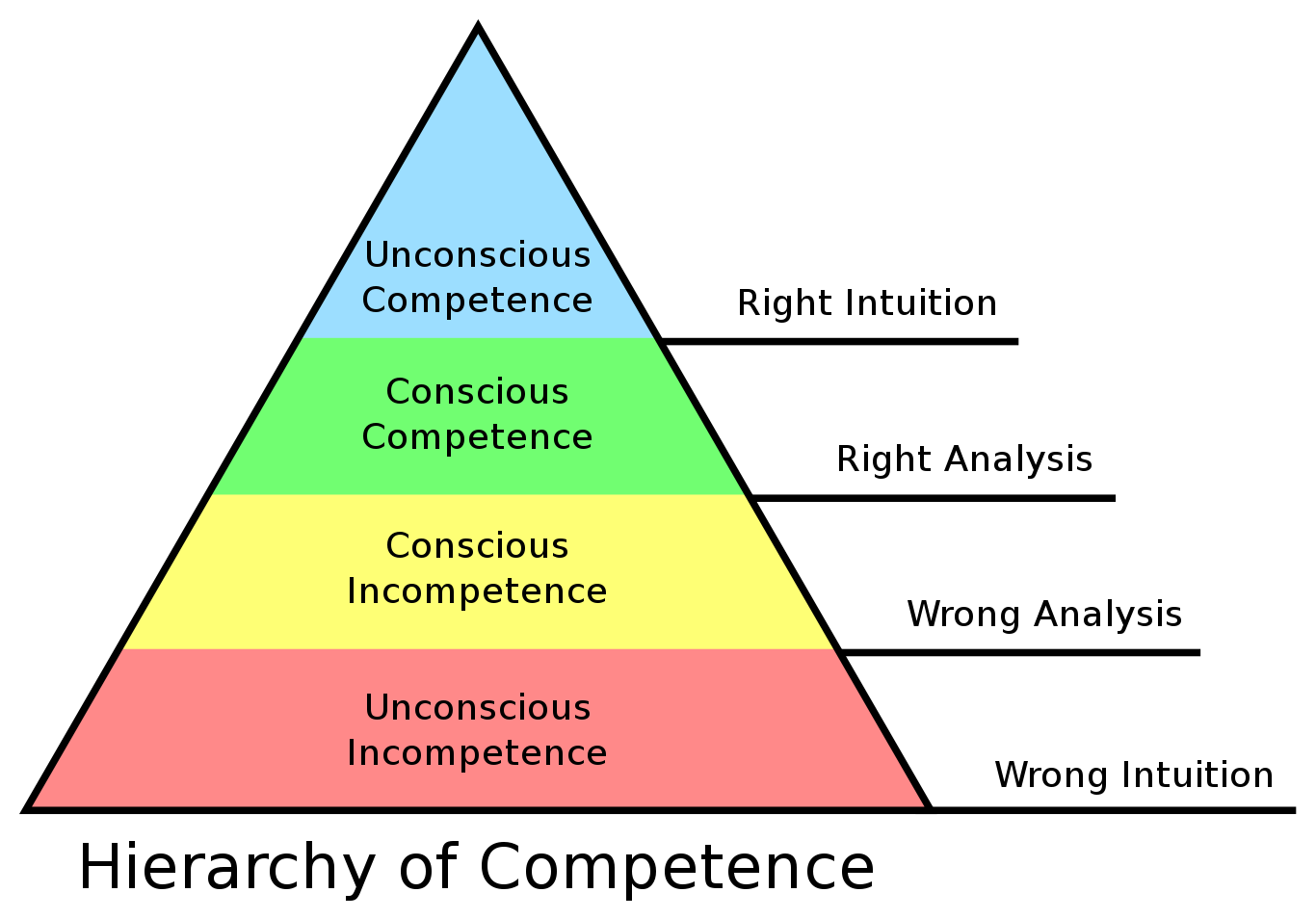
    Usually, however, people are looking for the four levels of competence. These originally come from Martin M. Broadwell who intended them for teachers in need of a model for their students.

    As a learner, you can also use these levels of learning to help navigate your way through complex topics. Following this model can also help ensure you meet your cognitive needs in a structured manner as you go about your learning.

    Hierarchy of Competence

    Let’s have a look at each level in detail.

    Unconscious Incompetence

    Have you ever started learning something you’re basically familiar with only to realize how little you know about the topic?

    I’ve had this with music. Although I’ve played in bands for decades and toured the world, when I hang out with much better musicians, I realize how little I know. My skills lead to all kinds of incorrect intuitions as I play simply because I don’t know the key signatures as well as some of the trained jazz musicians I know.

    Memorize bass music with mnemonics image of Anthony Metivier on tour with the Outside
    Memory expert Anthony Metivier performing at a concert in Germany.

    Still, I sometimes find myself trying to play in ways I don’t understand, only to hit notes that don’t sound great. It doesn’t happen to me anymore, but when it did, it was like I was suffering the musical version of the Dunning-Kruger Effect.

    This point is important to understand. You don’t have to be completely unfamiliar with a topic to experience unconscious incompetence.

    Captain Edward J. Smith provides one of the most famous examples. As the captain of the Titanic, he certainly knew a thing or two about sailing boats.

    But that didn’t stop Captain Smith from following the wrong intuitions. Although he received multiple warnings about the dangers ahead, he still failed to take action and the Titanic wound up sinking.

    Conscious Incompetence

    I’ve become much more modest over the years in music, and am now much more conscious of my incompetence with certain genres of music.

    To become more competent, I study the specific areas where I’m weak and patch in deliberate practice to turn incompetence into skill.

    memory skills feature imageA more famous example of conscious incompetence is someone like Elon Musk using first principles to figure out what he doesn’t know. Then, by adding knowledge and competence, he was able to purchase various companies and improve them.

    Of course, the court is still out on whether or not his conscious incompetence about Twitter will improve.

    Conscious Competence

    At this level of knowledge, you’re in the sweet spot. You can clearly visualize the skills you’re familiar with even when not doing them.

    To give you a concrete example of someone who has passed this stage of learning, think about Stevie Wonder. Many people think he’s a musical genius – including me.

    Although blind from birth, he learned not only how to play piano and sing, he also learned how to compose and perform.

    You might think of these as one task, but they’re actually different things.

    For example, I’m consciously competent when it comes to playing concerts with bands in my preferred genre. I can also compose relatively well and even sing to a certain degree.

    But I’ve never developed conscious competence as a studio musician.

    This is not uncommon. Many of your favorite bands aren’t actually playing on the albums you buy. Their record companies have hired consciously competent musicians, leaving them to do what they do best: perform.

    Then there are musicians who don’t even write their own songs, which is not necessarily a bad thing. Many creative industries rely on detailed knowledge of conscious competence. That way, each person can focus on just their part and shine.

    Unconscious Competence

    At this level of competence, the individual barely has to think about what they’re doing.

    Shakespeare, for example, was thought to be able to run circles around other playwrights when it came to writing incredibly powerful plots and individual lines of dialogue.

    Or you can think about virtuoso musicians. They don’t even need to see a score or rehearse. They just hop on stage with musicians they’ve never met and produce pure musical magic.

    Theoretically, they have highly trained procedural memory skills.

    Or, they have memorized the information to such a high degree, they can simply recite it, such as I did after memorizing the speech I delivered at a 2019 TEDx event in Melbourne.

    https://www.youtube.com/watch?v=kvtYjdriSpM

    I knew the speech inside and out, so well that when the audience laughed at a part I did not intend to be funny, I quickly overcame my distraction and got back on track.

    People who are fluent in another language provide another example of having reached this learning stage. Even if they forget how to say something using a particular set of words, they can find another set that lets the communicate the core ideas without having to think for long.

    In all of these examples, it’s not just stages of learning that have been completed. Various stages of memory have been well exercised and made capable of providing competence outside of conscious awareness.

    Why You Might Have Trouble Learning New Information Quickly

    The answer is simple:

    Many people put the cart ahead of the horse.

    I once heard musician Joe Satriani answer a guitar student’s objection that they did not know what to learn next to overcome a plateau. They were trying to do advance soloing but kept getting stuck.

    Satriani asked if they knew the name of every note on the fretboard. The person did not.

    “Then you do know what you need to learn next,” Satriani insisted.

    He wasn’t particularly patient in his response and it was partly because the student clearly had Dunning-Kruger Effect. (This happens when people are unaware of how little they know about something, but nonetheless suffer memory biases that make them think they do.)

    So what’s the solution:

    Always analyze what you want to learn, chunk it down, and start with beginner’s mind.

    Being humble, developing foundational knowledge and not being afraid to repeat certain levels of knowledge is almost always the key.

    How to Remember the Stages of Knowledge

    As we’ve seen, there’s more than one “four levels of learning” model out there.

    So if you want to be able to whip out the stages of learning process from any source you’ve found interesting or useful, here’s what I suggest:

    Develop unconscious competence with memory techniques.

    They will help you rapidly absorb lists like these and add on examples like the ones we’ve discussed today with everyone from captains to musicians.

    How to get started?

    I share the best ways I’m aware of in my free memory improvement course:

    Free Memory Improvement Course

    These ancient memory techniques are still in use today for one simple reason:

    Our ancestors found them helpful when it comes to moving through a lot more than the four levels of learning.

    We’ve been using them to help us learn languages and every topic you can imagine.

    All you have to do is avoid the perils of unconscious incompetence and they will you avoid learning struggles.

    So what do you say?

    Are you ready to learn with greater competence?

    Make it happen!


    Master Maslow’s Hierarchy By Fulfilling All Of His Cognitive Needs Mar 22, 2023
    Show notes

    cognitive needs feature imageDid you know that nearly every discussion of Maslow’s hierarchy of needs is missing an essential piece of the pyramid?

    It’s true, and today we’re going to restore that piece.

    On top of that, we’re going to dive deep into how you can fulfill each tier in your life.

    Even better, I’m going to help you remember each of the needs.

    That way, as you work on improving your life and the lives of others, you’ll be able to rapidly access a mental database packed with examples of psychological needs.

    And you’ll be able to fulfill your full potential.

    Perhaps you’ll even be able to go beyond that because there’s one need in particular that Maslow wasn’t able to publish before he died.

    I’ll share what it is, show you how to experience it and give you tips on maintaining this missing piece of the pyramids of needs once you’ve got it in place.

    Ready?

    Let’s dive in!

    https://youtu.be/H9Wi_hvKeRc

    What Are Cognitive Needs? The Forgotten Tier In Maslow’s Hierarchy of Needs

    As the term “cognitive needs” suggests, we have cognitive awareness of things we want and need from life.

    We’re not the only species that has such awareness, but our cognitive abilities are so developed that we seem to be especially sensitive to things we don’t have.

    Abraham Maslow got very interested in humanity’s special sensitivity to a set of human requirements that led to him developing the hierarchy of needs.
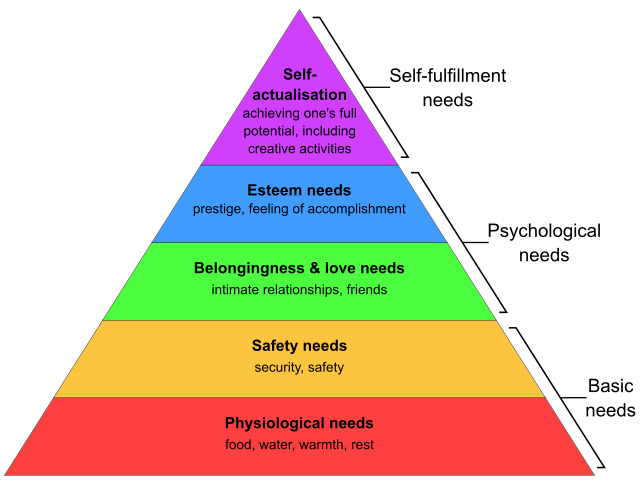
    Abraham Maslow's Hierarchy of Needs represented as a pyramid

    Often, you see Maslow’s needs placed within a pyramid.

    The wider needs are basic and as you move up the pyramid, you get psychological and fulfilment needs. All together, the needs in the basic pyramid of needs are:

    • Physiological needs (food, water, warmth, rest)
    • Safety needs (security, safety, predictability)
    • Belongingness and love (intimate relationships and friends)
    • Esteem needs (prestige, sense of accomplishment)
    • Self-actualization (creativity, fulfilling your potential)

    Maslow first presented these needs in a paper titled, “A Theory of Human Motivation.”

    Solving the “First Glance” Problem With The Pyramid of Needs

    One mistake that people sometimes make is thinking that you can move up the pyramid and leave earlier needs behind.

    But this isn’t the case. You always need to balance the needs, which is why an alternative, dynamic visualization can help understand Maslow’s hierarchy as something that plays out over time:
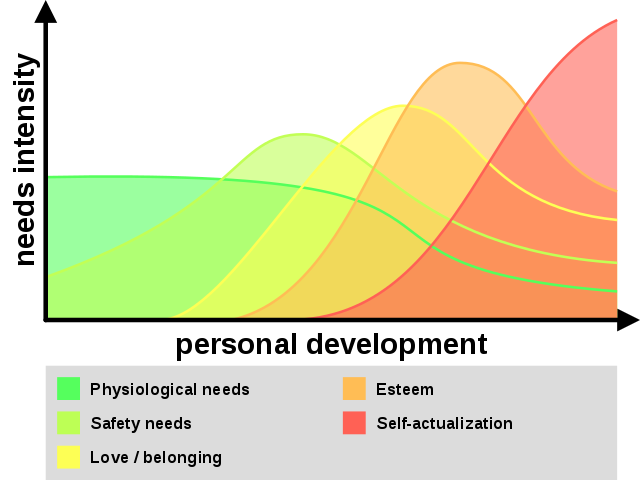
    The dynamic hierarchy of needs over time by Abraham Maslow

    Others have interpreted the hierarchy of needs in terms of a circle.

    For example, my friend Arthur Worsley used the “Wheel of Life” format in his “Faster to Master” Tracktion Planner:
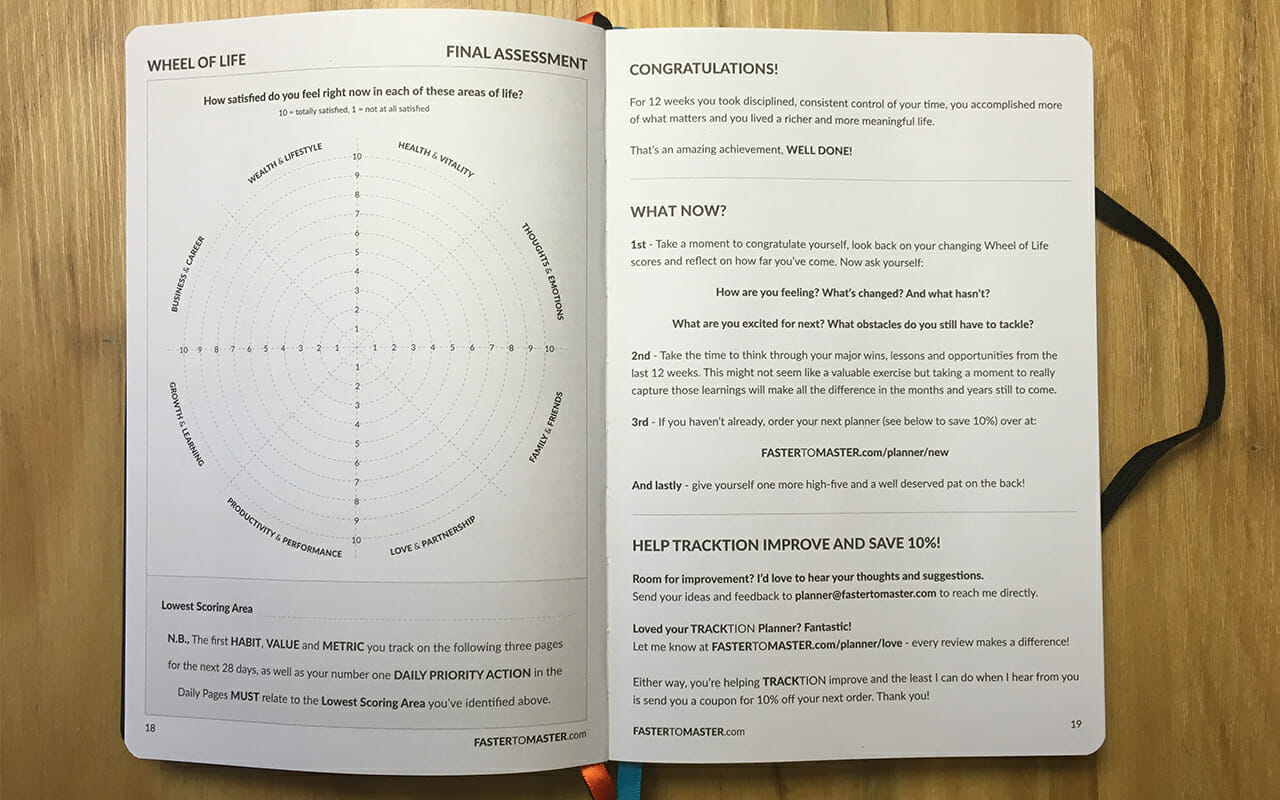
    Wheel of Life based on Abraham Maslow's Hierarchy of needs in Arthur Worsley's Tracktion Planner

    In this case, the “needs” are modernized to include cognitive needs examples like:

    • Health and vitality
    • Thoughts and emotions
    • Family and friends
    • Love and partnerships
    • Productivity and performance
    • Growth and learning
    • Business and career

    As you can probably see, “productivity and performance” are basically the same as Maslow’s original esteem needs.

    In truth, there’s no perfect way to visualize the hierarchy. The best thing is to find a model that works for you so you can bring balance to all of the needs in your life.

    The Missing Cognitive Need

    As great as Maslow’s original hierarchy can be, he ultimately wasn’t happy with it.

    Towards the end of his career, he wrote The Farther Reaches of Human Nature.

    In this book, he described a very special cognitive need he called self-transcendence.

    Basically, it’s like the “karma yoga” concept we talked about in my post on mental strength. The idea is that you ultimately put your own needs aside as much as possible, if not entirely.

    The Farther Reaches of Human Nature by Abraham Maslow book cover

    Many people who have sought to master their memory share this concept. For example, Giordano Bruno described a kind of nondual experience where you would experience a kind of oneness with the entire universe.

    Sound weird and raise your skeptical hackles that a psychologist like Maslow would suggest such things?

    Well, here’s Maslow in his own words from The Farther Reaches of Human Nature:

    Transcendence refers to the very highest and most inclusive or holistic levels of human consciousness, behaving and relating, as ends rather than means, to oneself, to significant others, to human beings in general, to other species, to nature, and to the cosmos.

    I myself have suggested something similar in my book The Victorious Mind. Fulfilling the cognitive need to give to others without expectation of return is hard, make no mistake. But this “karma yoga” is indeed far more fulfilling than I ever imagined possible.

    In fact, fitting it into your life is highly recommended.

    Why It’s Important to Fulfill Your Cognitive Needs

    We’re all on this planet together.

    That’s the ultimate reason why you really should spend time every week working on your personal hierarchy or “wheel of life.”

    The more people who self-transcend, the better it will be for everyone. Eckhart Tolle makes an excellent argument for increasing the number of transcended people in his book, A New Earth.

    A similar point is made by John Danaher who focuses on the positive outcomes technologically is likely to bring when it comes to freeing humanity from work.

    Let’s take another example. The reason you want to make sure you’ve fulfilled every example of physiological needs specifically comes down to your ability to learn faster, focus and remember things.

    But you can’t do that if you’re clogging your mind with foods that destroy your memory and create brain fog.

    The same goes for your career, study needs, family and personal rituals around sleep, meditation and the quality of your memory.

    The good thing is that if you start working with your memory first, you’ll be able to better remember to focus on all the other parts of the hierarchy.

    With that in mind, let’s talk about a powerful memory technique that will help you do just that.

    How to Use a Memory Palace to Satisfy Your Cognitive Needs

    Along my personal journey, I found it useful to go beyond merely reading about Maslow’s hierarchy.

    I also memorized it while completing journaling exercises that use the Wheel of Life.

    The best technique for getting all of the cognitive needs into memory? The Memory Palace technique.

    Let’s say you memorize Maslow’s original hierarchy.

    All you have to do to memorize it is mentally layer it on a wall in a room of your house, your school or where you work. Like this:
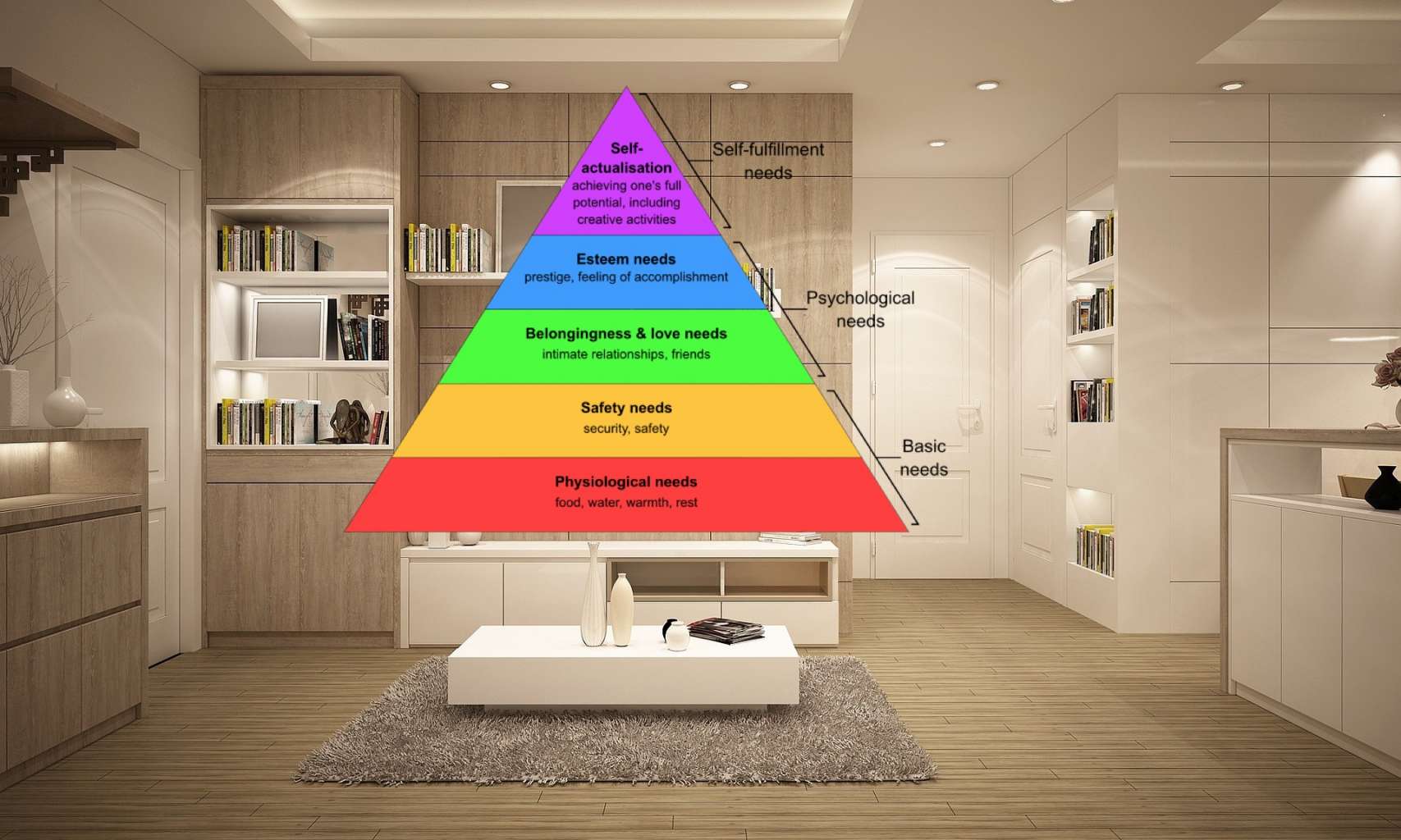
    Memory Palace example for remembering Maslow's Hierarchy of Needs

    By placing the pyramid in a familiar space, you give your mind an anchor point it can refer back to when you want to recall each tier.

    If you need more “stickiness” you can add a memory technique like the number rhyme or other forms of mnemonic imagery.

    With practice, you can memorize information like this often within minutes.

    Once in memory, it will be much easier for you to remember to focus on each tier as you go about your life.

    Memorize The Pyramid Of Needs And Succeed

    I’m so glad I took time to really understand Marlow’s formula. And not just the original form, but the enhanced format he wasn’t able to fully promote before he died.

    Luckily, people have expanded the concept since his time with alternative versions like the Wheel of Life.

    But as I hope to have made clear, it’s important for you to experiment with multiple versions. Even if you find one that feels “right,” I suggest you continue to study and experiment.

    Many cultures have interesting variations and the more you can consider them both through study and application, the more you’ll benefit.

    And who knows?

    Perhaps one day you’ll transcend and become so selfless that you’ll enjoy a life of giving.

    That’s certainly my goal, and to paraphrase the playwright Howard Baker put it, “because it is hard, I feel honored.”

    Not everyone agrees that humans need to take on challenging projects to feel fulfilled, but it’s certainly worked for me.

    One of those projects is to give this free course away to as many people as possible:

    Free Memory Improvement Course

    Is it really free?

    Yes, but it does “cost” your time, attention, focus and energy.

    However, complete the exercises and you will emerge with a memory system that allows you to learn faster and remember more.

    And you’ll have practice fulfilling one of the biggest cognitive needs of them all:

    The esteem need to feel a sense of accomplishment.

    I enjoy that sense every time I memorize something new and know that you will too once you have some Memory Palaces set up and in use.

    So what do you say?

    Are you ready to get out there and make the cognitive needs your own by committing them to heart and practicing fulfilling each and every one (including the lost tier)?

    I wish you a great journey and hope to meet you some time and place along the way!


    How to Learn Faster: 10 Proven Ways to Master Any Subject Fast Mar 14, 2023
    Show notes

    Yes, you can learn faster. All it takes is applying a small variety of techniques I’ve compiled for you below in the form of a specific toolkit traditional schooling often overlooks. These strategies blend memory techniques rooted in the ancient traditions that built the Renaissance with modern approaches. I didn’t learn them the easy way, but you can by reading this post and avoiding my mistakes. But before I share a personal note to explain just how powerful what you’re about to learn will be, here’s a table of contents of all the learning techniques for you: Why These Techniques Matter (A Personal Note From This Professor) Now, in case you’re wondering why I’m so passionate about all of these accelerated learning techniques and sharing them for free, the answer is simple. These techniques saved my life. See, during the first year of my PhD, I could barely read a paragraph. Taking antidepressants to try healing my depression unfortunately dulled my mind. Collapsed my focus. And made me almost believe I wasn’t cut out for serious learning anymore. But everything changed when I accidentally stumbled across the techniques I’m going to share with you today. They didn’t help me just retain more. They pulled me out of my cognitive fog, rewired my focus and gave me the confidence to keep going. Since then, I’m taught at major universities. I’ve studied languages like Biblical Hebrew, German and Chinese. And for my personal progress and one of my most popular books, I also memorized over 100 verses of Sanskrit to learn an ancient philosophy. But the most powerful learning technique I discovered? I’ll share it near the end. It will help you remove obstacles so you can learn faster than ever before. Ready? Let’s dive in. 10 Proven Ways to Learn Faster(Backed by Memory Science and Ancient Techniques) As we get into these learning processes, it might surprise you to know that in many cases, picking up new topics and skills faster isn’t about more effort. It’s often about alignment. And the techniques you’re about to discover reduce unnecessary effort because they’re grounded in how your memory actually functions, as I’ve shared in my full guide to how memory works. Some of what you’re about to learn comes from ancient traditions. Other techniques have been identified by modern memory science and research into education at large. To get the most out of this list, here’s what I suggest: Try at least one of the techniques immediately Reflect on how it feels using pen and paper Stack on more techniques over the weeks and months to come There’s no need to tackle all of them at once. But when you and and apply each one consistently over time, you’ll experience faster recall, deeper understanding and more joy in learning than ever before. One: Start Every Learning Session With These Three Brain-Activating Questions Instead of diving into a book and scanning or skimming for facts, pause first next time. And ask these three questions used regularly by the fastest learners I know: Why exactly am I learning this? How specifically will I use this knowledge in the next 24 hours? When will I practice recalling it to ensure long-term retention takes place? Although this might seem too simple to create an effect, it’s a highly strategic learning accelerator. That’s because when you start the learning process with a clear understanding of purpose, your brain knows how to filter for the main points. Two: Consistently Deploy the SQR3 Method Top-tier learners don’t just read. They constantly extract information using the in-depth tactics covered in my guide to effective note-taking combined with a powerful process called SQR3. In case you’re new to SQR3, it means: Survey Question Read Recite Review To apply it during your next study session, glance through the book’s index and table of contents. This quick activity gives you a broad overview of the book. Start formulating 2-3 questions you want the material to answer. If you don’t know what kinds of questions to ask, look for a practice exam or do some research. Identifying what you’ll have to know in advance is a major key to enjoying life as a top performer. During the reading step, truly read the book. Put aside distractions and give yourself room to concentrate. If the book is a real brain buster, check out my additional tips on dealing with especially hard books. Then recite. Repeat what you’ve read in your own words, both in writing and out loud. Finally, review the chapter to test your understanding and check the accuracy of your written summary. If you’re skeptical about this simple approach, I understand. But this study shows positive results that I’ve experienced many times. Not only will you learn faster when using SQR3. You’ll also become a better self-regulator. That benefit in itself will provide you with some powerful knock-on effects as you continue to grow as a lifelong learner. And for even more results, try adding Socratic questioning to the process. Three: Relax Your Mind and Body Before Studying(Using My 3-Step “Magnetic” Method) I’ll never forget one of the reviews on the first edition of my first book, How to Learn and Memorize German Vocabulary. The person complained about how I’d included material on relaxation before sitting down to study this challenging language. The truth? The fastest learners in the world aren’t frantic. And they do not cram at the last minute. They’re calm, deliberate, and tuned in. Because they know this fundamental truth about memory: Information flees from tension. But it’s “magnetically” attracted to relaxation. When your brain is overloaded, stressed, or anxious, your cognitive bandwidth shrivels up. Worse, your working memory can’t hold what it needs to process, and long-term encoding gets blocked. But when you relax using an intentional process, your brain will absorb more information. My Magnetic Relaxation Protocol (3 Steps Before You Study) 1. Stretch Your Body Just spend a few moments reaching for the sky. Then touch your toes. Roll your shoulders, open your chest. Shake out your hands. Open and close your jaw. These simple and gentle movements signal safety to your nervous system and help prime your focus. 2. Breathe With Intent Close your eyes and breathe in for 4, hold for 4, out for 6. Do this 6 times. Add a soft mental mantra like, “I’m here. I’m learning. This matters.” This simple process will shift you from a sympathetic fight or flight state into parasympathetic calm. 3. Prime Your Focus With Movement or Mapping Take a 5-minute walk while reflecting on what you’re about to learn. Create a quick mind map to externalize your thoughts (more on how to do this below). This clears the noise and organizes your intent. Relaxation isn’t about zoning out. It’s about entering the zone. Use this simple three-step protocol before each study session and you’ll enjoy: Faster recall Less internal resistance More enjoyment while learning To help yourself stop forcing your memory to learn and start flowing with it at an even deeper level, check out my guide on yoga for memory. Then follow up with my guide on dopamine resetting. Four: Focus on Less to Remember More When I wrote my guide on how to realistically memorize a textbook, I had no idea people would find it so practical and useful. Like Sebastian Acosta, who wrote on Facebook: The reason Sebastian got such great results isn’t just because focusing on less helps you read faster. It’s because using personalized flash cards provides you with a laser-targeted tool for remembering only the parts of your study materials that matter. You’re also harnessing the power of what scientists call the chunking memory strategy. Check out this video tutorial for all the details and 10 steps to follow: https://www.youtube.com/watch?v=eIQRiqQFKQY As you read, restrict the notes you take to only the information that answers your guiding questions. Some people will freeze up at this suggestion because they think they’re leaving too many details behind. This feeling is normal, but it’s not correct. It’s a feeling of scarcity caused by a variety of memory biases. Let them arise, but keep focusing. Your brain will fill in the details, especially during the final part of the SQR4 method discussed above. And that step is to recite the answers in your own words, both in writing and out loud. As a minimalist approach, it works because it: Forces you to identify only the most important concepts Saves you time because you’re no longer copying out long passages Creates stronger mental links Enables active recall principles as you review It might help you to think of learning like pruning a tree. When you cut away all the clutter, the healthiest branches grow stronger and the roots grow deeper. I often use the term “rhizomatic learning” to describe this process of “less is more.” Rhizomes make connections through their systems of tendrils without even touching each other. And that’s how the brain works too through your synapses. What matters is that the connections are solid. To grow them, you have to select and plant the best possible seeds. Less truly is more when you want to study faster. Five: Use Summary Writing to Reveal (and Fill) Your Knowledge Gaps There’s a reason Tony Buzan told us on this episode of the Magnetic Memory Method Podcast: “You don’t know what you don’t know… until you try and recall it.” In other words, if you want to learn faster, you need to shine a light on your own ignorance. And the best way to do that is to write. Now, you might be thinking: Hang on… how can I write about something I don’t understand? The answer is to combine writing summaries with the Feynman technique. Scott Young, author of Ultralearning, talks about it often, and I find it useful in my own learning projects. Except I’ve modified it. Here are the steps: Without looking at your notes or the source material, write a quick summary after each study session in your own words. Write down your questions about aspects you remember, but don’t quite understand to process in your own words exactly what you think you’re failing to comprehend. Make a plan to fill in the gaps in writing. Ask questions to help guide yourself: Where can I look to get the answers I need? Who can I ask to get help? This simple technique not only reinforces what you’re learning. It sharpens your selective attention and builds what scientists call active recall. You’re also developing a positive feedback loop that develops continual improvement. And the best part is that it only takes a few minutes to use the technique. Six: Use Active Reading to Lock Information Into Long-Term Memory Ever have that feeling that all you’ve done is moved your eyes across the pages of a book while your mind drifted in the void? You can solve this issue by using a variety of active strategies beyond asking questions while reading in the kind of flow state we discussed above. Here are some of my best tips: Sit While Reading Like A Hunter Many people slouch while reading. Although it is possible to read in bed and still retain information, generally your body’s physical position influences your cognitive state. Sit upright at a desk like you see me in this photograph: I’m deliberately “hunting” for ideas and using my body to create a physical state that sharpens my mind. Interleave the Input Even when I’m deeply interested in what I’m studying, I still experience topic exhaustion. To combat it, I use a technique called interleaving. In simple terms, it’s just switching between books and articles at regular intervals. Follow these steps to experience for yourself the benefits of keeping active while reading: Read a chapter for 15-20 minutes max. Switch to another book or article. Reflect on both for a few minutes by writing a summary or creating a mind map. Read a third book or return to the first one. One reason interleaving works is that your brain experiences contrasts that lead to deeper encoding. You’re also experiencing diffuse thinking, a process recommended often by the learning expert Barbara Oakley. For more on active reading, I’ve written an entire tutorial for you. The additional details are worth checking out, so long as you read them actively. Seven: Using Mind Mapping to Speed Up Comprehension Mind mapping can do a lot of things for you. One of the many benefits of mind mapping comes from how they engage more parts of your brain during the learning process. They literally help you process information faster because more of your brain is invovled. Part of the increased engagement comes from how the technique gets you creating a visual summary, rather than using prose. And organizing information in space using a clocklike circle engages your focus in a completely different way than keeping linear notes. That’s why I often incorporate a bit of mind mapping as part of the interleaving process. You don’t have to make mind mapping just about comprehension for learning either. Look at the mind map pictured above. I was trying to “comprehend” what would make the best possible YouTube video about retention. So I used the mind map process to speed up the process, triggering many associations in my mind. The Core Principles of Effective Mind Mapping To use the technique yourself: Start with a central image or keyword Use branches that extend from the central image to develop related ideas Use color generously Add additional images throughout I sometimes also mind map after reading to recreate what I’ve learned in as non-verbal a manner as possible. As you can see in this mind map, there are no words at all: As with active reading strategies, mind mapping as you learn gets your body involved. And it utilizes more of your mind, leading to deeper absorption and longer recall. Eight: Optimize Your Schedule for Maximum Learning Retention Even if you could create more hours in the day using AI tools, you don’t need them. You need to use the best hours of your day better. Rather than study whenever you can squeeze it in, make time for it. For example, I’m studying Neigong and Neidan at the moment. When I merely jam in a bit of learning here and there, my results aren’t very good. But when I stick to a defined morning and evening session based on my best study time guide, I enjoy more understanding and very powerful outcomes. Those are the times that work best for me. But you will need to work out your own schedule. Here’s how: Observe When Your Brain is Naturally Sharp Over the next few weeks, deliberately read at different times of the day. In a journal, jot down when your summaries were the most accurate. And make a note of when you actually enjoyed the process most. As you keep track of your best times of day, you’ll learn to avoid: Studying during energy dips Cramming when you should be sleeping Soon, you’ll find that you’re getting a lot more value from the time you spend learning. Take care too about using digital journaling tools. Some of the most innovative and successful technological CEOS like Sam Altman use physical journals. For more details, see my article on how to approach learning in the age of artificial intelligence. Protect Your Learning Environment A lot of people study in situations of chaos. Rather than let the randomness of life slow you down, check out my list of the best study places. Having boundaries and locations you can trust to be clutter-free and quiet will ensure the time you set aside is much more useful. Nine: Learn and Apply Memory Techniques that Actually Work Memory techniques saved my life. As I wrote in The Victorious Mind, I almost lost my life to depression. But as this research on using one particular memory technique shows, memory training is known to help people resolve mood issues. It can also help eliminate symptoms from PTSD, as my student Nic Castle shared on this episode of the Magnetic Memory Method Podcast. Why am I mentioning this history of suffering? Because nothing slows learning down more than having to…

    Full show notes at the publisher

    The 3 Best Teas for Memory, Focus, Concentration & Brain Health Feb 21, 2023
    Show notes

    Every morning I have one cup of a special kind of tea I’ll tell you about below. And almost every afternoon, I drink one cup of matcha tea for its well-proven memory benefits. In fact, some studies show that this concentrated form of green tea is the gold standard when it comes to an easy to make tea. It’s also highly enjoyable and directly beneficial. Apart from green tea, black and oolong teas have been shown to work, but on this page, I’ll share with you a few other options. The question is, will drinking any of the most highly recommended teas also improve your memory? Maybe. But you have to be careful. That’s because a lot of people throw out scientific studies. You read them and think: “That’s the tea for me.” But those studies don’t show you all the nuances you need to drink tea safely. See, various teas for concentration, memory or focus interact with other supplements you might be taking. As a result, you can wind up making things worse. Various teas can also interact with your diet overall creating unwanted effects. So in this post, we’re going to look at the truth about tea for better memory and brain health. It’s easy to understand and the information I’ve researched and tested personally will help you make better choices overall. The Best Tea for Memory, Studying, Focus, and More Let’s start by approaching the topic counterintuitively: What’s better? A tea you add to your daily routine that stimulates focus? Or a tea that helps remove distractions so that you can focus? The answer to this question is ultimately something only you can determine. And you arrive at the best possible answer through experimentation. As I have explained in my book, The Victorious Mind, the easiest way to arrive at an answer is by rotating through various substances while journaling. By noting down the effects you feel, you can start to track patterns. Why Do Some Teas Help Memory, Focus and Concentration? When it comes to the kind of memory benefits you can get from reducing distraction, the answer is simple. Many teas have L-theanine, which studies have shown makes you feel more peaceful. In other words, L-theanine reduces the feeling of unrest. This clears the way for more focus and concentration, and the leads to better memory because you’re able to pay attention. In fact, Murray Carpenter reported in his book Caffeinated that Starbucks added L-theanine to its coffee to prevent people from getting too buzzed, which in some contexts means too focused and concentrated. It’s also possible that the caffeine in some teas can improve your memory because they reverse the effects of sleep deprivation. At least in male mice and in the context of social memory, as this study shows. Anecdotally, this makes sense to me as I do tend to feel that my memory is much sharper after drinking either tea of coffee. But how various teas makes you feel is not necessarily the same as being able to focus or concentrate in a way that helps you learn faster and remember more. Only taking specific actions do that. And that’s again why I suggest you learn about tea for memory through experimentation and thinking about what you add vs. what you take away. Because the truth is that you can often increase your focus by not drinking any teas at all. Just making sure you’re hydrated by regularly drinking water in combination with proper diet and lots of exercise is also a powerful strategy for better memory. You can also work on developing concentration as its own practice. For example, here’s a tutorial on activities that improve concentration. And here’s one on some of my favorite memory training activities. That said, I love my two daily cups of tea and I’ll explain why they have personally been the most effective for me. Let’s get started. One: Personalized Chinese Herbal Tea As I mentioned in my study of herbs for memory and focus, everything comes down to removing pain and discomfort. Since I have chronic pain that leads to brain fog when left untreated, I go to a Chinese Medicine practitioner almost every week. The specific tea I’m given is personalized based on where my health stands on a week-to-week basis. And my practitioner and I always check that the tea I’m drinking works in conjunction with my diet overall. That way, there are no problematic interactions. I’ve had interaction issues in the past, such as when two supplements created confusion, so I’m glad I now get help in order to reduce chronic pain issues. You need to take these things in consideration for yourself as well. And it’s key to check based on every tea you try. Every tea will potentially interact with everything else you eat and drink throughout your day. Two: Why Matcha Could Be the Best Green Tea for Memory Overall Many people have cited straight up green tea as a memory booster. However, I’ve found better results anecdotally from matcha. And although longest term studies have only been done on mice, they prove the basic point that other dietary considerations matter. In brief, the mice showed better memory only when the matcha was combined with other foods in their overall diet. But why else might matcha be better than green tea for memory? Matcha has been shown to have more L-theanine than standard green tea. These higher levels are likely brought out during the detailed preparation process proper matcha goes through. That said, one study has shown that your working memory could potentially benefit from green tea extract on its own. I tried taking green tea extract for a few months to conduct an n=1 test, but I did not experience any positive results with my memory. But I did suffer bad skin issues as a result of taking green tea extract. Nonetheless, green tea supplements might work for you without side effects. You’ll just have to experiment and keep track of the results. I’m very glad I can tolerate green tea in its matcha from because there’a another reason to have some kind of green tea in your daily diet. As this study has shown, amongst many others, green tea reduces inflammation and oxidative stress. Timing is Key One thing I’ve found over the years is that I cannot drink matcha after two p.m. Otherwise, I find it difficult to sleep. I have experimented with drinking it in the morning, but I prefer the benefits of coffee at that time, especially since I usually memorize poetry early in the day. Then, provided I don’t drink it too late in the day, the cup of matcha provides a focus boost after launch along with a peaceful attentiveness until the workday is through. Your timing needs may differ, but it’s important to make sure you keep when you ingest tea in mind in the same way you consider possible food interactions. Is matcha the best green tea for your brain? There’s one more question you need to consider as you experiment with it. What About Matcha Late? Personally, I do not add milk to any teas that I drink. That’s partly because I don’t digest milk will, and partly because quite a bit of research shows that milk reduces the effectiveness of tea for memory improvement outcomes. For example, this study found that adding milk prevents some of the protective effects tea provides. Another study found that milk does not affect other benefits, however. All the more reason to take into consideration my core suggestion that you need to track your results in order to determine what outcomes your preferred teas provide. Personally, I do have some dairy each day in the form of yogurt. But I time out when I eat it, waiting usually 2-3 hours after drinking tea in order to give my daily matcha the highest possible opportunity for my body to absorb it. Three: The Best Tea for Studying (Yerba Mata) I was first introduced to Yerba Mata while visiting memory expert Jonathan Levi in Tel-Aviv. We were collaborating on a major project together while also intensively studying various health reports to solve an issue I was having at the time. When Jonathan noticed I was getting tired looking through mountains of scientific studies, he offered to make me a cup. Soon, I found myself studying this dense material with much greater focus and concentration. I was immediately interested in learning more. As I looked into this tea, I found studies that show why Yerba Mata works . For one thing, Yerba Mata helps reduce the destruction of your neurons as you age. And it many even help prevent negative memories from distracting you while you’re trying to focus your mind. Although more research needs to be done, this study shows that one reason why people report feeling calmer has to do with the multiple physical benefits this tea provides. In other words, it all comes back to the principle that anything that clears your mind up so you can pay attention will almost certainly help you remember more. This is a point memory expert Harry Lorayne made repeatedly throughout his career. And drinking it while working with Jonathan is undoubtedly while I felt so focused while collaborating with Jonathan on a very intense project and a personal health improvement mission for weeks on end. At the risk of repetition, this point matters: You here again you see a key principle at play: It’s not so much about what these teas for focus add. It’s about what they take away. Tea For Brain Health When it comes to your personal development, you really do have to experiment. All of the teas I’ve mentioned on this page have been tested by myself personally. And my outcomes match with the research, including one of the biggest studies showing improvements in cognitive function from regular tea consumption. As mentioned, the biggest consideration I would suggest you make regards interactions between the teas you drink and other substances. Always remember: there’s a huge difference between foods that are bad for memory and those that are good for it. And definitely consider staying away from black tea. This study shows that it could lead to suppressing memory formation in living creatures. A second, major point you need to consider is your sleep in the context of memory improvement. If you constantly fall asleep while reading, tea might not actually help because the teas that help for memory also tend to lead to greater relaxation. How To Experiment And Find The Best Tea For Concentration And Energy As I mentioned above, I do a lot of journaling to work out the effects of various teas as I experiment with them. Here’s more detail on how I do it. As part of how I journal for overall self-improvement, I keep track of what teas I drink and when. That means noting the date and the exact time of day with a final review in the evening. At the end of the week, I look for patterns in how I’m feeling. A lot of this is guess work, but I get my blood tested regularly, and as mentioned, see my Chinese Medicine practitioner almost every week. I share my journal with her to get another point of view. Even if you don’t check in with a health professional frequently, developing pattern recognition around what you’re eating and drinking is key. Finally, always take timing into account. Humans have a 72 hour digestion cycle, if not longer. Journaling helps with tracking back to what may have been consumed a few days ago, something very helpful for people who have memory issues. Speaking of memory issues, if you’d like to experience better memory, sign up for my FREE memory improvement course: It will help you remember details like we discussed today. So what do you say? Are you ready to think about teas for memory a bit more critically and make better choices? Thanks for reading and happy sipping!

    Full show notes at the publisher

    Advanced Memory Palace Problems & Solutions With Don Michael Vickers Feb 15, 2023
    Show notes

    Don Michael Vickers memory athlete feature imageYou’ve got advanced Memory Palace problems and Don Michael Vickers has got solutions.

    In this episode of the Magnetic Memory Method Podcast, we’re diving deep into his impressive memory competition experience.

    And together, we discuss the differences between using memory techniques for short-term memory and long-term memory outcomes.

    But you might be wondering…

    What Kind Of Advanced Memory Palace Problems?

    There are a few you might encounter as you use the Memory Palace technique.

    These include:

    • Too much or too little space between your loci
    • Dropping off parts of words when memorizing vocabulary
    • Mishearing or misreading the target information
    • Not keeping a journal for this form of self improvement or memory athlete specific journaling
    • Not having a community with people who share your interest in memory

    https://www.youtube.com/watch?v=3O7M2TZT8rA

    Suggestions From Don Michael Vickers

    One thing I love about how Don shares his approach to using memory techniques is that he documents the journey.

    You can check out a lot of what he’s doing on his YouTube channel and other media.

    But that’s just one level or layer of journaling.

    He also journals privately so he can see what’s working and what isn’t.

    This is a solid tactic for one big reason:

    It’s only through what scientists sometimes call “metacognitive learning recognition” that we can learn as fast as possible. It’s been demonstrated to help us see variables and define new strategies.

    Journaling also helps us because it enables deeper levels of reflection than if we were to merely think about our memory improvement activities without writing them down.

    How Specifically Does This Help You Solve Advanced Memory Palace Problems?

    The answer is easy:

    As your perspective widens, you’re able to run new “experiments.”

    In other words, every time you use a Memory Palace to memorize anything, you’re experimenting.

    If you take the time to observe your results, you can always ask:

    • What went right? And how can it go better?
    • What went wrong? And what needs to improve?
    • What other Memory Palace variations can I try, such as the Massively Distributed Memory Palace described by Richard Rubin

    These are the kind of questions that only you can solve and you need to be the scientist in the laboratory of your own mind to do it.

    But there’s one more ingredient that I think really shines in this conversation.

    Let’s talk about that next:

    The Power of Community

    You can also see in how Don talks about his interactions with fellow memory competitors like Katie Kermode that hanging out with others who love mnemonic strategies is key.

    Communication is yet another level of reflection.

    But there’s also the competition aspect.

    As Don puts it, memory competitors are a lot friendlier than hockey players. Yet, you still get the chance to really throw down the gloves and test your skills.

    I hope you enjoy this discussion with Don and please do follow him on his YouTube channel and social media for more exciting demonstrations and news from his activities in the world of memory competition.

    Don Michael Vickers’ YouTube Channel

    Don Michael Vickers’ LinkedIn

    Don Michael Vickers’ Twitter

    Don Michael Vickers’ Tiktok

    Important Show Note Regarding The Shadow Memory Technique

    There’s a technique known as the Shadow. I heard about it quite some time ago, and Braden Adams has discussed it with us on this previous episode of the MMM Podcast, and on this one.

    During this episode, Don and I figured that I probably hadn’t understood the Shadow correctly.

    But Ron Johnson from the excellent Craft of Memory Podcast posted this on YouTube below the video version of the interview:

    Ron Johnson comment on the Shadow memory technique

    This is an excellent example of the power of community, so if you aren’t yet part of ours, here’s what I suggest.

    I have a free course you can download and get notifications about new podcasts like these.

    If you’d like to register, please click the image below:

    Free Memory Improvement Course

    That way, you won’t miss a thing when new interviews like this come out.

    And you’ll get some world class memory training too.

    It’s a win-win!


    How to Study for Finals: 11 Tips No One But A Professor Can Share Jan 25, 2023
    Show notes

    If you want to know how to study for finals, here’s what I did while completing my BA, my MA and later my PhD. I still do this as a researcher and language learner as well. The same strategy that helped me at university has helped me in many walks of life, and it is this: Start studying for finals is as early as possible – and always with accelerated learning strategies. And yes, the common advice that you need to take care of your sleep, diet and fitness in order to study well still stands. It also helps to keep organized and make the most out of your classes and review sessions. But if you have a nagging feeling that there must be better study tips for finals, then you’ll want to pay attention to the strategies I just mentioned. This is the knowledge that you can only get from a PhD like me. And because you’re the kind of person who wants more than just a passing grade, you’re going to love the tips on this page. Because you’re the kind of learner who wants to enjoy an epic career, you’re going to need them. Once you have them, you’ll be the student with all the advantages. You’ll be the student who aces the finals. And you’ll be the student who enjoys an epic career in any field you want because you’re the one who finally learned how to really learn. Ready? Let’s dive in! https://youtu.be/r0NXI5o9CMo How To Study For Finals: 11 Tips That Actually Work As we go through this list, I’ll be sharing with you more than tips. You’ll discover detailed examples of why and how these study principles and strategies work so well. I’ll also give you scientific references and other research resources so you know that everything I’m suggesting is valid. But here’s something really important to understand: Apart from the rule I always applied starting as an undergrad (start studying as soon as possible), there is no cookie-cutter, one-size-fits-all study method. You need to get involved in the process and tailor some of these strategies for yourself. And I’ll start with a powerful way you can do this in my first tip, one of many of the best study tips for finals you’ll find on this page. One: Learn How To Create A Study Schedule For Finals Yes, you absolutely want to get a head start when studying for finals. But even more importantly than starting early, it’s important to understand as much as possible before the semester begins. When I was an undergrad, I used to contact the professors the day I registered in their courses. I asked them for the course syllabi so I could do three things in advance: Enter all the assignment due dates into my calendar Enter all the exam dates into my calendar Start gathering and studying the reading list immediately This process was critical for me because I worked sometimes up to three jobs when I was an undergrad. But getting this overview of the semester on a course-by-course basis will help even those who have student loans or grants and don’t have to work. Indeed, later when I had grants of my own and didn’t need to hold so many jobs, I still used this approach. As a result, I was always able to get my assignments done with time enough to revise them at least once. And I was also able to read beyond the assigned book list. It takes 10-15 minutes to reach out to all of your teachers and arrange to get the syllabi in advance. If you can’t get in touch with them, contacting the department secretary also works. You can often swing by the departmental office to get an advance copy as well. Two: Clear Your Mind Before Studying Using This Simple Process It’s normal to be nervous when studying for exams. The mind kicks up all kinds of fears and we resist common sense thanks to all kinds of biases. That’s why it’s important to always start the process of preparing for exams on the basis of mental strength, not weakness. So to begin, start with this simple exercise: Start a study journal “Mind dump” all of your anxieties about the exam onto paper (kind of like brainstorming) Analyze your fears and question why you have them Once this is done, you can use the same journal to complete some of the steps discussed below. If you prefer mindmapping, you can do that as an alternative to keeping a journal. I give a detailed example of how this exercise works on a mind map in this video. This step works because when we have a bunch of worries on our mind, they keep arising until we deal with them. The Zeigarnik Effect describes why and how our minds become cluttered with unattended worries. And research shows that addressing those worries in a journal helps us eliminate them. This ability is especially important when you’re dealing with boring topics, which every student does at some point in their learning career. Three: Communicate Loudly And Clearly With Your Community Do you know that most interruptions are a choice? You choose them when you don’t communicate your priorities to others. Once you’ve received your syllabi and blocked off the entire semester in your calendar, you can give your friends and family a copy. Let them know how seriously you’re taking your studies and ask them to avoid interrupting you. Most people will be more than happy to support you. Likewise, you want to make sure your employer knows well in advance of times when you’ll be dealing with assignments and exams. Since they’re only human and often dealing with multiple employees and a variety of seasonal projections, the earlier you let them know your scheduling needs, the more they’ll be able to treat you flexibly. I did this all the time during university. All of my employers appreciated it very much and I wound up getting more overtime during the summers than anyone else at one of my jobs because I communicated so well. This scheduling boon meant that during the times I worked less so I could study more I wasn’t suddenly struggling financially. Finally, you should always communicate with your teachers. For example, I’ve had jobs where there were opportunities to work more due to seasonal shifts. If there was an assignment conflict, I let my professors know and arranged for different dates. I’ve even arranged alternative assignments and exams with professors that enabled me to miss many classes without harming my grade at all. Four: Read Your Textbooks Right The First Time There’s a so-called “speed reading” expert named Howard Berg who proves that the Guinness World Records people have a sense of humor. In fact, his record reads that Berg: …has convinced a number of TV hosts that he comprehends and remembers what he scanned, perhaps not the details, but the concepts, with the details left for a later, slower reading. When I teach people how to read faster, I skip the nonsense and teach you how to read right the first time. The method helps you avoid falling asleep while reading. And you’ll learn all kinds of advanced ways to use flashcards, Anki and note taking. If you want to learn the method in full, check out my blog post on memorizing textbooks. It allows you to read deeply, extract all the main points and rapidly commit them to memory. That way, you will rarely have to go back to review a book again. Frankly, that takes too much time and simply shouldn’t be necessary. Point being, skip the speed reading pseudoscience like subvocalization suppression and learn to read actively. Five: Slow Down And Think If you’re a slow reader, that might actually be a good thing as you’re learning how to study for finals. That’s because too many students cram instead of using memory hacks and memory techniques. These techniques are very important because they give you more time to reflect. Studies show that when you slow down and reflect on your current grades, future grades will improve. Likewise, studies show you will understand difficult and confusing concepts better by reflecting on them. Physicist Richard Feynman was such an enthusiastic proponent of this study technique, they named it as a method after him. Since then, many studies have shown that when you stop and take time to think without making it a formal study session, you’re using active recall. This process of using your mind helps you form memories quicker, memories that have lasting power that will serve you long after the finals are over. The other part of slowing down to think is the importance of taking breaks while studying. The learning process isn’t completely about studying. It’s also about reflecting and letting your mind process information unconsciously. When you take time to rest and think, you’ll also reduce, if not eliminate, the memory blocks other students face. Well-rested and well-considered students simply think faster on their feet. Six: Write Summaries Remember that journal I suggested you keep? It will help you reflect in the ways I just mentioned. And writing is also a great way to help you remember what you’ve learned faster. Scientists know that writing summaries helps you learn and remember faster, but some think they are hard to write. In reality, summaries can be simple. In order to get the job done quickly and experience the benefits, I used to summarize entire books on index cards. By limiting my notes to two sides of one card, I kept my focus on the biggest and most important ideas. Or, if I’m using a journal, I summarize using a maximum of two pages. By doing this, I made sure that I wasn’t re-writing every detail of the book. I was just getting down the big picture, and by doing so, crystalized many of the granular details as well. Often, I would jot these out on the card as well in the form of bullet points. So when I suggest that you prepare for finals by writing summaries, I’m not talking about writing epic essays. Just a few sentences will be tremendously helpful. Although even just 2-3 sentences might feel like it’s slowing you down, when it comes to remembering more and understanding the material, it’s a proven way to study faster without losing comprehension. Finally, writing summaries is one of the best ways to prepare yourself for essay-based exams. If you don’t take time to practice writing extensively before the exam starts, you’ll struggle to put meaningful sentences together once the test begins. Seven: Choose Study Groups Carefully Make no mistake: Study groups can be absolutely fantastic. But they can also be a giant time suck. I’ve experienced both versions, and it often takes only one apple to ruin a bunch. So I learned to have all the members of my study groups sign an oath of commitment. Sure, this sounds stiff and formal, but it was tremendously beneficial. On the same document, I codified how the study groups were to run and that way everyone had the plan in mind and knew what to expect. The best part? Because we were all disciplined and spent our time wisely as we covered the big points and the granular ideas we were responsible for on the finals, we enjoyed our free and informal time after the study sessions much more. Eight: Avoid Topic Exhaustion Learning fatigue is real, especially if you’re cramming. Try interleaving instead. Basically, this technique involves reading for a short period of time from one book and then switching to another. You would think this would break your focus when reading, but it has been shown to boost how you’re paying attention. Switching between readings also increases diffuse thinking, an automatic process related to how implicit memory interacts with explicit memory. What doesn’t work, however, is switching from reading to social media or watching movies. That has the opposite effect. So I suggest you pile up a bunch of books while in the library, and rotate through them. This is what I look like when I’m interleaving to avoid topic exhaustion: Nine: Choose The Most Effective Study Spots For Focus To get started finding them, read my article on the best study locations and then experiment with a bunch. You can also come up with a “relocation schedule.” To this day, I still like to move from location to location while reading and writing. I call it “roadwork” and as Alex Pang points out in Rest, rotating locations has been the key to the successes of many smart and accomplished people. Ten: Use Active Recall Strategies With Passive Review I mentioned active recall above. Let’s dig a bit deeper. In order to get your mind and memory as engaged as possible so you can recall everything you need during your finals, make sure that you: Ask yourself plenty of questions about what you’re studying Complete practice quizzes Write from memory When it comes to passive review, the following processes challenge your brain a bit less, but are just as important: Reread various passages Listen to lectures or watch videos that relate to your exam topic Visit your professors office to discuss the basic concepts Although passive review won’t help you quite as much as active recall, it’s important to balance the two activities for the best result. I’m sure glad I always did while I was in university and continue to do so as I study for my current career. Eleven: Use Ancient Memory Techniques Long before books existed, our ancestors needed to carry voluminous amounts of information in their minds. Many of the learning techniques they used are still helpful today. One of the key and strongest of all accelerated learning techniques is called the Memory Palace. It takes a bit of setup, but it’s worth it. You basically create a map of locations in your mind and then associate information with familiar rooms using mnemonic images. If you need help learning this powerful technique, please grab my Free Memory Improvement Kit: You’ll rapidly master it and enjoy an encyclopaedic memory as you sit for all your finals. When To Start Studying For Finals As I shared with you, I used to start studying for finals before the semester even began. But the truth is that you ultimately have to answer that question for yourself. The trick is to avoid making errors that cost you time and money because you have to retake exams or repeat entire semesters. And to do that, look at your calendar as soon as possible. Try to make the most reasonable projection and block out as much study time as possible. Keep in mind that topic exhaustion is real and use the many techniques I shared today to compensate. Although I’m pointing out that you’re ultimately on your own to make these decisions, you’re never alone. For example, when you join my community, you’ll always have people to discuss study strategies with, people who look beyond the finals. And that’s what I encourage you to do each and every day. To avoid the biggest errors of all, look beyond your final exams and see life as a constant series of tests and quizzes. Invest in your mind and memory a.s.a.p. And learn the foundational memory techniques I share with the world so that you are a mental master who just happens to be a learner. That way you will study using energy-creating power, and not the power-draining “force” of cramming so many other learners choose. So what do you say? Are you ready to prepare for your finals starting today? Thanks for reading and enjoy the process of becoming a lean and mean learning machine!

    Full show notes at the publisher

    Focus First/Memory Second For Business and Lifestyle Success? 2x USA Memory Champ Shares His Secrets Jan 11, 2023
    Show notes

    John Graham surprised me twice on the same day!

    And if you know me, you know I’m not easily surprised.

    So, what exactly made my jaw hit the floor?

    First, I found out that John had won the USA Memory Championship… again.

    I mean… who has the time for all that memory practice? Especially during times like these?

    Then John tells me that focus is so much more useful than memory… and more lucrative too.

    And to make matters even more confusing… John keeps telling people not to meditate in the morning?

    Huh?

    As a practitioner of meditation for decades, I really had to get to the bottom of all these incredible (and sometimes shocking) things John was saying.

    And so I did in this EPIC discussion of how John really succeeds.

    Not only to win memory competitions, but to experience an abundance of time freedom supported by a fantastic business.

    And you’ll be surprised to discover that memory improvement training doesn’t even get second fiddle. Not when it comes to the tactics you really need.

    After hearing what he has to say and giving it some consideration, I think it all makes sense.

    And I think it will help you too.

    So dive in for an epic discussion packed with takeaways, and…

    Don’t worry!

    I ask John to share some feedback on a little memory issue with mnemonic images I was having. So there are some next level memory secrets in this episode of the Magnetic Memory Method Podcast too.

    https://www.youtube.com/watch?v=KxTpqc6OoDU

    Who Is John Graham?

    John Graham is an entrepreneur, memory expert, memory athlete and winner of both the 2018 and 2022 USA Memory Championship.

    In case you’re not familiar with what an accomplishment that is, let me explain:

    You have to accurately recall a lot of information from multiple categories of information.

    These categories change from competition to competition, but often include:

    • Memorizing playing cards
    • Memorizing long strings of digits using something like the Major System, Dominic System or PAO System
    • Memorizing names
    • Poetry
    • Abstract images

    The Memory-Focus Connection

    But as John points out in today’s episode, memory isn’t so much the core of his success. It’s the ability to focus his mind that matters.

    And the tactics and strategies that explain his ability to win also support his entrepreneurial success.

    John Graham 2018 and 2022 USA Memory Champion with Tony Dottino
    2x USA Memory Champion John Graham with competition founder Tony Dottino

    If you’re an entrepreneur and would like to speak with John about your own focus, check out his Optimize My Mind page where you can book a time.

    Obviously, John is very serious about helping entrepreneurs, and I know you’ll respect his wish to focus on your concentration, not your memory.

    Because John’s right:

    There’s an enormous amount of information about memory techniques out there. So if you still haven’t nailed memory techniques so you can use them in your business, it’s focus and concentration that are at stake.

    Get that nailed, and so many other things will fall in place.

    I second his argument completely because the same thing has been true for me.

    And it always will be:

    Focus first!


    Can A Person With No Sense Of Direction Stop Getting Lost? A Conversation With Christopher Kemp Jan 05, 2023
    Show notes

    Dark and Magical Places by Christopher Kemp feature imageEver found yourself turning down an unfamiliar street, only to struggle to retrace your steps?

    Why does that happen?

    How about back before GPS, when you would pull over to the side of the road and struggle with a map?

    If you’ve experienced situations like these, there’s hope.

    That’s because there’s one author in particular who has no sense of direction to speak of. And that feature of his mind makes him the perfect science writer to explore what direction is and how we might optimize our experience of it.

    Even better, in Dark and Magical Places, Christopher Kemp explores how the brain produces your sense of direction.

    You’ll also learn why some of us might struggle to keep on track or lose our way in space.

    We delve into some of the common mistakes people make and get into some of the “metaphysics” behind space itself.

    Whether you’re a seasoned traveler or someone struggling to get around your hometown, you’ll find this discussion useful.

    I highly recommend reading Dark and Magical places and hope you enjoy this interview with Christopher Kemp.

    https://www.youtube.com/watch?v=zcGWE5gQlUk

    Dark And Magical Places Is An Excellent Read

    There are many things I love about this book.

    It’s well written and researched, for one thing.

    But it also takes you into highly consequential situations, some of which you’ll have experienced yourself.

    And if you ever find yourself lost in a dark place where the stakes are life and death, you’ll find key strategies that will help you keep yourself alive.

    But above all, I love how the author makes learning about the science of navigation and the brain incredibly fun.

    More Resources On Memory, Directions & Locations

    A few years ago, I shared this quick video on applying memory techniques to memorizing any address:

    https://www.youtube.com/watch?v=i2shzBN1tNo

    The approach relies on a combination of:

    • The Memory Palace technique
    • The Pegword Method
    • Either the Major System or a 00-99 PAO

    If you’d like to improve your navigation skills and enjoy stronger cognitive mapping of the world, I can’t make any big promises. But it’s well-worth experimenting with techniques like these. Ancient people used them all the time, including a really cool “magical place” skill called the Songline.

    And of course, these techniques will work even better when you’ve read Dark and Magical Places.

    Check it out!

    Free Memory Improvement Course


    Previous 1 17 18 19 20 21 45 Next

    Related Podcasts

    Making Sense with Sam Harris

    1

    Making Sense with Sam Harris Education
    Grammar Girl

    2

    Grammar Girl Education
    Good Life Project

    3

    Good Life Project Education
    Explain It to Me

    4

    Explain It to Me Education
    Team Never Quit

    5

    Team Never Quit Comedy
    Optimal Living Daily – Personal Development and Self-Improvement

    6

    Optimal Living Daily – Personal Development and Self-Improvement Alternative Health
    footer-logo

    Contact Us

    Toll Free: 844-670-7747

    Links

    • Home
    • Top Charts
    • Networks
    • Apps
    • Independents Podcasts
    • Podcast Advertising
    • Podcast News
    • Contact Us
    • About Us
    • Analytics & Insights

    Stay Connected

      Privacy, Terms of Use & Our Code of Ethics Protecting Content Creators Copyrights