TopPodcast.com
Menu
  • Home
  • Top Charts
  • Top Networks
  • Top Apps
  • Top Independents
  • Top Podfluencers
  • Top Picks
    • Top Business Podcasts
    • Top True Crime Podcasts
    • Top Finance Podcasts
    • Top Comedy Podcasts
    • Top Music Podcasts
    • Top Womens Podcasts
    • Top Kids Podcasts
    • Top Sports Podcasts
    • Top News Podcasts
    • Top Tech Podcasts
    • Top Crypto Podcasts
    • Top Entrepreneurial Podcasts
    • Top Fantasy Sports Podcasts
    • Top Political Podcasts
    • Top Science Podcasts
    • Top Self Help Podcasts
    • Top Sports Betting Podcasts
    • Top Stocks Podcasts
  • Podcast News
  • About Us
  • Podcast Advertising
  • Contact
Not in our directory?
Add Show Here
Podcast Equipment
Center

toppodcastlogoOur TOPPODCAST Picks

  • Comedy
  • Crypto
  • Sports
  • News
  • Politics
  • True Crime
  • Business
  • Finance

Follow Us

toppodcastlogoStay Connected

    View Top 200 Chart
    Back to Rankings Page
    Education

    Anthony Metivier’s Magnetic Memory Method Podcast

    Learn, Memorize And Recall Anything Using Memory Techniques, Mnemonics And A Memory Palace Fast

    Advertise
    • Apple Podcasts
    • Google Play
    • Spotify

    Latest Episodes:
    The Memory Journal For Competition and Developing Mnemonic Systems For Learning With Johannes Mallow Aug 17, 2022
    Show notes

    Memory Athlete Johannes MallowHave you ever set your mind on accomplishing something big?

    Johannes Mallow did.

    After seeing memory techniques demonstrated on German television, he decided he would do more than merely learn how to use mnemonics.

    He committed to conquering them so well that he could win the most challenging memory competitions on the planet.

    Despite all the odds, including battling against a physical condition…

    Mallow made it happen.

    And today he uses his status as a world renowned memory athlete and memory expert to help others.

    He’s an incredible promotor of memory sports and has helped many people experience the power of their minds.

    In this exclusive interview, Mallow shares some of the lesser-known secrets of how to develop the memory systems needed to succeed.

    The Role Of The Memory Journal In Memory Sports And Long Term Learning

    One of the most important tools you can use when learning memory techniques is the memory journal.

    Listen in as Johannes Mallow shares tips and tricks around getting one started and using it to optimize your memory skills over time.

    https://youtu.be/3dbGaCvj9yU

    These are tips you’ll wish you’d had years ago!

    Johannes Mallow On Practical Memory Techniques

    One thing I appreciate highly in Johannes’ approach to teaching memory skills is clarity.

    See, a lot of memory athletes make it seem like how they use mnemonics for competition translates to long term learning gains.

    Make no mistake:

    The techniques are definitely related.

    But you need a bit more in order to form long-term memories, such as active recall.

    This is so refreshing to hear! Especially since the points Johannes brings from his years of studying memory science in addition to practicing as a mental athlete are so key when it comes to learning new things thoroughly.

    And all the more so in the context of keeping a Memory Journal.

    Journaling is itself a skill that you don’t just pick up automatically.

    It’s also not something that you drop, as we’ve discussed in my post about how some of the best innovators approach learning in the age of artificial intelligence.

    No, journaling is a specific skill that you can learn to do well. Which is all the more reason I’m grateful for Johannes and the tips and experiences he shared in this episode of the Magnetic Memory Method Podcast.

    Enjoy!

    Further Resources From Johannes Mallow And Resources Mentioned In This Episode

    MemorysportsTV on YouTube

    Johannes Mallow’s memory improvement course

    Johannes Mallow’s website

    Johannes Mallow on Twitter

    Johannes Mallow on Wikipedia

    Interview with Boris Konrad

    Fun memory demonstration on German television:

    https://www.youtube.com/watch?v=NicGJAqSME0


    The Only Planet Mnemonic You Need Aug 07, 2022
    Show notes

    the only planet mnemonic you need feature imageMemorizing the planets is one of the coolest things you can do.

    But finding the best planet mnemonic can be tricky.

    That’s because the best planet mnemonic for someone else might not be the best approach for you.

    That’s why I’m going to share an alternative to acronyms and acrostic mnemonics for the planets on this page.

    And you’ll probably find the hermetic mnemonic for planets especially useful.

    It’s definitely my favorite and works fast!

    The Simple and Effective Planet Mnemonic

    Let’s get one thing clear:

    Simple doesn’t necessarily mean easy.

    But when you use an effective planet mnemonic and have fun with it, you will enjoy efficiency with learning as much of the solar system as you wish.

    As you rapidly absorb the knowledge using these techniques, you can add details about each planet to your memory with ease.

    https://www.youtube.com/watch?v=iadUSC0yMw4

    For learning the planets, I recommend using a Memory Palace. Even if you use an acrostic inside of a Memory Palace, I think you’ll find using your spatial memory as part of the process much more powerful.

    What is a Memory Palace? It’s a mental image based on a familiar location. You simply place the names of the planets along a journey in this location and use funny or weird associations to trigger the target information.

    To get started, pick any room. Then assign a spot for each of the planets you want to memorize.

    Let’s say you’re going for a comprehensive solar system mnemonic that includes:

    • Mercury
    • Venus
    • Earth
    • Mars
    • Ceres
    • Jupiter
    • Saturn
    • Uranus
    • Neptune
    • Pluto
    • Haumea
    • Makemake
    • Eris

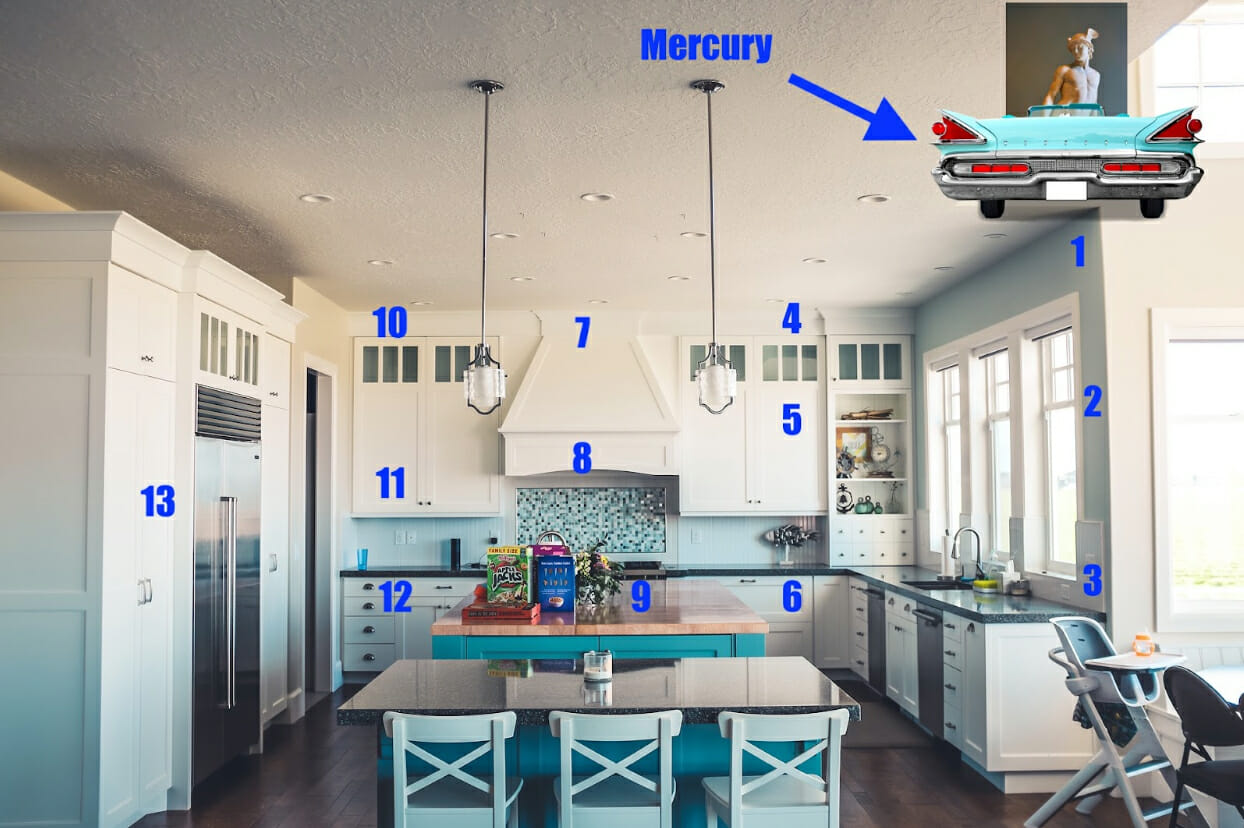
    This means you need 13 stations in your Memory Palace.

    13 stations in memory palace

    As you can see in the illustration above, it’s easy to assign stations in any room for this amount of information.

    Next, you simply place a mnemonic image that helps you remember the name of each planet in order.

    For example, on station one, you can place something that reminds you of Mercury.

    You could choose the mythical god Mercury. Or a car, like a Mercury Grand Marquis.

    Or you could combine the mythical god and the car in an unusual way to help you remember that you mentally placed Mercury in that part of the room. This is the kind of approach that makes memorizing planets so much fun.

    planets mnemonic for mercury

    You then simply repeat the process, using simple pegword associations throughout the room you chose.

    The Hermetic Memory Palace For the Classic Solar System

    Recently, I wanted to memorize the solar system as it was used in the Italic Hermetic Tradition.

    Or better said, I adapted it in a particular way for one of my applied memory experiments.

    (See David Pantano’s The Magic Door for the source of my inspiration.)

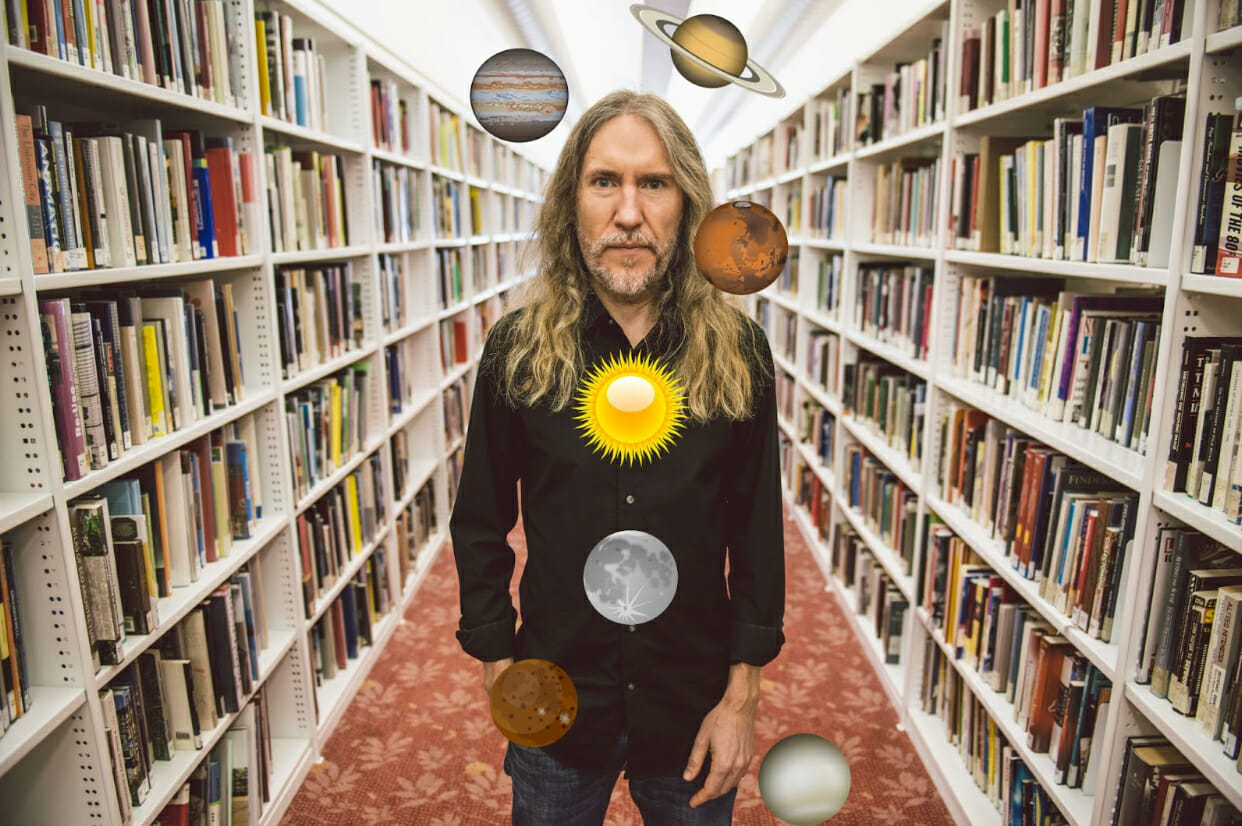
    To do this, I memorized the seven classical planets using my body as the Memory Palace.

    the human body as a mnemonic device for planets
    The Body Memory Palace for Memorizing the Classical Solar System

    Using the human body as a mnemonic device for the planets and information about the solar system is easy.

    In this case, I needed only seven stations.

    • Saturn (the space above my head)
    • Jupiter (the top of my head)
    • Mars (mouth)
    • Sun (chest)
    • Moon (belly)
    • Mercury (hip joint)
    • Venus (thigh)

    To add more planets, you would simply create more stations.

    You can also link each of these stations to numbers using the Major Method. I talked about this style of Memory Palace with memory expert Ron White in this detailed interview.

    To add details about the planets is easy once they’re in place. For example, the hermeticists considered Mars an image of willpower. So near my mouth, I imagined this planet clamping my mouth closed to help me hold my tongue as an act of willpower.

    Acrostic For The Planets

    Typically, you’ll find examples of planet mnemonics in the form of acrostics.

    This type of memory technique involves assigning a word to each letter in an attempt to create a memorable phrase.

    Common examples for different amounts of planets include:

    • My Very Educated Mother Just Served Us Nine Pizzas
    • Men Very Easily Make Jugs Serve Useful Needs, Perhaps
    • Mary’s violet eyes make Johnnie stay up nights pondering

    Personally, I find all of these mnemonic examples vague, abstract and hard to memorize.

    They’re not adaptable either. You can’t easily expand them to include more space for more planets and information as we discover it.

    But with a Memory Palace you can.

    If you use your body, you can even duplicate yourself inside of a Memory Palace to create more space.

    solar system mnemonic example for replicating a bridging figure inside of a memory palace
    You can reproduce this solar system mnemonic multiple times to help you remember more information about the planets.

    This approach uses a mnemonic device called the Bridging Figure. It’s a principle taught in the Magnetic Memory Method Masterclass.

    The Ultimate Solar System Mnemonic

    In brief, I think the best mnemonic strategy for the planets is the Memory Palace technique.

    If you still like using planet acrostics, you can help yourself remember them better by stringing them out in a Memory Palace. Or you can explore the story and linking method.

    In all things, experimentation with a wide variety of mnemonic strategies is important. On the matter of experimentation, keep in mind that you can also use each and every planet you memorize itself as a Memory Palace. Here’s an example of how that works using the moon:

    https://youtu.be/9QF4AihKmbo

    And if you’d like to learn more about these techniques, please consider signing up for my FREE Memory Improvement Kit:

    Free Memory Improvement Course

    It will help you create the perfect system of associations for mastering knowledge of the planets. Both what we know currently and what people thought about the planets in the past.

    After all, that’s what true astronomy is all about: the past, the present and what we imagine we’ll discover in the future.

    So what do you say?

    Are you ready to deeply absorb information about our galaxy?

    To infinity!


    Everest Memory Masterclass: Is Nelson Dellis’s Course Good? Jul 20, 2022
    Show notes

    everest memory feature imagePut simply, Nelson Dellis is a legend in the memory competitor world.

    He’s won the USA Memory Championship a bunch of times, and ranks very high globally.

    Nelson’s also well-known as a mountaineer. Just about every year, he’s got cool posts of traveling to Everest and other mountains on his Instagram.

    But what you probably don’t know about him is that he’s a skilled university lecturer too.

    And when memory expertise, the mindset of an athlete and raw teaching ability combine, you get an amazing memory improvement course.

    Although I know a fair amount of memory techniques, I learned new things. I had a lot of fun too.

    Even better, an aspect of my memory improved.

    And just so you know, I didn’t get this course for free. Even though I’ve known Nelson for many years and probably could have asked for a comp, I bought it as a regular person.

    To me, that’s important for a few reasons, ranging from instilling the desire to go through the course and feeling free to speak my mind about the experience as a legit course participant.

    So if you’re ready, let’s dive into a bit more about Nelson himself, and then the course.

    https://www.youtube.com/watch?v=zMyIdE0ql1M

    Who is Nelson Dellis?

    Nelson’s memory competition record is impressive. There’s a full rundown on his Wikipedia profile, including the records he’s broken.

    How did it all start?

    In response to seeing his grandmother’s memory decline due to Alzheimer’s disease.

    I find his charitable and educational efforts especially impressive. I’ve interviewed him several times on the Magnetic Memory Method Podcast and he’s always dreaming up new ways to inspire people to use mnemonics.

    His books include:

    • Remember It
    • Memory Superpowers

    And now there’s his Everest Memory Masterclass.

    Let’s have a look at what it’s all about.

    Everest Memory Masterclass Review: What You Need to Know

    There are many things to love about this course. If I were to sum it all up in a simple statement, it’s this:

    Nelson’s very upfront about the fact that each of us need to develop our own skills.

    Literally, no one else is going to do it for you. The same way that no one could ever climb a mountain on Nelson’s behalf.

    In other words, there are aspects to the art of memory that can only be learned by doing.

    With this learning requirement in mind, Nelson equips you with materials that will help in just about every possible regard. He gives you the ropes, the boots, the helmet, flashlight, etc.

    You just need to bring yourself and your willingness to take action.

    The course includes:

    • Clear and crisp descriptions of the core memory techniques
    • Weekly assignments
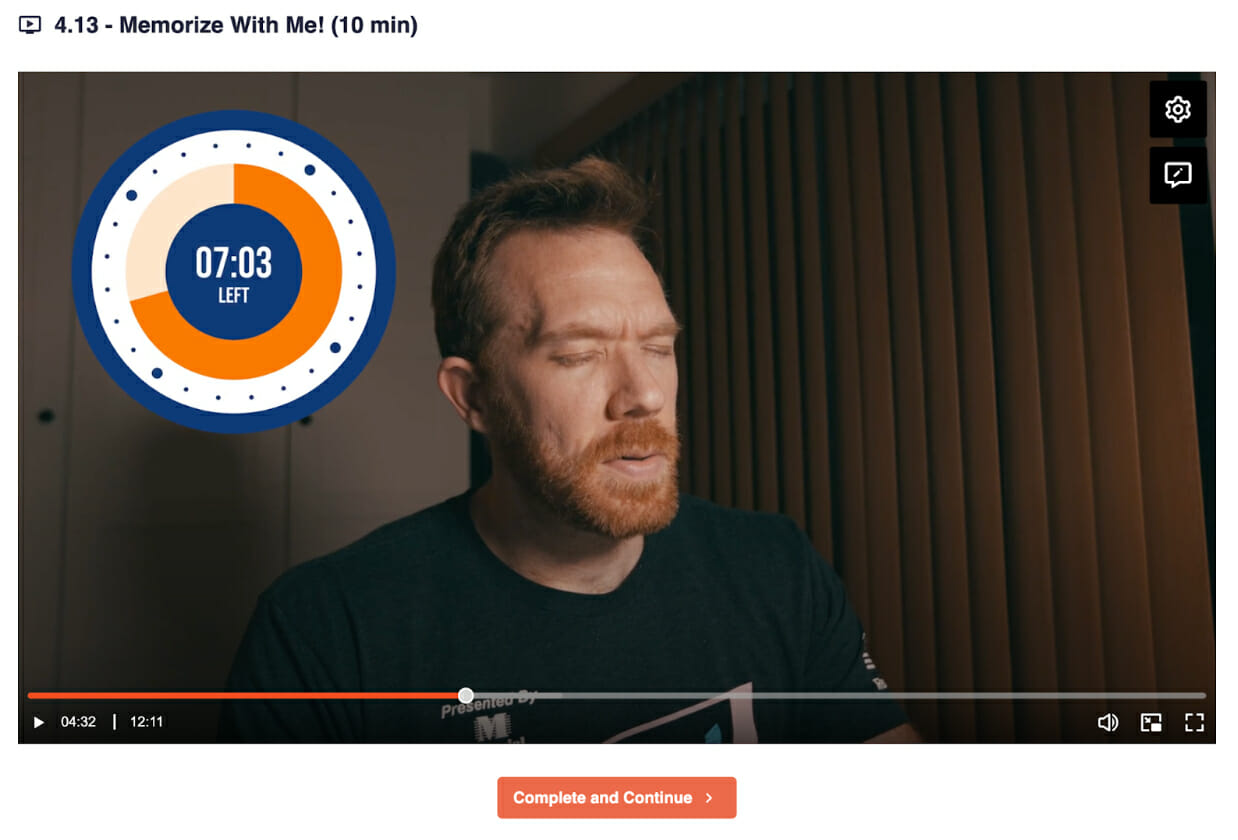
    • “Memorize with Me” timed sessions
    • Sitdown sessions
    • Live streams during the cohort (with replays)
    • Discussion group
    • Additional resources
    • Instructions on tracking your progress
    • Progress tests
    • Detailed lessons on how to beat Nelson at a memory competition
    • Interviews with renowned memory experts

    practice your memory with nelson dellis in real time

    The progress tracking techniques are probably my favorite part of the Everest Memory Masterclass. Nelson shows you how to set specific benchmarks based on your baseline.

    When I took the course, I created my own Google Drive folder as Nelson recommends and started tracking my progress with memorizing words using the International Association of Memory software.

    Normally, I memorize directly from print books. So it’s quite something that Nelson’s course encouraged me to tackle something I not only dislike, but dread: memorizing from screens.

    Incredible Progress Tracking Lessons

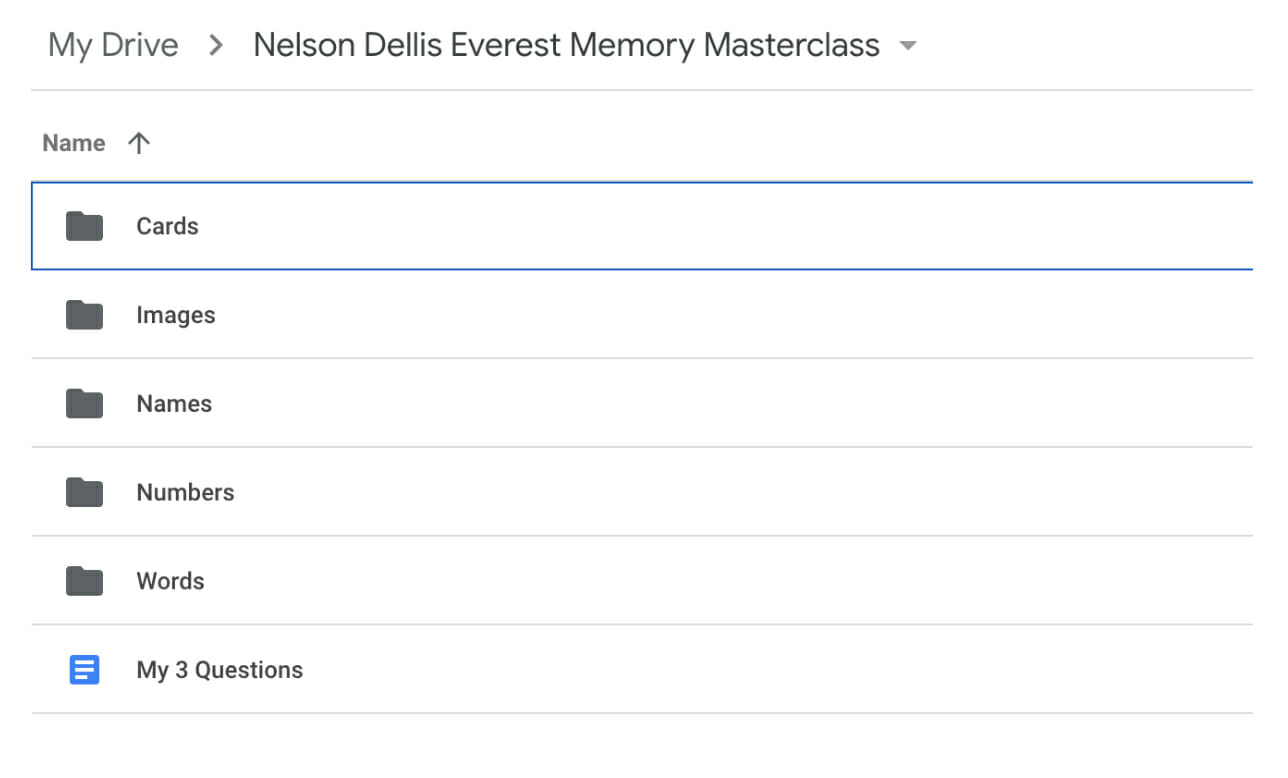
    As an example, he gets you to answer some questions and set up folders to track your progress based on the different information categories he teaches.

    everest memory masterclass homework

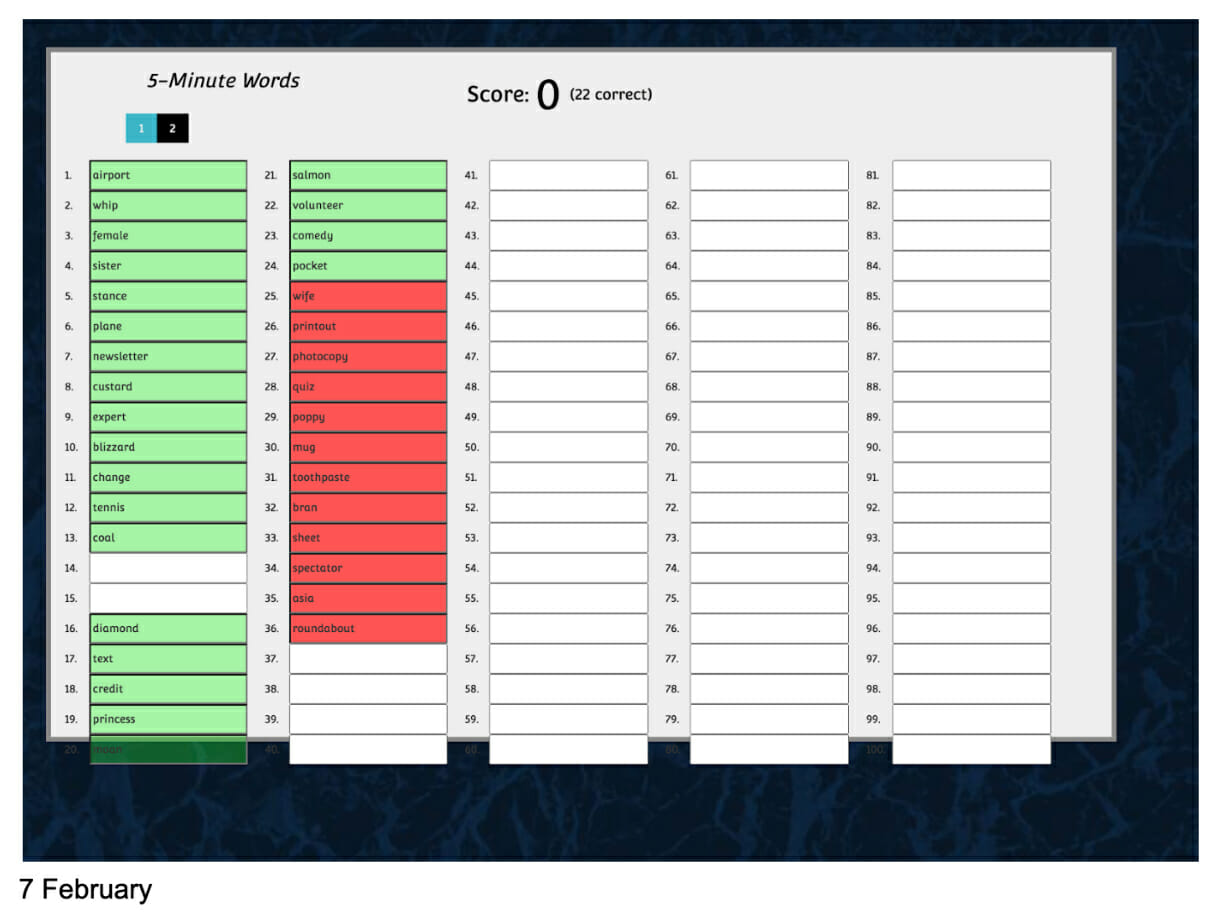
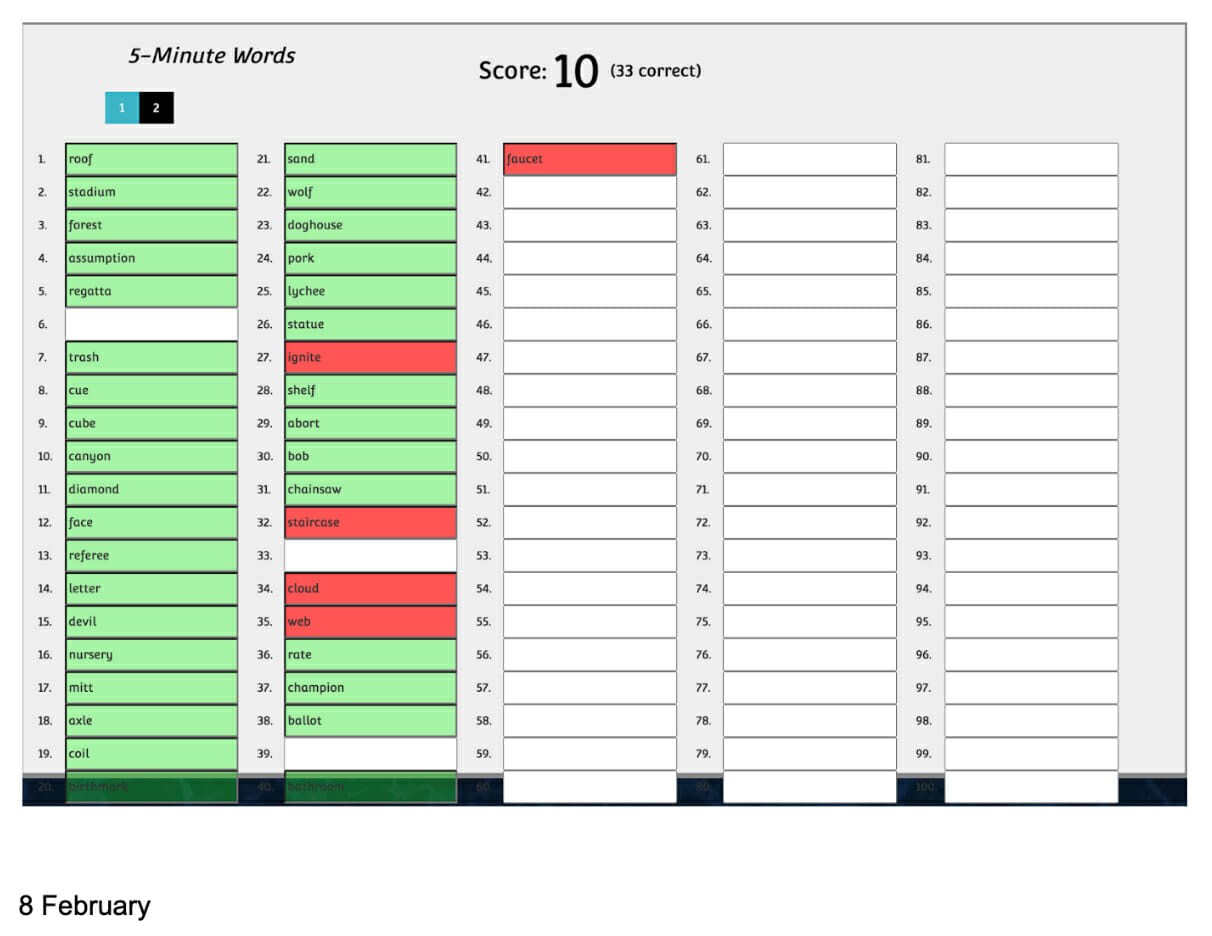
    To take you inside just one of my folders, you can see the progress using Nelson’s approach created for me at a glance.

    day one in everest memory

    In just one day I went from having a ton of errors to having much fewer errors in the same allotment of time for memorizing vocabulary.

    day two in everest memory masterclass

    Frankly, I still find it challenging to memorize from screens.

    But the proof is in the pudding.

    If you track your results, a certain kind of magic as profound as the memory techniques themselves takes place.

    And I’m now much better at this particular kind of memorization.

    In sum, measuring our own progress is itself a skill. And Nelson’s approach to getting yourself serious gains in this area is fantastic.

    The Memory Teaching

    Nelson is an incredible teacher. He gives you multiple ways to think about the techniques and “for instance” examples of how you might use them.

    He’s also great at helping you develop the mindset needed to get out there and use them without worrying about making mistakes. He also gives useful tips on getting out of your own way and removing unhelpful self-criticism.

    Speaking of criticism, you might be wondering if I have any…

    Not really.

    But let me gesture at something I think about a fair amount when it comes to online education:

    My favorite parts of the course are the longer videos. I find the shorter videos anywhere fairly annoying. I’m totally biased in this regard, and it could have more to do with my demographic than with digital amnesia.

    See, I’m in my mid-forties and grew up with detailed introductions to just about everything. The university lectures I attended and gave were usually 90 minutes with (maybe) one break. And my favorite online cases tend to be long.

    (I mean, really long and I find that quite helpful compared to short lessons.)

    But you know what?

    This kind of criticism doesn’t matter much because Nelson’s course has plenty of variety.

    Although I couldn’t attend any of the live sessions due to my time zone, I was able to ask him a few questions in the discussion group. And reading the comments and questions of others raised quite a few interesting points I hadn’t thought of before.

    And the replays are there if you want them in all their lengthy glory.

    The Truth About Succeeding With Any Memory Improvement Course

    Frankly, no matter how you cut up a course, the true student goes through it all. The true student develops patience for the many different kinds of content and presentation styles out there.

    And when it comes to memory, your results will only partially come from consuming “content.”

    The lion’s share of developing your memory will come from taking action. When it comes to memory techniques, there are at least three kinds of action:

    • Developing your systems of association
    • Applying them while learning in real time
    • Using some form of recall practice to instill information in long term memory

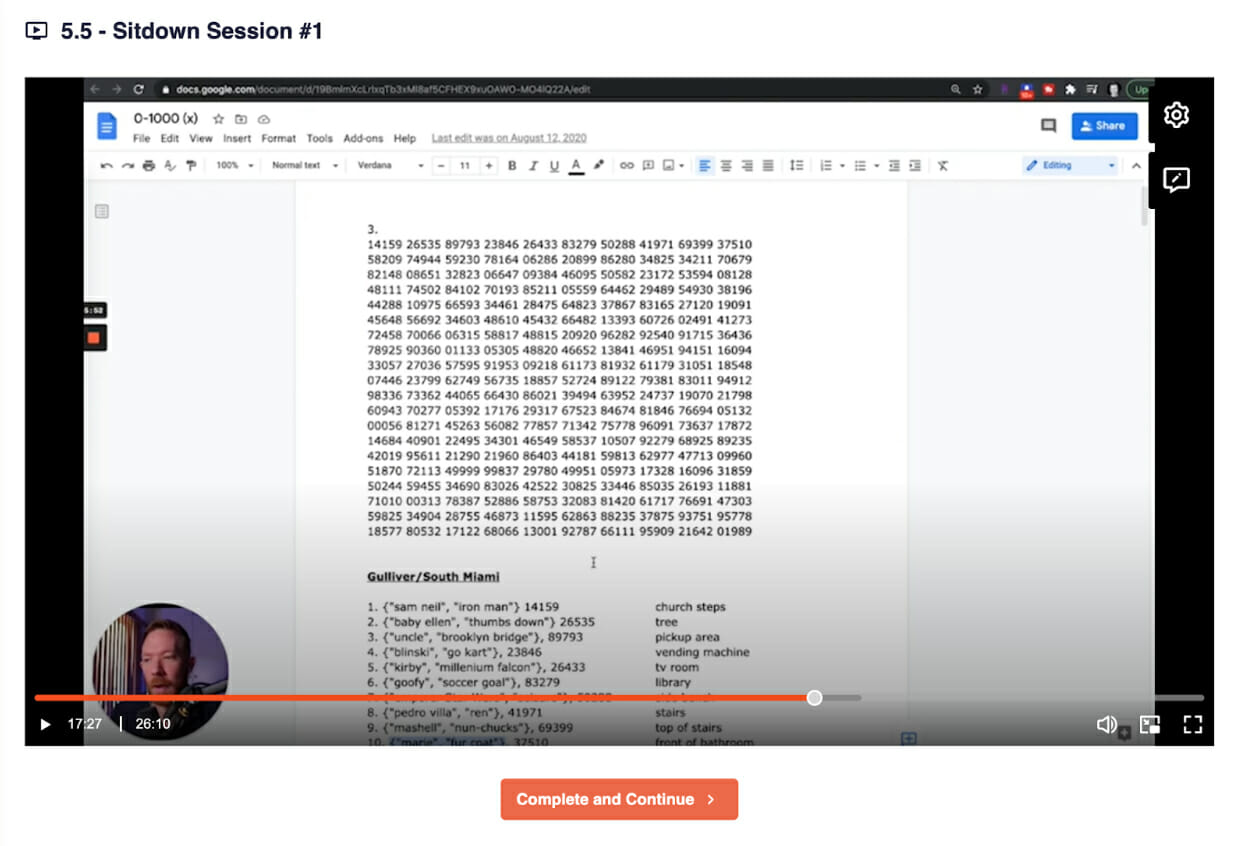
    I’m very impressed by what Nelson has put together, especially the detailed walkthroughs. You join him as he explains exactly how you can achieve his same memory feats in detail.

    sitdown with nelson dellis and learn how to memorize hundreds of numbers fast

    And if you find it hard to settle down and focus on your own, the timed focus sessions will be a boon for you. You’ll have a focused set of sessions to sit down with and get the implementation aspects of the course done.

    Yes, You Should Take Everest Memory Masterclass

    In sum, this is a great course and you should take it.

    Frankly, if you go through everything and take action, your memory will improve.

    In my experience, the hardest thing for most people is setting goals for what to memorize.

    Nelson has pretty much solved that.

    No, you might not want to memorize random vocabulary or digits.

    But the fact of the matter is that the world is filled with them.

    And if you can’t remember them as they come in randomly, you’re probably not going to be able to memorize them when they’re packed into meaningful units.

    So in this program, you get the best of all possible worlds.

    It’s just up to you to take the steps. Or place your hands on the mountain face, as the case may be.

    And on that note:

    I’ll never forget something Nelson told me during one of our many conversations.

    He said that when you’re climbing a mountain, you don’t have to worry about the peak.

    It’s there. And you can reach it.

    Really, all you have to think about is where you’re going to place your hands and feet next.

    When you’re willing to do that, you can summit the biggest mountain of them all:

    Your mind.

    So what do you say?

    Are you ready to experience epic memory skills?

    I can’t recommend Everest Memory Masterclass highly enough!


    How to Improve Memory After a Stroke: 4 Proven Methods Jul 06, 2022
    Show notes

    how to improve memory after a stroke feature imageMany people come to me with memory loss after a stroke.

    They’re confused.

    Struggling to pay attention.

    Frustrated that they can’t remember details that used to come to mind so easily before suffering their stroke.

    Equally troubling are the spouses who email me about their loved ones.

    They ask me about brain exercises for stroke recovery.

    And they’re generally worried about the future, because we all want to lead rich and fulfilling lives in our old age.

    Which won’t be easy or particularly fun without enjoying significant recovery.

    Good news.

    Life can be rich and fulfilling, even after a stroke.

    On this page, you’ll learn all about why memory loss happens after a stroke.

    And what can be done to get your precious memory abilities back.

    Not only that, you’ve got a chance of having your memory operate even better than before.

    Ready?

    Let’s dive in.

    Does a Stroke Cause Memory Loss? What You Need to Know

    Strokes cause memory for a few reasons.

    • Brain cells die as a result of the stroke
    • Neuronal connections may be severed
    • Vascular dementia may develop
    • Comorbidity or other health issues may exacerbate the previous reasons

    There are other factors that might contribute. For example, researchers have found that previous educational experiences might contribute either positively or negatively.

    In other words, if you have a strong education background, you may fare better than someone who has not. Likewise, if you’re bilingual, you may have developed “cognitive reserve” that will work to protect your brain.

    education books

    To be clear: learning a language or completing a degree might not prevent you from having a stroke. But it can help protect your brain from damage, or bounce back much faster.

    Of course, a lot depends on exactly where the stroke has hit the brain. For example, a stroke that affects the prefrontal cortex can diminish your ability to pay attention. This cognitive ability affects memory differently than other types of memory.

    Finally, you should know that having a stroke creates stress. Stress is known to reduce your memory abilities.

    This means that both the stroke victim and family and community members may be affected.

    But the good news is that there is a lot you can do to improve.

    Let’s check them out!

    How to Improve Memory After a Stroke: 4 Scientifically Proven Methods

    The following list is in no particular order of importance.

    All of them are good.

    And all of them can be done after a stroke to enjoy memory recovery.

    But they also can be done beforehand to prevent having problems in the first place. You’ll enjoy fewer memory blocks and greater brain health overall.

    One: Movement

    Researchers have noted significant memory improvements when stroke patients engage in the 8 brocades of Qigong.

    I practice these myself and notice great memory boosts. I recommend Mimi Kuo-Deemer’s Qi Gong and the Tai Chi Axis. It contains easy to understand instructions for each of the movements tested in the brocade study.

    Movement also improves sleep, which automatically leads to improved memory.

    Two: Vibration Work

    If Qigong gets the entire body movement, transcranial direct current stimulation has been shown to improve audioverbal memory in stroke patients.

    a girl is singing on a roof

    These devices can be quite expensive, but there are two alternatives you can explore:

    • Singing
    • Chanting

    There are many studies that show the therapeutic value of these activities. My favorite studies come from Dr. Gunter Kreutz and his team because they also show improved mood in their subjects.

    In their studies, singing as part of a choir. This outcomes makes sense because being with others also promotes better health.

    But it’s how singing and chanting “vibrate” the brain that most strongly correlates with the findings from studies in transcranial current stimulation.

    Three: Brain Exercises

    There are all kinds of apps selling “brain exercise” subscriptions. According to Dr. Christine Till and many others, the claims they make are mostly dubious.

    So what counts as simple routines that do work?

    First, you need brain exercises that follow the mental workout rules shared here. These include new learning, which as we saw above, helps people avoid memory loss from strokes in the first place.

    Second, if you want to clear brain fog after a stroke, you need a brain exercise that is designed for such outcomes. Neurobic exercises provide excellent routines for that.

    strong brain exercise

    I’ll give you a few specific brain exercises a little further down this page. But first, let’s talk more specifically about what you can do to recover your memory moving forward.

    Four: Memory Exercises

    Memory exercises differ from brain exercises. Whereas brain exercises train our focus and attention, memory exercises are all about improving recall.

    One of the best things you can do is deliberately remember information. You can engage in activities like:

    • Remembering some of pi
    • Committing vocabulary to memory
    • Deeply absorbing scripture
    • Learning a language

    To make all of these activities much more fun and easy, I suggest you learn how to use a Memory Palace. It’s a simple mental tool that uses association to help you learn new things faster.

    These Brain Exercises for Stroke Recovery Will Help You Restore Your Memory

    Now that you know of the key activities you can explore for better memory, let me share a few quick brain exercises with you.

    Give each a try and journal your results along the way.

    Writing out your experiences and keeping a recovery diary is the best way to note what works. That way, you know what to do more of and what you can replace.

    Number Skipping

    When it comes to improving the ability to pay attention that so that you can remember incoming information, this exercise is key.

    https://www.youtube.com/watch?v=p7NPia_lkaE

    To get started, get from one to ten, but not exactly.

    Skip representing the even numbers.

    In other words, count “one” out loud, but when you get to the “space” you would normally count “two,” suppress it.

    For many people, this will be hard. It’s like saying to someone, “Don’t think of a red cat.” Your mind has to do it in order to obey the command.

    But with practice, you can assign space in your mind for numbers without representing them.

    I know this exercise is abstract, so please watch the video version so you can learn it as thoroughly as possible.

    Kirtan Kriya

    You can reduce stress at the same time you boost memory and comprehension.

    This simple brain exercise involves reciting simple syllables as you work with your fingers.

    Here’s an excellent video tutorial on the practice from Dr. Gary Weber:

    https://www.youtube.com/watch?v=ehvokeZnXMM

    If you want a more advanced version of this exercise, try combining it with number skipping.

    Memory Training

    We’ve already discussed a few ways you can train your memory.

    But did you know you can also engage in it as a sport?

    ACTIVE is the longest study we have, and although it doesn’t involve memory sports as such, it involved using the same mnemonic images memory athletes use.

    People who trained with this form of association showed better abilities to navigate life. This included their ability to reason effectively. In other words, by memorizing something each day, the kept their critical thinking skills intact.

    Complete Physical Puzzles

    Did you know that science shows completing jigsaw puzzles helps your mind age better?

    This is likely due to the benefits of haptic memory exercise, literally the mental exercise you get from using your hands. It could have to do with combining the visual and physical experience of assembling a picture in a way that engages Weber’s law.

    One study implies that it would be very good if we all continue to complete physical puzzles as kids, rather than playing too much on devices that create digital amnesia. Basically, the study suggests that you’ll do even better with these kinds of activities if you have prior experience with them.

    But anyone can benefit, so get yourself a puzzle and start solving it.

    Become An Expert And Maintain Your Expertise

    As we’ve seen, it pays to be prepared in the event of a stroke.

    But even if you’re recovering, you can work on developing expertise in a topic and then benefit from maintaining your knowledge.

    As Timothy Salthouse has found, there is truth to the “Use It or Lose It” hypothesis.

    a person is playing chess himself

    It’s never too late to develop even just a small amount of expertise in areas like:

    • Chess
    • Music
    • The arts
    • Law
    • History
    • Literature
    • Politics
    • Philosophy

    In all cases, the trick is to get sufficient amounts of deliberate practice.

    Can Strokes Affect Memory?

    In a word, yes.

    But so can many other things, both positively or negatively.

    So whether you’re working on your recovery now, helping someone who is, or hoping to avoid issues altogether, the time to get started with the activities on this page is now.

    The best part is that all of the brain exercises and accelerated learning techniques you’ve discovered today are easy and fun.

    So what do you say?

    Are you ready to give your stroke the boot and enjoy amplifying your memory?

    If so, why not give my FREE Memory Improvement Kit a try?

    Free Memory Improvement Course

    It will help you develop those Memory Palaces I was telling you about above.

    And they’re useful for working on the vocabulary memorization exercises that have been scientifically shown to help people live fulfilling lives, even after experiencing a stroke.

    If you have any questions, just let me know and I’ll get back to you a.s.a.p.


    The Number Rhyme System (What It Is & How to Use It) Jun 29, 2022
    Show notes

    the number rhyme system feature imageRemembering lists is tough, right? Not with a proper mnemonic number rhyme system.

    Whether it’s items you need from the grocery store or an index of medical terms you need to pass an exam.

    Enter the real magic of the number rhyme system.

    This simple trick is used by students around the world in multiple fields.

    Mentalists use it to create astonishing illusions.

    And you can use it too. Simply take a few minutes to learn it and practice this unique mnemonic tool with information you want to remember.

    The best part?

    It’s fun, fast and one of the best memory techniques for both kids and adults alike.

    Ready?

    Let’s get started.

    What Is the Number Rhyme System?

    Number rhymes or counting rhymes are a variation on the pegword method.

    That is, they allow us to follow a series of established associations, sometimes called mnemonic images.

    But the key difference here is that all of the mnemonic images rhyme. And we know from studies like this one that kids absolutely remember far better when they rhyme words.

    Another study has shown that there’s a memory advantage from involving a sense of rhythm, and that works for all ages.

    https://www.youtube.com/watch?v=hW5OUO7kD9Y

    Typically, this kind of pegword works by rhyming each number to with an object or some other reference. Like the following examples I’ve used personally for years:

    • Zero is a superhero
    • One is a gun
    • Two is a shoe
    • Three is a bee
    • Four is a door
    • Five is a hive
    • Six is sticks
    • Seven is heaven
    • Eight is a gate
    • Nine is wine
    • Ten is a hen

    If you like any of these images, feel free to use them. Or come up with your own.

    For example, some people use a “bun” instead of a gun because they don’t like weapons.

    For myself, I switched “heaven” for my friend Evan. He’s much more memorable than that rather vague concept.

    That said, if you like heaven, a trick is to make it more concrete, perhaps by thinking about the ceiling of the Sistine Chapel.

    I do that for most of these. For example, 3 is a bee is generic. But I make the mnemonic rhyme specific by using Jerry Seinfeld as a bee from The Bee Movie.

    How to Use the Number Rhyme System

    The purpose of this mnemonic system is to “attach” or “associate” information you don’t know what simple mental images.

    Then, by elaborating something like a story between the target information and the number rhyme, you’ll find it easier to remember the list of what you want to remember.

    For example, let’s say you need to remember that you want to research architecture.

    You would then go to your number rhyme system and imagine a famous piece of architecture wrapped up in a bun.

    number rhyme example

    Then, if your second research project is to research steel, you could have steel bars filling up a shoe.

    These associations help trigger your memory because of the combination of rhyming the numbers and associating them with the target information.

    The cool thing is that if someone tests you: “What was item 5 on your list?” You’ll be able to instantly tell them what that item was.

    Things might be a bit trickier if you’re trying to memorize information like the amendments to the constitution. But you will still benefit by attaching your rhymed images to each amendment.

    How to Practice the Number Rhyme System

    When it comes to practicing this system, there are a number of things you can do. We’ve already looked at remembering research topics you want to look up in the future.

    (This type of use will strengthen your prospective memory, by the way.)

    More ways to practice include using the system to memorize lists of:

    • Vocabulary
    • Names of people
    • Names of places
    • Book titles
    • Historical dates
    • Number tests
    • Medical information like remembering vital signs
    • Any kind of information collected into lists you need to memorize

    And this mnemonic strategy will work for just about anything that involves simple items or ideas that don’t involve a lot of words. I wouldn’t suggest using this approach to memorize a poem, however, though you certainly could give it a try.

    a printed poem
    The number rhyme system probably won’t help you memorize a poem, at least not with any ease. But it would make for a fascinating and challenging experiment to try.

    The hardest thing for many people is putting the time together to create lists of information to memorize. Here are some suggestions:

    • For vocabulary, use the dictionary
    • For names, use something like the Internet Movie Database
    • For place names, open up Google Maps and memorize street names
    • For book titles, use your bookshelves or Ebook catalog

    You can also explore software options like the free International Association of Memory training software.

    Expanding From The Number Rhyme System

    Usually, once people have a taste for the power of using number rhymes to memorize lists, they want more.

    One of the next levels of skill to explore involves the Major System. It lets you memorize numbers in a highly refined way. Instead of using rhymes, you associate the digits 0-9 with consonants. You then turn these consonants into memorable words.

    The Major can be evolved even further by creating a PAO System. Instead of having words to help you memorize numbers, you also use people, actions and objects in a strategic manner.

    Finally, the technique that governs them all: The Memory Palace. It allows you to store information in your mind by placing things like rhymes in an imaginary way throughout a building.

    For example, let’s say you’re helping your kids learn memory techniques. You know that 2 rhymes with shoe and 4 rhymes with door.

    To help your kids remember that 2×2=4, you can use the number rhyme system in combination with a Memory Palace.

    memory palace example of using the number rhyme system to memorize the multiplication table

    If you learn to use the Memory Palace technique strategically, it’s easy to place the entire multiplication table along a simple journey in one or two buildings.

    Learn More Memory Systems Now

    What you’ve discovered today is really just the beginning of an incredible adventure you can enjoy using memory techniques to learn and remember more.

    If you’d like more information on how these techniques help you stop forgetting things, register now for my FREE Memory Improvement Kit:

    Free Memory Improvement Course

    It will show you exactly how to develop a robust Memory Palace Network that scales. You never have to forget important information again.

    So what do you say?

    Are you ready to master your memory using number rhymes?

    Although it’s a simple start to a much larger universe of memory techniques, it will remain useful and powerful for the rest of your life.


    Mnemonic Images: What They Are & How They Help Jun 08, 2022
    Show notes

    Mnemonic images are powerful tools you can use to speed up the learning and remembering process. You can use mnemonic pictures for nearly everything: Language learning Info from textbooks Chemistry Math Names Facts Historical dates Lists Verbatim tasks like quotes and speeches The trick is to assign your mnemonic images correctly. Miss just one step, and the process can be slow, boring and not worth the time. But learn to use mnemonic images well, and you’ll learn at a much faster pace. Ready for the real deal when it comes to this powerful learning strategy? Let’s dive in! What Are Mnemonic Images? Mnemonic images are associations. Learners use them to pass exams, and they are increasingly used in cognitive training as discussed in this scientific study. For example, if I want to remember a name like “Bruce,” I might think of Bruce Wayne from Batman lore. https://www.youtube.com/watch?v=qM1sQJshXE4 You attach a simple image like either of them to information you want to learn. They can be simple and direct like Bruce Wayne, or more complex as needed. For larger learning projects, we typically place our associations in a Memory Palace. You can also draw them out, which I often do to speed up the learning process. It works because of how drawing and imagination both exercise your visual memory. Here’s an example of how I’ve used drawing in combination with a superhero image from one of my language learning missions: This kind of visual mnemonic works because the answer isn’t on the card. I’ve also left a blank area with no mnemonic image at all to tickle my memory and imagination in a growth-oriented way. That way, the entire mnemonic image presents a puzzle to be solved. And solving it makes memories form faster. The Truth About Mnemonics Frankly, there’s a bit of a problem in how we use this term “mnemonic image.” You see, the idea of an image mnemonic makes it seem like the associations have to be visual. But visual mnemonics are actually just one category of associations you can assign. In the Magnetic Memory Method Masterclass, I teach you all the major categories of association through KAVE COGS: Kinaesthetic mnemonics Auditory mnemonics Visual mnemonics Emotional mnemonics Conceptual mnemonics Olfactory mnemonics Gustatory mnemonics Spatial mnemonics Those are the major eight categories most of us draw upon the most often. But there are twenty more that I teach, and knowledge of the entire set can be useful from time to time. You can also discover and develop each one by completing various sensory memory exercises, all of which I recommend. The point is this: True Mnemonic Images Are Multisensory Good mnemonic images are always multisensory. They don’t just rely on the visual mode. So if you want to learn faster and remember more, visual mnemonics are okay. But you’ll do a lot better if you add in more mental imagery based on other sensations. In the Magnetic Memory Method world, we call the range of sensations we use the “Magnetic Modes.” Why? Because we know from personal experience and a variety of sources that multisensory association is the key to associative learning. First, we have thirty years of memory competition records, and I’ve interviewed dozens of memory athletes like Nelson Dellis, Braden Adams, Lynne Kelly, Katie Kermode and John Graham to name just a few. I’ve also interviewed the creator of the World Memory Championships, Tony Buzan. We know from studies that mnemonic processing works a lot better when it is multisensory. Studies have shown that multi sensory mnemonics can beat flash cards, for example. (I’ll show you a way you can combine mnemonic images with flash cards in a moment.) Overall, multisensory association is a kind of “guided learning,” and this has been shown to be very healthy for adults. And you don’t have to be a memory competitor to benefit. People like myself, Scott Gosnell and John Michael Greer all produce materials for adult learners to help teach themselves this “martial art of the mind.” Finally, this study shows that it is best for the images to be as strange and bizarre as possible. In the past, I used to call this process Mindshock, as discussed in this episode of the Magnetic Memory Method Podcast: With all of the evidence and that podcast in tow, let me now give you a few steps and some examples that will help you quickly master using mnemonic images as you learn. How to Use Visual Mnemonics to Remember Things Keeping in mind that what we’re talking about is visualizing a wide range of sensations when assigning associations, here’s what to do and how to do it. If you struggle to visualize, try these simple exercises. You can also learn to image stream or develop hyperphantasia. Step One: Have Your Target Information Prepared I know this step sounds obvious to some learners. But here’s the sad truth. Many people don’t spend any time at all thinking about what they want to memorize. And that means they don’t arrange their target information in order to optimize how they’ll approach memorizing it. This neglect causes issues later because mnemonic images are associations and they can blur into each other if they aren’t separated and arranged in optimal ways. For example, when you’re memorizing a speech, you may want to memorize the quotes you use first. That’s how I approached my TEDx Talk. Sure, it’s out of order, but the decision paid off. Let’s take another example: When you’re memorizing foreign language vocabulary, you might want to organize the words by theme or even alphabetically. By arranging the German vocabulary I needed to learn in order to lecture at the University of Saarland alphabetically, I learned a lot more words and phrases faster than I could have done otherwise. What’s the best way to organize what you want to memorize using mnemonic images? First, follow my process for taking notes from your textbooks. Next, you’ll want to follow the next step to avoid issues that emerge from poor information organization. Step Two: Use a Memory Palace You can definitely use mnemonic images without a Memory Palace. Some people prefer the story and link method. However, here’s something to consider: A Memory Palace is a mnemonic image. And it’s a powerful one because it allows you to use every other memory technique within it. Any building you are basically familiar with can be used as a Memory Palace for storing your mnemonic imagery. You also can use the Memory Palace to review your mnemonic images. Without this spatial memory foundation, it’s difficult to manage a bunch of associations floating around in the void of your mind. Step Three: Select Your Mnemonic Images Skillfully When learning, a lot of people make weak mnemonic images. For example, if they are memorizing scripture, they might do something like this for Proverbs 18:13, “To answer before listening, that is folly and shame.” They might use a mnemonic image of a tutu answering a bee-shaped telephone to get started. That’s okay, but as a mnemonic, it’s also generic and vague. To use the Magnetic Memory Method, you choose much more specific references. I would certainly stick with the tutu, but I would add Desmond Tutu. Desmond Tutu wearing a tutu is a lot stronger than just the piece of clothing floating around on its own. Then, with this image secured in a Memory Palace, I would add KAVE COGS. I would literally pretend to be Desmond Tutu and feel the tutu against my skin. I would hear him dancing around like a ballerina on his way to answer the bee-shaped phone. And it would not be just any bee-shaped phone. It would be the character from The Bee Movie, voiced by Jerry Seinfeld. Instead of using a generic mnemonic image, take things one step further. Find a specific version of that visual image. This reduces cognitive load when using the association to remember information. These specific references make it easy to pack in sounds, emotions, physical sensations and elements of size, smells and tastes. It’s so much more powerful than visual mnemonics on their own. Mnemonic Images For Language Learning Example When I learned the Japanese hiragana, I applied all of the principles I’m teaching you on this page. To keep things highly specific and easy to animate in the mind, I chose Ezra Pound as a mnemonic image that helped me both “see” and “hear” the following hiragana: あ (a) Ezra Pound standing in Jesus Christ pose with a Christian fish symbol attacking his legs. He shouts Ah! い (i) Pound with two eels in his mouth, squirming, one long like an upside down seven, one short. They are squealing eee eee eee. う (u) Pound leaning on a stick with a beret cooing ooh as the weight is relieved by the stick. To help you better experience how I linked these mnemonic images to the hiragana, I’ve asked an illustrator to supply the following pictures: This process works great thanks to applying a much fuller understanding of mental imagery than is normally taught. Simply by “leaning” on Ezra Pound throughout the encoding process, I was able to memorize fifteen hiragana in fifteen minutes. I’m not alone in experiencing such tremendously fast outcomes. Many students like Sunil Khatri have done fantastic with Japanese. Kevin Richardson is another of my students who has shared his knowledge about applying wild and zany images to Japanese specifically on the Magnetic Memory Method Podcast. But it’s not just about Japanese or language learning. You can check out many testimonials from people who went from using mnemonics how others teach them, to the Magnetic Memory Method approach. So long as you choose your mnemonic images well, you will have a much easier time recalling your target information. That’s because how you’re using these mnemonic devices has been properly optimized. Step Four: Review Your Mnemonic Images Strategically With a Memory Palace in play, you’re able to gather together dozens, if not hundreds of mnemonic images. My TEDx Talk involved over 300, to give you a simple example. (Though, please keep in mind that it’s not a numbers game. And there are different ways to count how many images are involved depending on your exact approach). In my experience, the best way to review the associations is to follow the Memory Palace journey using dedicated patterns: Review them forwards Backwards From the middle of the Memory Palace to the end From the middle of the Memory Palace to the beginning Out of order Randomly pop in This approach gives equal doses of Primacy and Recency to each mnemonic image in the Memory Palace. Step Five: Experiment I mentioned above that there’s a way to integrate flash cards. You can also use digital flash cards using an app like Anki. The same rules apply. When you create your card, either on paper or on a digital screen, make sure to use KAVE COGS. And practice memorizing many different types of information. The images you use to memorize words will ultimately be linked to what you use for words. But knowing how, when and why to shift your mnemonic strategy is the key to long term success across the learning landscape. Step Six: Develop As you continue learning using mnemonic images, develop other systems. There are three key systems that give you literally dozens of images you can draw from on demand. These are: Major System Pegwords 00-99 PAO Within 2-5 hours of developmental work, the piles of mnemonic images these systems give you will be ready to use in a flash. For example, if I have to memorize an unfamiliar name like Gangador Dianand, I don’t have to create a mnemonic image from scratch. I just consult my pegword list for ideas. If I have to memorize a number like 33924345, all I need is my 00-99 PAO, which has three images perfectly suited for those numbers. It’s ready to go, and all I had to do was develop it based on the Major System. That’s all you’ll have to do too. Beyond Mnemonic Pictures Without a doubt, mnemonic images are fun and easy to develop and use. The trick is to not treat them like “pictures” or limit them to the visual mode. The more you broaden them into the multi-sensory capacities of your mind, the great memory power they will have. And you can apply the KAVE COGS formula to your Memory palaces too. Remember: Every Memory Palace is also a mnemonic image. And it’s the best kind of mnemonic image because it is the one that lets you store all the rest. If you need help building your first Memory Palace and want an entire network of them, register for this free course now: It will help you develop them in an optimal way to house all of your mnemonic images from here on in. That way, you’ll remember a lot more, a lot faster.

    Full show notes at the publisher

    12 Brain Warm Up Exercises That Actually Work Jun 01, 2022
    Show notes

    11 brain warm up exercises feature imageGood brain warm up exercises are hard to find, but you’ve just discovered an in-depth list of the best.

    What makes a mental warm up routine good?

    For one thing, it has to challenge your mind.

    In order to create an effect, each warm up routine needs to produce at least a bit of friction.

    By taking on the quick and creative challenges I’ve gathered for you on this page, you’ll experience exactly that:

    Positive friction that produces mental dexterity, new ideas and personal growth.

    Sound good?

    Great! Let’s dive in!

    12 Brain Warm Up Exercises That Wake Your Brain Up

    This list of warm ups for your brain is a cornucopia of ideas.

    They’re all good, so don’t feel that the numbers are an indicator of value.

    But if you want my personal opinion?

    I saved the best and most scientifically-tested exercises to wake up your brain for the end of the list.

    https://www.youtube.com/watch?v=re81N5KlouY

    One: List 10 Alternative Uses For An Object

    You’ve probably heard of the one where you list 10 alternative uses for an object before.

    Like if I show you a paperclip, you might suggest stringing enough of them together to create a ladder from here to the moon as your first alternative use.

    It’s a great exercise that creates rapid benefits, and it works with any object.

    But I’d suggest you go a step further. For example, if you’re going to create a ladder to the moon using paperclips, why not also imagine a version of the moon composed entirely of paperclips.

    This is the alternative substance exercise that in some sense already exists. For years people have been saying the moon is made of cheese, but paperclips… how about socks? Or arts? Or noodles?

    Then go a step further yet.

    What possible things could you use a moon made out of noodles for? Would you campaign the rich to donate spaceships and space suits so they could bring those noodles back to earth to feed the poor?

    Whatever use you find your random objects, figure out what links you’ve made between things, then change the substance of the thing being linked to into the original object and find at least a few alternative uses for that.

    If you can’t think of ten, don’t sweat it. But keep coming back to it throughout the day for some mini-creative exercise.

    It’s a great exercise that creates rapid benefits, and it works with any object.

    So grab an eraser, sock, book or any object you can find and jot down at least ten alternative ways it could be used.

    If you can’t think of ten, don’t sweat it. But keep coming back to it throughout the day for some mini-creative exercise.

    Two: Question Your Dreams

    I don’t know about you, but I dream often.

    But instead of letting them drift away, I use my dreams to engage in one of the strongest morning brain exercises I know.

    yellow sweater woman remembering her dreams

    Here are the steps to remembering your dreams:

    • Write down the dream or dream fragment you remember
    • Ask what it reminds you of (situation, person or place)
    • Journal briefly on any emotions or concepts that arise

    You can also do exercises throughout the day with your daydreams. This is an activity Robert Langs discusses in full in his excellent Daydream Workbook.

    In brief, when you notice yourself daydreaming, make a note of the nature of the dream. And ask yourself similar questions about what memories come to mind surrounding it? What emotions, longings or fulfillments does the dray dream suggest?

    There doesn’t have to be any particular outcome from this exercise. You’re just going for the brain warm up and using your dreams and day dreams to do it.

    Three: Give Emotions to Colors

    Take ROY G BIV, the acronym for red, orange, yellow, green, blue, indigo and violet.

    Then list as quickly as you can the first emotion that comes to mind for each color. For example:

    • Red = anger
    • Orange = shame
    • Yellow = happy

    To take the exercise to the next level, find 3-5 alternative words for each emotion. In other words, mentally transform happiness into contentedness, comfort, mirth, cheer, elatedness, etc.

    Try and do it on your own before reaching for a thesaurus.

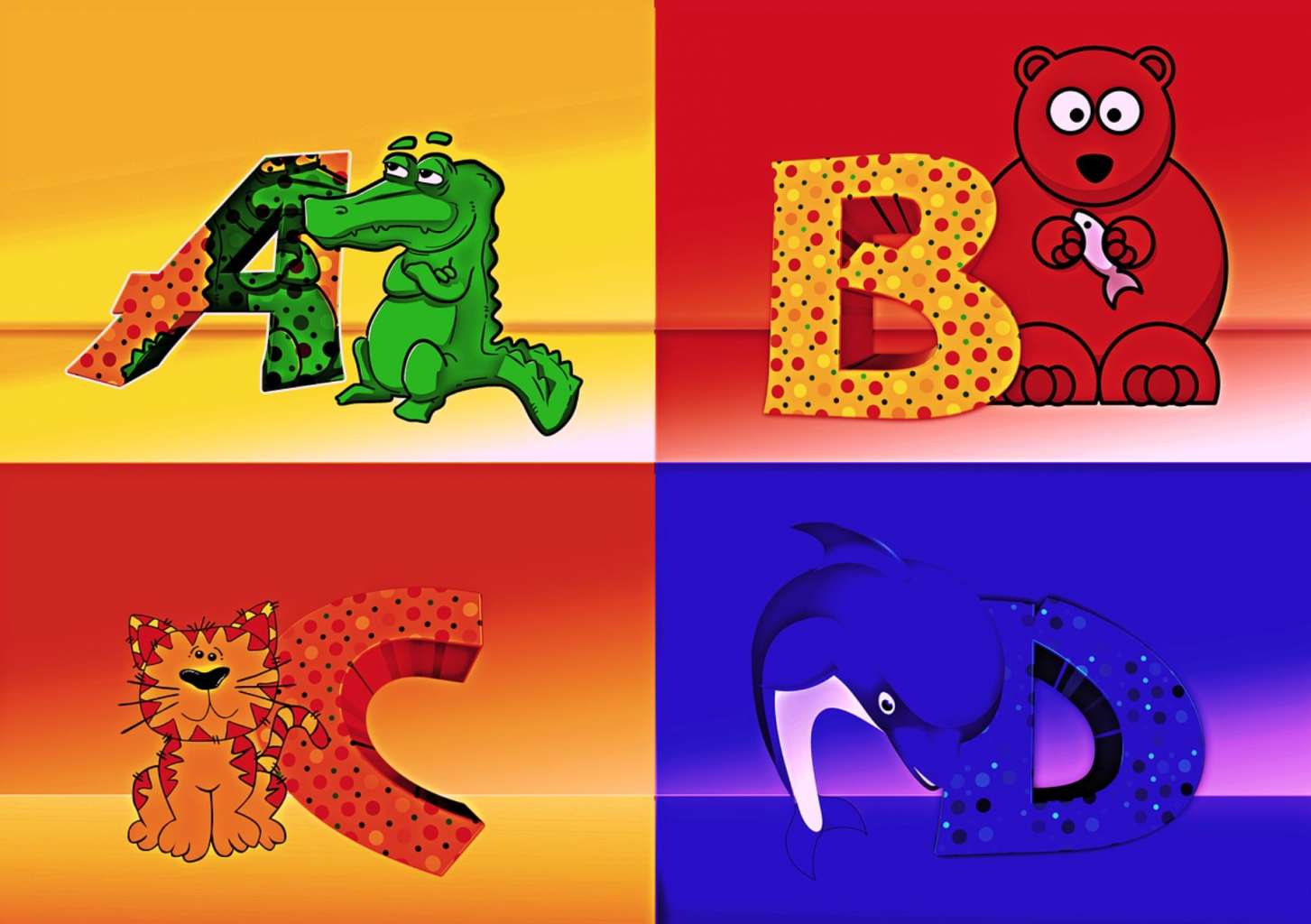
    Four: Play the Alphabet Game

    Either in your mind or using paper and pen, think of a name for each letter.

    For example:

    • A = Anthony
    • B = Bonnie
    • C = Connie etc.

    Now, they don’t have to rhyme, as I’ve done, but that in itself provides interesting exercise that will stretch your mind even further.
    alphabet games

    You can also go through the alphabet and name only objects:

    • A = apple
    • B = ball
    • C = car etc.

    If you want to take this to the next level, have a person you name interact with an object by the same letter. Have the action also start with the same letter, like this:

    • Al Pacino accepts an apple
    • Batman bounces a ball
    • Cookie monster cooks a car, etc.

    Sure, things might get weird, but that’s why this exercise works so well to wake up your brain.

    You can take this exercise further with the pegword method or by building a PAO System.

    Five: Encode Using Associations

    Let’s say you’re doing the color/emotion exercise I shared above. You’ve discovered a word in the thesaurus and you want to remember to use it more often.

    Take the word and think about an image that comes to mind that can help you remember it.

    For elatedness, you could seize upon the el and think about someone named Elaine arriving late.

    To take another example, for mirth, you could think about frankincense and myrrh, as mentioned in the Bible.

    For best results and an additional exercise, place these associations in a Memory Palace.

    Six: Reading Recall

    Go back as far as you can in your life. For example, grade one or two.

    Think of a book that you loved during that year. Or at least a book you can remember reading.

    remember reading a book

    For me, I remember a book in kindergarten or grade one that involved teddy bears falling off of the book shelf they lived on. They fell onto a map spread on the floor and had to find their way back to the bookshelf from disparate lands.

    The next book I distinctly remember is Where the Red Fern Grows. All I really remember about it is that there was a dog and quite a bit about hunting racoons.

    Don’t worry if you have to skip entire grades or if you aren’t sure about accuracy. Just try your best to proceed on a year-by-year basis.

    You can also just go year-by-year if you haven’t been in school for a very long time. The point of the warm up exercise is to stick with the yearly progression.

    As an alternative, you can also use movies and try to match the year or grade you were in when you saw them.

    Seven: The Movie Name Game

    Take a movie that you know. Then, take the last letter in the name of the movie. Use it to name another movie.

    For example, if you think of Aliens, then your next movie should start with S, such as Superman. Then you would think of one that starts with N.

    This exercise can get challenging fast, and challenge the relationship between your memory and intelligence because of how it requires you to mentally rotate the alphabet while engaging your semantic memory. But push through and see how far you get. Try to name at least 10 titles before you stop.

    As an alternative, you can use book titles, names of people you know or celebrities.

    Eight: Mentally Combine Objects

    Unlike the exercise where you name as many possible uses for an object as you can think of, here the goal is to think of mixing two objects together.

    For example, imagine mixing cherry juice with mustard. Or attaching a chain saw to a car. How about an airplane that shoots spiderwebs?

    spiderwebs

    See if you can get 10 combinations together.

    You can also take this to the next level by getting actual objects together on a table and trying to combine them. For example, you can play around with combining:

    • Fork
    • String
    • Coins
    • Salt shaker
    • Etc.

    To take a simple example, you could tie the string around the coin and use it as a swinging mallet to make a dinner bell out of the salt shaker.

    Nine: Combine Stories

    Imagine Dorothy from the Wizard of Oz.

    But instead of having a dog named Toto, imagine that her pet is Scooby Doo. Then imagine how Scooby Doo would fit into the basket on Dorothy’s bike. And think about how he would react when meeting the Wicked Witch for the first time?

    To continue this creative warm up exercise, have a number of movie and story titles on slips of paper. Mix them around and mishmash a few together. Then think of scenarios and what they would be like with the character swaps in place.

    For more examples, imagine:

    • James Bond in a battle against Kermit the Frog
    • Rambo taking on the Death Star in Star Wars
    • Sherlock Holmes in The Firm instead of Tom Cruise

    Keeping physical books in the area where you complete your morning brain exercises is a great way to do this. Just grab a few novels or comic books and think of mix-and-match ways to create new and unusual combinations.

    You could also combine philosophical concepts for an additional layer of challenge if you read it regularly. It will challenge your reasoning skills and enable you to ask new and interesting philosophical questions.

    grab a book

    Ten: Use a Memory Palace

    Many people think that the Memory Palace technique is only used to improve your memory for studying.

    This is not true.

    One of the most ice-cold mental situations people face comes from problems like PTSD and depression.

    Yet, as Nic Castle, a former police officer found, using a Memory Palace helped him reduce his symptoms.

    It’s not just his anecdotal experience either. Dr. Gary Dalgleish and his co-researchers have found exactly these results in their clinical trials.

    You don’t have to suffer in order to benefit from using this technique as a brain warm up, however.

    All you have to do is:

    • Have at least one Memory Palace (here’s how to create your first)
    • Use it to memorize something (like a simple mantra)
    • Enter your Memory Palace first thing in the morning
    • Recite the mantra
    • Exit the Memory Palace feeling warmed up

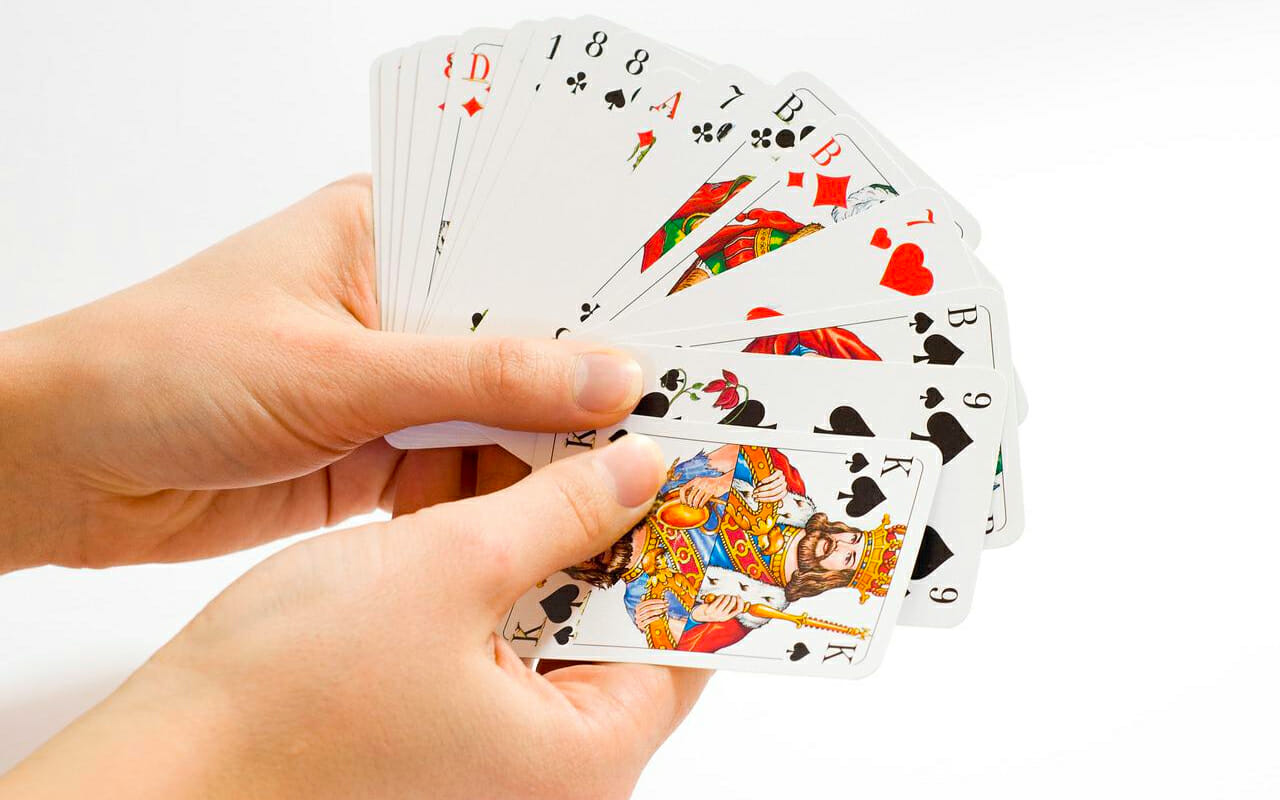
    If you really get into this practice, you can also memorize playing cards as a quick warm up. I sometimes do this before applying memory techniques to language learning.
    card games

    Eleven: Learn and Use a Speed Calculation System

    Imagine being able to solve mathematical equations within seconds?

    All you have to do is learn a simple system. I recommend the Trachtenberg method.

    Although learning it might not itself serve as a brain warm up, using it certainly well.

    It’s a lot of fun and you can learn to use it for addition, multiplication, division and even squaring and algebraic manipulation.

    Twelve: Journal About Your Emotions

    Researchers found that students who journaled for 10 minutes about their emotions scored better on their exams.

    Imagine that:

    Getting an A instead of a B+ just by writing about how you feel.

    Researchers also found that if the participants focused on their breathing while journaling, they did even better.

    The catch with this study is that it was useful for students with anxiety. Having dealt with anxiety myself and used journaling, I’ve found this approach excellent in my own life for getting my brain warmed up.

    I don’t see why it wouldn’t help anyone, even if they don’t have anxiety themselves.

    Give it a try!

    Exercises to Wake Up Your Brain

    As you can see, there are many routines you can follow.

    In fact, we’re just scratching the surface.

    If you find that you like these brain warm up routines, there are so many more things you can do.

    And if you found the Memory Palace technique intriguing, why not learn the skill in earnest?

    I’ve got a whole FREE course you can register for right now:

    Free Memory Improvement Course

    It will take you through how to develop this simple tool so you can use it throughout the day to keep your brain sharp.

    The best part?

    It will help you remember the different brain warm up routines we discussed today.

    So give it a try and just shout out if you have any questions along the way. I’ll get back to you a.s.a.p.


    Memory and Intelligence: Are They Connected? May 25, 2022
    Show notes

    memory and intelligence feature imageAre memory and intelligence connected?

    Of course they are.

    After all, how could you ever display your intelligence without using your memory to speak?

    But let’s dig deeper.

    Working memory and intelligence are connected in some interesting ways.

    And when you understand these, you can use your natural memory to boost your own intelligence quickly.

    Even better:

    You can help others do the same.

    Ready?

    Let’s get started!

    The Link Between Memory and Intelligence Explained

    Intelligence comes down to drawing upon remembered experiences to plan and make decisions.

    Indeed, it is a sign of high intelligence when individuals take time to plan before making snap decisions.

    Of course, as neuroscientist David Eagleman points out in The Brain: The Story of You, we don’t always have time to plan out our decisions.

    To help us see how the intelligence centers of the brain light up when faced with logical problems that need to be decided quickly, neuroscientists study people’s brains as they consider the trolley problem.

    But here’s something interesting:

    In these scenarios, it is typically not intelligence, but emotions that guide how people make decisions.

    Emotional Intelligence and Memory

    According to researchers, emotional memory always involves physiological responses. These can range from happiness to anger whenever our episodic memory brings up something from the past.

    But the idea that emotions are not part of our intelligence is suspect at best. Of course we draw upon past emotional experiences to help us make decisions.

    Not only that, but there are many subconscious mind exercises that seek to extract past emotions so that intelligent decisions can be made. Without using your emotional memory, it’s hard to elicit positive emotions required for motivation.

    Music also involves both emotional intelligence and memory. To be able to memorize song lyrics and perform with gusto draws upon both.

    music song lyrics

    Plus, actors often draw upon emotions and memory that utilize many aspects of intelligence. They do this to memorize their lines and perform them.

    Can You Have a High IQ and be Forgetful?

    You can have a high IQ and suffer from low working memory. Or, you can experience the reverse.

    This is because many factors can cause working memory issues. You might be tired, distracted or simply not paying attention. You might also be experiencing a serotonin or dopamine issue.

    The truth is that everyone forgets, even if an individual has done a lot of work to improve their IQ. No matter how smart you might be on an average day, things can get in the way of both your memory and your intelligence. Even the best memory champions forget things.

    Also keep in mind that IQ typically involves tests that rely upon abstract thinking and reasoning in response to symbols.

    My Best Memory Resources

    If you really want to experience better intelligence, it’s pretty simple. Set specific learning goals and use memory techniques to boost your understanding and recall.

    Here’s a list of my best resources for learning these skills quickly:

    • Memory Palace
    • Major System
    • PAO System
    • Pegword Method
    • Read Faster
    • Critical thinking exercises

    By combining memory and reading techniques with critical thinking, you’ll automatically boost both your recall abilities and intelligence.

    girls are reading red and green books

    The reason this mix works is because we often cannot understand certain things until we get them into memory.

    Yet, so many people persist in putting things aside and giving up. That’s simply not necessary. If you would just spend a bit of time committing things to memory, soon you’ll start to understand.

    It’s like this in language learning as well. Many polyglots agree that you’re better off committing vocabulary and phrases to memory so that you can understand grammar more quickly. It seems like studying grammar is the thing to do, but it’s far from the smartest path.

    Memory Vs Intelligence

    At the end of the day, we need multiple levels of memory in order for our intelligence to work.

    These levels go beyond the episodic memory we talked about above. We also can include:

    • Procedural memory
    • Autobiographical memory
    • Long-term memory
    • Context-dependent memory
    • Visual memory

    And of course, there are even more categories to explore.

    The more you know about memory, the more intelligent you can be about setting goals to improve it, write about it or simply enjoy thinking about it.

    So what do you say?

    If you’d like the ultimate guide to memory improvement, grab this FREE Memory Improvement Kit:

    Free Memory Improvement Course

    It will help you rapidly learn the best techniques I know for improving your intelligence so that you have wonderful things worth remembering.


    15 Of The Best Critical Thinking Books That Come Packed With Examples May 18, 2022
    Show notes

    Critical thinking books are a dime a dozen. However, few of them come packed with examples. Even fewer come with exercises. Examples and exercises are important because critical thinking is not just something you learn. It’s something you develop through observation followed by practical application. Here’s another problem that might be frustrating you if you’re looking for the best critical thinking books: A lot of them are either irrelevant, “dumbed-down” for the mass market, or already abandoned by their authors. For example, the famous Thinking, Fast and Slow on just about every list has big problems. Its author, Daniel Khaneman has agreed that several entire chapters need to be removed in a future edition. Why? The reproducibility problem. Many of the studies he refers to weren’t scientifically valid. But critical thinking is based on reproducible models. So on this page, let’s dig into a comprehensive list of critical thinking books that won’t go out of date. The 15 Best Critical Thinking Books Packed With Examples For Improving Your Mind As you go through these examples, consider your specific goals. As you’ll see, each of these examples are related, but each has different strengths. You’ll want to beef up on each of these areas, but as you gather your collection, I suggest you start with where you currently feel you need the most help. One: Scientific Critical Thinking In Critical Thinking for Better Learning: New Insights from Cognitive Science, Carole Hamilton helps you understand how the brain creates categories in the mind. Knowledge of how your mind works helps you tap into how your memory deals with examples and analogies that can improve your thinking skills. Some of the best parts of this book teach you: How to study topics thoroughly so that you can think critically about them. How to develop creative analogies so you can see the “shape” and dynamics of larger topics. Threshold concepts, which are “the central, defining truths in a given discipline, the ideas that open a gateway to deeper understanding.” Why some ideas are obvious to certain people but take others a long time to learn. As an example of how this book and its critical thinking strategies helped me personally, when I was working on my Art of Memory project, this guide reminded me to read both the historical summary and also the specific books about memory during that period. This is what Hamilton means by knowing the “shape” of a topic. Other great aspects of this book include its points on: How beliefs can distort facts Who really benefits and who suffered from environmental damage in the world The concept of opportunity cost How to assess critical thinking It gives examples of each and concludes strong with its best tip: Study real problems and how they were solved, and then recall these frequently to test your memory for accuracy about the details. Two: A Jargon Free Toolkit Critical thinking often involves a lot of complex terminology. You have to learn about antecedents in logic and the concept of paraconsistencies. But if you’re just beginning and don’t have a Memory Palace, such terms can be hard to learn and remember. Enter The Critical Thinking Toolkit. This book provides a wonderful introduction with examples from: Rhetoric Psychology Sociology Political science Three: How To Think About Arguments We all get into arguments. That’s not a problem, but the ways we use language while arguing often causes more problems than necessary. Enter The Uses of Argument by Stephen E. Toulmin. There are many reasons many of us fail to be persuasive. Worse, we are unaware of the reasons we are so easily persuaded. But in this excellent book, Toulmin shows you: What it means to make a valid argument How to lay out valid arguments The difference between working logic and idealised logic How that validity must be intra-field, not inter-field (so that you approach critical thinking comparatively) It boils down to this: Arguments have patterns and we can learn to perceive those patterns. One pro tip in this book is to find ways to see logic and critical thinking as historical. When you know how logic has changed over time, you’re able to note the patterns that shape how we communicate and use them better. That’s just one benefit. Here are 11 more benefits of critical thinking you can expect after reading the books on this page. Four: Validity In Your Thinking I’ll never forget hearing The Amazing Kreskin discuss hypnosis. He said: “Hypnosis is nothing more than the acceptance of a suggestion.” In other words, it’s just persuasion. And since we’re persuaded all the time, there’s a strong suggestion that our behavior is being shaped outside of our awareness more often than we think. If you don’t have much time to learn how this is happening to you, I suggest Critical Thinking : A Concise Guide by Tracy Bowell and Gary Kemp. This book’s strength is how it helps you determine whether an argument is valid. To do so, the authors teach you the connection between critical thinking and symbolic logic, informal logic and formal logic. You also learn how to determine which parts of an argument are relevant. You get real world examples with detailed commentary on each. A v Hoare is one of my favorite examples. In it, you learn about how the amount of detail shapes our perceptions. You also learn how to determine what information is valuable to properly assess the context and shape of an argument. Five: How To Stop Thinking Against Yourself I used to think very darkly. Little did I know that I was using my thoughts against myself, practically making it impossible to see opportunities. Then I discovered The Luck Factor by Richard Wiseman. This book not only goes through numerous examples of how people use cynical thinking against themselves. It also gives powerful exercises that help your critical thinking skills see opportunities your own thinking patterns might be hiding from you. Six: Understanding Your Personality Few books in this field approach the topic with personality types in mind. That’s why I recommend Stuart Hanscomb’s Critical Thinking: The Basics. Looking at your personal dispositions can help you avoid many of the problems created by emotions and cognitive biases. You may even want to go further by looking into the OCEAN model to help better understand how your personality might help or hinder your thinking abilities. Either way, Hanscomb’s book is great. Pay extra attention to the final chapter. It’s pack with additional examples of fallacies you’ll want to avoid. Seven: Simple, But Not “Dumbed Down” Critical Thinking Skills For Dummies, like many books in the “dummies” series is actually quite valuable. Its biggest strengths are: Strong examples of false dichotomies How to avoid logical pitfalls Examples of key arguments Pay special attention to the final chapter and its list of “arguments that changed the world.” These are interesting and useful case studies. Eight: Thinking On Autopilot One of the most challenging critical thinking examples to work through involves the topic of free will. My favorite book on the topic is also one of the most hotly contested. But it’s the examples in Free Will by Sam Harris that really bring it all together. And although Daniel Dennet strongly disagrees with its thesis, going through the for and against will give your thinking abilities a stretch. Without a doubt, contending with the issue of free will is one of the best ways you can practice critical thinking. It will also give you a better understanding of human consciousness too. Nine: The Humpty Dumpty Of Thought Thinking from A to Z by Nigel Warburton is a fantastic encyclopedia of terms and concepts you’ll want to be familiar with. As the cohost of Philosophy Bites, a fantastic philosophy podcast, Warburton has packed this book with excellent critical thinking tools to up your game. Some of my favorites include: Weasel Words “Advertisers who declare the food they are selling to be a ‘healthier alternative’ need to specify precisely what the food is healthier than and why. If they cannot do this, then the weasel words ‘healthier alternative’ are meaningless – mere rhetoric” Humptydumptying Giving private meanings to words in common use ‘When I use a word,’ Humpty Dumpty answers, in rather a scornful tone, ‘it means just what I choose it to mean — neither more nor less.’ Ten: The Power of Analysis Check out Critical Thinking Skills: Effective Analysis, Argument and Reflection by Stella Cottrell. This book proves a number of self assessment activities, including several sub-skills, such as identifying similarities and differences. It also includes material on: Note taking in a critical manner Critical writing Reflective thinking tips as a mental discipline Multiple models of reflective thinking Bonus practice activities If you do any kind of reading and writing, this book is a must. Eleven: Improve Your Research Skills If you do anything involved in research, you know just how difficult interpreting data accurately can be. This is where Critical Thinking About Research: Psychology and Related Fields by Julian Meltzoff and Harris Cooper will help you up your game. In this book, you’ll learn all about: How to seek trustworthy knowledge How to understand the role of hypothetical questions How samples are chosen and validated Aspects that threaten the validity of a research project The role of ethics in research Examples of multiple studies in different fields of interest There are a large number of practice articles too. These will help you better engage with scientific reporting you encounter in the media. Twelve: Avoiding Errors If you’re like me, you probably prefer to avoid mistakes whenever possible. Let me suggest Critical Thinking: Learning from Mistakes and How to Prevent Them by Gerald J. Watson and Jesse J. Derouin. This book exposes the many poor thinking habits we have. Here are just a few the book covers and then repairs: Being in a hurry Missing a deadline Faulty cost analyses Failing to ask for help I’ve personally found this book helpful, especially when dealing with customers and personal coaching clients. It’s great to be able to ascertain what errors people are making and help guide them to more logical conclusions. Anyone can do this for themselves too. Read this book. Thirteen: Know Your Science The lack of scientific literacy in society is a huge problem. That’s why I recommend Science, Pseudo-science, Non-sense, and Critical Thinking: Why the Differences Matter. In this book by Marianna Barr and Gershon Ben-Shakhar, you get detailed chapters that use critical thinking to debunk: Cold reading Astrology Graphology Mysticism Another thing that makes this critical thinking book unique is that it includes: Correspondence with Houdini Good movie and literature examples Excellent lists of books to follow-up on with for further information about each pseudoscientific topic I also like how the book discusses the reasons why people need to believe – or at least think they do. Fourteen: An Ancient Critical Thinking Book Of all the schools of philosophy, I personally find Advaita Vedanta the most interesting. Basically, this term translates to a statement like: “the culmination of the Vedas is ‘not two’”. In other words, the philosophy works to demonstrate a “oneness” in human consciousness. One of the most interesting books uses critical thinking to demonstrate this principle. It is called Panchadasi. My favorite commentary on this text, which includes a translation, is Inquiry Into Existence, by James Swartz. This philosophy will probably stretch your mind. The trick is not to mistake its conclusions for solipsism, which is arguably nonsense. This book is really just a way of thinking through the situation we all find ourselves in as the bearers of consciousness. And challenge is really good for helping you see certain cherished beliefs or long-held assumptions in new ways. I’m glad I read it and return to it often to take on further challenges to my thinking. Fifteen: Super Thinking: The Big Book of Mental Models A friend turned me on to Super Thinking: The Big Book of Mental Models after it helped him solve a problem he’d struggled to solve for a few years. What makes this book great isn’t just the sheer number of examples it includes. It’s fast-paced, fun and built around relatable examples that we all face in the real world. You’ll go through case studies and scenarios, including business situations, issues that arrive in your personal life and even your studies. If you’ve ever wondered by your mind operates the way it does and how to make the change to more effective modes of thought, the mental models in this book will intrigue you. Crafting A Library Of Critical Thinking Books I hope you enjoyed checking out this list of books on critical thinking. Please let me know which ones you check out and how you helpful you found them. There are many more out there, and keep in mind that you can find texts that will help you improve many types of thinking. The important thing is to have a library that you continually build and read thoroughly. And to get it all in, I recommend that you check out how to read faster next. Need help with remembering what you read from these books? Check out my free memory improvement course:

    Full show notes at the publisher

    Learn New Skills Fast With These 12 Proven & Efficient Tips May 11, 2022
    Show notes

    If you want to learn new skills quickly, the process can be easy and fun. But let’s call a spade a spade: What might challenge you are the steps involved. This point is important for one simple reason I’ve observed many times over my years as a professor and author who helps people with skills development: Far too many people miss out on learning the most effective process for rapidly acquiring a new skill. Often, they chase after efficiency first. In fact, learning how to learn effectively is where everyone should start when it comes to just about every skill you can learn. There’s another problem we’re going to eliminate today: We live in a world where all kinds of gurus keep telling you what to do and how to do it based on their journeys. Sure, sometimes you can follow their tips. But let’s get one huge problem out of the way from the get go: You should not try to reproduce anyone else’s journey. Why should you take me seriously – apart from the fact that I just gave you the most powerful advice for learning any new skill upfront? Well, for one thing, I have rapidly learned skills that helped me become a person of accomplishment. I’m not asking you to follow my journey, but you should know that I’ve been in the trenches of developing multiple skills. I have: Written and marketed multiple bestselling books Accomplished goals in multiple languages Delivered a TEDx Talk with over 2 million views Built the world’s leading memory improvement website Completed a PhD, two MAs and multiple certificates Toured as a musician in multiple bands Studied multiple languages … and much, much more on my polymathic journey Despite all those experiences, I’ll be the first to tell you that I still have a lot to learn. And that’s the next best tip I can give you upfront: Keep humble. It helps you learn faster no matter how good you get. So are you ready for the best nitty-gritty learning tactics I know? Let’s get started. How to Learn and Master New Skills Quickly The first thing I would point out is that technically there’s no such thing as a “new skill.” Now, this might be getting a bit philosophical, but I think the point is important. Just because it’s “new to you,” doesn’t make it new. In fact, it wouldn’t even be called a “skill” if someone else hadn’t learned it first. That’s why this first tip is so important. As Michael Hyatt once put it, “you always have all the resources you need.” When it comes to learning skills, this statement has never been more true. Most of us can access blogs, videos and social media to learn more than ever before. One: Get Clarity Using “Dual-Coding” Often, the people who have mastered skills completely define them very differently than those who want to learn it. For example, if you read certain books by Bruce Lee, you’re not going to get a lot of technical verbiage about the physics of movement. You will get a combination of photographs with something more akin to philosophy, which is more important to skills development than you might think. Combining reading with looking at illustrations is called “dual-coding.” It’s been scientifically tested and in this study, researchers found that it helps learners enjoy both concrete and abstract thinking at the same time. But when you’re looking for books and courses, you have to watch out for sandtraps. Many publishing companies hire people to write books and create courses teaching skills the instructors don’t actually possess, after all. It’s a tragedy, but you can learn to avoid it by doing your research. It’s not that such learning programs are always bad. You just want to make sure that you’re getting a variety of learning inputs, with ample materials coming directly from the source. I use the Bruce Lee example because he shares more than just the technical processes and photographs. In books like Striking Thoughts, Lee gives you critical thinking strategies as well so you get the benefits of dual-coding. Access to multiple channels of information is so important because combining theory and practice will help you learn skills faster in almost every case. Two: Seek Experiences Wherever Possible As part of going to the source and beefing up on theory, try to find ways to learn the skills through lived experience. This doesn’t mean not reading books or taking video courses. You definitely want to do that, and make sure you read in a way that makes the information memorable. I’m talking about supplementing the skill you want to learn with: Workshops Seminars Apprenticeships Field trips Long term coaching Working with a mentor Even skills that are solitary, like reading and writing, benefit from working in groups. You can take breaks and talk with others, rapidly accelerating how you learn. Three: Remove Limiting Beliefs A lot of people think they have a particular learning style. Whereas you might respond better to different kinds of visualization related to reading, there’s no reason to believe that anything holds you back. As Tesia Marshik has shown in her research, learning outcomes don’t budge at all when educational material is presented in ways that cater to different learning styles. Check out her TEDx Talk for a quick overview of her work in this area. Four: Make Your Own Metaphor One of the reasons people blame “learning styles” for their failure to master skills is having a low-self image. Fortunately, it’s fun and easy to use positive visualization to correct this issue. You can also craft a personal metaphor. As Nir Eyal has shown in his research, many addicts have recovered thoroughly and completely after adopting a new persona. The science behind this strategy is solid, but it’s also not new. Many philosophers, ranging from Plato to Nietzsche and beyond have suggested this strategy. In my own case, I have often adopted personal metaphors like: My memory flourishes like a garden I am a Discipline Engine My life is floating along with calm and enjoyable cruising altitude Practice creating and using your own metaphors and I’m confident you’ll find yourself learning new skills much faster. Five: Embrace Mistakes Fear of failure spreads like a disease. It’s a particularly savage blight on the learning community because few things can be learned without making mistakes. Many times when I want to learn a new skill, I know in advance that I’ll be making tons of mistakes. When you accept and embrace this fact, you’ll enjoy more fulfilling success. The trick is to employ the next step. Six: Journal and Analyze I always counsel my students in the Magnetic Memory Method Masterclass to use a Memory Journal. https://www.youtube.com/watch?v=BracGhyKS4I It’s an essential tool because it helps you keep track of your progress. And when failure happens – as it inevitably will – keeping a journal helps you reflect on the exact nature of what went wrong. As this study found, students learning pharmacology not only learned faster. They also managed to reduce their stress and enjoy better mental health overall. This works because of the reflective thinking journaling promotes. Without using journaling to analyze your progress, it’s difficult to make corrections and avoid repeating mistakes. It also makes deliberate practice nearly impossible if you starve yourself of the metacognition journaling provides. Seven: Break Things Down As Your Practice Too many people approach a new skill as one giant object. It’s important to eat the elephant one bite at a time. I’m not necessarily talking about chunking things down, but rather seeing the component parts of the skill you’re trying to learn. Then examine how those parts can be divided into even smaller components. For example, when I learned the very difficult skill of writing books, I didn’t just dive into 100,000 word tomes. I started with small articles. Even to this day, I write books one chapter at a time. And these are written one page at a time. My general practice is to focus on just 2000 words a day, but always with an eye to appreciating each word as part of the whole. Likewise, when learning to market my books, I didn’t try to advertise on dozens of platforms all at once. I picked just one, learned its ropes and grew from there. Let me give you another example from when I learned this complex riff on guitar: https://www.youtube.com/shorts/_HHChKwNkVU I didn’t try to learn the whole passage in one go. That’s a mistake a lot of people new to the skill or learning music make. Instead, I broke the passage down into individual sections. Then I focused on practicing just those sections before weaving them together. Using mnemonics for music helps with naturally breaking things down, but you can also do this when learning music without any memory techniques. Here’s the point: Break things down to the smallest possible component. Then practice that isolated aspect of the skill. If you struggle with breaking things down, this is where adopting a personal metaphor can help. You can say, for example, “I am a master at breaking skills down.” Eight: Balance the Challenge-Frustration Curve Largely due to fear of failure, many people avoid challenges. The problem is, if you don’t take on challenges, you cannot grow. On the opposite end of the spectrum, many people rush into things so quickly that they wind up frustrated. That leads them to give up prematurely. With this in mind, the best thing to do is balance what I think of as the Challenge-Frustration Curve. There’s no chart or diagram that will show you how to do this. You simply have to maintain an awareness that you cannot grow without taking on challenges. And if things get too tough, you need to explore ways to reduce the frustration that will inevitably occur when you’re not skilled enough to continue – yet. Nine: Avoid Unanswerable Questions When Setting Your Goals & Milestones How long does it take to learn a new skill? Well, let me ask you this: If you really want the skill, does it really matter how long it takes? Personally, I focus on acquiring new skills that I want to enjoy maintaining for life. I don’t want my mind cluttered with worrying about when I’ll finally master a skill. Instead, I want to enjoy each and every step of the way. In other words, mastery is ongoing practice. And the best way to pick up new skills is to act as if you will be learning them forever. This is another kind of mental metaphor that helps keep your focus where it belongs. That said, if you really need to know how long something takes, do some research. Find three people who have mastered the skill and found out how long each of them took. Make an average of the times they took. Probably that number will resemble how long you’ll need to master the skill. Ten: Space Your Learning Out & Enjoy Breaks Strategically Did you know that there’s a highly scientific way to take breaks while learning? A tactic for getting rest that will help you learn new skills faster? It’s called interleaving. You literally focus on learning one skill for 15-20 minutes, then switch to something else. The best part about it is that you can pick up multiple skills at the same time while accelerating your progress. My fellow memory expert Dave Farrow has talked about how it helped him learn robotics quickly. I find interleaving especially useful when reading, especially dense and technical books about philosophy. I also use it a lot when learning music. For example, I tend to spend a maximum of ten minutes on a challenging piece of music. Then I switch to playing something easier before coming back to the harder piece of music. My fitness trainer led me through a similar process for learning the Turkish getup with kettlebells. I was especially difficult for me at the time because I was not strong at the time, nor flexible. We broke it down and after working on just part, we switched to something else before coming back to working further on the Turkish getup. Rotating through different parts of different skills isn’t new. If you think about it, schools have operated this way for a long time, interleaving topics like math, science, social studies and language arts throughout the weeks of each semester. As adults, we don’t have schools to design rotational learning like this for us. But now that you’re aware of the principle, you can do so for yourself. Eleven: Be a Completionist In the Magnetic Memory Method Masterclass, I pass on a few notes my best students have urged me to show new students. To take one example, from Adolfo Artigas you get the stern warning not to skip around the program or “cherrypick.” I find this important in every course I take myself. And the only reason I can see why more and more people are missing out on crucial details is that digital amnesia is ruining their ability to focus for more than a few moments at a time. The reason completing books and programs from beginning to end is so important has to do with your brain chemistry is that thorough learning requires tonic dopamine. In other words, you need a stable level of the brain chemical across time. But when you flip between screens and tabs on your computer, you’re blasting yourself with phasic dopamine. It ruins your attention span. Now, there are ways to skim and scan through books that let you study faster with wrecking your focus, but they’re not a replacement for being a completionist most of the time. That’s why it’s important to study in ways that actually ensure you will remember what you study. Another part of proper completionism involves learning from experts efficiently. As this scientific research paper outlines, part of the puzzle here is learning how to distinguish real experts from novices who are pretending to know more than they actually do. One tip that comes out of the research is that real experts tend to much better organized and live well-integrated lives. So when you’re deciding who to learn from, perform due diligence. Match what they say with what they actually do and have their claims independently verified. Twelve: Get Help If You Need It Many people are too proud to get a coach or mentor. That’s a shame because often times, personal guidance is the only thing that will help them move forward. I’ve had many coaches and mentors and the only downside is that you sometimes have to experiment with a couple of them until you find a fit. But that’s the same thing with trying on shoes, so it shouldn’t be a dealbreaker. If you’re journaling as I suggested above, you should be able to find the right fit for you a lot sooner. And when you’re practicing the mental metaphor technique I shared with you today, you’ll soon be able to add your mentor’s style to your mind. You can literally save yourself a coaching hour by asking yourself, “What would my coach tell me to do about learning this skill?” Learning New Skills Could Not Be Easier Now that you’re equipped with some of my best tips, I hope you agree that learning any new skill is a lot easier than it seems. The trick is to adopt a personal policy of complete and “radical” honesty. Don’t let yourself or anyone else pull the wool over your eyes. There’s nothing to be gained from self-deception. And one of the best skills of all to learn involves amping up your memory. That way, you won’t forget the tips you learned today. If you’re interested, grab my FREE Memory Improvement Kit: In it, you’ll learn to use a Memory Palace. This is a skill that gives you a mental toolbox for storing lessons like the ones you learned today. And if you have any questions, just pop them in the comments. So what do you say? Are you ready to get out there and learn something new?

    Full show notes at the publisher

    Previous 1 19 20 21 22 23 45 Next

    Related Podcasts

    Making Sense with Sam Harris

    1

    Making Sense with Sam Harris Education
    Grammar Girl

    2

    Grammar Girl Education
    Good Life Project

    3

    Good Life Project Education
    Explain It to Me

    4

    Explain It to Me Education
    Team Never Quit

    5

    Team Never Quit Comedy
    Optimal Living Daily – Personal Development and Self-Improvement

    6

    Optimal Living Daily – Personal Development and Self-Improvement Alternative Health
    footer-logo

    Contact Us

    Toll Free: 844-670-7747

    Links

    • Home
    • Top Charts
    • Networks
    • Apps
    • Independents Podcasts
    • Podcast Advertising
    • Podcast News
    • Contact Us
    • About Us
    • Analytics & Insights

    Stay Connected

      Privacy, Terms of Use & Our Code of Ethics Protecting Content Creators Copyrights