TopPodcast.com
Menu
  • Home
  • Top Charts
  • Top Networks
  • Top Apps
  • Top Independents
  • Top Podfluencers
  • Top Picks
    • Top Business Podcasts
    • Top True Crime Podcasts
    • Top Finance Podcasts
    • Top Comedy Podcasts
    • Top Music Podcasts
    • Top Womens Podcasts
    • Top Kids Podcasts
    • Top Sports Podcasts
    • Top News Podcasts
    • Top Tech Podcasts
    • Top Crypto Podcasts
    • Top Entrepreneurial Podcasts
    • Top Fantasy Sports Podcasts
    • Top Political Podcasts
    • Top Science Podcasts
    • Top Self Help Podcasts
    • Top Sports Betting Podcasts
    • Top Stocks Podcasts
  • Podcast News
  • About Us
  • Podcast Advertising
  • Contact
Not in our directory?
Add Show Here
Podcast Equipment
Center

toppodcastlogoOur TOPPODCAST Picks

  • Comedy
  • Crypto
  • Sports
  • News
  • Politics
  • True Crime
  • Business
  • Finance

Follow Us

toppodcastlogoStay Connected

    View Top 200 Chart
    Back to Rankings Page
    Education

    Teaching in Higher Ed

    Thank you for checking out the Teaching in Higher Ed podcast. This is the space where we explore the art and science of being more effective at facilitating learning. We also share ways to increase our personal productivity, so we can have more peace in our lives and be even more present for our students.

    Advertise

    Copyright: © Innovate Learning, LLC

    • Apple Podcasts
    • Google Play
    • Spotify

    Latest Episodes:
    Toward Socially Just Teaching Across Disciplines, with Bryan Dewsbury Aug 28, 2025
    Show notes

    Bryan Dewsbury helps us explore what socially just teaching might look like across disciplines on episode 585 of the Teaching in Higher Ed podcast.
    [divwrap class=”one-half first”]

    Quotes from the episode

    The things I say on day one are not going to mean anything over the course of the semester if I don't give them feedback in a reasonable time or if I'm rude when they answer a question wrong in class.

    I am not interested in being in a war with AI. I’m not trying to be a faculty detective to see who’s using ChatGPT or not, I didn’t sign up for that work.
    -Bryan Dewsbury

    I’m not your enemy. I’m not against you. I’m rooting for you every single day. I really mean that.
    -Bryan Dewsbury

    The things I say on day one are not going to mean anything over the course of the semester if I don’t give them feedback in a reasonable time or if I’m rude when they answer a question wrong in class.
    -Bryan Dewsbury

    The way in which we can interact around this material doesn’t have to be one that’s dictatorial.
    -Bryan Dewsbury

    You don’t have to be able to save the world, but you’re obligated to try, right? And so the whole key behind that is in trying, you almost by definition achieve more.
    -Bryan Dewsbury

    [/divwrap][divwrap class=”one-half”]

    Resources

    • Toward a Humanist and Agentic Paradigm of Inclusive Teaching—Lessons from the United States Civil Rights Era for College Pedagogy, by Bryan M. Dewsbury
    • This I Believe – Essay Guidelines
    • The Norton Guide to Equity-Minded Teaching
    • Michael Palmer on “Big Beautiful Questions”
    • David Yeager on “Wise Feedback”
    • Eli Review
    • Collaboration with Sarah Cavanagh on Assessment, Feedback, and Grading
    • We Are Lady Parts
    • Abbot Elementary
    • Nexus: A Brief History of Information Networks from the Stone Age to AI, by Yuval Noah Harari

    [/divwrap]


    A Different Way to Think About AI and Assessment, with Danny Liu Aug 21, 2025
    Show notes

    Danny Liu shares a different way to think about AI and assessment on episode 584 of the Teaching in Higher Ed podcast.
    [divwrap class=”one-half first”]

    Quotes from the episode

    There is no way to really know if the rules that you're putting in place are going to be followed by students, and it doesn't mean that we need to detect them or surveil them more when they're doing their assignments.

    Our students are presented with this massive array of things they could choose from. They may not know the right things to choose or the best things to choose. And our role as educators is to kind of guide them in trying to find the most healthy options from the menu to choose from.
    -Danny Liu

    People want to give their students clarity. They want to give their students a bit of guidance on how to approach AI, what is going to be helpful for them for learning and not helpful for learning.
    -Danny Liu

    There is no way to really know if the rules that you’re putting in place are going to be followed by students, and it doesn’t mean that we need to detect them or surveil them more when they’re doing their assignments.
    -Danny Liu

    We need to accept the reality that students could be using AI in ways that we don’t want them to be using AI if they’re not in front of us.
    -Danny Liu

    Not everyone lies. Most of our students want to do the right thing. They want to learn, but they have the temptation of AI there that is saying, I can do this work for you. Just click, just chat with me.
    -Danny Liu

    Our role as teachers is not to be cops, it’s to teach and therefore to be in a position where we can trust you and help you make the right choice.
    -Danny Liu

    [/divwrap][divwrap class=”one-half”]

    Resources

    • Menus, not traffic lights: A different way to think about AI and assessments, by Danny Liu
    • Talk is cheap: why structural assessment changes are needed for a time of GenAI, by Thomas Corbin,Phillip Dawson, &Danny Liu
    • What to do about assessments if we can’t out-design or out-run AI? by Danny Liu and Adam Bridgeman
    • Course: Welcome to AI for Educators from the University of Sydney
    • Whitepaper: Generative AI in Higher Education: Current Practices and Ways Forward, by Danny Y.T. Liu, Simon Bates
    • Five myths about interactive oral assessments and how to get started, by Eszter Kalman, Benjamin Miller and Danny Liu
    • Interactive Oral Assessment in practice, by Leanne Stevenson, Benjamin Miller and Clara Sitbon
    • ‘Tell me what you learned’: oral assessments and assurance of learning in the age of generative AI, by Meraiah Foley, Ju Li Ng and Vanessa Loh
    • Interactive Oral Assessments: A New but Old Approach to Assessment Design from the University of South Australia
    • Interactive oral assessments from the University of Melbourne
    • Long live RSS Feeds
    • New AI RSS Feed
    • New AI RSS Page
    • Broken: How Our Social Systems are Failing Us and How We Can Fix Them by Paul LeBlanc

    [/divwrap]


    Write Like You Teach, with James Lang Aug 14, 2025
    Show notes

    James Lang shares about his latest book, Write Like You Teach, on episode 583 of the Teaching in Higher Ed podcast.
    [divwrap class=”one-half first”]

    Quotes from the episode

    Start right now. That's the most important thing.

    Answers on their own are not interesting. They become interesting when we know the questions behind them.
    -James Lang

    When you take a reader on a journey, as the reader works through an essay or book that you’ve written, they spend a lot of time with you.
    -James Lang

    Be attentive to the person that you are on the page to the reader.
    -James Lang

    Start right now. That’s the most important thing.
    -James Lang

    [/divwrap][divwrap class=”one-half”]

    Resources

    • Write Like You Teach: Taking Your Classroom Skills to a Bigger Audience by James M. Lang
    • Distracted: Why Students Can’t Focus and What You Can Do About It by James M. Lang
    • Small Teaching: Everyday Lessons from the Science of Learning by James M. Lang
    • Cheating Lessons: Learning from Academic Dishonesty by James M. Lang
    • The Greek Way by Edith Hamilton
    • The Orchid Thief by Susan Orlean
    • How Can Educators Teach Critical Thinking? by Daniel T. Willingham (American Educator)
    • James M. Lang’s official website
    • Susan Orlean’s official website
    • Scrivener, a popular writing and revision tool for long-form projects
    • The Opposite of Cheating from the Teaching and Learning in Higher Education Series (University of Oklahoma Press)
    • University of Oklahoma Press – Teaching, Engaging, and Thriving in Higher Ed series
    • Christine Tulley
    • The Sirens’ Call: How Attention Became the World’s Most Endangered Resource, by Chris Hayes
    • Proust and the Squid: The Story and Science of the Reading Brain, by Maryanne Wolf

    [/divwrap]


    Counterstory Pedagogy, with Adriana Aldana Aug 07, 2025
    Show notes

    Adriana Aldana shares about Counterstory Pedagogy: Student Letters of Resilience, Healing, and Resistance on episode 582 of the Teaching in Higher Ed podcast.
    [divwrap class=”one-half first”]

    Quotes from the episode

    One of our ethical obligations as social workers is to engage in self care to avoid burnout.

    One of our ethical obligations as social workers is to engage in self care to avoid burnout.
    -Adriana Aldana

    Their voice really comes through in the letter format in ways that I don’t see in other forms of writing. I encourage them to loosen up a little bit with what they think I am expecting them to write about or how to write.
    -Adriana Aldana

    [/divwrap][divwrap class=”one-half”]

    Resources

    • Counterstory Pedagogy: Student Letters of Resilience, Healing, and Resistance, by Adriana Aldana
    • Rest as Resistance, by Trisha Hersey
    • Rest as Resistance card deck
    • Episode 195: Considering Open Education with an Interdisciplinary Lens with Robin DeRosa
    • Radical Hope: Letters of Love and Dissent in Dangerous Times, by Caro de Robertis
    • Counterstory: The Rhetoric and Writing of Critical Race Theory, by Aja Y. Martinez
    • Managing Transitions: Making the Most of Change, by William Bridges
    • Elon University Center for Engaged Leanring Open Access Book Series

    [/divwrap]


    Joyful Justice, with Alexandra Kogl Jul 31, 2025
    Show notes

    Alexandra (Ana) Kogl shares about her chaper in Joy-Centered Pedagogy in Higher Education on episode 581 of the Teaching in Higher Ed podcast.
    [divwrap class=”one-half first”]

    Quotes from the episode

    Joy isn't something that we can coerce out of students.

    I didn’t expect to find joy in the classroom when I started teaching political science 20 years ago.
    -Alexandra (Ana) Kogl

    Joy isn’t something that we can coerce out of students.
    -Alexandra (Ana) Kogl

    They seem to expect to feel dead inside in the classroom, which is heartbreaking.
    -Alexandra (Ana) Kogl

    The opposite of joy isn’t suffering, it’s numbness.
    -Alexandra (Ana) Kogl

    People survive injustice and they thrive.
    -Alexandra (Ana) Kogl

    [/divwrap][divwrap class=”one-half”]

    Resources

    • Joy-Centered Pedagogy in Higher Education: Uplifting Teaching & Learning for All, edited by Eileen Camfield
    • Ross Gay
    • Masculinity as Homophobia: Fear, Shame and Silence in the Construction of Gender Identity, by Michael S. Kimmel
    • SIFT
    • Audre Lorde
    • Martin Luther King Jr.
    • Mike Caulfield
    • Karl Marx
    • Stanley Milgram
    • Hannah Arendt
    • Joy Cards
    • Eichmann in Jerusalem
    • All My Relations Podcast

    [/divwrap]


    The Joy of Embodied Learning, with Leslie Bayers Jul 24, 2025
    Show notes

    Leslie Bayers discusses her chapter in Joy-Centered Pedagogy: The Joy of Embodied Learning on episode 580 of the Teaching in Higher Ed podcast.
    [divwrap class=”one-half first”]

    Quotes from the episode

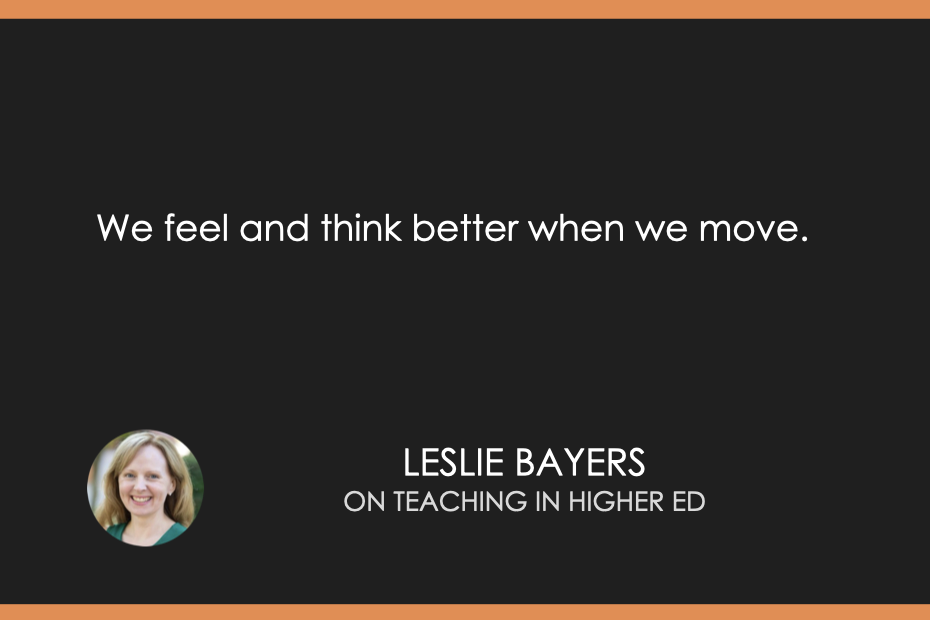
    We feel and think better when we move.

    I certainly wasn’t taught body literacy in school, and what I mean by that is how to read the internal signals that the body might be communicating.
    -Leslie Bayers

    We feel and think better when we move.
    -Leslie Bayers

    I try to get students moving or engaged with sensory textures as much as possible to spark learning.
    -Leslie Bayers

    How we feel absolutely shapes if and how we learn. And many of us feel this in our bodies.
    -Leslie Bayers

    Learning is incredibly hard work. It’s one of the things that does drain the body of energy.
    -Leslie Bayers

    [/divwrap][divwrap class=”one-half”]

    Resources

    • Joy-Centered Pedagogy in Higher Education: Uplifting Teaching & Learning for All, edited by Eileen Camfield
    • Katy Bowman
    • Episode 505: How Role Clarity and Boundaries Can Help Us Thrive with Karen Costa
    • Scope of Practice Template, developed by Karen Costa
    • An Educator’s Scope of Practice: How Do I Know What’s Mine?, Karen Costa’s Chapter in Trauma-Informed Pedagogies
    • Bend App
    • 15 Minute Gentle Morning Yoga
    • Catalina: A Novel, by Karla Cornejo Villavicencio
    • On Muscle: The Stuff That Moves Us and Why It Matters, by Bonnie Tsui

    [/divwrap]


    Lessons in Love and Learning from Mr. Rogers’ Legacy, with Jennifer Baumgartner Jul 17, 2025
    Show notes

    Jennifer Baumgartner shares some lessons in love and learning from Mr. Rogers’ legacy on episode 579 of the Teaching in Higher Ed podcast.
    [divwrap class=”one-half first”]

    Quotes from the episode

    Anything that is mentionable is manageable.

    Mr. Rodgers was a very comforting influence as a young child.
    -Jennifer Baumgartner

    Moving slowly or taking your time is a very key theme of Mr. Rogers neighborhood, and also Fred Rogers’ life and the way he lived it.
    -Jennifer Baumgartner

    He didn’t shy away from talking about difficult subjects.
    -Jennifer Baumgartner

    “Anything that is mentionable is manageable.”
    -Jennifer Baumgartner, quoting Fred Rogers

    [/divwrap][divwrap class=”one-half”]

    Resources

    • Fred Rogers Institute
    • Fred Rogers Institute at Saint Vincent College
    • The Neighborhood of Make-Believe
    • You don’t have to wait for the clock to strike to start teaching, by Peter Newbury
    • Go Somewhere: Reimagining Technology in Education for a Better Tomorrow, Bonni Stachowiak’s Keynote at LSU’s Faculty Colloquium
    • Speaking Freddish: How to Sound Like Mister Rogers, by Alexei Novak
    • “Did You Know?” Song by Mister Rogers
    • 10 to 25: The Science of Motivating Young People, by David Yeager
    • Cartoon about writing
    • Teaching C-I Substack
    • Fred Rogers Archive
    • OuiSi Original: Games of Visual Connection
    • Thomas Dambo – Recycled Art and Troll Sculptures
    • Trollmap – Locations of Thomas Dambo’s Trolls
    • Won’t You Be My Neighbor? (2018 Documentary)

    [/divwrap]


    Learning to Teach, Design, and Rest From Nature, with Karen Costa Jul 10, 2025
    Show notes

    Karen Costa describes learning to teach, design, and rest on episode 578 of the Teaching in Higher Ed podcast.
    [divwrap class=”one-half first”]

    Quotes from the episode

    The mindset is learning from nature rather than learning about nature.

    Gardening is something I’ve tried and failed at many times. I don’t know if it’s something you can win or fail at.
    -Karen Costa

    There’s a ton of research on our mental health and well being and what green spaces can do for us.
    -Karen Costa

    The mindset is learning from nature rather than learning about nature.
    -Karen Costa

    Nature is really, really good at resting.
    -Karen Costa

    Resilience is born of rest, of hibernating, of knowing that we’ve got to kind of go down into the ground, into the earth, in those seasons of quiet and peace in order to begin again and rejuvenate.
    -Karen Costa

    Diversity is the foundation of life. Diversity is strength.
    -Karen Costa

    [/divwrap][divwrap class=”one-half”]

    Resources

    • Biomimicry Checklist
    • Karen’s Final Biomimicry Presentation
    • Biomimicry Life’s Principles
    • The Native Plant Trust
    • Kerry Mandalak on Teaching in Higher Ed
    • Biomimicry – Janine Benyus
    • Learn Biomimicry
    • Rest Is Resistance
    • Lead Through Strengths
    • The Residence
    • acoustic-ish: an album…ish
    • Yes to religion freedom; No to Christian nationalism, by Jeff Hittenberger
    • The OpEd Project

    [/divwrap]


    Teaching and Learning When Things Go Wrong in the College Classroom, with Jessamyn Neuhaus Jul 03, 2025
    Show notes

    Jessamyn Neuhaus shares about her book, SNAFU Edu: Teaching and Learning When Things Go Wrong in the College Classroom, on episode 577 of the Teaching in Higher Ed podcast.
    [divwrap class=”one-half first”]

    Quotes from the episode

    Human beings make mistakes. We make mistakes as part of learning. We make mistakes just being in the world.

    Human beings make mistakes. We make mistakes as part of learning. We make mistakes just being in the world.
    -Jessamyn Neuhaus

    Academia generally attracts people with perfectionist tendencies.
    -Jessamyn Neuhaus

    Sometimes there is no positive outcome when something goes wrong. Sometimes things just get messed up because people are human.
    -Jessamyn Neuhaus

    Inadvertently we have a subtext that teaching is somehow perfectible. Teaching and learning will never ever be perfectible.
    -Jessamyn Neuhaus

    [/divwrap][divwrap class=”one-half”]

    Resources

    • Snafu Edu: Teaching and Learning When Things Go Wrong in the College Classroom, by Jessamyn Neuhaus
    • Center for Teaching and Learning Excellence (CTLE) at Syracuse University
    • Picture a Professor: Interrupting Biases about Faculty and Increasing Student Learning, by Jessamyn Neuhaus
    • Geeky Pedagogy, by Jessamyn Neuhaus
    • Manly Meals and Mom’s Home Cooking: Cookbooks and Gender in Modern America, by Jessamyn Neuhaus
    • Let’s Get Real or Let’s Not Play: Transforming the Buyer/Seller Relationship, by Mahan Khalsa
    • The Sleeper, by Mike Wesch
    • SIFT (The Four Moves), by Mike Caulfield
    • Our University Is Replacing DEI with Vibes and Vaguely Diverse Stock Photos by Carla M. Lopez for McSweeney’s
    • DEI? You’re Fired! with Heather McGhee on The Weekly Show with Jon Stewart
    • 10 In the Moment Responses for Addressing Micro and Macroaggressions in the Classroom, by Chavella Pittman
    • 10 to 25: The Science of Motivating Young People, by David Yeager
    • Critical Teaching Behaviors: Defining, Documenting, and Discussing Good Teaching, by Lauren Barbeau, Claudia Cornejo Happel
    • Dippity Do Girls with Curls Curl Boosting Mousse
    • MoMA Sliding Perpetual Calendar
    • Mrs. Meyer’s Clean Day Hand Soap
    • Teaching and Learning Together in Higher Education
    • International Journal for Students as Partners
    • Tea for Teaching Podcast
    • The Present Professor, by Elizabeth A. Norell
    • Thrifty Shopper
    • We Are Lady Parts on Peacock

    [/divwrap]


    The AI Con Jun 26, 2025
    Show notes

    Emily M. Bender & Alex Hanna share about their book, The AI Con: How to Fight Big Tech’s Hype and Create the Future We Want on episode 576 of the Teaching in Higher Ed podcast.
    [divwrap class=”one-half first”]

    Quotes from the episode

    The boosters say AI is a thing. It's inevitable, it's imminent, it's going to be super powerful, and it's going to solve all of our problems. And the Doomers say AI is a thing, it's inevitable, it's imminent, it's going to be super powerful, and it's going to kill us all. And you can see that there's actually not a lot of daylight between those two positions, despite the discourse of saying these are two opposite ends of a spectrum.

    What’s going on with the phrase artificial intelligence is not that it means something else than what we’re using it to mean, it’s that it doesn’t have a proper referent in the world.
    -Emily M. Bender

    There’s a much broader range of people who can have opinions on AI.
    -Alex Hanna

    The boosters say AI is a thing. It’s inevitable, it’s imminent, it’s going to be super powerful, and it’s going to solve all of our problems. And the doomers say AI is a thing, it’s inevitable, it’s imminent, it’s going to be super powerful, and it’s going to kill us all. And you can see that there’s actually not a lot of daylight between those two positions, despite the discourse of saying these are two opposite ends of a spectrum.
    -Emily M. Bender

    Teachers’ working conditions are students’ learning conditions.
    -Alex Hannay

    [/divwrap][divwrap class=”one-half”]

    Resources

    • The AI Con: How to Fight Big Tech’s Hype and Create the Future We Want, by Emily M. Bender and Alex Hanna
    • Distributed AI Research Institute (DAIR)
    • The Princess Bride
    • Emily Tucker, Executive Director, Center on Privacy & Technology at Georgetown Law
    • On the Dangers of Stochastic Parrots: Can Language Models Be Too Big? By Emily M. Bender, Timnit Gebru, Angelina McMillan-Major, and Shmargaret Shmitchell
    • Emily M. Bender’s website
    • How the right to education is undermined by AI, by Helen Beetham
    • How We are Not Using AI in the Classroom, by Sonja Drimmer & Christopher J. Nygren
    • Empire of AI: Dreams and Nightmares in Sam Altman’s OpenAI, by Karen Hao

    [/divwrap]


    Previous 1 5 6 7 8 9 65 Next

    Related Podcasts

    Making Sense with Sam Harris

    1

    Making Sense with Sam Harris Education
    Grammar Girl

    2

    Grammar Girl Education
    Good Life Project

    3

    Good Life Project Education
    Explain It to Me

    4

    Explain It to Me Education
    Team Never Quit

    5

    Team Never Quit Comedy
    Optimal Living Daily – Personal Development and Self-Improvement

    6

    Optimal Living Daily – Personal Development and Self-Improvement Alternative Health
    footer-logo

    Contact Us

    Toll Free: 844-670-7747

    Links

    • Home
    • Top Charts
    • Networks
    • Apps
    • Independents Podcasts
    • Podcast Advertising
    • Podcast News
    • Contact Us
    • About Us
    • Analytics & Insights

    Stay Connected

      Privacy, Terms of Use & Our Code of Ethics Protecting Content Creators Copyrights