TopPodcast.com
Menu
  • Home
  • Top Charts
  • Top Networks
  • Top Apps
  • Top Independents
  • Top Podfluencers
  • Top Picks
    • Top Business Podcasts
    • Top True Crime Podcasts
    • Top Finance Podcasts
    • Top Comedy Podcasts
    • Top Music Podcasts
    • Top Womens Podcasts
    • Top Kids Podcasts
    • Top Sports Podcasts
    • Top News Podcasts
    • Top Tech Podcasts
    • Top Crypto Podcasts
    • Top Entrepreneurial Podcasts
    • Top Fantasy Sports Podcasts
    • Top Political Podcasts
    • Top Science Podcasts
    • Top Self Help Podcasts
    • Top Sports Betting Podcasts
    • Top Stocks Podcasts
  • Podcast News
  • About Us
  • Podcast Advertising
  • Contact
Not in our directory?
Add Show Here
Podcast Equipment
Center

toppodcastlogoOur TOPPODCAST Picks

  • Comedy
  • Crypto
  • Sports
  • News
  • Politics
  • True Crime
  • Business
  • Finance

Follow Us

toppodcastlogoStay Connected

    View Top 200 Chart
    Back to Rankings Page
    Education

    Teaching in Higher Ed

    Thank you for checking out the Teaching in Higher Ed podcast. This is the space where we explore the art and science of being more effective at facilitating learning. We also share ways to increase our personal productivity, so we can have more peace in our lives and be even more present for our students.

    Advertise

    Copyright: © Innovate Learning, LLC

    • Apple Podcasts
    • Google Play
    • Spotify

    Latest Episodes:
    Are We There Yet? Rebuilding Trust in the Value of Education, with Rolin Moe Jun 19, 2025
    Show notes

    Rolin Moe shares about rebuilding trust in the value of education (among other things) on episode 575 of the Teaching in Higher Ed podcast.
    [divwrap class=”one-half first”]

    Quotes from the episode

    Education is the process of helping people find things that they don't yet know they love.

    I never again had a static lesson plan. I was always very fluid in whatever I was going to be doing. I knew where I wanted to get, but the road could go in all sorts of different directions.
    – Rolin Moe

    Learning is a continuous activity in all sorts of areas and all sorts of places.
    – Rolin Moe

    Education is the process of helping people find things that they don’t yet know they love.
    – Rolin Moe

    [/divwrap][divwrap class=”one-half”]

    Resources

    • Gary Stager
    • George Siemens
    • Van Gogh-Inspired AI Course Policy (YouTube)
    • MOOCs (Massive Open Online Courses – Wikipedia)
    • Smithsonian Institution
    • Michael Peter Edson
    • UC Riverside XCITE Center
    • Community Colleges in California
    • California State University (CSU) System
    • Go Somewhere Card Game
    • James A. Michener quote
    • Wingspan Board Game
    • Elizabeth Hargrave (Game Designer)
    • Merlin Bird ID App (Cornell Lab)

    [/divwrap]


    May Contain Lies: Stories, Stats, and Bias, with Alex Edmans Jun 12, 2025
    Show notes

    Alex Edmans shares about his book, May Contain Lies: How Stories, Statistics, and Studies Exploit Our Biases and What We Can Do About It on episode 574 of the Teaching in Higher Ed podcast.
    [divwrap class=”one-half first”]

    Quotes from the episode

    It's not that they're bad people, it's that they're people, they're humans. And if we're a person, we have biases.

    We think a lie is basically the opposite of truth. So something is a lie if you can disprove it factually.
    -Alex Edmans

    What I focus on in my book is a more subtle form of a lie where something could be 100% accurate, but the inferences that we draw from them might be misleading.
    -Alex Edmans

    It’s not that they’re bad people, it’s that they’re people, they’re humans. And if we’re a person, we have biases.
    -Alex Edmans

    What I’m trying to highlight is the importance of being discerning. We want to have healthy skepticism, but we want to have the same healthy skepticism to something that we do like as something that we don’t.
    -Alex Edmans

    [/divwrap][divwrap class=”one-half”]

    Resources

    • May Contain Lies: How stories, statistics and studies exploit our biases — and what we can do about it, by Alex Edmans
    • Outliers, by Malcolm Gladwell
    • Cookie Monster Practices Self-Regulation | Life Kit Parenting | NPR
    • Addiction Rare in Patients Treated with Narcotics
    • Taking A Mosaic Approach to AI in the Writing Classroom, presented by Chris Ostro
    • All Else Equal Podcast
    • A Little Life, by Hanya Yanagihara

    [/divwrap]


    How to Facilitate Enriching Learning Experiences, with Tolu Noah Jun 05, 2025
    Show notes

    Tolu Noah shares about her new book, Designing and Facilitating Workshops with Intentionality, on episode 573 of the Teaching in Higher Ed podcast.
    [divwrap class=”one-half first”]

    Quotes from the episode

    Whenever I'm planning a learning experience, I start by identifying a clear goal for the experience.

    Whenever I’m planning a learning experience, I start by identifying a clear goal for the experience.
    -Tolu Noah

    I don’t think there’s necessarily one right way to approach planning.
    -Tolu Noah

    A really important aspect of facilitation is that yes, you have a plan, but you also need to be flexible with that plan and be willing to take a rest stop or a detour if needed.
    -Tolu Noah

    Timing is probably one of the most important aspects of facilitation.
    -Tolu Noah

    [/divwrap][divwrap class=”one-half”]

    Resources

    • Designing and Facilitating Workshops with Intentionality: A Guide to Crafting Engaging Professional Learning Experiences in Higher Education, by Tolulope Noah
    • Yoruba
    • The Art of Gathering: How We Meet and Why It Matters, by Priya Parker
    • Richard E. Mayer
    • Padlet Breakout Rooms
    • Padlet Sandbox
    • Bryan Mathers Permission Slip
    • Headliner App
    • Butter Scenes
    • SessionLab
    • Facilitating On Purpose

    [/divwrap]


    Myths and Metaphors in the Age of Generative AI, with Leon Furze May 29, 2025
    Show notes

    Leon Furze shares about myths and metaphors in the age of generative AI on episode 572 of the Teaching in Higher Ed podcast.
    [divwrap class=”one-half first”]

    Quotes from the episode

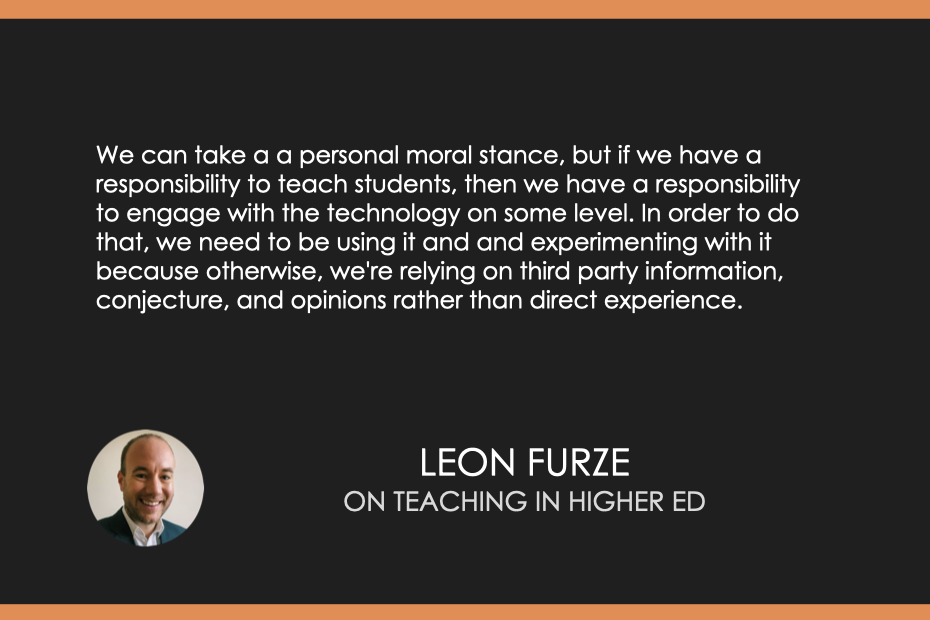
    We can take a a personal moral stance, but if we have a responsibility to teach students, then we have a responsibility to engage with the technology on some level. In order to do that, we need to be using it and and experimenting with it because otherwise, we're relying on third party information, conjecture, and opinions rather than direct experience.

    In higher education there is a need to temper the resistance and refusal of the technology with the understanding that students are using it anyway.
    -Leon Furze

    We can take a a personal moral stance, but if we have a responsibility to teach students, then we have a responsibility to engage with the technology on some level. In order to do that, we need to be using it and and experimenting with it because otherwise, we’re relying on third party information, conjecture, and opinions rather than direct experience.
    -Leon Furze

    My use of the technology has really shifted over the last few years the more I think about it as a technology and not as a vehicle for language.
    -Leon Furze

    Let the English teachers who love English, teach English. Let the mathematics teachers who love math, teach math. Let the science teachers teach science. And where appropriate, bring these technologies in.
    -Leon Furze

    [/divwrap][divwrap class=”one-half”]

    Resources

    • Myths, Magic, and Metaphors: The Language of Generative AI (Leon Furze)
    • Arthur C. Clarke’s Third Law (Wikipedia)
    • Vincent Mosco – The Digital Sublime
    • MagicSchool AI
    • OECD’s Definition of AI Literacy
    • PISA (Programme for International Student Assessment)
    • NAPLAN (Australia’s National Assessment Program – Literacy and Numeracy)
    • Against AI literacy: have we actually found a way to reverse learning? by Miriam Reynoldson
    • ChatGPT (OpenAI)
    • CoPilot (Microsoft)
    • Who Cares to Chat, by Audrey Watters (About Clippy)
    • Clippy (Microsoft Office Assistant – Wikipedia)
    • Gemini (Google AI)
    • Be My Eyes Accessibility with GPT-4o
    • Be My Eyes (Assistive Technology)
    • Teaching AI Ethics – Leon Furze
    • Black Box (Artificial Intelligence – Wikipedia)
    • Snagit (TechSmith)
    • Meta Ray-Ban Smart Glasses

    [/divwrap]


    Overcoming Imposter Syndrome Through Joyful Curiosity, with Jackie Shay May 22, 2025
    Show notes

    Jackie Shay Shares about overcoming imposter syndrome through joyful curiosity on episode 571 of the Teaching in Higher Ed podcast.
    [divwrap class=”one-half first”]

    Quotes from the episode

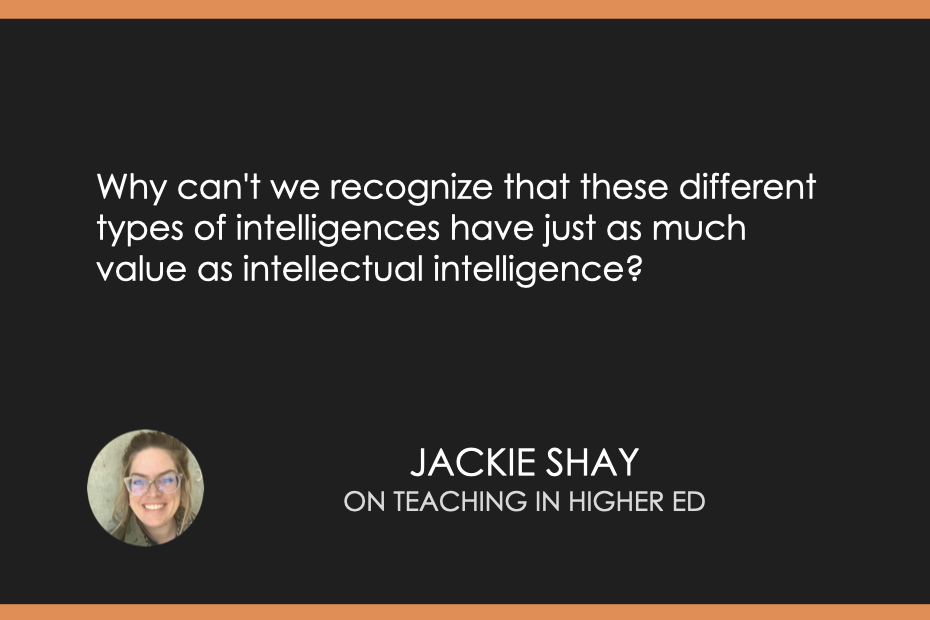
    Why can't we recognize that these different types of intelligences have just as much value as intellectual intelligence?

    Sometimes I get in my head about imposter syndrome about being joyful.
    -Jackie Shay

    Why can’t we recognize that these different types of intelligences have just as much value as intellectual intelligence?
    -Jackie Shay

    It’s about supporting the learning by doing meaningful, challenging work that promotes growth, that allows us to find joy in the discomfort that comes from the vulnerability of pushing your mind to its boundaries and beyond.
    -Jackie Shay

    [/divwrap][divwrap class=”one-half”]

    Resources

    • Joy-Centered Pedagogy in Higher Education: Uplifting Teaching & Learning for All, edited by Eileen Camfield
    • Emotional Intelligence
    • Video about neuroplasticity
    • Making Challenging Subjects Fun: Episode 66 with Anissa Ramirez
    • Creating Desirable Difficulties to Enhance Learning, by Elizabeth L. Bjork and Robert Bjork
    • Beyond Dichotomous Thinking: Episode 527 with Alexis Peirce Caudell
    • What Baby George (and Handstands) Taught me About Learning from Mike Wesch
    • Radical hope: A teaching manifesto, by Kevin Gannon
    • Fred Wolf
    • Awe: The new science of everyday wonder and how it can transform your life, by Dacher Keltner
    • Coaching for Leaders Episode 254: Use Power for Good and Not Evil, with Dacher Keltner
    • Tennis ball massage
    • Relaxed Cozy House Mix in a New York Loft | Tinzo

    [/divwrap]


    How to Get Started with Interactive Storytelling in Any Discipline, with Laura Gibbs May 15, 2025
    Show notes

    Laura Gibbs shares how to get started with interactive storytelling in any discipline on episode 570 of the Teaching in Higher Ed podcast.
    [divwrap class=”one-half first”]

    Quotes from the episode

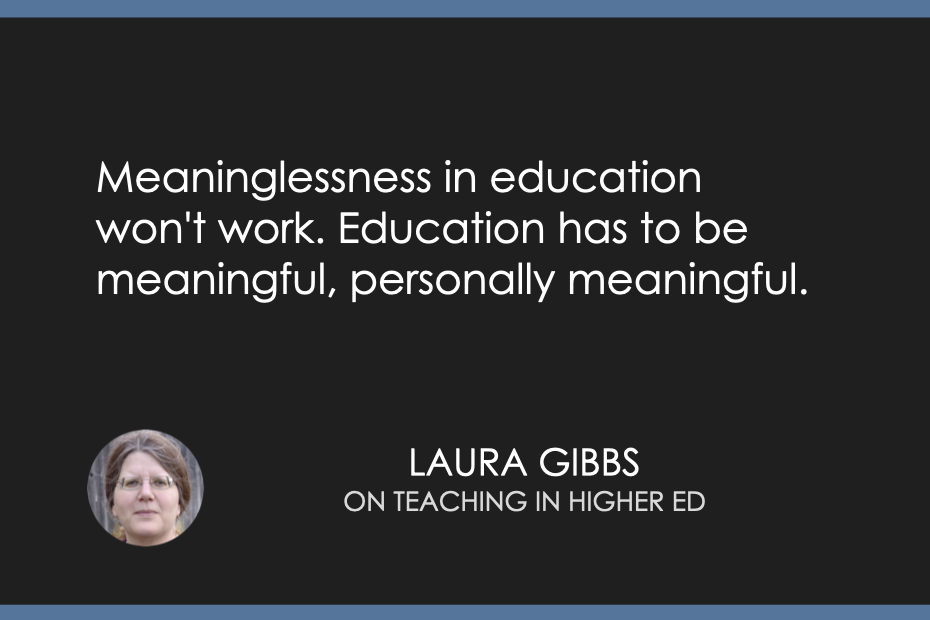
    Meaninglessness in education won't work. Education has to be meaningful, personally meaningful.

    I think what happens with a lot of people’s efforts to tell stories is that they’re staring at a blank page or a blank screen, and they just feel lost in it because they don’t have a form that they’re filling up.
    -Laura Gibbss

    Everybody was thriving with these hundred word stories.
    -Laura Gibbss

    Meaninglessness in education won’t work. Education has to be meaningful, personally meaningful.
    -Laura Gibbss

    [/divwrap][divwrap class=”one-half”]

    Resources

    • Laura Gibb’s Website and Blog
    • Laura Gibb’s Aesop Survivor and Other Games
    • Improvised Shakespeare Company
    • TV Tropes
    • George Station
    • The Mouse Bride
    • Mike Caulfield
    • MYFest
    • Nursery Rhyme Maze Game
    • LinkedIn Post: Go Somewhere + Games, in General
    • Laura’s Ungrading Padlet
    • Who Cares to Chat? by Audrey Watters
    • Audrey Watters’ 2nd Breakfast Newsletter
    • Readers Theater, by Laura Gibbs & Heather Kretschmer
    • Zine Construction video with Dawn Stahura
    • Dawn Stahura’s Zine-Making Resources
    • 100-Word Stories from Laura Gibbs (and her students)
    • Tiny Writing Workshop Padlet, including 6-Word Stories
    • Keeping ScOR from John Biewen
    • Write Your Own Book List, by Laura Gibbs
    • Ungrading Chapbook, by Martha Burtis
    • Bonus Video After Pod Party with Laura Gibbs

    [/divwrap]


    A Practical Framework for Ethical AI Integration in Assessment May 08, 2025
    Show notes

    Mike Perkins and Jasper Roe share a practical framework for ethical AI integration in assessment on episode 569 of the Teaching in Higher Ed podcast.
    [divwrap class=”one-half first”]

    Quotes from the episode

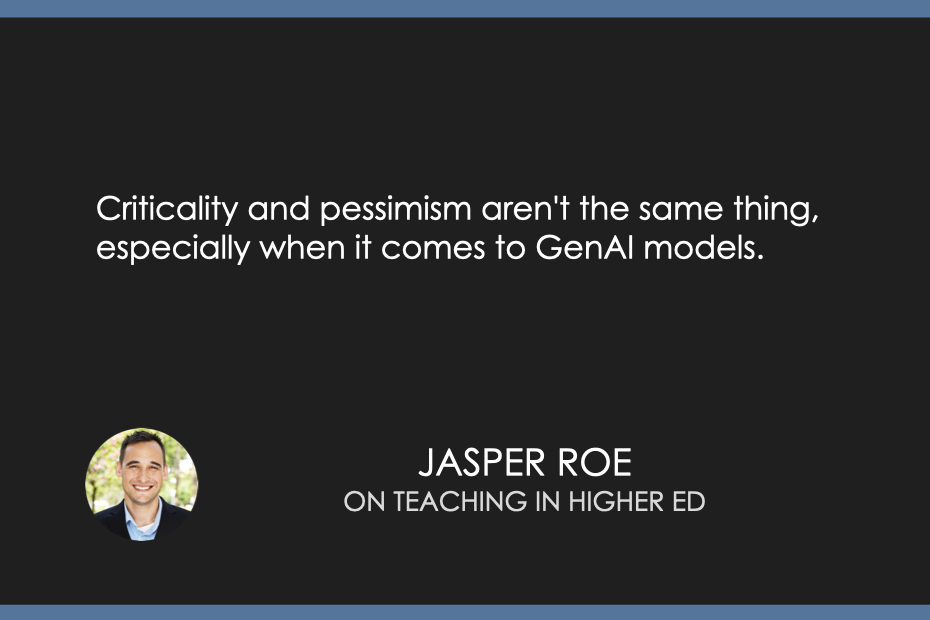
    Criticality and pessimism aren't the same thing, especially when it comes to GenAI models.


    We wanted to be flexible and have some opportunities for students and faculty to really have open conversations about how AI might be suitably used given the individual circumstances and the cultural context.
    -Mike Perkins

    One of the things that is happening that we can’t deny is that the rate of hallucinations is going down. The capabilities are getting better and better.
    -Jasper Roe

    Criticality and pessimism aren’t the same thing, especially when it comes to GenAI models.
    -Jasper Roe

    [/divwrap][divwrap class=”one-half”]

    Resources

    • AI Assessment Scale Website
    • Updating the AI Assessment Scale, by Leon Furze
    • The Artificial Intelligence Assessment Scale (AIAS): A Framework for Ethical Integration of Generative AI in Educational Assessment, by Mike Perkins, Leon Furze, Jasper Roe, & Jason MacVaugh
    • Nick McIntosh
    • Artificial intelligence and illusions of understanding in scientific research, by Lisa Messeri & M. J. Crockett
    • Amelia King
    • Jane Rosenzweig’s Bluesky post: Schitts Creek: The Sequel (Bluesky login required to view)
    • Jane Rosenzweig’s Breakfast Club Ai generated photos mixed with real ones (login required)
    • SIFT Toolbox for Claude (and ChatGPT) Released, by Mike Caulfield
    • Strava
    • Garmin
    • AI and the Future of Higher Ed, by Nick McIntosh
    • The Residence

    [/divwrap]


    Teaching for Integrity in the Age of AI May 01, 2025
    Show notes

    Tricia Bertram Gallant and David Rettinger discuss The Opposite of Cheating: Teaching for Integrity in the Age of AI on episode 568 of the Teaching in Higher Ed podcast.
    [divwrap class=”one-half first”]

    Quotes from the episode

    You can treat people with dignity and respect even as you’re calling out their mistake. You can challenge them while being respectful.

    It is true that people cheat, and that’s the reason we have rules in the first place in our lives.
    -David Rettinger

    There are always going to be social, personal, and individual pressures on us that cause us to do things that either we didn’t realize were wrong, or that we perfectly well know that are wrong, but that in that moment seem like a reasonable trade off to our behavior.
    -David Rettinger

    Take care of yourself first, whatever that looks like. You’re never going to help somebody else if you’re not on firm ground yourself.
    -David Rettinger

    You can treat people with dignity and respect even as you’re calling out their mistake. You can challenge them while being respectful.
    -Tricia Bertram Gallant

    It is important for us to remember to give grace to ourselves.
    -Tricia Bertram Gallant

    [/divwrap][divwrap class=”one-half”]

    Resources

    • The Opposite of Cheating: Teaching for Integrity in the Age of AI, by Tricia Bertram Gallant and David A. Rettinger
    • Doing School: How We Are Creating a Generation of Stressed-Out, Materialistic, and Miseducated Students, by Denise Clark Pope
    • The Four Agreements: A Practical Guide to Personal Freedom, by Don Miguel Ruiz
    • Crucial Conversations: Tools for Talking When Stakes Are High, by Joseph Grenny, Kerry Patterson, Ron McMillan, Al Switzler and Emily Gregory
    • Authentic Assessment
    • Phil Dawson at Deacon University
    • How Van Gogh Informs my AI Course Policy
    • Taking A Mosaic Approach to AI in the Writing Classroom–
    • Episode 555: A Big Picture Look at AI Detection Tools
    • Good Robot Podcast
    • Forever Chemicals, Forever Consequences: What PFAS Teaches Us About AI
    • International Center for Academic Integrity
    • Make It Stick: The Science of Successful Learning, by Peter Brown, Mark A. McDaniel, and Henry L. Roediger
    • Study Like a Champ, by Regan a. R. Gurung and John Dunlosky
    • The Residence
    • Galatea 2.2: A Novel, by Richard Powers
    • Tulsa Oklahoma

    [/divwrap]


    How to Keep Our Brains Sharp, with Therese Huston Apr 24, 2025
    Show notes

    Therese Huston shares about Sharp: 14 Simple Ways to Improve Your Life with Brain Science on episode 567 of the Teaching in Higher Ed podcast.

    Quotes from the episode

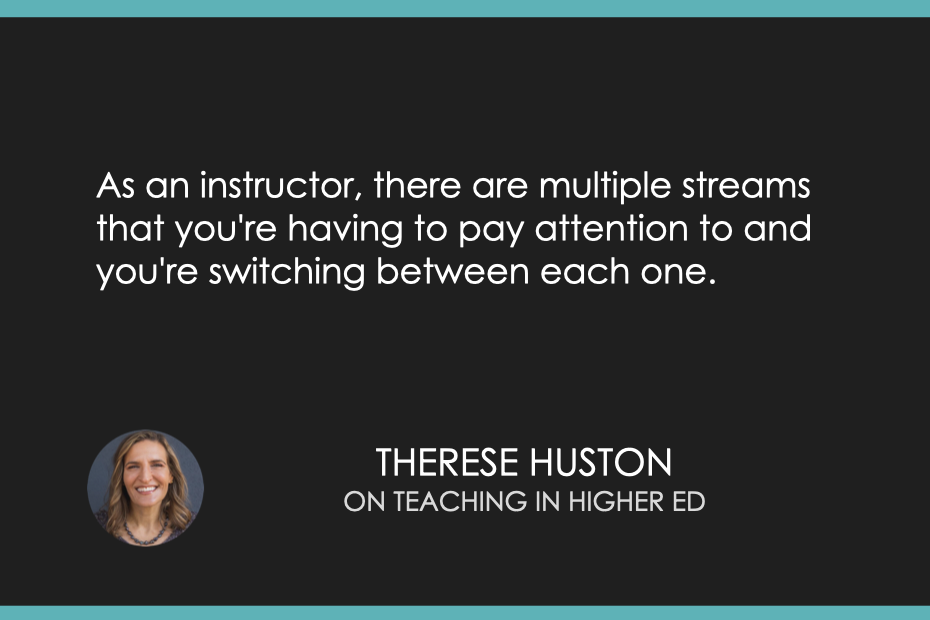
    As an instructor, there are multiple streams that you're having to pay attention to and you're switching between each one.

    As an instructor, there are multiple streams that you’re having to pay attention to and you’re switching between each one.
    -Therese Huston

    The research shows that listening to music that moves you will increase dopamine in your ventral striatum, so you feel a sense of reward.
    -Therese Huston

    Visualizing the process actually increases productivity. The neuroscience shows that you see five times more brain areas activated when you picture the process than when you picture a glorious outcome.
    -Therese Huston

    If you do just a 5 minute meditation right before you need to recall something, you can get up to a 75% improvement in your recall.
    -Therese Huston

    Resources

    • Sharp: 14 Simple Ways to Improve Your Life with Brain Science, by Therese Huston
    • Unlocking Us Podcast: Brené Brown on Anxiety, Calm, and Over-/Under-Functioning
    • Classroom Assessment Techniques: Episode 554 with Todd Zakrajsek
    • The Dunning–Kruger Effect
    • Calm App
    • The Live Your Values Deck
    • The Healthy Minds App

    Joy-Centered Pedagogy, with Eileen Camfield Apr 17, 2025
    Show notes

    Eileen Camfield shares about Joy-Centered Pedagogy in Higher Education on episode 566 of the Teaching in Higher Ed podcast.
    [divwrap class=”one-half first”]

    Quotes from the episode

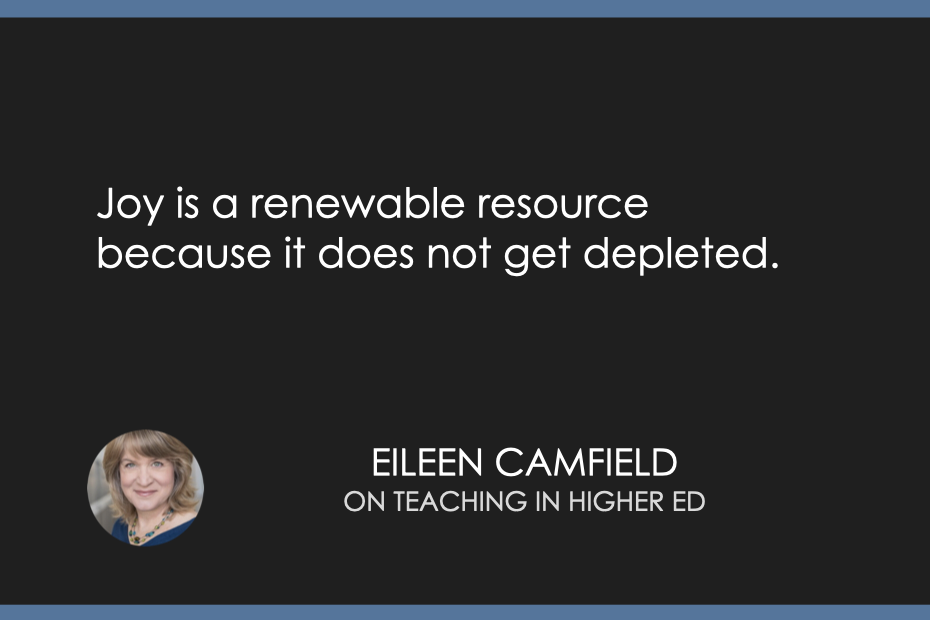
    Joy is a renewable resource because it does not get depleted.

    I want to encourage folks to think about how vigor can go alongside rigor.
    -Eileen Camfield

    We really feel healed. We really feel like our suffering does not have to define us anymore.
    -Eileen Camfield

    Joy is a renewable resource because it does not get depleted.
    -Eileen Camfield

    [/divwrap][divwrap class=”one-half”]

    Resources

    • Joy-Centered Pedagogy in Higher Education: Uplifting Teaching & Learning for All, edited by Eileen Camfield
    • Daniel J. Siegel
    • Kevin Gannon
    • Ross Gay
    • Songpop Party
    • Rest is Resistance: A Manifesto, by Trisha Hersey
    • Awe: The New Science of Everyday Wonder and How It Can Transform Your Life, by Dacher Keltner
    • Inciting Joy, by Ross Gay
    • The Rook, by Daniel O’Malley

    [/divwrap]


    Previous 1 6 7 8 9 10 65 Next

    Related Podcasts

    Making Sense with Sam Harris

    1

    Making Sense with Sam Harris Education
    Grammar Girl

    2

    Grammar Girl Education
    Good Life Project

    3

    Good Life Project Education
    Explain It to Me

    4

    Explain It to Me Education
    Team Never Quit

    5

    Team Never Quit Comedy
    Optimal Living Daily – Personal Development and Self-Improvement

    6

    Optimal Living Daily – Personal Development and Self-Improvement Alternative Health
    footer-logo

    Contact Us

    Toll Free: 844-670-7747

    Links

    • Home
    • Top Charts
    • Networks
    • Apps
    • Independents Podcasts
    • Podcast Advertising
    • Podcast News
    • Contact Us
    • About Us
    • Analytics & Insights

    Stay Connected

      Privacy, Terms of Use & Our Code of Ethics Protecting Content Creators Copyrights