TopPodcast.com
Menu
  • Home
  • Top Charts
  • Top Networks
  • Top Apps
  • Top Independents
  • Top Podfluencers
  • Top Picks
    • Top Business Podcasts
    • Top True Crime Podcasts
    • Top Finance Podcasts
    • Top Comedy Podcasts
    • Top Music Podcasts
    • Top Womens Podcasts
    • Top Kids Podcasts
    • Top Sports Podcasts
    • Top News Podcasts
    • Top Tech Podcasts
    • Top Crypto Podcasts
    • Top Entrepreneurial Podcasts
    • Top Fantasy Sports Podcasts
    • Top Political Podcasts
    • Top Science Podcasts
    • Top Self Help Podcasts
    • Top Sports Betting Podcasts
    • Top Stocks Podcasts
  • Podcast News
  • About Us
  • Podcast Advertising
  • Contact
Not in our directory?
Add Show Here
Podcast Equipment
Center

toppodcastlogoOur TOPPODCAST Picks

  • Comedy
  • Crypto
  • Sports
  • News
  • Politics
  • True Crime
  • Business
  • Finance

Follow Us

toppodcastlogoStay Connected

    View Top 200 Chart
    Back to Rankings Page
    Education

    Teaching in Higher Ed

    Thank you for checking out the Teaching in Higher Ed podcast. This is the space where we explore the art and science of being more effective at facilitating learning. We also share ways to increase our personal productivity, so we can have more peace in our lives and be even more present for our students.

    Advertise

    Copyright: © Innovate Learning, LLC

    • Apple Podcasts
    • Google Play
    • Spotify

    Latest Episodes:
    Teaching in the Digital Age, with Mike Truong Apr 07, 2016
    Show notes

    In this week’s episode, Mike Truong and I discuss teaching in the digital age.

    teaching in the digital age

    Quotes

    In our instant and very distracted culture … it’s critical to learn how to pay attention.
    —Mike Truong

    As faculty, we need to find ways that force us to slow down.
    —Mike Truong

    I try to prioritize in-person interactions over virtual ones whenever possible.
    —Mike Truong

    It is a real discipline to turn off our devices … the default is to be connected all the time.
    —Mike Truong

    Resources

    • Tim Stringer’s blog: Technically Simple
    • One Button Studio at Penn State

    Recommendations:

    Bonni

    • Visit APU’s Office of Innovative Teaching and Technology and check out the section on blended learning.
    • Article: From Showroom to Classroom: Advancing Technology in Education

    Mike

    • Book: Hamlet’s Blackberry* by William Powers
    • Book: Now You See It* by Cathy Davidson (Cathy was featured on TIHE episode 28: How to see what we’ve been missing)
    • Book: Alone Together* by Sherry Turkle
    • Book: Reclaiming Conversation* by Sherry Turkle

    Retrieval Practice, with Pooja Agarwal Mar 31, 2016
    Show notes

    On today’s episode, I get the pleasure of talking with Dr. Pooja Agarwal about retrieval practice.

    retrieval practice

    Guest: Pooja K. Agarwal, Ph.D.

    Cognitive Scientist, Memory Expert, and Education Consultant,
    Founder of RetrievalPractice.org

    www.retrievalpractice
    www.poojaagarwal.com
    Twitter: @poojaagarwal

    Pooja K. Agarwal, Ph.D. is committed to bridging the gaps between research, teaching, and policy. Passionate about evidence-based education, Pooja has conducted retrieval practice research in a variety of classroom settings for more than 10 years, in collaboration with distinguished memory scholar Henry L. Roediger, III. In addition to her career as a scientist, Pooja earned elementary teacher certification and has extensive teaching experience at K-12 and university levels. To advance the use of scientifically-based learning strategies, she contributes her expertise through collaborations with students, educators, scientists, and policymakers worldwide.

    Recommendations

    Bonni:

    Change the culture in your classroom by asking students (in reference to retrieval practice): “What is it we’re doing right now?” and “Why are we doing it?”

    Pooja:

    Check out www.retrievalpractice.org for helpful resources.

    Are You Enjoying the Show?

    1. Rate/review the show. Please consider rating or leaving a review for the Teaching in Higher Ed podcast on whatever service you use to listen to it on (iTunes, Stitcher, etc.). It is the best way to help others discover the show.
    2. Give feedback. As always, I welcome suggestions for future topics or guests.
    3. Subscribe. If you have yet to subscribe to the weekly update, you can receive a single email each week with the show notes (including all the links we talk about on the episode), as well as an article on either teaching or productivity.

    Strength Through Habits, with Natalie Houston Mar 24, 2016
    Show notes

    Natalie Houston talks about strength through habits.

    Strength through habits

    Quotes

    Habits save us tremendous time and energy, but they can also lead us to doing a lot of things mindlessly.
    —Natalie Houston

    Sometimes we have goals or intentions that are outdated, they’re from who we used to be.
    —Natalie Houston

    Habits often work really well when they’re connected to each other.
    —Natalie Houston

    If you successfully create one habit, it’ll be easier to create others.
    —Natalie Houston

    All of us have habits that we’re less than happy with and they’re there because they’re meeting some need.
    —Natalie Houston

    Resources

    TIHE episode 34: Practical Productivity in Academia (Natalie Houston)

    Natalie’s Blog: re:focus now

    Natalie’s articles at the Chronicle of Higher Education

    Book: The Power of Habit* by Charles Duhigg

    Three Steps to Creating a New Habit

    1. Identify why you want to create a new habit
    2. Get very clear and specific about how you’re going to measure that behavior
    3. Track your behavior

    Recommendations

    Bonni recommends:

    • Lee Skallerup Bessette’s Bad Female Academic posts

    Natalie recommends:

    • Music Service: Focus at Will

    Small Teaching, with James Lang Mar 17, 2016
    Show notes

    small teaching

    On this week’s episode, James Lang shares about his book: Small Teaching

    [divwrap class=”one-half first”]

    Quotes

    What I started to notice was that the coaches who paid attention to these little things, and focused on small fundamentals, tended to do a lot better than the teams that didn’t.
    —James Lang

    I’m a big believer in the opening and closing minutes of class … I think those are really ripe opportunities for small teaching.
    —James Lang

    I try to do framing activities to help the students realize the value of what we’re doing.
    —James Lang

    [/divwrap][divwrap class=”one-half”]

    Resources

    Small Teaching: Small modifications in course design or communication with your students. These recommendations might not translate directly into 10-minute or one-time activities, but they also do not require a radical rethinking of your courses. They might inspire tweaks or small changes in the way you organize the daily schedule of your course, write your course description or assignment sheets, or respond to the writing of your students.

    • Book: The Power of Habit* by Charles Duhigg
    • Teaching in Higher Ed Episode 71 with Derek Bruff
    • Video: How to be Alone
    • Article: Boring but Important
    • MERLOT Awards

    [/divwrap]


    Choose your own adventure assessment Mar 10, 2016
    Show notes

    On this week’s episode, I share my experiences with “choose your own adventure” assessments.

    choose your own adventure

    Background on choose your own adventure assessments:

    • TIHE Episode 58: Universal design for learning

    What is it?

    • TIHE blog post: Choose your own adventure learning (Part 1)
    • TIHE blog post: Choose your own adventure learning (Part 2)

    Resources

    App: Scannable* by Evernote

    Recommendation

    Peter Felten (@pfeltenNC) from the Center for Engaged Learning at Elon University shared on Twitter: Scholarship of Teaching and Learning Annotated Literature Database

    Are You Enjoying the Show?

    1. Rate/review the show. Please consider rating or leaving a review for the Teaching in Higher Ed podcast on whatever service you use to listen to it on (iTunes, Stitcher, etc.). It is the best way to help others discover the show.
    2. Give feedback. As always, I welcome suggestions for future topics or guests.
    3. Subscribe. If you have yet to subscribe to the weekly update, you can receive a single email each week with the show notes (including all the links we talk about on the episode), as well as an article on either teaching or productivity.

    Take-aways from the Lilly Conference, with Todd Zakrajsek Mar 03, 2016
    Show notes

    On this week’s episode, Todd Zakrajsek and I discuss our key take-aways from the 2016 Lilly Conference.

    Lilly Conference

    Guest: Todd Zakrajsek

    Conference Director, Lilly Conferences California

    Twitter: @ToddZakrajsek

    www.lillyconferences.com

    Dr. Todd Zakrajsek, Ph.D., is the former Executive Director of the Academy of Educators in the School of Medicine and an Associate Professor in the Department of Family Medicine at UNC-Chapel Hill. Dr. Zakrajsek is the immediate past Executive Director of the Center for Faculty Excellence at University of North Carolina at Chapel Hill and prior to his work at UNC, he was the Inaugural Director of the Faculty Center for Innovative Teaching at Central Michigan University and the founding Director of the Center for Teaching and Learning at Southern Oregon University, where he also taught in the psychology department as a tenured associate professor. Dr. Zakrajsek also sits on two educational related boards and several editorial boards for journals in the area of teaching and learning, is an international speaker requested regularly for keynote presentations and campus workshops, and has published widely on the topic of effective teaching and student learning.

    Todd was previously featured on Episode 47: Developing metacognition skills in our students

    See list of Bonni’s resources from the Lilly Conference: www.teachigninhighered.com/lillycon

    Quotes

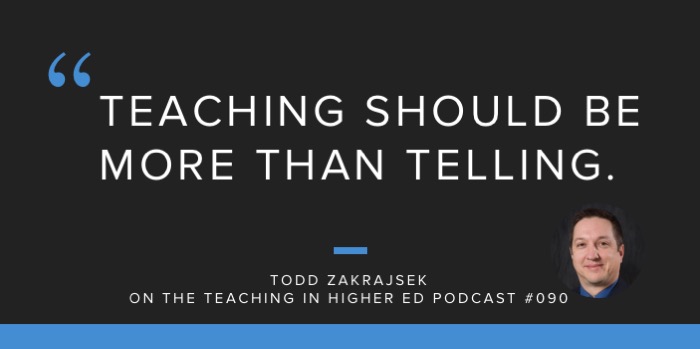
    Teaching should be more than telling.
    –Todd Zakrajsek

    If a worker knows why they’re doing something, they’re much better at doing it than if it’s a mystery to them. It’s the same thing in teaching.
    –Todd Zakrajsek

    Any time we start looking at these concepts and saying, “Should we do this, or that? Do the students fall into this category or the other category?” we lose the richness of all the individuals in between.
    –Todd Zakrajsek

    Lecturing alone simply does not return the same kind of advances you get when you add in engaged, active kinds of learning.
    –Todd Zakrajsek

    Resources

    • https://twitter.com/Bali_Maha
    • https://twitter.com/vconnecting (virtual connecting)
    • Video: Father Guido Sarducci’s Five Minute University
    • Stephen Brookfield featured on Episode 15: teachinginhighered.com/15
    • Taxonomy of Significant Learning by Dee Fink
    • The Carl Wieman Project
    • From The Onion: Parents of nasal learners demand odor-based curriculum

    Recommendations

    Bonni

    • Presentation polling app: Sli.do*

    Todd

    • Book: Teaching for Learning: 101 Intentionally Designed Educational Activities to Put Students on the Path to Success*

    The research on course evaluations, with Betsy Barre Feb 25, 2016
    Show notes

    On today’s show, Betsy Barre joins me to share about the research on course evaluations.

    course evaluations

    Guest: Betsy Barre

    Assistant Director of the Center for Teaching Excellence at Rice University

    After making the move to Rice in 2012, she was able to pursue her interest in undergraduate pedagogy by working with students and faculty in Rice’s newly developed Program in Writing and Communication. In this role, she taught a series of disciplinary-based first-year seminars and contributed to the PWC’s faculty development programming for those teaching first-year writing courses. And in July of 2014, she began her current position as Assistant Director of Rice’s newly established Center for Teaching Excellence. More

    Quotes

    One of the biggest complaints faculty have about student evaluations is that it’s not a reflection of teaching effectiveness.
    –Betsy Barre

    Just because a student likes a class doesn’t necessarily mean they’re learning.
    –Betsy Barre

    It turns out that the harder your course is, the higher evaluations you get.
    –Betsy Barre

    If students think the work is valuable and something that’s helping them learn, you can give up to twenty extra hours a week of work outside of class and students will still give you higher evaluations.
    –Betsy Barre

    When we want to know if students have learned, one of the best things to do is just ask them if they’ve learned.
    –Betsy Barre

    Part of the movement in student evaluations now is to ask questions about learning, rather than questions about what the faculty members are doing.
    –Betsy Barre

    Notes

    • Article: Do Student Evaluations of Teaching Really Get an “F”?
    • Screencast: Student Ratings of Instruction: A Literature Review
    • RateMyProfessor Analysis: Gendered Language in Teaching Evaluations

    Betsy’s Six Most Surprising Insights about Course Evaluations

    Taken from her article “Do Student Evaluations of Teaching Really Get an “F”?”

    1. Yes, there are studies that have shown no correlation (or even inverse correlations) between the results of student evaluations and student learning. Yet, there are just as many, and in fact many more, that show just the opposite.
    2. As with all social science, this research question is incredibly complex. And insofar as the research literature reflects this complexity, there are few straightforward answers to any questions. If you read anything that suggests otherwise (in either direction), be suspicious.
    3. Despite this complexity, there is wide agreement that a number of independent factors, easily but rarely controlled for, will bias the numerical results of an evaluation. These include, but are not limited to, student motivation, student effort, class size, and discipline (note that gender, grades, and workload are NOT included in this list).
    4. Even when we control for these known biases, the relationship between scores and student learning is not 1 to 1. Most studies have found correlations of around .5. This is a relatively strong positive correlation in the social sciences, but it is important to understand that it means there are still many factors influencing the outcome that we don’t yet understand. Put differently, student evaluations of teaching effectiveness are a useful, but ultimately imperfect, measure of teaching effectiveness.
    5. Despite this recognition, we have not yet been able to find an alternative measure of teaching effectiveness that correlates as strongly with student learning. In other words, they may be imperfect measures, but they are also our best measures.
    6. Finally, if scholars of evaluations agree on anything, they agree that however useful student evaluations might be, they will be made more useful when used in conjunction with other measures of teaching effectiveness.

    Recommendations

    Bonni

    • Think about how you administer the student evaluations.
    • Check out her Betsy’s screencast (see above).

    Betsy

    • Design your own evaluation instrument and distribute it yourself, especially at the mid-point of the source.
    • Take advantage of the teaching center on your campus for student interviews and classroom observations.

    Are You Enjoying the Show?

    1. Rate/review the show. Please consider rating or leaving a review for the Teaching in Higher Ed podcast on whatever service you use to listen to it on (iTunes, Stitcher, etc.). It is the best way to help others discover the show.
    2. Give feedback. As always, I welcome suggestions for future topics or guests.
    3. Subscribe. If you have yet to subscribe to the weekly update, you can receive a single email each week with the show notes (including all the links we talk about on the episode), as well as an article on either teaching or productivity.

    Top five gadgets for teaching, with Dave Stachowiak Feb 18, 2016
    Show notes

    On this week’s episode, Dave and I share our top five gadgets for teaching.

    gadgets for teaching

    Guest: Dave Stachowiak

    Bonni’s twitter: @bonni208
    Dave’s twitter: @davestachowiak

    1. Wireless presentation Remote

    • Commonly referred to as a “wireless presenter”*
    • Logitech remotes* are reliable and fairly inexpensive
    • Video Downloader

    2. iPad Pro

    • iPad Pro specs
    • iPad Pro on Amazon*
    • iPad pro case from Sena

    3. Apple Pencil

    • Apple Pencil

    4. Apple Watch

    • use as a non-distracting notifier
    • use as a timer
    • can seamlessly record and Send reminders to OmniFocus
    • TIHE article about using Due app

    5. Web Cams with Zoom app

    • Logitech web cam with 1080p *
    • Sign up for Zoom*

    Recommendations

    • Bonni: iPad app for pencasting: Doceri*
    • Dave: Cloud database software: Airtable*

    What the best digital teachers do, with Sean Michael Morris Feb 11, 2016
    Show notes

    On today’s episode, I talk with Sean Michael Morris about what the best digital teachers do.

    Digital Teachers

    Sean Michael Morris,
    Digital Teacher and Pedagogue

    • www.seanmichaelmorris.com
    • Twitter: @slamteacher

    Sean is a digital teacher and pedagogue, with experience especially in networked learning, MOOCs, digital composition and publishing, collaboration, and editing. He’s been working in digital teaching and learning for 15 years. His work as a pioneer in the field of Critical Digital Pedagogy is founded in the philosophy of Paulo Freire, and finds contemporary analogues in the work of Howard Rheingold, Cathy N. Davidson, Dave Cormier, and Jesse Stommel. He is committed to engaging audiences in critical inspection of digital technologies, and to turning a social justice lens upon education.

    Quotes

    There are no principles that I’m aware of in instructional design that allow for the human to creep in; it’s very mechanistic.
    –Sean Michael Morris

    I believe that teaching isn’t method; teaching is intuitive.
    –Sean Michael Morris

    Every time we step into a classroom or design a new course … we have to step back and realize we don’t know anything, that each time it is new.
    –Sean Michael Morris

    I approach everything by asking, “What is it that you’re wanting to get out of this?” and, “What is it that you want your students to get from this?”
    –Sean Michael Morris

    Recommendations

    Bonni:

    • The courses at digitalpedagogylab.com/courses
    • TIHE Episode 57: Teaching with Twitter

    Sean

    • Book: A Pedagogy for Liberation* by Paulo Friere and Ira Shor
    • Book: The Qualitative Manifesto* by Norman K. Denzin
    • Book: Complexity Theory and the Philosophy of Education* by Mark Mason
    • Book: Savvy* by Ingrid Law
    • Twitter user: Simon Ensor (@sensor63)
    • Twitter user: Pat Lockley (@patlockley)

    Are You Enjoying the Show?

    1. Rate/review the show. Please consider rating or leaving a review for the Teaching in Higher Ed podcast on whatever service you use to listen to it on (iTunes, Stitcher, etc.). It is the best way to help others discover the show.
    2. Give feedback. As always, I welcome suggestions for future topics or guests.
    3. Subscribe. If you have yet to subscribe to the weekly update, you can receive a single email each week with the show notes (including all the links we talk about on the episode), as well as an article on either teaching or productivity.

    Get It Together Feb 04, 2016
    Show notes

    Bonni shares strategies to help “get it together” during stressful times of the semester.

    Get it together

    Quotes

    Never succumb to the temptation to say you don’t have enough time to stop.
    —Bonni Stachowiak

    Listening might be the most important part of our jobs.
    —Bonni Stachowiak

    Sometimes we’re so worried about entertaining our students that we miss the opportunities for them to have creative insights of their own.
    —Bonni Stachowiak

    Celebration.

    • Celebrate what you are doing.
    • Song: Celebration by Kool & The Gang
    • Watch on Youtube

    Stop. Collaborate. And listen.

    • Stop spinning, collaborate, and listen (which is maybe the most important part of our jobs).
    • Song: Ice Ice Baby by Vanilla Ice
    • Watch on Youtube

    List of projects.

    • Create actionable names for your project tasks and use a system you trust.
    • Song: Are You Gonna Kiss Me or Not by Thompson Square
    • Watch video on Youtube

    Back to Life … Back to reality

    • Get real with your aspirations
    • Song: Back To Life by Soul II Soul
    • Watch Video on Youtube

    Recommendations:

    • Mobile App: Due
    • Website: http://www.dueapp.com/
    • Find on the App Store*

    Previous 1 54 55 56 57 58 65 Next

    Related Podcasts

    Making Sense with Sam Harris

    1

    Making Sense with Sam Harris Education
    Grammar Girl

    2

    Grammar Girl Education
    Good Life Project

    3

    Good Life Project Education
    Explain It to Me

    4

    Explain It to Me Education
    Team Never Quit

    5

    Team Never Quit Comedy
    Optimal Living Daily – Personal Development and Self-Improvement

    6

    Optimal Living Daily – Personal Development and Self-Improvement Alternative Health
    footer-logo

    Contact Us

    Toll Free: 844-670-7747

    Links

    • Home
    • Top Charts
    • Networks
    • Apps
    • Independents Podcasts
    • Podcast Advertising
    • Podcast News
    • Contact Us
    • About Us
    • Analytics & Insights

    Stay Connected

      Privacy, Terms of Use & Our Code of Ethics Protecting Content Creators Copyrights