TopPodcast.com
Menu
  • Home
  • Top Charts
  • Top Networks
  • Top Apps
  • Top Independents
  • Top Podfluencers
  • Top Picks
    • Top Business Podcasts
    • Top True Crime Podcasts
    • Top Finance Podcasts
    • Top Comedy Podcasts
    • Top Music Podcasts
    • Top Womens Podcasts
    • Top Kids Podcasts
    • Top Sports Podcasts
    • Top News Podcasts
    • Top Tech Podcasts
    • Top Crypto Podcasts
    • Top Entrepreneurial Podcasts
    • Top Fantasy Sports Podcasts
    • Top Political Podcasts
    • Top Science Podcasts
    • Top Self Help Podcasts
    • Top Sports Betting Podcasts
    • Top Stocks Podcasts
  • Podcast News
  • About Us
  • Podcast Advertising
  • Contact
Not in our directory?
Add Show Here
Podcast Equipment
Center

toppodcastlogoOur TOPPODCAST Picks

  • Comedy
  • Crypto
  • Sports
  • News
  • Politics
  • True Crime
  • Business
  • Finance

Follow Us

toppodcastlogoStay Connected

    View Top 200 Chart
    Back to Rankings Page
    Education

    Teaching in Higher Ed

    Thank you for checking out the Teaching in Higher Ed podcast. This is the space where we explore the art and science of being more effective at facilitating learning. We also share ways to increase our personal productivity, so we can have more peace in our lives and be even more present for our students.

    Advertise

    Copyright: © Innovate Learning, LLC

    • Apple Podcasts
    • Google Play
    • Spotify

    Latest Episodes:
    Action science – Relevant teaching and active learning, with Bill Robertson Jan 28, 2016
    Show notes

    In today’s episode, Dr. Bill Robertson introduces us to “action science” and the ways he is making his teaching relevant, creating opportunities for the most active kind of learning I can imagine.

    Action science - Relevant teaching and active learning 

    Guest: Bill Robertson
    Dr. Skateboard

    Bill has a Ph.D. in Education and has been a skateboarder for over thirty-five years. He has done hundreds of demonstrations nationally and internationally in festivals, events and in academic settings.

    Bill has been an educator for over twenty years. His academic areas of expertise are science education, curriculum development, and technology integration. He also teaches and does research in the areas of problem-based learning and action science.

    Find him online:

    • Linkedin
    • Dr. Skateboard Website
    • Twitter
    • skateboard videos

    Quotes

    People who are learning a second language may know exactly what they’re talking about but might not be able to express themselves.
    —Bill Robertson

    The things that made me successful in skateboarding made me successful in education.
    —Bill Robertson

    I realized there was a lot of physics and concepts in these sports that can be expressed and could be engaging and motivating for the students.
    —Bill Robertson

    The skills [students] are really good at can apply to something like education … if they can master something, they can probably master something else.
    —Bill Robertson

    You have to find ways to integrate the interests of your learners into your curriculum.
    —Bill Robertson

    Resources

    • Teaching in Higher Ed episode 015: How to get students to participate in discussion, with Stephen Brookfield
    • Teaching in Higher Ed post: Sticky notes as a teaching tool

    Recommendations:

    From listener Pamela:

    • Book: Training in Motion* by Mike Kuczala. Emphasizes the importance of movement for learning (and not just regular exercise)

    Bill:

    • Non-profit organization: Skateistan. Using skateboarding as a tool for empowerment, with a large commitment for young women in Afghanistan, Cambodia and South Africa.
    • Educational Portal: Edutopia. Dedicated to transforming K-12 education.

    Are You Enjoying the Show?

    1. Rate/review the show. Please consider rating or leaving a review for the Teaching in Higher Ed podcast on whatever service you use to listen to it on (iTunes, Stitcher, etc.). It is the best way to help others discover the show.
    2. Give feedback. As always, I welcome suggestions for future topics or guests.
    3. Subscribe. If you have yet to subscribe to the weekly update, you can receive a single email each week with the show notes (including all the links we talk about on the episode), as well as an article on either teaching or productivity.

    Helping students discover interesting research topics, with Doug Leigh Jan 21, 2016
    Show notes

    Doug Leigh on helping graduate students come up with interesting research topics.

    interesting research topics

    Dr. Doug Leigh earned his PhD in instructional systems from Florida State University, where he served as a technical director of projects with various local, state, and federal agencies. His current research, publication, and lecture interests concern cause analysis, organizational trust, leadership visions, and dispute resolution. He is coeditor of The Handbook of Selecting and Implementing Performance Interventions (Wiley, 2010) and coauthor of The Assessment Book (HRD Press, 2008), Strategic Planning for Success (Jossey-Bass, 2003) and Useful Educational Results (Proactive Publishing, 2001).

    Leigh served on a two-year special assignment to the National Science Foundation, is two-time chair of the American Evaluation Association’s Needs Assessment Topic Interest Group, and past editor-in-chief of the International Society for Performance Improvement’s (ISPI) monthly professional journal, Performance Improvement. A lifetime member of ISPI, he is also a member of the editorial board for its peer-reviewed journal, Performance Improvement Quarterly. More

    QUOTES

    Some of the differences between doctoral work and master’s work have to do with the amount of original data collection.
    —Doug Leigh

    I try to set up the expectation that when a dissertation chair is doing a good job, they’re giving a lot of feedback, and that may involve several iterations of drafting.
    —Doug Leigh

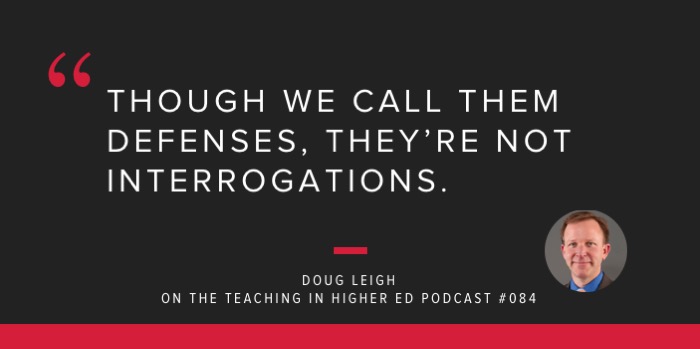
    Though we call them defenses, they’re not interrogations. They’re not about getting lined up to be battered with questions to prove your worth before a student is allowed into the club.
    —Doug Leigh

    Students who can avoid just reaffirming what’s already known are able to position themselves to do research that sticks with them as a passion.
    —Doug Leigh

    Resources

    • Murray Davis’s “That’s Interesting!” article at Philosophy of the Social Sciences (paywalled)
    • Science’s 2015 Breakthrough of the Year (free), see the runners-up here (paywalled)

    Doug also shares his reworking of Davis’s index that he developed for his students, along with representative examples …

    1. Interestingness via Organizing or Disorganizing: things which have been thought to be similar are truly dissimilar, or that things believe to be dissimilar are actually similar. Example: John A Bargh’s “The Four Horsemen of Automaticity: Awareness, Intention, Efficiency, and Control in Social Cognition“
    2. Interestingness by Composing or Decomposing: what seems to be varied and complex is really better understood simply, or something that is currently understood to be simple is actually elaborate, distinct, independent, heterogeneous, and diverse. Example: Quanta’s “The New Laws of Explosive Networks”
    3. Interestingness by Abstraction or Particularization: that which people assume are experienced by just a certain few are actually shared by all, or vice versa. Example: NYT’s “Mass Murderers Fit Profile, as Do Many Others Who Don’t Kill“
    4. Interestingness by Globalizing or Localizing: what seems to be a global truth is really just a more local one, or that something thought to be experienced just locally is actual more global. Example: Pew Research Center’s Views on Science poll
    5. Interestingness by Stabilizating or Destabilizating: what seems to be stable and unchanging is actually unstable and changing, or things thought to be unstable are surprisingly stabilit and even permanent. Example: BBC’s “The Libet Experiment: Is Free Will Just an Illusion?” (video)
    6. Interestingness by Effective or Ineffective Functioning: some aspect of the world that was believed to function effectively is actually ineffective, or vice versa. Example: Derek Muller’s “Khan Academy and the Effectiveness of Science Videos” (video)
    7. Interestingness by Re-assessment of Costs or Benefits: what seems to be bad is in reality good, or what was believed to be good is actually bad. Example: On Point’s “Is Recycling Really Worth It?” (radio broadcast)
    8. Interestingness by Inter-dependence or Independence: what seem to be unrelated (or independent) phenomena are in reality correlated (or inter-dependent) phenomena, or vice versa. Example: Quartz’ “This article has been perfectly formatted for maximum reading comprehension“
    9. Interestingness by Inconsistencies or Consistencies: what has been thought to be able to exist together are in reality things that cannot, or phenomenena thought to be mutually exclusive actually can co-exist. Example: Quanta’s “Physicists and Philosophers Debate the Boundaries of Science“
    10. Interestingness by Positive or Negative Covariation: what has been thought to co-vary positively actually co-varies negatively, or what has been thought to co-vary negatively actually co-varies positively. Example: Big Think’s “How Hearing Something Now, Can Lead You to Believe the Opposite Later“
    11. Interestingness by Dissimilarity or Similarity: phenomena that seem to be similar are in reality opposite, or phenomena that seem to be opposite are really similar. Example: The Atlantic’s “How ‘Quantum Cognition’ Can Explain Humans’ Irrational Behaviors“

    Recommendations

    Bonni:

    • Book: Doing a Literature Review* by Chris Hart

    Doug:

    • Software: Harzing’s Publish or Perish
    • Research: ERIC Thesaurus of Descriptors

    Talking to students about vocation, with Tim Clydesdale Jan 14, 2016
    Show notes

    Talking to Students about Vocation

    Tim Clydesdale talks about how we can all better support our students in navigating college and beyond by talking about vocation.

    Quotes

    [Vocation] is about the type of life you want to lead and the type of person you want to be.
    —Tim Clydesdale

    It may be that the broader sense of who you are isn’t being fully expressed in your work but it’s being expressed in many other places: in your volunteer work, or your care for a family member.
    —Tim Clydesdale

    Vocation is a much better way to talk to students [than career] because it captures much more of the breadth of life as it’s really lived.
    —Tim Clydesdale

    Resources

    • Article: Inside Higher Ed
    • Organization: Council of Independent Colleges
    • The Purposeful Graduate*

    What are some of the mistakes universities make when attempting to develop effective programs to facilitate more conversation about vocation?

    1. Design a program that wasn’t organic to the campus
    2. Hiring people who didn’t have a high emotional intelligence

    Recommendations

    Bonni:

    • Keep a list of ideas for each class you have been scheduled to teach.

    Tim:

    • Good food helps with conversation. Use a slow cooker (Crock-Pot) with a manual switch. This allows you to cook but also be engaged in conversation.

    Practical program development, with Doug Grove Jan 07, 2016
    Show notes

    Practical Program Development

    Doug Grove discusses practical program development: what works and what doesn’t when building learning experiences for today’s students.

    Quotes

    We see a lot of benefits of synchronous class sessions, but we’re not sure every student wants that. There’s a tradeoff with flexibility.
    -Doug Grove

    One of the mistakes we made when developing some of these programs was trying to be all things to all students.
    -Doug Grove

    Every program is a little different. One of the bigger mistakes we’ve made was we just took our existing structure and placed it on any new program.
    -Doug Grove

    Education Technology Tools

    • Adobe Connect web conferencing software
    • Dragon Naturally Speaking for speech-to-text

    Recommendations

    Bonni:

    • Batch processing on the computer. Do “like work” all at one time.

    Doug:

    • Book: Start with Why by Simon Sinek
    • Coaching for Leaders Episode 223: Start with Why Featuring Simon Sinek
    • Simon Sinek’s TED talk

    The ethics of plagiarism detection, with Stephanie Vie Dec 31, 2015
    Show notes

    Stephanie Vie discusses the ethical considerations of using Turnitin and other automatic plagiarism checkers.

    Ethical Considerations of Using Turnitin

    Guest: Stephanie Vie

    twitter: @digiret
    email: Stephanie.Vie@ucf.edu
    Academia: https://ucf.academia.edu/StephanieVie

    Stephanie Vie researches the construction of digital identities in social media spaces as well as critical approaches to composing technologies such as plagiarism detection services. Her research has appeared in First Monday; Computers and Composition; Computers and Composition Online; Kairos: Rhetoric, Technology, and Pedagogy; and The Community Literacy Journal.

    She is a Reviews Section Co-editor with Kairos; a Project Director with the Computers and Composition Digital Press; and an editorial board member of the undergraduate research journal Young Scholars in Writing.

    Her doctorate from the University of Arizona (2007) is in Rhetoric, Composition, and the Teaching of English, and her dissertation, “Engaging Others in Online Social Networking Sites: Rhetorical Practices in MySpace and Facebook,” examined the use of privacy settings in these sites within a Foucauldian framework. More

    Quote

    The more moments you can take from an active, engaged classroom and bring them into your assignments, that’s going to significantly help reduce plagiarism.
    -Stephanie Vie

    Recommendations

    Bonni:

    • Go for a walk. It’s easy to forget how great it feels walk.

    Stephanie:

    • Book: My Freshman Year* by Rebecca Nathan
    • App: Wunderlist for creating to-do lists
    • App: Toggl for time tracking

    Are You Enjoying the Show?

    1. Rate/review the show. Please consider rating or leaving a review for the Teaching in Higher Ed podcast on whatever service you use to listen to it on (iTunes, Stitcher, etc.). It is the best way to help others discover the show.
    2. Give feedback. As always, I welcome suggestions for future topics or guests.
    3. Subscribe. If you have yet to subscribe to the weekly update, you can receive a single email each week with the show notes (including all the links we talk about on the episode), as well as an article on either teaching or productivity.

    International Higher Education in the 21st Century, with Mary Gene Saudelli Dec 23, 2015
    Show notes

    International Higher Education in the 21st Century

    On today’s episode, I speak with Dr. Mary Gene Saudelli about developing curriculum for international higher education in the 21st Century.

    Guest: Dr. Mary Gene Saudelli

    Author, The Balancing Act: International Higher Education in the 21st Century*

    LinkedIn
    Book on Amazon*

    Mary Gene is an assistant professor and director of the Center for Teaching and Learning at the University of Calgary in Quatar. More

    Quote:

    I create a situation where I ask my students to think about things from multiple perspectives, but also allow their voices to be honored.
    –Mary Gene Saudelli

    How Dubai has Changed

    dubai-1

    dubai-2

    dubai-3

    Recommendations

    Bonni:
    Book: Transitions: Making Sense of Life’s Changes* by William Bridges
    Book: The Way Of Transition: Embracing Life’s Most Difficult Moments* by William Bridges

    Mary Gene:
    In difficult circumstances, stop to consider your own thoughts: When you have extreme positions, does that extreme thought mirror who you want to be as a person and what you want to believe?


    The potential impact of stereotype threat, with Robin Paige Dec 17, 2015
    Show notes

    On today’s episode, I speak with Dr. Robin Paige about the potential impact of stereotype threat inside and outside of our classrooms.

    Stereotype Threat

    Quote

    When dealing with stereotypes, one of the things we can do on our campuses or in our classrooms is create a space of accountability but without saying “You’re a bad person for thinking that.”
    —Robin Paige

    Resources

    Academic Paper by Claude Steele and Joshua Aronson: Stereotype Threat and the Intellectual Test Performance of African Americans

    Recommendations

    Bonni:
    Podcast: This American Life episode 573: Status Update
    Book: Between the World and Me* by Ta-Nehisi Coates
    Course: 5 days to your best year ever course with Michael Hyatt*

    Robin:
    Book: Whistling Vivaldi* by Claude Steele
    Blog: http://thesocietypages.org/socimages/
    Tip: Use food to create a stereotype-safe environment because it becomes a thing people have in common.


    The power of checklists Dec 10, 2015
    Show notes

    Atul Gawande

    Today on episode #078 of Teaching in Higher Ed: The power of checklists

    Book: The Checklist Manifesto by Atul Gawande

    Good checklists, on the other hand are precise. They are efficient, to the point, and easy to use even in the most difficult situations. They do not try to spell out everything–a checklist cannot fly a plane. Instead, they provide reminders of only the most critical and important steps–the ones that even the highly skilled professional using them could miss. Good checklists are, above all, practical.
    ―Atul Gawande

    We don’t like checklists. They can be painstaking. They’re not much fun. But I don’t think the issue here is mere laziness. There’s something deeper, more visceral going on when people walk away not only from saving lives but from making money. It somehow feels beneath us to use a checklist, an embarrassment. It runs counter to deeply held beliefs about how the truly great among us—those we aspire to be—handle situations of high stakes and complexity. The truly great are daring. They improvise. They do not have protocols and checklists. Maybe our idea of heroism needs updating.
    ―Atul Gawande

    Definitions

    A to-do list is what to do, a checklist is how to do it:
    Article on lessdoing.com

    A checklist is a documented process for something you’ll do daily; a to-do list is something you assembled yourself that you need to do at a certain point of your day:
    Article on alphaefficiency.com

    Philip Crawford, software entrepreneur on Quora, gives his definition:
    Question on Quora

    Natalie Houston on checklists

    A checklist ensures communication and confirmation among members of a team and catches errors.
    —Natalie Houston

    There are Two kinds of checklists:

    • Read-do: read each step and perform the step, checking off as you go (like following a recipe)
    • Do-confirm: perform steps of the task from memory until you reach a defined pause point when you confirm that things have happened.

    Advice for making checklists:

    • Keep it simple
    • Make it usable – need to be able to check things off
    • Try it out and edit as necessary

    Read her article about checklists HERE

    Checklist on Checklists

    Atul Gawande lists things to consider when making a checklist:

    • You you have clear, concise objectives
    • Have you considered adding items that will improve communication among team members
    • When crafting the list, is the font sans serif?
    • Have you trialled the list with frontline users? And have you modified the checklist in response to repeated trials?

    Class Checklist

    • See my class checklist HERE on Evernote. (I currently use an OmniFocus project template by Curt Clifton
    • TIHE Article: Use checklists to teach more effectively and efficiently
    • TIHE Article: Checklist for class planning efficiency
    • Article by the late Grant Wiggins: How do you plan? On templates and instructional planning

    Recommendations:

    • Book: The Checklist Manifesto* by Atul Gawande
    • Task planning system: Trello

    Teaching What You Don’t Know, with Therese Huston Dec 03, 2015
    Show notes

    teaching what you don't know

    Today I welcome to the show Dr. Terese Huston to talk about teaching what you don’t know.

    Guest: Therese Huston

    Faculty Development Consultant, Seattle University
    Author: Teaching What You Don’t Know

    Seattle University faculty page: here
    Personal page: www.theresehustonauthor.com
    Twitter: @ThereseHuston

    Therese Huston received her B.A. from Carleton College and her M.S. and Ph.D. in Cognitive Psychology from Carnegie Mellon University. She was also awarded a prestigious post-doctoral fellowship with the Center for the Neural Basis of Cognition. Therese was the Founding Director of CETL (now the Center for Faculty Development) and served as Director from 2004 to 2010. Drawing upon her background in cognitive science, she has spent the past decade helping smart faculty make better decisions about their teaching. Her first book, Teaching What You Don’t Know, was published by Harvard University Press (2009).

    Quotes

    If I could go back to my 28-year-old self and give her one piece of advice, it would be to talk to a content expert.
    -Therese Huston

    I wish I had offered to take an expert to coffee once a week to brainstorm what I should be teaching.
    -Therese Huston

    Teaching is more than just knowing every single detail there is to know; teaching is much more about stimulating learning.
    -Therese Huston

    You have to be thinking, “I’ve got to do something that I know well, but if I’m going to be the best teacher I can be to my students I’ve also got to teach them some things that are perhaps outside of my comfort zone.”
    -Therese Huston

    No one can be an expert on this material, and what I’m going to be doing is to always look for the most recent, most important topic that I can be teaching you.
    -Therese Huston

    If I’m doing a good job up here, I’m going to be pushing the boundaries of what I know.
    -Therese Huston

    Notes

    Teaching what you don’t know looks at it from two perspectives:

    1. A subject you don’t know
    2. A group of students you don’t understand

    Things unique to people who experience minimal anxiety when teaching outside of their expertise:

    • They had a choice about whether or not to teach the subject
    • They addressed the “imposter issue” with their students
    • They embraced a teaching philosophy that emphasizes the idea: “I don’t need to master the material”

    You have just been assigned to teach a course outside of our expertise. What are the most important steps to take in preparing to teach it?

    1. Tell someone (deal with the imposter issue)
    2. Find five syllabi for similar courses online
    3. Get a timer and start practicing preparing for your class in set chunks of time.

    Recommendations

    Bonni recommends:
    Therese’s book: Teaching What you Don’t Know*
    Sonos speakers : See on Amazon*

    Therese recommends:
    Licorice tea: See on Amazon*
    Book: Thanks for the Feedback: The Science and the Art of Receiving Feedback*
    Book: Difficult Conversations*
    Podcast about Book: Coaching for Leaders: Episode 143


    Making online courses work, with Doug McKee Nov 25, 2015
    Show notes

    Doug Mckee talks about online courses

    In today’s episode, Doug McKee joins me to share about online courses. His Introduction to Econometrics class is taught about as close to an in-person as you can get, but without being bound by geographic barriers.

    Guest: Doug McKee

    Associate Chair and Senior Lecturer of Economics at Yale
    http://economics.yale.edu/people/douglas-mckee

    Website: http://dougmckee.net/
    Teach Better blog and podcast: http://teachbetter.co/
    Personal Blog: www.highvariance.net
    Twitter: https://twitter.com/TeachBetterCo

    Quotes regarding online courses:

    We weren’t lowering the price, but we were lowering the geographic barriers.
    –Doug McKee
    You don’t need a big film crew, and snazzy digital effects; you just need to be clear, and communicate it well.
    –Doug McKee
    Students show up, and they don’t have any questions. What I do is come with questions.
    –Doug McKee

    Links:

    Udacity: https://www.udacity.com/
    Zoom: http://zoom.us/
    Examity: http://examity.com/
    Explain Everything iPad app: App Store Link*

    Recommendations:

    Bonni recommends:
    Sherlock: IMDB
    Doug recommends:
    Poster sessions with students: Read blog post here
    CS50 course: Syllabus
    TeachBetter podcast: episode with David Malan


    Previous 1 55 56 57 58 59 65 Next

    Related Podcasts

    Making Sense with Sam Harris

    1

    Making Sense with Sam Harris Education
    Grammar Girl

    2

    Grammar Girl Education
    Good Life Project

    3

    Good Life Project Education
    Explain It to Me

    4

    Explain It to Me Education
    Team Never Quit

    5

    Team Never Quit Comedy
    Optimal Living Daily – Personal Development and Self-Improvement

    6

    Optimal Living Daily – Personal Development and Self-Improvement Alternative Health
    footer-logo

    Contact Us

    Toll Free: 844-670-7747

    Links

    • Home
    • Top Charts
    • Networks
    • Apps
    • Independents Podcasts
    • Podcast Advertising
    • Podcast News
    • Contact Us
    • About Us
    • Analytics & Insights

    Stay Connected

      Privacy, Terms of Use & Our Code of Ethics Protecting Content Creators Copyrights