TopPodcast.com
Menu
  • Home
  • Top Charts
  • Top Networks
  • Top Apps
  • Top Independents
  • Top Podfluencers
  • Top Picks
    • Top Business Podcasts
    • Top True Crime Podcasts
    • Top Finance Podcasts
    • Top Comedy Podcasts
    • Top Music Podcasts
    • Top Womens Podcasts
    • Top Kids Podcasts
    • Top Sports Podcasts
    • Top News Podcasts
    • Top Tech Podcasts
    • Top Crypto Podcasts
    • Top Entrepreneurial Podcasts
    • Top Fantasy Sports Podcasts
    • Top Political Podcasts
    • Top Science Podcasts
    • Top Self Help Podcasts
    • Top Sports Betting Podcasts
    • Top Stocks Podcasts
  • Podcast News
  • About Us
  • Podcast Advertising
  • Contact
Not in our directory?
Add Show Here
Podcast Equipment
Center

toppodcastlogoOur TOPPODCAST Picks

  • Comedy
  • Crypto
  • Sports
  • News
  • Politics
  • True Crime
  • Business
  • Finance

Follow Us

toppodcastlogoStay Connected

    View Top 200 Chart
    Back to Rankings Page
    Education

    Teaching in Higher Ed

    Thank you for checking out the Teaching in Higher Ed podcast. This is the space where we explore the art and science of being more effective at facilitating learning. We also share ways to increase our personal productivity, so we can have more peace in our lives and be even more present for our students.

    Advertise

    Copyright: © Innovate Learning, LLC

    • Apple Podcasts
    • Google Play
    • Spotify

    Latest Episodes:
    Professional Online Portfolios, with McClain Watson Jun 20, 2016
    Show notes

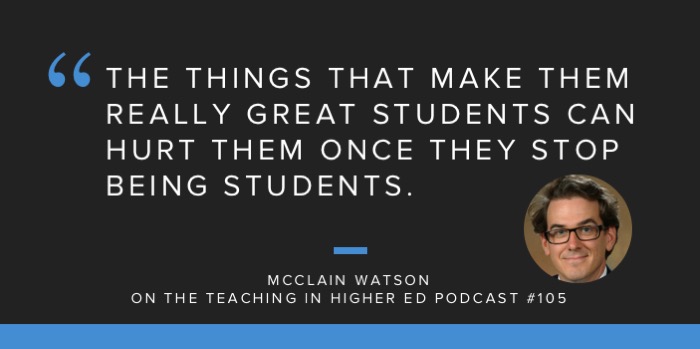
    Today’s guest, Dr. McClain Watson, at University of Texas at Dallas, advocates for the importance of our students being able to: “ convince people in the professional world that they 1) know what they’re doing, 2) can be trusted, and 3) are interesting to be around?” On today’s episode: Professional Online Portfolios.

    online portfolios

    Guest: McClain Watson
    Clinical Associate Professor, Director of Business Communication Programs Organizations, Strategy and International Management

    Bio: http://jindal.utdallas.edu/faculty/john-watson

    Resources

    • Episode 101: Public sphere pedagogy with Thia Wolf
    • Going public with our learning
    • What are POPs?
    • A Domain of One’s Own on UMW site
    • University of Wisconsin – Stout rubric for assessment e-portfolios

    Sample portfolios

    • http://danyalahmed93.wix.com/portfolio
    • http://andreacastanedae.wix.com/andycastaneda
    • http://olasaleh.weebly.com/
    • http://nathanblumenthal.weebly.com/
    • http://luzechanove.wix.com/misitio
    • http://thomasjmckee.com/
    • http://guohaoyue1990.wix.com/howardguomusic
    • http://edq130030.wix.com/elainequayle
    • http://adrianhovelman.wix.com/pop2

    Are You Enjoying the Show?

    1. Rate/review the show. Please consider rating or leaving a review for the Teaching in Higher Ed podcast on whatever service you use to listen to it on (iTunes, Stitcher, etc.). It is the best way to help others discover the show.
    2. Give feedback. As always, I welcome suggestions for future topics or guests.
    3. Subscribe. If you have yet to subscribe to the weekly update, you can receive a single email each week with the show notes (including all the links we talk about on the episode), as well as an article on either teaching or productivity.

    Disability Accommodations and Other Listener Questions, with Dave Stachowiak Jun 09, 2016
    Show notes

    On this week’s episode, Dave and I discuss disability accommodations and other listener questions.

    disability accomodations

    1) Disability accommodations

    • Dyslexia simulator
    • Neurotribes: The Legacy of Autism*

    2) Online scenario manager resource

    • Geogebra.org
    • Geogebra – Spreadsheet View

    3) Preparation for getting doctorate degree

    • Julie Wilson’s bio
    • www.Lynda.com
    • www.Zotero.org

    4) “Small” approaches to reclaiming teaching as a focus

    • TIHE 092: Small Teaching (James Lang)
    • www.doodle.com
    • The Lean Startup* by Eric Ries
    • Leading Change* by John Kotter
    • Six ways to improve your department’s teaching climate

    Are You Enjoying the Show?

    1. Rate/review the show. Please consider rating or leaving a review for the Teaching in Higher Ed podcast on whatever service you use to listen to it on (iTunes, Stitcher, etc.). It is the best way to help others discover the show.
    2. Give feedback. As always, I welcome suggestions for future topics or guests.
    3. Subscribe. If you have yet to subscribe to the weekly update, you can receive a single email each week with the show notes (including all the links we talk about on the episode), as well as an article on either teaching or productivity.

    Critical Instructional Design, with Sean Michael Morris Jun 02, 2016
    Show notes

    On this week’s episode, Sean Michael Morris and I discuss Critical Instructional Design.

    Critical Instructional Design

    Guest: Sean Michael Morris

    Sean is a digital teacher and pedagogue, with experience especially in networked learning, MOOCs, digital composition and publishing, collaboration, and editing. He’s been working in digital teaching and learning for 15 years. His work as a pioneer in the field of Critical Digital Pedagogy is founded in the philosophy of Paulo Freire, and finds contemporary analogues in the work of Howard Rheingold, Cathy N. Davidson, Dave Cormier, and Jesse Stommel. He is committed to engaging audiences in critical inspection of digital technologies, and to turning a social justice lens upon education. More

    Course: Critical Instructional Design

    • Critical Instructional Design course from Digital Pedagogy Lab

    Quotes

    [Instructional Design] makes very mechanical the non-mechanical nature of teaching. Certain processes are put into place where the spontaneity is taken out of teaching. The relationship is taken out of teaching. The care and nurture of the student is taken out of teaching.
    —Sean Michael Morris

    A lot of critical instructional design is questioning. It’s a matter of stepping back and observing and saying, “What are the assumptions of the LMS? What are the assumptions that I make and have been given to make about online learning? And how can I switch that up?”
    —Sean Michael Morris

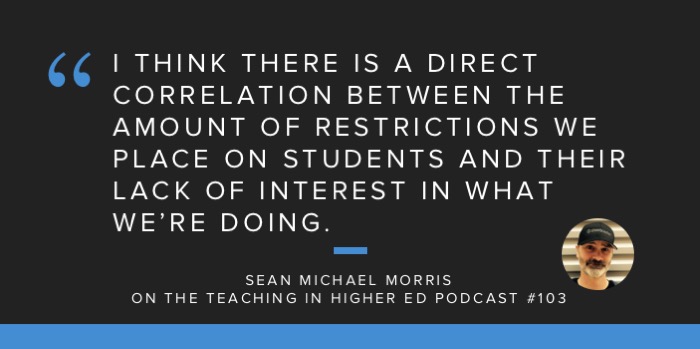
    I think there is a direct correlation between the amount of restrictions we place on students and their lack of interest in what we’re doing.
    —Sean Michael Morris

    The more restrictions we place on learning, the less students have the ability to to explore it themselves.
    —Sean Michael Morris

    Resources

    • Article: Critical Pedagogy in the Age of Learning Management
    • TIHE episode about the “8 Recond Rule”

    Are You Enjoying the Show?

    1. Rate/review the show. Please consider rating or leaving a review for the Teaching in Higher Ed podcast on whatever service you use to listen to it on (iTunes, Stitcher, etc.). It is the best way to help others discover the show.
    2. Give feedback. As always, I welcome suggestions for future topics or guests.
    3. Subscribe. If you have yet to subscribe to the weekly update, you can receive a single email each week with the show notes (including all the links we talk about on the episode), as well as an article on either teaching or productivity.

    Proactive Inclusivity, with Carl Moore May 26, 2016
    Show notes

    On today’s episode, Dr. Carl Moore and I have a dialog about proactive inclusivity.

    Proactive Inclusivity

    Guest: Dr. Carl Moore

    Dr. Moore is currently an Associate Professor and Director of the Research Academy for Integrated Learning (RAIL) at University of DC. Prior to his current role he served as an adjunct assistant professor in the College of Education as well as the Director of the Teaching and Learning Center at Temple University. More

    Quotes

    There are stages in which a person can honestly, truly feel [colorblind], but I do think that there is something to be said about honoring and respecting differences.
    —Carl Moore

    I have a strong sense of ethnic identity, but also a strong sense of identity of the mainstream majority, [as] an American.
    —Carl Moore

    Are You Enjoying the Show?

    1. Rate/review the show. Please consider rating or leaving a review for the Teaching in Higher Ed podcast on whatever service you use to listen to it on (iTunes, Stitcher, etc.). It is the best way to help others discover the show.
    2. Give feedback. As always, I welcome suggestions for future topics or guests.
    3. Subscribe. If you have yet to subscribe to the weekly update, you can receive a single email each week with the show notes (including all the links we talk about on the episode), as well as an article on either teaching or productivity.

    Public Sphere Pedagogy, with Thia Wolf May 19, 2016
    Show notes

    On this week’s episode, Dr. Thia Wolf shares about public sphere pedagogy.

    Thia Wolf

    Guest: Thia Wolf

    Thia is a Professor of English and Director of the First-Year Experience Program at California State University, Chico, where she has worked since 1989. Prior to her appointment in the FYE program, she coordinated a variety of writing programs, including the first-year composition program and the writing across the disciplines program. Since 2006, she has been collaborating with faculty in several disciplines to embed public dimensions in first-year classes. Her publications have focused on collaborative learning and on public sphere pedagogy. More

    Quotes

    Students need to have an experience when they come to college that … gives them a sense that education is for the rest of their lives, it’s to help them do things in the world.
    —Thia Wolf

    I noticed that the curriculum of first year students looks a lot like the curriculum in high school … I would say that it sends the “Not ready for prime time” message.
    —Thia Wolf

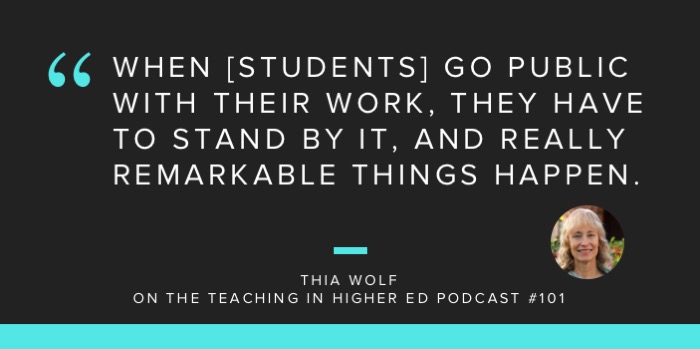
    When [students] go public with their work, they have to stand by it, and really remarkable things happen.
    —Thia Wolf

    We don’t give students opportunities to experience and reflect on how the curriculum is part of them and how they are affecting it.
    —Thia Wolf

    Resources

    • First-Year Experience Program at Chico State
    • Book in Common Program
    • Courses that take students’ transitioning processes into account
    • Public sphere events where students and their course work are “center stage”
    • Chico Great Debate
    • Meet the faculty

    Are You Enjoying the Show?

    1. Rate/review the show. Please consider rating or leaving a review for the Teaching in Higher Ed podcast on whatever service you use to listen to it on (iTunes, Stitcher, etc.). It is the best way to help others discover the show.
    2. Give feedback. As always, I welcome suggestions for future topics or guests.
    3. Subscribe. If you have yet to subscribe to the weekly update, you can receive a single email each week with the show notes (including all the links we talk about on the episode), as well as an article on either teaching or productivity.

    The Failure Episode, with Dave Stachowiak May 12, 2016
    Show notes

    Eight faculty share their failure stories on this special #100th episode of Teaching in Higher Ed.

    failure

    CV of Failures

    • Johannes Haushofer’s CV of Failures
    • HBR article about Johannes Haushofer

    Quotes

    At the time, I felt like I had to know everything in order to be a good teacher, so instead of admitting that I didn’t know the answer to the student’s question, I dismissed it.
    —Cameron Hunt-McNabb

    I think I understand way better now what kinds of issues my students think are important.
    —Doug McKee

    I strongly identified with that strain of perfectionism that insists that unless every student in every class feels like every moment was a rich and profound learning experience, then I have failed.
    —Jeff Hittenberger

    Guest Stories

    1) Katie Linder

    • Didn’t allow discomfort in the classroom and rushed too quickly through it.
    • Check out the Research in Action Podcast

    2) Jeff Hittenberger

    • Felt like he had failed at the end of each semester.

    3.) Angela Jenks

    • Didn’t know how much the class textbooks cost.

    4.) Josh Eyler

    • Gave quizzes just to test that students read.
    • Read the conversation in Storify for Twitter

    5.) Michelle Miller

    • Didn’t take care of a problem before it escalated.

    6.) James Lang

    • Was not clear enough in assignment criteria.

    7.) Cameron Hunt-McNabb

    • Thought she had to know everything to be good teacher.

    7.) Maha Bali

    • Laughed at student’s suffering … almost.

    8.) Doug McKee

    • Didn’t understand what issues his students thought were important.
    • TIHE episode 045: Calibrating our teaching (Aaron Daniel Annas)

    Recommendations

    Books:

    Janine Utell: Dear Committee Members* by Julie Schumacher

    José Bowen: Teaching Naked* by José Bowen

    Sean Micael Morris: Savvy* by Ingrid Law

    Cameron Hunt McNabb: Tina Fey’s advice to “Say yes” in her memoir, Bossy Pants*

    Amy Collier: Quotes Anne Lamott: “These are the words I want on my gravestone: that I was a helper, and that I danced,” from her book Grace (Eventually)*

    Tools:

    Doug McKee: Piazza*

    Aaron Daniel Annas: Amazon Echo*

    Teaching inspiration:

    Rebecca Campbell: Be kind to students. Don’t make assumptions.

    Linda Nielsen: Cultivate your courage by trying out things you’re afraid of.

    Lee Skallerup Bessette: Be hopeful. Be optimistic. And give your students the benefit of the doubt right from the start.

    Doug McKee: Try poster sessions with students.

    Peter Newbury: Get yourself into a learning community. Get on Twitter.

    Are You Enjoying the Show?

    1. Rate/review the show. Please consider rating or leaving a review for the Teaching in Higher Ed podcast on whatever service you use to listen to it on (iTunes, Stitcher, etc.). It is the best way to help others discover the show.
    2. Give feedback. As always, I welcome suggestions for future topics or guests.
    3. Subscribe. If you have yet to subscribe to the weekly update, you can receive a single email each week with the show notes (including all the links we talk about on the episode), as well as an article on either teaching or productivity.

    Encouraging Accountability, with Angela Jenks May 05, 2016
    Show notes

    Dr. Angela Jenks shares about her experiences encouraging accountability in her students on today’s episode of the Teaching in Higher Ed podcast.

    encouraging accountability

    Guest: Angela Jenks

    Angela is a medical anthropologist and Lecturer, PSOE (Tenure-Track Teaching Faculty) in the Department of Anthropology at the University of California, Irvine, where she also directs the M.A. in Medicine, Science, and Technology Studies program.

    Quotes

    It’s not necessarily a kindness to not fulfill the requirements of the class.
    —Angela Jenks

    One of the challenges is holding standards while not turning the classroom into an adversarial situation.
    —Angela Jenks

    One of the things I focus on increasingly is very clear policies.
    —Angela Jenks

    I didn’t want the syllabus to turn into something that reads like a Terms of Service.
    —Angela Jenks

    Mentioned in Episode

    • Race Gender Science syllabus (inspired by Tona Hagen’s “Extreme Makeover” of her History syllabus)
    • In Praise of Slowness* by Carl Honore

    Podcast episodes on kindness:

    • Episode 057: Teaching with Twitter (Jesse Stommel)
    • Episode 052: Respect in the Classroom (Kevin Gannon)
    • Episode 019: Small Teaching (James Lang)

    Podcast episode on Attitude:

    • Episode 062: Mindset (Rebecca Campbell)

    Recommendations

    Bonni recommends:

    Allowing students to “show up.” Consider this quote from Anne Lamott (who was mentioned on Episode 070 with Amy Collier):

    I had a session over the phone with my therapist today. I have these secret pangs of shame about being single, like I wasn’t good enough to get a husband. Rita reminded me of something I’d told her once, about the five rules of the world as arrived at by this Catholic priest named Tom Weston.

    The first rule, he says, is that you must not have anything wrong with you or anything different.

    The second one is that if you do have something wrong with you, you must get over it as soon as possible.

    The third rule is that if you can’t get over it, you must pretend that you have.

    The fourth rule is that if you can’t even pretend that you have, you shouldn’t show up. You should stay home, because it’s hard for everyone else to have you around.

    And the fifth rule is that if you are going to insist on showing up, you should at least have the decency to feel ashamed.

    So Rita and I decided that the most subversive, revolutionary thing I could do was to show up for my life and not be ashamed.

    —Anne Lamott


    The Skillful Teacher, with Stephen Brookfield Apr 28, 2016
    Show notes

    skillful teacher

    Stephen Brookfield shares about his book, The Skillful Teacher, on today’s episode of Teaching in Higher Ed.

    [divwrap class=”one-half first”]

    Quotes

    I think I internalized early in my career that my job was to talk, to profess. And that if I wasn’t talking, then I really wasn’t earning my money. I still feel that, and I fight against it constantly.
    —Stephen Brookfield

    Skillful teaching is whatever helps students learn.
    —Stephen Brookfield

    College students of any age should be treated as adults.
    —Stephen Brookfield

    Teachers need a constant awareness of how students are experiencing their learning and perceiving teachers’ actions.
    —Stephen Brookfield

    [/divwrap][divwrap class=”one-half”]

    Resources

    The Skillful Teacher*

    Episode 15 with Stephen Brookfield: How to get students to participate in discussion.

    [/divwrap]


    Integrating Personal Management Techniques into Curriculum, with Dustin Bakkie Apr 21, 2016
    Show notes

    Dustin Bakkie shares how to integrate effective study methods, learning tools, and personal management techniques as a part of your curriculum.

    personal management techniques

    Guest: Dustin Bakkie
    Lecturer at California State University, Chico

    email: dbakkie @ csuchico dot edu
    website: EpicHigherEd.com (coming soon)
    twitter: @dustinbakkie

    Quotes

    The best time to learn something is right as you’re about to forget it.
    —Dustin Bakkie

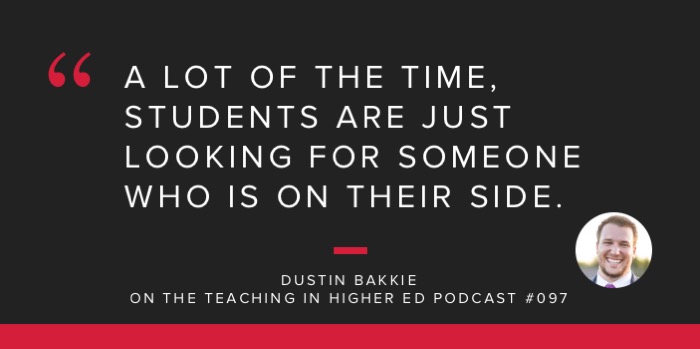
    A lot of the time, students are just looking for someone who is on their side.
    —Dustin Bakkie

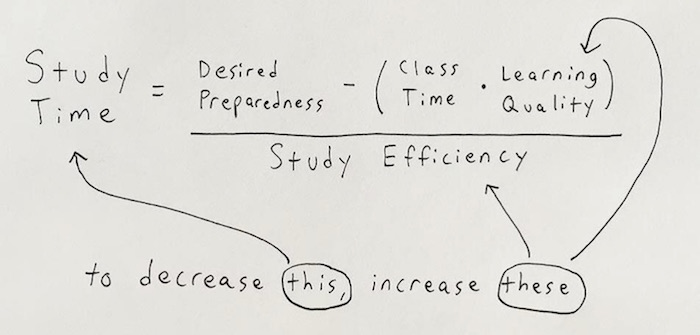
    Dustin’s effectiveness equations

    9E70A178-67DC-4826-944B-22EB6D43D42F

    CBFA75CB-B4D6-4B51-A116-A53D040CC412

    Resources

    • Book: Deep Work* by Cal Newport
    • Coaching for Leaders podcast episode 233: Engage in Deep Work, with Cal Newport
    • Thomas Frank’s Collegeinfogeek.com
    • Leitner Review System
    • App: Anki flashcards
    • App: Attendance2*

    Are You Enjoying the Show?

    1. Rate/review the show. Please consider rating or leaving a review for the Teaching in Higher Ed podcast on whatever service you use to listen to it on (iTunes, Stitcher, etc.). It is the best way to help others discover the show.
    2. Give feedback. As always, I welcome suggestions for future topics or guests.
    3. Subscribe. If you have yet to subscribe to the weekly update, you can receive a single email each week with the show notes (including all the links we talk about on the episode), as well as an article on either teaching or productivity.

    The Clinical Coach, with Jeffrey Wiese Apr 14, 2016
    Show notes

    On today’s episode, I have the honor of talking with Dr. Jeff Wiese about how he uses coaching skills in his teaching of residents.

    teach students

    Guest: Dr. Jeff Wiese

    Jeffrey G. Wiese, MD, is a Professor of Medicine with Tenure, and the Senior Associate Dean for Graduate Medical Education at the Tulane University Health Sciences Center. He is also Associate-Chairman of Medicine, the Chief of the Charity Medical Service and the Director of the Tulane Internal Medicine Residency Program. He has also served as the course director for the Clinical Diagnosis, Biostatistics, Advanced Internal Medicine, and Medical Education courses.

    Quotes

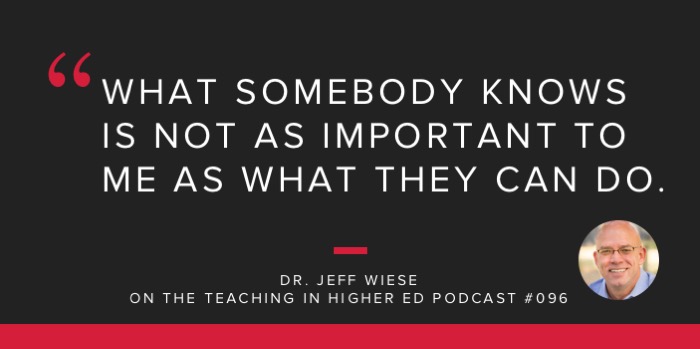
    What somebody knows is not as important to me as what they can do.
    —Dr. Jeff Wiese

    Years ago, we were so focused on on knowledge. Now, getting the knowledge is pretty easy. The shift of becoming a great coach is moving towards … teaching people not what to think, but how to think.
    —Dr. Jeff Wiese

    The way you go from good to great is finding your weakest area and improving it.
    —Dr. Jeff Wiese

    Training is to prevent surprise. Education is to prepare for surprise.
    —James Carse

    Links:

    • Teach Better podcast episode 27: Teaching Clinical Reasoning With Geoff Connors
    • Dr. Wiese’s Four Developmental Phases of a Teacher

    Are You Enjoying the Show?

    1. Rate/review the show. Please consider rating or leaving a review for the Teaching in Higher Ed podcast on whatever service you use to listen to it on (iTunes, Stitcher, etc.). It is the best way to help others discover the show.
    2. Give feedback. As always, I welcome suggestions for future topics or guests.
    3. Subscribe. If you have yet to subscribe to the weekly update, you can receive a single email each week with the show notes (including all the links we talk about on the episode), as well as an article on either teaching or productivity.

    Previous 1 53 54 55 56 57 65 Next

    Related Podcasts

    Making Sense with Sam Harris

    1

    Making Sense with Sam Harris Education
    Grammar Girl

    2

    Grammar Girl Education
    Good Life Project

    3

    Good Life Project Education
    Explain It to Me

    4

    Explain It to Me Education
    Team Never Quit

    5

    Team Never Quit Comedy
    Optimal Living Daily – Personal Development and Self-Improvement

    6

    Optimal Living Daily – Personal Development and Self-Improvement Alternative Health
    footer-logo

    Contact Us

    Toll Free: 844-670-7747

    Links

    • Home
    • Top Charts
    • Networks
    • Apps
    • Independents Podcasts
    • Podcast Advertising
    • Podcast News
    • Contact Us
    • About Us
    • Analytics & Insights

    Stay Connected

      Privacy, Terms of Use & Our Code of Ethics Protecting Content Creators Copyrights