TopPodcast.com
Menu
  • Home
  • Top Charts
  • Top Networks
  • Top Apps
  • Top Independents
  • Top Podfluencers
  • Top Picks
    • Top Business Podcasts
    • Top True Crime Podcasts
    • Top Finance Podcasts
    • Top Comedy Podcasts
    • Top Music Podcasts
    • Top Womens Podcasts
    • Top Kids Podcasts
    • Top Sports Podcasts
    • Top News Podcasts
    • Top Tech Podcasts
    • Top Crypto Podcasts
    • Top Entrepreneurial Podcasts
    • Top Fantasy Sports Podcasts
    • Top Political Podcasts
    • Top Science Podcasts
    • Top Self Help Podcasts
    • Top Sports Betting Podcasts
    • Top Stocks Podcasts
  • Podcast News
  • About Us
  • Podcast Advertising
  • Contact
Not in our directory?
Add Show Here
Podcast Equipment
Center

toppodcastlogoOur TOPPODCAST Picks

  • Comedy
  • Crypto
  • Sports
  • News
  • Politics
  • True Crime
  • Business
  • Finance

Follow Us

toppodcastlogoStay Connected

    View Top 200 Chart
    Back to Rankings Page
    Education

    Teaching in Higher Ed

    Thank you for checking out the Teaching in Higher Ed podcast. This is the space where we explore the art and science of being more effective at facilitating learning. We also share ways to increase our personal productivity, so we can have more peace in our lives and be even more present for our students.

    Advertise

    Copyright: © Innovate Learning, LLC

    • Apple Podcasts
    • Google Play
    • Spotify

    Latest Episodes:
    Using Open Educational Resources in Your Teaching, with John Stewart Nov 03, 2016
    Show notes

    open educational resources OER

    John Stewart shares how he uses Open Educational Resources (OER) in his teaching on episode 125 of the Teaching in Higher Ed podcast.

    Quotes from the episode

    Any time you’re doing experimental work, you can anticipate some of the problems, but not all of them.
    –John Stewart

    Laziness at the faculty level hasn’t been invented recently.
    –John Stewart

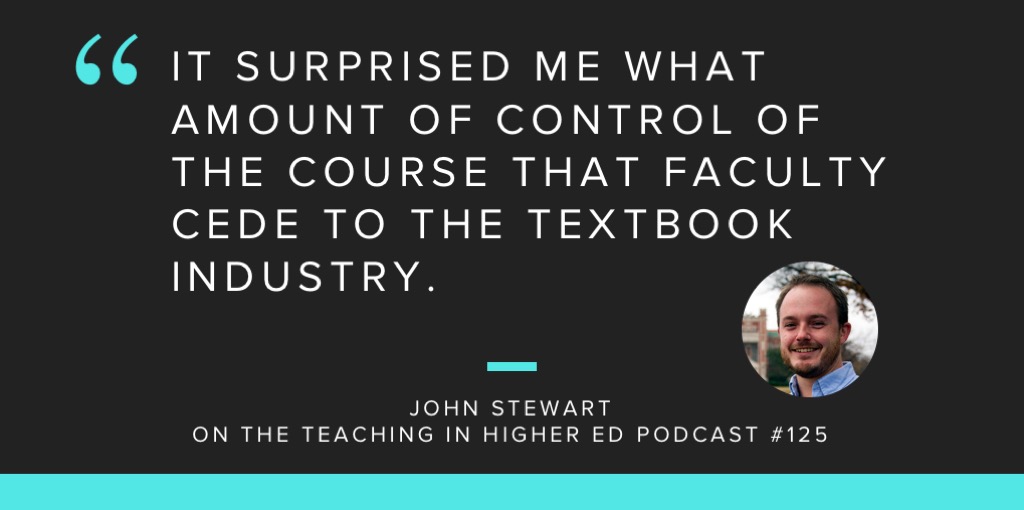
    It surprised me what amount of control of the course that faculty cede to the textbook industry.
    –John Stewart

    Think about how you can take the time both for yourself and for your students to share what you’re doing.
    –John Stewart

    Resources Mentioned

    • John Stewart’s Digital Projects
    • Very Bad Wizards Episode #99
    • iBooks
    • After Newton
    • OU Create
    • FeedPress
    • Rezzly (used to be called 3D Game Lab)
    • MERLOT II
    • eXperience Play
    • GOBLIN

    Intercultural Learning, with Maha Bali Oct 27, 2016
    Show notes

    Intercultural learning

    Maha Bali talks about intercultural learning on episode 124 of the Teaching in Higher Ed podcast.

    Quotes from the episode

    By spending a lot of time with people who are different than yourself, you get to know yourself even better.
    –Maha Bali

    When you leave your culture and go to live somewhere else it helps you question your values, what you take for granted, and your assumptions.
    –Maha Bali

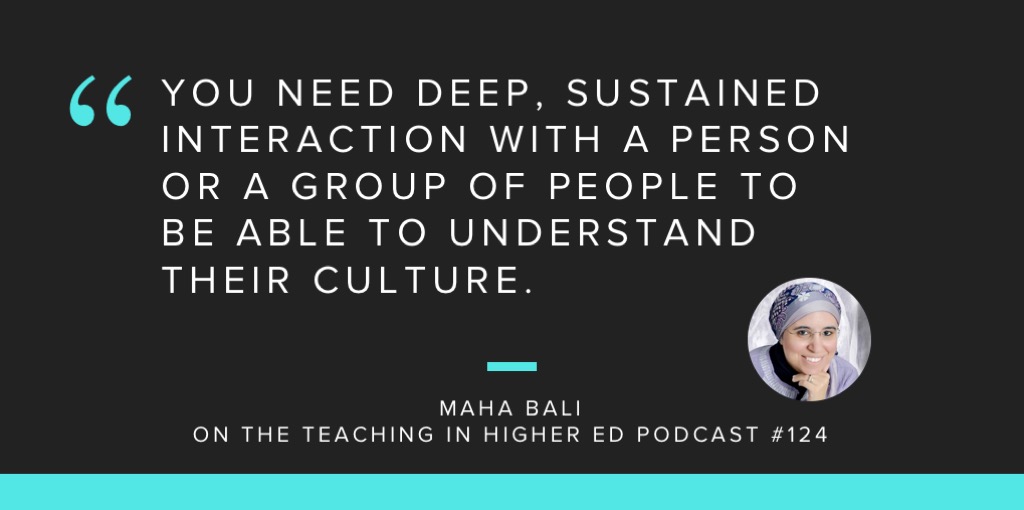
    You need deep, sustained interaction with a person or a group of people to be able to understand their culture.
    –Maha Bali

    Resources Mentioned

    • Maha’s PhD Thesis: Critical Thinking in Context: Practice at an American Liberal Arts University in Egypt
    • Developing Intercultural Competence in Practice* by Michael Byram, Adam Nichols, and David Stevens
    • The Outer Word and Inner Speech: Bakhtin, Vygotsky, and the Internalization of Language by Caryl Emerson
    • Developmental Model of Intercultural Sensitivity by Milton J. Bennett
    • Hannah and the Talking Tree by Elke Weiss
    • The Lion Guard song: We Are the Same
    • Homi K. Bhabha’s Third Space Theory
    • Edward Said

    Presumed Incompetent, with Yolanda Niemann Oct 20, 2016
    Show notes

    Presumed Incompetent

    Yolanda Flores Niemann dialogs about being presumed incompetent in academia on episode #123 of Teaching in Higher Ed.

    Quotes from the episode

    Only about 20% of faculty are people of color.
    —Yolanda Flores Niemann

    No matter how you think of yourself, you cease to be the independent scholar … and you become what the environment needs you to be because you are one of the few people of color.
    —Yolanda Flores Niemann

    We need to mentor women to not be afraid to negotiate.
    —Yolanda Flores Niemann

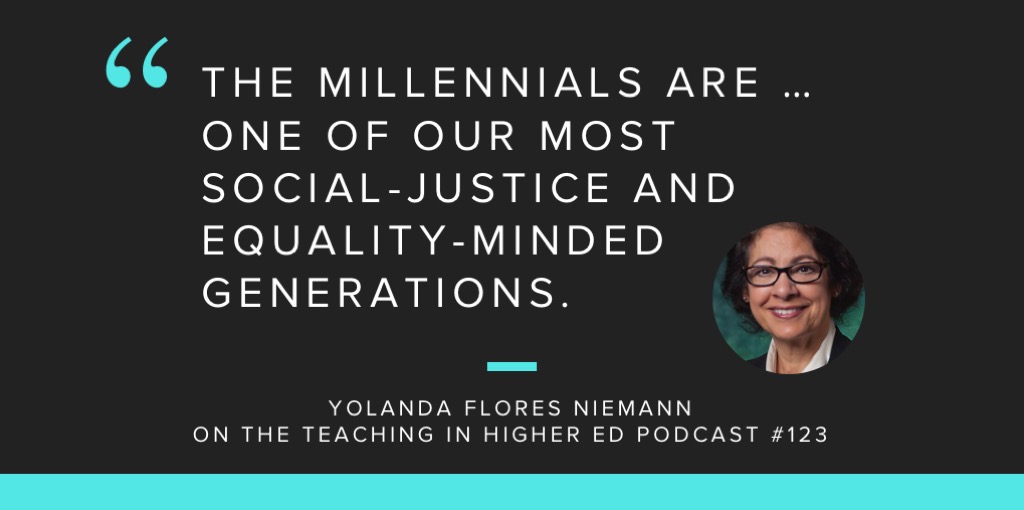
    The millennials are … one of our most social-justice and equality-minded generations.
    —Yolanda Flores Niemann

    The responsibility for knowing about issues of race, class, and gender identity, and being able to mentor students around these issues, is a responsibility that needs to be shared.
    —Yolanda Flores Niemann

    Resources Mentioned

    • The Making of a Token by Yolanda Flores Niemann
    • The Life-Changing Magic of Tidying Up by Marie Kondo
    • “They Forgot Mammy Had a Brain” by Sherrée Wilson, a chapter in Presumed Incompetent
    • Meg Urry on Teaching in Higher Ed #069, talks at one point about negotiation
    • Inclusive Teaching in the STEM Classroom, a video series by Vanderbilt’s Center for Faculty Development

    Are You Enjoying the Show?

    Rate/review the show. Please consider rating or leaving a review for the Teaching in Higher Ed podcast on whatever service you use to listen to it on (iTunes, Stitcher, etc.). It is the best way to help others discover the show.

    Give feedback. As always, I welcome suggestions for future topics or guests.

    Subscribe. If you have yet to subscribe to the weekly update, you can receive a single email each week with the show notes (including all the links we talk about on the episode), as well as an article on either teaching or productivity.


    Game-based Learning, with Keegan Long-Wheeler Oct 13, 2016
    Show notes

    Game-based learning

    Keegan Long-Wheeler talks about game-based learning on episode 122 of Teaching in Higher Ed.

    Resources Mentioned

    • Goblin
    • eXperience Play
    • Open Education Conference 2016
    • Stephen Colbert’s Escape from the Man-sized Cabinet
    • Healing Words
    • Twine
    • Video of Keegan sharing about his domain of one’s own

    Are You Enjoying the Show?

    Rate/review the show. Please consider rating or leaving a review for the Teaching in Higher Ed podcast on whatever service you use to listen to it on (iTunes, Stitcher, etc.). It is the best way to help others discover the show.

    Give feedback. As always, I welcome suggestions for future topics or guests.

    Subscribe. If you have yet to subscribe to the weekly update, you can receive a single email each week with the show notes (including all the links we talk about on the episode), as well as an article on either teaching or productivity.


    Networked Pedagogy, with Bonnie Stewart Oct 06, 2016
    Show notes

    Networked pedagogy

    Bonnie Stewart talks about networked pedagogy on episode #121 of Teaching in Higher Ed.

    Quotes from the episode

    Networks are a foundational structure of human experience.
    —Bonnie Stewart

    Recognizing that there is a distinction between the personal and the private can be encouraging for people who may feel uncomfortable with the whole idea of sharing.
    —Bonnie Stewart

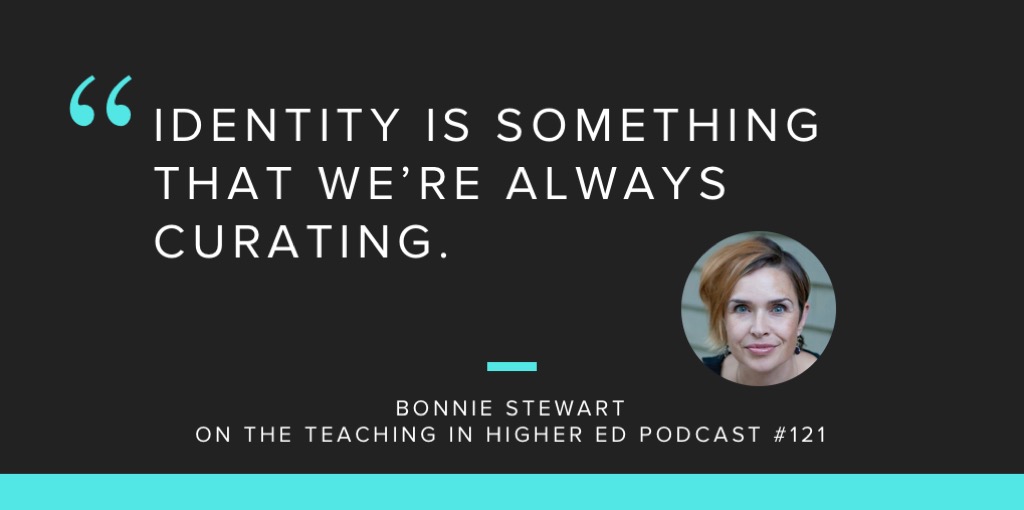
    Identity is something that we’re always curating.
    —Bonnie Stewart

    I realized that I’ve been curating my identity since long before there was the internet … with the things that I save.
    —Bonnie Stewart

    Resources Mentioned

    • Hybrid Pedagogy
    • Digital Pedagogy Lab
    • Networked Pedagogy Graphic on Bonnie’s site

    Get More Meaningful Work Done, with Robert Talbert Sep 29, 2016
    Show notes

    Getting Things Done

    Dr. Robert Talbert talks about how to get more meaningful work done on episode 120 of Teaching in Higher Ed.

    Quotes from the episode

    90% of the emails I get in my inbox are not actionable.
    —Robert Talbert

    The human brain is fantastic for processing information but it’s terrible for storing information.
    —Robert Talbert

    Sometimes the busyness we have is entirely self-inflicted; we work hard because we’re disorganized.
    —Robert Talbert

    Say yes to the things that matter and say no to everything else.
    —Robert Talbert

    Resources

    • Getting Things Done (Updated Edition)* by David Allen
    • Getting Things Done: Five Steps Overview

    The Five Steps

    1. Capture
      • Dave and Bonni talk about capture on episode #32
      • todoist
      • Recommendations from the Last TIHE episode with Robert Talbert
      • Bonni talks about inboxzero on episode #56
      • Capture sticky notes using Evernote
    2. Clarify
      • Dave and Bonni talk about clarify and organize on episode #41
    3. Organize
      • Evernote
    4. Review
      • Google Keep
      • Episode #64: The Weekly Review
      • Episode #78: Checklists
      • Essentialism* by Greg McKeown
    5. Engage
      • Amazon’s Grocery Delivery Service*
      • Amazon Dash
      • OmniFocus

    Bridging the Culture Gap, with Annemarie Perez Sep 22, 2016
    Show notes

    bridging the gap

    Annemarie Perez shares about bridging the culture gap in the classroom and other broad thoughts about cultural competence on episode 119 of Teaching in Higher Ed.

    Resources Mentioned

    • Annemarie’s Teaching Manifesto Blog Post
    • Chicano or Chicana
    • Latino
    • Latina
    • Hispanic
    • The Case for ‘Latinx’: Why Intersectionality is Not a Choice

    Teacher Becomes Student Through LIFE101, with Michael Wesch Sep 15, 2016
    Show notes

    LIFE101

    Mike Wesch describes his becoming a learner and what it taught him about teaching on episode 118 of Teaching in Higher Ed.

    Quotes from the Episode

    I’ve always picked things that are really hard and bring out fears inside me.
    —Mike Wesch

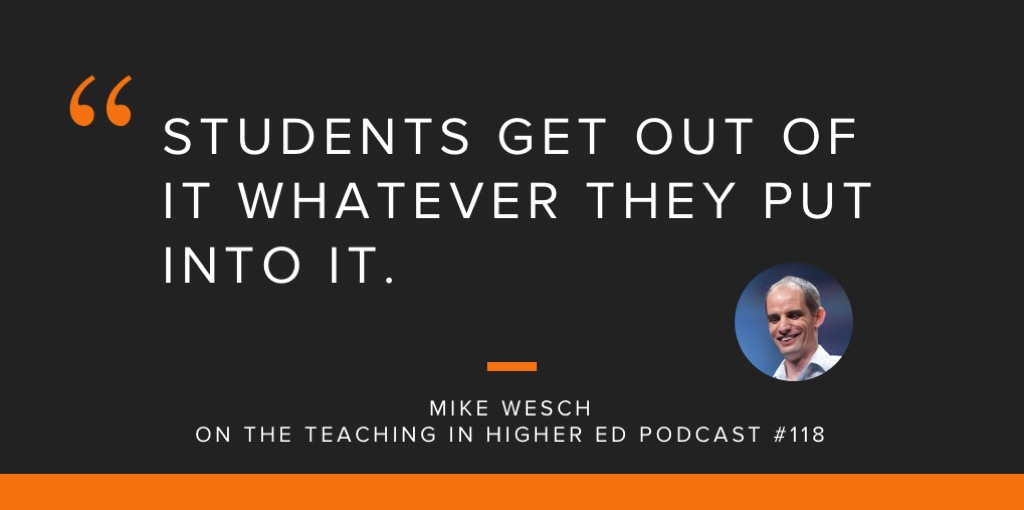
    Students get out of it whatever they put into it.
    —Mike Wesch

    I take the philosophy that grading can play different roles depending on the course.
    —Mike Wesch

    What matters when students graduate is how they’ve changed, not just their GPA.
    —Mike Wesch

    When I started teaching in my late 20s, it was really easy to relate to students. As I was in my late 30s, it was much more difficult.
    —Mike Wesch

    Life is too short to not experiment.
    —Mike Wesch

    Resources Mentioned

    • The Sleeper, by Mike Wesch
    • Rethinking the Syllabus (with a Course Trailer)
    • Links to Presentations and Videos by Mike Wesch
    • Daniel Pink’s Research on Motivation: Drive*
    • LIFE101 Podcast
    • LIFE101: Episode 1
    • What Baby George and Handstands Have Taught Me About Learning
    • Mike Wesch’s YouTube Channel

    The Balancing Act, with Kerry Moore Sep 08, 2016
    Show notes

    Kerry Moore discusses how to balance the responsibilities of caring for an elderly loved one with our teaching responsibilities.

    [divwrap class=”one-half first”]

    caregiving

    Quotes from the episode

    We’re trying to help people grow their own ability to meet needs and to have agency in their own lives.
    —Kerry Moore

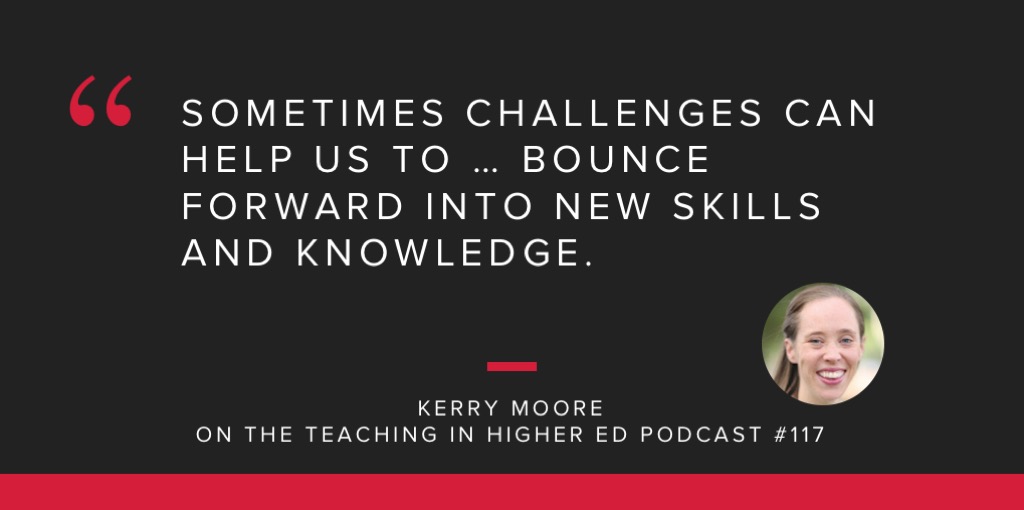
    Sometimes challenges can help us to … bounce forward into new skills and knowledge.
    —Kerry Moore

    Nothing is going to make the loss of someone you love or a disability okay, but the way we walk through it makes a big difference in what our life looks like on the other side.
    —Kerry Moore

    A healthy locus of control has a realistic assessment of the things that I am in control of and also the things that I’m not.
    —Kerry Moore

    Caregiving [has] a lot of physical demands but also a lot of emotional demands.
    —Kerry Moore

    [/divwrap][divwrap class=”one-half”]

    Resources Mentioned

    • Radiolab episode: The Bitter End
    • National Hospice and Palliative Care Organization
    • Council on Aging

    [/divwrap]


    Connected Learning for the Curious, with Laura Gogia Sep 01, 2016
    Show notes

    connected learning

    Laura Gogia shares about connected learning on this week’s Teaching in Higher Ed podcast.

    Quotes from the episode

    The most important part of [connected learning] is helping others understand the connections between all the different aspects of their life.
    —Laura Gogia

    It’s not a tool-first [mentality] … it’s which tool matches up with what I’m trying to achieve.
    —Laura Gogia

    Assessment becomes about documenting [the] process of learning.
    —Laura Gogia

    Resources Mentioned

    • Connected Courses at Virginia Commonwealth University
    • Journal for Prison re-entry
    • Academic Transformation Lab at VCU
    • http://lauragogia.com/connected-course-design/
    • Julian Sefton-Green
    • Connected learning coaching
    • Laura’s dissertation on connected learning

    Bonni mistakenly attributed this Twitter analysis tool to being introduced by Robert Talbert on the TIHE Slack channel, but it was actually Ken Bauer who shared it.

    Are You Enjoying the Show?

    Rate/review the show. Please consider rating or leaving a review for the Teaching in Higher Ed podcast on whatever service you use to listen to it on (iTunes, Stitcher, etc.). It is the best way to help others discover the show.

    Give feedback. As always, I welcome suggestions for future topics or guests.

    Subscribe. If you have yet to subscribe to the weekly update, you can receive a single email each week with the show notes (including all the links we talk about on the episode), as well as an article on either teaching or productivity.


    Previous 1 51 52 53 54 55 65 Next

    Related Podcasts

    Making Sense with Sam Harris

    1

    Making Sense with Sam Harris Education
    Grammar Girl

    2

    Grammar Girl Education
    Good Life Project

    3

    Good Life Project Education
    Explain It to Me

    4

    Explain It to Me Education
    Team Never Quit

    5

    Team Never Quit Comedy
    Optimal Living Daily – Personal Development and Self-Improvement

    6

    Optimal Living Daily – Personal Development and Self-Improvement Alternative Health
    footer-logo

    Contact Us

    Toll Free: 844-670-7747

    Links

    • Home
    • Top Charts
    • Networks
    • Apps
    • Independents Podcasts
    • Podcast Advertising
    • Podcast News
    • Contact Us
    • About Us
    • Analytics & Insights

    Stay Connected

      Privacy, Terms of Use & Our Code of Ethics Protecting Content Creators Copyrights