TopPodcast.com
Menu
  • Home
  • Top Charts
  • Top Networks
  • Top Apps
  • Top Independents
  • Top Podfluencers
  • Top Picks
    • Top Business Podcasts
    • Top True Crime Podcasts
    • Top Finance Podcasts
    • Top Comedy Podcasts
    • Top Music Podcasts
    • Top Womens Podcasts
    • Top Kids Podcasts
    • Top Sports Podcasts
    • Top News Podcasts
    • Top Tech Podcasts
    • Top Crypto Podcasts
    • Top Entrepreneurial Podcasts
    • Top Fantasy Sports Podcasts
    • Top Political Podcasts
    • Top Science Podcasts
    • Top Self Help Podcasts
    • Top Sports Betting Podcasts
    • Top Stocks Podcasts
  • Podcast News
  • About Us
  • Podcast Advertising
  • Contact
Not in our directory?
Add Show Here
Podcast Equipment
Center

toppodcastlogoOur TOPPODCAST Picks

  • Comedy
  • Crypto
  • Sports
  • News
  • Politics
  • True Crime
  • Business
  • Finance

Follow Us

toppodcastlogoStay Connected

    View Top 200 Chart
    Back to Rankings Page
    Education

    Teaching in Higher Ed

    Thank you for checking out the Teaching in Higher Ed podcast. This is the space where we explore the art and science of being more effective at facilitating learning. We also share ways to increase our personal productivity, so we can have more peace in our lives and be even more present for our students.

    Advertise

    Copyright: © Innovate Learning, LLC

    • Apple Podcasts
    • Google Play
    • Spotify

    Latest Episodes:
    Celebrating 75 Episodes, with Dave Stachowiak Nov 19, 2015
    Show notes

    Peter Newbury

    On today’s episode, ten prior guests, as well as Dave and I, come together to celebrate 75 episodes of Teaching in Higher Ed. We look back at episodes that have had a big impact on us, take a listener question, and make recommendations.

    Guests:

    1) Sandie Morgan
    The Eight Second Rule – Wait eight seconds to give students a change to respond
    https://teachinginhighered.com/6

    2) Michelle Miller
    Rebecca Campbell’s – Don’t refer to students as children
    https://teachinginhighered.com/62

    3) Scott Self theproductivenerd.org
    Rebecca Campbell – Normalize help seeking behavior by being transparent with our students
    https://teachinginhighered.com/62
    Mail App add-on: Act-On

    4) Josh Eyler (two coming up both mentioning Cameron Hunt McNabb)
    Cameron Hunt McNabb – How to bring more creative assignments to students
    https://teachinginhighered.com/24

    5) Janine Utell
    Cameron Hunt McNabb – Creative and critical thinking and “backwards design”
    https://teachinginhighered.com/24

    6) Jim Lang
    Amy Collier – Not-yet-ness
    https://teachinginhighered.com/70
    Article in the Chronicle mentioning more of Jim’s recommendations

    7) Doug McKee
    Zero inbox
    https://teachinginhighered.com/56
    The weekly review
    https://teachinginhighered.com/64
    Recommendation: Pinboard for read-it-later service
    Pinboard
    Pinner App*
    Paperback Web App

    8) Jeff Hittenberger
    Appreciates Bonni’s vulnerability about her own teaching, that she’s willing to admit her own mistakes.

    Questions from a Listener:

    Question: When seeking a professorship, how do you stand out from the crowd? Or, how do you find opportunities to the things you love in other career paths?
    Peter Newbury from UCSD, who appeared on Episode 53, answers the question.

    Recommendations:

    Dave recommends:

    Teaching in Higher Ed podcasts:
    Guest: Anissa Ramirez
    https://teachinginhighered.com/66
    Guest: Meg Urey
    https://teachinginhighered.com/69

    Beth Buelow’s podcast:
    The Introvert Entrepreneur Podcast
    Episode 93: Kevin Kruse and The 15 Secrets Successful People Know About Time Management

    Bonni recommends:

    Podcast:
    http://verybadwizards.com/episodes/75

    Books:
    What the Best College Teachers Do by Ken Bain

    Cheating Lessons by James M. Lang


    The public and the private in scholarship and teaching, with Kris Shaffer Nov 12, 2015
    Show notes

    2

    Podcast Notes

    On today’s show, Dr. Kris Shaffer talks about two topics: public scholarship and student privacy.

    Guest: Kris Shaffer

    Website: kris.shaffermusic.com
    Twitter: @krisshaffer
    GitHub: kshaffer

    We don’t have a nice, fuzzy boundary between completely private and completely public like we used to.
    —Kris Shaffer

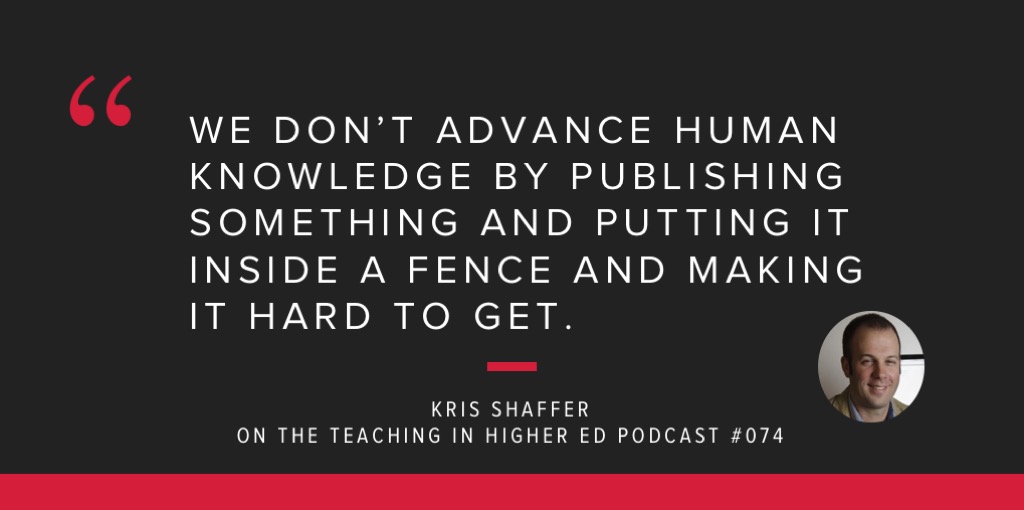
    We don’t advance human knowledge by publishing something and putting it inside a fence and making it hard to get.
    —Kris Shaffer

    Social media is about more than just projecting my identity online; it’s about cultivating a community online.
    —Kris Shaffer

    And by raising a question, sometimes we advance knowledge more than by simply stating a fact.
    —Kris Shaffer

    Links:

    www.openmusictheory.com
    www.hybridpedagogy.com
    Open-source scholarship on Hybrid Pedagogy

    Recommendations:

    Bonni:
    Zotero tutorials: http://universitytalk.org/zotero/
    N. Cifuentes-Goodbody on Twitter: https://twitter.com/doctornerdis

    Kris:
    CitizenFour: A documentary about Edward Snowden, streaming on HBO. Watch trailer here.
    Hello, by Adele: Watch here.


    Team-based learning, with Jim Sibley Nov 05, 2015
    Show notes

    Jim Sibley shares about Team-based Learning.

    Slide1

    Podcast Notes

    Team-based learning has come up a few times on the show previously (Dr. Chrissy Spencer in Episode 25). Today, however, we dive deep into this teaching approach and discover powerful ways to engage students with Dr. Jim Sibley.

    Guest: Jim Sibley

    Jim Sibley is Director of the Centre for Instructional Support at the Faculty of Applied Science at University of British Columbia (UBC) in Vancouver, Canada. As a faculty developer, he has led a 12-year implementation of Team-Based Learning in Engineering and Nursing at UBC with a focus on large classroom facilitation. Jim has over 33 years of experience in faculty support, training, and facilitation, as well as managing software development at UBC. Jim serves on the editorial board of the Journal on Excellence in College Teaching.

    Jim is an active member of the Team-Based Learning Collaborative and has served on its board and many of its sub-committees. He has mentored colleagues in the Team-Based Learning Collaborative’s Train the Trainer mentorship program. He is a co-author of the new book Getting Started with Team-Based Learning that was published by Stylus in July 2014. He is an international team-based learning consultant, having worked at schools in Australia, Korea, Pakistan, Lebanon, United States, and Canada to develop team-based learning programs.

    Jim’s Book: Getting Started With Team-Based Learning

    Jim’s Website: www.learntbl.ca

    More About Jim’s Personal Story:

    • The Stroke
    • Interview with Brainstream
    • Hiccups

    Team-Based Learning Defined

    • A form of small-group learning that gets better with the bigger size of class you have. The idea is to discuss the question until you get to some sort of consensus.
      Team-based learning could easily be called decision-based learning, because as soon as you make a decision, you can get clear and focused feedback. That’s what team-based learning is all about.
    • Think about a jury, where you need brainpower. Then imagine you’re presenting the verdict, and you look around and see five other juries, on the same case as you. You can bet they’ve put a lot of thought into the verdict, and if they all have a different verdict than you, you can bet they’re going to give feedback.
    • Team-based learning is not a prohibition on lecturing…but it’s in smaller amounts, and it’s for a reason like answering a student need or question. An activity will often make students wish they knew about something, then you teach it.

    About Teams

    • The Achilles heel of group work are students at different levels of preparedness. Team discussion has a nice leveling effect.
    • Experience shows that smaller teams are the ones that have the most trouble
    • 5-7 students is the ideal size for a group.
    • Big teams work because you’re asking them to make a decision, and that’s something teams are naturally good at.
    • Because team-based learning is focused on teaching with decisions, there is less opportunity for people to ride on the coattails of others.
    • Instructors don’t have to teach about team dynamics or decision-making processes because teams are naturally motivated to engage in good discussion (if their conclusion is different than every other group, there will naturally be a lot of feedback).

    The Team-Building Process:

    • The instructor builds teams, trying to add diversity to each team.
    • The instructor of a large class can do an online survey for diversity of assets.
    • Even freshman classes can have diversity (different people are better at different subjects).
    • CATME has an online team maker function, as does GRumbler.

    Should students ever elect their own teams?

    • Student-selected teams are typically a disaster, mostly because they’re a social entity, and you tend to pick people that are the same as you.
    • It does work when students are passionate about the project.

    Team-based learning requires commitment:

    • Team-based learning is something you have to commit to, not just something you try on for a day. it’s not a pedagogy that you can sprinkle on top of your lecture course; it’s a total change to the contract between you and your students.
    • It used to be that you were a “sage on the stage” or a “guide on the side.” Team-based learning means you’re a “sage on the side.”
    • Roles change. Everybody is uncomfortable at the beginning; students are in a new role, you’re in a new role.
    • You’ll get some student resistance, but if you commit, student evaluations at the end of the semester will show that students rate team-based learning courses better than conventional ones.
    • Teachers who do commit talk about “joy” and say things like “I’m falling in love with teaching again” and “class is so much fun.”

    When should we use Team-based learning? Any cautions?

    • It works for all disciplines, but if you, as a teacher, are a last-minute person, be cautious with team-based learning. Because you’re making your students uncomfortable, and they’re looking for someone to pin it on, and if you’re disorganized, you’ll become a target.
    • For teachers, it’s a similar amount of work as a traditional course, but because you have to do all the work upfront, it might seem like more.

    Resources

    • teambasedlearning.org
    • Jim’s Site: www.learntbl.ca
    • Jim’s Book: “Getting Started with Team-Based Learning”
    • Use the ERIC database to research your topic
    • Use peer-evaluation tools like those available on CATME

    Recommendations

    • Bonni uses Feedly to subscribe to student blogs. It serves up all new student posts in one place, saving her from having to go to each blog individually. Feedly Pro allows you to gather student blogs, and then students can subscribe to the class collection with one click.
    • Jim recommends an article in the Journal of Excellence in College Teaching by Bill Roberson and Billie Franchini. The article discusses why some teaching activities seem to crash while some seem to soar.

    How to use cognitive psychology to enhance learning, with Robert Bjork Oct 29, 2015
    Show notes

    Robert Bjork on using cognitive psychology to enhance learning.

    tihe73

    PODCAST NOTES

    Guest:

    Dr. Robert Bjork

    • Distinguished Professor of Psychology at UCLA
    • Learning and memory; the science of learning in the practice of teaching.
    • The Bjork Learning and Forgetting Lab

    Common misperceptions

    Belief that we work something like a man made recording device.

    In almost every critical way, we differ from any such device.” – Robert Bjork

    How can it be that we have all these years of learning things and formal education and then end up really not understanding the process? You might just think by sheer trial and error during all of our educational experiences we would come to understand ourselves better than we apparently do.” – Robert Bjork

    We found all these different situations where the very same thing that produces forgetting then enhances learning if the material is re-studied again. Forgetting is a friend of learning.” – Robert Bjork

    tihe-quote1

    The spacing effect

    • Delay in re-studying information

    The environmental context

    • If you study it again, then you’re better off to study it in a different place.
    • This is counter to the advice to study in a single place.

    Retrieval practice

    When you recall something, it does far more to reveal that you did indeed have it in your memory.

    “Using our memories shapes our memory.”- Robert Bjork

    As we use our memories, the things we recall become more recallable. Things in competition with the memories become less recallable.”- Robert Bjork

    tihe-quote2

    We should input less and output more.”- Robert Bjork

    tihe-quote7

    Test yourself; retrieval practice

    Low-stakes or no-stakes testing is key to optimizing learning.”- Robert Bjork

    tihe-quote6

    “When I say they become inaccessible, they are absolutely not gone.”- Robert Bjork

    Interleaving

    “In all those real-world situation where there’s several related tasks or components to be learned, the tendency is to provide instruction in a block test. It seems to make sense to work on one thing at a time.”- Robert Bjork

    “We are finding that interleaving leads to much better long-term retention. It slows the gain in performance during the training process but, then leads to much better long-term performance.”- Robert Bjork

    “Forgetting is not entirely a negative process. There are a number of senses in which forgetting can be a good thing.”- Robert Bjork

    “The very same people who just performed better, substantially, with interleaving, almost uniformly said that blocking helped them learn better.”- Robert Bjork

    Desirable difficulties

    They’re difficulties in the sense that they pose challenges (increased frequency of errors) but they’re desirable in that they foster the very goals of instruction (long-term retention and transfer of knowledge into new situations).

    1. Interleaving vs blocking
    2. Varying the conditions of learning and the examples you provide rather than keeping them constant
    3. Spacing vs massing (cramming)

    “The word desirable is key. There’s a lot of ways to make things difficult that are bad.”- Robert Bjork

    The generation effect

    Any time you can take advantage of what your students already know and give them certain cues so that they produce an answer, rather than you giving them an answer, you greatly enhance their long-term retention.”- Robert Bjork

    tihe-quote5

    Incorporating generation is a desirable difficulty but people have to succeed at the generation. If they fail, it is no longer a desirable difficulty.”- Robert Bjork

    Errors are a key component of effective learning.”- Robert Bjork

    tihe-quote4

    Successful forgetting

    • Memory relies on being in the same situation
    • Present it in a different context, produces longer-term learning
    • Encode the information differently; encoding variability
    • Retrieval is powerful, but depends on success to make it so

    Many things are involved in remembering people’s names.” – Robert Bjork

    Self regulated learning

    The key is for us all to learn how to learn more effectively.”- Robert Bjork

    tihe-quote3

    As a consequence of our complex and rapidly changing world and also changes in technology and educational environments, more and more learning is happening outside any formal classroom setting. It’s in our own hands.”

    • Across a lifetime

    Recommendations

    Bonni recommends:

    GoCognitive’s Robert Bjork videos on YouTube

    Bob recommends:

    Making things hard on yourself, but in a good way: Creating desirable difficulties to enhance learning

    Several books on research on learning

    • Make it stick: the science of successful learning


    • How we learn: The surprising truth about when, where, and why it happens


    • What if everything you knew about education was wrong?


    Closing notes

    1. Rate/review the show. Please consider rating or leaving a review for the Teaching in Higher Ed podcast on whatever service you use to listen to it on (iTunes, Stitcher, etc.). It is the best way to help others discover the show.
    2. Give feedback. As always, I welcome suggestions for future topics or guests.
    3. Subscribe. If you have yet to subscribe to the weekly update, you can receive a single email each week with the show notes (including all the links we talk about on the episode), as well as an article on either teaching or productivity.

    Flipped out, with Derek Bruff Oct 22, 2015
    Show notes

    Derek Bruff gives his unique take on the flipped classroom… what to have the students do before they enter the classroom and what to do once they get there.

    flipped-out

    PODCAST NOTES

    Guest:

    Dr. Derek Bruff

    On Twitter

    His blog

    • Ph.D., Mathematics, Vanderbilt University, 2003
    • Director, Center for Teaching, Vanderbilt University, November 2011 to present
    • Bruff, D. (2015). An indirect journey to indirect impact: From math major to teaching center director. In Rogers, K., & Croxall, B. (Eds.), #Alt-Academy. Online: MediaCommons

    The flipped classroom

    Shin, H. (2015) ‘Flipping the Flipped Classroom: The Beauty of Spontaneous and Instantaneous Close Reading’, The National Teaching & Learning Forum, 24(4), pp. 1–4. doi: 10.1002/ntlf.30027.

    What are the experiences and activities we want to have our students engage in that will help them make sense of this material and have them do something interesting with it?” – Derek Bruff

    tihe71

    Eric Mazur – learning as a 2 stage process

    1. Transfer of information (during class)
    2. Assimilation of that information by the students (outside the classroom)

    A definition

    • A shift in time to that process
    • Class time spent on the assimilation process

    The classic flipped classroom

    • Students encounter the info before class
    • Come to class already having exposure
    • Practice and feedback

    Flipped Classroom resources

    Vanderbilt flipping the classroom

    FlippedClassroom.org

    The Learning process

    If students aren’t doing the pre-work before they come to class, the time together isn’t going to be well-served.” – Derek Bruff

    tihe71-quote4

    Concerns that the flipped classroom is doubling the work for the students.

    First exposure

    Effective Grading, by Barbara Walvoord

    Schwartz, Daniel L. and Bransford, John D.(1998)’A Time For Telling’,Cognition and Instruction,16:4,475 — 522

    Diet coke and Mentos experiment

    https://www.youtube.com/watch?v=iS2vG1o7Op4

    This video is just an example of the Mentos/Diet Coke experiment; it isn’t Derek’s daughter

    Creating times for telling

    Students first need to encounter a problem, or a challenge, or something mysterious… and then that provides motivation to hear the 15 minute [explanation].” – Derek Bruff

    tihe71-quote3

    • Linear algebra course
    • Look at the board game Monopoly. What are the best places to buy on the board?
    • Markov chain modeling

    Classes should do hands-on exercises before reading and video, Stanford researchers say. (2013, July 16). Retrieved 21 October 2015, from http://news.stanford.edu/news/2013/july/flipped-learning-model-071613.html

    Even when you have defaults [in your teaching], you want to have good defaults…” – Derek Bruff

    tihe71-quote2

    Peter Newbury on Teaching in Higher Ed talks about Peer Instruction

    RECOMMENDATIONS

    Bonni recommends:

    • Pictures as a means for reminders

    Derek recommends:

    • The adventures of Babage and Lovelace

    Not yet-ness, with Amy Collier Oct 15, 2015
    Show notes

    Amy Collier joins me to talk about not yet-ness, geekiness, Jazzercise, Stevie Ray Vaughan, teaching, and learning.

    not-yet-ness

    Podcast notes

    Guest: Dr. Amy Collier

    • Amy’s blog
    • Connect with Amy on Twitter

    Amy admits to some shenanigans

    Stevie Ray Vaughan sings Mary Had a Little Lamb

    https://www.youtube.com/watch?v=4cGphy7XeZk

    The great thing about Lego is that it gives kids these tools and they don’t have to be built a certain way.” – Amy Collier

    Vaughn builds Lego with instructions

    https://www.youtube.com/watch?t=1&v=nMohv6GQBHc

    Vaughn builds Lego without instructions

    https://www.youtube.com/watch?v=bRXtAcHIGq4

    Thoughts on education and teaching

    You can work with students to do something related to what you’re talking about in class, but they can find creative ways to do things you might not have predicted.” – Amy Collier

    tihe70-quote5

    …finding out what drives them, keeps them coming back, and helping them find their own voice – that’s what education is about. That’s where I find the most joy.”

    tihe70-quote6

    • Not Yet-Ness
    • Amy’s post on Not Yet-Ness
    • Jen Ross
    • Creating conditions for emergence
    • Living in that not yet-ness…

    When you embrace not yet-ness, you are creating space for things to continue to evolve.” – Amy Collier

    tihe70-quote1

    By not creating space for those things, we end up creating a more mechanistic approach to education, rather than something that feels more human and more responsive to our humanity.” – Amy Collier

    tihe70-quote2

    Multidisciplinary examples

    • Domain of One’s Own
    • They have this flexible interface while also connecting to a community
    • Messiness

    How do we evolve the ways in which we understand what learning is?” – Amy Collier

    tihe70-quote4

    More conversation is needed

    Amy invites us to consider for which students not yet-ness works best and for which students might it cause some kind of disequilibrium that will cause them not to be successful in their educational experience?

    More on not yet-ness

    • Audrey Watters: Privileged Voices in Education
    • Embodiment

    Recommendations

    Bonni recommends:

    Doug McKee’s advice: “Your job is to move them one step along a path. You can do that job no matter where they are when they enter your class.”

    Amy recommends:

    Anne Lammot

    “These are the words I want on my gravestone: that I was a helper, and that I danced.” – Anne Lammot

    We are human and our dance is one of the things that we bring to a human interaction.” – Amy Collier

    tihe70-quote3

    Closing notes

    1. Rate/review the show. Please consider rating or leaving a review for the Teaching in Higher Ed podcast on whatever service you use to listen to it on (iTunes, Stitcher, etc.). It is the best way to help others discover the show.
    2. Give feedback. As always, I welcome suggestions for future topics or guests.
    3. Subscribe. If you have yet to subscribe to the weekly update, you can receive a single email each week with the show notes (including all the links we talk about on the episode), as well as an article on either teaching or productivity.

    Correcting mental models, with Meg Urry Oct 08, 2015
    Show notes

    Meg Urry shares approaches we can use to help our students correct inaccurate mental models and grasp complex information.

    Correcting mental models

    PODCAST NOTES:

    Correcting inaccurate mental models

    • Guest: Dr. Meg Urry
    • Connect with Meg on Twitter

    Interest in science

    At some moment it clicked and I understood what it meant. Not only was that the moment that I started to like physics, but also the moment I realized everybody can learn physics if they get this key that unlocks the door. You don’t want to leave them in the same state that I was in… of wondering why the heck we’re doing this… You want people to get over that hump and suddenly see that this is really simple, straightforward, beautiful, and useful.” – Meg Urry

    tihe69-quote8

    Gender discrimination in the sciences

    “It was very typical for me to be one of the only women in the class and the guys just sort of took over.” – Meg Urry

    “I always assumed that if someone claimed authority about something, that they must, indeed, know about it. It turns out lots of people do that all the time.” – Meg Urry

    “When I entered graduate school in 1977 at John Hopkins university, it had allowed women in as undergraduates only since 1970.” – Meg Urry

    It hasn’t been easy [for women].” – Meg Urry

    tihe69-quote7

    People who feel different than the norm (who feel outside the tribe) have a harder time learning.” – Meg Urry

    tihe69-quote6

    Science faculty’s subtle gender biases favor male students

    Moss-Racusin, C. A., Dovidio, J. F., Brescoll, V. L., Graham, M. J. and Handelsman, J. (2012) ‘Science faculty’s subtle gender biases favor male students’, Proceedings of the National Academy of Sciences, 109(41), p. 16474. doi: 10.1073/pnas.1211286109.
    (Moss-Racusin et al., 2012)

    Despite efforts to recruit and retain more women, a stark gender disparity persists within academic science. Abundant research has demonstrated gender bias in many demographic groups, but has yet to experimentally investigate whether science faculty exhibit a bias against female students that could contribute to the gender disparity in academic science. In a randomized double-blind study (n = 127), science faculty from research-intensive universities rated the application materials of a student—who was randomly assigned either a male or female name—for a laboratory manager position. Faculty participants rated the male applicant as significantly more competent and hireable than the (identical) female applicant. These participants also selected a higher starting salary and offered more career mentoring to the male applicant. The gender of the faculty participants did not affect responses, such that female and male faculty were equally likely to exhibit bias against the female student. Mediation analyses indicated that the female student was less likely to be hired because she was viewed as less competent. We also assessed faculty participants’ preexisting subtle bias against women using a standard instrument and found that preexisting subtle bias against women played a moderating role, such that subtle bias against women was associated with less support for the female student, but was unrelated to reactions to the male student. These results suggest that interventions addressing faculty gender bias might advance the goal of increasing the participation of women in science.”(Moss-Racusin et al., 2012)

    “Both the women and the men made this gender-biased judgment.” – Meg Urry

    Early lessons in teaching

    “I didn’t realize how hard these students were working.” – Meg Urry

    The first year, I did straight lecture intro to physics, but, I realized something was missing.” – Meg Urry

    tihe69-quote5

    • Video of Eric Mazur sharing his teaching approaches
    • Article about Eric Mazur: Twilight of the lecture
    • Mazur Group
    • Making large classes interactive with Dr. Chrissy Spencer

    “You listen to what the groups are saying and you can tell from that what their misperceptions are…” – Meg Urry

    What they need to do is to explain it to someone else, because that is how they will come to understand it better.” – Meg Urry

    tihe69-quote4

    Learning catalytics

    More ways to teach complexity

    They’re not going to get there by you talking at them. It just doesn’t work.” – Meg Urry

    tihe69-quote3

    Real learning takes time. We often don’t allow students the time they need to get there.” – Meg Urry

    tihe69-quote2

    “You can only get them to understand stuff when they have had to think about it and reject some possible alternatives.” – Meg Urry

    • Bonni’s blog about showing the “not” in the learning

    Trying to tell students things, before they were in a state to listen.

    “You have to make them care about what you’re saying before you say it, or they’re not going to hear you.” – Meg Urry

    That moment when they don’t know what to do is a perfect teaching moment.” – Meg Urry

    tihe69-quote1

    Tool: How to solve problems

    Meg’s prescriptive checklist for solving problems

    • Always share a picture of what you’re trying to solve.
    • Figure out the principle of what you’re trying to solve.
    • Etc.

    RECOMMENDATIONS

    Bonni recommends:

    • David Wilcox’s: Leave it like it is

    IMG_0118

    Meg recommends:

    • The Only Woman in the Room

    “This book is a gift to any person who is a minority in science.”

    Closing notes

    1. Rate/review the show. Please consider rating or leaving a review for the Teaching in Higher Ed podcast on whatever service you use to listen to it on (iTunes, Stitcher, etc.). It is the best way to help others discover the show.
    2. Give feedback. As always, I welcome suggestions for future topics or guests.
    3. Subscribe. If you have yet to subscribe to the weekly update, you can receive a single email each week with the show notes (including all the links we talk about on the episode), as well as an article on either teaching or productivity.

    Grading exams with integrity, with Dave Stachowiak Oct 01, 2015
    Show notes

    Bonni and Dave Stachowiak share about ways to reduce the potential for introducing bias while grading exams.

    PODCAST NOTES

    Grading exams with Integrity

    In today’s episode, Dave Stachowiak and I share about ways to reduce the potential for introducing bias while grading exams.

    Risks of bias in grading exams

    • Halo effect
    • Exam-based halo effect
    • Inflating favorite students’ grades
    • Vikram David Amar calls “expectations effect”
    • Exhaustion factor

    Techniques to reduce potential bias

    • Blind grading (sticky notes, LMS-based, etc.)
    • Grade by question, not exam
    • Inner-rater reliability practices
    • Block time for grading during peak energy hours
    • Be transparent and over-communicate your practices and rationale
    • *** Re-grade the earlier exams, to avoid what Dave spoke about…

    Recommendations

    Bonni recommends:

    Asking your students what they want to listen to before class

    Coming Home, by Leon Bridges

    Dave recommends:

    Coaching for Leaders episode #211: How to be productive and present

    Closing notes

    1. Rate/review the show. Please consider rating or leaving a review for the Teaching in Higher Ed podcast on whatever service you use to listen to it on (iTunes, Stitcher, etc.). It is the best way to help others discover the show.
    2. Give feedback. As always, I welcome suggestions for future topics or guests.
    3. Subscribe. If you have yet to subscribe to the weekly update, you can receive a single email each week with the show notes (including all the links we talk about on the episode), as well as an article on either teaching or productivity.

    Personal knowledge management revisited, with Dave Stachowiak Sep 24, 2015
    Show notes

    Bonni and Dave Stachowiak revisit the topic of personal knowledge management and discuss how our processes have evolved.

    Personal knowledge management

    Podcast notes

    Personal knowledge management revisited

    James Lang’s article in The Chronicle about Teaching in Higher Ed

    Harold Jarche

    PKM is a set of processes, individually constructed, to help each of us make sense of our world, work more effectively, and contribute to society. PKM means taking control of your professional development, and staying connected in the network era, whether you are an employee, self-employed, or between jobs.

    Seek

    • Twitter
    • Peter Newbury on episode #053
    • Still Feedly and Newsify

    Sense

    • Pinboard
    • Newsify to Pinboard
      Email to Pinboard
    • PushPin app
    • Evernote lists (list of potential podcast guests, blog topics, conferences, journals)
    • Getting real about Pocket
    • Instapaper

    Share

    • BufferApp
    • Canva
    • Deposit photos
    • Copyright video

    Recommendations

    Bonni recommends:

    • Mid-exam stretch break

    Dave recommends:

    • TimeTrade

    Closing notes

    1. Rate/review the show. Please consider rating or leaving a review for the Teaching in Higher Ed podcast on whatever service you use to listen to it on (iTunes, Stitcher, etc.). It is the best way to help others discover the show.
    2. Give feedback. As always, I welcome suggestions for future topics or guests.
    3. Subscribe. If you have yet to subscribe to the weekly update, you can receive a single email each week with the show notes (including all the links we talk about on the episode), as well as an article on either teaching or productivity.

    Making challenging subjects fun, with Ainissa Ramirez Sep 17, 2015
    Show notes

    Ainissa Ramirez shares about how and why to make challenging subjects fun.

    Making challenging subjects fun

    Guest: Dr. Ainissa Ramirez

    http://www.ainissaramirez.com/bio.html

    https://youtu.be/H5TNkGC4p3Q

    “I learned that this thing of investigating and being curious around the world was the thing that people called science.” -Ainissa Ramirez

    tihe66-quote8

    Early influences

    • The television show 321 contact

    https://youtu.be/-4273oOYy7s

    “By seeing my reflection in this young [African American] lady on television doing science, it gave me permission to say, ‘maybe I should be doing this.’”. -Ainissa Ramirez

    tihe66-quote1

    • Teachers as a big influence

    Making learning fun

    “When it comes to teaching, I try to come across as approachable.” – Ainissa Ramirez

    “I don’t think I have the luxury to come off as extremely heady, because there’s so much stuff that’s going to prevent communication from [happening].” – Ainissa Ramirez

    tihe66-quote2

    Service-oriented teaching approach

    “I feel like it’s my job to get you there. I can’t get you there completely, but I can at least figure out where the gaps are and tell you where to head.” – Ainissa Ramirez

    tihe66-quote3

    More approaches for making learning fun

    • The importance of a hook
    • Experimentation vs memorization
    • Failure as data collection

    “If we think of failures as data collection, they lose their sting.” – Ainissa Ramirez

    tihe66-quote4

    Materials research society

    DemoWorks (a cook book for materials science experimentation with items you can buy at a local hardware store)

    “It’s the messy stuff where you learn.” – Ainissa Ramirez

    tihe66-quot5

    A call to get musicians involved in the call to make science fun

    Adventures in giving a TED talk

    Ainissa’s TED talk

    STEM education advocate via TED blog

    “It’s vulnerability that people really resonate with… If you’re willing to be vulnerable, it is a position of power, because you’ll connect with many more people.” – Ainissa Ramirez

    tihe66-quote6

    Great videos of Ainissa in action, getting people excited about science

    Gina Barnett – Play the Part: Master Body Signals to Connect and Communicate for Business Success (helps you get out of your way)


    Importance of having passion in our teaching

    “Get back in touch with that thing that made you excited and then share that with other people. Be a beacon for that.” – Ainissa Ramirez

    tihe66-quote7

    Recommendations:

    Bonni recommends:

    Making invitations to learn (my experimentation with extending Remind this semester)…

    Ainissa recommends:

    Learn from Einstein – “If you can’t explain it to your Grandmother, you don’t understand it.”


    Previous 1 56 57 58 59 60 65 Next

    Related Podcasts

    Making Sense with Sam Harris

    1

    Making Sense with Sam Harris Education
    Grammar Girl

    2

    Grammar Girl Education
    Good Life Project

    3

    Good Life Project Education
    Explain It to Me

    4

    Explain It to Me Education
    Team Never Quit

    5

    Team Never Quit Comedy
    Optimal Living Daily – Personal Development and Self-Improvement

    6

    Optimal Living Daily – Personal Development and Self-Improvement Alternative Health
    footer-logo

    Contact Us

    Toll Free: 844-670-7747

    Links

    • Home
    • Top Charts
    • Networks
    • Apps
    • Independents Podcasts
    • Podcast Advertising
    • Podcast News
    • Contact Us
    • About Us
    • Analytics & Insights

    Stay Connected

      Privacy, Terms of Use & Our Code of Ethics Protecting Content Creators Copyrights