TopPodcast.com
Menu
  • Home
  • Top Charts
  • Top Networks
  • Top Apps
  • Top Independents
  • Top Podfluencers
  • Top Picks
    • Top Business Podcasts
    • Top True Crime Podcasts
    • Top Finance Podcasts
    • Top Comedy Podcasts
    • Top Music Podcasts
    • Top Womens Podcasts
    • Top Kids Podcasts
    • Top Sports Podcasts
    • Top News Podcasts
    • Top Tech Podcasts
    • Top Crypto Podcasts
    • Top Entrepreneurial Podcasts
    • Top Fantasy Sports Podcasts
    • Top Political Podcasts
    • Top Science Podcasts
    • Top Self Help Podcasts
    • Top Sports Betting Podcasts
    • Top Stocks Podcasts
  • Podcast News
  • About Us
  • Podcast Advertising
  • Contact
Not in our directory?
Add Show Here
Podcast Equipment
Center

toppodcastlogoOur TOPPODCAST Picks

  • Comedy
  • Crypto
  • Sports
  • News
  • Politics
  • True Crime
  • Business
  • Finance

Follow Us

toppodcastlogoStay Connected

    View Top 200 Chart
    Back to Rankings Page
    Technology

    StorageReview.com

    StorageReview.com is a leading provider of news and reviews throughout the entire IT stack – from the datacenter to the edge, and all points in between.

    Advertise
    • Apple Podcasts
    • Google Play
    • Spotify

    Latest Episodes:
    Lenovo ThinkPad P1 Gen 9 Review: Panther Lake and a 50W RTX PRO 2000 in the Thin ThinkPad Flagship Oct 26, 2026
    Show notes

    The Lenovo ThinkPad P1 Gen 9 is Lenovo’s thin flagship mobile workstation. This 16-inch machine carries the premium features the rest of the ThinkPad P line trims to meet weight and price targets. It’s an aluminum chassis that measures 9.87mm at the front edge and weighs under 1.8kg, a 90Wh battery with 140W charging, two Thunderbolt 5 ports, dual M.2 slots with a Gen5 x4 bay, and a choice of an 800-nit 3840×2400 IPS panel or a 120Hz Tandem OLED. Our review unit pairs the Core Ultra 9 386H with 64GB of LPDDR5X-8533 on an LPCAMM2 module, a 2TB SK hynix Gen5 SSD, the RTX PRO 2000 Blackwell, and the 4K IPS display. Lenovo.com lists the same build with the OLED panel at $7,719 as of October 24, 2026, and sold it for $5,399 two days earlier; Lenovo discounts the P line often enough that the sale price is the better basis for judging it, and we use it in the conclusion. The site does not list the 4K IPS panel with this processor and GPU, and the closest IPS build, the Core Ultra 7 356H with the RTX PRO 2000, 32GB, and 1TB, is $5,099 after selling for $3,449 on October 22, with build-your-own configurations opening at $3,734 with 16GB and 512GB. Lenovo targets creative professionals, engineers, and AI developers who want ISV-certified graphics without a P16-class chassis. The Gen 9 is a silicon update in the same body as Gen 8: Intel’s Core Ultra Series 3 with a 50 TOPS NPU replaces Series 2, LPCAMM2 memory climbs from 64GB to 96GB, and the GPU ceiling stays at the RTX PRO 2000 Blackwell with 8GB of GDDR7. We tested it with the same scripted suite used for the Dell Pro Precision 9 T2 and the RTX Spark notebooks. We then compared its results against the Dell Pro Max 14 Premium, equipped with the previous-generation Core Ultra 9 285H and the same RTX PRO 2000; the Dell Pro Precision 5 16S, with the Core Ultra X9 388H and no discrete GPU; and the HP OmniBook Ultra 16, powered by NVIDIA’s RTX Spark N1X. Panther Lake earns its place on multi-threaded work. The P1 scored 5,083 in Cinebench 2026 multi-core against 4,292 on the 285H, built LLVM in 309.1 seconds against 393.9, and read 81,712MB/s in STREAM Triad against 62,255, while its single-core Cinebench score of 519.9 sits 7 percent ahead and Speedometer is a wash at 40.6 against 41.5. On the GPU, the P1’s 50W RTX PRO 2000 ran 19 to 27 percent faster than the Dell’s 47W card on MLPerf Client token rates, and the 8GB of GDDR7 kept our 20B-and-up model tiers, and every serving tier above 3B, out of reach. Key Takeaways Multi-threaded CPU work moves a generation ahead: 5,083 in Cinebench 2026 multi-core, 18 percent ahead of the Core Ultra 9 285H with the same GPU, 109.2 GIPS in 7-Zip against 93.4, Blender up 18 to 23 percent across three scenes, and an LLVM build that takes 22 percent less time at 309.1 seconds. Single-thread and browser work did not move: Cinebench single-core is 519.9 against 486.0, Speedometer 40.6 against 41.5, and single-threaded Python is within 2 to 5 percent of the 285H in either direction; the 386H gives up 3 percent in single-core to the 5.1GHz Core Ultra X9 388H in the Dell Pro Precision 5 16S. The memory system is the quiet upgrade: STREAM Triad reads 81,712MB/s from LPDDR5X-8533 against 62,255 on the 285H, memory latency drops from 173.1 to 116.1 ns, and DGEMM climbs from 391 to 519 GFLOPS. 8GB of GDDR7 sets the AI ceiling: MLPerf Client generates Llama 3.1 8B at 64.8 tokens per second and Phi-4-mini at 111.9, ahead of both the Dell’s 47W RTX PRO 2000 and the RTX Spark N1X on the small models, but the 20B and larger tiers in our model-load and coding-agent tests, and the serving tiers above 3B, did not qualify; the 128GB N1X notebook and the 64GB Arc Pro B390 Dell ran every model-load and coding-agent tier. The price makes the market confusing: At $7,719 list, the OLED version of our build costs more than the 128GB HP OmniBook Ultra 16 at $6,229.99; at the $5,399 sale price Lenovo ran on October 22, it falls between that machine and the 64GB OmniBook at $4,999.99. The 128GB unit ran every local AI tier the P1 could not, and Ryzen AI Max unified-memory workstations land in the same bracket. The P1’s case is ISV certification, Thunderbolt 5, and the fastest small-model GPU in the group, not local AI capacity. Cool enough to hold its score: the 30-minute Cinebench loop settled at 4,811, 0.983 of its first pass at a 3,505MHz mean clock, with the CPU pinned at 94.1C; the 2TB PCB01 reads 10,012MB/s sequentially and peaks at 756.5K IOPS on 4K random reads. Where the P1 Gen 9 Sits Lenovo announced the P1 Gen 9 in March alongside the ThinkPad P14s Gen 7 and the P16s Gen 5, with June availability, and calls it the most capable ThinkPad it has built, the thin flagship of the P series. The P16s Gen 5 offers the same Core Ultra Series 3 processors, the same 96GB LPCAMM2 ceiling, and the same RTX PRO 2000 option, so the GPU is no longer what separates the two; the P1 earns its premium with the chassis and what Lenovo fits into it. Against the P16s, it carries a 90Wh battery in place of 60Wh, a 140W adapter in place of 100W, two Thunderbolt 5 ports and a Thunderbolt 4 in place of two Thunderbolt 4, dual M.2 slots in place of one, an SD Express 7.0 reader, optional 5G, an all-aluminum shell, and the two premium panels, all at 1.77kg against the P16s at 1.79kg. Above it, the ThinkPad P16 Gen 3 remains the full-power 16-inch with HX silicon and up to the RTX PRO 5000, and the ThinkPad P16v Gen 3 is the value 16 with the 285H and the same RTX PRO 2000 at 2.1kg; neither has moved to Series 3 yet. The P1’s top GPU is the RTX PRO 2000, with the RTX PRO 1000 below it, unchanged from Gen 8, and the discrete GPU decides the processor: Lenovo does not pair the dGPU with the Arc Pro B390 integrated graphics, so RTX PRO 2000 configurations ship with the Core Ultra 7 356H or Core Ultra 9 386H, which offer the four-Xe-core integrated GPU and top out at 4.9GHz, while the Core Ultra X7 368H and X9 388H with the 12-Xe-core B390 and 5.1GHz are integrated-only builds. That is why the Dell Pro Precision 5 16S with the X9 388H and B390 is in this comparison: it is the other way to configure a Panther Lake workstation, and together they show what the RTX PRO 2000 buys and what the faster CPU gives back. Generation over generation, the Gen 9 is the Gen 8 chassis with new silicon. The footprint is 354.4 x 241.2mm vs 354.3 x 241.0; the port set, three display options, and two GPU options are unchanged, and the weight drops from 1.84 to 1.77kg. The change is from Series 2 Arrow Lake-H with a 13 TOPS NPU and LPDDR5X-7467 up to 64GB to Series 3 Panther Lake with a 50 TOPS NPU and LPCAMM2 up to 96GB. Lenovo lists the memory at 8533 MT/s; our unit uses a 9600-rated module running at 8533. Build and Design The P1 Gen 9 is an aluminum clamshell measuring 354.4 x 241.2mm, with 9.87mm at the front edge, 15.8mm at the rear, and a 20.6mm maximum at the feet; Lenovo lists it at 1.77kg. The lid and base are both aluminum; Lenovo reports the top cover is 75 percent recycled aluminum and the bottom 55 percent, and the machine carries MIL-STD-810H testing like the rest of the P line. Our unit is the black finish, which is the only color. The display is a 16-inch 3840×2400 IPS panel with 800 nits, a 16:10 anti-glare screen, 100 percent DCI-P3 coverage, DisplayHDR 400, Dolby Vision, and X-Rite factory calibration at 60Hz. Lenovo also offers a 1920×1200 500-nit IPS panel on the entry builds and a 3200×2000 Tandem OLED touch panel with pen support, 600 nits SDR and 1,500 nits HDR peak, and a 40 to 120Hz variable refresh rate. The IPS panel on our unit is what most buyers in this segment choose for color work, and at this resolution, Windows defaults to 250 percent scaling. The keyboard is a six-row ThinkPad layout with a Copilot key, backlighting, and spill resistance, with the TrackPoint and a glass haptic touchpad (85 x 135mm) below it. The power button carries the match-on-chip fingerprint reader, and the 5MP camera above the display pairs an IR sensor for Windows Hello with a physical privacy shutter and computer-vision presence detection. The Wi-Fi model has a pair of 2W speakers with Dolby Atmos; the WWAN model adds a second pair of 1W drivers. Ports run along both sides, with two Thunderbolt 5 ports with DisplayPort 2.1 and 140W power input, an HDMI 2.1 port, and an audio jack on the left. The right side carries the Thunderbolt 4 port, which Lenovo builds as a replaceable module, the 10Gbps USB-A port with always-on charging, the SD Express 7.0 reader, the Kensington Nano slot, and the Nano-SIM tray on 5G models. There is no onboard Ethernet; Lenovo bundles a USB-C to 2.5GbE adapter in some configurations and lists it as an option in others. The three USB-C ports can drive three external displays at up to 5120×3200 each, or a single 8K60 panel. The bottom cover comes off for service and carries tamper detection in the BIOS. The LPCAMM2 memory module is customer-replaceable up to 96GB, the two M.2 2280 slots are one Gen5 x4 and one Gen4 x4 with RAID 0 and 1 support, and the 90Wh battery is customer-replaceable with rapid charge to 80 percent in an hour from the 140W USB-C GaN adapter. The 5G module occupies the Gen4 slot on WWAN builds, so a two-drive configuration and 5G are exclusive. Lenovo ThinkPad P1 Gen 9 Specifications Specification Lenovo ThinkPad P1 Gen 9 (21UE000XUS as tested) Platform Processor Intel Core Ultra 9 386H (Series 3), 16 cores / 16 threads (4P + 8E + 4LPE), P-core 2.1 to 4.9GHz, 18MB Intel Smart Cache, Intel vPro EnterpriseOptions: Core Ultra 7 356H, Core Ultra 7 366H, Core Ultra X7 368H, Core Ultra X9 388H (X-series with Arc Pro B390, integrated graphics only) NPU Intel NPU, up to 50 TOPS Memory 64GB LPDDR5X-8533 on one LPCAMM2 module (dual-channel), customer replaceable; 16GB, 32GB, 64GB, or 96GB Graphics NVIDIA RTX PRO 2000 Blackwell Generation Laptop GPU, 8GB GDDR7, 50W TGP as configuredOptions: RTX PRO 1000 Blackwell 8GB; Intel Arc Pro B390 integrated (X-series CPUs) Storage 2TB SK hynix PCB01 (HFS002TFM9X179N), M.2 2280 PCIe 5.0 x4, Opal 2.0Slots: one M.2 2280 PCIe 5.0 x4, one M.2 2280 PCIe 4.0 x4; up to 8TB (2 x 4TB); RAID 0/1 Display Panel as tested 16-inch WQUXGA (3840×2400) IPS, 800 nits, 100% DCI-P3, 60Hz, 1500:1, anti-glare, DisplayHDR 400, Dolby Vision, X-Rite factory calibration Panel options 16-inch WUXGA (1920×1200) IPS, 500 nits, 100% sRGB, 60Hz16-inch 3.2K (3200×2000) Tandem OLED touch, 600 nits SDR / 1,500 nits HDR, 100% DCI-P3, 40 to 120Hz VRR, pen support Connectivity Ports 2 x Thunderbolt 5 (USB PD 3.1, DisplayPort 2.1, 140W in / 15W out)1 x Thunderbolt 4 (modular)1 x USB-A 10Gbps, always on1 x HDMI 2.1 (8K60)1 x SD Express 7.01 x 3.5mm headphone / microphoneKensington Nano slot Wireless Intel Wi-Fi 7 BE211 2×2 with Bluetooth 5.4 (6.0 hardware ready), vProOptional Snapdragon X61 5G sub-6 with eSIM (uses the Gen4 M.2 slot); optional NFC Ethernet None onboard; Lenovo USB-C to 2.5GbE adapter Camera and audio 5MP RGB + IR with privacy shutter and presence detection; dual far-field microphones, Dolby Voice; 2 x 2W speakers, Dolby Atmos (quad speakers on WWAN models) Physical Battery and power 90Wh, customer replaceable, Rapid Charge to 80% in one hour; 140W USB-C GaN adapter, PD 3.1 Dimensions 354.4 x 241.2 x 9.87 / 15.8mm (front / rear), 20.6mm maximum Weight From 1.77kg (3.90 lbs) Security Discrete TPM 2.0, match-on-chip fingerprint reader in the power button, self-healing BIOS, bottom cover tamper detection, IR camera for Windows Hello Certifications MIL-STD-810H; ISV certification for Altair, AVID, Autodesk, ANSYS, Barco, Bentley, Dassault, Esri, Nemetschek, PTC, Siemens; EPEAT Gold, ENERGY STAR 9.0, TCO 10 Operating system Windows 11 Pro (tested); Windows 11 Home, Ubuntu, Fedora, Red Hat Enterprise Linux 10.2 certified Price $7,719 on lenovo.com for the matching configuration with the Tandem OLED panel (21UE0014US) as of October 24, 2026, $5,399 on sale earlier the same week; from $3,734 for the build-your-own Core Ultra 7 356H with the RTX PRO 2000, 16GB, 512GB, and the WUXGA panel Test Setup and Methodology Our review unit pairs the Core Ultra 9 386H with the RTX PRO 2000 Blackwell, 64GB of LPDDR5X-8533 memory, and a 2TB Gen5 SSD running Windows 11 Pro 25H2. We ran the benchmarks while plugged in, with Windows set to Best performance and Lenovo’s Ultra Performance mode enabled. Battery life will follow in a later update. Results come from full and Peak-profile runs of sr-client, our scripted client benchmark suite. We used version 1.3 on the P1 and Dell Pro Max 14 and version 1.2 on the Pro Precision 5 16S and OmniBook. Version 1.3 is a maintenance release that corrects run conditions without changing any tests. Each system ran its factory Windows image with the OEM’s drivers and utilities, and the P1 ran NVIDIA driver 597.16. The suite applies the same settings everywhere: Windows power mode at Best performance, display at 50 percent brightness, all sleep and display timers off, Windows Firewall and UAC prompts off, and VBS and Memory Integrity left on as shipped. Each result is the median of repeated passes, and the suite reruns a test if its spread exceeds 2 percent before accepting it. The Dell Pro Max 14 Premium is the previous Intel generation with the same RTX PRO 2000, so the two together isolate the CPU platform; the Dell runs its card at 47W against Lenovo’s 50W, which is the only hardware difference on the GPU side. The Dell Pro Precision 5 16S is the same Panther Lake generation in a 16-inch workstation with the Core Ultra X9 388H and the Arc Pro B390 integrated graphics and no discrete GPU, and the HP OmniBook Ultra 16 is NVIDIA’s RTX Spark N1X with 128GB of unified memory, the system that currently leads our local AI tests among notebooks. Configuration CPU Memory GPU Boot drive OS and power mode Lenovo ThinkPad P1 Gen 9 (21UE000XUS) Intel Core Ultra 9 386H, 16C / 16T (4P + 8E + 4LPE) 64GB LPDDR5X-8533 LPCAMM2 NVIDIA RTX PRO 2000 Blackwell Laptop GPU, 8GB GDDR7, 50W SK hynix PCB01 2TB (HFS002TFM9X179N), Gen5 x4 Windows 11 Pro 25H2 (x64), Lenovo Ultra Performance, Best performance Dell Pro Max 14 Premium (MA14250) Intel Core Ultra 9 285H, 16C / 16T (6P + 8E + 2LPE) 64GB LPDDR5X-8400 NVIDIA RTX PRO 2000 Blackwell Laptop GPU, 8GB GDDR7, 47W SK hynix PC811 2TB Windows 11 Pro 25H2 (x64), Dell Optimizer Ultra Performance Dell Pro Precision 5 16S (PW516260) Intel Core Ultra X9 388H, 16C / 16T (4P + 8E + 4LPE) 64GB LPDDR5X-8533 LPCAMM2 Intel Arc Pro B390 (integrated, 12 Xe cores) SK hynix PCB01 1TB, Gen5 x4 Windows 11 Pro 25H2 (x64), Dell Optimizer Ultra Performance HP OmniBook Ultra 16 (16-bk0xxx) NVIDIA RTX Spark N1X, 20C / 20T (Arm) 128GB LPDDR5X-9400 (64/64 split) 6,144-core Blackwell RTX (integrated, 62.5GB usable) Sandisk PC SN8050S 2TB, Gen5 x4 Windows 11 Pro 26H1 (Arm64), HP Performance Two labels recur in the tables: N/A means a test does not apply to the hardware, such as the Cinebench SMT single-core test on chips without SMT, and Not run means a test did not execute, either because the hardware does not qualify (our model-load, coding-agent, and larger serving and image tiers need at least 16GB of GPU-usable memory, and both RTX PRO 2000 machines measure 7.7GB) or, for the NVENC encode on the two RTX PRO 2000 systems, because the driver refused to start it. A handful of fio cells kept a spread above 2 percent after a rerun and are reported as measured. The P1 exposed CPU temperatures to the suite, and neither Dell did, so the thermal section reports the P1 and the OmniBook with mean clocks for all four. The P1’s main run was completed with Smart App Control on, and we reran its GROMACS and LLM serving tests with it off after it blocked those two binaries; the comparison systems ran with it off. Local AI Performance The RTX PRO 2000’s 8GB of GDDR7 is the main factor in this section. On the small models that fit, the P1 is the fastest system in the group, ahead of the same GPU at 47W in the Dell and ahead of the RTX…

    Full show notes at the publisher

    Cisco IQ Goes GA for Partners With an MCP Server, Model Foundry, and a Quantum-Resilient Wi-Fi 7 AP Oct 26, 2026
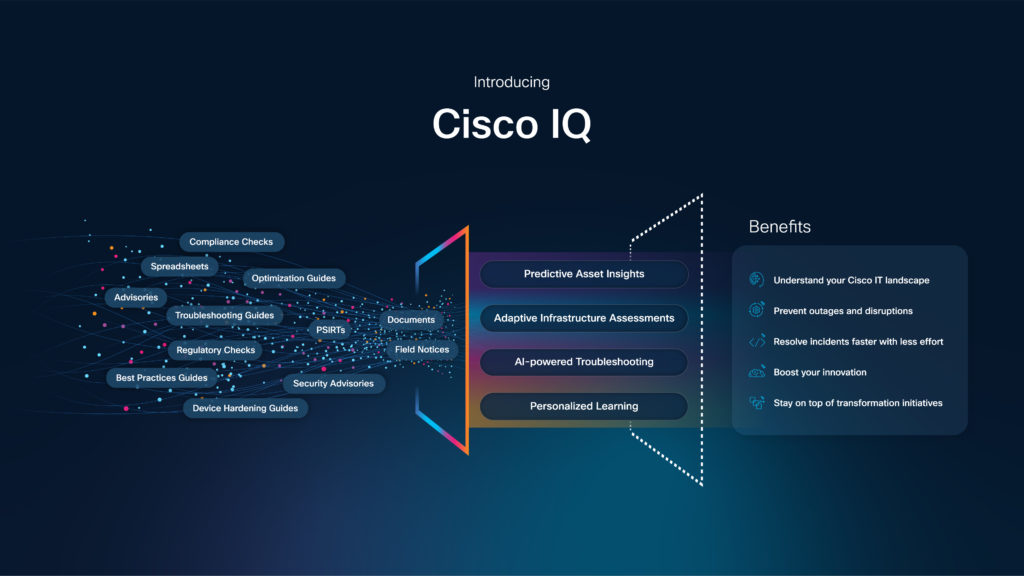
    Show notes Cisco IQ diagram showing advisories, troubleshooting guides, and field notices feeding predictive asset insights, infrastructure assessments, AI-powered troubleshooting, and personalized learning Cisco IQ diagram showing advisories, troubleshooting guides, and field notices feeding predictive asset insights, infrastructure assessments, AI-powered troubleshooting, and personalized learning

    Cisco today made Cisco IQ generally available to partners at Cisco Partner Summit in Vancouver, opening the support platform’s telemetry and automation to partner workflows through a Cisco IQ MCP Server, expanded API access, and role-based access control that lets a customer grant its partner direct visibility into its installed base. Cisco says the platform has onboarded more than 16,000 customers and 19 million devices since April. The same announcement adds AgenticOps tooling to Cisco Cloud Control, a quantum-resilient Wi-Fi 7 access point, a wider Live Protect footprint, and a revised partner program with higher incentive rates.

    Cisco IQ diagram showing advisories, troubleshooting guides, and field notices feeding predictive asset insights, infrastructure assessments, AI-powered troubleshooting, and personalized learning

    “Our partners are where Cisco meets the customer, and the AI era is asking more of all of us,” said Tim Coogan, SVP, Global Partner Sales, Cisco. “Customers need partners with the agility to move first and fast. By combining the strength of the Cisco 360 Partner Program with Cisco IQ and Cisco Cloud Control, we’re giving every type of partner new ways to deliver that and be rewarded for it, from the advisor who shapes a decision to the partner who delivers and supports it.”

    AgenticOps, Model Foundry, and Native ThousandEyes Telemetry

    Cloud Control, the console Cisco introduced in June as one login for human operators and AI agents, picks up tooling built for automated administration. Model Foundry is a new Cloud Control platform service for discovering, evaluating, fine-tuning, and running Cisco’s purpose-built models on a customer’s data, and it is the exclusive home of Cisco’s newest model versions and weights before broader release. It enters Controlled Availability with partners first, and launches with Deep Network 1.4 for network investigation and root-cause analysis, Antares-3B for vulnerability localization, Decision Model 1.0 as a tool-selection layer for network agents, and Cisco Time Series Model 1.0 for observability data.

    Partners work through tenant-scoped API keys with per-model access controls and usage visibility by model, key, and day, and the fine-tuning pipeline, GPUs included, runs base and tuned models side by side for evaluation. Cisco is also introducing MCP servers for its networking platforms, a standardized bridge that lets AI tools read live network data without the custom connectors partners would otherwise build and maintain for troubleshooting and reporting workflows.

    ThousandEyes now runs natively on Cisco Wi-Fi 6E and Wi-Fi 7 access points, included with eligible Cisco Networking Essentials and Advantage licenses with nothing extra to buy, deploy, or configure. The always-on agent runs automated background testing to validate application and network performance around the clock, even when no users are online.

    For operational access, Cisco is developing Cisco Privileged Infrastructure Access with Teleport, which gives network teams and AI agents task-specific access to Cisco routers and switches through short-lived, identity-bound certificates; sessions are recorded, privilege expires when the session ends, and customers on Cisco ISE and TACACS+ can reuse the policy and device context they already manage.

    Quantum-Resilient Wi-Fi 7 Hardware and Live Protect Platform Expansion

    The hardware piece is the Cisco Wireless CW9176ISEC, which Cisco calls the industry’s first Wi-Fi 7 access point with quantum-resilient capabilities. It builds on the CW9176I with security aligned to CNSA 2.0, the NSA’s quantum-resistant algorithm suite that new national security system deployments must meet from January 1, 2027.

    Post-quantum cryptography over the air arrives in January across Cisco’s Wi-Fi 7 access point portfolio on Qualcomm Technologies silicon, with the complete client-side path supported by an Intel Wi-Fi chipset and driver on Windows, so Intel-based Windows machines are the first clients that can use it. Cisco Wireless 9800 Series controllers and Campus Gateways get the same quantum-resilient refresh in January.

    Live Protect, the runtime mitigation that narrows the gap between a vulnerability disclosure and a completed patch on supported platforms, widens its footprint. It now covers N9000 Series Switches, N9300 Smart Switches, Catalyst SD-WAN, C9000 Series Smart Switches, and CW9800 Wireless Controllers, with Cisco 8000 Secure Routers and Cisco Firewalls intended to follow by the end of 2026. When Cisco introduced Live Protect in June, the supported list was the N9000 alone, with campus switches and secure routers promised for later in the year.

    Cisco IQ Diagnostic Playbooks and Technical Support Integrations

    On the Cisco IQ side, new AI-powered Quantum Safe and Software End of Vulnerability Support (EoVS) playbooks flag risks that routine patching does not catch, and Priority Bugs and Software Conformance Assessments spot outage risks, prioritize remediation, and scope upgrade or hardening work. The Cloud Control integration surfaces that risk intelligence in real time, quantum-readiness status included, and enables one-click action on at-risk, controller-managed devices from inside Cloud Control.

    Cisco’s AI Assistant now troubleshoots with device diagnostics and Cisco Technical Assistance Center (TAC) knowledge behind it, and a TAC case can be created, escalated, and closed from within the assistant. Under Cisco IQ Partner Support Standard, partners deliver that intelligence under their brand and through their experts, which is the piece that turns Cisco IQ from a Cisco support tool into something a partner sells.

    “For too long, partners walked into customer conversations without the same view Cisco had. That changes today,” said Liz Centoni, EVP and Chief Customer Experience Officer, Cisco. “With Cisco IQ Partner Support Standard, partners get that same intelligence under their own brand, delivered through their own experts. It’s their name. Their customer relationship. Their services practice. Cisco IQ is the engine. Partners are the business.”

    Cisco 360 Partner Program Revisions and Incentive Rates

    As the Cisco 360 Partner Program enters its first full year, it adds dedicated paths for Advisors, Developers, and Distributors. Ecosystem Deal Registration formally recognizes Advisor and Developer contributions that lead to transactions, Advisor and Developer Partner Value Indexes (PVIs) are available now, and a unified Distributor PVI is scheduled for spring 2027.

    Under the Cisco Partner Incentive (CPI) structure, the ACV growth reward rises 50 percent, Adopt rewards double across all use cases, and a new Adopt incentive covers Cisco IQ onboarding. Preferred and Portfolio partners earn an incremental 2 percent cross-sell bonus for expanding accounts into net-new Cisco architectures, Splunk included. New operations tools include deal registration visibility in the Partner Experience Platform (PXP), PVI APIs for trend analysis and eligibility tracking, a beta One Cisco Content Agent for co-branded presentations, a CPI Deal Estimator for modeling deal economics and rebate yield, and a Cisco OT Security Practitioner certification from Learn with Cisco alongside Cisco Modeling Labs 2.11.

    Cisco IQ

    The post Cisco IQ Goes GA for Partners With an MCP Server, Model Foundry, and a Quantum-Resilient Wi-Fi 7 AP appeared first on StorageReview.com.


    Dedicated Smartbird AI Clusters Integrate WEKA NeuralMesh for Managed Enterprise AI Oct 26, 2026
    Show notes Smartbird x WEKA partnership graphic with the two logos over a blue data wave Smartbird x WEKA partnership graphic with the two logos over a blue data wave

    Smartbird and WEKA have announced a partnership that puts WEKA NeuralMesh inside Smartbird’s dedicated AI clusters, sold as a managed service for enterprise AI workloads. Smartbird designs, builds, and operates each cluster for a single customer’s workloads, on-premises or in a dedicated colocation facility, and the companies describe the result as sovereign by design, with customer data staying in a customer-controlled environment and production-ready from day one. The agreement is the first in a planned network of Smartbird infrastructure partnerships.

    Smartbird x WEKA partnership graphic with the two logos over a blue data wave

    Smartbird is the company formerly known as Allbirds. Allbirds sold its footwear brand and assets, changed its name to Smartbird, Inc. in June, kept the NASDAQ listing under the BIRD ticker, and named Dr. Nadia Carlsten, previously CEO of GPU compute provider DCAI, as president and CEO. Its first clusters were still being designed at the time of the rename, with data center sites under development in the U.S. and Europe, which makes the WEKA deal the first look at what the stack will contain.

    Data Throughput and Inference Claims

    NeuralMesh supplies the data and memory layer. The companies say GPUs stay continuously supplied with data at throughput reaching hundreds of gigabytes per second, but the companies have not identified the hardware configurations, software versions, or test conditions behind that figure. For inference and continuously running agentic applications, the companies say the combined platform expands GPU memory capacity, shortens time to first token, and reduces recomputation, which they tie to lower token costs.

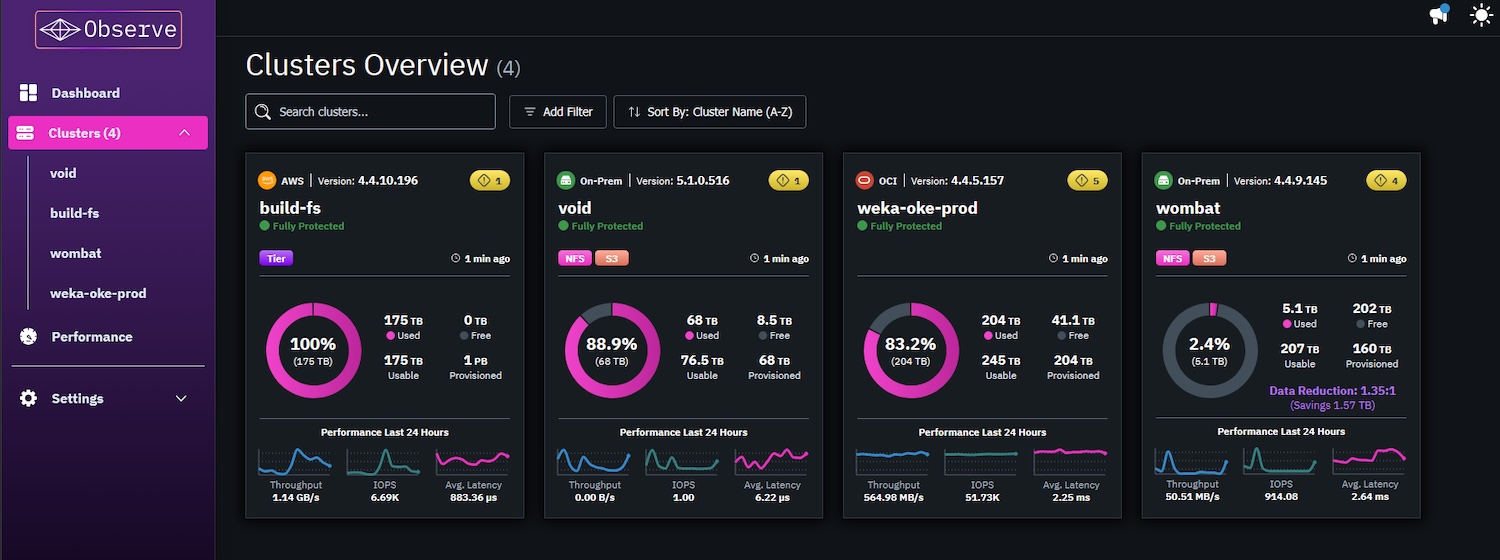
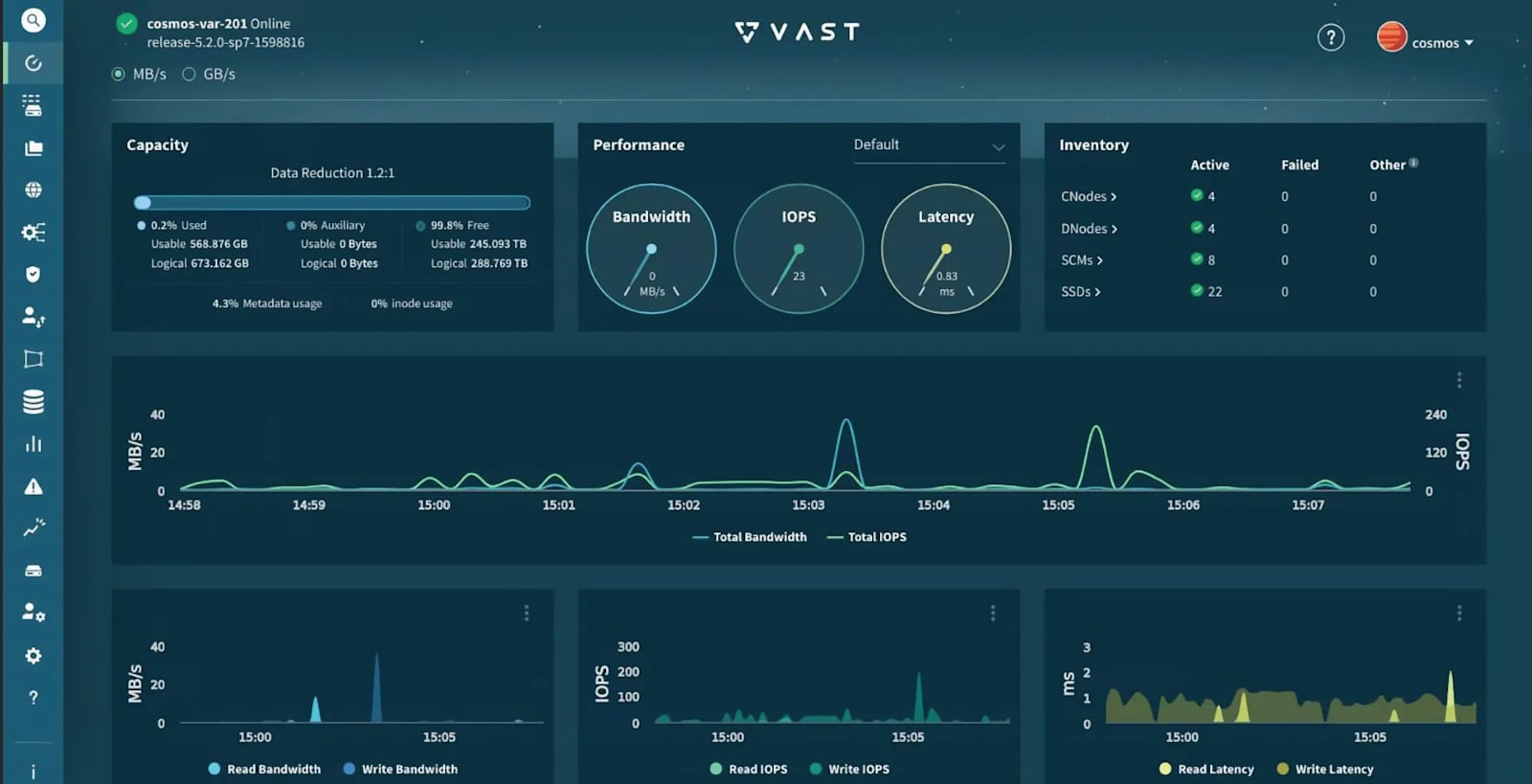
    WEKA Observe clusters overview dashboard showing four NeuralMesh clusters with capacity, throughput, IOPS, and latency panels

    WEKA’s answer to those three in NeuralMesh is Augmented Memory Grid, the KV cache tier that extends GPU memory into NeuralMesh storage, and WEKA’s figures for it are up to 1000x more GPU memory capacity, up to 20x faster time to first token, and 10x more concurrent users on the same GPUs, which it attributes to production benchmarks. Those are WEKA’s numbers for NeuralMesh in general; the Smartbird announcement does not say which NeuralMesh components the clusters use and carries no measured GPU utilization, power, or cost-per-token results for them.

    “Enterprises don’t want to assemble AI infrastructure from individual parts. They want a complete solution that works, operated by people who have done this before,” said Dr. Nadia Carlsten, president and CEO of Smartbird. “Every Smartbird AI cluster is designed around the customer’s specific requirements, whether they’re a bank, a hospital, a manufacturer, or a government agency. By incorporating WEKA NeuralMesh, Smartbird gives customers a data and memory layer proven to perform at scale.”

    “Agentic AI is unforgiving: idle GPUs and stalled pipelines land straight on the P&L statement. Enterprises have been told the fix is a tradeoff, performance or sovereignty, but that was always a failure of infrastructure, not a law of physics,” said Liran Zvibel, co-founder and CEO at WEKA. “WEKA NeuralMesh ends the tradeoff. Smartbird delivers it as dedicated clusters customers don’t have to build or operate. Together, we’re giving regulated industries production AI that runs at full speed, on infrastructure only they touch, with more output per GPU, per watt and per dollar.”

    Dedicated Infrastructure and Managed Operations

    Smartbird operates the full stack, covering facilities, compute, networking, data infrastructure, and data orchestration, so the customer has one accountable partner and does not integrate vendors or track multiple hardware release cycles. Each cluster is mapped one-to-one to its customer, and the companies say the fully dedicated footprint provides the isolation, encryption, and auditability that government, healthcare, and financial services workloads require. The companies have not named deployment jurisdictions, encryption implementation, or compliance certifications.

    Although the companies describe the platform as production-ready from day one, there is no general availability date, no named customer, and Smartbird’s sites were still under development as of the June rename. NeuralMesh itself is the shipping product in the pair: WEKA took it to general availability in March and moved it to multi-tenant NeuralMesh 6 in July, with a parallel deal that puts it under Andromeda’s 50-plus GPU providers.

    WEKA NeuralMesh

    Smartbird

    The post Dedicated Smartbird AI Clusters Integrate WEKA NeuralMesh for Managed Enterprise AI appeared first on StorageReview.com.


    NVIDIA Minerva Brings AIOps to AI Factories Through Dell, Lenovo, and Supermicro Oct 26, 2026
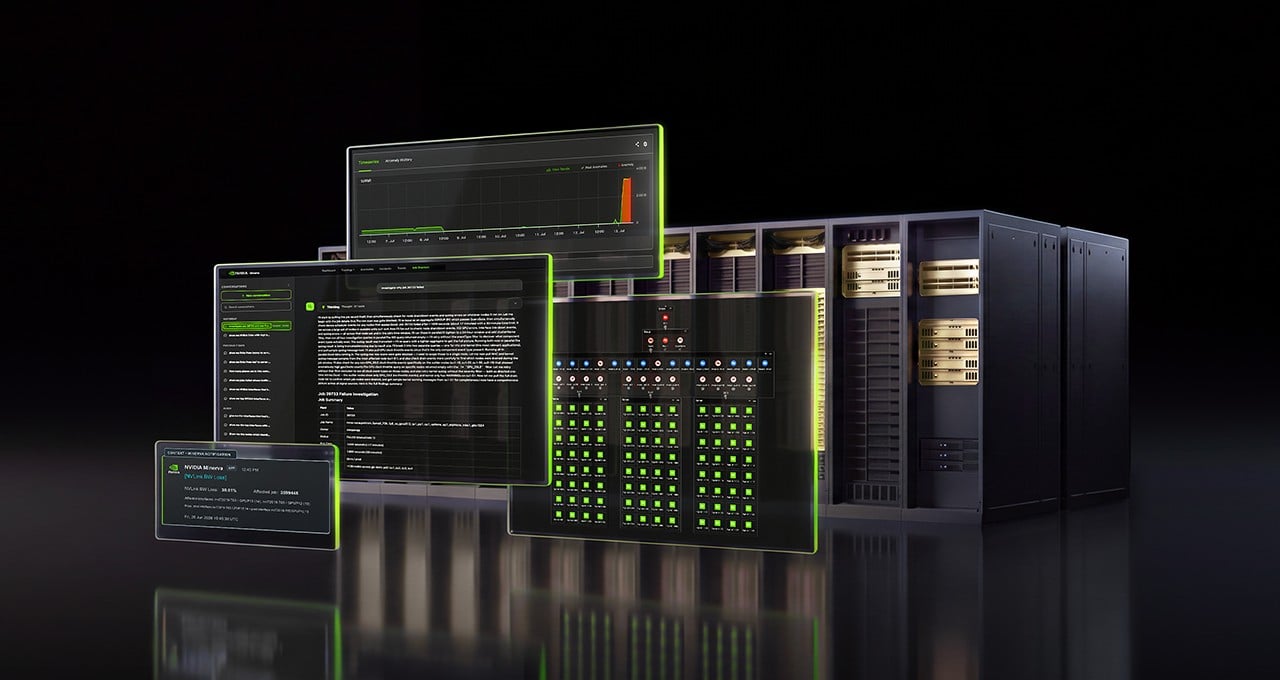
    Show notes NVIDIA Minerva AIOps dashboards showing an anomaly timeline, a job failure investigation, and a GPU topology map in front of AI factory racks NVIDIA Minerva AIOps dashboards showing an anomaly timeline, a job failure investigation, and a GPU topology map in front of AI factory racks

    NVIDIA announced Minerva at GTC Berlin, an AIOps platform that pulls telemetry from GPUs, networking, storage, schedulers, and the AI workloads running on them, then applies machine learning to find a degrading component before it slows a training job. Dell Technologies, Lenovo, and Supermicro will offer it in their AI factory operations portfolios, IREN is already running it, and IBM, Jio, Lambda, Quake AI, Tesla, Aolani, and Bitdeer AI plan to deploy it. NVIDIA has not published pricing or a general availability date.

    NVIDIA Minerva AIOps dashboards showing an anomaly timeline, a job failure investigation, and a GPU topology map in front of AI factory racks

    The problem Minerva targets is one every large cluster operator knows: thousands of GPUs on a high-speed fabric behave as one machine, so a single part running out of spec drags the whole job with it. NVIDIA’s examples are a GPU running hotter than its neighbors and an NVMe drive losing performance under load, the kind of data signal that today sits in a networking tool, a compute tool, and an ML team’s dashboard, each with a separate view of the same cluster.

    What Minerva Watches

    Minerva builds a dynamic knowledge graph that maps GPUs, SuperNICs, switches, cables, and the jobs scheduled onto them, then analyzes what NVIDIA describes as billions of data points per hour with supervised and unsupervised machine learning. The models learn normal behavior for the factory, flag anomalies they have not seen before, predict failures that are developing, and correlate related events using the topology, so a slow training job can be traced to the component responsible across factories NVIDIA sizes at hundreds of thousands of GPUs.

    The output is organized as incidents, with related events grouped into a single item and a likely root cause attached, which NVIDIA says replaces a flood of alerts with one actionable item. A built-in assistant answers natural-language questions against the live telemetry and recommends a fix, and the platform connects to external agentic tools. Operators choose whether a person applies the remediation or whether Minerva hands it to automation through infrastructure APIs and external systems.

    NVIDIA frames the payoff as AI factory yield, which it measures in GPU hours, goodput, cluster uptime, and token production. The claimed results are longer intervals between interruptions, faster repairs, and fewer alerts to triage, with the operations team moving from reactive to proactive maintenance. Those are vendor claims without figures attached; NVIDIA has not published mean-time-to-repair or uptime numbers for Minerva.

    Where It Sits in the Stack

    NVIDIA already sells operations software for its reference designs. Mission Control, introduced in March 2025, handles cluster provisioning through Base Command Manager, workload management through Run:ai, telemetry, and autonomous job recovery for DGX SuperPOD systems. The same week as Minerva, NVIDIA put three open source DSX OS components into developer preview for AI factory lifecycle management: Config Manager for network configuration, Rack Management Service for rack-level power, inventory, firmware, and switch management, and Cluster Readiness Engine for validating GPU clusters with distributed workloads.

    The scale of the problem Minerva is aimed at was on display in Meta’s Prometheus write-up last week. Meta runs each NVL72 domain as a 64-GPU slice with the other eight GPUs held as in-rack spares, keeps about 2 percent of racks in reserve, and quarantines every repaired system until it passes validation. A year of root-cause work with NVIDIA engineers on site cut interruptions by 99 percent and pushed the mean time between interruptions past 54,000 GPU hours, with a target of 100,000.

    That is a hyperscaler running a purpose-built telemetry pipeline and a joint triage team with NVIDIA. Minerva looks like a packaged version of that discipline, something closer to out of the box for an enterprise or neocloud that wants hyperscaler-grade visibility into GPU, fabric, and storage health, and the spare-and-restart workflow that goes with it, delivered through the same OEMs that sell it the racks.

    NVIDIA has not said how Minerva relates to Mission Control or DSX OS, whether it ships as software, an appliance, or a hosted service, or what the OEM packaging from Dell, Lenovo, and Supermicro will look like. The product’s documentation page directs customers to their NVIDIA account team for the user guide. The customer reference is IREN, which NVIDIA says is using Minerva to optimize its AI factories today.

    “NVIDIA Minerva gives our operations team one view across the network, the GPUs and the jobs running on them,” said Denis Skrinnikoff, chief technology officer of IREN, who credited it with shifting the team’s time toward proactive maintenance.

    For the storage side of the house, the interesting claim is that drive behavior under load is an input alongside GPU and fabric telemetry, since an NVMe device that is slowing down rarely shows up in GPU utilization until a checkpoint or data-loading stage stalls. How deep that storage telemetry goes, and which OEM and array platforms feed it, is the detail that will be interesting to dive into as we see this solution come to market.

    NVIDIA Minerva

    The post NVIDIA Minerva Brings AIOps to AI Factories Through Dell, Lenovo, and Supermicro appeared first on StorageReview.com.


    AMD and Intel Make oneDNN the Default x86 Path in PyTorch, Folding ZenDNN In and Lining Up AI Compute Extensions Oct 22, 2026
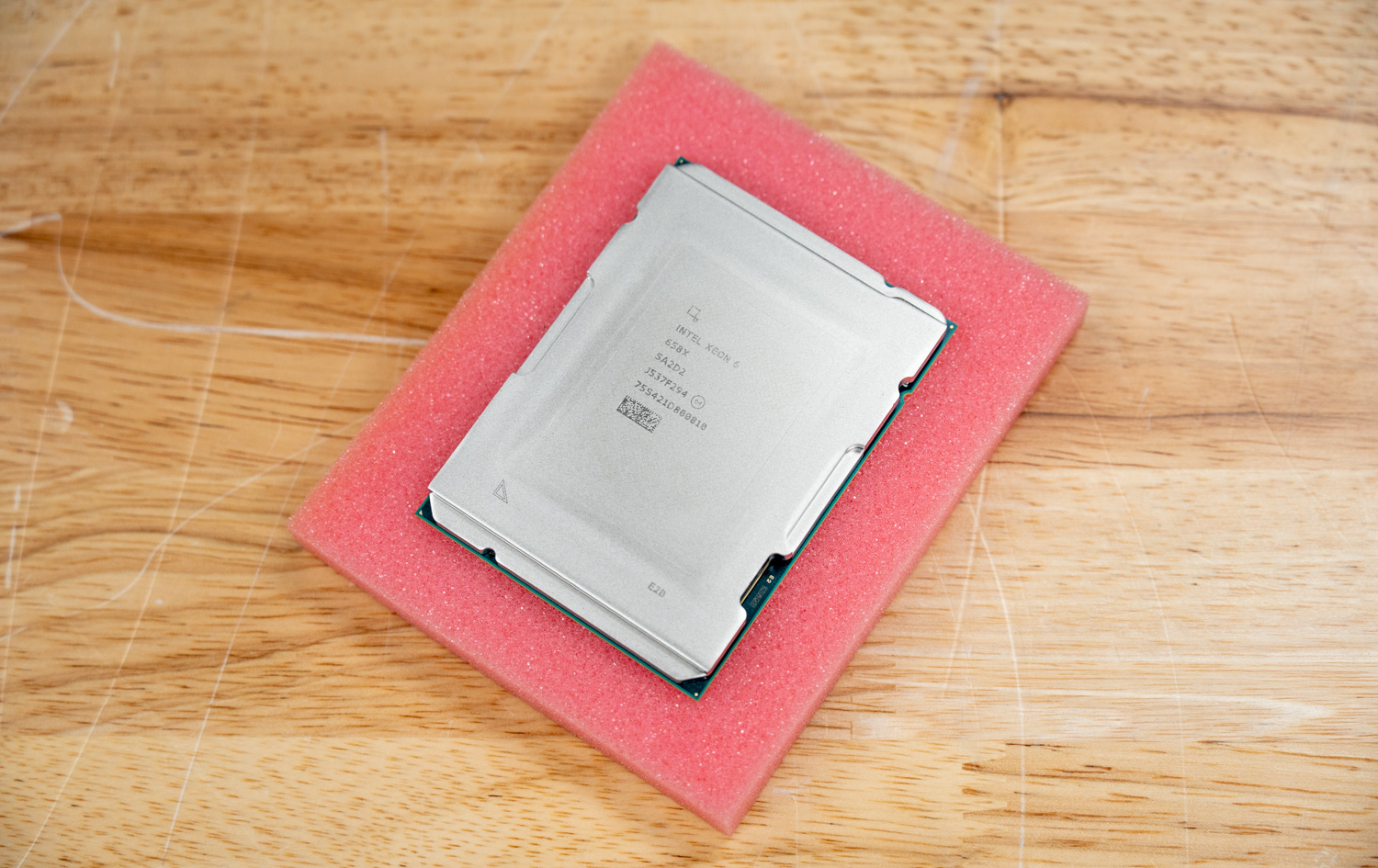
    Show notes Intel Xeon 6 processor on anti-static foam in the StorageReview lab, one of the two x86 CPU families that oneDNN will cover for PyTorch Intel Xeon 6 processor on anti-static foam in the StorageReview lab, one of the two x86 CPU families that oneDNN will cover for PyTorch

    AMD and Intel announced that they will combine their x86 CPU optimization work for PyTorch in oneDNN, the open-source deep learning library governed by the Unified Acceleration Foundation (UXL), and have aligned on it as the default open-source library for x86 acceleration inside PyTorch. AMD is folding its ZenDNN optimizations into oneDNN and has joined the UXL Foundation as a steering member. The move came on a recommendation from the x86 Ecosystem Advisory Group, and the stated goal is one software path for optimized CPU inference and training across AMD and Intel processors.

    Intel Xeon 6 processor on anti-static foam in the StorageReview lab, one of the two x86 CPU families that oneDNN will cover for PyTorch

    AMD Integrates ZenDNN Optimizations into oneDNN

    Until now, PyTorch on x86 has carried two vendor paths. oneDNN, which began as Intel’s MKL-DNN and now sits under UXL governance, is already the library behind many of PyTorch’s optimized CPU operators, while AMD maintained ZenDNN as a set of EPYC-tuned primitives with a separate PyTorch plug-in. Developers who wanted the best from each vendor’s silicon had to know which library applied and install the right one. Consolidating in oneDNN puts both vendors’ kernels behind the same PyTorch calls.

    “AMD is advancing an open software ecosystem that gives developers greater choice and makes it easier to build high-performance AI applications,” said Robert Hormuth, corporate vice president, Architecture and Strategy, AMD. “By working with the x86 Ecosystem Advisory Group, we’re bringing the industry together around common technologies that simplify development across x86 processors.”

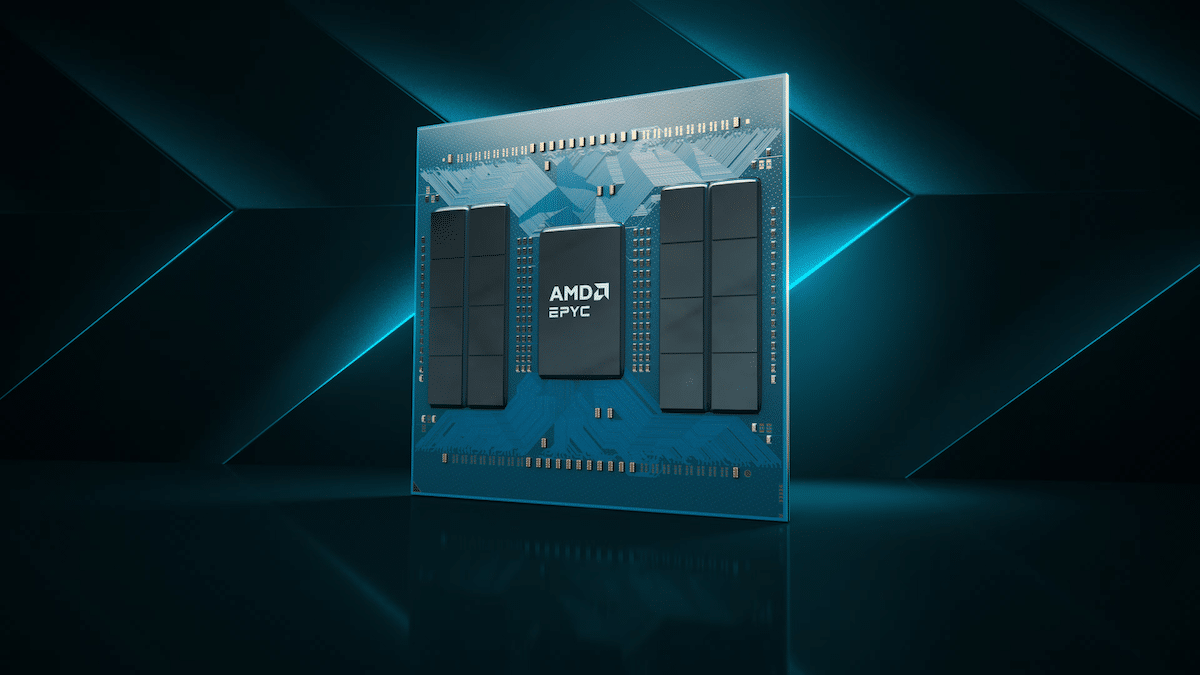
    AMD EPYC processor render; AMD is folding its ZenDNN optimizations for EPYC into oneDNN so PyTorch uses one library across x86

    AMD says it will keep optimizing for its processors as the ZenDNN work lands in oneDNN. Neither company has named the PyTorch release or oneDNN version that carries the consolidated implementation, published a timeline, or given performance figures, so for now the announcement describes integration work in progress. The EPYC 9006 Venice line and Intel’s Diamond Rapids are the newest server parts on each side, and neither company has said which generations get the consolidated path first.

    The advisory group behind the recommendation is the body Intel and AMD formed in October 2024 to steer x86 as a shared platform, with Broadcom, Dell, Google, HPE, HP, Lenovo, Meta, Microsoft, Oracle, and Red Hat as founding members. Its charter covers cross-platform compatibility and simpler software development, and the oneDNN alignment follows the ACE specification as the second outcome the two chipmakers have attributed to it.

    AI Compute Extensions Support Planned for Future Updates

    The second piece of the collaboration is AI Compute Extensions (ACE), a next-generation x86 instruction set that AMD and Intel are defining together through the same advisory group. ACE is built to accelerate matrix multiplication, and the companies say it will reach PyTorch through future oneDNN updates, which is the practical reason for a single library: one integration gets the new instructions to both vendors’ processors.

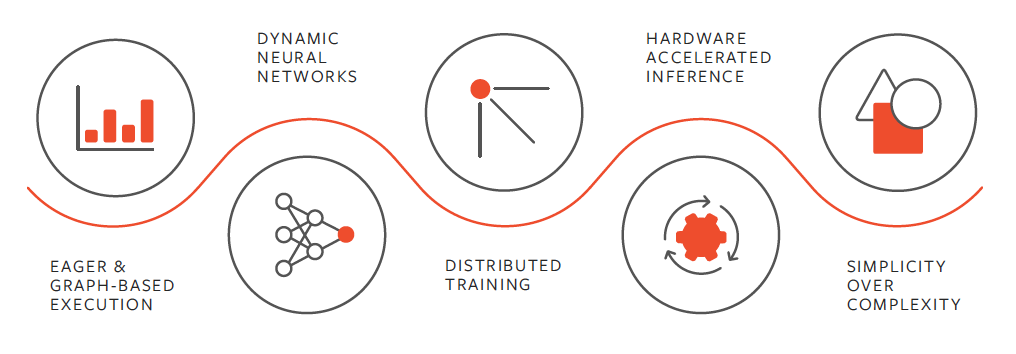
    PyTorch feature graphic listing eager and graph-based execution, dynamic neural networks, distributed training, and hardware accelerated inference, the framework whose x86 CPU path oneDNN will carry

    AMD and Intel published the ACE specification through the advisory group earlier this year. It defines outer-product matrix instructions as an additional unit inside the AVX10 engine, with eight 512-bit tile registers, a 1,024-bit block scale register for OCP MX block scaling, and INT8, FP8, MXFP8, MXINT8, and BF16 data types, with conversions covering MXFP4 and MXFP6. ACE appears to software as a new palette under the AMX framework, which lets it reuse the AMX programming model and operating system support, and the specification claims a 16x compute density gain over the equivalent AVX10 multiply-accumulate.

    “Developers shouldn’t have to think about separate software paths to get the best from an x86 CPU,” said Jeff McVeigh, vice president and general manager, Data Center Strategic Programs, Intel. “Working with AMD through oneDNN gives the PyTorch community a consistent approach for modern processors and a way to bring future capabilities, including AI Compute Extensions, into the framework.”

    Neither company has named the processor generations that will ship ACE, so the oneDNN integration is the software side of a hardware roadmap that is still unannounced. For PyTorch users on x86, the near-term change is in where the optimizations live, and the measurable part, whether a single oneDNN path matches what ZenDNN delivered on EPYC, will have to wait for a release that both companies can point to.

    AMD EPYC

    Intel Xeon

    The post AMD and Intel Make oneDNN the Default x86 Path in PyTorch, Folding ZenDNN In and Lining Up AI Compute Extensions appeared first on StorageReview.com.


    Supermicro NVIDIA Vera CPU Rack: 256 Vera CPUs, 400TB of LPDDR5X, and 22,500 Agent Sandboxes in a 208kW Liquid-Cooled 48U Oct 22, 2026
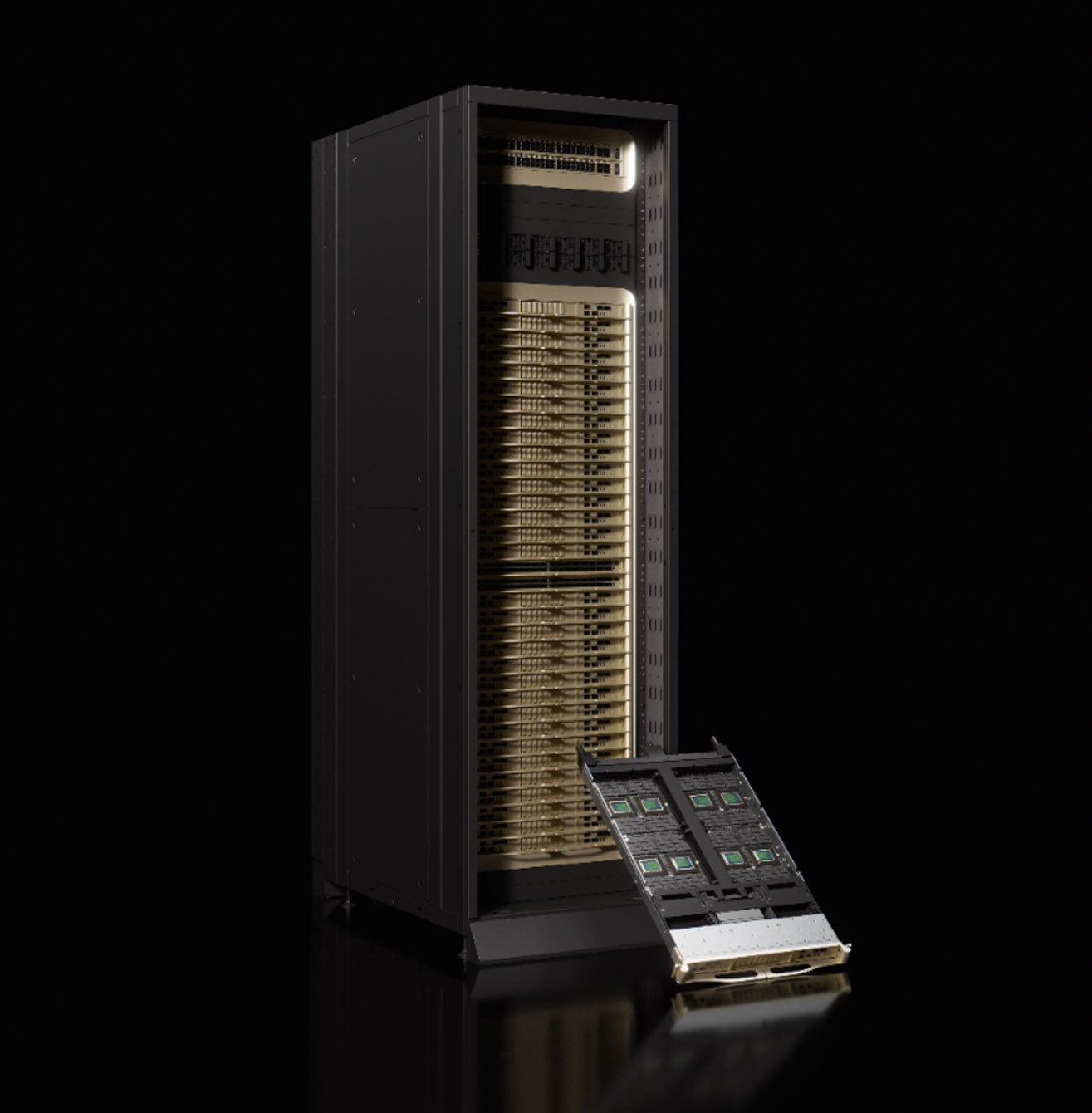
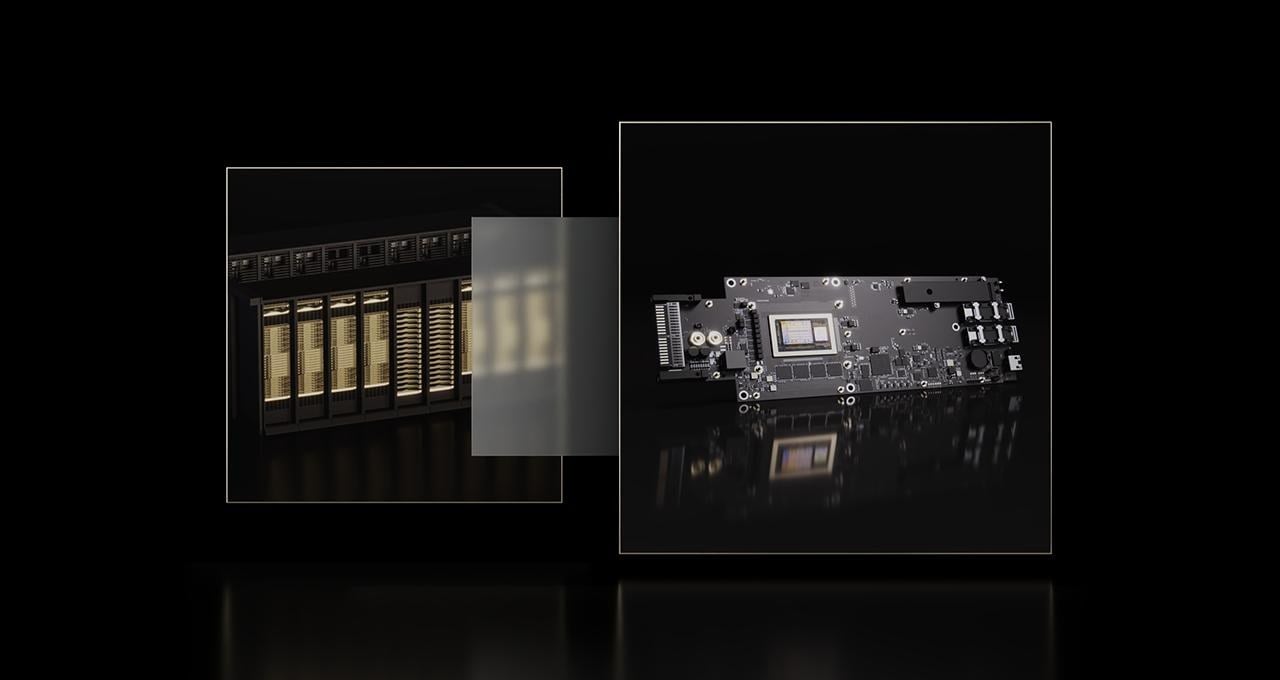
    Show notes NVIDIA render of a Vera CPU rack with a compute tray pulled out in front, showing the processor sockets on the tray NVIDIA render of a Vera CPU rack with a compute tray pulled out in front, showing the processor sockets on the tray

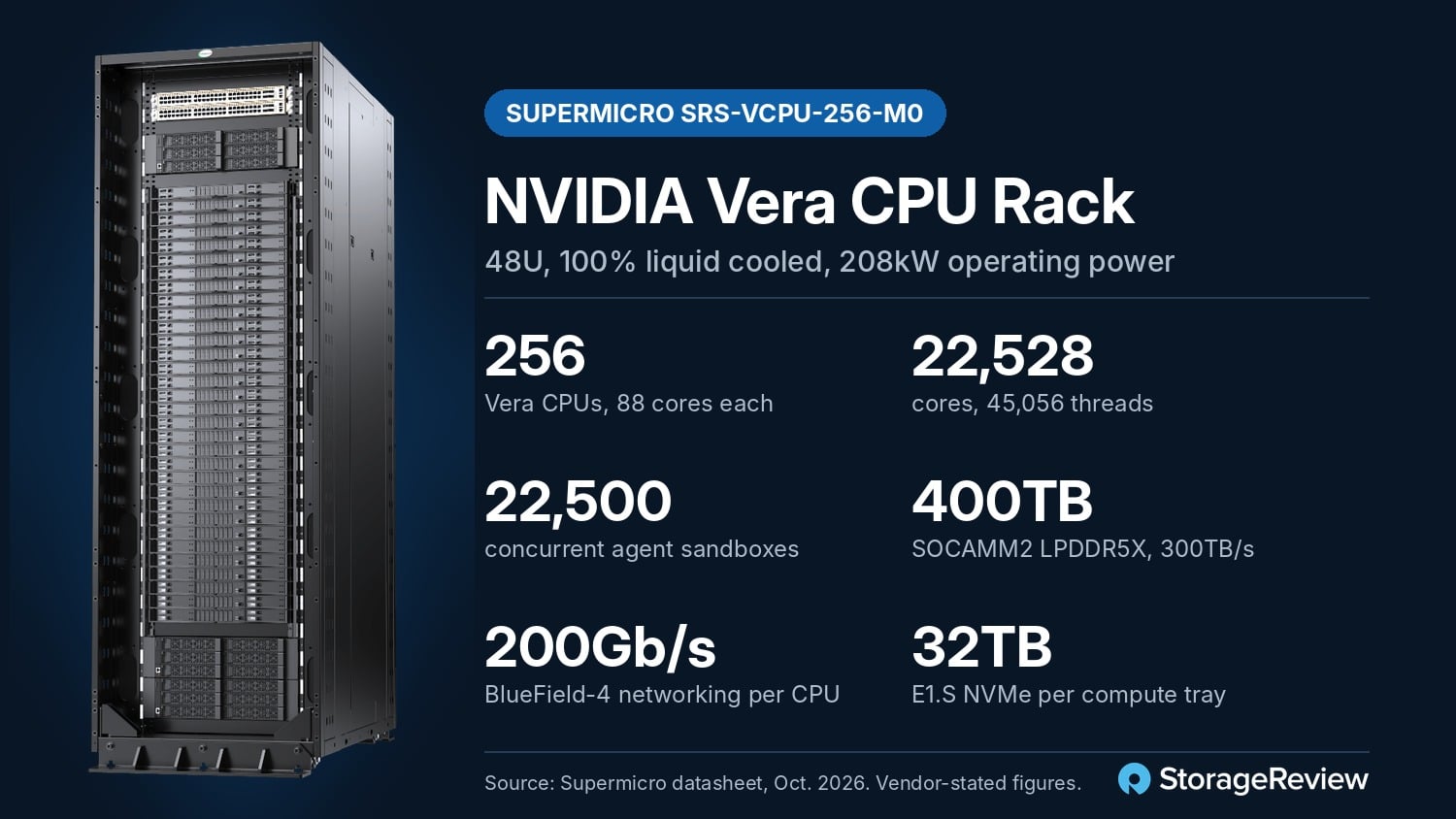
    Supermicro announced the NVIDIA Vera CPU rack today, a 48U, 100 percent liquid-cooled rack that holds 256 NVIDIA Vera CPUs, 22,528 cores, and 45,056 threads and that Supermicro rates for up to 22,500 concurrent agent sandboxes. It is the newest member of the Data Center Building Block Solutions (DCBBS) portfolio, built to run beside the Supermicro Vera Rubin NVL72, which the company says is now shipping, or standalone as a dense CPU rack for agent orchestration, reinforcement learning, and data processing. The rack is available to quote now; Supermicro has not given a ship date.

    NVIDIA render of the Vera CPU rack reference design the Supermicro NVIDIA Vera CPU Rack follows, with a compute tray pulled out to show the processor sockets

    It is the second 256-CPU Vera rack announced this week, after the Dell PowerEdge M9882 at GTC Berlin, and both follow NVIDIA’s Vera CPU Rack reference design with 88 cores per CPU. Dell lists the M9882 for Q1 CY27 and has not published its memory or networking configuration. Supermicro has published both, which makes this the first full set of rack-level figures for a Vera CPU rack from a system vendor.

    Dedicated CPU Capacity for Agent Execution

    Supermicro’s case for a CPU-only rack is that agentic AI and reinforcement learning turn linear inference chains into branched, looped execution with many intermediate steps that wait on CPU availability. GPUs generate the tokens, code, and queries; CPU-based sandboxes execute the actions, evaluate the results, run the tools, and orchestrate the workflow. At the scale of an AI factory with hundreds or thousands of GPUs, Supermicro says that means hosting thousands or millions of parallel execution environments, which is the job this rack is sized for.

    Supermicro lists the rack as model SRS-VCPU-256-M0: 32 1U compute trays, each carrying four dual-CPU nodes for eight Vera CPUs per tray, up to 400TB of SOCAMM2 LPDDR5X per rack with 300TB/s of aggregate memory bandwidth (1.2TB/s per CPU, or 13.6GB/s per core), up to 1.8TB/s of NVLink-C2C bandwidth per CPU, and up to 32TB of E1.S NVMe per tray. Each tray carries four NVIDIA BlueField-4 DPUs for 200Gb/s per CPU, and the rack networks over an NVIDIA Spectrum-X Ethernet converged fabric with up to 400Gb/s north-south, two 1U top-of-rack switches, and 1G/10G management switches.

    NVIDIA BlueField-4 DPU board render; the Supermicro NVIDIA Vera CPU Rack carries four BlueField-4 DPUs per compute tray for networking and Sentry policy enforcement

    The 22,500-sandbox figure against 45,056 threads works out to two threads per sandbox. Supermicro does not say what memory allocation, workload, or software configuration that rating assumes, so treat it as a sizing ceiling for lightweight sandboxes until a reference configuration appears. As a standalone platform, Supermicro also lists database operations, cluster management, Slurm and Kubernetes scheduling, data analytics, and large-scale software build pipelines as target workloads, and the broader Supermicro Vera CPU portfolio includes air-cooled 1U and 2U systems for sites that cannot take liquid.

    Third-Generation MGX Supports AC and 800 VDC Power

    The rack uses the third-generation NVIDIA MGX design, part of Supermicro’s DLC-2 stack, so it shares infrastructure with the Supermicro Vera Rubin NVL72. Supermicro puts it in a 48U MGX v1.2 busbar rack measuring 600 x 1,200 x 2,296mm with 208kW of operating power. Customers can feed it with three 3U 110kW AC power shelves (415 to 480VAC) in 2+1 redundancy, or with 800 VDC through three 90kW DC-DC shelves fed from a power sidecar rack.

    Supermicro NVIDIA Vera CPU Rack SRS-VCPU-256-M0 render beside its datasheet figures: 256 Vera CPUs, 22,528 cores, 22,500 sandboxes, 400TB of LPDDR5X, 200Gb/s per CPU, and 32TB of NVMe per tray

    The 800 VDC sidecar is what enables battery backup units in place of a conventional UPS for power-loss protection, and Supermicro says the arrangement frees data center floor space, can improve end-to-end power conversion efficiency, and lowers capital and operating cost. The announcement does not quantify any of those three claims. Cooling comes from the DLC-2 stack: an in-row coolant distribution unit rated up to 5MW with redundant pumps that can serve multiple racks, an optional rear door heat exchanger, and an optional 200kW or 500kW liquid-to-air sidecar CDU for sites without facility water.

    For customers building on the Supermicro DCBBS Blueprints for Vera Rubin NVL72, Supermicro offers an optional design that pairs NVL72 racks with Vera CPU racks under a defined Spectrum-X network topology, hot-aisle containment layouts, and redundant in-row CDUs and rear door heat exchangers from the DLC-2 stack. One Supermicro team covers site survey, design, L11 and L12 integration and testing, on-site deployment, and ongoing support whether the CPU rack ships with an NVL72 or alone.

    “As agentic AI transforms data center requirements, Supermicro is extending its DCBBS portfolio with fully integrated infrastructure,” said Charles Liang, president and CEO of Supermicro. “For customers seeking air-cooled deployments, Supermicro’s NVIDIA Vera CPU portfolio includes air-cooled 1U and 2U systems, in addition to rack-scale liquid cooling options. Together with NVIDIA, we help accelerate time to deployment with a common purpose-built architecture for secure, scalable agentic AI.”

    OpenShell and Sentry Govern Agent Activity

    The rack natively supports the NVIDIA OpenShell Reference Architecture that NVIDIA detailed at GTC Berlin this week. OpenShell runs on the Vera CPUs and applies least-privilege, policy-based controls to agents at runtime, while NVIDIA Sentry runs on the BlueField-4 DPUs as an out-of-band monitor that enforces policy, provides attested telemetry, and can quarantine an agent that moves outside its permitted boundaries in milliseconds. Because Sentry lives on the DPU, Supermicro says the monitoring keeps observability and auditability in production without consuming host CPU resources.

    “As enterprises scale agentic AI and reinforcement learning, supporting thousands of concurrent agent workflows requires a new class of high-density CPU infrastructure,” said Chris Marriott, vice president of enterprise platforms at NVIDIA. “NVIDIA Vera CPUs and BlueField-4 DPUs, integrated with Supermicro’s liquid-cooled DCBBS architecture, give customers the dedicated compute and hardware-based security to scale the execution of agentic workloads across their AI factories.”

    The CPU-only agent rack has turned into a category this month: AMD’s Helion blueprint packs up to 32,768 EPYC cores into an open OCP design, Dell’s M9882 arrives in Q1 CY27, and Supermicro’s version is quotable today with published specifications. What none of the three has published yet is a measured sandbox density on a named workload, which is the number that will decide how many of these racks an AI factory needs per NVL72 row.

    Supermicro NVIDIA Vera CPU Rack

    The post Supermicro NVIDIA Vera CPU Rack: 256 Vera CPUs, 400TB of LPDDR5X, and 22,500 Agent Sandboxes in a 208kW Liquid-Cooled 48U appeared first on StorageReview.com.


    VAST Agent Sandbox Foundation Stack Puts NVIDIA OpenShell Sandboxes on Zero-Copy Clones and Logs Every Tool Call Oct 22, 2026
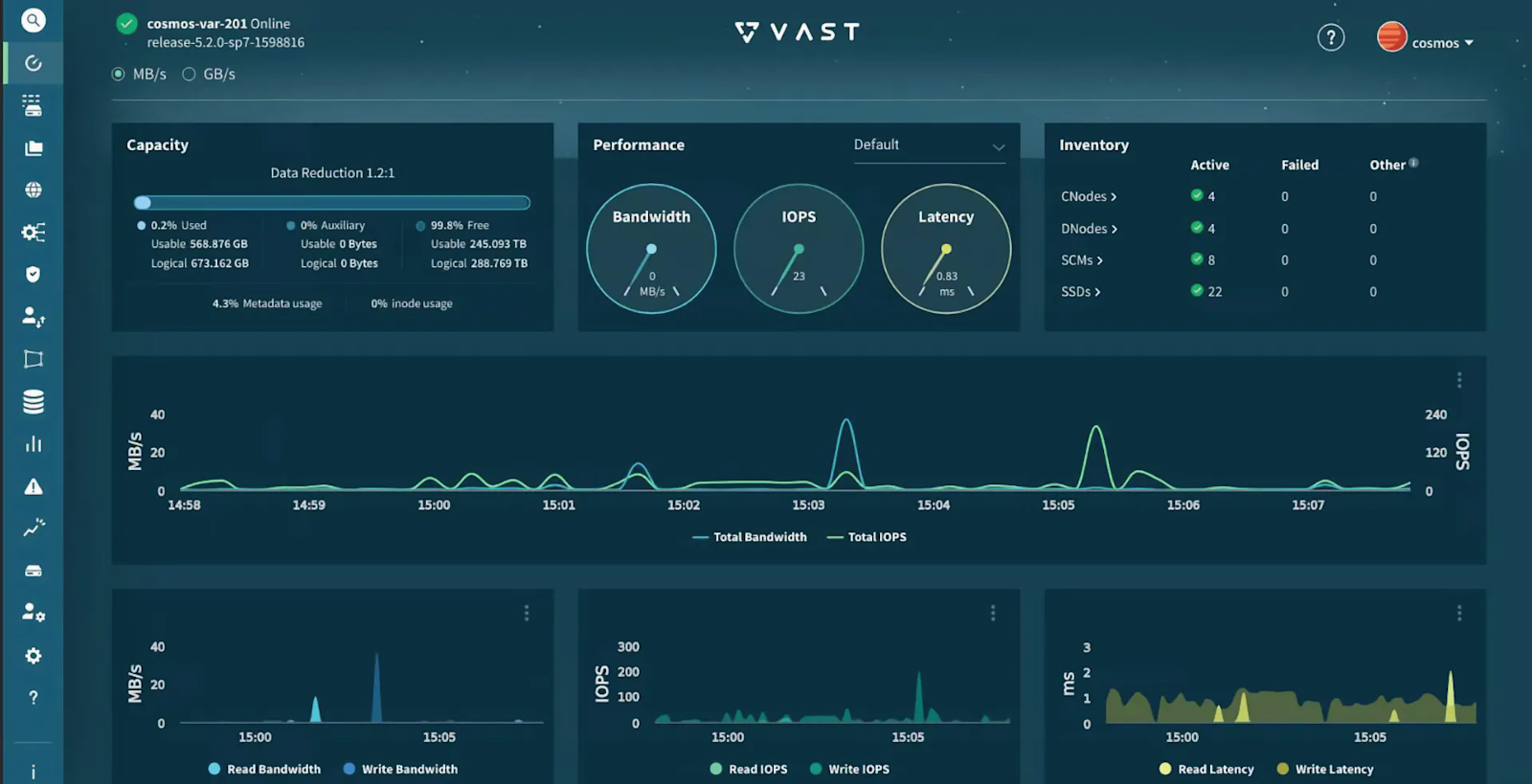
    Show notes VAST Management System dashboard on a StorageReview lab cluster showing capacity, bandwidth, IOPS, and latency, the telemetry layer of the VAST Agent Sandbox Foundation Stack VAST Management System dashboard on a StorageReview lab cluster showing capacity, bandwidth, IOPS, and latency, the telemetry layer of the VAST Agent Sandbox Foundation Stack

    VAST Data announced the Agent Sandbox Foundation Stack with NVIDIA at NVIDIA GTC Berlin, a reference architecture that runs NVIDIA NemoClaw agents inside NVIDIA OpenShell sandboxes on the VAST AI Operating System. OpenShell handles isolated execution and policy enforcement around each agent, and VAST handles the parts that have to outlive the sandbox: the agent’s workspace, its memory and context, and a record of every action it took. VAST says the design is meant to run thousands of agents and sub-agents in production without tying their state to whichever compute node happens to be running them.

    VAST Management System dashboard on a StorageReview lab cluster showing capacity, bandwidth, IOPS, and latency, the telemetry layer of the VAST Agent Sandbox Foundation Stack

    Zero-Copy Workspaces Separate Storage from Agent Execution

    VAST is addressing the churn that agent fleets create: thousands of isolated workspaces built and torn down in an hour, and long-running agents that sleep, resume, and hand work to short-lived sub-agents along the way. The stack decouples each agent’s persistent state from any one compute node, so an agent can pause, resume, or move to other eligible infrastructure without losing its progress or working data, and the compute can stay ephemeral while the state stays durable.

    When a new agent task starts, the VAST DataStore Block CSI driver provisions a persistent volume for the OpenShell sandbox from a zero-copy clone, which VAST says takes seconds and avoids a full copy of the underlying data. In the reference implementation VAST published on GitHub under an Apache 2.0 license, each workflow gets a head persistent volume claim, and each sub-agent gets a clone of it; volume snapshots cover suspend and resume, and a sleeping sandbox keeps its volume.

    VAST DataBase serves as the shared vector store and knowledge base, which VAST says lets hundreds of reasoning agents query the same dataset concurrently without a copy per agent. In the GitHub implementation, it also holds per-department agent memory, the trace spans and turns, and the finished reports, and a Model Context Protocol server is the only path from a sandbox to the database. NemoClaw supplies the agent layer and supports Hermes, LangChain, OpenClaw, or a custom harness.

    “Every enterprise that puts an agent into production will eventually need to answer what it did and why it did it,” said Alon Horev, CTO and Co-Founder at VAST Data. “An agent might exist for minutes, spawn thousands of other agents and then disappear, but its work has to persist and its actions have to stay understandable long afterward.”

    Persistent Records Track Activity Beyond Sandbox Lifetimes

    OpenShell applies identity-based access and behavior policies and logs every interaction between an agent and anything outside its sandbox. VAST DataBase keeps the durable copy of that record, logging every tool call, prompt, token, cost, and decision so the audit trail survives after the agent and its sandbox are gone. The VAST Management System adds real-time telemetry on data flows across the fleet, and VAST says that telemetry interoperates with NVIDIA Sentry, the BlueField-4 DPU layer that monitors traffic between agents on Vera CPUs and models on Rubin GPUs.

    When Sentry flags or quarantines a misbehaving agent, VAST says the AI OS isolates that agent’s data access and freezes the sandbox state for forensic review. “As AI agents take on more complex work, enterprises need infrastructure that can support secure execution while preserving the data, context and state agents depend on across their lifecycle,” said Kari Briski, Vice President of Generative AI Software at NVIDIA.

    Foundation Stacks are VAST’s packaging of NVIDIA AI Blueprints into repeatable deployments on the AI OS. The first two covered an enterprise research assistant on VAST DataEngine with NVIDIA Nemotron and video intelligence on NVIDIA Cosmos reasoning models with NVIDIA Video Search and Summarization; this one covers the agent runtime itself. It also builds on VAST DataEnclave, the confidential computing runtime VAST previewed in September, and on the OpenShell reference architecture NVIDIA detailed at the same show.

    VAST is demonstrating the stack at GTC Berlin with a governed multi-agent workflow in which agents spawn, pull from persistent data services, and keep their state as the compute underneath them changes. The GitHub implementation runs that pattern as a supervised research job: a lead agent plans the work on an NVIDIA NIM model, a human can approve or edit the plan, and sub-agents run in parallel inside OpenShell sandboxes against an earnings-call corpus in VAST DataBase.

    VAST has not published a general availability date, required software versions, or hardware configurations for the stack, and the thousands-of-agents figure is a design target with no measured provisioning rate or concurrency result behind it.

    VAST AI Operating System

    The post VAST Agent Sandbox Foundation Stack Puts NVIDIA OpenShell Sandboxes on Zero-Copy Clones and Logs Every Tool Call appeared first on StorageReview.com.


    Podcast #155: Micron’s 245TB SSD and What Extreme Density Enables at Scale Oct 21, 2026
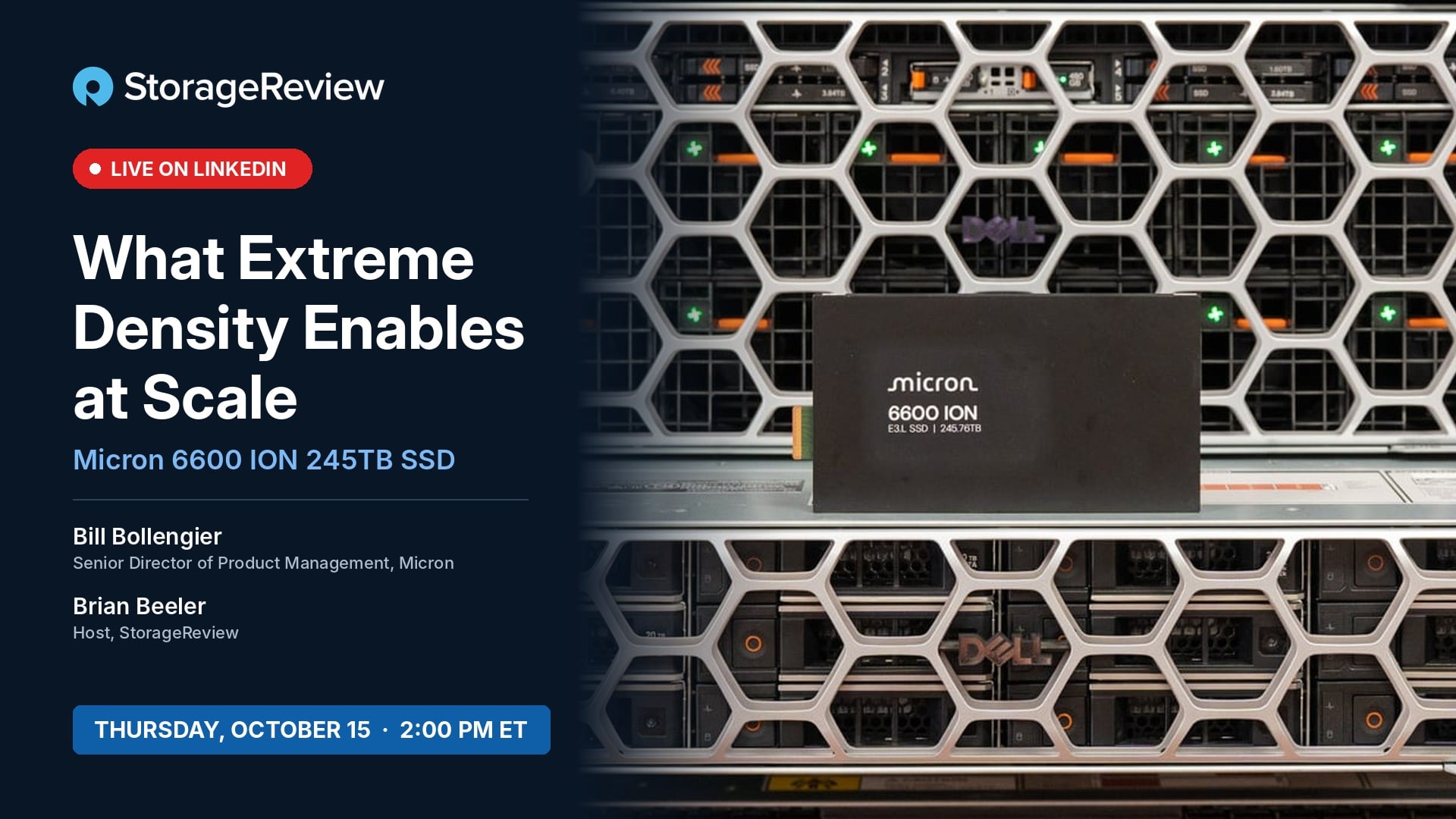
    Show notes StorageReview LinkedIn Live graphic for What Extreme Density Enables at Scale with Bill Bollengier of Micron and Brian Beeler, with the Micron 6600 ION 245TB SSD in front of a Dell server StorageReview LinkedIn Live graphic for What Extreme Density Enables at Scale with Bill Bollengier of Micron and Brian Beeler, with the Micron 6600 ION 245TB SSD in front of a Dell server

    Brian hosted Bill Bollengier, Senior Director of Product Management at Micron, for a live podcast on LinkedIn on October 15, with Bill calling in from the floor of the OCP Global Summit. The subject was the Micron 6600 ION 245TB SSD and what a quarter petabyte per drive bay does to floor space, power budgets, rack density, form factors, and the warm tier hard drives have held for decades. We reviewed the drive in June and followed it with a Micron exabyte study in September that found the flash footprint collapses from 22 racks of hard drives to 6, freeing the 120kW that runs a GB200 NVL72.

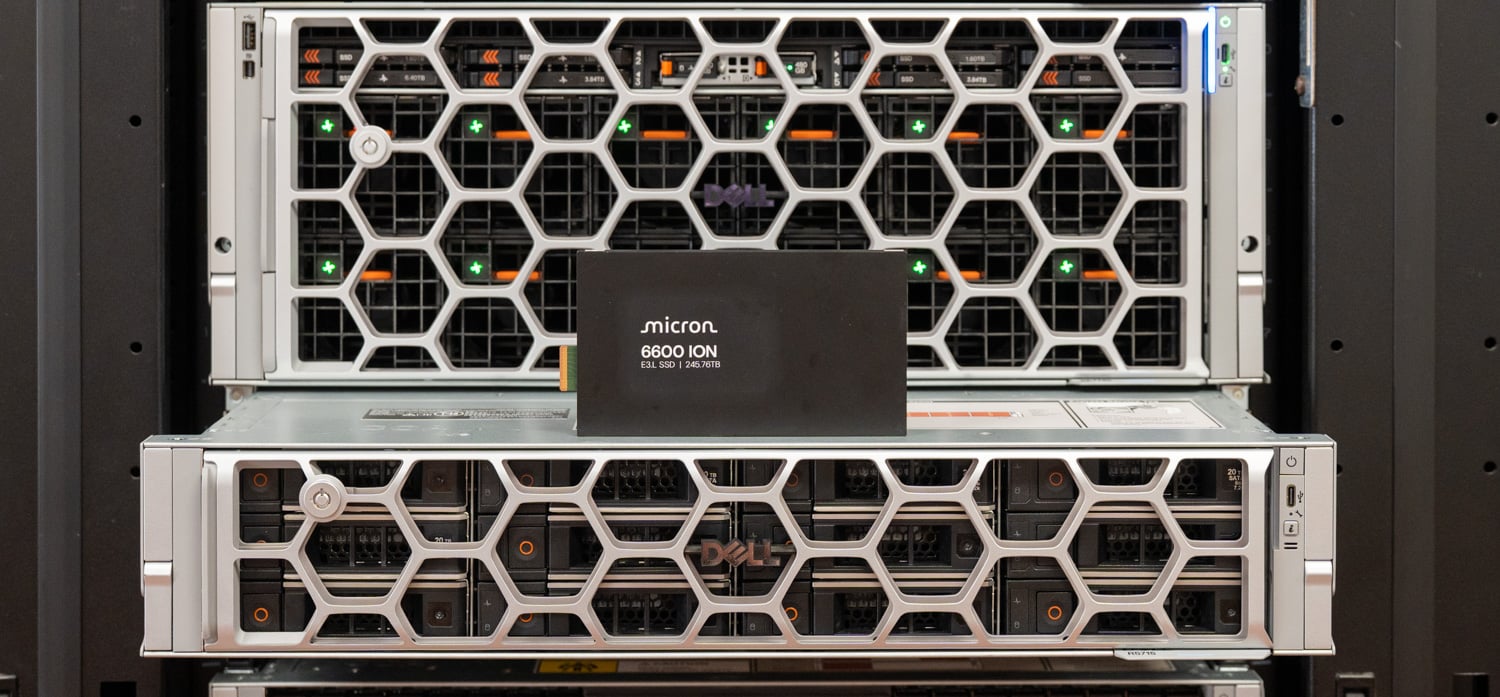
    Micron 6600 ION 245TB E3.L SSD standing in front of a Dell PowerEdge flash server and a 2U hard drive server in the StorageReview lab

    Bill spent 18 years at Intel in strategic planning, product line management, and engineering management across China, Taiwan, and the U.S., took a one-year detour into international sales at Daiya Foods, and joined Micron in January 2020 as a product line manager. He became Senior Director of Product Management in October 2025 and runs Micron’s data center SSD line, which now spans 480GB M.2 boot drives to the 245TB E3.L.

    Micron has been a steady presence in our lab for more than 15 years; the Micron 9550 MAX holds the top spot on our Best Enterprise SSDs leaderboard, the 6600 ION holds the high-capacity slot, and the 9650 was among the first PCIe Gen6 enterprise drives.

    The episode runs about 43 minutes. The numbers that stuck with us: SSDs hold 12 to 15 percent of data center bits today, the 245TB drive is aimed at the next 10 percent that sits on warm hard drives, a one-exabyte deployment on 245TB drives saves about 921 megawatt-hours a year against hard drives, customers are building racks that approach 200PB, and the drive keeps a 16K indirection unit so nobody has to rewrite a software stack. If you don’t have time to listen end-to-end, we have broken it into segments so you can choose what matters most to you.

    [00:00] OCP as the Enterprise Bellwether

    Bill joins from the OCP Global Summit, and the opening segment is about how a hyperscaler show became the place to see what enterprise infrastructure looks like two years out.

    • Brian’s read is that busbar power, liquid cooling, and new storage form factors all showed up at OCP first and are now mainstream enterprise conversation, and Bill describes the mood as an unprecedented period with as much talk about supply as about innovation.
    • Data centers are no longer homogeneous, and Bill says one-size-fits-all server design has stopped working at hyperscale, with storage, memory, compute, and GPUs each needing a separate answer.
    • Micron’s data center SSD roadmap runs from 480GB boot drives to the 245TB tier, with use cases at every capacity point in between.

    [03:38] EDSFF: E1.S to E3.L, and E2 Next

    The 6600 ION’s E3.L form factor is the reason it exists, and this segment covers why Micron builds every EDSFF variant and what the next large form factor adds.

    • Bill says U.2 ran into signal integrity problems at PCIe Gen6, while EDSFF was designed with headroom for Gen6, Gen7, and beyond, and every variant shares one connector.
    • Micron supports all the EDSFF form factors and the direct liquid cooling designs coming out of the SNIA specifications.
    • E1.S and E3.S cover compute-oriented systems and smaller capacities; E3.L carries the large capacities, and E2 is next, with the most PCB real estate for NAND placements and capacities well past 245TB.
    • Server and storage vendors are redesigning backplanes for flexibility across those lengths, a shift Brian says started showing up a few months ago.

    [06:40] SKU Sprawl and the In-House Controller

    Brian asks how Micron manages a product list that has grown from a few U.2 capacities to a matrix of form factors, NAND types, and endurance classes.

    • Bill’s engineering team pushes to limit options, but the market demands flexibility, so Micron builds every family on a common core design it carries forward from one generation to the next.
    • Micron SSDs use Micron NAND, Micron DRAM, and Micron controllers, which Bill says keeps the architecture consistent across families and shortens customer qualification cycles.
    • The 245TB drive complements the existing 122TB model at the top of the line, and Micron was among the first with PCIe Gen6 drives at the performance end.

    [10:08] 30 to 245TB in a Few Years, and the Warm Tier

    Capacity went from 30TB to 60TB to 122TB to 245TB in a short window, and this segment covers what is driving it and where the drives land.

    • Bill, who remembers when 2MB floppies were good enough, says the thirst for data and the need to store it in less space and less power are pushing customers to higher capacities faster than before the AI boom.
    • Brian’s lab finding from the exabyte study: eight idle hard drives draw more power than one 245TB drive writing at full speed, which is why he calls efficiency per terabyte per watt the real headline.
    • Bill is clear that flash will not replace every hard drive; SSDs are 12 to 15 percent of data center bits today depending on whose estimate you use, and the 245TB targets the next 10 percent, the warmer data that sits on higher-end hard drives.
    • Micron’s figures for that tier: up to 86 percent better storage efficiency per watt than hard drives, and about 921 megawatt-hours saved per year on a one-exabyte deployment.

    [15:56] Tiering, LTO-10, and TLC Running in SLC Mode

    Neither host thinks the answer is all flash, and the conversation turns to data placement across tape, hard drives, and several kinds of NAND.

    • Brian points to LTO-10 tape libraries as a still-valid cold tier and says the hard part is getting smarter about scheduling data movement and rehydration, whether the source is tape, hard drives, or slow flash.
    • Micron ships TLC and QLC drives and in some cases runs TLC NAND in SLC mode for endurance and performance; the 245TB is QLC.
    • Micron plans four, five, and ten years out while some customers at OCP say they cannot predict their requirements twelve months ahead.
    • Brian’s examples of why the portfolio is wide: KV cache wants write endurance and performance, capacity tiers suit read-heavy QLC, and transactional databases and logging still want TLC.

    [20:54] QLC Since 2018, 200PB Racks, and the Blast Radius

    QLC was pitched for years as the density and cost play; Bill explains where it has landed and what dense racks do to the rest of the system.

    • Micron was first to put QLC in the data center in 2018, and the 6600 ION continues that line into data lakes, object storage, hard drive displacement, and media streaming.
    • Customers are building racks that near 200PB, and Brian points to what a mainstream 2U 40-bay box holds when every bay carries a 245TB drive, which works out to about 9.8PB raw.
    • Bill’s planning list for high-capacity deployments: network bandwidth into the box so the rack is not stranded, a 16K indirection unit that avoids software rewrites, and power.
    • On blast radius, Bill says he has heard the same objection at 8TB, 16TB, and 32TB, and the drives have proven their reliability each time; Brian adds that erasure coding and array-level protection have always been part of the answer.

    [25:36] Is There a Capacity Cap? The 314-Trillion-Digit Pi Run

    Brian asks whether there is a point where more capacity stops helping, and the answer leads into the record the two companies set together.

    • Bill will not predict a cap: NAND die density and PCB real estate are physics problems, but he saw the same “who could use it” argument about CPU speed earlier in his career, and the software ecosystem always found a use.
    • Brian cites the 314-trillion-digit Pi calculation StorageReview ran with Micron, which holds the Guinness World Record, and notes that scientists have since mined the dataset for number patterns nobody had access to before.
    • The only planning constant, in Brian’s words, is that you will need more.

    [28:14] Indirection Units, Explained

    A short detour into the mapping table inside every SSD and why 16K is the number Micron is holding at.

    • The SSD keeps a lookup table that maps host addresses to physical NAND locations, and the indirection unit is how much data each entry covers; a larger unit means fewer entries and less DRAM.
    • Traditional drives used 4K, which does not scale to 122TB and 245TB, and some have discussed 32K or 64K.
    • Micron holds its high-capacity drives at 16K to keep the mapping table and DRAM cost in check without adding overhead on the host software side.

    [29:57] PCIe Gen6 and Which Drives Get It First

    Our lab has Gen6 drives running in AMD Venice and NVIDIA Vera platforms, and Brian asks what customers are asking about beyond the doubled read bandwidth.

    • Micron introduced Gen6 with the 9650, timed to NVIDIA’s platform cadence and in work with the CPU vendors, so storage is not the bottleneck behind GPU and CPU bandwidth gains.
    • Gen6 lands in the high-performance segment first; high-capacity drives stay on Gen4 and Gen5, and the 245TB is a Gen5 drive, because driving that many NAND dies at Gen6 bandwidth takes more power than the capacity tier wants.
    • Bill works closely with Micron’s memory side, which supplies the DRAM in every Micron SSD, and frames the whole problem as tiering by distance from the GPU and CPU, HBM included.

    [34:11] Planning a Server Refresh

    Brian asks what a customer planning a refresh around new silicon should think about beyond raw speed.

    • Bill’s advice is to start from the workload and ask the platform vendor about compute versus storage options, since the portfolio now spans high-performance, mainstream, high-capacity, and boot drives, each with a time and place.
    • Network bandwidth into the building matters for on-prem builds, and the service level agreement matters for hosted ones.
    • Brian’s point is that buyers who are prescriptive about CPU, GPU, and memory should be just as prescriptive about storage, and Bill adds that a box with the latest XPU and the latest drives is not automatically the right box for the workload.

    [38:59] Demand in the Super Cycle and the Close

    The last segment covers what has surprised Bill about high-capacity deployments and why density matters to enterprises that cannot add floor space.

    • Bill says the surprise is that demand for 245TB stays strong despite supply constraints and pricing in an AI-driven super cycle, which he reads as the value proposition holding.
    • Brian’s case for density: a single rack of 245TB drives replaces five racks of servers that would otherwise need power, and most enterprises cannot add 20,000 or 50,000 square feet or four or five megawatts on a whim.
    • Bill’s summary of the pitch is more data, less power, less space, and the two close on what comes after 245TB and the Gen6 opportunity now in front of customers.

    You can read our Micron 6600 ION 245TB review, the exabyte power study, and the Pi record write-up for the work discussed in the episode.

    The post Podcast #155: Micron’s 245TB SSD and What Extreme Density Enables at Scale appeared first on StorageReview.com.


    NVIDIA GTC Berlin: 14-Day DSX POD AI Factories, a 2.5x Substrate Buildout, and the OpenShell Reference Architecture Oct 21, 2026
    Show notes

    NVIDIA’s GTC Berlin announcements today span containerized Vera Rubin infrastructure, a 2.5x expansion of its substrate supply, and software for AI factory power management and agent security, along with telecom, autonomous vehicle, robotics, and healthcare programs. The headline number is a deployment target: NVIDIA says its new DSX POD reference design cuts an AI factory’s deployment at a prepared site from six months to as little as 14 days, with partner-built systems due in early 2027. DSX POD Moves Infrastructure Integration into the Factory NVIDIA DSX POD combines Vera Rubin compute with networking, cabling, rack-level power, and liquid cooling in factory-built containers. Partners complete rack-to-rack cabling, wiring, piping, and functional validation before shipment, so a delivered container connects to prepared power, cooling, and networking at the site. NVIDIA attributes the shorter window to finishing integration and testing at the manufacturing facility; the 14-day figure assumes a prepared site and leaves out the time to build the supporting facility. Partners targeting worldwide delivery in early 2027 are Anduril, Armada, Bull, Crusoe, DayOne, Dell Technologies, Delta, Eaton, Foxconn (Ingrasys), GIGABYTE, HPE, Lenovo, Pegatron, Quanta Cloud Technology (QCT), Schneider Electric, Vertiv, and Wistron. Dell’s version, the Dell Modular Data Center with NVIDIA DSX POD, was announced this morning with the same early 2027 timing. NVIDIA has not published per-POD capacity, rack counts, or pricing. Manufacturing Plans Expand Substrates, Packaging, Testing, and Optical Engines NVIDIA plans to increase substrate capacity for its products by 2.5x over the next three years. A multibillion-dollar capacity reservation advance to IBIDEN supports expansion of IBIDEN’s Ono Plant in Japan to three times its current capacity, with additional capacity expected to begin ramping in Q1 2028. Samsung Electro-Mechanics joins NVIDIA’s substrate supply chain with capacity from its existing South Korean operations plus facility upgrades and new factories in Sejong and Busan. NVIDIA is also supporting Unimicron’s KF substrate expansion in Taiwan through a capacity reservation agreement, with capacity arriving from Q2 2027 and full capacity by mid-2028. “We are in the midst of the largest infrastructure buildout in human history,” said Jensen Huang, founder and CEO of NVIDIA. NVIDIA and Amkor plan to increase interposer wafer capacity in South Korea by more than 300 percent by the end of 2028. NVIDIA expects its total semiconductor testing capacity to double from 2026 to 2027 through expansion in the U.S., Taiwan, and Singapore; a $1.1 billion capacity reservation advance to King Yuan Electronics (KYEC) funds new U.S. testing facilities and equipment, with high-volume production targeted for April 2027, and expanded Singapore testing operations target high-volume production in February 2027. For co-packaged optics, NVIDIA and Siliconware Precision Industries (SPIL) plan to expand Taiwanese optical-engine manufacturing capacity by 15x by mid-2027, then double it again by the end of 2028. Every figure in this section is a planned capacity target, and NVIDIA gives no current baseline volumes. DSX Addresses Cooling, Power Budgets, and Cluster Readiness NVIDIA DSX is the full-stack reference architecture that combines compute, networking, storage, software, power, and cooling. Its software components are DSX MaxLPS for dynamic power allocation within a provisioned budget, DSX Flex for coordinating workload power with grid conditions, DSX Sim for simulation, DSX OS for infrastructure management, and DSX Exchange for connecting computing and facility systems. Vera Rubin infrastructure supports 100 percent liquid cooling with coolant temperatures up to 45 degrees Celsius, and the DSX reference designs connect it to closed-loop, dry-cooler heat rejection. NVIDIA says those designs can cut facility cooling water consumption to near zero, with local climate deciding whether supplemental mechanical cooling is needed in the hottest periods. At a 2-gigawatt scale, NVIDIA estimates savings of 54 million liters of water per day against conventional cooling-tower systems. NVIDIA says DSX MaxLPS can deliver the same token output using up to 30 percent less power. In a Lambda proof of concept on HGX B200 systems, the company reports 24 percent higher cluster token throughput and 19 percent more GPU capacity within a fixed power budget, and an Nscale evaluation across four GB300 NVL72 racks in Iceland reports 49 percent higher inference throughput and 37 percent more managed GPU capacity within the same 264-kilowatt provisioned budget. These are vendor results, and we did not run or audit them. DSX Flex coordinates workload demand with utility conditions, demand-response events, energy prices, onsite generation, and storage. In an early trial with Emerald AI, EPRI, Nebius, the U.K. National Grid, and NVIDIA, a Blackwell Ultra cluster reduced power draw by up to 40 percent during simulated grid events while critical workloads kept running. NVIDIA’s new SimReady Central Library provides validated power and cooling equipment assets for DSX digital twins. Nscale uses DSX Sim at facilities in Portugal and Iceland, and Schneider Electric, AVEVA, Siemens, Dassault Systèmes, Vertiv, ABB, PTC, and Procore are contributing equipment models, simulation, or construction workflows; ABB’s work also covers 800 VDC development through its Infinitus Direct Current portfolio. Three DSX OS components enter developer preview: NVIDIA Config Manager for network configuration, NVIDIA Rack Management Service for rack-level power, inventory, firmware, and switch management, and NVIDIA Cluster Readiness Engine for distributed validation and node-level fault isolation. They join NVIDIA Infrastructure Controller, NVIDIA AI Cluster Runtime, and NVSentinel. On the facility side, Trane Technologies has published seven thermal management reference designs, three of them 250-megawatt DSX-based cooling designs. Trane’s LiquidStack GigaModular and Vertiv’s 2.3-megawatt CoolChip coolant distribution units have qualified in their DSX Ready categories, and Hitachi Energy’s battery energy storage system has earned DSX Ready BESS qualification. AI-RAN Extends GPU Infrastructure into Telecom Networks NVIDIA and Nokia are moving platforms that run radio access network software and AI services on shared accelerated infrastructure toward commercial service. NVIDIA says nearly 20 operators have publicly announced AI-RAN collaborations using Nokia anyRAN software and NVIDIA Aerial RAN Computer (ARC). T-Mobile completed what NVIDIA describes as the world’s first AI-RAN call on a commercial network, in Bellevue, Washington, using commercial ARC servers, Nokia’s CUDA-accelerated RAN software, massive MIMO radios, an existing 5G Standalone core, and a commercial smartphone. Elisa ran voice, mobile data, and video analytics at the same time on ARC in an over-the-air 5G field environment, which NVIDIA says clears the way for commercial AI-RAN services in 2027. BT plans live trials in Birmingham in 2027, Deutsche Telekom plans field trials after validating the platform in Bonn and Oulu, and Orange is testing Nokia 5G software on ARC for spectral efficiency and edge services. Two new ARC configurations, MGX 2U and MGX 4U, use NVIDIA RTX PRO 6000 Blackwell Server Edition GPUs and will offer x86 or NVIDIA Vera CPU options. Dell Technologies, QCT, and Supermicro will offer ARC-ready servers; NVIDIA gives no ship date for either configuration. Deutsche Telekom is expanding its Industrial AI Cloud and demonstrating robotics workloads distributed across onboard, edge, and central infrastructure. Orange is deploying ARC for voice applications on Nemotron Speech, and Elisa has deployed an ARC-based enterprise voice assistant. NVIDIA also lists new infrastructure projects at CRA, Etisalat, Silknet, and TIM, and expansions at Cassava, Deutsche Telekom, Fastweb + Vodafone, Kazakhtelecom, and Orion Telecom. Nokia is integrating Nemotron and the NVIDIA Agent Toolkit into its Autonomous Networks Suite, Cisco has put fine-tuned Nemotron models into Crosswork AI for IP and optical transport operations, and TCS, BT, and NTT DATA are building agents for installation inspection, fault diagnosis, remediation, and early detection of network degradation. OpenShell Separates Agent Execution from Hardware Security Enforcement The NVIDIA OpenShell Reference Architecture is available now. It pairs Vera Rubin infrastructure for model workloads with Vera CPUs running agent harnesses and the OpenShell runtime, and BlueField DPUs running NVIDIA Sentry for out-of-band monitoring and in-silicon policy enforcement. “AI capability and safety must advance together,” said Jensen Huang, founder and CEO of NVIDIA. NVIDIA says Sentry, built on DOCA and running on BlueField-4, quarantines and stops an agent within milliseconds when it tries to move outside its software boundary. The company also claims up to 20 percent higher agent capacity with Sentry, 30x higher throughput per megawatt for agentic workloads on Vera Rubin NVL72, and twice the performance of x86 processors for Vera CPUs, with no comparison configurations or workload conditions given for any of the three. The architecture runs on Linux and Kubernetes from Canonical, SUSE, and Red Hat, on Windows through Microsoft Execution Containers (MXC), and on AWS, Google Cloud, and Microsoft Azure, with edge deployments on RTX Spark, DGX Spark, and DGX Station. SAP is integrating OpenShell with the Joule Studio runtime. ServiceNow announced general availability of ServiceNow Arc, with runtime governance through its Super Intelligence Control Tower and enforcement through OpenShell; its AI Passport authority layer extends policies to OpenShell and Sentry and can revoke an agent’s access across software and hardware within seconds. Dell Technologies, Cisco, HPE, Lenovo, and Supermicro are building infrastructure on the architecture. CoreWeave, Crusoe, Firebird, Firmus, GMI Cloud, IREN, Lambda, Nebius, Nscale, Oracle Cloud Infrastructure, and Vultr are working on cloud deployments, and 1Password, Check Point, CrowdStrike, Cisco, F5, Fortinet, Microsoft, Okta, Palo Alto Networks, TrendAI, and Zscaler are integrating support into their agent security products. Hyperion Expands Vehicle Programs and Safety Validation Volvo Cars is adopting NVIDIA Hyperion and the Alpamayo Stack; Mercedes-Benz is extending its work on the platform to L3 and L4 capabilities; Volkswagen Commercial Vehicles is showing its ID. Buzz AD platform on Hyperion, and Einride is building its autonomous freight driver on Hyperion with Halos, Alpamayo, and Cosmos. Bolt has selected the Alpamayo Stack for a European robotaxi program that starts with future Hyperion-based Lucid vehicles, with driving data collection in Madrid in 2027 subject to regulatory approval and a planned rollout of at least 25,000 L4-capable Lucid vehicles. NVIDIA introduced Halos SAFE, the Safety Assurance Framework for Evaluation, to connect simulation, software- and hardware-in-the-loop evaluation, road testing, and fleet monitoring into traceable safety evidence, with dSPACE, IVEX, and TÜV Rheinland as collaborators. Alpamayo 2 Edge is a 2-billion-parameter reasoning model built on Cosmos 3 Edge’s Nemotron-based foundation, optimized for DRIVE AGX Thor and designed to run at 10Hz for in-vehicle scene understanding and motion planning. AlpaJudge scores driving explanations, Foundation4D labels multicamera video without lidar input, and new Cosmos 3 Nano variants add synchronized multiview, multicamera, and lidar generation. Cosmos Data Factory’s AV blueprint turns driving video and vehicle signals into curated, labeled datasets, and Alpamayo Agentic Factory, due in early 2027, will connect data preparation, post-training, and simulation evaluation. NIM inference containers now cover Alpamayo 1.5 and NuRec Harmonizer. Porsche is leading a Volkswagen Group data workflow on Microsoft Azure through Voxel51, Cosmos Data Factory, and Omniverse NuRec, which Porsche projects will cut repeated physical test drives by up to 90 percent and development-cycle duration by up to 85 percent. Isaac Adds a Reference Humanoid and Robot Runtime Agile Robots’ Agile ONE SN reference humanoid pairs Isaac GR00T with Jetson Thor and is scheduled for early 2027. The Agile ONE S body stands 1.40 meters, weighs 40 kilograms, and provides 31 degrees of freedom with a 3-kilogram payload per arm; its dual WUJI Hand 2 five-finger hands each offer 20 degrees of freedom, 1kHz force control, and tactile sensing. Onboard Jetson Thor compute delivers a stated 2,070 FP4 teraflops and 128GB of unified memory; sensing comes from head and wrist cameras, lidar, and inertial measurement units; and NVIDIA plans to integrate on-robot safety protocols with Halos. Isaac Lab 3.0 is generally available as an open-source learning framework with multi-GPU workflows and the Newton and PhysX physics engines, and NVIDIA introduced Isaac OS, an open-source runtime built on Holoscan that connects AI, sensors, controls, and robot hardware for deterministic real-time operation. SimReady Central Library carries more than 2,000 robotics and factory assets, and the Human 1M Dataset holds synchronized three-view video and 3D hand tracking; both are on Hugging Face, with the full Human 1M Dataset open to Cosmos Coalition partners. Three open-source DGX Station reference workflows cover reinforcement-learning refinement of GR00T 1.7, dexterous manipulation training in Isaac Lab, and Cosmos post-training for synthetic data generation using ChatGPT Astra. Halos, built on IGX Thor, is the safety platform alongside them, with robotics partners integrating or evaluating it for industrial and warehouse use. In Europe, ABB Robotics is integrating Omniverse libraries with RobotStudio HyperReality, KUKA is using them in Visual Components FactoryLens, Sereact is training its goods-handling platform on GR00T with Cosmos Transfer, and Toyota Material Handling Europe and SoftServe report deployment-time reductions of up to 50 percent with Omniverse and Isaac Sim. BioNeMo Protein Design and Healthcare Workflows Expand NVIDIA and the UW Medicine Institute for Protein Design released RFD4-Proteina, an open BioNeMo model that combines programmable protein design with search, generating and refining candidates from molecular inputs, constraints, and scoring objectives. NVIDIA says the model’s research paper reports higher computational design success rates and generation throughput than the evaluated baselines across protein binding, small-molecule binding, enzyme scaffolding, and DNA binding benchmarks, without giving the magnitudes, and laboratory testing still decides how any design performs. The model is available today through Amazon Bio Discovery, Anthropic’s Claude Science, Benchling, Databricks, Google Cloud, Hugging Face, Nebius, OpenAI, and Tamarind Bio. Siemens Healthineers and NVIDIA are developing adaptive radiotherapy workflows that combine agentic co-planning, patient-specific simulation, and real-time computing; the collaboration is exploring Nemotron for planning assistance, CUDA-accelerated dose calculation, and Holoscan for connecting live sensor data with AI and simulation. Benchling, Biolevate, Boltz, Automata, Genedata, Hologen, and Therna Biosciences are developing scientific agents, models, or laboratory workflows on BioNeMo, Nemotron, and related tools, and Genedata’s planned protein design foundry inside Danaher’s autonomous lab will incorporate RFD4-Proteina with experimental feedback. Avelios, Corti, Dedalus, Dawn Health, and Sword are building on Nemotron for AI scribes, clinical care assistance, and patient support; PolyAI is deploying multilingual dialog with medical software provider Corilus across more than 70,000 healthcare professionals in Belgium and France; and Apian and Vi…

    Full show notes at the publisher

    DeepL Deploys the VAST AI Operating System for Voice Translation Training, Expecting 3x the Capacity From Its Existing NVMe Oct 21, 2026
    Show notes VAST Data diagram contrasting a legacy cloud AI stack of separate databases and storage systems in regional silos with the VAST Data Platform's DataBase, DataStore, and DataSpace layers spanning regions VAST Data diagram contrasting a legacy cloud AI stack of separate databases and storage systems in regional silos with the VAST Data Platform's DataBase, DataStore, and DataSpace layers spanning regions

    VAST Data announced that DeepL is deploying the VAST AI Operating System as the data foundation for the research environments behind its written and real-time voice translation. Based on current deployment plans, DeepL expects roughly three times the storage capacity of the NVMe hardware it already runs, and it will use VAST’s SyncEngine to migrate data out of its incumbent environment. DeepL’s platform serves more than 200,000 business teams, and the company says real-time voice training is what is driving the new data demand.

    VAST Data diagram contrasting a legacy cloud AI stack of separate databases and storage systems in regional silos with the VAST Data Platform's DataBase, DataStore, and DataSpace layers spanning regions

    NVMe Consolidation Targets 3x Usable Capacity

    The threefold figure covers DeepL’s existing NVMe infrastructure, and DeepL frames the gain as room to scale model development without a corresponding increase in physical hardware. Neither company breaks the gain down between data reduction, erasure coding, and consolidating separate pools onto one platform, and VAST has not tied the figure to Amplify, the program it launched in January with a claim of up to 6x effective capacity from existing SSDs. Drive models, raw capacities, and a deployment timeline were not disclosed.

    SyncEngine, the AI OS component that catalogs and migrates data, moves DeepL’s data from the incumbent environment onto the VAST platform. From there, the platform serves file and object storage from one system, which DeepL says simplifies the data structure underneath its research teams and gives it flexibility as the workloads change with the models.

    VAST AI Operating System component diagram with DataEngine, SyncEngine for catalog and migration, InsightEngine, AgentEngine, DataStore, DataBase, and DataSpace

    “VAST gives us the performance and reliability we need while allowing us to make significantly more efficient use of the infrastructure we already operate,” said Stefan Andresen, chief scientist at DeepL. “Just as importantly, it gives us a path to make data more easily accessible across our own data centres and, over time, cloud environments, reducing the manual data movement that can get in the way of research.”

    DeepL Voice, introduced in November 2024 for live multilingual conversation, is the workload pushing the requirements. Recent updates let it preserve characteristics of a speaker’s voice across languages, and DeepL says training those capabilities puts heavier demands on data access and infrastructure performance than text, with efficient movement between training and production environments as the priority.

    Hybrid Data Management Spans On-Premises and Cloud

    The deployment starts in DeepL’s data centers, with plans to extend VAST into cloud environments over time so researchers get the same access to datasets wherever the training cluster sits and stop copying data between sites by hand. Neither company has said which VAST services the cloud phase will use or when it begins.

    “As AI moves into production, infrastructure reliability becomes just as important as raw performance,” said Jeff Denworth, co-founder of VAST Data. “Written language, real-time voice and the next generation of AI experiences all place different demands on data, but researchers should not have to redesign the underlying infrastructure every time the model or product changes.”

    VAST positions the AI OS as a common data foundation across model development, training, and inference, consolidating file and object services with consistent access across distributed infrastructure. DeepL follows a run of VAST announcements this fall, including DataEnclave for running models on regulated data inside NVIDIA confidential computing and the CrowdStrike integration that went live in September.

    VAST AI Operating System

    The post DeepL Deploys the VAST AI Operating System for Voice Translation Training, Expecting 3x the Capacity From Its Existing NVMe appeared first on StorageReview.com.


    Previous 1 5 6 7 8 9 15 Next

    Related Podcasts

    Reply All

    1

    Reply All Games & Hobbies
    Inside VR & AR

    2

    Inside VR & AR Gadgets
    Note to Self

    3

    Note to Self News
    BrainStuff

    4

    BrainStuff Natural Sciences
    This Week in Tech (Audio)

    5

    This Week in Tech (Audio) News
    Hands-On Tech (Audio)

    6

    Hands-On Tech (Audio) Technology
    footer-logo

    Contact Us

    Toll Free: 844-670-7747

    Links

    • Home
    • Top Charts
    • Networks
    • Apps
    • Independents Podcasts
    • Podcast Advertising
    • Podcast News
    • Contact Us
    • About Us
    • Analytics & Insights

    Stay Connected

      Privacy, Terms of Use & Our Code of Ethics Protecting Content Creators Copyrights