Introducing the Roast Development Kit + Virtual Roasting Class
Apr 06, 2018
Show notes
First, please let me apologize for taking so long to offer the “Roast Development Kit” I had promised in The Coffee Roaster’s Companion. It’s finally here, and I am certain it is going to have a beneficial influence on roasters’ understanding of coffee defects.
*****
Among the classes I’ll offer in Seattle this April is a roasting masterclass that will be offered to attendees both in person and virtual. In January I offered a wildly successful “beginners'” roasting class (which was much more advanced than any industry class) in conjunction with Map It Forward. For those of you who have never attended such a class, I’d like to explain a bit about them.
First, let’s get the bad stuff out of the way: the class in January was the first virtual class I’ve offered, and the feedback was overwhelmingly positive, but there are a few things I intend to improve this time around. The video and sound quality were good enough to communicate the lesson well, but not up to the standards of some virtual attendees who worked in the audio and video industries. I take feedback seriously, so the production quality of this next class will be better. Based on requests from previous attendees, I will also email the key slides from the masterclass to viewers ahead of the scheduled class date. Virtual attendees will have access to the class video for three weeks after it airs.
I’m also launching the Roast Development Kit (RDK) in conjunction with the virtual masterclass. Those buying virtual tickets will pay $50 less per ticket than live attendees to compensate for not having access to the tasting or being able to ask questions in person. However, virtual attendees will have the option to purchase the set of roast samples I’ll use in the class, in the form of the RDK ($50) that I had mentioned in The Coffee Roaster’s Companion.
I’m pleased to announce that The Regalia Company, a new roaster in New York City, will roast the samples for the kit. I co-own Regalia with my friend Paolo Maliksi and his wife Chisato (aka the secret weapon). From a distance I have been training Paolo to roast for the past several months through email, FaceTime video, Cropster screen sharing, and exchanging roast samples. I’m proud to say that Paolo, an accomplished cellist, is a diligent and disciplined student, and he is now one of the most consistently good roasters in the country. Some of the best roasts I’ve tasted in the past year came from Paolo, and he is dedicated to offering light, developed, consistently great roasts. I don’t even complain when Paolo offers naturals and honeys. :0 Paolo is the only roaster out there whom I would entrust to roast the samples for the (RDK) and my class, now that he has mastered the art of knowing how to judge, avoid, and create both baked and underdeveloped roasts. For those of you in NYC, Regalia is also currently renting time on its 15kg Mill City roasting machine. Please contact Regalia directly for more information.
The first RDK will consist of three frozen and vacuum-sealed 100g roast samples: an underdeveloped roast, a baked roast, and an excellent roast, all of the same coffee. With the kit we will provide the roast curves, complete with settings used as well as some notes about the coffee and roasts. We’ll also provide two small packets of mineral salts (magnesium sulfate and sodium bicarbonate), with each packet designed to convert four liters of distilled (demineralized) water into perfect brewing water. Importantly, using that water means that everyone in the world who tastes the coffees in the kit will be using the same water. Those buying the kit and following my grind and extraction recommendations should have a very similar tasting experience to that of the live-class attendees.
****
As of April 30 Regalia will be offering the RDK to the general public on a regular basis. Going forward, each month we will offer a new RDK using a different coffee, and we may expand the kit at some point to include coffees with other intentional roast defects as well as various green defects. I also have hopes of using the kit to showcase the flavor impact of novel processing methods, such as those used by Lucia Solis.
Please click here to purchase tickets to the virtual roasting masterclass and Roast Development Kit
Thanks for reading.
Roasting Masterclass | Seattle
Mar 18, 2018
Show notes
After last year's sold-out, fantastic roasting masterclasses in Seattle, I'm excited to offer an even better set of classes this year. The classes will again be held at The Lab at Ada's Technical Books in the lovely Capitol Hill neighborhood. There will be three classes:
UPDATE APRIL 21: The Seattle classes have passed, but the virtual class will be available until May 21; if you purchase the virtual class you'll be able to view it as many times as you'd like until May 21. Virtual attendees will receive an email linking to the class slides and will be welcome to participate in a Facebook group to discuss matters related to the class. I'll participate in that group daily.
The links contain full class descriptions. But let me say here that the main topic will be a new system designed to prevent ROR crashes. I've worked hard with clients over the past year to figure out what causes an ROR crash and how to prevent it. Once you master the lesson in this class, you'll feel much more in control of your RORs at first crack.
Saturday's class will also be offered virtually, through a private Facebook group. Please see the details on Friday's class page. Virtual attendees will have the option to pay a lower ticket price OR receive in the mail the roasted samples that we will be using in the class, along with a water salts concentrate, so you can cup the same coffees along at home as we taste them in the class. Virtual attendees will have access to the class video for three weeks after it airs. Please note: in-person attendees will not have access to the FB group or video.
I have no doubt tickets to all three classes will sell out, so please don't wait. See you there!
It's Time to Create a Scoring System For Roast Quality
Mar 18, 2018
Show notes
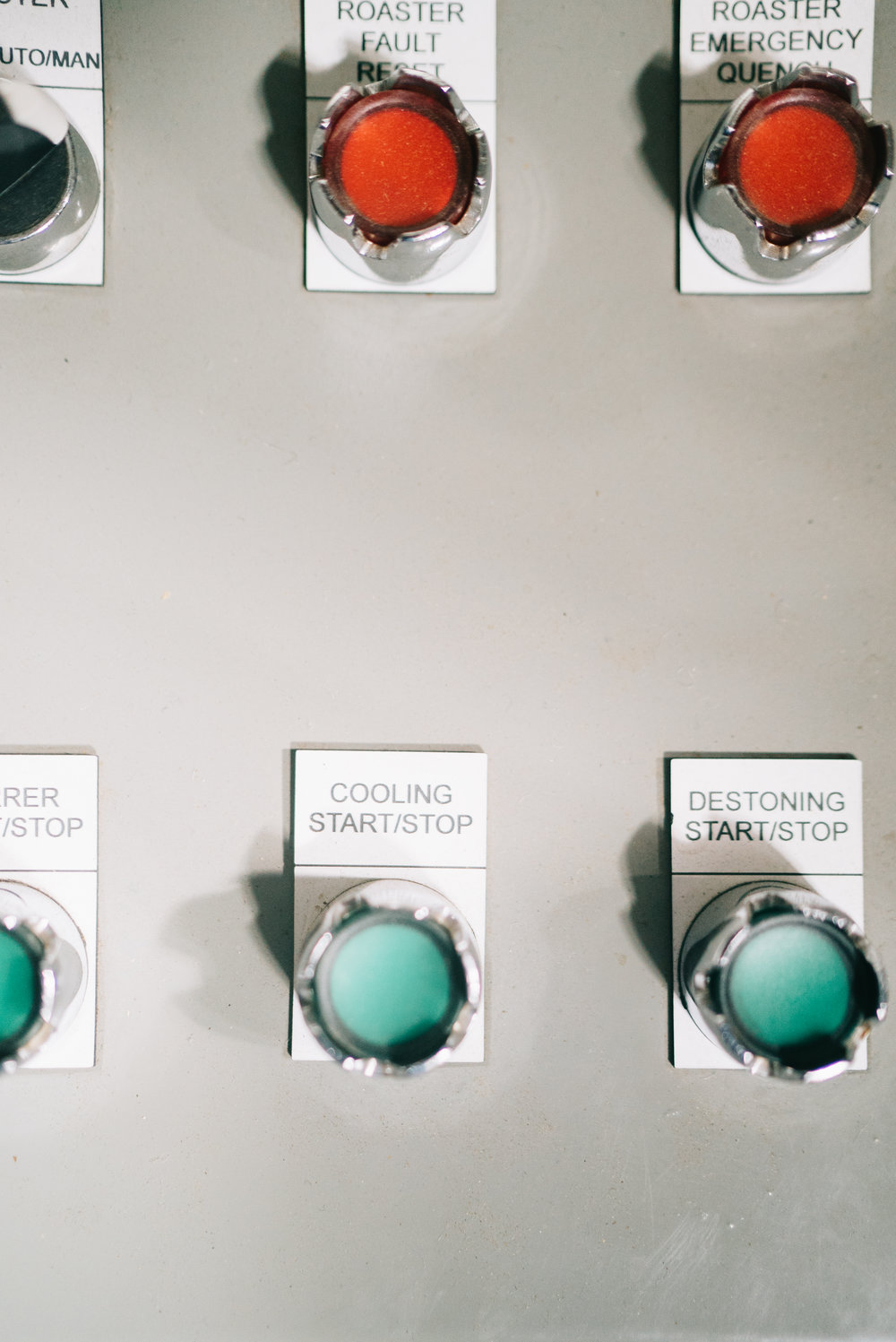
Coffee Roaster Controls
Coffee professionals almost universally use a 100-point scoring system to evaluate green coffee. The system is silly in some ways; for instance, in specialty it’s really a 20-point system, and realistically, readers of this blog probably drink coffees in the 82-90 point range 90% of the time. So if you taste a cup of specialty coffee and it’s “great” you could probably assume it’s in the 88-90 range; “good” puts you in the 85-87 range; and “meh” puts you in the range of 82-84.
Many of us have had the experience of filling out a standard SCA scoring sheet while cupping, and finding that our cumulative scores are much lower than what most pros would rate the coffee (and always lower than what the broker selling the green claims it is. Hehe.) That’s because, in a sense, the sheet is designed to nudge you toward conformity, usually in the mid-80s. It’s also because the quality of a coffee is not merely the sum of its parts in whatever way the form weights those parts.
The first time I scored a bunch of coffees on a form, I was a judge in the 2008 Best of Panama, which used a version of the SCA form. I had a working mental model of how scores like 82, 86, and 90 tasted, but I had never before needed to derive the total scores by adding the scores of individual attributes. I began by evaluating the fragrance, aroma, and sweetness, penalized points for defects, and ended up with a score that didn’t at all sound right. This was a nice, clean, and sweet coffee: 79. This coffee was all right; it seemed a little inconsistent and the acidity fell apart as it cooled: 87. I furiously found places to push the numbers up or down to more accurately land on what seemed to be a fitting score. It involved a lot of erasing and arithmetic.
The second time I scored a bunch of coffees on a form, I was a judge in the 2008 El Salvador CoE, where I did the opposite. The CoE form has eight scoring categories of 8 points each. (A coffee begins with 36 points, provided there are no defective cups in the sample.) Starting with the final score, I then frantically figured out what attributes added up to that number. It was better, but my scoring still involved some unpleasant fudging.
I eventually hit my stride on forms. I found what the average score for each component would be to yield an 86, which, throughout my coffee buying time, was a sort of benchmark. I then asked myself, for each attribute, is this an 86-like sweetness? Higher? Lower? Is this an 86-like acidity? An 86-like body? Et cetera. This worked surprisingly well, and I only ever found my final score to be at most about a half-point different from my initial gut reaction.
**********
I don’t want to dwell on the quirks or limitations of the industry’s standard scoring forms; they serve their purpose well enough, and coffee professionals seem, as a group, to have figured out how to agree on green-coffee scores. However, roasters and baristas often use these sheets to evaluate production roasts, a purpose for which the forms are not intended or well-designed.
Around the same time Ryan was judging the Best of Panama coffees, I had my first significant revelation about cupping forms and evaluating roasts. I was, coincidentally, at a “Best of Panama” cupping hosted by a roastery in Seattle, and I was having difficulty rating some cups because the sample roasts were all over the map. Some roasts were spot on, some terribly baked, and some underdeveloped. Being someone more tuned into roast quality than green quality, these roasts threw me. Others in the room were doing a better job of “seeing through” the roasts but I was also pretty sure some of their scores were being influenced by roast quality in ways they did not realize.
I have no doubt that great — and terrible — roasts sway professionals by 1-2 points here and there. I don’t mean to confuse a point that Ryan made to me after he read an earlier draft of this post:
When it comes to buying green, a coffee’s “true” cupping score should be the best one you can achieve with it at a given point in time.
I would argue, and I think Ryan would agree, that the influence of extraction, water, and roasting can only deduct from a coffee’s “true” score. That said, there’s no way to know with certainty when the extraction, water, roasting, etc, have all been optimized to help illuminate a coffee’s true score.
For example, that massively sweet fruit bomb on the table may get a score of 86 instead of 88 if the sample roast is very baked, because baking kills sweetness. The sample that retained its acidity and sweetness as the cup cooled may not be better than its neighbor that “fell apart” after cooling; the second cup may have simply been baked. “Brothy” underdeveloped roasts often don’t bring out the plump, pleasing, and juicy notes that some coffees potentially offer. Finally, I’ve had brews that tasted minerally, metallic, or gamey when made with water unsuitable for coffee extraction.
Regardless of one’s views on how much roast quality sways professionals in green evaluation (and to be clear, we’re all swayed to different degrees), it’s clear we’d be better off with a separate system for evaluating roasts if we want to get better at roasting and also want to avoid allowing roast quality to interfere with green evaluation.
Let’s say you production-roast a 90-point Kenya and the ROR crashes hard and then flicks. The coffee may still have some pleasant fruit since, after all, the coffee’s raw material was so stellar that you’d have to roast the coffee on a BBQ to destroy all of its goodness. You may score a cup from that roast as an 88. Now let’s say you execute a flawless roast of an 83-point blend component; you will likely still score that coffee an 83. As a production roaster, there isn’t much to learn from the Kenya scoring five points higher than the blend component. After all, you were handed two radically different types of raw material, did a masterful job with one of them, and a poor job with the other, yet the better job scored lower.
If you’ve read my two previous posts about seeing through roasts, part 1 and part 2 you’re familiar with my opinion that some cup traits are primarily due to roast, some are due to green quality, and most are a combination of the two. “Seeing through roasts” is more art than science. I propose that an effective roast-scoring system focus only on traits that are predominantly indicative of roast quality.
To that end, here’s a first draft of a proposed roast-scoring system.
A Scoring System for Roast Quality
Development (as in “how well developed are the bean cores,” not “how dark is the roast”): -2 to 0
-2: objectively underdeveloped -1: debatably underdeveloped 0: adequately developed (according to your standards)
Success in highlighting terroir or other roast goals: -2 to 0
-2: failure to highlight desired flavors -1: partial success 0: complete success in highlighting terroir, etc.
Baked: -2 to 0
-2: definitely baked, hollow, lost most sweetness -1: a little baked but still kinda sweet 0: not baked at all
Roasty: (not a real word): -2 to 0
-2: reminds you of your last cup of Starbucks -1: hint of char, smoke, or unintended roastyness (also not a word) 0: would please George Howell
Admittedly, you may find it awkward that scores will usually be negative, or at best zero. I’m personally okay with that, in the sense that roasting isn’t capable of improving green coffee. A roast will either show a coffee’s full potential (the score would be zero) or cause the coffee to fall short of its potential (the score would be negative.) As Ryan wrote in DCB:
“No matter what wizardry your roasting team is capable of, there's no way to improve a coffee's potential through roasting. Green coffee either has it or it doesn't.”
Please note that it would not be a good idea to subtract a coffee’s roasting score from its green score, as that will cause confusion and misses the point about keeping the green and roast evaluations separate.
Applying this Coffee Roast Quality System
Coffee #1: fast roast, no ROR crash or flick, tastes green Very underdeveloped (brothy): -2 Some varietal character shines through: -1 Not baked at all: 0 Not roasty at all: 0
Total Score: -3
Coffee #2: developed, but the ROR crashed hard and flicked Development is great: 0 Terroir shines through a little: -1 Very baked: -2 Very roasty: -2
Total Score: -5
Coffee #3: almost perfect, but development was borderline Development: -1 Terroir: 0 Baked: 0 Roasty: 0
Total Score: -1
I’d like to be clear that this proposal is a work in progress, and I hope readers will criticize this post constructively, and offer their own suggestions for improving the system.
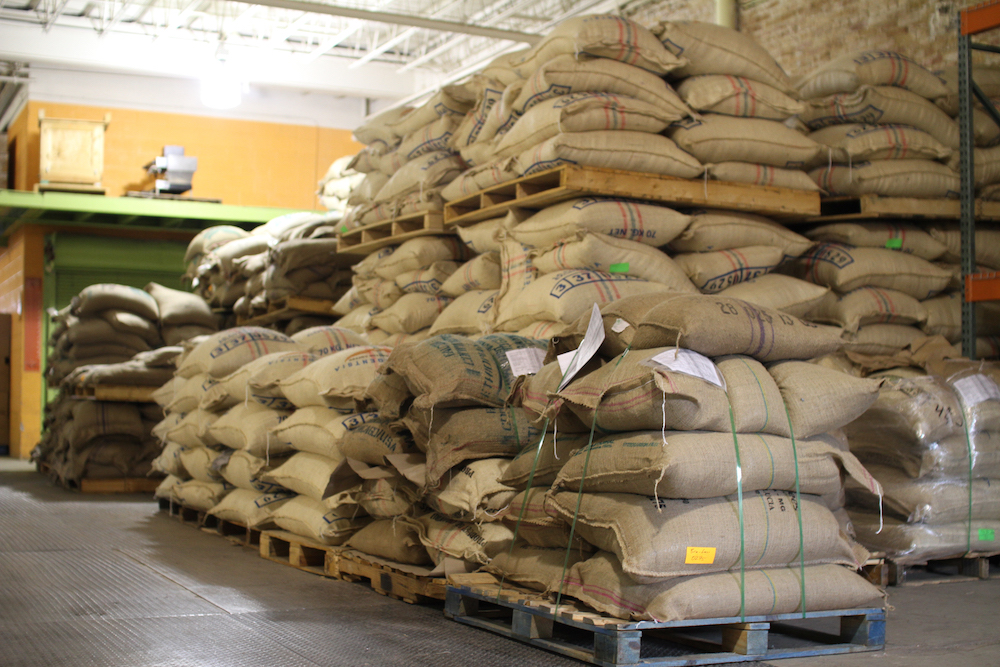
Green coffee bean storage. photo credit: Liz Clayton
My apologies to the 150 or so readers who wrote to me requesting samples of coffees processed by Lucia Solis. Bad luck and timing have conspired to delay the availability of a suitable set of samples. Let me explain.
The first time I tasted a coffee processed by Lucia and her pet yeast, I was blown away. The coffee was a Rwandan and it was probably the best cup of Rwandan I've ever tasted. I immediately wanted more, and I told Lucia I wanted to be able to offer that coffee to my readers.
That coffee had already been spoken for, and Lucia and I hatched a plan to offer an Guatemala from a farm she was on her way to work at early this winter. The crop was delayed, and Lucia couldn't be there personally for the fermentation, so we passed on that one. Lucia's subsequent jobs all involved helping farmers turn low scoring coffees (78 ish) into more respectable offerings (84). Although it would be insightful to be able to offer and taste pairings of the Lucia- and non-Lucia- versions of those beans, I have been hesitant to offer anything below an 87. I've made that decision in part because I want readers to thoroughly enjoy the coffee, and also because in my experience, too many people will taste an 83-point coffee alongside its former 79-point self, and simply walk away far less impressed than they should have been, because neither coffee was insanely delicious.
The bottom line is that sooner or later, there will be a Lucia project suitable for this blog's readers, and when that happens, I'll reach out to all of you who have patiently waited for these offerings.
Thanks
Scott and Lucia.
Lucia Solis Classes in Seattle, April 19--21
Mar 09, 2018
Show notes
This April, I'll be sharing the back building at the charming Ada's Technical Books in Seattle with my friends Lee Safar of Map It Foward and Lucia Solis of Solis Coffee Solutions. We'll all be offering various classes there. I'll be co-hosting one of Lee's classes (to be announced soon) and I'll certainly be attending one of Lucia's classes myself. She has a lot to teach me.
Lucia will be teaching two different classes about coffee processing.
April 21: Understanding Coffee Processing for Cuppers
If you’re a barista, roaster or coffee buyer come hang with me on Saturday April 21st from 12:30 to 2pm. The room is small, limiting it to 30 seats.
I'm excited to present a series of coffees that I've designed to demonstrate the power of processing on altering flavor. We'll cover advanced topics in coffee processing that go beyond reductionist terms like "washed" and "natural" and cup examples of custom-designed fermentations from Africa and Latin America against reference coffees processed using more conventional methods.
There are two sessions on April 19th and 20th specifically about processing techniques like Controlled Fermentation these classes are only for Growers and Producers who own or work in a Wet Mill. The session on April 19th will be in Spanish.
If you don’t have a Wet Mill where you can implement new protocols this is not for you - but if you buy from producers that will be in Seattle - please forward this link to them
Map It Forward Events in Seattle This April
Mar 06, 2018
Show notes
My good friend, the irrepressible Lee Safar of Map It Forward, will be offering two classes this April in Seattle during the SCA Expo week. Lee has partnered with established, successful coffee pros to put on the Map It Forward series in an attempt to mentor coffee professionals in planning their coffee careers. The series is innovative and only gets better every session. All classes will be available both in real life to about 35-40 attendees, as well as broadcast virtually to a private Facebook group.
****************
MAP IT FORWARD - How To Map A Successful Career & Business As A Coffee Roaster
I'm pleased to announce I'll be co-hosting this event Lee on April 21st from 3:00--6:00. We designed this seminar to inform and empower current and future roasters (and business owners of roasting companies) in the specifics of mapping a considered career path as a roaster in today's coffee industry.
Please click here to learn more about the event and to purchase tickets
****************
MAP IT FORWARD: How To Map A Successful 10-Year Career As A Barista
Lee will co-host this event with our friend Jared Truby, aka 1/2 of Trubaca, aka co-founder of Cat & Cloud, aka the guy who made me a famously awesome cappuccino about 6 years ago :). Jared is one of my all-time favorite baristas, and anyone in the industry could learn a lot from his enthusiasm and attitude toward service.
Please click here for more about this event and to purchase tickets
#raotips
Mar 03, 2018
Show notes
As some of you know, I've begun a daily Instagram feature "Coffee Tip of the Day." I'm attempting to offer bite-sized bits of coffee knowledge as often as possible. If you'd like to check it out, follow me @whereisscottrao. I aim to be the first IG user to have a decent following without resorting to memes or photos of "instagram models." I know, I'm too old-fashioned.
Comments are welcome and I'd love suggestions if there are any subjects you'd like me to address. But please, remember these are quick tips; the last time I asked for requests, people wrote 200-word questions about roasting. :0
See you there.
Second Melbourne Class Added!
Mar 02, 2018
Show notes
I'm pleased to announce that tickets are selling like, well, like flat whites, for the Melbourne Roasting Masterclass, so I've decided to add a second class on March 23 from 8am--11am. This class will also be held at the Five Senses Training Centre. Please see here for tickets and details.
Please contact me directly if you have any questions or concerns: scott@scottrao.com
Please do not contact the fine folks at Five Senses with questions.
See you there!
MAP IT FORWARD: Mapping A Career and Business In Wholesale Roasted Coffee Sales (March 11)
Mar 02, 2018
Show notes
Two of my favorite coffee people, Lee Safar and James Marcotte, will be co-hosting this event on March 11. You can attend virtually, or in person if you're in the Los Angeles area.
Lee founded Elixir Specialty Coffee and the Map It Forward series. She's at it again with an innovative seminar focused on mapping a career in wholesale roasted coffee sales.
James Marcotte is the guy who got me into coffee 25 years ago (!) and has extensive experience selling roasted coffee for Intelligentsia. James will have a lot to say about the job, the career path, and marketing beans. The event will be held in one of the most surprisingly bucolic neighborhoods in LA on March 11.
Roasting Masterclass | Melbourne
Feb 26, 2018
Show notes
I'm happy to announce that I'll be in Melbourne during MICE to offer a roasting masterclass on March 21. I'm grateful to my friends at Five Senses Coffee for hosting the class, which will be held at their training center near the CBD.
Beyond the incredibly challenging masterclass material that you won't find anywhere else, I will be offering something special: effective, original methods to prevent ROR crashes. What I've learned is exciting, and this class will be the first time I share those methods with anyone other than a handful of clients.

 Our TOPPODCAST Picks
 Stay Connected