Immersion, Percolation, and Grinding-- A Quiz and Contest
Sep 27, 2017
Show notes
Let’s have a quiz and a contest. :)
Suppose you are to make these four brews using similar brewing ratios and a properly aligned EK grinder with settings 1–-11, with 1 being the finest setting, 11 the coarsest.)
Cupping, to be sampled at 12 minutes
v60, using 22g grounds and a 3:1 prewet plus one main pour
French Press, 4:00 brew time
Fetco, using 120g grounds, 2L of water, an appropriate basket size, 15% prewet, and 4:30 programmed brew time.
The Quiz:
Easy (easier?) question:
1. Put the brews in order, from finest grind to coarsest grind AND tell me why, other than empirical evidence, you chose that order.
Bonus question:
2. Based on a v60 grind of #6, predict the grind settings needed to make all four brews extract to roughly the same percent.
The reasoning behind the proper grind settings is straightforward, yet I have never been to a cafe that chose the correct order for those grind settings, let alone remotely correct grind-setting numbers for all of them ("correct" meaning settings likely to produce similar extraction %'s for all brews.) Makes you wonder about the dial-in process at cafes.
Since most readers seem timid about offering blog comments, I’d like to add an enticement: the first person to get #1 right with the correct reasoning gets a free signed copy of any of my books. If you already have my books, thank you, and I'll buy you a copy of The World Atlas of Coffee by James Hoffmann, because it's awesome. If you already have all of those books, I'll find a suitable replacement prize.
The first person to get both #1 and #2 correct earns a book or the option to receive the first production model of an exciting one-cup brewing gizmo I'm in the process of creating. (hint: choose this prize.)
Good luck!
UPDATE
Over 100 readers took a stab at the quiz. Thanks for writing, for having the guts to take a guess, and for the clear communication. I have high-quality readers!
I suppose I'm naive-- I've been asking friends for weeks how to motivate readers to comment on the blog. Now I know: offer them free stuff :)
THE WINNERS ARE.....
QUESTION #1 CAN GENCER!! Great job, Can. Your reasoning was close enough to what I was seeking. For someone who doesn't have an EK, your grind guesses were excellent, as well. I already knew from your prolific blog commenting :) that you have a keen mind.
QUESTION #2 CHRIS CAPELL!!! Judging this was tough. I wanted to be flexible about the numbers, so there was a little judgment involved. And a few readers offered good numbers but hadn't explained their reasons for answer #1.
Chris was the first to get in the ballpark with the numbers and explanation. Congrats Chris!! (full disclosure, Chris worked with me for about a year, circa 2008/9. At least now I know those endless chats about extraction paid off!)
ROSS NICKERSON, GABOR KISS, AND WESTIN MILLS all wrote in with an excellent all-around answers as well. Thank you.
Thanks to everyone for your answers. I'll post all of the comments now and will reply to a few.
QUIZ ANSWERS
FROM FINEST TO COARSEST:
French Press -> Cupping -> V60 -> Batch Brew *or* French Press -> v60 -> Cupping -> Batch Brew
This was not a trick- I was willing to accept either order, because measuring the TDS of a cupping is challenging. Whether you stir before sampling and from where in the cup you take the sample have a huge impact on the reading, and it's nearly impossible to trust the reading, as it's too technique-dependent. I measured a cupping this morning and found that depending on whether I agitated the cup, I could get readings of either 1.10 or 1.40. Go figure. Because of this, I wanted to be flexible about where readers put the cupping. Logically, cupping should be coarser than French Press because of the extended contact time in cupping.
THE REASON FOR THE ORDER
Several astute readers noted that percolation (drip) is more efficient than immersion at extraction. (*If a reader wrote "because drip extracts more than immersion" I didn't count that as specific enough--sorry)
Drip is more efficient than immersion primarily because during percolation, strong coffee is being removed from the slurry while fresh, clean water (good solvent) is being added, for most of the process. That keeps the concentration gradient in the slurry much higher for most of a drip brew vs. an immersion. Yes, there are other differences (temperature, amount of convecting of liquid, agitation, etc) but by far the main driver of percolation's superior extraction ability is the higher concentration gradient during much of the brewing process.
Assuming you've read every word of this blog over time (you have, right?), you may remember the discussion about the Ground Control brewer and how repeatedly draining and refreshing the slurry increases extraction a lot.
THE NUMBERS
These numbers are estimates, and I was simply looking for someone to come up with numbers in the ballpark. Depending on the way you sample from a cupping, the alignment of your burrs, etc, these can vary a bit. I was looking for something on the order of
FRENCH PRESS #4--#5 CUPPING #5.5--#7 V60: #6 (it was given) FETCO: #9.5--#11
V60 Video
Sep 16, 2017
Show notes
I'm about five years late to the v60 party, but I've recently made an instructional pour-over video that I'd like to offer to readers. Plenty of third-wave cafes offer hand pours, and of the ones I've tried, I've enjoyed perhaps 10% of them. Uneven, low-temperature extractions are the norm.
Ten years ago, almost every barista who watched me stir a slurry was horrified. Five years ago, about half of third-wave baristas seemed to grudgingly accept that stirring may help extraction quality. Recently, the "Rao Spin" has made uniform extraction even easier to achieve, and the few whom I've demonstrated it for have been instant converts.
Most third-wave baristas seem to brew hand pours with no agitation, and their consistency is rather unfortunate. I still hear baristas say nonsense like "if my whole staff stirs hand pours, they will be less consistent." It's nonsense because if you don't stir, you're guaranteed a fair amount of inconsistency, because some grounds will remain dry through the entire prewet phase. Judicious stirring reduces channeling, makes extractions more uniform, and improves repeatability. It's not rocket science.
I pour v60's two ways: one pour or two pours. I find the one-pour method ideal for cafe service, because it's fast and allows the barista to spend much less time paying attention to the coffee. Total barista time spent standing in front of the brew should be 1:20.
The two-pour method requires a slightly coarser grind and adds 30--40 seconds to both the barista's task and the brewing time. I use the two-pour method when I have extra time and care about squeezing an extra 0.5% extraction out of a coffee.
I do not recommend brewing v60's with much less than 20--22 grams of grounds, as smaller doses require finer grinds (more fines = more bitterness) and average extraction temperature is lower in smaller brews. I'm also wary of breaking up the pour into more than two parts, as that makes the average extraction temperature much lower and may hinder extraction uniformity.
In the video, I demonstrate the one-pour method. With a great grinder (or sieved grounds), it's possible to extract 20% from a 22-gram v60 in less than 2:15 with this method. It's easy to adapt this method to other pourover brewers, including Chemex and Melitta. Just please be sure to use a ground dose suitable to the brewer.
If more cafes would use this method, long waits for astringent, muddled, or underextracted hand pours would be a thing of the past. But I'm not counting on that.
Please enjoy the video here, and don't be shy about commenting.
Fines: Fine for Espresso, Not So Fine For Filter
Sep 01, 2017
Show notes
Every once in a while I hear or read a misunderstanding of the role of fines in coffee extraction and flavor. I’d like to discuss how coffee extracts, the role of fines in extraction, and how fines influence espresso and filter brewing differently. This is a long, technical post. But if you’re a coffee professional, it’s important you read, and probably re-read, it in its entirety. It is easy to make practical use of the ideas I present here.
If you find this post interesting or useful, please feel free to share, translate, or link to, this post.
Defining fines
A coffee bean is a complex three-dimensional matrix of cellulose strands coated with oils and other solids. These strands crisscross to form void spaces, or "cells." Researchers estimate a typical bean contains a million such cells. Roasting makes the cellulose brittle and grinding shatters the cellulose structure into various particle sizes. We call the smallest particles “fines.”
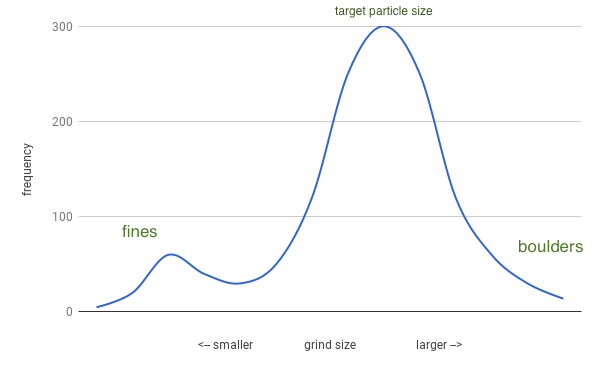
There is some disagreement about the definition of a fine. Most of the older research papers I’ve read referred to fines as cell-wall fragments containing no intact cells. Some people define fines as particles with diameters smaller than a certain size, say 50 microns. Others have recently defined fines as the particles in a certain section (the small hump, if you will) of a particle-size-distribution curve.
Typical particle-size distribution curve. Please ignore numbers, curve is for conceptual purposes only. Frequency here refers to weight or volume of particles.
My preferred definition of a fine is a cell-wall fragment containing no intact cells, because particles with intact cells extract differently than particles without any intact cells. Defined this way, brewing water can freely access all of the surface of the cellulose of a fine during extraction, but in particles with intact cells, some of the cellulose surface is inside the cells and not directly exposed to the water.
Choosing an arbitrary diameter-size cutoff to define fines makes little sense to me, as fines come in many different shapes, few of which are remotely spherical. Unfortunately, many scientific papers make the seemingly innocuous assumption that coffee grounds are spherical, for the sake of simplifying math and modeling extraction kinetics. That assumption is absurd and misleading, and the conclusions of such papers should be taken with a (spherical?) grain of salt.*
Looking at the little hump of a particle-size distribution curve (PSD) is an interesting way of grouping coffee grounds, but doesn’t provide an objective criteria or definition for fines, as that hump’s quantity, quality, and distribution change along with bean, roast, grinder, burr sharpness, burr alignment, etc, not to mention the method used to measure the PSD.
How coffee extraction occurs
There are two phases of coffee extraction: surface erosion and inner-particle diffusion. When water contacts a large ground-coffee particle, it rapidly dissolves coffee solids from the exposed surfaces of the particle. In perhaps a few seconds, such erosion is nearly complete.
Extraction from the intact cells within a ground occurs by diffusion, a process that takes minutes, and is never complete, at least under reasonable brewing circumstances. In diffusion, a concentration gradient causes solids to move from the particle to the water (solids will always move from an area of high concentration to a neighboring area of lower concentration.) The solids dissolved in the water then have to diffuse through the pores of the cellulose to reach the brewing liquid surrounding the particle. Inner-particle diffusion is slow because of its many steps: water must pass through the ground’s pores, dissolve solids, pass back out the pores, and ultimately carry the solids out of the coffee slurry into the brew. Extraction from larger particles is slower primarily because they have longer diffusion paths.
During a percolation process such as batch brewing, there will always be some dissolved solids left behind in the cells of the grounds, and some solids left behind in the interstitial liquid between grounds. In an immersion brew such as a French press, extraction is slower, primarily because solids-packed brewing liquid is not continually removed from the brewer, and during most of the extraction process, the concentration gradient is not as high as it is during percolation brewing. (This is why you should grind much finer for French press than for batch brewing, something that 99% of coffee professionals do not do.) As well, the liquid left behind in the coffee bed of an immersion brew contains much more dissolved solids than that of a percolation brew, making immersion brewing a less efficient extraction method than percolation. As a technical aside, the different solids concentrations remaining in the spent grounds of percolation and immersion brews is why Extract Mojo software has separate modes for calculating drip and immersion extractions. I'm happy to write more on that in another post if readers express interest.
One day we may be enjoying 30% extractions
(and I’m sure that really excites Matt.)
Approximately 35% of the mass of a coffee bean is water soluble. Without extreme temperatures, unrealistically long extraction times or additional solvents, it’s a fair to assume that you’ll never extract more than 35% of the weight of a pile of coffee grounds. Quality extractions of grounds from sub-$20,000 grinders usually top out around 23% in cafes but some massive roller-mill grinders produce grounds that readily extract a few percentage points higher. This is speculative, but it seems that one may be able to extract about 80%—90% of the soluble solids contained on a section of cellulose (i.e., a fine) before astringency and bitterness skyrocket. Say what? It may be possible to get a delicious 30% extraction? Perhaps, but not today, and not with your EK. You may be able to get to 26% or so with a decent grinder if you grind much finer than usual, arduously sift and remove as many of the fines and “boulders” (oversized particles) as possible, and batch brew the coffee. (Please don’t rush to judge the idea based on one such brew— the odds are low that you got the grind setting, sieving, and extraction all just right— it takes practice. But when you do get it right, the results are fantastic.)
Dear Vince, we may need new software when we get to 30% extractions, as my CoffeeTools tops out at 26% :).
My contention is that if a given section of coffee cellulose is 35% soluble solids by weight, it is potentially desirable to extract 30 of that 35. (i.e. 86% of the available soluble solids), and that somewhere between 30 and 35, extraction of astringency increases dramatically. In theory, if you had a pile of fines (fully-exposed cellulose fragments) and managed to get all of the particles to extract at exactly 30%, it would be an amazing cup of coffee; but that’s probably impossible to do.
The problem is that in everyday brewing, the solids from the surfaces of grounds (i.e. all of the solids on the fines and exposed surfaces of larger particles) will extract beyond 30% in seconds, while the 80%? of coffee solids extracting by diffusion will take minutes to reach merely 20%. Additionally, it’s likely that diffusion from some smaller particles or particles along channels in the coffee bed may eclipse 30% extraction before the coffee bed’s average extraction reaches 20%.
Why all of this science stuff matters
To make the best-possible filter coffee, it’s likely you should try to minimize fines (and boulders, for what it's worth). Given that fines are guaranteed to overextract and contribute bitterness and astringency, if you can remove fines or avoid creating them the first place, you’ll make a cleaner, sweeter cup with smoother mouthfeel. Most of us don’t enjoy astringent coffee, but if you do, that’s great, as tannins are excellent gut-bacteria modulators. I prefer to get my tannins from wine, thanks.
How to minimize fines, in order of importance:
Use sharper grinder burrs
Ensure grinder burrs are aligned as well as possible
Grind coarser
Use larger grinder burrs (burr design also matters, but larger is generally better)
Roast lighter
Avoid naturals at all costs*
Sift and remove the fines— this is difficult to do well, but worth experimenting with for home use and brewing competitions
Potentially, grind warmer coffee beans or use a warmer grinder (jury is out on this)
*Not true, but just felt like throwing that in there.
Along with minimizing fines, avoiding channeling in percolation brews is incredibly important for controlling astringency. Fines and channels affect cup quality in similar ways.
Fines are fine for espresso, to a degree
But what about espresso? Espresso extraction times are too short for extraction to occur via diffusion. Researchers have debated whether diffusion contributes at all to espresso extraction; if it does, its contribution is trivial. (I’m ignoring “espresso” made with minute-long preinfusion, "Slayer shots", and other such non-standard practices.)
The authors of Illy’s espresso book state that fines provide the necessary extraction surface, while larger particles are required to achieve adequate flow rate through the coffee bed of an espresso. If there are too few fines, extraction is low; if there are too few large particles, flow chokes. Given that espresso requires rapid extraction via erosion, some fines are likely to be required for a decent shot. (I think it’s theoretically possible to isolate grounds in the 100–200 micron range and use them to pull a tasty fines-free shot, but that’s not practical in a cafe.) What’s the ideal proportion of fines? Of course, no one knows. To complicate the matter, there seem to be two subsets of fines; let’s call them “larger fines” and “coffee dust.” The presence of the tiniest fines, or coffee dust, probably damages espresso quality by disproportionately slowing flow rates relative to their extraction contribution, thus requiring a coarser grind setting, which in turn decreases extraction.
Chris Hendon noted on my Instagram recently that grinding frozen beans produces less coffee dust and more of the larger fines, and they are of more uniform size. I have not seen the data, but that phenomenon may explain the success many baristas claim to have with grinding frozen beans for espresso. Minimizing coffee dust and producing larger, more uniform fines would almost certainly produce superior espresso extractions. Thanks, Chris, and I hope I have represented your findings accurately.
The bottom line
Congratulations if you’ve made it through this whole post. Now please read it again so it all makes sense :). Most importantly, I hope this post convinces you to be cognizant of fines production and the ways you can minimize it when grinding for non-espresso brewing. The two most impactful things most cafes can do to immediately improve quality are to replace old, worn grinder burrs with fresh, seasoned burrs, and to align the burrs as precisely as possible. Extractions will increase, flavor clarity will improve, astringency and bitterness will decrease, and mouthfeel will be smoother.
I’d love to know your thoughts. Don't be shy.
Interesting Flavor vs. Flavor Balance
Aug 13, 2017
Show notes
I recently spent a week in Italy, where the difference between the third-wave palate, if you will, and the palates of the rest of the population, couldn’t be more pronounced. The average Italian coffee drinker prefers robusta to arabica (not a misprint), dark to light, espresso to everything else, and pretty much anything coffee-related that readers of this blog hate to anything they like. But they invented pizza as well as pistachio gelato, so I won't be too hard on them.
Why does the third-wave palate differ so much from that of the rest of the population? There are some obvious reasons (cultural bias), some some fairly obvious reasons (availability bias), and some speculative reasons (bacterial bias).
Say what? Yup, your gut bacteria determine to a large degree what you think tastes good, and it’s possible the polyphenols in coffee shape your gut population and the signals they send you, affecting your preferences. More on that soon.
The typical third waver seeks coffee that’s “interesting” while the average coffee drinker wants drinkability and flavor balance — nothing new there. Both may seek caffeine and pleasure in a cup of coffee, but the third waver probably focuses more on the intellectual pleasure of discovering and discussing flavors, while others seek the more visceral or physical pleasures coffee offers.
I was served an undrinkable, painfully sour Ethiopian espresso in Prague recently. The snooty, unfriendly barista seemed to think underextracted, channeled coffee with the pH of lemon juice was just right. I suppose the coffee was “interesting” but I didn't find any pleasure in it. It was exactly the kind of experience that would forever scare away a newcomer to third-wave coffee, unless that newcomer enjoys straight lemon juice.
There are third-wave companies that do a good job of bridging the gap between interesting flavors and flavor balance— Go Get Em Tiger comes to mind right away, as does St. Ali/Sensory Lab in Melbourne and Doubleshot in Prague, just to name a few. Too many baristas ignore flavor balance while searching for interesting, and i’d like to see more companies emulate those three. I know various people will define balance differently, but I'm referring to a cup that has identifiable sweetness, bitterness, ripeness, and caramels, with perhaps a winey acidity or sourness. A tiny proportion of third-wave coffee meets that criteria.
Kavarna Misto, Prague
But this post isn’t about my preferences vs. yours— that’s not important to me. What is important is that after 15 or so years of third-wave coffee, 99% of the world’s coffee is still dreck, and much of the other 1% is "interesting: but usually sour, baked, or vegetal. From that perspective, we haven't gotten very far, and I think one of the main reasons is our collective failure to serve balanced coffee, in part due to our myopic fixation on interesting flavors at the expense of balance.
I hear baristas talk about “educating” customers all the time. It’s my least-favorite phrase in coffee— not because I don’t believe in education, but because too many baristas uttering those words seem to mean it condescendingly. Memorably, a barista once said to me “I have to keep educating my customers that our coffee isn’t sour.” To which I replied “but your coffee is sour.” That shocked him, but upon reflection, and to his credit, he ultimately agreed and worked on it.
To be good educators, we have to be a good listeners. If a customer says a coffee is too sour, too bitter, or expresses an interest in more caramelly flavors or less acidity, it’s a good idea to meet them at least halfway in the discussion. If we just want to intimidate or scare off anyone who doesn’t already share our taste, we should keep doing exactly what we’re doing.
Winning over hipsters, well-to-do foodies, and trendy Brooklynites was relatively easy -- they were the low-hanging fruit of converts. If we want to be relevant beyond those demographics, I suggest that as a group we learn to respect and accommodate the non-third wavers’ preference for flavor balance, “educate” with humility and respect, and serve coffee that highlights the uniqueness of a bean while offering a balanced flavor experience.* Oh, and we should be nice when we do it.
*NB: Lest you think I’m advocating for dark roasts, I think one can easily create balanced, well-developed roasts dropped before first crack is complete.
Diary of a Coffee Consultant, Part 2: Florence to Lisbon
Jul 31, 2017
Show notes
Continued from Part 1Moka Pot image "Evoluzione" reproduced with permission by CLET, a brilliant street artist based on Florence. Stop 6: FlorencePrague and Florence are probably my two favorite European cities. Both city centers are famously overrun with tourists but somehow remain perfectly charming. As an American, I’m impressed with any tourist destination that hasn’t sold its soul and turned into an amusement park of a city, full of tacky and disposable junk. If Prague has humility, good cafes, and tea, Florence has joie de vivre, gelato, and sex appeal. While the world associates Italy with coffee, there is only one company in Florence with very good specialty coffee: Ditta Artigianale. (There are also a few good local cafes in Florence that serve Ditta’s coffee.) This may be a surprising statement, but… 99% of Italians do not value coffee quality. More precisely, they value coffee at exactly one euro per cup and they protest angrily when someone tries to charge more than that. To them, coffee is a commodity — 99% of Italian cafes charge exactly one euro for an espresso. The idea of “specialty coffee” doesn’t excite them, it offends them, and not because of the snobby hipster baristas. Can you imagine expecting all wine, cheese, or prosciutto to cost the same amount? Of course not, and Italians don’t, either. But somehow they don’t respect coffee quality as they do wine quality. (My anthropologist friend Kevin has an interesting hypothesis that Italians will value anything more highly if its raw materials are from Italy, but tend see non-Italian items as commodities.)Ditta, owned by the famous and charismatic Francesco Sanapo, is quite unusual by Italian standards. When Francesco began offering special single-origin shots of espresso for 3-4 Euros several years ago, it was national news. Francesco was “ruining Italian culture” and seen as a criminal by some the public. That was despite Ditta still offering shots of a high-quality espresso blend everyday for a mere 1.50 Euros, also considered robbery.Francesco won the Italian barista championship three times by preparing well and using high-quality medium-roast arabica coffee, while some other competitors were (seriously) using robusta. Since that time, most cities in Italy have gained one or two modern coffee bars. I suppose that’s progress, but there are literally a million espresso machines in Italy dispensing robusta, and Italian coffee bars probably go through as much sugar as espresso grounds, by volume. I spent a day at Ditta working on their capable-but-complicated Brambati roaster. A 10kg Brambati is a complicated machine takes up as much space as a typical 30kg drum roaster. It is the roaster that would make Rube Goldberg most proud, and it has at least 10x the number of parts required to roast coffee with precision. I’ve been told the machine is so complicated due to Italian fire regulations and the like, but I think Italians secretly just prefer to make complicated machines. That is, seriously, a 10kg roaster. Note the 7'-tall grey cabinet behind the roaster on the left- that houses the roaster's controls and is itself larger than a typical 10kg roaster. Thankfully, Ditta has Michele Anedotti to manage the machine and navigate its countless screens of complicated software. I am proud of Michele: we’ve worked together twice in the past, and each year I’ve seen him, he has roasted better and better coffee. The roasts in our cupping session this visit were as good as any I’ve had in Europe. At Ditta I got to roast and cup multiple batches of “anaerobically fermented” coffee for the first time. I also had the pleasure in Budapest and Florence of chatting with Felipe Croce of FAF about anaerobic fermentation. Felipe and his family are progressive, experimental coffee farmers, and Felipe gave me a crash course in Florence in the various types of fermentation they are exploring — perhaps more on that some other time. But let’s just say that while a natural is still a natural by any other name, things are getting interesting in the world of coffee fermentation. Talking to Felipe made me realize that my two interests, coffee and microbes, are merging more than ever (and yes, I remember I owe you a post about coffee and gut bacteria.)Ditta’s roaster occupies a corner room in the massive roastery of Caffe Corsini, complete with three side-by-side 360kg automated roasters. Walking through roasteries like Corsini makes it seem silly that 1000s of specialty companies are roasting 1-2 kg at a time. Think about it: in a few hours, Corsini can roast the annual coffee needs of the typical third-wave cafe. Sometimes it’s shocking how big some roasters are, and how small our obsessive third-wave cottage industry is. Corsini is probably about the size of Intelligentsia, Stumptown, and Blue Bottle combined, yet you have almost certainly never heard of it. Francesco of Lilliput. Stop 7: A morning in BolognaWhenever I arrive in Bologna, my first thoughts are “wow, this place looks old!” and “I should consider living here.” If Bologna only had a surf beach… You won’t find much Bolognese sauce in Bologna, but you will find Europe's oldest university, countless beautiful medieval buildings, a fair number of shops that make farinata di ceci*, which is a treat for those of us who eat senza-glutine, and the home of the most passionate coffee people I know: Bar Aroma Degustazione E Vendita Di Caffe' Pregiati, aka Aroma. You could easily walk by Aroma and not notice it: it’s a modest little cafe on a quiet side street on the edge of Bologna’s center. By Italian standards, Aroma is maverick: it's a multi-roaster cafe serving numerous high-quality, light-roast, single-origin espressos and filter coffees, and they even have some nice teas and competition-style signature drinks. Run by the uber-friendly Cristina and her coffee-scholar husband Alessandro, two of the nicest people you’ll ever meet, visiting Aroma is like stepping into your friend’s kitchen, if your friend happens to make coffee with the precision and attention to detail of a watch maker. When you go there, you will feel like part of the family, and you will experience how third-wave service should be. *Fun fact: Matt Perger loves farinata di ceci and his recipe is revolutionary. This visit I learned that Alessandro had just written three coffee-training books in Italian for SCA. The books are lovely, with great graphics and Alessandro’s usual attention to detail. If you speak Italian and want to learn from a master, buy Alessandro’s books. I had only a few hours’ detour in Bologna, but I’m glad I stopped there to visit Alessandro and Cristina and to savor their coffee.Stop 8: Prague 2I had a few days with no work, so I returned to Prague. It’s one of my favorite cities and home to some of my favorite people as well as Salek, so why not? On this visit i got to be more of a tourist. I visited Gwilym, Petra, and Misa at their coffee training center in the pretty little town of Jilove u Prahy and they graciously took me to lunch at Florian, a charming, ancient pub. We went to Florian via a 30-minute walk through farmland on a 35c day, and only upon arriving they told me that we could have walked there in less than 10 minutes on a more direct path :). But Jenny Brown loved the walk through the farms and her joy, if not her rest stop on a pile of horse manure, made the sweaty walk worthwhile. If you don’t know who Gwilym and Petra are, Petra is a former Czech cafe owner who has sold more copies of her Czech-language coffee book than I have sold of all of my English-language books combined. She’s a massive celebrity in Czech coffee, an expert trainer, and perennial World Barista Competition judge. Petra’s only shortcoming is she doesn’t like filter coffee much, though Gwilym tries to convert her on a daily basis, and I have faith he will succeed one day. Gwilym is a former World Barista Champion, co-owner of Prufrock Coffee, one of the world’s best and most sensible coffee trainers, and all-around nice guy. I recommend you find your way to Jilove one day and convince them to take you to Florian. There’s no better way to spend an afternoon. Later that week we went on an adventure to Liberec, a small city an hour north of Prague. Lunch was at Mikyna, a delightful cafe that would fit in well in Melbourne, and after lunch we had coffee at Double Brew, a soon-to-open cafe run by some serious and friendly coffee guys. Before heading home we hiked up to Ještěd tower, a communist-era structure that looks like it’s from The Jetsons. Ještěd Tower Stop 9: BerlinI confess that Berlin does little for me, but I’ve been sucked into visiting twice now by Kris Schackman, owner of Five Elephant. Kris is a great guy, and happened to have been a regular customer at my first cafe in the 1990s. We didn’t know each other then (Kris says he avoided me so I wouldn't notice how much time he spent at the cafe), but our lives have crossed paths many times since then. Five Elephant is dedicated to light roasts of very pretty coffees. We have had an interesting professional relationship over the years, as we’ve worked together but often disagreed in small ways about what makes an ideal roast. On this trip i was pleased to note that our preferences are now well aligned and their current head roaster Wojtek is humble, competent, and dedicated. I happened to be in Berlin at the same time as the “Raw Hustle” tour, a series of talks by Matt Graylee and Matt Perger. I attended their talk at The Barn, and was fascinated by Matt Graylee’s creative model for helping coffee farmers improve the quality of their lives and coffees. To be fair to Matt P, I would have been fascinated by his talk as well, but his talk covered topics that he and I already discuss on a regular basis when we're not talking about ceci and gut bacteria. The very short version: automation and more accessible options (pods, capsules, fancy instant) will eventually devour specialty coffee.Stop 10: LisbonI’ve always wanted to visit Lisbon, and this turned out to be a convenient time to stop there for a few days. Lisbon is an attractive city, with lots of beautiful old buildings, water views, and winding cobblestone streets. But fair warning: don’t visit without training on a Stair Master for a few months — Lisbon makes San Francisco look flat. Lisbon is also not the place for those like me who prefer to eat dinner before 9pm (most restaurants don’t even open until 7:30!), enjoy modern coffee, or eat gluten-free. I may have to scratch Lisbon off my list of potential future homes in case Trump is re-elected (sorry, didn’t mean to ruin your day with that thought.)On my first full day in Lisbon, I met my gracious friend Gonçalo Duerte, Portugal’s biggest fan of good coffee and owner of Voo cold brew, at Wish Slow Coffee, where they serve Five Elephant. Someone had forgot the store key, so Wish Slow opened an hour late, a pattern during my stay in Portugal. Although Lisbon coffee shops typically open at 9am, even that seemed too early for many baristas to bother. The coffee was good, the service was surly (another pattern, unfortunately), and the food was pretty, but the portions were tiny, and shockingly expensive in an otherwise dirt-cheap city for eating. The saving grace of the cafe visit was Gonçalo’s unbridled enthusiasm for good coffee, and his clear-eyed awareness of Portugal’s medieval approach to coffee— almost all coffee in Portugal is made from dark, cheap, oily beans, usually involving robusta. If Gonçalo can infect 1% of Portugal with his level of enthusiasm, it will become the next Australia. With Gonçalo in Ericeira The coffee highlight of Lisbon was a tiny place called Hello Kristof that had a GS3 and a K30 as its only coffee equipment. I have friends with more and bigger equipment in their apartments. I’m not saying my friends are reasonable, just that Lisbon has a very long way to go before hipsters turn it into another Brooklyn. In my three days in Lisbon, the folks at Hello Kristof were just about the only coffee or restaurant staff I encountered who were friendly and hospitable. I spent one night in the pretty beach town of Ericeira in the hopes of catching a morning surf before heading home, but alas, the surf report lied and I woke up to a flat ocean. After I made a lovely 7am batch brew of Five Elephant Kenya in my hotel’s kitchen, a couple of Israeli surfers asked to share some of my coffee (well, really they hovered til I had no choice). I gave them two mugs, which they returned, full, a few minutes later. Hilariously, they semi-apologized for not liking the coffee, implied that I had terrible taste (gee thanks, I’m glad I shared my coffee with you), and said they would go into town to get some “good coffee.” Note that almost all of the coffee in town was cheap, dark, and mostly robusta. :).Thanks for reading.
Batch-Brew Basics, Continued...
Jul 21, 2017
Show notes
One of the first posts on this blog was "Batch Brew Basics, Part 1". I've wanted to write Part 2 for a long time, but have been deterred by what I see in cafes: almost no one has the basics down. What's the point of an advanced post if almost no one has mastered the basics? Am I in the minority in thinking cafes should treat their batch-brew setup with respect?
I'd like to restate a few things that should be obvious to coffee professionals, but even well-known cafes seem to not get these points. To the 99.9% of readers who aren't coffee consultants, you'd be shocked at how many excuses cafe owners and baristas give me for why they can't be bothered to implement these simple practices that would greatly improve the quality of their batch brews.
1. Brew batches no larger than 2 liters. The only cafe I've been to in the last five years that was too busy to get by on 2-liter batches was in Grand Central Station. I can't even fathom how many cups of filter coffee they sell per day-- it's well over 1000. For almost everyone else, if you're serving fewer than 500 cups of filter coffee per day, two liters per batch is sufficient. If you're really busy, ie you serve more than 50 cups (12oz or 350ml) of batch brew per hour, it may be best to brew into a rotation of three tw0-liter carafes during those busy hours. That system will keep the coffee fresher and tasting better than will brewing fewer, but larger, batches.
There is no reasonable excuse for brewing 4-liter batches, or brewing into 4-liter urns, as I see so many cafes do. If you want your customers to respect batch-brew coffee, it will help to show it more respect from behind the counter first. Small batches, brewed into full carafes, turned over at least once per half hour is the way to go. Please.
2. Your bed depth should be 3cm--5cm... I applaud the many cafes, especially in Australia, trying to promote batch brew to a disinterested population, and brewing tiny batches (often 1--1.5 liters) to limit coffee waste. But if you want to brew one-liter batches, you either need a wire basket insert to narrow the diameter of your coffee bed (hence increasing its depth) or you need to find a machine designed properly to brew such small batches (and, honestly, the home-version of the Moccamaster is not a cafe-quality machine.)
3. This will shock many readers:
If your batch-brew grind setting is not in the 15% coarsest section of your grinder dial, there is a problem somewhere in your system.
That's not a misprint. You know that "auto drip" icon in the middle of the spectrum of grind settings on the old Bunn and Grindmaster machines? It's in the wrong spot*--- those settings were chosen years ago when 99% of those grinders were used in American restaurants where they skimped on grounds. Back then restauranteurs were using 30-40g/L (seriously-- in the 90s, when I tried to get my restaurant accounts to use 60g/L they thought I was mad) and grinding too fine in order to reach a palatable brew strength. A professional using a reasonable ratio ( i.e. 16:1--18:1) should grind very coarse. If you find the coffee is too weak in that coarse range of grind settings, at least one of these things is a problem:
The grinder burrs are too dull.
The bed depth is too shallow.
The brew time is too short.
The sprayhead may not be making use of the whole coffee bed.
There is no prewet phase at the beginning of brewing.
There are other potential problems, but these are the most common culprits.
*While we're at it, you may as well swap the "auto drip" and "French press' positions on the grinder.
4. Total Contact Time should be 6:00--6:30
This advice is more flexible than the other recommendations in this post, but 6:00--6:30 seems to be the sweet spot for batch brews. Try to get there without extending the programmed brew time past 4:30.
Thanks for reading.
Diary of a Coffee Consultant, Part 1: Bath to Budapest
Jul 18, 2017
Show notes
I’ll get no sympathy for saying this, but sometimes work travel is exhausting. I know, I know, I get to work in places like Melbourne, Prague, and Florence regularly. And most years I incidentally get to avoid much of winter. This month has been one of those months that makes the endless hotel rooms, airports, and dishonest taxi drivers (I’d say thank God for Uber, but you can’t really say that anymore) all worth it.
Stop 1: Bath
Imagine a postcard photo of a perfect university town in the English countryside, complete with ancient thermal baths and a surprising number of good coffee shops, and you’re imagining Bath. I had the pleasure of spending two days in Bath and Bristol while working for the lovely people at Clifton Coffee Roasters, and finally got to visit Colonna & Smalls. I like a good coffee as much as anyone else, but what really wins my heart at coffee shops is a warm, inviting staff. Maxwell and his crew couldn’t have been more hospitable and friendly, and visiting them was a great start to my trip. I finally got to try Maxwell’s famous capsules, and other than first being served a natural from the capsule machine (he apparently doesn’t read this blog), the capsule coffee didn’t disappoint. Two days later, my final cup, an Aeropress Colombian, consumed while trading thoughts on water with Maxwell, was memorably delicious, and made it more difficult to leave Bath.
Not your father's Nespresso.
Stop 2: Bristol
My first regret of the trip was to not allow enough time to explore Bristol. Bristol is much larger and more vibrant than Bath, but also gorgeous and incredibly compelling, especially on a nice 24c day. I had been invited by Clifton Coffee Roasters to spend the day roasting together, followed by a brewing talk in the evening with their staff and customers, and finally a group dinner at Bosco, a bustling and modern Italian restaurant. Friendly, spirited discussions ensued about the merits of buying larger-than-needed roasting machines (my take: always do it if you can afford it), brewing smaller pots of batch brew (just do it; no excuses), and gut bacteria (of course). I’m grateful to Clifton for the work, the hospitality, and the enthusiasm; it was a blast.
Cupping at Clifton
On my way to London I stopped at Red Pig Coffee (redpigcoffee.com) for a short roast session with Adam Smith and a delightful lunch at Soho Farmhouse, not far from Oxford. The Soho Farmhouse www.sohofarmhouse.com restaurant is beautiful—it’s hard to describe, but it felt like a cross between a London boutique hotel and a country inn from Downton Abbey. It’s members-only, and very worth befriending a member :).
Stop 3: London
I confess: I like my cities warm and affordable. London is neither, unless you’re a Russian oligarch, and then it’s both. But this was my most enjoyable London visit to date, due to the 25c weather, two intense, intimate roasting classes at Prufrock, an intellectually stimulating dinner with James Hoffmann and John Buckman (it’s a joy to be the dumbest person at the table), and a chance to finally explore flow profiling on the DE1+.
Stimulating after-dinner conversation.
I hate to say it, but my day of cafe-hopping in London was a complete bust, full of charred-but-green-tasting light roasts sourced from far-away roasters (why bother buying such bad roasts from so far away?), oblivious customer service, and expensive batch brews served two hours after brewing (WTF?) Good coffees at Prufrock and newcomer Catalyst were highlights of an otherwise disappointing tour. I fear too many London cafes have become complacent, and like cafes in other very expensive cities, they are so focused on throughput that they forgot to offer a nice customer experience.
Prufrock hosted me for a double header of small roasting classes with a novel format: ten roasters came to each class and brought two roast samples each, along with printouts of the roast curves. We cupped all of the samples as a group, compared the cups to the roast curves, and discussed how the roasts could have been improved. The classes were very productive and genial, with all of the participants open to group feedback about their roasts, and I suspect most of them were fascinated to hear how various roasting machines required different strategies. Among the machines represented were the usual Diedrichs, Probats, and Giesens, as well as an electric roaster, a Loring, and a direct-flame Vittoria. Such classes are a lot more intense for me than the typical seminar, due to the frenetic pace of cupping, analysis, and questions I had to ask about each machine, but everyone seemed to walk away happy, and I’ve already received numerous emails from attendees who said their roasts were instantly improved by the experience. Thanks to Prufrock for its always-professional support of my classes, and to everyone who attended.
Stop 4: Prague
Dear Prague, You have far too many tourists, your language is inscrutable, drivers brake far too close to pedestrians in crosswalks, and you really need to serve vegetables other than potatoes in your restaurants. Beyond those small flaws, you are charming, gorgeous, romantic, and kind. And you are probably the world capital of hard-working, humble citizens.
Coffee people may not realize this, but not only is Prague littered with good cafes (thanks in part to the coffees of Doubleshot and the training efforts of Gwilym and Petra, coffee’s most-loved couple), but it also has as many good tea shops as good coffee shops. At the top of the heap is Tea Mountain. Tea Mountain specializes in Sencha, the Yirgacheffe of teas. After a coffee-cupping session, Jaroslav of Doubleshot and I stumbled into a cupping of new-crop Senchas at Tea Mountain.
Sencha cupping at Tea Mountain.
Martin, the owner and Japanese-tea obsessive, invited us to partake. It was a great experience, and I walked out with some lovely Kabusecha as well as my first-ever Japanese oolong, perhaps the finest beverage ever consumed on a Wizz Air flight (yes, that’s really the name of an airline.)
I came to Prague at the request of Jaroslav Tucek, one of the nicest people in coffee, and the co-owner of both Doubleshot roasters, and my favorite European cafe, Můj šálek kávy. If you go anywhere in Prague, go to Salek and walk two blocks to Tea Mountain afterward -- you’ll be thinking about buying real estate in the neighborhood as soon as you do. Salek is a special place: it manages to nail that rare combination of friendly service, great coffee, delicious food, and a warm atmosphere. Salek is the only cafe I’ve been to outside of Australia that serves both food and coffee on a certain level.
Můj šálek kávy
Doubleshot is, amazingly, owned by three men named Jaroslav — Czechs are nothing if not consistent in the way they name children. I spent two days roasting with the Jaroslavs on their restored UG22 and had some intense cupping sessions and discussions about roasting. Thankfully, in the end we unanimously agreed on our preferred roasts and we all left quite happy with the new profiles.
Stop 5: Budapest
This year’s World of Coffee was held in Budapest, a city remarkably like Prague, but somehow a little darker in character, at least in my experience. One of the brightest spots in Budapest is Espresso Embassy, run by the thoughtful Tibor Varady. Tibor was gracious enough to host my masterclasses a few years ago and I’ve been smitten with Espresso Embassy ever since. EE is set in a charming space with a ceiling made of brick arches, the staff is friendly and earnest about coffee, and especially during the week of the World of Coffee, the buzz at EE was electric. It was the social hub of the expo and I lost count of the number of spontaneous coffee-people reunions that took place there. I personally met at least 10 people at EE with whom I’d spoken to many times online but had never met in person. It was a treat.
Espresso Embassy hosted John and me for a demo of the Decent Espresso machine. It was the most fun demo to date, partly because the DE1+ now does flow profiling, which is fantastic, but also because the room was buzzing. So many people came that we needed to have two consecutive demos, with people waiting outside between the sessions. The crowd was extremely excited about the Decent, the Kenya was tasting big and juicy as espresso with none of the sharpness one usually expects, and after many demos using random espresso grinders, I was finally able to pull shots of a coffee I roasted using a Mythos. Kenya + flow profiling + Mythos = Scott happily had too much espresso to sleep that night.
We allowed random guys off the street to pull shots.
And the winner is...
I gave two roasting masterclasses in Budapest during WOC week. The classes were a resounding success, after four years my PowerPoint finally looks professional, thanks for my friend Tiffany’s design brilliance (if you want smart design work done efficiently and affordably, contact Tiffany.)
I enjoyed having such luminaries as Matt and Gwilym in the room. If I wanted to know if I was communicating well, boring everyone, or saying something too complicated, all I had to do was glance at Matt’s facial expression. Luckily, he seemed happy throughout class, but that may have been because he was sitting closest to the pot of Kenya and sneaking tastes every 10 minutes.
Thanks for reading and coming along on my journey. Tune in next week for Part 2: Florence to Lisbon.
Fines
Jul 18, 2017
Show notes
This is the first post of a new feature of short posts, thoughts, and notices, tentatively named "fines."
Feedback is welcome, as always.
Espresso-Machine Service
I have a question for readers: If you have an annual service contract for espresso machine repair and/or service, what does it cost, and what specific services do you receive in return? John and I are discussing how to structure Decent’s service and repair arrangement for the PRO machines post-warranty, and any feedback would be greatly appreciated. Please send us a comment.
I think many readers would benefit from knowing what others are paying for service and maintenance. Thanks
Hottop For Sale-- THIS MACHINE HAS BEEN SOLD. THANK YOU.
Orange Cactus Rao
Jul 17, 2017
Show notes
As you may know, I gave up on ‘YES or No by RAO” a while back. The game didn’t generate that many questions, and the questions I received were rarely the type that could be answered with a simple Yes or No. I spent much more time asking people to rephrase questions than answering them. I may never understand why that was, but it was time to cut the cord.
After cancelling YES or NO, I solicited suggestions from readers for an easy Q&A format. The most appealing suggestion came from Jake and Mike of the Orange Cactus Coffee podcast. They offered to collect and filter questions from their listeners, and submit them to me, and I would voice-record my answers, which they would then spiff up and turn into a short podcast. I’ve kept the answers dense and compact in order to give listeners the best value for their time that I can. Our podcast Q&A's will be no longer than 5 minutes each.
The first episode dealt with sweetness and acidity in coffee, and the second episode was about green-coffee storage concerns.
I’d love your comments and suggestions.
The Brewtime App
Jun 26, 2017
Show notes
A few months ago I was contacted by a Czech team that had published a coffee-brewing app called Brewtime. They wanted some advice on coffee recipes. I liked the app for its simplicity and user-friendliness, so I asked them to allow me to overhaul their recommendations and help them long-term with their app. They have big plans for the app to be more than a simple set of brewing instructions, and I think they'll do nice things with it. Brewtime has just released the updated version. It’s free, and I recommend you download it and give it a shot. We’re going to be adding features and will create an ecosystem around the app over time, so keep it on your phone and stay tuned :)

 Our TOPPODCAST Picks
 Stay Connected