A Comparison of IMF vs Loring
May 19, 2023
Show notes
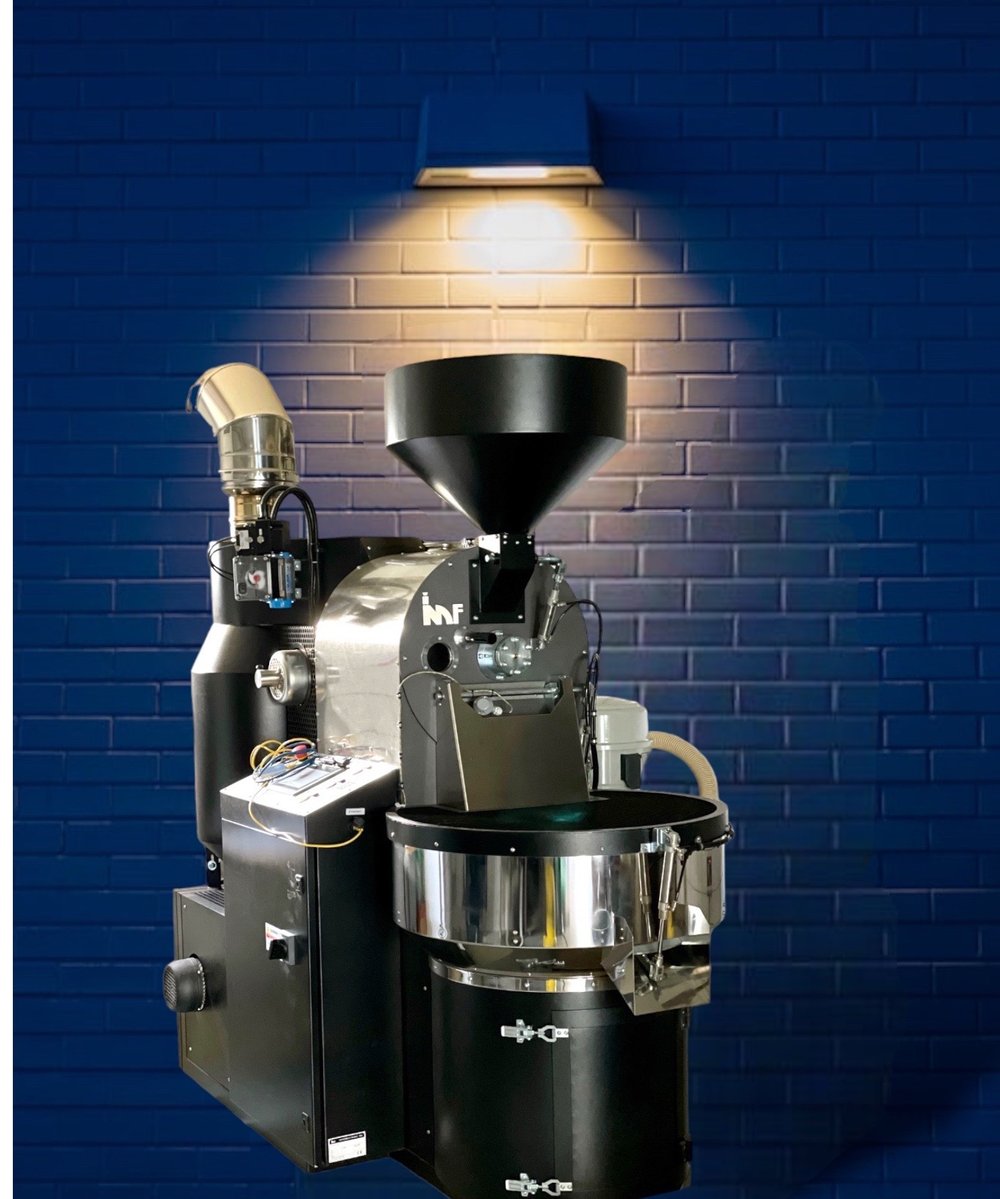
Why I chose IMF for Prodigal
I’ve been asked dozens of times why I chose IMF for Prodigal, and not Loring or Probat. To understand that, I’d like to explain how those machines differ and why I believe IMF makes the best roasting machines in the world.
Drum roasters vs air roasters
Although IMF and Loring machines have drums, most of us call them “air roasters” because they transfer heat almost exclusively by convection with little-to-no conduction. Some air roasters, such as Sivetzand Neuhaus Neotec move the beans via a “fluidized bed” of hot air; other air roasters such as IMF and Loring use a drum to direct the bean movement, independent of airflow.
Over the years, marketers have done a good job of muddying the facts about drum vs air roasting. Air roasting advocates have often claimed all drum roasts are “burnt” and only air roasting is “clean” and some drum roaster fans have claimed air roasts have “no body” or “uneven development.”
While such claims may have some merit when a machine is used improperly, I do not think they accurately represent the results a semi-skilled operator would achieve.
A skilled roaster will find drum roasts offer a little more body, a bit less flavor clarity or delicacy, and less inner-bean development at a given outer-bean roast color. All of those differences are due to drum roasters transferring more heat via conduction.
Air roasters, on average, make inner-bean development easier and are less likely to impart roasty flavors. The same trade-off that exists between flavor clarity and body exists in roasting; increasing one decreases the other.
Air roasters allow faster roasting than drum roasters do, since air roasters can operate at extremely high inlet-air temperatures without concern of overheating the drum surface. The common notion that roasts should take “10-12 minutes” or the like is an artifact of most roasters using drums; let’s say you put a massive burner in a 12kg Probat and roasted 12kg in six minutes; the drum would get so hot that it would sear the beans, causing tipping, scorching, and likely inadequate inner-bean development at lighter roast levels. But it’s common to roast in 6-7 minutes in air roasters; hot air does not damage beans (for reference, in my ROEST, I use an inlet temperature as high as 700 fahrenheit during my 200-g batches with no cosmetic or flavor damage.
One could argue that roast consistency is a little easier with an air roaster, though I think nearly equal consistency is achievable in most machines, provided they don’t have features or control systems that interfere with an effective between-batch protocol.
Which type of roaster is better?
I don’t believe there is a one-size-fits-all roaster design. If you prefer darker roasts and maximum body, you should probably use a drum roaster. At darker roast levels, inner-bean development won’t be much of a concern, and you probably won’t mind the lack of flavor delicacy. If you prefer light roasts and high flavor clarity, you’ll probably want to choose an air roaster.
But, dear reader, please do not misinterpret what I’ve written here: nowhere have I said that you cannot develop light roasts well in a drum roaster or impart roasty flavors in an air roaster. These are merely comparisons of their relative performance.
IMF vs Loring
Given that I prefer light roasts and delicate flavors, I was definitely going to buy an air roaster for Prodigal. The choice came down to IMF and Loring.
Both machines use air-recirculation: instead of having a burner for the roasting process and an afterburner to clean the exhaust air, they have one burner held at afterburner-level temperatures to clean the exhaust air and provide hot air for roasting. Both designs are more fuel efficient than using a drum roaster with an afterburner. But the similarities end there.
Airflow: There are effectively two different airflows in IMFs and Lorings, what I’ll call “air throughput” and “recirculated air.” Think of them like this: imagine you are filling a leaky bucket with water from a faucet. The water entering the bucket and draining from the bucket are the “throughput.” If you simultaneously stir the water, that is the recirculation. The “types” of airflow in the IMF and Loring intermingle but their levels are independent.
Both machines recirculate air through their burners, and assuming one maintains the burner temperature high enough, the air is “cleaned” of smoke and pollution, to prevent the recirculation from tainting coffee flavor.
The amount of throughput in Lorings is correlated with the gas setting, in order for its fuel injection system to maintain a constant air:fuel ratio. So, when using a gas setting of 80%, the throughput is roughly twice as high as when the gas is at 40% (I’m not sure if it’s exactly a 1:1 ratio, but it’s close). I do not like this system for two reasons: it prevents the Loring from lending itself to inlet-temperature profiling (see below), and it means the air throughput is very low when using low gas settings late in roasts. This, to me, is the reason why the IMF is better at both controlling roasts through first crack and executing dark roasts.
The IMF exhaust fan and burner temperature are independently controlled. That means we can have whatever throughput level we want at anytime. It also allows one to use inlet-temperature profiling, which is the best way to control an air roaster.
Incoming air in the IMF is a combination of hot air from the burner and air from the roasting room, blended dynamically by a fluttering “vortex” valve that produces the desired inlet temperature at all times. The level of air throughput is determined by the exhaust fan setting, which is set by the operator.
To me, the only benefit of Loring’s lower overall air throughput is it makes the fuel efficiency higher than that of the IMF. The IMF’s higher air throughput offers superior control of roast curves at all times, especially when most needed late in a roast.
Airflow: advantage IMF
Fuel Efficiency: advantage Loring
Drum: The Loring’s drum is solid steel, while the IMF’s is perforated. While I don’t think that’s a big deal, I would always choose a perforated drum in order to decrease potential conductive heat transfer.
Drum: advantage IMF
Productivity: Both machines can roast full batches faster than a drum roaster. Some Loring machines seem more powerful relative to stated capacity than others (The 15kg seems especially underpowered.) But IMFs are more powerful than Lorings at any size, and one can roast full batches in less than 8:00 in IMF with no compromise in quality.
Productivity: advantage IMF
Control System: Loring offers three ways to control roasts: manually changing gas settings, using automated burner recipes, and “profile roasting.” Burner recipes are like manual control, but with valve settings preset by the operator, and executed by the machine (Cropster Gas & Replay, and Artisan software offer this same option for any machine that has a digital gas valve capable of receiving commands from the software.) In profile roasting, which I wrote about here, the Loring uses a PID to change the gas setting automatically, in an attempt to trace the bean-temperature curve of a reference roast. The system does not perfectly trace curves, because profile roasting gets confused during the first minute of a roast while the BT reading drops. After the turn, the system does a relatively good job of tracing curves, assuming the operator has programmed a curve achievable by the automation. I find the profiling system useful for very dark roasts, but a skilled operator can usually roast more consistently in manual mode than in profiling mode.
The IMF control screen allows the operator to create a twelve-step recipe using bean-temperature set points. The operator can choose the inlet temperature, drum speed, and fan setting at each bean-temperature set point. I cannot overstate the superiority of controlling roasts by inlet temperature rather than valve settings. For example, let’s say you have a Probat and have a recipe that looks like this:
gas 80@ BT300°F
gas 70@ BT320°F
gas 60@ BT340°F
The beans do not experience the gas-valve settings, they experience the inlet temperatures produced by those settings. However, since ambient air is drawn through the burner, unless the ambient temperature is tightly controlled, a given valve setting will produce different inlet air temperatures as ambient conditions change. For example, it’s typical for a certain gas setting to produce hotter inlet temperatures at the end of a roast session than at the beginning, if the roastery gets progressively warmer throughout a session. Likewise, inlet temperatures tend to be higher in summer than winter for a given valve setting.
Directly controlling the inlet temperature prevents inconsistencies due to changes in ambient conditions. I doubt many roasters until now have recognized the benefit of such a system. The improvement in predictability and consistency yielded by an inlet-temperature control system is why I asked ROEST to add that feature to its machines, and why machines like ROEST and IMF make roast replication much easier than machines that require control by gas-valve settings.
One cannot operate a Loring by inlet temperatures, and even if they could, the constantly changing air throughput of the Loring would make the heat transfer more challenging to manage.
Advantage: IMF, by a landslide
In this photo of the IMF recipe screen, the machine will deliver inlet temperatures of
485c @ BT174c
480c @ BT185c
475c @ BT191, etc
Please note these settings are not recommendations; they are merely examples.
Price
While price was never a consideration when deciding which machine to purchase for Prodigal, IMFs are, across the board, cheaper than Lorings. I doubt that will be the case for long, once roasters come to understand the benefits of IMF.
Advantage: IMF
Conclusion
While I consider Loring and IMF to be two of the best roasting machines on the market, I chose IMF for all of the reasons above. I confess that I didn’t start Prodigal earlier because I was frustrated with the choices of sample roasters and production roasters until recently. Now that I have found IMF, and ROEST has added inlet-temperature profiling, I couldn’t be happier with o results.
Since starting Prodigal, I’ve been thinking a lot about sample roasting. Sample roasting is arguably more important to final product quality than production roasting is, so I have been remiss in not discussing sample roasting more in the past.
What is sample roasting?
Sample roasting involves roasting small quantities of coffee, usually as little as 50g up to 200g, but most commonly 100g, to test and choose which lots of green coffee to buy. Sample roasting is also sometimes used to “profile” a coffee before production roasting, but the utility of such “profiling” is dubious. The word profiling can mean various things, but here it refers to the practice of attempting to learn how to roast a new coffee on a small machine, with the intention of transferring that knowledge to a larger machine. Unfortunately, it is difficult to transfer more than general insights (how much relative power does a coffee require to roast, approximately how does it behave around first crack, what roast color tastes good, etc.) from a small machine to a larger one. Profiling in this way can give one a “ballpark idea” of how to approach a coffee, but cannot, with our current technology and understanding, tell one precisely how to roast a coffee in a larger machine.
Types of sample roasters
Historically, most sample roasters were small drum roasters with open-faced drums, such as in the photo above. While such dinosaurs often churn out surprisingly delicious coffee, they make consistent, predictable results nearly impossible. For a deep dive into why these machines offer poor consistency, and how to modify them for better results, please see my post HERE
In recent years, a plethora of +/-500g drum roasters have hit the market that offer more controlled and consistent, if not always as delicious, sample roasts. Most such machines come from China, have similar features, and none stand out as particularly special. The positive aspects of these machines include fully modulating control over gas, drum RPM, and airflow, and easy connection to software such as Cropster or Artisan. However, some of these machines roast with too much conduction, most have slow bean probes in frankly stupid locations, and some have the reliability of an Edsel. If you don’t know what an Edsel is, consider yourself fortunate.
If you are going to buy one of these small drum roasters, I recommend getting one of the cheaper ones, because they are all similar, with nearly identical designs, and usually require the user to replace and move the BT probe, possibly the gas-pressure gauge, and often a few other small features.
More recently, air roasters such as the Ikawa, Kaffelogic, and Roest have hit the market. The potential roast quality out of air roasters is generally superior to that of drum roasters, since air roasters transfer little to no heat by conduction, but instead use convection, which makes it easier to develop coffee and avoid roasty (not a real word) flavors. Until recently, I was frustrated by the control and repeatability offered by most of these machines, although all have the ability to produce delicious coffee at least some of the time.
What I use
Prior to 2022, my preferred sample roaster was a 500g drum roaster. Such machines offer good data quality down to 100g batches, and offer probably the most insight into how a coffee may behave in a production roaster. Roast quality was “pretty good” but consistent and predictable. I’d rather roast at a quality level of 8/10 consistently than have erratic, and occasionally better, sample roasts, because one needs consistency to give each green sample a fair trial.
More recently, at Prodigal I began using the Roest. For full disclosure, I did not pay for the machine. You don’t have to trust me, but no amount of free stuff could make me use anything but the best possible machine at Prodigal, or could compel me to write a blog post about a product. I needed a great machine to get the most out of my coffee, and for years I’ve been begging manufacturers to build exactly what Roest has built.
My relationship with Roest was rocky at first, as I had a disagreement with someone at the company about roasting data. Because we had such different perspectives, I invited some of the Roest folks as guests at my roasting seminar in Boston last year. They took notes, asked questions, shared their experience designing machines with the class, and — wonderfully — embraced the importance of an effective warmup and between-batch protocol. They were excited, because they recognized an effective BBP was not only necessary for good consistency (yes, even in an air roaster), but also essential for successful automation and replication. I was excited, because a manufacturer finally engaged and cared about the importance of a quality warmup and BBP :). Further discussions led to the addition of an inlet-temperature probe, because using an inlet-temperature recipe is the most effective way to manage an air roaster consistently (more on that in a future post).
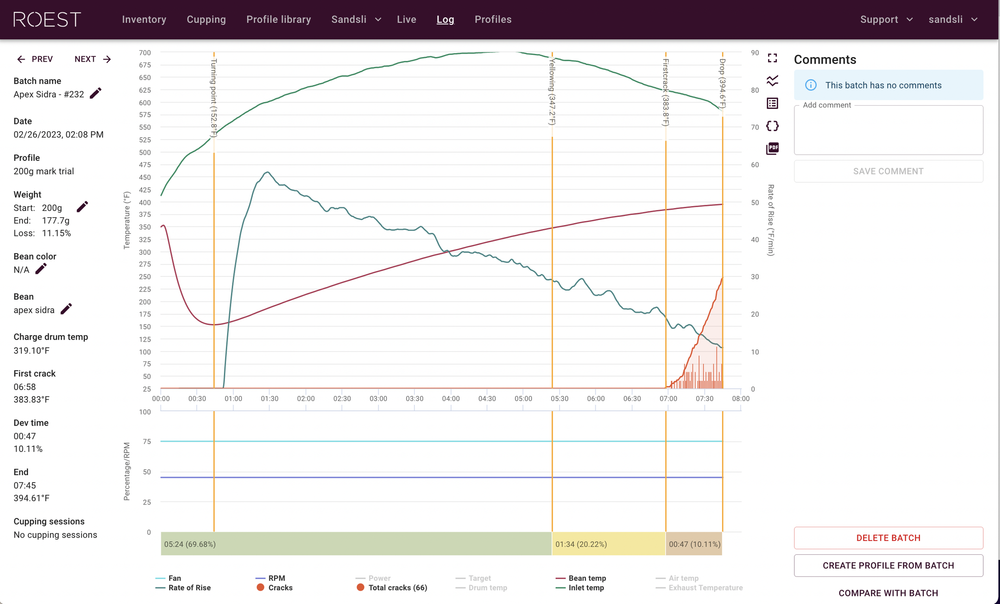
A roast using an inlet-temperature profile (please ignore the “yellowing” note)
Last year, Roest added the ability to create customized warmup and BBP profiles, and now the machine automatically triggers the BBP upon dropping a batch. I cannot say how happy that makes me as a roaster, and also the only person yelling about the importance of an effective BBP for years. The last piece of the puzzle happened this month, as Roest now offers the option to create inlet-temperature profiles based on bean-temperature set points instead of time. Such as system makes consistent, predictable, high-quality roasting possible in a way it had never been before.
I’m grateful to Roest for the machine, but more grateful they care about details, consistency, and continual improvements. Choosing a sample roaster is finally a no-brainer for me.
NB: Readers may notice some similarities between the Roest and the Decent espresso machine. I’m fond of both machines for similar reasons: each is a seamless marriage of user-friendly, clever software and hardware, both companies listen to feedback and rapidly improve and update their software and hardware, and they offer unparalleled control and real-time information while roasting and making espresso, respectively. Most importantly, each offers better coffee, more consistently, than any other machine in its category.
Roest screenshots: 1) An inlet-temperature profile 2)Profile log 3)Roast comparison
Portland Classes
Please join Samo Smrke and me for our masterclasses in Portland.
You can find tickets and details about my roasting masterclass HERE.
Tickets and details of Samo’s “Improving coffee with science” class can be found HERE
Prodigal Update
Prodigal is on hold for another month or two, while we finalize our permits and the installation of our IMFroaster. We may release a small amount of extremely delicious coffee in the next couple of weeks, as we have some stunning green that we want to roast while it is still incredibly fresh. We will update our mailing listandInstagramfollowersas soon as we know when we will get back to a regular roasting schedule.
Prodigal Coffee at SCA Expo
I’m pleased to announce you will be able to taste two smashing Prodigal coffees at SCA Expo, our washed Colombian “Finca La Indonesia” sidra and washed Colombian “Francy Castillo” geisha. I will roast both coffees on the ROEST, the machine I consider hands-down the best sample roaster.
You can taste Prodigal’s coffee brewed in the new NextLevel Pulsar by the fine folks of NextLevel (they will share Sivetz Roasters’ booth) and also at the ROEST booth. I will spend time brewing the coffees at the two booths, and I’ll post my schedule on Instagram on the day of the event so you know where to find me.
My intention is to not only showcase what the ROEST and Pulsar can do, but to make sure these are the two most memorable coffees you taste at Expo!
You can, of course, also taste Prodigal coffees at my Roasting Masterclass on Saturday.
Thanks to Apex Coffee Imports for sourcing two of the cleanest, prettiest, most floral coffees I have tasted in recent memory.
I look forward to seeing you in Portland!
HOW TO BE A BETTER CUPPER
Mar 09, 2023
Show notes
Ahead of the launch of Prodigal, Mark and I cupped for a minimum of one hour each morning. Having such a routine allowed us to calibrate well after cupping more than 2000 samples together. Those sessions also taught us a lot, some of which I’d like to share here. First, I want to credit Ryan Brown. Over the years, I learned a lot not just from cupping with Ryan, but from throwaway remarks he would make. To him, many of those remarks were the equivalent of cupping small talk. To me, they often held pearls of hard-earned wisdom. Ryan is rigorous in creating systems that prevent bias and help to confirm his findings about samples. A good green buyer cups each sample multiple times on multiple days and does everything possible to avoid bias. Until launching Prodigal, most of my cupping was done through the eyes of a production roaster and cupping was mostly an exercise to evaluate roast quality. I focused on problems of baking, roast development, side effects of excessive conduction, and the like. I did not cup to intensely analyze the merits of one green lot vs another. But production-roast cupping improved my green-evaluation skills.
Herein are what I consider some cupping best practices.
Always cup blindly
This rule may seem obvious, but in my experience, few roasters follow this rule religiously. I get it: cupping blindly with others can be embarrassing and humbling. But cupping isn’t a competition. You can either protect yourself from looking bad, or you can learn from experience, but you can’t do both well at the same time. Suck it up, make mistakes, and don’t worry if you thought that wet-hulled Sumatra was a washed Kenya. It happens to everyone.
As often as possible, consder “double blinding” a cupping by having someone else set up the cupping so the cuppers do not know what coffees are on the table.
To make cupping as blind as possible, consider hiding visual differences in coffees; for example, if you have a variety of roast levels on the table, it helps to cup in bowls with black interiors, in order to not see the colors of the brews. Some training sessions even use sunglasses to decrease visual cues about samples.
Please do not use the traditional practice of setting a sample tray of roasted coffee next to each cupping bowl. That makes it impossible to be appropriately blind when looking at the roasted beans of a sample.
Always cup with others
Cupping with others is far more educational than cupping alone. Various people will perceive different flavors in coffees, and some people are better at perceiving certain defects than others are. Cupping with others is a great way to expand your tasting abilities. For example, Mark is better than I am at tasting certain underdeveloped flavors, while I am more likely than he is to detect fade in coffee samples. Cupping together helps us shore up our weaknesses.
Try to cup with more experienced professionals whenever possible.
This is a no-brainer. Cupping with more experienced pros is by far the best accelerant if you want to get better at tasting coffee.
Always take notes during cupping
Please don’t try to memorize your impressions of 5–10 cupping bowls; it is always better to take notes to discuss results with others, for scoring coffees accurately, and for future reference. I don’t believe one needs an official score sheet to score samples accurately, but I do believe it takes months of calibration practice to score accurately and consistently.
Wait until after everyone has done at least one round of slurping and note taking before discussing samples
I’ve been to many cuppings where people begin discussing the coffees as soon as they begin tasting. That is more fun than taking notes silently, but it also inhibits learning and increases the risk of bias.
Be as rigorous as possible in cupping procedure
What I mean by this is: use a consistent grind setting (I usually grind at a setting 1-2 integers finer than a typical 20g pourover setting) and water chemistry, weigh grounds to 0.1g resolution, weigh water to within a few grams per bowl, grind, pour, and taste on a timer with a rigorous schedule, and consider cupping at a brisk but comfortable pace to ensure you are tasting all samples at similar temperatures. Ryan taught me to take just one or two slurps per sample and to focus hard on those slurps. That has helped me cup more quickly. Previously I was taking too many slurps per bowl, which was taking too much time, decreased my focus , and caused my palate to fatigue earlier.
Take one or two slurps, jot down a couple of words in your notes, and move to the next bowl. It’s okay if you don’t perceive an encyclopedia of descriptors after just one or two slurps.
When cupping to choose green, do your best to optimize cup quality
When cupping to decide what green lots to purchase, sample roasting and cupping should be done in a way that optimizes cup quality. That will allow each green lot the shine and show its best features.
When cupping for production roasting QC, consider sacrificing cup quality, if necessary, in order to detect roast defects more easily
Let me explain this idea… Personally, I use an identical procedure when cupping for green buying and cupping for production roast analysis. However, I’ve cupped with many companies whose coffees tasted better when using a coarser grind or lower water temperature during cupping. In those situations, grinding finer or brewing hotter likely highlighted roast defects. If your cuppings taste better at grind settings coarser than your typical pourover grind setting, then there is probably work to do to improve roast quality. But please do not change the grind setting or water temperature to improve the flavor of cupping bowls.
Always cup at least one sample from another roaster on every table for context
I find many roasters are biased in favor of their own coffees. I recommend roasters find the best coffees they can from competing roasters, and to always have at least one such sample on every cupping table for context.
Test the effectiveness of your cupping system
Many roasters have told me something like “This coffee cupped sharp on day one out of the roaster, was super fruity on day two, the flavors were muted for a few days and then the coffee was cupped great again after one week.” While I don’t doubt that cupper’s experience, it is unlikely the coffee really got worse, better, worse, and better. It’s possible, of course, but it’s more likely the cupping system is to blame, or the coffee has an abundance of quakers or other dodgy beans that show up in some samples but not others.
To test the reliability of your cupping system, try something like this:
Scatter three bowls of the same coffee among several other coffees on the cupping table. Note whether your tasting notes and scores were consistent for those three bowls.
Taste several bowls of the same coffee several days in a row, again scattered among other samples, to see whether your notes change day to day.
With a little effort, you can taste the baseline reliability of your cupping system. If the three bowls in each of the trials above tasted and scored identically, your system is probably reliable. If the three bowls varied a lot in flavor
, it’s important to run the same test with a few other coffees to see whether the cupping system or the coffees themselves are inconsistent.
In general, scattering multiple bowls of a particular sample throughout a cupping table and trying to identify them is an excellent exercise to hone your tasting ability.
Re-cup your roasts several times over the few weeks after roasting
Once you have shored up the reliability of your cupping system, it is worth tasting various roast batches over several weeks after roasting to perceive how the coffee ages and evolves. You may find your coffees typically peak after a certain number of “resting” days or you may find your coffees peak within a day of roasting and decline from there.
Regularly testing and monitoring the quality of your roasts as they age can help you optimize your customers’ experience.
Cup more rigorously when purchasing green than when analyzing sample roasts
When cupping to select green for purchase, I consider it essential to cup multiple bowls of a candidate sample multiple times before choosing a green lot. Not only do I want several looks at a coffee in order to avoid defects that may appear in only some bowls, but I want to confirm my impression of a coffee before committing to it.
When cupping production roasts, we are usually confirming the consistency of our results, or testing whether one approach works marginally better than another approach to roasting a particular coffee. Occasionally I will re-cup a roast batch to get a clearer picture of its quality, but usually one bowl is sufficient per batch.
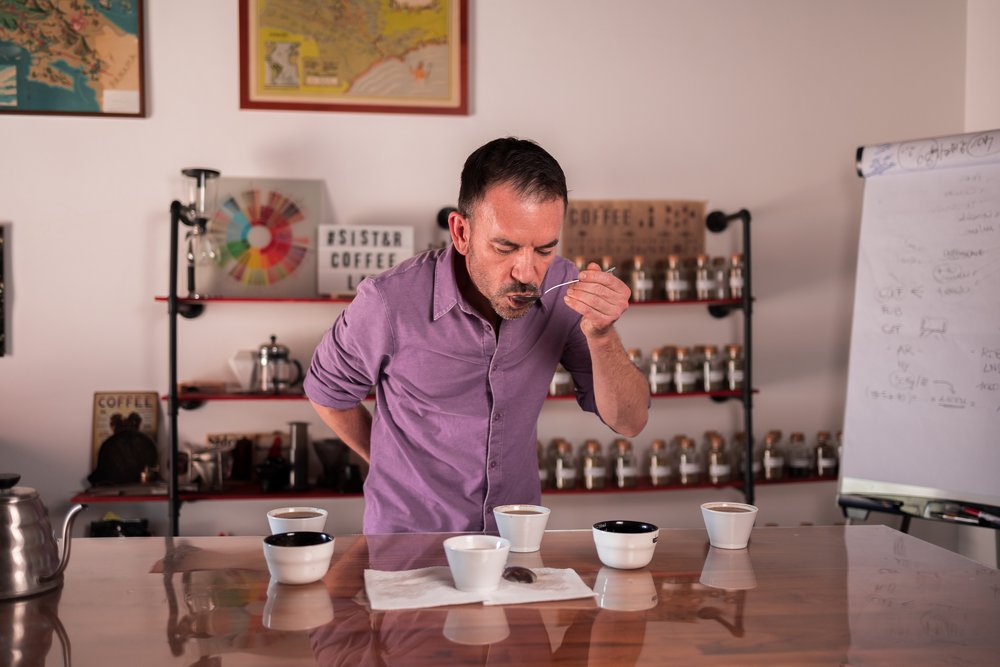
photo credit: @coffeeandlucas
Prodigal Update: month two and a discussion of roast quality vs roast style
Feb 03, 2023
Show notes
Lessons from the first month
We received multiples more inquiries than we had coffee available. Some of that was due to us deciding some of our green, once arrived, was below our quality standards for Prodigal, and some was due to my poor forecasting skills.
Roasting and filling orders and handling inquiries was quite a challenge, as we had expected a much slower start. To be frank, no part of the process ran as smoothly as I would have liked, but we intend to be far more prepared for our next roasting and fulfillment session.
Before the launch we did not have a green moisture meter, color meter, or enough staff to double-check every order. We also didn’t have experience with how our roasts would evolve due to travel and resting. All of that is sorted now.
The first day of roasts (Jan 4) cupped beautifully directly out of the roaster and the next morning. A week or two later, the coffees tasted “too developed” but not roasty. I issued a public apology and offered to make any dissatisfied customers whole. Three customers took us up on that offer.
Working on a new machine in an environment I couldn’t control was challenging. Contrary to popular belief, roasting is about systems and controlling variables, not about sniffing beans in a trier or some sixth sense about what is happening to 50,000 beans inside a giant hunk of hot metal. Having sixty batches under our belts, learning when to roast (at night, in a sealed, climate-controlled space), and how our coffee would age with time, will all contribute to future improvements.
The vast majority of feedback was wildly positive; we received many comments such as “the best coffee I’ve tasted in over six months,” “the juiciest roast I can remember,” etc. The majority of critical comments were something like “it was not roasty but it was more developed than I prefer.” As noted, those batches have been acknowledged, and I don’t expect many of those roasts or comments in the future, other than from the more extreme tasters out there. Doing the best one can is not the same as pleasing everyone.
A couple of weeks ago we upgraded our sample roaster and began using the Roest. After a few days of a steep learning curve on the Roest, we’ve settled into a system using the new inlet-temperature recipe program and automated BBP. We’ve been pleased with the overall results. I’ll write a post soon about our experience with the Roest.
We sold coffee wholesale to three cafes with whom we had prearranged deals. With apologies to others who made wholesale inquiries, we did not have enough green to sell wholesale to any other cafes. We hope to change that soon, but it will depend on retail demand and green availability. Likewise, we hope to offer a subscription soon, but cannot do so until we are confident about having a steady stream of green that meets our quality threshold.
Roast level vs quality of roast
Having consulted for well over a thousand roasters over the years, I have to remain relatively adaptable about roast level. It is not my job to tell my clients how light or dark to roast, it is to help them achieve their desired roast level in the highest-quality and most consistent way possible. I’ve literally never told a client “you have to roast darker (or lighter)” or “you have to roast to 20%DTR,” etc. What one writes in a book for mass consumption is necessarily different from what one prescribes to a roaster with a particular machine and unique goals. As a consultant, step one is to ask a client his or her goals. Step two is to help them achieve those goals. Everything must be customized for that client.
Like any coffee drinker, I have my personal preferences. I prefer light, juicy roasts of clean —usually washed — coffee, and famously despise funk. I respect that others have different preferences.
There is, however, a difference between roast level and quality of roast.
I’ve noticed many people confuse the two. A roaster may roast darker than I like, but do a great job of optimizing that roast level. Likewise, another roaster may roast in the color range I prefer, but the coffee may be baked or underdeveloped. I do not judge roasts solely by the final color, I also judge them by how skillfully the roaster achieved that roast level.
Roast level is a style choice. Roast quality is independent of roast level. I don’t see that distinction made often enough.
What’s next
Prodigal will release four new coffees this week. I’m pleased to say the new release will include our first natural :0, our first blend (the components of which will remain a mystery until next week’s blog post), a new shipment of the lovely Betel Geisha, and our first coffee from Ecuador.
We always notify our Prodigal Mailing Listsubscribers a day before anyone else of our new releases. If you don’t want to miss out on the new offerings, please consider joining the mailing list.
Thanks for your support
Prodigal week one: lessons and confessions
Jan 09, 2023
Show notes
“Transparency,” like “sustainability,” is a word thrown around too often. Let’s face it, very little in modern society is truly sustainable. Likewise, transparency in business is always selective and limited.
It is nice to know that a roaster paid $10/kg FOB or $5/KG at the “farm gate” but do we know what that really means to the producer? It’s always more complicated than it seems. We paid $19/lb ($41.80/kg) before shipping for our two Betel coffees, but we don’t know César’s input costs or the cost of living in his part of Colombia. I don’t know how he and his family are doing financially, but he produces lovely coffee and he seems happy.
It’s easy to say “this is what we paid” but it’s difficult to know what the numbers mean. One USD of income is a very different thing in Cauca and Copenhagen. I can imagine economists arguing endlessly about how to compare the value of a dollar in each place.
Financial transparency is nice, but tricky to make sense of at times.
At Prodigal, we hope to practice a different type of transparency more relevant to our customers: owning up to our virtues and mistakes. I’ve ordered coffee from hundreds of respected roasters over the years, and as every honest, experienced coffee professional knows, inconsistency is rampant in our industry.
Sources of inconsistency in coffee
Green coffee quality can change radically from the cupping table at a mill, to a PSS (pre-ship sample) from an importer, to an arrival or spot sample offered in the country of the roaster. A small change in green temperature or ambient roastery temperature can be the difference between a deliciously developed and underdeveloped roast. Heck, even what was roasted the previous batch can dramatically impact the current batch, unless one has an appropriately slow, systematic BBP (between-batch protocol), and even then, there are times when a BBP has a difficult time compensating for extreme changes in batch-to-batch roast styles (eg switching from a dark roast to a light roast or changing batch sizes mid-session can cause a roaster fits.) Throw in problems with water chemistry, brewing technique, and grind quality, and it’s a wonder that we ever enjoy two consecutive cups of coffee.
Prodigal: consistency, standards, and flops
When Mark and I launched Prodigal, we fretted over every detail that could affect quality, and we still came up short in some ways. For example, we cupped over 100 green samples, begged suppliers to be very selective in what they sent us, and we purchased only seven coffees.
All of the coffees we purchased cupped at 87.5+ as PSS. We score strictly, and if you see any green sellers or roasters claiming they are awash with 88+ coffees, please disregard them. Score inflation is real. We calibrate with COE judges and impartial Q Graders, not marketing scores.
Upon arrival, a few coffees held up and matched their PSS quality, and a few declined by 0.25-0.75 points across numerous sample roasts. We made the difficult decision to not sell those coffees as “Prodigal” because we want to uphold a certain standard for our brand, even if it means we sell less coffee. All of the rejected coffees are still lovely, and i reckon almost any coffee pro would happily drink them.
We are selling our good-but-rejected arrivals as green coffee to home roasters, as they are tasty, and a bargain relative to what home roasters can source through the usual channels.
Green buying is the most important and difficult job of a roasting company. Green coffee is alive and constantly changing. Precious, delicious green gets exposed to a variety of conditions between the mill and the roastery that can and will degrade quality. We missed by a little on three of our seven purchases. We will find transparent ways to unload our green that doesn’t make the cut.
Roasting
I separate third-wave roasters into three groups; note that companies I refer to here may offer more than one roast level or style. I am focusing on their “filter” roast offerings, and don’t mean to imply that they target only one goal or style for all of their offerings. They are merely illustrative examples using high-quality, familiar roasting companies. I have enjoyed coffee from all of these companies and roast styles at times.
“Nordic” style roasters favor cup clarity above all else. Examples of such roasters include Sey, La Cabra, and Tim Wendelboe (Tim crosses over into the “maximum juiciness” group frequently, in my opinion.) Fans of those companies are virtually allergic to “roast” flavors and most fans would probably choose to sacrifice some sweetness, body, and juiciness to achieve maximum clarity. One may often need to “rest” Nordic roasts for several weeks or months to decrease the perception of underdeveloped flavors.
“Maximum juiciness” roasters target a balance of acidity and sweetness, and are willing to sacrifice a bit of body or clarity to achieve their aims. Such companies include Regalia, Nomad, and Doubleshot.
“Fully developed” third-wave roasters focus on sweetness and juiciness, and sacrifice a some acidity and clarity to meet their goals. Examples of such roasters include Onyx, Go Get ‘Em Tiger, and Blue Bottle.
Each group has its fans and detractors. Some Nordic-style fans tend to call everything else “dark,” which is like a guy who is 6’5” calling everyone else short.
The common complaints about Nordic roasts, beyond their light, tea-like body, include flavors reminiscent of peanuts, vegetable broth, grass, and cellulose. Most Nordic roasters drift into that flavor territory periodically. To me, it is a fail; to others, it’s no big deal.
“Maximum juiciness” roasts may be too low in clarity or acidity or body, depending on the coffee drinker.
“Fully developed” roasters may stray into “roasty” territory on occasion, or suppress acidity enough to make some coffees taste a little dull.
For the record, my personal preference is on the light end of maximum juiciness. But it is not always wise to attempt to target one’s ideal roast level, as discussed below.
Prodigal beans, left to right: Betel geisha, Fidencio Castillo (caturra and Colombia varieties), and La Argentina pink bourbon
Prodigal’s roast style
We are currently roasting on a friend’s Probat. While we roast on that machine, we will target “maximum juiciness.” Once we have installed our IMF roasting machines, we are likely to lighten our roast level by a few degrees Fahrenheit, or approximately 5-10 points on the Agtron Gourmet Scale.
Why would we roast darker on a Probat than on an IMF? An IMF, like a Loring, is a convection-dominant machine that recirculates exhaust air through a burner held at 600 to 700°C. Such machines are very fuel efficient and make inner-bean development easier than do classic-drum roasters. When inner-bean-development is easier to achieve, it is safer to roast light with less risk of underdeveloped flavors.
My mistakes
When we launched Prodigal, we thought we had enough green to last a few weeks. Instead, we sold out in 24 hours. That presented several challenges to our efficiency and quality. We not only had to roast through the wee hours of the morning several days in a row, but we learned the hard way on our first roast day that our roastery’s ambient temperature was not stable enough to roast on our preferred knife’s edge of Nordic/maximum juiciness without flirting with underdeveloped flavors or losing some juiciness.
Three batches from day one went into bags of “first batch” beans we sell at a steep discount. The “first batch” offering was very popular, and we look forward to feedback from customers who purchased our “first batch” coffees.
To combat consistency and development problems, on day two we stabilized the roastery’s ambient temperature by roasting at night when no one would open doors to the frigid Colorado air. Along the way, we cupped every batch directly out of the roaster (!), as well as the next morning, and we were happy with the results. We see ways to improve, and we see every batch and cupping as an opportunity to learn and improve.
We will always cup every batch before packing it in Prodigal bags. It’s time consuming and makes our systems less efficient, but we think it’s worth it.
Unfortunately, those roasts from day one lost some vibrancy over the next few days, and I reckon by the time some international customers receive those beans, the roasts will be in the “fully developed” camp. We’re thrilled with their sweetness, and none of those batches tastes “roasty,” but we missed the sweet spot on several batches from day one. I’m frankly a little embarrassed by that. We will do everything in our power to ensure that never happens again. (Note: please do not “rest” our beans; drink them ASAP upon delivery.)
Thankfully, the next two roast days were more on-target and consistent, we were able to safely lighten our drop temperatures by 3°F/1.5°C, and we now have a tighter rein on green-storage temperature, roastery ambient temperature, and our approach to the Probat. Perhaps 25% of our roasts fell in the “fully developed” camp and the other 75% were in the “maximum juiciness” category. Nothing was baked, underdeveloped, roasty, or flicked, but some of our roasts taste darker than we would have liked. If you purchased some Prodigal coffee and found it too dark, please let us know.
Our promises to you
Coffee is challenging. We’re always learning, our standards and preferences are always evolving, and we are all fallible. I rarely hear roasters own up to their mistakes or inconsistencies, and often see them fight back against legitimate customer complaints. I’d like to do things differently.
If you are ever unhappy with any Prodigal purchase, please reach out to us directly (preferably without maligning us online first) and we will find a way to satisfy you.
No company or roast style will please everyone, and I expect to hear an equal amount of “you roast too light” and “you roast too dark” comments over the coming years. We’ll do our best to set clear expectations, communicate about our mistakes, and manage customer relationships with respect.
We will alert our mailing list first when we have new coffees!
HOLIDAY COFFEE GIFT GUIDE
Dec 06, 2022
Show notes
Welcome to my semi-annual Holiday Coffee-Gift Guide. I thought it would be nice to suggest a few coffee-related gifts for the coffee nerd in your life. I won’t tell if you buy yourself the gifts or ask me to send this blog post to a family member ;). These suggestions are completely biased: they are all products I enjoy, and some that I sell. Barista Hustle Subscription Forget overpriced, dumbed-down industry courses; the BH Unlimited Subscription is hands down the best all-around online coffee education money can buy. Coming from someone who offers coffee education for a living, I hope those words carry weight. Whether for you or for your café staff, BH is the best option. In 2023, BH Unlimited is going to get even better, as a certain blogger you follow will be contributing to the subscription’s roasting content. Click HERE to sign up and get a 14-day free trial. Lagom P64 and P100 If you *really* like someone, get him or her a Lagom grinder. The Lagom P64 and P100 are the best single-dosing grinders on the market, in my opinion. The grinders are beautiful, have low retention, excellent burrs, adjustable RPM (an important, underrated feature), and the are well-aligned at the factory (Thank you, Option-O, for caring.) In other words, Lagom offers everything you can ask for in a grinder. Photo @Juheegrapher Spinware Ceramics Crafted by my friend Martina in Golden, CO, Spinware Ceramics are clean, beautiful, functional, and durable. Martina’s work would make a great gift for anyone who drinks coffee or tea. From Spinware’s website: “When you buy a handcrafted piece from a ceramic studio, you are buying more than an object. You are buying hours of experimentation and error. You are buying moments of frustration and happiness. You are buying a piece of heart, a piece of soul, and a piece of someone else's life.” The Fellow Ode was already the best-value home grinder on the market for making filter coffee (note: it is not designed to grind fine enough for espresso or aeropress) before they released their v2 burrs in late 2022. Now it’s the best-value home grinder with even better grind quality (but still not made for espresso.) March Online Roasting Class I don’t usually pre-sell my online classes, but in case someone would like to give or receive a class as a gift, I thought I’d make tickets to my upcoming March online roasting class available now. The class comes with daily access for one month to a private group in which I will answer any and every question asked, and help students manage their roast curves. This is the most factual and practical roasting class in the world. Clever Dripper The Clever Dripper doesn’t get the credit it deserves. Compared to a pourover, the Clever produces delicious, non-astringent coffee with less effort and skill required. Pro tip: add the water first to yield higher and more even extractions. When adding the water first, one avoids the two most challenging problems in pourover brewing: achieving even extractions and extracting at high-enough temperature to make acidity “pop.” What I know about running coffee shops By Colin Harmon I’ve owned enough cafés to say with authority that this is a good book. While it’s tempting to dismiss the book as “mostly common sense advice,” it is packed with great advice aspiring and current café owners should follow, but few do. Colin’s writing is informal and pleasant, and the book is peppered with stories and lessons he learned while building his successful company 3fe in Ireland. Doubleshot Christmas Set Doubleshot from Prague doesn’t get the attention it deserves, perhaps because they don’t roast super-light, but attempt to highlight the juiciness and ripe fruit notes in coffee by roasting light/medium. Regardless, Yara from Doubleshot is one of the world’s best green buyers, and his production-roast cupping tables are as delicious as any I’ve experienced. Doubleshot is offering a Christmas Coffee Set featuring two washed Colombian coffees from the Imbachi family, whom Yara has worked with for eleven years. Both coffees, caturra and pink bourbon, are grown on the same farm and processed identically. This set is a unique opportunity to taste the influence of coffee variety on flavor. Expect big, juicy, ripe fruit notes with a hint of spices (it is Christmas, after all.)Click HERE to purchase in North America and HERE to purchase in Europe and the rest of the world. Lotus Water Drops Lotus Water Drops: While there are plenty of powder sachets you can buy to optimize your coffee water, I prefer the Lotus Water Drops, both because many of the sachets on the market produce inconsistent results, and because the LWD mineral concentrates are easier to use. To be honest, I’ve spent a few too many Saturday mornings exploring how different LWD recipes affect coffee flavor. If you need suggestions for how to use the drops, see my blog post here. Last, but not least: Introducing Prodigal After 15 years of writing and consulting, I’ve missed producing something tangible, and decided to get back into roasting. My new company Prodigal, based in Boulder, Colorado, doesn’t intend to be large or take over the world. What we want is that thing we’ve never been able to find: a source of clean, juicy, delicious coffees, always roasted meticulously. Our promise to you is every coffee we ever ship in a Prodigal bag will be well developed, not baked, and not roasty (and not funky haha). If we make a mistake, it’s our problem, not yours. Count on it. Our first offering is a set of four gorgeous, clean, washed Colombian coffees. Not only will our first month’s offering come separately or as a set of four coffees, but we will offer our customers an online, interactive cupping session with Shared Source founder Andrew Kelly, who imported the green, and myself. Prodigal customers are welcome to cup and score with us, and ask questions along the way. Prodigal will launch in the coming week. Please follow us on Instagram @getprodigalcoffee; we will offer our Instagram followers a discount on the first order and they will always be the first to know when we release a limited-edition coffee likely to sell out quickly.
LOTUS WATER DROPS: How to use them, and a great hack to find the best water for your coffee
Dec 02, 2022
Show notes
Years ago, the main concerns about water for coffee were “don’t scale up your espresso machine,” “don’t make coffee with very hard water,” and “don’t use water that tastes or smells bad.” Times have changed; since the advent of the Barista Hustle water recipe and products like Lotus Water Drops, capable of independently manipulating water hardness and alkalinity, coffee enthusiasts have become much more interested in customizing water to enhance coffee flavor.
Over the past few months I’ve been using Lotus Water Drops at home to make coffee and to learn more about the effect of water chemistry on coffee flavor. In this post I’d like to tell you about the drops, the standard way to use them, and a shortcut I use to discover the optimal water for a particular coffee.
About the drops
A kit of LWD contains four dropper bottles:
Calcium Chloride (CaCl2)
Magnesium Chloride (MgCl2)
Sodium Bicarbonate (NaHCO3)
Potassium Bicarbonate (KHCO3)
The Calcium (Ca) and Magnesium (Mg) contribute to hardness
The Sodium (Na) and Potassium (K) Bicarbonate contribute to alkalinity
(All references to ppm in this post refer to ppm as CaCO3 equivalent.)
For 450 ml of water:
1 drop Ca adds 10 ppm hardness
1 drop Mg adds 10 ppm hardness
1 drop Na adds 5 ppm alkalinity
1 drop K adds 5 ppm alkalinity
For one gallon of water:
5 drops Ca adds 6 ppm hardness
5 drops Mg adds 6 ppm hardness
5 drops Na adds 3 ppm alkalinity
5 drops K adds 3 ppm alkalinity
Hardness and Alkalinity basics
Hardness, also known as General Hardness (GH), is a measure of divalent ions (ions with a positive charge of 2+). Magnesium and Calcium make up the bulk of hardness in water, and, depending on their levels and ratios – and who you ask :0 – may add “sweetness,” “structure,” or flatness to coffee.
Alkalinity, also known as Carbonate Hardness (KH), buffers acidity. Too little alkalinity, and coffee may taste acidic and unrefined. Too much, and coffee may taste chalky or flat.
Note that the flavor effects of these minerals are not “linear” or always predictable. For example, I recently tested four LWD recipes using the same coffee, and the cups at 10 KH (low) and 70 KH (moderately high) “popped” and tasted better than the cups at 30 KH and 50 KH. At extremes, such as 0 KH or 150 KH, the effect of KH on flavor is more predictable.
I prefer a little sodium in my coffee water because sodium counteracts bitterness. If you want to tame a bitter coffee such as a robusta or dark roast, adding extra sodium may help. If for some reason you must drink a dark-roast robusta, just dump an entire salt shaker in the mug after brewing.
Alkalinity for filter coffee and espresso
When adding minerals to water, one can do something not usually possible with standard water-treatment systems: easily and radically change hardness or alkalinity independently of the other. Very hard water is not great for coffee making because some of the hardness will precipitate as scale upon heating the water, and scale can damage coffee machines. However, very high-alkalinity water can have positive effects espresso.
Many coffee professionals agree that when making filter coffee, water alkalinity levels around 30–40 ppm yield reasonable levels of acidity. Given that alkalinity neutralizes acidity, and filter-coffee strength is approximately 1.2–1.4% TDS, to neutralize acidity in espresso at a strength of 10% TDS requires water with perhaps 7–8 times more alkalinity. With LWD or a jar of sodium bicarbonate, one can experiment with neutralizing espresso acidity for interesting effect. I doubt making espresso with KH of 200-300 ppm will become the norm, but I have found the results enjoyable and insightful.
Protecting your machines while experimenting
Calcium can create scale but Magnesium cannot. Therefore, you can test high-hardness and high-alkalinity recipes by increasing Magnesium and bicarbonate without increasing Calcium beyond a certain level. To estimate the scaling and corrosion potential of a recipe, you can use this online calculator.
How to use Lotus Water Drops - the standard method
The traditional way to use LWD is to add drops to distilled (demineralized) water. If distilled water is not an option for you, reverse-osmosis water is the next best option, but one can add LWD to any water to increase its hardness or alkalinity.
A couple of standard filter-coffee recipes based on distilled would look like this:
*the Rao/Perger recipe is the brainchild of Dan Eils, my partner and 3D printing expert at Litmus Coffee Labs
To one gallon of distilled or RO water, add:
25 drops Ca
50 drops Mg
30 drops Na
40 drops K
My Lotus Water Drops hack to reverse engineer your preferred water chemistry
Recently I was frustrated by the myriad possible water chemistries and decided to create a shortcut to finding what water chemistry would make the beans in my kitchen taste best. Using a surprising recent insight from chemist Samo Smrke that coffee tastes the same whether water minerals are added before or after brewing, I decided to brew a large amount of coffee using distilled water, split the brew into several equal portions, and add LWD to the brewed coffee.
Here is a shortcut to zero in on your preferred water chemistry:
Brew 900ml of coffee (you can do this by combining multiple pourovers, using one giant immersion, or whatever is convenient.)
Stir the brewed coffee well.
Pour equal 225ml portions into four cups.
Add a different combination of LWD to each cup. Each drop of Ca and Mg will add 20 ppm GH; each drop of Na and K will add 10 ppm KH)
Stir and taste (preferably blindly)
For example, I tried this recently to zero in on my preferred KH level for a coffee:
Cup one: 1 Ca + 2 Mg + 1 Na (60 GH, 10 KH)
Cup two: 1 Ca + 2 Mg + 2 Na + 1 K (60 GH, 30 KH)
Cup one: 1 Ca + 2 Mg + 3 Na + 2 K (60 GH, 50 KH)
Cup one: 1 Ca + 2 Mg + 4 Na + 3 K (60 GH, 70 KH)
Note that while KH drives acidity level, you may not sense a difference between levels as close as 10 KH and 30 KH. I recommend beginning with much larger differences, such as 10 KH, 50 KH, 100 KH, and 150 KH. Once the differences are apparent, you can challenge yourself with smaller variations in GH and KH.
Lotus Water Drops for roasters
Any roasting company that sells coffee outside of its home city faces a dilemma: how to roast coffee to suit the variety of water chemistries its clients use. There is no easy answer to this. One option would be, of course to use a common/recommended water chemistry (such as the Rao/Perger recipe above) and to encourage customers to use similar water. Another option would be to use LWD to mimic a variety of common water chemistries customers are likely to use, and to roast in a way that yields good results for that spectrum of chemistries. LWD is probably the most convenient way to mimic customers’ water chemistries.
ClickHERE to for more information and to purchase Lotus Water Drops
Score inflation, and my failed quest to find 88s
Sep 27, 2022
Show notes
Last month I posted a request on Instagram for 88-point coffees, with the promise to promote any samples that I (and a Q-Grader friend) scored 88 in a blind cupping. The purpose of the offer was not to get lots of free coffee (that’s the last thing I need), but rather to understand more about how roasters score, and what they know about scoring. The experience was eye-opening in unexpected ways
The results
First, no coffee scored 88; the highest score was 87.5 (cottage Colombian pink bourbon from Escape in Montreal), and that was for a coffee the roaster said he didn’t think was 88, but given that it was a pink bourbon recommended by Jonathan Gagné, i was keen to try it. It was delicious. And I’m impressed that Escape didn’t try to oversell it.
The other candidates scored in a range of 83–87. The 83 may have once been a great coffee, but the coffee tasted old and baggy.
The process
I only accepted samples from roasters who offered credible reasons to believe the coffees might be 88. Several roasters offered coffees they were confident were 88 because “the green seller said it was 92” or “the coffee is so fruity that it has to be 88” or “it must be 88 because my customers love it so much.” I rejected those offers to save those roasters the time and expense of sending the coffee to me. It’s apparent that most roasters don’t understand the mechanics of scoring.
All coffees were cupped blindly, multiple times, by my friend Mark (Q Grader) and me. All cupping sessions contained coffees from multiple roasters. All cupping sessions included “anchor” coffees we had tasted multiple times, whose scores were consistent and known. Usually one of us had no idea what coffees would be on the table each day.
Calibrating with Sey
During this process, Matt from Sey Coffee reached out and offered some samples. Matt didn’t claim any of the samples would be 88, but he promised they would be tasty, and he was interested in calibrating, which I appreciated. I reciprocated by sending various samples to Sey. We compared our respective scores, as well as the scores of some importers with which Sey deals.
While my scores on all samples were a tad lower than those of Sey and the importers, we generally agreed on how we ranked various coffees. I believe everyone involved enjoyed and benefitted from the experience, though I doubt Sey enjoyed that baggy sample much :0 (sorry guys).
How roast quality affects score
When Ryan Brown and I ran Facsimile, a cupping-oriented subscription service, I occasionally sent multiple sample roasts of the same coffee to Ryan. Ryan preferred that all samples he received were not marked in any identifiable way (Not even country of origin). Every sample roast we cupped was well within the range of “typical” third-wave roast quality, ie nothing was grossly flicked or underdeveloped.
Our scores for a given coffee roasted a variety of ways would land in a 1.5-point range. Since then I have assumed semi-competent roasting could influence a cup score by up to 1.5 points. One way to look at that would be a “perfect” roast would capture the full potential of a coffee, while a flawed-but-not-awful roast would cause a deduction of up to 1.5 points.
Score inflation is real
As with everything, it seems, at some point marketers hijack something good, exaggerate claims of quality, and eventually make quality claims meaningless. Coffee scoring is no different. Green sellers and roasters are under competitive pressure to inflate scores. After all, if two green suppliers offer nearly identical coffees from a given origin at roughly the same price, but one importer scores theirs “88” and a competitor claims theirs is “86,” most roasters will be more inclined to buy the “88.”
In my experience, score inflation can be reasonably predicted based on the source of a score:
Coffee-review websites will habitually over-score by 6-9 points (no joke; if they scored conservatively, no one would send them samples)
Green importers will over-score by 1-5 points depending on the audience
Roasters inflated scores by an average of 1-3 points
Cup of Excellence scores seem quite accurate
CQI scores are accurate, by definition
Even if you disagree with my estimates, the simple fact that the main sources of public scores disagree by such large amounts mean the system is full of bias and inaccuracy.
The vast majority of the world’s roasters are quite small, and as far as i can tell, the majority of small roasters don’t sample roast and cup green samples blindly before purchase. A great deal of small and new roasters get their introductions to scoring from importers, which may compound score inflation over time.
A friend of mine who has been a Cup of Excellence judge since the beginning of COE says he is frustrated by scores creeping higher in COE competitions as well. I doubt score creep is nearly as bad there as it is in most of the industry, but that was still concerning to hear.
Thankfully the industry has a scoring “anchor” in the form of the CQI, which offers Q–grader scoring of coffees for a fee. Unfortunately that fee is rather high for most small roasters, but it would behoove roasters and importers to send the occasional samples to the CQI for calibration.
Scoring should be semi-logarithmic
I recommend interpreting seemingly linear scoring systems, such as that used in coffee, as non-linear. Although 88 is just over 1% higher than 87, I don’t view 88s as approximately 1% better than 87s; 88s are obviously much more than 1% better. Scoring is not linear.
I assume that over the course of cupping an extremely large number of samples (at least 10,000, preferably more) from a great variety of sources and price points, there should be approximately 10x more 87s than 88s. In my experience, that has been the approximate trend.*
Of course in a smaller sample size, or a set of samples with some sort of selection bias (eg you only taste washed coffees that cost above a certain price), this 10x relationship won’t hold. But it’s a good mental model; if you score only 2x more coffees 87 than 88, something is wrong. If you are scoring or offering 90-point coffees on a regular basis, there is a calibration problem.
*Think of this 10x trend as a bit like the stock market. The stock market may not return 10% in any given year, and its annual returns may fluctuate between -10% and +40%, but over time the market may return 10%. In 2018, I probably scored 2-3 coffees (all Kenyans) at 90 and 15 of them at 88-89. In 2022, due primarily to the collapse in Kenyan-coffee quality, so far I have scored nothing 89 or 90. Much like the rare years in which the stock market returns 40%, coming across coffees that score above 90 is so rare that it’s hard to know what their frequency would be over 100s of 1000s of samples over many decades. My guess is the 10x relationship would have decent predictive power up to about 93-94 points. To be honest, I have no idea what a 95+ coffee would taste like. If I ever taste one, I’ll probably cry and make that the last cup of coffee I ever drink. (Note to the haters: serve me a 95 and you’ll never have to hear from me again. Thanks)
The future of scoring
I fear that a few current trends will contribute to further score inflation:
The dramatic fall in the quality of coffee from Kenya and Ethiopia, historically the highest-scoring origins, over the past few years.
The continued explosion in the number of new roasters who learn scoring calibration from their green suppliers
The explosion in popularity of funky processing methods that are objectively dirtier than washed but somehow get a pass. (The phrase “clean for a natural” alone should make one suspicious.)
The first trend is most critical: Literally every 90-point coffee I have tasted over 30-year career was from Kenya. If there are no more 90-point Kenyas, “90” will lose its historical meaning, and today’s 87s may become tomorrow’s 90s. Once that happens, how will we score the Kenyans sitting in George Howell’s freezer? 105?
This slide is already happening, most obviously in 2022 due to “framing” effects and roasters “grading on a curve.” I’m frankly a little frustrated with the number of 88–90 scores roasters have claimed for their Kenyans this year. Literally twenty roasters this year have said to me a version of “I know Kenyans aren’t as good as they were, but I found one that tastes like the Kenyans of old.” Right, and everyone is a better-than-average driver :0.
Bias is rampant in all human pursuits.
If you want to know what a true 90+ coffee is, try some Kenyan from George’s freezer. It’s probably the only current, reliable source of such coffees. If you want to know what an 88 is, perhaps purchase a coffee that scored 90+ in a Cup of Excellence competition. I say 90+ because the competition coffees will have been scored when they were optimally fresh. By the time they land in your local roaster’s warehouse, they likely lost one or two points.
How to combat score inflation
If you are interested and can afford it, consider taking the Q Exam. It’s probably the quickest route to learning to score accurately.
Whether you are Q-certified or not, the most important practice is to calibrate with other experienced scorers who have no motivation to inflate the scores of the coffees you cup together. I didn’t know how to score until cupping with Ryan Brown, and I’m grateful to have been introduced by someone so competent and objective.
In recent years, I have found myself well-calibrated with Lance Hedrick, the entire, well-calibrated team (!) at Nomad in Barcelona, Jaroslav of Doubleshot in Prague, my daily co-cupper Mark Benedetto, Elliot at Steady State, and a few others.
Over time I hope to expand my circle of calibrated cuppers, as I believe it is the best way to prevent bias or score drift. In the future I plan to send samples to CQI periodically to calibrate with them. I welcome your comments.
It’s the most affordable way to get professional coaching for your roasting, and the group is 100% polite, supportive, and a pleasure to work with. Just having access to the vast archive of posts is worth the price of admission. Get more info HERE
WHY ROASTER AUTOMATION IS NOT YET A SUCCESS
Jul 20, 2022
Show notes
Many people wonder why roaster automation is not better or easier. I’d like to discuss the current state of automation and the difficulty of creating successful automation. I define “success” as having identical results in the cup, such that a panel of expert tasters would not notice a material difference among several batches of a coffee roasted using automation.
I define full automation as a system in which the roasting machine manages the settings in an attempt to match a reference curve. This is distinct from semi-automatic systems such as Cropster Gas Control and Replay Assist, the Probat Pilot system, etc., which change gas settings at bean-temperature triggers based on preset recipes.
For clarity, Loring offers both systems: “profile roasting,” which is full automation, and “burner recipe” which is semi-automation.
Successful full automation requires:
An effective warmup and BBP. I’m a little tired of machine manufacturers claiming that *their* machines don’t require an effective BBP. Sure, it’s possible one of those manufacturers has rewritten the laws of physics, but it’s much more likely they have low tasting abilities or low standards for consistency, or their marketing departments are just dishing out BS.
A very well tuned PID.
Ideally, a fluid bed (Sivetz, Neuhaus Neotec, Typhoon) or indirectly-heated machine with recirculation (Loring, IMF, Brambati). Full, precise automation is always going to be more difficult in classic drum roasters due to the slow responsiveness of heavy metal drums combined with our current inability to measure drum temperature reliably.
Let me give some examples of why automation systems are not as precise as they seem at first glance. These examples are from roasts using Loring automation (profile roasting) with a competent BBP. While Loring has made the best attempt so far at full automation, I personally would not use it yet. These examples show that the best automation system out there still needs work. Of course, if these examples did not involve an effective BBP, they would look and taste even less consistent.
These are two 60kg Loring batches that followed a series of 20kg batches. The blue curve was the first of the 60kg batches, as astute readers would assume. The graph shows that the machine’s thermal energy was lower before the blue batch, which was to be expected, given that the previous batch was 20kg, and few roasters know how to create a successful “transitional BBP” when changing batch sizes (which is emphatically necessary, even with Loring.) These curves could have conceivably been identical with a proper transitional BBP, but those are 1) difficult to work out and 2) needing one brings into dispute the false claim that one can switch between batch sizes at will and the Loring automation will keep churning out identical batches (of a given batch size) regardless of those changes.
These two batches of course tasted noticeably different.
In the example above, at the very least, the PID should have used more gas, and kept it at 100% sooner and longer, in the blue roast, at approximately 1:30. Note that most of the time, when the automation chooses 100% gas, it is saying “I’m playing catch-up with the reference curve” which means it is usually not replicating the reference curve.
Here is an example of four batches using Loring automation. As you can see, replication was obviously more successful here. Factors that probably improved the replication were that the BBP was effective and didn’t have to compensate for a change in batch size, and the inlet-temperature curve was more consistent. That doesn’t guarantee consistent results, but it is an important piece of the puzzle. If we had better data quality from the first minute of each batch, I suspect the replication would look a little less successful,
Here is an example of excellent replication by a competent human roasting manually
Let’s up the stakes and look at replication of 9 consecutive batches by a competent human roasting manually. Note that some of the (very minor) discrepancies below came from changing the recipe in an attempt to improve results (in other words, intentional inconsistency, as you can see in the purple gas curve). The cup results were as consistent as the curves
Should you use full automation?
That depends on your standards. If your standard is “I don’t mind a small drop in quality and consistency to have a more labor-efficient system” then using it may make sense. If you say “the automation is more consistent than I am” then it also may make sense. Though in that case I’d prefer you seek a consultant to improve the consistency of your manual roasts (hint: choose the person who coined the term “between batch protocol” and developed the first truly successful BBP in the industry.)
Personally, I think more people should use semi-automatic (burner recipe) systems. Such systems are also labor efficient, but when combined with an effective BBP will generally yield more consistent, and likely tastier, coffee than the currently available automation systems.
The day will come when roasting automation is better than a competent human, but that day has not yet arrived.
I would rank the current state of roasting systems like this:
Best: competent human or competent human programming a semi-automatic system
Good: full automation
Bad: Not-so-competent human or not-so-competent automation
Cannot ever work consistently: any system that excludes an effective BBP
Thanks for reading.
Misguided Maillard Mania
Jul 13, 2022
Show notes
If you read the coffee-internet enough, you are guaranteed to be more confused about roasting than you were before reading it. One of the more confusing bits of roasting advice I hear often is to “extend the Maillard phase” of a roast. The internet seems to believe more time in the Maillard phase has predictably beneficial results.
One challenge in roasting is when a roaster makes a single change from batch to batch, tastes a difference, and then declares that one aspect of that change (eg lower gas, lower ET, longer Maillard phase, longer roast time, etc) responsible for the change in flavor. Unfortunately, to be confident in the cause-and-effect relationship, one would have to make that change countless times, under controlled conditions, and make extreme efforts to rule out other possible causes of the new result. It’s painstaking work, which is why scientists often spend years and millions of dollars to study the effects of a small change in a system—often without clear answers despite the time and effort!
A few thoughts on why the standard Maillard-phase thinking is questionable:
Extending the Maillard phase necessarily means lowering and flattening the ROR, reaching first crack at a lower ROR, and increasing the risk of an ROR crash. There is no way to change just one variable in roasting— every change creates a chain reaction.
Extending the Maillard phase results in Maillard reactions happening at a slower rate. If you double the time in the Maillard phase, you may approximately halve the rate of Maillard reactions (this is a guess; I don’t know the exact change, but the relationship of Maillard phase time to Maillard products is not remotely linear, and no one really knows the relationship yet.) So, it’s possible the net change in Maillard products is negligible. I do not believe this issue has been studied thoroughly.
One can easily create two equivalent-tasting roasts of quite different total durations and Maillard-phase durations. For example, a 7:00 sample roast may taste nearly identical to a 13:00 production roast. This fact alone negates the standard Maillard thinking.
It is suspicious that no one ever seems to recommend shortening the Maillard phase. The implication seems to be “more is better.” Every good practice in roasting seems to have a “happy medium.” I can’t think of any instance where more is always better. This is a red flag indicating the proponents of longer Maillard phases are just repeating a trendy idea and don’t really know what’s optimal.
Focusing on balancing the time in various phases is extremely difficult and will almost necessarily lead a roaster to sacrifice curve shape, consistency, and predictability.
The bottom line is that roasting is complex. Most of what one reads online is false. Knowing a factoid about chemistry is not the basis for a roasting system. It’s an excellent practice to form opinions slowly, and only after exhaustive testing.

 Our TOPPODCAST Picks
 Stay Connected