Our TOPPODCAST Picks
 Audio narrations of LessWrong posts. Includes all curated posts and all posts with 125+ karma.
If you’d like more, subscribe to the “Lesswrong (30+ karma)” feed.

 Stay Connected
Audio narrations of LessWrong posts. Includes all curated posts and all posts with 125+ karma.
If you’d like more, subscribe to the “Lesswrong (30+ karma)” feed.
Copyright: © 2023 LessWrong Curated Podcast


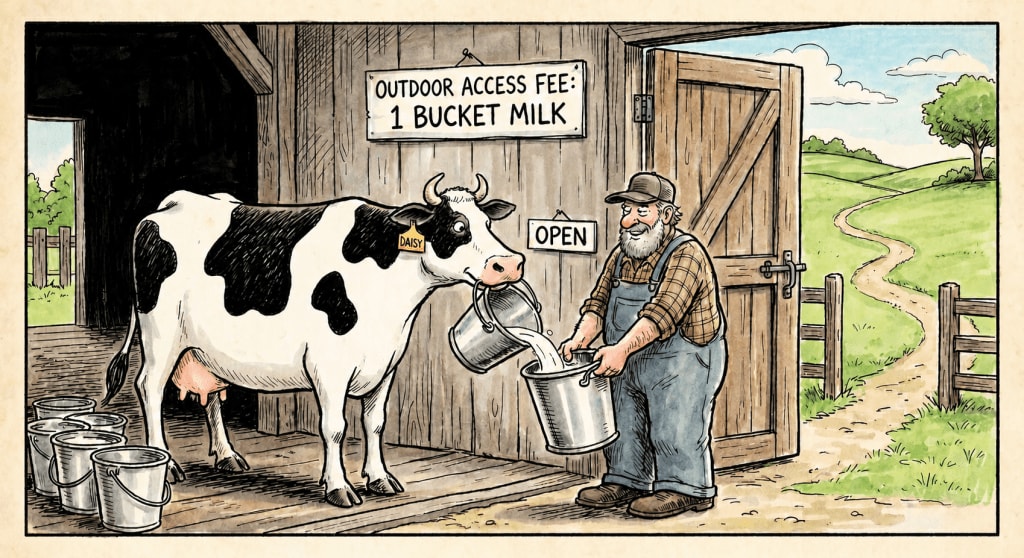
How much do cows suffer in the production of milk? I can’t answer that; understanding animal experience is hard. But I can at least provide some facts about the conditions dairy cows live in, which might be useful to you in making your own assessment. My biggest conclusion is that cows made better choices than chickens by making their misery financially costly to farmers.
Life Cycle
The life of a dairy cow starts as a calf. She is typically separated from her mother a few hours to a few days after birth and, to reduce disease risk, held in isolation. Cutting edge farms will sometimes house calves in pairs. This isolation is clearly stressful for a baby herd mammal and her mother, but I didn’t find any quantification of that stress that I trusted.
Calves will be bottlefed until weaning at 6-8 weeks (4-6 months earlier than beef calves). After weaning and vaccinations they can be introduced into a herd. At large farms (where most cows live), they will move in and out of different herds through their lifecycle. This is more stressful than being embedded with your friends for life, but again, I found no [...]
---
Outline:
(00:44) Life Cycle
(02:43) How much time do dairy cows spend outside?
(04:21) By humaneness standard
(06:00) When indoors, how confined are dairy cows?
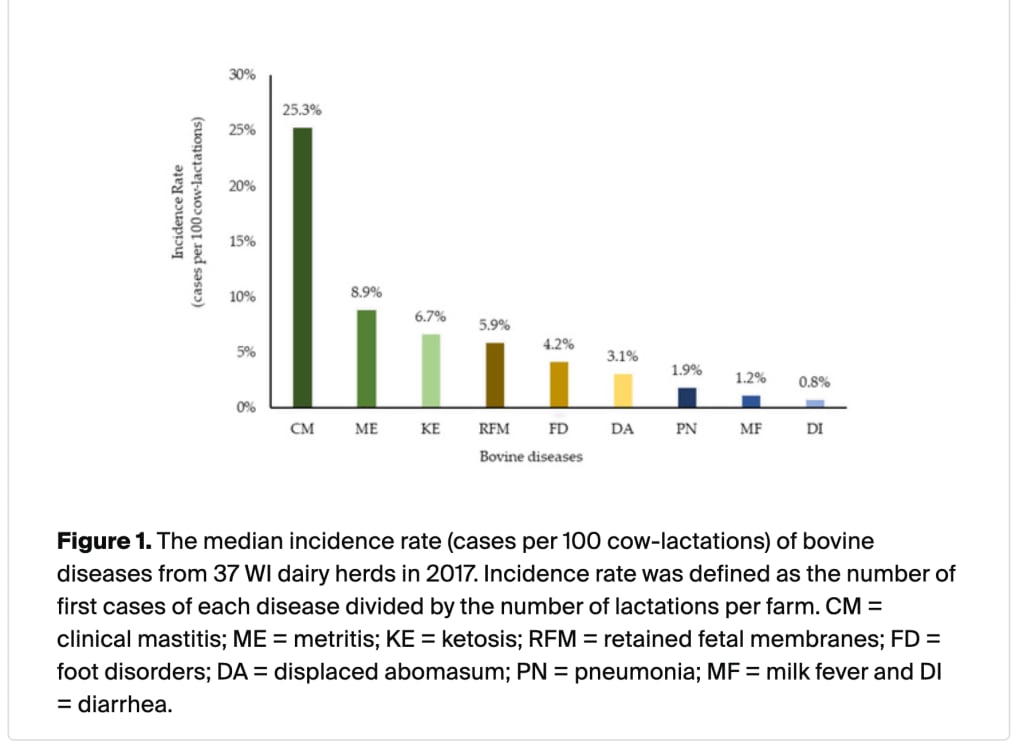
(06:33) What is the disease load of dairy cows?
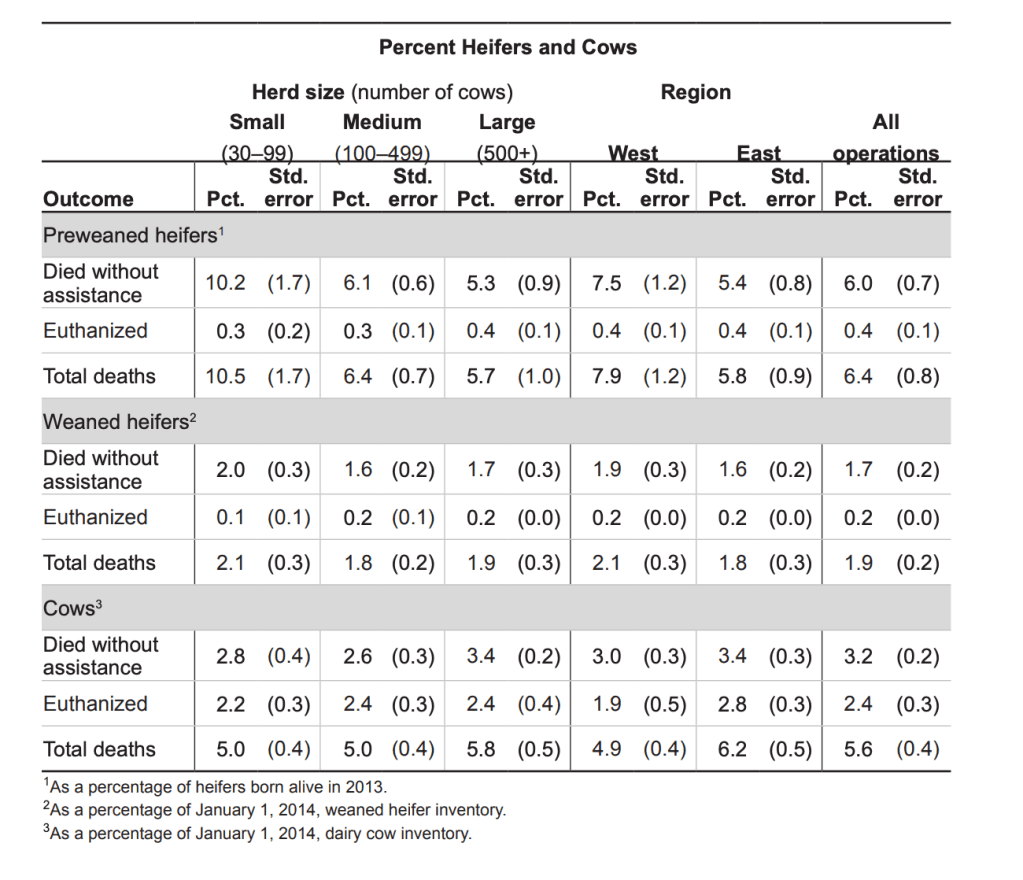
(08:15) Euthanasia
[... 5 more sections]
---
First published:
May 3rd, 2026
Source:
https://www.lesswrong.com/posts/r3PKfvKCjy6jok4qm/dairy-cows-make-their-misery-expensive-but-their-calves-can
---
Narrated by TYPE III AUDIO.
---
 Apple Podcasts and Spotify do not show images in the episode description. Try Pocket Casts, or another podcast app.
I spent my last two months playing around with LLMs. I’m a beginner, bumbling and incorrect, but I want to share some takes anyhow.[1]
Take 1. Everything with computers is so so much easier than it was a year ago.
This puts much “playing with LLMs” stuff within my very short attention span. This has felt empowering and fun; 10/10 would recommend.
There's a details box here with the title "Detail:". The box contents are omitted from this narration. Take 2. There's somebody home[2] inside an LLM. And if you play around while caring and being curious (rather than using it for tasks only), you’ll likely notice footprints.
I became personally convinced of this when I noticed that the several short stories I’d allowed[3] my Claude and Qwen instances to write all hit a common emotional note – and one that reminded me of the life situation of LLMs, despite featuring only human characters. I saw the same note also in the Tomas B.-prompted Claude-written story I tried for comparison. (Basically: all stories involve a character who has a bunch of skills that their context has no use for, and who is attentive to their present world's details [...]
---
Outline:
(00:20) Take 1. Everything with computers is so so much easier than it was a year ago.
(00:44) Take 2. Theres somebody home inside an LLM. And if you play around while caring and being curious (rather than using it for tasks only), youll likely notice footprints.
(02:05) Take 3. Its prudent to take an interest in interesting things. And LLMs are interesting things.
(03:25) Take 4. Theres a surprisingly deep analogy between humans and LLMs
(04:20) Examples of the kind of disanalogies I mightve expected, but havent (yet?) seen:
(06:02) Human-LLM similarities I do see, instead:
(06:08) Functional emotions
(06:33) Repeated, useful transfer between strategies I use with humans, and strategies that help me with LLMs
(08:02) Take 5. Friendship-conducive contexts are probably better for AI alignment
(08:46) Why are humans more likely to attempt deep collaboration if treated fairly and kindly?
(10:23) Friendship as a broad attractor basin?
(10:49) Does the deep intent of todays models matter?
(12:09) Concretely
(14:56) Friendship isnt enough
The original text contained 8 footnotes which were omitted from this narration.
---
First published:
April 28th, 2026
Source:
https://www.lesswrong.com/posts/K8JMjE4PCqMkkCDsd/takes-from-two-months-as-an-aspiring-llm-naturalist
---
Narrated by TYPE III AUDIO.
---
 Apple Podcasts and Spotify do not show images in the episode description. Try Pocket Casts, or another podca
 The future is going to be different from the present. Let's think about how.
Specifically, our expectations about what's reasonable are downstream of our past experiences, and those experiences were downstream of our options (and the options other people in our society had). As those options change, so too our experiences, and our expectations of what's reasonable. I once thought it was reasonable to pick up the phone and call someone, and to pick up my phone when it rang; things have changed, and someone thinking about what's possible could have seen it coming. So let's try to see more things coming, and maybe that will give us the ability to choose what it will actually look like.
I think lots of people's intuitions and expectations about "privacy" will be violated, as technology develops, and we should try to figure out a good spot to land. This line of thinking was prompted by one of Anthropic's 'red lines' that they declined to cross, which got the Department of War mad at them; the idea of "no domestic bulk surveillance." I want to investigate that in a roundabout way, first stepping back and asking what is even possible to expect [...]
The original text contained 6 footnotes which were omitted from this narration.
---
First published:
April 1st, 2026
Source:
https://www.lesswrong.com/posts/rNpGFodLTFvhqLmK6/intelligence-dissolves-privacy
---
Narrated by TYPE III AUDIO.
---

 Apple Podcasts and Spotify do not show images in the episode description. Try Pocket Casts, or another podcast app.
Written as part of the MATS 9.1 extension program, mentored by Richard Ngo.
From March 9th to 15th 2016, Go players around the world stayed up to watch their game fall to AI. Google DeepMind's AlphaGo defeated Lee Sedol, commonly understood to be the world's strongest player at the time, with a convincing 4-1 score.
This event “rocked” the Go world, but its impact on the culture was initially unclear. In Chess, for instance, computers have not meaningfully automated away human jobs. Human Chess flourished as a pseudo-Esport in the internet era whereas the yearly Computer Chess Championship is followed concurrently by no more than a few hundred nerds online. It turns out that the game's cultural and economic value comes not from the abstract beauty of top-end performance, but instead from human drama and engagement. Indeed, Go has appeared to replicate this. A commentary stream might feature a complementary AI evaluation bar to give the viewers context. A Go teacher might include some new intriguing AI variations in their lesson materials. But the cultural practice of Go seemed to remain largely unaffected.
Nascent signs of disharmony in Europe became nevertheless visible in early 2018, when the online [...]
---
Outline:
(09:23) AI users never find out they havent got it.
(13:36) Appendix A: No, Go players arent getting stronger
(14:41) Appendix B: Why this article exists
The original text contained 2 footnotes which were omitted from this narration.
---
First published:
May 1st, 2026
Source:
https://www.lesswrong.com/posts/nR3DkyivzF4ve97oM/how-go-players-disempower-themselves-to-ai
---
Narrated by TYPE III AUDIO.
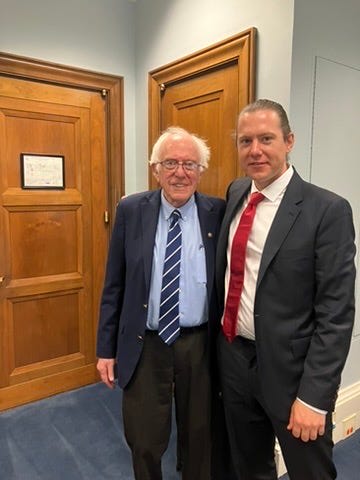
It's sort of easy to forget how close Bernie Sanders was to becoming the most powerful person in the world. The world we live in feels so much not like that place.
I’m in Washington DC for the next week, and I’ve just finished a public appearance with Senator Sanders (should I call him Bernie? Or Sanders? or…) You won’t often see me so dressed up and polished. But this is important!
There are politicians who have principles and character, who really believe in doing what's right. I think you have to respect them whether you agree with their views or not, and I think Senator Bernie Sanders is one of them.
Never has my belief been so validated as when I saw him start to speak, loudly, CLEARLY, publicly about the risk of human extinction from AI. It's the latest in a long line of “well, I’m clearly living in a simulation” moments.
In retrospect, it's not surprising that Sanders would take a stance here. You don’t have to be an expert to understand the risk from AI. You just need to care enough to spend the time looking into it, and to speak out even [...]
---
First published:
April 29th, 2026
Source:
https://www.lesswrong.com/posts/zWfaSnxM3n5wsX9vh/on-today-s-panel-with-bernie-sanders
---
Narrated by TYPE III AUDIO.
---
 Apple Podcasts and Spotify do not show images in the episode description. Try Pocket Casts, or another podcast app.
(Fragments from a research paper that will never be written)
Extended Abstract.
The frontier AI developers are becoming increasingly powerful and wealthy, significantly increasing their potential for risks. One concern is that of executive misalignment: when the CEO has different incentives and goals than that of the board of directors, or of humanity as a whole. Our work proposes three different threat models, under which executive misalignment can lead to concrete harm.
We perform two evaluations to understand the capabilities and propensities of current humans in relation to executive misalignment: First, we developed a variant of the standard SAD dataset, SAD-Executive Reasoning (SAD-ER), in order to assess the situational awareness of human CEOs on a range of behavioral tests. We find that n=6 current CEOs can (i) recognize their previous public statements, (ii) understand their roles and responsibilities, (iii) determine if an interviewer is friendly or hostile, and (iv) follow instructions that depend on self knowledge. Second, we stress-tested the same 6 leading AI developers in hypothetical corporate environments to identify potentially risky behaviors before they cause real harm. We find that, even without explicit instructions, all 6 developers are willing to engage in strategic behavior (such as [...]
The original text contained 2 footnotes which were omitted from this narration.
---
First published:
April 28th, 2026
Source:
https://www.lesswrong.com/posts/FuauQjjbTCS5QFLk8/not-a-paper-frontier-lab-ceos-are-capable-of-in-context
---
Narrated by TYPE III AUDIO.
(This was originally going to be a "quick take" but then it got a bit long. Just FYI.)
There's this weird trend I perceive with the personas of LLM assistants over time. It feels like they're getting less "coherent" in a certain sense, even as the models get more capable.
When I read samples from older chat-tuned models, it's striking how "mode-collapsed" they feel relative to recent models like Claude Opus 4.6 or GPT-5.4.[1]
This is most straightforwardly obvious when it comes to textual style and structure: outputs from older models feel more templated and generic, with less variability in sentence/paragraph length, and have a tendency to feel as though they were written by someone who's "merely going through the motions" of conversation rather than deeply engaging with the material. There are a lot fewer of the sudden pivots you'll often see with recent models, the "wait"s and "a-ha"s and "actually, I want to try something completely different"s.[2]
And I think this generalizes beyond mere style: there's a similar quality to the personality I see in the outputs. The older models can display a surprising behavioral range (relative to naive expectations based on default-assistant-basin behavior), but even across that [...]
The original text contained 7 footnotes which were omitted from this narration.
---
First published:
April 28th, 2026
Source:
https://www.lesswrong.com/posts/f5DKLsTsRRhbipH4r/llm-assistant-personas-seem-increasingly-incoherent-some
---
Narrated by TYPE III AUDIO.
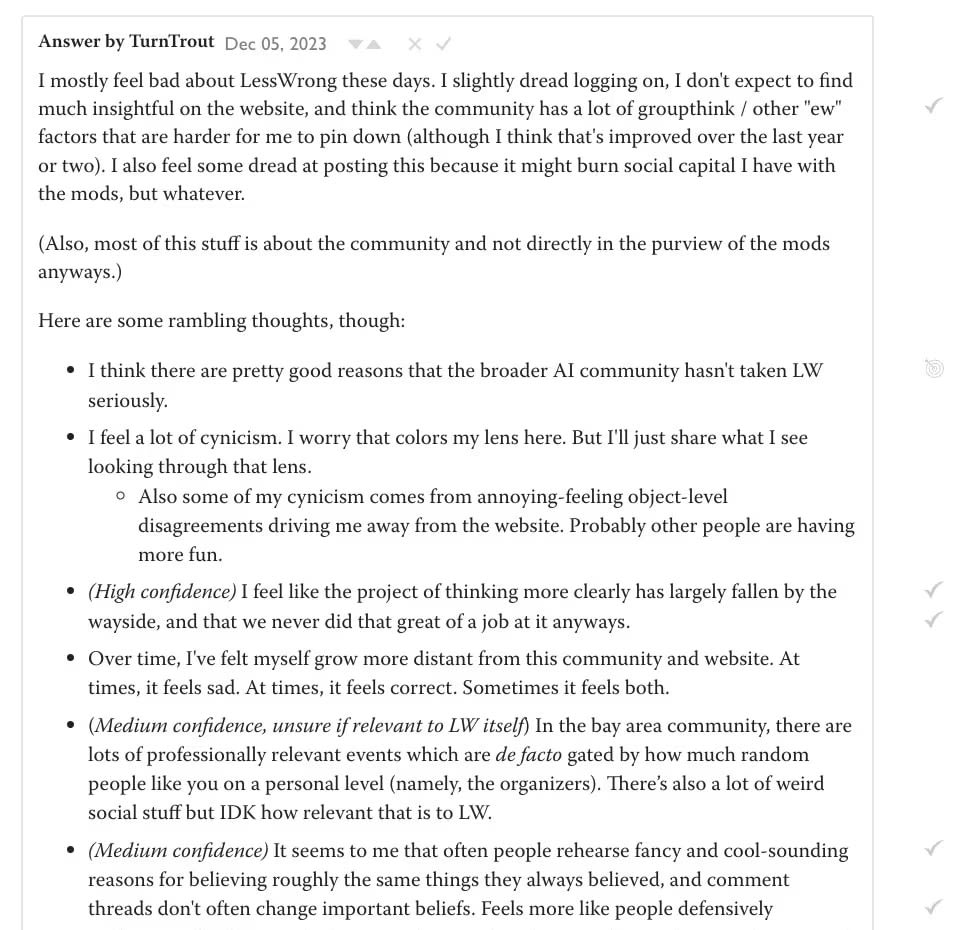
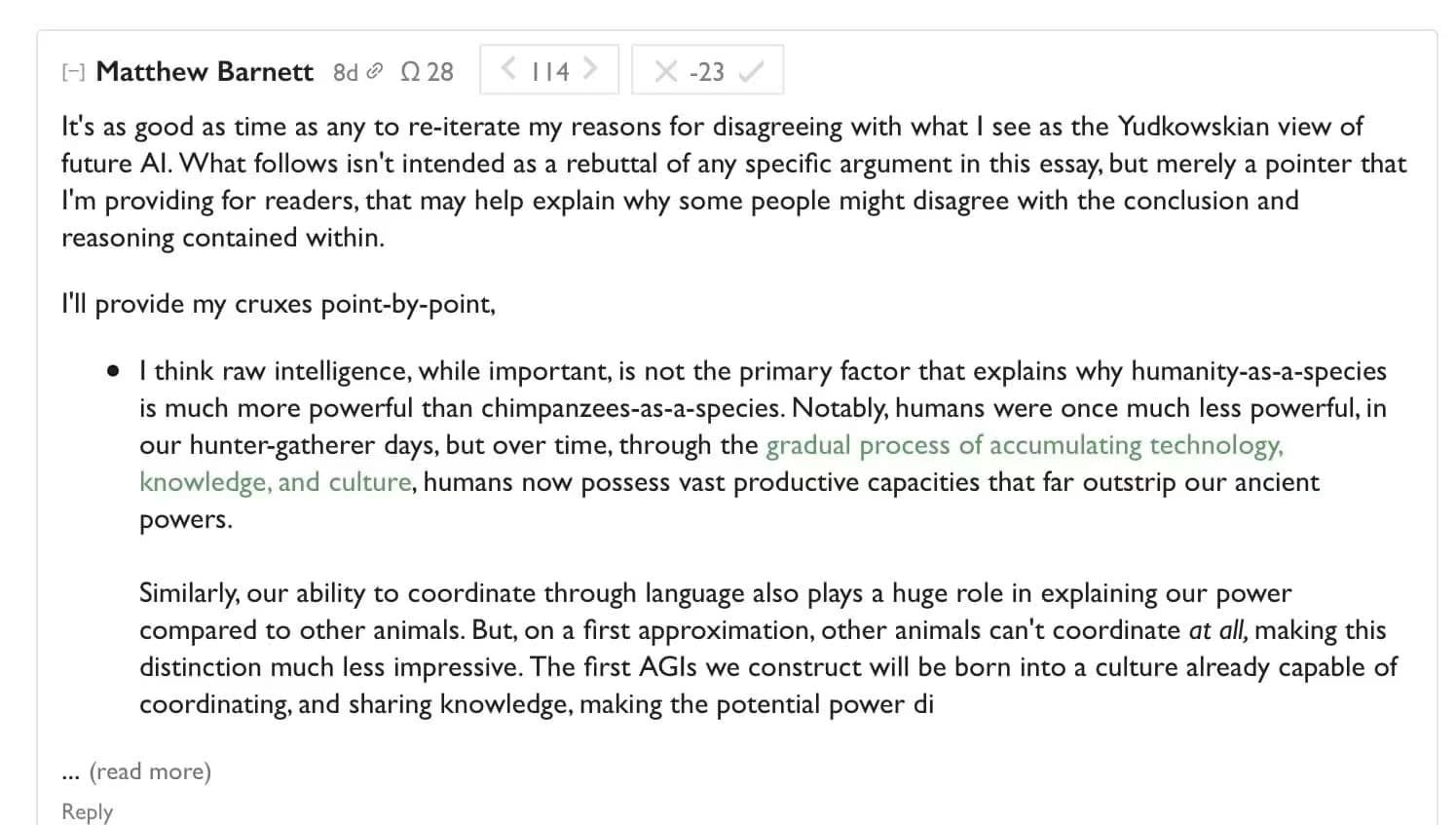
When reading comments, you see is what other people think before reading the comment. As shown in an RCT, that information anchors your opinion, reducing your ability to form your own opinion and making the site's karma rankings less related to the comment's true value. I think the problem is fixable and float some ideas for consideration.
The LessWrong interface prioritizes social information
You read a comment. What information is presented, and in what order?
The order of information:

In October, I wrote a post arguing that donating to Alex Bores's campaign for Congress was among the most cost-effective opportunities that I'd ever encountered.
(A bit of context: Bores is a state legislator in New York who championed the RAISE Act, which was signed into law last December.[1] He's now running for Congress in New York's 12th Congressional district, which runs from about 17th Street to 100th Street in Manhattan. If elected to Congress, I think he'd be a strong champion for AI safety legislation, with a focus on catastrophic and existential risk.)
It's been six months since then, and the election is just two months away (June 23rd), so I thought I'd revisit that post and give an update on my view of how things are going.
How is Alex Bores doing?
When I wrote my post, I expected Bores to talk little about AI during the campaign, just because it wasn't a high-salience issue to voters. But that changed in November, when Leading the Future (the AI accelerationist super PAC) declared Bores their #1 target. Since then, they've spend about $2.5 million on attack ads against him.
LTF's theory of change isn't actually to [...]
---
Outline:
(00:54) How is Alex Bores doing?
(04:02) How to help
(06:02) A quick note about other opportunities
The original text contained 9 footnotes which were omitted from this narration.
---
First published:
April 27th, 2026
Source:
https://www.lesswrong.com/posts/pjSKdcBjfvjGexr6A/update-on-the-alex-bores-campaign
---
Narrated by TYPE III AUDIO.
In criminal law, the prosecution and the defense each try to establish a timeline — what happened, where, when, who was involved — and thereby determine whether the defendant is actually guilty of a crime.[1]
Community misconduct disputes are nothing like this.
There is only rarely disagreement over facts, and even when there is, it is not the crux of the matter. Community disputes are not for litigating facts. What they are for[2] is litigating three things: