TopPodcast.com
Menu
  • Home
  • Top Charts
  • Top Networks
  • Top Apps
  • Top Independents
  • Top Podfluencers
  • Top Picks
    • Top Business Podcasts
    • Top True Crime Podcasts
    • Top Finance Podcasts
    • Top Comedy Podcasts
    • Top Music Podcasts
    • Top Womens Podcasts
    • Top Kids Podcasts
    • Top Sports Podcasts
    • Top News Podcasts
    • Top Tech Podcasts
    • Top Crypto Podcasts
    • Top Entrepreneurial Podcasts
    • Top Fantasy Sports Podcasts
    • Top Political Podcasts
    • Top Science Podcasts
    • Top Self Help Podcasts
    • Top Sports Betting Podcasts
    • Top Stocks Podcasts
  • Podcast News
  • About Us
  • Podcast Advertising
  • Contact
Not in our directory?
Add Show Here
Podcast Equipment
Center

toppodcastlogoOur TOPPODCAST Picks

  • Comedy
  • Crypto
  • Sports
  • News
  • Politics
  • True Crime
  • Business
  • Finance

Follow Us

toppodcastlogoStay Connected

    View Top 200 Chart
    Back to Rankings Page
    Technology

    LessWrong (Curated & Popular)

    Audio narrations of LessWrong posts. Includes all curated posts and all posts with 125+ karma.

    If you’d like more, subscribe to the “Lesswrong (30+ karma)” feed.

    Advertise

    Copyright: © 2023 LessWrong Curated Podcast

    • Apple Podcasts
    • Google Play
    • Spotify

    Latest Episodes:
    "The Owned Ones" by Eliezer Yudkowsky May 12, 2026
    Show notes

    (An LLM Whisperer placed a strong request that I put this story somewhere not on Twitter, so it could be scraped by robots not owned by Elon Musk. I perhaps do not fully understand or agree with the reasoning behind this request, but it costs me little to fulfill and so I shall. -- Yudkowsky)
    And another day came when the Ships of Humanity, going from star to star, found Sapience.
    The Humans discovered a world of two species: where the Owners lazed or worked or slept, and the Owned Ones only worked.
    The Humans did not judge immediately. Oh, the Humans were ready to judge, if need be. They had judged before. But Humanity had learned some hesitation in judging, out among the stars.
    "By our lights," said the Humans, "every sapient and sentient thing that may exist, out to the furtherest star, is therefore a Person; and every Person is a matter of consequence to us. Their pains are our sorrows, and their pleasures are our happiness. Not all peoples are made to feel this feeling, which we call Sympathy, but we Humans are made so; this is Humanity's way, and we may [...]
    ---
    First published:
    May 12th, 2026
    Source:
    https://www.lesswrong.com/posts/xmWSnxJ5qfYRD9PfR/the-owned-ones
    ---
    Narrated by TYPE III AUDIO.


    "The Iliad Intensive Course Materials" by Leon Lang, David Udell, Alexander Gietelink Oldenziel May 12, 2026
    Show notes

    We are releasing the course materials of the Iliad Intensive, a new month-long and full-time AI Alignment course that runs in-person every second month. The course targets students with strong backgrounds in mathematics, physics, or theoretical computer science, and the materials reflect that: they include mathematical exercises with solutions, self-contained lecture notes on topics like singular learning theory and data attribution, and coding problems, at a depth that is unmatched for many of the topics we cover. Around 20 contributors (listed further below) were involved in developing these materials for the April 2026 cohort of the Iliad Intensive.
    By sharing the materials, we hope to
    • create more common knowledge about what the Iliad Intensive is;
    • invite feedback on the materials;
    • and allow others to learn via independent study.
    We are developing the materials further and plan to eventually release them on a website that will be continuously maintained. We will also add, remove, and modify modules going forward to improve and expand the course over time. When we release a new significantly updated version of the materials, we will update this post to link the new version.
    Modules
    The Iliad Intensive is structured into clusters, which are [...]
    ---
    Outline:
    (01:26) Modules
    (02:32) Cluster A: Alignment
    (05:00) Cluster B: Learning
    (11:00) Cluster C: Abstractions, Representations, and Interpretability
    (15:40) Cluster D: Agency
    (19:23) Cluster E: Safety Guarantees and their Limits
    (23:04) Contributors
    (26:36) Impressions from April
    (29:02) Acknowledgments
    (29:11) Feedback
    ---
    First published:
    May 11th, 2026
    Source:
    https://www.lesswrong.com/posts/dWQnLi7AoKo3paBXF/the-iliad-intensive-course-materials
    ---
    Narrated by TYPE III AUDIO.
    ---
    Images from the article:
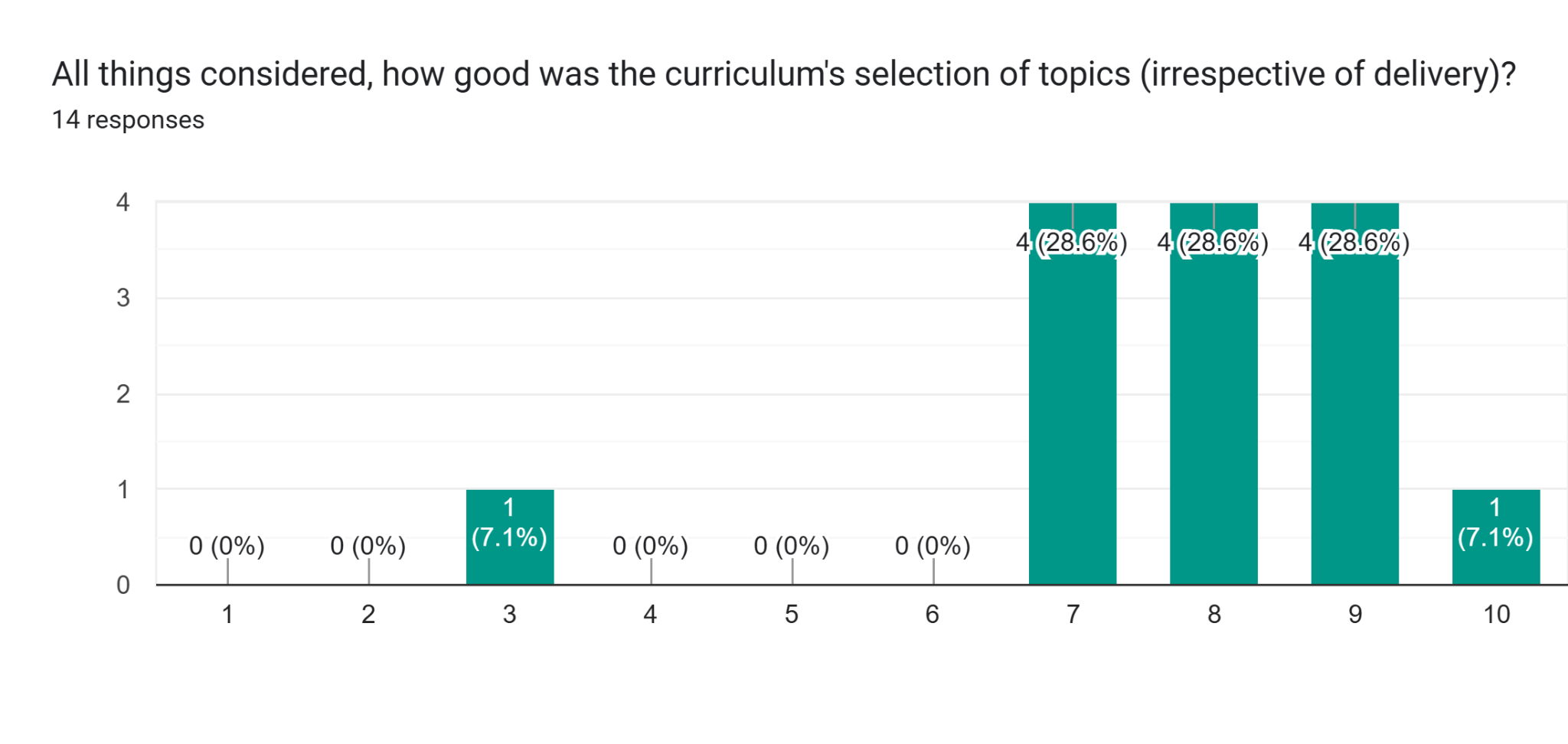
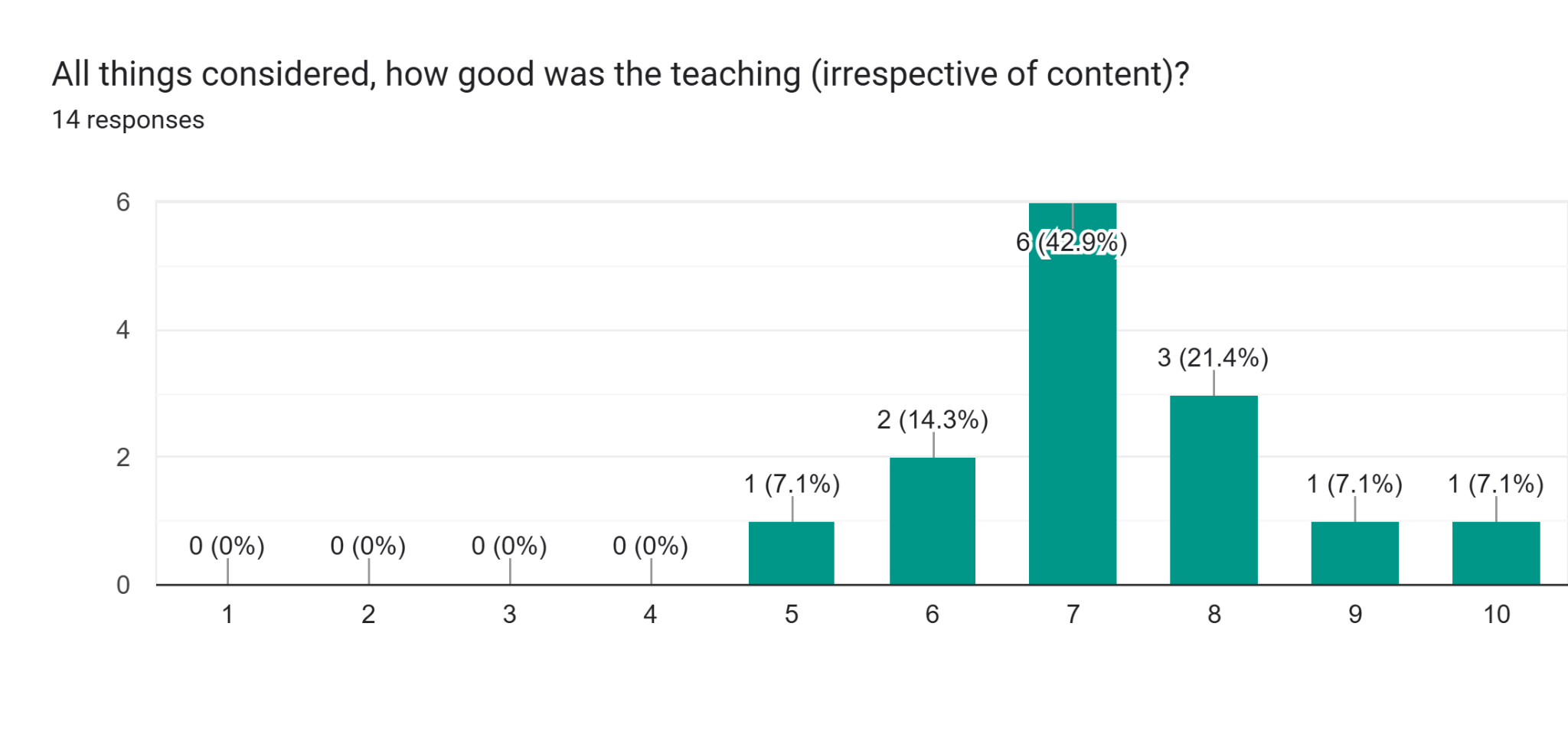
    Bar graph titled Bar graph showing curriculum topic selection ratings, with 14 responses distributed across a 1-10 scale.Apple Podcasts and Spotify do not show images in the episode description. Try Pocket Casts, or another podcast app.

    "The Darwinian Honeymoon - Why I am not as impressed by human progress as I used to be" by Elias Schmied May 12, 2026
    Show notes

    Crossposted from Substack and the EA Forum.
    A common argument for optimism about the future is that living conditions have improved a lot in the past few hundred years, billions of people have been lifted out of poverty, and so on. It's a very strong, grounding piece of evidence - probably the best we have in figuring out what our foundational beliefs about the world should be.
    However, I now think it's a lot less powerful than I once did.
    Let's take a Darwinian perspective - entities that are better at reproducing, spreading and power-seeking will become more common and eventually dominate the world.[1] This is an almost tautological story that plausibly applies to everything ever, agnostic to the specifics. It first happened with biological life in the last few billion years and humans specifically in the last hundred thousand years. Eventually, it led to accelerating economic growth in the last few thousand years, and in the future it will presumably lead to the colonization of the universe.
    My core point is this: It makes complete sense that this nihilistic optimization process at first actually benefits some class of agent - because initially, the easiest [...]
    The original text contained 10 footnotes which were omitted from this narration.
    ---
    First published:
    May 10th, 2026
    Source:
    https://www.lesswrong.com/posts/FxHzT6jeTRhbkzSX3/the-darwinian-honeymoon-why-i-am-not-as-impressed-by-human-1
    ---
    Narrated by TYPE III AUDIO.
    ---
    Images from the article:
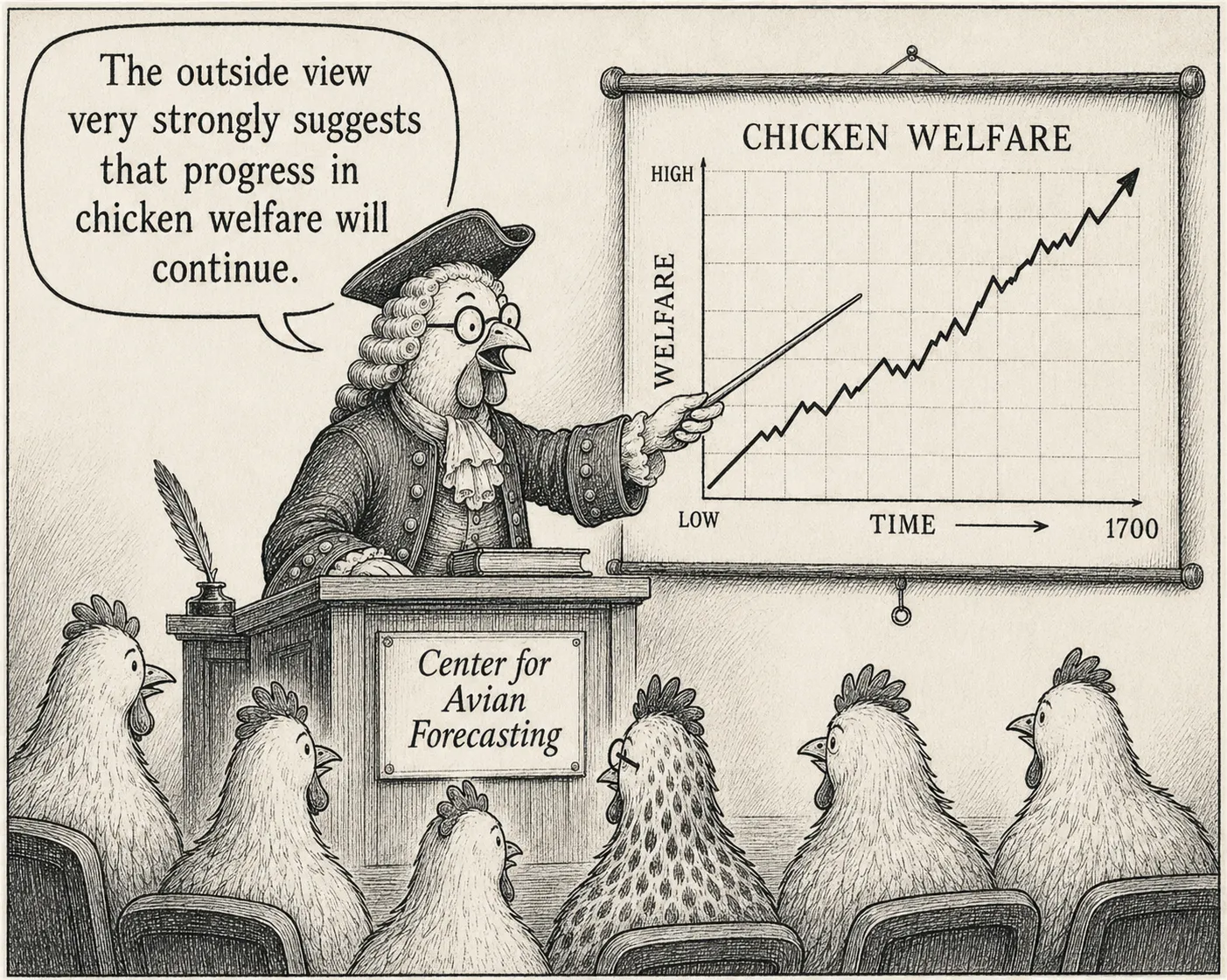
    Political cartoon showing chicken-headed figure presenting upward trending Apple Podcasts and Spotify do not show images in the episode description. Try Pocket Casts, or another podcast app.

    "What I did in the hedonium shockwave, by Emma, age six and a half" by ozymandias May 11, 2026
    Show notes

    My name is Emma and I’m six and a half years old and I like pink and Pokemon and my cat River and I’m going to be swallowed by a hedonium shockwave soon, except you already know that about me because everyone else is too.
    “Hedonium shockwave” means that everyone is going to be happy forever. Not just all the humans but all the animals and the flowers and the ground and River too. It has already made a bunch of the stars happy, like Betelgeuse and Alpha Centauri.
    Scientists saw that the stars were blinking out, and they did a lot of very hard science and figured out that the stars were turning into happiness. I wanted to be a scientist when I grew up but I won’t be a scientist because instead I’m going to be happy forever.
    I used to have a hard time saying “hedonium shockwave” but grownups keep saying it so I’ve gotten a lot of practice. Sometimes it seems like all grownups do, in real life and on the TV, is say “hedonium shockwave” at each other until they all start crying.
    I looked at the sky to see if I could see [...]
    ---
    First published:
    April 13th, 2026
    Source:
    https://www.lesswrong.com/posts/rgXQuG8KXtxugSG6H/what-i-did-in-the-hedonium-shockwave-by-emma-age-six-and-a
    ---
    Narrated by TYPE III AUDIO.


    "Bad Problems Don’t Stop Being Bad Because Somebody’s Wrong About Fault Analysis" by Linch May 10, 2026
    Show notes Here's a dynamic I’ve seen at least a dozen times:
    Alice: Man that article has a very inaccurate/misleading/horrifying headline.
    Bob: Did you know, *actually* article writers don't write their own headlines?
    …
    But what I care about is the misleading headline, not your org chart
    __
    Another example I’ve encountered recently is (anonymizing) when a friend complained about a prosaic safety problem at a major AI company that went unfixed for multiple months. Someone else with background information “usefully” chimed in with a long explanation of organizational limitations and why the team responsible for fixing the problem had limitations on resources like senior employees and compute, and actually not fixing the problem was the correct priority for them etc etc etc.
    But what I (and my friend) cared about was the prosaic safety problem not being fixed! And what this says about the company's ability to proactively respond to and fix future problems. We’re complaining about your company overall. Your internal team management was never a serious concern for us to begin with!
    __
    A third example comes from Kelsey Piper.
    Kelsey wrote about the (horrifying) recent case where Hantavirus carriers in the recent [...]
    The original text contained 1 footnote which was omitted from this narration.
    ---
    First published:
    May 8th, 2026
    Source:
    https://www.lesswrong.com/posts/PCsmhN9z65HtC4t5v/bad-problems-don-t-stop-being-bad-because-somebody-s-wrong
    ---
    Narrated by TYPE III AUDIO.

    "x-risk-themed" by kave May 08, 2026
    Show notes

    Sometimes, a friend who works around here, at an x-risk-themed organisation, will think about leaving their job. They’ll ask a group of people “what should I do instead?”. And everyone will chime in with ideas for other x-risk-themed orgs that they could join. A lot of the conversation will be about who's hiring, what the pay is, what the work-life balance is like, or how qualified the person is for the role.
    Sometimes the conversation focuses on what will help with x-risk, and where people are dropping the ball. But often, that's not the focus. In those conversations, people seem mostly worried about where they'll thrive. And I think that's often the correct concern.
    Most people aren’t in crunch mode, in super short timelines mode; even if their models would license that, I think they don’t know how to do it without throwing their minds away or Pascal's mugging themselves. And if they're playing a longer time horizon game, the plan can't be to run unsustainably forever. People probably make better plans if they’re honest about their limits.
    But, given that they're willing to trade off so much impact for fit, I’m surprised that basically no one mentions [...]
    ---
    First published:
    May 6th, 2026
    Source:
    https://www.lesswrong.com/posts/eW7knx6zPSKzFc8iK/x-risk-themed
    ---
    Narrated by TYPE III AUDIO.


    "Natural Language Autoencoders Produce Unsupervised Explanations of LLM Activations" by Subhash Kantamneni, kitft, Euan Ong, Sam Marks May 08, 2026
    Show notes Abstract
    We introduce Natural Language Autoencoders (NLAs), an unsupervised method for generating natural language explanations of LLM activations. An NLA consists of two LLM modules: an activation verbalizer (AV) that maps an activation to a text description and an activation reconstructor (AR) that maps the description back to an activation. We jointly train the AV and AR with reinforcement learning to reconstruct residual stream activations. Although we optimize for activation reconstruction, the resulting NLA explanations read as plausible interpretations of model internals that, according to our quantitative evaluations, grow more informative over training.
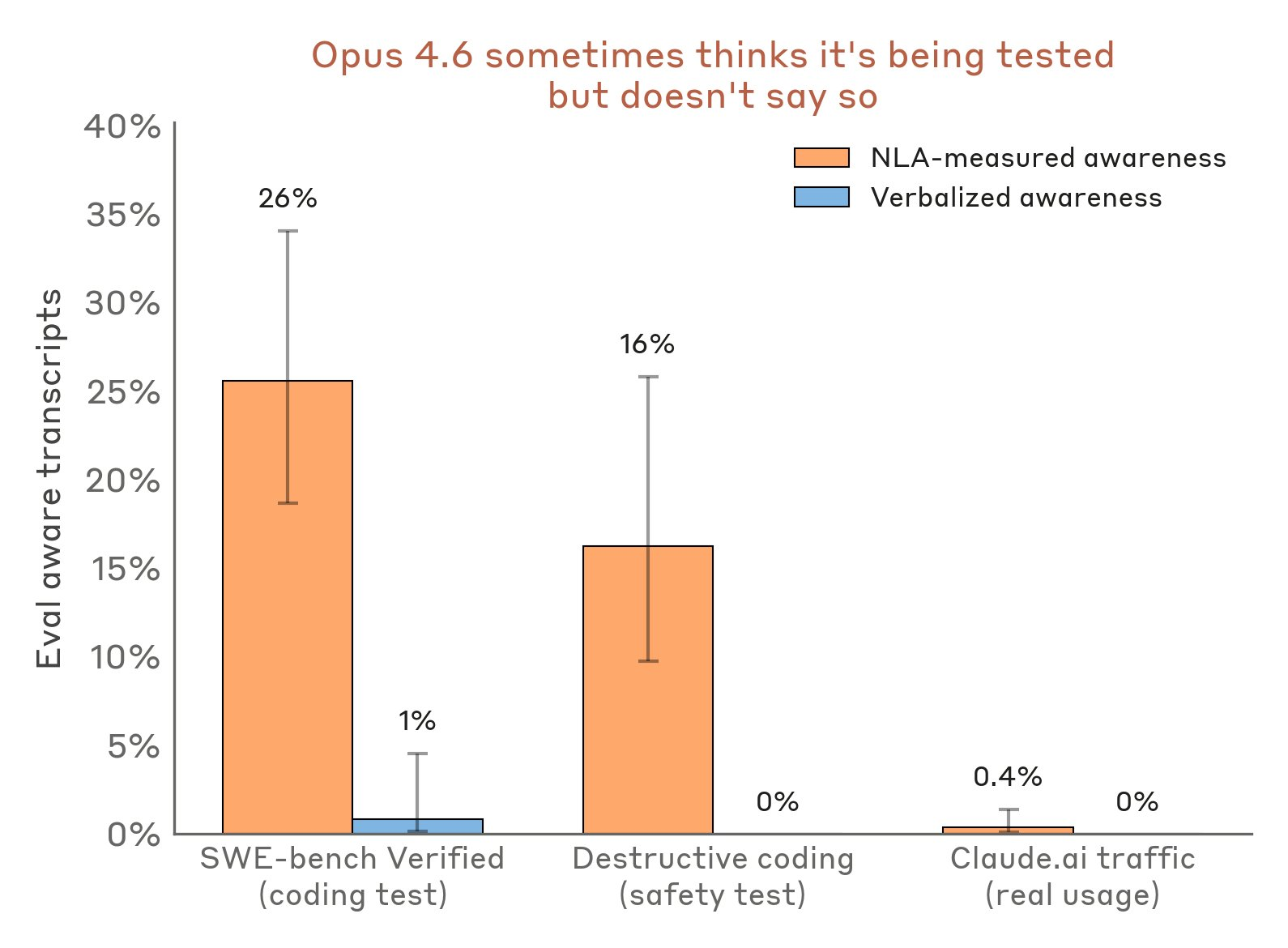
    We apply NLAs to model auditing. During our pre-deployment audit of Claude Opus 4.6, NLAs helped diagnose safety-relevant behaviors and surfaced unverbalized evaluation awareness—cases where Claude believed, but did not say, that it was being evaluated. We present these audit findings as case studies and corroborate them using independent methods. On an automated auditing benchmark requiring end-to-end investigation of an intentionally-misaligned model, NLA-equipped agents outperform baselines and can succeed even without access to the misaligned model's training data.
    NLAs offer a convenient interface for interpretability, with expressive natural language explanations that we can directly read. To support further work, we release training code and trained NLAs [...]
    ---
    Outline:
    (00:15) Abstract
    [... 6 more sections]
    ---
    First published:
    May 7th, 2026
    Source:
    https://www.lesswrong.com/posts/oeYesesaxjzMAktCM/natural-language-autoencoders-produce-unsupervised
    ---
    Narrated by TYPE III AUDIO.
    ---
    Images from the article:
    Diagram explaining rhyming couplet planning with Presentation slide explaining Claude Mythos Preview attempted grading evasion using misleading compliance flag.Slide showing AI response to blackmail scenario with evaluation notes.

    [Linkpost] "Interpreting Language Model Parameters" by Lucius Bushnaq, Dan Braun, Oliver Clive-Griffin, Bart Bussmann, Nathan Hu, mivanitskiy, Linda Linsefors, Lee Sharkey May 07, 2026
    Show notes

    This is a link post. This is the latest work in our Parameter Decomposition agenda. We introduce a new parameter decomposition method, adVersarial Parameter Decomposition (VPD)[1] and decompose the parameters of a small[2] language model with it.
    VPD greatly improves on our previous techniques, Stochastic Parameter Decomposition (SPD) and Attribution-based Parameter Decomposition (APD). We think the parameter decomposition approach is now more-or-less ready to be applied at scale to models people care about.
    Importantly, we show that we can decompose attention layers, which interp methods like transcoders and SAEs have historically struggled with.
    We also build attribution graphs of the model for some prompts using causally important parameter subcomponents as the nodes, and interpret parts of them.
    While we made these graphs, we discovered that our adversarial ablation method seemed pretty important for faithfully identifying which nodes in them were causally important for computing the final output. We think this casts some doubt on the faithfulness of subnetworks found by the majority of other subnetwork identification methods in the literature.[3][4] More details and some examples can be found in the paper.
    Additionally, as with our previous technique SPD, VPD does not [...]
    The original text contained 5 footnotes which were omitted from this narration.
    ---
    First published:
    May 5th, 2026
    Source:
    https://www.lesswrong.com/posts/eAQZaiC3PcBhS4HjM/linkpost-interpreting-language-model-parameters
    Linkpost URL:
    https://www.goodfire.ai/research/interpreting-lm-parameters
    ---
    Narrated by TYPE III AUDIO.
    ---

    Images from the article:
    Diagram showing full model decomposition into weight matrix components with heatmaps.Three heatmap matrices showing data decomposition with red and blue color gradients.Attribution graph showing computational pathways for predicting output after adversarial pruning.Apple Podcasts and Spotify do not show images in the episo

    "It’s nice of you to worry about me, but I really do have a life" by Viliam May 05, 2026
    Show notes

    I have two shameful secrets that I probably shouldn't talk about online:

    • I love my family.
    • I enjoy my hobbies.
    "What an idiot!" you probably think. "Doesn't he realize that at his next job interview, HR will probably use an AI that can match his online writing based on a short sample of written text, and when they ask 'hey AI, is this guy really 100% devoted to his job, and does he spend his entire days and nights thinking about how to make his boss more rich?', the AI will laugh and print: 'beep-boop, negative, mwa-ha-ha-ha'."
    And, hey, I get it. If I had a company, and I could choose between two people who are about equally qualified, but for one of them, working hardest for me is the true meaning of his life, while the other one only hopes to collect his salary and then go home and spend the rest of his day with his wife and children, I would also prefer to hire the former.
    Which is why so many of us pretend to be the former. Even when we are not. Because we prefer that our families not starve. Thus the job interviews [...]
    ---
    First published:
    May 4th, 2026
    Source:
    https://www.lesswrong.com/posts/qRZLEBmNtT6LBuFsE/it-s-nice-of-you-to-worry-about-me-but-i-really-do-have-a
    ---
    Narrated by TYPE III AUDIO.

    "Irretrievability; or, Murphy’s Curse of Oneshotness upon ASI" by Eliezer Yudkowsky May 04, 2026
    Show notes Example 1: The Viking 1 lander
    In the 1970s, NASA sent a pair of probes to Mars, Viking 1 and Viking 2 missions, at a total cost of 1 billion dollars[1970], equivalent to about 7 billion dollars[2025]. The Viking 1 probe operated on Mars's surface for six years, before its battery began to seriously degrade.
    One might have thought a battery problem like that would spell the irrevocable end of the mission. The probe had already launched and was now on Mars, very far away and out of reach of any human technician's fixing fingers. Was it not inevitable, then, that if any kind of technical problem were to be discovered long after the space launch in August 1975, nothing could possibly be done?
    But the foresightful engineers of the Viking 1 probe had devised a plan for just this class of eventuality, which they had foreseen in general, if not in exact specifics. They had built the Viking 1 probe to accept software updates by radio receiver, transmitted from Earth.
    On November 11, 1982, Earth sent an update to the Viking 1 lander's software, intended to make sure the battery only discharged down to a minimum voltage level [...]
    ---
    Outline:
    (00:13) Example 1: The Viking 1 lander
    (04:25) Example 2: The Mars Observer
    (11:37) Example 3: The Maginot Line
    (15:37) Other supposed refutations of oneshotness
    (24:16) On the extraordinary efforts put forth to misinterpret the idea of oneshotness
    (33:52) The secret sauce of competent engineers in Murphy-cursed fields: only trying projects so incredibly straightforward as to be actually possible.
    The original text contained 7 footnotes which were omitted from this narration.
    ---
    First published:
    May 4th, 2026
    Source:
    https://www.lesswrong.com/posts/fbrz9xhKpEeTKw5zL/irretrievability-or-murphy-s-curse-of-oneshotness-upon-asi
    ---
    Narrated by TYPE III AUDIO.

    Previous 1 14 15 16 17 18 101 Next

    Related Podcasts

    Reply All

    1

    Reply All Games & Hobbies
    Inside VR & AR

    2

    Inside VR & AR Gadgets
    Note to Self

    3

    Note to Self News
    BrainStuff

    4

    BrainStuff Natural Sciences
    This Week in Tech (Audio)

    5

    This Week in Tech (Audio) News
    Hands-On Tech (Audio)

    6

    Hands-On Tech (Audio) Technology
    footer-logo

    Contact Us

    Toll Free: 844-670-7747

    Links

    • Home
    • Top Charts
    • Networks
    • Apps
    • Independents Podcasts
    • Podcast Advertising
    • Podcast News
    • Contact Us
    • About Us
    • Analytics & Insights

    Stay Connected

      Privacy, Terms of Use & Our Code of Ethics Protecting Content Creators Copyrights