TopPodcast.com
Menu
  • Home
  • Top Charts
  • Top Networks
  • Top Apps
  • Top Independents
  • Top Podfluencers
  • Top Picks
    • Top Business Podcasts
    • Top True Crime Podcasts
    • Top Finance Podcasts
    • Top Comedy Podcasts
    • Top Music Podcasts
    • Top Womens Podcasts
    • Top Kids Podcasts
    • Top Sports Podcasts
    • Top News Podcasts
    • Top Tech Podcasts
    • Top Crypto Podcasts
    • Top Entrepreneurial Podcasts
    • Top Fantasy Sports Podcasts
    • Top Political Podcasts
    • Top Science Podcasts
    • Top Self Help Podcasts
    • Top Sports Betting Podcasts
    • Top Stocks Podcasts
  • Podcast News
  • About Us
  • Podcast Advertising
  • Contact
Not in our directory?
Add Show Here
Podcast Equipment
Center

toppodcastlogoOur TOPPODCAST Picks

  • Comedy
  • Crypto
  • Sports
  • News
  • Politics
  • True Crime
  • Business
  • Finance

Follow Us

toppodcastlogoStay Connected

    View Top 200 Chart
    Back to Rankings Page
    Business

    Insureblocks

    blockchain & smart contracts in industries across the world

    Advertise
    • Apple Podcasts
    • Google Play
    • Spotify

    Latest Episodes:
    Ep. 158 – Deep Dive on Plastic Bank’s Blockchain Apr 25, 2021
    Show notes

    Shaun Frankson is the CTO and co-founder of the Plastic Bank. In this podcast we discuss Plastic Bank’s model and perform a deep dive on Plastic Bank’s blockchain and token platform. This is a great example of how blockchain can be used for social good.

    What is blockchain?

    Blockchain is a secure digital ledger that provides a trusted way for peer to peer data exchanges in an encrypted manner.

    The Plastic Bank

    Plastic Bank transforms plastic waste into a form of currency to help create ethically sourced ecosystems where communities that collect this plastic receive an above market rate for it.

    Plastic Bank uses blockchain technology to work with some of the poorest communities in the world to offer them a digital ID and a digital savings account to provide them with financial inclusion. Plastic Bank’s message is if you have to use plastic ensure that it is plastic that was stopped from entering the ocean and that is used to improve lives and regenerate communities.

    Tackling poverty

    Shaun explains that when you look at the 17 United Nations Sustainable Development Goals, the first one is poverty. Poverty is the focal point of many other issues including ocean plastic. Plastic Bank uncovered that about 80% of ocean plastics comes from developing countries with almost no waste management systems. They recognise that by creating a business solution where recycling can be an earned income for anyone not as an endpoint in life but as a starting point to a better life, a starting point to education, career training that can provide for all the things a family needs, then this can address both the plastic problem and the poverty problem.

    When Shaun looked at bringing technology to bring financial inclusion to the poorest places in the world he came upon a number of problems: no phones, limited connectivity or data, and issues of illiteracy. They had to design a whole interface for first time illiterate person that’s never used a phone, without any reference to any technology and potentially lives somewhere with poor data connectivity.

    Plastic Bank designed a system where when they open up a new branch they give the local team a first phone where they can create accounts for non-phone holders upon verifying their ID and age. This will automatically create for them a digital ID and a digital wallet for them to receive the cash earned from the plastic they collect. Like that they can earn their first phone through this system and provide them with full access over their account.

    Hitting the 1 billion plastic bottles milestone

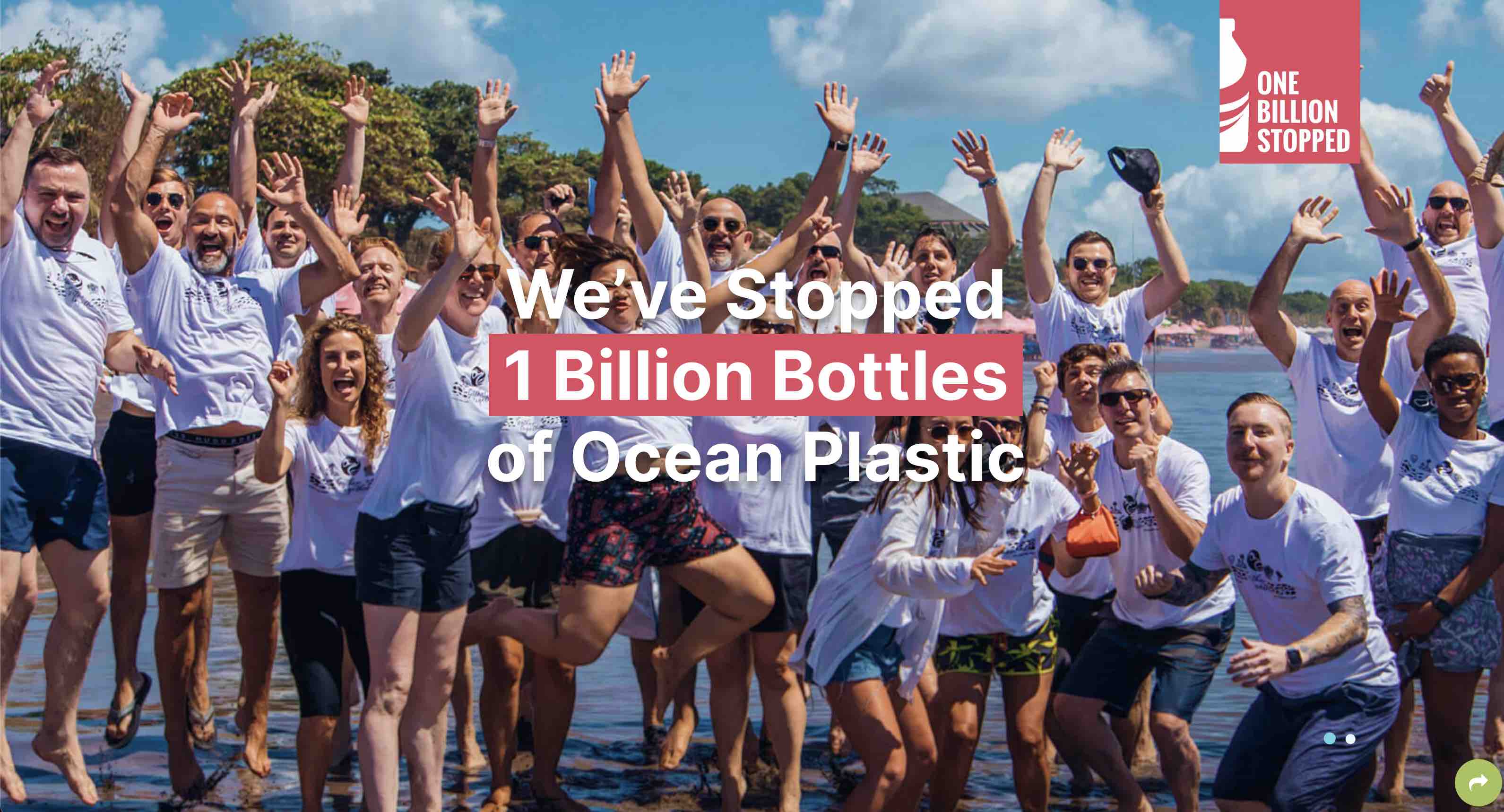
    The Plastic Bank measured that it takes 50 bottles to reach 1 kilo of plastic. 1 billion plastic bottles resulted in 20 million kilogrammes of plastic waste that was prevented from entering the oceans.

    It took them 4 years to reach 500 million collected plastic bottles, this year to reach the next 500 million and in the next 12 months they expect to recycle well over another billion bottles worth of plastic.

    The Plastic Bank has a target, that by 2025, they will be becoming a billion dollar company, impacting a billion lives and preventing a billion kilos of plastic from entering the ocean every year.

    Plastic Bank’s Blockchain

    Need for a digital reward programme where we can ensure that the right people get the right amount of reward. For example, how to ensure in a country like Haiti that you put millions of dollars into the country and ensure it goes to the right people in a safe manner.

    Whilst on the other side their client would want a system that is attack proof. They desire a system that is valid and legitimate. This is where blockchain becomes a valuable tool as it provides trust to the data, trust to the impact stats, and trust the right people in some of the poorest parts of the world would receive the right amount of money for their labour in collecting the plastic.

    IBM Montpellier’s blockchain team stepped in to provide support to Shaun’s team in helping them build their Hyperledger Fabric blockchain platform, on the IBM LinuxONE Servers on IBM Cloud.

    When a plastic collector registers on the Plastic Bank they agree to be part of a traceable supply chain. So, for example when the collector receives their rewards for collecting the plastic onto their digital wallet this provides an element of traceability back to the client. This level of traceability is important for transforming recycling plastic into social plastic that goes into the products of Plastic Bank’s customers such as Henkel and SCJohnson.

    From the client side they get a full audit trail of a transaction. They get proof that it’s real people, real plastic. They get access to a special GPS mapping system that shows the location, the distance from the shoreline with the accurate information that verify that it was ocean bound plastic from a registered collector. In addition, Plastic Bank has a team that performs internal audits to make sure there’s no user error or fraud.

    Tokens

    On this technology stack they also deployed their own token system which has a fractional energy cost which is equivalent to 1/10 the cost of an email. The Plastic Bank token reward programme has one token equivalent to one US cent, which they use as an asset backed stable coin. This has ensured a smooth acceptance of the tokens, backed by a stable coin on a very secure environment, by all the digital payment providers to telecom partners.

    Shaun describes the token as a reward for being part of an ethical transparent supply chain. A reward for making the supply chain ethical, making it traceable, and ensuring that recycling can be a livelihood programme. Plastic Bank is able to incentivize behavioural changes by adding a tokenized bonus programme or premium programme on top of the existing market rate of plastic.

    When working with local merchants to accept tokens they offer their collectors with either $1 in cash or $2 worth of rice. They can provide subsidised goods in exchange as another outlet to redeem their tokens.

    Plans for the next 12 months

    On the 31st of March, Henkel and the Plastic Bank opened their first three plastic waste collection centres in Cairo. In addition to this first step on the African continent, Plastic Bank invested a lot of time and effort to standardise their platform to turn into a turnkey franchise style system of how they set up, how they train, and how they audit for that Plastic Bank can expand into many other countries 10 times faster than today.

    The aim is for them to put that foundational groundwork so that they can grow exponentially next year and add another billion bottles of collected plastic.


    Ep. 157 – SLAFKA – Safeguarding Nuclear Material with Blockchain Apr 18, 2021
    Show notes

    Cindy Vestergaard is the Stimson Centre Director, Nuclear Safeguards Program & Director, Blockchain in Practice program. In this podcast we discuss the interesting work she does in safeguarding nuclear material with blockchain technology.

    What is blockchain?

    Blockchain is a subset of DLT, which is essentially a combination of a variety of different technologies that have been around for already a number of decades, such as peer to peer protocols, cryptography hashing, to make it an immutable ledger that can be shared securely, digitally, across the ecosystem.

    The Stimson Centre

    The Stimson Centre is a think tank that was set up in 1989 by Barry Blechman & Michael Krepon at a time when the Cold War was ending shortly before the fall of the Berlin Wall. It’s a nonpartisan and independent centre that looks at real world problems.

    The work that Cindy’s team does is evidence-based policy research that sits at the intersection of technology and policy.

    SLAFKA

    In 2019 a partnership was established between the Finnish Radiation and Nuclear Safety Authority (STUK), the Stimson Centre in Washington, D.C., and the University of New South Wales (UNSW) in Sydney, Australia, to develop the world’s first distributed ledger technology (DLT) prototype for safeguarding nuclear material, called SLAFKA.

    Finland is the first country in the world to be building a deep geological repository for its spent nuclear fuel. STUK, its radiation and nuclear safety authority approached the Stimson Centre for helping them develop a prototype.

    The question for STUK and for the government of Finland needed to answer is how to ensure that the material underground is also the same that is reflected on the books above ground. Data integrity is very important. The other reason is concerning their relationship with Euratom, the regional safeguards body for the EU’s member states that ensures a regular and equitable supply of nuclear fuels to EU users. The objective is in increasing security, enhancing data sharing and transparency between STUK and Euratom.

    For the Stimson Centre, the opportunity, was to see if DLT can actually handle the different types of transactions that are needed under a nuclear safeguards agreement.

    Data transactions and trust amongst parties

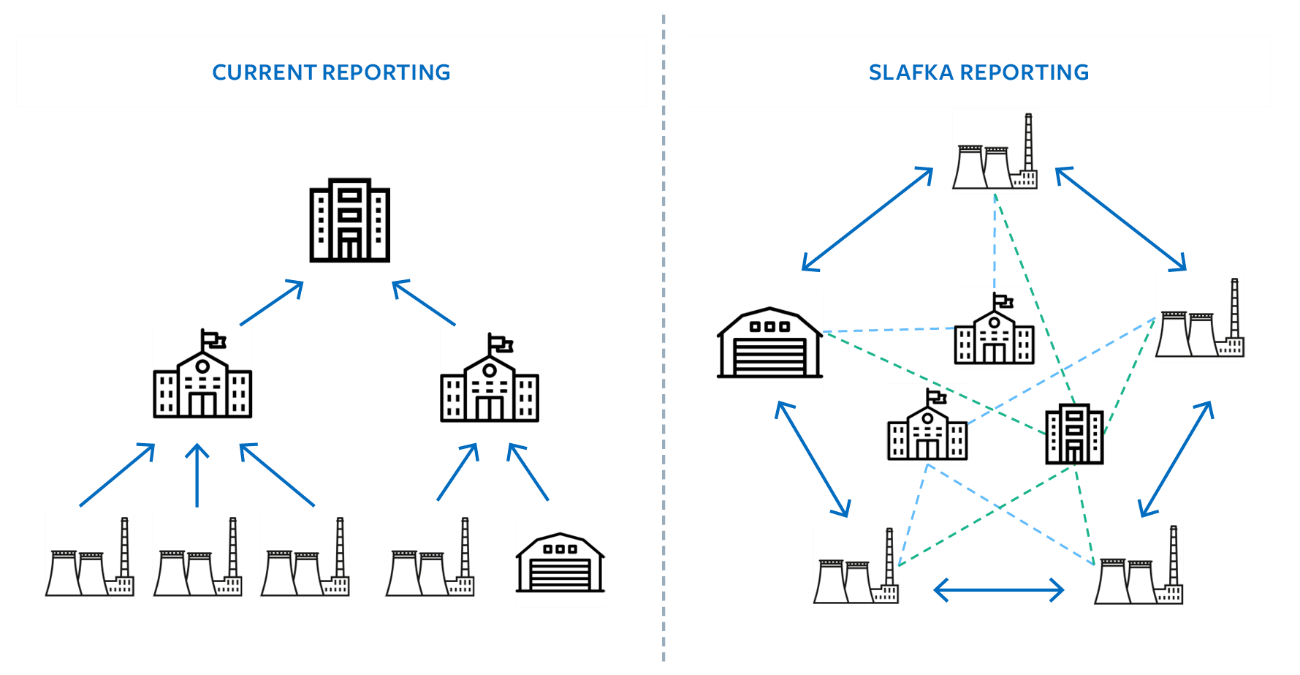
    From a data transaction perspective; nuclear material moves within a facility, within a country and internationally. As it moves it also shifts in form for example from yellowcake or uranium ore concentrates to enriched uranium. All these movements and change of state have to be logged and reported to either a national regulator or a regional regulator such as Euratom within the EU and then to the International Atomic Energy Agency (IAEA) in Vienna.

    Source: Stimson Centre

    Today’s data transactions come in all shape and form both in terms of paper and in an electronic format. The IAEA has a portal for safeguards declarations but it isn’t universally used. Some countries still provide their declaration on a USB stick whilst others on paper.

    In the nuclear world there isn’t a lot of trust among different parties. The IAEA goes in to monitor and verify that what states are doing is actually meeting their obligations in using nuclear material for peaceful purposes.

    One of the reasons why the IAEA hasn’t launched a blockchain system is partly due to its stage of digitisation. International organisations such as the IAEA are the still the product of their member states. If member states are not willing to put money in certain thing then it takes a long time for them to happen.

    Launch of the Proof of Concept (PoC)

    On the 10th of March 2020 the SLAFKA PoC was officially launched in Helsinki. The purpose of the PoC was to demonstrate can the DLT SLAFA prototype handle nuclear safeguard transactions? The answer was yes. The platform was able to demonstrate transactions:

    • Shipping material within a country or outside of a country
    • Related to a deep geological repository
    • Type Code 10, EU regulation 2004 known as the Commission Regulation (Euratom) No 302/2005 of 8 February 2005 on the application of Euratom safeguards agreements with the IAEA which are based on the nuclear non proliferation treaty

    They did not test the security side of things as they wanted to focus on transactions.

    Hyperledger Fabric

    As Hyperledger Fabric permits different roles for different members and different access in terms of read and write restrictions, this aligned well with the confidentiality aspects related to nuclear material.

    In SLAFKA the chain code allows them to build access controls. For example, in a domestic shipment it would check whether the peer proposing it is within a list of approved holders. Holders of nuclear materials or nodes that have the permission to transact that particular batch of nuclear material. There are a number of different confidentiality rules that come with nuclear materials. A nuclear operator for example, such as a nuclear plant can see its own inventory on SLAFKA, but can’t see the inventory of another nuclear operator. The regulator has full access whilst the IAEA has its own range of access controls at an international level.

    Next steps for SLAFKA

    SLAFKA is a first step that will not be commercialised as it is for demonstration purposes only. SLAFKA is open and transparent to demonstrate and educate different stakeholders within the nuclear fuel cycle on the usage of DLT.

    DLT is a disruptive technology, however SLAFKA has to demonstrate that it isn’t going to mess with certainty that nuclear material is not misused or diverted for nefarious purposes. That it isn’t going to mess with the governance structure, the international treaties, the requirements and obligations that are currently established.

    Next Steps for SLAFKA:

    • Test further safeguard transactions in addition to the one related to Code 10 but ones under the “Additional Protocol”.
    • A system of Nuclear Cooperation Agreement (NCA) which are bilateral trade agreements between states, usually a prerequisite before they can trade in nuclear material. And those agreements will also have specific reporting requirements, and to share information specific to the trade of that nuclear material or technologies. Countries like the United States, Canada or Australia can have nuclear cooperation agreements upwards of 20 – 30 different types of agreements. Being able to have that information in a more efficient ledger would be one area to test.
    • Transport security
    • Export controls

    Exploring expanding SLAFKA beyond nuclear to the chemical. There are a lot of similarities in international treaties when it comes to non-proliferation. The Chemical Weapons Convention is for disarmament of a category of mass destruction. Under that agreement states have to fully disarm and of course, there are a number of reporting requirements that dwarf the nuclear material space.

    The Stimson Centre has a proposal for which they hope to receive funding for them to work with the Organisation for the Prohibition of Chemical Weapons on that. There they are looking at what’s called scheduled chemicals under the CWC (Chemical Weapons Convention), specific chemical that have to be reported in terms of their international trade.

    Throughout this process, Cindy hopes to be able to provide a comparison, of their different types of DLT prototypes to show the different lessons that they can learn from them when it comes to not just nuclear, but also chemical non-proliferation, hopefully, also biological non-proliferation, and then she hopes to also getting into small arms and light weapons, and so on and so forth.


    Ep. 156 – Rebalance Earth – Blockchain & Climate Change Apr 11, 2021
    Show notes

    Walid Al Saqqaf, Founder of Insureblocks and CEO & Co-Founder of Rebalance Earth joins us in this podcast to discuss the role blockchain has in fighting climate change but also the impact it can have in regenerating biodiversity. In a world that is increasingly threatened by the challenges of climate change, ecosystem destruction, and the 6th mass extinction, carbon credits and carbon offsetting markets seem ill equipped to face them. The markets are plagued by a lack of transparency and a number middlemen here to make a quick buck, can blockchain, AI and Internet of Things along with keystone species like African Forest Elephants provide an answer?

    What is blockchain?

    Bruce Pon, co-founder of Ocean Protocol, mentioned blockchain as this “general purpose technology” like the steam engine during the industrial revolution. Now everyone will tell you that blockchain is a distributed database that removes the need for intermediaries and that has immutable or tamper proof properties.

    From the perspective of Rebalance Earth, Walid looks at blockchain from two perspectives, a short term and a long term one:

    On a short term it is a technology that allows for the transparent, traceable and trusted transfer of value, from firms and households wishing to rebalance themselves, to local communities that are here to safeguard keystone species like African Forest Elephants who perform the carbon offsetting services and the maintenance of whole biodiverse ecosystems. All this in a transparent manner to avoid corruption and double counting.

    From a long term perspective, we all know today that biodiversity is important. However we don’t have enough data to understand how important it is, and crucially how much it’s worth. To get the necessary amount of data to begin to understand biodiversity you need a very large number of actors around the world to share their data. This is where blockchain can come in, in the creation of a data marketplace that will facilitate the share of data to unlock the value of biodiversity

    Rebalance Earth

    Co-founded by startup founder, Walid Al Saqqaf, Assistant Director at the IMF, Ralph Chami, world renown conservationist Ian Redmond, along with 60 volunteers, Rebalance Earth is a purpose driven company whose aim is to re-imagine carbon offsetting as a mechanism to fund the protection of keystone species to promote and regenerate biodiversity. Other ecosystem services attributable to these species will follow as research reveals the value of their role in the ecosystem.

    Biodiversity is the variety of life on earth in all its form and all its interactions.

    A keystone specie is an organism that helps to define an entire ecosystem. It is one which has a disproportionately large effect on its natural environment relative to its population size. If that species dies an entire ecosystem risks collapsing. Equally if a keystone specie is reintroduced into an ecosystem it can reflourish. This is the case of what happened in the Yellowstone National Park when 31 wolves were reintroduced into it in 1995.

    The company headquartered in the UK, uses nature-based solutions augmented with innovative technologies such as blockchain, AI (artificial intelligence), and IoT (internet of things) sensors to monitor the “client’s animals’” and manage the transfer of carbon offsetting dollars to local communities in Gabon.

    The Kyoto Protocol

    The Kyoto Protocol was adopted on 11 December 1997. Owing to a complex ratification process, it entered into force on 16 February 2005. Currently, there are 192 Parties to the Kyoto Protocol.

    In short, the Kyoto Protocol operationalizes the United Nations Framework Convention on Climate Change by committing industrialised countries and economies in transition to limit and reduce greenhouse gases (GHG) emissions in accordance with agreed individual targets. The framework pledges to stabilise greenhouse-gas concentrations “at a level that would prevent dangerous anthropogenic interference with the climate system”.

    Emissions trading, as set out in Article 17 of the Kyoto Protocol, allows countries that have emission units to spare – emissions permitted them but not “used” – to sell this excess capacity to countries that are over their targets. Thus, a new commodity was created in the form of emission reductions or removals. Since carbon dioxide is the principal greenhouse gas, people speak simply of trading in carbon. Carbon is now tracked and traded like any other commodity. This is known as the “carbon market.”

    Unfortunately the resulting carbon markets were murky, lacked transparency and were full of middlemen whose only objective were to enrich themselves.

    Why blockchain?

    Carbon Credits and the voluntary carbon offset works with certification bodies such as The Gold Standard and Verra. What are these bodies essentially do is provide trust. Rebalance Earth believes that by opening up its science model of how keystone species like the African Forest Elephants perform carbon sequestration services and demonstrating how its uses a network of sensors to act as what is called in the blockchain world, Oracles (trusted sources of truth) they can build trust with their partners and customers through a transparent and traceable platform.

    With regards to the science behind the model of the African Forest Elephant you can read the paper by Fabio Berzaghi and colleagues in Nature Geoscience entitled “Carbon stocks in central African forests enhanced by elephant disturbance“. This paper provided Ralph Chami and his colleagues the science to build their valuation model that an African Forest Elephant provides $1.75m of carbon offsets and carbon sequestration in their 60 years lifespan.

    Walid recognises that from an MVP they don’t necessarily need a blockchain. However when looking at a 5 – 20 years timeline a blockchain platform makes a lot more sense. In the future the science model can be uploaded onto the blockchain platform for national governments around the world to upload their keystone species onto the Rebalance Earth platform as long as they follow the guidelines of the science model. This will enable Rebalance Earth to rapidly scale in a distributed manner and allow nation states to value their natural capital and generated revenue from them. For example Indonesia could generate revenue by uploading the orangutang onto Rebalance Earth. Carbon offsetting buyers will thus be able to have a mixed portfolio of keystone species around the world.

    Mixing blockchain along with AI and IoT

    For Rebalance Earth to be successful it needs a platform that provides trust, transparency and traceability. Blockchain can provide such a platform but Oracles, trusted sources of data are required. Having IoT (internet of things) sensors that provide imagery, videos, acoustic and DNA data is critical to be able to prove that individual elephants are alive. The the elephants clients have hired out for their carbon sequestration services are alive and in their natural habitat. Using a wide range of sensors requires a sophisticated AI (artificial intelligence) to be able to combine all these different sources of data to distinguish a unique elephant.

    What does success look like?

    For Rebalance Earth, success is having a platform that achieves the following goals:

    • Help change the narrative of how local communities see keystone species not just like a nuisance but as an asset. Where conservationism becomes a profitable experience. Where that keystone species is raising their living standards
    • From a government perspective is about promoting good governance, where money can’t end up in some minister’s bank account and a number of new Mercedes. Everything is traceable. But crucially it’s about making them rich countries in terms of their natural assets. Not one where natural assets like oil, gas or ores are extracted but where natural assets are protected and regenerated.
    • From a buyers perspective it’s about bringing nature closer to them. You can name and see, hear your elephant. It’s about bringing trust that your Carbon dollars are being used for carbon for social good in building schools and health facility.
    • From a nature perspective is rewilding, regenerating keystone species

    What can you do?

    Rebalance Earth is an initiative that has attracted 60 volunteers from around the world. 95% of them have never met! Three principles bind them together:

    1. Be Human
    2. Have Love
    3. Give Hope

    Recognising the enormous challenge and requests for support the initiative, Rebalance Earth has launched the Guardian Platform.


    Ep. 155 – Digital Euro – Insights from ABI Apr 04, 2021
    Show notes

    Silvia Attanasio, is the Head of Innovation at ABI (Italian Banking Association). Previously to that role she worked for 17 years at ABI Labs, the centre of research and innovation at ABI. Previously Silvia introduced us to Spunta, the private permissioned DLT project for interbank reconciliation. In this podcast she shares with us some of the work that ABI and its consortium of Italian Banks are looking to offer to the European Central Bank in its development of its CBDC called the Digital Euro.

    What is blockchain?

    Blockchain is a disruptive technology that can deeply transform the way we transact. It may add transparency and eliminate frictions in transactions. Blockchain is not a cost cutting technology. It is a technology that can bring some efficiency gains in due course. Blockchain technology can transform processes

    Update on Spunta

    Silvia featured on Insureblocks on the 22nd March 2020 where she introduced Spunta, a private permissioned DLT project for interbank reconciliation.

    The new application streamlines and automates the reconciliation of transactions, improving governance of the overall Spunta process, a nostro vostro account, and moves from a slow error prone settlement system to a real time management of the reconciliation process.

    Today after three waves of migration, nearly 100 banks are in production operating the Spunta DLT daily. Each bank has its own DLT node, geographically distributed in nine different cities across the country processing 322 million transactions.

    Introduction to Central Bank Digital Currency (CBDC)

    The term CBDC denotes money that a central bank could create in digital form and make available to the general public. It would not be another currency, it will be another form of the existing currency.

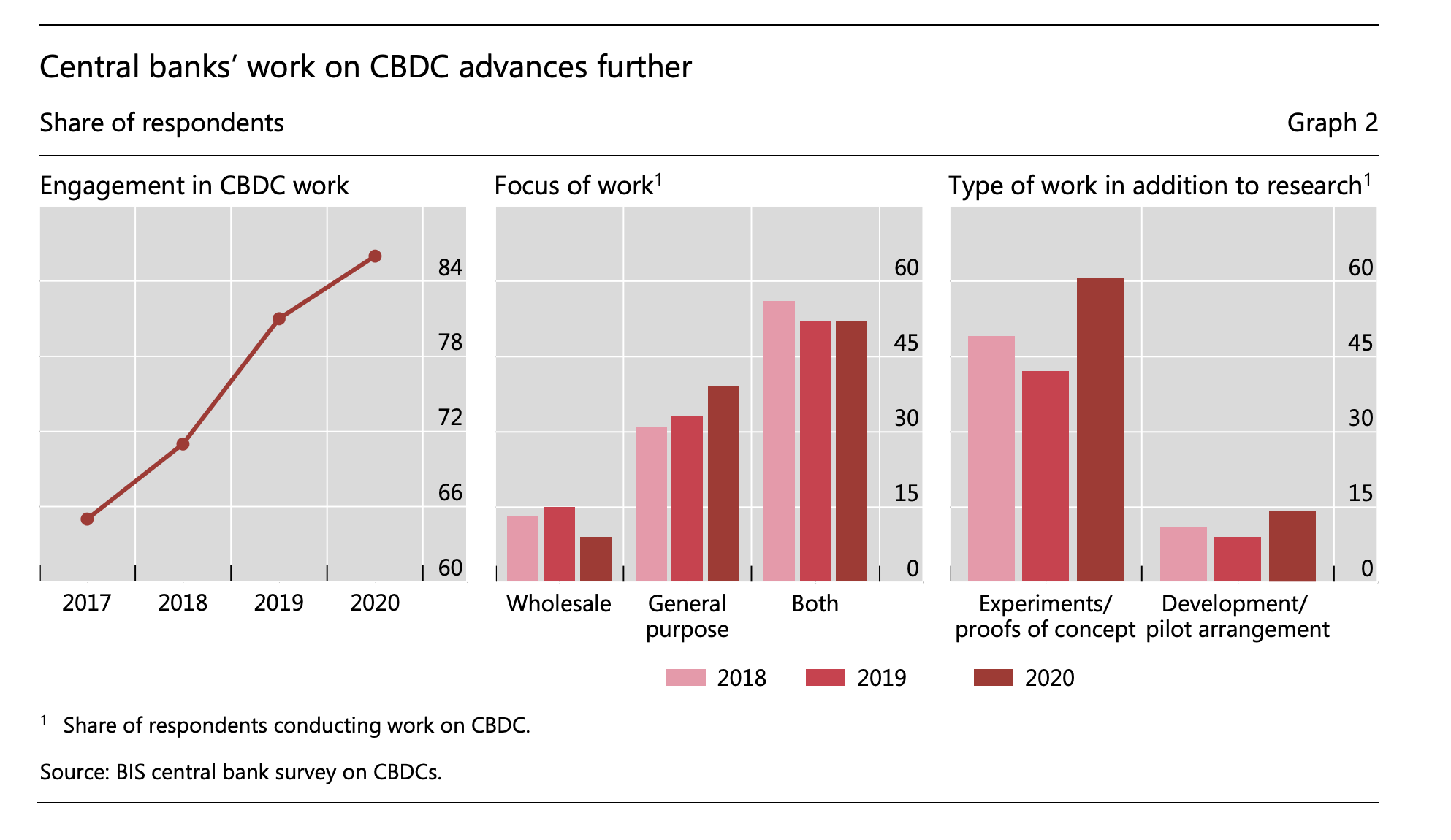
    In January 2021, The Bank of International Settlement ran an updated survey with central banks around world. In it they found that 86% of central banks are engaged in CBDC work. P from 80% in May 2020. Central banks representing 1/5 of the world’s population are likely to issue a retail CBDC in the next three years.

    The goal of improving financial inclusion is much more pronounced in emerging economies, while it is less present in advanced economies like European Union, where the main objectives are the security and efficiency of the payment system.

    The Digital Euro

    The European Central Bank’s CBDC is called the Digital Euro. The ECV see’s three main benefits in exploring the possibility of launching a Digital Euro:

    1. Support digitisation for a native digital European economy
    2. Respond to the declining usage of cash as a means of payment.
    3. Tackling sovereignty concerns related to foreign private digital means of payments in the euro area or possible future foreign CBDC

    There are a few more benefits from the bank’s perspective that Silvia highlighted such as the possibility of enabling use cases based on the programmability of the currency, and the possible application to transactions from counterparties as a machine.

    Preserving properties of cash, anonymity and privacy in a Digital Euro

    Fabio Panetta, Member of the Executive Board of the ECB stated that in a blog post: “Central to all our discussions is the fact that a digital euro would be a means of payment that would complement cash, not replace it. Abolishing cash is not on the table, as ECB President Christine Lagarde and other members of the ECB Board and Governing Council have stated publicly on several occasions.”

    With regards to anonymity. If the identity of Digital Euro users were not verified at any stage of a transaction then they would be anonymous and AML / CFT mechanisms (anti-money laundering / combating the financing of terrorism) wouldn’t be effective. Silvia believes that this would require at least a light identity verification when opening a digital wallet. However as the implementation of a Digital Euro may happen on a DLT platform it is possible to ensure that the information related to the individual is exchanged on a need to know basis. So only the two banks involved in a transaction will have access to the information.

    ABI’s 10 considerations for a CBDC

    The Italian banks experience in the Spunta project gave them the necessary competences and understanding of what could be possible with CBDCs. ABI has prepared 10 considerations for a CBDC which can be summarised into three main concepts:

    1. The digital euro must be functionally different from an electronic payment instrument in order to complement and not to compete with commercial bank money.
    2. In order to be complimentary and not competing with electronic payment instruments, in the same way that as today, banknotes and coins as well as the different payment instruments are providing an array of choices of choices to the customers and are not competing, it would be useful to start by defining potential synergies with existing payment instruments. A Digital Euro built on DLT, thanks to the programmability could allow banks to deliver and propose new service.
    3. In terms of accessibility and ease of use, since all citizens have the right to access the physical euro, they must have immediate perception and awareness that they are using a digital euro.

    ABI’s prepared 10 considerations for a CBDC (source ABI):

    1. Monetary stability and a full respect of the European regulatory framework must be taken into account as a priority.
    2. Italian banks are already working on a distributed ledger infrastructure thanks to the Spunta DLT project. They want to be part of the change that comes from such an important innovation like digital currency.
    3. In the financial environment, a programmable digital money represents an innovation that’s able to profoundly modify the way we conceive currency and exchange. This transformation can potentially deliver a great added value in terms of efficiency for both operational and support processes. This is the reason why it is so important to dedicate attention and energies to develop, quickly and in collaboration with the entire ecosystem, new instruments able to primarily support the development of the Euro area.
    4. It is necessary that digital money deserves the maximum trust from the public. To this extent, it is essential that the highest standards of regulatory framework, security and supervision are fully respected.
    5. Thanks to the key role played by the Central Bank, a CBDC represents the instruments that, more than others, can satisfy the innovation needs in alignment with the current framework of rules, existing instruments and interoperability with the analogical world. At the same time, an instrument like this may reduce the attractiveness of analogue tools issued by private or (in the fully decentralized implementation) non identifiable actors, due to a higher inherent risk.
    6. To deliver at its maximum the potential of transformation of such kinds of tools, it is of absolute interest for the possibility, currently under consideration, to issue a retail European CBDC, that can represent an innovation of cash. Thanks to the role of banks, it is possible to identify technical solutions and an operational framework able to preserve the current characteristics of cash, while adding several typical benefits of the digital world (already satisfied by digital payment instruments), such as the ability not to lose money and, in this period where sanitary risk is under the spotlight, to operate contactless.
    7. Analysing every detail, it would be possible to define how to distribute, store and exchange digital money in a way that enables banks to combine customer needs, together with the ability to ensure that the monetary policy is transmitted to the real economy and compliance to the regulatory framework. For sure, in each of these objectives, The banks role is crucial.
    8. A key success factor for the adoption of CBDC is to reach a frictionless user experience, ensuring, at the same time, full interoperability between digital and analogical worlds and a complete circularity among all ecosystem actors.
    9. According the technological choices that will be taken, a particular attention to the protection of personal data of our citizens is required (privacy).
    10. Thinking to the future that awaits us, the availability of a CBDC will enable several very interesting use cases: to foster peer to-peer value transmission, supporting money exchange between person and machine and in a machine-to-machine scenario; to facilitate cross-border transactions settlement, reducing interest rate, exchange and counterparty risks; to promote, thanks to the programmability of this instrument, the automatic execution of payments when predefined situations arise, reducing administrative processes.

    Learnings from Spunta

    ABI gained three key findings from their work with Spunta:

    • Distributed ledger technology implies distributed governance
    • Straight from the beginning it is important to work in a collaborative manner
    • If DLT is a disruptive technology we need to accept and embrace the disruption

    In their view the design of a Digital Euro requires careful reflection on the adequacy of traditional governance models that have been applied for infrastructure projects led by the ECB and the Euro.

    The digital euro will deeply affect customers, payments, services, processes, and ICT solutions of the payment service providers in Europe.

    From this perspective, the banking sector and other providers of retail payments are in the best position to assess potential effects of architectural options on the end users and to quickly evaluate the feasibility on actual payment services. The Italian banking sector would like to share their experience and expertise gained over the last few years with Spunta in particular the infrastructure itself and the distributed governance aspects that proved to be key determinants on the project success. They believe that the set of experiments based on coopetition principles brings great benefit to the market, particularly in the context of distributed paradigms.

    Four possible use cases

    ABI, along with 18 banks, has spent the last two months developing four possible uses cases to understand the impact of a programmable digital Euro:

    • Simply Home with Reply
    • Safe Return with Fabrick
    • Culture Pass with NTT Data
    • Pay & Split with PWC

    Simply Home

    Performance of multiple payments expected at the time of purchasing a property through the granting of a mortgage. The execution of payments (to the seller, to the agency, to the notary, to the seller’s bank to pay off a previous mortgage, etc.) through the enabled functionality of making a single transaction divided into multiple payments will simplify and automate the management of transactions towards the various actors involved in the process of buying and selling a property. The distinctive feature of this use case lies in the maximum exploitation of the digital euro as a central bank liability as well as in the combination of two feature of programmability the execution of multiple payments in a single transaction and the possibility of limiting the expandability.

    Safe Return

    The process of returning a purchase made through an e-commerce. Thanks to the implementation in a distributed ledger of instructions that are binding and executable only on the occurrence of predetermined conditions (so-called Smart contract), it is possible to make the process of returning purchased goods more reliable and consumer-friendly. At the time of delivery of the returned goods by the client, the sum of money can be blocked and kept in an escrow account, which only releases it after confirmation or rejection of the return.

    Culture Pass

    Culture Pass is related to the bonuses provided by the Government to support some kind of expenses: the development of this case will lead to the creation of specific smart contracts linked to the Digital Euro, which will allow to encode the logic and purpose of expendability of these tokens, making it possible to use the bonus only in compliance with the terms and conditions indicated by the issuing entity. In addition, a simplified prototype linked to the management of sums to minors (pocket money) will be developed, in order to limit the usability only to the categories of purchases allowed by law.

    Pay & Split

    Execution of payments for products on consignment. The case provides for the transparent management of the execution of payments for products on consignment in the so-called short supply chains, using the functionality of “split transaction” (atomic and instantaneous transactions). At the time of purchase, a single transaction is divided so that payment is directed to the seller of the product and to the various producers making up the supply chain.

    ___________________________________________________________________________________________

    This episode is brought to you by our friends and sponsors at R3, one of the pioneers in the Spunta collaboration to provide a faster, more efficient and more transparent way of reconciling interbank transactions.

    Visit R3.com to find out how Corda, R3’s enterprise blockchain platform has been adopted as the platform of choice by Spunta and for other innovative blockchain projects across multiple industries including insurance, trade finance, supply chain and capital markets.


    Ep. 154 – Trust your supplier by ChainYard Mar 28, 2021
    Show notes

    Gary Storr, General Manager of Trust Your Supplier by ChainYard, explained to us some of the challenges that the supplier information management industry is facing with disparate sources of information and the role blockchain can help to mitigate them. In this podcast you will hear how Trust Your Supplier creates a trusted source of supplier information and digital identity that simplifies and accelerates supplier onboarding, lifecycle management and the seamless exchange of information.

    What is blockchain?

    For Gary the best way to explain what is blockchain is what it isn’t. Blockchain is not a cryptocurrency, it’s a technology. It isn’t a programming language. Blockchain is a ledger that is organised in a sequence of blocks that are chained together. It is distributed and it’s immutable. Blockchain is highly secure and decentralised, thus allowing for a multitude of participants to store information on the blockchain within the ledger. Security is assured by encryption and hashing technology making it impenetrable from current day hacking.

    What is ChainYard?

    ChainYard is a subsidiary of IT People Company, founded by Sai Nidamarty, its CEO. IT People Company is essentially an IT staffing business that was started in 1999.

    IBM is a close partner to IT People Company, so when Sai noticed that blockchain was taking off he decided to spun off a new organisation called ChainYard with the intent for it to be a service organisation providing IT consulting services in and around blockchain.

    Within a few years of launching ChainYard, Sai recognised there was an opportunity to create commercial applications on blockchain to address serious needs within the enterprise, such as Trust Your Supplier.

    ChainYard is now a 5 years old organisation with 80 staff providing blockchain services and products.

    Challenges of the supplier information management industry

    Supplier information management is about getting information on a supplier. It is essentially an identity question which blockchain is particularly good at with regards to establishing an identity and to protecting it.

    Traditional enterprises have traditional systems where identities are very segmented. It isn’t unusual for large supplier to have hundreds of identities within the system architecture. This is highly unmanageable. Systems could be storing, for a single identity, multiple versions of the truth for a contact with varying degrees of accuracy. Questions regarding data privacy are another issue.

    Coming out of an enterprise and looking at the market a supplier would want to have a single identity as it deals with a number of customers. Similarly to a driver’s license or to a passport you want a single identity to be used across the value chain.

    Consequently, there is an opportunity for efficiency, for speed, for reduction of cost, for reduction of risk and for compliance.

    Trust Your Supplier (TYP)

    IBM, a partner of ChainYard, recognised that there were some pain points within its supplier information. Both IBM and ChainYard expressed the desire to leverage their respective blockchain expertise to tackle those challenges. Trust Your Supplier was thus born to tackle not just IBM’s supplier identity issues, its supplier qualification and lifecycle management issues but also those of enterprises across industries in a decentralised manner.

    Within its capacity as a partner IBM teams from TradeLens and Food Trust have contributed to the expertise and development of Trust Your Supplier.

    With Trust Your Supplier, every supplier is provided with an identity on a blockchain platform. Provide them with easy tools and applications for them to access and process that identity in a meaningful way.

    It allows organisation to discover, identify, qualify, on board and manage relationships with suppliers in a decentralised manner with a single version of the truth.

    Trust Your Supplier application is in production for the last 18 months and is used by tens of thousands of users worldwide.

    Trust Your Supplier’s underlying architecture, is designed to be interconnected with other networks. It enables to be the identity layer for networks of networks. Whilst TYP is built on Hyperledger Fabric they could theoretically roll out on other blockchain flavours.

    Value proposition

    From a buyer perspective the procurement officer has a reduced administrative burden thanks to a single version of the truth concerning his/her suppliers. In the past information on suppliers would come from disparate sources scattered around their architecture. This reduced administrative burden, reduces cycle time and in turn reduces costs.

    From a supplier perspective their benefits are twofold. (1) Similarly, to the buyer side they get a reduced administrative burden as they don’t have to share the same information repeatedly to their customers. They have one profile with all the information pertinent to that profile published on the blockchain. (2) The second benefit is that as they’re on this digital marketplace they can be discovered and gain new business opportunities.

    Third parties like D&B, EcoVadis and others validate supplier records, help fill in missing information and perform watch-list screenings while banks validate account information and financial health. D&B reports are aggregated into the application where supplier sovereign information is accessible along the ones from EcoVadis and other authoritative sources providing a one snapshot on that supplier.

    Governance

    Vodafone, Anheuser-Busch InBev, Cisco, GlaxoSmithKline, Lenovo, Nokia and Schneider Electric are some of the early participants on Trust Your Supplier. Each of these leading organisations have seeded the TYS network with their supplier base. They have been offered a seat on the board of governors and access to the network at no cost. In return they onboard their suppliers and help inform the direction of new product features and provide guidance in how to evolve the network in the appropriate way.

    COVID19 and Trust Your Supplier

    In March 2020 there was a recognition that PPE was in short supply from masks, gloves, ventilators and other medical equipment. There was a growing need, particularly for health care organisations to find providers of PPE equipment from a reliable source. TYP partnered with a number of trusted suppliers and health care organisations to provide that trusted source of PPEs.


    Ep. 153 – RiskStream Collaborative’s Canopy 3.0 launch – a multi-ledger approach Mar 21, 2021
    Show notes

    Christopher McDaniel is the President at the Institutes’ RiskStream Collaborative. In this podcast he announces the launch of Canopy 3.0 their latest version of their insurance blockchain platform. This new platform, built on Kaleido, supports Corda, Enterprise Ethereum and Hyperledger. Chris also shares with us his plans to launch first notice of loss in production mode on Canopy 3.0 this year.

    What is blockchain?

    Since the launch of Canopy 1.0 in late 2017, Chris’ view of blockchain has evolved. Back then when they were building Canopy 1.0 their views were that blockchain was fundamentally a sharing mechanism. There weren’t many applications out there so they had to build use cases and applications to demonstrate to the market what is possible.

    Now with the launch of Canopy 3.0 things have changed. GDPR, and the right to be forgotten, has had some impact on what you can and can’t do on a blockchain. There are now many parties building out solutions on blockchain compared to back in 2017. Whilst blockchain is still a sharing mechanism there is this realisation that you don’t need to put everything on the blockchain. You can store data off chain and link it to the blockchain via a validated hash. For Chris, blockchain is a great solution for verification, for trust and for facilitating sharing.

    The Institute and RiskStream Collaborative

    The Institute, parent company of RiskStream Collaborative, is focused on education and certification in the insurance industry. Their flagship certification is the CPCU certification amongst another 20 certifications.

    Their reason for starting RiskStream Collaborative, is that the management at the Institute realised that emerging technologies such as blockchain, AI (artificial intelligence) and IoT (internet of things) are going to be key things they will need to teach and certify for insurance professionals in the future. Based on that they created RiskStream.

    Canopy 1.0

    Prior to creating Canopy 1.0 the Institute organised a working group for 30 insurers who wanted to find out more about blockchain. From that event three to four proof of concepts (PoCs) were set up on a public Ethereum blockchain. Some of the learnings they gained from that event was the need to build on a private blockchain. Canopy 1.0 was launched on a private Ethereum blockchain with proof of insurance as the one use case built on top of it.

    Canopy 2.0

    One of the key learnings that the team took out of Canopy 1.0 is that members of RiskStream Collaborative weren’t comfortable with the classic version of blockchain where everything is shared with everyone on the network. Whilst the information was encrypted and accessed on a permissioned basis it still had trust issues along with legal and compliance ones as it was shared with everyone.

    Chris and his team looked for an alternative solution and identified R3’s Corda as it had a point to point approach instead of everything being shared across the blockchain. This was a critical success factor for the consortium’s members. Purist would argue that Corda isn’t a blockchain but a distributed ledger technology (DLT). Whilst this is true from a technical standpoint, the DLT solution provided the answers to the challenges they were facing.

    Canopy 2.0 was launched on a Corda Enterprise License with a number of use cases such as first notice of loss, proof of insurance and a number of other applications within commercial lines, workers compensation, certificates of insurance, surety bonds and a proof of concept for the placement process for reinsurance between brokers and reinsurers.

    Canopy 2.0 brought significant learnings including one where a number of customer needs and third-party solutions weren’t a natural fit for Corda and thus couldn’t be integrated into Canopy 2.0.

    GDPR along with the California Consumer Privacy Act (CCPA) of 2018 introduced some new challenges for blockchain. Both presume the operation of the traditional data model (ie. a centralised one), which makes them difficult to reconcile with a decentralized or distributed data model. These are issues that Canopy 2.0 couldn’t quite addressed which Canopy 3.0 would.

    Canopy 3.0 – Multi-ledger

    Chris’ vision with Canopy 3.0 was to make it the universal sharing layer for carriers, brokers and reinsurers to transact. With a large number of Insurtechs requesting different blockchain protocols to integrate with, Canopy 3.0 was built with a multi-ledger approach to act as a hub for Insurtechs and also to enable future capability to build tokenisation incentives. Supported blockchain protocols are Corda, Hyperledger Fabric, Ethereum and Quorum.

    With Canopy 3.0, RiskStream Collaborative has taken the approach of not having any data stored directly on the blockchain but instead of having hashes linking to it off chain.

    Canopy 3.0 benefits

    Under Canopy 2.0, it wasn’t easy setting a node. Members of RiskStream Collaborative had different levels of technology capabilities, but on average it would take 2 weeks to set up a node on Canopy 2.0. Having 40 – 50 insurers on RiskStream Collaborative, the support and resource requirements to set them all up with a node and integrate them would be quite high.

    With Canopy 3.0 they can perform what they call a “rapid node setup”. Members only need to go to a website and within half a dozen clicks they can choose their cloud service provider and the flavour of the blockchain they wish to have. This is considerably faster than the previous 2 weeks it would take on Canopy 2.0.

    This setup creates a lot flexibility for insurtechs and small carriers, who may not have the technical staff, especially as they also get a safe environment for them to perform tests before going into a production environment.

    The increased speed for deployment and the way Canopy 3.0 was architected enables insurers to operate on Canopy 3.0 at a lower cost. The DLT stack uses a growing amount of open source technology and it comes with a certain amount of prebuilt modules.

    Canopy 3.0 has partnered with Guidewire to facilitate carrier back office integration with Guidewire version 10.

    Plans for 2021

    Chris’ number one goal is to have their first notice of loss application on Canopy 3.0 in production. In addition he hopes that a number of third parties will build on canopy 3.0 and take advantage of the sandbox environment they have developed for them to build applications on top of.

    _______________________________________________________________________________________________________

    This episode is brought to you by our friends and sponsors at R3. In this digital-first world, now more than ever, businesses need to modernize existing processes, systems and models – and enterprise blockchain provides the ideal solution for transacting directly and streamlining business operation.

    Developed by R3, Corda is light years ahead of other blockchain platforms in terms of privacy, security, scalability and interoperability. And–because Corda was built to meet the stringent requirements of highly-regulated industries, it can be used by firms of any type or size and in any industry.

    Blockchain applications built on Corda can reimagine and increase the potential of existing business networks, enabling direct and trusted transactions that eliminate friction and accelerate growth.

    Check out r3.com to find out more.


    Ep. 152 – Blockchain insurance innovation – insights from Tata Consultancy Services Mar 14, 2021
    Show notes

    Pratap Tambe is the Head of BFSI Blockchain Consulting, UKI and Europe at Tata Consultancy Services (TCS). He has has 25 years of experience has been working in commercial insurance since 2011 and in blockchain with insurance since August 2015. In this podcast we discuss TCS partnership with B3i and how blockchain has evolved in the insurance industry since 2015.

    What is blockchain?

    Pratap looks at blockchain more from a DLT (distributed ledger technology) perspective. He uses an example where traditionally a transaction is sent to one or more web servers run by one party. Typically, one server validates that transaction, processes it and saves it. In DLT, a transaction is sent to multiple servers run by different parties which validate the transaction and together run a consensus process. Successful outcome of the consensus results in the transaction being processed and saved.

    In blockchain that transaction will be saved in a chain of blockchain which isn’t necessarily the case in DLT.

    Tata Consultancy Services

    Tata Consultancy Services (TCS) is a 50 year old IT services company that is part of the Tata Group which has revenues of $106 billion. TCS has $22 billion worth of revenue from 470k global professionals that employs 36.4% women from a total of 147 nationalities.

    TCS partnership with B3i for ecosystems innovations

    In November 2020, TCS partnered with B3i to design, develop and launch ecosystem innovations based on DLT for the insurance industry.

    Having worked in the London insurance market since 2011, Pratap is sharply aware of the difficulty competitors have in collaborating together. He believes that B3i has managed to launch a consortium blockchain of the ground with the participation of a number of those competitors.

    B3i has developed a strong product vision and technology which requires a strong system integrator (SI) partner like TCS. As an SI, TCS plays a key role in enabling and scaling consortium blockchains to succeed.

    TCS brings scaling up innovation, pipeline ideation and validation, product engineering, professional services and product support. These are natural services provided by a typical SI.

    TCS already works with many global insurers and reinsurers across geographies from providing IT services support. Because of these relationships TCS brings unique value in helping blockchain consortiums provide back end integration into the blockchain to their customers and partners.

    The role of the SI is to leverage its relationships to enable and support the baseline success of initiatives in core geographies of the blockchain consortium. Once that is achieved the SI is here to scale up innovation and delivery in core geographies and then to other geographies.

    Ecosystems of ecosystems

    Insureblocks is a big fan of the notion of ecosystems of ecosystems. We perceive a future where we will see cross industry blockchain consortiums connecting and exchanging value between each other. For example, B3i could connect to PharmaLedger in the pharmaceutical space or to Marco Polo in the trade finance space.

    Pratap states that B3i connecting with other blockchain consortiums is part of the agenda. He also states that this fits well within TCS strategy of driving ecosystems whether or not they use blockchain.

    One current example that Pratap mentioned is asset or property data. The insurance industry has a lot of this kind of data in various formats and in varying quality of data. The insurance industry could cleanse this data, and leverage it with the appropriate consent to monetise this data to other industries.

    Another example of cross industry collaboration is for healthcare industry consortiums interacting with a healthcare ecosystem.

    Blockchain in insurance since 2015

    In August 2015, Pratap published an article entitled “Blockchains and London insurance market?”. Back then he was a great fan of the potential of blockchain. Over the last 5 – 6 years there have been a lot of PoCs and progress but he personally believes that a lot of potential still lies unactualized. Pratap reminds us that blockchain is a difficult technology and it’s still in its early days.

    He points that if you track B3i: In September 2019, B3i released catastrophe excess of loss placement. In September 2020 they released catastrophe excess of loss technical accounting. Pratap predicts that in 2021 they will release claims. With the launch of claims you will have all three pieces of the puzzle and will be able to prove business value.

    Private and public blockchains

    From August 2015 to about September 2017, Pratap didn’t believe there was an opportunity for public blockchains in the insurance space. However, that changed in September 2017. Pratap believes there is a role for public blockchain with regards to identity, risk and data exposure. For example, he believes that SSI (Self Sovereign Identity) is the best model for KYC. Additionally exposure data as an attribute of an SSI is a natural means for managing that exposure data.

    The Baseline Protocol is an approach to using the public Mainnet as a common frame of reference between different systems, including traditional corporate systems of record, any kind of database or state machine, and even different blockchains or DLTs.

    This is important for business that wants to utilise the immutability properties of blockchain technology. It lays a foundation for working directly with the widely available public Ethereum network in a manner that is enterprise friendly.

    Pratap recognises that whilst the Basesline protocol is very interesting it isn’t going to become a dominant architecture due to the technical constraints of public blockchains.

    Cyber risk modelling

    In April 2018, Pratap published an article entitled “Improving the quality of cyber underwriting” that was well received by the market. Unfortunately as there wasn’t any privacy protected blockchain solution available at that time, the solution didn’t take off.

    Now that B3i blockchain is available having cyber insurance solution on a blockchain is back on the agenda. Products like TCS Ignio, which is installed within an enterprise IT infrastructure, gathers the IT footprint of that enterprise through an inside out manner. This inside outer data is used to fit into standard cyber risk models. In 2018 the dominant approach for cyber insurance solution was the outside in approach. However, by using blockchain you can use a inside out approach in a secure and privacy protecting manner. You can also pool and share claims and loss data.

    Cyber security

    Pratap brings up the example of deepfakes whether it’s the one of Obama or the most recent one on TikTok with Tom Cruise:

    These deep fakes have the potential to create some big losses and Pratap is surprised this hasn’t yet happened. SSI has the potential to help validate the person within a video or if you are speaking to the person you should be speaking to. This is important for it could help staff within a large company to validate that it is the CEO of their company who is instructing them to make a wire transfer for example.

    Pratap discusses such kind of mechanisms and others in his video:

    Blockchain’s role in sustainability and in reducing modern slavery

    Pratap and his wife wrote two papers last year regarding using AI and blockchain to reduce modern slavery: “Reducing Modern Slavery Using AI and Blockchain”. In the paper they discuss the use of Microsoft AI, SSI technology and Ethereum baseline to reducing modern slavery globally. Their paper has garnered interest with both Swedish and UK retailers.

    _______________________________________________________________________________________________________

    This episode is brought to you by our friends and sponsors at R3. In this digital-first world, now more than ever, businesses need to modernize existing processes, systems and models – and enterprise blockchain provides the ideal solution for transacting directly and streamlining business operation.

    Developed by R3, Corda is light years ahead of other blockchain platforms in terms of privacy, security, scalability and interoperability. And–because Corda was built to meet the stringent requirements of highly-regulated industries, it can be used by firms of any type or size and in any industry.

    Blockchain applications built on Corda can reimagine and increase the potential of existing business networks, enabling direct and trusted transactions that eliminate friction and accelerate growth.

    Check out r3.com to find out more.


    Ep. 151 – How to Design your own Token System Mar 07, 2021
    Show notes

    Shermin Voshmgir is the author of the book Token Economy, the founder of Token Kitchen and BlockchainHub Berlin. In the past she was the director of the Research Institute for Cryptoeconomics at the Vienna University of Economics which she also co-founded. She was a curator of TheDAO (Decentralized Investment Fund), an advisor to Jolocom (Web3 Identity), Wunder (Tokenized Art) and the Estonian E-residency program. In this podcast we discuss “How to design your own token system”.

    What is blockchain?

    Blockchain is a collectively maintained public infrastructure where people are incentivised to keep the ledger up to date in a trustful manner. It is the backbone of this new generation internet often referred to as the Web 3.

    Blockchain allows its participants to collectively settle data transactions, whether its value transactions or data flows on a shared public infrastructure that everyone can trust. This contrasts to today’s Web 2 which is managed by private client server infrastructure where data is managed and stored behind the walled gardens of a server that belongs to a specific institution or a private entity.

    Shermin believes that blockchain itself isn’t particularly interesting. What is interesting is that blockchain brought the back-end revolution for a decentralised web or Web 3. Tokens are the killer application of the Web 3 as websites were the killer application of the early internet in the 1990s when the World Wide Web came about.

    Types of tokens

    Cryptocurrencies and crypto assets are specific type of tokens.

    A token can represent money, whether it’s state issued money, often referred to as CBDC (central bank digital currency) or virtual currencies such as cryptocurrencies.

    Tokens can represent any type of assets such as commodities, physical assets and fungible assets like art or real estate. Any virtual or real asset can be tokenized and have a digital representative that is easily traded.

    Tokens can also be used to represent an identity of a person, machine or an institution. Credential tokens are tokens that are tied to an identity or that have limited transfer abilities.

    Token System

    A system is use to described how people and objects interact in this physical world. Token systems can have varying degrees of complexity.

    Usually, the more actors are involved in a system, the more complex the system and its interactive parts become.

    An example of a complex token system is the Bitcoin network which is a network of physical computers operated by humans or institutions. It has a three-layered network composed of tokens, machines, and peer-to-peer network.

    An example of a less complex system is a token system that represents tokenizing shares in a company which can be settled on a public or semi-public infrastructure.

    Creating a token system, the questions

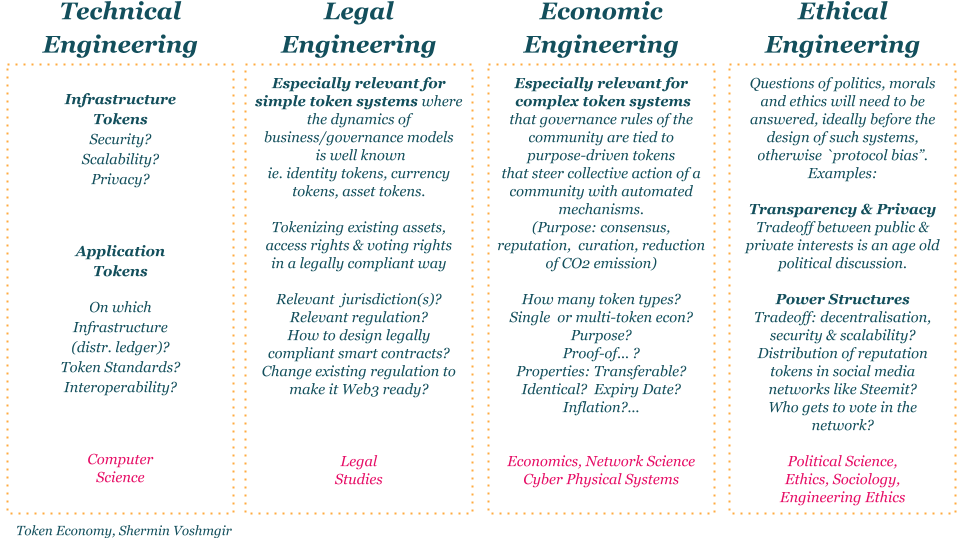
    Source: Token Economy, Shermin Voshmgir

    When creating a token system the main questions that one should ask themselves are:

    • What do you want to do?
    • What is the purpose of your venture?

    For example, if you want to tokenize real estate, the question of how to design your token system is very different than if you want to create a token based social network where the token creation needs an intelligent incentive design for how to incentivize people to upload and curate posts. An example of such a token system is Steem. However, such token systems are very complex and have a lot of unanswered questions.

    Tokenising real estate whilst it involves a series of complex legal questions sits within an understood legal framework. Whilst they may seem less complex they can very easily become more complex where your individual real estate objects can be tokenised allowing for fractional tokenization of a single object, like an apartment.

    There is a series of technical, legal, economic and ethical questions to be asked when we design our token system, but the first question is always, what do I want to do?
    Design thinking and engineering design for token systems

    Design thinking became popular in the startup world in the 90s. It helps to strategically plan concepts for any new technology, products or service. The process ranges from problem definition, ideation, solution-focused strategies, modelling, prototyping, testing and evaluating including iterative feedback loops thereof.

    In the case of token systems, design thinking approaches, the technology being blockchain allows for interactions to happen on a socio economic level. It also allows for the move away from individual products and services to collectively shared dynamic socio economic systems.

    In March 2018, Trent McConaghy, co-founder of Ocean Protocol, coined the terms token engineering and explained his thinking in a blog post entitled “Towards a Practice of Token Engineering”. Which he describes as: “the theory, practice and tools to analyze, design, and verify tokenized ecosystems.“

    Trent also defined “Engineering is about rigorous analysis, design, and verification of systems; all assisted by tools that reconcile theory with practice. Engineering is also a discipline of responsibility: being ethically and professionally accountable to the machines that you build”.

    For Shermin, engineering always requires the ethical part. Part of the challenges of the early websites is that the engineering ethics of building websites didn’t exist. When websites failed they simply pivoted. Token engineering forces us to think in more robust and responsible ways and it can sit at the intersection of design thinking when creating new token systems.

    Technical engineering.

    Token systems either have an infrastructure token or an application token.

    Infrastructure token are tokens that steer blockchain networks. Bitcoin is an infrastructure token which is used to incentivize participants in the network to contribute to the security of the network. Similarly, Ether is the infrastructure token on the Ethereum network. Infrastructure tokens are used in Web 3 networks that have a native currency to incentivize network behaviour and contribution.

    When designing an infrastructure token you have to balance the needs for security, scalability and privacy.

    Application tokens on the Ethereum network allow the creation of simple smart contracts on an application level. These application tokens can represent a myriad of different applications such as an asset back currency, a piece of art, fractional ownership of a real estate, a reputation token on a social network and a number of other applications.

    When designing an application token you have to balance the needs for infrastructure, interoperability and standards.

    Legal engineering

    We’ve had securities for hundreds of years. As a society we know how to issue securities, manage securities and manage the issue of fraud and security. Essentially, we have built the mechanisms to prevent fraud, to protect investors and to create a safe ecosystem where we avoid the kind of stock market crash we had in the 1930s.

    If we were to tokenising the New York Stock Exchange for example we would need to answer the following questions:

    • How to do it in a legally compliant manner?
    • Are new laws or a regulatory environment required to encompass the use of a new technology solution?

    Legal engineering, whilst is complex in itself, is only focused on the legal aspect. Tokenisation of existing businesses, networks and institutions predominantly requires legal engineers, which refers to making the tokenization of existing assets, access rights and voting rights legally compliant within relevant local legislation. In this case legal engineering refers to the tokenisation of traditional governance models where smart contracts replace many of the existing human, paper and client server based operations.

    Economic engineering

    Economic engineering is used when designing “complex token systems”. What contributes to the complexity of a token system is:

    • how big is the network. The higher the number of individual or autonomous actors are in the network the higher the level of complexity.
    • Number of interactions
    • Number of types of tokens you have in a token economy, such as a multi-token economy

    Tokens are there to they steer collective action towards a common purpose. The main question that need to be answered in such design process are:

    • Goal of the token system
    • Number of different types of tokens – single vs multi-token economy
    • Purpose of the token
    • Properties of the token including their transferability and fungibility

    The economic engineering aspect of creating decentralised autonomous organisations where you have a number of autonomous actors from different backgrounds you need to have behavioural economics, ecological economics, micro and macro economics. You need network scientists and people of different skill sets.

    Ethical engineering

    In building effective token systems, you need people with an economics background, network science background, cyber and physical systems background for the economics part, but in the end, these token systems, are about the socio-economic coexistence of people in social network which has many ethical questions.

    • The question of transparency versus privacy. There is a trade-off between what should be public and what should be private
    • Power structures. If a token system incentivize network actors with a network token, it needs to ensure that it doesn’t favour a set of network actors over others

    Ep. 150 – Bringing innovation into the Polish Financial Sector with the Blockchain Sandbox Feb 28, 2021
    Show notes

    Blockchain Sandbox is Poland’s first business and technology platform designed to accelerate the development of innovative blockchain solutions within an isolated system that simulates real world production environment. To take us through this innovative solution we are joined by Dorota Dublanka, President of the Foundation Cyberium and Head of Human Resources at KIR along with Maciek Jędrzejczyk, Blockchain Technical Leader at IBM for Central and Eastern European Region and lead architect of the blockchain sandbox.

    What is blockchain?

    Dororta defines blockchain as a list of records that is stored on a wide range of computers. She also refers to blockchain as lego blocks where different participants join together to build a tower together whilst verifying each blocks added to the structure and exchanging information between each other.

    Maciek’s defines blockchain as a database with a very specific data structure whereby transactions are put together into a block representing an interval of time between the recording of a previous state and the current state which is going through the approval process. Each block is cryptographically linked to previous blocks and the governance over how the data is stored on the chain is determined by the network. The network decides whether or not certain transactions are going to be included within a block or not.

    State of innovation within the financial sector in Poland

    Maciek states that to understand the state of innovation in the financial sector in Poland one has to go back 30 years to 1989 – 1990 when Poland transitioned to a market economy. At that time there was no digitisation and computers were virtually inexistent. The financial infrastructure was nearly all paper based. Everything had to be created from scratch which represented both a set of challenges and opportunities for Poland.

    Poland had virtually no technical debt, or legacy IT infrastructure within its financial services sector that other countries in Western Europe or in North America had. This enabled the Poles to choose the best and most flexible solution to their specific needs. As the Polish leadership and society were very curious they were also very open to innovation.

    Dorota added that, Poland has a relatively high social acceptance for innovative solutions. Poland has one of the highest percentages of mobile banking and debit cards users in Europe. Because of its embracing approach to innovation, Poland has adopted a lot of the most innovative platforms for payment solutions and its IT professionals rank as some of the top 10 best in the world.

    The Blockchain Sandbox

    Blockchain Sandbox is here to accelerate the development of innovative blockchain solutions in Poland. They aim to demystify what is blockchain and break the view that it’s only related to cryptocurrencies. They wish to develop blockchain technology to support entrepreneurs and companies to access solutions within the sandbox.

    Startups and major companies who join the sandbox with innovative ideas can leverage blockchain within the sandbox for developing their applications and business solutions. They will also receive support from the blockchain sandbox founding members.

    Foundation Cyberium is the leader of the Blockchain Sandbox. The founding members are PKO Bank Polski, KIR and IBM. PKO Bank Polski is one of the biggest banks in Central and Eastern Europe who has implemented production grade blockchain solutions.

    KIR is the hub of shared services for the Polish financial services sector. They build system solutions for the banking business and the government. KIR is one of the sandbox leaders and is implementing innovative solutions to the economy.

    IBM is the technology partner to the Sandbox initiative. Chmury Krajowej, the national cloud operator, responsible for sustaining the IT infrastructure for mission critical applications in in Poland, is a technology provider to the initiative.

    The Financial Supervisory Authority of Poland acts as a regulator to the financial sectors and reviews solutions built within the sandbox which gives participants some certainty as to whether they can introduce them into the market.

    There is an obvious motivation coming from the founding members of blockchain sandbox, to leverage the best of breed blockchain protocol that is being used for businesses in order to provide a safe environment for startups and companies incubated through the sandbox to give them the best tools that are using blockchain as the core infrastructure.

    The platform is based on Hyperledger Fabric. Each company that is incubated in the sandbox has access to a simulation of a real world network with a number of organisations where they can develop their applications within. They can also test the overall governance of a decentralised network, test their business solutions’ performance, privacy and confidentiality.

    In addition, they will receive advisory services provided by the founding members from a legal, technological and regulatory perspective.

    Benefits in joining the blockchain sandbox

    Dorota listed out the benefits in joining the blockchain sandbox:

    • Isolated controlled environment
    • Latest technologies
    • Access to development resources
    • Regulatory support
    • Marketing and promotional support of startups and businesses to reach customers and investors

    Maciek, listed out the benefits from an iterative process:

    • Qualification stage: each applying member is interviewed by the founding members where the use case is analysed
    • Onboarding process: the company receives an access to their instance of the sandbox where they receive all the tools they will need for the incubation process
    • Ongoing process: this is where they receive the advisory support from the founding members
    • Evaluation process: this is where they get the biggest benefit as it is the moment when their application is verified by institutions and organisations which act within a regulated market

    Applying to the sandbox

    Dorota stated that they are hoping to attract innovative solutions from non-profits, startups, and big and small companies. Participants don’t necessarily have to come from Poland as they’re open to receiving ones from companies around the world.

    Participation in the sandbox is free of charge and no fees are incurred when using the platform. Applications can join by going to https://www.sandboxblockchain.pl/en/ and complete the application form which will be reviewed by the sandbox team. Selected candidates will be invited to join the interviewing process.


    Ep. 149 – Innovation and blockchain in the insurance industry – insights from MSG Feb 21, 2021
    Show notes

    Bernhard Lang, Member of the Board at MSG System, joins us to discuss innovation and blockchain in the insurance industry. In this podcast we discuss the importance for the insurance industry to remain relevant in an ever changing market. How making innovation a corporate discipline and embracing a customer centric approach to remain engaged in customer ecosystems is critical to that objective of relevance.

    What is blockchain?

    From a non-technical point of view blockchain is a form of digital representation of what we naturally do in real life. We want to be part of social communities within which we communicate, make agreements, state facts, and make promises that are then known to the people within the community as a current status of things or an evolving collective truth.

    The technical definition of blockchain is that it’s an immutable and distributed technology that enables the creation of new business scenarios. According to Bernhard, too often blockchain technology is looked at from a technology angle first before a business one. He personally prefers that we start with a business problem and then identify blockchain technology if it is the right one for the business problem.

    About MSG

    Bernhard Lang has been with MSG for the past 25 years. MSG is a German product based system integrator. MSG focuses on 10 different lines of business. Their business strategy is to develop industry specific content, software assets, software solutions, that go very deep into the lines of business along with a consulting services associated with it. The majority of MSG’s business is within insurance but also looks at other industry verticals such as banking, public sector, automotive and others.

    In addition, MSG works with startups such as Ritablock (featured on Insureblocks: Ep. 124 – Reinsurance accounting blockchain, Ritablock integrates with B3i’s Fluidity platform) and they have co-developed the SAP FS-RI (financial services reinsurance), which has become the market standard for professional reinsurance companies and for cedents.

    Outside of reinsurance, MSG has partnered with Marco Polo, a trade finance blockchain solution, to help them integrate with SAP European Systems.

    Insurers approach to blockchain in comparison to mature platforms like SAP

    Bernhard believes the insurance industry is quite open to blockchain technology however he notes that the materialisation of previous blockchain investments haven’t been that great. Consequently he believes that in the future the insurance industry might be more cautious to making investments in blockchain.

    Source: Cookhouse Labs

    MSG has an innovation lab in Canada called Cookhouse Lab. In May 2017, they launched a four week design thinking blockchain workshop along with seven insurance companies where they identified 34 uses cases and created three prototypes. Whilst there was a lot if interest at that time, Bernhard would qualify the output as having had a limited impact and not significant enough to be considered a game changer.

    Whilst he believes insurers will keep looking at blockchain technology few will expect high returns.

    Evaluating new innovative technologies within the insurance industry

    Bernhard candidly describes the decision making process within insurance companies as being sometimes irrational. To support that statement, he recalls a meeting regarding ACORD standards, which in his opinion represent a huge business case. During that meeting, insurance professionals flew in from around the world, agreed to join forces and create a service organisation. All participants were requested to make a €40,000 investment for this initiative. Unfortunately, they had great difficulties in raising that amount of money. Bernhard asks the question that if it was such an obvious use cases with large saving potentials why was it so difficult to raise such a small amount of money?

    For Bernhard the insurance industry sometimes makes irrational decisions when it doesn’t go for obvious business cases. He thinks that’s equally true for blockchain. Blockchain can bring great benefits and large saving potential but there’s still some resistance to it. He queries whether the reason blockchain isn’t being fully adopted in the insurance industry is because the industry is doing well enough that it doesn’t need to improve its efficiency.

    There is also the case of finding the right top managers within an insurer who has the willingness to take strong decisions.

    Bernhard believes blockchain can be a key technology to set up cross industry collaborations. Therefore, he believes that insurance has to collaborate with other industries. Otherwise, he thinks there’s a risk that they are pushed to the second row, and that they lose access to their consumers.

    Best practices when evaluating innovative technologies

    Bernhard explains how in the past they would receive an RFP, they answered the RFP, they presented their product and if the product was liked it was purchased.

    Now he believes that the way of collaboration for new solutions and leveraging new innovative technologies has changed. The whole approach to innovation, open innovation and collaboration in new ecosystems has all changed.

    Bernhard believes that now entities need to collaborate at the idea generation, join forces in a co-innovation space where you perform join design thinking sessions and jointly work on the solution. That’s the key to success, to take new fields and leverage digital technologies like blockchain for creating new products and collaborating with customers, partners and subject matter experts from within your industry and outside your industry.

    MSG partnered with B3i to create an innovation laboratory for reinsurance solutions

    As B3i has a growing community of insurers, MSG believed there was a potential to work with them to understand their needs and work jointly to leverage digital technologies in an innovative environment. MSG comes into the partnership with their reinsurance products and primary insurance products whilst B3i comes with their DLT consortium. They want to connect these two worlds and work jointly on new innovative solutions.

    They’ve recently sent out invitations to the market to join MSG and B3i and work jointly on new innovative business ideas, leveraging MSGs products and B3i’s fluidity platform and B3i’s Corda based technology.

    Initially working with B3i wasn’t something that MSG had envisioned as their product managers and architects felt that B3i had the potential to disrupt MSG and remove the need for the FS-RI products if everything moved onto blockchain.

    However, when they looked at it more closely they realised that if this was to happen it would be much later in the future and in the meantime, there exists many opportunities for the two entities to collaborate together.

    It turns out that B3i also initially saw MSG as competitors but both parties now see each other as partners who want to collaborate together to improve the industry.

    Changes coming to the insurance industry

    Bernhard believes insurance as a service has a great potential. He believes that cross industry platforms that foster cross industry collaboration is the way forward and blockchain is a great technology to support this.

    He foresees that we will see more insurance companies partner up with companies from other industries whether it is with Marco Polo or Contour that can expand their products by bundling together insurance to the end customers.

    To sum it up Bernhard thinks there is a great potential to bundle insurance as a service in all kinds of cross industry platforms.

    Fostering cross industry learnings & remaining relevant

    Insurers have to get out of their silos and collaborate with other industries if they still want to main customer relations. They need to understand what is happening in other markets, understand the risk and identify the kind of risk coverage services they can offer. To achieve this you need an ecosystem point of view that is customer centric.

    Bernhard reminds us that everybody needs risk transfer but not necessarily from an insurance company. With so much capital in the market, it’s normal that non-traditional risk carriers want to get into that market.

    MSGs’ innovation experiences

    Bernhard recognises the challenges for a corporate like MSG to successfully perform innovation because of its own corporate culture. As a corporate’s innovation is often stifled by compliance, reporting figures, IT security and other requirements, MSG wanted to have a startup mentality and culture. To reach that objective they took people from the corporate, created an innovation space for them and removed some of the corporate pains by giving them increased freedoms and independence.

    Members of the team that work in the innovation lab have some skin in the game and is willing to participate in a risk reward model.

    More importantly Bernhard believes that innovation needs to have top management attention and as finance, accounting or controlling, innovation needs to become a corporate discipline in itself.

    Figuring out the right approach to installing an innovation culture within a corporate can be a tricky exercise. The Insureblocks team has built over 6 startups and help build 2 innovation labs within large corporates. If you’d like to have a conversation on how to install an innovation culture or innovation lab within your corporate please don’t hesitate to reach out to us on info@insureblocks.com or via Linkedin.


    Previous 1 2 3 4 5 19 Next

    Related Podcasts

    How I Built This with Guy Raz

    1

    How I Built This with Guy Raz Business
    Planet Money

    2

    Planet Money Business
    Inside Strategic Coach: Connecting Entrepreneurs With What Really Matters

    3

    Inside Strategic Coach: Connecting Entrepreneurs With What Really Matters Business
    BiggerPockets Real Estate Podcast

    4

    BiggerPockets Real Estate Podcast Business
    The Smart Passive Income Online Business and Blogging Podcast

    5

    The Smart Passive Income Online Business and Blogging Podcast Business
    A Thousand Natural Shocks With Gabe S. Dunn

    6

    A Thousand Natural Shocks With Gabe S. Dunn Business
    footer-logo

    Contact Us

    Toll Free: 844-670-7747

    Links

    • Home
    • Top Charts
    • Networks
    • Apps
    • Independents Podcasts
    • Podcast Advertising
    • Podcast News
    • Contact Us
    • About Us
    • Analytics & Insights

    Stay Connected

      Privacy, Terms of Use & Our Code of Ethics Protecting Content Creators Copyrights