TopPodcast.com
Menu
  • Home
  • Top Charts
  • Top Networks
  • Top Apps
  • Top Independents
  • Top Podfluencers
  • Top Picks
    • Top Business Podcasts
    • Top True Crime Podcasts
    • Top Finance Podcasts
    • Top Comedy Podcasts
    • Top Music Podcasts
    • Top Womens Podcasts
    • Top Kids Podcasts
    • Top Sports Podcasts
    • Top News Podcasts
    • Top Tech Podcasts
    • Top Crypto Podcasts
    • Top Entrepreneurial Podcasts
    • Top Fantasy Sports Podcasts
    • Top Political Podcasts
    • Top Science Podcasts
    • Top Self Help Podcasts
    • Top Sports Betting Podcasts
    • Top Stocks Podcasts
  • Podcast News
  • About Us
  • Podcast Advertising
  • Contact
Not in our directory?
Add Show Here
Podcast Equipment
Center

toppodcastlogoOur TOPPODCAST Picks

  • Comedy
  • Crypto
  • Sports
  • News
  • Politics
  • True Crime
  • Business
  • Finance

Follow Us

toppodcastlogoStay Connected

    View Top 200 Chart
    Back to Rankings Page
    Business

    Insureblocks

    blockchain & smart contracts in industries across the world

    Advertise
    • Apple Podcasts
    • Google Play
    • Spotify

    Latest Episodes:
    Ep. 168 – IDunion a European decentralised identity management platform Aug 15, 2021
    Show notes

    IDunion is a new European decentralised identity management platform that is promising to bring user centric digital identity with privacy at its core. In this podcast we had Adrian Doerk – Product manager at Lissi and communication & Public relations at IDunion, walk us through IDunion.

    What is blockchain?

    For Adrian, blockchain is just a data structure. When you expand its definition from a DLT (distributed ledger technology) perspective with multiple nodes on a network what makes it interesting is whether the rights to writing on the network are permissioned or permissionless. This is determined by the type of consensus that exists on the network who determines who and what is written into the network.

    Present challenges with digital identity

    History of the digital identity on the internet:

    • Isolated siloed identity where users would login and authenticate themselves with the provider of a digital identity for accessing a service
    • Federate identity where multiple companies and institutions got together and agreed on a single sign on for multiple sites. However, the challenges of this model is that the identity was still focused on a central operator and not all companies and institutions where comfortable with this approach
    • User centric identity where a classic example is login with Google login or Facebook login. Whilst this is very convenient for the user it does lock up the user in a proprietary ecosystem which is very dangerous since these providers live from user and behavioural data which they resell to third parties.

    The next generation of digital identity will be designed with privacy by design principles. It will be a user centric proposition that is both convenient but also gives the user more control around their identity for authentication and identification purposes.

    • Identification asks: who are you?
    • Authentication asks: is it you again?

    IDunion vision

    IDunion is a consortia, whose aim is to build an open ecosystem for self sovereign identities controlled by its user. Whilst the platform can be used everywhere it is based on European values, laws and regulations.

    Everyone (including natural as well as legal persons and things) has the possibility to manage their identity information by themselves and to decide when they want to share this information with whom. The sovereignty over one’s own data is tremendously important, especially when it comes to very sensitive and personal information.

    Users can choose one of several wallets, which are used for storing and presenting credentials to third parties as required. This is helpful for a wide range of use-cases and enables a new way of identity management. Thus, technology companies are no longer acting as a central identity manager, but the user himself! The user can decide where the information can be seen, which program is used to manage information and with whom this information is shared. We call this concept the self-sovereign identity.

    IDunion platform

    Source: IDunion

    IDunion uses Hyperledger as a kind of technical umbrella for their multiple implementations:

    • Hyperledger Indy for the implementation of the network
    • Hyperledger Aries for the agents which communication with the network
    • Hyperledger Ursa for the crypto libraries

    Governance

    IDunion initiative was started by a number of German stakeholders and early on received some funding from the German government.

    The newly founded IDunion organisation will act as the legal entity behind the network and represent the stakeholders’ interests within a European Cooperative Society (Societas Cooperativa Europaea S.C.E.). In addition to operating the network, the organisation’s main tasks will be to attract new partners and to bring together partners working on the same or similar use cases. This ensures that all European participants are put on a level playing field.

    The participants in the network have defined rights and obligations to enable legally binding relationships which are in harmony with the European legal framework (especially eIDAS and GDPR).

    Benefits for the user – user centric design

    The interesting aspect for the end user is that with IDunion they will have peer to peer encrypted communication channels which they can use to exchange verifiable information.

    One of several wallet apps offered can be downloaded to the mobile device and used to receive, store, manage and present digital credentials. The data is stored locally on the mobile phone and can be transferred from wallet to wallet thus ensuring data portability.

    Selective disclosure of personal data and encrypted communication prevent the creation of user profiles by third parties. The wallet offers the possibility of storing, managing and sharing all personal data in a bundled form as required. For example, users will have a clear history of what information was shared with whom and when giving them a clear history of the shared data and that they can execute data protection rights such as the right to be forgotten.

    This facilitates access to online offers of companies and institutions and creates transparency for all parties involved.

    Benefits for the corporation

    The network enables the clear verification of customers, companies and institutions. This facilitates access for customers and saves companies time, costs and administrative work. Since companies can independently verify the identities of business contacts, identity fraud is prevented to a large extent.

    Furthermore, the single sign-on functionality offers the user a user-centred alternative to a password or the dependence on a single technology provider. Since users store their data themselves, this leads to fewer obligations and potential penalties of data protection regulations such as the GDPR.

    What we have to remember is that personal data can be a liability for companies. If we look at some of the recent data breaches that have led to massive GDPR fines it shows that storing personal data in a centralised way acts as a honey pot for hackers.

    Benefits for institutions

    Institutions such as educational institutions, state authorities or citizens’ offices can use the network to identify citizens in an eIDAS-compliant manner and thus provide easy access to their services and systems. Once a connection is established, information requests can be sent directly to the citizens’ wallet via an encrypted connection.


    Ep. 167 – Empowering individual’s consent using NFTs and blockchain – insights from Acoer Jul 25, 2021
    Show notes

    Jim Nasr, is the CEO of Acoer, a software development company whose vision, and work is all about building useful, usable, real time technologies that are fundamentally targeted at the healthcare industry. Jim was the former chief software architect at the Centre for Disease Control and Prevention (CDC) in the United States. In this podcast we discuss how NFTs and blockchain can be used to empower individual’s consent.

    What is blockchain?

    Blockchain is a public infrastructure that should be used within the public context. Blockchain provides transparency, auditability and accountability. Blockchain is a layer of trust that can be used to impute trust between parties who don’t trust each other.

    Jim is keen for blockchain to move past the world of cryptocurrencies and proof of concepts. He wants to make blockchain as practical as possible with real practical solutions.

    Challenges of consent

    Consent is an element of compliance.

    In the healthcare industry, when you go see your GP, you fill out paperwork to essentially give them consent to your medical health information for all time. For Jim there are a number of issues with that. It’s wrong that the patient doesn’t always fully comprehend what they’re signing, the process is complicated, it has to be done multiple time and the patient has no rights to say they’ve changed their mind. Jim gives the example that “if you’re my orthopaedic surgeon, you should not have access to my mental health information”.

    There is a double challenge with regards consent. On one side individuals who sign consent forms have no idea what they have exactly signed, what data is shared and where that agreement is. On the other side organisations have limited idea on who signed what agreements, what data was covered and where the agreements are stored. This creates repetition of the process where the individual is repeatedly asked to sign new consent forms.

    Dynamic consent is the recognition that consent is not a and done concept, it is more dynamic with potential multiple phases for providing consent with the ability to revoke the consent, where the consent may expire after a certain amount of time and where it could be renewed.

    Dynamic consent is digital which gives it properties to be tracked and monitored.

    Data dignity

    Data has creators like individuals on Facebook, Instagram and Twitter to name a few who create data on those platforms. Essentially, we are implicitly giving those platforms the ability to use this data and along the way we become the product for the “free usage” of that platform. Consumer of those platform are creating content for the platform to leverage in a manner that creates a financial windfall for themselves. The issue is that we as consumers have no say in how that data is marketed and no say on whether firms like Cambridge Analytica use our data and create secondary data markets for themselves.

    Regulation: GDPR & CCPA

    Regulation such as GDPR (General Data Protection Regulation) and CCPA (California Consumer Privacy Act) provide an important opportunity for regulators to help regulate consent. GDPR gives EU citizens the right to grant access to their information to third parties, including consent and gives them the right to be forgotten. Crucially this regulation carries some serious teeth where the financial penalties for firms who breach GDPR regulation is up to 4% of gross revenue.

    For example Google has received a fine of €50m, British Airways of €22m and Marriott International of €20m.

    CCPA is very similar to GDPR in terms of the protection it provides to consumers, in terms of consent and in terms of being fined if firms don’t comply.

    In the healthcare industry there is the Cures Act which gives patients the legal right to get access to their health data from their electronic health record irrespective of the type of app they’re using.

    Components of consent

    There are multiple components to a consent. First of you have who is consenting? With that you have a signatory piece which can be a wet signature on a piece of paper, a digital signature or even an oral consent on a transcript record.

    In 2021 and going forward all this information should be captured digitally and traceable digitally. Metadata of the consent needs to be captured such as the time stamp and other characteristics of the consent file such as file size, who touched the file.

    Consent files can also be aggregated for reporting purposes such as for understanding what’s happening in terms of vaccinations for COVID-19. This needs to be done within a context of traceability, accountability and traceability and crucially in a privacy preserving manner.

    Blockchain and consent

    The future of consent is one where it is dynamic. It recognises that individuals will have different states in their life cycles which won’t be contained within one app or one organisation. So, the questions are:

    • How do you transfer the rights of consent?
    • How do you maintain the state of consent throughout those different life cycles?

    Public blockchain ledger is designed for collaboration amongst parties that don’t know each other. It provides an immutable reference point that can be trusted due to the cryptography and public nature of the network.

    Public blockchains can provide the facility to have a public anchor of that consent without the public have access to the file thus keeping the data private. That anchor on a public ledger effectively acts as a chain of custody.

    Launch of RightsHash

    RightsHash, is a decentralised engine that allows to associate NFTs (non-fungible token) on the Hedera Hashgraph network to any digital asset that will have different states within its lifecycle.

    Jim takes us through an example of where a patient goes to see a doctor and signs a consent document. Using OCR, optical character recognition, this document can be digitised as a PDF making into a digital object with its specific public token ID that can be tracked. Which means any time the file is accessed or any changes to its state for example if it expires or if it is renewed, it can all be tracked using that one token ID.

    By building on the Hedera network, RightsHash brings a full range of benefits to the underlying process of managing an individual’s rights. These include the ability to track and monitor discrete rights and protections in real-time, tracking transactions from different data sources and across different apps, demonstrating cryptographic proof of action and providing an automated, continuous, transparent auditing of all related compliance transactions. Additionally, RightsHash uses its own distributed architecture, decentralized processing, and storage nodes, physically located across the globe and on different cloud providers to ensure fault tolerance and high performance.

    The first production deployment of RightsHash has been dedicated to the process of consent management, in particular for clinical trials with patient health or medical consent scenarios. Acoer has been working exclusively with the Consent Custody Corporation to develop a fully functional blockchain-enabled consent platform based on RightsHash called ConsentHash. Consent Custody Corporation is a custodial bank for consent agreements and personal data assets, and acts as a data fiduciary. Consent Custody Corporation protects people and organizations by safeguarding consent agreements while making consent information available, transparent, and certified anywhere data is managed.


    Ep. 166 – PharmaLedger – the Pharmaceutical Blockchain Consortium Jul 12, 2021
    Show notes

    In January 2020, 12 global pharmaceutical companies and 17 public and private entities; including technical, legal, regulatory, academia, research organisations and patient representative organisations, got together to form PharmaLedger, the pharmaceutical blockchain consortium.

    Joining us for this podcast is Daniel Fritz, PharmaLedger Industry Project Leader and Supply Chain Domain Architect at Novartis and Marco Cuomo, Manager Applied Technology Innovation at Novartis, a team that brings in new technologies, such as blockchain, into Novartis. Marco is also the co-lead architect at PharmaLedger for the blockchain platform.

    What is blockchain?

    Daniel likes to introduce blockchain with the five A’s:

    • Assets, too often blockchain is associated with cryptocurrencies as assets but assets can also be data and medicinal products that can be exchanged on a distributed ledger technology
    • Audit, the immutability aspect of blockchain is good for audit.
    • Automation, use of smart contracts eliminate non-value adding steps
    • Anonymize, especially important in the healthcare care industry to protect the patient’s data by keeping it confidential and protecting their privacy
    • Authority, no central authority where authority is distributed amongst the participants

    For Marco the real strong added value blockchain provide at its core is the immutability function. Whatever you store on the blockchain, transactions and data are immutable so no one can change it.

    An introduction to PharmaLedger

    PharmaLedger, launched in January 2020 as a public private partnership under (IMI) the Innovative Medicines Initiative, a joint undertaking between the European Union and the (EFPIA) European Federation of Pharmaceutical Industries and Associations. It’s a three project with over €22m of public private funding. There are 29 partners in the consortium which includes 12 pharmaceutical companies whose goal is to accelerate blockchain adoption. Its aim is to prove that this technology can bring value to patients, increase trust amongst all of the different ecosystem stakeholders and enable new capabilities around supply chain clinical trial and health data. In addition it aims to demonstrate that blockchain can address some of the key challenges the industry has around identity and governance.

    The whole idea of the IMI is actually about building consortiums to address problems or challenges that are too risk for any one company or too expensive for any one company and which would benefit from having public partnerships.

    PharmaLedger use cases

    PharmaLedger has launched with 8 use cases broken down into three domains:

    • Clinical trials
    • Health data
    • Supply chain

    Within the supply chain domain, you have two versions of supply chain traceability: clinical supply and finished good traceability. There is electronic project information (ePi) which is also known as an e-leaflet, or an e-patient information leaflet. It’s a digital version of the leaflet you find in a medicine box. It contains the latest approved version of that leaflet in a manner that preserves the patient’s privacy. In the future it will have the capability to send out recall notification, if there was a quality issue of that product, to send updated product information and also to apply some additional checks on the provenance of that medicine to help reduce the risk of counterfeits.

    On the clinical trial side, they have eRecruitment which is clinical trial recruitment so that patients can share their health profile and be matched through an algorithm to open clinical trials. Clinical trial eConsent aims to reduce the very administrative process for agreeing to undergo procedures and processes for any clinical trials. Clinical trial for IoT devices is for getting data from devices. Personalised medicines is putting it all together with some advanced digital technologies like machine learning and artificial intelligence to help predict what kind of diagnosis or treatment the patient should have in the future.

    Competitors collaborating together

    For Marco the real transformational aspect of using blockchain is that the entire industry is working together in building digital ecosystems to benefit together from this technology. Building this digital ecosystem means the members have to work and collaborate together to define standards.

    All technologies that is developed in the PharmaLedger consortium is open sourced. So, whoever within the consortium develops some code it is open sourced for all other members to use and to build upon.

    Governance

    Daniel looks at governance from a project governance standpoint and from what he calls a next generation governance structure. From a project governance perspective, they have a steering committee, a project management board and a general assembly for all 29 partners. Any major changes to the membership of the consortium requires unanimous approval of all 29 partners.

    The next generation governance structure is here to provide a governance body to manage a blockchain network and ecosystem which should be decentralised but with some kind of control or guidance. The present thinking is to have a foundation ecosystem which is to oversee the blockchain network and how application decisions are done. They will test out this new governance body for the electronic product information. Marco anticipates that there probably won’t be one governance model for all use cases but different ones that fits best each use case. There are ongoing discussions on how best to achieve this.

    The PharmaLedger blockchain platform

    The PharmaLedger project’s main goal is to establish an ecosystem where everyone can use a blockchain platform without the need to reinvent every time they have an idea to utilise blockchain. However, at the same time Marco points out that they didn’t want one big fat blockchain network but something that is more flexible. They wanted a platform that could grow with time and that had the capability to replace, expand or adopt new technologies.

    All use cases don’t all have the same requirements. They don’t all need payments or voting features and some may only need anchoring services.

    To achieve this need of flexibility they developed an abstraction layer, called open DSU (dat sharing unit) that separates the blockchain applications from the blockchain and to have the capability to define blockchain networks and blockchain technology for each individual use cases. For example, a use case could choose to have a public, private or hybrid blockchain network.

    Due to GDPR and capability issues data isn’t stored on the blockchain. The Open DSU, the abstraction layer, solve the interoperability issues between the different blockchains, applications and where the data ultimately resides. The abstraction layer also handles the questions around private keys and thus helps the application developers to focus on the business solution and not on the underlying technology.

    From an identity standpoint the open DSU layer supports different identity systems and issuers. It ensures that the users and the organisations are in control of their identity and of their data and the application who is working with that data is also under their control.

    Impact of COVID

    COVID has demonstrated the importance of getting reliable information on a product, especially with regards to vaccines. The electronic product information helps to address that. There has been many instances of counterfeited personal protective equipment which can be addressed with ability to track the provenance of the materials.

    The IoT use case for clinical trials helps to perform clinical trials without having to come to the hospital through the use of remote devices.

    What COVID has provided is the opportunity for what Daniel calls as hyper collaboration where manufacturers joining forces to help fill demand.

    Post 2022

    The grant agreement with the IMI and EFPIA, which comes to its conclusion at the end of 2022, is to demonstrate the uses cases in a pre-production environment, to document it, to disseminate the information through research papers, conferences, hackathons, and webinars.

    For Daniel, a real achievement would be to have one of these use cases in a productive state before the project ends and to have the functional governance set up an operational.

    For Marco, the three years of PharmaLedger is really to lay down the foundation that will give birth to many new use cases.


    Ep. 165 – Cross blockchain ecosystem collaboration – insights from Contour & MineHub Jun 27, 2021
    Show notes

    Arnoud Star Busmann, CEO of MineHub and Carl Wegner, CEO of Contour join us in this exciting podcast to discuss their cross blockchain ecosystem collaboration. Arnoud and Carl share their insights on how to identify opportunities for cross ecosystem collaboration based on customer overlaps and data to ultimately build an experience that will delight the customer.

    What is blockchain?

    Carl’s definition of blockchain, within the context of distributed ledger technology, is a way of managing multiple databases and keeping that data where they overlap is in sync. You have a set of consensus mechanisms to manage agreements between the multiple databases, a communications protocol and a rules-based system for them to work.

    Arnould’s definition of blockchain is one of a data infrastructure that provides a shared single source of truth that is distributed across an ecosystem. The responsibility for maintaining the shared truth maintained by a neutral, unbiased machine or machines. The data is owned by the data owners but the truth is controlled by none of them. The governance model of data is really the crux of blockchain technology and distributed ledger technology in Arnould’s opinion.

    ERP 2.0, it’s the ecosystem resource planning, building the apps and solutions that create value across an ecosystem instead of just one enterprise on the basis of that shared data.

    Challenges MineHub addresses

    In the mining and metals industry there are many parties involved in post trade management of physical commodity transactions and across general supply chains. The multiple parties have a tendency to collaborate and coordinate themselves via email, sending PDFs or couriering paper documents. So, by the time that information is reconciled and acknowledged to be true, the cargo is already discharged or financed.

    There are a number of challenges with this approach in the sense that it is easy to manipulate, hard to trust for important business decisions making such as credit decisions, stockpile optimization, purchasing, pricing and compliance. The worst problem according to Arnoud, is that the valuable information has a tendency of being locked up in courier bags or boxes.

    World Economic Forum White paper: “digital transformation is estimated to generate more than $320 billion of value in the metals and mining industry over the next decade, including $77 billion”

    MineHub ensures that its users have high quality information, reliable information about the most important risks and opportunities in their daily work available in real time

    MineHub has developed its platform on HyperLedger Fabric. However, it is on their roadmap to go multi-ledger because they have a requirement to have a single reliable source of truth with data privacy and data residents.

    Challenges Contour addresses

    Contour was previously known as Voltron before they rebranded.

    Trade finance is a very paper intensive industry where information is being couriered back and forth. Goods are arriving before the paperwork gets there thus making credit decisions harder to make or slower.

    Contour focuses on one aspect of trade finance which is a letter of credit, which is where a buyer and seller have some trust issues between each other. The buyer doesn’t want to pay for something that he didn’t want, whilst the seller doesn’t want to ship and let go of his stock until he’s sure he’s going to get paid. They both use their banks to act as intermediaries to effectively manage the trust. That trust is managed by moving documentation between buyer and buyer’s bank and seller and seller’s bank and back and forth.

    Contour facilitates all four parties ability to see information at the same time. All four parties can join one ecosystem to support a letter of credit between them using one platform, an R3 Corda platform, instead of potentially four and Contour allows transparency and veracity of information between the parties. The result is that instead of it taking two to three days to issuing a letter of credit it can now take 20 to 30 minutes!

    As Corda was built with the support of the whole banking and financial industry, using Corda for Contour was a no brainer as it helped establish trust between the banks and Contour.

    The collaboration

    For Arnoud there is sufficient ecosystem overlap in their respective markets to establish a close and valuable collaboration for the ecosystem. Customers today are already using multiple platforms for their data to flow in a manner that creates opportunities for them.

    Connecting MineHub to Contour in a seamless manner makes it easier for the customer’s data to flow from one platform to the other thus delighting the customer.

    For Carl:

    1. The need to have customers in common.
    2. Being able to work with a partner that shares a common mindset.

    By sharing customers, the opportunities to delight customers by being able to share information increases exponentially.

    The partnership will enable trades on MineHub to flow seamlessly into the Contour network, where a digital letter of credit can be created using API connectivity. MineHub digitises the supply chain by allowing miners to capture mineral digital contracts with buyers and streamline post-trade operations, including document flow, financing, ESG reporting and logistics.

    Working together, MineHub and Contour will bring greater trust and transparency to fragmented metals and mining supply chains and trade finance processes, helping data flow across the world’s trade routes, connecting buyers, sellers and their banks.

    Interoperability.

    Corporates and banks shouldn’t be expected to join one platform and digitise all of their process. The key to interoperability is multi-platform participation. APIs provide the interconnection between the platforms and the data can move seamlessly between the two systems.

    Data marketplaces

    Arnoud is looking at creating a business model where the customers can monetize their data which currently they have difficulty in doing for different reasons such as regulatory and ones of competition. An opportunity would be for customers to aggregate their data with their competitors and monetize it in a way that they can start generating revenue from it.

    For Carl, the opportunity is, if you have data that can be verified, if you have data that’s updated consistently, then you can have different finance and other business models. For example today, if a bank would lend money 90 days before shipment not knowing what the person did until it actually got in the container at the part. By having verifiable data in different milestones that opens up the opportunity for different types of financing from micro financing to dynamic risk financing for example.

    _______________________________________________________________________________________________________

    This episode is brought to you by our friends and sponsors at R3. In this digital-first world, now more than ever, businesses need to modernize existing processes, systems and models – and enterprise blockchain provides the ideal solution for transacting directly and streamlining business operation.

    Developed by R3, Corda is light years ahead of other blockchain platforms in terms of privacy, security, scalability and interoperability. And–because Corda was built to meet the stringent requirements of highly-regulated industries, it can be used by firms of any type or size and in any industry.

    Blockchain applications built on Corda can reimagine and increase the potential of existing business networks, enabling direct and trusted transactions that eliminate friction and accelerate growth.

    Check out r3.com to find out more.


    Ep. 164 – Tokenisation of Assets and Potential Implications for Financial Markets – OECD Report Jun 13, 2021
    Show notes

    Asset tokenisation has become one of the most prominent use-cases of distributed ledger technologies (DLTs) in financial markets, for assets including securities, commodities and other non-financial assets. For this podcast we had Iota Nassr, Economist and Policy Analyst at the OECD, join us to discuss her recent OECD report on the tokenisation of assets and their potential implications for financial markets.

    Iota started working as an investment banker at Merrill Lynch and at Citigroup before joining the OECD for the last 9 years working for the committee on financial markets. The committee has set up an expert group on financial digitalisation which includes representatives of central banks, finance ministries, treasuries and other financial authorities from the 38 OECD members. The group looks into Fintech related matters in financial markets and their policy implications including the area of blockchain in finance.

    What is blockchain?

    Blockchain is a type of distributed ledger technology, that records information in a distributed manner, in an immutable, time stamped and programmable manner that allows for the exchange of value without the need for a trusted central authority or without the need of intermediaries.

    This allows for efficiency gains on the back of such disintermediation.

    Tokenisation of assets and potential implications for financial markets – OECD report

    On the 17th of January 2020, the OECD published the “Tokenisation of assets and potential implications for financial markets” report.

    Since 2018, the OECD committee on financial markets had been working on blockchain related issues. What kicked it off was the ICO (initial coin offering) hype, which the OECD looked at for their potential for SME financing in a report entitled “Initial Coin Offerings (ICOs) for SME Financing ”. With the drop in ICO hype the committee continued to have an interest on the potential of tokens and tokenised markets post ICO, particularly on their potential proliferation in the technique of tokenisation would affect traditional financial markets.

    What they were really looking at is a theoretical environment where tokenized assets and market for tokenized assets take off. If that were to happen, how would it affect financial markets? And what do policymakers need to know and think ahead of that? That was the initial objective of the tokenisation of assets report they published in January 2020.

    What is tokenisation of assets?

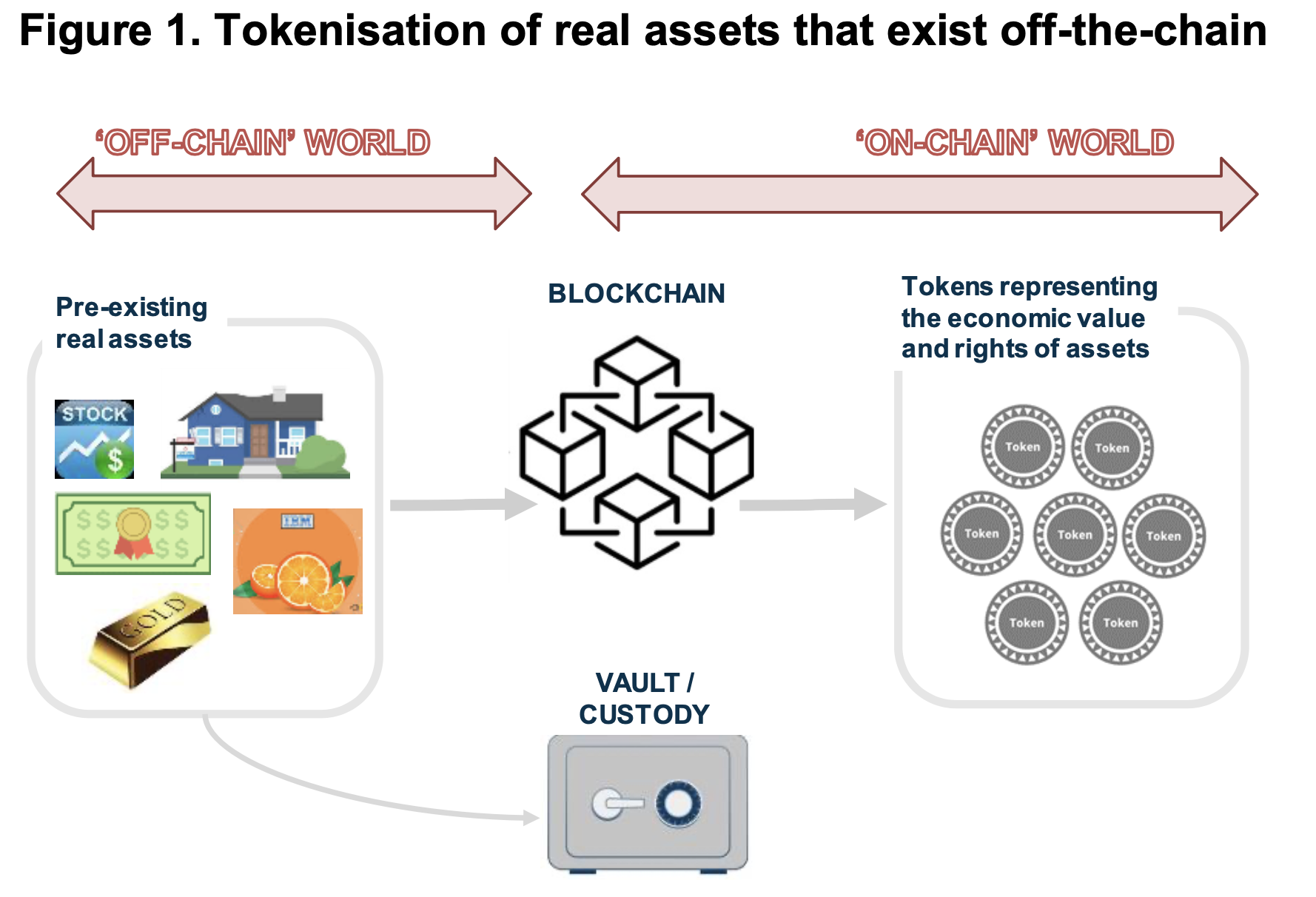
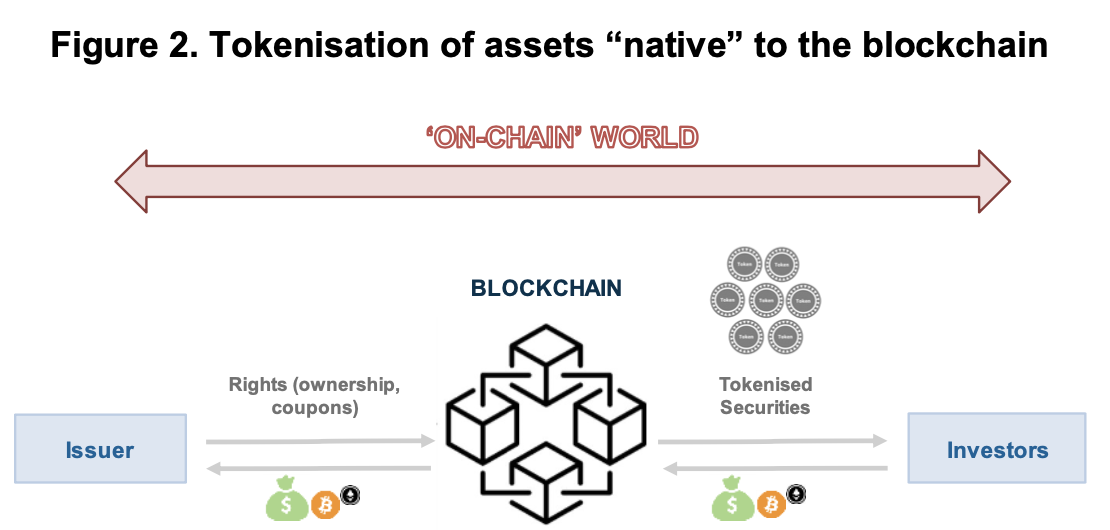
    The report looks at tokens from two perspective: (1) tokens representing a pre-existing real asset and (2) tokens “native” to the blockchain.

    Source: OECD Report

    The firsts case has tokenisation as the process of representing in a digital way by using the DLT an asset that already pre-exists. The tokens exist on the chain and carry the rights of the assets that they represent. They effectively act as a store of value for something that exists in the physical world.

    Source: OECD Report


    In the second case, we have native tokens which are built directly on the chain and live exclusively on the distributed ledger. Cryptocurrencies like Bitcoin or payment tokens are examples of native tokens which derive their value in of themselves and are defined by their existence on the blockchain.

    The difference between the two is that in the first case the real assets on the back of which tokens are issued, continue to exist in the off-chain world. In the case of physical real assets, those would need to be placed in custody as to ensure that the tokens issued are constantly backed by those real assets. In the second case the issue of custodianship or third parties securing the existence of the tokenised asset does not exist.

    The role of the custodian in the first case is quite important because they are here to ensure that the real assets continues to exist off chain, that the characteristics of the asset correspond to the characteristics that are assigned to the token issued and to ensure that there is no second token that is issue on the back of the same asset.

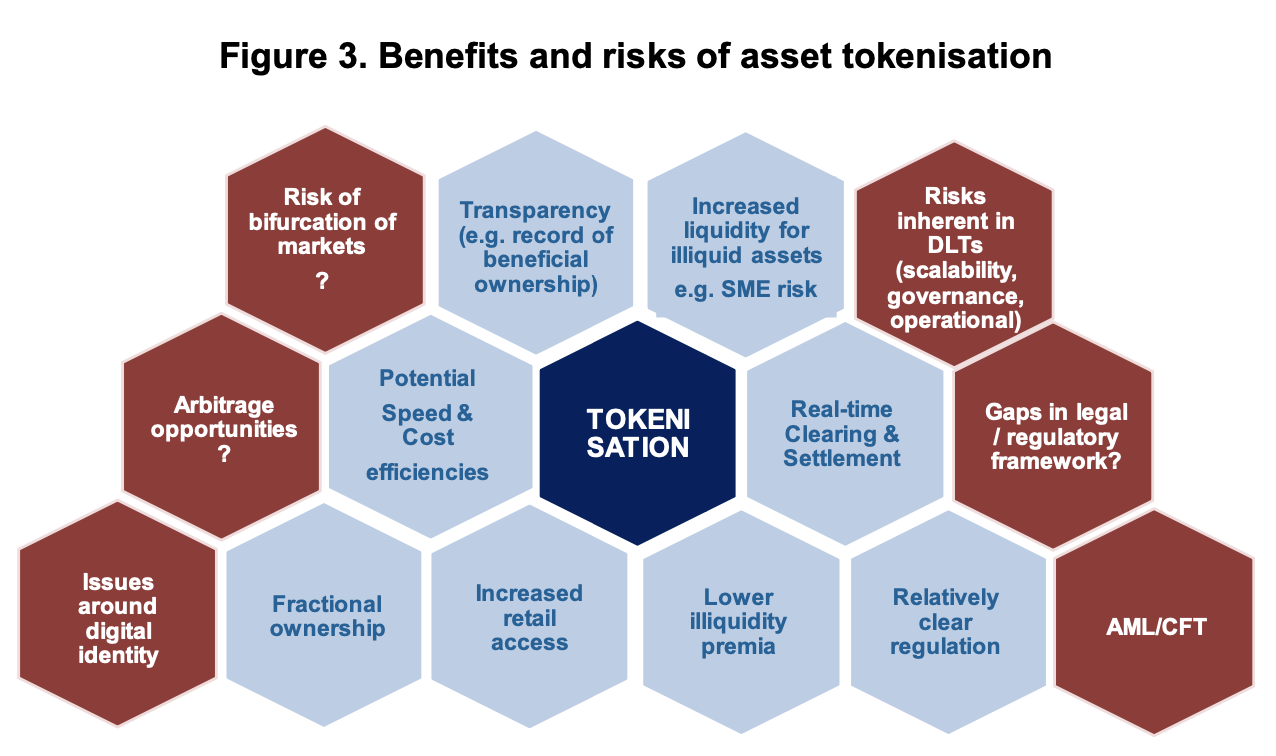
    Benefits, risks and challenges to the wide adoption of tokenisation

    Source: OECD Report

    Iota, states that there are a lot of purported benefits to tokenisation, since we are still in a phase of having more pilots than actual practical applications. The number one and the most important one in her view is the efficiency gains such as the transfer of value on the blockchain without the need of an intermediary.

    Such kind of disintermediation, coupled with smart contract automation on the blockchain potentially reduces the cost of any transaction and speed of execution.

    Blockchain allows for fractional ownership of assets which in the past may have been beyond the reach of the average retail investor. An example of this was when a $30m luxury Manhattan condo development was tokenised back in 2018. Such tokenisation results in a more inclusive investor environment which can increase liquidity to previously illiquid asset classes. SME private placements, venture capital funds, small investor funds which are currently some of the most illiquid asset classes can receive liquidity by tokenising these asset classes.

    In addition, as with any DLT based applications there comes the benefit of increased transparency, immutability, security and auditability.

    There are however a number of challenges that need to be addressed. There are questions concerning operational risks, the technical feasibility and scalability. Add to that the legacy cost of infrastructure and the need for potential interoperability in the tokenise markets there is still some way to go before the tokenised markets really take off.

    The role of regulatory policies

    Iota recognises that the possible lack of clarity in some parts of the world, particularly in the early stages of the development of this market, could have acted as a potential hurdle for the industry. However, since then there has been a phenomenal progress. For example the introduction of innovation hubs and sandboxes that cater for DLT based financial services and products. The FCA has a sandbox catering for DLT projects. In the context of the European commission proposal there is a section for specific DLT application based sandbox to receive a number of pilots within it.

    The BIS innovation hub has delivered a number of pilots for DLT based applications in finance such as Project Helvetia.

    Disintermediation & disruptive effects tokenisation

    By using DLT, transactions can be enabled between participants without the need for a central trusted authority as trust can be distributed between the nodes of the network. No middleman is required to validate the transactions between two parties. Investors for example can actually acts as their own broker/dealers as the transactions are confirmed by the participants themselves. This removes the payment of feeds from the traditional financial markets that would have gone for brokerage or any other entity intermediary functions.

    When building their report Iota believed that DLT could potentially disrupt the market making model. Market makers are here to provide liquidity to the market. If DLT was to bring disintermediation to this industry it could potentially remove some of the benefits provided by the market makers. For example, market makers play an essential role in smoothing out disequilibrium and swings in supply and demand during periods of volatility. Disintermediation of market makers could disrupt this kind of liquidity provision provided by market makers and their ability to smooth out volatility levels during periods of stress.

    The greatest disintermediation, question comes at the post trade at the clearing and the settlement of the transaction. The post- trade multi-step process is simplified and the back-office administrative burden is lowered significantly as you don’t need the central securities depositories or the need for a clearing house. Because in theory the DLT will be acting as the clearing entity and as the counterparty for the completion of trades.

    Trades will be settled and validated by the participants of the network instead of a central authority.

    Central bank digital currency (CBDC) or stablecoins in tokenised securities

    According to the OECD report, for settlement to be achieved in as near real-time as possible and for delivery to be confirmed, the securities transacted and the corresponding payments need to switch ownership simultaneously. This opens up the opportunity for central bank digital currency (CBDC) or for stablecoins.

    With tokenised securities on the blockchain either type of coins would allow for delivery and near real time settlement to become a viable and feasible proposition. This will also allow of the removal of lengthy processing and fees that are used in the off chain environment.

    The dilemma between using CBDCs and using private stablecoins affects the atomic settlement. CBDCs for example have less risks than stablecoins whether it’s in the form of credit risk, proper audit or a number of other issues.

    _______________________________________________________________________________________________________

    This episode is brought to you by our friends and sponsors at R3. In this digital-first world, now more than ever, businesses need to modernize existing processes, systems and models – and enterprise blockchain provides the ideal solution for transacting directly and streamlining business operation.

    Developed by R3, Corda is light years ahead of other blockchain platforms in terms of privacy, security, scalability and interoperability. And–because Corda was built to meet the stringent requirements of highly-regulated industries, it can be used by firms of any type or size and in any industry.

    Blockchain applications built on Corda can reimagine and increase the potential of existing business networks, enabling direct and trusted transactions that eliminate friction and accelerate growth.

    Check out r3.com to find out more.


    Ep. 163 – Enabling an open mobility ecosystem – Insights from bloXmove Jun 06, 2021
    Show notes

    Harry Behrens – bloXmove co-founder. Harry was until recently the Head of the Daimler Mobility Blockchain Factory where they built a mobility blockchain platform. Harry describes himself as a software guy. Now, along with his co-founder Sophia Rodiger, he has performed a management buyout of the Daimler Mobility Blockchain Platform which is the core of what bloXmove will be bringing to the market. In this podcast we discuss how bloXmove will enable building an open mobility ecosystem.

    What is blockchain?

    Harry defines distributed ledger technology (DLT) as way for independent parties to keep a shared set of truthful facts of transactions they conduct amongst each other. It is a peer to peer system that facilitates trusted transactions between trustless parties, where they can trust the distributed ledger to reflect the reality of the business relationships between them.

    From Daimler Mobility Blockchain to bloxMove

    One of the many uniqueness of this startup is that of the four founders, two of them are women with the CEO being a woman named Sophia Rodiger, who also comes from the Daimler Mobility Blockchain Platform.

    The Daimler Mobility Blockchain Platform is a blockchain project at Daimler Mobility AG whose aim is to sustainably optimize booking and invoicing processes for mobility solutions.

    Non-native electric automakers, where native electric being Tesla for example, are facing serious transformations, in additions to the challenges of COVID19. Daimler for example is doing a form of demerger of all its entities where the truck unit is being separated from the passenger car unit and its financial arm is being split into two. In such times Daimler, like any other business, needs to focus on its core business. Thus, no matter how promising the mobility blockchain platform could be for Daimler or Daimler mobility it isn’t core business.

    The platform was production ready and was ready to be “unleashed” as Harry describes it. However, as the platform was built for ecosystem, he believes that any big player with a very strong brand name will never be able to build an ecosystem because it won’t be able to attract the other brands to its ecosystem. For example, Daimler wouldn’t be able to attract Toyota, BMW or Tesla to join the Daimler Mobility Blockchain Platform.

    Thus, the only way to do a platform game, to go into platform economics based on software can only be done via a perceived neutral entity. A platform branded as the Daimler Mobility Blockchain Platform will never be able to become the platform for shared mobility or urban mobility.

    It was thus agreed that Sophia and Harry will perform a management buyout of the Daimler Mobility Blockchain Platform via bloXmove with the help of venture capital funding from players such as Outlier Ventures.

    “By granting the software license, we want to make it possible for the platform to be used for other areas of application and thus to reach its full potential. I am very pleased that our successful pilot project is now being continued and further developed at bloXmove,” says Carmen Roth-Schäfer, CTO Daimler Mobility AG.

    BloXmove being this independent third party is now able to build on this mobility blockchain platform and build a mobility ecosystem to revolutionise the way urban mobility is conducted.

    Changes to the mobility industry

    About 5 years, Harry shares, that the automotive industry started looking into an analysis of the upcoming megatrends such as “CASE” (Connected, Autonomous, Service/Software, Electrification), development towards smart cities, environmental consciousness and avoiding congestion in the big cities.

    Mobility as a service is increasingly growing as large cities are increasingly becoming congested and cities are in turn trying to reduce the number of vehicles in them by adding congestion charges and reducing parking spaces. Cars are increasingly becoming internet connected computer on wheels with higher degrees of being autonomous.

    Mobility is increasingly transforming from “I want to ride my car” to “I simply need to move within a city”. The cities of the future are increasingly constituted by many different modalities of transport: micro mobility scooter, walking, bicycle, public transport and other shared resources. This changes the paradigm of the product from a vehicle to mobility as a service where the customer needs the highest level of flexibility in mobility within a city as per their preferences and needs. This requires a clear collaboration between a number of parties where a customer can demonstrate a form of credential that is accepted seamlessly between all the parties. This is similar to a SIM card when it is being used in different countries on a roaming basis.

    In this scenario a customer is only onboarded once, payment can be done in a seamless manner where in the backend all of the players can run the settlement between themselves.

    To deliver on such a vision you would require a decentralised shared infrastructure. Whilst centralised platforms can develop an efficient system for the end user, Harry describes them as having the potential of being seriously dangerous and almost predatory. He gives the example of a centralised platform such as Uber that manages to take 20 to 25% of revenue from the operator. He believes that they can do that because their power is so imbalanced that the operator has no choice.

    For Harry, decentralised platforms are the way that enables the participants to scale together, to have the network effect whilst keeping their customer relationships.

    Governance & standards

    Decentralised governance is always more difficult to focus and to bring to execution speed of a centralised platform. However, an efficient decentralised governance can be achieved by designing the governance around the common incentives. This ensures that all the participants are behaving around both their selfish own interest and those of the platform.

    You have to start at identifying the key stakeholders and their incentives. You then try to find a set of incentives that all parties share in common. Harry makes references to the successes of co-operatives in aligning incentives between all of their participants. When incentives are well aligned between participants and competitors they can continue to compete between each other whilst still collaborate on many levels. The collaboration level does not interfere with their core incentives.

    Most standards have a better chance of being successful if they are introduced by a neutral player, government or policy maker who help to define an open standard and an open API standard. For example, in the Netherlands there is an interesting initiative being done by the Dutch Blockchain coalition and the Ministry of Infrastructure which is precisely in going in that direction of defining open standards and open API standards.

    bloXmove structure

    The platform will be structured from the operational side as a cooperative. Operators are both customers and co-owners of the platform. As customers they pay transaction fees on revenue they make and as co-owners they get to keep a portion of that transaction fee. On a basic level this is the incentive design that is being used to structuring the governance

    _______________________________________________________________________________________________________

    This episode is brought to you by our friends and sponsors at R3. In this digital-first world, now more than ever, businesses need to modernize existing processes, systems and models – and enterprise blockchain provides the ideal solution for transacting directly and streamlining business operation.

    Developed by R3, Corda is light years ahead of other blockchain platforms in terms of privacy, security, scalability and interoperability. And–because Corda was built to meet the stringent requirements of highly-regulated industries, it can be used by firms of any type or size and in any industry.

    Blockchain applications built on Corda can reimagine and increase the potential of existing business networks, enabling direct and trusted transactions that eliminate friction and accelerate growth.

    Check out r3.com to find out more.


    Ep. 162 – Komgo – rethinking blockchain in trade finance May 30, 2021
    Show notes

    Souleima Baddi is the CEO of Komgo, an innovative platform that powers trade networks. In this podcast we discussed the challenges of bringing blockchain to the trade finance industry. Souleima shared her insights on how to manage the need to bring user value immediately whilst dealing with both tech and user issues for adopting blockchain. How do you manage IT and security departments conventional ways of vetting a new platform whilst gaining the trust of traders accustomed to using email and paper processes for the last decades?

    Souleima is a banker, having spent 18 years with Société Générale, of which the last 10 years were in Geneva launching their commodity finance business. She’s also a passionate mum of three kids.

    What is blockchain?

    Blockchain is a distributed ledger. It is a shared and synchronised database across multiple participants, that enables the recording of interactions and transfer of information, such as identity or values like money and securities, between two parties without the need for a centrally coordinating entity.

    Komgo uses DLT to create a digital audit trail of documents which strongly mitigates the risk of hampering the document or using the document multiple times for fraudulent purposes.

    Trade finance industry challenges

    One of the main challenges of this industry has been its usage of paper based process for such a long time.

    There has been an acceleration of digital transformation that has increased due to COVID. However, transforming an industry does take a lot of time. Individuals are not easily willing to change their way of working, their routines, to invest in change management and put extra effort to adopt new processes.

    Komgo has more than 150 companies using its platform on a worldwide basis. Souleima recognises that for companies using any new software is a huge investment in terms of time and energy before it brings added value to the company. Teams within companies are swamped with their everyday job with their execution and it is extremely challenging for them, despite their goodwill, to embrace digitisation on top of everything else.

    The good news is that the trade finance industry recognises that digitisation is an absolute must and that it will play a major role in the future of the industry. The players who move too slowly in embracing digitisation will lose their competitive edge to others who are faster at it.

    Komgo

    Komgo is an industry initiative with 20 shareholders from corporates and financial institutions who have merged forces to build a solution that matches the needs of the industry from both sides. Komgo is a software development company incorporated in Geneva in 2018 whose vision is to bring workings solutions to clients that helps them execute more trades, faster and in a more secure manner.

    Komgo, offers fours solutions to the market:

    • Konsole: streamline trade finance – structured and authenticated messaging to issue secure banking instructions
    • Market: optimize liquidity & manage risk – harmonized data and transactions to enable better choices
    • Check: simplify onboarding & renewal – a single source to accelerate KYC
    • Trakk: keep track of document trails – build unique documentary audit trails to guard against fraud and falsification

    Konsole

    Konsole allows banks and corporates to connect together in an authenticated structured exchange around the full lifecycle of trade finance instruments. Souleima provided an example where corporates can discuss between them and agree on the draft of a letter of credit which they can push it to their banks. There is no need to create new chains of interactions, it goes from opening the issuance, the amendment and the presentation of the document to the settlement of the letter of credit.

    In addition there are automated flows between Konsole and the client’s internal systems so that data flows from the eCRM of the trader can move through the platform to the back office of the bank in a fully automated way.

    Market

    Market answers the challenge around how receivables data is being captured today which is mainly around email or over the phone. Market allows users to have a standard way of exchanging receivables data, reporting them and tracking them. It allows to send request to any counterparty using or not the platform thus increasing the access to liquidity of historical data.

    Check

    Check is a very simple client portal to accelerate and secure the exchange of documents between counterparties. Today everything is done via email which is unsecured. With Check you have a structured portal where you can the link to the counterparty to have them upload documents.

    Trakk

    Trakk is Komgo’s product that is using DLT as it allows users to mitigate cyber fraud. Trakk is the backbone of the Komgo platform as it supports Market, Check and Konsole.

    Trakk allows users to register the proof of any document to create an immutable digital version of the document, with its authenticity easily verified by anyone. This can be done via an outlook plugin or via a widget on the users’ websites or straight onto Komgo. Using the widget you can drag and drop the document to confirm if it still has the consent of the user. Banks, traders, inspection companies can track what is done with a document if it has been changed or not, thus allows to strongly mitigates the risk of using a fraudulent document.

    Komgo’s blockchain journey

    Komgo started experimenting with blockchain back in 2016 to the point of creating a smart letter of credit. However, it was clear that the industry wasn’t ready to use it at scale. Souleima has a very strong focus on answering the industry’s challenge now instead of in 5 – 10 years. Based on the user feedback that they received on their smart letter of credit as not answering the needs of the industry, Souleima decided to stop using the smart letter of credit and instead to use blockchain where it is needed, where it adds value to the user and where users are willing to adopt it and pay for it.

    Participants in the trade finance industry know that they have no choice than to transform the way they operate. Plenty of companies have been trying to do this over the past decades and have not managed to do it at scale. The hype around the blockchain technology that happened in the industry has been massively driven by the hope that this technology could solve all the problems in one year. As Souleima reminds us that bringing added value to the user is not about technology, it’s about allowing them to execute their business in a faster and more secure way and allowing them to do more business. To achieve that requires much more than just technology.

    Komgo proved that you can use blockchain to provide end to end secure messaging and track document data registration. In the future they foresee some business cases that may involve additional blockchain features like token ownership and shared state machines. However, the time isn’t quite right in terms of readiness of the industry.

    Barriers to using blockchain

    When a company starts using a software, it needs to be vetted by security and IT departments. The first hurdles was that at the beginning no one had agreed to approve a blockchain based platform. This required time for experts to have a think about how they were going to assess blockchain technology in the B2B space. As they started to apply conventional ways of vetting platform this didn’t work as blockchain is a different way of building a tech stack.

    As Komgo’s mission is to deliver a solution now, they couldn’t wait for all the experts to agree on setting up a new analysis framework.

    On the user side, individuals who execute trade finance deals, they are accustomed to executing them the same way for the last decades. They are not accustomed to platforms, their default tool is email. When they get told by management to use the platform they need to start trusting your platform. Something that is difficult to achieve when too often blockchain is misunderstood as being Bitcoin.

    To complicate matters as Souleima states there are as many standards as markets themselves. Some of the standards compete among themselves. To date there isn’t no industry standard.

    Souleima’s advice to herself

    Souleima was asked if she could advise herself for starting Komgo in 2021 what top tip would she share with her future self. First thing would be not to start with the technology. Always start with solving a business problem and getting the approval of the users. Engage the user straight from the beginning, create design flows that you can share with the user to get their approval. Only when you have understood that you solve a business problem for the user that you can start building the technical solution. If blockchain is the best way of solving the problem then use blockchain, if not don’t use it.


    Ep. 161 – ClaimShare a use case in confidential computing May 23, 2021
    Show notes

    Chaim Finizola is the ClaimShare Director and the head of business development for emerging markets over at IntellectEU. In this podcast we discuss ClaimShare’s confidential computing solution built on top of R3’s Conclave and Corda Enterprise platform for the detection and prevention of “double dipping” fraud in the insurance industry which runs in the several billions of dollars each year.

    What is blockchain?

    Blockchain is a technology that allows different actors to collaborate with each other without having to trust each other. Having a database in the form of a distributed ledger you can have not only the data decentralised, but also the way the data is handled in a decentralised manner.

    Independent of the discussion of centralised versus decentralised, Chaim reminds us what is important is to focus on the business use case and then determine the best approach.

    What is confidential computing

    Confidential computing allows different actors to perform private computations on specific data sets and process data without other actors being aware of each other and without them being able to see what data is being processed.

    The party that is hosting this black box whether it’s a regulator or a network operator they can’t see what is being processed within the black box.

    An example of such a black box is the Intel SGX chip which has enclaves where the data can be processed in a fully confidential way without revealing any data to external parties.

    Insurblocks recorded a podcast with Richard Brown, CTO at R3 entitled “Confidential computing – introduction to R3’s Conclave“.

    “Double Dipping” Fraud

    KPMG has estimated that detected and undetected fraud make up between 5% to 10% of insurers’ total claim payouts. “Double-dipping” fraud a key contributor to fraud, costs the insurance industry several billion dollars each year, which inevitably leads to higher household insurance costs

    Double dipping happens when one actor for one loss event goes to multiple insurers to request a same payout. For example, a customer whose had a car accident will go to insurers A, B and C to get a payout from each one of them. This is quite a large problem for insurers which today has been extremely hard to detect. Insurers are usually unaware of this problem as they do not have a way to detect if their customer are insured with another insurer and if a payout has been made on a claim or not.

    There has been attempts by insurers to share information via a centralised database but that came up with a number of complexities from a regulatory standpoint and from a GDPR one. In addition, centralised databases run the risk of getting hacked or of leaked sensitive information.

    IntellectEU

    IntellectEU are the developers of the ClaimShare solution. The firm was founded over 15 years ago as an integration company in the payment sector. They have done over 400 integrations, mainly with SWIFT, in addition to other payment rails. Since 2014 they have been working with DLT and were the first to perform a SWIFT to Ripple integration.

    In the blockchain space, IntellectEU has been working first with Ripple, then with Ethereum and in 2016 they were one of the founding members of Hyperledger. Since 2017 they have been working closely with R3

    Up to now they have been working with 40 capital market, insurance and telco projects for using blockchain and emerging technologies such as AI, confidential computing and quantum computing.

    ClaimShare

    Chaim introduced ClaimShare is the first platform that allows the detection and prevention of double dipping fraud in the insurance industry. ClaimShare uses blockchain technology to allow the sharing of public information to match data and match claims based on colour, location and date, for example. They then use, confidential computing part to match sensitive data of the claims that can be the named user, their address and birthdate. This allows insurers to detect double dipping fraud by matching data without revealing data between themselves.

    R3’s Conclave platform enables the usage of Intel’s enclave for ClaimShare’s customers to be fully GDPR compliant as no exchange or storage of sensitive or private data of the end users happens on other insurance databases. Enclaves are the hardware chip where the private computation happens, whilst Conclave is R3’s platform that allows the easy usage of this confidential computing chip.

    In addition to R3’s Conclave, ClaimShare also uses R3’s Enterprise Corda platform to know the identity of the insurers with whom public data claims is shared. However due to GDPR no client private or sensitive data is stored on the ledger. It is stored off chain which is where the confidential computing part comes into play.

    ClaimShare use case

    ClaimShare is a platform that is very efficient to match any type of claim and can also work cross claims. For example, a customer could travel to Spain with both a cell phone insurance and a travel insurance. If the phone is stolen then the customer could try to request a payout from both their travel insurance and their phone insurance. It is very hard for the insurers to know if double dipping occurred. These are examples of the type of $5 – $10 billion of double dipping that occurs on a yearly basis.

    ClaimShare isn’t limited to one type of insurance as it does this cross-insurance policy type check as well. An example of how this could work is where you have one end user that goes to insurer A to submit their claim. The insurer will use their AI and machine learning (ML) on available public data to see if there is already a case of fraud. If the insurer detects no fraud it will proceed with the payout. What ClaimShare propose is for the insurer to perform one simple API check to the ClaimShare’s Corda public ledger, to see if similar claims have been submitted based on public information. No personal identifiable information is stored on that ledger. As this is the first payout made to that user there are no challenges made.

    Now lets suppose the same person goes to a second insurer to request the same payout. The second insurers will also do its own due diligence using their AI and ML techniques and will most likely conclude that the payout can happen. However as the API will be triggered to ClaimShare’s public ledger it will detect a similar or a suspicious claim was done based on public information such as colour of the car, type of accident and date of accident.

    If a match has been identified between two similar claims, this is when the confidential computing part is engaged. At this point the two insurers can access the private information regarding the user that they have such as full name, address and birthday. That private information is encrypted and is sent to the Conclave black box where it is decrypted and compared. No one can see what happens in the black box as it is done by machines. Once the comparison is complete an encrypted answer is sent back to the insurers. If the information was proven to be the same then a confirmed fraud message will be sent. If the information was not the same then a confirmation message is sent instructing for the payout to happen.

    Confidential computing vs zero knowledge proof

    Zero knowledge proof (ZKP) is effectively a technique which uses cryptographic algorithms so that various parties can verify the veracity of an item of information without sharing the data that compose it.

    Chaim was asked how does confidential computing compare to ZKP. Chaim believes that from a scalability perspective enclaves are much more widely adopted and more scalable compared to ZKP techniques. Enclaves are hardware chips whilst ZKP is software. Hardware it usually easier to fix than software when problems arise, and the chips are easier to maintain.

    Additionally Chain points out that the development experience required to use ZKP is much higher than with using R3’s Conclave where in a matter of two weeks you can set up a Conclave component and start matching private data.

    ___________________________________________________________________________________________

    This episode is brought to you by our friends and sponsors at R3.

    Privacy-enhancing techniques like Confidential Computing allow different parties to gain reliable insight from data without revealing the actual data to anyone, eliminating concerns around data privacy, lack of control over how data will be used, and – most importantly – fear of it getting into the wrong hands.

    Conclave is a new privacy-enhancing platform from R3 that enables the development of solutions that deliver insight from shared data across multiple parties—without the underlying data ever being seen.

    Discover how Conclave is powering applications – like Intellect EU’s ClaimShare – that mitigate fraud and deliver trusted collaboration in the insurance industry and beyond by visiting www.conclave.net.


    Ep. 160 – NFTs an opportunity for the financial industry? May 16, 2021
    Show notes

    Charles Kerrigan – Partner & Global Head of Fintech at CMS. Charles spends his time looking at what do new technologies mean for the industries that their clients work in from financial institutions to fintechs, crypto firms, and blockchain protocols. In this podcast we take a comprehensive look at NFTs and their impact on the financial industry, on property, transferability and ownership within legal frameworks.

    What is blockchain?

    Charles gives us a lawyer’s definition, where he sees blockchain as both a puzzle and a challenge. To explain that he gave us an example, where is cryptocurrency property as defined under a legal system in English law. Property can be categorised into two buckets:

    • Real property, is tangible and is something that can be touched.
    • Intangible property: Shows in action, is essentially everything else where you can bring an action in relation to it, i.e. that you can sue in court for it.

    When Bitcoin arrived, it wasn’t something that can be touched and thus could be considered as an intangible property. However intangible property has been defined over the centuries as something that you can sue under a contract. Bitcoin thus isn’t either an intangible property nor a tangible one.

    The theft legislation talks about depriving someone of property, so bitcoins not property, you can’t steal it.

    In November 2019 Sir Geoffrey Vos, Chancellor of the High Court came to the conclusion. That crypto-assets have all the legal indicia of property and are, as a matter of English legal principle to be treated as property. There are two primary reasons:

    • First, the novel features of some crypto-assets, such as intangibility, cryptographic authentication, use of a distributed transaction ledger, decentralisation, and rule by consensus, do not disqualify them from being property.
    • Secondly, they are not disqualified from being property either because they can be regarded as pure information, or because it might not be possible to classify them as being things in possession or things in action

    Taking the above points into consideration for defining blockchain, Charles explains that blockchain identifies value, it establishes certainty of ownership and is able to transfer value with certainty.

    NFTs – Non Fungible Tokens

    NFTs provide the opportunity to identify ownership in a digital context and that has value in itself.

    A lot of present and historical legal disputes around commercial law are with regard to disputes over ownership. A person acquires a piece of property from another person, not through a valid transfer, whether it’s via theft or mistake, or anything, that means that Person A has lost an asset, Person B has gained an asset in a way that’s invalid. So far, we’ve got an easy case, because Person B should give it back to Person A.

    The hard cases come from variations of when Person B, hands it on to person C in exchange for some value. So now you’ve got A out of pocket, and C out of pocket, and B disappears whether physically or financially where they become insolvent. We’ve now got a dispute between A and C, neither of whom are at fault. But both of whom are arguing that they should have this asset returned to them.

    NFTs provide an immutable, searchable register in terms of who is the owner of a piece of property.

    Because NFTs are sitting on their own blockchain protocol such as Ethereum, they transfer their rights of ownership via an executable code. Two questions arise with regards what is being transferred:

    • How to reconcile two registrars a real world asset registrar such as the Land Registrar in the UK with a NFT registrar?
    • Where you don’t have a real world asset registrar for example in the UK, copyrights are not registerable. The protocol on which the NFT is minted and issued will purport to transfer rights, but it’s not transferring rights and their copyright unless the copyright owner is party to that transaction

    Who has the ownership rights in relation to a clip of a sports game for example. Because there are the participants that are being filmed? There are the broadcasters, there is the platform on which that clip lives. All of those may have a claim. And the answer to do they have a claim or don’t have a claim is generally written into commercial contracts, So the intellectual property is established and transferred by those commercial contracts. And it is not affected by the NFT. Because often those parties are not party to the creation of the NFT. So, the NFT will transfer a digital certification of the ownership of that piece of digital art, but it probably won’t transfer, intellectual property in the underlying, right.

    Do NFTs represent an opportunity for the financial industry?

    NFTs are mainly concerned with determining ownership of intangible property. The financial industry fundamentally deals with intangible property. So NFTs do represent an opportunity for the financial industry.

    DeFi, decentralised finance, brings a number of benefits such as the ability of market participants to be able to deal not through intermediaries, the reduction in cost, the potential efficiency and the potential for democratisation. However, Charles indicates that the consumer protection question is still an open question.

    NFT’s are for the insurance industry a method for both storing information in a safe, secure and manipulable way. They are also a way for engaging with customers who will potentially see these things as having a connection to the type of digital assets that they’ve got on their device.

    Charles also believes that on a theoretical basis, if NFTs can provide some of the underlying risk that’s underwritten in policies by insurance companies it could mean that this opens up to a wider market for underwriting that risk. What is also required alongside it is information to enable participants in that market to make judgements about the risk that they should hold. For example, internet of things devices connect to blockchain can enable to manage risk on a real time basis.

    Adding smart contracts to the occasion you have automation which with internet of things enables the automation of many more contracts.


    Ep. 159 – AAIS’ OpenIDL joins the Linux Foundation May 02, 2021
    Show notes

    Joan Zerkovich – Senior Vice President, Operations at AAIS (American Association of Insurance Services) and Brian Behlendorf, Executive Director of Hyperledger at the Linux Foundation join us to announce that the AAIS’ OpenIDL is joining the Linux Foundation. In this episode we get an introduction to the AAIS, OpenIDL, the Linux Foundation and Hyperledger. We also discussed how OpenIDL will leverage the Linux Foundation unique approach to governance.

    What is blockchain?

    Joan: distributed ledger technology is a technology that provides a way to have immutable records in the digital world, in a networked environment. Blockchain is used in a number of ways in addition to cryptocurrency, such as for business applications that require data security, privacy and an immutable record. OpenIDL uses blockchain to pursue a path of data security, privacy and transparency.

    Brian: blockchain is a shared system of record amongst participants in a commercial ecosystem. Brian, compares blockchain to the mid and late 90s when a group of folks were talking about free software and working on projects with no justifiable economic basis behind them such as the Apache Software project and the Linux project.

    Insurance have been conservative about adoption of new technologies, open source software and blockchain technology. However, Brian now thinks that insurers now see blockchain as solving some real problems, particularly problems created in understanding risk within a regulated environment.

    Blockchain helps organise an industry to solve a collective problem. A shared system of record, with automation through smart contracts is an essential part of solving these problems and doing that in an auditable and verifiable and, and regulatable way.

    AAIS

    AAIS is a US based advisory organisation. In the United States, insurance is regulated at the state level. That poses some issues when you’re trying to offer insurance products nationally. The National Association of Insurance Commissioners or representatives from all the states got together and they said we need an organisation that can help them collect data on the insurance market and provide some perspective at the national level. They can use that data to develop products that can be filed in all 50 states to provide a common foundation for insurance companies to add value on top of that with some consistency across all 50 states.

    For the last 80 years AAIS has been authorised to collect data from the insurance carriers as an advisory organisation licenced in 50 states. AAIS is allowed to collect data that insurance companies wouldn’t be able to share between themselves due to antitrust concerns. AAIS uses that data to provide reports to the regulators and to develop products that they use.

    Linux Foundation and Hyperledger

    20 years the Linux ecosystem was composed of a number of open source contributors from RedHat, HP, IBM and thousands of other contributors. A consortium approach was set up as a home for the Linux project where the basic sustainability model was companies paying membership dues tiered by the size of the organisation. They weren’t pay for software development but paying for the coordination overhead, or as Brian calls it, the air traffic control function to all the different contributions coming in.

    After a few years there was a sense that this model was stable, that it was reliable and replicatable. The model was thus used for adjacent technology domains like cloud computing, software define networking and industry specific domains like automotive software. For each of these projects there is a clutch of companies who pay yearly membership dues to provide the core essentials, small staff to serve in that air traffic control function and coordinating functions. This has led to the creation of over 400 different projects.

    When Hyperledger started five years ago, it was started and continues to be managed in this kind of model where it has its own membership, budget and it is overseen by its own governing board which makes it accountable to its membership. All of its activities are public facing and you do not have to be a member to download the code to use the code for any reason. All the code is under an Apache license.

    Hyperledger is the enterprise blockchain, open source community that builds the software that is behind products like Hyperledger Fabric, Hyperledger Besu, Hyperledger Sawtooth, Hyperledger Indy an Hyperledger Aries. These technologies are for organisations and consortia to build their own distributed ledger systems.

    Last year they realised two things:

    • how the governance of permissioned blockchain networks could be enhanced by what the Linux Foundation learned about how open source communities work
    • because of the pandemic the Linux Foundation launched the Linux Foundation Public Health which Brian is its general manager for blockchain healthcare and identity initiatives

    OpenIDL & Linux Foundation

    In August 2018 the AAIS launched the Open Insurance Data Link known as OpenIDL with the stated purpose of creating a solution for the insurance industry to solve a problem on data security, privacy and transparency on how data was used. However as they started working on OpenIDL and building out that solutions by working collaboratively with insurance carries, regulators and data providers they realised that this solution could serve many industries in addition to insurance.

    OpenIDL was launched with the initial use case of regulatory reporting to demonstrate the technology itself and the solution it provides. The created solution is one where the carriers can keep their data private in their own data centre, what OpenIDL calls a harmonised data store. It is a data repository according to a standard that merges all of the regulatory reporting requirements that a carrier might face.

    Using the blockchain technology to write a hash of what’s in that data store on chain that proves to the regulators that the carriers by they have met the regulatory requirement to have it available to answer questions. Through a web interface, regulators would ask questions and regulators could opt in to answer that question where OpenIDL creates a report in which data is anonymised and aggregated and made available to the regulator’s without ever having to transfer the data. This met the needs of the regulators and the needs of the carriers who didn’t have to transfer any data to anyone.

    A partnership with the Linux Foundation enables OpenIDL to access a wide range of talent to continue develop the platform not just for the PNC insurance industry but for their partners such as ones in the fire protection and automotive industry to name a few.

    OpenIDL is now a project of the Linux Foundation and the governance of the network is moving from AAIS to the Linux Foundation as well.

    OpenIDL partners

    Chainyard is an infrastructure partner helping OpenIDL with the technology platform and ensuring that it is easily installed and maintained in multiple cloud environments.

    OpenIDL has had a long relationship with MOBI (Insureblocks podcast with their CEO, Chris Ballinger). MOBI is interested in data standards and technology platform that support the exchange of automotive information. The insurance industry has a number of auto products that would benefit from a relationship with MOBI.

    KatRisk provide catastrophe modelling software with an expertise in flood whilst RMS have a broader platform looking at other types of types of risks such as hurricanes and wind losses. OpenIDL has been working with KatRisk and RMS on a working group focused on floods in the United States. The objective of that group is to gain access to better information, better flood models, better policy and claims data in order to provide a better solution for flood risk and perhaps partner with the federal government to create a new programme that would provide better coverage across the United States.

    Whilst KatRisk and RMS are competitors they see value in both competing and adding value on top of the OpenIDL network.

    Governance learning for OpenIDL from open source

    When looking at the permission blockchain space, it became evident that a lot of blockchain initiatives didn’t make it past the pilot was inevitably a lot of them are put together with a company at the centre of that network. This would cause the other participants to question whether this was a truly distributed network and how different is it to a company saying “we’ve got a central database just trust us”.

    Brain reflects on the similarities between the blockchain space and the open source software space from 20 years ago where there was the rise of open source foundation as a home for open source projects as a counter to single vendor hosted open source projects. It was thanks to the Apache Software Foundation, the Python Foundation and the Linux Foundation that so many these open source projects came to become the default standard in their industries.

    What is core to the open source movement is the “do-ocacy” principle: “Open source projects adopting the “do-ocracy” governance model tend to forgo formal and elaborate governance conventions and instead insist that “decisions are made by those who do the work.” In other words: In a do-ocracy, members gain authority by making the most consistent contributions.” Source: The Open Source Way.

    Having the do-ocracy principle along the transparency principle is core to the open source movement. These principles along with the members of a blockchain consortium providing the financial support for “air traffic control” also apply to management of a permissioned blockchain network.

    With regards to governance, Brian looks to ICANN (Internet Corporation for Assigned Names and Numbers) is responsible for coordinating the maintenance and procedures of the global domain name system on the internet. They do their work via a set of contractual relationships they have with domain name registrars around the world. Thus by applying a mixture of technical governance and human governance you have a process to bind nodes on a permissioned blockchain network in an open and transparent manner.

    ________________________________________________________________________________________

    This episode is brought to you by Chainyard, an IT People Company.

    In this hyper-competitive environment, businesses need to modernize today more than ever. Chainyard is a digital transformation specialist, and a technology partner that can help you modify your existing business processes, culture and customer experiences to meet the changing business and market requirements.

    Chainyard is an Infrastructure Member of The Linux Foundation openIDL project and can help you develop a strategy to benefit from this novel blockchain centric, open source project. Our services span advisory, engineering, and operations helping you to have a single trusted partner in your digital transformation journey.

    Check out chainyard.com to learn more about Chainyard.


    Previous 1 2 3 4 19 Next

    Related Podcasts

    How I Built This with Guy Raz

    1

    How I Built This with Guy Raz Business
    Planet Money

    2

    Planet Money Business
    Inside Strategic Coach: Connecting Entrepreneurs With What Really Matters

    3

    Inside Strategic Coach: Connecting Entrepreneurs With What Really Matters Business
    BiggerPockets Real Estate Podcast

    4

    BiggerPockets Real Estate Podcast Business
    The Smart Passive Income Online Business and Blogging Podcast

    5

    The Smart Passive Income Online Business and Blogging Podcast Business
    A Thousand Natural Shocks With Gabe S. Dunn

    6

    A Thousand Natural Shocks With Gabe S. Dunn Business
    footer-logo

    Contact Us

    Toll Free: 844-670-7747

    Links

    • Home
    • Top Charts
    • Networks
    • Apps
    • Independents Podcasts
    • Podcast Advertising
    • Podcast News
    • Contact Us
    • About Us
    • Analytics & Insights

    Stay Connected

      Privacy, Terms of Use & Our Code of Ethics Protecting Content Creators Copyrights