TopPodcast.com
Menu
  • Home
  • Top Charts
  • Top Networks
  • Top Apps
  • Top Independents
  • Top Podfluencers
  • Top Picks
    • Top Business Podcasts
    • Top True Crime Podcasts
    • Top Finance Podcasts
    • Top Comedy Podcasts
    • Top Music Podcasts
    • Top Womens Podcasts
    • Top Kids Podcasts
    • Top Sports Podcasts
    • Top News Podcasts
    • Top Tech Podcasts
    • Top Crypto Podcasts
    • Top Entrepreneurial Podcasts
    • Top Fantasy Sports Podcasts
    • Top Political Podcasts
    • Top Science Podcasts
    • Top Self Help Podcasts
    • Top Sports Betting Podcasts
    • Top Stocks Podcasts
  • Podcast News
  • About Us
  • Podcast Advertising
  • Contact
Not in our directory?
Add Show Here
Podcast Equipment
Center

toppodcastlogoOur TOPPODCAST Picks

  • Comedy
  • Crypto
  • Sports
  • News
  • Politics
  • True Crime
  • Business
  • Finance

Follow Us

toppodcastlogoStay Connected

    View Top 200 Chart
    Back to Rankings Page
    Education

    Anthony Metivier’s Magnetic Memory Method Podcast

    Learn, Memorize And Recall Anything Using Memory Techniques, Mnemonics And A Memory Palace Fast

    Advertise
    • Apple Podcasts
    • Google Play
    • Spotify

    Latest Episodes:
    Black Belt Memory Review: Is Ron White’s Course Good? Jul 28, 2021
    Show notes

    black belt memory review feature imageIf you’ve spent any amount of time looking into memory improvement courses, you’ve come across the name Ron White.

    But you might be wondering…

    Is his Black Belt Memory course any good?

    In a word:

    Yes.

    And if you’ve struggled with other memory improvement books and courses, his approach might just be the ticket.

    One reason why is because the course makes you earn your future lessons. You don’t just get to the next level by skimming and skipping around.

    You have to actually complete tests in order to progress.

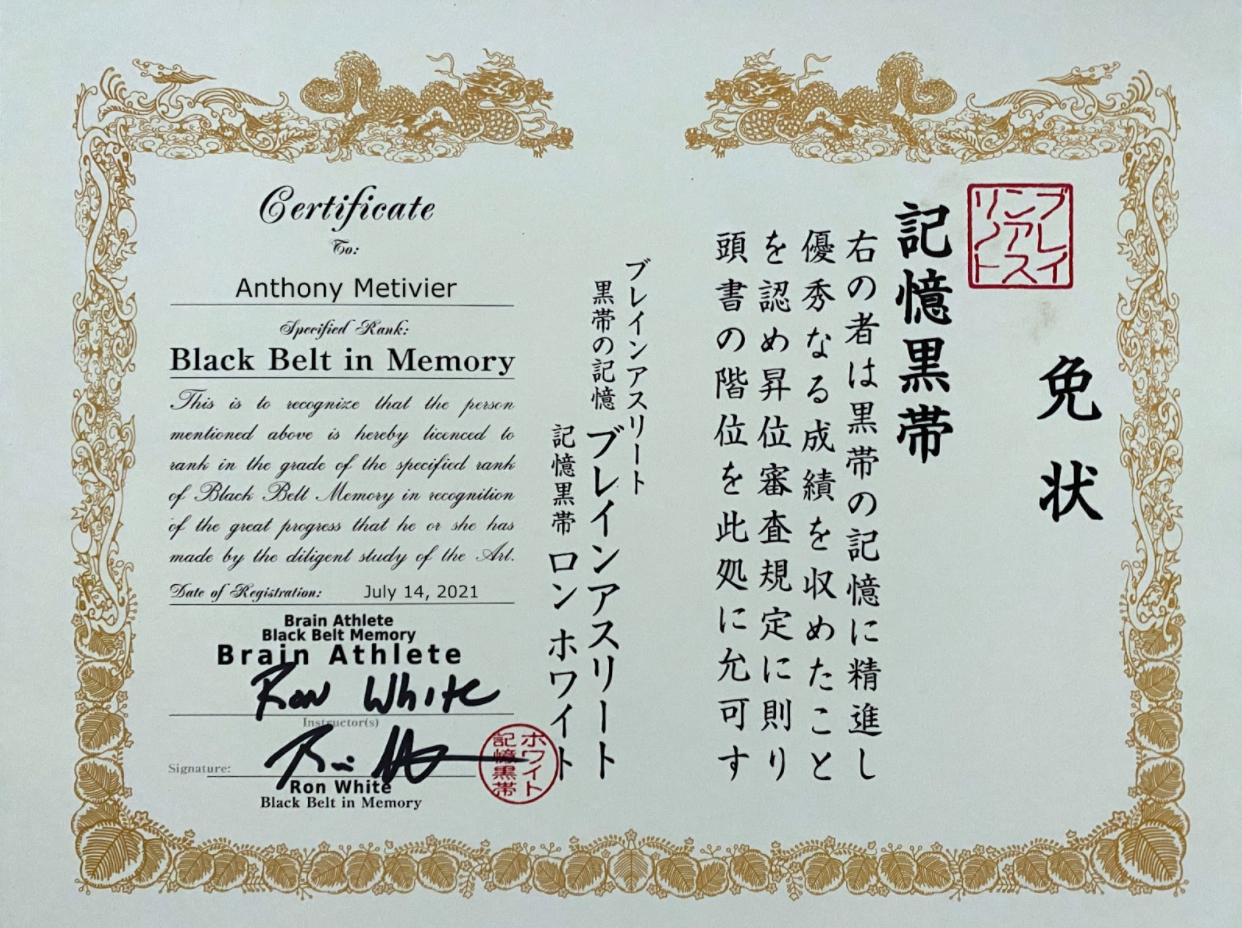
    And in case you’re wondering, I know this from experience. I’ve completed the course myself. Here’s my Black Belt certificate:

    ron white black belt memory certificate for anthony metivier
    Receiving my Black Belt in memory after taking Ron White’s training was a great feeling!

    Although I already know a fair amount about memory techniques, I still learned new things.

    The best part?

    I had a lot of fun going through the program too.

    And on this page, I’ll tell you more about what I learned and what you can expect.

    But first, let’s talk about the man who created the course before digging into a full Black Belt Memory Review.

    Who Is Ron White?

    Ron White is an author, speaker, seminar leader, course creator and talented YouTube personality.

    He has also served as a soldier and won several national memory competitions.

    For example, he won the USA Memory Championship twice, in 2009 and 2010.

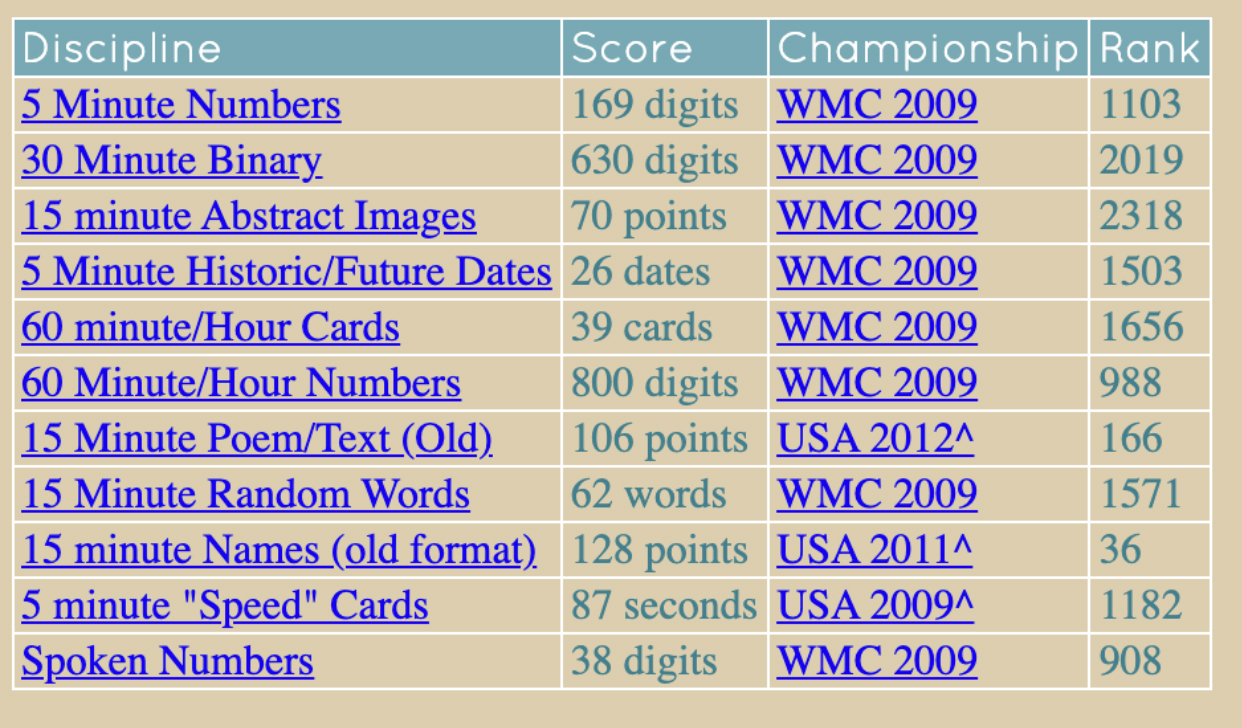
    When it comes to the World Memory Championships, his records are also impressive.

    ron white world memory championship statistics

    He’s also completed incredible memory demonstrations, such as the 7000 pieces of information involved in the Afghanistan Memory Wall project.

    I wanted to learn more about these experiences, which is why I’m so glad Ron sat down with me for a long form conversation.

    https://www.youtube.com/watch?v=Y1JcM1znKOc

    I hope by now it’s obvious to you that Ron White’s memory training course is more than legit.

    And the man is not only a memorizing machine when it comes to using mnemonic strategies.

    He’s a great teacher and provides tons of inspiration.

    Ron also knows his history, so it was fun talking with him about some of the old memory books that contain powerful tips and tactics you won’t want to miss.

    Black Belt Memory Review: What You Need To Know

    As I mentioned before, this course is unique in that it requires you to earn your progress.

    To be honest, I initially thought this was a little annoying. I really just wanted to check things out.

    But that’s the problem isn’t it?

    We get courses, skip around and then throw our hands up in the air and say… “Nothing new here.”

    That’s wrong in nearly every case, and when you go through this program as Ron has designed it, there’s a lot new to learn.

    Keep in mind too that “new” means a few different things:

    • It can be completely new to you because you’ve never heard of something like the Memory Palace or the Major System
    • It can be new because you’ve not thought about classic techniques through the lens of someone else’s experience
    • It can be new because you’ve never deployed a classic technique in quite the same way as Ron has

    So when Ron gets you to go through the training sequentially, it doesn’t matter whether you’re a complete beginner or an old master. You’re going to learn something new from the program.

    The Filing System

    Ron approaches the arrangement and encoding of information through what he calls files.

    These can be used in different ways.

    For example, you can have files that serve as numbers and images at the same time.

    It’s kind of like the pegword method, but with more possible uses. You can use the filing approach to easily make any Memory Palace much more robust, for example.

    Unique Approaches to the Major System

    As Ron shared in the conversation we recorded, he combines the body Memory Palace with the Major System in a way that stems from Mega Memory.

    I think it’s a brilliant adaptation. I wish I would have thought about it myself!

    The coolest thing about it is that you can apply it to other bodies and use those bodies as files distributed throughout a Memory Palace.

    In this way, any figure you place can instantly have ten individual stations instead of just one.

    Review Tips

    Ron’s Black Belt Memory is one of those rare memory training courses that goes through what matters most in memory: review.

    You see, so many people treat techniques like the method of loci as if it were meant to be some kind of “eternal” treasure chest.

    But that’s not the way it works.

    Rather, these tools give us a solid means for reviewing information in a way that triggers what memory scientists call active recall.

    If you aren’t following these patterns in an optimal way, your brain simply won’t form memories reliably.

    And since reliable memory is what we want, Ron makes sure you know about it.

    Holistic Memory Health

    As if all that weren’t enough, Ron makes sure you know about diet, hydration and fitness.

    Face it:

    We’re all getting older by the minute and we need to keep both our bodies and our brains as fit as possible.

    The program doesn’t go as deep into this topic as it could, but I’m glad the basics are touched upon.

    ron white with dr oz
    Memory Expert Ron White with Dr. Oz

    And there’s even a cameo with Dr. Oz!

    Will You Earn A Blackbelt For Your Memory?

    As I hope you can tell, I definitely think you should take this course.

    And you might find that a bit confusing. After all, I’ve got courses of my own to offer, like the Magnetic Memory Method Masterclass.

    The answer is simple:

    When I taught philosophy as a professor, I never once said, “Only read Plato. Forget all about Aristotle.”

    That would be foolish.

    The reality is that you only get a full understanding by going through as many programs as you can.

    Of course, there are some out there you can definitely skip.

    But I’m very glad that I went through Black Belt Memory and grateful Ron took some time to have a detailed chat.

    So if you want more benefits from his experience and some of the “next level” ways you can improve your memory, give Black Belt Memory a try.

    I think you’ll be glad you did!


    How to Learn Something New in 6 Easy Steps Jun 30, 2021
    Show notes

    Let me compliment you on wanting to learn something new. In a world of indifference, so few people take action, let alone search for how to take action. Then there’s the question of what to learn. This can itself be quite challenging because there are so many options out there. Well, on this page we’ll simplify everything by talking about how to learn a variety of things. Not all skills are learned the same way, after all. And to start eliminating the confusion about how to learn, let’s boil things down to a simple formula: S.I.P. Study Implement Practice Once you pick what you want to learn, you study to find out the steps involved. Then you implement those steps, followed by practice to improve your execution. With this process in mind, let’s get started. Why You Should Learn Something New One word: Longevity. Learning things literally promotes cellular growth in your brain. It also strengthens the neural connections you already have. If you go the language learning route, some studies in bilingualism report up to 32 years in brain fortification. This benefit means that your brain gets protected from diseases like Alzheimer’s and Dementia. Other reasons you’re right to say, “I want to learn something” include: Getting a raise or promotion (like Jesse Villalobos) Winning a competition (like James Gerwing) Speaking a language in another country Studying effectively so you can pass an exam Spending time offline to fend off digital amnesia Improve your reasoning abilities To put it another way: If you want to continue learning for the rest of your life, always learning something new is the best way to keep your mind and memory short. And the more you know, the more you can know. How to Learn Something New: A Proven 6-Step Process Now, we’ve seen that to learn we need to take it one S.I.P. at a time. But what are the exact steps? There will always be nuances for different things you want to learn. But generally, here’s what you need: Step One: A Vision Before planning anything or buying books, it’s useful to sit down and imagine the desired outcome. For example, if you want to learn how to improve your memory, you can craft a memory improvement vision statement. https://www.youtube.com/watch?v=MFz31HpVkj0 The reason it’s important to do this is that it helps you know your “why.” That way, when certain parts of the journey get tough, you’re able to keep pushing through. And never give up when you’re challenged. No doubt, obstacles can create resistance. But it’s when we push through challenges that growth occurs. This cannot happen if you quit. Crafting a vision statement also helps you test through your conviction. There’s often a difference between what we want and what we’re actually willing to do. When spending some time on your vision, you can dodge a lot of speeding bullets. You can also think through various alternatives. Pro tip: If you don’t like linear prose, one great way to craft your vision statement is through mind mapping. Step Two: Plan Wisely After testing your conviction by crafting a vision statement, it’s time to plan. In this step, you’ll set aside time to research what you want to learn. During this phase, you’ll identify books, courses and key experts who can help you achieve your vision or desired learning outcome. Then, you’ll chart out when you’re going to go through those materials or meet with the expert trainers who can help you. Pro tip: If you struggle to plan and schedule your time, getting help from a coach can be a game changer. There’s no shame in lacking discipline and knowledge in this area. So if you have a vision but struggle to plan and implement, find someone who can help you make it happen. Life Coach Spotter has a great guide that can help you find the perfect person. Step Three: Define The Project I’ve already talked about spending some time identifying your books and courses. This should help you define the scope of the project. To do this, state how much time you’re going to spend and how much material you want to get through. For example, when I started my Art of Memory learning project, I devoted six months to it. I committed to reading one book on the topic per week and at least two articles. By giving your learning commitments definition in terms of both scope and duration, it’s so much easier to achieve specific goals. You can even create certain milestones. For example, if you’re learning about a topic that has multiple authors writing about it, pick one author. Read just their major works as a milestone before moving on to the next author. Step Four: Plan To Fail Sounds weird right? Not at all. As I mentioned, there will be challenges when learning anything. And that’s why we need to have a plan for what to do when those challenges arise. The choices you make can be quite simple. For example, when I reach a point of frustration, I almost always take a walk. “Go for a walk,” is my auto-pilot mantra and it helps refresh the mind. I also like to have “attitude adjusters.” Many of my journals come with motivational quotes printed on each page. I follow lots of positive quote Twitter and Instagram accounts and motivational speakers. Constantly fueling positivity helps so much. Step Five: Take Effective Notes And Keep A Learning Journal There are so many approaches to note taking. It can be frustrating trying to find the best option. At the end of the day, I suggest you experiment with a few different styles. Combine what you find works best with the Memory Palace technique for best results. Keeping a journal is important too. Here’s why: Learning is a lot like art. And artists always sketch in journals. They do this not just to practice. They do it so they can look back and see just how far they’ve come. Instead of always filling your journal with notes about what you’re learning, try this instead: Fill your journal with the questions you have along the way. Then work at answering them. When you look back, you’ll find that you’ve grown incredible, and the Q&A process with yourself will have paid many dividends. By the way, this process of asking yourself questions and working to answer them is called The Feynman Technique. It’s just one of 28 ways I’ve compiled in How to Study Effectively. Step Six: The Big Five Of Learning Finally, it’s important to integrate everything. For that, we pull all the big guns together: Reading Writing Listening Speaking Memorization Basically, this process means that you deeply integrate what you’re learning through ample discussion and follow-up in multiple ways. For example, to integrate what you’re learning, a discussion group helps you reflect on your own thoughts while appreciating the varying viewpoints of others. Writing, as we’ve seen through journaling, helps you identify and answer any questions you have. And memorizing makes sure that everything you learn remains for the long term. What New Things Should You Learn? If you’re not sure what to learn, here’s a master list of suggestions. It’s possible to pick up skills in each of these in a single lifetime. But as always, it helps to focus on just one skill at a time. Keep the lesson above about scope and definition in mind when choosing what you want to learn. Typing “All wealth comes from writing.” That’s a quote I heard a long time ago, and I believe it’s true. Whether it’s writing books and articles or just an effective networking email, it helps if you can do it quickly. If you don’t know how to type, I’d suggest starting with this foundational skill. Languages I’m a big believer that everyone should speak at least one other language. It’s not only good for your brain, but hugely beneficial for your wallet. As reported in the BBC, knowing at least one other language can add more than six figures to your wealth every four years. The best part is that it’s incredibly easy to learn any language, even without leaving your home. Economics Understanding exactly how money makes the world go round is hugely beneficial. It not only helps you earn and save more. It helps you avoid mistakes and reduces your stress about market changes. Marginal Revolution is a leading blog that aggregates links from around the net relating to economics. You can learn a ton just from following its links and book recommendations. Numeracy If you’ve ever wanted to start a business, you’ll need to know at least something about math. Knowing your numbers is also useful for: Accounting Investing Statistics Programming And that’s just to name a few areas. One fun and easy way to make math fun and exciting is to learn Chisanbop. Music What can be more pleasing than being able to pick up an instrument and accompany yourself as you sing a song? There’s another benefit: When you know how to memorize a song, singing produces healing chemicals in your body. Playing an instrument exercises your brain, which means that bringing them together is even more beneficial. Drawing I used to hold the limiting belief that I could not draw. But I wanted to and within a year was stunned by the progress I’d made. Riven Phoenix has a great course on drawing the human figure I highly recommend. It’s helped a lot with my visualization skills tool. Psychology Learning how and why your mind operates helps you enjoy life a lot more. There are many mental models to discover, not to mention sorting out your cognitive biases. Knowing about psychology also boosts your ability to think in a reflective way. Mulling over topics is fine, but doing so with knowledge of how your mind functions boosts the entire process. Survival Skills And Bushcraft Sure, few of us will wind up lost in a forest or stranded in the desert. But you never know, do you? If you’re casting about for something to learn, these skills will keep you prepared for even the most unlikeliest of events. Podcasting And Video Course Creation Everyone has to run errands and most of those people are listening to either music or podcasts while doing them. Why aren’t you the one in their ears? Simple: You haven’t learned podcasting yet. I’ve been running a podcast since 2014 and have hardly missed a week. If you want to learn from me about how to do it, check out my course, Branding You. It’s been a bestseller on Udemy since it was released in 2015. SEO And Blogging Learning how to rank posts on page one of Google is an art, craft and science. You can turn it into a career or just do it for fun. But the name of the game either way is to have an audience. And that’s where learning to write for both humans and the search engines come in. It’s a great learning project and one I highly recommend. Here’s why: It makes you a better writer overall. When you can learn to reach people through both search engines and peaking their interest once they’ve found you, those skills apply to: Books Speeches Podcast episodes YouTube video scripts Online course content Give this skill a try! Public Speaking When I wrote this TEDx Talk, I had no idea it would reach over one million people. https://www.youtube.com/watch?v=kvtYjdriSpM But it did, and having taken a course on public speaking helped. I’m not the greatest speaker, but I’m glad I spent the time learning how to present. If you’re worried you’ll forget your presentation, please don’t be. Here’s how to memorize a speech (and deliver it without sounding like a robot). The Law The vast majority of people can’t read the law that governs them. That means they can’t participate in shaping the rules they follow. But even just a little knowledge of the law can go a long way. It helps you communicate with your representatives better, for one thing. And you can keep them more accountable in the first place, something obviously not enough people do. It sounds cliche, but we all need to be the change we want to see in the world. Remember: Gandhi was a lawyer first. This background was a key part of his civil rights activism. Logic If you do start learning the law, you’re going to get logic as part of the package. But you can also learn it as a topic and skill on its own. Why bother? A few reasons: Reasoning through whether arguments are objective or subjective is a valuable skill You can persuade others more effectively Learning logic is a major intellectual achievement You’ll spot fallacies fast and avoid devastating problems You’ll become clear and precise in many areas of your life The media becomes easier to interpret, freeing you from irrational beliefs And that’s just for starters. I highly recommend learning all that you can about logic. Here are some critical thinking exercises to help you get started. Networking Of course, all of the above suggestions will be of limited use if you don’t have anyone to share your skills with. That’s why learning to become a well-connected person is an important skill to learn. Of course, “networking” isn’t necessarily the right word for it. Often people associate it with business-types trying to find new clients. As Jennie Gorman puts it, “netweaving” is the alternative. In this approach, you’re there to give to others, not to figure out how you can benefit. And when you’ve learned something new, being in a position to give is exactly where you’ll be. Best Websites to Visit to Learn Something New Now that you have some ideas in mind, here are a few suggested websites for learning new skills. Obviously, there are thousands of choices out there. To help narrow it all down, don’t forget to craft your vision, define your plan and take some notes on which resources you want to investigate further. Learning How To Learn Resources Learning How to Learn How to Study Effectively How to Remember What You Study Language Learning Resources I Will Teach You A Language Fluent in 3 Months Best language learning software Internet Writing, Podcasting And Course Creation Resources Smart Blogger Neil Patel Creating Valuable Video Content That Sells Music Resources Music theory Fret Fury (guitar) Piano Course Aggregators (Various Resources) Udemy Skillshare LinkedIn Learning This Free Masterclass Can Help You Learn New Things Fast At the end of the day, every learning goal places huge demands on your memory. But that doesn’t mean you have to struggle. In fact, there’s a special way to approach learning using an ancient tool. We’ve already mentioned it above. If you’d like a free course that takes you through the fundamentals, learning to master your memory first is a great idea. To get started, just let me know where to send you Memory Palace Mastery. It’s four free videos with three worksheets in the form of a Memory Improvement Kit: So now, what do you say? Are you ready to go out there and learn something new? I hope you feel more empowered and focused now than just casting about to learn stuff. I hope you have the tools to bring laser focus to the learning topics you choose so that you can truly soar.

    Full show notes at the publisher

    Aboriginal Philosophy And Indigenous Memory Techniques with Tyson Yunkaporta Jun 17, 2021
    Show notes

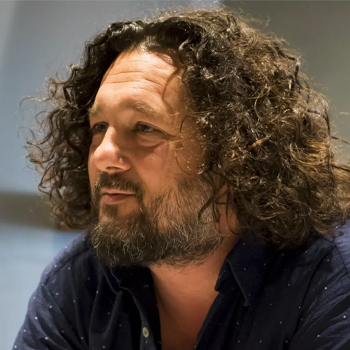
    Tyson Yunkaporta feature imageAre you curious about the memory techniques used in the ancient world?

    I’m talking about aboriginal memory techniques in Australia.

    But also a lot more.

    For example, it’s possible to learn about all sorts of indigenous tools for learning and retaining information used by people around the world.

    If this sounds interesting to you, you’re in luck.

    In this episode of the Magnetic Memory Method Podcast, I sat down with Tyson Yunkaporta, an author and educator who has shared these techniques with many groups of people.

    https://www.youtube.com/watch?v=R_–IAZz410

    Aboriginal Philosophy and Memory Techniques

    Tyson’s a huge fan of both the Aboriginal memory techniques and the Memory Palace, so I think you’re going to love how we discuss all the techniques we go over in this discussion.

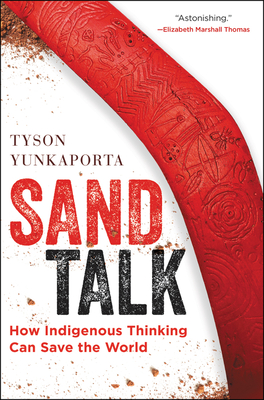
    As the author of Sand Talk: How Indigenous Thinking Can Save The World, Dr. Yunkaporta is an incredible teacher.

    I found this book compelling, useful and the main mnemonic device taught in the book is an obvious win for social change and healing global issues.

    Sand Talk Book Cover

    As Tyson expresses in this interview, the time for “memory wars” (and all kinds of other wars) is over.

    We simply don’t have time for them anymore.

    And to help you be part of the solution in your culture, you need to widen your context and bring that back into your community.

    Here are just some of the memory techniques you’ll discover in this discussion:

    • Real places and objects
    • Relational
    • Haptic connections
    • Riddles and wordplay
    • The Night sky
    • Songlines
    • Place and maps of place
    • Symbols and images
    • Rhythm and rhyme
    • Repetition
    • Song
    • Rude language
    • Stories
    • Message sticks

    In sum, if you were to put these mnemonics into play, you’d be using them as a “way of life.”

    For more on the scientific study that inspired this “yarn,” please see my discussion with Dr. David Reser:

    https://www.youtube.com/watch?v=UkDgT6_sNJQ

    I also recommend you supplement this video with Brilliant Miller’s interview with Tyson:

    https://www.youtube.com/watch?v=JCzlgBbv5OY

    Lynne Kelly and her books The Memory Code and Memory Craft comes up in this interview, so if you’d like to catch up with me and her, please see:

    https://www.youtube.com/watch?v=jim_csNGV1Q

    Finally, here’s The “Memory Wars” recording with Dr. Reser and Dr. Yunkaporta.

    We talk about a number of mnemonic devices in this interview, so please be prepared to write them down. Songlines are part of a larger set that people used who had a ton of knowledge they needed in order to survive.

    Make sure you supplement your own survival by digging as deeply as you can into the wide range of techniques history around the world has to offer. And apply the information you acquire to helping the world become a better place.

    Thanks for being part of the memory world at large and talk soon!


    10 Types of Synesthesia (Examples, Causes, and Symptoms) Jun 09, 2021
    Show notes

    10 types of synesthesia feature imageWith so many types of synesthesia out there, it can be hard to understand exactly what it is.

    That’s why it’s important to look at the word itself first:

    It shares a root with anesthesia. This word means “no sensation.”

    “Syn” means that something is joined or coupled together. Thus, synesthesia means the joining or coupling of two or more sensations.

    And because many different kinds of sensations can be joined, that’s why there are so many synesthesia types.

    On this page, we’ll go through the definitions of each one. You’ll discover specific examples and interesting tidbits from scientific research.

    That way, you can leave with the fullest possible understanding of this condition. You might even be able to invoke it too using a resource I’ll share below.

    Let’s get started.

    The 10 Types of Synesthesia (with Examples, Causes, and Symptoms)

    In his book on the topic, neurologist Richard E. Cytowic states that approximately 4% of the population experience some form of synesthesia.

    Exactly how long people experience their synesthesia is unknown, but many seem to drift in and out of it.

    In Wednesday Is Indigo Blue: Discovering the Brain of Synesthesia, Cytowic and his co-authors David Eagleman and Dmitri Nabokov found that evolutionary pressures may shape when and for how long a synesthesia condition affects people.

    The condition also tends to be unidirectional. As they point out, a person might experience the letter J as blue. However, seeing blue does not cause them to think about the letter J or experience “J-ness.”

    Most forms of synesthesia belong roughly to what some people call “Projection Synesthesia.” That is, something in the brain causes their minds to project senses that aren’t there for the rest of us. Often they tend to involve colors.

    So with these aspects in mind, let’s dig into as many types of synesthesia as we can.

    One: Colored Days of the Week

    Here’s how Daniel Tammet discusses his birthday:
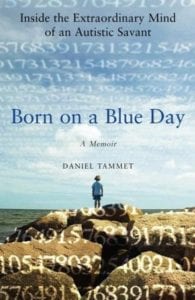
    born on a blue day

    “I was born on January 31, 1979 — a Wednesday. I know it was a Wednesday, because the date is blue in my mind and Wednesdays are always blue.”

    In his book, Born on a Blue Day: A Memoir of Aspergers and an Extraordinary Mind, Tamet says that Tuesday is a “warm color” and Thursday is “fuzzy.”

    This lack of specificity for some days of the week should remind us of the consistency issue raised by Cytowic. Or it’s possible that some days have substances for Tamet rather than colors.

    Is this the same as associating numbers with colors. Not necessarily. For that we need to learn more about our next type.

    Two: Grapheme Color Synesthesia

    When you see or think about the letter “A,” does it have a color? For some people it does. Likewise with numbers.

    Some people will read letters and numbers and see them as colors. Others with grapheme color synesthesia will see letters and numbers as black marks on white paper but think about them as colors.

    In The Frog Who Croaked Blue: Synesthesia and the Mixing of the Senses, Jamie Ward gives a list of letter-color associations from two research participants.
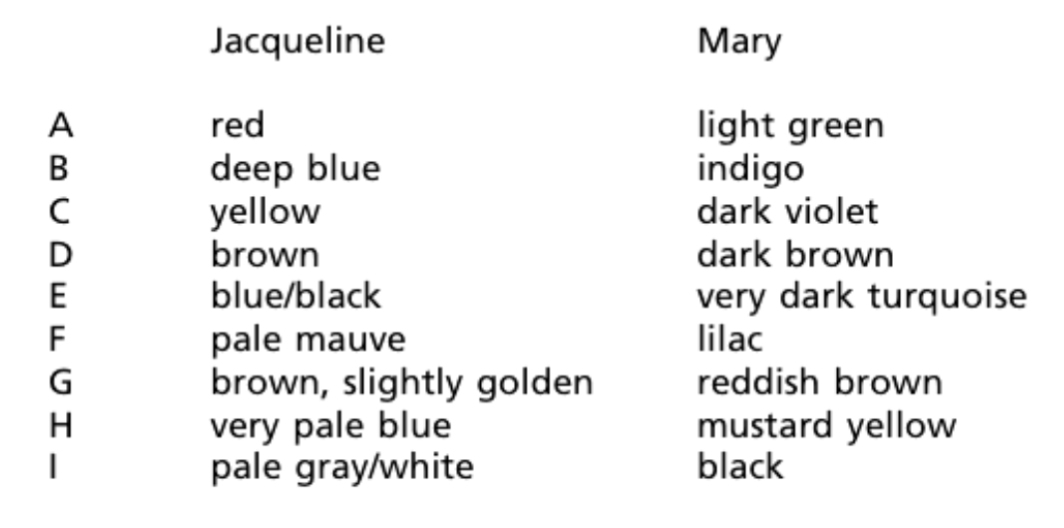
    graphene color synesthesia example

    It is interesting that different people experience these letters in different ways. This suggests just as much nurture in the development of this form of synesthesia as nature.

    Three: Chromesthesia

    Chromesthesia, or colored hearing, means that the individual experiences colors connected with sounds.

    Researchers have found that sounds can trigger more than colors as well. A person with this condition might hear music and experience shapes, landscapes or textures.

    Composers who may have drawn upon this type of synesthesia include Franz Liszt and Jean Sibelius.

    Four: Ordinal Linguistic Personification

    In this manifestation of synesthesia, the individual will experience numbers, days, months and multiple kinds of words and things as if they were people.

    For example, the word “camping” might be experienced as having a gender and a tendency towards grumpiness. A stick on the street might seem to the individual as a happy young man.

    camping

    In many ways, this synesthesia condition is a lot like how kids play with objects to keep themselves entertained.

    Five: Mirror Touch

    Imagine you see two people across the street shaking hands. But you don’t just see it. You feel it as if you were the one shaking hands. That’s what is meant by Mirror Touch synesthesia.

    In a two-year study by Charlotte A. Chun and Jean-Michel Hupé, these researchers found that many kinds of people with synesthesia experience this form. There was no way to predict which kinds of people might have this kind, but they did see some indication that French people were more likely to experience grapheme color synesthesia.

    Six: Spatial Sequence Synesthesia

    There are at least two parts to Spatial Sequence Synesthesia, sometimes called “Number Form” synesthesia.

    First, the person experiences numbers units as having distinct locations. For example, take an organizational unit like a calendar. Instead of thinking of February conceptually as a group of days, the person will experience it bound up with a location, or as if it had the qualities of a location.

    Mark Price and Jason Mattingly give an example of calendar drawings in Automaticity in sequence-space synaesthesia.
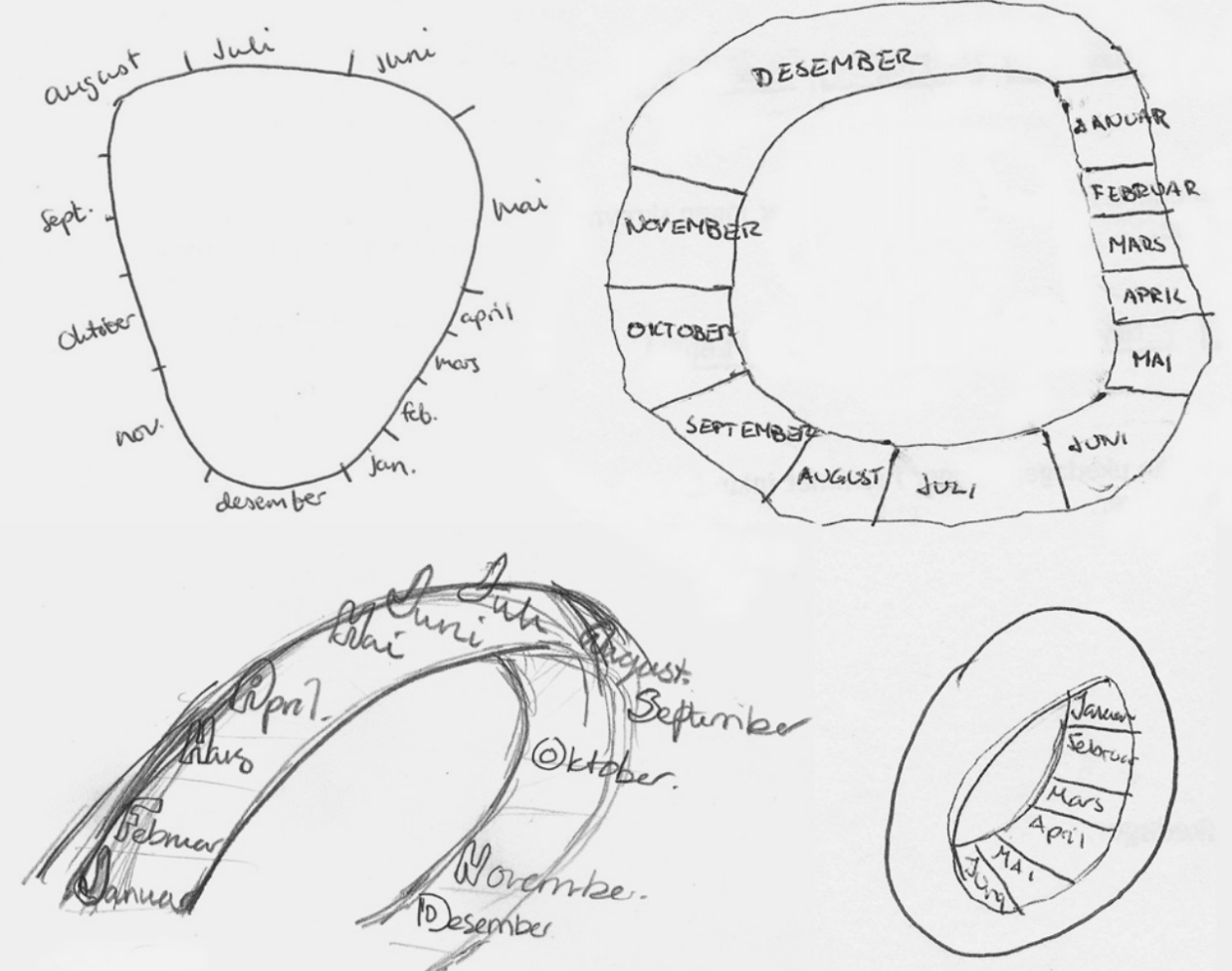
    sequence space synesthesia example

    Second, this unit will be experienced with references to other numbers, themselves located in space.

    Jamie Ward asked a test participant to draw how she was experiencing Spatial Sequence Synesthesia.
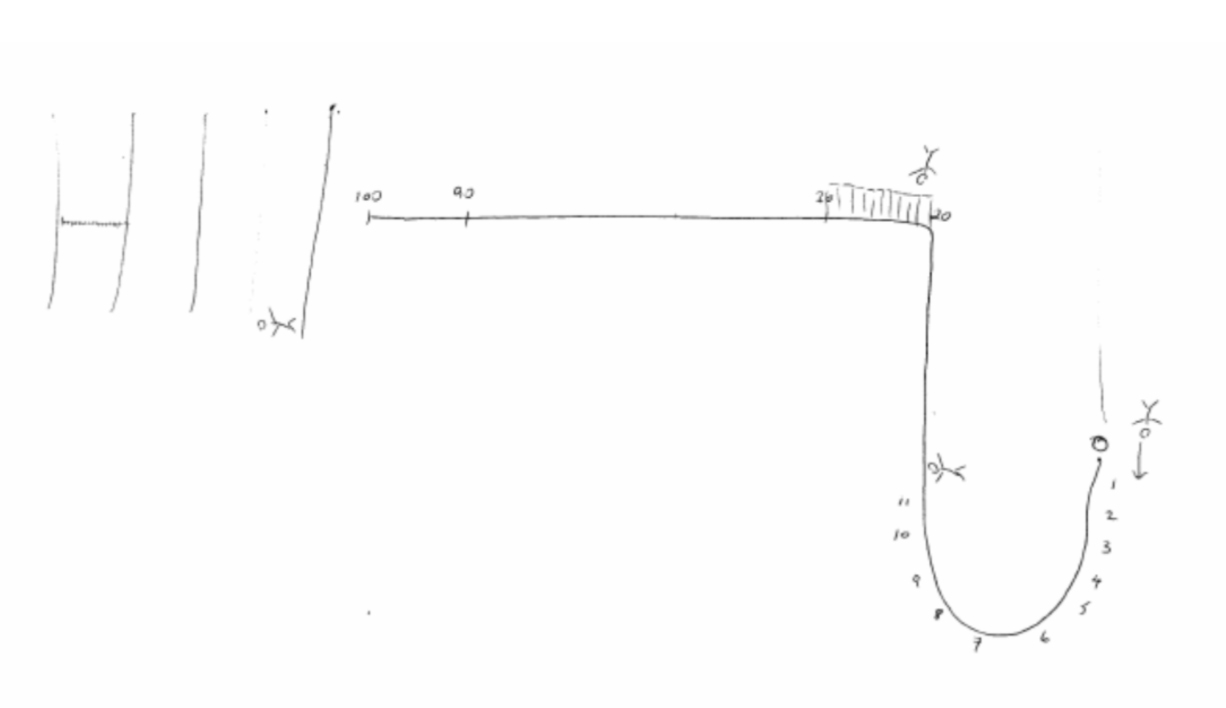
    spatial sequence synesthesia example

    As you can see, the participant not only has the numbers represented where they appear in space. She has indicated how she can rotate her point of view around their location.

    Another point:

    Part of experiencing this form of the condition might mean that people experience numbers “floating in space at a fixed distance from their body.”

    Seven: Auditory-Tactile Synesthesia

    Also called “Sound-Touch Synesthesia,” this form of the condition means that common sounds create physical sensations in the listener. These are typically described as “tingling” and may be intense enough to deeply disturb the individual.

    Studies in people with thalamic lesions have shown that this part of the brain might be responsible for both physical and sound sensations. This area of knowledge is one place where knowing how to remember the cranial nerves could also be helpful because they contribute to some of our ability to perceive physical and auditory sensations.

    Eight: Lexical-Gustatory Synesthesia

    Imagine tasting the words of this article as you read it.

    That’s exactly what would be happening to you now if you had lexical-gustatory synesthesia.

    Researchers have found that amongst the few people who experience this condition, the experience is very intense but lacking in quality. Brain scans show that the parts of the brain involved in emotions light up, which may explain the magnitude of these experiences.

    brain scans

    Sound-gustatory is much the same. However, in this case, the sense of taste is triggered by noises and auditory modulations in the person’s environment.

    We’ve talked about taste. What about smelling colors?

    This too is something that happens to people with synesthesia, but seems much less common than some of the other types.

    Although subjective feelings are involved in each of these, it’s hard to say if any of them amount to emotional synesthesia as a type on its own. More research needs to be done, some of which is being uncovered by those investigating our next type.

    Nine: Misophonia Synesthesia

    People with misophonia can be triggered to rage by everyday sounds.

    Researchers have not been able to find out much about it. Some conclude that many people fail to report their symptoms for fear of being stigmatized.

    On the opposite end of the spectrum, ASMR has been all the rage over the past few years. Videos featuring all kinds of mundane sounds of racked up millions, if not billions of views on YouTube hoping to induce “auto sensory meridian response.”

    These are pleasant tingling sensations that come from listening to sounds like whispering voices, tapping, blowing bubbles or chewing gum.

    Ten: Ideaesthesia

    Of these two images, which would you name Booba and which Kiki?

    booba kiki test for ideaethesia

    Most native English speakers will name the image on the left Kiki and the image on the right Booba.

    Why?

    Because hard-K sounds are conceived as being similar to sharp angles. Softer B-sounds are generally perceived as more like the rounded drawing to the right. According to Derren Bridger, marketers have long known about this tendency and used it to help dream up product names.

    Much more research needs to be done on this branch of synesthesia. It’s not yet clear if colors are also involved in how people might experience these conceptual approaches to linking sounds with shapes in a conceptual way.

    Can You Give Yourself Synesthesia?

    I don’t think so. And I hope you never harm your brain or develop a lesion that might come with unwanted effects just to experience synesthesia.

    However, you certainly can increase your ability to experience the world in a multi sensory way.

    To give this a try for yourself, go through this hyperphantasia guided meditation:

    https://www.youtube.com/watch?v=uAz3_pkqXqc

    In the meantime, I hope this rundown of the many different types of synesthesia helped you out.

    If there are any I missed, please pop them into the discussion area so we can all learn about them. And if you’d like to be able to memorize all of these different terms we discussed today, check out my FREE Memory Improvement Kit today:

    Magnetic Memory Method Free Memory Improvement Course


    Better Than The Memory Palace? A Discussion With Dr. David Reser Jun 03, 2021
    Show notes

    Dr. David ReserTell me if this sounds like clickbait?

    “Ancient Australian Aboriginal Memory Tool Superior to ‘Memory Palace’ Learning”

    I mean, I thought so too.

    Must be click bait.

    I grew even more concerned when Dominic O’Brien tweeted a Neuroscience article and added this statement:

    “In short, Link or Story Method combined with Journey Method provide the optimum learning strategy.”

    With all due respect to Dominic and acknowledgement of his great accomplishments and wonderful books, this is not precisely what the Neuroscience article says.

    Nor is it what the full study says.

    Neither the media report or the study even contain the word “Journey.”

    An Opportunity For The “Pause” Button

    Now, because I’m human too, I decided not to battle about this on Twitter. As you know, Angry Birds just ain’t my schtick.

    In fact, I simply retweeted Dominic’s statement with a link to the original study.

    https://www.youtube.com/watch?v=UkDgT6_sNJQ

    And with sincere humility, let me offer this:

    For a memory expert to… shall we say… shape what a study says by promoting it with a quasi-branded term like “Journey Method” should be a wake up call to the human and humanness in us all.

    Because as educators, it’s normal to get excited by anything in the world of science that validates what we’ve been saying all along. I’m sure in haste I’ve done something like that too, and in this fast paced world, probably will again.

    All the more reason that we must be on our guard and seek to go beyond the headlines and the tweets.

    To temper ourselves so that we can truly learn from the research, and hopefully improve how we teach and learn, while avoiding getting territorial in ways that risk placing borders on the wonder.

    Territorialism Over Terminology

    Because frankly, I noted a small tremor of territorialism in myself at the idea that something could be better than the Memory Palace.

    And that happened to me even though I often remind you that this term is just a word for location-based mnemonics, and nothing more.

    Knowing that there must be more to this study than anyone could hope to convey in a tweet, I read the full paper myself. And to get even more detail, I reached out to Dr. David Reser at Monash university.

    As a neuroscientist with interests in attention, consciousness and many aspects of education, Dr. Reser is the head author on the study that several dozen people have emailed me about since the story broke.

    What Does The Study Actually Say?

    First off, it’s important that you read it yourself.

    The study is called:

    “Australian Aboriginal techniques for memorization: Translation into a medical and allied health education setting.”

    It turns out, the medical and health education setting matter a great deal. And there are several more nuances that make this study very, very interesting.

    For example:

    • A particular story was important to the study
    • Student preparedness and preexisting learning experiences may be key to learning faster
    • Having a teacher in the learning space with the students was important
    • The Aboriginal approach is shown to have helped the individuals remember the order better
    • More research on long term comparisons with the Method of Loci and the Aboriginal technique are required

    These are just my tentative bullet points for the time being.

    Frankly, Dr. Reser is so good at explaining the science, I really hope you’ll dive into the full conversation.

    This Actually Could Be “Better” Than The Memory Palace Technique

    For now, I’m happy to say this:

    If all of us educators and students can get on the same page, share these findings around and collaborate with those members in the Aboriginal community who hold knowledge we should be very excited about…

    Why then, there might just be something many magnitudes of better, better than whatever you want to call the memory techniques you currently use.

    But we do have to pay the price of attending to accuracy.

    With care and accuracy in mind, I’m grateful Dr. Reser spent this time with us to discuss the study, the nature of its implications and what we all can do to learn, explore.

    Links To Dr. Reser

    Please spend some time on the reading, share your thoughts in the comments.

    And if you’re new to the Magnetic Memory Method blog, please get subscribed because I’m hoping to record a follow-up interview with Tyson Yunkaporta soon.

    If you, like me, care about the memory tradition and our quest for the truth about what really works, you’re not going to want to miss a thing.

    Dr. David Reser’s Monash University Profile

    Dr. David Reser on Twitter


    Anterograde vs Retrograde Amnesia: A Simple Guide May 12, 2021
    Show notes

    Amnesia is a tricky term to understand because it is used in so many ways. For example, it has become popular to talk about “political amnesia” to explain the “crisis of memory” in various parties. Movies and streaming series also often feature characters suffering some form of memory loss and calling it “amnesia.” But using the term amnesia in these ways muddies the waters of an already complicated topic. So let’s bring some light to the field of forgetting as we explore retrograde vs anterograde amnesia in full, including some specific case studies from scientific literature. Anterograde vs Retrograde Amnesia: What’s the Difference? The difference is found in the prefixes. Something that is anterior is situated in front of another object or event. “Retro” as many of us know, refers to the past. Therefore, anterograde amnesia refers to having difficulties forming memories after amnesia sets in. Retrograde amnesia, on the other hand, refers to experiencing issues with accessing memories before the onset of amnesia. Let’s dig a bit deeper and look at some specific examples. That way you can truly learn the difference between retrograde and anterograde amnesia. What Is Anterograde Amnesia? Christopher Nolan’s Memento, released in the year 2000. According to clinical neuropsychologist Sallie Baxendale, this movie’s representation of anterograde amnesia is fairly accurate. As she explains: “The film documents the difficulties faced by Leonard, who develops a severe anterograde amnesia after an attack in which his wife is killed. Unlike in most films in this genre, this amnesic character retains his identity, has little retrograde amnesia, and shows several of the severe everyday memory difficulties associated with the disorder. The fragmented, almost mosaic quality to the sequence of scenes in the film also cleverly reflects the ‘perpetual present’ nature of the syndrome.” https://www.youtube.com/watch?v=0vS0E9bBSL0 “Perpetual present” is a key term here because people suffering anterograde amnesia cannot lay down new memories. Why does this happen? Traditionally, scientists have thought that anterograde amnesia is likely caused by something interrupting the consolidation of new memories. Here’s how Dr. Michaela Dewar puts it in her contribution to the excellent book, “Cases of Amnesia: Contributions to Understanding Memory and the Brain”: “During consolidation, new fragile memo­ries become increasingly resistant to disruptions.” Dr. Dewar’s research at Heriot Watt University’s Memory Lab suggest that more rest can help people suffering from anterograde amnesia. Research findings from Dr. Dewar’s Memory Lab project on distinguishing retrograde and anterograde amnesia. Exactly what it is that interrupts consolidation remains unclear. Dewar suggestions it could be: A general malfunction in the automatic consolidation of new memories A lack of intention by the patient to voluntarily rehearse new memories Situations where the patient faces overwhelming amounts of sensory input Other, as yet unknown interruptions between encoding and retrieval of memories A Specific Case of Anterograde Amnesia Dewar herself reports the specific case of a patient with severe anterograde amnesia caused by limbic encephalitis. For privacy purposes, the patient in question is referred to as PB. “The severity of his anterograde amnesia is perhaps best illustrated by a couple of anecdotes: when we first met, PB’s wife reported that a close family friend from abroad had recently been staying with them for several days. However, within minutes of the friend’s departure, PB had no recollection of the friend’s visit. More strikingly, after an hour of interviews and neuropsychological assessments, I left the room for a couple of seconds and then re-entered to examine informally PB’s ability to remember me after a brief delay. When I returned, PB had no recollection of ever having met me before.” Dewar found after working with PB that rest improved his ability to remember certain kinds of information. “I was both excited and perplexed by these findings! How was it possible for people with severe anterograde amnesia to be able to retain so much new infor­mation over periods of up to one hour?” Is There A Cure For Anterograde Amnesia? Dewar’s best answer as of 2020 has been rest, something which seems to have enabled PB to recall certain kinds of information even when his attention was diverted to other topics. She is not the only researcher to conclude that rest is a potential solution for anterograde amnesia. It may even be possible to promote memory consolidation without patients needing to sleep. This was reported in a Neuropsychology journal article called “Minimizing interference with early consolida­tion boosts 7-day retention in amnesic patients.” Finally, a lot of the answer depends on what exactly the patient is trying to remember. There’s a difference and it matters. For example, according to senior lecturer Anshok Ansari, some people with anterograde amnesia will struggle with laying down new: Episodic memories (stories about life, events, etc) Semantic memories (facts, vocabulary, etc) As Dr. Ansari has explained in a video for Sage, you can ask a person with anterograde amnesia for facts about France. They’ll be able to answer them correctly (semantic memory), but not be able to tell you what happened to them personally last week (episodic memory). Can An Actor With Anterograde Amnesia Still Perform? Further along in Cases of Amnesia, researchers Michael D. Kopelman and John Morton discuss the case of an actor with severe autobiographical memory issues. This case is especially interesting because many actors use their personal memories as the basis for forming their roles. The autobiographical memory issues harmed this patient’s anterograde memory: “His antero­grade memory deficit was evident at the first learning trial, where he consistently performed worse than controls but, thereafter, he was able to learn and retain (for use at subsequent learning trials) longer and much more complex material (in terms of syntax and semantics) than has been demonstrated previously.” The research is very interesting because they challenged him with contemporary theater acting tasks and older texts, like Shakespeare. Regardless of the text, the actor still did well in recalling his lines. However, he still could not remember much about his life: “He said that he practised for approximately an hour to an hour and a half each day. He did not commit all the lines to memory, and did not carry out word-by-word learning. Instead, he said that he ‘thinks about the per­formance . . . how it will work best. . . . By reading aloud, I work on it.’ “ Despite this accomplishment, AB still had a severe amnesia in everyday life. “For example, he could not recall at all a therapist whom he had met on approximately 12 occasions previously, and he had only vague recollection about another therapist, whom he had met on more than 20 occasions.” As sad as this case of anterograde memory is for the actor’s personal memory, it is fascinating that he could still learn enough complicated material to perform in a play. This shows the importance of rehearsal in forming new memories. What Is Retrograde Amnesia? In Individual and Collective Memory Consolidation: Analogous Processes on Different Levels, researcher Thomas Anastasio defines retrograde amnesia as: “Any loss of memory for events that occurred before the insult that caused the amnesia, and it may be induced in individuals through various neurologic or psychologic pathologies.” In other words, with this form of amnesia, you can forget large amounts of your past, but still be able to learn and remember new information. This form of amnesia can be caused by: Damage to brain structures from collisions Harm to the brain from substances like toxins Medicinal side effects Hippocampal damage from tumors Brain damage from conditions like encephalitis and meningitis Oxygen deprivation Psychological harms, such as trauma or even insults In this form of amnesia, patients may suffer different effects. For example, they may forget: Many things or everything from before the onset of amnesia Material from a few hours before the onset Longer periods of time To help distinguish these kinds of retrograde amnesia, scientists use the terms “recent” and “remote.” The patient might suffer full or reduced forgetting. Retrograde amnesia can be distinguished as being recent and remote. Both categories can have full memory loss or some level of memory loss that many not be complete. A Specific Example Of Retrograde Amnesia Here’s a very clear example of retrograde amnesia given in the book, Amnesia: Clinical, Psychological and Medicolegal Aspects. “A woman of 34 began to show disturbances of behaviour while on a cycling holiday with her husband. She lost her way on familiar routes, would stop and wander off the road for no reason, and on two occasions temporarily lost her bicycle. However, it was not until three weeks later that she developed headache, slight fever and a gross confusional state, at one time with hallucinations. On examination at this time, she had some swelling of her optic discs and a marked lymphocytic pleocytosis in her cerebrospinal fluid, but no localized signs in the central nervous system. As the general confusion and hallucinations subsided, mental examination showed a gross fixation amnesia with florid confabulation. She recovered slowly, but it was over two months before she was fit to resume her household duties. When seen nine months after her illness, she had a permanent retrograde amnesia which involved some six weeks of her stay in hospital and the preceding three weeks, with a sharp end-point at one particular incident of her cycling holiday. Her memorizing was also persistently defective. She would lose things easily, forget household details and had difficulty in remembering acquaintances. However, these defects were minor ones and she was able to lead a normal life and look after her home satisfactorily. She died some two years later of an unrelated condition. At autopsy the brain was macroscopically normal. Histological examination showed evidence of localized perivascular cuffing in the floor of the third ventricle and extending a little into the periaqueductal region. No other abnormalities were found.” Attempts To Understand And Cure Retrograde Amnesia To understand how memory works, scientists often use models. As with anterograde amnesia, the basic model requires understanding memory consolidation. It is a time-based process that transfers short term memory into long term memory. You can think of memory consolidation as involving at least three “buckets.” The more effectively information is transferred from one bucket to the other, the more you’ll remember. Many researchers think that amnesia interferes most with the consolidation period between buckets two and three. You can think of memory consolidation as laying bricks. First you have a foundation, then you put down some cement. Into this cement, you align bricks and allow the cement to set. Memory consolidation is the setting process. The more it functions in a stable way, the more you’ll be able to retrieve each individual brick in your “wall of memory.” But when retrograde memory takes place, it’s not entirely clear what goes wrong, especially since some people are able to recover from it. For example, in the book Amnesia cited above, people with retrograde amnesia from meningitis have recovered their memories when the illness was resolved. And as we’ve seen, they can still lay down new memories even while suffering from retrograde amnesia. Other Causes Of Memory Loss Sigmund Freud talks a lot about forgetting in his 1901 book, The Psychopathology of Everyday Life. In brief, he suggests: Social forces cause us to repress things we wish to express Forgetting is one of the mind’s ways to prevent us from expression Forgetting may be “incomplete” leading to other problems, like resentment Was Freud correct about these things? Although he has fallen out of favor, many people can probably relate to efforts they’ve made to “forget” things that have irritated them. We have all gone out of our way to avoid launching our various criticisms for fear of “rocking the boat.” But when you think about it, the Internet has made it possible for people to air any number of complaints, particularly through social media. This form of collective activity has caused many people to wonder if we haven’t seriously reduced our collective attention span. In fact, it’s led to one German researcher coining the term “Digital Amnesia.” Does using a computer cause “Digital Amnesia”? There is definitely something to these factors and how our technologies have changed human memory. And there may well be a political price to pay. As a collection of essays called Geopolitical Amnesia: The Rise of the Right and the Crisis of Liberal Memory argues, we may have entered an “age of forgetting.” Part of the problem Vibeke Tjalve finds in the conclusion to this book is that we have externalized or offloaded so much human memory to machines that history has been “re-shaped, and re-circulated to an extent that ultimately threatens to render history itself without meaning.” This is a serious criticism worthy of criticism. But is it really amnesia? Let’s Stop Confusing Amnesia With Cultural Issues At the end of the day, amnesia is a condition that harms individuals. It prevents you from either accessing your personal past or laying down new personal memories. This condition must be devastating for the people who experience it. And all the more so when it becomes increasingly difficult to find clear definitions and extended examples. Although I appreciate that there probably is such a thing as “cultural amnesia,” history is a big place. The Internet really hasn’t been around long enough for us to start calling its few historical disruptions by the name of what is effectively a serious disease. I hope this article has helped you understand the differences between retrograde and anterograde amnesia. I also hope the examples have given you deeper insight into the nuances of each. As we move into the future, let’s work together to use terms like “amnesia” very carefully. Real people with real issues need the best possible help they can get and definitions matter.

    Full show notes at the publisher

    What Is Autobiographical Memory: A Simple Guide May 05, 2021
    Show notes

    The term “autobiographical memory” sounds straightforward enough, doesn’t it? In reality, this aspect of human memory is quite complex. And the way scientists write about it can be hard to penetrate. I’ve been studying all kinds of memory for decades, so let me help you understand it with some examples and infographics. To do that, let’s take a step back and get a working definition of autobiographical memory and some examples that are easy to understand. Once you understand the different levels of autobiographical memory, you’ll be able to understand yourself and others better. And those psychology exams? Consider them aced when this unique and nuanced term comes up. Let’s get started. What Is Autobiographical Memory? In a word, this type of memory is a “system.” Better than that, autobiographical memory is a system that draws upon other systems so that you can rapidly draw upon emotions and facts that help you make decisions. What are these systems? And where are they found in the brain? Memories are in fact spread all over the brain. Or as memory expert Dr. Gary Small describes it, memories are distributed into what you can think of as “neighborhoods.” This means that when your brain serves up autobiographical memories about your life, it might be drawing upon: Episodic memory Semantic memory Iconic memory Sensory Memory If you think about these different aspects of memory as cousins and uncles who live in different neighborhoods throughout your brain, then experiencing an autobiographical memory is like an event. In other words, if you’re trying to remember something about yourself, you will gather all those different kinds of memories into one “room,” the same way you gather your family members for Thanksgiving dinner. And because autobiographical memory is something you can deliberately call upon and experience consciously, it belongs to a larger level called explicit memory. This is different than implicit memory, which involves unconscious processes. Do Some People Have Superior Autobiographical Memory? Yes, and the scientific term for superior autobiographical memory is hyperthymesia. This form of memory is sometimes confused with eidetic memory, which is itself mistakenly associated with photographic memory. Superior autobiographical memory or hyperthymesia isn’t understood well by scientists. In fact, some scientists think that there might be OCD or obsessive levels of self-reflective repetition involved. If this finding proves correct, then it would be elaborative encoding that explains the high levels of recall these people experience. Jill Price is one such notable case where people have noticed that obsessive levels of journaling have featured across her life. But whether or not repetitive journaling explains this level of recall or not, here’s the easiest way to think about it: Researchers have noticed that some people with superior autobiographical memory tend to journal much more than the average person. People with hyperthymesia are simply more efficient at calling all those different types of memory into the same “room” to help produce the experience of personal memories. In fast, it is very telling that superior autobiographical memory is really the only kind of memory that has shown this feature. As the personal suffering seen in the Price case shows, there might be such a thing as too much reflective thinking. The 3 Levels of Autobiographical Memory There are three levels and four “types” of autobiographical memory. It’s useful to distinguish them because they involve different kinds of autobiographical information. Type One: Lifetime Periods This literally means the memories you have to distinguish childhood from your adolescence, early adulthood, middle age and senior year. Jean Piaget described these periods in great detail in his theory of cognitive development. Some scientists include other categories in this type of autobiographical memory. For example, they would include how your memory divides: Elementary school High school College Type Two: General Events General events are much less fluid and don’t have distinct borders like “grade seven,” which has a beginning, middle and end. A time-based event like the fact that you attended grade seven at school is a general autobiographical memory. This level of autobiographical memory refers to those kinds of memories when you basically remember a set of days, weeks or perhaps entire seasons gathered around a theme. For example, when you tell someone a story about a fascination you had, you might say, “I studied that topic for a good couple of weeks. I couldn’t get enough.” But whereas lifetime periods have more specific beginnings and endings, you would not be able to say when exactly those weeks of a general event took place. Type Three: Event Specific When experiencing this level of autobiographical memory, you can literally remember things that happened down to the second. This might be a memory of the first time you saw the person you married, or a flashbulb memory of a tragic event. The 4 Types of Autobiographical Memory There’s some crossover between “types” and “levels” of memory, but it’s still useful to separate the two so you have the fullest possible picture. Level One: Personal Information Examples of autobiographical memory here include: Your name and the names of your parents Where you were born Where you went to school Remembering where you went to school is an example of autobiographical memory. To help you dig up more of this kind of memory you might not have experienced for a while, there’s a podcast on this page with 3 Memory Games You Can Play With Your Childhood. You’ll find other memory improving games in that article too. Level Two: Copies and Reconstructions Remember when I talked about superior autobiographical memory being poorly understood? One reason why is that just because the person thinks they remember their lives exceptionally well, doesn’t mean that they really do. Studies have shown that we all reconstruct our memories, and autobiographical memories are often highly inaccurate. Why? Think back to Dr. Gary Small’s neighborhood analogy. Each time a memory is recalled, it changes location in the brain. Anything that moves is transformed, so by the time you’ve recalled the memory, it is now: Located somewhere else in the brain Chemically different than it used to be This doesn’t mean that we’re all liars. But it’s just a fact that memories change over time and by recalling them, we are literally “reconstructing” them. To make things more complicated, copies can be incredibly vivid and deliberately amplifying them can increase their accuracy. The act of vivifying your memories so you can recall them with greater accuracy is greatly assisted by using a Memory Palace. Level Three: Generic Vs. Specific This level is basically the same as the second and third type described above. The difference here comes down to the conscious effort to “relive” the memories. For example, we can often call up generic memories about our lives without thinking too much about them. “Oh yeah, I remember doing that,” is easy to say about the time you went for ice cream on a date. But you don’t actually have to relive it because going for ice cream is a generic event. However, if someone asks you to remember a specific time you went for ice cream when something special happened, you might have to press them for more specific details. For example, they might need to give you the street name or general neighborhood to help you remember the exact ice cream excursion they have in mind. Sometimes researchers think of this level differently in terms of the remembering vs. knowing dynamic, but the topic is far from decided upon. Level Four: Perspective This level of autobiographical memory is especially interesting. For example, you can remember going for ice cream from your first person point of view. This is called the “field” perspective. But you can also think of the same event from either a second or third person perspective. For example, you can imagine looking down at yourself having ice cream from the sky. Or you can see yourself through the eyes of the person you were with. This is called the “observer” perspective. Autobiographical Memory Examples Memory expert David Berglas gave the ultimate autobiographical memory example in his book, A Question of Memory. He calls it “The Kennedy Effect.” During his era, people used to ask each other all the time: “Where were you when John F. Kennedy died?” These days, people ask “Where were you when 9/11 happened?” much more often, but the principle is the same. If you observe people when asking this question, you will see how most people will frame their explanation from the field level of autobiographical memory. If you want a fun exercise, pick a major historical event like this and try to see yourself while it is happening through the eyes of others. As you think about doing that, here are some other autobiographical memory examples: Your wedding day Getting your driver’s license Taking a trip to a foreign country Having a child Graduating high school Receiving an award Retirement day Of course, autobiographical memories aren’t always positive. Here are some negative autobiographical memory examples some of us might experience: A traffic accident Court dates Losing a loved one A home invasion War Struggling with a challenge The good news is that studies have shown that people tend to recover from such events quite readily. Best Books To Read On Autobiographical Memory I find this branch of memory so fascinating, that I thought you might like to know some of the books I’ve read on the topic over the years. First up is The Organization and Structure of Autobiographical Memory by John Mace. This book brings together over 30 years of empirical findings from multiple researchers. Its strongest point is how it shows the cultural influence on how autobiographical memories form. For example, some cultures remember more about their personal lives than others based on their political leanings. Autobiographical Memory Development: Theoretical and Methodological Approaches is a recent volume edited by Sami Gülgöz and Basak Sahin-Acar. The strength of this book is how it has incorporated the relatively new field of trauma studies into the conversation. Everyday Memory, edited by Svein Magnussen and Tore Helstrup is a great book I want to mention specifically for one chapter. It’s the chapter called “Memory Sensitivity in Autobiographical Memory,” co-authored by Cesare Cornoldi, Rossana De Beni and Tore Helstrup. In this chapter, the authors point out how rewarding engaging with the memories of your life can be. As they suggest, it can readily become a self-reinforcing practice that serves you many times over in life: “Having experienced positive and rewarding effects of searching one’s past, one is more likely to engage in new attempts. Reminiscing develops into a cognitive style that can be backed up by knowledge about different pathways to one’s own episodic memories.” Autobiographical Memory and Your Cognitive Style Personally, my cognitive style used to be horrible. In fact, I used to find thinking about my past a horrifying experience. But as I shared in this TEDx Talk, I found that thinking addressing the experience of memories in a slightly different way “defanged” them and made all memories much more positive in the ways that Cornoldi, De Beni and Helstrup suggest. https://www.youtube.com/watch?v=kvtYjdriSpM As you’ve already seen, this post is packed with resources to follow-up on. And for more exercises that can improve how you access your personal history through memory, give these visualization exercises a try next. The fourth exercise in particular brings your personal memories together with the places you used to live. Speaking of exercises, if you’d like to strengthen all aspects of your memory, grab my free memory improvement course here: Now that you know all about autobiographical memory, what do you say? Are you ready to explore the aspect of your memory more as a means of enhancing your experience of life?

    Full show notes at the publisher

    Memorize All 66 Bible Books with the Memory Palace Method Apr 21, 2021
    Show notes

    Most people struggle to memorize the books of the Bible because they’re using songs, flashcards or rote repetition. Sure, those approaches can work. I’ll even show you a way to get much better results from flashcards further down on this page. But what is there was a memory method for the books of the Bible that is faster, more flexible and sets the stage for you to easily remember many others things? There is and it’s called the Memory Palace technique. In this guide, you’ll learn it. Memory Palaces are time-tested, scientifically valid and the most mentally efficient memory system you’ll likely every find. It makes memorizing a list of 66 items a breeze. And like I said, once you know how to use the technique properly, you’ll be able to recall individual verses, entire chapters or a list of Biblical themes whenever you want. Ready to unlock your Biblical memory for all the books for life? Let’s get started! The Fastest Way to Memorize all 66 Books of the Bible? A Memory Palace As mentioned, most modern Bibles contain 66 books. You can find them in order based on the Old Testament and the New Testament using this handy list. Some of the names will be familiar to you already, but memorizing even the most well-known names in order can still be a challenge. Often, this is because your memory is not trained to deal with large volumes of unusual names in a linear order. Other names will be difficult because of how they sound and how they’re spelled. But I’ll also show you how to deal with harder names of books like Zephaniah. Soon, they will all be very easy to remember. But let’s focus on memorizing the order first. For that, it’s important to have a technique that makes it simple and easy to think back to each book in its exact order within the Bible. One: Learn The Memory Palace Technique Learning to use a Memory Palace is essential for all learning tasks that involve large amounts of information. But this ancient tool is especially useful when it comes to memorizing Biblical verses. I do have one student who memorized 66 Psalms in a way he felt was without a Memory Palace. However, as we spoke, it was clear that the same basic use of spatial memory was still in place. Logically speaking there’s no getting around the method of loci for this kind of goal. To use this technique, you will create a journey throughout a familiar location. This journey will have space for 66 units of information, one spot for each book of the Bible. Depending on the room you choose, you can fit this journey into one room by using four walls something like this: This is one example of how you can start structuring a Memory Palace for memorizing the name of every book in the Bible. If you’re just beginning with this technique, this amount of information crammed into a single room might be too cramped. That’s okay. Just make the Memory Palace journey more spaced out. You’ll need more rooms, but that’s okay. This memory skill is a marathon, not a race. Also, I would suggest you consider having two Memory Palaces. One for the Old Testament and one for the New Testament. In this way, you can work on memorizing their books as two separate learning projects. It will make this learning project more manageable. Two: Learn to Place Memorable Associations The next step is to use your imagination to “pair” an association with a location in your Memory Palace. For example, you would place an image or association that reminds you of the word “Genesis” in position one of the Memory Palace. It could be a Sega Genesis, or perhaps you remember the Genesis Device and Genesis cave from Star Trek II: The Wrath of Khan. If those references don’t work, you could even think of someone you know named “Gene,” such as Gene Simmons, the bassist for the rock band Kiss. Even better, you can combine all three of these associations for striking effect when you revisit the Memory Palace journey. By placing a few words that sound like “Genesis” or are spelled in a similar way in a Memory Palace, it’s easy to remember all the books of the Bible. Coming up with associations really just means looking at the letters of the words you need to memorize and thinking about similarities. For example: Exodus brings to mind Exxon oil Leviticus brings to mind Lev Goldentouch Numbers brings to mind the numbness you feel after a trip to the dentist Deuteronomy brings to mind Doctor Dolittle, etc. To start thinking up associations like this rapidly, have a look at the pegword method. Three: Elaborate Your Associations It’s not enough to assign associations. You also need to make them strange and striking using a process memory scientists call elaborative encoding. So let’s say that you use the example of a dentist numbing your gums to help you remember that the book of Numbers is at position four in your Memory Palace. (This association works because “numb” sounds similar to Numbers.) To elaborate it, you want to imagine: Feeling that numbness as a physical sensation Hearing your voice trying to speak through numbed lips Imagine what it looks like to have a syringe injecting “Numbers” into your gums Experience the emotions involved Include any tastes or smells Think about the size of the needle and make it exaggeratedly huge Using everyday life experiences like the “numbing” effect you experience at the dentist helps you remember the Book of Numbers. These exaggerations only take a second per each book of the Bible. They will help you remember the name of each book with greater ease when you think back to where you stored them in the Memory Palace. Now, there’s something to consider here that some students have let me know about. They know that it’s possible to memorize the Bible, both in part and in whole. Especially if you have a Bible memorization plan. However, they do not like the idea of filling their minds with strange images and ideas. As I discussed in Where Did Noah Park the Ark?, the Bible has lots of interesting images. It’s possible to draw upon them instead. Plus, as actor Ashley Strand shared on my podcast when discussing how he memorized the Book of Mark in its entirety for a performance, analytical thinking is also helpful. At the end of the day, there’s no right or wrong answer. You need to follow what’s right for you. I personally fall on the side of the great religious memory masters like Augustine and Aquinas. They both considered imagination and memory to be gifts from God. Since God himself placed a rainbow in the sky as a reminder following quite a visually dramatic incident (flooding the world), we’re quite alright to use a bit of weird imagery to remember his Word. Although less famed than Augustine and Aquinas, Peter of Ravenna was a famed mnemonist who also memorized a lot of Scripture. He openly admits that he used all kinds of lewd information to do it and suggests in The Phoenix that people sometimes overthink these things. Four: Link Your Associations How do you know the Book of Deuteronomy follows Numbers? Often, the Memory Palace journey is more than enough. You just mentally move from station to station. However, it also makes sense to use the link and story method. One way you could help yourself memorize the order of the books of the Old Testament is to have the associations act upon each other. In other words, it’s not just that you have Gene Simmons using a Sega Genesis controller to start the Genesis Device from Star Trek II. You have this image interacting with the Exxon image. For example, you can have Gene Simmons firing the Genesis device at an Exxon station. This mnemonic example shows you have you can use the linking method in a Memory Palace to memorize the books of the Bible. Likewise, you can have someone named Lev or Lee or any “Le” image that makes sense to you fleeing from the Exxon station. By linking the associations from station to station throughout the Memory Palace, you give yourself an extra layer of “recall power.” Five: Review For Long Term Retention Once you have all 66 books assigned with associations, you want to revisit the entire journey a few times to get all of them into long term memory. We need to do this because memory and learning always require some level of repetition. The Memory Palace helps us manage the repetition and reduce the amount we need. https://www.youtube.com/watch?v=8nOwZVQosNg Basically, you want to follow these patterns: Forward through the Memory Palace Backward through the Memory Palace Skipping the stations These patterns will give primacy effect and recency effect to each station in your Memory Palace through a process memory scientists call serial positioning. It’s basically the same thing as using spaced repetition software, but much more powerful. What makes it more effective than software are flashcards is what is called “active recall.” When we put a little bit of “pressure” on our memory to recall facts we’ve learned, our memories develop much faster. Six: Follow Up With More Than Memory Learning how to memorize scripture at any level is fun and easy. If you have any doubts that you can do it, check out my student Matt Barclay’s incredible demonstration video. He recites one of the psalms in front of his congregation, something he memorized while recovering from cardiac arrest. And to really go the distance like Matt and get the material deep into memory, you want to learn it in context. To make that process riveting: Read as much as you can about the Bible and also memorize facts about each book Write summaries of each book and your thoughts about their meaning Discuss individual Books of the Bible with others as often as possible Listen to lectures about each book in order During this stage, you can also add facts to the names of the books you’ve already memorized. For example, if you want to remember that Zephaniah is prophetic literature, you can add an image of a prophet profiting to the core image in the Memory Palace. Seven: A Bonus Step For Those Who Prefer Flash Cards If the Memory Palace technique is not an option for you, here’s the best possible way to use flash cards. Instead of feeding yourself the answer on the back of the card, have a drawing that triggers your memory of the word. A mnemonic example to help you remember a book of the Bible called Zephaniah For example, you could draw a zipper to help you remember Zephaniah. You could even cut out a picture of Shania Twain or write her name beside the Zipper. In the mnemonic example above, I have drawn a zipper and a few lines to suggest the letter “Z.” I’m no artist, but I’ve drawn a singer and given myself a clue by adding some of the lyrics from a very famous Shania Twain song. Then, when looking at the card, the guessing process helps me form memories because it gives my brain a bit of a workout. In other words, this form of “memory triggering” creates a brain game that promotes learning instead of cheating you out of it. But chances are you can learn to love the Memory Palace technique, and this free course shows you how: Remember All Of The Books Of The Bible With Ease As you’ve seen, there’s a fast and easy way to memorize each and every book of the Bible. Sure, it takes a bit of setup. But given the amount of time and hassle it saves in the end, I’m confident you’ll find the front-loaded effort was well worth it. The important thing is to embrace the setup. It takes different people different amounts of time, but anyone can do it. And the best part is that each and every bit of information you memorize brings you one step closer to God. And once you can memorize the name of each book, you can use the same technique to absorb my list of the best Bible verses that provide encouragement (or your own favorite list) So what do you say? Do you feel equipped to memorize the books of the Bible in order? Let me know in the discussion or feel free to enter any questions you have. I’ll chime in a.s.a.p.

    Full show notes at the publisher

    How to Think Logically (And Permanently Solve Serious Problems) Apr 07, 2021
    Show notes

    If you want to solve life’s problems with greater ease, you should learn how to think logically, right? Yes, but not so fast. You want to make sure you’re using the right kinds of logic for the problems at hand. For example, you might need a non-classical logic instead of classical logic to approach a particular problem. You see, logical thinkers do what I’m doing now: They put the brakes on when they encounter problems and start to spin those problems around. Why? Because logic itself often involves digging deeper and analyzing different perspectives. For example, one of the forms of logical thinking you’re about to discover would have you instantly ask… Is there more than one kind of logic for solving life’s problems quickly? Or can I explore alternatives outside of logic? A logical thinker might do the same thing to the very idea of a “problem” itself. This is done by “mentally rotating” the topic at hand and seeing how it might in fact not be a problem at all. It might be a path to a solution. How to Think Logically: 9 Ways to Improve Your Logical Thinking Skills At the end of the day, using the right form of logic is more about the best possible solution than the problem, but we do need to make sure we understand the problem first. If you’ve listened to Elon Musk talk about first principles thinking, that’s a form of logic he’s using to help humans thrive on distant planets after earth dies. And communicate better here on our precious planet while we still can. Those are real problems, and the right forms of logic are needed. The best part? There are a whole lot more ways to think logically to solve global and personal problems alike, so let’s get started One: Take A Deep Dive Into Logical Thinking Improving logical reasoning begins by knowing the types of logic at your disposal. Exploring the history of logic is well worth your time because it will help you see how humans discovered these principles and refined them over time through practice. As you’ll soon discover, many cultures have identified and used logical forms such as: Philosophical logic Informal logic Formal logic Modal logic Mathematical logic Paraconsistent logic Semantic logic Inferential logic Systematic logic Related to this, you have the difference between what philosopher Elijah Millgram calls theoretical reasoning vs. practical reasoning. The first involves figuring out the facts, the second is the process of determining what courses of action to take based on what is ideally a set of accurate facts. Now, usually what people who want to think more logically are actually after is the first category, or philosophical logic. This is also called “reasoning” and includes the skills of: Deduction Induction Causal inference Analogy Deductive reasoning is what we think of when we think of Sherlock Holmes, who builds his cases by arguing from general principles. He uses these to describe a specific series of events and solve various mysteries. Inductive reasoning is essentially the reverse of this process. Instead of using general principles to arrive at specifics, you use specific details to generalize. For example, you might notice that I post on this blog almost every week, and use inductive reasoning to logically determine that I am a consistent blogger. Causal inference helps you understand the scientific reason why and how things change. For example, why are you reading this article? I can logically infer that it is because you want to experience change and become a better thinker. (Or maybe you want to experience more, such as all of these 11 benefits of critical thinking.) Analogy or analogical reasoning involves making comparisons based on established examples or models. For example, we know that nearly every memory champion openly admits that they have normal memory that doesn’t work especially well without using mnemonic devices. By analogy, we can infer that any person with average memory abilities can become a memory champion. How long should you study logic? I’d suggest at least 90 days so you can get the bird’s eye overview and enough of the granular details. Logical thinkers always make sure they have a bird’s eye view and the granular details at the same time. Plus, as you’ll soon discover on this page, there are other fields you can read from to improve your logical thinking. Two: Understand the Problems You’re Trying to Solve Deeply Ever taken a quiz and realized you answered before thinking about the question? You could have gotten it correctly, but your impulses took over and you lost precious points. It’s not that you were being illogical. You just didn’t take the time to fully understand the question, and the reason why you failed to do so might have been logical. For example, from one perspective, in some contexts it might be perfectly logical to rush through an exam if you’re running out of time. But generally, we want to be sure that we deeply understand the problems we face. That is why Abraham Lincoln famously said: “Give me six hours to chop down a tree and I will spend the first four sharpening the axe.” Lincoln is using an analogy here, one in which the “axe” stands in as an analogy. It speaks to spending the time needed to make sure you’re using the right tools for the job. Moreover, you make sure they are in top shape before you use them. All the more reason to learn more about the different forms of logic. It will put more tools in your tool box and enable you to keep them sharp. Here are 9 more critical thinking strategies to help you keep your axe sharp. Three: Learn More About Language A lot of people struggle to think logically because they don’t understand enough about what words mean. Logical thinking involves nuance, so the more you know about words and their meanings, the greater mental precision in decision-making you’ll enjoy. To improve, here’s how to memorize vocabulary. It will help you add more meanings to words and add more definitions to those you already know. Learning word origins and how prefixes and suffixes work will help you too. https://www.youtube.com/watch?v=mWz80vWvMU4 On top of learning more about words and their meanings, learning about language and logic will help, such as studying syllogisms and logical fallacies. Bonus tip: Go deep and learn as much as you can about fallacies so you really know your stuff. It’s easy to fall into thinking traps if you don’t. For example, some people like to accuse others of slippery slope fallacy, without realizing that there are actually six kinds of this fallacy. If you want to think logically, it pays to be thorough. That’s why we’ll focus on thoroughness next. Four: Read Quickly Without Sacrificing Thoroughness Improving vocabulary is huge for improving logical thinking, and it will help you read faster. But to improve your logical skills over time, you need to read thoroughly. I suggest you read bigger books and more of them, starting with the key textbooks in your field of interest. By going for the biggest and most authoritative books, you’ll be reading more logically. Establishing foundations in your mind by reading authoritative textbooks will help you develop pattern recognition. This skill leads to faster use of the logical forms of inference we discussed in the first part of this article. Five: Listen To Long Form Content Short form content is causing people to make snap judgments and interrupt people before they’ve heard the full story. Logical thinkers protect themselves by practicing listening for long periods of time. Not only is it helpful to read longer books, but you’ll learn to think much more logically when you listen to logical people think out loud. Debates are a great way to do this and the Internet makes it possible to find many of them. It’s important to pay attention to both sides of the argument, however. As you listen, practice thinking yourself by mentally rehearsing the evidence you would provide in support of your views. Also think about how you would respond. Another tip: Notice the holes in the arguments proposed by the debaters and list out the ways you would fill in the gaps. And if you want to remember more of what goes on during debates, Memory Palace Mastery is here to help. Six: Expand Your Competence Using Multiple Media I’ve just suggested that you experience “thinking out loud” and model it yourself. But you’ll want to go beyond completing logical exercises in your mind. You should also: Speak Write Analyze To practice speaking logically, engage in as many discussions as you can about real problems. Sure, there’s a place for talking about movies and sports. But if you want to know how to think more logically, you’ve got to practice it yourself in real time. Writing is always key for developing logical thinking, so I suggest you keep a journal. This simple practice will help you see your own thinking process and improve it over time. Combined, you will have many opportunities for self-analysis. If you can record your conversations and look at transcripts of them, all the better. Seven: Ask Better Questions A lot of us ask the typical W5 questions and let it rest at that: Who What Where When Why How But to practice thinking logically, you want to go beyond these questions. Ask in addition to these questions: According to whom? According to what precedent? Where isn’t this true? When hasn’t this been the case? Why now? There are many variations on these questions you can ask, and I cover more along these lines in our community’s post on how to think faster. Eight: Learn Game Theory One of the lesser known ways to learn logical thinking is to study games and metagames. In brief, game theory studies areas of competition where people regularly make decisions. These decisions are influenced by other people in the area and in turn influence others. By modeling the ways people interact in competitive contexts, you can learn to think more logically and avoid cognitive biases that harm your performance in life. You’ll enjoy avoiding many problems because game theory helps train your mind to anticipate the possible outcomes of various decisions. By thinking through consequences in advance, you save yourself a lot of trouble. Note: You can perform game theory on the past as well by thinking through what would have happened had people acted differently. This philosophical approach is called working through the counterfactuals of a historical situation and can be used on your personal life and large groups. Some people think that game theory has limited value for everyday life, but I don’t think they’re being… logical about that. We all find ourselves in situations where we are influenced to act in certain ways and understanding these pressures will help you respond in much better ways. A key example is by using the Monty Hall Problem or Three Door Problem to make decisions. Logical exercises like The Monty Hall Problem help you think through what to do when you face choices in life. Some people squabble over whether it is in fact logical to use this problem in life, but I can attest to its value. For example, when I see an opportunity to do something different and feel like I want to default to my previous choices, I bring this game theoretical example to mind and remind myself to travel the “path less travelled.” Is the math on my side? I think so, because I’ve gone on many adventures that logic dictates could not have happened had I chosen to stick with the same thing. To learn more about these situations, check out the stories I share in The Victorious Mind: How to Master Memory, Meditation and Mental Well-Being. Nine: Use Rules And Embrace Limitations I didn’t use to like rules. In some ways I still don’t. But one day I was enjoying dinner with Tony Buzan, memory expert, mind map innovator and co-founder of the World Memory Championships. I told him about how I sometimes would switch memory systems while under time trials for numbers and playing cards. He said, “The rules will set you free.” Tony Buzan with Anthony Metivier and Phil Chambers This is important because life, as in memory training, often gives us the opportunity to use multiple techniques. For example, when remembering numbers, we could choose the Dominic System or the Major System, though as I discovered, it doesn’t pay off to switch from one to the other during a time trial. But by willing to limit ourselves and stick to the “rules” of just one system, we can improve our performance. This is true in life too, where you can learn certain rules of thumb and stick to them. To take another example, learning the logic of Chip and Dan Heath’s W.R.A.P. technique and practicing it over time has been a tremendously helpful problem solving model for me. In fact, it’s probably the approach that has improved my critical thinking the fastest. In fact, it’s so helpful, it is “illogical” to forget not to use it when making decisions. That’s why I memorized it using a special memory technique called ars combinatoria, something that was very important in the history of how logical thinking developed. What rules of thumb that help you “limit” yourself to a productive form of thinking and decision making can you adopt? Thinking Logically Is A Rewarding Process To Enjoy For Life Have you enjoyed learning these nine ways to improve your logical thinking? I hope so and hope you will make practicing some of these approaches a personal hobby. You can easily practice logical thinking while meditating or working with an alternative to logic like Zen. As a final tip, it would only be logical for me to recommend the opposite of logic. You see, there are practices like Zen which evolved to help us see and experience the limits of logic. Zen turns language against itself to help us experience mental relief from the problems we think so hard about. One of the best critical thinking books that situates the topic in the larger realm of computational thinking for both humans and machines is Gödel Escher Bach. For a collection of koans to explore, The Gateless Gate by Mumon is an interesting source. I mention the opposite of logic not only because it is logical to do so. To fully experience the rewards of logical thinking, you need to be able to step outside of thinking altogether. Questioning deeply is not enough. We need to question the process of questioning itself as a lifelong learning habit. So on that note, let the questioning begin. Let me know which of these ways to improve your thinking you’re going to try out and what questions about logic do you still have?

    Full show notes at the publisher

    Positive Visualization: 7 Substantial Techniques For Lasting Success Mar 10, 2021
    Show notes

    If you want to experience incredible transformations leading to substantial accomplishments, positive visualization can help. You just have to make sure you make them multi-sensory and based on one simple quirk no one else talks about. The best part is that this form of visualization is really simple and fun to do. Are you ready? Dive in and please enjoy this actionable list of easy steps and positive visualization exercises. What Is Positive Visualization? During the weeks leading up to my dissertation defense, instead of feeling my palms sweat and my knees shake, I visualized. To make sure the practice was positive, I built in the proper outcomes based on a secret ingredient you’ll learn today. That ingredient is called multi-sensory visualization and it is very powerful. I added breathing and muscle relaxation to ensure I was really present. How? Getting really tuned in with my body. That means consciously feeling my feet on the floor. It means following the passage of air in and out of my lungs. And it means mentally noticing that the experience of having thoughts is itself physical. All the worry and the strain could be dispelled simply by acknowledging it was there and directing oxygen at dispelling it. Then, while going through the grueling rigors of the exam, I kept focused on my body. And as I answered questions, I positively imagined getting my degree. I didn’t just “see” this happening in my mind. No, I made it multi-sensory by hearing the sounds of clapping from the audience attending my exam. I felt the handshakes. I experienced an imaginary version of the emotions that come from success. I even tasted and smelled the celebration sushi dinner we planned for after the exam. To give a simple formula: Body + multi-sensory imagery + a focus on positive outcomes = Mindcrafting. Here’s the best part: When you have a positive experience, you can craft it as a tool for use later. For example, I have revisited the experience of successfully earning my PhD on that day many times. To do so, I put it in a Memory Palace. That way it has continued to grow in effectiveness over the years whenever I need positivity on demand. In case you’re wondering, this positive visualization practice is scientifically valid. Here’s just one of many excellent studies by Dr. Tim Dalgleish on using a Memory Palace for positive visualization. Positive Visualization: A Working Definition You now know that this form of visualization is powerful and can be reused many times. It is also defined as: A pleasant alternative to “monkey mind” thinking that wears you down with stress A multi-sensory experience A mental experience that incorporates the entire body An imaginary event that is used before, during and after a goal A process-based resource that you can benefit from on demand 7 Positive Visualization Techniques And Exercises As you can guess by the fact that I’m sharing this information, I successfully passed my final exam and was awarded my PhD. Here is a list of the different visualization meditation routines I use personally. They are all science-based and will serve as a starting point for you to build your own “stack” of visualization tools. Again, please understand that the core technique I have been using improves mood and has been successful in helping people with mood disorders, PTSD and more. That core technique is called the Memory Palace and is well worth learning. But before we dig into it, let’s start with some fundamentals of visualization so you can make sure you do it in a way that is actually positive in nature. This aspect can be a bit counterintuitive, so the granular details really matter. One: Focus Your Visualization Exercises On Practical Outcomes As Richard Wiseman notes in 59 Seconds, many people who visualize slow or ruin their progress. How? They set impossible goals. You can definitely visualize yourself getting fit, but there are more appropriate parts of the process to focus on. And you want to make sure that the outcome is actually achievable in your personal context. For example, a person with a particular skeletal shape might never be built like Schwarzenegger. Yet, some will persist in creating such impossible visualizations instead of focusing on seeing themselves getting their shoes on and going out for a run. Likewise, a person who has not made a dollar in their life as a business person is spinning their wheels visualizing themselves as a billionaire, let alone a millionaire. It’s much more practical and therefore useful to direct visualization at learning how to make that first sale instead. That you can visualize the next most logical step in the process of reaching your goal. Here’s another way to look at it, and this is the secret ingredient that matters most: You want to base your visualization practice on your existing competence. As psychologist Jordan Peterson lays out in Maps of Meaning, your path to learning and experiencing more success is secured if you take what you’re already good at and focus on the next step forward. Basing your visualizations on existing competence is critical to ensuring you can take the next steps forward with success. This point is important because you have in memory the skills that it took to get where you are now. You visualize what they are and then you imagine just the next step. Of course, that next step can be optimized, so let’s talk about how next. Two: Visualize Milestones Supported By Systems Now that you know what not to visualize (impossible goals), let’s make sure that when you break down what you’re going to visualize, you have the support you need. Few goals involve any kind of direct path. Most things worth achieving require you to successfully bring together multiple moving parts. To visualize in ways that help you keep the big picture and the granular details in mind at the same time, it’s important to break goals down into milestones. For example, when I wrote my dissertation, 100,000 words was an overwhelming number. Visualizing a printout the size of a phonebook did not help me. Positive visualization is helpful even for massive projects like writing a book. However, what did help was visualizing myself organizing my outline, then writing 1000 words a day. I also visualized myself following a simple writing system. If I put my computer to sleep, I would have the document I was working on open so the next time I logged on, it would be the first thing I saw. Then I started following that system. (By writing this post, I’m following it now too.) To help myself even further with that massive document, I recorded a simple guided visualization for myself. This quick recording focused on the feeling of accomplishment of both doing the writing and having finished the project. Whatever goals you are trying to visualize, break it down into smaller parts. And focus on creating and then following simple systems. That way you don’t need to wait for motivation. Instead, you just follow the steps involved in the system. And you’ll know those steps very well thanks to the power of visualization. Three: Make Sure Your Visualization Experience Is Multi-sensory It’s a quirk of the English language that we say “visualization.” What we really mean is multi-sensory imagination. It can take some practice, but multisensory visualization is important for creating lasting transformation. For example, when I visualize myself writing the millions of words I’ve produced across my career, “seeing” the action in my mind is barely part of the process. There are even people with aphantasia who can’t see images at all. Instead, I focus on the feeling of the keys as I type. I hear how it all sounds and enjoy the taste of my favorite teas. The deeper into all of your sensations you can go, the more you’ll get out of the experience. It is truly inspiring and helps you notice more of the nuances involved in so many pleasures we usually dismiss. Here’s more on how to visualize clearly when you want to reach the next level. Four: Make Sure Your Positive Visualizations Are Actually Positive A big problem a lot of people have is they disguise negativity in their visualization efforts. For example, some people will follow a visualization script that says, “I get a raise and the promotion I finally deserve.” It’s important to test your visualizations because it’s easy to think you’re being positive when you’re actually still stuck in negativity. This kind of visualization encodes negativity because it implies entitlement. You might well “deserve” it, but nothing in this example visualization follows the rules we’ve laid out above. An alternative would be a multisensory visualization that focuses on existing competence and systems that lead toward getting a raise. For example: I feel great as I prepare my notes for the meeting with my boss. I enjoy listing the positive boosts in revenue I’ve generated for the company and specifically connecting them to the evidence of my contributions. I remember to explain my plans for improving myself further by mentioning the new professional certification courses I’ve joined and am completing in my free time. Notice how the goal of getting the raise remains, but the emphasis is on the performance in the meeting. The focus is on the positive demonstration of why the raise makes sense, not why the visualizer is entitled to it. Five: Script Your Visualizations The best way to make sure your visualizations are in fact positive is to write them out. Sure, it would be nice if someone knew you well enough to tailor-make a visualization for you. But that’s not realistic, and you gain so much by doing it yourself. Just as you’ll want to visit a tailor for clothes that truly fit properly, it’s important to script your visualization routines so they work for your unique circumstances. For one thing, writing your own visualizations is itself an immersive positive visualization exercise. By putting what you want to create into writing, you externalize it, which gives it more dimensions as it grows in your imagination. And the writing process helps you “stress test” that what you want is actually true and as positive as it should be. Six: Choose The Right Time And Settings When it comes time to practice the visualization itself, make sure you’re comfortable and won’t be disturbed. I suggest a variety of locations, both in your home and in outdoor environments. Why? It’s important to have fresh air, greenery and a bit of exercise to stimulate what is called “diffuse thinking.” This is what leads to those eureka moments where even more dots connect. People often give up too soon. Please don’t fall into that trap. Seven: Visualize Frequently Enough To Make A Difference The main problem I see with people who aren’t getting results from visualization is that they give up too soon. Or they don’t practice frequently enough to really learn the nuances you’ve discovered today. After all, we know that reading is not enough. You have to practice the right visualization exercises and you need to do so consistently. The question is… how do you rig the game and expand your mind sufficiently enough that you cannot fail? There’s no cookie cutter answer here, but I do have some tips: Have a big enough “reason why” and test that reason (writing your visualization of the reason is a good place to start) Schedule a time to practice with something like The Freedom Journal Practice at least 4x weekly for 90 days That might seem like a lot of practice, but in the grand scheme of things, it is nothing. You’re going to live those 90 days anyway, and the neurochemistry of habit formation shows how repetition is key. Habit formation is really just a process of mindcrafting the neurons in your brain. Once this is done, you’ll find you just show up to the practice of positive visualization automatically. Without getting too deep into the science of neurons and dopamine, I “visualize” it like gardening: You have cellular connections in your brain that are like vines. (Vines are positive habits.) The strength of those vines comes down to your consistency in showing up to water them and clear away the weeds. More weeds are always coming and water, if not fertilizer will always be needed. Be consistent with your visualization activities and you will improve how you’re doing it and experience more successful outcomes. The Ultimate Truth About Positive Visualization Exercises In a phrase: They work, if you do the work. The good news is that this “work” is easy and fun. But if you struggle, you now have powerful guidelines that can get you over the hurdle. And if you find it hard to remember when and how to visualize, or you want to recite potentially dozens of positive visualization routines from memory, here is my FREE memory training course: So what do you say? Are you ready to dive in and visualize with renewed success? Which of these tips are you going to explore first?

    Full show notes at the publisher

    Previous 1 22 23 24 25 26 45 Next

    Related Podcasts

    Making Sense with Sam Harris

    1

    Making Sense with Sam Harris Education
    Grammar Girl

    2

    Grammar Girl Education
    Good Life Project

    3

    Good Life Project Education
    Explain It to Me

    4

    Explain It to Me Education
    Team Never Quit

    5

    Team Never Quit Comedy
    Optimal Living Daily – Personal Development and Self-Improvement

    6

    Optimal Living Daily – Personal Development and Self-Improvement Alternative Health
    footer-logo

    Contact Us

    Toll Free: 844-670-7747

    Links

    • Home
    • Top Charts
    • Networks
    • Apps
    • Independents Podcasts
    • Podcast Advertising
    • Podcast News
    • Contact Us
    • About Us
    • Analytics & Insights

    Stay Connected

      Privacy, Terms of Use & Our Code of Ethics Protecting Content Creators Copyrights