How to Remember What You Study (Almost Without Trying!)
Jan 08, 2024
Show notes
Want the best way to remember everything you study? Without all the pain and hassle of boring explanations that are hard to understand? And come from some faceless corporation who hired a writer who hasn’t studied any topic seriously? You’re in luck. I’ve sat for some of the most competitive exams in existence during my eleven years of university. Despite many personal challenges, I managed to get my Ph.d. and have picked up many other certifications along the way. I’ve even used what you’re about to discover to help me learn languages and earn certifications for both German and Mandarin. So whatever you’re studying, I’m qualified to help you get some quick wins. I’ve also made a lot of mistakes over the years and am sharing what I got wrong. That way, you can avoid some of the problems I’ve created for myself. Ready for a gold mine of practical tips that will help you achieve your learning and remembering goals? Let’s dive in! How to Remember What You Study Fast: 11 Quick-Win Strategies Later, I’m going to give you a more robust strategy that will take you approximately one weekend to learn. But we’re going to start with some powerful strategies that you can start applying today. https://www.youtube.com/watch?v=-95LBlPS2pY One: Use Memory Techniques The absolute best way to boost your recall involves memory techniques, specifically mnemonics. These help you remember information by transforming complex information into meaningful images and associations. The more vivid you make them, the more ease and fun you’ll have while studying. And the better your recall will be. I’ll give a number of examples below, but the key mnemonics I’ve used throughout my studies and career as a professor include: Memory Palaces (also known as the method of loci) Visual associations based on alphabetical pegwords The Major System for memorizing numbers You can also explore acronyms, acrostics and number-rhymes. To be fair, there is a bit of a learning curve when it comes to mastering mnemonics and applying them to your studies. But if you have the right attitude, that’s not a problem. Let me help you ensure that you do by covering the topic of study attitudes next. Two: Get Your Mindset Sorted Negativity is a major reason that so many people fail. They play a little story repetitively through their minds about how “hard” everything feels. Instead of focusing on the task at hand, they visualize the stress of the exam and the consequences of failure. This is not helpful. The alternative? Relaxation and deliberately letting go of the outcome. Simply being willing to fail if that’s what was going to happen was the number one strategy that helped me most before and during the toughest exam of my life. Sound hard? It isn’t really when you have mental strength exercises to guide you. Even if mindset isn’t a problem for you, it’s useful to focus on the positive. Three: Take Intelligent Breaks Many people force themselves to study for hours at a time. You cannot expect to succeed by doing this – at least not many of us can. Personally, I love studying for long periods at a time. But after more than a few years of pushing myself too far, I’ve learned to take plenty of breaks. Basically, I follow the 25-5 rule: 25 minutes of pure concentration followed by a quick 5 minute break (or longer). I get up, walk around, drink plenty of water, reflect on what I’ve been studying and enjoy some time away from the computer screen. It’s one of the simplest ways to help you study and remember. During your breaks, you can also spend time on relaxation, meditation and breathing exercises. Often, I will switch from reading heavy philosophy or my language learning activities and just read a comic book or novel. Either way, research like this shows that short breaks helps us learn. You’ll help both your brain and your memory out a great deal by pausing frequently and following the steps illustrated on the infographic above. Four: Switch Things Up The special technique I use as part of taking breaks is to read other kinds of books. They can be either related or unrelated to the topic at hand. The point is to switch things up so that your brain has time to percolate the ideas you’re learning and make unexpected connections. https://www.youtube.com/watch?v=3U34nJGuFvQ You don’t have to follow any particular pattern, but an easy way to take action with interleaving is to have three books at all times. Switch from book one to book two and then book three on a loose pattern. Don’t “try” to recall different elements or connect them. Just plow forward and enjoy the benefits of what your mind will do for you on autopilot. This is one simple strategy where the “let go of the outcome” attitude is really important. Five: Use Your Hands We often hear about different note taking and mind mapping techniques. Although neither of them are the best way to study and memorize, they’re great because of how they get the hands involved. But scientists have shown that the deliberate use of gestures helps you learn. You can also use your fingers to learn different ideas. For example, take an example of abstract thinking you want to learn. Name the concept out loud Press your thumb and pointer finger together Focus on mentally “linking” the idea to the connection between thumb and finger Take 2-3 deep breaths as you focus Revisit the connection throughout the day This simple technique can be used in combination with gestures. True, it’s hard to imagine how it will scale to help you remember dozens of ideas. But give it a try. If you can make it work for one idea, you can reuse the technique to help you remember dozens. Six: Draw I used to struggle to understand charts and graphs. This is because I’m easily overwhelmed by too much information displayed on a page that isn’t text. Then Tony Buzan gave me the idea of re-drawing those charts and graphs with my own hand. While taking a few minutes to manually reproduce information charted out visually, I was able to explain to myself their meaning. I’ve since used this technique to help me remember harder vocabulary in various languages that other memory techniques for some reason could not penetrate. Seven: Verbalize When I was struggling to understand various aspects of French philosophy, I read it out loud. Back then, iPhones were still a daydream. I recorded myself reading into a micro-cassette recorder. Then, I would listen back to the recording while reading the book. You might think, “That sounds time-consuming!” It isn’t.If you’re spending time reading and failing to comprehend the material, that’s 100% consuming time you cannot get back. But narrating material and then listening back to it in a way that captivates your mind so information can integrate into memory? That’s just smart learning. Eight: Use Spaced Repetition Properly People love their spaced-repetition apps. Yet, so many fail to show positive results despite spending hundreds of hours using them. Worse, they might be able to answer correctly on the app. But in the real world? No such luck. This is because spaced-repetition must involve active recall in order for your efforts at studying quickly to be truly effective. To get more out of each and every card or slide in your app, do this: Add multisensory associations to the information Never show yourself the answer until you’ve tried to recall the information through association Be suspicious of the answers you give the app (in other words, be honest) Recall information even when the app isn’t asking you to learn For example, let’s say you’ve got a list of medical terms. Rather than have “edema” on one side of the card and the definition of the other, try this: Imagine a famous person named Ed and an emu or someone named Emma swelling up with fluid. Hear the sound of them stretching. Feel it physically, as if it were your own body. Imagine the emotions involved and focus on what the situation would look like. You might even write out this scenario on the card instead of the word or the definition. When you try to recall the word, treating it like a puzzle to solve will help your brain create connections. A faster and more physical way to do this is by using physical index cards. Learn more by reading my how to memorize a textbook post. Nine: Study In Multiple Locations One of the quickest wins of all is to keep moving. The best part is that moving from spot to spot while you’re studying not only helps your memory. It’s an easy way to incorporate taking breaks and getting a bit of physical fitness. There are at least three ways to approach this principle: In your home On campus Around town While at home, pick 2-3 locations you can tackle your study materials. For example, your room, the kitchen table and the back porch. Deliberately switch things up over twenty minutes or so. On campus, have a few different spots in the library. Move to a cafe and look for empty lecture halls or classrooms you can park in to read a chapter or two. Now that I have a Ph.d., I don’t have the benefit of a campus anymore. But I still cart my books around with me for my current research projects. I read at the beach, in front of stores while my wife is shopping, on the bus, etc. What matters above all is that your study areas are optimal. As I’ve shared in the infographic above, this is easy to achieve. Just make sure that the locations you choose: Are easy to declutter Allow you to control the amount of noise Have proper lighting to avoid eye strain Let you study in comfort while maintaining good posture Unfortunately, I went far too long studying in bad physical positions. As a result, I’ve developed shoulder and hip issues that I probably would not be suffering had I taken greater care with my posture during the many hours I’ve studied. Ten: Use Those Locations as Memory Palaces Although it’s beneficial to move around, you can get even more bang for your buck by turning those locations into Memory Palaces. If you’re not sure what a Memory Palace is, here’s a powerful set of examples for you. This technique is more robust and will take at least a weekend to learn thoroughly. To use it, turn any location into a mental reference tool. If one of your study spots is the kitchen, use the walls to create associations and hold in place. For example, instead of placing the “edema” example we used before on a card in SRS software, you can mentally project it onto a wall. There are a few ins-and-outs to learn, so if you’d like more info, please grab my FREE Memory Improvement Course: Eleven: Make Studying Feel Like A Game A lot of learning apps try to “gamify” the learning process. I think they’re heading in the right direction. However, I think they’re missing a piece of the puzzle. It relates to the mindset issue we mentioned at the beginning. Anything can be a game if you simply decide to make it one. And the best games we play are the ones we design ourselves. My personal philosophy around the best designed games is simple: Only play the games that you are happy and willing to play again and again. Voluntarily. At the end of the day, those kinds of games are easy for me to define: They involve tons of variety and plenty of options for flexibility and personalization. As for rewards, sure. They can be useful. But for the best possible results, make playing the game itself a reward. Not even the toughest topics will ever seem boring to you again. Why can’t I remember anything I study? If you’re still asking that question, chances are you haven’t turned learning into a game you can win. So to sum up: Work on your mindset Take breaks properly Use interleaving Get your hands involved in multiple ways Copy hard graphs you cannot understand Verbalize and record Use spaced-repetition correctly Change your location frequently Maximize the locations by using the Memory Palace technique Make learning a game Even if you pick just 2-3 of these tips and get started with them, your ability to remember what you study will quickly soar. So what do you say? Are you ready to get more out of your study sessions? This set of tips truly is the best way to study and remember fast. Let me know in the comments and enjoy the blessings of knowledge!
How to Remember Trivia: Win Any Competition & Know Your Facts
Jan 03, 2024
Show notes
Knowing how to remember trivia questions and answers can make you a lot of money.
But there are other reasons you might want a full arsenal of memorization tricks at your side.
In addition to making bank, being at the ready with lots of interesting tidbits can be:
Personally fulfilling
Professionally useful
An alternative to physical sports for competitive people
A great way to socialize
A source of social capital
Plus, being fascinated with trivia does not make the information “trivial.”
Far from it.
In fact, as you’re about to discover, even if a fact you commit to memory does prove trivial (heaven forbid), you can still use that datapoint as an asset. I’ll show you how I used a random bit of trivia to produce a great outcome earlier today near the end of this post.
As a memory expert, I commit a lot of information to memory, and the exercise itself is useful. None of it is trivial to me in the end.
So if you want to learn how to get better at trivia, this page has all the details that will take you from amateur to pro. And if you wind up winning at trivia night, all the better.
Just rest assured that when you’re using the techniques on this page to give you a competitive edge, you can never lose. The benefits from the brain exercise itself are too valuable to leave you feeling anything but a trivia master.
Ready?
Let’s dive in!
https://www.youtube.com/watch?v=KHB6cRHDsDM
The Strategy Behind Trivia Memorization
When memory athlete Jonas von Essen won a major television trivia competition in 2023, a ton of people asked me my opinion as a memory expert.
How to Remember Trivia: 6 Memorization Tricks to Help You Become a Trivia Master
Now that you’ve got the broad overview and understand how being skilled with trivia can fulfill a variety of cognitive needs, let’s get into the granular details.
More advanced strategies like the Major System and PAO System are also helpful, especially for memorizing numbers.
All of these approaches have mnemonic images and the Memory Palace technique in common. People serious about getting better at trivia will want to get deeply familiar with each of these approaches.
Two: Consume Massive Amounts of Info Like a Pro
Once you’ve got your memory skills boosted, you’ll want to get good at extracting information from a variety of sources.
Basically, you use this technique with physical index cards. Some people call them flash cards, but the strategy is the same. You extract the information onto cards, ideally by hand, and then use Memory Palaces to memorize each fact.
Sure, you can use Anki or some other spaced repetition software, but you’re quite possibly diminishing the amount you can remember when you do.
So whether you’re memorizing information from philosophical books or absorbing medical terminology, the extraction process I just described streamlines everything. It will also give you more time to hold trivia practice rounds.
Three: Chunk While You Read
You don’t always have to use the index card method, however.
For example, I was reading a book about Latin and Greek word origins earlier today. I learned that “sitos” is Greek for “sitting and eating, usually at the side of another.” It’s part of the word parasitos. We get our word for “parasite” from this origin.
To remember this, I didn’t need to do anything other than chunk it together with a quick mental image of Superman sitting beside a guy I know named Perry at a Safeway grocery store.
Superman is a pegword I use a lot for words that start with ‘s.’ And I have many others.
The point is that I’m able to “chunk” the core information quickly together and add it to a Memory Palace. In this case, the Memory Palace starts with ‘s’ as well.
Four: Learn Mental Calculation
A lot of facts involve numbers related to historical dates, how much things weigh, how old things are, distances, etc. I suggest you use the number techniques I’ve already mentioned, or try the number rhyme technique.
You may even have to perform calculations. To get really fast at that, you can:
Not only will these skills help you solve any math-related puzzles that may come up, they also contain interesting tidbits that might come up on a trivia quiz.
Five: Practice in the Right Conditions
I once competed at a memory competition against Dave Farrow.
Fortunately, I didn’t fall flat on my face. But because I had never competed before, I had no context dependent memory developed.
As memory expert and multi-time USA Memory Champ Nelson Dellis coached us when he hosted the Magnetic Memory Method Podcast, to win you need to practice competing.
Here are a few ways you can do that in low stress environments before taking it to the big time:
Play trivia games in noisy places where your concentration will be taxed
Practice with friends who understand your goals and support you
Make sure you balance the challenge-frustration curve
Balancing the challenge-frustration curve means that you should watch out for when things get too easy. It can feel good for your ego that you’re doing really well, but it risks not growing your skills.
On the flip side of the coin, if you take on too many challenges, you wind up frustrating yourself. So always be willing to scale back so that you don’t wind up quitting.
As you continue on, you’ll find that that mental strength tactic helps you improve with greater consistency and avoid the temptation to pause or quit.
Six: Keep a Progress Journal
We’ve talked about the role of handwriting as a kind of encryption tool.
And as someone who loves facts large and small, I journal what I memorize frequently.
I’m not particularly tidy about it. I just summarize what I memorized throughout the day to get in a bit of extra practice.
Become an Invaluable Trivia Player & Person of Incredible Knowledge
One thing I love about memorizing trivia is that it makes playing trivia games with others a lot of fun.
Not just because winning is deeply fulfilling. It also provides two special opportunities:
A chance to reflect on when and where you encountered the right information in your past
The opportunity to learn many new things
In this way, you never lose when you play trivia. Each and every question gives you fantastic brain exercise whether you score points or not.
Plus, becoming a personal of greater knowledge is an ongoing benefit.
There’s always so much more to know.
And the great thing about learning more about Latin and Greek as I was just doing today is that I can chunk on more and more facts. That’s because once you establish one thing in memory, it’s easy to add on more.
For example, it’s not at all trivial to know about the etymology of “sitos” when I can use the same image of Superman to add on “supercilious.”
The word means “haughty and arrogant” now, but it literally comes from the words for eyebrow (super means “above” and “cilium” is eyelid). What better eyelid to use than Superman’s?
If you’d like ancient memory techniques like these working for you, please consider getting my free memory improvement course by clicking the image below and signing up:
In it, you’ll learn more about how to create a vast web of associations in your mind.
That way, you’ll win on trivia night and enjoy knowledge that stand the test of time.
How To Renovate A Memory Palace (And When You Shouldn’t)
Dec 27, 2023
Show notes
Year after year, people ask me “what if” questions about the Memory Palace technique.
For example, what if I need to make changes to my Memory Palace?
It’s a good question with several dimensions.
For one thing, we need to look at what the need to change involves. Is part of the Memory Palace making its use inefficient?
Or do we feel the need to expand the Memory Palace, if not connect it to other Memory Palaces?
Certainly, you can do all of these things if absolutely necessary.
And on this page, I’ll give you some suggestions that will help make the process smooth.
But there are also ways to ever have to avoid renovating any Memory Palace once you’ve set it up.
And when things do change, you’ll be ready to handle the need for transformations in a flash.
Ready to get into the nitty-gritty?
Let’d dive in!
https://youtu.be/X7VKqhoBm7w
The First Thing To Do If You Feel The Need to Change A Memory Palace
Pause.
That’s right.
Before you do anything, pause and ask a simple question:
Is this really necessary? Why do I think the Memory Palace needs to be changed?
Could I start a new Memory Palace as an alternative?
The answer is that yes, you can start new Memory Palaces. But some people don’t have enough of them.
Then, using the principle of compounding, I add entire phrases to the words I’ve memorized.
This technique moves from strength to strength because they only thing it changes is the mnemonic imagery, not any of the Memory Palaces themselves.
Explore Reusing Your Memory Palaces
Frankly, reusing a Memory Palace is usually only worth exploring after you’ve mastered the main Memory Palace technique.
I’ve talked about this several times.
https://youtu.be/3wc544lgS1U
Here’s a follow-up video with more detail:
https://www.youtube.com/watch?v=Umt-innA-u8
The key drawback is that reusing a Memory Palace often leads to ghosting or confusion. Ghosting is often referred to in memory science as The Ugly Sister Effect.
How To Renovate a Memory Palace Properly
After exhausting all other options, the first step is to clean the Memory Palace you want to renovate.
According to 3x World Memory Champion Alex Mullen, the key is not to “clean” the Memory Palace. That would involve going through it with an imaginary mop.
Instead, Mullen suggests that you leave the Memory Palace fallow for a certain amount of time. Not using the Memory Palace will fade out anything in it and give you the most solid foundation for changing it if you want to revise the journey.
This point is important because if you make changes too soon, you could lead to the ghosting issues created by reusing Memory Palaces.
One of the simplest ways to renovate or expand a Memory Palace is by creating and adding Virtual Memory Palace elements. These can include imaginary bookshelves other types of invented or imaginary stations. You place these between pre-existing stations and the information memorized at/on/beside/in or under them.
This technique will be most useful for mnemonists who already have some experience using Virtual Memory Palace elements in combination with the Method of Loci.
Personally, I stopped doing this many years ago. Starting a new Memory Palace has proven faster, more direct and ultimately more effective.
Connect Your Memory Palace Network With Mnemonic Images
At intermediate and advanced levels, every mnemonic image can serve as a Memory Palace.
I was working with a coaching client yesterday. She was asking for help with memorizing an aspect of the law. For a term like “Supreme court jurisdiction,” I showed her how Superman connects with the word Supreme.
And it connects via the letter S to my friend Stacey’s home. It also connects to the number 1 using the Major. And the number 1 has a top, middle and a bottom.
These observations mean that you can expand any Memory Palace conceptually. You don’t have to change it. You just notice features of the target information and start to elaborate it with spatial information in mind.
This is just one of the features of the ancient memory techniques that are quite different from how memory athletes memorize.
Multiple Memory Palaces for each letter of the alphabet may have limited appeal. But once you give it a try, you’ll find that it works a charm.
The worst that can happen is that you wind up not using some of the Memory Palaces you create.
But that’s hardly a problem. It will give you a lot of practice in Memory Palace construction and you can always go back and use those Memory Palaces later. You’ll also boost both your memory and intelligence simply by engaging in the experimentation and exploration process.
Your mind loves this kind of exercise and the experimentation involved. It certainly gives your declarative memory a workout, amongst other types of your memory. You just need the mindset, the willingness and the determination to succeed and you’ll find more success than you imagined possible.
Multiple alphabetized Memory Palaces also work wonders when you’re memorizing vocabulary around themes.
For example, if you’re memorizing words based on the theme of restaurants, instead of having one Memory Palace with 50 words, you could have 5 with 10 words each.
In fact, you could think of 5 restaurants that you’ve enjoyed and use these. This will create a nice connection between the theme you’re working on and the actual Memory Palaces you’re using.
Get Out There And Start Experimenting
Ultimately, in my experience with teaching memory techniques over the last decade, I feel strongly that your personal experimentation is the key to success.
Studies in active recall demonstrate the importance of your personal involvement. And one of the only mysteries that remains is why some people jump in and others hesitate.
I hope this post has helped you take action and I invite you to learn more by getting my FREE Memory Improvement Course:
It will help save you time by teaching you how to create Memory Palaces properly from the get-go. That way, you won’t have to worry about renovating them because everything I teach you is based on how your memory actually works.
But if you still want to, now you can. And there’ll be no “what ifs” about it. Because now you know that you need to experiment – and if you run into trouble, you now have powerful alternative approaches to renovating Memory Palaces.
As always, please let me know if you have any questions. And if you want more detailed training, everything you need to learn and memorize anything you want awaits you in the full Magnetic Memory Method Masterclass.
Memory Alchemy & A “Magnetic” Tarot Reading With Brad Kelly, Author of House of Sleep
Dec 25, 2023
Show notes
Just about every novel I read has the word “memory” in it.
But few novels serve as meditations on the nature of memory itself.
Enter Brad Kelly’s House of Sleep.
The novel is literary, but not at the expense of having a driving plot.
And the writing is exquisite in how it brings out both the plot and the novel’s central themes.
To discuss the theme of memory in House of Sleep and much more, Brad Kelly joins me on this episode of the Magnetic Memory Method Podcast.
In addition to writing, Kelly is also a pro Tarot reader. As a bonus on this episode, he demonstrates his divination skills on this podcast itself.
Cool, or what?
https://www.youtube.com/watch?v=r42HFy_w9l4
Who Is Brad Kelly?
Brad Kelly is a widely published author and former Michener Fellow who focuses on the darkness lurking within creativity.
He is also the co-host of The Art of Darkness Podcast. The discussions revolve around a variety of artists, musicians and writers who transformed their issues in life by channeling it into their cultural productions.
That’s because Kelly’s novel revolves around a number of characters, most specifically:
Lynne
Daniel
The Diving Man
Lynne seeks out a program offered by the Diving Man that uses a drug to help people use dreams to resolve issues. Only, she doesn’t realize that the Diving Man not only has ties to the CIA, but perhaps a number of troubling motives beyond offering therapy.
The homes of Lynne and Daniel, albeit featured only briefly, could be useful to your practice. And the Diving Man’s mansion provides several sub-locations to explore.
The book cover itself could also be useful as a mini-Memory Palace for those of you willing to explore smaller loci.
Brad Kelly On the Tarot
Exploring the Tarot with Kelly is one of my favorite aspects of this interview.
I am asked fairly frequently about how to memorize the cards and have started thinking more about it in recent years, especially in the context of Sacred Geometry.
As memory skeptics loaded up with multiple types of critical thinking, some of us tend to dismiss practices like the Tarot. Although I have been as guilty of brushing off things like the Tarot and the horoscope, I’m glad to have opened to them a bit more.
As Kelly reveals, there’s a practical way to use the tools with an open mind – but a mind not so open that your brain falls out. That is a very good thing indeed.
I’m grateful for Kelly’s reading of the MMM project overall because it did exactly as promised. It provided food for thought that both affirms and negates some of my deeply held memory biases.
The experience also reminding me of another author with the surname Kelly, and my wish to revisit The Memory Code. There is surely much more to explore when it comes to the mnemonic aspects built into the Tarot. Mnemosyne willing, I sure that we shall dive deeper as this project carries on.
So…
Should you read House of Sleep?
I certainly think so and encourage you to check out Brad Kelly’s other projects, both current and forthcoming.
How to Memorize a Speech Fast: 5 Proven Tips for Memorizing Speeches
Dec 18, 2023
Show notes
By Dr. Anthony Metivier, PhD | Updated August 4, 2026
The fastest and easiest way to memorize a speech is to write it out first and then commit it to memory using the Memory Palace technique.
The Memory Palace should be big enough to contain your entire talk and follow the best practices I’m going to share with you on this page.
The best part is that this technique is versatile. It works for verbatim speeches when you need your message to land exactly. And you can use it to memorize key points and move through them in order while speaking more freely.
My TEDx Talk involved a bit of both, with a few verbatim quotes we’ll use as examples.
Whether reciting verbatim or speaking from a list of memorized points, I’m glad I learned these techniques. Before I used Memory Palaces, I was a nervous wreck. During my undergraduate years, I even developed a phobia of public speaking and broke out in a cold sweat every time I had to do it.
Now I’m a memory expert who has traveled the world as a speaker, and I use these same techniques when I need to memorize a presentation.
The memory techniques you’re about to learn are what moved me from feeling crippled to confident. They’re the same techniques I coached Jonathan Levi to use for his verbatim TEDx, amongst many other clients. His Memory Palace sketch is included in this tutorial too.
Since being able to give speeches is a highly marketable skill that also lets you express your personality, it only makes sense to learn how to do it right. Without sounding like a robot.
Ready?
Let’s dive in!
The Best Way To Memorize A Speech
The Memory Palace technique is the best tool for this task because it enables you to use familiar locations to memorize exactly what you want to deliver… in the order you want to deliver it.
As you move through your Memory Palace, you always know when you’ve finished a specific section of your speech. And this technique is superior because it quickly helps you find your place if you momentarily get lost.
https://www.youtube.com/watch?v=gBvKFI7AlLE
How To Memorize A Speech: Step-By-Step
As we go through these steps, keep in mind that they are quite linear.
This is the exact process I have followed many times over the years. They are the modern version of an approach that has been around since at least 90 BCE, as described in a book called Rhetorica ad Herennium.
Step One: Write A Great Speech
It sounds kind of obvious, but I want to point it out all the same.
So many speeches fail because they speaker knows that their message isn’t great.
There’s only one fix: Put in the time to boil your message down to just one idea. Craft it and shape it like a wordsmith.
Include examples and quotes, use metaphors and similes, all in the service of addressing just one key theme or thesis.
Also, make sure to choose an opening with short and simple words. One study in particular has found something I think that accounts for the success of my TEDx Talk and my video presentations overall: short and simple words are correlated with trustworthiness.
It’s worth reading your written speech over several times, and ideally having it reviewed by at least one other person.
To get an objective take on it yourself, record yourself speaking the speech out loud and listen back. Repeat the process until you’re sure it sounds right. Often, you’ll be able to weed out unnecessary words a lot better once you’ve heard what they sound like when played back on a recording.
You can also get a speaking mentor like I did. I’ve actually interviewed him on my podcast where we go over further details about how I delivered my TEDx Talk based on his presentation coaching.
You’ll save a lot of time by only memorizing a speech that you don’t need to change after you’ve memorized it.
Next, you’ll begin to create the ultimate tool for memorizing the perfected speech.
Step Two: Create a Memory Palace
A Memory Palace is simply a mental recreation of a location you’re familiar with. First, you draw out a journey and then decide where you will place mnemonic images that remind you of each and every word. Or associations for keywords if you only need to recall the big ideas in a particular order.
Let’s look at a specific example of how a real person uses this technique based on my help: Jonathan Levi and his TED Talk “What if Schools Taught us How to Learn?“
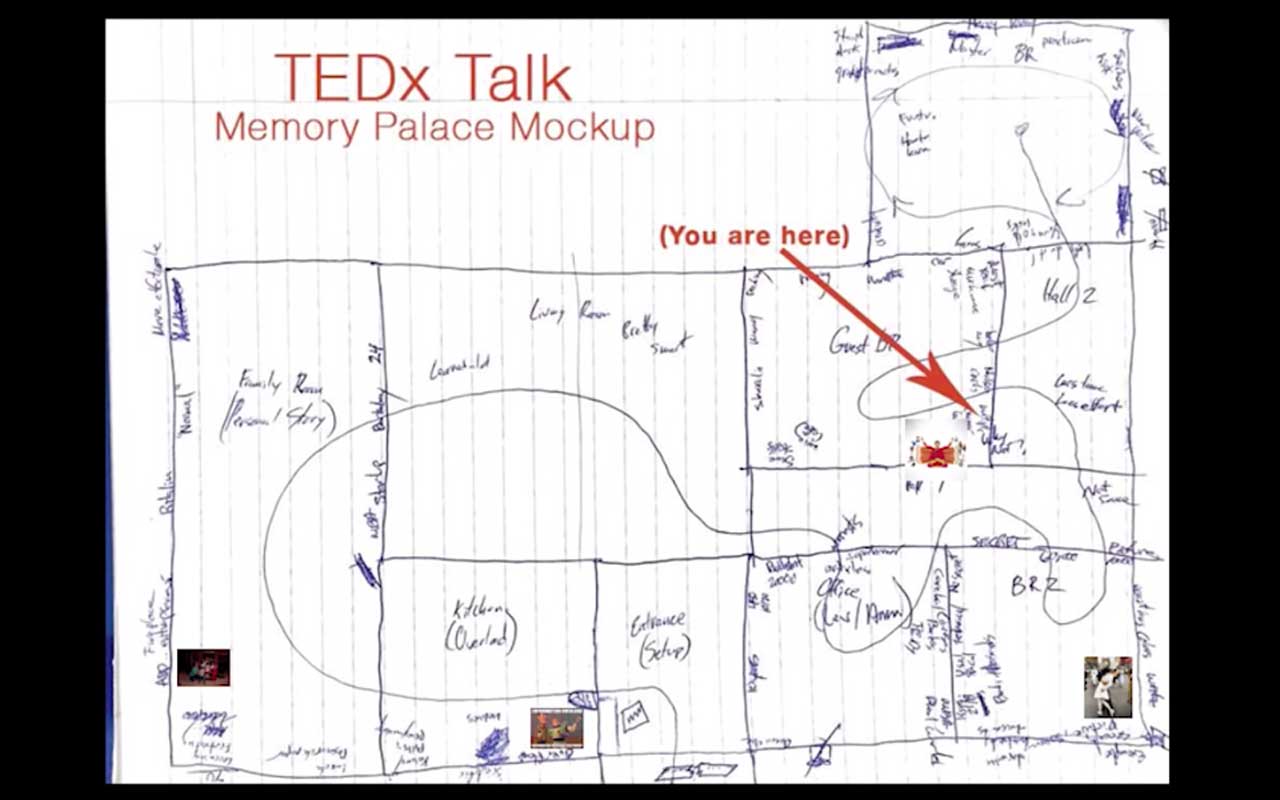
As I just mentioned, I suggest you draw out your Memory Palace journey. Here’s Jonathan’s:
Jonathan Levi’s Memory Palace for his TEDx, a speech he memorized verbatim.
The trick is to make the Memory Palace big enough to contain your entire talk.
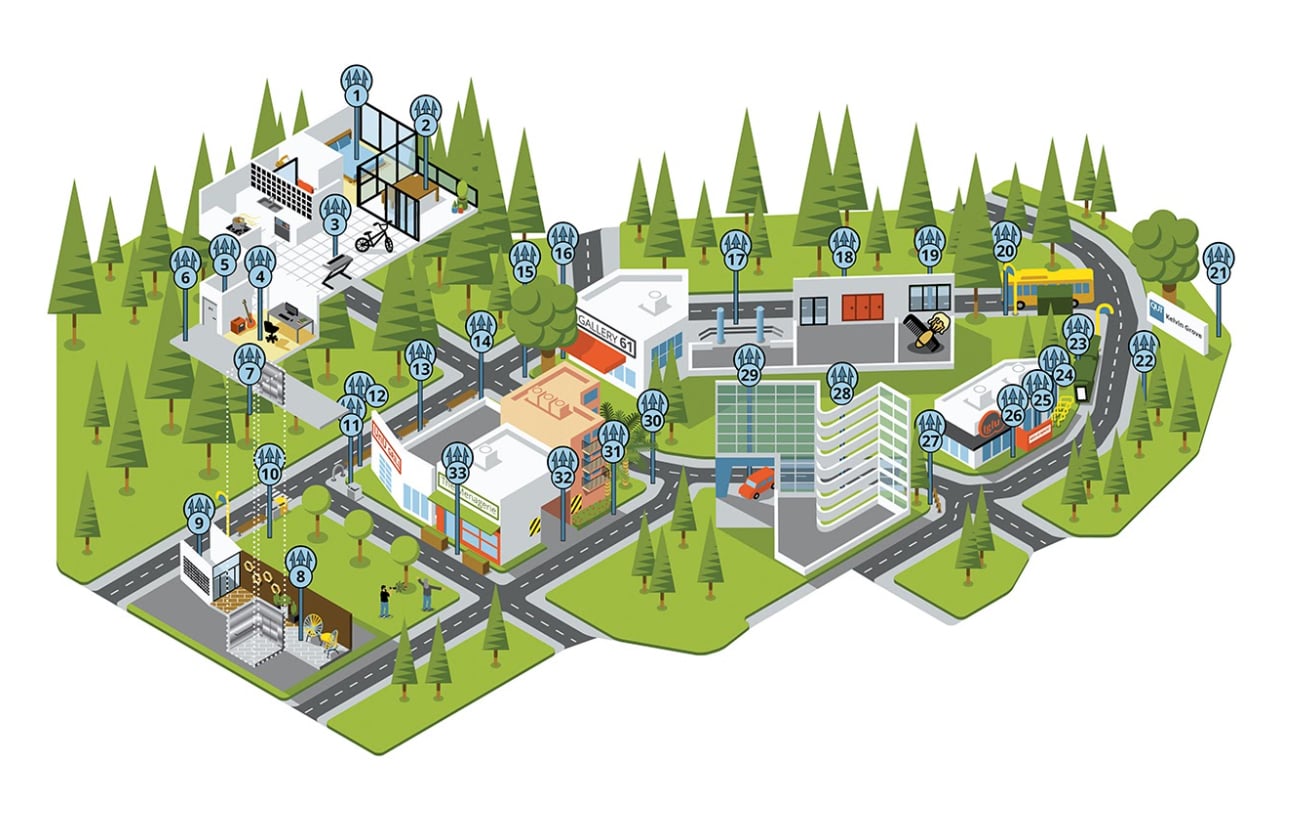
For my own TEDx Talk, I used an entire neighborhood based on Kelvin Grove, part of Brisbane:
Here’s the talk as I delivered it in Melbourne, Australia:
https://www.youtube.com/watch?v=kvtYjdriSpM
Step Three: Use Compression & Keywords To Memorize the Speech
You don’t have to place every single word inside of your Memory Palace.
Certainly, you can, and there are verbatim quotes in my TEDx Talk where I did just that.
However, for most of the talk, I was using one or two images to remind me of entire sentences.
For example, “How would you like to completely silence your mind?” was just the image of Howie Mandel hitting the YouTube like button and creating silence.
If you’re new to memory techniques, it can be challenging to come up with associations for your quotes and keywords. I suggest you learn the pegword method. It will make it simple for you to rapidly assign your associations.
Step Four: Rehearse Using the “Big Five”
Once you’ve memorized your speech using the Memory Palace, it’s time to use the Big Five at least five times.
What does that mean?
Write out what you’ve memorized, from memory.
Speak it out loud, either to yourself or someone else.
Record yourself speaking and then listen to the recording.
Get your recording transcribed and read it over.
And practice, practice, practice!
Practice your speech in front of the camera or in front of friends. Use the relaxation tips I shared earlier in the post. And get as comfortable as you possibly can before you jump up on that stage.
Finally, let’s take a look at a couple of real-life examples, so you can see how this methodology works in practice.
Real-Life Examples of How to Remember a Speech Using Alternative Approaches
In this section, we’ll talk about how to memorize a speech quickly using some of my favorite alternatives to the Memory Palace technique.
There are a couple of speeches I give regularly. Both the NAME and FREE speech are very fluid and packaged, and I do them entirely from memory based on acronyms.
Let’s look at both speeches, starting with…
The NAME Speech
When I give this speech, I talk about how to memorize names.
I follow the acronym “NAME.”
Noticing,
Making Associations,
Using Memory Palaces, and
Managing Expectations.
Within 20 minutes I’m done and everyone in that room can memorize any name they want!
Does working from an acronyme mean my speech is a little bit different every time? Of course, but this method is super simple to follow, very structured, and gives me the chance to just talk about the topic.
Next, let’s look at…
The FREE Speech
The same thing goes for this particular speech. When I give this speech, I run through the acronym:
Frequency,
Relevance,
Edutainment, and
Engagement.
What I find fun about using acronyms to memorize your speech is that you can also use them backward. Sometimes I’ll write out “FREE” on the board, and then proceed to work up from the bottom. It’s a great way to catch the audience’s attention.
Hopefully, by this point, your interest has been piqued. And maybe you even want to learn more about how to give a great speech.
The Ultimate Benefits of Memorizing A Speech
Now that you know how to memorize a speech, I think it’s worth looking at some of the benefits I’ve enjoyed over the years.
Marketability
There are lots of companies that need someone to be able to present the value they offer – their expertise, unique selling proposition, value for the market, etc – and why customers should pick them. It’s the same for you — you want to be known as the person a company wants to hire, the one they want to promote, the one they want to give a raise.
Public speaking displays your expertise
Your ability to speak coherently and clearly is a key indicator to both your employer and clients that you know your stuff. When you can speak from the top of your mind without hemming and hawing or stuttering, it lets your knowledge shine.
Stepping on stage develops courage
Getting comfortable with public speaking takes practice — and getting out there and starting to give speeches (even if it’s just to a friend or two at first) will begin to build your courage muscle. It’s a win-win.
Speaking shows your personality
As you practice giving speeches, you’ll begin to develop your own personal presentation style. And the more comfortable you get, the more your personality will shine.
Giving speeches helps build relationships
Getting out into the community allows you to connect with people in both your personal and business networks. And if you’re still in school, it can help you build connections with your teachers and your fellow students.
Public speaking sets you up as an expert in your field
When you’re the one up on stage, it’s clear to the audience that you know what you’re talking about. You can prepare the road ahead by being known as the expert who has the courage to get up on stage and share their knowledge. It helps you deliver results to other people.
Right now, your audience doesn’t have a particular set of knowledge. When you get up on stage, you’re able to give them that knowledge — and package it in a way that helps them quickly absorb it. Plus, you can do so in a way that encourages them to take action, because they’ve seen you demonstrate how valuable it is from the stage.
Speaking can help you build your memory as you learn
Learning to memorize a speech will help you build your memory as you go. Even if you do need notes in the beginning, you can still improve your memory as you practice your speech.
So as you can see, learning to commit your talks to memory is not only a valuable skill, but being able to jump up on stage and speak off the top of your mind is actually a lot of fun!
Have Fun Memorizing a Speech
Think back to how giving speeches used to make you feel.
Sweaty. Queasy. Shaking just thinking about stepping up on stage.
Now, think about how confident and powerful you can feel standing up on stage as you deliver your expertise to a rapt audience.
This second scenario isn’t just possible… it’s probable. All you have to do is follow the tips and techniques in this post, and before you know it you’ll be a cool and confident public speaker.
But maybe you’re thinking, “I don’t know how to get started — how can I give my first speech?” I would recommend to everybody, if you haven’t given a speech in your life, make an occasion to go out and give a speech, and give it in different ways.
Give a number of speeches, even if it’s just to a small audience or a close group of friends. This simple practice will help develop both your crystal and fluid intelligence – both needed for developing the skill of speaking. And try different formats: recite from a piece of paper, do partial recall from memory, speak verbatim from memory, or any way you prefer.
And whatever you do, have fun with it! Giving speeches is a great way to play a giant, satisfying brain game — as well as delivering value to others and setting yourself up as an expert in your field.
If you’re still feeling uncertain, there’s a mini-course in the Magnetic Memory Method Masterclass about memorizing speeches that goes deeper into this topic.
Dive in, enjoy and please let me see you deliver your speech once it’s recorded and up online!
The Chunking Technique Explained: 7 Powerful Techniques
Dec 17, 2023
Show notes
You’ve probably heard of the chunking technique and thought it sounded pretty boring. I mean, how is splitting large pieces of information into smaller pieces supposed to help you remember more? Isn’t that just more work? Your intuition is correct to ask. Because if the chunk method is poorly executed, it not only leads to wasted time and energy. It doesn’t provide the desired results either. So to fix that, let’s go beyond the standard chunking definition. And I promise that after you’re read each and every example I have to share on this page, you’ll always get great results whenever you’re chunking information. Ready? Let’s dive in! https://www.youtube.com/watch?v=lqLf5HygEbo What is Chunking? David Sousa gives a very simple way to understand chunking in How the Brain Learns. Look at the word “chunking.” Do your eyes and your brain see eight individual letters? Technically, yes. But your mind “chunks” c-h-u-n-k-i-n-g into a single word. We also tend to chunk numbers, such as the ones we use to call one another by phone. Whereas telephone numbers were initially very short, as the systems grew in popularity, they needed to be longer. The term “chunking” comes from Dr. George Miller. In a 1956 paper titled The Magical Number Seven, Plus or Minus Two, he famously pointed out how grouping numbers into shorter chunks made them much easier to remember. Many memory athletes and memory experts have used mnemonic devices like the PAO System to completely sidestep the limitations Miller identified and chunk in highly efficient ways. One of my students even memorized 1200 digits of pi and can recite them all in about a minute! Experts provide another example. Instead of trying to understand vast swaths of disconnected information, they think categorically. They find and refer to patterns. And when necessary, experts create new terms or paradigms that help us understand the connections between aspects of the world. Finally, some students treat “cramming” as a form of chunking. Although this practice can provide some results, one of my favorite memory hacks is called “The Cram Smasher.” It helps you group blocks of time in a sophisticated way that reduces forgetting and maximizes your free time. How the Chunking Technique Works Chunking is not necessarily a natural behavior. It tends to be a skill we learn. For example, when we are young, we are shown how ten dimes make a dollar. There are many patterns like this that we learn: ten, ten dollar bills make one hundred, etc. But to turn this into a memory strategy, we want to add a few additional elements. We can look for patterns and then group information deliberately. Things You Can Remember Better With The Chunking Memory Strategy You can learn many things faster using chunking. Some of the classics include: Music (especially using the Circle of Fifths) Foreign language vocabulary and phrases First and last names Facts and trivia Numbers Facts that come up at work Let’s look a bit closer at numbers by using an example like 9289. In this number, you might notice that your grandfather is 92 and in 1989 he took you to the zoo. By comparing or mentally linking those similarities, you are chunking them together. Instead of looking at 9289 as a random digit, you have chunked it down and encoded smaller parts of the larger digit with personal meaning. How Memory Competitors Use Chunking You can also use the PAO System I mentioned above or the Major System. These are the mnemonic systems used by memory competitors to win prizes and break records each and every year going back for over three decades. The Major System The Major works by translating each digit from 0-9 into a consonant. You then use those consonants to make words. 9289, for example, could become Peter Pan vaping – a chunk that works because P = 9, N =2 and V = 8. Using these facts about the Major System, you assign words that you find striking and recall numbers a lot easier. Chunking Using Linking And Stories Another way to chunk items together involves applying stories and links. For example, let’s say you need to memorize the following list of words: Kitten Field Football Drink Hunting Ocean To remember these items, you could chunk them together using a story. For example, you can imagine a kitten in a field playing football. After the game, the kitten grabs some beers, puts on a hunting cap and goes to the ocean. Yes, the story is weird, but it chunks the items in the list together, making them much easier to recall. Scientists have shown that this approach words by specifically expanding your working memory. But the tactics we’ve covered so far aren’t the only ways to chunk. Let’s have a look at a few more. 7 Powerful Chunking Memory Techniques As you go through this list, pick at least one and apply it to something you’re learning. As always, you’ll want to ask before getting started with any particular chunking technique if it’s really appropriate to the learning goal. Sometimes there are more appropriate strategies available, though we never know until we experiment. So above all, have fun. One: Make An Acronym I’ve given a lot of speeches in my career. But sometimes I don’t feel like memorizing them word for word. So I craft an acronym instead. Often, an entire talk comes from one keyword, a strategy I outline in detail in How to Memorize a Speech Fast. YOLO for “You only live once” chunks the the concept both into a single sentence and then further into a single, unique word. You can also use acronyms to memorize definitions or phrases. The catch is that it can take a bit of time to think up a good one. It’s still powerful when you hit upon something good, and we use chunking like this all the time for news networks (CNN) and government institutions (FBI, CIA). A recent popular example is YOLO for “you only live once.” This acronym chunks the concept into a unique word, but the phrase itself is itself chunking because it expresses a much longer sentiment in just a few words. Even better, scientific research has shown that using acronyms can help you get focused again on certain tasks after an interruption. Acronyms have this effect because they provide your procedural memory a more robust structure to refer back to after an interruption. Two: Mind Map Mind mapping doesn’t have to involve chunking, but it certainly can. Here are a few ways I’ve chunked related ideas to remember and recall concepts in memory through mind mapping. Basically, ever image on a mind map chunks together and image with a concept or keyword you want to remember. Have a look at this example from one my students in the Magnetic Memory Method Masterclass: Keko used my concept of the “Seashell Mind Map” to place various steps in the memory improvement process in order. Using big words, she can see larger concepts and understand what they are at a glance. In many ways, what Keko has created is a combined mind map and concept map. Here’s an example of one of my own mind maps: The central keyword is “retention” and I use tributaries in different colors to isolate different concepts. I’m using as few words as possible so that they are all chunked down to their key ideas on the mind map. In one case, I included a drawing, which is a great way to include imagistic chunking as a memory strategy. In this final mind map example, I use all images and no words to remind me of the most important activities in my professional life as a memory teacher and researcher: Each image chunks down an entire world of ideas. For example, in the 3 o’clock position, you see a clock and some letters on a typewriter. These images chunk down the idea that I will spend an hour a day writing. The medical symbol at the 7 o’clock position reminds me of my goal to work on my medical mnemonics podcast, especially on topics related to neuroscience and mental health (hence the unhappy and the happy faces). In each of these mind map examples, chunking is used slightly differently. But the point remains the same: highly compressed mental connections are laid out on the space of the mind map. They are understood at a glance even though there are very few words on them, and in some cases no words at all. Three: Compare and Contrast One of the ways I remember so much as I read comes down to thinking comparatively. For example, when I come across a main point in a book, I often ask, “What else is like this? What contrasts or opposes this?” To give a simple example, I recently read Christopher Kemp’s Dark and Magical Places. It’s about how the brain navigates space. When I asked about the opposite of navigation, I thought about certain meditation practices where you sit very still. When your questioning produces answers, even if they are very simple, you effectively chunk the ideas together. The chunking effect makes all of the involved information easier to remember in the future. Asking questions also makes it possible to read faster because of how it develops your pattern recognition abilities. Four: Notice Structures, Categories and Functions We often just consume entertainment. But if we take some time to pay attention to the form a story takes, we can remember more about it. I shared some of the narratological structures I used to use as a Film Studies professor in How to Remember a Story. You can also use certain observations to help remember names. For example, if you’re at the dentist and you learn that the secretary’s name is Martina, you could imagine your dentist drinking a toothpaste flavored martini with her at the service counter. You’ve literally chunked a dentistry related flavor to her name and put your dentist into the picture so you’ll remember that she’s his secretary. Speaking of names, yet another way to understand chunking is to consider your last name. It’s one of many ways your identity is chunked to your family. The use of family trees to track lineage is another. Five: Use Memory Techniques Did you know that there are over 20 memory techniques to choose from? These include rhyming, the Memory Palace technique and some of the number systems we discussed above. In many ways, the Memory Palace is the ultimate chunking technique because you group the information you want to remember into individual rooms. If you’d like to learn more about how it works, get my FREE Memory Improvement course for some free lessons and exercises: Six: Inverse Chunking So far, we’ve seen that chunking is all about grouping or organizing information in particular ways. But another way to approach grouping information involves how you organize it in time. For example, I love to use a reading technique called interleaving. Basically, it involves reading 3-5 books at the same time and switching between them. Instead of chunking the topics or information in them, it’s about chunking the time down into manageable bits. Then, during the brakes, diffuse thinking helps form more memory connections. You literally learn and remember information about the first topic while paying attention to the second. Seven: Flash Card Chunking A lot of people like to use Anki or standard flashcards. Although both are great and you can certainly chunk information onto cards categorically, it’s also possible to insert questions and connections into them to help you remember things. In the example above, I used a question to contrast a point. Although this line of questioning might not make sense to you, it instantly reminds me that many spiritual traditions have very different goals than Marxism. You can use questions like this to also help you compare, contrast and ultimately remember more. Use the Chunking Technique Widely As you can see, chunking is powerful. How and when humans started gathering things together is not entirely clear. But as Dr. Miller pointed out, there’s only so much information the brain can easily contain. But that’s where the techniques you’ve learned today provide some very good news. By using the chunk method in its many forms strategically, it’s possible to learn faster and remember more. So what do you say? Are you ready to get out there and master more information quickly? Chunk it up!
PAO System: Your Full Guide to Person-Action-Object Mnemonics
Dec 12, 2023
Show notes
The PAO System is the ultimate mnemonic tool for high-speed memorization. A lot of people believe this system is used exclusively for memorizing numbers. But a well-formed PAO System is actually a lot more powerful than that. As a research professor, memory expert and author of multiple books on memory techniques, I’m going to show you how to use a Person-Action-Object (PAO) system for rapidly learning everything from historical dates, to mathematical formulas and credit card numbers. You can also remember medical dosages and even complex terminology and foreign language vocabulary with this mnemonic system. The various ways you can use it for the mental compression of all kinds of information is immense. In this guide, we are diving deep into the mechanics of how to build your first, world class PAO list. Or, if you’ve already got one, I’m going to show you how to improve and expand it for multiple uses. Are you excited? Let’s get started! https://youtu.be/ogtVQ48VgC4 What Is The PAO System? PAO memory systems go back a very long time. They offer you a simple way to create a formal mnemonic linking system for quickly encoding two-digit pairs into memory. Scientifically, the technique leverages a mnemonic chunking strategy identified by researchers who determined that the most efficient amount of information for learning boils down to 3-4 items at a time. David Dirlam’s “Most efficient chunk sizes” is worth a read if you’re interested in the psychological explanation. In practice, all you need to do is get out a piece of paper and write down all the digits from 00-99. Then, using the Major System, apply mnemonic associations to each two digit par. The key is to select associations that can readily interact in memorable ways. Example Using the Traditional PAO System Take these two-digit pairs, for example: 21 36 90 Someone using a traditional PAO system would divide the numbers into a set of images specifically ordered according to the PAO pattern, Person-Action-Object. The images are decided in advance so that you’re always ready to go when you look at numbers. You then imagine something like Jack Nicholson throwing burning matches at a bus. Person = Jack Nicholson Action = Throwing matches Object = Bus The exact PAO associations I’ve just listed come from my personal 00-99 PAO list. You can derive your own exact images in different ways, and we’ll talk about how to do that in a moment. I’ll also share with you the thinking behind how I selected mine. Briefly, 21 is Jack Nicholson in my PAO System because I’ve built each image based on the Major System. Here’s what the Major System (sometimes called the Major Method) looks like: When it comes to associating 21 with the actor Jack Nicholson, bear with me. The exact process can confuse beginners, but I’m going to make it clear for you. Look at the Major System graphic above. You’ll note that: 2 = N 1 = D or T Following these rules, I assigned the word “nut” to the two-digit pair 21. Since Jack Nicholson often plays characters who are completely insane (or “nuts”) he struck me as perfect for that number. But before we get any further in to the nuances of the PAO System, you might be wondering… How the heck did people come up with such an interesting way to approach memory? A Brief History of Person Action Object Systems The notion of combining or linking information you want to remember to a Person Action Object complex begins much more simply. The first reference I can find is the Katapayadi system. The oldest available evidence is 683 C.E., but it is almost certainly older than that. In this alphanumeric system, we see what is probably the first detailed basis for transforming numbers into words. What kinds of words? Persons Actions Objects Later, you see this arrangement built out with great sophistication in the works of Giordano Bruno, especially On the Shadows of the Ideas. I’m not entirely sure, but I think Bruno chose to include Hebrew letters in his memory system because of the gematria. In this system, each Hebrew letter is classified so that it also represents a number. It also probably helped him expand his range of possible associations. And since almost every Hebrew letter represents an animal, you pretty much have either a person or object in each letter along with the number. This approach is likely also the origin of what used to be called a “bestiary,” and on that Lynne Kelly is really the expert. A Quick Review of PAO System Basics Both in the past and now, linking numbers to consonants and then forming words that can be linked to mnemonic associations allows you to compress much more information into Memory Palaces. As you saw with the Jack Nicholson example, the idea is to rotate between 3 different kinds of images for each two-digit pair. But you also want each two-digit pair to have three associations. For example: 01 = Peter Sutton suds soap In this case, 01 (s + t) creates: Sutton, the Person Creating suds (the action) Soap (the object) You don’t have to use the technique this way, however. But you do want to set up your system so that you can in order to enjoy full access to its possibilities for a variety of learning goals. I’ll show you how to simplify your PAO arrangements further down this page so you need only one image per two-digit pair. But first, let’s look a bit deeper at the mnemonic systems people use to create their PAO Systems. PAO System vs Major Method vs Dominic System Two other systems to know about are the Major Method and the Dominic System. Dominic O’Brien came up with his variation to compete in memory competitions. Technically speaking there is no such thing as a Dominic System PAO – at least not to my knowledge. This is because the Dominic System reduces a PAO down to a PA system (Person Action). The Major, much like the katapayadi, lets you create any number of words from numbers. So in a true PAO system, you can actually have a lot more words: Person Action Object Emotional state Smell Flavor Favorite snack, etc One of my favorite students also has a man and a woman for each two-digit pair. In other words, for 12, he has both a man named Don and a woman named Dawn. For 32 he has assigned a man named Manuel and a woman named Mandy. The point is that the PAO System can be much more flexible than you might have been taught. What if you don’t like either the Major or the Dominic System? There are other systems you can explore, such as the Ben System and the Shadow. (For more on the Shadow, check out my conversations with Braden Adams. But note that most people I’m aware of also base their PAO System on the Major.) The Shadow is a very powerful and much more robust version of a PAO system, especially for playing cards. How To Use The PAO System There are many ways to use a PAO system. You can use it to: Memorize numbers Memorize tones in tonal languages like Chinese Memorize difficult names and vocabulary when you can’t figure out more direct associations Number your Memory Palaces so they always have pre-built associations at each station Memorize playing cards Know the verse numbers when memorizing scripture Perform a stunt by memorizing and reciting Pi Benefit from incredible brain exercise Performing magic tricks with a memdeck One way that people use the PAO system for numbers is very formal. They will always approach numbers in 3 sets of 2 pairs and then use their person action object in order. That means that if you have a sequence of numbers like 89 43 21: 89 will be encoded as the person 43 will be encoded as the action 21 will be encoded as the object Using my system, the images here are: A viper (Cobra Commander) rams a nun (or Jack Nicholson). Then, when memorizing the next set of digits, I can have the final object interact with the next set. In other words, if the sequence is 89 43 21 55, the object that represents 21 can be doing something to the image for 55. In this way, you can either have short vignettes or much longer narrative sequences. Getting Started with Your First PAO System The first step is to choose how you’re going to approach PAO memory systems so that success is guaranteed. Again, for most people, I suggest learning the Major System first. Grounding your PAO System on the Major helps reduce the arbitrariness of the associations in a way that other systems do not. Here’s what I mean: In the Dominic System, you can choose just about any name so long as it starts with a particular letter of the alphabet. But the Major limits the number of words you can choose from. And that means while learning your first PAO, you can use logic to work your way back to the core words you assigned. And if you make a few leaps like I’ve done by turning V + P for 89 to turn the word “viper” into Cobra Commander, you can still track back the logic while you’re learning the system. But you’re also free to simply assign words to your people, objects and actions without any special mnemonic system. If you have synesthesia, you might have some deeply intuitive choices that come to mind based on that aspect of how your mind words. It might also be helpful to realize that a PAO list is really just one of several variations on the pegword method. I’ve shared the basis for my entire list there if you want to take a look. Borrowing PAO Words From Others I do not recommend this, but you certainly can look up various number dictionaries for ideas. Bruno Furst created a really interesting one. Why do I suggest you not look at the lists created by other people? Typically, the results you want will really start to flow when you personalize each and every assignment you make for a full 00-99 PAO. As the science of active recall shows us, it’s the personalization that makes this technique work. So why not start there now that you know how the system works? From High School Struggles to University Scholarship: A PAO Success Story One of the biggest hesitations I hear from people is that learning a PAO System is too complicated. I get that, but check this out. Adolfo first completed my Magnetic Memory Method Masterclass over a decade ago. When he saw his son struggling in high school, he decided to share what he learned and help his son develop a PAO so he could go from failing grades to greater success. Instead of buying an app, Adolfo bought his sun a large dry-erase board and put it in the dining room. Then, together, he walked his son step-by-step through constructing the system. They even sent me this pic of them doing it: Adolfo’s son in front of the Major System and PAO System dry-erase board that led to a university scholarship As you can see, the Major System was drawn along the top and the 00-99 PAO items were developed in vertical columns. The Payoff? Adolfo’s son went from struggling with his grades to earning straight A’s and then secured a full university scholarship. I recently re-connected with Adolfo to get permission to share that photo with you and he proudly reported that his son is now completing his thesis. All thanks to the PAO System and a dry-erase board. For more inspiring stories of parents helping their kids master memory techniques, check out this interview with Alicia Crosby. And this one with Imogen Aires and her father. Examples From My “Magnetic” PAO For many years I got along just fine with just the Major System. But then I competed with Dave Farrow and realized how slow I was using the Major to memorize cards. Later, memory athlete Florian Delle made me realize that you can actually “compress” each assignment in a way that lets make each one a Person that is both an action and an object. For example, my 84 used to be “fire.” But after speaking with him, I upgraded it to a character in a movie who uses a blowtorch. Fire because a person who uses an object to burn things. To repeat: The person is the object that takes an action. This made everything so much faster! Another example: 36 used to be a box of matches for me, based on the Major System. It’s still “match,” but now it’s Mike Tyson in a boxing match. Tyson is the person, boxing is the action and his gloves are the object. In this way, when I want to memorize a number like 8436, I just have to imagine the blowtorch character from Missing in Action 2 setting Mike Tyson on fire. This works the same way when memorizing playing cards that have been assigned numbers or memorizing Chinese tones or verse numbers in scripture. And the best part? If you take a moment to number your stations in a Memory Palace, you instantly have an image to interact with in each and every memory space you use. I don’t use that approach particularly often, but it has come in handy many times as an organizational tool. Using The PAO System For Memorizing Historical Dates It’s useful to know when certain things happened. Personally, I like to know when philosophers lived so I can understand the development or overlap of certain philosophical questions across time. Spinoza lived from 1632 to 1677. Using my images, that would be Johnny Cash (the man in black) and Mr. Koch, who was my grade seven teacher. I placed Spinoza in a Memory Palace after Giordano Bruno who is thought to have been born in 1548 and who died in 1600. This means that I don’t need an image to place Spinoza in the 1600s. But if I did, I would use Dashiell Hammett doing dishes for 16. The key thing here is to involve the philosophical figure in the images somehow. Usually, I place the birth date in the left hand of the figure and the date of death in the right hand. I adopted this idea from Bruno’s ancient memory strategy of using the body as a Memory Palace. A Fun Way To Practice A PAO Here’s an exercise from the Magnetic Memory Method Masterclass: Once you have all your figures worked out, get some index cards. Starting with 00-99, fill them all out with a 2-digit pair on each card. Then, shuffle them up. If you come across a 42, name out the figure you chose. Or if it’s 72, call out that figure. Once you’re able to name each of your associations for 00-99 relatively quickly, you can then start shuffling the deck and practicing memorizing the numbers that come out in order. I would suggest starting small, such as with three, two-digit pairs. As you develop your memory for larger and larger sequences of numbers, place the associations in a Memory Palace so you have a point of reference. Having a place to store your associations gives you the ability to think back and work out what your numbers were with much greater ease than if you only think about the images in the void of your mind. Make The PAO System Your Own At the end of the day, developing your own PAO System is a highly personal journey. Although it will undoubtedly share similarities with others, it will still work best when it’s unique to you. For example, both Ron White and I share William Shatner as an image. But the exact way we use the association differs. It’s the Major System that causes us to land at the same choice, but after that, you can refer to any particular Star Trek episode or movie, and even several of them, depending on what you’re memorizing. Again, a rigid PAO approach strikes me as unlimited. I like it to be flexible and give me more options. Explore The PAO System For Language Learning When I’ve struggled to come up with associations when learning a language, I always stop. I ask myself what the numbers would be for the word I’m struggling with. For example, there’s a word in German: faseln. It means to “spout off.” When I looked at the F and S, I thought of 80. That is an image of… you guessed it: William Shatner as James T. Kirk with his phaser set to stun. “Eln” would be 52, which is a lion in my PAO system. I use a “lion” for 52. But instead of relying on the generic concept, I push it further to a specific lion: The MGM lion. For your 00-99 PAO, it might be the cowardly lion from the Wizard of Oz or one of the characters from The Lion King. But not just any lion. It’s the MGM lion so that the i…
Roman Room: A Solid Memory Palace Strategy
Dec 11, 2023
Show notes
The Roman Room method is just one term for the most powerful memory technique humanity has ever known. It helps you memorize information for a few simple reasons we’ll explore on this page. The best part? The Roman Room technique helps you memorize information quickly. What kinds of information? Everything from foreign language vocabulary to entire speeches. Ready to learn and master this powerful learning technique? Here’s a Table of Contents for you of what’s on this page for you: The Origin of the Term Roman Room?Roman Rooms or Memory Theatres: Which Is Better?How To Prepare To Use A Roman RoomHow to Use Your First Roman RoomPracticing the Roman Room MethodHow to Expand Your Roman RoomsHow to Modify A Roman RoomIs the Roman Room Method the Best Memory Technique? https://www.youtube.com/watch?v=zz4G6j2OO4s The Origin of The Term “Roman Room” First off, it’s important to repeat that this term is just one variation of a mental tool that appeared many thousands of years ago, long before Rome was even built. The term “Roman Room” means practically the same thing as: Journey Method Memory Palace Mind Palace Memory Castle Memory Room Method of Loci I’ll never forget one of my first students – he was 88 and didn’t like any of these terms. So I said call the Roman Room technique whatever you like. He chose “apartments with compartments.” Once settled, he went on to revive his German and memorize dozens of poems. But there’s a reason some people call this technique the “Roman Room.” This is because Roman Orators used their homes, and even the stages they spoke from, to help them memorize and recite their speeches. In fact, a phrase we still use today is thought to come from the use of rooms as memory devices. When a speaker would say, “In the first place” or “in the second place,” this verbal habit was referring to the information in a mental room used to store the point. It’s entirely possible that the people in the audience also used the technique, and used it along with the speaker to rapidly internalize the information as they heard it. This use of locations is why the Roman Room technique is sometimes called the Method of Loci. Loci is the plural of locus, a Latin word for a place. You have “loci” when you have strung multiple places together, such as the four corners of a room. In the Greek tradition, we have the Story of Simonides of Ceos, which I give two powerful versions of in our detailed study of 7 Ancient Memory Palace tips. https://www.youtube.com/watch?v=nSn2qjuYjxs Now, this technique is not just about using buildings or rooms. We also have the notion of space itself, which was incredibly special to the Greeks in many ways. As Thales said, a person widely considered to be both the first philosopher and scientist: Μέγιστον τόπος άπαντα γαρ χωρεί Megiston topos hapanta gar chorei Space is the ultimate thing, as it contains all things. Pre-historically, we have evidence that ancient people did not use rooms at all to create their memory tools. For example, people have used constellations to help them remember. Lynne Kelly demonstrates in The Memory Code how aboriginals used skyscapes both day and night to help them remember songs. She also shows how they used long stretches of geography and even objects like the lukasa to help them memorize the names and locations of medicinal plants. I would go so far as to say that humanity has survived precisely because it learned to use external and internal structures as memory aids. Imagine trying to remember what kind of plants are safe to eat during a drought, versus which are poisonous. If you can’t remember, you’re dead. Roman Rooms or Memory Theatres: Which Is Better For Memory Palace Training? If you can’t find any terms you like, let’s introduce another option that I’m quite fond of and talk about Robert Fludd’s “memory theatre.” It uses rooms very specifically, or at least, that’s what memory expert Frances Yates believes. She talks a lot about Fludd’s variation on the Roman Room in her seminal book, The Art of Memory. The idea here is that we can mentally visit locations, and this man is apparently imagining a structure like the Tower of Babel, an obelisk, what appears to be a town square and perhaps an angel introducing a new person to heaven. On the Oculus Imaginationis diagram, we see different spaces that can be used in combination with other kinds of mental imagery to help us remember words, poems, mathematical formulas and names. However, there is a difference to notice between ars quadrata and ars rotunda. The first is the art of using squares and the second is the art of using round and dynamic spaces, such as using trees in a forest or other shapes in nature. As an experiment, I created my own version of The Tower of Babel and used it to memorize these two terms. On locus one, I mentally imposed a big fat circle that is badly overweight. That reminded me of the term ars rotunda. On the second locus, I imposed a square and thought of Q from James Bond bringing the secret agent into a new quadrant for ars quadrata. Now, Fludd was apparently against using a virtual Memory Palace or any imaginary space. But that didn’t stop him from using spaces of imagination. Who was Robert Fludd? And why should we care about his memory teaching? He was a key thinker in the development of both scientific thinking and the use of memory techniques. He had a lively, albeit controversial exchange with Johannes Kepler, and thought deeply about the nature of the mind and memory, providing many illustrations of how he thought our mechanisms of psychology worked. Again, it seems that Fludd preferred using actual buildings for his spatial memory work, not imaginary spaces. In fact, Yates thinks he may have used Shakespeare’s Globe Theatre for his Roman Rooms. And if you take a look at one of his diagrams, you can see that this theatre space with entrances to multiple rooms is coded in an interesting way: Notice how the image of this theatre depicts five entrances (three on the ground floor and two on the top floor). Corresponding with these rooms are different shapes. Yates is not sure, and no one can be, but it’s easy to imagine that Fludd may have had actors stand on these shapes and then used them to walk through the rooms behind those doors. Then, in each corner and possibly on each wall, he had pre-determined “loci” where he would place the information he wanted to memorize. We don’t know, but we can theorize that Fludd would have visited the rooms behind those doors, not imagined them. Assuming that you’re using rooms you’ve seen with your own eyes, now let’s talk about… How To Prepare To Use A Roman Room If you want to be a purist, you would first set a specific goal. For example, a goal might be to use this memory technique to memorize a speech, as the Roman orators would have done. But you can use this style of journey system to memorize anything else, from foreign language vocabulary and phrases to mathematical formulas. For the vast varieties of possible memory goals and the powerful outcomes anyone who becomes a discipline of these techniques can experience, I want to correct a misconception. It is sometimes said that memory techniques that use space are only useful for memorizing lists or what is sometimes called “unstructured” information. This claim is not necessarily false, but it is deeply misguided about the nature of the information we want to memorize. For example, information is structured by default, isn’t it? How could it be information if it didn’t have a structure? The word information itself has multiple structures, for example. The letter ‘I’ that begins the word is a structure, as is each letter in the word. The word has four syllables, each syllable a structure until itself. Analyzing information in this way is one of the great secrets used by memory artists to rapidly create multiple hooks and make concrete associations out of even the most concrete and abstract material. To the true mnemonist, there is in fact nothing abstract or difficult or obscure when it comes to memorizing information. Every detail comes in the form of perceivable assemblages of multiple structures for which mnemonic associations can always be made. You just need to be trained and well-practiced. Let’s go a bit deeper on this point: When memorizing my TEDx Talk, on some of the locus of my Roman Room, I was able to encode 11-17 word phrases in the corner or along the walls. This approach works because every sentence is a list. It’s just one word coming after another in a particular order. We just happen to call it a “sentence.” And the word “sentence” is just a list of letters, s-e-n-t-e-n-c-e. It’s the same thing with a string of digits. For example, the 1200 digits of pi memorized and recited publicly by my student Marno Hermann who established himself at the top of the South African memory competition records is technically a list, and yet… If you use this technique properly, in a way that allows you to both get the info into long term memory and recall it out of order, you can manipulate the linear nature of information. You can use what I call “Magnetic Compounding” based on ideas from Giordano Bruno that vastly explode the potential of everything memorized inside of a Roman Room. But that would no longer technically be a Roman Room – it would be a Magnetic Memory Palace. So let’s stick with the plot, shan’t we? Here’s how to get started with your first Roman Room: Get out a piece of paper. Think of a room you’re familiar with. Draw the room using just four lines to represent the room. Represent the corners of the room with numbers. Write down the list of the stations. The reason I ask students to follow these steps is not just because I have loved receiving them by the thousands as symbols of people taking action. I do love that! But I ask serious students of memory improvement to draw the Roman Room because it helps them tap into more visual and spatial memory power than imagination accomplishes on its own. We also harness the power of something called “the levels of processing effect” by physically creating this memory aid through drawing. It then becomes newly visual to you as a blueprint, which means it’s better remembered. Then, by writing numbers and words, you’re processing it through your numerical and verbal brain – strengthening the journey. The more levels of processing, the better, and this is true no matter how good you get. I find that if I don’t complete this quick step for both simple and elaborate Memory Palaces that I create, the technique just doesn’t work nearly as well. I think that drawing the memory journey is like the equivalent of a London cabbie driving the streets in preparation for the exam and then taking prep tests to manually write out the routes by hand. Sure, you can probably remember the routes without taking those steps… eventually. But if you really want to succeed, you’re going to do what good students do, and compound your efforts using multiple approaches. If you’re worried that this simple Roman Room won’t be enough space to memorize much, don’t be. Here are two mindset tips to keep in mind: If you haven’t developed the skills to memorize just four pieces of information in one room, why worry about thousands of pieces of information? Any dedicated individual who puts in the time can pull dozens, if not hundreds of rooms from their memory. Just think about your years in elementary school and high school. Personally, from pre-school to when I graduated with my PhD, I have drawn dozens of these powerful memory tools. And that’s not to mention all the movie theatres, cafes, restaurants, churches, hotels and bookstores I’ve seen (just to name a few possible options you surely have waiting for you in your memory). Be willing to start small, and if you’re not willing to do that, be willing to scale back after a massive effort at making enormous Memory Palaces poses too much challenge for your spatially unexercised brain. I myself overwhelmed myself like crazy in the beginning, and it seems that some of the best students do need to feel that bit of pain in order to train themselves to simplify. There’s nothing wrong with failing to follow the advice to keep it simple, so long as you learn from the experience. How to Use Your First Roman Room: A Real-Life Example One of the best ways to learn the Roman Room technique is to go through a real-life example. Let’s use my February 2020 TEDx Talk and break it down into steps. Step One: Write a Great Speech (Or Organize Your Info Well) This step is kind of obvious, but throughout history, people have failed to do make sure their presenters are receiving the best possible message. Even back in 90 BCE, the author of the Rhetorica ad Herennium gave instructions on how to use the Roman Room method in combination with a well written speech. In the case of language learning, the equivalent of this step would be to organize the words and phrases you want to learn. Every minute spent in preparation will save you time later and create a better outcome. Step Two: Select the Best Possible Roman Room When thinking about how I was going to memorize my TEDx Talk, the stakes were high. That’s why I chose a clear and distinct location based on a place I see every day. Then I drew it by hand. The full version, created with the help of a graphic artist, looks like this: By figuring out each part of the Roman Room first, it is easy to start the encoding process. Step Three: Place Your Magnetic Associations The first line of my TEDx Talk is: How would you like to completely silence your mind? To memorize this line, I simply started at the first locus and thought of Howie Mandel. Why this comedian? Well, besides the fact that we’re both Canadian and I liked him a lot when I was a kid, “how” and “Howie” have the same letters and basic sound. Using sound-links in your choice of mnemonic images is a key part of what makes the technique work. The tighter and more evocative the images, the easier you’ll recall the information. Step Four: Add as Much Elaboration as Needed Howie provides just the word “how” from within this Roman Room on the first station. To get more of the first sentence in place, I next imagined Howie chopping wood (would) while hitting thumbs up on his phone (like). Once this part of the line was encoded, I didn’t need the rest of the line because this was the point of the talk. Step Five: Keep Moving Forward The next step is to move to the next locus in your Roman Room. In my case, I went from locus one in the Roman Room when I was done the first line and encoded the next line on locus two. Sometimes I needed to encode the sentences word for word, but other times I only encoded keywords. It’s a fairly long talk, but I can often get a lot of words on one locus, so it took the equivalent of 8 Roman Rooms in total. But again, “Roman Room” is just one of many possible names for this technique, so it’s important to not focus on the terminology. So please understand that the Magnetic Memory Method has fused all of the best techniques together into one smooth and systematic approach. We’ll discuss some of the other parts involved in using it successfully below. First, we need to touch upon instilling the content you want to remember for the long term. Practicing the Roman Room Method For Long Term Memory This is the fun part of using the Roman Room method. You see, encoding is only half of the task. You also have to practice decoding the speech using spaced repetition. Sometimes I call this process “Recall Rehearsal,” especially when I’m using Roman Rooms to memorize any speech fast. To do that, I followed a few unusual steps that I recommend to anyone using this technique. Recall the speech forwards from beginning to end. Pick segments of the speech to practice in different orders. Walk the Roman Room while reciting. Reciting the speech from beginning to end is obvious. That’s how yo…
How to Reset Dopamine Levels: 5 Exercises and the Truth About Dopamine Fasting
Dec 04, 2023
Show notes
Did you know that visualising success, jumping in a cold river and consuming illegal narcotics can trigger the release of the same pleasurable neurochemical in your brain? I know, I know…it sounds like a late-night infomercial from the 90’s, but it’s true. It’s science. And this little feel-good chemical is called dopamine. Dopamine is a well-known but often misunderstood neurotransmitter that plays a vital role in our experience of rewards, motivation, and cravings. If you have any interest in psychology and personal development, you’ve probably heard of it. Unfortunately, the internet is rife with popular myths about the nature of dopamine, dopamine ‘levels’ and how this all impacts our sense of pleasure, focus and drive. Broadly speaking there are two types of dopamine levels to be aware of: tonic and phasic. Tonic dopamine levels are the baseline levels of dopaminergic activity that occur in our brain. If these levels are too high this can be related to impulsivity, hyperactivity and mania, among other symptoms. If they are too low, this may lead to loss of pleasure, depression symptoms and fatigue. Phasic dopamine levels are the moment-to-moment fluctuations in dopamine that we experience in response to specific stimuli such as food, media, cigarettes and alcohol. If phasic dopamine levels are too high, particularly for a prolonged period of time, this might lead to addiction and associated risky behaviours. If they are too low, this may reduce our ability to experience pleasure. https://youtu.be/GS8v98zkfNw What Factors Impact Your Dopamine Levels? However, it’s important to note that our dopamine systems are impacted by environment, genetics and specific circumstances and their relationship to behaviour is complex. While there may be a correlation between loss of motivation or low mood and low dopamine levels, this doesn’t mean that feeling low or unmotivated is only a result of dopaminergic dysfunction. So what does we really mean when we say we want to “reset our dopamine levels.” Well, this would be to return our baseline (tonic) dopamine levels to a normal range. There are generally three ways you can do this and later in this post I’ll offer some specific examples: Reduce or eliminate the factors that cause dopamine dysregulation Adopt healthy habits that support dopamine (and other neurotransmitters) balance Increase your tolerance and capacity to experience pleasure and pain But first, it’s necessary to consider why we may have low dopamine levels or more low motivation and mood more generally. 5 Reasons Why Your Dopamine Levels Are Low #1. Chronic Stress Releasing dopamine can often be a way that we deal with the stress of the present moment. It helps us disengage (go on autopilot), distract (ignore discomfort) and disconnect (numb). When we’re stressed, our brain releases a hormone called cortisol. Unfortunately, chronic stress leads to persistently elevated cortisol levels and this can disrupt our dopamine balance and contribute to reduced motivation, pleasure and general cognitive function. Stress can also mess with your memory. Reducing your stress levels may therefore increase your baseline levels of dopamine and increase your dopamine receptor sensitivity and in doing so, reduce the urge to reach for quick dopamine spikes. #2. Trauma When we talk about dopamine detoxes, most of the attention is focused on daily habits such as social media, Netflix, and overconsumption of food, caffeine, nicotine or other substances. However, we often overlook the root causes of our reaching for those things in the first place. While part of this behaviour may be linked to societal abundance and increased access to dopamine-spiking stimuli, this whole system is partly fuelled and maintained by the very common experience of trauma. Trauma is basically any intense physiological or psychological stressor that the nervous system cannot process in the moment and which results in a defense mechanism that limits our range of future responses to a situation. The result of this trauma can range from simple disconnection and disengagement in life all the way to a formal diagnosis of Post-Traumatic Stress Disorder (PTSD). Traumatic experiences – particularly during crucial periods of brain development – have long-lasting impacts on the brain’s neurochemistry. That’s not to mention trauma from brain injury, which can also cause issues. While we’re still learning about the brain, it’s entirely possible (maybe even probable) that “dopamine hits” give us relief from painful emotions and therefore trauma makes us more susceptible to craving and addiction. For example, trauma impact the functioning of dopamine-related brain regions such as the prefrontal cortex, amygdala and hippocampus, and disrupts dopamine receptors and the Hypothalic-Pituitary-Adrenal (HPA) axis, which helps regulate stress hormones like cortisol. Fortunately, by receiving therapy to heal our trauma we can move towards a state of nervous system regulation and control. #3. Dopamine Abuse AKA. Pleasure Seeking When we engage in pleasure-seeking activities such as excessive screen time or consuming unhealthy or processed foods, we are rewarded with brief surges in dopamine without any effort. The problem with instant gratification (as opposed to delayed gratification) is that the brain was evolutionarily designed to provide good feelings in response to effort. This means that over time, our dopamine receptors become desensitised and we are dependent on more and more intense forms of pleasure-seeking. The extreme end of this occurs in substance abuse such as amphetamines or cocaine, whereby the result is chronically low dopamine levels, depression, decreased motivation and cognitive dysfunction. However, overindulging in something like YouTube, Netflix or social media can do the same thing, just on a smaller scale. In psychology there is something called “the opponent process theory.” This is a general heuristic that is used to describe how the brain seeks to find balance. In the case of pleasure and pain, if we only seek pleasure, we eventually experience pain, whereas if we intentionally seek out discomfort we will be rewarded with pleasure (such as in the case of intense exercise and endorphin release). This is known as hormesis – exposing ourselves to mild stressors to improve resilience and well-being in the long term. #4. Sleep, Diet and Exercise Another important reason why your dopamine levels may be low (and definitely not one to be overlooked) is because of a generally unhealthy lifestyle. Insufficient quality sleep can get in the way of the brain’s ability to reset dopamine levels, damaging your concentration, motivation and mood regulation. Similarly, if we don’t get the essential nutrients we need, such as amino acids, vitamins and minerals, our brain is not optimised for dopamine production. Exercise is important for overall brain health as well as the effort-based dopamine release we described earlier, so a sedentary lifestyle can also contribute to low levels of dopamine. #5. Genetics The final factor that may relate to low dopamine levels is genetics. There is a complex relationship between dopamine production, the enzymes involved in dopamine synthesis, dopamine receptor sensitivity and the efficiency of transporters. It’s beyond me and beyond the scope of this article. Importantly, there is currently no test that can accurately tell you if you are genetically predisposed to low tonic dopamine levels. The most important take-away from this is that you can change how you feel, and we are about to share how! Dopamine Fasting: Does This New Trend Really Work? There has been a lot of talk in recent years about dopamine fasting and if it can be helpful. Because the relationship between dopamine and behaviour is still relatively misunderstood, there are conflicting opinions among researchers. According to Dr. Anna Lembke, psychiatrist and author of Dopamine Nation, and neuroscientist Andrew Huberman, in the case of those with chronic dopamine imbalances, such as recovering addicts, a dopamine fast whereby we intentionally abstain from things that trigger our phasic dopamine levels, while our tonic dopamine levels get back towards normal, can be helpful. For those with a history of substance abuse, this is best discussed with a psychiatrist before attempting any form of detox, which can be quite challenging and emotionally disruptive. Why You Need To Avoid Easy Street However, for most of us, Huberman suggests that it’s more effective to actively reduce (not completely eliminate) things that give us pleasure too easily. For example, I noticed at one point, about a year ago, that I had picked up a couple of small but noticeable immediate gratification habits throughout the extended COVID lockdowns in 2020 and 2021. Firstly, whenever I ate a meal by myself, I would always consume content, usually an educational podcast or Youtube video. It was easy to justify this as productivity, but the reality was, it was entertainment. Secondly, when exercising I would consume caffeine beforehand and listen to music throughout. 21st Century Abstinence Both of these activities fell under something that Huberman refers to as “dopamine stacking,” drawing from multiple sources of pleasure at once (food, digital media, caffeine, music, exercise). I took his advice and began to eat meals without any external stimuli and exercise (usually) without any caffeine or music. Initially there was resistance, but after a few weeks I noticed that I was enjoying both eating and my post-work exercise ‘high’ a lot more. One thing to consider is that you might want to abstain from what you habitually reach for when you’re in distress (such as your phone), and learn to tolerate distress and discomfort, and if possible, go one step further and actively seek out challenges. If you don’t have chronically low dopamine levels, a complete dopamine fast probably won’t have any long-term effects, and the stress of doing so might actually counteract any subtle positive effects of the fast anyway. The originator of the “dopamine fast” psychiatrist Dr. Cameron Sepah, actually says that his initial focus was not neurochemical (as you can’t fast from a naturally occurring chemical) but it was a cognitive-behavioural therapy method intended to help people reduce impulsive behaviour. How to Repair Your Dopamine Receptors: 5 Mindfulness-Based Exercises Based on the factors that cause a reduction or imbalance in our dopamine levels, it’s clear that maintaining a healthy diet, getting regular exercise, having sufficient sleep and reducing your overall stress levels are all important. However, here are some other ways to reset your dopamine levels. Exercise #1 – Meditation There are several forms of meditation and the one that is most likely to improve your baseline dopamine levels (and general brain health) is ultimately the practice that a) makes you feel good b) you are motivated to do most consistently. This will be different based on your unique brain, history, temperament, and natural level of concentration. For example, focused attention meditation is a great way to stimulate high levels of dopamine release, but many people find it difficult to concentrate for long enough to get into such a state. Loving-Kindness meditation can be deeply healing and is great for fostering feelings of love, safety and connectedness, but some people find the visualisations that are a part of the practice challenging and struggle to feel compassion at will. Chanting or singing meditation is an amazing way to stimulate the Vagus nerve, reduce physiological stress and release dopamine but some people may be too shy to chant out loud. Exercise #2 – Cold Exposure In sticking with the theme of hormesis, progressively introducing yourself to uncomfortable situations, one of the most potent ways to reset dopamine levels is through cold exposure. This is most commonly done with ice baths, swimming in cold water or cold showers. Cold exposure stimulates the production of norepinephrine, which is a precursor to dopamine. One study found that immersion in cold water raised blood levels of dopamine by 250% and that this was still elevated for up to 72 hours after the exposure. On top of this, there are other health benefits to consistent cold exposure, such as a reduction in stress levels, improved blood circulation, improved focus and energy, and better sleep, which may indirectly help in balancing out your dopamine levels. Exercise #3 – Viewing Early Morning Sunlight & Avoiding Screen Time at Night Human beings spent 99% of our history without electronic lights. As a result, our physiology is highly attuned to natural light, which is influential in regulating our dopamine production. Viewing early morning sunlight (without sunglasses) for 10-30 minutes a day can help release dopamine when done consistently. It goes without saying to make sure you don’t stare directly at the sun! On the flip side, viewing bright artificial lights between 10pm and 4am has been shown to significantly reduce the amount of dopamine in our system. This is worrying given that a large majority of the world’s population are watching screens late into the night. Exercise #4. – Do One Thing at a Time By stacking several sources of dopamine at a time, we may over-spike our phasic dopamine levels which can lead to a crash and reduced motivation in the long term. For example, if you’re going to exercise, you may be accustomed to having energy drinks, loud music, and social connections all at the same time. If you can reduce one of these (e.g. don’t always listen to music or ingest caffeine), that’s a good start. Likewise, you may be used to having a beer while watching a thriller movie on television and eating dinner – you may want to try having dinner without the television playing. When it comes to memory, there is a case of multi-tasking while using spaced repetition techniques. But overall, even when using a memorization technique, it’s generally best to focus on one thing at a time. Exercise #5. – Control Your Thoughts It’s quite clear that when we have negative thoughts our nervous system takes this as a stressor, and it reduces our capacity for pleasure. However, what a lot of people don’t know is that by intentionally having positive thoughts or using positive mental imagery, we can actually release dopamine. Memory palaces, which combine goal-oriented, focused attention with mental imagery can undoubtedly improve our dopamine levels. The Truth About How To Repair Dopamine Receptors Ultimately, it’s important to maintain not only a healthy dopamine balance, but also to ensure you get enough of the other “feel-good” neurochemicals such as endorphins, serotonin, and oxytocin. This will ensure that you feel more fulfilled and motivated in general and don’t have as many cravings to reach for dopamine hits. Making the necessary effort to balance dopamine levels when there are so many easy sources of neurochemical reward available at our fingertips can be a tough task. Like most healthy habits, the best route to long-term success is to start with small steps. It may be necessary to improve our diet, exercise and meditate, but within this it’s also important to choose things that we enjoy in order to keep us motivated and consistent. Find an exercise routine that you like doing, eat healthy foods that you prefer (you don’t have to eat kale if you hate it!) and experiment with meditation styles till you find a style that you enjoy. Don’t forget to include a Memory Palace exercise routine too. If you’re concerned that you may have chronically low dopamine levels as a result of substance abuse, or you’ve experienced a prolonged period of low mood, make sure you contact a counsellor or psychotherapist in your area. If that’s something you need, Ben Fishel has been on the MMM Podcast before and I highly recommend him for global telehe…
How to Become a Mnemonist & Develop Memory Skills
Nov 29, 2023
Show notes
If you’d like to become a mnemonist, or a person who excels at using memory techniques, it’s actually pretty easy. Or at least, it can be if you follow the right steps based on the right goals. What exactly are those goals and what steps do you need to follow in order to become a memory expert capable of demonstrating how memory techniques work? That’s exactly what we’re going to cover in this post. I’m a memory expert and mnemonist myself. But I won’t just be using my own examples. I’ll share with you the stories of many other mnemonists as well. That way, you can compare and contrast the different mnemonic styles you can pursue. Along the way, you’ll also discover how to memorize a large amount of information. Ready? Let’s get started! https://youtu.be/1yY3k9fbZyo What Is A “Mnemonist”? The term mnemonist is related to the word “mnemonic,” which means “memory technique.” This means that a mnemonist is essentially someone who is skilled with using memory techniques. The term may also refer to a person who: Gives memory demonstrations (like Harry Kahne) Teaches memory techniques Does a combination of both There’s a bit of a grey area here because sometimes people think that people with superior autobiographical memory, synesthesia are also mnemonists. For example, there are people like Solomon Shereshevsky or Daniel Tammett where autism may be involved. In each of these cases, it seems clear that these people used mnemonics or something very close to mnemonics when memorizing vast amounts of information. (Shereshesky’s story is particular interesting, and here’s my full profile if you want to learn more about him.) Kim Peek does not appear to have used mnemonics, but the mental calculator Sal Piacente has successfully reproduced many of Peek’s talents. You may also encounter people like Jill Price. She’s associated with photographic memory, but technically has hyperthymestic syndrome. One of the first studies was based on Jill Price’s case, and this condition is not to be confused with eidetic memory. In sum, a mnemonist has developed a skill. Virtually anyone who wants to have this skill can train for it. How to Become a Mnemonist and Unlock Your Memory’s True Potential Once you’ve decided to become a mnemonist, your path is mostly straight forward. Let’s have a look and pick up some specific examples along the way. Note that some of these steps are in a logical order. But others can be started any time, such as making friends in the memory community. One: Decide To Be All In When memory expert and mnemonist Harry Lorayne decided to master his memory, it was to escape punishment. In order to do it, he went to the library and devoted himself to figuring out what mnemonic devices are and how to use them. https://www.youtube.com/watch?v=kaPMuWHZ1lU When I say “be all in,” I don’t just mean read a lot of books on Memory Palaces. I also mean devote yourself to practicing the techniques with a wide variety of information types: Vocabulary Names Numbers Symbols Playing cards By doing this, you’ll start to deeply understand more about what memory really is and how you can make it work better on demand. Two: Start Simply That said, you have to start somewhere. And for most us, we’ll need to start with a simple goal. A first goal is to learn how to memorize a list. You can do this using the pegword method, or a use an even a simpler number-rhyme system. Three: Make Friends In The Memory Community Given the many stages of learning, it’s useful to be able to speak with others who are both behind and ahead of you. You’ll find lots of cool people doing amazing things. For example, Braden Adams memorized 70 decks of playing cards for charity. Marno Hermann broke a record in his country for reciting pi. And Jesse Villalobos got a raise and a promotion. There are so many examples like this, and the best part is that most of these people are happy to share their experiences and the specific memory hacks they’ve explored. Four: Learn More Advanced Mnemonic Techniques Once you’ve mastered the basic techniques, it’s time to keep developing your skills. Now, exactly what counts as an “advanced” memory technique is admittedly subjective. But in general, number rhyme systems and alphabet mnemonics are simple compared with tactics like using a 00-99 PAO System based on the Major Method are more advanced. At this stage, it’s possible to get stuck with decision anxiety because instead of the Major Method, you could choose the Dominic System. Other times, people cause issues for themselves by using Anki to learn the more advanced systems. But that’s really evading the skill you’re trying to build by confusing mnemonic spaced repetition with rote learning. Journaling and mindmapping to test if you really want to be a mnemonist can help resolve such issues, and ultimately you want to know about both options, even if you only use one. Five: Increase The Complexity Of Your Goals As you continue using memory techniques, you’ll likely find that you plateau. In other words, you get pretty good and then your growth comes to a stand still. 2x USA Memory Champion John Graham has a great suggestion: adding distractions. You can practice memorizing pi with loud heavy metal playing, for example. Or, you can keep yourself challenged by: Exploring new topics Becoming a trivia master Memorizing mantras as part of a concentration meditation program Applying mnemonics to learning a language Giving memory demonstrations One person who gives very interesting memory demonstrations is Nelson Dellis. He’s memorized decks of cards underwater and while climbing Mount Everest! Six: Know Your Memory History Most of the “real deal” memory techniques are in the past. For example, did you know that Aristotle was a memory master? He was one of the first to write about the more advanced memory techniques based on the alphabet. https://www.youtube.com/watch?v=_3N2i73LKt0 Then there are the Aboriginal memory techniques discussed by people like Tyson Yunkaporta and Lynne Kelly. Perhaps my favorite mnemonists are Matteo Ricci and Giordano Bruno. They both traveled widely during the Renaissance and we still feel their influence. In fact, it’s a pet theory of mine that in the 20th century, the mnemonist Bruno Furst took that name as a reference to Giordano Bruno. Seven: Keep Studying Other Mnemonists Technically, your goal of studying the great mnemonic traditions is never done. And since it’s a living tradition, it only makes sense to take courses and read the books of those currently alive and writing them. I do this myself, and in recent years have loved learning from mnemonists like Tony Buzan, Ron White, Jim Kwik, John Michael Greer, Martin Faulks and Brad Zupp. Even if I don’t agree with some of these people, or have criticisms that come to mind with now disappeared courses like Phenomenal Memory, it’s only possible to stretch yourself if you have the widest possible picture of what’s out there. And by understanding how others use memory techniques, you’ll fashion new goals for yourself that you probably wouldn’t have come up with on your own. Eight: Teach Others Although this step is optional, it’s almost impossible to understand mnemonic imagery properly without explaining it to others. How exactly to teach others is its own discussion, but in brief, you can simply give a demonstration and then explain how you were able to accomplish the feat. A lot of mnemonists I know get frustrated that people often aren’t interested in picking up the skills for themselves. But I suggest avoiding this conclusion. Teaching of others will certainly benefit from them. But it also helps you. By talking about what you’re learning, you’ll see the gaps in your own knowledge. And that will give you clues regarding how to come back to this list and start again from the beginning. Because ultimately, that’s what memory training is really all about: the deliberate practice of keeping an open mind and focusing on the fundamentals. Beyond Memorizing Lists As I hope you’ve seen, there are different kinds of mnemonists and different goals mnemonists can complete. If you would like to develop exceptional memory skills and call yourself a mnemonist, I can really only ask one thing: Seek the truth about memory. And that means being radically honest. Nothing is gained by trying to pull the wool over anyone’s eyes. Sadly, there’s quite a bit of cheating in the memory world, and that only harms everyone. But if you’re willing to talk about the mistakes you’ve made, something I go out of my way to do, you’ll help and inspire others who also want to enjoy superior memory skills. And if you would like my free course on using the incredibly powerful Memory Palace technique, here’s where to get it: It will take you through my favorite of all the ancient memory techniques, with exercises and examples. So what do you say? Are you ready to master your memory and become a world class mnemonist? Make it happen!

 Our TOPPODCAST Picks
  Stay Connected