TopPodcast.com
Menu
  • Home
  • Top Charts
  • Top Networks
  • Top Apps
  • Top Independents
  • Top Podfluencers
  • Top Picks
    • Top Business Podcasts
    • Top True Crime Podcasts
    • Top Finance Podcasts
    • Top Comedy Podcasts
    • Top Music Podcasts
    • Top Womens Podcasts
    • Top Kids Podcasts
    • Top Sports Podcasts
    • Top News Podcasts
    • Top Tech Podcasts
    • Top Crypto Podcasts
    • Top Entrepreneurial Podcasts
    • Top Fantasy Sports Podcasts
    • Top Political Podcasts
    • Top Science Podcasts
    • Top Self Help Podcasts
    • Top Sports Betting Podcasts
    • Top Stocks Podcasts
  • Podcast News
  • About Us
  • Podcast Advertising
  • Contact
Not in our directory?
Add Show Here
Podcast Equipment
Center

toppodcastlogoOur TOPPODCAST Picks

  • Comedy
  • Crypto
  • Sports
  • News
  • Politics
  • True Crime
  • Business
  • Finance

Follow Us

toppodcastlogoStay Connected

    View Top 200 Chart
    Back to Rankings Page
    Education

    Anthony Metivier’s Magnetic Memory Method Podcast

    Learn, Memorize And Recall Anything Using Memory Techniques, Mnemonics And A Memory Palace Fast

    Advertise
    • Apple Podcasts
    • Google Play
    • Spotify

    Latest Episodes:
    Robert Fludd & Why His Masterful Memory Techniques Still Matter Mar 03, 2024
    Show notes

    Robert Fludd is one of many people who taught memory techniques during the Renaissance. Although he’s largely forgotten due to some catastrophic errors in his thinking about medicine and science, his understanding of mnemonics is sound. So if you’re not sure about where to start with Robert Fludd’s contribution to memory, you’re in the right place. On this page, we’ll looking at his specific contributions to mnemonics for learning faster and remembering more. Let’s get started! https://www.youtube.com/watch?v=phaCt8tqyok Who Was Robert Fludd? Robert Fludd lived during an era when it was possible to be considered an expert in multiple areas. He was born in 1574 and died 1637, and was the son of Sir Thomas Fludd, who served as Queen Elizabeth’s treasurer at one point. Overall, his era was a time of explosive intellectual sharing through books and travel. But also one of controversy in which some people were forced into hiding for their ideas and even faced execution. No stranger to controversy himself, Fludd studied successfully at St John’s College, Oxford, with a focus on medicine. He also traveled widely and other areas he studied and wrote about throughout his colorful life include: Astrology Math Cosmology Various religious philosophies For our purposes, it is his role as a mnemonist that interests us the most. This is because one of his major works discussed the art of memory in greater detail than most books involving Memory Palaces of his era. His key text has a very long title, both in English and Latin: Utriusque Cosmi, Maioris scilicet et Minoris, metaphysica, physica, atque technica Historia (The metaphysical, physical, and technical history of the two worlds, namely the greater and the lesser) Recently, just the mnemonic strategy portion of this book has been published by Lewis Masonic as Mnemonic Methods. I highly recommend reading it, especially since it comes with Fludd’s original Latin and illustrations. Robert Fludd & the Philosophy Behind His Approach To Mnemonics On the one hand, it’s easy to extract Fludd’s approach to memory techniques without talking about the historical figure at all. He was largely passing forward what he’d learned from our ancient ancestors, after all. His description of the mnemonics stands the test of time because Fludd offered greater depth and more variety than others. In my view, Fludd was also much clearer in technical matters (mnemotechnics) than his important Italian contemporaries Giordano Bruno and his student Alexander Dicsone. (Though as far as I’m concerned, Dicsone’s philosophy makes more sense and feels more aligned with truth as an emergent, nondual property in line with what our contemporary physics seems to be revealing.) All in all, Fludd draws our attention to many technical points well worth focusing on – and he does so in a way that avoids the plagiarism in many other memory books, such as Matteo Ricci’s. And when it comes to what some people call the Roman Room technique, Fludd’s “theatre of the world” approach is well-worth close consideration. Because there’s one big part about it that I think many people have misunderstood that I’ll try to highlight for you below. With all this in mind, here are some ideas that I feel are well worth highlighting from Fludd’s work. I’m confident they will assist you in your use of mnemonics if these finer points aren’t already on your radar and integrated in your practice. One: Align Your Mnemonics As Close To The Target As Possible People new to memory techniques often use vague and abstract mnemonic images. Although this is not technically incorrect, it’s generally a poor approach. This is because the more vague and generic your images, the less likely they’ll help you recall what you’re trying to memorize. Here’s what I mean: Let’s say you’re memorizing a name like, well… Robert Fludd. You could be forgiven for associating his name in a general way with the concept of flooding. But Fludd would encourage you to go deeper by connecting the name to the flood of the Bible, ideally a specific painting of this scene you might know about. Were he alive today and aware of the music producer Mark Ellis, who goes by the artistic name “Flood,” Robert Fludd would likely suggest you connect the idea of the Biblical flood using either linking or the story method with a specific painting and a known person who also uses a similar sounding or identical name as your core mnemonic strategy. Two: Use Real Relationships Sometimes you can’t find exact or near-exact associations like we’ve just seen in the Fludd/flood example. In such cases, Fludd suggests that you focus on what he calls “real relationships.” For example, if you’re memorizing scripture, here’s Fludd in his own words: If the second word is sword, then I can imagine this either by relationship, with Delilah moved to furious wrath breaking in two her husband’s scabbard… or by real action, with Delilah killing herself in despair. Sounds extreme, right? That’s Fludd’s point. If you can’t link sword with a sound-related figure like Jimmy Swaggart, then imagining the sword in an action already in your memory, you’ll do much better. Three: Amplify The “Presence” Of The Imaginary Fludd uses another term to describe mnemonic images you might find useful: real presence. This tactic is important because you can’t always use real associations. Sometimes you have to imagine things like giant insects. To make them more present, you want your mental imagery to be as multisensory as possible. A quick way to apply more sensations to mnemonics both real and imagined is to apply KAVE COGS: Kinesthetic Auditory Visual Emotion Conceptual Olfactory Gustatory Spatial In other words, you’re rotating through a kind of Memory Wheel of possible associations. But even in this case, Fludd suggests that you don’t stop at making imaginary images similar in sound to the core word. You need to elaborate them. True, some people with aphantasia report difficulties with this, but there are elaborative memory exercises that can help even people with the darkest of mental experiences. Four: Use The Alphabet The point comes through perhaps too subtly. But Fludd does several times stress a point I’ve made many times about using the alphabet to help develop your mnemonic systems. Fludd gives the example of using Neptune doing nothing to help you remember the concept of nothingness (a key point in his larger theory he shares with Bruno that I sometimes call the Chaos Memory Palace technique). Fludd’s point is that if you have an “alphabetical sequence of the Gods,” you’ll always have highly specific mnemonic images you can use based on the spelling of the target information you want to learn. You just need to rotate through them, which is another aspect of the Memory Wheel principle. Fludd gets even more specific by suggesting that when you want to memorize pronouns, you should specifically use monsters. Your milage may vary with heavily constrained mnemonic strategies by category, but you should know that I personally do not go quite so far. For example, when I memorized the opening of Shakespeare’s Sonnet 59, to memorize “that” in the poem, I used Thor with a hat and switched to Thor pulling on his hair for “there.” I did not need to think specifically of what category Thor belongs to so I could match it with the grammatical function of these words in the sentence. (I was memorizing Shakespeare, after all, not learning grammar!) But if the idea of hyper-categorizing your mnemonic associations helps you, give it a go and consult Fludd’s ideas on this for further details. Five: Develop Image-Based Number Systems Although not his own idea, Fludd was one of the strongest Renaissance promoters of what we now call the Major System. It’s related to the PAO System and there are signs of this more evolved number mnemonic system in his work as well. The core idea is that you develop images for each digit from 0-9. As much as possible, you follow the principle of the real he has already laid out earlier in Mnemonic Methods. In other words, using a number-shape approach, his Renaissance-era pegword method suggests linking the number 6 with a snail shell shaped like a 6. I personally use a fishing hook for this, but any idea that works for you on a consistent basis is bound to be good. In case it doesn’t leap out at you, in the image above, you can see the 00-99 PAO idea in Fludd’s work when he shows a spear with a donkey. The spear represents one and the donkey zero. The implication is that you would have two spears for eleven, a spear and scissors for twelve and so on. Again, this is not quite the 00-99 system, but it’s a step in that direction and also presages Tony Buzan’s SEM3. Six: Use Colored Memory Palaces Fludd also discusses several unique ways to use Memory Palaces. It’s not entirely clear to me what he means when he talks about colors. However, it is generally a common strategy to reuse Memory Palaces and avoid what memory enthusiasts call “ghosting” by either changing colors or applying substances. For example, if you have three different versions of one Memory Palace, you would have one version be black, another blue and the final version red. Or, you could make a cloud version of the Memory Palace, followed by a fire version, a stone version, etc. Adding features like this will help make sure the information you store within the different versions of the same Memory Palace doesn’t blur together. Fludd also suggests using different types of columns and geometrical floor patterns to help maximize the ways you use Memory Palace interiors. As Fludd is believed to have either drawn his own Memory Palace examples or participated in their creation, I have also drawn my own based on some of his suggestions. I’ve experimented with these suggestions in a variety of ways. For example, in the drawing from my one of my Memory Journals above, I made a Memory Palace in which some stations were circles and others were squares. I used these as portals to specific kinds of Memory Palaces. (It didn’t accomplish much, but did make for a fascinating experiment.) Overall, however, Fludd is clear about one thing. To avoid overwhelming yourself with unnecessary problems for most learning goals: … you should choose real rooms… which are as different from one another as possible. I have found this to be important in my own work, and here’s an important point. Many people think that Fludd’s theatre illustrations mean that he things you should create theatres out of thin air to use as Memory Palaces. After reading Yates Theatre of the World for more information about Fludd and his time, I feel that Fludd probably had in mind that you would use real theatres. But more importantly, you would use the real actions and the real relationships as if they were playing out in the theatre of your mind. Yes, the way he lays it out in his memory instructions is confusing. But I think this is the truth of the matter. Real Memory Palaces based on associations so “theatrically” strong, they cannot help but make you remember the target information. This approach will be much stronger than virtual or invented Memory Palaces for most of us. Seven: Experiment Although it can sometimes feel like Fludd overuses the word “should,” he also constantly encourages you to experiment. In fact, success with the Memory Palace technique requires personal experimentation. Fludd doesn’t quite use these words, but I believe the meaning is the same. As he puts it: … memory can be strengthened in one of two ways: Either by the assiduous operation of the imaginative faculty, which inscribes in the memory impressions of actual objects and events through representations of fictitious ones, or through the power of medicines to restore a natural memory that has become unreliable. He goes on to conclude that utter perfection tends to come through using your imagination. Pretty much the rest of the memory writing he offers focuses on how to experiment with your imagination using the guidelines he’s found most useful. In many ways, Fludd holds up memory training with the same regard St. Aquinas did in terms of being good at both using the technique and letting it help guide the quality of your actions (prudence). Should You Apply Fludd’s Memory Improvement Suggestions? My answer is a resounding yes. In fact, every idea that is good and true in Fludd’s memory writing is true because it’s true, not because he wrote about them. Other ideas Fludd discussed haven’t stood the test of time. For example, Carl Shoonover shows in Portraits of the Mind that Fludd perpetrated ideas found in Galen, ostensibly because Fludd’s anatomy skills were lacking. Fludd himself creates this impression by how he presented the optic nerve in one of his most famous illustrations. As fantastic and beguiling as this illustration is, it has encouraged people to this day to perpetuate mystical ideas for which little or no evidence has been found. Although I don’t think it’s a bad thing that copies of the Ars Notoria still circulate, Fludd says in Mnemonic Methods that some cases like angel-assisted learning are real. Perhaps. And rest assured, I wish learning and life could be that easy. But as William H. Huffman shows in his Robert Fludd and the End of the Renaissance, Fludd was likely an advocate for such pseudoscientific ideas because he belonged to Neoplatonic associations. He was trying to create a “theory of everything” not from the basis of a scientific standard that might have put more anatomical correctness into his illustration. Rather, Fludd was more interested in maintaining what he called “my imitation of the Physical and Theo-philosophical Patron St. Luke… Eternal Word of Divine Wisdom.” I have no doubt that some wisdom is better than others. But it is likely for the precise character of Fludd’s mysticism that his mnemonic contributions have fallen by the wayside compared to Bruno’s. But I still find them well worth going through and am glad Lewis Masonic has made them available in their excellent bilingual edition. If you’d like to learn more about memory techniques like the Memory Palace in a way that combines the best of the ancient traditions with contemporary science and learnings from the memory competitors, feel free to sign up for my FREE Memory Improvement course now: It will help clarify the scientifically valid tactics Fludd discussed through worksheets and video lessons. My own philosophy is simple: Take action. Get results. In the meantime, I hope these nuances from Robert Fludd’s work help you on your own use of memory techniques. He’s a lot of fun to read and when you take his fantastic illustrations into consideration with the fullest possible context of what his mnemonic instructions imply, they reveal much more than meets the eye. Some of them can be used as Memory Palaces too, even if Fludd himself would not advise using them when there are so many rich and evocative locations in the world beneath your feet.

    Full show notes at the publisher

    Mental Stimulation: Brain Health And Brain Exercise Made Easy Feb 27, 2024
    Show notes

    Did you know that getting mental stimulation causes new brain cells to grow and connect? It’s true. The process is called neurogenesis and anyone can enjoy multiple brain health benefits by exercising their minds. You can also avoid cognitive decline, or at least reduce it. But you might lack confidence when it comes to understanding and using brain exercises to give your mind great stimulation. And I can’t blame you. Tinkering with your brain can feel scary. But rest assured. I do it all the time, as do millions of others around the planet. In fact, I credit so much of my success with spending so much time stimulating my mind. It’s safe, healthy and really does boost your brain. Provided you focus on the mostly likely activities to work. So if you’re ready for a simple explanation of the science behind mental stimulation and a list of fun steps to follow based on my research and my decades of personal experience, let’s get started. What is Mental Stimulation? Think about the difference between your brain and your mind. You’ve probably seen documentaries where surgeons use electrodes to stimulate parts of the brain. Sometimes touching a part of the brain causes the patient’s limbs to move. Other times, the person undergoing the stimulation might think they are smelling toast. Either way, this is the difference between stimulating the brain’s connection to the body and its connection to mental imagery. Whereas brain stimulation that causes muscle movement is physical, stimulation that triggers a mental experience is mental. Do the two types of stimulation ever combine? In a word, yes. Neuromodulation One of the scientific terms for the physical aspect of brain stimulation is called “neuromodulation.” As Clement Hamani and his co-authors show in Neuromodulation in Psychiatry, manipulating physical brain structures has a long, and sometimes troubling history. For example, gamma knife radiation, normally used to treat lesions and tumors, has been used experimentally to treat obsessive compulsive disorder. Some positive results have been seen in how such patients think and behave. But there have also been some not so positive outcomes as well. However, neuromodulation is not what we usually mean by mental stimulation. Usually what we mean involve topics like the ones categorized by John Clement in Creative Model Construction in Scientists and Students: The Role of Imagery, Analogy, and Mental Simulation: Using your imagination to mentally simulate experiences like using image streaming Conducting thought experiments Using analogies Thinking philosophically Reasoning through problems objectively and subjectively Spatial reasoning Playing a musical instrument Reading frequently Playing challenging games The Impact of Mental Stimulation on Brain Health The benefits of the activities outlined above can increase creativity, memory, productivity, consistency, decision-making and goal completion. Mental activity is key in each of these areas. As the co-authors of The Wise Advocate show, thinking in particular ways helps improve brain structures. It also helps new neural pathways form, helping people lead themselves and others much better. Plus, you’ll also feel sharper when you stimulate the brain. Although keeping your mind stimulated is important at all ages, research has shown that such activities are especially important for reducing cognitive decline as we age. The question is, what kinds of activities do this effectively and efficiently? Let’s have a look at some of the best. Mental Activities That Can Stimulate Your Brain As we dive into this list of stimulating activities, please remember the role of exercise and diet. Engaging in many mental exercises is a must. But improving your blood sugar, cholesterol or other aspects of physical health through exercise are all incredibly important. Keep in mind that some physical exercise is also mentally stimulating. Yoga can improve memory, for example, for a variety of reasons. You can also play outdoor games and find obstacle courses to complete so that both your mind and body are challenged. When it comes to pure mental stimulation that you can do while sitting at home, it’s important not to take the easy way out. To make sure you’re getting proper levels of challenge, make sure that the activities you choose to get mentally stimulated involve: Learning or relearning Reasonable complexity Variation and increases to each challenge Frequent engagement If you’re missing any of these criteria, make sure to include them in for a good brain workout. Basically, if things start to get easy, you’ll be bored, which is why you need to vary the challenges and increase them over time. That, or you need to make sure that you add mnemonics to the intellectual activities you choose. On the other hand, it’s important to avoid challenges that are so hard you wind up frustrated and either cheat or quit. One: Learn a Language One of the most proven ways to increase what is called “cognitive reserve” is to study a foreign language. What is cognitive reserve? It is robust brain health that people free from Alzheimer’s and Dementia show in old age. It’s well-known that keeping your brain active throughout life, but especially in old age helps increase this aspect of mental fitness. Some studies I’ve discussed in my post on bilingualism show that learning just one language can provide up to 32 years of cognitive reserve. Luckily, learning a new language provides a range of challenges, and is also really fun. It’s also easy to increase and decrease the level of challenge when studying languages. For example, some days I focus on just one word when learning Sanskrit. On other days, I will memorize up to five or more phrases in Chinese. The variation keeps my practice consistent and always challenging. When it comes to memorizing vocabulary and varying the challenge, I suggest using dice. Whatever number you roll is the amount you will memorize. You don’t have to randomize the challenge like this every day, but it is a powerful tactic. Here’s more information on how I make dice part of varying the challenges of language learning for maximizing the mental stimulation. Two: Study Music Music provides a similar level of challenge as language learning. There are at least as many ins-and-ands you’ll stretch your brain to accommodate. Whether it’s learning the key signatures or the names of the notes for each string on a guitar, your brain will benefit. Keep in mind that you don’t have to learn an instrument. Studies have shown that even just regular singing stimulates the brain so much, people who do it recover better from surgeries than those who don’t. Plus, you can also stimulate your brain by learning about the history of different musical styles, along with the biographies of great composers and musicians. I’ve been increasing my knowledge of music theory a lot recently in order to get more mental stimulation. First, I have started learning more complex riffs. You can see me playing one in this recent YouTube Short. I’ve also started learning new musical concepts, such as “limited hexaphonic transpositions.” Adding more theory to my practice of memorizing music has helped me understand Bach’s music a lot better at a theoretical level. Now, instead of just playing his music, I have deeper insight into what’s going on. Here’s me playing some Bach, by the way: https://www.youtube.com/watch?v=N6iHzX_YH6E Memorizing his music has been one of the most intense mental challenges I’ve taken on and it feels great every time I play his music. Three: Long Form Reading Many people graze in their reading. They dip in and out of books and give up on topics quickly rather than mastering them. That’s sad because long form reading stimulates your brain much more profoundly when you read: Multiple books on the same topic A variety of books by the same author so your mind can build a paracosm Several books that compare and contrast topics to expand your perspective There are many other reading strategies, but the three listed above are some of my favorites. As I just mentioned, I’ve been learning more about complex topics in music. Using the principle of interleaving, I’m able to avoid topic exhaustion and still dive deep into individual topics. This is so important because becoming a true polymath leads to even more stimulation as you connect things in your mind. Four: Neurobics If aerobic exercise gets your lungs and heart to change their normal resting pattern, neurobics changes the normal patterns of your brain. A simple example is changing your route to and from work. It can even be just a simple detour down a street you’ve never explored that awakens your brain. Or, you can: Brush your teeth using your non-dominant hand Unlock your door with your eyes closed Learn to recite the alphabet backwards One of my favorite neurobic exercises involves taking different routes. Instead of always walking the same way to the store, for example, I’ll go for a few blocks in the opposite direction. I even sometimes circle around lamp posts and mail boxes. Although this can appear silly, this study found neurobics to be incredibly powerful for memory and mental sharpness. Interestingly, that same study showed that combining neurobics with memory-friendly herbs helped the study participants even more. I myself take herbs almost daily and have noticed many positive benefits over the years. Five: Brain Exercise Brain exercise is controversial. Tons of companies have created apps that claim they will help keep your brain sharp. However, as I discussed with Dr. Christine Till, there’s little to no evidence that they have any effect. That said, there are a number of mentally stimulating brain exercises you can engage in that will stretch your figural memory. For example, you can imagine taking different letters of the alphabet apart and visually reorganize them in unique ways. The key is to make sure that the brain exercises you engage in are varied and actually challenge you. One of the most challenging brain exercises I do involves memdeck routines. If you’d like to see what one the core exercises looks like, here’s a video of me assembling a deck in memory during one of my personal practice sessions: https://youtu.be/56nbsNrRaFw You can literally see my expression change as the rewards of this practice settle in. That’s just one reason I do this form of brain exercise nearly every day. Six: Puzzles and Games Solving puzzles is very stimulating. But I don’t mean crossword puzzles, an activity where the temptation to cheat is strong. I’m talking about physical puzzles that require you to complete a picture. For the strongest possible challenge, choose densely colored abstract images to work on. When it comes to games, check out my list of the best adult brain games. Recently, I ordered a Houdini puzzle to complete. I chose the picture to align with my interests in sleight of hand magic. I suggest you consider doing the same. The more meaningful you find the puzzles you choose, the more you will enjoy the focus and concentration aspects of the activity. Seven: Memory-Based Meditation Many types of meditation are fantastic. But the most stimulating tend to involve chanting and mudras. To get started, I suggest learning Kirtan Kriya. It’s good for reducing stress while improving concentration and memory. For greater levels of challenge, memorize chants like the kind I discuss in my book, The Victorious Mind. If you need help memorizing long chants, it’s also great mental stimulation to use a Memory Palace. You can ultimately tie this form of meditation back to language learning, such as by memorizing a book of chants in another language. At the moment, I’m memorizing the Atma Bodha. It’s the longest text I’ve tackled so far. It’s also the most philosophical, which provides yet another level of intensity for my brain workouts. Eight: Develop Your Critical Thinking Skills In a world filled with so much gullibility and strife, it’s easy to stand out just by being a reasonable person. But how do you get started if you’re currently struggling with falling for bad ideas and disinformation? Here’s a simple exercise that Lisa Mendelman rightly argues sounds simplistic, but is incredibly effective. As you read, circle the concepts and the images authors use to try and persuade you. For example, in this section, you might circle the word “strife.” This in itself will help you think more critically. But to take it to the next level, start questioning while reading. Ask questions like: According to whom? What’s the evidence? Who benefits if this claim is true? This kind of real-time reflective thinking is incredibly stimulating – and beneficial. Even just thinking about the nature of thinking and how it relates to your experience of mental imagery can help create many positive benefits. Personally, I like to think critically every day, and use a journal to help. I’m working on a large marketing campaign right now and one simple critical thinking exercise I use to stimulate new ideas is called the W.R.A.P. technique. Each time I’m faced with making a decision, I wrote out the different ways I can: Widen my options Reality test Attain distance Prepare to fail In many ways, this simple act of critical thinking is like a modern version of Stoicism. And this circles back to the language learning suggestion because I also memorize Latin phrases that help me think critically. Here’s an example of some Latin I’ve memorized that involves very stimulating critical thinking: https://youtube.com/shorts/ISvX0-CfRkk?feature=share Can You Really Boost Your Brain? As we’ve seen, this is not really the right question. What we need to do is stimulate our minds. Or course, there’s a time and a place for stimulating the physical brain, ideally with physical exercise. But when it comes to stimulating the mind so that it really does get a boost, we need to challenge it. I’ve shared a bunch of powerful activities on this page, and included several personal examples of myself getting stimulation by playing music, exercising with playing cards and reciting Latin. Although I know this can seem like a lot, especially if you’re struggling, please rest assured that your intelligence is not fixed. I’ve improved my mind precisely because I just got started with these activities. Frankly, I’m confident you even stand to improve your IQ if you set goals around stimulating your mind in similar ways. I’ve studied those with the highest IQs in the world and they do similar things. That’s why I started doing them too. For some people, the real challenge is going to be taking on the challenge in the first place. And no doubt. Modern life is hectic. Many of us are tired. Digital amnesia has frazzled our brain and Johan Hari has gone deep into how and why this has happened in his book Stolen Focus. But if you’re stuck, there are always options. One of those options is memory training. It is perhaps the most stimulating option of them all because it gives multiple levels of your memory a great workout. Get my FREE MEMORY IMPROVEMENT KIT now if you’re interested in some great mental exercise: The mental stimulation you’ll receive in this course includes stimulation of your: Spatial memory Procedural memory Autobiographical memory Episodic memory Short term or working memory Long term memory Visual memory Prospective memory … and much, much more All you have to do is dive in and get started. It truly is up to you. All you have to do is take that first step. So what do you say? Are you ready for some authentic mental stimulation? Stimulate yourself now by saying yes and completing some of the activities you’ve discovered today.

    Full show notes at the publisher

    Ars Notoria: Matthias Castle on Angelic Magic and the Art of Memory Feb 26, 2024
    Show notes

    Matthias Castle headshot translator of Ars NotoriaArs Notoria is an important text for all students and practitioners of the art of memory.

    The book provides instructions for prayers with memory techniques intended to help the user learn the seven liberal arts and feel more connected to divinity.

    Best part? An all new edition of this work has recently appeared. And it’s the best I’ve seen yet.

    To discuss his new translation and study of what many people consider the earliest example of angelic magic, Matthias Castle joins me on this episode of the Magnetic Memory Method Podcast.

    On this page, I’ll also review this beautiful book. I’ll also discuss how I think it might help you in your journey to memory mastery.

    It’s definitely well worth having in your collection for many reasons. One of them is written on the cover of the book itself. This edition truly is an in-depth examination of the history surrounding this book. And Castle’s understanding of how memory techniques work is impeccable.

    Although I can’t speak much to the angelic magic aspect of this text, I’ll also share a few considerations you might find useful on that front nonetheless.

    Ready?

    Listen to the interview with Matthias or watch the discussion via the magic of video.

    https://youtu.be/lUaDrac4MM4

    Who Is Matthias Castle?

    As an independent scholar, Matthias Castle focuses on classical studies, the Western esoteric tradition and medieval history.

    He’s an incredible researcher and you can learn more by reading his blog. He’s also on Instagram and Twitter.

    When reading his examination of the Ars Notoria, you can definitely feel his years of research coming through.

    You can get your own copy of this book on the Inner Traditions website. I recommend getting it in print because the book is itself an object of beauty. You will not only avoid the problems of digital amnesia by reading it in print, but enjoy a deeply aesthetic experience.

    Ars Notoria Feature Image

    About the Ars Notoria

    The Ars Notoria first came to my attention thanks to people who follow this blog and the Magnetic Memory Method Podcast.

    I then heard about the Matthias Castle edition before it was released from Justin Sledge when we recorded a previous Ars Notoria episode about the text.

    If I’m understanding it correctly, the promise of the Ars Notoria is fairly straightforward:

    By using ritual magic, you can communicate with angels. They will help you learn faster.

    Although I don’t personally believe in angels as such, there are reasons to believe that engaging in visualization exercises involved in the Ars Notoria rituals would create positive benefits.

    In Castle’s excellent analysis, you’ll learn more about how people thought about and interacted with this text during its long history.

    Some of the highlights for me include:

    • The goal of living a life of wisdom and virtue
    • How magic was defined
    • Details on how the figures in the book likely worked as part of a method of loci
    • Beliefs about ascending to the divine through this practice (henosis)
    • The difference between calling upon the spirits and persuading them, versus coercing and attempting to bind them
    • Details about the shorthand note-taking system, Tironian notes

    Shapes, Compression & Note Taking

    Another aspect that I appreciated in Castle’s analysis in this book involves how the notae appear.

    At first glance, it can all seem a bit random. But as Castle demonstrates, there is a small set of shapes that interact with what appears to be shorthand.

    I’m not sure, but I wonder the extent to which some of the notae related to Ramon Llull’s memory wheels and ars combinatoria. I would love to see further scholarship on this question, if not implementation by contemporary practitioners of using angelic magic.

    Can The Ars Notoria Still Be Used Today?

    Quite possibly, yes. And if you wanted to try, this new edition is a fantastic resource for the attempt.

    I thought about giving it a try myself, but with my dietary issues, I don’t think I could handle the fasting. There is also a touch of aphantasia that makes using the notae themselves more challenging than a traditional Memory Palace.

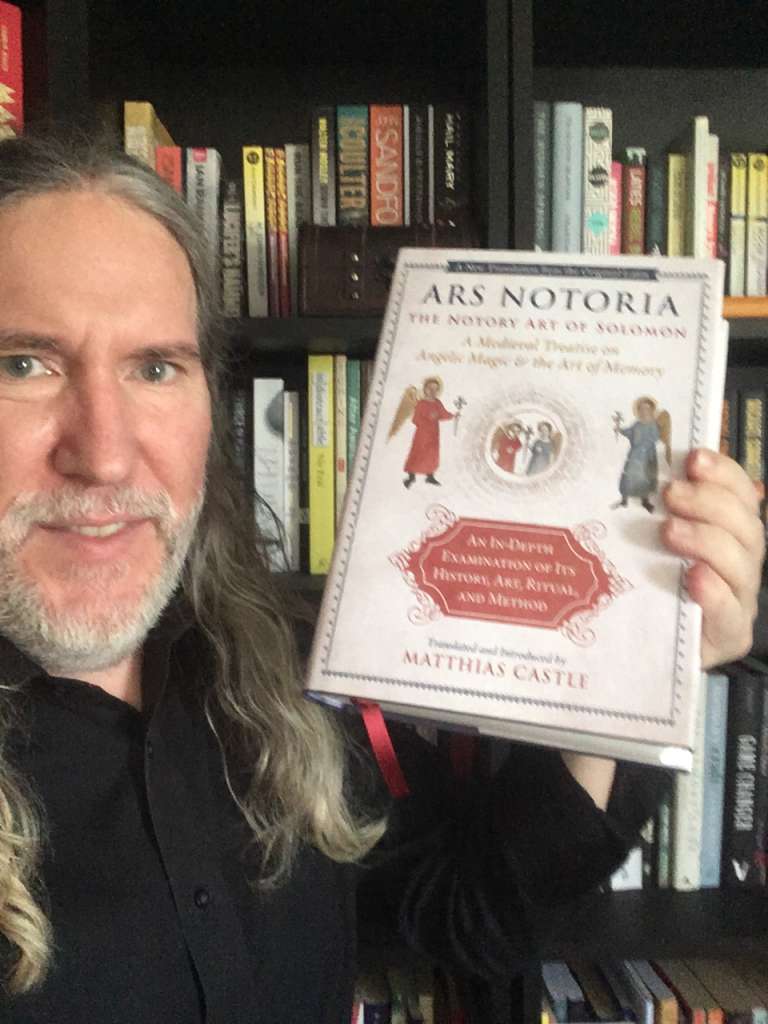
    It seems to me that having a learning goal would also be essential. That means it would be very interesting to see if someone could reproduce the promised effects for learning the latest, cutting-edge material in topic categories like chemistry, physics and medicine.Anthony Metivier with the Matthias Castle edition of Ars Notoria published by Inner Traditions

    In terms of calling upon angels, my recent Internet friend Richard Webster offers instructions for gaining protection from archangels. There is some crossover in what Webster is suggesting and what you find in the Ars Notoria, and it is worth thinking about how these rituals carry forward in our modern age.

    John Michael Greer has suggested in books like The Twilight of Pluto that we are returning to a magical age. It certainly seems that way.

    I was surprised, for example, when memory champions John Graham and Nelson Dellis both reached out to tell me about their recent experiences with mysticism and remote viewing.

    Understanding What’s Really At Stake

    My feeling is that the experimentation matters above all. I certainly have found reciting the language found in the rituals interesting and pleasing. With my many experiences using Sanskrit in meditation, I can easily see how medieval students using the Ars Notoria would have improved their concentration.

    In other words, spending time in prayer or ritual and focusing on what you want to occur is generally a good thing. And as the Ars Notoria itself says, you can’t rest on the rituals alone. You also need to use the art of memory itself.

    That’s where there’s a bit of a perfect circle involved for one simple reason. People with clear minds are much more likely to be able to use memory techniques. This simple fact has been a major focus of my own teaching for many years, especially in The Victorious Mind. Martin Faulks focuses a lot on this topic as well.

    It’s also well-known to contemporary scientists that meditation enhances memory. Indeed, there are almost too many concentration meditations you can try, meaning we’re all incredibly blessed.

    In sum, I think you are missing out if you don’t know this history or spend at least a little time giving this ancient memory technique a try.

    Please enjoy this interview and reading Castle’s edition of the Ars Notoria for yourself!


    Mind Mapping For Business: 12 Years Of My Best Tips And Tactics Feb 21, 2024
    Show notes

    Mind mapping for business has been one of the biggest drivers of success in my 12-year career. Yet, when I first heard about it, I nearly laughed the teacher out of the room. That’s how arrogant I was when taking my first course in business fundamentals. I’m sure glad I had a change of heart. Since then, I’ve explored every form of mind mapping I’ve found. It has made my career so much easier over the past twelves years. It’s also helped make everything much more interesting while regularly helping to improve the bottom line. Ready for my best mind mapping secrets and case studies? Let’s dive in! What Mind Maps Are & How They Help Mind mapping is a visualization activity that operates like a Swiss Army Knife for the mind. In other words, it helps you accomplish more than one goal. For starters, this cognitive learning and productivity technique helps you: Brainstorm Visualize information in fresh new ways Connect central themes with subtopics and related concepts through logical branching Improve memory and comprehension Think more logically Plan for success Avoid unnecessary problems Reveal hidden opportunities and assets in your current business Develop courage and mental strength when you need it As I discuss in What is Mind Mapping, the technique has a long history. Until his demise, Tony Buzan was historically one of the most active teachers in the field. My favorite term from him is found in his book Mind Map Mastery. He says that mind mapping promotes “radiant thinking.” In my experience, this benefit of mind mapping absolutely true because it helps you blow away the clouds of confusion and bask in the light of good ideas you enjoy using and pursuing. Mind mapping has been shown in scientific studies to help medical students, and researchers have actually used mind mapping exercises to study how business students are developing. Likewise, researcher Emilia Tosheva has found that mind mapping is useful for learning entrepreneurship skills, especially since digital mind maps are easy to share. This is a great point because so much of business requires abstract thinking. Mind maps help stimulate much more direct, concrete thinking thanks to how they help us visualize concepts and processes. 6 Powerful Use Cases for Mind Maps in Business Let’s turn now to different ways you can use mind mapping to make great progress in your business life. Keep in mind that there are many different ways to mind map. But I personally try to follow Buzan’s main suggestions. These involve: Always having a central image or keyword Using multiple colors to keep the activity visually engaging and fun Connecting ideas through branching Moving in a clockwise formation As you explore your options, keep in mind that it’s okay to make mistakes when mind mapping. It’s not an exercise in art. It’s about generating ideas, gaining insight and discovering opportunities as quickly as possible. Now let’s dive into specific mind mapping examples that will you enjoy all of these outcomes yourself. One: Product Creation At the simplest level, anyone can get started in business by simply having a product that serves a particular market. As you can see in the picture above, I used a mind map to brainstorm a new product. I literally have a section in grey exploring the question, “Who wants this?” Once I have a product identified and am ready to start building it, I often use mind maps to design the book or course I need to create. Since this is a linear process with many non-linear aspects to work out during the design stage, I often use arrows to help me work out the best possible flow. Here’s an example mind map for that: Two: Planning Your Future Business Activities Buzan talked a lot about planning. In fact, the blog you’re reading now follows a plan I mind mapped with Tony Buzan during one of his ThinkBuzan events. To this day, I follow this mind map, which is almost purely picture-based: As you can see, I followed Buzan’s rule of using multiple colors and a central image. Here are what some of the images on this mind map for my business mean: The central flag has lips on it which represents the goal of serving the entire world and multiple languages The man speaking into the camera represents me doing more video (at the time I did not like being on camera, but now my YouTube Channel is massive thanks to developing courage and following the business plan) Around the seven o’clock position in purple, the medical symbol with the comedy and tragedy faces represents the goals I had to write The Victorious Mind and help medical students Although not all of these goals have been as fully realized as others, I still follow the basic plan. It remains powerful and only took fifteen minutes to create. Three: Developing Courage & Overcoming Obstacles As I mentioned above, I used to dislike being on camera. In fact, I went out of my way to avoid it, limiting the success of my business by only speaking over slides. Mind mapping helped me get over my fears about how my skin outbreaks were holding me back. I actually applied three kinds of mind maps to get over it, which I teach in detail in this video: https://www.youtube.com/watch?v=BracGhyKS4I They involve using mind maps to identify your FOS: Fears Opportunties Strengths By visualizing your obstacles on paper, it’s much easier to come up with strategies for eliminating them from you life. That way, you can create your plans and follow them. Without doing that, it’s very difficult to enjoy any kind of success. Give these three forms of mind mapping a try if you’re facing any kind of mental barriers when it comes to doing the things needed to see success in your business. Four: Designing Presentations Not all business people need to deliver speeches from memory or remember presentations. For those who do, mind mapping provides a quick way to craft a compelling message. It’s good for both live presentations and streaming. In this mind map example, you see one of many mind maps I’ve created for live streaming on YouTube: This example Mind Map was created for one of my live stream presentations. I usually juggle for a few minutes to get my creative juices flowing. The great thing bout mind mapping in this way is that I don’t have to write out boring slide shows. I can just follow the clock-like structure and unpack at a glance what I wanted to say by “decoding” each part of the mind map. You can also place each image in a Memory Palace if you don’t want to look at your mind map while presenting. Give this form of presenting a try. You won’t regret it. Five: Training Your Staff As we’ve seen, research shows that one reason mind maps are so effective when it comes to business and entrepreneurship is how easy they are to share. You can either take pics of them like I’ve done to share mine on this page. Or you can create digital mind maps and share files. You can even collaborate on creating mind maps with a team. When it comes to training purposes, you can put an entire vision statement on a single mind map to help keep your company aligned with your goals. You can also help your team understand certain aspects of your business by using a close alternative called concept mapping. A mind map can also help with company events. Check out this “World Mind Map Day” example Buzan used to use for both internal purposes and to help market his business: Created by mind map expert Phil Chambers, it’s a powerful example of using software for mind mapping for helping an organization see everything involved in a company event at a glance. Six: Reflective Thinking Entrepreneur and business author Dan Kennedy often points out that many people fail to take time out for reflective thinking. As a result, the slow their progress and don’t enjoy the insights they need. That’s why I often get out of my office and remove myself from all computers and devices. I love mind mapping outdoors and combining the practice with journaling for overall self improvement. It has helped me identify key areas that need more attention in my life. I’m talking about sleep, diet and regular meditation. How to Harness the Powers of Mind Mapping in Your Business It’s difficult to exaggerate just how powerful mind mapping has been for me. I’m glad I ran into Tony Buzan and started following his advice. As a result, I wound up being able to mind map with the master himself and many great things have unfolded ever since. My biggest suggestion is to use the technique to feel more free and get into “flow” in the sense that psychologist Mihaly Csikszentmihalyi meant it. In other words, mind mapping helps you get “into the zone.” This is so important because it helps reduce the many levels of abstraction involved in planning and conducting a variety of business procedures. Everything from product development to helping your team develop customer service processes will enjoy much greater success just by taking a few moments to develop mind maps. Keeping your mind maps visible will also help you remember your goals. I often keep my mind maps on my desk until the day the project is done and do not allow myself to move them because I know how easy it is to forget about projects. If you’d like more ideas on how to remember your business goals, please get my free course now: It will help you use a variety of memory techniques, all centered around the Magnetic Memory Method, an enterprise that simply would not have grown without mind mapping. So if you’d also like to beat the statistics that say most businesses fail in fewer than five years, give mind mapping a try. And if you have any questions where my personal insight might help you and your business, feel free to get in touch. Just as Buzan helped me personally with my mind map, I’ve enjoyed helping other entrepreneurs work on their over the years. With these techniques as part of your practice, greater success is not only guaranteed. It’s inevitable. All you have to do is map it all out.

    Full show notes at the publisher

    How I Memorized a Presentation for TEDx (Word Perfect) Feb 17, 2024
    Show notes

    Ever since my TEDx Talk cracked several million views, people from around the world have asked me how to memorize a presentation. Beyond that presentation from the stage, what qualifies me to offer you advice for memorizing a presentation of any length? Well, I also spent a decade as a professor at three universities in three different countries. I delivered dozens of lectures during those years. In more than one language. I’ve also spent over a decade as an online “professor of memory.” My expertise in memory has taken me around the world. I’ve given presentations in Germany, Switzerland, Austria, England, China, Canada, Australia and the USA. In fact, the feature image for this post shows discussing memory as a part of language learning at a 2016 Polyglot Conference in Berlin. You can also watch hundreds of hours of my presentations on YouTube from several years of live streaming. And on this page, I’m going to share the best of my experiences with multiple kinds of presentation. If you want to memorize your presentation verbatim, I’ll show you how. Or, if you prefer to work from mental bullet points, I’ll help you do that too. When it comes to memory aids for speakers, this is the real deal from someone who practices these techniques week in and week out. Ready? Let’s get started! https://www.youtube.com/watch?v=5SxbHXtx_Ow So You Need to Memorize a Presentation… Here’s Where to Start Getting started… this is the tricky bit. So here’s a story using the Polyglot conference speech I gave to help dimensionalize the starting point I usually use. Determine Who Your Presentation Is For… And Who It Isn’t For Before I wrote a single word, I asked myself a very simple set of questions: Who can I help and who am I unable to help? And what’s the one thing that will help the listeners above all? I went through this same process with my TEDx Talk and many other presentations. Make no mistake, this step can be tricky. It’s a discipline to whittle things down to the biggest and most important point. https://www.youtube.com/watch?v=kvtYjdriSpM But it is possible and often the success of the talks we enjoy most comes down to knowing that the audience you’re addressing is defined as closely as possible. It was hard for me, but I believe focusing on just one kind of person and one message for that person helped my TEDx Talk reach so many viewers. Of course, some presentations need more details and more nuance, but even then, the principle is the same. If you think about who each principle is for and how to focus on the biggest and most impactful part, it’s going to be easier to digest. And easier for you to remember successfully. Script The Presentation When it comes to helping yourself remember your presentation, writing is key. And you need to make sure that you’re actually delivering on the promise so that your presentation is worth memorizing. For example, in law school I recently got an A+ for an oral presentation worth 50% of the course grade. I wrote the presentation and then re-read the assignment. I realized I hadn’t fully addressed the requirements, so I rewrote it and simplified my points for clarity. But if you write a bunch of mush with endless long sentences, you’re setting yourself up for a struggle. So when you’re putting the presentation together, ask yourself: Do I want to memorize the presentation verbatim? Or can I memorize keywords and let my expertise fill in the blanks while speaking? Both ways work very well. It just comes down to your goal. In the case of my TEDx Talk, I wrote the presentation and memorized it verbatim. In my Polyglot Conference talk, however, I prepared slides and memorized only the key points, which involved speaking some Chinese based on how I’ve studied that language. Either way, scripting or preparing slides can help you decide how you’re going to memorize the presentation. And if you’re preparing a speech rather than a slide-based presentation, please see my guide on how to memorize a speech fast for more details on verbatim memorization. Review The Presentation As a final preparation step, it’s great if you can take a moment to review what you’ve prepared. Ideally, you’ll also get at least one other person to review it as well. For my TEDx Talk, Thomas Krafft reviewed the script itself and a recording of me delivering it from memory. Before presenting the script of my live-action “Memory Detective” game attached to a memory improvement novel I wrote, I had a test audience go through the entire sequence. Reviewing the speech, slides and related materials with others helps add an extra layer of understanding that helps with the memorization process. I highly recommend making time for review. How to Memorize a Presentation from Start to Finish in 7 Easy Steps As Hanna Pishwa points out in Language and Memory, Aristotle was one of the first to intensively describe the rhetorical strategies used for persuasion in speeches. But we can go a step further: Aristotle also closed his treatise on memory by explaining that we are moved most by people who speak from memory. This picture was shot the first time I delivered a talk about Film Studies in the German language. He says reciting from memory is impressive because the person who has memorized their presentation doesn’t have to “hunt” for their ideas. They use a “process” that brings those ideas to them automatically. How can you do that too? Just follow these steps: One: Learn To Use The Memory Palace Technique Since long before Aristotle, people have been using the ancient art of memory to commit presentation points to memory using Memory Palaces. A Memory Palace is simply a mental copy of a location you know well, like your home, office, school, church or any place with walls, paths and other environmental features. This is a graphic representation of the Memory Palace I used to memorize my TEDx Talk: It’s a neighborhood in Brisbane and the numbers represent individual stations. I teach people who take the Magnetic Memory Method Masterclass to number their stations to help them rapidly create these simple journeys. To do this, it’s helpful to draw your Memory Palaces first. Like this: A Memory Palace drawn on an index card to maximize its value as a mnemonic device. This one is based on a bookstore in Zamalek, a part of Cairo. Two: Add Interesting Associations To The Words & Ideas In Your Presentation The best memory techniques all rely on mnemonic imagery. When it comes to how to memorize lines for a presentation, you can do this very quickly by tapping into a pegword list. For example, in a presentation that starts with, “How would you like…?” my pegword list suggests Howie Mandel for “how” and Elijah Wood for “would.” Those figures are laid out in the Memory Palace at the beginning of its journey. This leads us to the next step. Three: Make Your Associations Zany Let me make a preemptive strike here: A lot of people have protested to me over the years: “I’m not creative. I can’t get myself to see Howie Mandel and Elijah Wood kicking a like button on a platform like YouTube.” Stop right there. I’m not creative either. All I’m doing is taking two people who already exist and having them do something strange. There are only so many actions in the world. They could kiss the like button, put it in a rocket ship and send it to the moon, or bury it with thumbs-up shaped shovels. Seriously. There’s nothing “creative” about this. It’s just borrowing from real possible actions and animating them in the Memory Palace. Please don’t overthink this process and make use of the exercises I’m going to share with you in step four. If you’re memorizing your presentation verbatim, you’ll need more associations than you would for one delivered based on bullet points. Either way, the process is the same. Four: Make Your Associations Multisensory Once you’ve decided what your characters are going to do with one another, add some multisensory elements. For example, you can hear the voices of your celebrity associations, or imagine that you’re feeling them interacting with the like button in our example. We do this because scientific research makes it clear that elaboration helps form memories faster. To get better at making your associations weird and multisensory within seconds, these elaborative encoding exercises will help, as will these visualization exercises. Five: Use The Memory Palace To Memorize Your Presentation When the ancient Romans gave presentations, they often would start a persuasive passage with a set of points. “In the first place,” an orator would say before diving into the point. Then the orator would say, “In the second place,” etc. Anthony Metivier memorizing and recalling names at a memory demonstration in Brisbane This convention remains with us today, and those orators were literally using their Memory Palaces in real time to recall each point they wanted to make. But you can be sure that they had practiced in private before delivering them. We know that Rhetorica Ad Herennium, originally attributed to Cicero, gives many suggestions around how best to practice for both public speaking and reciting poetry. And you need to practice as well. You do it by starting at the “first place” of the Memory Palace and then triggering those images to help you recall the words. Personally, I practice my presentations by following several patterns. For example, instead of always starting at the beginning, I will practice reciting a few lines from the end, then switch to the beginning, then go to a spot in the middle. This is helpful in ushering the presentation into long-term memory quickly because it harnesses the primacy effect, recency effect and serial-positioning effect. Six: Practice Delivering The Presentation Now, this point raises a subtlety that I personally find very important and impactul when memorizing presentations. I do not go through my Memory Palace while delivering my presentations unless I absolutely have to do so. See, when you follow the process I’ve described above, the presentation will be in your long-term memory. However, unexpected things can happen. During my TEDx Talk, people laughed at a spot where I hadn’t placed a joke. It surprised me for a second and I briefly popped into the Memory Palace I’d made to help me get back on track (instead of standing there like a deer caught in headlights). But ideally, you want to just have the presentation memorized and not have to rely on any mnemonic strategies while in the moment. In other words, with optimal setup and execution, the memory techniques will have already done their job and you can do what Aristotle described: speak without looking like you’re hunting for the ideas. This point is especially important when delivering a sales presentation from memory. And that means you can connect with that audience you identified during the preparation stage. The more you connect with them, the more successful you’ll be during and after your presentation because people remember connection. Seven: Analyze Your Performance Want to be a pro speaker? Then you’ll want to spend some time reflecting on your presentation. This step is important because it gives you the opportunity to identify areas to improve the next time. And it will help you congratulate yourself where credit is due. Please make sure to do so. Delivering a presentation is a huge accomplishment and you deserve recognition merely for making it happen. But the real gold is found when you apply some objective and subjective reasoning to the entire process. Reflecting on your experience will also reveal new ideas for other presentations you might not have thought about otherwise. How to Memorize a Presentation in Another Language If you’re wondering how these steps apply to presenting in a language other than your mother tongue, I’ve done this myself a few times. During my Mercator Guest Professorship in Germany, for example, I was asked to present in German on an aspect of Canadian Cinema. Here’s exactly what I did: First, I drafted the script myself. After doing my best on my own, I asked my research assistant for help in correcting it. This step matters a great deal when presenting in a second language for at least two reasons: It’s better for your listeners if your grammar and vocabulary choices are as accurate and sensible as possible You will help yourself memorize aspects of the language correctly, developing your fluency instead of digging common errors second language learners often make deeper into your memory To memorize my presentation once it had been corrected, I used the Magnetic Memory Method by following all the steps covered on this page. But there’s one addition that makes all the difference when memorizing presentations in another language. The Principle of Word Division Often in foreign language learning, it can be difficult to find mnemonics for words with multiple syllables. That’s why I suggest you break words down and give each syllable an individual mnemonic association. Scientifically speaking, this step is called chunking and is well-known to aid memory. Once you’ve broken a word down, then link individual syllables together with well-formed associations on one or more stations in a Memory Palace. This approach isn’t exactly something I invented. It’s inspired by the memory guides written by Peter of Ravenna and Jacobus Publicius, both of whom discussed either presentations or language learning. Their approaches to syllable-level encoding have been so useful to me that I produced my own translations of their works so more people could discover the process. And if you’ve watched my TEDx Talk, you’ve already seen this technique in action. The memorized Sanskrit I recite in that presentation was encoded the same way, syllable by syllable. In sum, whether you’re presenting in German, Spanish, Chinese or any other language, the process is the same: Write the script, get it corrected by a native speaker and memorize the corrected version. When words resist memorization, use the Principle of Word Division to chunk them down and keep moving. https://www.youtube.com/watch?v=II0jIyqxXAY How Long Does It Take to Memorize a Presentation? 4 Case Studies This is one of those questions that requires nuance and discussion of actual circumstances. Because ultimately, I can only speak for myself and how the techniques I’m sharing with you have helped me. TEDx Case Study I worked on my TEDx Talk for approximately two weeks before I realized the script was totally wrong. As mentioned, I’d gone through it with my coach and then essentially rewrote the opening and closing of one of my books. Although I kept revising small parts up to the date of delivery, I memorized most of it verbatim and walked the same journey I used as my Memory Palace several times. I made these practice walks approximately twice with the script in hand, then entirely from memory another two times. Then, after arriving in Melbourne a few days early, I recited the talk while walking the city a few times before finally delivering the presentation during a dress rehearsal one day before I delivered the final version. Polyglot Conference Case Study The slides for this presentation took approximately 90 minutes to prepare and I was instilling the material in memory as I went. Plus, as a mostly image-based presentation, I could rely on those pictures to help trigger various aspects of the presentation. You could say that the presentation script was somewhat cinematic, rather than keyword-based or verbatim. German Presentation Case Study My German lecture took considerably longer than any of the equivalent English presentations I’ve given. I technically had three months, though I confess I only got started writing the presentation three weeks before showtime. But if you’re presenting in another language, treat the timeline according to your own comfort and how much practice time you think you’ll need. Foundational Questions Th…

    Full show notes at the publisher

    Implicit vs. Explicit Memory: The Key Differences Feb 12, 2024
    Show notes

    implicit vs explicit memory feature imageThe key to understanding implicit vs. explicit memory involves one simple image.

    Sigmund Freud on a bicycle.

    Freud, as you probably know, was a major theorist of the unconscious.

    Riding a bike is usually an unconscious activity once you’ve picked up the skill, and that’s what implicit memory involves. It’s literally anything that happens on autopilot.

    Now imagine Freud consciously remembering a time he saw an explicit movie. It’s the conscious act of remembering with intent that makes this kind of memory explicit.

    It really is that simple, and now you have a simple way to remember the difference. Just think of Freud on a bike for implicit memory and him watching a movie intended for mature audiences to help you remember explicit memory.

    Remember:

    Whereas riding a bike is an implicit skill, consciously using your memory to recall something is an explicit skill.

    Of course, there are a few nuances to each of these types of memory.

    So in this mini-masterclass on explicit vs implicit memory, let’s dive in and reveal all.

    https://www.youtube.com/watch?v=zXiNlGrRRoU

    Implicit vs. Explicit Memory: The Difference

    As the authors of The Development of Implicit and Explicit Memory point out, philosophers, psychologists, psychiatrists and other types of scientists have been defining these two types of memory since the late 1800s.

    Basically, these terms are concepts tested by different means.

    Implicit memory (unconscious memory related to skills you just seem to know) is often explored through priming tests. One way to think about this type of memory is that you retain knowledge without necessarily remembering how you got it.

    You can test yourself:

    Do you remember the first time you realized how to use a fork and knife? How about picking up a glass to drink? Most people won’t have memories of the first time they used such skills, and yet they do remember how to perform these common operations.

    people in a restaurant enjoying the food

    Explicit memory, on the other hand, is normally tested by recall and recognition tests. For example, if you were asked to recall your last birthday, you probably could tap into your episodic and autobiographical memory consciously and share a decent amount of information about the event.

    To this day, the conscious element remains the key distinguishing factor. In fact, most people don’t really think about riding a bike and associate this simple procedure with memory. But it is a memory-based skill even if you don’t consciously think about it that way.

    And that lack of consciousness around it is precisely the point:

    • Implicit = unconscious
    • Explicit = conscious

    What Is Implicit Memory?

    Another way to think about implicit memory is that it involves indirect tasks.

    Riding a bike is a kind of “all-or-none” skill. You can either do it or you can’t. It’s the same thing with swimming.

    Implicit memory is automatic and can work without context.

    Let me explain:

    If you know how to swim, you can mimic many of the movements without being in water. You can also mimic riding a bike without having one around. This is why games involving miming and charades are so fun. You can easily perform the skills even if a pool or a bike are nowhere in sight.

    Implicit memory can be described as skills you know how to do, like walking, without really knowing why you know them.

    Sure, everyone can ask their parents about how they learned how to walk. But few, if any people actually remember learning how to do it. That’s what makes implicit memory implicit.

    What Is Explicit Memory?

    By definition, explicit memory is conscious.

    Whereas riding a bike is a general skill that morphs with other skills like walking, explicit memory is much more specific.

    It involves the concrete recall of semantic facts, like words and numbers.

    Explicit memory can also be slower, like when you have to take your time to correctly recall a name or scripture.

    Explicit memory is associative.

    Remember when we just talked about miming and charades? If you see someone miming swimming, the fact that you can draw the connection comes from the associative character of this kind of memory.

    Now, implicit memory could be like this with some skills, such as learning the choreography of one dance helping you learn the moves of another. But if you try to make the connection, you’re doing so consciously and intentionally, which places much more weight on explicit memory.

    Speaking of weight, explicit memory is what we use to talk about the function of things. It’s the kind of memory that helps you realize that a bike can be used for riding, but also could be taken apart to use for sculpture.

    Finally, explicit memory seems much more time-limited than implicit memory. You can go for years without riding a bike and still have the skill even if you’re a bit wobbly.

    But go for the same amount of time without speaking a language you know, including your mother tongue, and you’ll probably struggle. This kind of challenge to explicit memory is called linguistic deskilling.

    The Relationship Between Explicit and Implicit Memory (And Why It Matters)

    These two forms of memory are interlinked and having a healthy relationship matters a great deal for one simple reason:

    Independence.

    If you want to be a free member of society, you need to remember simple operations like opening doors and operating different tools. Likewise, you need to remember names, words and numbers.

    names on a blackboard

    As the authors of the Handbook of Implicit Learning point out, without both of these memory levels intact, it’s impossible to learn any kind of sequence. For example, any task involving writing requires you to implicitly remember how to move a pencil fluidly. As you do, you need explicit memory to help you recall individual words.

    Without these two levels of memory working flawlessly, you wouldn’t be able to find good places to study or keep a journal.

    Keeping Your Implicit And Explicit Memory In Good Shape

    Fortunately, it’s pretty easy to keep these two levels of memory sharp.

    One simple way is to make plans. This exercises your prospective memory. When you make good on your plans, such as meeting with friends, you’ll use your implicit memory while traveling and your explicit memory while chatting with them.

    You can also:

    • Study music
    • Learn a language
    • Take a course
    • Use a Memory Palace
    • Learn a number skill like the Trachtenberg Method

    The key is to combine a number of activities throughout life.

    If you’d like memory exercise that will help keep your mind sharp, give my Free Memory Improvement Kit a try:

    Free Memory Improvement Course

    It will help you combine the two skills and keep them well-practiced.

    For example, memory champions and mnemonists like myself learn to rapidly use mnemonic images almost as if they’re riding a bike.

    It takes a bit of practice, but you really can learn to use memory techniques automatically.

    This mental activity is so rewarding because it packs your mind with knowledge and makes recalling it so much easier.

    So what do you say?

    Is the difference between implicit and explicit memory clear for you now?

    If you ever struggle, just think back to Freud on his way to a movie theater.

    His implicit memory is what helps him unconsciously ride the bike without thinking about it. And later, when he remembers the movie consciously, that’s his explicit memory.

    The difference is that simple, and as you’ve seen, it’s a difference that matters.


    Can St. Augustine’s Memory Philosophy Help You Learn Faster? Jan 31, 2024
    Show notes

    Is St. Augustine’s memory philosophy practical? Or is it just intellectual noodling from yet another philosopher of times past? If you’re interested in St. Augustine’s comments on memory, but aren’t sure exactly what he was going on about, you can rest assured of one thing. What he had to say about memory is more than just interesting. And it’s not intellectual noodling. Far from it. Even where Augustine’s philosophy of memory does not gel with contemporary science, it’s astonishing how close some of this thinking gets to what we now believe is true about memory. Plus, thinking through his ideas is itself a good memory and critical thinking exercise. It’s worth learning about just for the mental workout. Straight up: a fit mind will always be able to learn faster than a flabby one. The best part? Once you understand St. Augustine on memory better, you’ll make better learning choices too. Sound good? Let’s dive in! https://www.youtube.com/watch?v=0OiSI6YRbBI Who Was St. Augustine? Augustine of Hippo lived from 354 AD to 430 AD. He is remembered for essentially inventing the autobiography and auto-hagiography by writing his Confessions. This literary offering is quite unique because, as Andrea Nightingale points out, a substantial part of how and why he was made a saint comes from things he said about himself. Not only that, but Augustine helped shape how we interpret texts, a process known as exegesis. Because he focused so much on his own memory and memory at large in his works, he has shaped how many cultures have come to interpret the experience of having a self. We’ll get more into why this contribution is so important in a moment, noting that Augustine also explored many other issues. For example, he discussed the nature of evil, desire and the philosophical ideas of Plato. He wrote prolifically, and his City of God is not only studied as a book of Christian philosophy. It was a key part of my political science program when I was an undergrad. It is a very good text to compare and contrast with Plato’s Republic, for example. Augustine was also deeply interested in the liberal arts and the memory and persuasion skills discussed in Rhetorica ad Herennium. He held critical thinking to be very important and demonstrated several ways to do it in his works. What Was St. Augustine’s Philosophy of the Mind & Memory? Augustine has been influential on people who use memory techniques. In fact, it’s possible that the term Memory Palace comes from his oft-quoted line: And I come to the fields and spacious palaces of my memory, where are the treasures of innumerable images, brought into it from things of all sorts perceived by the senses. But when it comes to mnemonics, Augustine’s philosophy of memory is useful more in a roundabout way. As I share with you the main points I’ve picked up from reading him, we’ll patch those valuable angles in. One: Augustine Helps You Meditate On The Nature Of Data Because examples of autobiography prior to Augustine are hard to find, he didn’t have many models to copy. Paula Fredriksen suggests that Augustine probably had the Pauline Epistles. These books of the Bible are letters and certainly have an element of reflective thinking related to autobiography. But Augustine isn’t just writing about himself. He’s thinking deeply about the nature of his memory and how it allows him to consider facts about his own experience. To use modern terms, he’s essentially thinking about how the mind collects data and transforms it into a useful form. We now call data we have gathered for analytical thinking, “information.” The next step he considers is how that information becomes knowledge and ultimately wisdom. These aren’t merely philosophical questions. They are questions of epistemology – the art and science of how we know something is true or false. Two: Memory Helps Us Create & Experience Meaning Augustine notes a few interesting paradoxes as he reflects on the nature of his personal experience of memory. For example, he observes that he can remember a time when he felt joyful, yet do so in a completely neutral state. It’s really weird if you think about this and experiment with thinking through happy memories in a neutral way yourself. This mental exercise suggests that there may be a difference between information and sensation. At some level, he thinks there has to be a difference. This is because in order to trust others, we can’t let ourselves get caught up in superstition. We have to analyze them rationally and sometimes let go of previous bad memories we might have about another person or group. Here’s another way of making this point: Part of our memory allows for rational and logical thinking. We can use our memory to sort, sift and screen a variety of sensations (data). We then use our minds to make them meaningful, specifically through the application of categories. I believe Augustine’s reflections on categorical thinking probably influenced Ramon Llull’s development of the Memory Wheel. To take things one step further, Augustine seems to suggest that we use our memory to make memory itself meaningful to us. As he writes in the Confessions: The interior sense perceives not only the things referred to it by the five senses, but also the sensations themselves. Then later: [Memory] is a faculty of my self and belongs to my nature. In fact, I cannot totally grasp all that I am. The mind is not large enough to contain itself… When I remember memory, my memory is present to itself by itself. Nothing is so much in the memory as memory itself. What I believe Augustine is suggesting here is that memory is itself a sensation. Only by reflecting on it thoroughly and deeply can memory truly become as fully meaningful as many of the great memory masters throughout history have proclaimed it to be. I’m talking about people like Giordano Bruno, St. Thomas Aquinas, Matteo Ricci, Aristotle, Albertus Magnus and many more. Three: Coping With Meaninglessness As a religious thinker, Augustine concludes that there’s an infinite number of data points about God and about ourselves. No matter how much your memory comes to contain in those “spacious palaces” of memory, knowledge will always be incomplete. In some ways, I think he’s anticipating Gödel’s Incompleteness Theory, but his notion of mental imagery seems to allow for a sense of totality even if you can’t understand everything. This is quite different from Giordano Bruno’s “Chaos Memory Palace” theory which suggests that you actually can understand it all. But he shares with Bruno the idea that memory is not like a sponge. When you learn something new, you don’t have to forget what you already know. As he puts it, new information “displaces no volume.” Here’s ultimately where I think Augustine makes the same error we find in Plato. I’m thinking specifically of anamnesis, the idea that learning is not about encoding or programming something into the brain. It’s more like uncovering or discovering something that is already there. Augustine frames it in the form of a question: How did I recognise [things I did not know] and say, ‘Yes, that is true’? The answer must be that they were already in my memory, but remote and pushed back… as in in most secret caverns. It’s a feel-good idea. It allows for a philosophy in which humans are made in the image of a creator. Memory becomes a tool that allows the seeker to find God through a process of inquiry into memory: O lovely light… I shall pass beyond memory to find you: but where will I find you? If I find you beyond my memory, then I shall be without memory of you. And how will I find you if I am without memory of you? Augustine’s answer is that the “memory” of god is built-into the system. But these days many of us recognize a more Darwinistic impulse towards belief as a survival strategy in the face of a universe in which life is the exception to the rule, with no empirical demonstration of a reason why anything should exist. For a strong alternative in an another important realm of philosophy to Augustine’s a priori-style of thinking about memory, see Nietzsche’s “rumination” on memory, especially in Human, All Too Human. Four: Memory For Critical Thinking I just used the word “rumination.” That’s because Augustine sees memory as something like the series of stomachs you see in cows. It’s not just that memory is “the stomach of the mind,” but that it digests different kinds of thoughts at different rates of speed. Some of those thoughts relate to categories Augustine picks up from Stoicism. He focuses particularly on these 4 “perturbationes”: Fear Desire Joy Sadness These are categories we can think through when trying to understand memories that arise through autobiographical memory processes. Or we can use these specific categories when thinking about prospective memory – such as our memory of what we need to do in the future. This would include thinking through what sometimes holds us back from taking action on those things we need to get done. Again, I believe Augustine’s thinking here was almost certainly influential on tools developed later like the Memory Wheel and ars combinatoria. You can also think of taking time to focus on your issues by using four simple categories like this as a form of chunking. Long story short, Augustine seems preternaturally aware that short term memory (or working memory) operates more efficiently when dealing with smaller units of information. Less is truly more. Five: Memory Is About Ability Although Augustine goes to great lengths to show that memory is essentially spiritual, he’s ultimately very practical. He sees memory as something that can be astonishingly easy for some things, like remembering the colors and the days of the week. Part of this effect St. Augustine notes is coming from something we call context dependent memory, but also the sheer amount of spaced repetition we get from this kind of quotidian information. In other cases, memory can be much more difficult, especially when learning complex topics. Although Augustine doesn’t have a very good answer when he suggests that all of this understanding is already in your mind and just needs to be uncovered, here’s his most practical tip: He says that your ability to remember and understand ultimately shapes your ability to succeed. You have to be able to demonstrate an understanding because you need to judge your own passions to avoid bad behaviours and the negative outcomes they create. The experience of joy, he tells us, essentially comes from studying and understanding the information that helps you guide your actions towards joy. Doing this will in turn provide you with better mnemonic images as you practice the art of memory. It’s a self-reinforcing system in that regard, and that’s why linking your learning choices and memory abilities wisely will ultimately help you learn faster. Yes, you can remember physical things like rocks and houses and the names of the foods you like to eat. But to really get ahead, you need to also be able to work with non-existent things. Like numbers and the concepts related to the liberal arts. Or the ideas in the best books about philosophy you come across over your lifespan. In my view, he places a premium on abstract thinking over concrete thinking. I think this emphasis is as wise now as it surely was then. This is so important because Augustine understands the nature of information the same way Bruno did, Galileo did and I do. It’s infinite, unfolding in time and as Augustine says of interpreting scripture, “not one line is exhaustible.” And to deal with it, St. Augustine tells you something every memory expert worth their salt admits. His memory is not perfect. Far from it. Not only that, Augustine uses mnemonics with passion because he observes that God himself uses them. Just take a look at Genesis 9:13-15 if you don’t believe me: I have set my bow in the cloud, and it shall be for a sign of the covenant between me and the earth. And it shall come to pass, when I bring clouds over the earth, and the bow is seen in the cloud, that I will remember my covenant. If putting a rainbow against the backdrop of the sky as a reminder isn’t the Memory Palace technique writ large, I don’t know what is. No wonder Eran Katz called his book on mnemonics, Where Did Noah Park the Ark? Augustine On Memory Is Worth Your Time Today’s summary is really just scratching the surface. There’s much more you’ll glean from reading St. Augustine on memory yourself. My goal has been to show you how Augustine’s observations about memory land on many of the features scientists have confirmed and named in our era. But St. Augustine didn’t need spreadsheets and graphs to know just how valuable using memory itself as a kind of concentration meditation can be. He knew intuitively and by applying logic that memory really is like a room: …a spreading limitless room within me. And if that’s an experience you’d like to enjoy yourself, then follow his advice to focus on learning the skills that lead to joy. Get my FREE Memory Improvement Kit now: It will take you deep into everything you need to know about the Memory Palace technique. Before you know it, you will know as Augustine did that memory is where you are most yourself, so long as you can come to truly perceive memory for what it is: A sensation that senses all the other sensations. “Who can reach memory’s utmost depth?” Augustine asks. The answer is you, so take a deep dive inside by learning memory techniques and applying them to the information that matters. Your joy is guaranteed when you do.

    Full show notes at the publisher

    Did This Memory Champion Just Use “Remote Viewing” To Read My Mind? Jan 24, 2024
    Show notes

    Nelson Dellis headshot for podcast about his remote viewing experimentNelson Dellis is a highly accomplished memory champion, author, YouTuber and all around great guy.

    But please get ready to dive deep into new territory, a topic I never expected to address.

    That’s because I never saw Nelson’s interest in the world of remote viewing and other psychic phenomena coming.

    Yet here we are discussing experiences that have Nelson thinking that the definition of memory needs to be changed.

    These are heady ideas for which there are no easy answers. But I’m confident you’ll enjoy the ideas we unpack in this episode of the Magnetic Memory Method Podcast.

    Here’s what you’ll discover as we search for a logical explanation to some of Nelson’s recent experiences with remote viewing and ponder the possibility that the citizens of the world might be witnessing a cognitive revolution as we speak.

    • Nelson’s history of debunking claims of skills that resemble photographic memory
    • The story that led to Nelson running experiments in remote viewing
    • The relationship between psychic phenomenon, Houdini and magic tricks
    • Why philosophy is so important when trying to understand paranormal claims (and why linear thinking might have its limits)
    • Nelson’s academic background in math and physics
    • Keeping memory sharp as we age after the time for extreme efforts in memory improvement has passed

    https://youtu.be/j240eFZNq04

    Who Is Nelson Dellis?

    Now, if you’re hitting this episode of the Magnetic Memory Method Podcast cold, you might not have heard of Nelson before.

    He is a five time USA Memory Champion and author of Remember It! and Memory Superpowers.

    Nelson runs an amazing and unique YouTube channel where he goes far beyond merely talking about memory techniques.

    Plus, he always pushes the limits. These include memory adventures around the world and his success with breaking world records. Nelson even involves his family in some of his video lessons.

    Enjoy this episode and feel free to follow up with these additional episodes and people who came up during the show:

    • John Graham on going beyond mnemonics and into enlightenment
    • John Michael Greer on Giordano Bruno
    • Nelson’s tutorial on how he memorizes poetry
    • My review of Nelson’s Everest Memory Masterclass

    How to Memorize Scripture: 7 Proven Approaches Jan 12, 2024
    Show notes

    If you want to know how to memorize scripture quickly and make it stick for the long-term, please understand the following. There’s no single way to do it. That said, there also isn’t an infinite number of approaches. You can use either: A Memory Palace Network Mnemonic images Rote Repetition Flashcards Spaced-repetition software Cloze tests A combination of all the above On this page, I’ll walk you through each of these options as a PhD who memorized a lot of scripture as part of my studies. I even included some scripture I memorized in my popular TEDx Talk. As I walk you through each strategy for memorizing scripture, consider focusing especially on the Memory Palace technique. You’ll get my best tips for all of the other methods listed above, but using Memory Palaces has helped the largest amount of people in the fourteen years I’ve been teaching memory techniques for scripture. How to Memorize Scripture: 7 Proven Approaches Before you start memorizing scripture, please consider following my P.E.A.C.H. formula (practice encoding at calm hours). Memorizing the Bible is possible. But you have to set aside the time to do it. And it’s very important not to let yourself get interrupted. For best results, explore each of the methods on this page in a well-thought out study place and a time when you won’t be disturbed. One: The Memory Palace Network for Memorizing Scripture and Verse Numbers Many people are aware of the Memory Palace technique and related memory techniques like the method of loci and the journey method. It works like this: Choose a familiar location, like your home or a neighborhood. Next, assign a path through that location, strategically following a journey where you will place mnemonic images that help you remember verses and their numbers. For that reason, it helps to have a numbered Memory Palace, as illustrated in this Kelvin Grove Memory Palace I used for one of my scripture projects: For best results, I suggest you sketch your Memory Palaces and keep these in a Memory Journal. Then, as you’re learning to use the technique, you have a self-created visual reference to work with as you place mnemonic associations in the Memory Palace. For some people, it will be easy to memorize multiple words at the same time. For others, it will be necessary to encode the verses with an image for every word. When it comes to memorizing the verse numbers specifically, you’ll want a number memory technique like the Major System or the PAO System. I’ll give a detailed example further down showing you how all this works. Two: Mnemonic Images without a Memory Palace Some people do not want to use Memory Palaces. They wonder if they can simply create associations to scripture and have them float “in the void of their mind.” One of my students just did that. In fact, Mike McKinley shared how he used just a part of my teaching to memorize 66 Psalms on the Magnetic Memory Method Podcast. But as we discovered in our conversation, he still used a certain level of spatial memory. You can contrast his experience with those of Matt Barclay, who joined me to discuss how he memorized and delivered an entire Psalm to his congregation. The reason most of us prefer to use a Memory Palace is that it helps reduce the cognitive load. Using a familiar location to place images is like having a canvas to paint on. It helps you look back at a reference point and reconstruct the target verses you want to recall. Three: Rote Repetition Of course, it’s worth noting that you’re perfectly welcome to simply repeat the verses until they stick. This approach is traditionally called rote learning. It doesn’t work very well for many of us. In fact, it can be downright destructive because it’s often frustratingly boring. That said, it’s worth experimenting with in order to see how it compares to using other mnemonic techniques. Often people are pleasantly surprised and come to realize the benefits of the active recall mnemonics provide compared to rote. Four: Flashcards I just mentioned “active recall.” One of its most important principles is that you need to personalize the associations you make when memorizing scripture. Obviously, this is not possible with rote learning. That approach involves literally repeating the same thing over and over again. But let’s say you want to memorize the books of the Bible by name. This is a great way to use flashcards. For example, I drew this to help me remember the name Zephaniah: I know. I’m not a great artist. But the zipper helps me remember that the word starts with ‘Z.’ And Shaniah Twain helps me remember the sound of Zephaniah. The trick here is that the exact name of the Bible is nowhere on the card. I have to use the way I’ve personalized the mnemonics as a clue that triggers the target information. This is what active recall is all about. Notice something else: The card is itself a kind of Memory Palace. Even without looking at any individual card, you can simply reflect and ask, “What was happening on that card?” By thinking of your drawing on the card, you’ll improve your rate of recall substantially. Five: Spaced-Repetition Software People often ask me about apps for memorizing the Bible. Personally, I don’t recommend them. That said, Anki is an app that follows the scientific principles needed for proper spaced repetition. What’s spaced repetition? It’s tactically (not randomly) revisiting the verses you’ve worked on committing to memory over time. If you prefer not using software programs, you can combine spaced repetition with flashcards by using the Leitner System. Six: Cloze Tests Some softwares for Bible memorization help you by restricting certain parts of the Bible verses you’re committing to memory. Like this: I ____ the ____ I have for you,” ________ the Lord, “plans to ______ you and not to ____ you, plans to ____ you ____ and a ______. – ________ 29:11 This kind of memory strategy is called a Cloze Test. Again, you don’t need a software to do it. You can write out scripture and leave out some of the key words and phrases. Then, when reading back the scripture, mentally fill in the blanks or use a pen and paper. This approach isn’t for everyone, but it’s well worth experimenting with as you commit scripture to memory. Seven: Combine Strategies You’ve learned that active recall works best when personalization is involved. Another aspect of active recall is getting in lots of variety. This principle ties together with interleaving, which shows that we learn faster when we combine multiple approaches. For this reason, I recommend you that you don’t get stuck in a rut with just one of the strategies I’ve discussed above. Try them all and rotate through them on a regular basis. It might seem a bit much at first, but as you continue to weave the activities together, you’ll likely find yourself remember scripture with greater ease. A Detailed Example of Memorizing Scripture & Verse Numbers Now let me give you an example of how I memorize Bible verses. Let’s focus on one of my favorites: Proverbs 18:13 (NIV): “To answer before listening — that is folly and shame.” First, I suggest that you sort out the keywords. That’s because your mind will typically fill in a lot of smaller words. The keywords I chose when memorizing our example verse were: Answer Before Listening Folly Shame Next, I asked myself… Who do I know who relates most closely to either the form of the verse or its meaning? My friend’s sister Andi comes to mind. She served as a mental association. Then, using a Memory Palace based on Andi’s brother’s home, I imagined her typing out an email while a bee floated around. Something like what you see in this illustration: To help with memorizing the full verse, I didn’t have Andi memorize just any kind of email? Rather, I imagined her writing an email in response to an episode of Fawlty Towers she’s just seen on television. She does this before she even heard the end of the sentence that offended her, and as a result, Andi feels ashamed. Why Fawlty Towers? Because it has a sound similar to “folly” in it. Note that I thought of and chose Andi as my “Bridging Figure” for this verse because I was focusing on the first word “answer.” The “an” in Andi and the “an” in answer “magnetically” attract each other. Weave these associations together in a Memory Palace and one will “trigger” the other. By looking for natural parallels that are already in your memory and imagination, you can often come across just the right set of images. This happens much more quickly than if you try to create abstract associations. Abstractions in your associations must be avoided as much as possible. They’re difficult to recall, create weak associations and cause more frustration than they’re worth. How To Memorize All Those “Little Connecting” Words Now, you might be thinking that you’re still a beginner. What about “to,” “before,” and “is”? Before you spend time memorizing them, stop and think it through. Do you really need to memorize them? Or can you allow your mind to fill in the blanks? In my experience, most people do fine with letting their mind fill in the blanks, provided they follow the rest of the steps I’m sharing now. As you’ve learned, Cloze tests actually involve getting yourself to fill in missing words from scripture that you want to memorize, so it’s actually a good thing not to have an image for each and every word. But if you need to come up with associations for all these little words, I suggest you consider creating a “stockpile.” If you use a tutu for “to,” always use that same association. If you use a bee driving a forklift for “before,” always use that every time you need this word. Don’t worry. It’s unlikely that your mind will mind the repetition. The Memory Palace will provide more than enough differentiation. The important point is that you’re drawing upon information, ideas, people and objects already in your memory. That’s where the real memory magic happens. And sadly, this is a point that is too often missed by many memory experts who otherwise mean well. How To Remember Verse Numbers I mentioned above that you can use either the Major System or a PAO System to memorize verse numbers. Let me give you an example of this technique. Once you’re set up with these number systems, you’ll find it simple to create little associations to precede the associations you use for the verses themselves. If you feel like you need more help after going through this example, feel free to go through my tutorial on the 3 Most Powerful Memory Techniques For Memorizing Numbers. For now, have a look at this: For Proverbs 18:13, for example, I see a large TV set that I actually owned vacuuming J Edgar Hoover using a Hoover vacuum. Weird and memorizable, right? It is! But why these images? Because 18 for me is always represented by a few things, one of which is a TV set. Not just any TV set, but a particular TV set that has meaning for me. And when you know the Major Method, you’ll know that there’s a very good reason that it’s a TV and not some other object. Likewise with J Edgar Hoover with a Hoover vacuum. It represents 13 because I’m following this simple chart based on the Major: Sometimes for 13, I see Hoover vacuuming on the Hoover Dam. There’s actually a way to make that dam a Virtual Memory Palace that I’ll talk about in the future. For now, here are 5 Memory Palace Examples you can learn about to enhance your practice. In any case, having multiple images to draw upon is the Magnetic Memory Method Principle of Compounding. It’s part of the joyful science of creating and using a “Magnetic 00-99 P.A.O.” Learn more in the MMM course on memorizing math, equations and all things related to numbers. I know that this process might sound complex. It really isn’t once you get into it. After all, as Jeannie Koh explains in her Magnetic Memory Method Testimonial, using these techniques helped her reach her goals immensely: And it’s a skill worth having for more than just memorizing verse numbers. It makes committing all numbers fast, easy, effective and fun. What matters most is that you associate everything with information that already exists in your mind and that is meaningful to you. Following Up: What To Do After Your Memorize Scripture Verses Now comes the fun part. What you want to do is mentally walk through your Memory Palaces one at a time. Do this as many times as it takes to recall the verses accurately. Be sure to recall them both verbally and in written form. There are a few more tips on this practice below. How many times exactly is a question no one can answer. At least 5 times the first day and then 1 time per day for a few weeks is a good rule of thumb derived from Dominic O’Brien. As you develop your skills, you’ll find that different verses enter your memory at different rates and each presents its own form of brain exercise. The varying levels of challenge is a good thing. It keeps you on your toes, keeps things interesting, and in fact, you don’t want it to be easy. If using memory techniques suddenly became easy, they’d be boring and you would stop using them. It’s very important to set a time aside for practicing recall to ensure that you do it. I suggest using a Memory Journal to gather all your Memory Palaces and record your recall. There’s no perfect journal, but one I recommend is called The Freedom Journal. It has just enough space for an effective Memory Palace drawing and lets you create 10-day “sprints” over the course of 100 days. How To Recall On A Verse-By-Verse Basis As you go, “trigger” off the associations you made and let them bring back the information. For example, I would start with the specific Memory Palace and the specific station. How does one remember that? If you’ve correctly planned and organized your memorization activities, then the answer will be known to you without any stress or strain. Remember: You create the Memory Palace Network to serve the outcome you want. This process alone will help you remember what is memorized where. If you’ve properly numbered each Magnetic Station as taught in the free course, then you’ll have even more “autopilot familiarity” with your Memory Palaces. How the Memory Palace Tells You The Right Word Order And if you are memorizing verse numbers and memorizing the scriptures in verse order, order itself acts as a clue. It will tell you where in your Memory Palace the information is located. Next, I would recall Andi and simply ask myself: “What was she associated with?” Asking questions during recall is important because you’re encouraging your memory to do a bit of work. Sometimes the entire line will blast back at you, almost like magic. Especially if you complete these powerful visualization exercises. Other times, you’ll have to piece it together, word for word. In all cases, if you have a pen or pencil in hand, recall the verse first, then write it down. Say the line out loud as well. At more advanced levels, you can certainly remove the writing part, but I don’t recommend it. Even when I’m memorizing names of people I’ve met, I almost always write them out in my Memory Journal. This simple, 1-2 minute practice ensures that anyone will reap the full benefits of instilling the scripture followed by successful recall. The Big 5 of Learning For Long Term Memory In full, these are: Reading Writing Speaking Listening… …from and into Memory Visualized, the levels of processing effect for memory looks like this: I’ve just mentioned writing out what you’ve memorized and speaking it out loud. Writing automatically leads to reading, and you’ve already read the verses before, during and after memorizing them. However, it’s good to also read interpretations by multiple thinkers where possible. Plus, there are often more comprehensive commentaries available that you can read on various scriptures that will give your mind more context to help create deeper connections in both your imagination and the physical s…

    Full show notes at the publisher

    How to Become a Polymath: 6 Steps To Mastering Multiple Topics Jan 10, 2024
    Show notes

    There have never been more polymaths on the planet than right now. And I compliment you on wanting to become one yourself. Polymathy is the epitome of intellectual versatility. Not for showing off. But for the sheer pleasure of enjoying mental dexterity across multiple disciplines. Who am I to tell you about becoming a polymath? I run this website, for one thing, which involves multiple skill sets. I’ve got a PhD and two MAs to top off my BA. Multiple certificates in different skills. Languages under my belt. And from my perspective, there are some serious misconceptions about how to define polymathy. When your definition is wrong, it’s impossible to reach the goal. So let’s define what a polymath is, look at some examples and make sure you can quickly craft the perfect path to being an autodidact polymath yourself. https://www.youtube.com/watch?v=OgicLXpIHaI Are There Any Modern-Day Polymaths? Many people focus on the Renaissance when looking for examples of well-rounded learners. Typically you hear about figures like Da Vinci and Michelangelo as having set the stage for polymathy in our age. Even in the memory improvement world, we tend to focus on Renaissance figures like Giordano Bruno and Matteo Ricci. Matteo Ricci was a Renaissance era mnemonist and polymath However, ancient India, ancient China and other parts of the world show us many people who used ancient memory techniques to master multiple topics, expand their linguistic intelligence and rapidly learn new skills. So whether it’s Ramon Llull with his memory wheels in the 13th century or an “ultra learner” like Scott Young, the signs of genius you’re looking for aren’t about a historical moment. They’re about how people behave. And there are many people making themselves polymaths by following simple steps. Not willy-nilly, but consistently. These are the key behaviours to look for and model yourself: Intellectual Curiosity Some people say that curiosity has to be naturally present. I disagree. Obviously, it helps when you’re inclined toward exploring different topics, but when you understand and exercise the subconscious mind, you can boost your interest in even the most boring topics. This ability is very important because no skill or interest area is exciting from top to bottom. For example, in language learning, you have to content with all kinds of unexciting words to be able to speak. You need the days of the week, colors, numbers and many pronouns that just aren’t that exciting. But when you can stimulate your own intellectual curiosity, it’s possible to get excited even by the most quotidian information. Learning as a Lifestyle Although there’s always a place for playing brain games for relaxation and fun, polymaths tend to limit the amount of time they spend on such pastimes. Make learning integral to your daily life and you’ll enjoy greater topic mastery. A subset of the learning lifestyle is time management. I do this myself primarily through journaling. I also design reading semesters for myself, modeling how the school year works. In other words, I spend three-six months taking “deep dives” into particular topics. Sometimes I’ll go longer, but the point is that it helps structure how much needs to be read in a day to reach certain learning goals. Cultivate Critical Thinking Skills There are several types of thinking you need to practice in order to be a polymath. When you structure your learning time in the ways I’ve just suggested, you can get through the best critical thinking books I recommend quite quickly. Once you’re familiar with what critical thinking is, from there you just have to practice this form of thinking and occasionally complete a few critical thinking exercises to keep sharp. Why It’s Easier Than Ever to Become a Polymath Thanks to memory techniques, it’s possible to learn quickly and retain more. But there are other reasons that becoming a modern polymath has never been easier. Free Information When I was a university student, people were terrified to study topics like the law because the law library at York University was filled with damaged books. People would tear pages out of legal textbooks to prevent their “competition” from beating them at exams. These days, so many of those books can be found for free online. That, and many books are available digitally – a format that makes it difficult to damage the information. But always remember that “free” doesn’t mean you can get away with skimming and scanning. You still have to engage with the information substantively no matter how much it costs or what format it comes in. Conversational Interconnectivity Back when I was an undergrad and in grad school, we went out of our way to organize study groups. We always had to show up at a particular time and place. If we couldn’t be there, the best we had was the memory or notes of other students, many of who did not have very effective note-taking strategies. But now? These days you can interact with other people on a variety of topics through forums. You can join live tutorials via Zoom. And if you can’t be there live, you can watch the replays. Even better, many people hosting the live sessions will take questions in advance and cover them during the sessions. That, or they will answer your questions after the fact. Some Multitasking Does Work Remember how I said above that a learning lifestyle puts the games aside and focuses on learning? There’s one exception to this rule, something I do for a few hours a week: I listen to podcasts while playing some simple games I use for light brain exercise. This allows me to place the priority on my learning goals while still enjoying a bit of downtime. And let’s face it: Even though I rarely fall asleep while reading, it’s sometimes nice to let my ears do the reading for a change. You Can Invent Your Own University David Perell talks about “learning in public.” This is an activity I’ve been doing since starting the Magnetic Memory Method Podcast back in 2014. Sure, there’s a small amount of technical learning and work involved – but this is precisely the kind of knowledge a true polymath will want to include in their skillset. From there, you invite on as many guests as you want to learn from and enjoy the flow of information wealth that comes into your life, one interview at a time. It’s basically exchanging coaching and mentorship in exchange for a bit of publicity you give to your guests. How to Become a Polymath in the Digital Age Now that you understand how easy it is to become a polymath, let’s look at some specific strategies that will help you remember the information you’re mining. Always remember: cruising forums and interviewing experts is one thing. But remembering what they say and turning it into crystalized intelligence is another. Here are the steps I recommend: One: Master Your Memory The key memory techniques are: The Memory Palace The Major System The PAO System The Pegword Method Mind mapping Spaced repetition You can spend a weekend and get the bird’s eye view on all of these techniques. From there, it’s just practice to keep your skills with each mnemonic device sharp. Two: Deliberate Practice Do you want to know the biggest reason people fail to ever pass a polymath test or experience the answer to the question, what is a polymath? It’s practice, specifically deliberate practice. For example, I’ve studied philosophy for years. But I couldn’t just absorb philosophy books and remember their details. I also had to practice asking philosophical questions in a philosophical way. In other words, it can’t be random or just seem philosophical. It has to literally involve the hallmarks of what philosophy is and how the best philosophers practice it – deliberately. Whatever skills and topic areas you include your in your polymath journey, you’ll want to make sure that you’re practicing things optimally, not just casually. As they say in Japanese: Genchi Genbutsu. Go to the real place and do the real thing. Three: Balance Depth & Breadth A true polymath is not a jack-of-all-trades. You can’t be a surface-level “expert.” In order to become and then remain a credible authority, I suggest you set goals that involve some kind of testing measure. For example, my first MA is in English Literature. Completing the degree is a testing measure, as is my second MA in Media & Communications. So when I share my views on the Internet, you can rest assured that they’re not just coming from my experiences as someone with a popular blog. They’re also informed by years of study into the nature of what information is and how it functions in different societies and different historical periods. Likewise in language learning. I don’t just speculate on how the Memory Palace works for studying languages. I complete specific goals, such as when I earned a certificate in Mandarin Chinese. Although in that case I didn’t carry on to a higher level, I still take steps to maintain the level I achieved, which is what balancing depth and breadth is all about. You’ll need to work out ways to do that too as you develop as a polymath. Four: Engage With Experts We use the term “autodidact,” and there’s truth to it. You can teach yourself many things as a solo student. But it’s also a misnomer because when we learn, we use materials created by others. Learning is always interpersonal and intrapersonal at the same time. The more you understand this, the more you’ll seek out conversations and collaborations with other experts in each of your fields. And by constantly expanding your network, you’ll be able to tap into and leverage the resources of other people. Build a polymathic community around yourself and you will constantly enjoy the spark of new ideas and opportunities to exercise your knowledge by helping others. You’ll also be able to observe how people use reasoning in a variety of topic areas and improve your own reasoning skills by asking them question and modeling them. Five: Nurture A Spirit Of Experimentation One sticking point for would be polymaths is that they remain stuck on consumption-mode. But you need to implement on ideas and embark on journeys into the unknown. An experiment can start with something as simple as a “what if” question. From there, you formulate a theory of how you would answer the question and provide a hypothetical answer. The more you brainstorm on this basis, the better your experiments will be. But let’s call a spade a spade: The more you experiment, the more you will fail. Just don’t ever accept the standard definition of “failure.” When you’re a true polymath, each mistake and every less-than-satisfactory outcome is in fact a gift. Downfalls provide opportunities for analytical thinking. And this is a very special kind of analytical thinking because it’s produced out of your personally designed learning experiments. For example, I wrote a “Memory Detective” novel as an experiment. As part of launching the book, I designed, tested and released a live-action memory game. There were many mistakes along the way. But each and every time, I used the unexpected results as an opportunity to analyze and think rationally about what to do next. I learned a lot about games, even more about novels and exercised an area of my “marketing brain” I’d never even knew existed. But no experiment? No new learning. And no new area of expertise to add to my polymath profile, so to speak. Six: Follow a Schedule Suited to Developing Polymathic Levels of Learning There are many ways to structure your time. In this video, I share my personal morning routine for learning information as quickly as possible, but without cutting corners: https://youtu.be/8PHUUNY5Cb8 Even though I probably have some polymathic personality traits, it’s important to structure my time. I believe that would be true for anyone, whether you believe you’re an autodidact or a polymath. Keep in mind that the more topics you juggle, the more disciplined you need to be with planning. Adding more topics will challenge your consistency, so consider tackling information in smaller sets of 3-5 topics, rather than trying to rotate through a higher number. By the same token, there are no magic numbers. You need to figure out how many topics work for you. 3-5 topics tends to be my best range, but sometimes I will reduce this number if I find myself lagging, or scheduling becomes impossible. Become A Modern Polymath (Almost) Overnight I’m confident that you can be a polymath incredibly quickle. It starts by setting some goals, organizing your time and making sure you build a community that helps encourage and guide your deliberate practice. Although it can never be just about learning and memorizing facts from a variety of subject areas, memory is a massive lever. So if you’d like to add memory skills, there’s a lot to explore and I invite you to get started with my FREE Memory Improvement Kit: It will not only give you new skills, but it will also introduce you to an entire area filled with topics you’re going to love. You’ll explore history, critical thinking, the biography of a variety of mnemonists and more. In sum, let me revisit one of the points above: by becoming a polymath, you can literally make your own university. And this reminds me of a personal story. Back when I was in grad school, my supervisor gave me “the talk” near the end of my degree. I was excited that I’d finished writing my dissertation and only had the final defense to go. We were walking down Bay Street in Toronto and he told me all about how bad the job market had become over the years. He said that even if I published a dozen academic books, I’d still struggle to get a job on the tenure track at a university. By that time, I’d already learned how to learn so many different topics, I turned to him with a clear and focused confidence in my voice. I said, “if it comes down to it, I’ll build my own university to teach at.” Long story short: That’s exactly what wound up happening. But it was only possible thanks to thinking and acting like a polymath. I know you can do it too, so put the strategies we’ve discussed today into action and do whatever it takes to become the architect of your creams. Polymathy is the path.

    Full show notes at the publisher

    Previous 1 12 13 14 15 16 45 Next

    Related Podcasts

    Making Sense with Sam Harris

    1

    Making Sense with Sam Harris Education
    Grammar Girl

    2

    Grammar Girl Education
    Good Life Project

    3

    Good Life Project Education
    Explain It to Me

    4

    Explain It to Me Education
    Team Never Quit

    5

    Team Never Quit Comedy
    Optimal Living Daily – Personal Development and Self-Improvement

    6

    Optimal Living Daily – Personal Development and Self-Improvement Alternative Health
    footer-logo

    Contact Us

    Toll Free: 844-670-7747

    Links

    • Home
    • Top Charts
    • Networks
    • Apps
    • Independents Podcasts
    • Podcast Advertising
    • Podcast News
    • Contact Us
    • About Us
    • Analytics & Insights

    Stay Connected

      Privacy, Terms of Use & Our Code of Ethics Protecting Content Creators Copyrights