TopPodcast.com
Menu
  • Home
  • Top Charts
  • Top Networks
  • Top Apps
  • Top Independents
  • Top Podfluencers
  • Top Picks
    • Top Business Podcasts
    • Top True Crime Podcasts
    • Top Finance Podcasts
    • Top Comedy Podcasts
    • Top Music Podcasts
    • Top Womens Podcasts
    • Top Kids Podcasts
    • Top Sports Podcasts
    • Top News Podcasts
    • Top Tech Podcasts
    • Top Crypto Podcasts
    • Top Entrepreneurial Podcasts
    • Top Fantasy Sports Podcasts
    • Top Political Podcasts
    • Top Science Podcasts
    • Top Self Help Podcasts
    • Top Sports Betting Podcasts
    • Top Stocks Podcasts
  • Podcast News
  • About Us
  • Podcast Advertising
  • Contact
Not in our directory?
Add Show Here
Podcast Equipment
Center

toppodcastlogoOur TOPPODCAST Picks

  • Comedy
  • Crypto
  • Sports
  • News
  • Politics
  • True Crime
  • Business
  • Finance

Follow Us

toppodcastlogoStay Connected

    View Top 200 Chart
    Back to Rankings Page
    History

    Walter Edgar’s Journal

    From books to barbecue, and current events to Colonial history, historian and author Walter Edgar delves into the arts, culture, and history of South Carolina and the American South. Produced by South Carolina Public Radio.

    Advertise

    Copyright: © 2023 South Carolina Public Radio

    • Apple Podcasts
    • Google Play
    • Spotify

    Latest Episodes:
    Rediscovered Ancestry: a Family Learns the Story of Their Remarkable Ancestor, Senator Lawrence Cain Apr 12, 2021
    Show notes
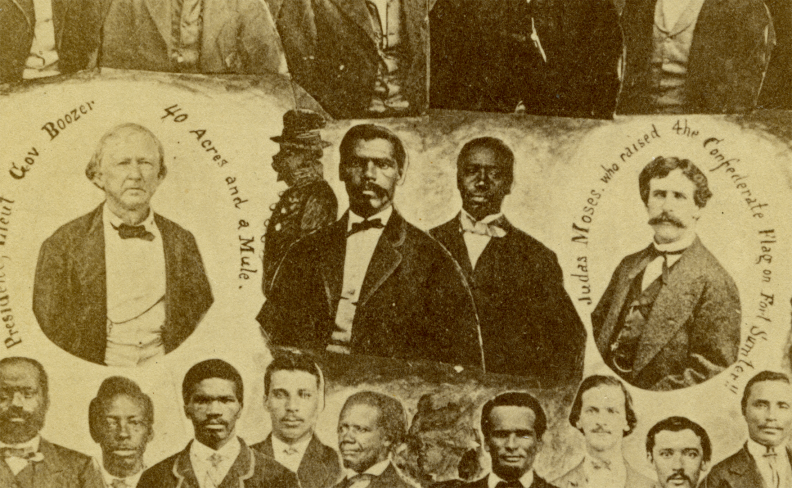
    Detail from photo montage of the some members of the first S.C.  legislature after the American Civil War, with Lawrence Cain, center
    "Radical members of the first legislature after the war, South Carolina" - Photomontage of members of the first South Carolina legislature following the Civil War, mounted on card with each member identified. (Lawrence Cain, center, third from left)( Library of Congress)

    Kevin Cherry's book, The Virtue of Cain: From Slave to Senator (2021, Rocky Pond Press) focuses on the short but extraordinary life of Reconstruction era Senator Lawrence Cain of Edgefield, South Carolina. He was considered an honorable and virtuous man and helped shape South Carolina politics between 1865 and 1877 as one of the leaders of the Radical Republican movement. He rose above numerous obstacles to go from slave to state senator

    The facts of his life had been forgotten by his descendants, like much of African American history during Reconstruction. But they were re-discovered Lawrence Cain's great great-grandson, Kevin M. Cherry, with the help of family, genealogy research, archived papers and genetic DNA results. Cherry is joined in conversation with Walter Edgar and Dr. Vernon Burton, professor emeritus of history at Clemson University, recounting Lawrence Cain’s remarkable life and the social and political upheaval of Reconstruction in South Carolina.

    News and Music Stations: Friday, Apr 16, at 12 pm; Sat, Apr 17, 7 am
    News & Talk Stations: Friday, Apr 16, at 12 pm; Sun, Apr 18, 4 pm


    The Tragic Story of the Hamlet Fire Apr 06, 2021
    Show notes
    A view of the cooker around which the 1991 Imperial Foods chicken processing plant fire was centered. Taken from this report by the United States Fire Administration.
    A view of the cooker around which the1991 Imperial Foods chicken processing plant fire was centered. Taken from a report by the United States Fire Administration.(United States Fire Administration / Wikimedia)

    For decades, the small, quiet town of Hamlet, North Carolina, thrived thanks to the railroad. But by the 1970s, it had become a postindustrial backwater, a magnet for businesses in search of cheap labor and almost no oversight. Imperial Food Products was one of those businesses. The company set up shop in Hamlet in the 1980s. Workers who complained about low pay and hazardous working conditions at the plant were silenced or fired. But jobs were scarce in town, so workers kept coming back, and the company continued to operate with impunity.

    Then, on the morning of September 3, 1991, the never-inspected chicken-processing plant a stone’s throw from Hamlet’s city hall burst into flames. Twenty-five people perished that day behind the plant’s locked and bolted doors. It remains one of the deadliest accidents ever in the history of the modern American food industry.

    Bryant Simon, professor of history at Temple University, and author of The Hamlet Fire: A Tragic Story of Cheap Food, Cheap Government, and Cheap Lives (2021, UNC Press) talks with Walter Edgar about the market pressures, the governmental neglect, and the greed that lead to the tragedy.

    News and Music Stations: Fri, Apr 09, 12 pm; Sat, Apr 10, 7 am
    News & Talk Stations: Fri, Apr 09, 12 pm; Sun, Apr 11, 4 pm


    The Fabulous Life of Gertrude Sanford Legendre Mar 31, 2021
    Show notes
     Portrait of Gertioe Sanford, 29.
    Portrait of Gertioe Sanford, 29.(Courtesy of Kathryn Smith)

    Gertie was a daring and fearless woman whose adventures included being the first American woman in uniform held as a POW by the Germans during World War II. She also partied on the Riviera with the Murphys, the Fitzgeralds and Harpo Marx in the 1920s, undertook numerous challenging expeditions for natural history museums (and lead four) and befriended some of the greatest personalities of the 20th century, including Dr. Albert Schweitzer, General George S. Patton, Lilly Pulitzer, and Bing Crosby. In her later years, she became an ardent conservationist, fighting for habitat preservation on the South Carolina coast and leaving her 7,000-acre plantation in a conservation easement, a place where the beasts can grow old and die.


    George Singleton: You Want More Mar 22, 2021
    Show notes
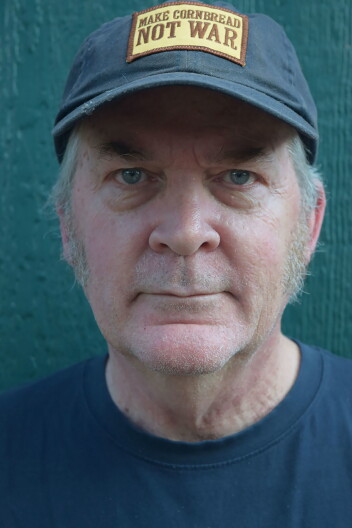
    George Singleton
    George Singleton(Courtesy of Hub City Press)

    With his signature darkly acerbic and sharp-witted humor, George Singleton has built a reputation as one of the most astute and wise observers of the South. Singleton’s latest book, You Want More: Selected Stories of George Singleton (2020, Hub City Press) is a compilation of acclaimed and prize-winning short fiction spanning twenty years and eight collections.

    These stories bear the influence of Flannery O’Connor and Raymond Carver, at other times Lewis Nordan and Donald Barthelme, and touch on the mysteries of childhood, the complexities of human relationships, and the absurdity of everyday life, its inexorable defeats, and small triumphs. Assembled here for the very first time, You Want More showcases the body of work, hilarious and incisive, that has cemented George Singleton’s place among the South’s greatest living writers.

    - Originally broadcast 03/29/21 -

    News and Music Stations: Fri, Jun 04, 12 pm; Sat, Jun 05, 7 am
    News & Talk Stations: Fri, Jun 04, 12 pm; Sun, Jun 07, 4 pm


    How the Blinding of Sergeant Isaac Woodard Changed the Course of America’s Civil Rights History Mar 08, 2021
    Show notes
    The Detroit tribune, November 23, 1946: a notice that Isaac Woodard would be speaking at an NAACP event.
    (Library of Congress, from Central Michigan University, Clark Historical Library)

    On February 12, 1946, Sergeant Isaac Woodard, a returning, decorated African American veteran of World War II, was removed from a Greyhound bus in Batesburg, South Carolina, after he challenged the bus driver’s disrespectful treatment of him. Woodard, in uniform, was arrested by the local police chief, Lynwood Shull, and beaten and blinded while in custody.

    President Harry Truman was outraged by the incident. He established the first presidential commission on civil rights and his Justice Department filed criminal charges against Shull. In July 1948, following his Commission’s recommendation, Truman ordered an end to segregation in the U.S. armed forces.

    An all-white South Carolina jury acquitted Shull, but the presiding judge, J. Waties Waring, was conscience-stricken by the failure of the court system to do justice by the soldier. Waring described the trial as his “baptism of fire,” and began issuing major civil rights decisions from his Charleston courtroom, including his 1951 dissent in Briggs v. Elliott, declaring public school segregation per se unconstitutional. Three years later, the Supreme Court adopted Waring’s language and reasoning in Brown v. Board of Education.

    - Originally broadcast on 03/08/19 -

    News and Music Stations: Fri, Mar 19, 12 pm; Sat, Mar 20, 7 am
    News & Talk Stations: Fri, Mar 19, 12 pm; Sun, Mar 21, 4 pm


    In Her Shoes: A History of the League of Women Voters of South Carolina Mar 01, 2021
    Show notes
    (Courtesy of the League of Women Voters of SC)
    (www.lwv.org)

    The League of Women Voters of South Carolina has a long and colorful history. Born out of the women's suffrage movement, the South Carolina League was organized in 1920, the year of the ratification of the 19th Amendment that ended a 72-year struggle for women’s right to vote.

    The League in South Carolina went dormant in the 1930s, only to revive in the late 1940s, with a state board in place in 1951, just in time for the struggle over desegregation of the public schools. Over the years, the South Carolina League has always focused on voter education, voting rights, empowerment of women, as well as advocacy for constitutional reform, environmental protection, public education, and transparent and accountable government.

    Joining Walter Edgar to talk about the League are Dr. Sheila Haney, author of In Her Shoes: A History of the League of Women Voters of South Carolina, 1920-2020, and Dr. Holley Ulbrich, co-president of the League.

    News and Music Stations: Fri, Mar 05, 12 pm; Sat, Mar 06, 7 am
    News & Talk Stations: Fri, Mar 05, 12 pm; Sun, Mar 07, 4 pm


    The Beginnings of Black Activism in South Carolina Feb 22, 2021
    Show notes
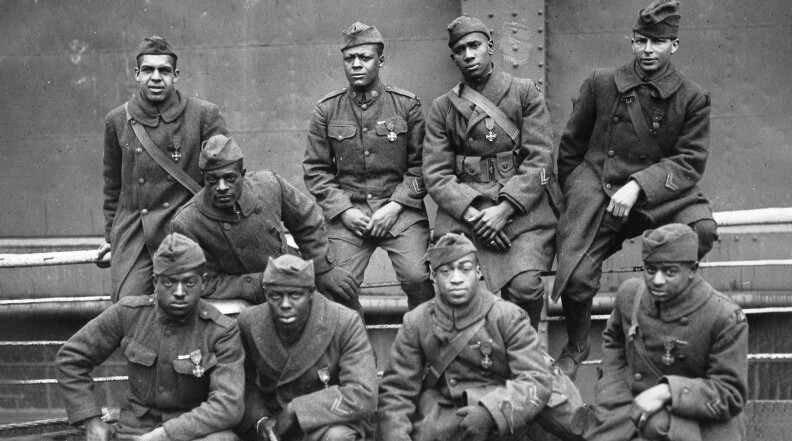
    The 369th Infantry Regiment served on the front lines for 191 days during World War I, longer than any other American unit. In that time, the Soldiers of the regiment, known as the "Harlem Hellfighters," never gave up any ground it captured.
    (Library of Congress)

    After World War I, Black South Carolinians, despite poverty and discrimination, began to organize and lay the basis for the civil rights movement that would occur after World War II. Dr. Bobby Donaldson of the University of South Carolina talks about the efforts by black South Carolinians to obtain justice and civil rights during a time of economic collapse and political change.

    - Originally broadcast 01/31/20 -

    News and Music Stations: Fri, Feb 26, 12 pm; Sat, Feb 27, 7 am
    News & Talk Stations: Fri, Feb 26, 12 pm; Sun, Feb 28, 4 pm


    Judge J. Waties Waring and the Secret Plan that Sparked a Civil Rights Movement Feb 15, 2021
    Show notes
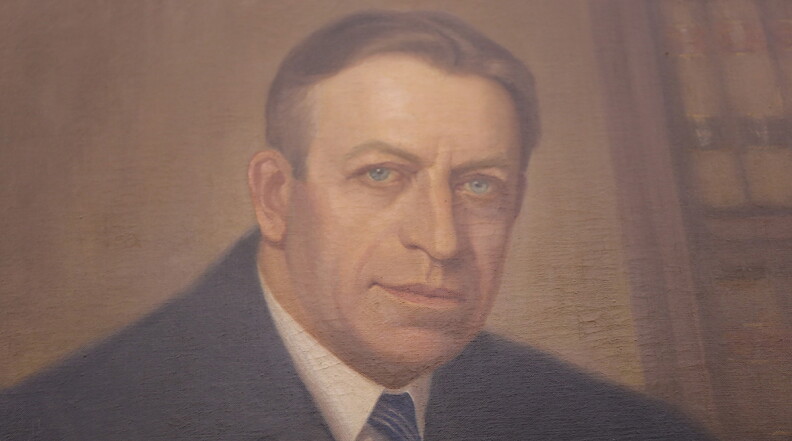
    A portrait of Judge J. Waities Waring hangs in the courthouse that bears his name.
    (Victoria Hansen/SC Public Radio)

    Four years before the landmark U.S. Supreme Court decision Brown v. Board of Education, a federal judge in Charleston hatched his secret plan to end segregation in America. Julius Waties Waring was perhaps the most unlikely civil rights hero in history. An eighth-generation Charlestonian, the son of a Confederate veteran and scion of a family of slave owners, Waring was appointed to the federal bench in the early days of World War II.

    Faced with a growing demand for equal rights from black South Carolinians, and a determined and savvy NAACP attorney named Thurgood Marshall, Waring did what he thought was right: He followed the law, and the United States Constitution. In fact, he helped guide Marshall down a narrow legal path that led to the end of segregation schools.

    Brian Hicks talks with Walter Edgar about Waring’s plan, and about his life, in the new book, In Darkest South Carolina: J. Waties Waring and the Secret Plan that Sparked a Civil Rights Movement (2017, Post and Courier Books).

    - Originally broadcast 01/25/19 -

    News and Music Stations: Fri, Feb 19, 12 pm; Sat, Feb 20, 7 am
    News & Talk Stations: Fri, Feb 19, 12 pm; Sun, Feb 21, 4 pm


    Stories of Struggle: The Clash over Civil Rights in South Carolina Feb 08, 2021
    Show notes

    In her new book, Stories of Struggle: The Clash over Civil Rights in South Carolina (2020, USC Press), journalist Claudia Smith Brinson details the lynchings, beatings, cross burnings, and venomous hatred that black South Carolinians endured—as well as the astonishing courage, dignity, and compassion of those who risked their lives for equality.

    Through extensive research and interviews with more than 150 civil rights activists, Brinson chronicles twenty pivotal years of petitioning, picketing, boycotting, marching, and holding sit-ins.

    These intimate stories of courage, both heartbreaking and inspiring, shine a light on the progress achieved by nonviolent civil rights activists while also revealing white South Carolinians’ often violent resistance to change. Although significant racial disparities remain, the sacrifices of everyday folk that produced real progress—and hope for the future.

    Brinson joins Walter Edgar and Dr. Valinda Littlefield to talk about the stories of these brave and tenacious men and women.

    - Originally broadcast 11/13/20 -

    News and Music Stations: Fri, Feb 12, 12 pm; Sat, Feb 13, 7 am
    News & Talk Stations: Fri, Feb 12, 12 pm; Sun, Feb 14, 4 pm


    Charleston Patriots in Exile During the Revolution Feb 01, 2021
    Show notes
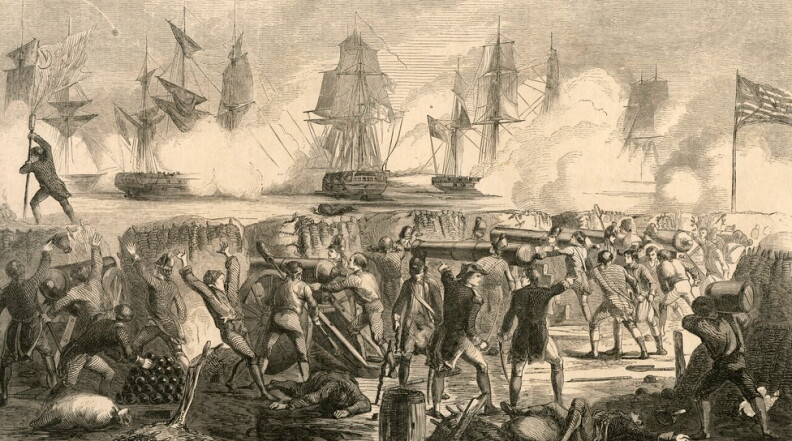
    "The attack on Fort Moultrie, Sullivan's Island, South Carolina, on June 28, 1776." Charleston eventually fell to the British, oin May of 1780.
    (N.Y. Public Library (public domain); Artist: Chapin, John Reuben (1823-1894))

    In the months following the May 1780 capture of Charleston, South Carolina, by combined British and loyalist forces, British soldiers arrested sixty-three paroled American prisoners and transported them to the borderland town of St. Augustine, East Florida—territory under British control since the French and Indian War.

    In their new book, Patriots in Exile: Charleston Rebels in St. Augustine during The American Revolution (2020, USC Press), James Waring McCrady and C. L. Bragg chronicle the banishment of these elite southerners, the hardships endured by their families, and the plight of the enslaved men and women who accompanied them, as well as the motives of their British captors.

    - Originally broadcast 11/20/20 -

    News and Music Stations: Fri, Feb 05, 12 pm; Sat, Feb 06, 7 am
    News & Talk Stations: Fri, Feb 05, 12 pm; Sun, Feb 07, 4 pm


    Previous 1 18 19 20 21 22 37 Next

    Related Podcasts

    Dan Carlin’s Hardcore History

    1

    Dan Carlin’s Hardcore History History
    More Perfect

    2

    More Perfect Government
    Casefile True Crime

    3

    Casefile True Crime Games & Hobbies
    The Way I Heard It with Mike Rowe

    4

    The Way I Heard It with Mike Rowe History
    BackStory

    5

    BackStory History
    The Black Dahlia Serial Killers

    6

    The Black Dahlia Serial Killers History
    footer-logo

    Contact Us

    Toll Free: 844-670-7747

    Links

    • Home
    • Top Charts
    • Networks
    • Apps
    • Independents Podcasts
    • Podcast Advertising
    • Podcast News
    • Contact Us
    • About Us
    • Analytics & Insights

    Stay Connected

      Privacy, Terms of Use & Our Code of Ethics Protecting Content Creators Copyrights