TopPodcast.com
Menu
  • Home
  • Top Charts
  • Top Networks
  • Top Apps
  • Top Independents
  • Top Podfluencers
  • Top Picks
    • Top Business Podcasts
    • Top True Crime Podcasts
    • Top Finance Podcasts
    • Top Comedy Podcasts
    • Top Music Podcasts
    • Top Womens Podcasts
    • Top Kids Podcasts
    • Top Sports Podcasts
    • Top News Podcasts
    • Top Tech Podcasts
    • Top Crypto Podcasts
    • Top Entrepreneurial Podcasts
    • Top Fantasy Sports Podcasts
    • Top Political Podcasts
    • Top Science Podcasts
    • Top Self Help Podcasts
    • Top Sports Betting Podcasts
    • Top Stocks Podcasts
  • Podcast News
  • About Us
  • Podcast Advertising
  • Contact
Not in our directory?
Add Show Here
Podcast Equipment
Center

toppodcastlogoOur TOPPODCAST Picks

  • Comedy
  • Crypto
  • Sports
  • News
  • Politics
  • True Crime
  • Business
  • Finance

Follow Us

toppodcastlogoStay Connected

    View Top 200 Chart
    Back to Rankings Page
    History

    Walter Edgar’s Journal

    From books to barbecue, and current events to Colonial history, historian and author Walter Edgar delves into the arts, culture, and history of South Carolina and the American South. Produced by South Carolina Public Radio.

    Advertise

    Copyright: © 2023 South Carolina Public Radio

    • Apple Podcasts
    • Google Play
    • Spotify

    Latest Episodes:
    South Carolina Progressives During World War I Jul 27, 2020
    Show notes
    Written on print: "Spartanburg, S.C. Saxon Mills; 'Girl workers in the half-time mill school.'"
    (Library of Congress/Goldsberry Collection of open-air school photographs.)

    (Originally broadcast 03/02/18) - There were progressives in South Carolina in 1918. And the progressive movement in this state was different from the movement in the Northeast. However, the United States’ entrance into World War I provided an extra momentum to the movement that led to some fundamental changes the interaction between state and federal authority that lasted through the 20th century.

    Dr. William Link, from the University of Florida, has a public conversation with Walter Edgar about Progressives in South Carolina in World War I. The conversation was recorded at the University of South Carolina’s Capstone Conference Center, in Columbia, on February 06, 2018. It was part of a series presented in January and February, 2018, and sponsored by the USC College of Arts and Sciences.

    - Originally broadcast 02/02/18 -

    All Stations: Fri, Jul 31, 12 pm | News & Talk Stations: Sun, Aug 02, 4 pm


    Fighting on Two Fronts: Black South Carolinians in World War I Jul 20, 2020
    Show notes
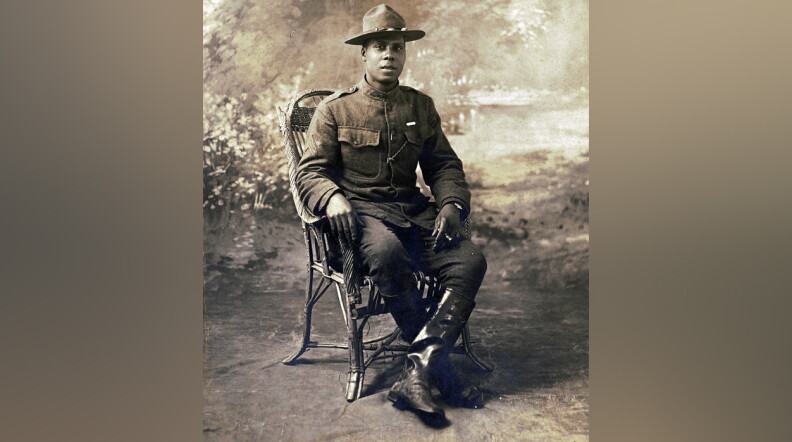
    Unidentified African American soldier in uniform with marksmanship qualification badge and campaign hat, with cigarette holder in front of painted backdrop.
    (Library of Congress)

    Upon the United States' entrance into World War I, President Woodrow Wilson told the nation that the war was being fought to "make the world safe for democracy." For many African-American South Carolinians, the chance to fight in this war was a way to prove their citizenship, in hopes of changing things for the better at home.

    Dr. Janet Hudson from the University of South Carolina joins Dr. Edgar for a public Conversation on Black South Carolinian in World War I. The conversation took place at USC’s Capstone Conference Center, in Columbia, on January 30, 2018. It was part of a series presented in January and February, 2018, and sponsored by the USC College of Arts and Sciences.

    - Originally broadcast 02/23/18 -

    All Stations: Fri, Jul 24, 12pm | News & Talk Stations: Sun, Jul26, 4 pm


    South Carolina in WWI: The Military Jul 13, 2020
    Show notes
    Camp Jackson

    With the United States’ entrance into World War I, three Army training bases were set up in South Carolina. The social and economic impact on a state still suffering from the devastation of the Civil War was dramatic. Three infantry divisions, including support personnel, swelled the Upstate and Midlands population by 90,000. On the coast, recruits flocked to Charleston’s Navy base. And some of those trainees were African Americans, which caused political turmoil and civil strife in a Jim Crow state.

    Dr. Andrew Myers from the University of South Carolina Upstate joins Dr. Edgar for a public Conversation on South Carolina History, World War I to talk about S.C. and the Military. This public conversation was recorded as part of a series presented in January and February, 2018, and sponsored by the USC College of Arts and Sciences.

    - Originally broadcast 02/09/18 -

    All Stations: Fri, Jul 17, 12 pm | News & Talk Stations: Sun, Jul 19, 4 pm


    Reconstruction and the African American Struggle for Equality in the South Jun 22, 2020
    Show notes
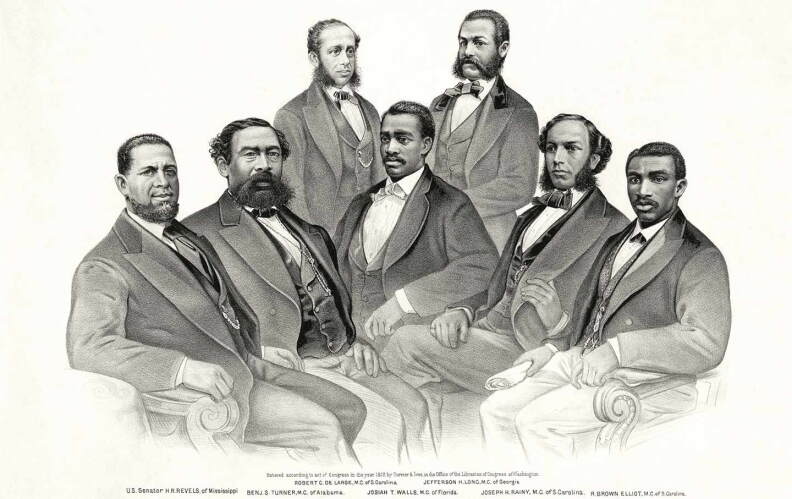
    The first black U.S. senator and first black House members were elected by Southern states during Reconstruction.
    (Library of Congress)

    Dr. Henry Louis Gates, Jr., has said, "Reconstruction is one of the most important and consequential chapters in American history. It is also among the most overlooked, misunderstood and misrepresented."

    For an overview of this fraught era in American history, Dr. Walter Edgar is joined by Dr. J. Brent Morris, Director of the University of South Carolina at Beaufort's Institute for the Study of the Reconstruction Era, for a discussion of Reconstruction and its aftermath, beginning with the hopeful moment of Civil War's end and Emancipation in 1865, and carrying through to 1915, when the nation was fully entrenched in Jim Crow segregation.

    - Originally broadcast 04/05/19 -

    All Stations: Fri, Jun 26, 12 pm | News & Talk Stations: Sun, Jun 28, 4 pm


    What Does Freedom Mean? The Agency of Black People Before and After Emancipation Jun 17, 2020
    Show notes
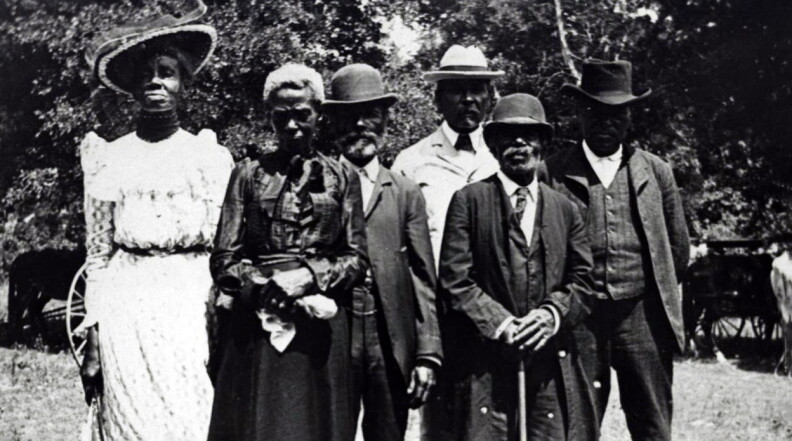
    Emancipation Day Celebration, June 19, 1900, Texas
    (Austin History Center, Austin Public Library)
    Dr. Heather Andrea Williams
    (Steve Exum)

    On June 19th, 1865, Union general Gordon Granger read federal orders in Galveston, Texas, that all previously enslaved people in Texas were free. The news of Emancipation had finally come to the state. Today, this day is celebrated as Juneteenth.

    What did it mean to these newly freed people to "be free"? What power, or "agency" did freedom bring? What agency had the enslaved managed to create before Emancipation?

    Dr. Heather Andrea Williams of Pennsylvania State University has spent her career putting black people at the center of the histories she has written. She joins Dr. Walter Edgar for a public conversation about agency in the lives of people of color before and after Emancipation at the end of the Civil War.

    Williams award-winning first book, Self-Taught: African-American Education in Slavery and Freedom (University of North Carolina Press, 2005), argued that education was inseparable from the fight against slavery.

    All Stations: Fri, Jun 19, 12 pm | News & Talk Stations: Sun, Jun 21, 4 pm

    - Originally broadcast 04/03/15 -


    The Winning of the American Revolution - in the South Jun 08, 2020
    Show notes
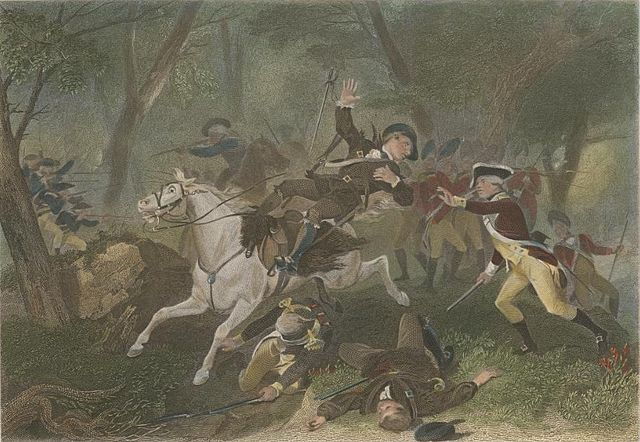
    Engraving depicting the death of British Major Patrick Ferguson at the Battle of Kings Mountain during the American Revolutionary War, October 7, 1780.
    (Chappel, Alonzo, 1828-1887 (artist), Jeens, Charles Henry, 1827-1879 (engraver), Anne S. K. Brown Collection at Brown University)
    Jack D. Warren, Jr, Executive Director of the American Revolution Institute of the Society of the Cincinnati
    (Civil War Trust/Lindsey Morrison)

    General U.S. history courses in many high schools depict the American Revolutionary War as a series of battles in the Northeast--Lexington, Concord, Bunker Hill, etc.--that lead inexorably to British General Charles Cornwallis's surrender of 8,000 British soldiers and seamen to a French and American force at Yorktown, Virginia, October 19, 1781.

    The truth is much more complicated, of course. And a major component of the war, one that paved the way to Yorktown, was the fighting that took place in 1780 - 81 in the South.

    In essence, according to Dr. Jack Warren and Dr. Walter Edgar, the war was won in the South.

    Warren talks with Dr. Edgar as part of a series of public conversations presented by the University of South Carolina’s College of Arts and Sciences, Institute of Southern Studies in 2016. Their topic: Colonial and Revolutionary South Carolina: The Revolution in South Carolina. Dr. Warren is Executive Director at The Society of the Cincinnati.

    - Originally broadcast 03/04/16 -

    All Stations: Fri, Jun 12, 12 pm | News Stations: Sun, Jun 14, 4 pm


    The Colonial Carolina Frontier: Cherokees, Colonists, and Slaves Jun 01, 2020
    Show notes
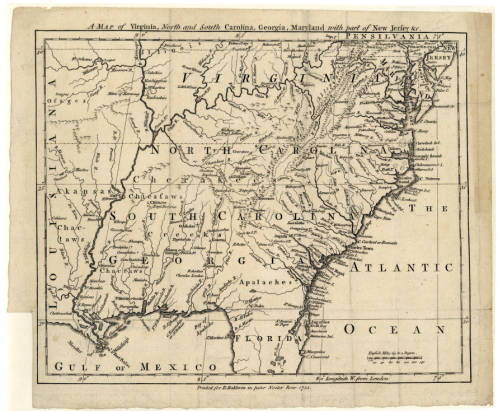
    Early map of Virginia and the Carolinas
    (North Carolina State Archives)

    ​In his book, Carolina in Crisis: Cherokees, Colonists, and Slaves in the American Southeast, 1756 - 1763, (2015, UNC Press) Dr. Daniel J. Tortora, assistant professor of history at Colby College, explores how the Anglo-Cherokee War reshaped the political and cultural landscape of the colonial South. Tortora joins Walter Edgar for a discussion of these events in one of a a series of public conversations, “Conversations on Colonial and Revolutionary South Carolina.”

    The series was presented in 2016 by the University of South Carolina’s College of Arts and Sciences.

    In their discussion, Dr. Tortora argues that the political and military success of the Cherokees led colonists to a greater fear of slave resistance and revolt and ultimately nurtured South Carolinians' rising interest in the movement for independence.

    - Originally broadcast 02/19/16 -

    All Stations: Fri, Jun 05, 12 pm | News Stations: Sun, Jun 07, 4 pm


    Why Southern Identity Still Matters May 25, 2020
    Show notes
    Okra for sale at the North Charleston Farmers' Market.
    Okra for sale at the North Charleston Farmers' Market.(Ryan Johnson / Flickr)

    The American South has experienced remarkable change over the past half century. Black voter registration has increased, the region’s politics have shifted, and in-migration has increased its population many fold. At the same time, many outward signs of regional distinctiveness have faded. But two professors of political science write that these changes have allowed for new types of Southern identity to emerge.

    In their new book, The Resilience of Southern Identity: Why the South Still Matters in the Minds of Its People (2017, UNC Press), Western Carolina University's Chris Cooper and the College of Charleston's Gibbs Knotts argue that, for some, identification with the South has become more about a connection to the region’s folkways or to place than about policy or ideology. For others, the contemporary South is all of those things at once—a place where many modern-day southerners navigate the region’s confusing and omnipresent history.

    - Originally broadcast 11/23/19 -

    All Stations: Fri, May 29, 12 pm | News & Talk Stations: Sun, Nov 31, 4 pm


    "They Stole Him Out of Jail" - Willie Earle, South Carolina's Last Lynching Victim May 11, 2020
    Show notes
    Walter Edgar's Journal
    (SC Public Radio)

    In They Stole Him Out of Jail (2019, USC Press), William B. Gravely presents the most comprehensive account of the Willie Earle's lynching ever written, exploring it from background to aftermath and from multiple perspectives. Gravely meticulously re-creates the case’s details, analyzing the flaws in the investigation and prosecution that led in part to the acquittals. Vivid portraits emerge of key figures in the story, including both Earle and cab driver T. W. Brown, Solicitor Robert T. Ashmore, Governor Strom Thurmond, and Rebecca West, the well-known British writer who covered the trial for the New Yorker magazine.

    Before daybreak on February 17, 1947, twenty-four-year-old Willie Earle, an African American man arrested for the murder of a Greenville, South Carolina, taxi driver named T. W. Brown, was abducted from his jail cell by a mob, and then beaten, stabbed, and shot to death. An investigation produced thirty-one suspects, most of them cabbies seeking revenge for one of their own. The police and FBI obtained twenty-six confessions, but, after a nine-day trial in May that attracted national press attention, the defendants were acquitted by an all-white jury.

    All Stations: Fri, May 15, 2020, 12 pm | News Stations: Sun, May 17, 4 pm

    - Originally broadcast 02/07/20 -


    Go Inside Catering, the Food World’s Riskiest Business with Matt and Ted Lee Apr 27, 2020
    Show notes
    Ted Lee and Matt Lee
    (Ovation)

    This week on Walter Edgar's Journal, Mat Lee and Ted Lee drop in to talk about their new book, Hotbox: Inside Catering, the Food World’s Riskiest Business (2019, Henry Holt). In Hotbox, the Lee brothers take on the competitive, wild world of high-end catering, exposing the secrets of a food business few home cooks or restaurant chefs ever experience. Known for their modern take on Southern cooking, the Lee brothers steeped themselves in the catering business for four years, learning the culture from the inside-out. It’s a realm where you find eccentric characters, working in extreme conditions, who must produce magical events and instantly adapt when, for instance, the host’s toast runs a half-hour too long, a hail storm erupts, or a rolling rack of hundreds of ice cream desserts goes wheels-up.

    - Originally broadcast 02/14/20 -

    All Stations: Fri, May 01, 2020, 12 pm | News Stations: Sun, May 03, 4 pm


    Previous 1 20 21 22 23 24 37 Next

    Related Podcasts

    Dan Carlin’s Hardcore History

    1

    Dan Carlin’s Hardcore History History
    More Perfect

    2

    More Perfect Government
    Casefile True Crime

    3

    Casefile True Crime Games & Hobbies
    The Way I Heard It with Mike Rowe

    4

    The Way I Heard It with Mike Rowe History
    BackStory

    5

    BackStory History
    The Black Dahlia Serial Killers

    6

    The Black Dahlia Serial Killers History
    footer-logo

    Contact Us

    Toll Free: 844-670-7747

    Links

    • Home
    • Top Charts
    • Networks
    • Apps
    • Independents Podcasts
    • Podcast Advertising
    • Podcast News
    • Contact Us
    • About Us
    • Analytics & Insights

    Stay Connected

      Privacy, Terms of Use & Our Code of Ethics Protecting Content Creators Copyrights