From books to barbecue, and current events to Colonial history, historian and author Walter Edgar delves into the arts, culture, and history of South Carolina and the American South. Produced by South Carolina Public Radio.
The Tragic Story of the Hamlet Fire
Jun 21, 2021
Show notes A view of the cooker around which the1991 Imperial Foods chicken processing plant fire was centered. Taken from a report by the United States Fire Administration.(United States Fire Administration / Wikimedia)
On the morning of September 3, 1991, the never-inspected chicken-processing plant a stone’s throw from city hall in tiny Hamlet, NC, burst into flames. Twenty-five people perished that day behind the plant’s locked and bolted doors. It remains one of the deadliest accidents ever in the history of the modern American food industry.
For decades, the small, quiet town of Hamlet, North Carolina, thrived thanks to the railroad. But by the 1970s, it had become a postindustrial backwater, a magnet for businesses in search of cheap labor and almost no oversight. Imperial Food Products was one of those businesses. The company set up shop in Hamlet in the 1980s. Workers who complained about low pay and hazardous working conditions at the plant were silenced or fired. But jobs were scarce in town, so workers kept coming back, and the company continued to operate with impunity.
Then, on the morning of September 3, 1991, the never-inspected chicken-processing plant a stone’s throw from Hamlet’s city hall burst into flames. Twenty-five people perished that day behind the plant’s locked and bolted doors. It remains one of the deadliest accidents ever in the history of the modern American food industry.
Bryant Simon, professor of history at Temple University, and author of The Hamlet Fire: A Tragic Story of Cheap Food, Cheap Government, and Cheap Lives (2021, UNC Press) talks with Walter Edgar about the market pressures, the governmental neglect, and the greed that lead to the tragedy.
- Originally broadcast 04/09/21 -
News and Music Stations: Fri, Jun 25, 12 pm; Sat, Jun 26, 7 am News & Talk Stations: Fri, Jun 25, 12 pm; Sun, Jun 27, 4 pm
Rediscovered Ancestry: a Family Learns the Story of Their Remarkable Ancestor, Senator Lawrence Cain
Jun 14, 2021
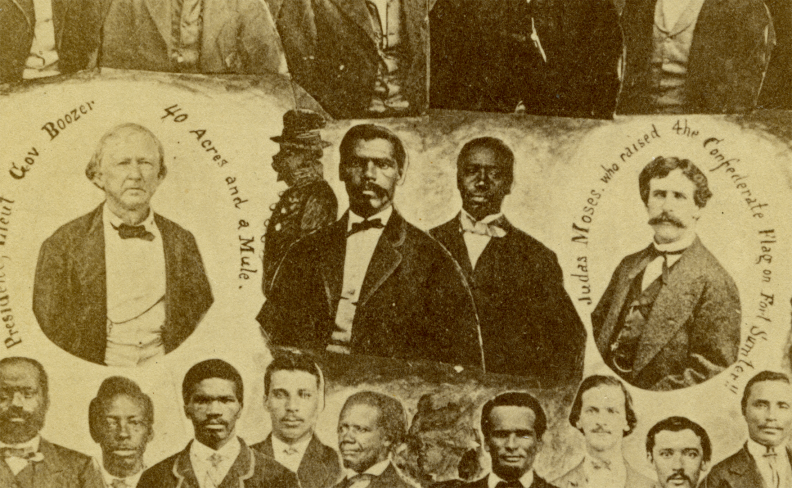
Show notes "Radical members of the first legislature after the war, South Carolina" - Photomontage of members of the first South Carolina legislature following the Civil War, mounted on card with each member identified. (Lawrence Cain, center, third from left)( Library of Congress)
Kevin Cherry's book, The Virtue of Cain: From Slave to Senator (2021, Rocky Pond Press) focuses on the short but extraordinary life of Reconstruction era Senator Lawrence Cain of Edgefield, South Carolina. He was considered an honorable and virtuous man and helped shape South Carolina politics between 1865 and 1877 as one of the leaders of the Radical Republican movement. He rose above numerous obstacles to go from slave to state senator
The facts of his life had been forgotten by his descendants, like much of African American history during Reconstruction. But they were re-discovered Lawrence Cain's great great-grandson, Kevin M. Cherry, with the help of family, genealogy research, archived papers and genetic DNA results. Cherry is joined in conversation with Walter Edgar and Dr. Vernon Burton, professor emeritus of history at Clemson University, recounting Lawrence Cain’s remarkable life and the social and political upheaval of Reconstruction in South Carolina.
News and Music Stations: Friday, Apr 16, at 12 pm; Sat, Apr 17, 7 am News & Talk Stations: Friday, Apr 16, at 12 pm; Sun, Apr 18, 4 pm
The Fabulous Life of Gertrude Sanford Legendre
Jun 11, 2021
Show notes Portrait of Gertioe Sanford, 29.(Courtesy of Kathryn Smith)
Kathryn Smith, author of Gertie: The Fabulous Life of Gertrude Sanford Legendre, Heiress, Explorer, Socialite, Spy (2021, Evening Post Publishing Company) joins Walter Edgar to tell the amazing story of Gertrude Sanford Legendre, a woman whose adventurous life spanned the twentieth century, beginning in Aiken, S.C. in 1902 and ending at her plantation outside Charleston in 2000.
Gertie was a daring and fearless woman whose adventures included being the first American woman in uniform held as a POW by the Germans during World War II. She also partied on the Riviera with the Murphys, the Fitzgeralds and Harpo Marx in the 1920s, undertook numerous challenging expeditions for natural history museums (and lead four) and befriended some of the greatest personalities of the 20th century, including Dr. Albert Schweitzer, General George S. Patton, Lilly Pulitzer, and Bing Crosby. In her later years, she became an ardent conservationist, fighting for habitat preservation on the South Carolina coast and leaving her 7,000-acre plantation in a conservation easement, a place where the beasts can grow old and die.
- Originally broadcast 04/02/21 -
News and Music Stations: Sat, Jun 12, 7 am News & Talk Stations: Friday, Jun 11, at 12 pm; Sun, Jun 13, 4 pm
George Singleton: You Want More
May 31, 2021
Show notes George Singleton(Courtesy of Hub City Press)
George Singleton joins Walter Edgar to talk about his new collection of short stories, You Want More, some of his favorite stories, and his life as a writer.
With his signature darkly acerbic and sharp-witted humor, George Singleton has built a reputation as one of the most astute and wise observers of the South. Singleton’s latest book, You Want More: Selected Stories of George Singleton (2020, Hub City Press) is a compilation of acclaimed and prize-winning short fiction spanning twenty years and eight collections.
These stories bear the influence of Flannery O’Connor and Raymond Carver, at other times Lewis Nordan and Donald Barthelme, and touch on the mysteries of childhood, the complexities of human relationships, and the absurdity of everyday life, its inexorable defeats, and small triumphs. Assembled here for the very first time, You Want More showcases the body of work, hilarious and incisive, that has cemented George Singleton’s place among the South’s greatest living writers.
- Originally released 03/26/21 -
A Year Like No Other and "The Summer of Lost and Found" - A Conversation with Mary Alice Monroe
May 24, 2021
Show notes Mary Alice Monroe( Courtesy of the Artist)
In a wide-ranging conversation, New York Times bestselling author Mary Alice Monroe talks with Walter Edgar about 2020 - "a year like no other" - and the personal challenges of living through it.
The also discuss her latest novel, The Summer of Lost and Found, in which many of the characters are facing the challenges and the same tough choices. And yet, they find support and even joy in "the beach house."
Monroe is the author of 27 books, including the Beach House series: The Beach House, Swimming Lessons, Beach House Memories, Beach House for Rent, Beach House Reunion, and On Ocean Boulevard. More than 7.5 million copies of her books have been published worldwide.
News and Music Stations: Fri, May 28, 12 pm; Sat, May 29, 7 am News & Talk Stations: Fri, May 28, 12 pm; Sun, May 30, 4 pm
The Gulf of Mexico: A Maritime History
May 17, 2021
Show notes The Gulf of Mexico(NASA / Flickr)
Gulf events of global historical importance are detailed, such as the only defeat of armed and armored steamships by wooden sailing vessels, the first accurate deep-sea survey and bathymetric map of any ocean basin, the development of shipping containers by a former truck driver frustrated with antiquated loading practices, and the worst environmental disaster in American annals.
This week on Walter Edgar’s Journal, John S. Sledge’s talks with Walter about his book, The Gulf of Mexico: A Maritime History (2021, USC Press). In it, Sledge presents a compelling, salt-streaked narrative of the earth's tenth largest body of water. In this beautifully written and illustrated volume, Sledge explores the people, ships, and cities that have made the Gulf's human history and culture so rich.
Occasionally shifting focus ashore, Sledge explains how people representing a gumbo of ethnicities built some of the world's most exotic cities—Havana, way station for conquistadores and treasure-filled galleons; New Orleans, the Big Easy, famous for its beautiful French Quarter, Mardi Gras, and relaxed morals; and oft-besieged Veracruz, Mexico's oldest city, founded in 1519 by Hernán Cortés. Throughout history the residents of these cities and their neighbors along the littoral have struggled with challenges both natural and human-induced—devastating hurricanes, frightening epidemics, catastrophic oil spills, and conflicts ranging from dockside brawls to pirate raids, foreign invasion, civil war, and revolution.
In the modern era the Gulf has become critical to energy production, fisheries, tourism, and international trade, even as it is threatened by pollution and climate change. The Gulf of Mexico: A Maritime History is a work of verve and sweep that illuminates both the risks of life on the water and the riches that come from its bounty.
The Grim Years: Settling South Carolina, 1670 - 1720
May 10, 2021
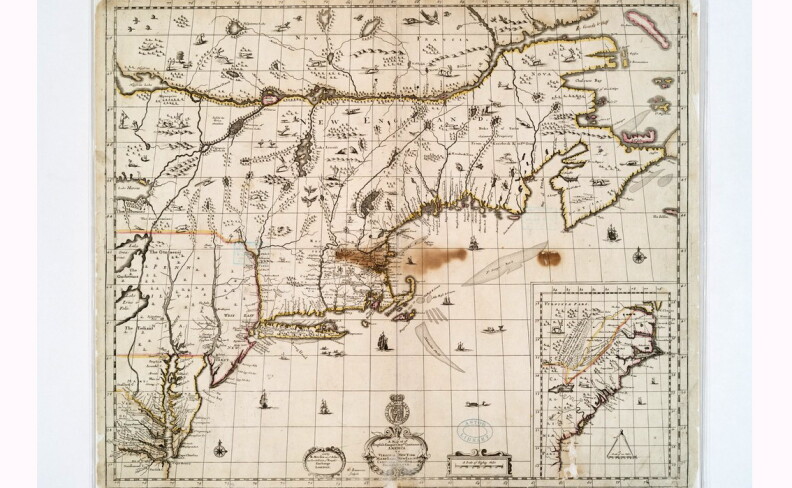
Show notes A map of ye English Empire in ye continent of America : viz Virginia, Maryland, Carolina, New York, New Iarsey, New England, Pennsilvania(Morden, Robert (d. 1703), Bookseller; Binneman, Walter, Engraver Daniel, R. (Richard), Cartographer / NY Public Library)
In his book, The Grim Years: Settling South Carolina, 1670-1720 (2020, University of SC Press), Dr. John Navin explains how eight English aristocrats, the Lords Proprietors, came to possess the vast Carolina land grant and then enacted elaborate plans to recruit and control colonists as part of a grand moneymaking scheme. In his conversation with Walter Edgar, Navin tells of a cadre of men who rose to political and economic prominence, while ordinary colonists, enslaved Africans, and indigenous groups became trapped in a web of violence and oppression.
But those plans went awry, and the mainstays of the economy became hog and cattle ranching, lumber products, naval stores, deerskin exports, and the calamitous Indian slave trade. The settlers' relentless pursuit of wealth set the colony on a path toward prosperity but also toward a fatal dependency on slave labor. Rice would produce immense fortunes in South Carolina, but not during the colony's first fifty years. Religious and political turmoil instigated by settlers from Barbados eventually led to a total rejection of proprietary authority.
Threatened by the Native Americans they exploited, by the Africans they enslaved, and by their French and Spanish rivals, white South Carolinians lived in continual fear. For some it was the price they paid for financial success. But for most there were no riches, and the possibility of a sudden, violent death was overshadowed by the misery of their day-to-day existence.
Black Freedom in the Age of Slavery: Race, Status, and Identity in the Urban Americas
May 03, 2021
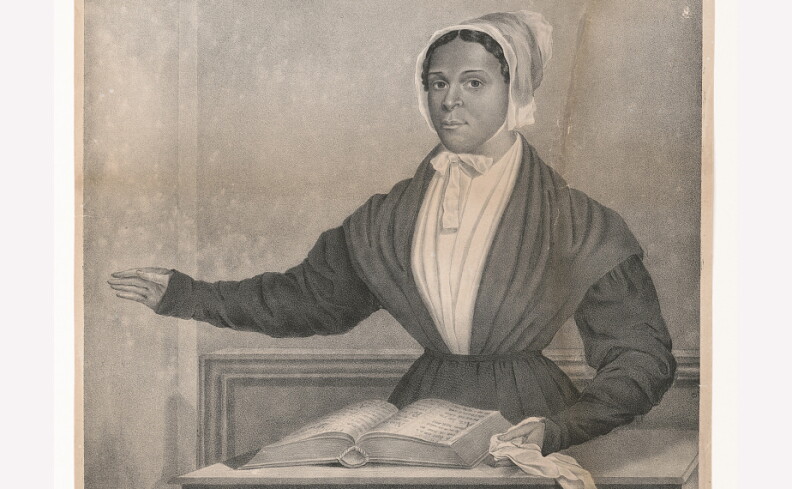
Show notes Mrs. Juliann Jane Tillman, preacher of the A.M.E. Church(A. Hoffy ; printed by P.S. Duval, 1844 / Library of Congress)
Dr. Marks examines how these individuals built lives in freedom for themselves and their families in two of the Atlantic World's most important urban centers: Cartagena, along the Caribbean coast of modern-day Colombia, and Charleston, in the Lowcountry of North America's Atlantic coast. His conversation on this edition of Walter Edgar’s Journal focuses on the world of free people of color in and around Charleston.
Jackson Station: Music, Community, and Tragedy in Southern Blues Bar
Apr 26, 2021
Show notes
The smoke was thick, the music was loud, and the beer was flowing. In the fast-and-loose 1980s, Jackson Station Rhythm & Blues Club in Hodges, South Carolina, was a festive late-night roadhouse filled with people from all walks of life who gathered to listen to the live music of high-energy performers. Housed in a Reconstruction-era railway station, the blues club embraced local Southern culture and brought a cosmopolitan vibe to the South Carolina backcountry.
Over the years, Jackson Station became known as one of the most iconic blues bars in the South. It offered an exciting venue for local and traveling musical artists, including Widespread Panic, the Swimming Pool Qs, Bob Margolin, Tinsley Ellis, and R&B legend Nappy Brown, who loved to keep playing long after sunrise.
The good times ground to a terrifying halt in the early morning hours of April 7, 1990. A brutal attack—an apparent hate crime—on the owner Gerald Jackson forever altered the lives of all involved.
News and Music Stations: Fri, Apr 30, 12 pm; Sat, May 01, 7 am| News & Talk Stations: Fri, Apr 30, 12 pm; Sun, May 02, 4 pm
A History of the Southern Conference
Apr 23, 2021
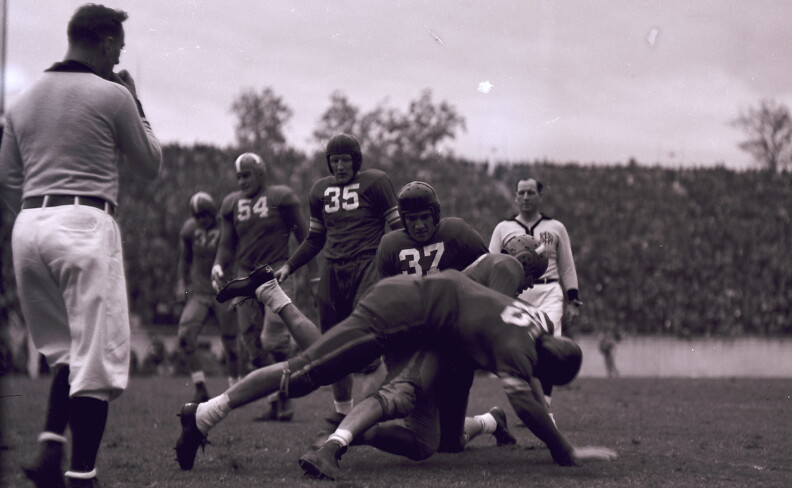
Show notes Duke University football coach Wallace Wade at practice in the 1930s. Duke was a member of the Southern Conference from 1928 to 1953.(Duke University Archives / Flickr)
In the winter of 1921, fifteen prominent colleges and universities met in Atlanta, Georgia, to form a new organization to promote intercollegiate athletics competition. That organization, soon to become known as the Southern Conference (SoCon), remains a strong and viable member of the National Collegiate Athletic Association (NCAA) 100 years later. Southern Conference roots may be found throughout college athletics from the Mid-Atlantic region to the deep South. All but three of the current Southeastern Conference (SEC) members once belonged to the Southern Conference. Likewise, a majority of present Atlantic Coast Conference (ACC) institutions formerly were SoCon members.
This time on Walter Edgar’s Journal, former SoCon commissioner John Iamarino, author of A Proud Athletic History: 100 Years of The Southern Conference (2021, Mercer University Press), tells the story of the notable athletes, coaches, and athletic programs that have built such a rich tradition over so many decades. Legendary sports figures such as Jerry West, Arnold Palmer, Bear Bryant, Sam Huff, and Steph Curry are all part of the Southern Conference's past.
- Originally broadcast 04/23/21 -
News and Music Stations: Fri, Dec 23, at 12 pm; Sat, Dec 24, at 7 am News & Talk Stations: Friday, Dec 23, at 12 pm; Sun, Dec 25, at 4 pm

 Our TOPPODCAST Picks
  Stay Connected