GitLab CFO: We’ve executed really well in a tough market
Dec 14, 2022
Show notes
I generally think I can pattern-match pretty well with respect to corporate earnings, having reported on them for decades.
Take, for example, GitLab, a young software vendor that came public in October of last year. It sells a set of software capabilities that are woven together that serve application developers. On the simplest level, it is what is called a a “version control system,” a repository where coders put their pieces of code that tracks which is the latest version, who has what, and other such functions.
The company a week ago reported their October-ending fiscal third quarter results, and it was the fifth quarter in a row since going public that the company has beaten expectations — by a very healthy margin, I should add — and the fifth time its forecast was higher.
In a case like that, where a company seems to be defying gravity, my sense of pattern tells me some on the Street might just start to expect the company has to stumble at some point, to have a sophomore slump. No company can keep a streak going forever.
“That’s fair,” says the company’s chief financial officer, Brian Robins, when I propose my theory to him during a Zoom interview last week.
There were, he admits, “watch points” in the quarter, things to keep an eye on. Specifically, “there's starting to be a little bit more deal scrutiny,” last quarter, by which he means, “there's a higher level of sign-offs required, basically, to get some deals done.”
More generally, he adds, “the second quarter, we weren't feeling any macro when a lot of companies were,” meaning, the broader economic distress didn’t touch GitLab’s business. “We felt that more in third quarter,” just ended
Some of the company’s expansion business with its existing software customers, when companies license more “seats” to use the program, was not as high as it should have been, based on GitLab’s statistics of its customer “cohorts.”
“It did have a material impact,” he says of the economic pressure, meaning, GitLab left money on the table last quarter.
Still, none of that is hurting reported results, obviously. GitLab is holding it together while other companies are trimming their forecasts.
GitLab isn’t stumbling by any means. My pattern recognition, in this case, seems to be off.
“You know, we executed really well in a tough market,” says Robins. “We delivered sixty-nine percent year-over-year revenue growth; we beat consensus by seven percent [for revenue] when a lot of companies aren't even beating, they're missing consensus; we did a small raise on top of that, so we had a beat-and-raise quarter.
“And then we also gave our soft guidance for fiscal year 2024, and also said that we're targeting to be cash-flow breakeven in fiscal year 2025.”
The term “soft guidance,” in this case, refers to Robin’s preliminary assessment that next fiscal year, the company will probably see forty percent revenue growth, about in line with consensus. With this, GitLab reassured analysts.
If things are not breaking down at GitLab, contrary to my pattern-matching hypothesis, what is happening?
“I like to try to do pattern recognition, and I came up with a hypothesis,” says Robins. He has told me in past that GitLab is the “best-prepared” among tech companies, doing assiduous research before, during, and after earnings season.
“You know, there’s been two hundred and ten thousand tech layoffs this year, and forty percent of that happened in the third quarter,” he says. That was, he notes, just around the time Meta, Google, Amazon, Twitter, and other firms were announcing a bunch of giant layoffs. “It almost felt like there’s this sentiment in the market, where executives said, holy crap, where is this economy?”
“It reminded me of when COVID first broke out,” he says, back in February of 2020. “A big drop in the stock market, and everything just, sort-of, seized up.”
Business for GitLab has not, however, seized up. Although the expansion deals were held back last quarter, the company had a stellar quarter for what it calls “first orders,” when first-time customers make their first purchase. The first orders, referred to as “new bookings,” rose seventy-five percent, year over year.
New orders should have been performing about in line with expansions, he had expected, but, instead, they did much better.
“To me that is awesome in the sense that, you know, people are coming on the platform,” says Robins. “I think the economy is really helping push people towards doing more with less, greater collaboration, get more efficient, show an ROI [return on investment] — and so, I was super-happy with that.”
You can’t artificially pump up sales results, says Robin’s. “You can't unnaturally grow way faster than the market, and you’re not going to unnaturally grow way slower than the market, but there's a range that you can grow in, and you just have to make sure that you invest accordingly to that range."
To Robins, the fact new customers are coming in the door at a time of economic uncertainty, when repeat business is harder to sign, is evidence of his conviction, which he’s told me before, that GitLab’s programs are “a mission-critical platform,” so much so that “we have some resiliency to the broad macro markets and things that are happening.”
To play devil’s advocate, I ask Robins if his firm should step on the gas, in Street terms, meaning, spend bigger to apply even more sales and marketing effort to win business when other vendors are struggling.
You can’t artificially pump up results, is Robin’s reply. “You can't unnaturally grow way faster than market, and you’re not going to unnaturally grow way slower than the market, but there's a range that you can grow in, and you just have to make sure that you invest accordingly to that range."
“The feedback there is, we've been really consistent,” in how the company talks to the Street, says Robins. “Our number-one objective is to grow, but we'll do that responsibly, and so that's why we've grown into improved operating leverage in the model.”
The operating leverage, in this case, is adding forty-six million dollars more in “incremental” revenue last quarter, with $2.3 million less in operating loss.
Last quarter, operating profit margin, while still negative, improved by a whopping seventeen percentage points, year over year. It is likely that in 2023, GitLab will add something like another one hundred and seventy milloin dollars in revenue, based on Street consensus, even as costs go down, for more operating leverage.
Does the investor pattern-match on all that’s working here? Do they, as I had suggested, fear some kind of stumble for GitLab?
It doesn’t sound like it.
“In three days, I spoke to thirteen analysts and over fifty investors” last week following the report, says Robins.
“When you got to the investors, the questions were all over the board,” he recalls. “I think you know you had a pretty good quarter when there’s not, like, three or four key themes everyone is asking about.”
GitLab stock this year is down forty-three percent, and it is off fifty-two percent since the IPO.
Oracle’s growth speed-up continues, touts gigantic cloud customers such as Nvidia
Dec 13, 2022
Show notes
Shares of software giant Oracle rose by about two percent in late trading Monday evening, as the company reported another quarter in which revenue growth sped up, echoing the prior quarter, with the focus heavily on how the company is winning new customers for its cloud computing business.
Founder and CTO Larry Ellison rattled off names of “big customers” who had moved to using the company’s cloud service, including Fedex, DeutscheBank, and the Tokyo Stock Exchange.
"We're the only ones running a major stock exchange” of all the cloud service providers, said Ellison.
Given a rising backlog of business, “we expect our infrastructure business to continue to grow very, very strongly into the future.”
The forecast for this quarter’s revenue, in addition, was ahead of the Street, with a projected revenue range of $12.3 billion to $12.5 billion versus consensus of about $12.28 billion. That’s stronger than the forecast offered in September.
Oracle is the start of the earnings season. Although it trails other reports and is one of the last companies to report, it closes the books faster than other tech companies and so it is reporting not on September or October results, as most companies have been, but the quarter ended in November.
Sales once again topped expectations, even though foreign exchange continued to hamper reported sales growth, reducing the top-line number by six percentage points. The “constant currency” growth rate of revenue would have been twenty-five percent, though reported growth was a still-healthy eighteen percent. That figure includes one and a half billion dollars of revenue from Cerner, the health care information systems giant that Oracle purchased in June for twenty-nine billion dollars.
CEO Safra Catz noted the company’s continued revenue speed-up: “Even excluding Cerner, total revenue grew 9% in constant currency,” she said. "That's higher than Q1, and on top of a revenue beat this time last year,” she added.
Catz reiterated an expectation that the company’s cloud computing business will rise faster this fiscal year ending in June, stating, “our business continues to accelerate, we expect organic growth for our fiscal year 2023 Cloud revenues will be over 30% in constant currency.” The term “organic” here means excluding the portion attributable to Cerner. Last fiscal year, growth was twenty-two percent, and Catz had said in June, on the fourth-quarter call, that the growth rate would pick up.
Analysts seemed clearly delighted with the cloud growth. Oracle is much smaller than Microsoft, Amazon and Google in cloud “infrastructure,” the basic running of workloads. Its revenue for “IaaS,” the portion that is infrastructure “as a service,” was just a billion dollars last quarter. But, as analyst Phil Winslow of Credit Suisse noted on the call, the rate of growth of IaaS last quarter sped up from fifty-eight percent in the August quarter to fifty-nine percent this past quarter.
Asked how the company is speeding up, Ellison’s reply was partly boosterism — the continued move of computing to Oracle’s cloud from either on-premise or other clouds — but he also gave an interesting insight into how stuff is moving to cloud generally, including artificial intelligence.
“The workloads, AI and machine learning, is a huge – is exploding,” said Ellison. “Nvidia, the people who provide the GPUs for most AI workloads, they're moving a huge amount of stuff to the Oracle Cloud and a bunch of other companies that are doing that.”
Sifting what’s perhaps broadly interesting in all this, I would say it is a) companies continue to plow money into using cloud computing, so that they are shifting how they run their operations in spite of the fact the economic outlook is supposedly volatile; and b) Oracle itself is continuing to spend to build out its cloud operations.
Said Ellison, Oracle has forty “public cloud regions” around the world, and nine underway. He said the company will continue to spend on building such data centers.
“We are careful to pace our investments appropriately, but need to continue to build to meet our accelerating demand,” said Ellison.
That, I think, should be good news for networking firms, including Cisco Systems, Arista Networks and Juniper Networks.
Overall, I’d say the report suggests data centers should continue to be a relative area of health for tech for the foreseeable future.
China’s opening up to play havoc with chips, says Lynx
Dec 13, 2022
Show notes
The Philadelphia Semiconductor Index’s three-month return. Its surge from mid-October has been among the best areas of tech stocks of late.
China’s pivot away from “COVID Zero” as its governing approach to the virus is leading to a surge in cases that will have a “dampening” effect on semiconductor production, opines chip observer RC Rajkumar of the boutique Lynx Equity Strategies in a note to clients Monday.
That might not bode well for semiconductor stocks, which have been among the best tech performers of U.S. issues recently, with the benchmark Philadelphia Semiconductor Index up almost a percent in the past month versus a 1.6% decline for the Nasdaq Composite Index. The Philly has risen despite continued negative data about inventory build-ups of chips and weakening tech spending.
China’s government last week eased off on the lockdowns imposed as part of its COVID Zero policy, and BloombergSunday reported that Covid is “rapidly spreading through Chinese households and offices.”
The supply chain, writes Rajkumar, “has been looking forward to upside as China eased up” on its stringent COVID measures, but, “overnight media reports warn of a dramatic increase in Covid cases across China,” including in Beijing, Shanghai, Shenzhen and Canton. Rajkumar doesn’t cite specific articles.
Rajkumar references “checks” suggesting that smartphone chip production, specifically, is already hampered, and The current unlocking corresponds with some of the heaviest travel time in China, writes Rajkumar, leading up to the Chinese New Year on February 1st.
“Smartphone component makers are planning for a slowdown, in anticipation of CMs [contract manufacturers] reducing capacity in CQ1 [calendar Q1 of 2023] as Covid-infected workers return after Chinese New Year travel,” writes Rajkumar.
“While the expected slowdown is likely not as bad as a government mandated shutdown, the supply chain is nevertheless planning for CM build plan under-shipping end demand.” That will probably hamper already strained supply of Apple’s iPhone 14, Rajkumar writes.
Rajkumar cites the example of what transpired in India before that country began widespread vaccination efforts, suggesting that COVID cases in China are “likely to explode to the upside in the near term.”
“Caseloads then hopefully comes down in 3-6 months as herd immunity kicks in,” while cautioning, “There is little evidence globally of caseloads dropping sharply on the basis on herd immunity alone.”
Silicon carbide investing: Susquehanna offers ST Micro as the reasonable alternative to Wolfspeed
Dec 13, 2022
Show notes
Chip maker Wolfspeed has gotten a lot of attention from the Street as the “pure play” with respect to the relatively new chip technology silicon carbide. But Wolfspeed’s high valuation — eleven times this year’s expected revenue, based on enterprise value — has left some looking for less-expensive investing alternatives.
That’s the situation for Susquehanna Financial’s Christopher Rolland, who on Monday morning initiated coverage of Wolfspeed with a Neutral rating, instead preferring Analog Devices and STMicroelectronics, starting those stocks at “Positive.”
“While we recognize the company’s clear leadership today, shares trade at a premium valuation,” writes Rolland, “even when adjusting to the company’s ambitious long-term target model, implying near perfect execution.
"We therefore opportunistically await a more favorable set up,” he concludes.
Silicon carbide, of course, is a chip technology that is leading to greater driving range in electric vehicles, as I detailed in a piece in February. The technology is used most prominently in what’s called the “traction inverter,” a component in a car that sits between battery and motor and that converts direct current battery power to alternating current power to drive the motor. More effective conversion makes better use of the battery, and SiC, as it’s known, has that attribute.
Rolland sees pretty stunning growth for silicon carbide through the end of this decade, most but not all of that from automotive applications:
We forecast the overall SiC (devices and materials) TAM will reach $10 billion by 2030, a +17.6% CAGR through 2030. Likewise, expect automotive SiC revenue to grow at a +19.1% CAGR from 2022-2030, ultimately reaching a TAM of $8 billion. Rising EV penetration is a key driver for SiC growth, with the highest value in traction inverters as we believe ~65% will contain SiC MOSFETs by 2030, a stark increase from the current level of ~10% as OEMs shift from IGBT-based power products to SiC.
Wolfspeed is the leader, but Rolland’s enthusiasm is tempered by the company’s massive spending plans. As I reported in October, Wolfspeed’s CEO, Gregg Lowe, has told the Street the company needs to be able to cover six and a half billion dollars worth of capital expenses over the next several years to expand their SiC factories in the U.S.
While acknowledging Wolfspeed’s enormous head-start, Rolland writes that the big spending is a turn-off:
Wolfspeed has spent decades driving Silicon Carbide manufacturing to become the undisputed market leader in materials/wafers today. Furthermore, the company is quickly and successfully building its capabilities in finished semiconductor devices. However, we note these capabilities require capital at a cost that is dilutive to shareholders in the near term. Furthermore, competition is coming on fast, and risks of commoditization remain a possibility.
STMicro, writes Rolland, is just starting out in SiC, and SiC may be something that increases the company’s sales growth rate, he opines:
On top of STMicro’s core analog and power management business, the company is addressing new greenfield opportunities, including Silicon Carbide, Gallium Nitride, connected MCU, 3D Sensing and more. These new opportunities can allow the company to reaccelerate growth and expand margins beyond today’s conservative mid-40%s today. This reacceleration in growth, combined with margin expansion, could help drive a meaningful re-rating in the valuation multiple, which today remains in the bottom decibel of the industry. Initiating Positive with a $50 price target.
Analog Devices is not a way to play SiC, per se, it is just a great chip maker that has “opportunities around electric vehicles (BMS), communications (5G RF), and specialty analog (medical, instrumentation, aerospace),” he writes, that “should help maintain industry-leading margins and growth.”
Rolland doesn’t mention the other big SiC chip name, ON Semiconductor.
Shares of Wolfspeed this year are down twenty-six percent, while ST Micro is off twenty percent, ADI is flat for the year, and ON Semiconductor is up five percent.
If you want even more SiC-related names, check out the long table of stocks at the bottom of my February article.
The TL podcast for December 18th, 2022: Chip stocks break their winning streak, and what ails Tesla.
Dec 11, 2022
Show notes
The week was a reprieve for software stocks, with GitLab, SumoLogic, MongoDB, C3.ai and DocuSign among names seeing big jumps in price, Alteryx is imagining a big role for its software going forward, ChatGPT captures the imagination, and subscriptions are coming to The Technology Letter.
Remember, Salesforce and VMware were young companies that rocketed out of the Great Recession
Dec 11, 2022
Show notes
I’ve been thinking a lot lately about The Great Recession of 2008 to 2009, and one of my favorite activities with historical stock data is to look back at what happened to various tech names going into and coming out of that period.
The key thing that you should meditate on is that some great companies that came public just before the recession came out of that economic contraction stronger. People will tell you new technology suffers in a downturn. CIOs, they might say, won’t spend on new stuff, they’ll buy the essentials to which they are already committed.
Don’t be mislead by that conventional wisdom. Important technology thrives and ultimately triumphs through a downturn.
I’d cite two important examples in particular that really make the case for new technology. This is not cherry-picking, though it is selective.
VMware came public moments before the recession, on September 28th of 2007. The officials start of The Great Recession, according to the National Bureau of Economic Research, the body in the U.S. charged with setting these landmarks, was January of 2008, following the peak in activity of the preceding economic expansion in December.
A few years before VMware and the Recession, Salesforce came public in July of 2004.
Both companies were not just young public companies in January of 2008, they represented relatively new technology waves at the time.
There was nothing like VMware as a company when it came public, even though the company by then had been shipping product for nine years. The only comparable software efforts that emerged at the time were from inside of public companies whose main software business had nothing to do with the “virtualization” that VMware spearheaded. In 2008, Microsoft was VMware’s biggest competitor.
To some extent, Citrix Systems had some overlapping offerings. Later, Intel added some virtualization to the chips it sold. Versions of virtualization were already emerging from the open-source software community, such as Xen, but it took a few years still for the biggest of them, such as OpenStack, to emerge. Follow-on works such as the Kubernetes container management software, didn’t emerge until 2015. And Nutanix, the closest comparable as a company, wasn’t founded until 2009.
So, September of 2007 was a time when it was still early in VMware’s influence. Mind you, VMware had already hit $1.3 billion in revenue in 2007, so it was an established company in that respect, even though it was still early in its mission.
Like VMware, Salesforce in 2008 had established itself as a successful company, but it hadn’t yet changed the landscape. For the fiscal year ending January of 2008, it had racked up $750 million in sales.
Salesforce was the poster child for cloud computing for years because there weren’t any other “Saas” — software as a service — companies back then. Its biggest competitor, Workday, which had been founded a year after Salesforce’s IPO, didn’t come public till 2012. And large, entrenched software vendors in 2008 were still largely disparaging of Salesforce in public. It took Larry Ellison of Oracle years more to get with the SaaS thing.
Microsoft’s Satya Nadella would not take over from Steve Ballmer until years later, 2013, which is when Microsoft’s SaaS engine really started to hum.
Consider that when venture capitalist Marc Andreessen wrote-his OpEd for The Wall Street Journal in 2011, two years after the recession, about how “software is eating the world,” he referred to Salesforce as a new kind of software giving competition to older, established software vendors Oracle and Microsoft.
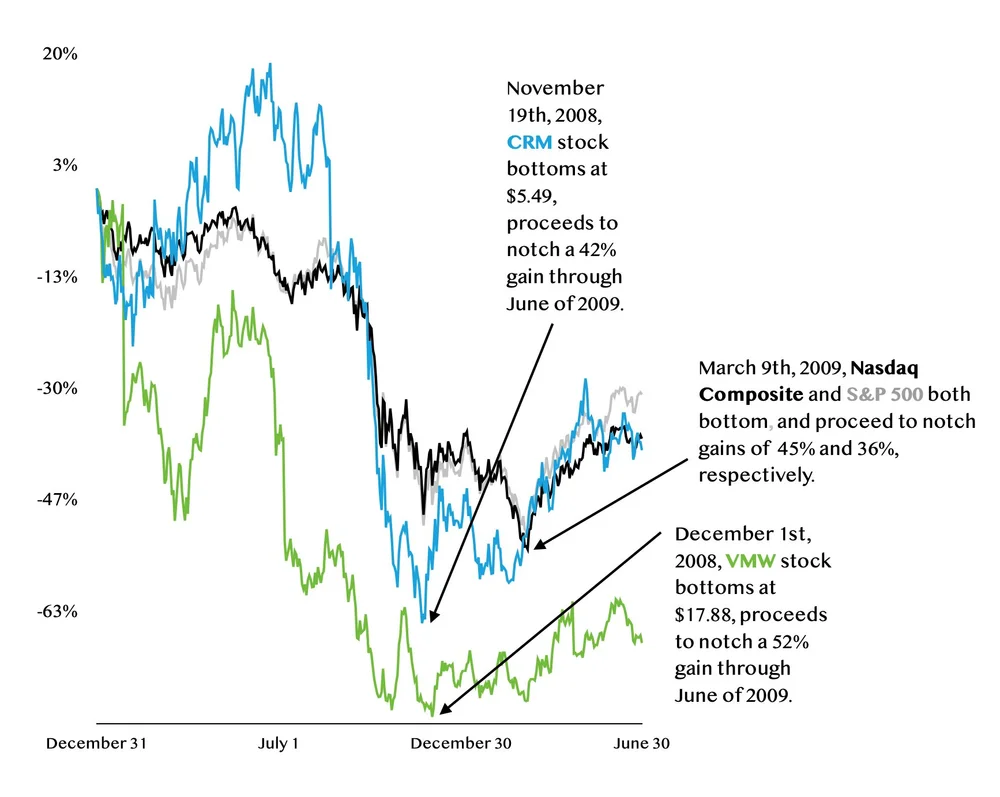
Here is where it gets interesting. Both stocks had deep declines during most of 2008, with VMware dropping sixty-eight percent between January of 2008 and June of 2009, the entirety of the eighteen-month contraction. That was the total damage. And, it dropped a staggering seventy-nine percent from January of 2008 till it finally bottomed on December 1st of that year.
I’ve laid out the course of events in a chart of the two for the whole eighteen months, comparing the two to the broader market:
Similarly, Salesforce had to lose thirty-nine percent from January, 2008 to June of 2009, and from January of 2008 till its bottom on November 19th, it lost sixty-five percent.
However, both stocks saw solid gains from their lowest points. From its bottom in December, VMware went on to notch a fifty-two percent gain in the subsequent seven months of the Recession, and Salesforce saw forty-two percent upside in the ensuing eight months.
Both of these stocks — and this was characteristic of many tech names — bottomed way before the broader market, which didn’t bottom until March 9th of 2009, in the case of The Nasdaq Composite Index and the Standard & Poor’s 500 index.
More important, both companies grewfinancially during the recession. VMware saw an amazing forty-two percent growth during 2008. Even though its growth was drastically reduced in 2009, at almost eight percent it was still growth. The following year, 2010, VMware rebounded sharply, with sales growth rising forty-one percent.
More remarkable, Salesforce saw an amazing forty-four percent increase in sales in the fiscal year that roughly corresponded to 2008. It then went on to twenty-one percent during 2009. After that year, growth picked up to the mid-thirties on a percent basis.
Both of these companies became richer companies, too. Free cash flow for VMware increased a staggering forty-five percent during 2009, to almost nine hundred million dollars that year, real cash profits. Salesforce’s free cash flow increased a slower but still very respectable twenty-eight percent in 2009.
So, what does all this tell you? Good companies with a hand in important technologies that are changing the landscape continued to sell even more stuff during the worst economic contraction the U.S. had seen since World War II. The growth rates were no doubt diminished by what was going on, but sales did not collapse. The companies became more rich on a real cash basis, and their shares bottomed ahead of the broader market and saw healthy gains months before the Recession was over.
Not a bad outlook for tech stock investing. My recollection of covering the market during those later months of 2008 is that everyone was still staggering, dazed and confused by the collapse of Lehman Brothers and the near-collapse of Merrill Lynch, and the folding of retail banking operations such as Washington Mutual. Very few people could see their way to a market rebound in March of 2009, and few were seeing what was already a turn in a couple of great stocks.
Now, the mind turns naturally to the question of which companies today might be in a similar position. Off the top of my head, I would say that software companies at a similar scale and similar rates of growth seem like parallels. In that regard, Snowflake, one of the TL20stocks to consider, is a highly successful cloud software company that just reported nearly two billion dollars in revenue in the twelve months ended in October, similar to the scale of VMware back in 2008. And it has some small free cash flow, similar to Salesforce and VMware.
In a similar vein, Confluent is a software vendor of important infrastructure that has just notched a little over half a billion dollars in trailing twelve-month revenue, though it won’t be profitable for another couple of years.
If you want to know how those two stocks have fared this year, relative to the seventy-nine and sixty-five percent declines of VMware and Salesforce, as a rough approximation, Snowflake is down fifty-seven percent this year, and Confluent is down seventy-two percent. You could say that the declines of both stocks — again, without any clear indication recession has happened or will happen — approaches the kinds of declines that their predecessors endured, allowing, of course, for the fact that Snowflake and Confluent were declining this year from very extended, if you will, valuations, which makes the comparison difficult.
I don’t have a crystal ball to tell you those are the two winners. And I suspect there are several other very good candidates, maybe not all of them as far along in revenue. The bigger takeaway is, companies with important technology and market momentum tend to come out alright on the other side of a financial contraction, and if their technology is really meaningful, it even changes the landscape.
A letter from the editor
Dec 10, 2022
Show notes
The Technology Letter editor Tiernan Ray discusses the forthcoming TL subscriptions.
I conceived of The Technology Letter in August of 2020 as a way to move past media’s fixation with just a handful of companies, Apple, Alphabet, Amazon, Meta, Tesla, and talk about a lot of other things investors care about.
In order to endure, The Technology Letter must become a profitable business. Later this month, subscriptions will go live.
For $30 a month, you’ll get access to the entire site’s content. Readers who already receive the free email newsletter will get an automatic discount to $20 a month.
I have a lot planned for The Technology Letter in the way of future features, and your patronage will be key to that.
In addition to leaving any thoughts about the plan in the comments below, feel free to email me at tiernan@thetechnologyletter.com.
Alteryx CEO Anderson: the platform is next
Dec 08, 2022
Show notes
Anderson in the company’s Manhattan satellite office. The biggest companies, he says, use lots of cloud services. “They can't put all their eggs in one basket.” He believes Alteryx can be an “orchestration or automation layer” across cloud services and on-premise. “We think there's permission that exists for us to build that platform as an independent company.” Mark Anderson has spent two years “re-tooling” software vendor Alteryx, as he puts it, since he came aboard in late 2020, to be better at going after the biggest customers.He worked from a playbook honed at prior tech companies, such as Palo Alto Networks, where he was president for four years, and other big firms. “The majority of the C-Suite is new, the majority of their teams are new,” says Anderson of Alteryx now, “and the people that were here prior to me coming on board, they've really worked hard to get evolved and enabled and trained for what customers need today and tomorrow.”As Alteryx approaches what the Street expects will be a billion dollars in revenue next year, what comes next? The “platform” is what comes next, a surprisingly ambitious bid to revamp the company’s offerings to be a much more comprehensive suite of software programs.I sat down with Anderson this week at the New York satellite office of Alteryx in midtown Manhattan as he took a breather from customer meetings. Alteryx is based in Irvine, California.It was two years ago that Anderson set out to change Alteryx, which he told me at the time needed new blood with a different pedigree, people who, like himself, had taken companies to multiple billions in annual revenue, people with “stage experience.”The re-tooling of the team is working great for Alteryx’s financials. After repeatedly missing expectations in 2020, the company in late 2021 began a very hot streak under Anderson. The third quarter reported last month was the fourth quarter in a row of revenue upside. And while some software makers are trimming their outlook because selling is getting harder, Alteryx raised its revenue forecast for the year for the third time in a row.What happens now is that the product itself needs to grow up. The many programs that make up the company’s offering, lead by its flagship app, Designer, are tools to let employees stitch together various data sources throughout an organization and to run analytic operations on them. It’s a window into operations, to see how sales have been trending, say, or pinpoint where future leads are going to come from, or how the new manufacturing target should be set.In one of the many instances of what he calls “pattern recognition,” Anderson sees a shift in Alteryx customers. Before taking over the CEO role in October of 2020, Anderson had already been a director at the company for over two years.“I used to talk to CFOs, just as a board member, before the pandemic, and they would say, ‘We'll get to our transformation when we're good and ready’,” he reflects. “And now, it's like they can't get there fast enough.”“The pandemic, the ensuing supply chain nightmares, the rampant inflation and talk of recession — companies need help seeing around corners,” he says. They need more of the analytics functions, in other words, with a new urgency. AYX Chart by TradingView Giant customers, he says, are now saying they’re “digital” companies. “I’ve heard the CEO of Capital One say, ‘We’re a technology company that moves money around,’ right?” Another customer, Coca-Cola, “is a technology company that facilitates performance experiences for their consumers.” Those companies need to run more analysis in order to make those transformations, but they can’t make their data scientists be both scientists and marketing and sales experts, he notes. “For one thing, there just aren’t enough of them” given data scientist is a high-price-tag role. And so, “you need to transform the functional knowledge workers with solutions that automate their output,” he says. The tool should be taking people in sales, in marketing, in product development — all over the organization — and make it so their work turns their expertise into valuable analytic insight.“If you're a supply-chain person or an analyst in FP&A [financial planning and analysis], we want to make you automated and great at what you do,” is the pitch. “We don't need to send you to school for five years to teach you how to use Alteryx, you can do it in a day.”At the same time as re-skilling is necessary, he says, some giant companies are in crisis mode in a digital age.“I've had three customer meetings already this morning,” he tells me. “One just left, a large insurance company, they have thousands of knowledge workers that are still working primarily with spreadsheets.“They're closing the books of one of the most famous insurance companies in the world — it’s really in the U.S — with spreadsheets and manual work.”This re-skilling, incidentally, is a mission of the company, he says. “We're advocating for an up-skilling of the world,” he tells me. “We're donating licenses to universities and polytechnics all around the world” to use the software for free.It is also a belief, I learn, that runs deep with Anderson. “I was born in the slums of West Belfast,” he later tells me. “And my dad got an education, and we got out of Belfast as fast as we could.“So, you know, education is super-important.”And so, the immediate opportunity is to have companies use more of the Alteryx software on a daily basis, more broadly throughout the organization.The first way to do that is to take a product that is used mostly on premise, meaning, inside a company’s own data center, and move it to public cloud computing facilities — to make it a cloud app, in other words. Alteryx is one of those rare birds, a software maker that hasn’t yet transitioned to being a cloud computing vendor. Because the Alteryx program ingests customers’ own data, cloud traditionally didn’t matter because the data was going to stay mostly on-premise. “Today, ninety percent of our customers’ data is still on-prem,” notes Anderson. However, the logic to offering customers public cloud computing, rather than just a Microsoft Windows version of Alteryx, is to spread usage throughout enterprise.“With easier access” to the program, he says, "I can sell to more users, and if I sell to more users, I can sell to different personas” within a company. That starts to lead to economies of scale for customers, says Anderson. “If I do more personas and more users, I can get the unit cost down for people dramatically,” he explains. With greater economics, “I’m not going to charge you the same that I charged you for the first hundred users that I will for the next thousand or the next two thousand.”Hence, the move to the cloud is now underway.“What we did in a hurry was really start to accelerate the cloud agenda,” says Anderson. “So, bringing in the right people in product and engineering that have seen the movie before, that have that pattern recognition.” The move to accelerate cloud has been lead by acquisitions of small, young firms that have brought new capabilities to Alteryx. Hyper Anna of New South Wales, Australia, a purchase last year for undisclosed terms, lead to one new cloud product, Auto Insights. That tool lets a business manager avoid analysis per se and instead have the system tell them where in the data to dig more deeply for potential insights. The second cloud product, Alteryx Machine Learning, offers some “basically, pre-built machine learning models that Alteryx Designer users can really go get to without becoming a data scientist,” says Anderson. Machine learning is a popular form of artificial intelligence, and so it is one capability that many companies increasingly would like to work with.Also last year, the company spent four hundred million to buy San Francisco-based startup Trifacta, which had built an analytics program of its own that already was running as a cloud service. The Trifacta code has been a key addition to propel the flagship Designer program’s move to a cloud version, Designer Cloud."That was our re-platforming option,” he says of Trifacta. “It took what would otherwise be a five-year journey to basically rewrite our software in all three public cloud environments globally, and would have required more engineers than we have.”Designer Cloud was first introduced in Amazon AWS in a simple version last year, before the Trifacta deal. Since the deal, Alteryx has been “knitting together” the desktop Designer features to the Trifacta infrastructure, he says. “We have a bunch of early adopters giving us feedback,” and the new Designer Cloud will go live in January.In revamping Designer for the cloud, Alteryx is placing a big emphasis on governance functions. Governance wasn’t as important on-premise because IT was able to closely control access to date. Governance becomes a more sensitive matter in cloud. “You start making your innovation available in a public cloud, and you’re now starting to pull meta-data out of their environments, you’ve got to have governance and security that’s rock solid.” “We over-rotated on innovation, and, in retrospect, probably under-rotated on governance and security,” says Anderson of the legacy Alteryx code.Trifacta, he notes, already had worked on governance factors because the startup was cloud-first, as they say. At the same time, Alteryx itself has “chopped a lot of wood on governance” in the past two years, he says.It will take time for the cloud versions to be an exact match with the on-prem versions, says Anderson, rather like how Microsoft’s Office365 had to evolve.“There will be a point where people will go, wow, this is identical” to the desktop versions, he says of Designer Cloud.Alteryx isn’t yet disclosing the amount of its cloud revenue. Back in April, CFO Kevin Rubin told the Street Trifacta might produce total contracts, or “annualized recurring revenue,” worth twenty million by the end of this year. But ARR is a non-GAAP metric, it is not the same as reported revenue. Rubin has said there is likely to be “limited revenue contribution this year” because of the timing of deferred revenue from the Trifacta acquisition. Anderson says of future cloud revenue, simply, “I think it ramps.” As an early sign, Anderson told the Street last month the company signed two million-dollar-plus deals with customers for Designer Cloud. A second avenue where Anderson has moved the company, in order to spread the use of Alteryx, is what are known as “enterprise license agreements,” or ELAs, a manner of pricing for usage that is “way more flexible.”The ELA is “not rocket science,” says Anderson, but one of the many tried and true ways to sell to large enterprises that he saw in his time at Palo Alto and other shops. “If you think about this in the old software contract, when you get to the one-thousand license threshold, and you go over, you're in trouble, we’re going to wrap your knuckles,” he explains, referring to how vendors limit the number of users in a software contract. “What our software does for businesses and for people matters so much, especially now of all times, we want them to go faster,” he says. So the ELA lets a customer “burst,” to temporarily extend the product to more than they’ve contracted for. A thousand-seat license would now burst to one thousand five hundred, without the customer having to spend more. The beauty of bursting comes when it’s time for a customer to renew their contract at the end of a year. “When it comes time for them to renew, we say, You’ve been using 1,500 for the last six months, do you want to pay for 1500? Because if you do, we'll let you go to 2,250 — you know, fifty percent more.”That can prompt more usage. “We say, Congratulations on transforming manufacturing as well as finance, let's get into supply chain.”Already, says Anderson, forty percent of the ELAs Alteryx has sold are in burst mode.This is a savvy way of finding opportunity by not being chiseling. “Maybe they don't have the budget for it, but the sense of urgency for deploying it to more people is there,” he says of his customers. “I've done this before, in a previous life, when we were doing virtual firewalls” at Palo Alto and F5 and Cisco, he says. “I did the exact same thing,” meaning, extending usage without gouging customers. “And it was like throwing gasoline on a fire because you accelerate adoption. “People aren't doing this to run a worse business or to, you know, run a looser ship,” says Anderson of the need to throw more people at analysis. “They're doing this because they need to transform, and time is your enemy when you're transforming.”Both cloud and ELAs are meant to bring more and more users in a company onboard and prompt a virtuous cycle economically. “The more we can make it easy for people to adopt our technology, the quicker the journey, I think the more successful we're going to be, the more users we will have, the easier it will be for us to get unit costs down even further.”What comes next after simply spreading usage is to be “more relevant,” he says. What does that mean? “This industry has been its own worst enemy,” says Anderson of the data analytics software field. “There are a few legacy platforms that have not transitioned to be more modern.”Companies such as Informatica, he says, and SAS, very prominent vendors of data management, “really haven't modernized.”"I've been in tech for thirty-five years, and platforms win in every other area like operating systems, public cloud, security,” he observes. “Platforms win because customers want fewer vendors, they want less complexity, they want more automation, they want fewer necks to choke as one customer would tell me.” “The more we can make it easy for people to adopt our technology, the quicker the journey, I think the more successful we're going to be, the more users we will have, the easier it will be for us to get unit costs down even further.” Even as competing vendors such as Informatica and SAS have been static, he says, the cloud service providers have been trying to build their own mass-market cloud analytics platforms.“The hyper-scalers have made acquisitions,” he says, using the sobriquet for giant cloud providers. “You know, Salesforce buys Tableau, Google buys Looker, Microsoft buys PowerBI — they’re going to take mid-market and below because they're the people that will put all their eggs in one basket.”But the enterprises, says Anderson, the customers that are his focus, want diversity, and they want more to pick and choose.The new vision is for Alteryx to be a central tool for companies to move data and move analysis between different databases and cloud platform. "This big insurance company that was here, they've got a lot of stuff in AWS, a lot of stuff in [Microsoft] Azure,” he notes. “They even started putting stuff in Google Cloud.” However, “they can't put all their eggs in one basket,” he cautions. “We want to be that orchestration or automation layer across the enterprise for analytics” to help the largest firms jockey across clouds.“We think there's permission that exists for us to build that platform as an independent company,” says Anderson.What Anderson is describing as an orchestration layer is not unlike the “trans-cloud” opportunity that I have mentioned recently at software makers such as SumoLogic and Nutanix. For a vendor of desktop analytics, it is a rather substantial step beyond an on-prem product built on a discrete set of data sources. It sounds like quite a substantial engineering project, and M&A project, I point out.“For sure,” replies Anderson. “You know, in two years we’ve done three acquisitions, and they haven’t been giant acquisitions, but they’ve given us a modern engineering team,” he observes.That team is…
Software scorecard: Unity soared, dLocal tanked in a tough season
Dec 06, 2022
Show notes
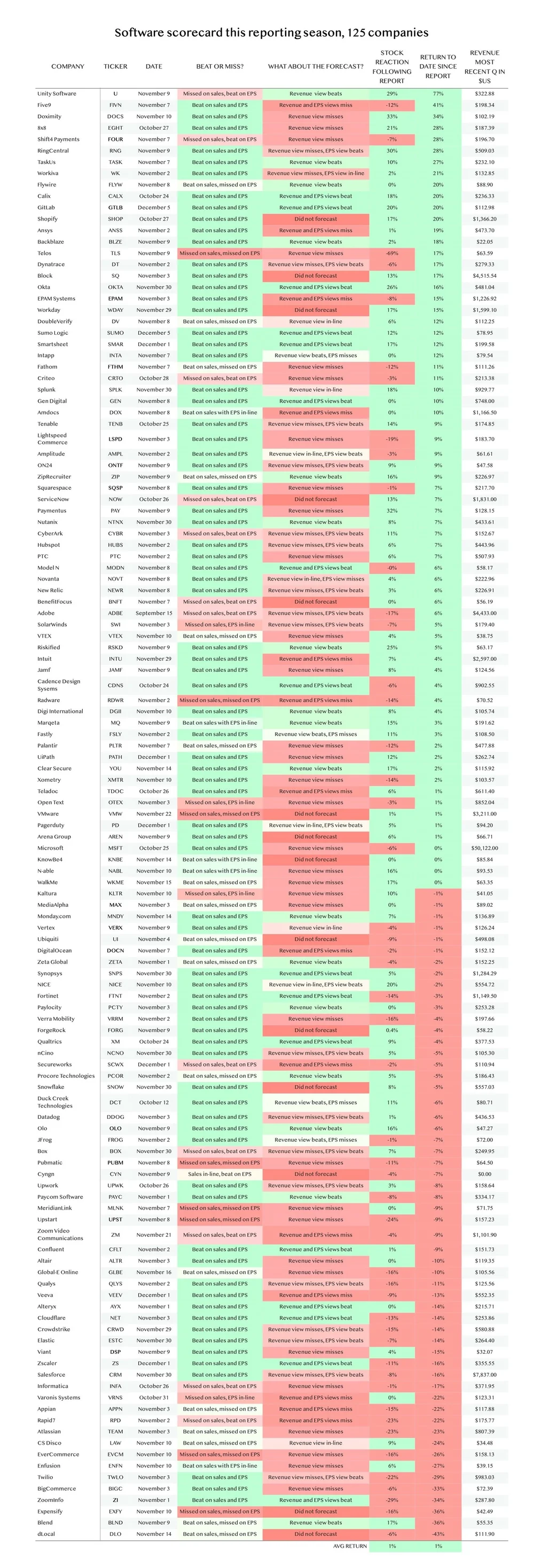
The biggest money maker in software stocks this earnings season has been video game authoring tools company Unity Software, based on its seventy-seven percent rise in stock price since it reported on November 9th. The biggest dog so far is payments processor dLocal.
The earnings season isn’t quite over, but after seeing reports from a hundred and twenty-five names in the past two months or so, I thought it might be instructive to see how things have done.
The latest positive earnings surprises, Monday evening, are GitLab, makers of versioning control systems for programmers, and Sumo Logic, makers of DevSecOps platform software and tools, both of which saw their shares rise sharply after-hours after reporting better-than-expected revenue and earnings and a better-than-expected forecast.
What I’m after, however, is not just the after-hours “pops” of the stock price this earnings season, but also how the software names have done in the days and weeks following.
And so the table at the bottom of this post includes the stock jump right after earnings in one column, but also the cumulative return of the share price since the day of the report. The table is sorted by the latter metric, the cumulative return, from most positive down to most negative.
A fundamental thing to take away are the reversals. Companies that had a big pop on their report have in many cases notched big declines subsequently, such as legal software maker CS Disco. The opposite is true too: some companies sold off big but recouped losses and even rose handsomely, such as help-desk software maker Five9.
I wouldn’t say there’s any deep reason for those reversals. They are merely a lesson not to take the pop from the report too seriously. After the smoke clears, some people find value in beaten-down names, while the enthusiasm for earnings reports for some names fades upon more careful reflection.
Another fundamental thing to take away is that companies that did everything right, such as Alteryx and Confluent, nevertheless sold off subsequently, whereas companies that blew it as far as reported results, such as Telos or Shift4Payments, were able to bounce back in the days following.
As you can see from the average return in the footer row of the table, the next-day pop for these stocks hasn’t been too good, just one percent, on average. The average return from report date to today as been as well, also just one percent.
It’s no surprise why software’s having a tough season. As I’ve chronicled in the past two months, many software names are reporting what they call “deal push-outs,” more time required to sell software, more scrutiny. It’s been harder and harder to make a sale as companies tighten their belts.
I’ve tried to weed out companies that are software to an extent but that include too much of a focus on content, such as online learning firm Coursera, which I dropped, or that are really making money by sales of items even if they regard themselves as a software company, such as luxury goods marketplace Farfetch. If you come across names you think do not belong in this group, please point them out.
I’ve included the most recent quarter’s revenue, as well, so that you can get a sense of each company’s scale. While there have been winners and losers of all sizes, I will point out that the average quarterly revenue of all the companies whose stocks have declined since their reports is $407 million. The average quarterly revenue of all the companies whose shares have stayed flat or risen since their reports is three times as large, $1.25 billion. So, on average, bigger companies have seen their shares hold up better than smaller companies.
The TL podcast for December 4th: Diving deep into Qualcomm, and the ominous outlook for AI press releases
Dec 05, 2022
Show notes
nteresting time for earnings from younger companies, including CrowdStrike’s (CRWD) disappointing report, but PureStorage (PSTG) was a bright spot, and diving deep into everything that’s going on with Qualcomm (QCOM), plus, beware next year’s flood of absolutely awful “generative” AI nonsense.

 Our TOPPODCAST Picks
  Stay Connected