TopPodcast.com
Menu
  • Home
  • Top Charts
  • Top Networks
  • Top Apps
  • Top Independents
  • Top Podfluencers
  • Top Picks
    • Top Business Podcasts
    • Top True Crime Podcasts
    • Top Finance Podcasts
    • Top Comedy Podcasts
    • Top Music Podcasts
    • Top Womens Podcasts
    • Top Kids Podcasts
    • Top Sports Podcasts
    • Top News Podcasts
    • Top Tech Podcasts
    • Top Crypto Podcasts
    • Top Entrepreneurial Podcasts
    • Top Fantasy Sports Podcasts
    • Top Political Podcasts
    • Top Science Podcasts
    • Top Self Help Podcasts
    • Top Sports Betting Podcasts
    • Top Stocks Podcasts
  • Podcast News
  • About Us
  • Podcast Advertising
  • Contact
Not in our directory?
Add Show Here
Podcast Equipment
Center

toppodcastlogoOur TOPPODCAST Picks

  • Comedy
  • Crypto
  • Sports
  • News
  • Politics
  • True Crime
  • Business
  • Finance

Follow Us

toppodcastlogoStay Connected

    View Top 200 Chart
    Back to Rankings Page
    Education

    Teaching in Higher Ed

    Thank you for checking out the Teaching in Higher Ed podcast. This is the space where we explore the art and science of being more effective at facilitating learning. We also share ways to increase our personal productivity, so we can have more peace in our lives and be even more present for our students.

    Advertise

    Copyright: © Innovate Learning, LLC

    • Apple Podcasts
    • Google Play
    • Spotify

    Latest Episodes:
    Being Kind to Our Future Selves, with Matthew Mahavongtrakul Mar 26, 2026
    Show notes

    Matthew Mahavongtrakul and Bonni Stachowiak have a conversation about being kind to our future selves on episode 615 of the Teaching in Higher Ed podcast.
    [divwrap class=”one-half first”]

    Quotes from the episode

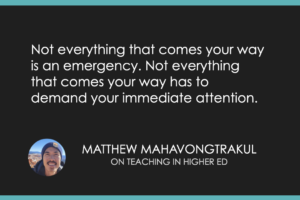
    Not everything that comes your way is an emergency. Not everything that comes your way has to demand your immediate attention.

    Not everything that comes your way is an emergency. Not everything that comes your way has to demand your immediate attention.
    -Matthew Mahavongtrakul

    Once you are comfortable with your system and you’re iterating, it actually starts to become second nature, not only to professional life, but to personal life as well.
    -Matthew Mahavongtrakul

    An exercise that I did with my supervisor once was to actually go through each of these tasks and to see what I thought was high priority, was it actually high priority for the job that I was in?
    -Matthew Mahavongtrakul

    [/divwrap][divwrap class=”one-half”]

    Resources

    • Karen Costa’s LinkedIn Post About the Ink & Volt Planning Dashboard
    • Notsu
    • Eisenhower Matrix
    • Episode 407: Unpacking Resilience and Grief with Chinasa Elue, Laura Howard, and Este Jordan (they share about each of their “pandemic dirty words” on this episode)
    • Goblin Tools – Magic ToDo
    • Ink and Volt Dashboard Deskpad
    • Gettin’ Air: The Open Education Network with Robin DeRosa and David Ernst, by Terry Greene
    • Asana

    [/divwrap]


    Keeping Your PKM Real Simple with RSS Mar 19, 2026
    Show notes

    Bonni Stachowiak shares how to keep your Personal Knowledge Mastery (PKM) real simple with RSS on episode 614 of the Teaching in Higher Ed podcast.
    [divwrap class=”one-half first”]

    Quotes from the episode

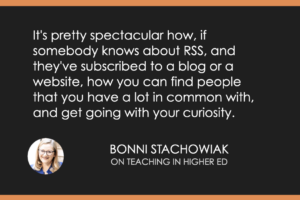
    It's pretty spectacular how, if somebody knows about RSS, and they've subscribed to a blog or a website, how you can find people that you have a lot in common with, and get going with your curiosity.

    Rather than get that overwhelmed feeling of how hard it’s going to be to keep up, I don’t have to, and neither do you. Enter RSS, Real Simple Syndication.
    -Bonni Stachowiak

    It’s pretty spectacular how, if somebody knows about RSS, and they’ve subscribed to a blog or a website, how you can find people that you have a lot in common with, and get going with your curiosity.
    -Bonni Stachowiak

    It’s amazing what happens when, before we start trying to lecture or share information, we ask people to predict something. Even if they end up predicting incorrectly, there still is that connection where we’ve piqued their curiosity.
    -Bonni Stachowiak

    [/divwrap][divwrap class=”one-half”]

    Resources

    • Why Isn’t RSS More Popular By Now, by Bonni Stachowiak
    • Real Simple Syndication, by Harold Jarche
    • Inoreader
    • Unread App
    • The Indispensable Digital Research Tool I can Say, Without Lying, Saves Time, by Alan Levine (aka CogDog)
    • RSS in Plain English, by Common Craft
    • MiniRoll
    • This Cozy Reading Life with Katie Linder
    • The Transformers: Imagining the Future of the Teaching of Writing
    • NASA Image of the Day
    • McSweeney’s Internet Tendency
    • Poll Everywhere

    [/divwrap]


    Skepticism and Curiosity in the Age of AI, with Marc Watkins Mar 12, 2026
    Show notes

    Marc Watkins shares about cultivating skepticism and curiosity in an age of AI on Episode 613 of the Teaching in Higher Ed podcast.
    [divwrap class=”one-half first”]

    Quotes from the episode

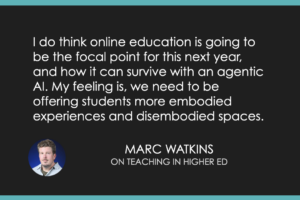
    I do think online education is going to be the focal point for this next year, and how it can survive with an agentic AI. My feeling is, we need to be offering students more embodied experiences and disembodied spaces.

    I do think online education is going to be the focal point for this next year, and how it can survive with an agentic AI. My feeling is, we need to be offering students more embodied experiences and disembodied spaces.
    -Marc Watkins

    Every technology has its affordances and the things that are negative about it too; your cell phone, the computer, the fact we’re talking about this right now on the systems that we are using, cloud computing, that all has a cost.
    -Marc Watkins

    For an incoming freshman student in college to take 4 or 5 classes and have 4 or 5 very different AI policies, 4 or 5 very different understandings of what AI is, it is incredibly confusing.
    -Marc Watkins

    [/divwrap][divwrap class=”one-half”]

    Resources

    • Sesame Street: One of These Things (Is Not Like the Others)
    • What We Give Up When We Let AI Decide: Automation Is Easy. Judgment Is Not, by Marc Watkins
    • Working with AI is more Mindset than Skill, by Marc Watkins
    • Civics of Technology’s Privacy Week Resources
    • The Opposite of Cheating
    • The Transformers: Imagining the Future of the Teaching of Writing, by Anna Mills, Jon Ippolito, Maha Bali, Jeremy Douglass, Mark C. Marino, Annette Vee, Marc Watkins

    [/divwrap]


    Make Learning Visible with ePortfolios, with Lynn Meade Mar 05, 2026
    Show notes

    Lynn Meade uncovers how to make learning visible with portfolios on episode 612 of the Teaching in Higher Ed podcast
    [divwrap class=”one-half first”]

    Quotes from the episode

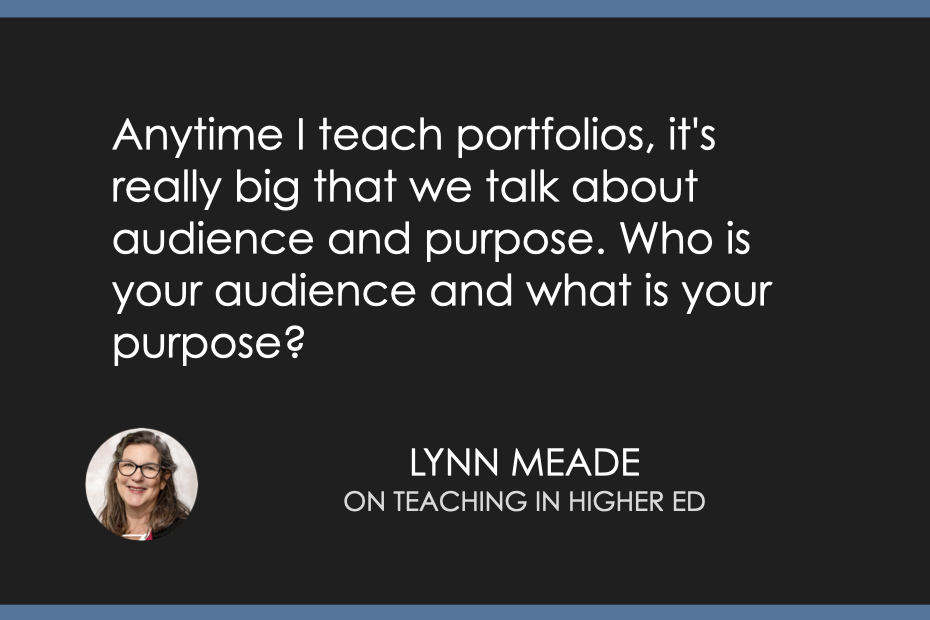
    Anytime I teach portfolios, it's really big that we talk about audience and purpose. Who is your audience and what is your purpose?

    An ePortfolio is basically a curated collection of student work. It includes reflection, and it’s usually across the college experience.
    -Lynn Meade

    Anytime I teach portfolios, it’s really big that we talk about audience and purpose. Who is your audience and what is your purpose?
    -Lynn Meade

    There’s something particularly lovely about seeing student or faculty members’ written comments about my work. Both the critiques and those comments that build me up, and how very powerful they are, and how much they mean to me.
    -Lynn Meade

    It’s not about the tech. The most important thing is, am I writing? Am I able to think about myself? Am I able to reflect about myself?
    -Lynn Meade

    [/divwrap][divwrap class=”one-half”]

    Resources

    • Building a Professional Portfolio (OER Book) by Lynn Meade
    • University of Arkansas Student Portfolios (portfolio.uark.edu)
    • Award-Winning ePortfolios Highlight Student Talent and Career Readiness
    • Fulbright College Team Outlines ePortfolio Initiative
    • Multiple New U of A ePortfolio Resources Available for Students and Faculty
    • Beyond a Resume, Part One: ePortfolios in Higher Ed (podcast)
    • Beyond a Resume, Part Two: ePortfolios in Higher Ed (podcast)
    • ePortfolios Overview (AAC&U ePortfolios Topic Page)
    • Poll Everywhere
    • Reese W. is Here to Boost My Writing Career, by John Warner
    • The Feeling Good Handbook by David Burns
    • Nancy Duarte on LinkedIn
    • Video on Box Breathing

    [/divwrap]


    Fostering Peace, Joy, and Community in Teaching and Leading, with Danny Mann Feb 26, 2026
    Show notes

    Danny Mann shares about fostering peace, joy, and community in teaching and leading on episode 611 of the Teaching in Higher Ed podcast.
    [divwrap class=”one-half first”]

    Quotes from the episode

    Great teaching, and I think great life, is this adaptive, responsive thing, pulling out the bugs or getting things back in balance.

    Great teaching, and I think great life, is this adaptive, responsive thing, pulling out the bugs or getting things back in balance.
    -Danny Mann

    Peace and joy are really interrelated, and I gravitated a lot towards these, as I spent time studying and practicing mindfulness practices.
    -Danny Mann

    If you discover your why, you could basically feel much more energized and joyful about what you do, if you align your life with that.
    -Danny Mann

    Giving students space to speak and share ups and downs. So the ironic leading by listening.
    -Danny Mann

    [/divwrap][divwrap class=”one-half”]

    Resources

    • University of California Irvine’s Division of Teaching Excellence & Innovation
    • Find Your Why, by Simon Sinek
    • How to Debug Your Life, by JA Westenberg
    • Happiness: Essential Mindfulness Practices, by Thich Nhat Hanh
    • Pedagogical Wellness | UCI Division of Teaching Excellence and Innovation
    • The Four Agreements: A Practical Guide to Personal Freedom, by Don Miguel Ruiz
    • How to Debug Your Life, by JA Westenberg
    • Happiness: Essential Mindfulness Practices, by Thich Nhat Hanh

    [/divwrap]


    Big and Small Experiments in Teaching and Learning, with Mike Cross Feb 19, 2026
    Show notes

    Mike Cross shares about his experiments (big and small) in teaching and learning on episode 610 of the Teaching in Higher Ed podcast.
    [divwrap class=”one-half first”]

    Quotes from the episode

    The reason I did it is because I just wanted to better understand what my students were going through.

    The reason I did it is because I just wanted to better understand what my students were going through.
    -Mike Cross

    I love that, that idea of tiny experiments. I think that that is absolutely critical because we’re all so busy.
    -Mike Cross

    Anytime you can put yourself in someone else’s shoes, it makes you a better person, right? Whether that’s a better teacher, a better spouse, a better friend, a better citizen, anything.
    -Mike Cross

    [/divwrap][divwrap class=”one-half”]

    Resources

    • Episode 106: Undercover Professor with Mike Cross
    • Snow College
    • Coaching for Leaders Episode 747: How to Get Out of a Rut, with Anne-Laure Le Cunff
    • What Baby George and Handstands Taught Me About Learning, created by Mike Wesch
    • Francesca and the Genie of Science, by Mike Cross
    • Living with Grief: A Poem for Those Who Are Grieving, by Christy Albright
    • The Sweetness at the Bottom of the Pie, by Alan Bradley
    • The Midnight

    [/divwrap]


    Pedagogical Wellness and the Conditions for Flourishing, with Theresa Duong Feb 12, 2026
    Show notes

    Theresa Duong on episode 609 of the Teaching in Higher Ed podcast.
    [divwrap class=”one-half first”]

    Quotes from the episode

    Pedagogy, the formal definition in my mind, is this art and science of teaching and learning.

    “All we’re really trying to do is create these conditions that can help our students flourish and thrive within our classrooms while maintaining the rigor of our work.”
    – Theresa Duong

    “I felt like I could thrive in my PhD program because I had these people who kept pushing me to go and kept pushing me to take care of myself.”
    – Theresa Duong

    “Pedagogy, the formal definition in my mind, is this art and science of teaching and learning.”
    – Theresa Duong

    “To me, wellness is really about thriving and flourishing in the work that you’re doing.”
    – Theresa Duong

    [/divwrap][divwrap class=”one-half”]

    Resources

    • Pedagogical Wellness | UCI Division of Teaching Excellence and Innovation
    • Pedagogical Wellness: A New Direction in Educational Development by Theresa Huong (Theresa) Duong, Andrea Aebersold, + Matthew Mahavongtrakul
    • Okanagan Charter
    • UCI Health Promoting University
    • Pedagogical Wellness Day
    • Artmakers Club with Lisa Bardow
    • Calm Strips
    • Forest App

    [/divwrap]


    Overcoming the Curse of Expertise and Other Ways to Be Inclusive in Our Teaching, with Sheila Tabanli Feb 05, 2026
    Show notes

    Sheila Tabanli shares ways to overcome the curse of expertise and other ways to be inclusive in our teaching on episode 608 of the Teaching in Higher Ed podcast
    [divwrap class=”one-half first”]

    Quotes from the episode

    "I suggest, sign up to a course that you have no idea, and then we'll talk later. In other words, feel what it means to be a novice

    “I suggest, sign up to a course that you have no idea, and then we’ll talk later. In other words, feel what it means to be a novice.”
    – Sheila Tabanli

    “An expert in a field doesn’t necessarily mean they will be able to effectively teach that content.”
    – Sheila Tabanli

    “There are differences between how experts and novices look at this content.”
    – Sheila Tabanli

    “We can still slow down. We can still show how an expert solves a math problem without sacrificing from the rigor or the content.”
    – Sheila Tabanli

    [/divwrap][divwrap class=”one-half”]

    Resources

    • Guidebook for Reducing the Novice-to-Expert Perception Gap in Mathematics to Increase STEM Diversity, by Sheila Tabanli
    • Minding the Perception Gap in College Math Classrooms and Beyond, by Sheila Tabanli for Inside Higher Ed
    • Last-Day Activities Ideas from Sheila Tabanli, Featured In The Chronicle of Higher Education Teaching Newsletter
    • Fostering Active Learning and Metacognitive Skills in a Cognitive-Science Based Math Course, by Sheila Tabanli for the International Journal of Teaching and Learning in Higher Education
    • Powerful Teaching: Unleash the Science of Learning, by Pooja Agarwal and Patrice Bain
    • A Mind for Numbers: How to Excel at Math and Science, by Linda Oakley
    • Learning How to Learn: Powerful Mental Tools to Help You Master Tough Subjects, Dr. Terrence Sejnowski and Dr. Barbara Oakley
    • Episode 106: Undercover Professor with Mike Cross
    • College Matters Podcast

    [/divwrap]


    An E-Bike for the Mind: AI, Augmentation, and Moral Hazards, with Josh Brake Jan 29, 2026
    Show notes

    Josh Brake shares metaphors and other ethical considerations regarding AI on Episode 607 of the Teaching in Higher Ed podcast.
    [divwrap class=”one-half first”]

    Quotes from the episode

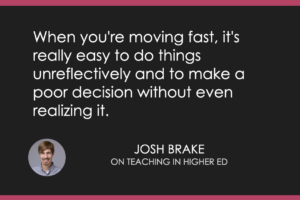
    When you're moving fast, it's really easy to do things unreflectively and to make a poor decision without even realizing it.

    “When you’re moving fast, it’s really easy to do things unreflectively and to make a poor decision without even realizing it.”
    -Josh Brake

    “The special thing about bicycles, at least in their non-electronic versions, is that they’re totally human-powered. So it’s all based on the energy that you put in, and it’s just transforming that energy, to make you more efficient and be able to move faster.”
    -Josh Brake

    “When you have something like an E bike, that augmentation can be used in a variety of different ways, so it can be used to actually extend your capacity.”
    -Josh Brake

    “It’s really this question about what’s the intention that you’re bringing to the technology when you come to the tool, what are the questions that you’re asking? And fundamentally, it’s a question of purpose and intention. Why are you using this?”
    -Josh Brake

    [/divwrap][divwrap class=”one-half”]

    Resources

    • An E-Bike for the Mind: E-Bikes and What They Can Teach Us About AI, by Josh Brake
    • I Grew Up Oblivious About Grades. It Ruined Me. Now I’m on a Mission to Ruin You too, by Josh Brake
    • The Moral Hazards of AI Are Closer Than You Realize, by Josh Brake
    • We Are Teaching Humans: A 50,000-Foot View As We Enter a New Academic Year, by Josh Brake
    • On Bandwidth and Bottlenecks: AI Tools Help Us Go Faster, But Speed is Not All You Need, by Josh Brake
    • Technique’s Deception: How Jacques Ellul Helps Us Understand the Difference Between Education and Schooling, by Josh Brake
    • Clip – Final Advice from Suborno Isaac Bari
    • The Real World of Technology, by Ursula Franklin
    • Player Piano, by Kurt Vonnegut
    • College Matters Podcast

    [/divwrap]


    An Educator’s Guide to ADHD, with Karen Costa Jan 22, 2026
    Show notes

    Karen Costa shares about An Educator’s Guide to ADHD on Episode 606 of the Teaching in Higher Ed podcast.

    [divwrap class=”one-half first”]

    Quotes from the episode

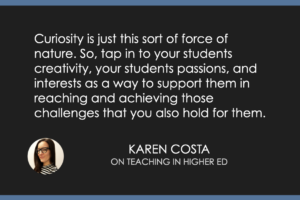
    Curiosity is just this sort of force of nature. So tap in to your students creativity, your students passions and interests as a way to support them in reaching and achieving those challenges that you also hold for them.

    Curiosity is just this sort of force of nature. So tap in to your students creativity, your students passions and interests as a way to support them in reaching and achieving those challenges that you also hold for them.
    -Karen Costa

    That’s a heavy thing for folks with ADHD to carry, that we are a burden on the other students in the classroom, that we are a burden on our teachers. And that is simply not true.
    -Karen Costa

    What we know now is that many times those are what are called stims in neurodivergent and ADHD and autistic communities. And those are actually a way that a lot of folks help themselves to stay present and regulated in their bodies so that they can direct their attention to the teacher or to the task at hand.
    -Karen Costa

    The best thing we can do to make the course real is as an instructor to be present in that online course.
    -Karen Costa

    [/divwrap][divwrap class=”one-half”]

    Resources

    • An Educator’s Guide to ADHD: Designing and Teaching for Student Success, by Karen Costa
    • 99 Tips for Creating Simple and Sustainable Educational Videos: A Guide for Online Teachers and Flipped Classes, by Karen Costa
    • Episode 577: Teaching and Learning When Things Go Wrong in the Classroom with Jessamyn Neuhaus
    • Snafu Edu: Teaching and Learning When Things Go Wrong in the College Classroom, by Jessamyn Neuhaus
    • Episode 578: Learning to Teach, Design, and Rest from Nature with Karen Costa
    • Community of Inquiry Checklist, from Karen Costa
    • Belmont University
    • The Canary Code, by Ludmila Praslova
    • Blackbird – The Harvard Opportunes
    • AP 100 Photos of 2025 The Defined the Year
    • Hard Core Literature

    [/divwrap]


    Previous 1 2 3 4 5 6 65 Next

    Related Podcasts

    Making Sense with Sam Harris

    1

    Making Sense with Sam Harris Education
    Grammar Girl

    2

    Grammar Girl Education
    Good Life Project

    3

    Good Life Project Education
    Explain It to Me

    4

    Explain It to Me Education
    Team Never Quit

    5

    Team Never Quit Comedy
    Optimal Living Daily – Personal Development and Self-Improvement

    6

    Optimal Living Daily – Personal Development and Self-Improvement Alternative Health
    footer-logo

    Contact Us

    Toll Free: 844-670-7747

    Links

    • Home
    • Top Charts
    • Networks
    • Apps
    • Independents Podcasts
    • Podcast Advertising
    • Podcast News
    • Contact Us
    • About Us
    • Analytics & Insights

    Stay Connected

      Privacy, Terms of Use & Our Code of Ethics Protecting Content Creators Copyrights