TopPodcast.com
Menu
  • Home
  • Top Charts
  • Top Networks
  • Top Apps
  • Top Independents
  • Top Podfluencers
  • Top Picks
    • Top Business Podcasts
    • Top True Crime Podcasts
    • Top Finance Podcasts
    • Top Comedy Podcasts
    • Top Music Podcasts
    • Top Womens Podcasts
    • Top Kids Podcasts
    • Top Sports Podcasts
    • Top News Podcasts
    • Top Tech Podcasts
    • Top Crypto Podcasts
    • Top Entrepreneurial Podcasts
    • Top Fantasy Sports Podcasts
    • Top Political Podcasts
    • Top Science Podcasts
    • Top Self Help Podcasts
    • Top Sports Betting Podcasts
    • Top Stocks Podcasts
  • Podcast News
  • About Us
  • Podcast Advertising
  • Contact
Not in our directory?
Add Show Here
Podcast Equipment
Center

toppodcastlogoOur TOPPODCAST Picks

  • Comedy
  • Crypto
  • Sports
  • News
  • Politics
  • True Crime
  • Business
  • Finance

Follow Us

toppodcastlogoStay Connected

    View Top 200 Chart
    Back to Rankings Page
    Education

    Teaching in Higher Ed

    Thank you for checking out the Teaching in Higher Ed podcast. This is the space where we explore the art and science of being more effective at facilitating learning. We also share ways to increase our personal productivity, so we can have more peace in our lives and be even more present for our students.

    Advertise

    Copyright: © Innovate Learning, LLC

    • Apple Podcasts
    • Google Play
    • Spotify

    Latest Episodes:
    Teaching Solidarity: Critical Race Reading, with Malini Johar Schueller Jun 04, 2026
    Show notes

    Malini Johar Schueller unpacks critical race reading and the role of discomfort in the classroom on episode 625 of the Teaching in Higher Ed podcast.
    [divwrap class=”one-half first”]

    Quotes from the episode


    Racism is a permanent structural feature of American society, and law alone, as now we have it, cannot deal with racism because racism is also part of law.

    Racism is a permanent structural feature of American society, and law alone, as now we have it, cannot deal with racism because racism is also part of law.
    -Malini Johar Schueller

    Critical race reading takes off from that, and it asks, is there a way of reading… that can awaken us to questions of racial privilege and hierarchy, but without us imagining that we have taken over somebody’s place?
    -Malini Johar Schueller

    Critical empathy, where you feel for others and you feel the injustice of others, but you also feel differently, you know, differently.
    -Malini Johar Schueller

    Some level of discomfort is fine for learning, because if learning doesn’t produce any kind of discomfort, you haven’t moved outside your zone of what you already know.
    -Malini Johar Schueller
    [/divwrap][divwrap class=”one-half”]

    Resources

    • Teaching Solidarity: Critical Race Reading, by Malini Johar Schueller
    • Malini Johar Schueller’s personal site
    • Kimberlé Crenshaw
    • Patricia Williams
    • Disparate treatment vs. disparate impact
    • The 1619 Project
    • Shoshana Felman
    • Pedagogy of the Oppressed, by Paulo Freire
    • Teaching to Transgress, by bell hooks
    • Defy: The Power of Saying No in a World That Demands Yes, by Sunita Sah
    • Jesse Stommel on Episode 320
    • Journey through infertility (Pudding, March 2026)

    [/divwrap]


    How to Engage Learners in Online Courses, with Denise Maduli Williams May 28, 2026
    Show notes

    Denise Maduli-Williams shares how to engage learners in online courses on episode 624 of the Teaching in Higher Ed podcast.
    [divwrap class=”one-half first”]

    Quotes from the episode


    When we design with accessibility in mind, we support everyone, all students.

    The very first thing I saw was the online instructor posting this video where she was roller skating in this roller Derby rink and welcoming us online, and that just changed everything for me.
    -Denise Maduli-Williams

    When we design with accessibility in mind, we support everyone, all students.
    -Denise Maduli-Williams

    Students who are quieter, whether it’s synchronous on Zoom or synchronous in person, they have the opportunity to participate when they’re ready and to prepare.
    -Denise Maduli-Williams
    [/divwrap][divwrap class=”one-half”]

    Resources

    • Denise Maduli-Williams at San Diego Miramar College
    • Denise Maduli-Williams on LinkedIn
    • Supporting ADHD Learners, With Karen Costa (Teaching in Higher Ed Episode 384)
    • Reach Everyone, Teach Everyone: Universal Design for Learning in Higher Education, by Thomas J. Tobin and Kirsten T. Behling
    • The Joyful Online Teacher: Finding Our Fizz in Asynchronous Classes, by Flower Darby
    • Rutgers Online Learning Conference (RUOnlineCon)
    • California Community Colleges Online Network of Educators (@ONE)
    • Universal Design for Learning (UDL) Guidelines
    • Zero Textbook Cost (ZTC) Program
    • The Correspondent: A Novel, by Virginia Evans
    • The Passion Planner
    • Poll Everywhere

    [/divwrap]


    Can’t Stop, Won’t Stop: Teaching with AI Tools, with Rebecca Fordon May 21, 2026
    Show notes

    Rebecca Fordon unpacks vibe coding and the eight AI teaching tools she built in a single semester on episode 623 of the Teaching in Higher Ed podcast.
    [divwrap class=”one-half first”]

    Quotes from the episode


    Vibe coding, I think of being able to describe the kind of application or website that you want in just words, a narrative, rather than having to code it, knowing coding language.

    Vibe coding, I think of being able to describe the kind of application or website that you want in just words, a narrative, rather than having to code it, knowing coding language.
    -Rebecca Fordon

    I think the easiest place to start is in ChatGPT, or Gemini, or Claude Code.
    -Rebecca Fordon

    Many of my students have not used it for anything related to law school. Until they get into my class, and then they see there actually are some good, legitimate uses.
    -Rebecca Fordon

    If you want to mess with things on your own, you can really just ask AI: How do I do that? Where should I look?
    -Rebecca Fordon

    [/divwrap][divwrap class=”one-half”]

    Resources

    • Can’t Stop, Won’t Stop: One Semester, Eight Vibe-Coded Teaching Tools
    • AI Law Librarians
    • TokenExplorer
    • NPR’s Driveway Moments
    • David Colarusso
    • Lovable
    • Replit
    • Video: Bonni Shows Jon Ippolito’s Connect Random Things Exercise
    • Jon Ippolito’s Connect Random Things Exercise
    • SongLink (Odesli.co)
    • Wolf Worm, by T. Kingfisher
    • Snipd
    • Artificial Intelligence and Human Legal Reasoning, by Bednar, Cleveland, Erbsen, and Schwarcz

    [/divwrap]


    Why Mattering Matters, with Jennifer Wallace May 14, 2026
    Show notes

    Jennifer Wallace shares about her book, Mattering: The Secret to a Life of Deep Connection and Purpose on episode 622 of the Teaching in Higher Ed podcast.
    [divwrap class=”one-half first”]

    Quotes from the episode

    Mattering says you belong at the table, but it goes even further, and it says you would be missed if you weren't here.

    Mattering says you belong at the table, but it goes even further, and it says you would be missed if you weren’t here. You are adding value, and we would notice if you weren’t here.
    -Jennifer Wallace

    We have so much input and so much output being demanded of us today that often we go through life on autopilot.
    -Jennifer Wallace

    Mattering is not another thing to add to your to-do list. Mattering is a way of looking at your to-do list.
    -Jennifer Wallace

    When you look at the data on what drives performance, it is engagement. And what drives engagement is mattering.
    -Jennifer Wallace

    [/divwrap][divwrap class=”one-half”]

    Resources

    • Mattering: The Secret to a Life of Deep Connection and Purpose, by Jennifer Wallace
    • Never Enough: When Achievement Culture Becomes Toxic—and What We Can Do About It, by Jennifer Wallace
    • Bowling Alone: The Collapse and Revival of American Community, by Robert D. Putnam
    • Jennifer Wallace’s Website
    • Mattering Movement
    • Gallup-Purdue Index Report
    • Nancy Schlossberg’s Transition Theory
    • World Spins Madly On
    • WeRateDogs – This is Sadie.
    • Sign up to be a Mattering Ambassador

    [/divwrap]


    The Public Scholar, with David Perry May 07, 2026
    Show notes

    David Perry shares about his new book, The Public Scholar, on episode 621 of the Teaching in Higher Ed podcast.
    [divwrap class=”one-half first”]

    Quotes from the episode

    Teaching is the most important form of public engagement that any of us do.
    Teaching is the most important form of public engagement that any of us do.
    -David Perry

    If we are really practiced at teaching, and as we develop our skills as teachers, those are the skills that can also take us into other spaces outside of the classroom.
    -David Perry

    Academia is structured around all kinds of failure. Once you recognize that, and then bring yourself into another context where you’re going to experience rejection, you already have the skills to cope with it.
    -David Perry

    I think all writers, and certainly in academia, worry a lot about our worst faith readers. How do we not get ripped apart? You have to write for your best faith reader. You have to really shift your focus.
    -David Perry

    [/divwrap][divwrap class=”one-half”]

    Resources

    • The Public Scholar: A Practical Handbook by David M. Perry
    • Tressie McMillan Cottom
    • Kevin Gannon — The Tattooed Professor
    • Irene Maweu
    • Higher Love
    • Pluribus
    • The Drop Kick Murphys
    • ‘Streets of Minneapolis’: 32 protest songs inspired by the Twin Cities’ ICE resistance
    • The Neighborhood Kids, “Breaking News”

    [/divwrap]


    The Joyful Online Teacher, with Flower Darby Apr 30, 2026
    Show notes

    Flower Darby shares about being a joyful online teacher on episode 620 of the Teaching in Higher Ed podcast.
    [divwrap class=”one-half first”]

    Quotes from the episode

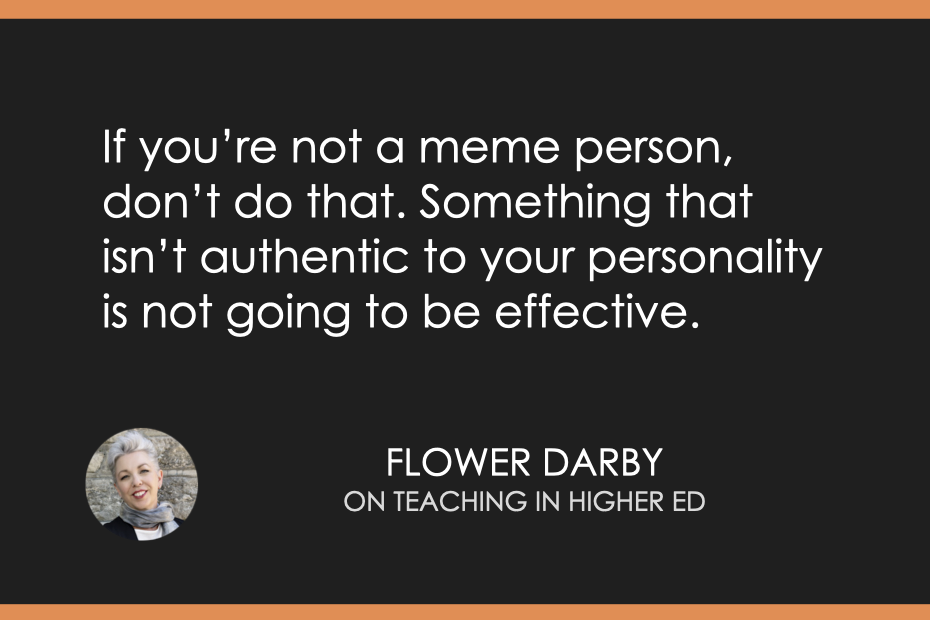
    If you’re not a meme person, don’t do that. Something that isn’t authentic to your personality is not going to be effective.

    Higher education doesn’t do a great job of preparing faculty to teach, generally speaking, that’s not new, but especially online teaching.
    -Flower Darby

    If you’re not a meme person, don’t do that. Something that isn’t authentic to your personality is not going to be effective.
    -Flower Darby

    Sometimes you don’t need all the latest bells and whistles; you don’t need the latest iPhone. We can be effective with simpler tools.
    -Flower Darby

    We can’t be joyful if we’re always working.
    -Flower Darby

    [/divwrap][divwrap class=”one-half”]

    Resources

    • The Joyful Online Teacher: Finding Our Fizz in Asynchronous Classes by Flower Darby
    • Michelle Pacansky-Brock
    • The Spark of Learning: Energizing the College Classroom with the Science of Emotion, by Sarah Rose Cavanagh
    • Dave Ghidiu
    • Denise Maduli-Williams
    • TextExpander
    • Thor: God of Thunder gets a library card
    • A Starting Point for Seth Godin’s Blog
    • Feel Good Inc., by Gorillaz
    • Muddiest Point Handout from Purdue
    • Revitalizing the Muddiest Point for Formative Assessment and Student Engagement in a Large Class, by Amy Mackos, Kelly Casler, Joni Tornwall, and Tara O’Brien
    • Poll Everywhere

    [/divwrap]


    The Science of Learning Meets AI Apr 23, 2026
    Show notes

    Lew Ludwig + Todd Zakrajsek uncover themes from The Science of Learning Meets AI on episode 619 of the Teaching in Higher Ed podcast.
    [divwrap class=”one-half first”]

    Quotes from the episode

    We could actually create an educational system. Not so that it deals with the problems we have with AI, but so that those problems are no longer relevant.

    We could actually create an educational system. Not so that it deals with the problems we have with AI, but so that those problems are no longer relevant.
    -Todd Zakrajsek

    If you don’t have students attention, they can’t learn because if you don’t attend to something, you can’t learn it.
    -Todd Zakrajsek

    Keep in mind that you’re the expert. This is your assignment. You know what you’re doing, you know the content, so then you can judge what AI gives you, what works, and what still may need some work.
    -Lew Ludwig

    What this gets down to is backward design; we start with the learning goals. We should figure out how to assess them, and then decide if AI fits in that or not.
    -Lew Ludwig

    [/divwrap][divwrap class=”one-half”]

    Resources

        • The Science of Learning Meets AI: A Practical Faculty Guide to Purposeful Integration, Student Engagement, and Ethical Practice, by Lewis D. Ludwig & Todd D. Zakrajsek
        • Lilly Conferences: Evidence-Based Teaching & Learning
        • Mary-Ann Winkelmes
        • Transparency in Learning & Teaching (TILT) Higher Education
        • Backward Design
        • The Opposite of Cheating: Teaching for Integrity in the Age of AI, by Tricia Bertram Gallant and David A. Rettinger
        • Caraway Cookware
        • Joy Comes Back, by Donna Ashworth, read by Harry Baker
        • TripIt
        • The Other Side of the Door, by Jeff Moss

    [/divwrap]


    From Awareness to Action, with Norma Montague Apr 16, 2026
    Show notes

    Norma Montague shares of her experiences going from awareness to action, interrupting bias in the classroom on episode 618 of the Teaching in Higher Ed podcast.
    [divwrap class=”one-half first”]

    Quotes from the episode

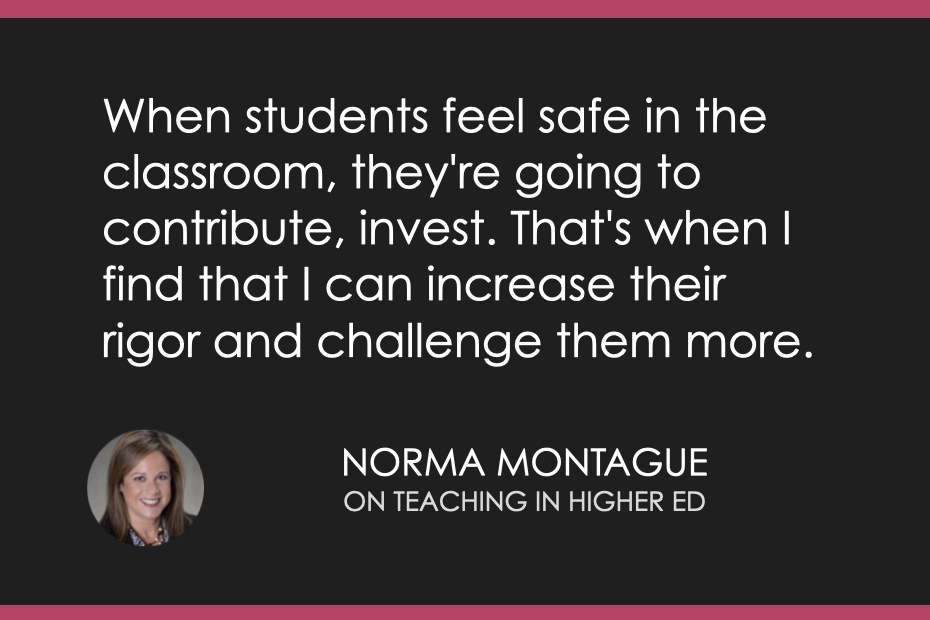
    When students feel safe in the classroom, then they're going to contribute, invest. That's when I find that I can really increase their rigor and challenge them more.

    One thing that my work on inclusive teaching focuses on, is really being able to understand your learner’s motivations.
    -Norma Montague

    One of the ideas that I learned from a colleague who had recommended a book was the idea of rebranding office hours as student hours.
    -Norma Montague

    I think it’s important to help students understand what those student hours are for and how they can get the most out of them.
    -Norma Montague

    When students feel safe in the classroom, then they’re going to contribute, invest. That’s when I find that I can really increase their rigor and challenge them more.
    -Norma Montague

    [/divwrap][divwrap class=”one-half”]

    Resources

    • Norma Montague at Wake Forrest University
    • Episode 425: Inclusive Teaching with Viji Sathy and Kelly Hogan
    • Inclusive Teaching: Strategies for Promoting Equity in the College Classroom, by Kelly Hogan and Viji Sathy
    • Quiet: The Power of Introverts in a World That Can’t Stop Talking, by Susan Cain
    • Mind over Monsters: Supporting Youth Mental Health with Compassionate Challenge, by Sarah Rose Cavanagh
    • Tiny Desk Concert: Mumford and Sons
    • Crucial Tracks
    • Alan Levine’s Cool Tech RSS Feed
    • Mix It Up Scratch Off Date Nights

    [/divwrap]


    How Agentic AI Changes What and How We Teach, with Teddy Svoronos Apr 09, 2026
    Show notes

    For resources, recommendations and more information about this episode’s host and guest(s), visit the episode 617 page on the Teaching in Higher Ed website.


    (Re)Orienting the Scholarship of Teaching and Learning Apr 02, 2026
    Show notes

    Nancy Chick, Peter Felten, and Katarina Mårtensson share about The SoTL Guide: (Re)Orienting the Scholarship of Teaching and Learning on episode 616 of the Teaching in Higher Ed podcast.
    [divwrap class=”one-half first”]

    Quotes from the episode

    What I usually say when I speak to colleagues and academics who are sort of starting a SOTL journey is to start small, small steps, and whatever is a low threshold.

    We see SOTL as simply inquiry into teaching and learning for the purposes of improving teaching and learning in context and then contributing to what we know about teaching and learning in support of the broader aims of higher education.
    -Nancy Chick

    What I usually say when I speak to colleagues and academics who are sort of starting a SOTL journey is to start small, small steps, and whatever is a low threshold.
    -Katarina Mårtensson

    I can’t go through this book and say who wrote this sentence or this section or whose idea this part was, because it really is a product of the three of us.
    -Peter Felten

    [/divwrap][divwrap class=”one-half”]

    Resources

    • The SoTL Guide: (Re)Orienting the Scholarship of Teaching and Learning, by Nancy L. Chick, Peter Felten, and Katarina Mårtensson
    • Human Synergistics
    • Dan Bernstein, Nancy Chick, Pat Hutchings, and Gary Poole Share Strategies for “Going Public” with SoTL
    • Book Resources (Including a Reading Guide)
    • I Lost My Job, by Robin DeRosa
    • Harold Jarche’s PKM Posts
    • Video: Tatiana Rodriguez Shares Her Online SetUp for Her Podcast Delivery Day
    • A Systematic Literature Review of Students as Partners in Higher Education
    • Drawing Digital: The Complete Guide for Learning to Draw & Paint on Your iPad, by Lisa Bardot
    • The Illustrator’s Guide to Procreate: How to Make Digital Art on Your iPad, by Ruth Burrows
    • The Correspondent: A Novel, by Virginia Evans
    • The Academic Imperfectionist
    • Making, Keeping, and Losing Friends: How Campuses Shape College Students’ Networks, by Janice M. McCabe
    • Poll Everywhere

    [/divwrap]


    Previous 1 2 3 4 5 65 Next

    Related Podcasts

    Making Sense with Sam Harris

    1

    Making Sense with Sam Harris Education
    Grammar Girl

    2

    Grammar Girl Education
    Good Life Project

    3

    Good Life Project Education
    Explain It to Me

    4

    Explain It to Me Education
    Team Never Quit

    5

    Team Never Quit Comedy
    Optimal Living Daily – Personal Development and Self-Improvement

    6

    Optimal Living Daily – Personal Development and Self-Improvement Alternative Health
    footer-logo

    Contact Us

    Toll Free: 844-670-7747

    Links

    • Home
    • Top Charts
    • Networks
    • Apps
    • Independents Podcasts
    • Podcast Advertising
    • Podcast News
    • Contact Us
    • About Us
    • Analytics & Insights

    Stay Connected

      Privacy, Terms of Use & Our Code of Ethics Protecting Content Creators Copyrights