TopPodcast.com
Menu
  • Home
  • Top Charts
  • Top Networks
  • Top Apps
  • Top Independents
  • Top Podfluencers
  • Top Picks
    • Top Business Podcasts
    • Top True Crime Podcasts
    • Top Finance Podcasts
    • Top Comedy Podcasts
    • Top Music Podcasts
    • Top Womens Podcasts
    • Top Kids Podcasts
    • Top Sports Podcasts
    • Top News Podcasts
    • Top Tech Podcasts
    • Top Crypto Podcasts
    • Top Entrepreneurial Podcasts
    • Top Fantasy Sports Podcasts
    • Top Political Podcasts
    • Top Science Podcasts
    • Top Self Help Podcasts
    • Top Sports Betting Podcasts
    • Top Stocks Podcasts
  • Podcast News
  • About Us
  • Podcast Advertising
  • Contact
Not in our directory?
Add Show Here
Podcast Equipment
Center

toppodcastlogoOur TOPPODCAST Picks

  • Comedy
  • Crypto
  • Sports
  • News
  • Politics
  • True Crime
  • Business
  • Finance

Follow Us

toppodcastlogoStay Connected

    View Top 200 Chart
    Back to Rankings Page
    Education

    Teaching in Higher Ed

    Thank you for checking out the Teaching in Higher Ed podcast. This is the space where we explore the art and science of being more effective at facilitating learning. We also share ways to increase our personal productivity, so we can have more peace in our lives and be even more present for our students.

    Advertise

    Copyright: © Innovate Learning, LLC

    • Apple Podcasts
    • Google Play
    • Spotify

    Latest Episodes:
    How to Use a Course Workload Estimator, with Betsy Barre Aug 19, 2021
    Show notes

    Betsy Barre talks about how (and why) to use a course workload estimator on episode 375 of the Teaching in Higher Ed podcast.
    [divwrap class=”one-half first”]

    Quotes from the episode

    The difference between an expert reader and a student reader is that an expert reader will slow down when they don’t know a word.

    The difference between an expert reader and a student reader is that an expert reader will slow down when they don’t know a word.
    -Betsy Barre

    Students are reading, they just aren’t reading well.
    -Betsy Barre

    Is this activity really worth it given my outcomes of the course?
    -Betsy Barre

    We all need to be talking more about time.
    -Betsy Barre

    [/divwrap][divwrap class=”one-half”]

    Resources

    • Course Workload Estimator 2.0
    • Course Workload Estimator
    • How Much Should We Assign? Estimating Out of Class Workload, by Betsy Barre
    • So Much to Read, So Little Time: How Do We Read, and Can Speed Reading Help?, by Keith Rayner et al
    • R Studio
    • Janet Evanovich’s Stephenie Plum novels

    [/divwrap]


    Small Teaching Reprised, with James Lang Aug 12, 2021
    Show notes

    James Lang shares about the second edition of Small Teaching on episode 374 of the Teaching in Higher Ed podcast.
    [divwrap class=”one-half first”]

    Quotes from the episode

    Small changes can absolutely lead to revolutionary changes.

    Small changes can absolutely lead to revolutionary changes.
    -James Lang

    Students have to be introduced and conditioned to accept different types of teaching approaches.
    -James Lang

    I love having my students try to teach things they have learned to another audience.
    -James Lang

    My most fundamental principal about teaching is vary what you’re doing.
    -James Lang

    [/divwrap][divwrap class=”one-half”]

    Resources

    • Should We Stop Grading Class Participation?
    • Small Changes in Teaching: The Last 5 Minutes of Class
    • On Not Drawing Conclusions About Online Teaching Now — or Next Fall
    • Small Changes in Teaching: Making Connections
    • What I Am Learning About My Students During an Impossible Semester
    • Turn Your Classroom Irritation Into Compassion
    • Pedagogies of Care: Open Resources

    [/divwrap]


    The Role of Faculty in Student Mental Health Aug 05, 2021
    Show notes

    Sarah Lipson and Laura Horne share about The Role of Faculty in Student Mental Health on episode 373 of the Teaching in Higher Ed podcast.


    Equity-Centered Trauma-Informed Education, with Alex Venet Jul 29, 2021
    Show notes

    Alex Shevrin Venet talks about her book, Equity-Centered Trauma-Informed Education on episode 372 of the Teaching in Higher Ed podcast.
    [divwrap class=”one-half first”]

    Quotes from the episode

    Something that might just be stressful for one person could be traumatic for another.

    Something that might just be stressful for one person could be traumatic for another.
    -Alex Shevrin Venet

    Trauma-informed education is not a checklist.
    -Alex Shevrin Venet

    The way we understand trauma is always changing.
    -Alex Shevrin Venet

    [/divwrap][divwrap class=”one-half”]

    Resources

    Episode 258 with Sara Goldrick-Rab: Paying the Price

    Equity-Centered Trauma-Informed Education, by Alex Shevrin Venet*

    Episode 335 with Mays Imad: Trauma-Informed Teaching and Learning

    [/divwrap]


    Peer Mentoring, with Simon Dalley Jul 22, 2021
    Show notes

    Simon Dalley shares about peer mentoring on episode 371 of the Teaching in Higher Ed podcast.
    [divwrap class=”one-half first”]

    Quotes from the episode

    Teaching is to learn twice.

    A peer mentor is a more qualified and experienced student that provides guidance and support to another student.
    -Simon Dalley

    Mentors are influential in terms of being a remodel. They are the embodiment of a successful student.
    -Simon Dalley

    Teaching is to learn twice.
    -Simon Dalley

    [/divwrap][divwrap class=”one-half”]

    Resources

    Video of peer mentors talking about the programme

    Motivational interviewing overview

    The Hidden Curriculum

    Video: Unwritten Rules for College Success

    Kristen Neff – Self Compassion

    [/divwrap]


    Toward More Equitable Assessment Jul 15, 2021
    Show notes

    Erin Whitteck and Douglas Fritz share efforts toward more equitable assessment on episode 370 of the Teaching in Higher Ed podcast.
    [divwrap class=”one-half first”]

    Quotes from the episode

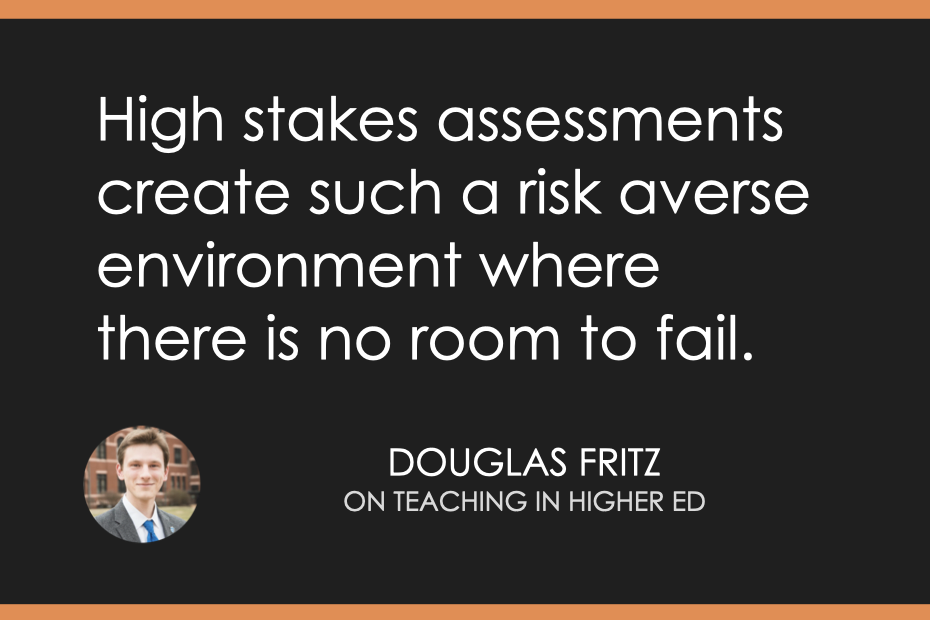
    High stakes assessments create such a risk averse environment where there is no room to fail.

    First impressions with students are extremely important.
    -Erin Whitteck

    High stakes assessments create such a risk averse environment where there is no room to fail.
    -Douglas Fritz

    [/divwrap][divwrap class=”one-half”]

    Resources

    • Bonni explains the significance of her favorite number (208) and how it is associated with her teaching during Episode 208
    • Boxes (digital and/or analog) of encouragement
    • Relationship-Rich Education, by Peter Felton and Leo Lambert
    • Peter Felton and Leo Lambert talk about Relationship-Rich Education on Episode 331 of Teaching in Higher Ed
    • Robert Talbert describes his 3-dimensional view of assessment in his post: Building Calculus Assessments (not just related to calculus, by the way)
    • Retrieval Practice
    • Erin likes how Rissa Sorensen-Unruh talks about the word ‘rigor’ in being used to support high-stakes exams

    [/divwrap]


    Advice to a New Professor, with Dave Stachowiak Jul 08, 2021
    Show notes

    Dave and Bonni Stachowiak give advice to a new professor on episode 369 of the Teaching in Higher Ed podcast.
    [divwrap class=”one-half first”]

    Quotes from the episode

    Students aren’t our adversaries.

    Students aren’t our adversaries.
    -Kevin Gannon

    [/divwrap][divwrap class=”one-half”]

    Resources Mentioned

    • Episode 6: Eight Seconds That will Transform Your Teaching with Dave Stachowiak
    • Episode 94: Retrieval Practice with Pooja Agarwal
    • Retrieval Practice website
    • Episode 184: The Science of Retrieval Practice with Pooja Agarwal
    • Distracted: Why Students Can’t Focus and What You Can Do About It, by James M. Lang
    • The Distracted Classroom series, by James M. Lang for The Chronicle of Higher Education
    • Small Teaching: Everyday Lessons from the Science of Learning, 2nd Edition, by James M. Lang
    • The Skillful Teacher: On Technique, Trust, and Responsiveness in the Classroom, 3rd Edition, by Stephen D. Brookfield
    • The Productive Online and Offline Professor, by Bonni Stachowiak

    [/divwrap]


    Defining Our Future, with Kelvin Bentley Jul 01, 2021
    Show notes

    Kelvin Bentley talks about defining our future on episode 368 of the Teaching in Higher Ed podcast.
    [divwrap class=”one-half first”]

    Quotes from the episode

    The pandemic has forced us to re-examine how we teach, what we are teaching, and what we can be doing differently.

    The pandemic has forced us to re-examine how we teach, what we are teaching, and what we can be doing differently.
    -Kelvin Bentley

    Our learners need us to be more mindful of our work.
    -Kelvin Bentley

    We need to do a better job at re-examining our learning experiences.
    -Kelvin Bentley

    We need to leverage better data to make more informed decisions that will help us improve our pedagogy.
    -Kelvin Bentley

    [/divwrap][divwrap class=”one-half”]

    Resources

    @BlackTimeLord

    Dr. Who

    Actualizing the Online Community College, by Kelvin Bentley for EDUCAUSE

    Kelvin joins Bryan Alexander on the Future Trends Forum

    Paul LeBlanc of Southern New Hampshire University

    Capella University’s FlexPath Learning Format

    WGU (Western Governors University)

    WGU Provost and Chief Academic Officer, Marni Baker Stein

    [/divwrap]


    Fuel Efficient Mentoring Jun 24, 2021
    Show notes

    Resa Lewiss & Adaira Landry share about fuel efficient mentoring on episode 367 of the Teaching in Higher Ed podcast.
    [divwrap class=”one-half first”]

    Quotes from the episode

    There has to be a sense of trust and physiological safety in the mentor/mentee relationship.

    There has to be a sense of trust and physiological safety in the mentor/mentee relationship.
    -Resa Lewiss

    Boundaries are the most important part of a relationship.
    -Adaira Landry

    The whole point of this is to build a sustainable model so that you mentor more.
    -Adaira Landry

    It is the responsibility of the mentor to recognize if it is not the right fit.
    -Resa Lewiss

    [/divwrap][divwrap class=”one-half”]

    Resources Mentioned

    • What Efficient Mentorship Looks Like
    • What a Compassionate Email Culture Looks Like
    • ‎Here’s Something Good: The Doctor Will See You Now…Remotely on Apple Podcasts

    [/divwrap]


    How to Create a Digital Teaching Toolkit, with Jeremy Caplan Jun 17, 2021
    Show notes

    Jeremy Caplan on episode 366 of the Teaching in Higher Ed podcast.
    [divwrap class=”one-half first”]

    Quotes from the episode

    Sometimes the tool isn’t the most important thing.

    Sometimes the tool isn’t the most important thing.
    -Jeremy Caplan

    The really important thing is that we are engaging people.
    -Jeremy Caplan

    Sometimes an investment in trying a new tool can open up some advantages.
    -Jeremy Caplan

    [/divwrap][divwrap class=”one-half”]

    Resources Mentioned

    • Jeremy Caplan’s Wonder Tools newsletter
    • Pitch | Collaborative presentation software for modern teams
    • Presentation Maker | From Basic to Beautiful in Minutes with Beautiful.ai
    • Projector — Create to captivate
    • Slido – Audience Interaction Made Easy
    • Recommended Zoom Settings – YouTube
    • Photos – Google Photos
    • Send to Dropbox | Email + Dropbox
    • Conversations in the cloud
    • SpeakPipe – receive voice messages from your audience directly on your website.
    • Flipgrid | Empower Every Voice
    • Google Jamboard
    • Padlet: You are beautiful
    • An Online Visual Collaboration Platform for Teamwork | Miro
    • MURAL.CO
    • FigJam is an online whiteboard for teams to explore ideas together
    • The Digital Gallery Walk: Collaboration on their feet – Ditch That Textbook
    • Amuse-bouche

    [/divwrap]


    Previous 1 26 27 28 29 30 65 Next

    Related Podcasts

    Making Sense with Sam Harris

    1

    Making Sense with Sam Harris Education
    Grammar Girl

    2

    Grammar Girl Education
    Good Life Project

    3

    Good Life Project Education
    Explain It to Me

    4

    Explain It to Me Education
    Team Never Quit

    5

    Team Never Quit Comedy
    Optimal Living Daily – Personal Development and Self-Improvement

    6

    Optimal Living Daily – Personal Development and Self-Improvement Alternative Health
    footer-logo

    Contact Us

    Toll Free: 844-670-7747

    Links

    • Home
    • Top Charts
    • Networks
    • Apps
    • Independents Podcasts
    • Podcast Advertising
    • Podcast News
    • Contact Us
    • About Us
    • Analytics & Insights

    Stay Connected

      Privacy, Terms of Use & Our Code of Ethics Protecting Content Creators Copyrights