TopPodcast.com
Menu
  • Home
  • Top Charts
  • Top Networks
  • Top Apps
  • Top Independents
  • Top Podfluencers
  • Top Picks
    • Top Business Podcasts
    • Top True Crime Podcasts
    • Top Finance Podcasts
    • Top Comedy Podcasts
    • Top Music Podcasts
    • Top Womens Podcasts
    • Top Kids Podcasts
    • Top Sports Podcasts
    • Top News Podcasts
    • Top Tech Podcasts
    • Top Crypto Podcasts
    • Top Entrepreneurial Podcasts
    • Top Fantasy Sports Podcasts
    • Top Political Podcasts
    • Top Science Podcasts
    • Top Self Help Podcasts
    • Top Sports Betting Podcasts
    • Top Stocks Podcasts
  • Podcast News
  • About Us
  • Podcast Advertising
  • Contact
Not in our directory?
Add Show Here
Podcast Equipment
Center

toppodcastlogoOur TOPPODCAST Picks

  • Comedy
  • Crypto
  • Sports
  • News
  • Politics
  • True Crime
  • Business
  • Finance

Follow Us

toppodcastlogoStay Connected

    View Top 200 Chart
    Back to Rankings Page
    Education

    Teaching in Higher Ed

    Thank you for checking out the Teaching in Higher Ed podcast. This is the space where we explore the art and science of being more effective at facilitating learning. We also share ways to increase our personal productivity, so we can have more peace in our lives and be even more present for our students.

    Advertise

    Copyright: © Innovate Learning, LLC

    • Apple Podcasts
    • Google Play
    • Spotify

    Latest Episodes:
    Faculty’s Role in Student Success, with Jody Greene Apr 25, 2024
    Show notes

    Jody Greene discusses faculty’s role in student success on episode 515 of the Teaching in Higher Ed podcast.
    [divwrap class=”one-half first”]

    Quotes from the episode

    "We know that there are so many other important elements to students' success, their well-being, their thriving, their career pathways, their ability to pursue interests and curiosities, their engagement, their activism, and all of these multiple measures." ~ Jody Greene

    The special power of literature comes from that capacity to have one foot in the factual or the real and one foot in the imagination or the fictional.
    -Jody Greene

    We know that there are so many other important elements to students’ success, their well-being, their thriving, their career pathways, their ability to pursue interests and curiosities, their engagement, their activism, and all of these multiple measures.
    -Jody Greene

    I think people care about what the institution has told them they need to care about.
    -Jody Greene

    I don’t think we should have expectations based on people’s gender in a classroom.
    -Jody Greene

    [/divwrap][divwrap class=”one-half”]

    Resources

    • About Jody Greene
    • Teaching Environmental Justice: Practices to Engage Students and Build Community, edited by Sikina Jinnah, Jessie Dubreuil, Jody Greene, and Samara S. Foster
    • The dualistic mind, by Richard Rohr
    • Gina Garcia
    • Torgny Roxå – ‘shame briefcase’
    • Listen: Improving Student Success in the Classroom, Inside Higher Ed podcast with Jody Green
    • New Day (live) – Alicia Keys
    • Alicia Keys: NPR Music Tiny Desk Concert
    • Try a little kindness
    • Notice
    • ASK: What is the most generous reading I can have right here?
    • “If things were simple, word would have gotten around.” Jacques Derrida

    [/divwrap]


    Transformative Education, with Joe Hoyle Apr 18, 2024
    Show notes

    Joe Hoyle shares lessons from more than 50 years of teaching and from his free book: Transformative Education, on episode 514 of the Teaching in Higher Ed podcast.
    [divwrap class=”one-half first”]

    Quotes from the episode

    If you want to become a better teacher, find someone who has an interest in teaching like you do.

    If you want to become a better teacher, find someone who has an interest in teaching like you do.
    -Joe Hoyle

    Great teaching is terribly, terribly complicated.
    -Joe Hoyle

    Having a good teacher who is kind to you is very, very important.
    -Joe Hoyle

    Your success, or your lack of success, is a product of the stories you’re telling yourself. So tell yourself different stories.
    -Joe Hoyle

    [/divwrap][divwrap class=”one-half”]

    Resources

    • Transformative Education: How Can You Become a Better College Teacher, by Joe Hoyle (a free resource)
    • Victorian Literature for Accounting Majors, by Joe Hoyle and Elisabeth Gruner
    • 50 years later, Joe Hoyle’s passion for teaching burns bright, a profile from the University of Richmond
    • Teaching in Higher Ed Episode 164: Setting Students Up for Success from the Start with Joe Hoyle
    • HelloFresh
    • Louise Penny
    • A League of Their Own Clip: The Hard Makes It Great

    [/divwrap]


    How to Develop MicroSkills Apr 11, 2024
    Show notes

    Adaira Landry and Resa Lewiss share how to develop your MicroSkills – small actions for big impact on episode 513 of the Teaching in Higher Ed podcast.
    [divwrap class=”one-half first”]

    Quotes from the episode

    Taking intentional deliberate breaks makes you even more effective and efficient at work.

    I love that no is a complete sentence.
    -Resa Lewiss

    Taking intentional deliberate breaks makes you even more effective and efficient at work.
    -Resa Lewiss

    In academics, we are told to always say yes.
    -Resa Lewiss

    [/divwrap][divwrap class=”one-half”]

    Resources

    • MicroSkills: Small Actions Big Impact, by Adaira Landry MD MEd and Resa E Lewiss MD*
    • “Small is good, small is all. (The large is a reflection of the small.)” in Emergent Strategy, by adrienne maree brown*
    • The Ultimate Guide to Time Blocking by The Sweet SetUp
    • How to Make a Good Virtual Introduction, by Joseph Crandall on LinkedIn

    [/divwrap]


    How to Create Engaging Microlectures, with Tolu Noah Apr 04, 2024
    Show notes

    Tolulope (Tolu) Noah describes how to create engaging microlecturees on episode 512 of the Teaching in Higher Ed podcast.
    [divwrap class=”one-half first”]

    Quotes from the episode

    Microlectures prompt students to do something with the information they're learning. -Tolu Noah

    Microlectures prompt students to do something with the information they’re learning.
    -Tolu Noah

    I always find myself learning so much more about the power and potential of my devices through watching his videos than I would ever figure out just by tinkering around on the device on my own.
    -Tolu Noah

    Providing information in both audio and visual formats can just make it easier for students to process and retain information.
    -Tolu Noah

    [/divwrap][divwrap class=”one-half”]

    Resources

    • Short and Sweet: The Educational Benefits of Microlectures
    • Jacob’s Quick Tips
    • iPad Quick Lessons
    • The Bible Project: Videos
    • Amaury Guichon’s YouTube Channel
    • Commoncraft
    • Microlectures 101: What, Why, & How?
    • Enhancing Flipped Learning with Microlectures
    • Microlectures Planning Template
    • Evidence-Based Principles for How to Design Effective Instructional Videos
    • Effective Educational Videos: Principles and Guidelines for Maximizing Student Learning from Video Content
    • Small Teaching Online, by Flower Darby
    • If You Can’t See the Small
    • Tiny Microphone
    • Flic Starter Kit
    • 99 Tips for Creating Simple and Sustainable Educational Videos

    [/divwrap]


    Using Alternative Grading Practices to Foster Student Learning, with David Clark Mar 28, 2024
    Show notes

    David Clark discusses using alternative grading practices to foster student learning on episode 511 of the Teaching in Higher Ed podcast.
    [divwrap class=”one-half first”]

    Quotes from the episode

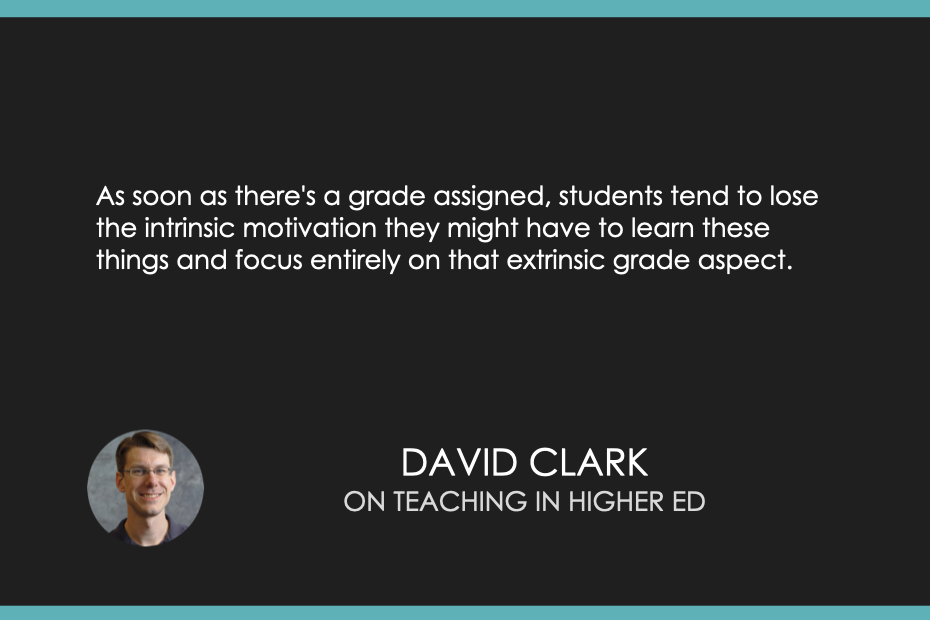
    As soon as there's a grade assigned, students tend to lose the intrinsic motivation they might have to learn these things and focus entirely on that extrinsic grade aspect.

    Does this represent what I really care about?
    -David Clark

    Most of us are used to giving feedback in some way, but making it helpful is the tough part.
    -David Clark

    A reassessment always needs some reflective parts, some metacognition, because that’s part of the feedback loop.
    -David Clark

    People aren’t going to remember everything that they’ve learned in our classes for all time.
    -David Clark

    As soon as there’s a grade assigned, students tend to lose the intrinsic motivation they might have to learn these things and focus entirely on that extrinsic grade aspect.
    -David Clark

    [/divwrap][divwrap class=”one-half”]

    Resources

    • Grading for Growth: A Guide to Alternative Grading Practices that Promote Authentic Learning and Student Engagement in Higher Education, by David Clark & Robert Talbert
    • Episode 510: The Principles of Grading for Growth with Robert Talbert
    • Four pillars described in Grading for Growth, by David Clark and Robert Talbert
      1. Clearly defined standards
      2. Helpful feedback
      3. Reassessment without penalty
      4. Marks indicate progress
    • Test Yourself: Which Faces Were Made by AI
    • Grading for Growth Blog

    [/divwrap]


    The Principles of Grading for Growth, with Robert Talbert Mar 21, 2024
    Show notes

    Robert Talbert shares about the principles of grading for growth on episode 510 of the Teaching in Higher Ed podcast.
    [divwrap class=”one-half first”]

    Quotes from the episode

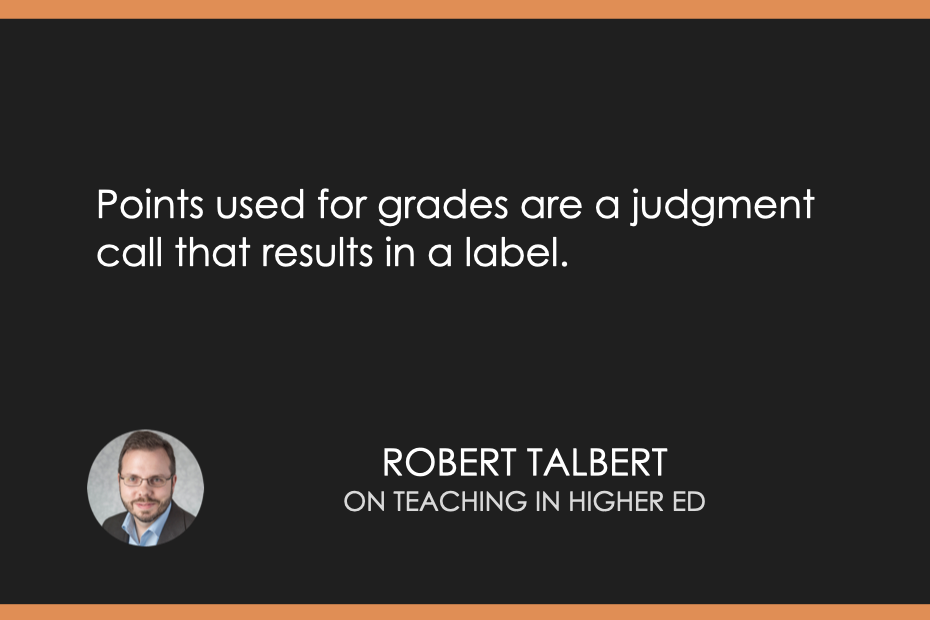
    Points used for grades are a judgment call that results in a label.

    In one shot, she can’t get a B in the class. And I sat there and just watched her sense of self worth and her excitement in the class just decay away right before my eyes.
    -Robert Talbert

    When you look at grades as we often use them in a traditional setting, they are much of what we do is under the guise of object what we think is objectivity.
    -Robert Talbert

    The biggest thing that’s broken about grades is that traditional grading is completely disconnected from the notion of a feedback loop.
    -Robert Talbert

    Give helpful feedback that doesn’t humiliate the student, affirms their basic dignity as a human being, and highlights what went well. Helpful feedback also highlights what could use some work and invites students to collaborate with you to make it better.
    -Robert Talbert

    Reattempts without penalty, that’s the closing of the feedback loop.
    -Robert Talbert

    Points used for grades are a judgment call that results in a label.
    -Robert Talbert

    [/divwrap][divwrap class=”one-half”]

    Resources

    • Grading for Growth: A Guide to Alternative Grading Practices that Promote Authentic Learning and Student Engagement in Higher Education, by David Clark & Robert Talbert
    • Difficult Conversations: How to Discuss What Matters Most (Third Edition), Douglas Stone & Sheila Heen
    • Dignity: Its Essential Role in Resolving Conflict, by Donna Hicks
    • Leading with Dignity: How to Create a Culture That Brings Out the Best in People, by Donna Hicks
    • The Extended Mind: The Power of Thinking Outside the Brain, by Annie Murphy Paul
    • Robert Talbert’s Sabbatical in Industry with Steelcase
    • The 12-week plan for building courses, by Robert Talbert

    [/divwrap]


    How to Teach in Active Learning Spaces, with Kem Saichaie Mar 14, 2024
    Show notes

    Kem Saichaie talks about how to teach in active learning spaces on episode 509 of the Teaching in Higher Ed podcast.
    [divwrap class=”one-half first”]

    Quotes from the episode

    Flexibility requires familiarity.

    Flexibility requires familiarity.
    -Kem Saichaie

    Oftentimes, at least at the research intensive level, we have this false comparison between STEM and non STEM types of teaching in classrooms.
    -Kem Saichaie

    At the heart of many active learning classroom design spaces is the concept of flexibility.
    -Kem Saichaie

    [/divwrap][divwrap class=”one-half”]

    Resources

    • A Guide to Teaching in the Active Learning Classroom, by Baepler, Walker, Brooks, Saichaie, and Petersen
    • Students Put Teaching and Learning Complex to the Test, by Sudhiksha Shanbhag Kota
    • Is Active Learning Accessible? Exploring the Process of Providing Accommodations to Students with Disabilities, by Gin, Guerrero, Cooper, and Brownell
    • Various definitions to explore, when considering active learning spaces: pedagogical, physical, and psychological
    • Design Justice Network
    • Kem’s namedrop.io
    • Bonni’s name-coach
    • Sarah Silverman’s workshops

    [/divwrap]


    How Curiosity Can Transform Lives and Change the World, with Scott Shigeoka Mar 07, 2024
    Show notes

    Scott Shigeoka shares about his book SEEK: How Curiosity Can Transform Your Life and Change the World on episode 508 of the Teaching in Higher Ed podcast.
    [divwrap class=”one-half first”]

    Quotes from the episode

    Students can feel unsafe on their campuses because of the discourse or the lack of discourse.

    It is a really beautiful experience to have multiple generations in the same house where we’re all just living and learning alongside one another.
    -Scott Shigeoka

    Students can feel unsafe on their campuses because of the discourse or the lack of discourse.
    -Scott Shigeoka

    [/divwrap][divwrap class=”one-half”]

    Resources

    • SEEK: How Curiosity Can Transform Your Life and Change the World, by Scott Shigeoka
    • Curiosity quiz
    • I drove across the US to meet people I disagree with – and learned how to look beyond labels, by Scott Shigeoka in The Guardian
    • Today Show Clip: How Being Deeply Curious Can Strengthen Connections
    • UC Berkeley Greater Good Science Center
    • Death Doula Alta Arthur’s TED Talk: Why Thinking About Death Helps You Live a Better Life
    • How Curiosity Can Help Us Overcome Disconnection, by Scott Shigeoka for the UC Berkeley Greater Good Science Center

    [/divwrap]


    Higher Education for All, with Tami Shetron Feb 29, 2024
    Show notes

    Tamara (Tami) Shetron shares a vision of higher education for all (including those with intellectual and developmental disabilities on episode 507 of the Teaching in Higher Ed podcast.
    [divwrap class=”one-half first”]

    Quotes from the episode

    Everyone can learn.

    My background is in a field called developmental education, which is some people used to call it remedial education, but the term evolved into developmental because remedial is the idea of fixing things, whereas developmental follows more the natural human cycle of growing and developing across the lifespan.
    -Tamara (Tami) Shetron

    Everyone can learn.
    -Tamara (Tami) Shetron

    What makes these programs different from a normal, typical college experience is they are designed to help students get employment.
    -Tamara (Tami) Shetron

    [/divwrap][divwrap class=”one-half”]

    Resources

    • Texas State University’s Bobcat RISE Program
    • Convention on the Rights of Persons with Disabilities
    • 2008 Higher Education Opportunity Act
    • National Core Indicators (NCI) from Think College

    [/divwrap]


    How to Use High Structure Course Design to Heighten Learning, with Justin Shaffer Feb 22, 2024
    Show notes

    Justin Shaffer shares how to use high structure course design to heighten student learning on episode 506 of the Teaching in Higher Ed podcast.
    [divwrap class=”one-half first”]

    Quotes from the episode

    Some students might be doing just fine with the traditional, maybe unstructured class. But we know from evidence, lots of research now shows that this type of structure does help students.

    Some students might be doing just fine with the traditional, maybe unstructured class. But we know from evidence, lots of research now shows that this type of structure does help students.
    -Justin Shaffer

    The keyword through all 3 steps is alignment.
    -Justin Shaffer

    I don’t think the structure necessarily guarantees success because it’s the students ultimately have to put the work in to earn that grade, to earn that outcome.
    -Justin Shaffer

    [/divwrap][divwrap class=”one-half”]

    Resources

    • The Spark of Learning: Energizing the College Classroom with the Science of Emotion, by Sarah Rose Cavanagh*
    • Recombinant Education
    • Podcases
    • Calvin and Hobbes
    • Kelly Hogan on Teaching in Higher Ed
    • A Time for Telling, by Schwartz and Bransford
    • Examples of Justin’s Reading Guides on his website
    • Bibliography on Case Study Teaching in Science, Technology, Engineering, and Mathematics
    • Improving Exam Performance in Introductory Biology through the Use of Preclass Reading Guides, by Lieu, Wong, Asefirad, & Shaffer

    [/divwrap]


    Previous 1 12 13 14 15 16 65 Next

    Related Podcasts

    Making Sense with Sam Harris

    1

    Making Sense with Sam Harris Education
    Grammar Girl

    2

    Grammar Girl Education
    Good Life Project

    3

    Good Life Project Education
    Explain It to Me

    4

    Explain It to Me Education
    Team Never Quit

    5

    Team Never Quit Comedy
    Optimal Living Daily – Personal Development and Self-Improvement

    6

    Optimal Living Daily – Personal Development and Self-Improvement Alternative Health
    footer-logo

    Contact Us

    Toll Free: 844-670-7747

    Links

    • Home
    • Top Charts
    • Networks
    • Apps
    • Independents Podcasts
    • Podcast Advertising
    • Podcast News
    • Contact Us
    • About Us
    • Analytics & Insights

    Stay Connected

      Privacy, Terms of Use & Our Code of Ethics Protecting Content Creators Copyrights