TopPodcast.com
Menu
  • Home
  • Top Charts
  • Top Networks
  • Top Apps
  • Top Independents
  • Top Podfluencers
  • Top Picks
    • Top Business Podcasts
    • Top True Crime Podcasts
    • Top Finance Podcasts
    • Top Comedy Podcasts
    • Top Music Podcasts
    • Top Womens Podcasts
    • Top Kids Podcasts
    • Top Sports Podcasts
    • Top News Podcasts
    • Top Tech Podcasts
    • Top Crypto Podcasts
    • Top Entrepreneurial Podcasts
    • Top Fantasy Sports Podcasts
    • Top Political Podcasts
    • Top Science Podcasts
    • Top Self Help Podcasts
    • Top Sports Betting Podcasts
    • Top Stocks Podcasts
  • Podcast News
  • About Us
  • Podcast Advertising
  • Contact
Not in our directory?
Add Show Here
Podcast Equipment
Center

toppodcastlogoOur TOPPODCAST Picks

  • Comedy
  • Crypto
  • Sports
  • News
  • Politics
  • True Crime
  • Business
  • Finance

Follow Us

toppodcastlogoStay Connected

    View Top 200 Chart
    Back to Rankings Page
    Technology

    Loup Ventures Podcast

    We publish research on frontier technology, the themes driving it, and the companies making it a reality. This podcast includes audio versions of select research notes.

    Advertise
    • Apple Podcasts
    • Google Play
    • Spotify

    Latest Episodes:
    Would You Let a Robot Do These 12 Jobs? Apr 07, 2017
    Show notes

    This week we attended Automate, a robotics trade show in Chicago focused on manufacturing and fulfillment. As we explored the show floor, we saw a number of robots able to work next to humans for an affordable cost of $30-$40k each. Most vendors claimed less than a 12 month payback period. Automation is now in reach for many businesses, and they are slowly becoming comfortable implementing robots, in part for the cost advantage and part out of necessity to find labor.

    We left the show with two questions. First, are we too conservative to believe it will take 30 years for 70% of human jobs to be replaced by robots? Short answer: we’re optimistic and should have a better idea of how quickly automation will come over the next few years. Second, how comfortable are consumers allowing robots to do certain jobs? To address this question, we surveyed 500 average consumers in the US and asked them to rate their comfort level with robots performing 12 specific tasks.

    Survey methodology. We asked survey takers across a mix of age and income demographics to rate their comfort level with robots performing various tasks on a scale of 1-5: 1 being extremely uncomfortable, 3 being neutral, and 5 being extremely comfortable. We surveyed jobs in four categories: time-consuming chores, transportation, personal/family livelihood, and professional services.

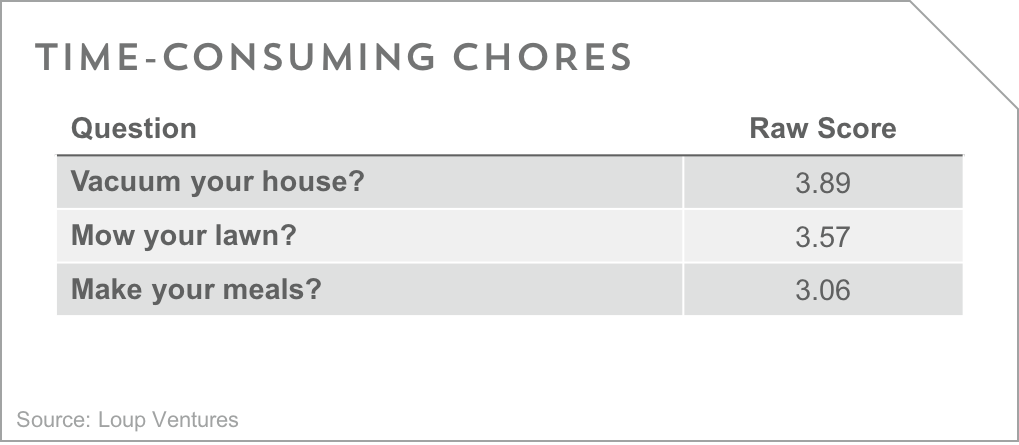
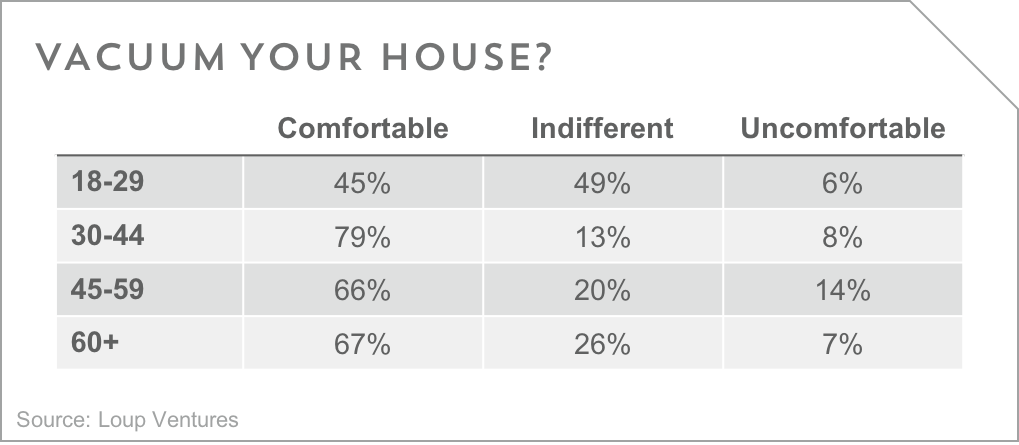
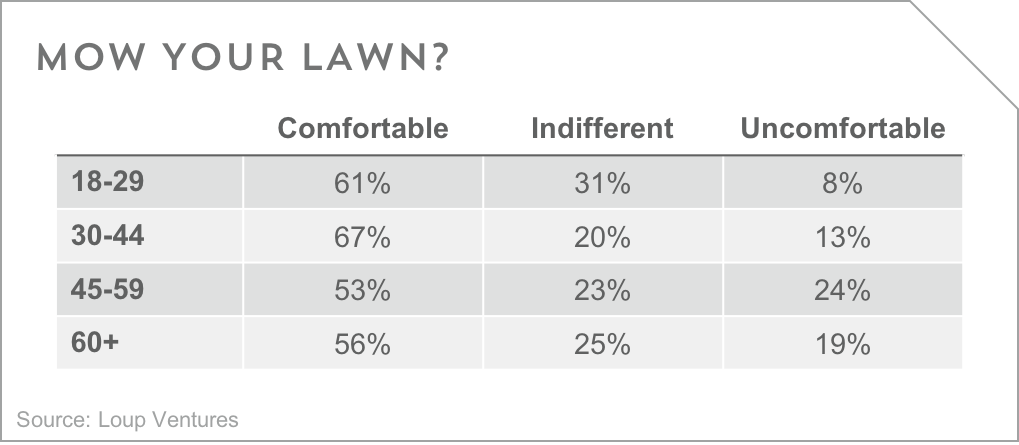
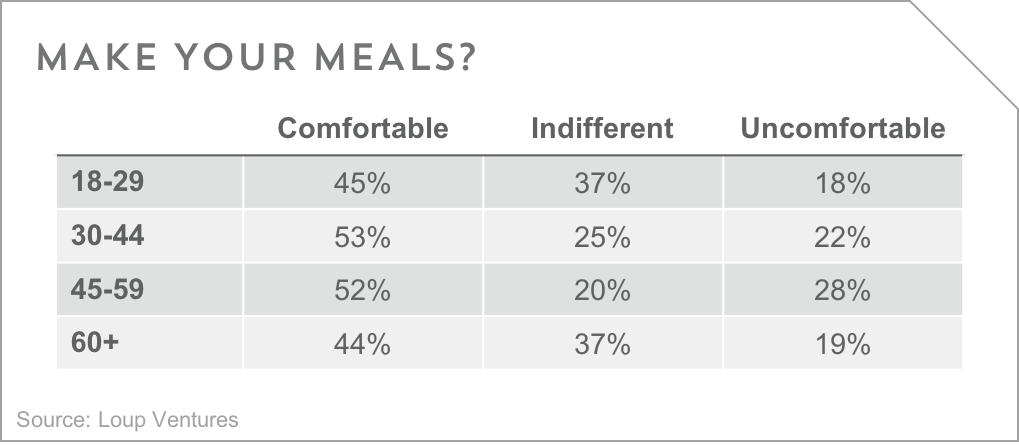
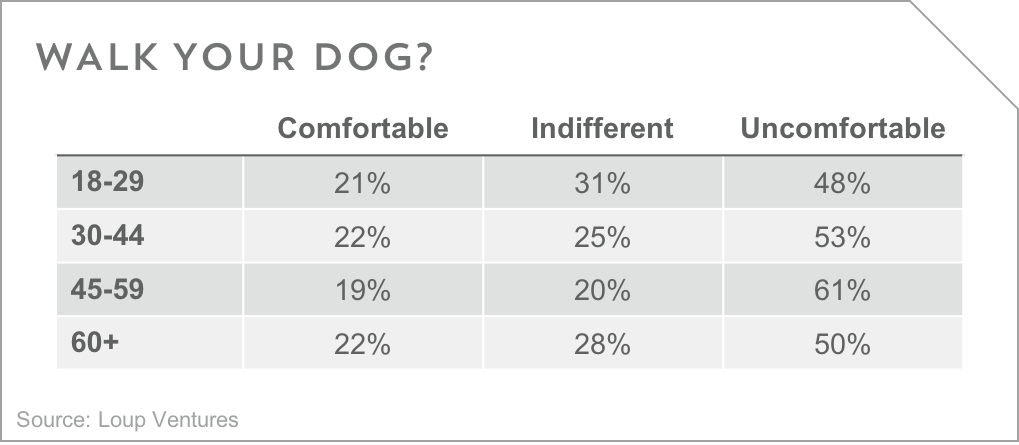
    Time-consuming chores. We found general acceptance in robots performing daily, relatively safe, time-consuming chores such as vacuuming, mowing the lawn, or preparing food. Of all of the four categories of jobs we surveyed, the time-consuming chore category was the most positively viewed. This may be because these tasks have low downside if a robot fails to do them well; you just end up with a poorly vacuumed house, a butchered lawn, or a bad meal. The 30-44 age bracket, or loosely late millennials, consistently indicated the highest levels of comfort with this category (and most categories), while the 18-29 demo, or early millennials, surprisingly saw less benefit to robot vacuums or meal-makers – perhaps because many in this demo don’t perform the tasks themselves (see tables below).

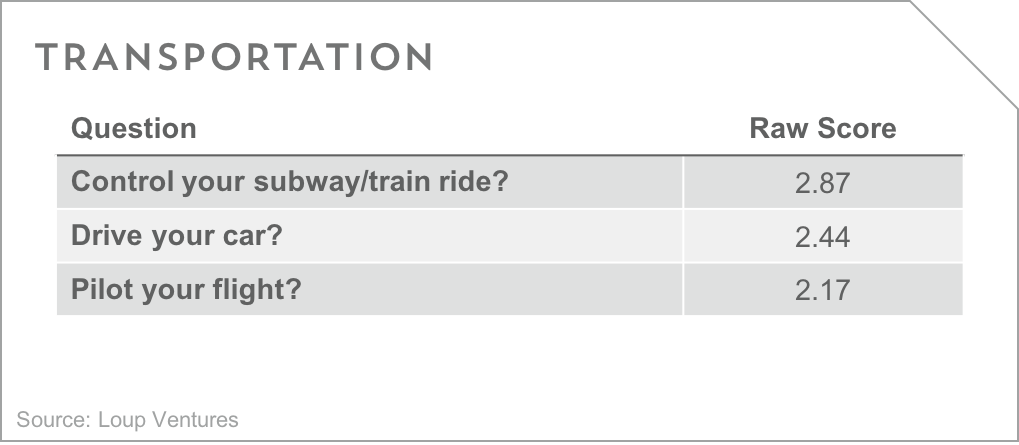
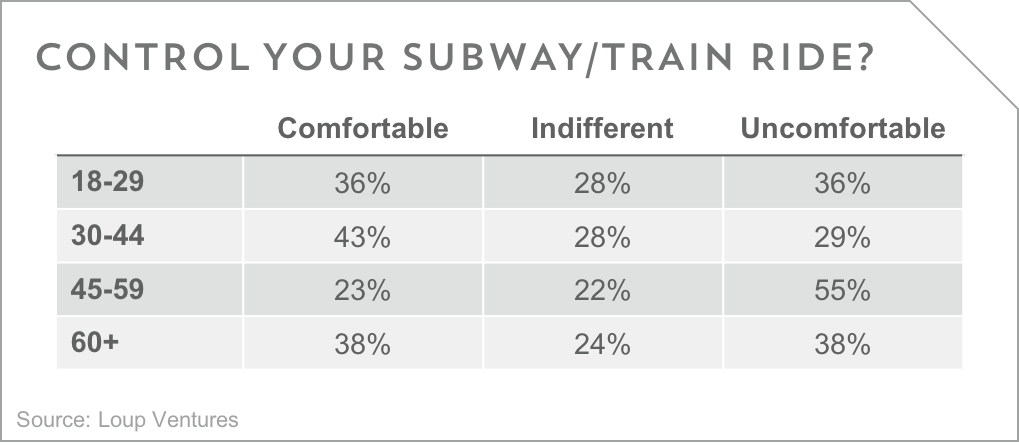
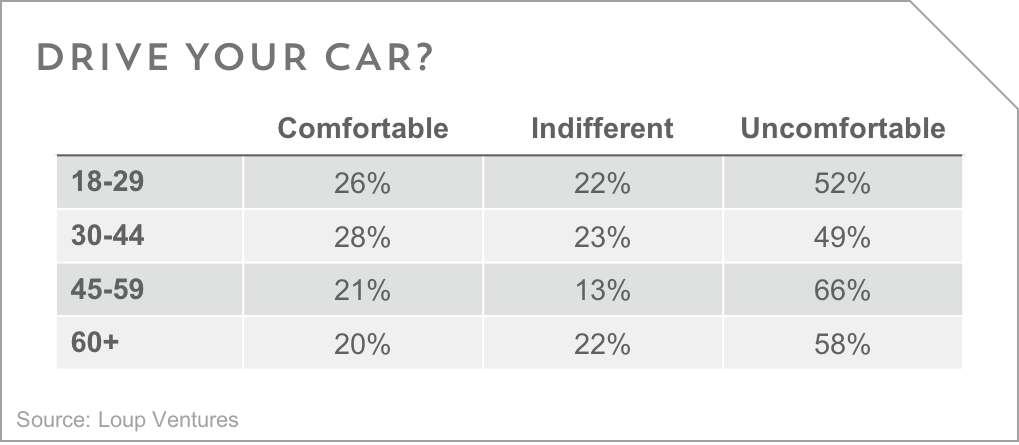
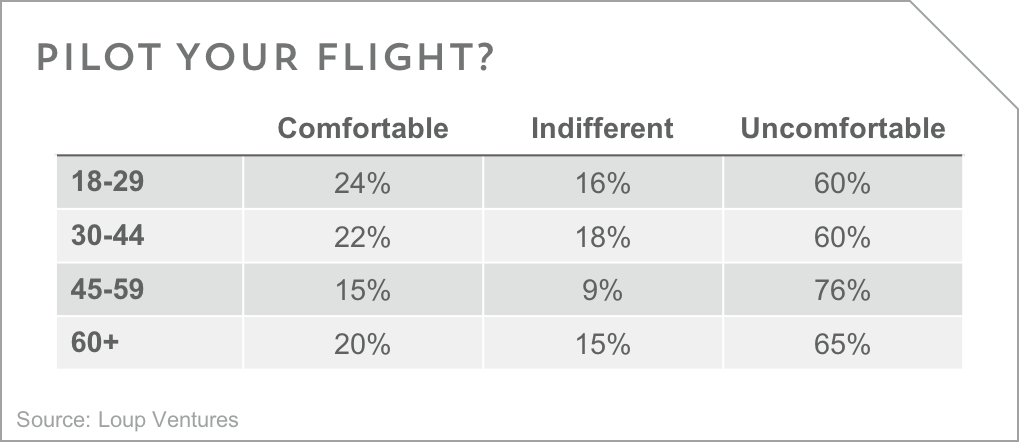
    Transportation. Our survey results indicated a general indifference to a robot controlling a subway or train ride, but less comfort with driving a car or piloting a plane. We believe this relates to the relative risk of downside due to robotic failure as mentioned in the prior section. It’s hard to imagine a catastrophic subway accident, but easy to imagine a major car accident or downed plane. Interestingly, the 40-59 demo, or Gen X, was the most uncomfortable of the demo groups, with on average 65% of responses indicating uncomfortable or extremely uncomfortable. We suspect relatively risk-averse Gen X upbringings and presence of young or teenage children may account for these results.

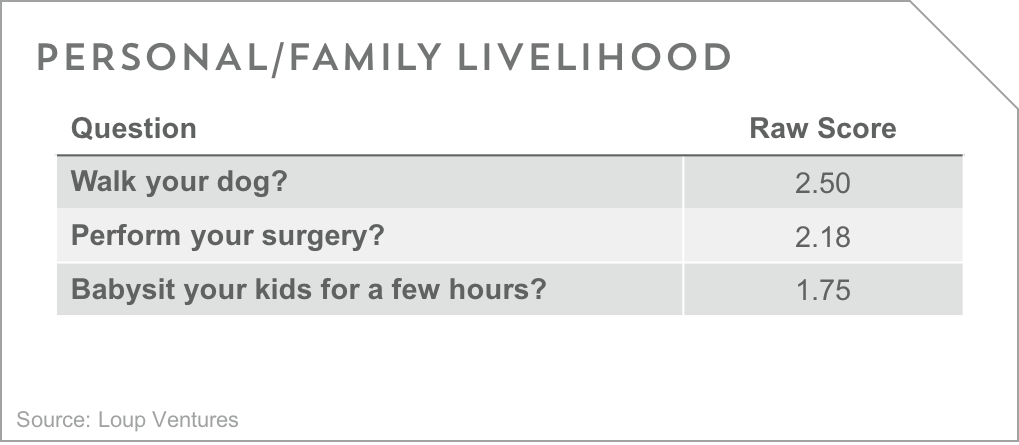
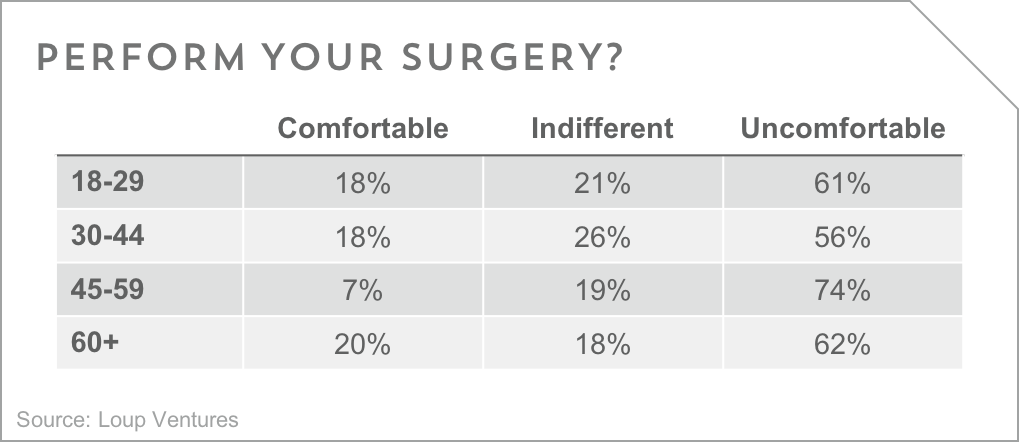
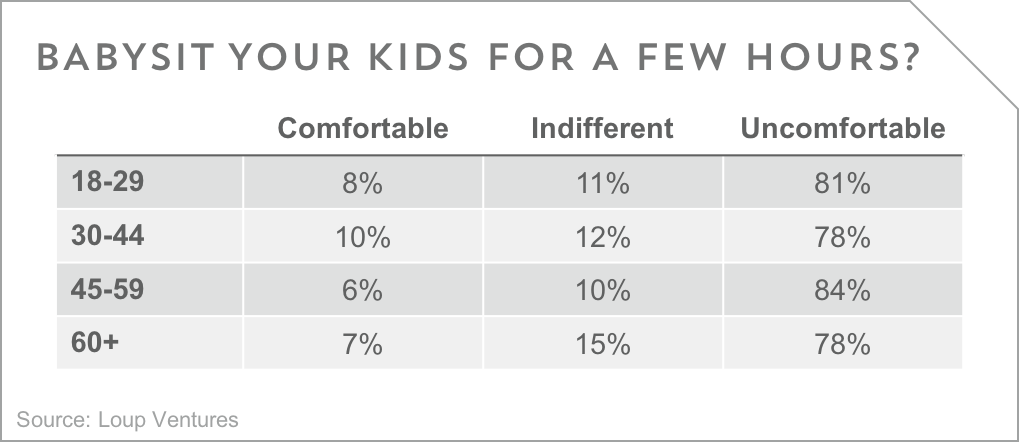
    Personal/family livelihood. Given the discomfort in letting a robot drive a car, it’s not surprising that most people aren’t ready to let robots do even more personal tasks like perform surgery or babysit. Again, downside risk to robotic failure is very apparent for both of these tasks, thus the lean toward discomfort. While babysitting requires empathy, which we view a one of the three key advantages humans hold over robots in addition to creativity and community, robots should theoretically be better surgeons than humans. Robo-surgeons have steadier and more precise instruments and can process more data about the body simultaneously than a human surgeon. Consistent high levels of discomfort to this category are seen across all demographics. Robo-babysitters scored an average of 20 points higher on the discomfort scale vs robo-surgeons.

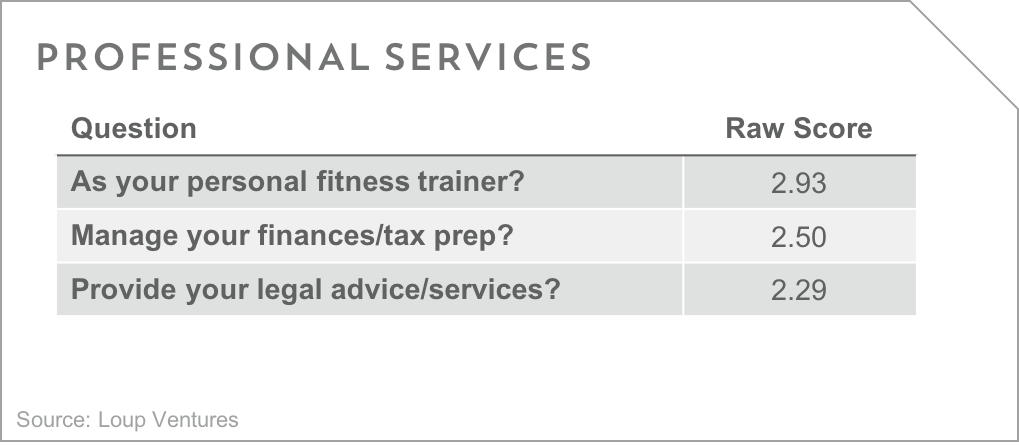
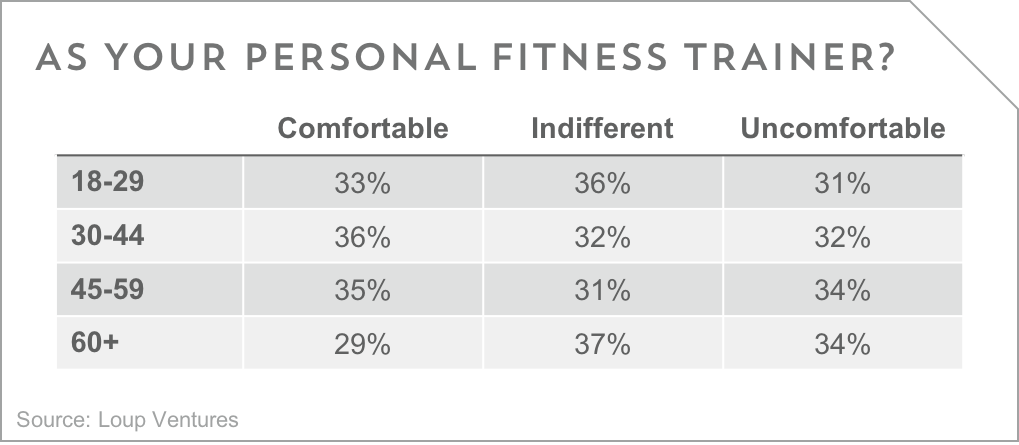
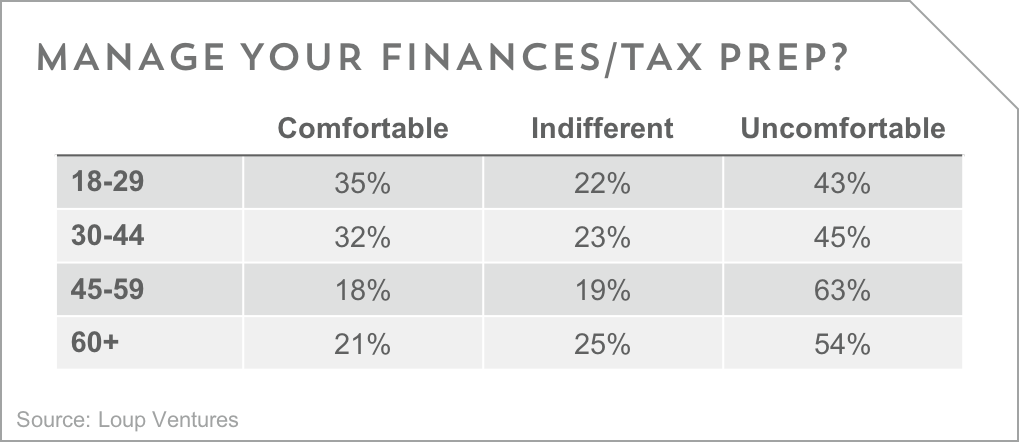
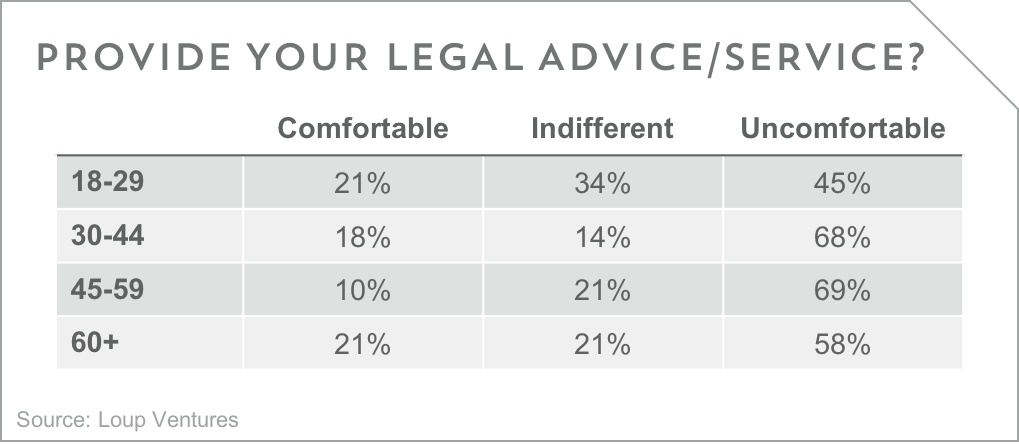
    Professional Services. Survey respondents were generally uncomfortable in relying on robots to perform professional services aside from personal training. We feel this again relates to risk. While there is no mortal risk to poorly performed taxes or legal services, there is a risk of financial cost from those failures. The 18-29 year old demographic showed the most comfort using robo-accountants or robo-lawyers.

    Overall, we have some trust to build between consumers and robots to get to the automated future we envision, particularly with tasks perceived to be “dangerous.” As humans come to accept that robots can perform almost all “dangerous” tasks with greater safety than humans, the associated comfort levels should rise.

    Disclaimer: We actively write about the themes in which we invest: artificial intelligence, robotics, virtual reality, and augmented reality. From time to time, we will write about companies that are in our portfolio. Content on this site including opinions on specific themes in technology, market estimates, and estimates and commentary regarding publicly traded or private companies is not intended for use in making investment decisions. We hold no obligation to update any of our projections. We express no warranties about any estimates or opinions we make.


    AI’s Busted Bracket Apr 03, 2017
    Show notes

    The Loup Ventures NCAA bracket contest isn’t as hotly contested as we thought it would be. We entered Bing’s AI bracket into our pool, and it’s just as busted as the others. In fact, Bing’s bracket will finish at the bottom of our pool, in 7th place, regardless of the outcome of tonight’s game. We would like to think that we outsmarted AI, but the reality is that predicting the outcome of the NCAA tournament is more a matter of luck than skill. Bing’s performance doesn’t mean it’s broken, just unlucky this year.

    * Bing Predicts 2017 NCAA Basketball Bracket

    To date, Bing has chosen 39 out of 67 games correctly, including the opening round. Bing was 2 of 4 in the opening round, 24 of 32 in the 1st Round, 9 of 16 in the 2nd Round, 4 of 8 in the Sweet Sixteen, before going 0 for 4 in the Elite Eight and ending its chances at victory. If you look at Bing’s bracket now, it will show a different story, because it re-picked winners for matches after each round. Even with this adjustment, it only picked 47 of 66 games correctly, leading into tonight’s game. In the adjusted rounds, Bing chose Final Four weekend right with Gonzaga and UNC as winners, with UNC ultimately taking home the crown.

    How does Bing predict winners? First, it’s important to understand how Bing predicted its winners. The Bing Predicts algorithm factors in millions of data points in an effort to create the best predictive model. The algorithm looked at every college basketball game played in the last 15 years in an attempt to analyze correlations between measurable statistics and wins. The algorithm will give an output of the likelihood in which a team will win the game. It’s not meant to choose a certain winner, but the higher the percentage, the greater the disparity amongst the teams.

    Walter Sun, an architect of the Bing Predicts algorithm, was asked by Wired Magazine about some of the important considerations in the algorithm. Defensive efficiency, strength of schedule, coaching rankings, and miles traveled were a few of the metrics that the algorithm measures.

    For defensive efficiency, strong defensive teams have had more success in the tournament historically. For strength of schedule, the theory is that the seeding committee favors Power 5 conference teams, which leads to schools in smaller conferences being underrated. For coaching ranking, experienced coaches have a big impact on the success of their teams in the postseason. For miles traveled, teams that travel farther have a harder time winning, especially when they travel across time zones.

    While it’s helpful to understand some of the metrics driving the Bing Predicts algorithm, taking a closer look at AI explains why the cards are stacked against Bing.

    Why didn’t Bing give better advice? The probability that Bing assigns to any given team winning is very likely the most accurate prediction possible, but a probability is still a probability. If Bing says a team has an 80% chance to win, that means it has a 20% chance to lose. But picking winners in a bracket is binary. You are choosing a team to win, period. If the 20% chance happens, brackets are bound to be busted happens – and with 69 games to predict it’s almost a statistical guarantee.

    Bing could be better at NCAA predictions if it was able to collect data about future events leading up to the game. What will the hydration level of each individual player be at game time, how much rest did each player get the night before the game, what is going on with each player psychologically, etc. All of these incremental factors would influence what historical data predicts if it were possible to be known by Bing. Even then, every possession of the game can be influenced by random events and the flow of the game changes the probability of how teams play later in the game. The Patriots’ epic comeback in the Super Bowl is a perfect example. They had a 99%+ chance to lose, which means they had a less than 1% chance to win, but not a 0% chance to win.

    What does this mean for the future of AI? We shouldn’t overreact. Every action we take as humans could be viewed as a predicted potential outcome and sometimes predictions are wrong. Take driving as an example. Every action we perform while driving is based on a predictive calculation in our heads about where we want the car to go and how to get it there. 1.3 million people die every year in traffic accidents, so we aren’t very good at those predictions. Machines already drive better than humans, because they don’t get distracted by phones or emotional about bad drivers.

    While skeptics may laugh that the robots failed at predicting the outcome of a basketball tournament, AI is still a better predictor of outcomes than any human because of the amount of data it can incorporate in its prediction. We shouldn’t expect AI to be right 100% of the time because it won’t be, but it will be right more often than humans making the same predictions. Humans got lucky with our brackets this year, but shouldn’t expect an easy repeat next year.

    Disclaimer: We actively write about the themes in which we invest: artificial intelligence, robotics, virtual reality, and augmented reality. From time to time, we will write about companies that are in our portfolio. Content on this site including opinions on specific themes in technology, market estimates, and estimates and commentary regarding publicly traded or private companies is not intended for use in making investment decisions. We hold no obligation to update any of our projections. We express no warranties about any estimates or opinions we make.


    Feedback Loup: Google Daydream Mar 31, 2017
    Show notes

    Google’s smartphone-powered VR platform, Daydream, represents the company’s most significant push to date in its effort to accelerate the adoption of VR. We’ve spent the last few weeks testing the platform with a Pixel phone and a Daydream View headset. Bottom line: Daydream isn’t there yet, but the platform establishes a solid foundation for the future of “low-immersion” VR.

    Along with Samsung’s Gear VR platform and Google Cardboard, we continue to believe these smartphone-powered, low-immersion platforms will drive the global VR user base above 100m by 2018. We expect the vast majority of VR users will be using low-immersion VR over the next several years. Low-immersion platforms are the on ramp for high-immersion VR platforms like the Oculus Rift and HTC Vive, so it is important to understand the low-immersion platforms of today in order to anticipate broader high-immersion use and the future of VR more broadly.

    Hardware, software and content are all critical components for the future of VR, but our experience with Daydream left us feeling that content represents the biggest near-term opportunity to show the power of VR.

    Hardware: Daydream is powered by Daydream-ready Android phones running the Nougat operating system. Currently, there are 4 Daydream-ready phones, including Pixel, with (many) more on the way. After a month-long wait, we used a Pixel ($649) for our testing of the Daydream platform. These phones pair with the Daydream View headset ($79), which is the best smartphone-powered VR headset we’ve ever used.

    Daydream View is the best VR headset we’ve ever used.

    Unlike some headsets we’ve tried, Daydream View is wearable. The soft fabric and angled head strap are clear signs of thoughtful design, built for wearability. Plus, in what seems like an industry first, it’s even comfortable for users with glasses. Daydream View comes with a remote control that we found easy to set up and intuitive to use. The remote conveniently nests in the viewer when not in use. Sound can be heard directly from the phone’s speakers, but it’s more immersive to use the easily accessible headphone jack on the Pixel.

    The only drawbacks we found with the Daydream View + Pixel combo were: 1) Heat – the Pixel gets very hot after about 20 minutes of use. Not hot enough to cause concern or discomfort inside the headset, but noticeable when you remove the phone from the headset and put it back in your pocket. 2) Light – some users noticed light coming into the headset near the nose area, which can interrupt immersion and remind the user that he or she is in a virtual environment.

    Software: Daydream requires Android 7.0+ “Nougat” operating system, which represents just 3% of all Android users today. Google Play is your destination for Daydream apps. Our favorite was Youtube VR. The experience is immersive and the recommended content is created for VR. Other content apps, Like Netflix VR, are simply virtual environments in which to view 2-D content. Some of the games were fun, but seem to be more proofs of concept vs engaging, fully developed products. We think that VR will play an important part in the future of casual gaming and expect more development there as the platforms become more widespread.

    Content: Overall, the app library is just enough for users to see the value in key use cases including gaming (check out Wonderglade), theatrical content (check out Youtube VR) and, increasingly, live content (check out the NBA via NextVR). The library shows early hope for great VR content experiences – but more content built specifically for VR will support a growing user base as Daydream-ready phones proliferate.

    Google Cardboard feels like a throwaway – not Daydream. Google’s emerging platform offers a true competitor to Samsung Gear VR. Both of these low-immersion platforms will accelerate growth in the VR user base by making it accessible to millions of users with smartphones. As content follows, users will be exposed to the use case of VR and compelled to use high-immersion systems that will lead us into the future of VR.

    Disclaimer: We actively write about the themes in which we invest: artificial intelligence, robotics, virtual reality, and augmented reality. From time to time, we will write about companies that are in our portfolio. Content on this site including opinions on specific themes in technology, market estimates, and estimates and commentary regarding publicly traded or private companies is not intended for use in making investment decisions. We hold no obligation to update any of our projections. We express no warranties about any estimates or opinions we make.


    Apple Services Tracking To 20% Of Revenue In Five Years Mar 28, 2017
    Show notes

    Apple Services Through 2022. We have written about the need for Apple to reinvent itself in the next decade through services and AR. The Services reinvention is already underway, accounting for 11.6% of revenue in 2016, and closer to 18% of profits. Today we are rolling out our 2022 Services model, and estimate services revenue will account for 20% of Apple’s sales in five years, 30% of profits and growing at 15% annually. For comparison, we estimate Apple’s hardware sales will be growing at about 5% in 2022. This translates to $60B in 2022 Services revenue up from our estimate of $30B in 2017. This growth will in part be maintained by App Store revenue from Apple’s advancement of augmented reality (AR) that will be the company’s next major development platform. We expect AR will be a key feature in the upcoming iPhone X release (more on that here), which will slowly build developer enthusiasm for AR apps.

    Beyond 2022. Apple should easily hit its stated goal that its Services business will become a Fortune 100 company sometime in 2017. Thinking about Services beyond 2022, we believe Services will have a steady 10% growth, and account for three quarters of Apple’s overall growth. This will be driven primarily by the App Store, Apple Music + Content, with all three areas strongly benefitting from the addition of AR.

    App Store. By 2022, we expect App Store revenue to account for 44% of Services revenue and be growing at 14% annually, due to Apple’s continued leverage of revenue share with developers. Apple will continue to see App Store revenue account for a major portion of total Services revenue. The emphasis on AR capabilities in the iPhone X will be the next foundation for developers, creating an even playing field for creation and distribution of AR content. It’s worth noting that we don’t expect an acceleration of App Store growth from AR; rather, developers will view adoption of AR as fundamental to a mobile experience, and a necessity to maintain existing users and compete for new ones. Our App Store growth goes from 29% in 2017 to 14% in 2022.

    Apple Music + Content. By 2022, we expect Apple Music + Content revenue to account for 23% of Services revenue, growing at 30% annually. We remain optimistic on the future of Apple Music. Despite a rough start, Apple has steadily built its music subscriber base to roughly 25m (as of Feb. 2017). By the end of 2017/early 2018, we expect Apple to begin offering additional video content as well, including its own original content (more on that here). While this pursuit adds Apple to an already tight freeway of content producers and providers like Netflix and Amazon, Apple’s combination of AR and VR related hardware and content could offer some differentiation.

    Growth in this segment is ultimately dependent on Apple’s investment in the quantity and quality of its content, en route to its internal goal of 100 million Apple Music + Content subscribers by 2022. Apple is well on its way to achieving this target with roughly 25m music-only subscribers to date, while the preponderance of future subscriber adds will need to come from a hybrid music/content offering.

    iCloud. By 2022, we expect iCloud revenue to account for 13% of Services revenue, growing at 15% annually. Apple’s iCloud business will continue to scale with continued growth in devices, users, and devices per user. In addition, natural storage pricing declines will continue to attract more users to the service.

    iTunes. By 2022, we expect iTunes revenue to account for 8% of Services revenue, declining 10% annually. iTunes revenue will continue to naturally decline as music and video streaming subscription services grow. Roughly half of iTunes revenue is from music purchases, while the other half is from video content. As more video is added to Apple Music/TV, iTunes revenue declines will accelerate.

    Licensing. By 2022, we expect Licensing revenue to account for 6% of Services revenue, growing at 12% annually. Apple derives most of its licensing revenue from Google, as Google pays to have its search engine as the default in Safari. In addition, Apple licenses many of its patents to other smartphone manufacturers, such as Samsung. This revenue should continue to grow steadily in the future as other parties will continue to rely on Apple’s platform and patented technology.

    Apple Care. By 2022, we expect Apple Care revenue to account for 5% of Services revenue, growing at 10% annually. Apple Care will remain an important contributor to Services revenue. Apple Care has benefited from the launch of the iPhone upgrade program. Apple Care subscriptions should continue to scale commensurate with increasing iPhone ASPs and popularity of upgrading more frequently.

    Apple Pay. By 2022, we expect Apple Pay revenue to account for 1% of Services revenue, growing at 40% annually. Despite its fractional contribution, Apple has seen a lot of success with the Apple Pay platform in just the past year. User growth has tripled to nearly 12m monthly users, while transaction volumes increased by approximately 500%. This is clear evidence of growing user adoption of Apple Pay, as well as growing contentment with the service as a frequent and preferred payment method. See our recent analysis of Apple’s progress with Apple Pay here.

    Apple’s adoption of AR will add an entirely new dimension to Apple pay. For example, iPhone X owners can eventually use their phones to view a product, get pricing comparisons, or even complete an order. Imagine going into a store and seeing the perfect shirt, only to realize that the size you need is not in stock. At this point, a shopper has to track down a sales associate, explain what product and size they want, and then fill out shipping and payment information at a register. With AR, a user could simply capture the item, and automatically navigate to product checkout on their device. Users will already have shipping and payment information stored in Apple Pay, simplifying the process and removing any need for interaction with a sales associate – a rather seamless transaction for the consumer.

    Disclaimer: We actively write about the themes in which we invest: artificial intelligence, robotics, virtual reality, and augmented reality. From time to time, we will write about companies that are in our portfolio. Content on this site including opinions on specific themes in technology, market estimates, and estimates and commentary regarding publicly traded or private companies is not intended for use in making investment decisions. We hold no obligation to update any of our projections. We express no warranties about any estimates or opinions we make.


    AirPods Are More Important Than The Apple Watch Mar 22, 2017
    Show notes

    At this point, it might not even be that crazy to say it, but we think AirPods are going to be a bigger product for Apple than the Watch. After using AirPods for the past month, the Loup Ventures team is addicted. The seamlessness in connecting and disconnecting with our phones and enabling Siri has meaningfully improved the way we work and consume content. AirPods are a classic example of Apple not doing something first, but doing it better. And they look cool. We think there are three reasons that AirPods are more important than the Apple Watch.

    AI-First World
    Google has been talking about designing products for an AI-first world for about a year now. In our view, an AI-first world is about more natural interfaces for our screen-less future. Speech is an important component of the next interface. Siri, Alexa, Google Assistant, and Cortana are making rapid improvements in terms of voice commands they understand and what they can help us with.

    We view AirPods as a natural extension of Siri that will encourage people to rely more on the voice assistant. As voice assistants become capable of having deeper two-way conversations to convey more information to users, AirPods could replace a meaningful amount of interaction with the phone itself. By contrast, using Siri on the Apple Watch is less natural because it requires you to hold it up to your face. Additionally, the screen is so small that interaction with it and information conveyed by it is not that much richer than an AI voice-based interface.

    Medical Data
    The core feature of Apple Watch is fitness tracking including step tracking and heart rate monitoring; however, we believe the ear offers similar, if not better, opportunity to track health data. We’ve heard from companies that have suggested that the ear offers much richer data than the wrist. To that end, Apple recently filed a patent for advanced earbuds capable of tracking “heart rate, VO2, galvanic skin, EKG, impedance cardiography, and temperature.” We believe that in the next two years, AirPods are likely to incorporate some of these additional health features with the main constraint being the tax on battery.

    Security
    AirPods could also be the future of Touch ID. NEC has developed technology that uses the ear canal to verify identity by bouncing sound waves off the ear canal. One advantage of this approach is persistent or semi-persistent authentication vs a point authentication via fingerprint. We believe the ear-based biometric approach will be a fundamental requirement for AR and AI interfaces of the future where there won’t be a convenient place to read a fingerprint or enter a password.

    Be Patient
    AirPods are more important for Apple than the Watch, but it may take some time for it to show. IDC data shows that Apple sold 8.8 million Watches in CY16. We expect 10 million in CY17. By comparison, we expect Apple to sell around 8-10 million AirPods in CY17, assuming production improves in the next month. We expect over 20 million AirPods in CY18 vs 12 million Apple Watches. Given the higher ASP on Apple Watch of around $450 vs $159, the company will have to sell about 3x as many AirPods as Watches for revenue to be roughly equivalent. We believe this could happen by 2020 as the health and security features make AirPods a must have accessory that the Watch can’t match.

    Disclaimer: We actively write about the themes in which we invest: artificial intelligence, robotics, virtual reality, and augmented reality. From time to time, we will write about companies that are in our portfolio. Content on this site including opinions on specific themes in technology, market estimates, and estimates and commentary regarding publicly traded or private companies is not intended for use in making investment decisions. We hold no obligation to update any of our projections. We express no warranties about any estimates or opinions we make.


    The Five Senses of Computing Mar 21, 2017
    Show notes

    The trend in computing towards more natural user interfaces is unmistakable. Graphical user interfaces have long been dominant, but machines driven by more intuitive inputs, like touch and voice, are now mainstream. Today, audio, motion, and even our thoughts, are the basis for the most innovative computer-user interaction models powered by advanced sensor technology. Each computing paradigm maps to one or more of the five human senses; exploring each sense gives us an indication of the direction in which technology is heading.

    Sight – Graphical User Interface

    The introduction of the graphical user interface (GUI) drove a step function change in computers as productivity tools, because users could rely heavily on sight, our dominant sense. The GUI was then carried forward and built on with the advent of touchscreen devices. The next frontier for visual user interfaces lies in virtual reality and augmented reality. Innovations within these themes will further carry forward the GUI paradigm. VR and AR rely heavily on sight, but combine it more artfully with other inputs like audio, motion, and touch to create immersive interfaces.

    Touch – Touchscreen Devices

    PCs leveraged basic touch as a foundational input via the keyboard and the mouse. The iPhone then ushered in a computing era dominated by touch, rejecting the stylus in favor of, as Steve Jobs put it, “the best pointing device in the world” – our fingers. Haptics have pushed touchscreen technology further, making it more sensory, but phones and tablets fall well short of truly immersive computing. Bret Victor summarized the shortcomings of touchscreen devices in his 2011 piece, A Brief Rant on the Future of Interaction Design, which holds up well to this day.

    More fully integrating our sense of touch will be critical for the user interfaces of the future. We think that haptic suits are a step we will take on the journey to full immersion, but the best way to trick the user into believing he or she is actually feeling something in VR is to manipulate the neurochemistry of the brain. This early field is known as neurohaptics.

    Hearing – Digital Assistants & Hearables

    Computers have been capable of understanding a limited human spoken vocabulary since the 1960s. By the 1990s, dictation software was available to the masses. Aside from limited audio feedback and rudimentary speech-to-text transcription, computers did not start widely leveraging sound as an interface until digital assistants began to be integrated into phones.

    As digital assistants continue to improve, more and more users are integrating them into their daily routines. In our Robot Fear Index, we found that 43% of Americans had used a digital assistant in the last three months. However, our study of Amazon Echo vs. Google Home showed that Google Home answered just 39.1% of queries correctly vs. the Echo at 34.4%. Clearly we’re early in the transition to audio as a dominant input for computing.

    Hearables, like Apple’s AirPods, represent the next step forward for audio as a user interface.

    Through Siri, AirPods can handle information requests, dictation, media control, and phone calls; meanwhile, quick glances at the Apple Watch on your wrist will suffice for most notifications. All of this means that your phone stays in your pocket. There’s more from us on AirPods here, but we believe audio as a UI is a key enabler of augmented reality technology and the future of computing. As your “device” becomes a seamless overlay of digital information on the real world, non-visual inputs like audio and motion become critical components to interacting with that device.

    Smell & Taste – Advanced VR

    Let’s not leave out smell and taste. The pinnacle of VR and AR experiences will include all five senses, not just sight, sound, and sometimes touch like we see today. As noted above, neurohaptics will ultimately enable lifelike touch experiences created by direct influence on the brain. The same neurochemical manipulation will be capable of enabling smell and taste. This form of advanced VR carries the promise of truly multi-sensory computing, making our digital experiences much more lifelike than previously imagined, perhaps indistinguishable from the real thing.

    As we track the arc of computing technology over the past few decades and peer into the future, it clearly bends towards more advanced user interfaces. Bringing all five senses together into a fully immersive future of computing. A future in which we interface with machines and each other in completely new ways.

    Disclaimer: We actively write about the themes in which we invest: artificial intelligence, robotics, virtual reality, and augmented reality. From time to time, we will write about companies that are in our portfolio. Content on this site including opinions on specific themes in technology, market estimates, and estimates and commentary regarding publicly traded or private companies is not intended for use in making investment decisions. We hold no obligation to update any of our projections. We express no warranties about any estimates or opinions we make.


    AirPods: The First Mass Market Hearable Mar 15, 2017
    Show notes

    Apple’s AirPods are a step towards the future of computing. Starting with the move from the keyboard and mouse to the touchscreen, computing continues to move towards more intuitive user interfaces. Audio and motion capture are the basis for most innovative computer hardware today, including wearables. And we think that voice-controlled wearables, like AirPods, show a lot of promise. We call them hearables.

    In order to look forward to the impact of AirPods on the future of computing, it helps to first look back at how sound has evolved as an interface. Computers have been capable of understanding a limited human vocabulary since the 1960s. By the 1990s, dictation software was available to the masses. Aside from limited audio feedback and rudimentary speech-to-text transcription, computers have not leveraged sound as an input or as an interface until natural language processing matured in the early 2000s.

    As digital assistants continue to improve, more and more users are integrating them into their daily routines, and AirPods make that even more convenient. In our Robot Fear Index, we found that 43% of Americans had used a digital assistant in the last three months. However, our study of Amazon Echo vs. Google Home using 800 different everyday queries showed that Google Home answered just 39.1% of the queries correctly vs. the Echo at 34.4%. We’re early in the transition to audio as a dominant input for computing.

    Hearables, like Apple’s AirPods, represent a giant leap forward for audio as a user interface. Now, Siri is always available and your phone stays in your pocket. In fact, using AirPods necessarily means using your phone less frequently – or at least pulling it out of your purse or your pocket less frequently. AirPods can handle information requests, dictation, media control, and phone calls; meanwhile, quick glances at the Apple Watch on your wrist will suffice for most notifications. All of this means that your phone stays in your pocket. As Jason Calacanis declared just yesterday, “AirPods are the new smartphone.” And we believe audio as a UI is a key enabler of AR technology. AirPods may not be perfect, but they’ll get better, smarter, and easier to use. They are just the beginning for hearables and a new wave of computing.

    We surveyed 55 AirPods users to better understand the state of the early hearables market. We were surprised that AirPods received a net promoter score (NPS) of -2, which means that the number of detractors, passives, and promoters were split roughly in thirds, with slightly more detractors than promoters.

    While an NPS of -2 could actually represent relative outperformance within the bluetooth headphones category, AirPods clearly have some kinks to work out if hearables are going to perform more of our daily computing. Among detractors and passives, half identified the ear fit as the opportunity for improvement, not the software or functionality. So, we remain convinced that AirPods and other hearables will play a big role in shaping the future of how we interface with our devices and with each other.

    Disclaimer: We actively write about the themes in which we invest: artificial intelligence, robotics, virtual reality, and augmented reality. From time to time, we will write about companies that are in our portfolio. Content on this site including opinions on specific themes in technology, market estimates, and estimates and commentary regarding publicly traded or private companies is not intended for use in making investment decisions. We hold no obligation to update any of our projections. We express no warranties about any estimates or opinions we make.


    Feedback Loup: College Panel Mar 08, 2017
    Show notes

    We recently hosted a panel of 8 college students from the University of Minnesota. The goal was to better understand how millennials think about social media, communications, video, VR, AR, the selfie generation, the future of work, and privacy. Here’s a summary of what we learned:

    Text Is Dying

    • Quote: “Texting replaced email, and photos have replaced text messages”.
    • Message: Text is being used less frequently by each of our panelists. They view text as a formal way to communicate. Snap, Facebook and Instagram are the preferred communication platforms, with Facebook settings being switched to photos only. The panelists mentioned tech platforms promoting messaging within games as a way to maintain usage.
    • Takeaway: Text is slowly going away, replaced by video and photos. Text is viewed more as a formal way to communicate.

    Fake News

    • Quote: “I like Snap for news.”
    • Message: Our panelists get their news from a wide variety of sources. 7 of 8 panelists are not concerned about fake news. Snap was the most popular way to aggregate news from traditional sources (3 of 8), followed by mainstream news outlets; e.g., CNN and WSJ.
    • Takeaway: Professional news is still respected but not paid for by these college students.

    The Future of Work

    • Quote: “It’s scary. If we can’t have cashiers, truckers and fast food jobs. . . how will people live?”
    • Message: College students know they are entering a workforce that will have dramatic changes over the next 30 years. They have concerns about who’s going to control everything as resources become more concentrated. The University of Minnesota offers a class titled “Size of the Future” that addresses the risk of job loss to automation. The group did consider these changes when thinking about a career, with an increased interest in a more technical education that feels more defensible. Ultimately these students believe that the negative impact of lost jobs will be partially offset by the positive impact of new industries being formed.
    • Takeaway: College students understand that the workforce is changing. They envision social challenges emerging from displacement of workers with lower levels of education. But they believe a college education will ensure that their futures are safe.

    It’s All About Photos

    • Quote: “I wouldn’t tell you about my day in words on Facebook, but would through a photo on Snap.”
    • Message: The panelists love Snap for three reasons: 1) they want to communicate through photos, 2) filters and geo tags enhances those photos, and 3) Snap is a tighter social network for most (fewer parents). As for Snap Spectacles, 8 of the 8 panelists think it’s weird to walk around with video glasses. However, they acknowledged that if enough people start using Spectacles, then they would adopt the technology. The $130 price for Spectacles is too high; just 1 of our 8 panelists said they would be interested in buying a pair at $50.
    • Takeaway: The Snap story experience has won the college demo. Spectacles are a work-in-progress that will eventually go mainstream as pricing comes down.

    The Selfie Generation

    • Quote: “Who doesn’t like talking about themselves?”
    • Message: One insightful panelist shared a belief that everyone, regardless of generation, has a desire to talk about themselves. But other panelists agreed that the self-promotion is amped up in their generation because they grew up on social media. Using social media enables this core human desire. Social is a way to share your thoughts and an open invitation to talk to other people. The panel refuted the belief that they have a difficult time communicating face to face, pointing to the fact that all ages are glued to their phones. As for work ethic, while its true they don’t prefer a traditional work environment, that does not mean that they’re lazy. This is the generation that adapts and will figure it out.
    • Takeaway: This generation grew up on social media and while they like talking about themselves, there is self-policing that keep narcissism in check. If you talk too much about yourself, you get tuned out.

    Phones

    • Quote: “I get a new phone when my contract is up”
    • Message: The panel consists mostly iPhone owners committed to the iPhone. 7 out of 8 have iPhones and of the 7, all said their next phone will be an iPhone. The Android user switched from iPhone 3 years ago because he feels Android is a more flexible platform. The typical upgrade window is when their contract is up, which tends to be every 2-2.5 years.
    • Takeaway: iPhone continues to dominate the college market, and the iPhone franchise appears to be intact with repeat buyers. The AR features of the iPhone X this fall generally did not appeal to our panelists. The biggest factor in timing of upgrades is their wireless contract.

    Snap & GroupMe

    • Quote: “Snap puts something out and I won’t think it’s cool. Then everyone will start using it and I’ll appreciate it.”
    • Message: Snap is the preferred social platform for our panelists (4 of 8), followed by Instagram (2 of 8). They like that Snap is a real time story of your day, and it’s better to see faces than text messages. Our panelists send 10-50 snaps per day. Professors take note: Your lecture has competition. We heard a recurring theme that Snap is a great distraction during a boring class. Separately, GroupMe is clearly the leader in the group messaging category.
    • Takeaway: Snap has the lead and, more importantly, Snap has won the trust of the college demographic.If Snap puts something out, it will likely catch on. We believe the camera is at the center of how Snap must advance the platform with new devices and new features to stay ahead of Facebook’s improved filters. If Snap slows on its vision as a camera company, Facebook will likely catch them.

    Dating Apps

    • Quote: “[Dating apps are] not used in class like I use Snap in a class.”
    • Message: We were surprised that most of the panel gave Tinder and Bumble the cold shoulder. Tinder appears to have two purposes: 1) a way to meet someone for a short term relationship; 2) the group browsing option for a maximum of four people. They use Tinder as as a weekend joke with friends to “send weird messages to people that we really don’t know.” Our panelists knew of Bumble, but did not use it.
    • Takeaway: Dating apps are popular as a way to kill time and are a niche market for millennials.

    Video

    • Quote: “Everyone shares Netflix passwords.”
    • Message: Netflix is the preferred long form video platform with YouTube and Facebook favored for short form video. Amazon Prime, HBO, and “streaming apps” represent a minority of usage. 7 of the 8 panel members said they “know someone” who shares a Netflix password. As expected, TV by appointment is a thing of the past.
    • Takeaway: There seems to be a hard line between long and short form video. Netflix still owns the long form market, with Facebook video growing quickly in short form, gaining some share from YouTube. This demo gives social platforms the benefit of the doubt, so YouTube must weigh how to combat a growing Facebook and Snap video offering.

    VR & AR

    • Quote: “I want to do more with [VR].”
    • Message: 4 of 8 have tried VR. They view VR as a novelty, with little repeat usage. 7 of 8 panelists feel that VR and AR are here to stay. Price is less of an issue because there are cheap ways to use VR today. More compelling experiences are needed to drive repeat engagement. They saw gaming space as an interesting opportunity for VR. As for AR, only 1 of the 8 panelists have given it any thought. The concept of what AR will bring is still confusing (even though they use Snapchat filters daily). All eight panelists have the perception that AR in the next iPhone is not compelling enough of a feature to get them to upgrade.
    • Takeaway: VR and AR have a long way to go, but we will get there. The students see the conceptual value of VR and are struggling with what’s exciting about AR. Despite these concerns, the group has an insatiable appetite for technology. They will continue to experiment with AR even though the experiences and use cases will be limited for the next few years.

    A Post-Privacy World

    • Quote: “We’re fine with people taking a Snap video of us.”
    • Message: Our panelists are laid back when it comes to privacy. For example, it’s OK if, at a party, a stranger takes a Snapchat video of them, just as long as it’s for Snapchat, and somehow they can tell if the person is posting on Snapchat. In terms of data security, our panelists don’t think twice about online transactions.
    • Takeaway: We live in a post-privacy world. Everything that happens may be known. College students know it and the rest of us need to come to terms with it. Today everyone walks around with a camera in their pocket. In the near future it will be a wearable camera.

    Disclaimer: We actively write about the themes in which we invest: artificial intelligence, robotics, virtual reality, and augmented reality. From time to time, we will write about companies that are in our portfolio. Content on this site including opinions on specific themes in technology, market estimates, and estimates and commentary regarding publicly traded or private companies is not intended for use in making investment decisions. We hold no obligation to update any of our projections. We express no warranties about any estimates or opinions we make.


    Jump Ball for the OS of the Future Mar 07, 2017
    Show notes

    As we watched the run up in SNAP shares since its IPO last week, we wondered how much of the move was based on potential revenue growth of more than 2x in 2017 or investors buying in to Snap’s long term vision as a camera company. Their vision suggests Snap wants to expand its position as an AR platform and compete for the jump ball of the next computing paradigm. That led to a bigger question: who is best positioned to win in AR and own the OS of the future? Here we weigh in on who’s most likely to grab that jump ball.

    Counting Down to Tip Off

    One of our core beliefs is that every 10-15 years a new computing paradigm emerges that changes the way humans interface with technology. Each paradigm shift creates an opportunity to own a new OS layer. In the late 80s it was the PC, ultimately powered by Windows, Mac and Linux. In the late 90s it was the Internet. We would argue that Google and Amazon provided the closest thing to an OS for the web. In the mid 2000s it was mobile, which is owned by iOS and Android. It’s obvious that the biggest value lies in owning that OS layer as evidence by the market caps of Apple ($730b), Google ($575b), and Microsoft ($490b).

    What We Know About The AR OS Layer

    We know that over the next few years, most AR functionality will happen through existing mobile OSes (iOS and Android); however, we also know that AR wearables – in order to drive a true paradigm shift – will need their own OS. It seems likely that there are 2-3 winners as the AR OS given what we saw in PC, Internet and mobile.

    This is necessary because developers and hardware manufacturers need reach and scale to maximize profits, so they will only build for the biggest audiences. If there are more than 3 OSes, reach and scale will be difficult to achieve.

    We also know that there will likely be at least one OS solution that is closed and one that is open. This is another commonality across the PC, Internet, and, mobile. Mac, Amazon, and iOS represent closed or integrated systems. The end-to-end experience is largely controlled by one player that allows some restricted development on the platform. Windows, Google, and Android represent open systems that allow broader utilization by third parties. Closed systems tend to be first to market, and the tight integration of software and hardware offer a user friendly experience that promotes early adoption. Open systems tend to follow, enabling third-party developers to innovate on hardware or software features while utilizing a standard, consumer-adopted OS. This means that hardware tends to become a commodity and, while there are definite challenges around miniaturization and battery today, we expect AR wearables to go the same way.

    AR Is A Culmination Of Several Core Disciplines

    Another core belief we hold is that the future of computing must build on prior technologies while introducing revolutionary changes; the AR OS will be no different. The winners of the AR OS layer will combine camera hardware with an OS that uses computer vision to map the real world and augment it with a layer of information and present it in a user-friendly interface. The OS will also need to incorporate artificial intelligence including the ability to interpret and interact with user speech as well as environmental sounds. But camera and UX design are just two of the more visible pieces of the AR stack. Supporting those elements are maps with points of interest, organized informational data, social data, a developer community, content, and payments. Unsurprisingly, that definition of the AR tech stack puts established companies like Google, Apple, Microsoft, Facebook, and Amazon in the best position to be AR platform winners because they already have many of the big pieces in place.

    Below is a scorecard that ranks many of the major players in AR in each of these core disciplines. We note that low scores in the table represent categories of potential M&A for the corresponding company.

    A few quick notes to explain the rankings. First, we didn’t rank camera even though that is a key factor, because we believe camera hardware is already commoditized. Every one of these players will have access to a relatively high quality camera in their OS efforts. By category:

    • UX design: We ranked the companies by their current capacity for UX design. On this basis, Apple ranks first given their ability to make simple, user friendly software products.
    • Maps: Having a core competency in Maps means owning proprietary map data. Google is far and away the leader; Apple and Microsoft are the only other players providing mapping services. Facebook leverages Here for maps.
    • Informational data: This category intends to rank how much purely informational or knowledge data the companies have access to. Again, Google is the obvious leader given its indexing of the web. Microsoft is second with Bing. We give Apple, Amazon, and Facebook lower data scores given that they do not focus on broad information collection like a search engine, but do have to domain specific data. Amazon, for example, likely has the best collection of commerce related information data of any of these players.
    • Social: Unsurprisingly, Facebook has access to the best social layer for an AR OS, followed by Snap. We gave points to Google for Gmail/Hangouts, Apple for iMessage/FaceTime, Microsoft for Outlook/Xbox, and Amazon for Twitch.
    • Developers: Given the rapid growth of mobile payouts, we ranked Apple and Google highest for developers. We believe they also benefit from a “cool” factor that Microsoft lacks, likely because Microsoft isn’t meaningful in mobile. We ranked Facebook slightly behind given that many web developers integrate Facebook into their services. We ranked Amazon 5 for its developer relations through AWS, although those developers aren’t specifically for an Amazon platform in the same way as the other players.
    • Content: We believe that YouTube, with over one billion hours of video viewed a day, makes Google the top content platform, followed by Amazon. We rank Facebook third given the rapid growth of video on their platform. Snap holds its own again the giants through its broad partnerships with media groups to create content for Snapchat.
    • Payments: We ranked payments based on technology, not adoption. While adoption is important, we believe having underlying payments tech is more important than adoption in building a new OS. We ranked Apple highest with Apple Pay and its hardware based security solution, which we view as slightly more secure than Google’s Android Pay or Microsoft Wallet, as they are cloud-based solutions. Facebook and Snap do not currently have mobile payments solutions that extend beyond their platforms.

    R&D Spend

    We realize that spending doesn’t equate to success, but we view spending as a proxy for how determined these companies are to win the jump ball. The five biggest players in the space will collectively spend $51b on R&D in 2017.

    A Closer Look At The What The Key Players Are Doing Now:

    • Google: Google was an early experimenter with Glass (2013) and Tango (2014), though neither of those efforts have established an AR OS. While it’s easy to criticize the discontinuation of Google Glass, it simply turned out to be a before-its-time experiment. Tango, on the other hand, looks like a for-its-time experiment. There is already one Tango-enhanced device: Lenovo’s Phab 2 Pro and Acer has also developed a Tango-ready phone. Both devices utilize three rear-facing cameras to enable Tango’s AR experience. We see Google as the most likely winner for the open AR OS, which could evolve from a combination of Android and Tango, augmented by its machine learning efforts. Google will likely also make its own hardware in a limited fashion like it does with “hero phones” today (e.g., Pixel).
    • Apple: Apple has aggressively let the market know that it intends to be a player in AR. Tim Cook has made public comments about the company’s interest in AR six times in the last seven months. The next iPhone, if it integrates a dedicated 3D mapping chip as expected, could be the first AR hardware to gain mass adoption (more than 100m units a year). The iPhone’s new chip will not only enable developers to create unique AR experiences on the iPhone, but Apple may also show off the capabilities of the chip with help from Prime Sense and Metaio, two of the company’s more recent AR software acquisitions.
    • Microsoft: Microsoft may be the furthest along in AR today with the Hololens and its Windows Holographic OS. Philosophically, we believe that Microsoft knows it missed mobile despite being one of the early players in the space with Windows Mobile. Thus, we think the company is determined not to miss AR. The biggest challenge for Microsoft will be that its doesn’t quite match up to Google in most of the core competencies to win in AR. Microsoft’s best competency lies in productivity, which we don’t view as a necessity to win the AR OS battle.
    • Facebook: Facebook was early to recognize the opportunity to own an OS with Oculus. In 2014 at the time of the Oculus acquisition, Zuckerberg commented, “We’re making a long term bet that immersive virtual and augmented reality will become a part of people’s daily lives.” Over the past three years Zuckerberg has been Oculus’s headline product evangelist, which emphasizes his determination to be a force in VR & AR for the long term. Zuckerberg has also characterized VR as 5-10 years ahead of AR. While there is definite overlap between VR and AR – and we believe Facebook is experimenting on both – it seems the company is more focused on VR at this point. We think this makes sense given the company’s relative weaknesses in the AR stack (maps and informational data), which are less relevant in VR. Social is their core competency, which, alongside content, are the two most important elements to winning the VR OS layer.
    • Amazon: We don’t expect Amazon to make a play on AR wearables, although we do think they are a player in AR through Alexa, an open OS. Alexa-powered devices will eventually include cameras that will enable computer vision, giving Amazon the ability to interact with both speech and sight. Bigger picture, we believe Amazon wants to maintain its authority as the OS layer for commerce. They will insert themselves into both open and closed AR platforms in the future and they don’t consider owning the platform as an imperative.
    • Snap: Communication is a key use case for AR, which represents Snap’s biggest advantage. The camera is already the basis for communication today, not text. That trend will be even more pronounced in the future. Snap’s focus on the camera as a communication tool gives it a singular focus around which to develop great experiences. Spectacles are an early example. However, it’s hard to envision Snap winning the AR OS battle given that they can’t offer incremental features beyond social to developers. For this reason, we think it is Snap’s goal to do one thing extremely well: communication in AR. In this sense, they could be an intermediary between developers and the larger OSes that enables unique AR functionality beyond the tools created by the OS owner. We still view this role as highly valuable, but not in the same league as owning the OS itself.

    Putting It All Together

    Maybe our conclusion is disheartening: in the foreseeable future, some combination of Google, Apple, and Microsoft is likely to win the AR OS race. While not exciting, it’s logical. Apple and Google, prior OS winners, won the mobile layer. Part of the reason is that these shifts are well defined and the existing players are carefully positioning themselves to be sure that they have a seat at the table. The good news is that the future won’t always be owned by the incumbents. As we move away from purely digital technologies into ones that combine the sciences — biology, chemistry, psychology – the opportunities for new major players will emerge.

    Disclaimer: We actively write about the themes in which we invest: artificial intelligence, robotics, virtual reality, and augmented reality. From time to time, we will write about companies that are in our portfolio. Content on this site including opinions on specific themes in technology, market estimates, and estimates and commentary regarding publicly traded or private companies is not intended for use in making investment decisions. We hold no obligation to update any of our projections. We express no warranties about any estimates or opinions we make.


    Feedback Loup: Snapchat Mar 02, 2017
    Show notes

    We think customer feedback is a critical (but too often overlooked) component of understanding where technology stands today and where it’s headed in the future. Our Feedback Loup series provides real customer feedback on the technologies shaping our future. Snap’s IPO is a perfect opportunity to step back and gather comments from Snapchat users on their habits and practices from frequency to filters.

    Snap’s public offering is great for the tech industry and is a huge accomplishment for the company. We summarized our thoughts in an open letter to the company, touching on managing expectations while chasing a bold long-term vision. We’re big fans of the direction they are heading with their core AR capabilities and budding hardware lineup. We recently argued that Snap is an augmented reality powerhouse because Snap combines market-leading AR technology with dedicated cameras, like Spectacles, to deliver an unmatched user experience.

    But we wanted to bring the Snap story to life, gather some real user feedback and, for novices, show you why people love using Snapchat. So we asked 32 college students – a small “buzz” survey within a core demographic – about how they use Snapchat. Here’s some of what we heard:

    https://youtu.be/azYMWk6FEoY

    Key Data Points from our Buzz Survey of College Students:

    • 66% snap more today than they did 6 months ago
    • The average user snaps 37.8 times per day
    • 69% send more than 5 snaps per day
    • 41% could recall a specific ad they saw on Snapchat

    We know Snapchat’s global user base is growing rapidly. Our data suggests that college Snapchat users are also using the service more often. 66% of the students we spoke with said they snap more now than they did 6 months ago, 28% snap less frequently today, and 6% snap roughly the same amount.

    Among the 32 students in our sample, the average user snaps 37.8 per day. 69% send more than 5 snaps per day and 19% send more than 75 snaps per day. One user told us that she sends about 200 snaps per day. Interestingly, the median number of snaps per day was 17.5, so it’s easy to see the 80/20 rule in effect. Based on our results, 80% of the snaps in our buzz survey were sent by 30% of the users we surveyed.

    We also asked each user to pick a favorite Snapchat filter. The most popular option is to send a snap without a filter; 25% of users prefer no filter. The most popular filter is the dog filter (13%) followed by the face swap filter (9%).

    Snap weaves sponsored content, filters, and ads into the Snapchat experience in an engaging way that sometimes goes unnoticed by users. It’s hard to use Snapchat without exposure to content that generates revenue for the company. While the seamless integration of sponsored content is clearly an objective for Snap, ad recall rates are also important for brands. Our survey found that 41% of users could recall a specific ad they say on Snapchat.

    Notably, about two-thirds of those who could not recall a specific ad remember seeing ads more generally. But that implies that about 20% of all users in our sample do not even realize that Snapchat serves ads to its users.

    Snapchat has the ability to generate advertising revenue by charging brands to post stories to its “Discover” page, and also by selling advertisements in three forms: Sponsored Ads, Geofilters, and Lenses.

    1. Sponsored Ads are full screen advertisements that users see in Snapchat. These ads can be seen in two places. First, the “Discover” stories that companies manage. On “Discover” stories, brands such as CNN, WSJ, Comedy Central, ESPN, National Geographic, or iHeartRadio can post pictures about their articles. Users can then swipe up to be directed to the article on the sponsor’s website. Companies on the “Discover” page can sell advertisements to other brands or allow Snapchat to sell advertisements to brands on their behalf. In both instances, Snapchat and the “Discover” brand will share the revenue. Second, sponsored ads can also be seen by a user in between their friends’ stories.
    2. Sponsored Geofilters are overlays that place an outline over a picture or video. These overlays allow brands to create a filter that users can add to the photos they share with their friends. Among our respondents that could recall a specific advertisement, 40% recalled a “Sponsored Geofilter” of an upcoming movie.
    3. Sponsored Lenses are similar to filters, but allow the manipulation of a photo or video before it is taken. Brands are able to create their own lenses that include their logo, with the intention that users will select their lens and send it out to their friends.

    Now that Snap is publicly traded, there will be even more scrutiny on how its users are engaging with the platform, including user growth, time spent, and ad revenue. Snapchat has established a unique ad experience within its platform as demonstrated by the 5x y/y growth rate in revenue in Q4 2016. The company has established a deeply engaged user base generating a solid foundation in ad revenue with interesting optionality in camera hardware. It will be fun to see how these assets converge even more in the future.

    Disclaimer: We actively write about the themes in which we invest: artificial intelligence, robotics, virtual reality, and augmented reality. From time to time, we will write about companies that are in our portfolio. Content on this site including opinions on specific themes in technology, market estimates, and estimates and commentary regarding publicly traded or private companies is not intended for use in making investment decisions. We hold no obligation to update any of our projections. We express no warranties about any estimates or opinions we make.


    Previous 1 2 3 4 5 6 Next

    Related Podcasts

    Reply All

    1

    Reply All Games & Hobbies
    Inside VR & AR

    2

    Inside VR & AR Gadgets
    Note to Self

    3

    Note to Self News
    BrainStuff

    4

    BrainStuff Natural Sciences
    This Week in Tech (Audio)

    5

    This Week in Tech (Audio) News
    Hands-On Tech (Audio)

    6

    Hands-On Tech (Audio) Technology
    footer-logo

    Contact Us

    Toll Free: 844-670-7747

    Links

    • Home
    • Top Charts
    • Networks
    • Apps
    • Independents Podcasts
    • Podcast Advertising
    • Podcast News
    • Contact Us
    • About Us
    • Analytics & Insights

    Stay Connected

      Privacy, Terms of Use & Our Code of Ethics Protecting Content Creators Copyrights