TopPodcast.com
Menu
  • Home
  • Top Charts
  • Top Networks
  • Top Apps
  • Top Independents
  • Top Podfluencers
  • Top Picks
    • Top Business Podcasts
    • Top True Crime Podcasts
    • Top Finance Podcasts
    • Top Comedy Podcasts
    • Top Music Podcasts
    • Top Womens Podcasts
    • Top Kids Podcasts
    • Top Sports Podcasts
    • Top News Podcasts
    • Top Tech Podcasts
    • Top Crypto Podcasts
    • Top Entrepreneurial Podcasts
    • Top Fantasy Sports Podcasts
    • Top Political Podcasts
    • Top Science Podcasts
    • Top Self Help Podcasts
    • Top Sports Betting Podcasts
    • Top Stocks Podcasts
  • Podcast News
  • About Us
  • Podcast Advertising
  • Contact
Not in our directory?
Add Show Here
Podcast Equipment
Center

toppodcastlogoOur TOPPODCAST Picks

  • Comedy
  • Crypto
  • Sports
  • News
  • Politics
  • True Crime
  • Business
  • Finance

Follow Us

toppodcastlogoStay Connected

    View Top 200 Chart
    Back to Rankings Page
    Technology

    Loup Ventures Podcast

    We publish research on frontier technology, the themes driving it, and the companies making it a reality. This podcast includes audio versions of select research notes.

    Advertise
    • Apple Podcasts
    • Google Play
    • Spotify

    Latest Episodes:
    Snap’s IPO And The Road Ahead Mar 02, 2017
    Show notes

    Snap priced its IPO at $17 per share, implying a $23.6 billion market cap. To put the valuation in perspective, we think Snap could grow revenues by 100% to ~$800 million in 2017 and believe some buy side investors think the number will be closer to $1 billion. Therefore, Snap is trading at about 29.5x our CY17 revenue expectation and 23.6x the early bullish whisper. For comparison, Facebook trades at about 10x the Street’s CY17 revenue estimate of $37.8 billion. There is a vast difference in forward growth that helps justify the difference in multiples: 100%+ y/y growth for Snap this year vs 36% for Facebook. Snap is obviously at a much different stage in its lifecycle as a company vs Facebook and is actually attacking social networking from a different angle – the camera.

    We believe investors will have questions over the next year as to what being a “camera company” means. Philosophically, we think of it as Snap trying to own the tech stack one step above social. The camera has already established itself as the future of communication. Snapchat, Snap’s flagship product, relies on smartphone cameras to enable its service. Without connected cameras, Snapchat doesn’t exist. By trying to own, or at least influence, the camera layer itself, Snap evolves beyond a social media app into an enabler of communications. In that sense, Snap’s focus on the camera is not all that dissimilar from Facebook with its experiments with VR and AR. The difference is Snap appears to be all in.

    Trying to own the camera layer may come through multiple products. Most obvious is software that uses and enhances current cameras. Snap already does this with products like Lenses. We expect the company to continue to develop software that utilizes the camera both in core Snapchat and perhaps outside of it as well. The second camera product is Spectacles, which we view as the most useable AR glasses on the market today. There is next to no learning curve because the glasses focus on one simple task: recording video through a camera. Spectacles aren’t the future of AR, but they are a baby step toward the next phase that will add a little more functionality. Beyond Spectacles, we believe the company is experimenting with other hardware, which may be other consumer wearables or may be products they look to partner with existing hardware manufacturers.

    We don’t know how the stock will react tomorrow or over the next year. What we do know is that the camera is at the centerpiece of communication already, and if Snap can find a way to own the camera they will be rewarded handsomely.

    Disclaimer: We actively write about the themes in which we invest: artificial intelligence, robotics, virtual reality, and augmented reality. From time to time, we will write about companies that are in our portfolio. Content on this site including opinions on specific themes in technology, market estimates, and estimates and commentary regarding publicly traded or private companies is not intended for use in making investment decisions. We hold no obligation to update any of our projections. We express no warranties about any estimates or opinions we make.


    Tesla’s Bedrock In AI & Robotics Will Transform The Industry & Our Lives Feb 21, 2017
    Show notes

    I always wanted to cover Tesla, but as an internet analyst, the stock fell outside of my coverage space. Despite this, I continued to study the company and ultimately invested because I believe that Tesla is not a car company, but a consumer electronics company that thinks like an internet company. With a bedrock in AI and robotics, Tesla is one of the best positioned companies to transform our lives over the next 20 years. We think Tesla is on par with Amazon when it comes to a reckless pursuit to shape the future, which we believe will reward investors over the long run.

    The Street Is Understandably Focused On The Wrong Metric

    Tesla reports December quarter results on Wednesday (Feb. 22). Given the 48% rise in TSLA shares over the past 3 months, now trading near an all-time high, it’s understandable why investors are nervous going into the print. After all, good news is priced in as information of the earlier-than-expected Fremont production retooling has stoked Model 3 production expectations. As of our last check, buy side investors expect 17k to 25k Model 3 shipments in 2017. That’s a big number when you consider that in 2016 Tesla delivered 76k vehicles (all models) to customers. Investors will be zeroed in on Elon Musk’s comments on the earnings call about production of the Model 3 in 2017. His comments may cause volatility in the stock short term, but they are irrelevant in the long run.

    It’s Not About How Many Model 3’s Tesla Sell In 2017

    As venture capitalists, we have the luxury of thinking about themes over a very long horizon. With that perspective, Wednesday’s Tesla earnings report is a non-event. What’s more important is that Tesla makes the best car in the world, amplified by AI and robotics. That focus will keep competitors in check, allowing the company to reach scale and ride the next tech mega wave as our lives are quickly transformed (over the next 20 years) into an electric, automated existence.

    Artificial Intelligence

    Tesla’s obvious AI play is autopilot for autonomous vehicles, with a less well known AI push in manufacturing. We know that the company is pushing boundaries to gain data to improve its driving AI with a goal of being first to market with an L4 compatible vehicle (the automated system can control the vehicle in all but a few environments).

    The first to market will have a measurable advantage because road data equates to smarter AI and safer cars. Google’s Waymo has driven over 2 million autonomous miles, but comparisons with other automotive companies are difficult given some companies include simulation miles. Last October, Elon Musk reported Tesla had driven 222 million cumulative autopilot miles, but those miles are not comparable to the fully autonomous number that Waymo reports. It’s unlikely that Waymo will have a commercially available vehicle in 2019, but likely that Tesla models solid in 2019 will be L4 compatible. Traditional automotive is even further behind, with BMW, Audi, Mercedes, Ford and GM likely shipping L3 autos in 2019. Note that L5 is the highest level of autonomy, for vehicles capable of all aspects of the dynamic driving under all roadway and environmental conditions that can be managed by a human driver, followed by L4, L3 and so on. This begs the question, why would anyone interested in an autonomous car buy an L3 compatible vehicle if it was priced similar to an L4 vehicle? We don’t know how Tesla’s autopilot AI stacks up against the market, but based on comments from our industry contacts, Tesla sees AI as one of its two core competencies and is structuring its future around it.

    Traditional Auto Is Behind; Needs To Get Right With Electric Before Tackling Autonomy

    To underscore how far behind traditional auto makers are in building the future of transportation, keep in mind those companies are still bracing for a post ICE (internal combustion engine) world. Spare parts and supply chain represent two profitable segments that traditional auto must give up. As for spare parts, an electric world lacks this gravy train. For example a Tesla Model S has 17 moving drivetrain parts, compared to a typical ICE vehicle with about 1,500 parts. Fewer moving parts means fewer repairs. The automotive supply chain is similar to the military spending complex, littered with special interests that will resist change. While big auto is easing into electric, Tesla was built for a post-ICE world and has already shifted its focus to AI (and as a result, autonomy) allowing the company to more aggressively pursue a self-driving world.

    The core issue is innovation. Automotive companies are not tech companies; with autonomy on the horizon, they face the wrath of the innovators dilemma. Ford acquiring Argo is a step in the right direction, but will only be successful if Argo triggers a wholesale change in the pace with which Ford embraces EV and autonomy. We believe that it’s unlikely children born in the US in 2020 will ever regularly drive a car. The race is on and the clock is ticking for these auto makers.

    Robotics

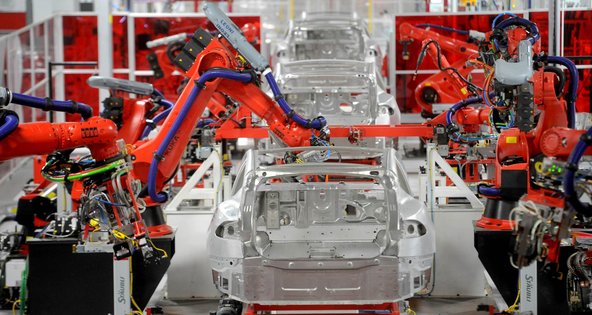
    Robotics plays into the Tesla story in two ways: First, an L4 compatible car is a robot. Second, robotics in manufacturing is a core competency for Tesla. Tesla’s expertise in robotic manufacturing is under-appreciated by investors for good reason; Tesla has long had a production problem – they can’t make cars fast enough.

    As a result, profitability lags, cash burns, and we don’t know the true underlying demand. but we do know demand is greater than supply. And with the release of the Model 3, with an average sticker price of $45k compared to the Model S and Model X at about $90k, we believe demand will continue to outpace supply. We’re comforted knowing that Tesla sees smart robotics as the solution to increase output. Compare that to traditional automotive companies, which, even if they prioritized automated manufacturing, would lag behind Tesla due to the lag in transitioning their labor force. Politically, it will be difficult for traditional auto to retool fast enough to capture the wave. On top of that, President Trump’s focus on manufacturing jobs will likely put the industry in a catch-22 as tax credits will postpone the required retooling and give Tesla more time to reach scale. Once Tesla reaches scale, their advantage may be insurmountable; just ask those who have competed with Google in search, Amazon in retail, Apple in smartphones, and Facebook in social.

    The Bear Case

    The bear case on Tesla has three primary assumptions. We think the first two are off base, but the third poses a true risk.

    • Every car company fails; therefore, Tesla must fail. This begs the question, what are the essential elements of a car company? We define a car company as providing transportation in an industry overseen by EPA, DOT, and organized labor. Only one of these three (DOT) applies to Tesla. The company does not need to navigate the EPA or organized labor. Again, we see Tesla as a consumer electronics company.
    • Tesla will run out of cash. There’s concern that Tesla’s production problems persist over the next several years and competing manufacturers rush to market and gain share, resulting in the company running out of cash. While there is risk that a tech company like Google, Baidu or Uber will compete more aggressively with Tesla (see below), we expect Tesla’s order book of $20B would help the company secure financing in a time of need. Investors will increasing appreciate the upcoming sea change in transportation and will be willing to see through the risk and underwrite the company’s future.
    • Competition is coming. This is the strongest bear case with Ford, BMW, Uber and Baidu (Yun Xiao, or “Cloud Ride”) each expecting to sell a fully autonomous car in 2021. With think Tesla should be most concerned with Google’s Waymo, Baidu and Uber, other tech companies pursuing self driving without the baggage that traditional automakers carry. Our belief is that Tesla will reach scale faster than these other players, making it difficult to compete on price.

    Valuation

    Tesla’s $43B market cap is over valued if you think of it as a car manufacturer. Ford’s market cap is $49B and GM’s is $56B. In 2016 GM sold 10m vehicles, Ford 6.7m, and Tesla 0.076m. However, one way to get comfortable with valuation is to look at the long term potential. Our best guess, and stress the word guess, is that in 2025 Tesla will sell somewhere between 1.5 and 2m vehicles which implies a 16-22% CAGR from 2019-2025. This valuation method is risky given the number of variables. What we can say is that Tesla today feels like Amazon in the spring of 2009. At that time, Amazon’s stock had doubled to $80 in six months. The story was thought to be fully valued as investors struggled to justify the surge in value. After all, Amazon was unprofitable. Today, Amazon still struggles to make money, but shares have risen 10x over the past 8 years and are near an all time high. Amazon had the roadmap for the future of commerce and web services, similar to Tesla’s roadmap to pursue the future of auto and solar, based on their core competencies in AI and robotics. Tesla may not an internet company, but they think like one, which will continue to serve them well.

    Disclaimer: We actively write about the themes in which we invest: artificial intelligence, robotics, virtual reality, and augmented reality. From time to time, we will write about companies that are in our portfolio. Content on this site including opinions on specific themes in technology, market estimates, and estimates and commentary regarding publicly traded or private companies is not intended for use in making investment decisions. We hold no obligation to update any of our projections. We express no warranties about any estimates or opinions we make.


    The Current State Of VR ARPU Feb 16, 2017
    Show notes

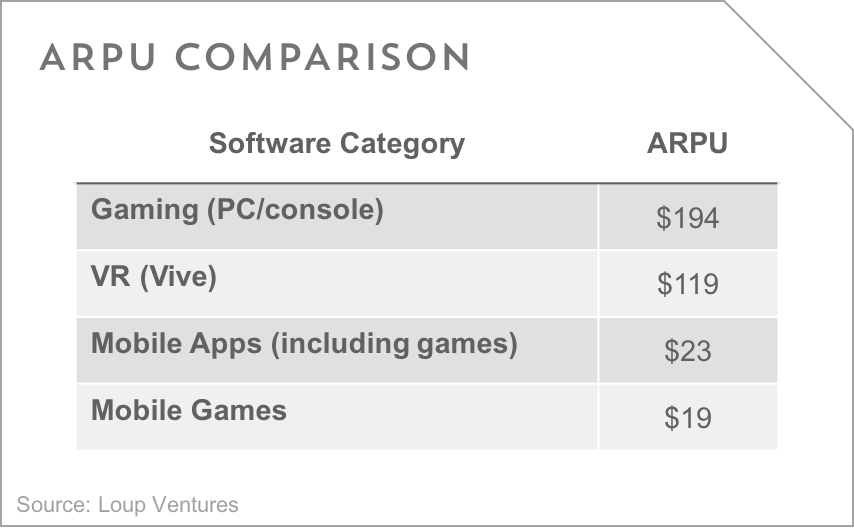
    While it’s still early, we think that VR gamers are already spending a significant amount on software. Based on an analysis of the top 100 VR-only Vive games on Steam, we estimate that about $35 million in software has been sold for the HTC Vive to date. We believe that HTC has sold over 300k Vives since the device launched in April 2016, which means that Vive owners have spent an average of about $119 on software over the past 10 months. Given an average sale price of ~$15.50 for the top VR games on Steam, this means Vive users are buying about 7 or 8 games on average. We looked at VR-only software for our analysis, which requires a VR device for its use, and excluded software that is PC based with additional VR content. In our view, VR-only software sales is the best indicator of what people are truly spending on VR. We also excluded Oculus Rift software sold on Steam in this analysis.

    The vast majority of paid software available for the Vive is gaming related, thus we believe gaming is the best way to contextualize Vive ARPU. Note that these comparative ARPU numbers are for a full 12 months vs our Vive estimate over 10 months. In 2016, we estimate that total gaming software revenue for PCs and consoles (excluding mobile games) was about $33 billion. We believe there are about 170 million PC/console gamers worldwide, so gaming software ARPU is about $194 per year. For comparison, we believe that the mobile apps market, including gaming and non-gaming software, was worth $50 billion in 2016. With 2.1 billion smartphone users, mobile app ARPU is $23 per year. Finally, we note that mobile games made up the vast majority of mobile app sales, representing $42 billion in sales in 2016.

    Since today’s high-end VR users are very early adopters, they are likely spending more than mainstream users would, despite limited software titles on the market. There are just over 1,000 VR-only titles on Steam vs over 27,000 titles on the store in total. Longer term, both the number of high-end VR users and ARPU will grow, driven by better, cheaper hardware and better titles respectively. We expect that VR ARPU will ultimately exceed that of traditional gaming, given richer games and other content experiences. As VR evolves beyond a purely digital solution, we believe that entire industries could be transformed, like travel and vice. That is why we think VR has the long-term potential to be more transformative to the human experience than AR.

    Disclaimer: We actively write about the themes in which we invest: artificial intelligence, robotics, virtual reality, and augmented reality. From time to time, we will write about companies that are in our portfolio. Content on this site including opinions on specific themes in technology, market estimates, and estimates and commentary regarding publicly traded or private companies is not intended for use in making investment decisions. We hold no obligation to update any of our projections. We express no warranties about any estimates or opinions we make.


    Face Off: Amazon Echo vs. Google Home Feb 15, 2017
    Show notes

    As digital assistants continue to improve, more and more users are integrating them into their daily routines. In our Robot Fear Index, we found that 43% of Americans had used a digital assistant in the last three months. But we believe that we are still in the early innings of how natural language processing will improve our daily lives and our interactions with machines.

    To see how far along our digital companions are, we chose to review the two most popular home assistants: Amazon Echo and Google Home. We put the devices to the test by asking them 800 different everyday queries. Google Home came out on top, answering 39.1% of the queries correctly vs. the Echo at 34.4%.

    Methodology

    For this experiment, we asked the same 800 queries of both the Echo and Home. We graded the queries on two metrics: First, did the device understand what we asked correctly? Second, did the device answer the query correctly? In our study, Amazon Echo understood 94.4% of the queries we asked and answered 34.4% of all queries correctly. Google Home understood only 77.0% of the queries we asked, but was able to answer 39.1% correctly.

    In our study, Amazon Echo understood 94.4% of the queries we asked and answered 34.4% correctly. Google Home understood only 77.0% of the queries we asked, but was able to answer 39.1% correctly.

    One reason that the Amazon Echo had a higher rate of understanding queries was due to our ability to confirm the data using the companion app. This app gives the user a live feed of what Amazon Echo heard. Google Home does not offer a transcript of what the device picked up. Because of this, it was difficult to tell if Google Home understood the queries but couldn’t answer them, or if it truly had a harder time understanding queries. Since we were unable to see exactly how well Google Home understood our queries, we assumed that if Google Home responded that it was unable to perform a certain function, then it had understood the query correctly. For example, if we asked “Hey Google, send a text to John” and received a response “Sorry, I can’t send texts yet,” then the query would be marked as understood correctly, but answered incorrectly.

    Results

    The queries that we asked divide into five buckets: local, commerce, navigation, information, and command. When breaking down the comparison of correct answers between the Echo and Home, Amazon predictably performed better at commerce and Google at information, in-line with their stated missions.

    Amazon Echo’s Advantage: Commerce Assistance

    As expected, Amazon Echo has the upper-hand when it comes to commerce-related queries. Prime members have the ability to order products via voice control, while non-Prime members can add products to their cart for review and purchase later.

    At this point, Alexa is best suited to help re-order simple, consumable products. In an interview with Billboard, Jeff Bezos shared, “Voice interface is only going to take you so far on shopping. It’s good for reordering consumables, where you don’t have to make a lot of choices, but most online shopping is going to be facilitated by having a display.” Amazon is reportedly looking to introduce an Echo model with a touchscreen sometime in 2017, which would significantly expand Alexa’s capabilities when it comes to commerce.

    Google Home’s commerce capabilities are limited to providing store recommendations or price quotes on specific products, much like core Google search. Currently, Google Assistant can’t help users order products via voice control.

    Google Home’s Advantage: Information Accuracy

    Google Home outperformed the Amazon Echo in the navigation, information, and command categories. However, it’s clearest advantage is in information. Aside from Google’s Knowledge Graph, a big factor in the Home’s information advantage is Google Assistant’s ability to engage in two-way conversations. By doing so, Google Assistant is able to answer follow-up questions, building on topics discussed in prior queries. This conversational approach makes it much easier for users to get the information they want because they are able to add clarifying comments to questions if they don’t receive the answer they are looking for the first time. By comparison, Alexa must be asked complete, individual questions each time and can’t engage in two-way dialogue.

    Strength of Home Assistants: Home Audio Control

    While the Amazon Echo and Google Home have their differences, there is one thing they both do very well: home audio control. Google Home and Amazon Echo can each connect to Spotify, Pandora, and TuneIn. In addition, Google Home has access to Google Play Music and YouTube Music, while Amazon Echo has access to Amazon Music and iHeartRadio. One slight drawback is that Amazon Echo owners must be Amazon Prime Music or Spotify Premium subscribers in order to play specific songs. If they are not, they are limited to user-created playlists or customized radio stations. For many, home audio control is a major selling point for home assistants and another reason why we expect to see continued investments in content across all the major Internet companies.

    Weakness of Home Assistants: Navigation Support & Reminders

    There are two basic categories at which home assistants performed poorly: setting reminders and providing navigation support. However, we view both of these as minor issues that will be fixed in the future.

    Reminders are a key function of phone-based personal assistants; however, neither the Echo nor Google Home have the ability to push reminders. Both devices can access the calendar associated with the signed-in user, but can’t proactively remind the user of an upcoming event. It’s up to the user to remember to look at their calendars on other devices. This is a minor downside to voice-based home assistants given that effectively all users also have a smartphone pushing them synced calendar alerts, but still an area where the assistants could improve.

    Navigation is another area for potential improvement. Neither the Echo nor Home could send directions to a smartphone efficiently. Google Home in particular had noticeable differences between the reported distance of a location versus the actual distance. Navigation would seem to be a logical improvement in the future, although the prevalence of smartphones with rich built-in maps renders the issue minor in our opinion.

    The Outlook for Home Assistants

    We view home assistants as one of the core elements of moving beyond the computer as we know it. While still early, the future is bright for these platforms as a companion to VR and AR. Adding third-party developers to the mix is the next logical step.

    Amazon appears to be following a version of Apple’s App Store model by offering third-party add-ons, which it dubs “skills,” that can improve the user experience. Some of the most-downloaded skills are ambient noises, games, bedtime stories, or even daily historical facts. Amazon Echo’s skill store is populated with thousands of add-ons that can improve the user experience.

    Google Home has not yet fully opened the door to third-party developers. In December, Google announced its “conversation actions” platform, which would allow developers to create back-and-forth conversations with users through Google Assistant. Conversation actions allow users to ask third-party services a question by name, and then have a discussion about that initial question. Interestingly, Google is not requiring users to download or enable these skills, as Amazon does.

    As companies like Amazon and Google continue to improve on the capabilities of home assistants, we would expect others, like Apple and Microsoft, to push further into the space. Our homes have just begun to be connected and we expect home assistants to be one of the centerpieces of managing our lives in the future.

    Coming soon: We’ll have a three-way battle of digital assistants between Siri, Cortana, and Google Assistant.

    Disclaimer: We actively write about the themes in which we invest: artificial intelligence, robotics, virtual reality, and augmented reality. From time to time, we will write about companies that are in our portfolio. Content on this site including opinions on specific themes in technology, market estimates, and estimates and commentary regarding publicly traded or private companies is not intended for use in making investment decisions. We hold no obligation to update any of our projections. We express no warranties about any estimates or opinions we make.


    Apple’s Thundering Baby Steps Into AR Feb 13, 2017
    Show notes

    Loup Ventures and Tim Cook share at least one thing in common. We both agree that AR will transform how humans interact with each other, removing the clumsy touchscreen, replacing the smartphone, and most importantly, expanding the utility of computing. An AR wearable from Apple is a long ways off. Over the next five years, we see the iPhone as Apple’s play in AR, which will be a driver for their all-important Services business.

    <!–more–>

    We’re closely watching Apple’s moves in AR and Tim Cook’s recent interview with The Independent caught our attention. Not because Cook said something new about AR, but because the frequency with which he’s talking about a future product category is unprecedented in the 14 years we have been covering Apple. If you’re interested, Cook told The Independent: “The smartphone is for everyone… I think AR is that big. It’s huge. I get excited because of the things that could be done that could improve a lot of lives. And be entertaining.”

    “The smartphone is for everyone… I think AR is that big. It’s huge. I get excited because of the things that could be done that could improve a lot of lives. And be entertaining.” – Tim Cook

    Cook’s talking about AR because innovation is the persistent question at Apple, and his comments support our belief that the next five years of Apple’s innovation will focus primarily on augmented reality. The smartphone is the world’s window into augmented reality today. While this will change driven by augmented reality hardware in the future, we would expect the next five years of AR innovation will happen mainly through the device in our pockets.

    It’s A Big Deal When Apple Talks About Future Products, Because It’s Rare. Apple doesn’t talk much about future products. The best example is going back to July 19th, 2006, six months before the iPhone was announced. During the earnings call, a question was asked regarding music-enabled phones putting increased pressure on MP3 players and the iPod in particular. Apple’s then CFO Peter Oppenheimer responded, “As regards to cell phones, we don’t think that the phones that are available today make the best music players. We think the iPod is. But over time, that is likely to change. And we’re not sitting around doing nothing.” Oppenheimer’s comments were significant because it was a rare tip of Apple’s hand about a future product. Under Cook Apple has strived to remain secretive around future products, but that’s more difficult given Apple’s revenue has grown to $218B in 2016, 10x larger than the $21B the company generated in 2006.

    So, What Has Cook Said About AR So Far? On July 26th, 2016, Cook made his first comments on AR during an earnings call in response to a question about Pokémon Go, commenting, “We are high on AR for the long run. We think there are great things for customers and a great commercial opportunity. And so we’re investing, and the number one thing is to make sure our products work well with other developers’ products, like Pokémon.” Below is a list of what we could find related to Cook’s public AR comments. Notably, on the last two Apple earnings calls analysts have not asked about AR, most likely because everyone knows it coming.

    • “AR can be really great. And we have been and continue to invest a lot in this.” Apple earnings call, July 2016
    • “I think AR is extremely interesting and sort of a core technology. So, yes, it’s something we’re doing a lot of things on behind that curtain that we talked about.” Washington Post, August 2016
    • “[AR] gives the capability for both of us to sit and be very present talking to each other, but also have other things visually for both of us to see.” ABC News, September 2016
    • “I do think that a significant portion of the population of developed countries, and eventually all countries, will have AR experiences every day, almost like eating three meals a day, it will become that much a part of you.” Utah Tech Tour, October 2016
    • “Augmented reality will take some time to get right, but I do think that it’s profound.” BuzzFeed, October 2016
    • No mention of AR on the Apple earnings call, October 2016
    • No mention of AR on the Apple earnings call, January 2017
    • “I get excited [about AR] because of the things that could be done that could improve a lot of lives and be entertaining.” The Independent, February 2017

    Three big questions remain: How quickly will Apple jump into AR? What form(s) will it take? And what does it mean for their business?

    Moving Forward With Baby Steps. Apple takes baby steps towards new products (we wrote about these baby steps here). We don’t expect Apple to release an AR wearable anytime soon. Our guess is 2020 at the earliest. That said, we expect Apple to continue moving slowly but powerfully into AR this fall with the launch of iPhone X (more on this here). Our industry contacts have told us that Apple will add improved 3D imaging technology that will position the next iPhone as an AR device. Apple will ease us into AR by building phones with powerful computer vision and mapping, which will enable developers to create a new category of AR apps. While the baby steps approach with the iPhone might not seem as exciting as launching iGlasses, we believe it will lay the groundwork for the next dominant computing platform.

    What Does AR Mean For Apple Over The Next 2-5 Years? Protecting Market Share and Services Revenue. We believe Apple’s tight integration of hardware and software will enable iPhones to be viewed as the best implementation of AR over the next 2-5 years. iPhone AR won’t be the first to market, given Google’s Tango platform, which launched in 2014 to third parties. However, Tango has not driven meaningful sales or adoption. Apple has many opportunities in AR including additional sensors to incorporate depth, cameras and software to enable computer vision, and even external peripherals connected to the phone, possibly some sort of wearable. While these features might not accelerate hardware sales in the near-term, they will protect Apple’s ~17% global smartphone market share as iPhone users will be able to do more with their phones. More importantly, we think Apple will accelerate Services revenue by enabling new experiences previously unavailable through a smartphone. This is an important driver of Apple’s growth over the next few years. We expect Services will increase revenue from about $30B in 2017 to $50B in 2020, which we expect to account for 50-60% of Apple’s revenue growth and 60-70% of earnings growth during that period.

    Disclaimer: We actively write about the themes in which we invest: artificial intelligence, robotics, virtual reality, and augmented reality. From time to time, we will write about companies that are in our portfolio. Content on this site including opinions on specific themes in technology, market estimates, and estimates and commentary regarding publicly traded or private companies is not intended for use in making investment decisions. We hold no obligation to update any of our projections. We express no warranties about any estimates or opinions we make.


    Education Could Drive Mass VR Adoption Feb 08, 2017
    Show notes

    Education is shaping up to be one of the biggest under-the-radar opportunities in VR. We talked about consumer education related to VR in our VR Excitement Index. Education ranked second in terms of consumer interest in VR content in our 500 person survey, ahead of gaming and exceeded only by entertainment.

    VR skeptics point out a valid current pitfall in other VR content: the nature of the experience separates you from the people around you. If you watch a sporting event or movie in VR, you remove yourself from the environment around you and make it a solitary experience, but that isn’t how we experience these events today, live or otherwise. We usually enjoy these events with others. That is a key part of the the sporting or movie experience – sharing it with the person next to you whether you’re in a stadium, a theater, or on your couch. Education doesn’t have that problem. It can be solitary. Questions and collaboration from others can amplify the environment, but it doesn’t matter if that participation comes from someone actually sitting right next to you or a virtual representation of that person.

    Another advantage of education is that it can be effective with basic forms of VR. Many educational tools won’t need the same level of tracking capability as an intensive gaming experience. The images may not need to be as sharp as a cinema experience. Educational VR may also not need sensory output to anything other than sight and hearing to be compelling. For example, educational VR can take the obvious form of a classroom type setting where the user interacts with basic digital input, like voice or even a keyboard. Many NFL teams already use StriVR for this and there are applications well beyond sports including corporate training and medicine. We would consider VR exposure therapy — exposing yourself to your fears, which is a common psychological treatment — a form of educational VR. You’re teaching yourself to not be afraid. While low-immersion VR is still very basic, it’s capable of at least offering these types of education in small does. As low-immersion VR improves with Daydream and Gear VR over the next couple of years, the educational experiences can grow with them.

    Considering our longer-term view of VR as a fully immersive sense experience, we believe there is a chance that humans have the ability to use advanced VR to live a “lifetime” in the span of just a few moments in real reality. We call this a compressed temporal sense experience (CTSE). More on this theory soon, but in short, it could mean that education in the future is living a life as a pianist, then living as a soldier, then an artist, then a doctor and rolling those skills into your real life. Education could ultimately be about a firsthand experience rather than secondhand information.

    There’s a popular rule that it requires 10,000 hours of practice to master something. That may or may not be an accurate estimate, but we can all agree that practice makes you better, no matter your sport or profession. VR is the perfect practice tool for education, and educational content may turn out to be the killer app that drives VR to mass adoption.

    Disclaimer: We actively write about the themes in which we invest: virtual reality, augmented reality, artificial intelligence, and robotics. From time to time, we will write about companies that are in our portfolio. Content on this site including opinions on specific themes in technology, market estimates, and estimates and commentary regarding publicly traded or private companies is not intended for use in making investment decisions. We hold no obligation to update any of our projections. We express no warranties about any estimates or opinions we make.


    Robot Fear Index: 31.5 Jan 26, 2017
    Show notes

    Like many in the tech space, we believe robotics is changing the nature of work; however, public perception of robots is still a question mark. We developed our Robot Fear Index to measure and track the average consumer’s perception of robots. We asked over 500 US consumers about topics ranging from their use of robots at home to their comfort level with self-driving cars. Then we distilled the data down to an index value that we will publish regularly. An index value of 100 suggests widespread and extreme fear of robots; an index value of 0 suggests minimal fear of robots.

    Consumer adoption of Artificial Intelligence and robotics is already quite broad. Consider how often you see someone dictating a text message to Siri or using the self-checkout lane at the grocery store. Our data shows that 68% of US consumers have used a digital assistant and 68% have used some sort of robotic technology in the last three months. And yet, fear of robots is also pervasive. We fear that they’ll replace our jobs or somehow overthrow us; and to be blunt, those fears are valid. To quantify, 14% of consumers say that robots make them nervous and 46% suggest that they simply aren’t interested in robots. Our Robot Fear Index value of 31.5 suggests that, on balance, we’re cautiously comfortable with robots. Let’s look at what’s driving this perception.

    We see digital assistants as an onramp to AI and robotics for many consumers. While we put digital assistants in the AI category (the brains behind machine capability), AI is oftentimes an integral part of robotics (the braun behind machine capability). And we believe that comfort with AI will drive comfort with robotics. Again, the data shows that 68% of consumers have used a digital assistant. Among them, roughly one-third use a digital assistant once a day or more.

    Use of robotics is also widespread. Granted, our definition is broad, including: self-checkout lanes and digital assistants. But these are important uses cases, because we believe that fear of robots will decrease as basic consumer usage increases, and our Robot Fear Index will track these changes. Somewhat surprisingly, 16% of consumers have tried robotic tech, like a vacuum, for household cleaning and 15% have used a robotic toy (check out our experience with Anki’s Cozmo here).

    But the Robot Fear Index could very well rise. For example, we would expect the index value to increase following a fatal crash involving a self-driving car or a faulty surgical procedure performed with robotic assistance. At this point, 14% of consumers say that robots make them nervous and 46% say they’re not interested in using robots. We also look forward to tracking these values as the field of robotics advances and consumer adoption marches on.

    There are two sides of the coin driving consumer perception of robotics: adoption of the more accessible and convenient technologies leveraging AI and robotics on one side, and uncertainty of what may be in store as AI and robotics replaces an increasing set of human work. We think our index value of 31.5 quantifies this cautious comfort with robots and we’re looking forward to updating the Robot Fear Index regularly as we track the progress of the robotics theme.

    Disclaimer: We actively write about the themes in which we invest: virtual reality, augmented reality, artificial intelligence, and robotics. From time to time, we will write about companies that are in our portfolio. Content on this site including opinions on specific themes in technology, market estimates, and estimates and commentary regarding publicly traded or private companies is not intended for use in making investment decisions. We hold no obligation to update any of our projections. We express no warranties about any estimates or opinions we make.


    The 5 Focuses: Analyzing The Top Priorities Of The Top Tech Companies Jan 22, 2017
    Show notes

    As a new fund, we think it is important to share how we view the world beyond our long-term purpose to pursue The Future Perfect. Our Philosophy Series details our most important learnings from our time covering the Internet space and how we plan to transfer that knowledge to venture investing. The 5 Focuses There’s a famous story about Warren Buffett helping his pilot set priorities in his life. Buffett advises the pilot to make a list of all the things that he wants to accomplish in life. Anything that comes to mind, even if the list is 100 items long. Then Buffett tells the pilot to take that list and narrow it down to the five most important things. You only have capacity to truly focus on five things in your life. Whether that’s family, work, hobbies, etc. They all require resource commitment. All the other things that didn’t make the top five are your ‘Stop Doing’ list. You should avoid these things at all cost because they will only serve to distract you from your more important goals. While this is great advice for individuals, we think it is equally important for companies, from small startups to Fortune 100s, to establish their five focus areas. And a company’s five focuses should be driven by their greater purpose — their mission statement. In this note, we go through Apple, Google, Facebook, and Amazon’s five focuses and how they will impact the VR, AR, AI, and robotics spaces on which we are focused. Apple Apple has taken some flak in the past regarding its mission statement. While the company does not seem to have as clear a statement as Google, Facebook, or Amazon, we believe it is to, “Make the best products on earth, and leave the world better than we found it.” This mission statement makes it a little more difficult to relate to Apple’s five focuses compared to the other three companies we analyze, but here’s what we think they are: iPhone/iOS. Apple has always been about integrated hardware and software, thus its hard to separate iPhone and iOS. They go hand-in-hand. iPhone is Apple’s most important product because it is the best smartphone on earth, following in their mission. iPhone and iOS are also a lead-in for Apple to participate in emerging technologies like VR and AR. The phone will be what ultimately powers a Daydream-like VR offering, which we expect in the next two years, and it already powers AR applications from third-party vendors. We continue to believe the next iPhone will have additional AR features including a chipset dedicated to providing AR functions. VR and AR are the next new categories where Apple can create the best products on earth. Services. We’ve already written a lot about Apple’s Services business. With the App Store, Apple proved that making great products doesn’t stop with just the hardware and software, but also requires great services. Additional offerings like Apple Music and Apple Pay lock iPhone users further into the platform by making their lives better. Like Amazon with Prime, Apple seems to realize that a truly compelling service experience can’t revolve around just one key offering. Prime was originally about fast shipping, which is still the cornerstone, but now also includes streaming video, music, book rentals, and more. Amazon stated in its 2015 10-K, “We want Prime to be such a good value, you’d be irresponsible not to be a member.” We believe Apple is embracing a similar philosophy with Apple Music by adding video content, including original programming. We expect Netflix to spend $7 billion in content in 2017 and, while we expect Apple to increase its content spend gradually over several years, the company has more than enough resources to participate in the same way. Machine Learning/AI. Apple has made no secret of its intentions in machine learning. Apple stated in a letter to the NHTSA (National Highway Traffic Safety Administration) that the company is “investing heavily in the study of machine learning and automation, and is excited about the potential of automated systems in many areas, including transportation.” Based on a leaked presentation about Apple’s efforts in machine learning, we broadly think of the company’s AI products in three buckets: digital assistant, image processing and prediction, and health. The first bucket touches us most today: Siri. While we believe Apple is investing in improving Siri’s capabilities via natural language processing, we think Apple’s digital assistant is really the iPhone. Siri is just a component of that. The iPhone via iOS already offers alerts for travel time with traffic, it finds meetings in your email, as well as app suggestions. Thus Apple’s investments in digital assistant technology will come across multiple products, not just Siri. Second, image processing and prediction ties directly to efforts in both AR and transportation, where Apple needs to understand the world around you and process those image-based inputs to perform actions, whether to overlay information or drive a car. These investments may come to light in the next iPhone with new AR features. Finally, the most unique of the three is health. We don’t believe any other major tech company is investing in machine learning in the health space to the same degree as Apple. This seems to speak directly to the idea of leaving the world “better than we found it.” Longer-term, health data can actually make the digital assistant side more effective because it gives it biological feedback, perhaps a proxy for body language, that the assistant misses today. Next-generation Products. We believe Apple is exploring three new product categories: a car, AR, and VR. Much has been written about Apple’s car efforts, Project Titan. There are two schools of thought related to Titan. The most obvious is that Apple plans on launching a car, although, as we’ve learned in the past, just because Apple experiments with a new product doesn’t mean they will launch it. Apple could decide to abandon the car project if it doesn’t seem feasible. Another possibility is that Apple just releases software that controls a car, leaving hardware up to a partner. This seems antithetical to Apple’s philosophy of integrated hardware and software. It’s hard to predict what way the car could go, but the market opportunity is undeniable. If Apple sold as many cars as BMW (1.9 million units in 2015), it would represent $130 billion in revenue (~$70k ASP). Aside from the car, we’ve already written about AR and VR above. It’s clear Tim Cook views AR as the bigger opportunity for Apple. We believe the company is experimenting with dedicated AR wearables, but still don’t expect one for the next few years. Mac. Mac is Apple’s second most important product after iPhone and is the best computer on earth. Mac is a legacy product, which we could see replaced by VR or AR in importance for Apple in the next decade or so. Non-core priorities for Apple: Apple Watch. The Apple Watch is the best smartwatch on earth, but it’s still an accessory to the iPhone. Limitations on battery power prevent it from being something more and we see the watch being tethered to the phone until at least next year. These are the same limitations that prevent us from having compelling AR glasses, the early versions of which are likely to start as tethered devices themselves. Philosophically, a device that relies on another, more powerful device for its functionality can’t be revolutionary until it stands on its own. iPad. We view iPad as a byproduct of iPhone and iOS. The iPad is basically just a large iPhone. This isn’t to say the iPad doesn’t fall under the “best product” on earth mission because it is the best tablet on the market at its price point, but we don’t believe Apple views iPad as a core opportunity like the other five focuses. The company can continue to leverage advances in the iPhone and iOS to sustain iPad as a great product without spending additional resources. We note that iPad unit sales have declined for the past 11 quarters straight, the surest sign the product isn’t a core focus. Google Google’s mission is to “Organize the world’s information and make it universally accessible and useful.” For this discussion, we are considering Google core, not Alphabet, it’s parent company. More on that later. We view Google’s five focus areas as: Search. The foundation of making information accessible is making it searchable so humans can find what they are looking for. This includes Maps as location data is fundamental to an end-to-end search experience. Search also includes the evolution beyond traditional web search — a combination of machine learning and AI elements that deliver information through other interfaces, like voice, as well as pre-cognitive delivery of information, i.e. providing information to people before they ask. An example is traffic affected time to the next appointment on your calendar. Android. A ubiquitous and affordable mobile computing platform is critical to making information accessible to all people and useful at any time. Android extends beyond the smartphone today to VR and AR through things like Daydream and Tango. Like Apple with the iPhone and iOS, we view Android as Google’s window into continued development in the VR and AR spaces to power platforms for future information consumption. Thematically, AR may be more important to Google than VR as it more directly enables the mission of making information universally accessible and useful. Machine Learning/AI. We view Google as the leading machine learning and artificial intelligence company in the world. Machine learning has evolved as the most recent five focus for Google. The company has numerous machine learning products including Google Cloud ML Platform, TensorFlow, and DeepMind. These are important to Google’s mission because they make information more accessible and more useful given better text processing, image enhancement, natural language recognition, etc. YouTube. Entertainment and information have always gone hand in hand, whether the platform is written word, newspapers, magazines, radio, television, or internet video. YouTube is not only the ultimate digital entertainment platform, but the ultimate how-to and video information platform. Video makes information more useful by combining it with visuals. Adtech. This one may seem strange, but Google’s ad products in many ways enable content partners to make their information free, thus more accessible. Those products then provide Google incremental revenue, which it can invest in improving other products that make information accessible and useful. We believe Google has the best end-to-end ad stack in the world from supply to exchange to demand. Non-core priorities for Google: Social. Google+ famously flopped, despite significant investment and PR. They talked the talk, but didn’t walk the walk. In retrospect, that outcome should have been obvious. Social could never be a top five priority because it doesn’t improve the accessibility or usefulness of organized information. Adding a human sharing element to information distribution creates a bottleneck to accessibility and usefulness. In a social network, the information you have access to is only as good as the information known by your network, an inherent limitation. Perfectly accessible and organized information means that you don’t need to find the right person to ask for it. That is the old way of doing things that Google is trying to fix. Since social did not have the qualities to deliver on Google’s core mission, it could never replace one of the existing five core priorities that all do. Gmail. Email in a lot of ways is pre-social social. Better search is the key function today in Gmail that maintains it as the best email platform, but that’s really an extension of the Search priority. Gmail’s path to dominance had some luck in that it was launched in the mid-2000s where the last generation of heavy email users were able to get new user names that were crowded out of the legacy Hotmail and Yahoo! Mail platforms. “Unlimited” message storage was a cherry on top. The product execution was and still is great, but the superior search function only makes information you have in Gmail more accessible and useful to you, not the world. It’s not the world’s information. We don’t view Gmail as a top five priority at Google and we don’t think most people would argue that statement. Note that Gmail is an example of when a powerful company can leverage its capital and brand, with a little bit of innovation and luck, to find a way to dominate a stagnant market with relatively little startup competition. Chrome. Like Gmail, Chrome shook up a stagnant market with little startup competition. The browser has historically been the window through which you can access the worlds information, but that window has always been “free” as a part of a complete operating system. Microsoft antitrust issues aside and no Windows pun intended. Really, Chrome is becoming a feature of Android that just happens to be available on other platforms. Making the world’s information more accessible and useful needs to work for all of those windows on all of those platforms, not just one. So owning the browser market in and of itself doesn’t further the grander purpose. Google has never been afraid to show an industry how to do things better, even if the intention isn’t to build a new business. Nexus is a classic example — Google’s effort to show the industry that Android devices could compete with iPhone. Then we got the Galaxy from Samsung. Fiber is another example of a business that wasn’t a focus and was more to push existing competitors to deliver faster Internet speeds. And it seems to have worked. Whether Fiber survives or not is irrelevant. Chrome showed the industry and consumers how fast a browser could be. It showed us the power of extensions. Every once in a while, one of these how-to’s will stick and Chrome stuck. A note on Alphabet: We think Google recognizes the prioritization issue perhaps better than any other company in the world, given their long interest in moonshots beyond the core business. That is why they formed Alphabet — to separate their Other Bets, as they call them, from core Google, because Google’s priorities would never allow any of the moonshots to be top five. Other Bets includes: Fiber, Nest, Verily, and Waymo (self-driving cars). In theory, the Alphabet holding structure frees the Other Bets to set their own top five priorities and not need to compete for resources within the larger Google structure. In practice, it remains to be seen whether or not that actually takes place. Facebook Facebook’s mission is to “give people the power to share and make the world more open and connected.” We view Facebook’s five focus areas as: Core Facebook. The company’s namesake product is closest to connecting the entire world with 1.8 billion monthly active users (MAUs) in Q3 2016. We expect over 2.2 billion MAUs by 2020. Instagram. Instagram enables evolved connectedness in developed markets with high-speed mobile data and high quality smartphone cameras. We believe that images are the future of communication, not text, and Instagram is a platform built specifically for images. Instagram has 600 million MAUs and we expect it could exceed 1 billion by 2020. Messaging. This includes both WhatsApp and Messenger. There are obviously separate teams running the two products, but from a priority standpoint, Facebook management can think of messaging as a single priority even with two products. Given the similarities between the two, logic would seem to suggest that if the world is completely connected on a single platform, one or the other must win out long term and Facebook shouldn’t care as long as it’s one of their two platforms. Both products currently have over 1 billion users. Oculus. VR represents the next computing paradigm and the evolution of human connectedness. VR is an evolution of the PC and…

    Full show notes at the publisher

    Feedback Loup: Cozmo by Anki Jan 20, 2017
    Show notes

    From time to time, we’ll review new products that are relevant to our focus themes: virtual reality, augmented reality, artificial intelligence and robotics. Our Feedback Loup series provides real customer feedback on the technologies shaping our future. We hope that our work helps, in some small way, to bring our focus themes to life and even accelerate their adoption. Cozmo is a great example of how real consumer AI and robotics are today.

    Yesterday, my kids and I spent some time getting to know Cozmo, a robot toy by Anki. Three scientists from the Robotics Institute of Carnegie Mellon University co-founded the company and launched at WWDC in 2013. With their first product, Anki Drive, they brought AI and robotics to Apple’s keynote stage in the form of toy cars that are autonomously and remotely controlled. Anki released Cozmo in October 2016, and we’ve been eager to see what the latest in consumer, artificially-intelligent robotics has to offer. The bottom line: AI-driven robots aren’t a sci-fi future, and they aren’t just for big tech companies with billion dollar R&D budgets. They’re a consumer reality, and they can be a lot of fun.

    Cozmo comes to life in his charger, his quirky eyes light up, blink a few times, then he comes out to play. Once you’ve got the Cozmo app downloaded, there’s a short sequence of setup and instructional steps facilitated in the app. Before you realize it, you’re playing with a new friend that’s just learned your name.

    All this seems natural because Cozmo lives up to his tagline: Big brain. Bigger personality. He clearly expresses frustration when he loses a game, excitement when you want to play again, and cleverness in the heat of battle. He’s glad to meet you and sad to see you go. Cozmo’s personality is driven by a combination of artificial intelligence, robotics, and strong connection to a mobile device or interaction and control. The AI is timely, responsive and can be seen mostly in his eyes and during gameplay. The robotics add a strong physical response to the emotion created by the AI. But all of this impressive technology becomes irrelevant to the human counterpart as the interactions become more about the fun of being recognized and called by name or the frustration of getting outmatched by a robot in a matching game. The real magic of Cozmo is that he’s relational, breaking the stereotypes of robots and their place in society.

    Over the next several decades, the combination of artificial intelligence and robotics will enrich our relationships with machines. Cozmo is one of the many steps we see being taken today, leading us towards this amazing future. We’re encouraged to see that these technologies are already moving into consumer products, and, therefore, everyday life – not just in autonomous driving projects or robotic manufacturing lines. AI-driven robotics are, in some ways, already becoming mainstream. Cozmo just had to introduce himself.

    Disclaimer: We actively write about the themes in which we invest: virtual reality, augmented reality, artificial intelligence, and robotics. From time to time, we will write about companies that are in our portfolio. Content on this site including opinions on specific themes in technology, market estimates, and estimates and commentary regarding publicly traded or private companies is not intended for use in making investment decisions. We hold no obligation to update any of our projections. We express no warranties about any estimates or opinions we make.


    Snap Is A Camera Company Because Text Is Dead Jan 19, 2017
    Show notes

    Human communications have done a complete reversal since the emergence of the smartphone. To prove it, let’s briefly review the history of how we communicate. We started communicating with hieroglyphics — pictures on cave walls. That allowed us to share experiences and knowledge with those that came after us, letting humanity evolve at a faster rate. But drawings could only convey so many meanings and needed interpretation, so we developed a written language with standardized symbols for the phonetic sounds of our spoken words — text. Text let us pass down even more knowledge, nuanced knowledge, increasing our rate of evolution; however, writing things down was time consuming and limited in scale, so we developed the printing press. That let us share knowledge as fast as we could print books, increasing our rate of evolution even more. The printing press took us roughly to the Internet age when books and newspapers were no longer physical, but digital. And, yes, that increased our rate of evolution again, despite the quality of some of the content that came from digital media.

    Then the smartphone came along. More than 2 billion people have a screen with access to all of the digital knowledge brought about by the Internet. Smartphones also give us a camera in our pockets all the time. Not just a camera, but a video camera. Because of the smartphone, text is no longer the path for humanity to accelerate its rate of evolution through communication. It’s hieroglyphics again. We go out of our way to use hieroglyphics to replace text in “text messages” through emojis. Pictures and videos convey more than words. And they’re more fun. It’s why Snap simply calls itself “a camera company.” Snapchat is built specifically for communicating with a camera, not with text, because they see the same future as us. It’s why they built Spectacles, a camera on your face without all the bells and whistles of full-blown augmented reality. Instagram’s mission is similar: a fun and quirky way to share your life with friends through a series of pictures. Not as broad as Snap’s, but maybe that’s why we haven’t seen Instagram move into wearables. In any case, Snapchat and Instagram are the new cave walls enabling rich, moving hieroglyphics.

    The growth of Snapchat and Instagram indicate that the transition away from text is happening quickly. Leaked investor pitch data shows that Snapchat grew from 50 million daily active users (DAUs) to 150 million in about nine quarters (March-14 to June-16). We believe Instagram did the same thing in about six quarters and Facebook did it in about four quarters. Although neither picture-based platform is growing as fast as Facebook did in its heyday, we saw that teens already value Snapchat and Instagram over the older, text-based platforms of Twitter and Facebook. With Snapchat at over 150 million DAUs and Instagram at over 300 million, they still have plenty of runway to catch up to Facebook’s 1.1 billion DAUs.

    As we move toward our vision of The Future Perfect, text will become even more marginalized because the computer interfaces of the future will cater for text even less than the small smartphone screen. If you’re using VR to immerse yourself in a new world, why would you take yourself out of that immersion to read a bunch of text? If you’re using AR to enhance the real world, why not just have graphical symbols and audio instructions as needed instead of having to scroll through menus of text that block a portion of your real world view?

    Communication tools let us share experiences with others as content creators and experience what’s happening in the lives of others as content consumers. It’s true of drawings on cave walls, a written letter, a phone call, and a story on Snapchat. The tools have evolved full circle to bring us back to hieroglyphics, but the purpose has always been the same. We think the hieroglyph trend will be safe for a while. The camera will be an extremely important part of both VR and AR, so building social products around it is the best strategy to be relevant in social moving forward. It’s the evolution of the camera that will create the next big opportunity in communication and the next acceleration in human evolution.

    Disclaimer: We actively write about the themes in which we invest: virtual reality, augmented reality, artificial intelligence, and robotics. From time to time, we will write about companies that are in our portfolio. Content on this site including opinions on specific themes in technology, market estimates, and estimates and commentary regarding publicly traded or private companies is not intended for use in making investment decisions. We hold no obligation to update any of our projections. We express no warranties about any estimates or opinions we make.


    Previous 1 3 4 5 6 Next

    Related Podcasts

    Reply All

    1

    Reply All Games & Hobbies
    Inside VR & AR

    2

    Inside VR & AR Gadgets
    Note to Self

    3

    Note to Self News
    BrainStuff

    4

    BrainStuff Natural Sciences
    This Week in Tech (Audio)

    5

    This Week in Tech (Audio) News
    Hands-On Tech (Audio)

    6

    Hands-On Tech (Audio) Technology
    footer-logo

    Contact Us

    Toll Free: 844-670-7747

    Links

    • Home
    • Top Charts
    • Networks
    • Apps
    • Independents Podcasts
    • Podcast Advertising
    • Podcast News
    • Contact Us
    • About Us
    • Analytics & Insights

    Stay Connected

      Privacy, Terms of Use & Our Code of Ethics Protecting Content Creators Copyrights