TopPodcast.com
Menu
  • Home
  • Top Charts
  • Top Networks
  • Top Apps
  • Top Independents
  • Top Podfluencers
  • Top Picks
    • Top Business Podcasts
    • Top True Crime Podcasts
    • Top Finance Podcasts
    • Top Comedy Podcasts
    • Top Music Podcasts
    • Top Womens Podcasts
    • Top Kids Podcasts
    • Top Sports Podcasts
    • Top News Podcasts
    • Top Tech Podcasts
    • Top Crypto Podcasts
    • Top Entrepreneurial Podcasts
    • Top Fantasy Sports Podcasts
    • Top Political Podcasts
    • Top Science Podcasts
    • Top Self Help Podcasts
    • Top Sports Betting Podcasts
    • Top Stocks Podcasts
  • Podcast News
  • About Us
  • Podcast Advertising
  • Contact
Not in our directory?
Add Show Here
Podcast Equipment
Center

toppodcastlogoOur TOPPODCAST Picks

  • Comedy
  • Crypto
  • Sports
  • News
  • Politics
  • True Crime
  • Business
  • Finance

Follow Us

toppodcastlogoStay Connected

    View Top 200 Chart
    Back to Rankings Page
    Technology

    Loup Ventures Podcast

    We publish research on frontier technology, the themes driving it, and the companies making it a reality. This podcast includes audio versions of select research notes.

    Advertise
    • Apple Podcasts
    • Google Play
    • Spotify

    Latest Episodes:
    The AI Portfolio: Non-Tech Companies Making AI Investments Jul 20, 2017
    Show notes

    Special thanks to David Kroger, Steve Van Sloun, and Austin Bohlig for their work on the Non-Tech AI Portfolio.

    In ten years, every company will have to be an artificial intelligence company or they won’t be competitive. While traditional tech companies have been very forward about their advancements and investments in AI, there are many “non-tech” companies that are making investments in AI as well. As a fun exercise, we put together a portfolio of publicly-traded non-tech companies that are poised to benefit from their efforts in AI.

    To build our portfolio, we scraped the last earnings call of every company in the S&P 500 to see which had specifically referenced “artificial intelligence” and/or “machine learning”. We also looked at companies that had been in the news talking about specific AI-related initiatives. Before we dive into highlighting individual companies, we want to clarify a few terms about AI that are sometimes confused:

    Artificial Intelligence is a general term that refers to a machine exhibiting intelligent behavior, which may include reasoning, learning, and audio/visual processing.

    Machine Learning is a subset of artificial intelligence centered around giving a computer the ability to learn dynamically without human influence.

    Deep Learning is a subset of machine learning, and is one of several techniques that enable more effective outcomes. For example, visual perception models use deep learning, i.e. self-driving cars are powered by deep learning systems.

    Neural Networks are a component of deep learning in which a computer system is designed to mimic the way a human brain works. A neural network passes input data through a hidden layer of neuronal nodes with dynamic weights that change the output of the system.

    One additional disclaimer before we start: We were former stock analysts and still pay a lot of attention to the public markets, but we never covered any of these companies or sectors. Consider our opinions here highly uneducated. Our analysis centered purely around each company’s efforts in AI and not fundamentals of the underlying business. Do you own diligence prior to any investment decision.

    Healthcare

    • IDEXX Laboratories (IDXX) – IDEXX manufactures and develops products for the animal healthcare sector. On the company’s last earnings call, management mentioned that its latest diagnostic products are utilizing machine learning so the instruments always have the ability to learn and train on new data. One product that leverages AI is their SediVue Dx analyzer.
    • GlaxoSmithKline (GSK) – GSK is one of the bigger pharmaceutical companies leveraging AI and machine learning to help reduce the amount of time it takes to research and bring new drugs to market. GSK recently signed a $43M deal with Exscientia, which is a Scotland-based startup that helps automated drug design. GSK stated that Exscientia’s platform will be applied up to ten different diseases to determine if the technology can help lead the way to developing new drugs.

    Retail

    • Macys (M) – If any industry needs the help of AI, it’s retail. Macy’s has been strategically increasing headcount with AI expertise and has partnered with IBM Watson to create On Call. On Call is an AI-powered assistant that can answer questions about products and departments in stores. While still early, we believe that experimental AI technologies that transform the brick and mortar shopping experience will be crucial to winning in the post-Amazon traditional retail world.
    • Under Armour (UA) – Under Armour is leveraging artificial intelligence to better understand their customers. UA is using IBMs Watson’s machine learning platform to develop more personalized fitness and health apps that are designed to measure and manage your well-being. By gathering health data from these apps, Under Armour will be able to provide personalized marketing strategies based on an individual consumer’s lifestyle. The company is also using AI to help design new products, including shoes.

    Logistics

    • FedEx (FDX) – FedExis making strong investments in AI, robotics and self-driving vehicles. FedEx has created an AI-enabled Alexa app that allows consumers to activate orders through voice commands rather than filling out traditional forms. In addition, the company has teamed up with Peloton, a private company focused on semi-autonomous driving platforms, as well as leading automakers Daimler and Volvo, to research semi/fully autonomous driving technologies. We believe the future of delivery will be focused on autonomous systems, and FedEx appears to be preparing for the same future.

    Professional Services

    • Accenture (ACN) – Over the past two years, Accenture has made significant investment in developing AI for both its internal operations as well as client offerings. Recognizing the positive impact that a strong AI platform can provide a business, Accenture has been creating tools to use in its consulting practice across various industries including healthcare, public safety, and financial services. The company has established Accenture Labs, which includes an Artificial Intelligence Research and Development group driving AI solutions for the broader business.
    • Interpublic Group (IPG) – IPG is a leading advertising services company that has been aggressive in creating AI-driven businesses. The company’s Mediabrands subsidiary introduced an AI-focused arm called Society that leverages a proprietary system called HEART. HEART will enable advertisers to find “emotional resonance in social conversations” through NLP and machine learning. The company also launched the Marketing Tech Venture Studio, an accelerator that gives IPG early access to cutting edge AI marketing tech startups.

    Finance

    • Northern Trust Corporation (NTRS) – NTRS, an asset management firm, highlighted investments in robotics, artificial intelligence, and blockchain on its last earnings that will allow the company to operate more efficiently and create superior solutions for their clients. Northern Trust is specifically trying to leverage AI and big data to decrease costs, which would allow the company to charge lower management fees in order to stay competitive.
    • Nasdaq (NDAQ) – Nasdaq has developed products that leverage machine learning, including their Trading Insights data analytics platform and SMARTS market surveillance platform. In a world now dominated by algorithmic trading, AI is an imperative to stay relevant as an exchange. The company expects these AI-focused products to contribute more meaningfully to results as they progress over the next few years. Nasdaq has also invested in machine learning companies, including Digital Reasoning.

    Transportation

    • Avis (CAR) – Avis recently announced a deal with Waymo, Alphabet’s self-driving car project, to maintain, store, and deploy its fleet of 600 self-driving Minivans in the Phoenix area. Avis was chosen because of its national presence and track record of efficiently maintaining and cleaning a fleet of vehicles. As Waymo expands its service, we expect it will expand its relationship with Avis.
    • Boeing (BA) – At the Paris Air Show last month, Boeing revealed plans to begin testing fully autonomous commercial jets. While many planes use auto-pilot for portions of flight today, reducing or removing pilots from the aircraft would be a significant change. In addition to autonomous jets, Boeing is also making other AI investments through its venture arm, HorizonX.

    Energy

    • Haliburton (HAL) – Haliburton is working to make its data more usable, laying a foundation for impactful artificial intelligence applications in the future. Haliburton recently outlined a data analytics advantage it gained simply by organizing and reading data where it was able to identify that one of its pumps was ill-equipped to handle a specific climate. We believe that companies making “dark data” accessible for learnings is a core precursor to effectively leveraging AI.
    • Pioneer Natural Resources Company (PXD) – PXD, a petroleum and natural gas exploration company, has noted that predictive analytics have helped the company begin to use data in an effort to improve business outcomes. The company has plans to better leverage AI to determine where to drill and could eventually have artificially intelligent robots conduct drilling autonomously.

    Food/Agriculture

    • Domino’s (DPZ) – Domino’s has been investing in multiple technologies in an attempt to improve its business. In autonomous delivery, the company has been testing delivery robots in Europe. In AI, Domino’s has invested in a virtual assistant that’s integrated in its mobile application, which aims to expedite and simplify the ordering process. Domino’s has also utilized AI to better route deliveries in real-time by tracking its drivers through GPS, which also happened to reduce driving incidents by 50%.
    • Monsanto (MON) – Monsanto is using AI to improve crop protection techniques, recently partnering with Atomwise, a company that uses AI to accelerate the discovery and development process of medicines. Monsanto noted that the average crop protection product takes 11 years and $250 million to commercialize. AI should help to reduce both of those figures.

    Construction

    • Caterpillar (CAT) – Caterpillar began integrating artificial intelligence into its business a few years ago by creating an analytics and innovation division. One key use case for AI in Caterpillar’s business is in preventative maintenance of its equipment, which can reduce down time and cost of operation. Additionally, Caterpillar’s venture arm has invested in Airware, a drone-tech startup that helps companies plan flights and analyze images gathered for insights, as well as other frontier tech startups.
    • Deere (DE) – In March, Deere announced a partnership with Kespry, a drone-tech startup that helps mining, construction, and other businesses gain insights from aerial imagery. Deere construction and forestry equipment dealers will offer their customers Kespry Aerial Intelligence systems for use on job sites around the world. We expect AI and robotics to have a significant impact on agriculture over the next decade plus and would expect continued exploration from Deere in the space.

    Non-Tech AI Portfolio vs. S&P 500

    Going forward, we will continue to track how our Non-Tech AI portfolio performs against the S&P 500. Each company will be equally weighted in the portfolio. Backtesting over the past year, our Non-Tech AI portfolio slightly outperformed the S&P 500. As detailed in the chart below, from July 1st, 2016 to present, the Non-Tech AI portfolio was up 17.1% versus the S&P 500 up 15.5%. While past performance is irrelevant in this comparison, we believe the non-tech winners in AI are going to start to demonstrate clear competitive advantages over the next several years, which will ultimately be reflected in their stock prices.

    Disclaimer: We actively write about the themes in which we invest: artificial intelligence, robotics, virtual reality, and augmented reality. From time to time, we will write about companies that are in our portfolio. Content on this site including opinions on specific themes in technology, market estimates, and estimates and commentary regarding publicly traded or private companies is not intended for use in making investment decisions. We hold no obligation to update any of our projections. We express no warranties about any estimates or opinions we make.

    Loup Ventures employees may currently or in the future hold positions in any or all of the stocks listed here.


    VR Sickness Should Be Mostly Solved In 5 Years Jul 20, 2017
    Show notes

    The sickness adoption hurdle. The timing of most tech adoption curves can be anticipated by a combination of cost and utility. The lower the cost, the higher the utility, the faster the adoption. We define mass adoption as 500m or more monthly users. We estimate monthly VR users to be about 25m today. It’s still very early. In addition to the standard tech adoption factors of cost and utility, VR has a third factor: sickness. In order for VR to go mainstream, simulation sickness is a problem that needs to be solved. We expect that over the next 5 years, technology will solve most VR sickness. It’s important to understand why we get sick in VR and what can be done to reduce VR nausea. We visited a VR arcade to further investigate the issue.

    Why do we get sick in VR? Users primarily experience sickness in virtual reality simulations due to the imbalance of inputs in their vestibular and visual systems. This sensory imbalance is related to motion sickness. In a common example of motion sickness, a passenger on a boat may become sick when the visual inputs to their body appear as if they are not moving, but their vestibular inputs give their body the perception that they are moving. In this example, motion is not seen by the user, but is felt by the vestibular system. Virtual reality can cause a type of motion sickness, where motion is seen by the visual systems but not felt by the vestibular systems. The most common theory posits that the imbalance of sensory inputs causes the brain to incorrectly believe that a user is hallucinating due to poison, and will attempt to induce vomiting.

    In addition to sensory and visual conflict, virtual reality sickness can also be caused between the lag in head movement and simulation refresh rate. If the simulation refresh rate can be brought down to within 5 to 10 milliseconds of our body’s movement (from on average 18 to 22 milliseconds today), sickness from refresh rate will be reduced or eliminated.

    Potential fixes. As mentioned, one solution to address VR sickness is to decrease the latency, or the time between a user’s head movement and the updated display content reaching a user’s eyes, to a level between 5 to 10 milliseconds. Improving latency inside VR is challenging, but achievable, notably through the introduction of eye tracking and foveated rendering. Eye tracking is when a VR headset has the ability to identify the specific area of the screen that a user is looking at. Foveated rendering is the process of rendering the specific area of the screen a user is looking at with a higher resolution. Areas outside of focus are rendered at a lower resolution. As such, foveated rendering is dependent upon a quality eye tracking system. Foveated rendering takes stress off of the GPUs, reducing the bandwidth necessary and potentially decreasing the latency.

    When it comes to sensory imbalance, there is still a lot of work to be done. There have been some VR applications that try to mimic movement in VR to limit the sensory imbalance, such as walking on a gaming treadmill. A less appealing, non-technological solution is for users to develop a tolerance for simulations and VR, slowly acclimating their sensory system to a simulated environment. Using VR more often for short periods of time can normalize one’s senses to the discrepancy between sensory inputs. We believe that over the next 5 years, technology will solve the vast majority of VR sickness.

    Measuring for VR sickness, our visit to VR game location. Madeleine Winges, an intern at Loup Ventures, visited Smaaash, a VR game location at the Mall of America in Minneapolis. Madeleine’s not a gamer, which made her the right person to do the testing. Here’s her report:

    A great experience, even thought I felt slightly nauseous. Overall, I had a great experience at Smaaash. It was my first time in a high definition VR headset, and I would recommend it to anyone, especially those curious about the world of virtual reality. I did get slightly nauseous (average of 3.6 on my 0-10 nausea scale) in the hour I tested the different VR experiences, and the nauseous feeling lasted for 45 minutes after I left. One complaint about the particular location-based VR experience: Players need to wait for an attendant to set up the game for you, compared to the simplicity of a classic, walk-up arcade. While I am not likely to return due to my lack of interest in gaming, I can see why groups of people would enjoy this unique experience.

    Game details. There were a wide variety of games for all ages, and I tried out seven of them with the HTC Vive:

    • Extreme Drone Racing. In this game, you sit on a stationary flying craft that is replicated in VR. Similar to Mario Cart, you race the person next to you on a designated course using controllers on the craft. The game was enjoyable and realistic, complete with tilt and a fan in front mimicking wind during the race. The only aspect missing from this game was a stomach drop when going off of a steep cliff.
      • Game time: 6 minutes
      • Nausea scale: 3; after 2 minutes
      • Recovery time: 2 minutes
    • Jurassic Escape. Imagine a prehistoric world in first person from the front seat of a Jeep. Once you put on the Vive, you are thrown into the world of Jurassic Park, being chased by a T-Rex on a bumpy ride. The graphics were very realistic. I’m embarrassed to report I let out a slight scream at one point during the ride.
      • Game time: 3 minutes
      • Nausea scale: 0
      • Recovery time: NA
    • Nitro Wheelie. This game had a unique setup in which the player is mounted on a stationary motorcycle that moves in coordination with steering while in VR. The player can accelerate, brake, and even pop a wheelie. It feels like you are actually inside of a race with the VR display showing a replicant of a real-life racing track. The only aspect missing from the ride was the feeling one would expect when hitting a wall, which, I suppose, is a good thing.
      • Game time: 4 minutes
      • Nausea scale: 1; after 3 minutes
      • Recovery time: 2 minutes
    • Flymax. This was by far the most intense game I played while at Smaaash. (see photo above) The player puts on a vest and leg straps and is hooked to cords on the machine that allow suspension over a platform. The player then holds onto a floating bar, while still in suspension, and the attendant places the Vive on them, throwing them into a hand-gliding simulation. I expected this game to be easy to handle, but I was proven wrong when the hand-glider took me on upside down loops over buildings and mountains.
      • Game time: 4 minutes
      • Nausea scale: 8; within 1 minute
      • Recovery time: 10 minutes
    • World Moto Jump Championship. This was my least favorite game due to unrealistic graphics and excessive jerkiness during the simulation. The experience is meant to mimic extreme drag racing in the desert. The player is not in control of the simulation, so no matter how annoying the stop-and-go is to you, there is no way to avoid the feeling.
      • Game time: 4 minutes
      • Nausea scale: 6; after 1 minute
      • Recovery time: 7 minutes
    • Finger Coaster. Despite poor graphics, this game was enjoyable. Before putting on the VR headset, the player gets to create their roller coaster with their finger on a touch screen connected to the ride. It was set on a beach similar to that of the Casino Pier on the Jersey Shore. Similar to other games, the stomach drop sensation was noticeably missing.
      • Game time: 3 minutes
      • Nausea scale: 4; after 2 minutes
      • Recovery time: 3 minutes
    • Exterminator. Based off of the Terminator movie series, this is a two-player VR simulation that encompasses world-end graphics in which players compete to destroy the most Terminator bots. The greatest appeal to this game was the point system, allowing gamers’ competitive nature to shine through. The player can move the large “gun” in all directions to get ahead of a competitor and terminate the Terminators.
      • Game time: 6 minutes
      • Nausea scale: 3; after 4 minutes
      • Recovery time: 3 minutes
    Disclaimer: We actively write about the themes in which we invest: artificial intelligence, robotics, virtual reality, and augmented reality. From time to time, we will write about companies that are in our portfolio. Content on this site including opinions on specific themes in technology, market estimates, and estimates and commentary regarding publicly traded or private companies is not intended for use in making investment decisions. We hold no obligation to update any of our projections. We express no warranties about any estimates or opinions we make.

    Swinging for Grand Slams Jul 09, 2017
    Show notes

    If we had to sum up our investment approach in one word, it would be non-incremental. Venture capital is a power law game: the vast majority of venture returns come only from a few investments. We believe we have to have the chance to hit a grand slam on every investment we make. Therefore, we look for great teams doing something a little more out there than most. Things like brain-computer interface, or connected fabrics, or creating the future of retail. And we actually think that investing in non-incremental businesses is safer than investing in incremental ones.

    Before we get to why, let’s define the difference between incremental and non-incremental.

    Incremental companies build for obvious or established markets. They create products and services that are 10% or 50% or even 100% better than what’s on the market now, but they don’t create products that are 10x better. They don’t create products that transform industries and change how consumers interact with the world. And that’s ok! Incremental businesses are important to the progress of the overall ecosystem and see good exits all the time.

    Non-incremental companies create products and experiences that are 10x better; those that revolutionize, not merely improve. They establish new markets that are obvious only in hindsight. They create entire ecosystems of companies trying to play in the sandbox they built. It takes a founder with a big vision and a dedicated team to build something non-incremental.

    With that distinction in mind, we see three reasons why investing in non-incremental companies is safer than investing in incremental ones:

    First, it’s just as hard to create a great non-incremental company as a great incremental company. Either way, the entrepreneur has to convince talented people to take a risk and come work for him or her. The entrepreneur has to retain that talent as other companies come calling with better offers. The entrepreneur has to convince skeptical customers to use his or her new product. The entrepreneur has to persevere through the rollercoaster of survival as a new business. We think that last point is the death knell for most incremental companies: the entrepreneur is beaten into submission and loses interest in the business. It’s easier to stay engaged working on non-incremental ideas than incremental ones.

    Second, non-incremental companies tend to have less relative competition than incremental ones. It’s red ocean/blue ocean strategy. Since incremental companies are attacking obvious problems, the market will be full of other businesses trying to solve the same thing. A non-incremental company will have less direct competition because they’re focused on something less obvious. This means that non-incremental markets look smaller than incremental ones at first, but the early non-incremental markets tend to morph into new markets that encompass larger legacy markets over time. Airbnb is an example. Air mattresses on a stranger’s floor is a weird, non-incremental market, but a platform to rent unused housing space competes with the legacy hospitality market.

    Third, non-incremental companies tend to develop things that the world needs most. What’s truly valuable about the 5th food delivery company? Or the 10th ride sharing company? Or the 100th photo sharing app? Yes, there are great potential markets there, but they’re obvious markets with lots of competition and, for the most part, undifferentiated technology that creates modest incremental value. We believe that companies tend to get rewarded in proportion to the value they create in the long term. This means that some companies can be overly rewarded in the short term (see many social plays). These short-term wins are harder to predict and are more driven by luck through rapid user adoption than true value creation. Investing in things the world really needs gives us a tangible reason for future reward.

    Our downside is still zero when we invest in non-incremental businesses, but the probability of zero is lower for the three reasons mentioned above, and the potential for a unicorn-sized return is greater. Even better, and cliché as it might sound, non-incremental companies are the ones that actually change the world and shape it in our vision of the future. That’s why we swing for grand slams.

    Disclaimer: We actively write about the themes in which we invest: artificial intelligence, robotics, virtual reality, and augmented reality. From time to time, we will write about companies that are in our portfolio. Content on this site including opinions on specific themes in technology, market estimates, and estimates and commentary regarding publicly traded or private companies is not intended for use in making investment decisions. We hold no obligation to update any of our projections. We express no warranties about any estimates or opinions we make.


    The Future of Retail May 26, 2017
    Show notes

    It’s no secret that online retail is slowly killing offline retail. In Q4 2016, 8.3% of total US retail sales were online (about $103 billion), up from 5.1% just five years ago (about $53 billion). Offline sales were 91.7% of the total, about $1.1 trillion. We don’t typically talk about the percentage sales that happen offline, but it’s powerful to see how large that market remains. The longer-term question is: how much of total retail will eventually happen online? We looked at the breakdown of US retail sales by category excluding gas and restaurant expenditures. Based on our analysis, we believe that 55% of total retail sales will eventually happen online, leaving 45% of retail sales for the offline world. But how will brick & mortar retail defend its territory?

    We believe the answer lies largely in a combination of artificial intelligence and robotics. Where AI and robots are superior to humans in terms of efficiency, logic, and raw productivity, we believe humans will remain superior at creativity, community, and experience. Machine-driven retailers are uniquely qualified for convenience, speed and selection. Human-driven retailers are uniquely qualified to create personalized service based on empathy.

    Human retailers are uniquely qualified to create personalized service based on mutual understanding – empathy.

    The degree to which retailers are successful in leveraging creativity, community and experiences in their stores is the degree to which they will be successful in defending their businesses against online commerce and automated retail.

    Given that backdrop, we see the future of retail delivered in three ways:

    • Online Shopping
    • Automated brick & mortar
    • Empathic offline retail

    The Future of Online Shopping

    Our analysis of US retail sales by category leads us to believe that 55% of total retail sales will eventually happen online. The consumer benefits of convenience, quick shipping and expansive product selection are too powerful to slow the gains that online shopping is enjoying at traditional retail’s expense. Amazon gets it, and they’re playing the long game, aggressively denying short term gains to establish itself as the owner of the operating system for commerce in the future. But Amazon also gets the fact that not all retail is best suited for the internet, which is why we’ve seen them dabbling in automated brick & mortar concepts. More on this below.

    More immersive buying experiences will be a major driver of further gains for online shopping. Specifically, augmented reality and virtual reality will allow shoppers to experience a product in lifelike ways before they purchase it. Test out a new outfit in VR and get feedback from your friends. Show your significant other the new couch in your living room with AR before you order custom furniture. The likelihood of returns goes down, customer satisfaction goes up, and so too does the share of online retail.

    The Future of Automated Brick & Mortar

    We also expect a portion of retail to move to an automated model with few if any employees. Stores will be monitored by computer vision systems. Shelves will be stocked by robots. Customers will be helped by service robots that understand natural language. Checkout may resemble Amazon Go where customers simply walk out with their purchases. We’ll likely see the lines between online shopping and automated brick & mortar blur as some stores become more like warehouses for delivery personnel or delivery robots.

    This automated model works best for commoditized goods from large chain retailers and grocery stores where price is the primary selling point. Categories in which personalized service, a unique experience, and technical expertise matter less. In these commoditized categories, reducing human overhead means lower prices, which will help retailers defend their territory.

    Think of the last time someone bagged your groceries. The cashier monotonously repeats his first of two questions: “Did you find everything okay today?” before cutting off your reply to drone on… “paper or plastic?” Then you watch as he puts the egg carton on top of your groceries and the carton tips sideways as he hands you your bag. These jobs are ripe for automation. And the transition has the added benefit of eliminating low wage workers that may not enjoy their jobs and provide a neutral to negative experience for customers.

    For human-delivered brick and mortar retail to survive, every time a customer visits a local store, that store has to deliver a great customer experience. The store can’t afford to have employees that don’t care or, even worse, project their own bad days onto customers. And if retailers don’t care, then they don’t give shoppers a reason to interact, build community, or share an experience.

    The Future of Empathic Offline Retail

    The remaining share of retail sales will be built on those uniquely human capabilities: creativity, community, and experience. Some of your favorite stores probably already leverage these capabilities like retailers of handmade goods with a unique story and shops where you’re a regular — you know others and feel known by the community. There will always be a place for these retailers – but they’ll need to be laser focused on empathy.

    Sales quotas and commissions are antithetical to empathic retail – they compel sales personnel for selfish reasons. In the context of empathic retail, a employee must be motivated to solve customer problems, find mutual interests, and connect on an interpersonal level. And technology can help turn retail employees into super employees – amplifying their skills and capability to deliver a highly personalized and interpersonal experience.

    Personalized retail will thrive when the retailer understands and connects with its client’s challenges and customizes a solution. Only people who truly care about other people will be capable of the work and employable in this environment. Even still, they’ll need tools to help maximize the effectiveness of their empathy. We’re excited about services that leverage emerging technologies to empower people to do what they are uniquely qualified to do. This could be as simple as helping retailers remember a customer’s name, their shoe size, or their favorite color. These services will also eliminate or reduce a current competitive advantage for online retailers (knowing who you are, what you’ve purchased, how frequently you buy, etc.).

    We see a huge opportunity in the future of retail, especially in the emerging automated retail and empathic retail categories. As brick & mortar retailers fight to defend their businesses against online retail, they’ll look to technology to help them compete.

    Disclaimer: We actively write about the themes in which we invest: artificial intelligence, robotics, virtual reality, and augmented reality. From time to time, we will write about companies that are in our portfolio. Content on this site including opinions on specific themes in technology, market estimates, and estimates and commentary regarding publicly traded or private companies is not intended for use in making investment decisions. We hold no obligation to update any of our projections. We express no warranties about any estimates or opinions we make.


    An Update on Commercial Drones #AUVSI2017 May 11, 2017
    Show notes

    If artificial intelligence is the brains, then robots are the brawn in the future of work.

    Earlier this week, we attended the AUVSI XPOENTIAL trade show in Dallas, the largest global gathering of unmanned systems providers, robotic software developers, and industry experts.

    We sat down with 13 executives from some of the leading commercial drone companies. Here are the takeaways from our meetings:

    • We’re Still in the Early Innings of Drones. Overall demand for drone hardware, software, and services continues to see strong momentum domestically and internationally. Industry leaders are confident that the market potential in core verticals remains deeply unsaturated. Increasing customer awareness around the efficiencies of drone technology represents acatalyst for accelerating industry growth.
    • Ground Robots and Drones are Complementary. Terrestrial robots and aerial robots (i.e., drones) should not be considered competitive offerings. Some of our favorite strategies in the space couple ground robots with drones for autonomous services.
    • Drone Delivery is Real. Throughout our meetings, robotic delivery of packages was identified as one of the largest untapped markets. Most industry leaders do not expect regular drone delivery to be viable for 5+ years; however, that’s a meaningful uptick from last year, when a similar group did not expect drone delivery to be realistic for 10+ years. Amazon is leading the way in the drone delivery space, but will likely acquire enabling technologies to make it a reality.
    • Deregulation is Key. Further deregulation is needed to take the drone industry to the next level. The FAA’s Part 107 significantly deregulated the commercial drone market and provided a meaningful catalyst to the industry, but additional legislation is needed to allow drone flights beyond the operator’s visual line of sight. This would expand the number of locations where drone flights are allowed. Another regulatory imperative is implementing a nationwide unmanned traffic management system.
    • Consolidation Will Continue. Industry consolidation has been a common theme over the last two years and leaders in the space expect this trend to continue. Consolidation will likely include smaller company acquisitions or mergers, as well as Fortune 500 companies entering the space.

    We asked each executive we met a set of six questions to better understand the trends driving or holding back the commercial drone industry. Here are the aggregate responses to our 6 questions:

    1. What’s the biggest limitation holding back the industry? Unsurprisingly, most drone executives highlighted regulation as the primary industry headwind. Customer awareness, product understanding, and a lack of actionable applications with drone-collected data were also common answers.
    2. What U.S. government regulation is holding back the commercial drone industry the most? Five executives mentioned the restriction of drone flights beyond visual line of sight (BVLOS). Prohibiting flights over people, allowing only one drone to be operated per pilot, and limiting the number of locations drone flights can take place were also identified as large regulatory headwinds. Companies that perform drone services for infrastructure inspection, construction, and mining indicated that regulations are not holding the industry back, because most of these operations are performed within the line of sight.
    3. When will flights beyond visual line of sight be deregulated? Almost everyone agrees that BVLOS flights will not be fully deregulated in the next year or two. On average, most experts think the industry will see BLVOS deregulated in 2020. A few sources indicated that the FAA may implement a process in 2018 that would streamline the application process allowing users to fly BVLOS.
    4. What is the biggest technical challenge you need to solve? While answers varied based on company focus, common technical challenges include sensor integration, battery performance, onboard computing capabilities, and computer vision capabilities.
    5. What is the biggest untapped market or use case for drones that you see? It was broadly acknowledged the largest untapped market remains the core verticals many of these companies are currently focused on: oil & gas, construction and mining, agriculture, and utility inspection. Several companies also highlighted package delivery as the largest market opportunity.
    6. Ground robots will be better than aerial drones for what applications? Most experts think terrestrial robots are better suited for applications that involve carrying heavier payloads or taking direct action (e.g., bomb disposal or pesticide dispersion), and most experts view these two robots as more complementary than competitive. For example, terrestrial robots can be used to carry multiple aerial drones to a central work location. Ground robots can also perform maintenance on drones, change components, or swap their batteries.

    Disclaimer: We actively write about the themes in which we invest: artificial intelligence, robotics, virtual reality, and augmented reality. From time to time, we will write about companies that are in our portfolio. Content on this site including opinions on specific themes in technology, market estimates, and estimates and commentary regarding publicly traded or private companies is not intended for use in making investment decisions. We hold no obligation to update any of our projections. We express no warranties about any estimates or opinions we make.


    Tesla is the Next Apple May 04, 2017
    Show notes

    This note was originally published on Business Insider.

    Apple is the world’s largest company with a market cap of nearly $770 billion as of this writing. Tesla is one of the world’s largest automakers with a market cap of close to $55 billion, although we think the Tesla story is just getting started.

    There are many parallels between Apple about a decade ago and Tesla today, market cap being one of them. In Q4 2005, Apple’s market cap was close to where Tesla’s is today ($54 billion). A decade from now, we think we’ll look back at Tesla and realize it was the next Apple.

    There are five major similarities to Tesla today and Apple in the mid-2000s:

    1. Brand
    2. Visionary leadership
    3. Integrated hardware and software
    4. Halo effect
    5. Reshaping a market

    Brand

    Tesla’s brand is to the car industry what Apple’s brand is to consumer electronics. Tesla owners love their Teslas.

    According to a Consumer Reports survey, 91% of Tesla owners state they would “definitely” buy their cars again, the highest rating of any automaker. The next two closest automakers were Porsche at 84% and Audi at 77%. By comparison, Tim Cook stated on Apple’s Dec-16 earnings call that iPhone had a 97% satisfaction rate.

    Beyond tangible customer satisfaction metrics, we believe there is a less tangible cool factor to the Tesla brand, much like Apple in the late 1990s and early 2000s. In many ways, Tesla has the same “think different” attitude that Apple popularized.

    Tesla has built a brand around being a different kind of automaker. Not only because its vehicles are powered entirely by electric, but also because they don’t use model year numbers and treat software updates more similar to updating an iPhone app than a car. The company has done this all while squarely placing itself in the conversation with BMW as one of the best-engineered cars in the world. Tesla has established itself as an aspirational brand by taking a new approach to the car market.

    Visionary Leader

    Elon Musk and Steve Jobs share similarities in that they are visionary entrepreneurs that simultaneously operated multiple groundbreaking companies. Musk with Tesla and SpaceX and Jobs with Apple and Pixar. However, both seem to have different guiding lights.

    Where Jobs seemed to be singularly focused on developing the absolute best products he could to delight customers, Musk appears to be driven to save the world, from developing alternative energy products, to exploring space, to protecting humanity from AI. But that doesn’t mean Musk isn’t obsessively detailed. He recognizes the importance of quality to be successful (recall Tesla’s satisfaction rate). But he seems to be driven by something bigger.

    Musk may be the biggest wild card in the comparison between the two companies. The drive to create great products is eternal from a business standpoint. That purpose survives as long as the company is in operation. Saving the world, if that is Musk’s guiding light, is not company dependent. What the world needs most may change over time.

    Obviously, the move to sustainable energy is a multi-decade opportunity. From an investment standpoint this may not matter, but from a philosophical standpoint it’s apparent that the world needs many things and Musk is convinced he can affect positive change.

    He’s already involved in Tesla and SpaceX as CEO. It was recently announced that he would also be CEO of Neuralink, a brain-computer interface company that creates a neural lace to enhance the human brain. Musk is also involved with The Boring Company, which is currently experimenting with tunneling under Los Angeles to reduce the traffic burden. Finally, Musk is involved with OpenAI, which is dedicated to creating open IP in artificial intelligence.

    There will always be those capable of breaking conventional rules, in this case the important of a laser focus. Musk is obviously one of those people. The only question may be if his desire to save humanity ultimately pulls him in too many directions. We think the risk of this is real, but low, as Musk has shown an ability to surround himself with great talent, enabling him to better leverage his own time.

    Integrated Hardware and Software

    Tesla, like Apple, produces its own hardware (cars) and software (software). Tesla’s integrated approach allows them to have complete control over the product experience, which is important because a car is a constant user experience when you’re in it.

    Perhaps more importantly, Tesla has a multi-year head start over other automakers in terms of features like over-the-air updates and autonomous driving. As autonomous driving functionality becomes a requirement for modern auto buyers, Tesla holds an advantage in that its constantly improving self-driving software is an update away.

    Other automakers will likely bring in software partners like Google and Microsoft (Ford has already). Apple may even become an automotive software partner depending on the direction of Project Titan. While partners like these will be able to deliver software experiences better than automakers have in the past, both the software providers and automakers will face natural limitations that come from designing the two product elements separately.

    Looking at product categories beyond transportation, Tesla’s proven ability to integrate hardware and software will continue to set it apart from competitors looking to introduce real innovation. Their ability to control the product experience from end-to-end is an innovator’s advantage over the incumbents in industries that Tesla will address in the future.

    Halo Effect

    Perhaps more than any company in history, Apple has used the halo effect to its advantage. The company’s iPod represented a product that appealed to the masses, where the Mac computer line did not. Once customers adopted iPods and experienced Apple’s attention to detail in design and simplicity of use, it convinced customers to buy Macs.

    The iPod also laid the groundwork for the iPhone. Combining the iPod with a phone had long been a topic of discussion, and those two features, combined with an Internet connection, were the iPhone’s tent pole features at launch. Now we see the halo effect in full with many iPhone owners also owning Macs, iPads, Apple Watches, and AirPods.

    Tesla has a similar opportunity to create a halo effect through its cars. With the Model 3 starting at $35,000, a large audience of entry level luxury car owners are going to experience Tesla for the first time, and at 91% satisfaction, they will likely be happy to join the club.

    Aside from cars, Tesla also offers the Powerwall energy storage product ($5,500), as well as the Solar Roof and solar panels. We believe that Tesla owners will want to add other Tesla products to further reduce their dependence on traditional energy.

    Tesla has taken over 400,000 pre-orders for the Model 3. For context, If you assume another 100,000 Tesla owners of Model S and Model X (500,000 Tesla owners in total by end of 2018), a 10% attach rate of Tesla owners buying the company’s Powerwall or solar products, and $30,000 in revenue from those products, there is an incremental $1.2 billion business opportunity in the near term due to the halo effect.

    Reshaping A Market

    Tesla’s stated mission is to accelerate the world’s transition to sustainable energy. The company is attacking two major industries — automotive ($995 billion in US new vehicle sales in 2016) and electric utilities ($377 billion in US revenue in 2015). These industries make sense.

    Transportation accounts for 70% of total US oil consumption. Sixty-four percent of electricity in the US is still produced by coal or natural gas. Where the iPhone created a platform that combined functionality of basic PCs, digital cameras, GPS, digital music players, software distribution and others, Tesla is creating a platform for sustainable energy from your vehicle to your home. Just as Apple captured significant value from the chain of industries it disrupted, we think Tesla can do the same.

    As Tesla pursues its mission, it has a path to be one of the most valuable companies in the world. For the past 10 years, the largest company in the world as measured by market cap has been either Apple, Exxon Mobile, or Petrochina.

    Going back 20 years, the only other additions are Microsoft and General Electric. Therefore, either a consumer electronics company, an energy company, or a conglomerate represented the biggest company in the world. Tesla is all three.

    Tesla’s cars are effectively consumer electronics, albeit expensive ones, that reduce our dependence on oil. Tesla’s acquisition of Solar City and introduction of the Powerwall and Powerpack are next-generation energy plays driving toward the replacement of coal and gas. Doing both makes it a conglomerate.

    Tesla is not a car company. It’s an operating system for sustainable energy that combines a powerful brand, a visionary founder, integrated hardware and software, and a halo effect all with the purpose of transforming a combination of large markets. TSLA might be the next AAPL, but Tesla will forge its own path and the world will be better for it.

    Disclaimer: We actively write about the themes in which we invest: artificial intelligence, robotics, virtual reality, and augmented reality. From time to time, we will write about companies that are in our portfolio. Content on this site including opinions on specific themes in technology, market estimates, and estimates and commentary regarding publicly traded or private companies is not intended for use in making investment decisions. We hold no obligation to update any of our projections. We express no warranties about any estimates or opinions we make.


    Building a Business for the Long Term Apr 21, 2017
    Show notes

    Vibrant culture driven by shared values separates the best companies from the rest. Without clearly stated values, a “company” is just a temporary group of people, not a sustainable organization. Working together over the past 10 years, we’ve identified a set of four core values that define Loup Ventures:

    • Intelligent Intensity
    • Radical Honesty
    • Intentional Generosity
    • Contrarian Curiosity

    Intelligent Intensity

    It’s easy to work hard and hard to work smart, but optimal to work hard and smart. Hard work only matters if its focused on the right things. Otherwise it’s just busyness.

    We make sure we’re working hard and smart on the right things in three ways:

    • We track metrics important to our success. What gets measured improves. This is not groundbreaking. Even bad businesses track metrics.
    • We track quality in those metrics. This is more unique and measures whether we’re working on the right things. An example is tracking followup meetings with companies as a measure of deal flow quality. In interest of our time and the time of potential investments, we don’t have follow up just for the sake of follow up. If you only track measurements of output, not quality, beware the true value of that output. The hardest part of tracking quality is finding the correct metrics beyond subjective measures that can easily fall to human misjudgment.
    • We measure our metrics by value/time. This is the crux of working smart. What is our output, as measured by the quantity and quality metrics, in how much time? The higher this number, the smarter we’re working.

    We strive to be 80% right in 20% of the time. No decision, estimate, or conclusion can ever be 100% right because, in the time it would take to be certain of something, the world would change and alter the correctness of the decision. Intelligent intensity combines focused hard work and speed with a rejection of commitment bias, which means we’re comfortable with updating our conclusions on the fly. As the saying goes, when the facts change, we change our minds.

    Radical Honesty

    Since we only have three partners, it’s easy for us to force “disagree and commit” as Jeff Bezos recommended in his 2016 Amazon Shareholder’s Letter; however, we do have, and welcome, open disagreement in conjunction with our simple majority rule.

    Without disagreement, there is no discussion. Without discussion, there is no strategy. Without strategy, we cannot be successful as a venture firm. We’ve debated and disagreed on everything from our media strategy, to the audience for our content, to how much we should spend on travel and more. We embrace constructive disagreement as a healthy part of running a good company.

    When we do disagree, we get over it fast. Holding grudges holds us back as partners. More importantly, when we disagree and the “winning” side ends up being wrong, we all own the decision and get over it fast. Owning mistakes, even when out of your control, leads to learning and improvement.

    Another application of radical honesty is that we try to give insightful feedback to entrepreneurs. Like most venture firms, we only invest in 1-2% of potential investments we see, which means we say no a lot. We do our best to give companies that don’t fit our criteria some quick feedback as to why. We hope this feedback helps the companies work through potential issues we perceive, informed by the scores of deals we see every month. It’s hard to hear critical feedback about something you’re passionate about and dedicating your life to building, and that means it can be scary for us to give it. We hurt when investors tell us no, too. But radical honesty in feedback is important because we want to see as many AI, robotics, VR, and AR companies succeed as possible, whether we’re involved or not. Feedback makes us all better, no matter how hard it is to hear.

    Intentional Generosity

    We believe in the power of generosity — the ability of one person to unexpectedly delight another. Our work is too often performed in a context where generosity isn’t practiced. And when this value is missing, companies, and the experiences they create for their customers, often fail to unexpectedly delight.

    Generosity can be an incredibly powerful business tool. Internally, it generates a virtuous cycle of colleagues supporting each other, which yields better work through true collaboration. A simple example: our team plays a running game of who can pay for lunch before the others pull out their credit cards. But this extends to delegating tasks, getting work done, and even compensation. Externally, the value of generosity impacts how we interact with all our stakeholders, going above and beyond to offer more than is expected.

    But this is not generosity for generosity’s sake. Intentional generosity is a tool that should be smartly wielded to the advantage of not just the recipient, but the provider as well. It’s mutually beneficial.

    Contrarian Curiosity

    If you do things the way everyone else does, expect the same results. We want to achieve uncommon results, which means we need to think for ourselves and see things differently.

    We strive to be contrarian when contrarianism is warranted, not just for the sake of being contrarian. When the herd is right, we’re fine to follow, but we always question while we follow. We always make sure to see the other side. When the herd is wrong, we diverge to form our own path, led by curiosity. We try to remain open, fascinated, and optimistic in everything we do.

    Some of our views are commonplace, like the importance of AR and AI in the near term, but some of our views aren’t as well accepted. One is our belief in the potential of VR to be the biggest technological development ever, although it will take several decades. Another is our broader inclusion of AR to include devices beyond smartphones and headmounted hardware. We see hearables and even apparel as critical parts of AR. Yet another is our feeling that the majority of American jobs are at risk of automation over the next 30 years, which may be sooner than most.

    Living Out Our Values

    Language brings culture to life and integrates the values of an organization into the day-to-day. Over the last 10 years, a set of “rules” has emerged that brings the Loup Ventures culture to life. These rules are the vocabulary of our culture. They serve as guides for our behavior. They help make complex concepts easy to communicate. When we invoke a rule, we just get it. Even though these are mostly valuable internally, we thought we’d share:

    • Rule #1: Walk through walls (Never give up)
    • Rule #2: Drive for the gate (Never give up)
    • Rule #3: Get over it (Take ownership of mistakes and move on quickly)
    • Rule #4: Publish or perish (Constantly fuel the brand)
    • Rule #5: Be transparent (Information is free and public)
    • Rule #6: Work quickly (Be 80% right in 20% of the time spent)
    • Rule #7: Revenue/time (Work smart)
    • Rule #8: Skate to where the puck is going (Embrace the future)

    Our shared values were, by definition, things that the three of us were doing before we started working with one another. The more time we spent together, the more clearly the values emerged, and our set of rules bring those values to life. Culture, values and language must be an organic outgrowth of the founders of any company, and they should act as guiding principles for how you run your business and who you hire. We want to build Loup Ventures for the long term and our values lay the groundwork for us to do so.

    Disclaimer: We actively write about the themes in which we invest: artificial intelligence, robotics, virtual reality, and augmented reality. From time to time, we will write about companies that are in our portfolio. Content on this site including opinions on specific themes in technology, market estimates, and estimates and commentary regarding publicly traded or private companies is not intended for use in making investment decisions. We hold no obligation to update any of our projections. We express no warranties about any estimates or opinions we make.


    Facebook Pushes Further Into AR Apr 19, 2017
    Show notes

    In an interview with Recode following Facebook’s F8 conference, Mark Zuckerberg laid out his rationale for Facebook’s big bet on augmented reality:

    “Think about how many of the things you use [that] don’t actually need to be physical. You want to play a board game? You snap your fingers, and here’s the board game. You want to watch TV? You don’t need a physical hardware TV, you buy a one-dollar app ‘TV’ and put it on the wall.” – Mark Zuckerberg

    To push towards this future – and in an attempt to own the underlying technology – Facebook launched its “Camera Effects Platform,” an open platform for developers to build AR-features and lenses for the Facebook in-app camera. Zuckerberg also confirmed to Recode that Facebook is building “AR hardware” and shared his thoughts on the future of AR and VR; among them:

    • There will be demand for separate VR and AR products in the future.
    • The technology doesn’t yet exist to create the AR glasses that industry leaders are envisioning.
    • Building VR products today will help build the AR products of the future.
    • AR will be a bigger business than VR.

    Our take: AR will enhance the smartphone, then replace it. It’s consensus that AR will be bigger than VR over at least the next 10 years — and we agree. AR will enhance the smartphone, then replace it in that time frame. But if you look out further than that, perhaps 30+ years, the immersiveness of VR has the potential to be so good that it rivals base reality. This will require advances in both artificial intelligence and neuroscience, not just digital enhancement. If VR can create alternate worlds as rich as the real one, we think the opportunity would surpass anything humans have created to date.

    Facebook gets it, and they are investing accordingly. In fact, the biggest players in the space will collectively spend over $51B on R&D in 2017, of which we estimate $4B will be AR-related spend.

    From Google’s work on Glass (2013) and Tango (2014) to Microsoft’s investment in Hololens to Apple’s uncharacteristically vocal pursuit of AR as a core technology, the biggest players are determined not to miss out on the next dominant computing platform and the AR technology underneath it. In fact, in our assessment, Facebook lags behind other incumbents including Google, Apple and Microsoft. But they’ve got a foothold in social and, today, AR is expanding through social – the most forward-thinking AR application is Snapchat. Everyone else is following fast and F8 is a clear indicator that Facebook is doubling down on AR in the race to own the OS of the future.

    Disclaimer: We actively write about the themes in which we invest: artificial intelligence, robotics, virtual reality, and augmented reality. From time to time, we will write about companies that are in our portfolio. Content on this site including opinions on specific themes in technology, market estimates, and estimates and commentary regarding publicly traded or private companies is not intended for use in making investment decisions. We hold no obligation to update any of our projections. We express no warranties about any estimates or opinions we make.


    Apple’s Glucose Monitor Better Delivered via AirPods Than the Watch Apr 13, 2017
    Show notes

    Media reports suggest Apple is aggressively pursuing the creation of a non-invasive blood glucose monitor. The most obvious device to leverage this monitor may seem to be the Apple Watch; however, as we wrote two weeks ago, we think that, long term, AirPods are a more important product for Apple than the Apple Watch, because biological data available in the ear is much richer than the data available from the wrist. This makes AirPods a better candidate to be Apple’s glucose monitoring solution in the future.

    Source: Apple

    A recent study on wrist-worn heart rate monitors, including the Apple Watch, suggests that they offer spotty accuracy at best. The study showed that the Polar M7 chest-worn monitor has a 99% correlation coefficient to an electrocardiogram when measuring heart rate, the industry standard. The Apple Watch had the next highest coefficient at 91%, with the study noting that the accuracy decreased as exercise levels increased. While 91% accuracy may be acceptable for recreational heart rate monitoring, it’s not acceptable for blood glucose monitoring.

    In a separate study, scientists tested the use of an ear-based sensor to calculate VO2 max during exercise. The study showed that the ear-based sensor had a 98% correlation coefficient to an electrocardiogram when measuring heart rate, nearly the same as the Polar M7 monitor. We believe that movement of the wrist during activity is a key factor in reducing accurate biological readings, a problem that impacts ear-based wearables significantly less. We also believe that the ear offers the possibility to collect better data, which the aforementioned study seems to confirm, and richer data, because of the semi-internal nature of the ear canal, proximity to the brain, and greater blood flow in the area.

    If Apple does use AirPods to monitor glucose via the ear, they wouldn’t be the first company to try it. Integrity Applications sells a product called GlucoTrack, which uses an ear-clip device to monitor ultrasonic, electromagnetic, and thermal data to produce a blood glucose reading. Apple may be able to incorporate similar functionality into AirPods, creating a multifunction device.

    Transforming medicine has long been a focus at Apple, particularly under Tim Cook. The company pioneered ResearchKit to drive forward medical research through rich patient data. Apple also created CareKit to enable developers to create better applications that help users manage their health. Developing solutions for a condition like diabetes, which affects millions of people around the world, is a next logical step. We think that step happens at the ear, not the wrist.

    Disclaimer: We actively write about the themes in which we invest: artificial intelligence, robotics, virtual reality, and augmented reality. From time to time, we will write about companies that are in our portfolio. Content on this site including opinions on specific themes in technology, market estimates, and estimates and commentary regarding publicly traded or private companies is not intended for use in making investment decisions. We hold no obligation to update any of our projections. We express no warranties about any estimates or opinions we make.


    Don’t Write Microsoft Off Apr 07, 2017
    Show notes

    Typically, when we talk about the future of AR and VR, the first companies that come to mind are Apple, Google, Facebook, and Snapchat; however, Microsoft does not receive enough credit for the strong positioning it has already built.

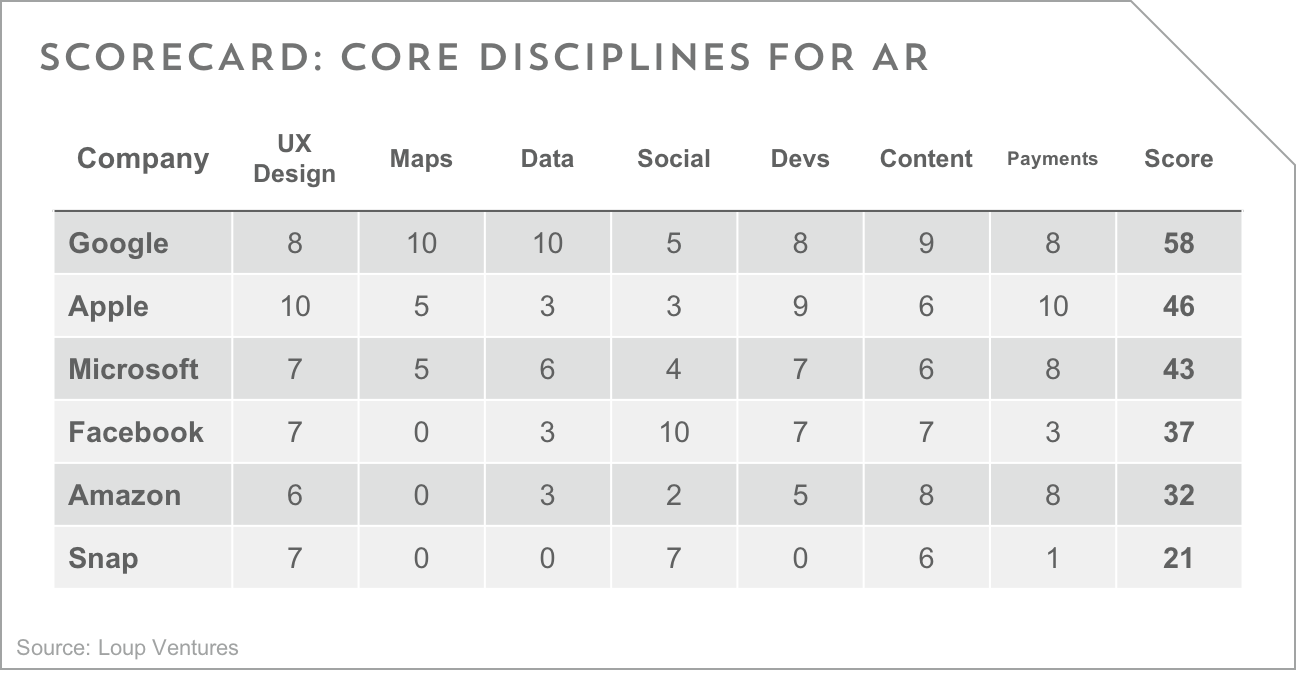
    As shown in our Jump Ball for the Next OS chart, Microsoft sits in third place behind Google and Apple in terms of elements necessary for a complete AR OS.

    In the past week, Microsoft has made three important announcements that show the advances it’s making in order to better position itself as a key platform for VR and AR the future.

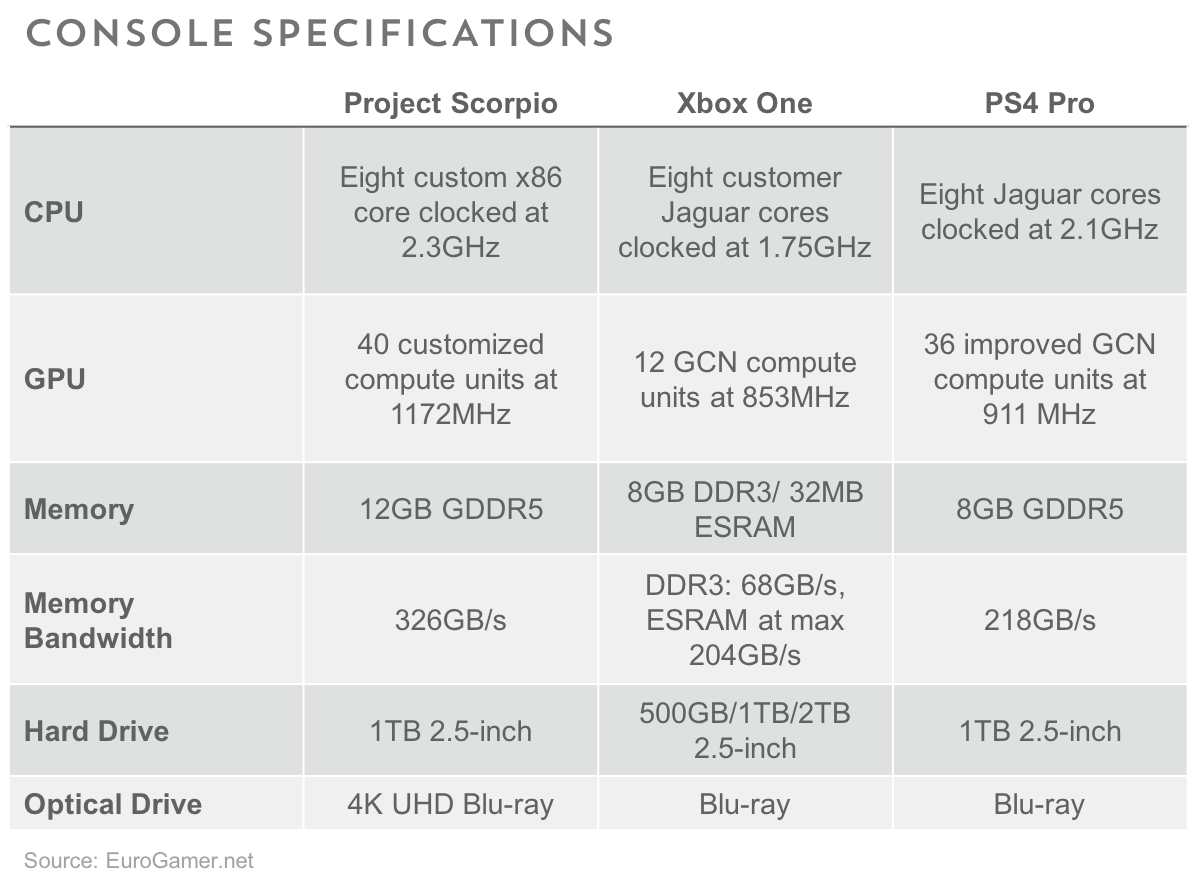
    Project Scorpio. Last week, Microsoft unveiled its final Xbox Project Scorpio specifications through Digital Foundry. Project Scorpio is a mid-generation console with 4K output and VR gaming capabilities. Gaming is one of the first areas where VR will have a big impact, and Microsoft is poised to benefit from it.

    Of all of the companies vying to own VR and AR platforms of the future, Microsoft is the only one to have a gaming console. In January, Microsoft shared that it had reached 55 million monthly active users on its Xbox Live platform, up 15% from the previous year. The Project Scorpio console, set to be released this fall, is powerful enough to display VR content. Microsoft’s main competition in console gaming is Sony, who released an early VR system in November of 2016. Sony has since announced that Playstation VR has sold over 915,000 units as of late February. We view Playstation VR as a step behind the HTC Vive and Oculus Rift, but ahead of smartphone-powered experiences.

    While Microsoft doesn’t produce any VR hardware, it sells the Oculus Rift headset in its stores and has included the Xbox controller in Oculus Rift bundles. Oculus seems like the logical choice for a VR headset partner for Project Scorpio, but Microsoft shared that the next console will also support the Mixed Reality Headsets from Microsoft in 2018, which include headsets manufactured by Lenovo, Dell, Acer, and HP.

    Mixed Reality OS Support. Microsoft recently announced that its latest Windows 10 update, the Creator’s Update, will start rolling out to users beginning on April 11th. This update will include support for Mixed Reality (MR) headsets. While this doesn’t mean much to consumers now since MR headsets won’t be available until the holiday season, developers that are soon to receive their MR development kits will be able to work on creating content and applications now. Providing developers with this early window should lead to high-quality MR content being available on day one of the MR headset releases.

    It’s also important to remember that Microsoft is leading the way when it comes to MR hardware, with the Hololens. While there are improvements that can be made, Microsoft has a commanding lead in the category. Its updates to Windows 10 will further benefit Hololens developers as well. We continue to view mixed reality as true augmented reality.

    Sprinkles. Microsoft has also released a photo application for iOS called Sprinkles, which is a foray into AR on a mobile platform. Sprinkles gives users photo editing tools, allowing them to add filters, stickers, and emojis. In addition, it utilizes facial recognition to position stickers and recommend celebrity look-a-likes. This app is similar to Apple’s recently released Clips.

    While Microsoft clearly missed an opportunity in the shift to the mobile computing paradigm, it seems heavily invested in positioning itself as a strong company in the future computing paradigm based on its investments in AR and VR.

    Disclaimer: We actively write about the themes in which we invest: artificial intelligence, robotics, virtual reality, and augmented reality. From time to time, we will write about companies that are in our portfolio. Content on this site including opinions on specific themes in technology, market estimates, and estimates and commentary regarding publicly traded or private companies is not intended for use in making investment decisions. We hold no obligation to update any of our projections. We express no warranties about any estimates or opinions we make.


    Previous 1 2 3 4 5 6 Next

    Related Podcasts

    Reply All

    1

    Reply All Games & Hobbies
    Inside VR & AR

    2

    Inside VR & AR Gadgets
    Note to Self

    3

    Note to Self News
    BrainStuff

    4

    BrainStuff Natural Sciences
    This Week in Tech (Audio)

    5

    This Week in Tech (Audio) News
    Hands-On Tech (Audio)

    6

    Hands-On Tech (Audio) Technology
    footer-logo

    Contact Us

    Toll Free: 844-670-7747

    Links

    • Home
    • Top Charts
    • Networks
    • Apps
    • Independents Podcasts
    • Podcast Advertising
    • Podcast News
    • Contact Us
    • About Us
    • Analytics & Insights

    Stay Connected

      Privacy, Terms of Use & Our Code of Ethics Protecting Content Creators Copyrights