TopPodcast.com
Menu
  • Home
  • Top Charts
  • Top Networks
  • Top Apps
  • Top Independents
  • Top Podfluencers
  • Top Picks
    • Top Business Podcasts
    • Top True Crime Podcasts
    • Top Finance Podcasts
    • Top Comedy Podcasts
    • Top Music Podcasts
    • Top Womens Podcasts
    • Top Kids Podcasts
    • Top Sports Podcasts
    • Top News Podcasts
    • Top Tech Podcasts
    • Top Crypto Podcasts
    • Top Entrepreneurial Podcasts
    • Top Fantasy Sports Podcasts
    • Top Political Podcasts
    • Top Science Podcasts
    • Top Self Help Podcasts
    • Top Sports Betting Podcasts
    • Top Stocks Podcasts
  • Podcast News
  • About Us
  • Podcast Advertising
  • Contact
Not in our directory?
Add Show Here
Podcast Equipment
Center

toppodcastlogoOur TOPPODCAST Picks

  • Comedy
  • Crypto
  • Sports
  • News
  • Politics
  • True Crime
  • Business
  • Finance

Follow Us

toppodcastlogoStay Connected

    View Top 200 Chart
    Back to Rankings Page
    Technology

    Loup Ventures Podcast

    We publish research on frontier technology, the themes driving it, and the companies making it a reality. This podcast includes audio versions of select research notes.

    Advertise
    • Apple Podcasts
    • Google Play
    • Spotify

    Latest Episodes:
    Esports Franchise Economics Mar 09, 2018
    Show notes

    We’re bullish on esports and committed to learning more about the space. The following note is an introductory piece that ‘shows our work’ as we get up to speed. Given the recent explosion in popularity of esports leagues, we wanted to take a look at the economics of owning of an esports franchise. As esports has grown in popularity, the model for team ownership has begun to change. 2018 marked the first year of competition for two new franchise leagues for Overwatch and League of Legends, both of which now operate similarly to traditional professional sports leagues. Traditional Esports Organization Traditionally, teams participating in esports were self-organized. Teams would find the necessary players to participate and join leagues and tournaments by paying an entry fee. By winning or placing near the top of these tournaments, teams would be compensated from the prize pool. As esports became more popular, more revenue opportunities presented themselves for teams. These opportunities included: sponsorships, merchandise, branded skins, and advertising opportunities on streaming platforms. With more revenue opportunities came better ownership organization. Ownership groups began to form, owning teams in multiple games. A team owner helps set up sponsorships, creates merchandise, and helps market the players. A good example of an esports organization is Team Liquid. Team Liquid was formed in 2000 as a Starcraft news site, before expanding to other games. It signed its first esports team in 2012 after recruiting a group of Dota 2 players. Since then, Team Liquid has added more players and teams, and now operates unique rosters in the following games: Starcraft II League of Legends Counter-Strike: Global Offensive Dota 2 Heroes of the Storm Super Smash Bros. Brawl Street Fighter FIFA PlayerUnknown’s Battlegrounds Quake Rainbow Six: Siege How do esports teams make money? The breakdown of income varies by organization, team, and game. The vast majority of revenue (roughly 70-80%) for esports organizations comes from sponsorships and advertising. The remaining revenue is split evenly between ticket sales, merchandising, and media rights. Sponsorships & Advertising This category includes advertisements shown during televised and live-streamed events, as well as revenue from brands that sponsor individual teams. Companies are flooding esports players and teams with sponsorship opportunities, and it is only going to continue to grow. In addition, players and teams can earn money from product placement and recommendations. Team jerseys are essentially billboards benefitting from rapidly growing viewership. On Amazon’s live-streaming platform, Twitch, users can scroll down to see discount codes on gaming equipment, clothing, and other products, and streamers get a cut of the sales made using their discount code. Esports teams don’t earn advertising revenue from an individual player’s live-stream, but rather when the team is participating in an event. Esports is well-positioned as an advertising opportunity for a number of reasons. First, cord-cutters are turning to online platforms, like YouTube and Twitch, for live entertainment. Second, esports’ younger demographics are valuable to advertisers. Finally, esports franchising adds stability for teams, their sponsors, and advertisers (more on that below). With more users flocking to online streaming platforms, and the audience becoming more valuable to advertisers, media rights contracts are becoming more valuable, and advertisers are paying more money to esports leagues, teams, and players. Global brands including Coca-Cola, Mercedes-Benz, and Intel have recently begun sponsoring esports in various ways because they recognize the value and massive opportunity. This builds an attractive foundation for investment. Ticket Sales Traditional esports events are held at event arenas around the world. The League of Legends World Finals has been held at Staples Center, and a mid-season League of Legends event was held at Wembley Arena. Other venues have included Commerzbank Arena in Frankfurt, San Jose SAP Center (also known as the Shark Tank), and Sang-Am World Cup Stadium in Seoul, South Korea. While the audiences vary in size, large events typically have between 10-15K in attendance, with some events attracting many, many more. Still, the lion’s share of esports fans watch the events online. For franchise league esports teams, one difference when compared to traditional sports franchises is that they lack a home arena to sell tickets and merchandise. Instead, esports events are held at neutral, league-owned locations. As a result, teams and organizers share ticket revenue. Team-owned stadiums are very much on the mind of team owners, especially with the location-based teams in the Overwatch League. The Overwatch League currently holds all of their events at Blizzard Stadium in Burbank, CA. Source: Blizzard Entertainment NA LCS hosts events its own studio in Los Angeles, CA, across the street from Riot Games headquarters. Source: Riot Games Merchandising A major revenue contributor in the merchandising category are in-game skins. A “skin” is simply different design or color scheme for a playable character or in-game item. Think about giving Mario an astronaut suit instead of his famous red hat and blue overalls. While skins are cosmetic and offer no competitive advantage, they are a major source of revenue for game developers because players enjoy the customization, and are willing to pay for it. In fact, in-game purchases (which skins contribute to) generated more than half of Activision-Blizzard’s revenue in 2017, amounting to $4B. Developers of esports-compatible games have tapped into this digital goods market and begun to create team-specific skins for major pro teams. Fans can purchase these skins to show support for their favorite team or player. League of Legends and Overwatch are the two major games that have esports-specific skins, but games with smaller competitive scenes like Halo 5 and Gears of War 4 have them as well. We believe the adoption from the OWL and the LCS is an indication that this is a market future esports organizations will want to target. League of Legends. Riot also creates skins for their league’s teams. When a world champion is decided at the end of each season, Riot makes a skin for the winning team. These are available for a similar price of about $5 worth of Riot Points, LoL’s in-game currency. The team receives 25% of the revenue from these skin purchases. Overwatch. Blizzard essentially created “jerseys” for each Overwatch League team and made them available for fans to purchase for $5 per skin via in-game tokens. See an example of playable Overwatch heroes wearing the team “jerseys” below. The competing teams also “wear” these skins during each and every OWL match, making it the esports equivalent of wearing your favorite team’s jersey. The revenue generated from this goes into a communal pot that is split evenly amongst the 12 teams. Overwatch heroes wearing the Houston Outlaws skins Similar to other revenue sources, game publishers share revenues for skins with teams and organizations that create and promote them. Fans of specific esports teams can sport their favorite skins in-game. This is akin to wearing a Stefon Diggs jersey while pretending to catch game-winning touchdowns. Media Rights While the concept of watching others play video games may seem foreign to some, there are a surprising number of people that tune into esports events. Because of this, esports franchises have recently been able to benefit from broadcasting contracts, just as traditional sports. While some esports events reach cable television, the vast majority of viewership happens online. One of the most important players in the esports market is the Amazon-owned streaming platform Twitch. Acquired for $1B in 2014, Twitch had 355 billion minutes of content viewed and over 15 million unique daily visitors on its platform in 2017 and strong growth continues. More on Twitch’s metrics below: On Twitch, gamers are able to stream their gameplay to viewers around the world. Believe it or not, one can make a living streaming gameplay on Twitch, and a fairly comfortable one at that. The revenue sources for streaming come from three main sources: advertisements, donations, and subscriptions. Advertisements. Streamers can have video ads play before their actual stream is shown (just like on YouTube), earning money passed on the number of impressions their channel gets. They also often have endorsements and advertisements on their Twitch pages from, for example, companies that make gaming equipment and computer parts. This creates a similar effect to traditional sports equipment endorsements where fans and amateurs want to use the equipment the best does, and having a well-known player use your equipment adds value and drives sales. Donations. Another source of revenue is donations from viewers. The amount and frequency of donations are up to the donor, some as low as $2 but some up into the tens of thousands. Here’s a video of a streamer receiving $62,000 in donations. Spend some time watching a popular streamer and you would be baffled by how often they’re getting donations, whether directly via PayPal or by “cheering” with Bits. Subscriptions. Finally, streamers earn money from viewers subscribing to their channel. A subscription lasts for a month and costs $5.00, and the streamer will usually take about half of that money per subscription. Twitch operates on a revenue sharing model with top streamers on its platform. The more popular the streamer, the higher percentage of revenue they are able to negotiate. Subscribing to a channel offers benefits like ad-free viewing and special chat privileges like emotes and additional features. Note that viewers re-subscribe every month. Some streamers have 0 subscribers and some have managed to amass over 100,000. Esports teams and organizations are able to stream as well. The structure is exactly the same as explained above for individual streamers, the money is just given to the collective group as opposed to one person. Many times, though, a player on a particular pro team will have a stream more popular than his overall team’s. It’s an example of how important personal brands are in esports. Teams, however, don’t make much from having a player with a large Twitch following. Sure, they have the team’s logo and name on the page/video and the streamer is clearly representing that organization with merchandise and even the name they go by online, but teams won’t see any money from one of their players’ streams. The popularity, and therefore most of the money, comes from viewers being drawn to the content the individual is producing. Media rights for tournaments, and the revenue shared with the teams from those deals, is where actual esports teams will be able to cash in on this trend as individuals don’t stream tournaments, organizations do. When it comes to tournaments themselves, massive audiences tune in to events online. The League of Legends World Championship amassed 60 million unique viewers. To help put that number in perspective, the 2018 Super Bowl reported just over 103 million viewers. While esports still has a long way to catch-up, it’s not dwarfed to the extent that some may think. Tournament Winnings For players, competition is what esports is all about. Players and teams compete to win tournaments and the associated prize pools. While these pools can be massive, such as the $24M+ pool for Dota 2, few players in the overall esports community take home winnings. Positively, most winnings are distributed directly to the players. While there are some large tournament pools, the vast majority of esports players and teams earn most of their income through the other sources we’ve talked about. Esports Franchise Leagues In 2017, three different franchise leagues were put into place, with competition beginning in the 2018 season. While the franchise leagues operate with similar game rules to previous leagues and tournaments, they require teams to pay a franchise fee in order to participate. By paying a franchise fee, leagues benefit from stability of teams and players, and operate the entire league’s advertising, sponsorship, streaming, and merchandising opportunities. This format is similar to the way major professional sports leagues operate. This shift toward franchising is a huge step for the legitimacy of esports, in both the eyes of the public and investors. Thus far in its young life esports has been plagued by a lack of stability, making it difficult to land sponsors. Before the franchising announcement last year, teams that placed poorly in the League of Legends Championship Series were relegated – similar to the English Premier League – where the teams that finished at the bottom were sent down and had to had to grind their way back to competing against top teams. The possibility of being dropped to a lower league with far less viewership and no certainty of promotion made companies very hesitant to inject money into something that could very easily lose its relevance. With the stability of franchises in leagues with multi-year broadcasting deals, the investors and sponsors are pouring in. Today, there are three franchise leagues: League of Legends North American Championship Series – by Riot Games Overwatch League – by Blizzard Entertainment NBA 2K League – operated by the NBA, game developed by Electronic Arts League of Legends North American Championship Series (NA LCS) League of Legends, a multiplayer online battle arena (MOBA) game, was released in October 2009 by Riot Games. While the League of Legends Championship Series has been around since 2012, they organized into a partnership with their 10-teams last fall, requiring owners to pay franchise fees. In order to participate, six existing teams paid a franchise fee of $10M, while four new teams paid $13M. Many of the prominent esports teams have received support from professional sports owners or athletes. Of the four new teams to NA LCS, are all wholly- or partially-owned by NBA franchises: the Cleveland Cavaliers (100 Thieves), Houston Rockets (Clutch Gaming), Golden State Warriors (Golden Guardians), and Milwaukee Bucks (OpTic Gaming). The new teams aren’t the only teams with ties to professional sports. Echo Fox was formed by ESports Group, led by former NBA player Rick Fox. Team Liquid, one of the original esports brands, was acquired in 2016 by a group led by Jeff Vinik, owner of the Tampa Bay Lightning. NA LCS began its season on January 20th, 2018. Games are streamed on its own website, YouTube, and Twitch. The prize pool for the league is $200K. Overwatch League Overwatch, a team-based, first-person shooter, was released in May 2016 by Blizzard Entertainment. Blizzard Entertainment announced the Overwatch League in 2016, and established 12 teams in cities across the world. 9 teams are based in the US, with the other 3 teams based in Seoul, Shanghai, and London. Each team paid a franchise fee of $20M to join the league. There are already rumors of further expansion and increased franchise fees due to the early popularity and success of the league (10m viewers in its first week of matches). The Overwatch League began its season on January 10th, 2018. Matches were initially streamed on the OWL website as well as MLG’s, but in January Blizzard reached a two-year, $90m deal with Twitch to broadcast Overwatch League matches on the streaming platform. The prize pool for the league is $3.5M. NBA 2K League The NBA 2K league is the first esports league to be operated by one of the four major pro sports leagues in the United States. The 2K league hosted open tryouts for hopeful participants in February, and has scheduled a draft to be held on April 4th at Madison Square Garden. 17 NBA teams will have a team in the 2K league. Players drafted…

    Full show notes at the publisher

    Amazon Go Extends Amazon’s Dominance to Brick and Mortar Feb 28, 2018
    Show notes

    After our first visit to Amazon Go, Amazon’s automated retail store in Seattle, we’re not surprised to hear the company has plans to open up to six more cashierless convenience stores later this year.

    Our experience was flawless, leaving us increasingly confident that Amazon is best positioned to own the operating system of automated retail. Eventually, we expect Amazon to make this technology available to other retailers, as they have with Fulfillment by Amazon (FBA) and Amazon Web Services (AWS), expanding their dominance into brick and mortar.

    The $50B automated retail opportunity. In 2016 there were 3.5 million cashiers in the U.S., according to the Department of Labor, with an average salary of $13,574, according to Data USA. That makes for a nearly $50 billion opportunity in cashierless retail that Amazon is well positioned to attack. Of those 3.5 million cashiers, 323,000 are convenience store or gas station employees, or 9% of the cashier workforce. The automated retail space is getting more and more crowded, but the Go store suggests that Amazon has the pole position.

    Why we think Amazon will license the Go technology. Just as Amazon did with FBA and, to a lesser extent, AWS, Amazon is initially building a backend infrastructure for its own use with Amazon Go. And just like FBA and AWS, that infrastructure gets more valuable as it scales. The Amazon Go backend gives the company a trojan horse into the brick and mortar retail space, clearly an area of interest given the Whole Foods acquisition. Perhaps the more critical question is why a retailer would work with Amazon? Our answer is the same as it is with all of Amazon’s best offerings: convenience. Retailers would have a turnkey solution for automated retail. While larger stores like Walmart and Target may not want to use the technology for competitive reasons, branded retail stores (like a Nike store) may be a fit if Amazon can create a product that helps save the retailer labor and processing costs.

    The Amazon Go experience. Amazon Go builds on the company’s core competence of convenience by automating the store with no cashiers or checkout lanes. Scan your phone on entry, grab your items, exit. In one test we bought a can of La Croix in 23 seconds. It felt like two parts magic and one part theft.

    A few observations from our visit:

    • No cashiers, but lots of employees: mostly chefs assembling the prepared food, one ID checker in the beer and wine section, a greeter/security guard, and a few stockers replenishing shelves, bags, and plasticware.
    • Signage with instructions everywhere: download the app, scan your phone here, just walk out; clearly, there is a great deal of consumer education at work.
    • Quickly builds trust: By my second or third trip, I was certain that the store was capturing and changing my items as I grabbed and replaced items throughout a visit.
    • Felt more like a tourist destination than a convenience store: most shoppers were taking pictures or video inside the store.
    • All about speed: Signage, taglines, the Just Walk Out Technology, the app, even the receipt all focused on the trip time (my record: 23 seconds for 1 item).
    • No chat: I never spoke to anyone or interacted with a person during several visits to the store.
    • Don’t linger: I found a seat at a nearby Starbucks (notable) where I could jot down my observations after visiting the Go store. There were 10 people in line at Starbucks, waiting to order, and another 5 people waiting where 8 baristas behind a waist-high coffee bar called out customer names and handed them personalized cups of coffee. It was a stark contrast to the can of La Croix I had just grabbed off the shelf at Amazon Go and paid for via the magic of cameras and the internet.

    We envision the future of retail in three categories: 1. online retail (e.g., Amazon.com), 2. automated retail (e.g., Amazon Go), and 3. Empathic retail (personalized services based on mutual understanding or empathy; more here). Amazon has already won the online space and Amazon Go could prove to be the operating system of automated retail. We’re bullish on the empathic retail space partly because it’s outside of Amazon’s core competency (convenience), leaving room for others to succeed.

    Disclaimer: We actively write about the themes in which we invest: virtual reality, augmented reality, artificial intelligence, and robotics. From time to time, we will write about companies that are in our portfolio. Content on this site including opinions on specific themes in technology, market estimates, and estimates and commentary regarding publicly traded or private companies is not intended for use in making investment decisions. We hold no obligation to update any of our projections. We express no warranties about any estimates or opinions we make.


    The Empathy Economy Feb 08, 2018
    Show notes

    Op-ed published February 7, 2018 onBusiness Insider

    Throughout history, different eras have begotten different heroes of productivity in industry. In the 80s, the stock broker was the rock star of the business world. In the late 90s and 2000s, it was the computer programmer. For the last decade or so, it’s been the data scientist. As the work of data scientists and engineers creates the Automation Age, the next industrial rock star will be the customer service specialist.

    Before you scoff at the idea of what may be considered a lower-level job today, ask yourself what happened to the stock broker? When’s the last time you talked to one or even heard of one? Jobs ebb, flow, and disappear. The importance of a function today is not equivalent to the importance of that same function tomorrow, and it never will be.

    Humans have three core capabilities with which robots cannot compete: creativity, community, and empathy. As we enter the Automation Age, where the fear of robots replacing human work is likely to come true, those three skills will enable the future of human productivity. The last of the three, empathy, should well be considered the most important.

    Empathy is what most makes us human – the capacity for mutual understanding. As the Automation Age eliminates rote and some not-so-rote tasks, it will create an opportunity for humans to capitalize on empathy. The manifestation of empathy in industry is through unique and memorable customer service, no matter the business. Welcome to the Empathy Economy.

    The Empathy Economy is an intentional spin on the Sharing Economy. Just as the Sharing Economy was a byproduct of a super connected world via the Internet and smartphones, the Empathy Economy will arise through the result of job loss from automation. Uber, Airbnb, WeWork, and countless other business have changed the way humans think about asset ownership and even asset leasing. If users own assets, they want to get more out of them. If users need assets, they want instant access to them on demand without the burden of ownership. The Sharing Economy, as with all functional economies, is efficient in matching two complementary desires. The Empathy Economy will similarly match humans or businesses who desire empathic services with those willing to offer them.

    We see 3 core opportunities within the Empathy Economy:

    1. Services that augment human empathy: For example, a lightweight CRM tool that enables employees to instantly recognize customers when they walk in the door, remember details about their lives, and know their preferences for service at the business.
    2. Services that build empathy: For example, a simulated environment that puts trainees through various situations to help them understand why another person feels a certain way and how to best serve them.
    3. Marketplaces that match buyers and sellers of empathy: For example, a platform that makes freelance customer service experts available for various tasks that might require a human touch to differentiate and enhance a particular service.

    Today’s businesses must adopt automation technologies and embrace the Empathy Economy simultaneously by leveraging empathic customer service specialists as the face of their automated tools. In other words, people will act as a truly human skin on the work being produced by robots.

    In the future, H&R Block will leverage AI to automate every customer’s taxes, but it’s also likely that they’ll need a human, who may only have cursory knowledge about accounting, present the sensitive reality that a customer owes the government a few thousand dollars in taxes; or perhaps the joy that they’ll be getting a few thousand dollars in refund. Either way, the human presentation creates a differentiated customer experience that can be distinctly H&R Block. Using only automation as their selling point, which every other tax prep service will also have and may only vary slightly, will necessitate a race to the bottom in price. In this example, H&R Block could benefit by adopting services that help augment and build empathy as the core skill of their customer service specialists.

    Another outcome of the Empathy Economy could be Target leveraging a marketplace for freelance workers with specific product expertise and high empathic qualities to deliver orders to local customers with personalized service. Similar to the tax example, this moves the discussion away from price towards experience, which can command a premium.

    You may be wondering why empathy is the greatest opportunity in the triumvirate of uniquely human traits. Creativity and community already exist in a structured sense in our societies. Creativity has always been a democracy, but the Internet made the distribution of creativity available to all. There are numerous ways, both online and offline, to share creativity and get paid for it, YouTube and Patreon as examples. These platforms will only become more important in the Automation Age. As for community, traditional institutions provide this now – governments, churches, schools, local businesses, etc. Technology will help these institutions continue to evolve with automation; however, trusting relationships between people will remain the heart of community because, by definition, it has to. Empathy doesn’t yet seem to have a defined structure for application in our world. We know it’s important and the best businesses find ways to implement empathy into their culture, but it’s still a nebulous, unmeasurable thing. The Empathy Economy will change that.

    It’s cliché to say that empathy is in short supply today because every generation probably has the same sentiment. The good news is that automation will force humans to be more human, and the Empathy Economy will create opportunities for humans to monetize a uniquely human capability. True empathy isn’t easy, but it’s the most powerful expression of humanity. In a world full of robots, empathy can only become more valuable.

    Disclaimer: We actively write about the themes in which we invest: artificial intelligence, robotics, virtual reality, and augmented reality. From time to time, we will write about companies that are in our portfolio. Content on this site including opinions on specific themes in technology, market estimates, and estimates and commentary regarding publicly traded or private companies is not intended for use in making investment decisions. We hold no obligation to update any of our projections. We express no warranties about any estimates or opinions we make.


    Simplicity Series: Augmented Reality Jan 23, 2018
    Show notes

    Last week we wrote about simplicity as a driving force behind the world’s biggest technology offerings. We’re extending our thoughts on simplicity into a series that explores the necessity of simplicity in frontier technology. First, we’ll dive into AR.

    Simplicity for AR in 2018 must start with a question: “What does AR do?” Not in the literal sense. We all know it overlays digital information on the real world. What the question needs to answer is what undeniable and unduplicable benefit AR confers to its users. What can only AR do?

    The smartphone put a powerful computer in your pocket that lets you work and play from everywhere. Apple makes the smartphone so simple anyone can pick it up and start working and playing instantly.

    What can only AR do?

    The Internet connected you with the world’s information. Google sorts it for you. Amazon lets you buy things you find.

    What can only AR do?

    The answer isn’t that it puts a computer with the world’s information in your eye. That’s only marginally better, maybe not even, than what we have now. Marginally better is fine as an emerging feature on smartphones today, but it won’t drive mass adoption of AR wearables that people wear all day long.

    The problem is more obvious when asked what the killer use case of AR is. To be clearer, a use case the average consumer could engage in every day. It’s not envisioning a new couch in your living room or getting step-by-step instructions or doing facial/object recognition. AR doesn’t have the advantage of email, messaging, and web browsing as the smartphone inherited from the Internet. Because AR is a true paradigm shift in how we interface with computers, we need to rethink communication, information collection, and information consumption specifically for AR. That hasn’t happened in a meaningful way yet.

    Our tone here is tough, but only because we think the AR space has been taking a pass at answering this hard existential question in favor of experimentation with hopes that customers figure it out for them. We remain bullish on the future of AR and think the answer to our core question here might have something to do with the relative “nearness” of information it creates. To elaborate, we’ve evolved from a limited keyboard-style interface to a touch interface to a mixed reality interface that might incorporate gestures, thoughts, voice, etc. Interacting with information is becoming much closer to how we interact with the real world. This answer isn’t perfect, but we think it’s in the right direction.

    Disclaimer: We actively write about the themes in which we invest: artificial intelligence, robotics, virtual reality, and augmented reality. From time to time, we will write about companies that are in our portfolio. Content on this site including opinions on specific themes in technology, market estimates, and estimates and commentary regarding publicly traded or private companies is not intended for use in making investment decisions. We hold no obligation to update any of our projections. We express no warranties about any estimates or opinions we make.


    Investing in Enjoy Jan 10, 2018
    Show notes

    We’re investing in Enjoy as a counter-automation play on the future of retail. Read our thesis on retail’s future here. In short: retailers must either embrace full automation or compete on experience by focusing on uniquely human capabilities: creativity, community, and experience. We call it “empathic retail.” Enjoy delivers the future of retail by focusing squarely on empathic retail. Enjoy hand delivers products bought online from the world’s premier companies and delivers them with an experience. The service comes at no additional cost to consumers and it’s fast, with nearly 50% being delivered the same day.

    Amazon is changing consumer expectations related to the price, availability, and delivery of products and services. But the in-person retail experience is outside of Amazon’s core competencies. Enjoy offers its premier companies (including AT&T, Sonos, DJI, and others) a high-touch, personalized delivery and setup service. Enjoy optimizes the customer experience, reduces returns, and increases customer satisfaction.

    At the same time, automation technologies are already replacing retail jobs. Enjoy offers its team of Experts (delivery and setup employees) flexible work, salaried, with benefits – a transformative employment model for the new retail workforce. In our view, Enjoy is creating the optimal go-to-market channel for premium brands in the automation age.

    Enjoy’s CEO, Ron Johnson, has spent his career innovating in retail. His experience as VP of Merchandising at Target, SVP and head of retail at Apple, and as CEO of JCPenney, along with his network of leaders at consumer electronics and luxury goods brands, uniquely positions Enjoy for success in these markets and beyond.

    We’re excited to be a part of delivering retail’s future with the team at Enjoy.

    Disclaimer: We actively write about the themes in which we invest: artificial intelligence, robotics, virtual reality, and augmented reality. From time to time, we will write about companies that are in our portfolio. Content on this site including opinions on specific themes in technology, market estimates, and estimates and commentary regarding publicly traded or private companies is not intended for use in making investment decisions. We hold no obligation to update any of our projections. We express no warranties about any estimates or opinions we make.


    3 Reasons Amazon Will Buy Target This Year Jan 10, 2018
    Show notes

    Amazon is the world’s largest online retailer, about five times bigger in that space than Walmart and its Jet.com subsidiary. Yet despite Amazon’s deep online roots and dominance over Internet shopping, I believe it will buy Target in 2018.

    After digging into the realities of both companies, it becomes clear that Amazon buying Target isn’t as bold of a prediction as one might think. Here are three reasons why a merger makes sense.

    Offline sales will always be a big part of retail.

    It’s no secret that online retail is slowly killing offline. My firm, Loup Ventures, estimates that in the fourth quarter of 2017, about 10% of total U.S. retail sales, or about $125 billion, were online. The longer-term question is: How much of total retail will eventually happen online? Based on our analysis of U.S. retail sales by category (excluding gas and restaurant expenditures), 55% of total retail sales should eventually happen online.

    Even if half of commerce shifts to online, that still leaves a massive market offline at 45%. People in the future will still want to pick up groceries at a local store. As retail changes dramatically going forward, the biggest winners will promote both online and offline opportunities.

    They both pursue affluent customers.

    Amazon’s acquisition of Whole Foods last year confirmed that the online giant’s focus is on the high-income consumer. Market research firm GfK MRI estimates the median household income for an Amazon shopper is $90,100, similar to Whole Foods at $95,200. Target reports its average shopper earns $87,000. These far exceed the U.S. median household income of $55,322.

    By buying Target, Amazon would solidify its dominance of the high-income consumer. Conversely, if Amazon were to acquire a company targeting lower-income customers, such as Dollar Tree, Amazon would steer its focus away from its core consumers. In my years of observing tech companies, I’ve seen that owning a demographic usually yields the best results.

    Brick and mortar will get more advanced.

    Over the following 10 years, I’d expect Amazon to convert Target and Whole Foods stores to an automated model with few employees. Stores would be monitored by computer vision systems; shelves would be stocked by robots; customers would be helped by service robots that understand natural language; and checkout would resemble Amazon Go locations, where customers simply walk out with their purchases. In this future, the lines between online shopping and automated brick and mortar stores would blur, as cost-focused stores become more like smart warehouses. The few employees working in stores would focus on delivering personalized service based on mutual understanding and empathy, which would enable retailers to differentiate themselves.

    Any number of factors could derail such a combination, including government intervention. But sometimes mergers make too much sense to ignore. Amazon buying Target is one such situation.

    This note was originally published on Fortune.

    Disclaimer: We actively write about the themes in which we invest: artificial intelligence, robotics, virtual reality, and augmented reality. From time to time, we will write about companies that are in our portfolio. Content on this site including opinions on specific themes in technology, market estimates, and estimates and commentary regarding publicly traded or private companies is not intended for use in making investment decisions. We hold no obligation to update any of our projections. We express no warranties about any estimates or opinions we make.


    The Underappreciated Beauty of Simplicity in Tech Jan 04, 2018
    Show notes

    Simplicity is underappreciated. In many things. But most obviously right now in our world of consumer technology.

    Simplicity is a requirement of mass adoption. Look at the iPhone, Google, Amazon, and Uber as examples: The iPhone never shipped with a manual. Turn it on. Press the screen with your finger. It just works. Google gives you a box with two buttons. Type what you’re looking for and hit enter. There’s your answer. Amazon lets you order anything you can imagine. Even with one click. Then it shows up on your doorstep a few days later. Even sooner with Prime. Uber: I’m here. Take me there. Ok, done.

    None of these products has a learning curve. They’re dead simple to use and they just work. You can make similar arguments for Facebook, Twitter, and Airbnb. Probably not Snapchat, and perhaps that is their biggest weakness.

    This isn’t to say that simple products don’t have extremely complex technical underpinnings. Almost no iPhone or Google user has any conception of the software that enables their seamless technology experiences. The part they touch makes the technology disappear.

    In this new wave of innovation, technology seems to be embracing itself. Tech is cool. Tech is sexy. And it feels like we’re trying less to hide tech with ease of use. With a friendly, non-tech face. That’s a mistake. In the consumer world, AI, robotics, VR, AR, even cryptocurrency, none of these will see mass adoption without the same simplicity employed by the incumbent giants.

    Simplicity is also underappreciated in investing. It’s easy to overthink things and build reasons why something can buck the reality of otherwise. We’re trying to employ the concept of simplicity in our investments. We’re not afraid to invest in complex tech, but when we do, we make sure the tech hides behind a friendly front that’s simple enough for mass adoption.

    Disclaimer: We actively write about the themes in which we invest: artificial intelligence, robotics, virtual reality, and augmented reality. From time to time, we will write about companies that are in our portfolio. Content on this site including opinions on specific themes in technology, market estimates, and estimates and commentary regarding publicly traded or private companies is not intended for use in making investment decisions. We hold no obligation to update any of our projections. We express no warranties about any estimates or opinions we make.


    Apple Readies to Fight for Your Monthly Video Wallet Share Nov 21, 2017
    Show notes

    Conclusion. Get ready for another $10 a month drag on your credit card. It’s a rebranded, all in one Apple video and music offering in 2-3 years.

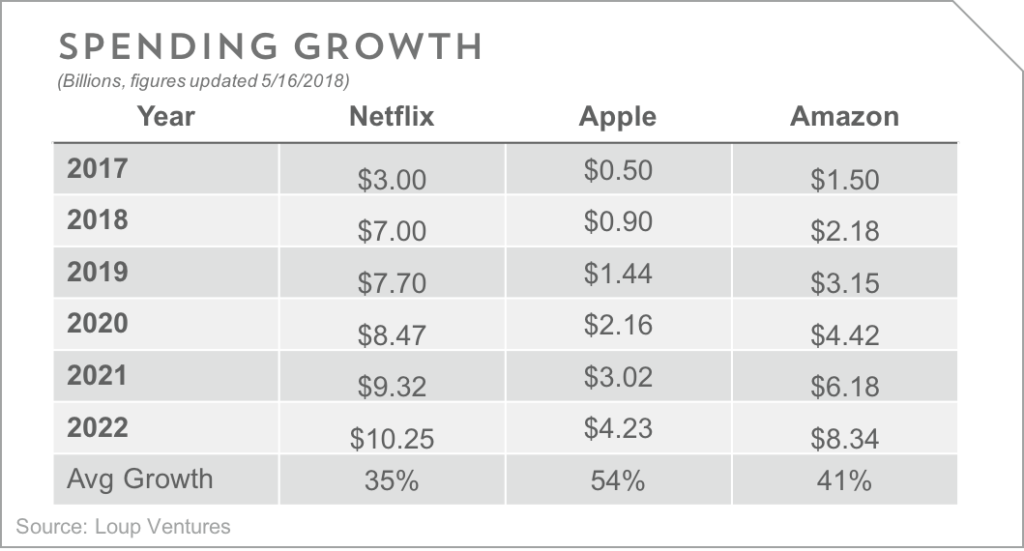
    An Emerging Area of Investment. It’s no secret that original content will be an emerging area of investment for Apple, given it will boost the increasingly important Services revenue line. The good news is the trend of more cord cutting is undeniable and consumers paying for multiple monthly streaming services. Multiple streaming services means there will be a handful of content provider winners. The bad news is Apple’s efforts in content have been limited to “learnings” (Carpool Karaoke and Planet of the Apps). We think that will change over the next 5 years as Apple ramps its original content investment from about $500m in 2017 to our estimate of $4.2B in 2022. It’s worth noting this will still lag our 2022 estimates for original content spend (excludes catalog spend) by Amazon at $8.3B which will likely surpass Netflix at $6.8B.

    Fighting To Reach 75m Subs. We define a winning content platform as having 75m+ monthly subs. That’s a tall order given it’s a crowded field with more than 200 subscription video services in Sep-17 (Parks Associates). These video services are working to catch up to the creative achievements of existing players. In 2017, HBO won 29 Emmys, (most for the 17th straight year), Netflix won 20, NBC 15, and Hulu 10. Looking at monthly subs, today’s leaders are Netflix (estimated to end 2017 with 115m subs) and Amazon (~80m global Prime subs). Hulu is the 3rd largest with 12-15m U.S. subs, but that doesn’t clear our 75m hurdle. Apple should be able to quickly expand their sub base given they have a running start with just over 30m Apple Music subs that will have access to the video offering for the same $10 per month. Even though Apple employs the “iTunes Store” nomenclature to sell most of its video content, we expect an all in one offering (music and video) to take the form of a rebranded Apple Music sometime in the next 2-3 years.

    This note puts Apple’s content ambitions in context with the other players.

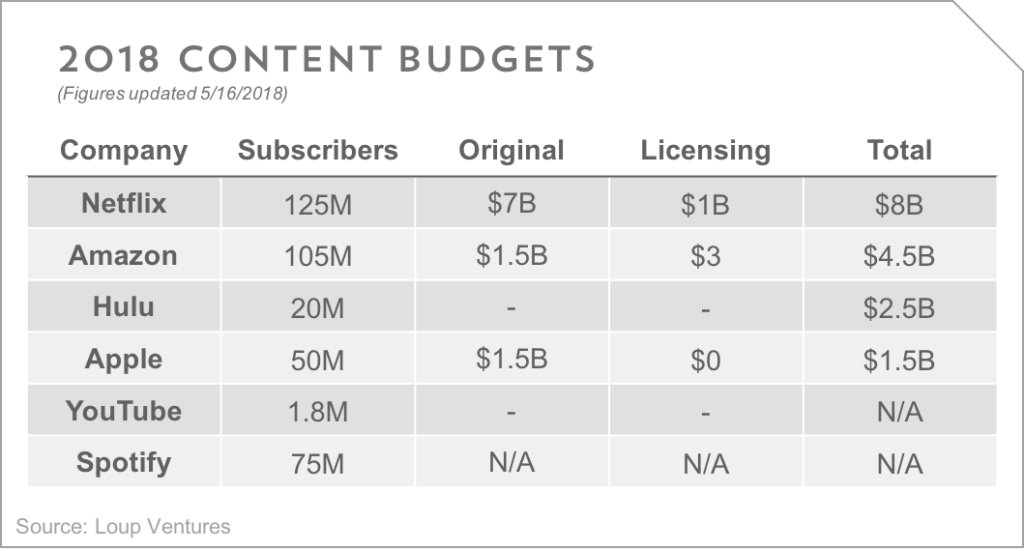
    Apple. With over 30m Apple Music subs, Apple aims to bundle the music offering with an expanded selection of original content video (essentially two shows today) and will steer clear of license catalog content. Apple cares about original content because it will grow Apple’s Services business. Services will account for about 14% of revenue in CY17, growing at a high-teens rate for the next several years, which is more than double the growth rate of Apple’s hardware business. Separately, Services carry a gross margin which is around 2x Apple’s overall GM of 38%. We note content margins are slightly higher than Apple’s current business based on other streaming services’ margins that are around 45%. As Apple continues to invest in original content over the next few years (we estimate it will be around $800m-$1B in 2017), Services gross margin could decline by 3-5%, which would pressure overall Apple gross margin (currently at 38%) by about 0.5%. We expect will generally have a positive view of this growth vs. margin trade off given this is an investment in a measurable revenue generating in addition to Apple’s core business.

    Adding Talent & Shows. Apple announced in early November they are developing a new TV show for its streaming service starring Jennifer Aniston and Reese Witherspoon. They beat out bids from Netflix and Showtime for the rights and could possibly spend over $10 million an episode, according to WSJ. The show, which doesn’t have a script yet, will follow the lives of morning news talk show anchors (think Today Show or Good Morning America). This is the second major content announcement for Apple recently, after announcing it is teaming up with Steven Spielberg to reboot his Amazing Stories series. On top of these two upcoming shows, Apple has been filling the ranks of its programming team with experienced entertainment executives. In late October Apple hired Jay Hunt, a rock star in UK original content, and in June hired Jamie Erlicht and Zack Van Amburg from Sony. Separately, these hires tie back to the acquisition of Beats and Jimmy Iovine joining Apple. Iovine was instrumental in bringing Erlicht and Amburg to Apple and has been the point man for Apple’s push into the original programming. Iovine has deep knowledge and a wealth of experience in the music industry — we consider him a “tastemaker” — and will likely work to expand their video offering into original programming, alongside their existing audio offering.

    Rebranding Apple Music & iTunes. Obviously, what is offered with ‘Apple Music’ and in the ‘iTunes Store’ is more than just music, and is another data point Apple lags behind on name changes. Looking back, they were ‘Apple Computer, Inc.’ until 2007 when Steve Jobs decided to ditch ‘Computer’ to better reflect the products the company sold (the first iPhone model was released in 2007). In 2016, they dropped ‘Store’ from their physical retail locations, indicating the stores are more of an experience than simply a place where you buy things (e.g. Apple Fifth Avenue, Apple Lincoln Park, or “I need to stop at Apple”). With the rebranding and expansion of its content library Apple’s positioned to be a player in original programming.

    Netflix. With 115m subs globally (54m in the U.S) and expected to spend $7-8B in content in 2018, Netflix is the gold standard for over-the-top original programming. Over the years they have won 37 Emmy awards on 128 nominations, and hoping to increase that as they are expect to release 80 original films in 2018. Netflix’s strategy is to keep a steady stream of diverse content coming, as opposed to HBO for example with a few high-profile releases. They certainly have those prestige shows – Stranger Things, Narcos, The Crown, to name a few – but that is not the (sole) objective. Instead, Netflix focuses on offering a content library with a broad range of appeal to its diverse subscriber base, seeking overall commercial success ahead of critical successes here and there. They’re also rolling out this strategy internationally by continually entering new markets and even offering original shows in the local language for those international markets. Currently, native-language shows are available in Spain, Japan, Mexico, South Korea, Brazil, France, and Italy. Netflix has the largest library, budget, and geographic reach of the streaming services and will continue to be a formidable force for many years to come.

    Hulu. Subs of 12-15m, U.S. only. Hulu will spend around $2.5 billion on content in 2017. While Amazon and Netflix will both spend more than twice that this year, it’s important to remember that Hulu is only available in the US, while Amazon and Netflix are both distributed internationally. Hulu also is not aiming to be a leader in original programming, instead using it to supplement their focus on licensing quality content from major TV networks. However, they have still had success with their original programs. The Handmaid’s Tale won an Emmy for Outstanding Drama Series, the first such award for a pure streaming service. They have begun bundling their service with others’, notably offering college students both Hulu and Spotify Premium for only $4.99/month. They have Cinemax and HBO add-ons to their service as well, though there are no discounts involved and are simply integrated into the Hulu app. Hulu’s approach is to offer as much quality content as possible, both originals and programming licensed from major networks (recently added 7,500 episodes in Q3).

    Amazon. Subs of -90m Worldwide. We believe Amazon Studios’ content spend is budgeted at $4.5 billion for 2017, and they have recently communicated will increase in 2018. On the Sep-17 earnings call, Amazon said they were “bullish” on video given it helps drive more engagement and purchases on Amazon. Prime Video is only available to Amazon Prime members, and Prime members (as expected) spend about 3x more money than non-members. Amazon recently announced they’re expanding Amazon Studios, even after they’ve had management shakeups in the unit in the past month. Amazon Studios’ head resigned amid sexual harassment allegations, and they’ve added new heads of both scripted and unscripted content. Coupled with these management changes is a strategy change. CEO Jeff Bezos had indicated he’s looking to find a high-profile series with global appeal, and recently acquired the rights for a TV show based on J.R.R. Tolkien’s writings (i.e. The Lord of the Rings). Amazon paid $200-$250 million for the rights to the Tolkien IP (Bezos paid $250 million for The Washington Post in 2013), and will shoot two seasons for a reported $100 million each, bringing the financial commitment to nearly $500 million. This has the potential to legitimize their video entertainment ambitions in the eyes of non-Prime customers.

    Disclaimer: We actively write about the themes in which we invest: artificial intelligence, robotics, virtual reality, and augmented reality. From time to time, we will write about companies that are in our portfolio. Content on this site including opinions on specific themes in technology, market estimates, and estimates and commentary regarding publicly traded or private companies is not intended for use in making investment decisions. We hold no obligation to update any of our projections. We express no warranties about any estimates or opinions we make.


    Do You Have What It Takes to Be a Great Founder? Sep 21, 2017
    Show notes

    Every VC says they only invest in great founders, but the majority of venture-backed businesses still end in relative failure. Does that mean we as VCs are just bad judges of founders or do we not know what great founders look like? This is a question we’ve obsessed over since we started Loup Ventures — trying to define what makes a great founder and how to test for it. It’s hard. Great founders come from a host of different backgrounds, educations, genders, ethnicities. We’ve identified 10 traits across two categories that make great founders at the seed stage: Innate and Dynamic.

    Innate Qualities of a Great Founder

    Innate traits are character elements that are difficult to impossible to learn — either the founder has them or they don’t. Regardless of the type of business a founder starts, there are five imperative innate traits for all great founders:

    • Intelligence
    • Integrity
    • Commitment to suffering
    • Focused curiosity
    • Resourcefulness

    Warren Buffett has talked about a few of these traits as things he looks for in his managers. Naval Ravikant has also talked about a few of them, so they shouldn’t come as much of a surprise. Intelligence is probably the most obvious of the innate traits. To start a valuable company, a founder must have some kind of smarts because intelligence leads to interesting insights about a market (see the next section). These insights translate into vision, which is the only truly defensible element and most important asset of any startup business. Vision is how an entrepreneur attracts talent and creates strategy.

    Pure book smarts matter, but emotional intelligence is important too. A founder has to deeply understand his or her customers to deliver products they want, not just products the founder wants to build. A founder also has to deeply understand his or her employees and what motivates them to sustain high levels of productivity.

    Integrity is the current buzz word in the startup world. We used to think about integrity as honesty, but that doesn’t seem to fully encompass the spirit of the trait. Honesty is a requirement because it means the founder learns from his or her mistakes. Dishonesty assumes problems are someone else’s fault, which means it’s impossible to learn. Ownership is a popular modern term for honesty – taking responsibility for things that happen whether they’re purely in your control or not.

    The interesting component about integrity as it relates to startups is that great founders need to be willing to break rules to build valuable businesses. However, there’s a line between what’s acceptable and what’s not, and sometimes it’s blurry. Salesforce.com hired fake protestors to disrupt a Siebel conference in its early days. Clever guerilla marketing. The cases of Hampton Creek, Theranos, and Zenefits are clearly in the unacceptable camp. The ride sharing legal disputes are blurrier, although we agree that the laws are outdated and ride sharing is a significant net positive to the world. In any case, dishonesty and unethical behavior are contagious, so integrity must come from the top and be a guiding light for any startup.

    The third quality of great founders is a commitment to suffering for at least five years. This might sound more extreme than necessary, but starting a company is a rollercoaster of suffering. You need to be comfortable with hearing no over and over and not let that destroy your will. You need to be able to withstand low periods that are inevitable — unexpected customer or employee losses, investor rejections, tax bills, fights with cofounders. Entrepreneurs don’t necessarily need to revel in difficulty, but it helps. We like to track the number of times we hear no during the week to reduce the negative reinforcement of it.

    Why five years of suffering? It usually takes at least two years before you have any reasonable traction to show that your business might be working, then another few years of driving growth to create something that looks like a moat. Then you can afford to breathe. A little.

    Focused curiosity might seem like an oxymoron, but curiosity that is targeted at a specific market leads to a commitment to testing new things. Testing new things leads to new business opportunities and products. Curiosity may be particularly necessary for seed stage founders (our focus) because their businesses are so nascent and require constant iteration. A lack of curiosity at the early stage leads to stagnation, which leads to death.

    An early stage startup is an unending series of challenges. This is doubly true for first time founders who not only have to figure out how to deliver their specific offering to market, but how to operate a business in general. The final innate trait, resourcefulness, gives founders the ability to thrive in the face of persistent tests. A great founder is not one that says he or she couldn’t do something because they didn’t have enough capital or it was too difficult. They figure it out and keep figuring it out.

    Dynamic Qualities of a Great Founder

    Where the innate traits are binary and fixed, the dynamic traits of a great founder are five qualities that exist on a spectrum and evolve over time:

    • Market insight
    • Operational capability
    • Product sense
    • Growth
    • Leadership

    Market insight is our term for the popular “founder/market fit.” What we want to see from a founder is that he or she has spent a lot of time thinking about and experimenting on a problem they’ve identified. In that sense, market insights are a byproduct of the innate intelligence trait being applied to a specific problem over a length of time. Founder/market fit to us implies that the founder has spent time involved in a market, thus the fit; however, prior market experience isn’t necessary for great founders. Jeff Bezos didn’t have founder/market fit when he started Amazon. He never ran a bookstore before, but he had a market insight about the Internet changing the way people shopped. The founders of Uber never worked in the livery business, but they had an insight about mobile changing the way people arranged transport. Airbnb is another example, and there are many others.

    The other four traits are relatively straight forward business-related qualities. Operational capability is the founder’s ability to deliver their product or service and serve customers. Product sense is the founder’s ability to create a product or service that unexpectedly delights consumers. Product sense is what enables a founder to reach product/market fit. Growth is the founder’s ability to market and sell the product or service. Leadership is the founder’s ability to organize his or her team to meet objectives.

    All five of these traits work in conjunction with one another, and all five are necessary for an early stage founder to possess in some degree. However, numerous factors influence the relative importance of the dynamic qualities of a founder. In other words, some of the dynamic traits need to be more developed depending on type of the founder’s company. For example, in a highly social company, a founder’s product sense seems to matter more than any other trait because user growth will have to be organically rapid for the company to service. The immediate experience of the users will be what keeps them engaged and sharing the product with others. An enterprise founder should require stronger growth capabilities to directly sell their B2B product, software or otherwise. Hardware companies tend to need stronger operational capability given the manufacturing requirements of their product.

    The above observations were specific to seed stage companies, but stage of the investment also impacts the relative importance of the dynamic qualities in a founder. At the A/B round, product should be somewhat established, so market insights and growth might matter more as the founder tries to leverage his or her unique vision into some sort of durable advantage. In a pre-IPO or public company, the importance of leadership matters significantly more because of the likely larger number of employees at the company.

    If You’ve Got It, Go for It

    It’s boring to hear every VC say they only fund great founders, but it really is true, and their criteria probably isn’t much different from ours. Early stage companies are extremely fragile. VCs obsess over the quality of founders because it’s one of the few variables we can control. Recognizing these qualities in oneself is also an important variable an entrepreneur can control. Whether you’re running a small business or hoping to build the next Google, you must have all the innate traits and the correct balance of dynamic traits to be great. If you know you have them, then focus on your goal and be great. Hopefully we can help you along the way.

    Disclaimer: We actively write about the themes in which we invest: artificial intelligence, robotics, virtual reality, and augmented reality. From time to time, we will write about companies that are in our portfolio. Content on this site including opinions on specific themes in technology, market estimates, and estimates and commentary regarding publicly traded or private companies is not intended for use in making investment decisions. We hold no obligation to update any of our projections. We express no warranties about any estimates or opinions we make.


    The Gold Rush of ARKit Jul 21, 2017
    Show notes

    When Apple launched the iPhone SDK in March 2008, they correctly anticipated a gold rush for iOS developers selling apps on the new App Store. Another gold rush is about to begin with the debut of iOS 11 and ARKit.

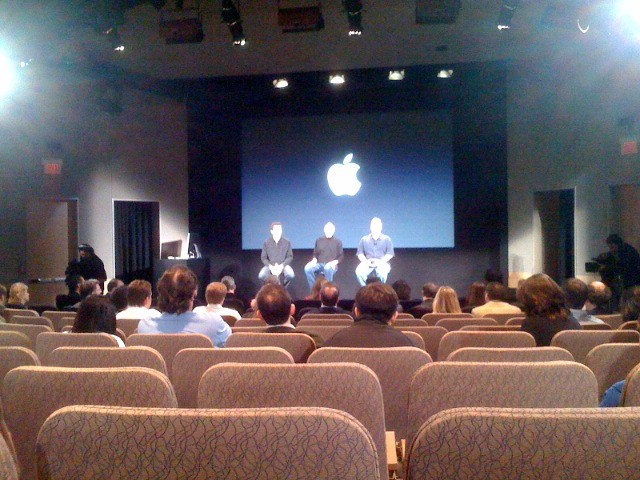
    Given how the App Store story has played out over the last decade it’s hard to believe it started like this:

    Look at all those empty seats. On stage, from left to right, was Scott Forstall, Steve Jobs, and Phil Schiller. I don’t think anyone in the room, except perhaps John Doerr from Kleiner Perkins, who announced the launch of the $100m iFund during the event, understood the magnitude of what had just happened.

    Since then, the App Store has been the single biggest driver behind the power of the iPhone to change the world. In order to better understand the iOS platform that has emerged over the last nine years, and the platform on which ARKit will sit, we took a look at the growth of the App Store, the number of apps available, and the money paid out to developers. The growth isn’t all that surprising, but the accelerating pace of growth of the App Store ecosystem is staggering.

    The growth isn’t all that surprising, but the accelerating pace of growth of the App Store ecosystem is staggering.

    As of June 2017, iOS users had downloaded over 180B apps, which represents nearly 150M app downloads per day, a rate 82% faster than it was a year prior, at 80M app downloads per day in June 2016. This implies that each of the over 1B active iOS devices downloads 1 app per week.

    As of January 2017, there were over 2.2M apps available on the App Store, which represents about 1,000 new apps available per day, a rate that has also shown an accelerating trend.

    And as of June 2017, Apple has paid out over $70B in app revenue to developers, which represents $68M paid out to developers per day, a rate 26% faster than it was a year prior, $54M paid out to developers per day in June 2016.

    ARKit and the possibilities it represents now sits on the shoulders of a massive and fast-growing iOS platform. There are now well over 1B active iOS devices around the world, although not all will run iOS 11 and ARKit apps. Given the broad ARKit compatibility (backward compatible to the 2015 iPhone 6s), we estimate that Apple’s device ecosystem for iOS 11 and ARKit will be over 200m devices at the launch of iOS 11. And if just 5% of paid apps leverage ARKit, the augmented reality apps on iOS would generate $1.7B in gross revenue per year (before Apple’s 30% take and the developers’ 70% net revenue). But many of the applications for augmented reality are entirely new and will justify – or even necessitate – an entirely new app, suggesting that our estimate is likely conservative. See a few early examples of ARKit apps here.

    In short, ARKit will enable the second great gold rush in the App Store’s history. And eventually, the underlying technology will fundamentally change how we interact with information throughout our days. AR (starting with ARKit), will enable the future of computing – a more immersive paradigm for computing in which the digital information we need is available within our real-world field of view. iOS developers are already hard at work making it a reality.

    Disclaimer: We actively write about the themes in which we invest: artificial intelligence, robotics, virtual reality, and augmented reality. From time to time, we will write about companies that are in our portfolio. Content on this site including opinions on specific themes in technology, market estimates, and estimates and commentary regarding publicly traded or private companies is not intended for use in making investment decisions. We hold no obligation to update any of our projections. We express no warranties about any estimates or opinions we make.


    Previous 1 2 3 4 6 Next

    Related Podcasts

    Reply All

    1

    Reply All Games & Hobbies
    Inside VR & AR

    2

    Inside VR & AR Gadgets
    Note to Self

    3

    Note to Self News
    BrainStuff

    4

    BrainStuff Natural Sciences
    This Week in Tech (Audio)

    5

    This Week in Tech (Audio) News
    Hands-On Tech (Audio)

    6

    Hands-On Tech (Audio) Technology
    footer-logo

    Contact Us

    Toll Free: 844-670-7747

    Links

    • Home
    • Top Charts
    • Networks
    • Apps
    • Independents Podcasts
    • Podcast Advertising
    • Podcast News
    • Contact Us
    • About Us
    • Analytics & Insights

    Stay Connected

      Privacy, Terms of Use & Our Code of Ethics Protecting Content Creators Copyrights